


Building an Expert System through Machine Learning for Predicting the Quality of a Website Based on Its Completion


 , and
, and 
Abstract
1. Introduction
- What are the Features that together determine the completeness of a website?
- How are the features computed?
- How did the features and the website’s degree of excellence relate to one another?
- How do we predict the quality of a website, given the code?
- This research presents a parser that computes the counts of different features given to a website;
- A model can be used to compute the quality of a website based on the feature counts;
- An example set is developed considering the code related to 100 websites. Each website is represented as a set of features with associated counts, and the website quality is assessed through a quality model;
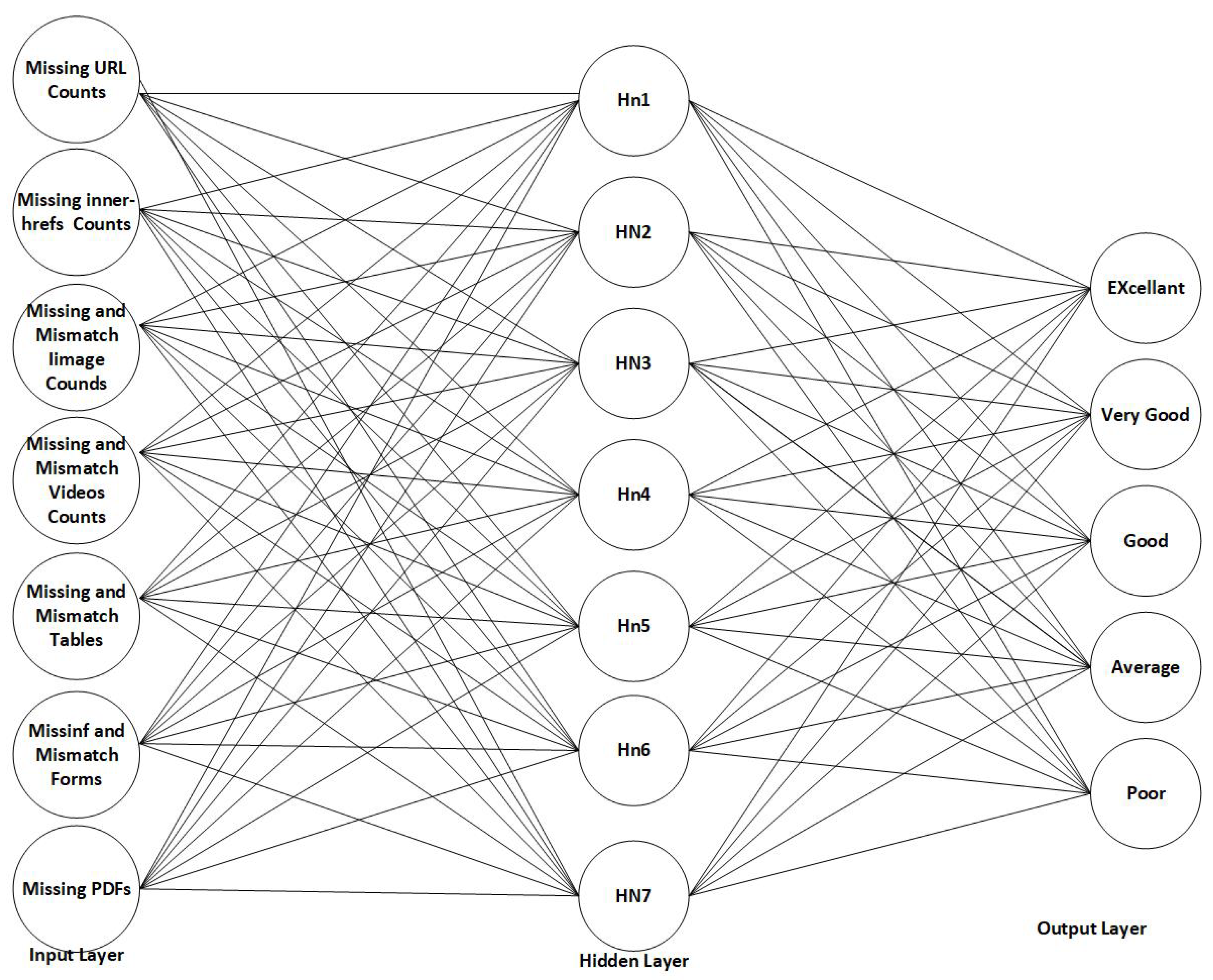
- A multi-layer perceptron-based model is presented to learn the quality of a website based on the feature counts, which can be used to predict the quality of the website given the feature counts computed through a parser model.
2. Related Work
3. Preparing the Example Set
4. Methods and Techniques
4.1. Analysis of Sub-Factors Relating to the “Completeness” Factor
- ⇒ Quality of URL/web pages
- ⇒ Quality of self-referential hrefs
- ⇒ Quality of tables
- ⇒ Quality of forms
- ⇒ Quality of images
- ⇒ Quality of videos
- ⇒ Quality of PDFs
- ⇒ Quality of the website
- Quality of URL/web pages
- Quality of self-referential hrefs
- Quality of tables
- Quality of forms
- Missing and mismatched images
- Missing and mismatched videos
- Missing PDFs
4.2. Total Quality Considering the “Completeness” Factor
4.3. Computing the Counts of Sub-Factors through a Parser
4.4. An Algorithm for Computing Object Counts (Parser Code)
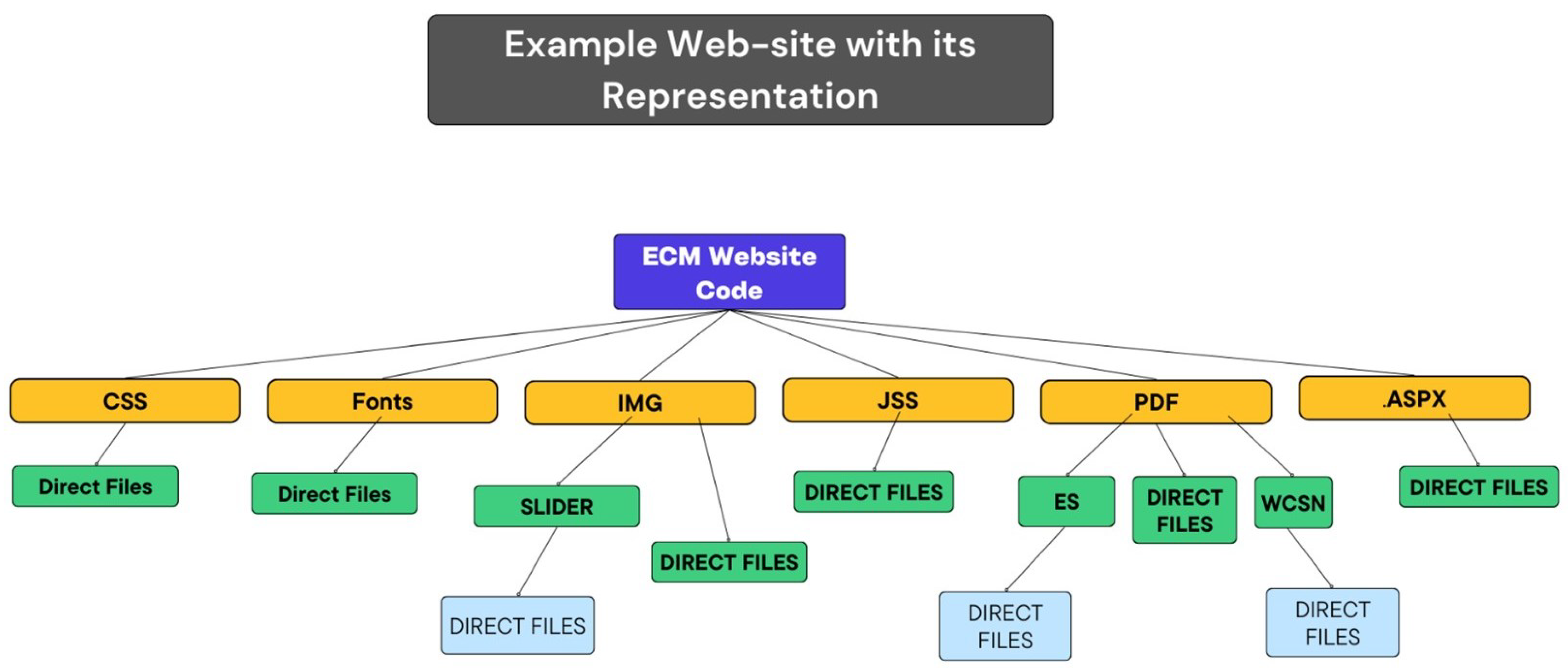
- Input: WEB site structure
- Outputs:
- The list of all files
- Number of Missing WEB Pages
- Number of the total, Existing and Missing Images,
- Number of Existing and Missing videos,
- Number of Existing and Missing PDFs,
- Number of Existing and Missing Fields in the tables,
- Number of the total, Existing and Missing columns in the forms
- Number of Existing and Missing self-references
- Procedure
- Scan through the files in the structure and find the URLS of the Code files.
- For each of the code file
- Check for URLS referred and then enter them into a Webpage-URL-Array
- Check for URLS of PDFS; if it exists, enter them into a PDF URL array.
- Check for URLS of Images; enter them into an Image URL array if it exists.
- Check for URLS of Videos, and if it exists, enter a Video URL array.
- Check for URLS of inner pages; if it exists, enter them into an inner-pages URL array!
- Check for the existence of tables and enter the description of the table as a string into an array.
- Check for the existence of forms and enter the description of the forms as a string into an array
- For each URL in the Array
- Add to total WEB pages.
- Check for the existence of the WEB page and if available add to the Existing WEB pages if not add to Missing WEB pages.
- For each entry in the PDF-Array
- Add to Total-PDFs
- Check for the existence of the PDF file using the URL.
- If available, add to Existing-PDFs, Else add to Missing-PDFs.
- For each entry in the Image-Array
- Add to Total-Images
- Check for the existence of the Image file using the URL.
- If available, add to Existing-Images else, add to Missing Images.
- For each entry in the Video-Array
- Add to Total-Videos
- Check for the existence of the Video file using the URL.
- If available, add to Existing-Videos else, add to Missing- Videos.
- For each entry in the inner-URL-Array
- Add to Total-Inner-URLS
- Check for the Existence of the Inner-URL.
- If available, add to Existing-Inner-URLS, Else add to Missing-Inner-URLs.
- For each entry in Table-Desc-Array
- Fetch the column’s names in each of the entries.
- Fetch the tables having the column names as Table fields.
- If no Table is found, add to missing tables else the table is found.
- If the table is found and the column and field names are the same, add to Matching Tables, Else add to the Mismatch Table.
- For each entry in Field-Desc-Array
- Fetch the Field names in each of the entries.
- Fetch the DB Tables having the field names as column names.
- If no table is found, add to missing forms else, the form-related table is found.
- If the field names and Columns names of the Table match, then add to Matching forms else add to mismatch forms.
- Write all the 7 counts into a CSV file for each WEB site as a separate Example.
- Write all names of the program files to a CSV file.
- Write all the Image URLS with associated properties to a CSV file.
- Write all the Video URLS with associated properties to a CSV file.
- Write all names of the PDF files into a CSV file.
- Write all names of the Tables into CSV files.
- Write all names of the forms into a CSV file.
- Write inner-href into the CSV file.
- Write Referred URLs into a CSV file.
4.5. Designing the Model Parameters
4.6. Platform for Implementing the Model
4.7. Inputting the Data into the Model
5. Results and Discussion
5.1. Sub-Factor Counts for Example Websites
5.2. Training and Testing the MLP Models
5.3. Weight Computations for the NN Model
5.4. Predicting the Quality of the Websites Using the Learnt MLP Model
5.5. Accuracy Comparisons
5.6. Discussion
6. Conclusions
7. Future Scope
Author Contributions
Funding
Data Availability Statement
Conflicts of Interest
References
- Nielsen, J.; Nielsen Norman Group. 10 Usability Heuristics for User Interface Design. 2020. Available online: https://www.nngroup.com/aiiicles/ux-research-cheat-sheet/ (accessed on 3 May 2021).
- Tognazzi, B. First Principles of Interaction Design (Revised and Expanded). 2014. Available online: https://asktog.com/atc/principles-of-interactiondesign/ (accessed on 5 September 2023).
- Shneiderman, B. The Eight Golden Rules of Interface Design; Department of Computer Science, University of Maryland: College Park, MD, USA, 2016. [Google Scholar]
- Law, R.; Qi, S.; Buhalis, D. Progress in tourism management: A review of website evaluation in tourism research. Tour. Manag. 2010, 31, 297–313. [Google Scholar] [CrossRef]
- Shneiderman, B.; Plaisant, C.; Cohen, M.S.; Jacobs, S.; Elmqvist, N.; Diakopoulos, N. Designing the User Interface: Strategies for Effective Human-Computer Interaction, 6th ed.; Pearson Higher Education: Essex, UK, 2016. [Google Scholar]
- Morales-Vargas, A.; Pedraza-Jimenez, R.; Codina, L. Website quality: An analysis of scientific production. Prof. Inf. 2020, 29, e290508. [Google Scholar] [CrossRef]
- Law, R. Evaluation of hotel websites: Progress and future developments. Int. J. Hosp. Manag. 2019, 76, 2–9. [Google Scholar] [CrossRef]
- Ecer, F. A hybrid banking websites quality evaluation model using AHP and COPRAS-G: A Turkey case. Technol. Econ. Dev. Econ. 2014, 20, 758–782. [Google Scholar] [CrossRef]
- Leung, D.; Law, R.; Lee, H.A. A modified model for hotel website functionality evaluation. J. Travel Tour. Mark. 2016, 33, 1268–1285. [Google Scholar] [CrossRef]
- Maia, C.L.B.; FU1iado, E.S. A systematic review about user experience evaluation. In Design, User Experience, and Usability: Design Thinking and Methods; Marcus, A., Ed.; Springer International Publishing: Cham, Switzerland, 2016; pp. 445–455. [Google Scholar]
- Sanabre, C.; Pedraza-Jimenez, R.; Vinyals-Mirabent, S. Double-entry analysis system (DEAS) for comprehensive quality evaluation of websites: Case study in the tourism sector. Prof. Inf. 2020, 29, e290432. [Google Scholar] [CrossRef]
- Bevan, N.; Carter, J.; Harker, S. ISO 9241-11 Revised: What have we learnt about usability since 1998? In Human-Computer Interaction: Design and Evaluation; Kurosu, M., Ed.; Springer International Publishing: Cham, Switzerland, 2015; pp. 143–151. [Google Scholar]
- Rosala, M.; Krause, R. User Experience Careers: Lf’Hat a Career in UX Looks Like Today; Nielsen Norman: Fremont, CA, USA, 2020. [Google Scholar]
- Jainari, M.H.; Baharum, A.; Deris, F.D.; Mat Noor, N.A.; Ismail, R.; Mat Zain, N.H. A standard content for university websites using heuristic evaluation. In Intelligent Computing, Proceedings of the 2022 Computing Conference, London, UK, 14–15 July 2022; Arai, K., Ed.; Lecture Notes in Networks and Systems; Springer: Cham, Switzerland, 2022; Volume 506. [Google Scholar] [CrossRef]
- Nikolic, N.; Grljevic, O.; Kovacevic, A. Aspect-based sentiment analysis of reviews in the domain of higher education. Electron. Libr. 2020, 38, 44–64. [Google Scholar] [CrossRef]
- Morales-Vargas, A.; Pedraza-Jimenez, R.; Codina, L. Website quality evaluation: A model for developing comprehensive assessment instruments based on key quality factors. J. Doc. 2023, 79, 95–114. [Google Scholar] [CrossRef]
- Khawaja, K.F.; Bokhari, R.H. Exploring the Factors Associated with Website Quality. Glob. J. Comput. Sci. Technol. 2010, 10, 37–45. [Google Scholar]
- Sastry, J.K.R.; Lalitha, T.S. A framework for assessing the quality of a WEB SITE, PONTE. Int. J. Sci. Res. 2017, 73. [Google Scholar]
- Mantri, V.K. An Introspection of Web Portals Quality Evaluation. Int. J. Adv. Inf. Sci. Technol. 2016, 5, 33–38. [Google Scholar]
- Moustakis, V.S.; Litos, C.; Dalivigas, A.; Tsironis, L. Website quality assessment criteria. In Proceedings of the Ninth International Conference on Information Quality (ICIQ-04), Cambridge, MA, USA, 5–7 November 2004; pp. 59–73. [Google Scholar]
- Graniü, A.; Mitrovic, I. Usability Evaluation of Web Portals. In Proceedings of the ITI 2008, 30th International Conference on Information Technology Interfaces, Dubrovnik, Croatia, 23–26 June 2008. [Google Scholar]
- Singh, T.; Malik, S.; Sarkar, D. E-Commerce Website Quality Assessment based on Usability. In Proceedings of the 2016 International Conference on Computing, Communication and Automation (ICCCA), Greater Noida, India, 29–30 April 2016; pp. 101–105. [Google Scholar]
- Anusha, R. A Study on Website Quality Models. Int. J. Sci. Res. Publ. 2014, 4, 1–5. [Google Scholar]
- Ricca, F.; Tonella, P. Analysis and Testing of Web Applications. In Proceedings of the 23rd International Conference on Software Engineering, ICSE 2001, Toronto, ON, Canada, 12–19 May 2001. [Google Scholar]
- Alwahaishi, S.; Snášel, V. Assessing the LCC Websites Quality. In Networked Digital Technologies, Proceedings of the Second International Conference, NDT 2010, Prague, Czech Republic, 7–9 July 2010; Zavoral, F., Yaghob, J., Pichappan, P., El-Qawasmeh, E., Eds.; Communications in Computer and Information Science; Springer: Berlin/Heidelberg, Germany, 2010; Volume 87. [Google Scholar] [CrossRef]
- Hasan, L.; Abuelrub, E. Assessing the Quality of Web Sites. Appl. Comput. Inform. 2011, 9, 11–29. [Google Scholar] [CrossRef]
- Singh, K.K.; Kumar, P.; Mathur, J. Implementation of a Model for Websites Quality Evaluation—DU Website. Int. J. Innov. Adv. Comput. Sci. 2014, 3, 27–37. [Google Scholar]
- Chen, L.S.; Chung, P. Identifying Crucial Website Quality Factors of Virtual Communities. In Proceedings of the International Multi-Conference of Engineers and Computer Scientists, IMECS, Hong Kong, China, 17–19 March 2010; Volume 1. [Google Scholar]
- Wah, N.L. An Improved Approach for Web Page Quality Assessment. In Proceedings of the 2011 IEEE Student Conference on Research and Development, Cyberjaya, Malaysia, 19–20 December 2011. [Google Scholar]
- Venkata Raghavarao, Y.; Sasidhar, K.; Sastry, J.K.R.; Chandra Prakash, V. Quantifying quality of WEB sites based on content. Int. J. Eng. Technol. 2018, 7, 138–141. [Google Scholar]
- Sastry, J.K.R.; Sreenidhi, N.; Sasidhar, K. Quantifying quality of websites based on usability. Int. J. Eng. Technol. 2018, 7, 320–322. [Google Scholar] [CrossRef]
- Sai Virajitha, V.; Sastry, J.K.R.; Chandra Prakash, V.; Srija, P.; Varun, M. Structure-based assessment of the quality of WEB sites. Int. J. Eng. Technol. 2018, 7, 980–983. [Google Scholar] [CrossRef][Green Version]
- Sastry, J.K.R.; Prakash, V.C.; Sahana, G.; Manasa, S.T. Evaluating quality of navigation designed for a WEB site. Int. J. Eng. Technol. 2018, 7, 1004–1007. [Google Scholar]
- Kolla, N.P.; Sastry, J.K.R.; Chandra Prakash, V.; Onteru, S.K.; Pinninti, Y.S. Assessing the quality of WEB sites based on Multimedia content. Int. J. Eng. Technol. 2018, 7, 1040–1044. [Google Scholar]
- Babu, J.S.; Kumar, T.R.; Bano, S. Optimizing webpage relevancy using page ranking and content-based ranking. Int. J. Eng. Technol. (UAE) 2018, 7, 1025–1029. [Google Scholar] [CrossRef][Green Version]
- Prasad, K.S.; Sekhar, K.R.; Rajarajeswari, P. An integrated approach towards vulnerability assessment & penetration testing for a web application. Int. J. Eng. Technol. (UAE) 2018, 7, 431–435. [Google Scholar]
- Krishna, M.V.; Kumar, K.K.; Sandiliya, C.H.; Krishna, K.V. A framework for assessing the quality of a website. Int. J. Eng. Technol. (UAE) 2018, 7, 82–85. [Google Scholar] [CrossRef][Green Version]
- Babu, R.B.; Akhil Reddy, A.; Praveen Kumar, G. Analysis on visual design principles of a webpage. Int. J. Eng. Technol. (UAE) 2018, 7, 48–50. [Google Scholar] [CrossRef][Green Version]
- Pawar, S.S.; Prasanth, Y. Multi-Objective Optimization Model for QoS-Enabled Web Service Selection in Service-Based Systems. New Rev. Inf. Netw. 2017, 22, 34–53. [Google Scholar] [CrossRef]
- Bhavani, B.; Sucharita, V.; Satyanarana, K.V.V. Review on techniques and applications involved in web usage mining. Int. J. Appl. Eng. Res. 2017, 12, 15994–15998. [Google Scholar]
- Durga, K.K.; Krishna, V.R. Automatic detection of illegitimate websites with mutual clustering. Int. J. Electr. Comput. Eng. 2016, 6, 995–1001. [Google Scholar]
- Satya, T.Y.; G, P. Harvesting deep web extractions based on hybrid classification procedures. Asian J. Inf. Technol. 2016, 15, 3551–3555. [Google Scholar]
- Jammalamadaka, S.B.; Babu, V.; Trimurthy, A. Implementing dynamically evolvable communication with embedded systems through WEB services. Int. J. Electr. Comput. Eng. 2016, 6, 381–398. [Google Scholar]
- Prasanna, L.; Babu, B.S.; Pratyusha, A.; Anusha, J.L.; Chand, A.R. Profile-based personalized web search using Greedy Algorithms. ARPN J. Eng. Appl. Sci. 2016, 11, 5921–5925. [Google Scholar]
- Boon-itt, S. Quality of health websites and their influence on perceived usefulness, trust and intention to use: An analysis from Thailand. J. Innov. Entrep. 2019, 8, 4. [Google Scholar] [CrossRef]
- Allison, R.; Hayes, C.; McNulty, C.A.; Young, V. A Comprehensive Framework to Evaluate Websites: Literature Review and Development of GoodWeb. JMIR Form. Res. 2019, 3, e14372. [Google Scholar] [CrossRef] [PubMed]
- Barnes, S.; Vidgen, R. WebQual: An Exploration of Website Quality. In Proceedings of the European Conference of Information Systems, Vienna, Austria, 3–5 July 2000; pp. 298–305. [Google Scholar]
- Bhanu, J.; Kamesh, D.B.K.; Sastry, J.K.R. Assessing Completeness of a WEB site from Quality Perspective. Int. J. Electr. Comput. Eng. (IJECE) 2019, 9, 5596–5603. [Google Scholar] [CrossRef]
- Rekik, R.; Kallel, I.; Casillas, J.; Alimi, A.M. Assessing web sites quality: A systematic literature review by text and association rules mining. Int. J. Inf. Manag. 2018, 38, 201–216. [Google Scholar] [CrossRef]
- Lin, H.-F. An application of fuzzy AHP for evaluating course website quality. Comput. Educ. 2010, 54, 877–888. [Google Scholar] [CrossRef]
- Heradio, R.; Cabrerizo, F.J.; Fernández-Amorós, D.; Herrera, M.; Herrera-Viedma, E. A fuzzy linguistic model to evaluate the Quality of Library. Int. J. Inf. Manag. 2013, 33, 642–654. [Google Scholar] [CrossRef]
- Esteban, B.; Tejeda-Lorente, Á.; Porcel, C.; Moral-Muñoz, J.A.; Herrera-Viedma, E. Aiding in the treatment of low back pain by a fuzzy linguistic Web system. In Rough Sets and Current Trends in Computing, Proceedings of the 9th International Conference, RSCTC 2014, Granada and Madrid, Spain, 9–13 July 2014; Lecture Notes in Computer Science (Including Subseries Lecture Notes in Artificial Intelligence and Lecture Notes in Bioinformatics); Springer: Berlin/Heidelberg, Germany, 2014. [Google Scholar]
- Cobos, C.; Mendoza, M.; Manic, M.; León, E.; Herrera-Viedma, E. Clustering of web search results based on an iterative fuzzy C-means algorithm and Bayesian information criterion. In Proceedings of the 2013 Joint IFSA World Congress and NAFIPS Annual Meeting (IFSA/NAFIPS), Edmonton, AB, Canada, 24–28 June 2013; pp. 507–512. [Google Scholar]
- Dhiman, P.; Anjali. Empirical validation of website quality using statistical and machine learning methods. In Proceedings of the 5th International Conference on Confluence 2014: The Next Generation Information Technology Summit, Noida, India, 25–26 September 2014; pp. 286–291. [Google Scholar]
- Liu, H.; Krasnoproshin, V.V. Quality evaluation of E-commerce sites based on adaptive neural fuzzy inference system. In Neural Networks and Artificial Intelligence, Proceedings of the 8th International Conference, ICNNAI 2014, Brest, Belarus, 3–6 June 2014; Communications in Computer and Information Science; Springer: Berlin/Heidelberg, Germany, 2014; pp. 87–97. [Google Scholar]
- Vosecky, J.; Leung, K.W.-T.; Ng, W. Searching for quality microblog posts: Filtering and ranking based on content analysis and implicit links. In Database Systems for Advanced Applications, Proceedings of the 17th International Conference, DASFAA 2012, Busan, Republic of Korea, 15–18 April 2012; Lecture Notes in Computer Science (Including Subseries Lecture Notes in Artificial Intelligence and Lecture Notes in Bioinformatics); Springer: Berlin/Heidelberg, Germany, 2012; pp. 397–413. [Google Scholar]
- Hu, Y.-C. Fuzzy multiple-criteria decision-making in the determination of critical criteria for assessing service quality of travel websites. Expert Syst. Appl. 2009, 36, 6439–6445. [Google Scholar] [CrossRef]
- Kakol, M.; Nielek, R.; Wierzbicki, A. Understanding and predicting Web content credibility using the Content Credibility Corpus. Inf. Process. Manag. 2017, 53, 1043–1061. [Google Scholar] [CrossRef]
- Jayanthi, B.; Krishnakumari, P. An intelligent method to assess webpage quality using extreme learning machine. Int. J. Comput. Sci. Netw. Secur. 2016, 16, 81–85. [Google Scholar]
- Huang, G.-B.; Ding, X.; Zhou, H. Optimization method based extreme learning machine for classification. Neurocomputing 2010, 74, 155–163. [Google Scholar] [CrossRef]
- Huang, G.B.; Zhou, H.; Ding, X.; Zhang, R. Extreme learning machine for regression and multiclass classification. IEEE Trans. Syst. Man Cybern. Part B (Cybern.) 2012, 42, 513–529. [Google Scholar] [CrossRef]

| Number of Missing Objects | Assigned Quality | Quality Grading |
|---|---|---|
| 0 | 1.0 | Excellent |
| 1 | 0.8 | Very Good |
| 2 | 0.6 | Good |
| 3 | 0.4 | Average |
| ≥4 | 0.0 | Poor |
| Missing Counts | 0 | 1 | 2 | 3 | 4 | Quality Value Assigned | |
|---|---|---|---|---|---|---|---|
| Quality Value | 1.0 | 0.8 | 0.6 | 0.40 | 0 | ||
| Missing images | 4 | ✔ | 0.00 | ||||
| Missing videos | 3 | ✔ | 0.60 | ||||
| Missing PDFs | 9 | ✔ | 0.00 | ||||
| Missing columns in tables | 1 | ✔ | 0.80 | ||||
| Missing fields in the forms | 1 | ✔ | 0.80 | ||||
| Missing self-references | 1 | ✔ | 0.80 | ||||
| Missing URLs | 0 | ✔ | 1.00 | ||||
| The total quality value assigned | 4.00 | ||||||
| Average quality value | 0.57 | ||||||
| Quality grade as per the grading table above | Average | ||||||
| Type of Layer | Number of Inputs | Number of Outputs | Type of Activation Function Used | Type of Kernel Initializer |
|---|---|---|---|---|
| Input Layer | 7 | 7 | RELU | Normal |
| Output Layer | 7 | 5 | SIGMOID | Normal |
| Model Parameters | Loss Function | Optimizers | Metrics | |
| Cross Entropy | Adams | Accuracy |
| ID | # Missing URLS | # Missing Images | # Missing Videos | # Missing PDFS | # Missing Tables | # Missing Forms | # Missing Internal Hrefs | Quality of the Website |
|---|---|---|---|---|---|---|---|---|
| 1 | 3 | 4 | 3 | 9 | 1 | 1 | 1 | average |
| 2 | 0 | 1 | 2 | 0 | 1 | 0 | 0 | very good |
| 3 | 1 | 2 | 4 | 1 | 2 | 1 | 1 | good |
| 4 | 0 | 2 | 2 | 1 | 2 | 1 | 2 | very good |
| 5 | 1 | 2 | 3 | 1 | 2 | 1 | 3 | good |
| 6 | 3 | 1 | 2 | 1 | 2 | 1 | 4 | average |
| 7 | 0 | 1 | 1 | 1 | 1 | 1 | 1 | very good |
| 8 | 1 | 2 | 2 | 2 | 2 | 2 | 2 | good |
| 9 | 3 | 3 | 3 | 3 | 3 | 3 | 3 | average |
| 10 | 4 | 4 | 4 | 4 | 4 | 4 | 4 | poor |
| Weight Code | Weight Value | Wight Code | Weight Value |
|---|---|---|---|
| W111 | 0.0005345 | W121 | −0.03049852 |
| W112 | −0.02260396 | W122 | −0.05772249 |
| W113 | 0.10015791 | W123 | 0.0124933 |
| W114 | −0.00957603 | W124 | 0.05205087 |
| W115 | 0.0110722 | W125 | −0.02575279 |
| W116 | −0.07497691 | W126 | 0.06270903 |
| W131 | 0.03905119 | W141 | −0.02733616 |
| W132 | 0.04710016 | W142 | 0.02808586 |
| W133 | −0.01612358 | W143 | −0.03189966 |
| W134 | −0.00248795 | W144 | 0.07678819 |
| W135 | −0.06121466 | W145 | −0.05594458 |
| W136 | −0.0188451 | W146 | −0.04489214 |
| W151 | 0.000643 | W161 | 0.02465009 |
| W152 | 0.0143626 | W162 | 0.02291734 |
| W153 | −0.00590346 | W163 | 0.06510213 |
| W154 | −0.05017151 | W164 | 0.0216038 |
| W155 | 0.00431764 | W165 | 0.02364654 |
| W156 | −0.04996827 | W166 | 0.04817796 |
| W211 | 0.00150367 | W221 | 0.05486471 |
| W212 | −0.02436988 | W222 | −0.0747726 |
| W213 | −0.04478416 | W223 | −0.03751294 |
| W214 | −0.0215895 | W224 | −0.00753696 |
| W215 | −0.01126576 | W225 | −0.16550754 |
| W231 | −0.02882431 | W241 | −0.0697467 |
| W232 | 0.09704491 | W242 | −0.00334867 |
| W233 | 0.00701219 | W243 | 0.00892285 |
| W234 | 0.05021231 | W244 | 0.08749642 |
| W235 | −0.12358224 | W245 | 0.08793346 |
| W251 | −0.0181542 | W261 | −0.06405859 |
| W252 | −0.09880255 | W262 | −0.07070417 |
| W253 | −0.00041602 | W263 | 0.01609092 |
| W254 | 0.02695975 | W264 | 0.00031056 |
| W255 | −0.03195139 | W265 | −0.10547637 |
| ID | # Missing URLS | # Missing Images | # Missing Videos | # Missing PDFs | # Missing Tables | # Missing Forms | # Missing Internal Hrefs | Quality of the Website | Predicted Quality of the Website through the MLP Model |
|---|---|---|---|---|---|---|---|---|---|
| 1 | 3 | 4 | 3 | 9 | 1 | 1 | 1 | average | average |
| 2 | 0 | 1 | 2 | 0 | 1 | 0 | 0 | very good | very good |
| 3 | 1 | 2 | 4 | 1 | 2 | 1 | 1 | good | good |
| 4 | 0 | 2 | 2 | 1 | 2 | 1 | 2 | very good | very good |
| 5 | 1 | 2 | 3 | 1 | 2 | 1 | 3 | good | good |
| 6 | 3 | 1 | 2 | 1 | 2 | 1 | 4 | average | average |
| 7 | 0 | 1 | 1 | 1 | 1 | 1 | 1 | very good | very good |
| 8 | 1 | 2 | 2 | 2 | 2 | 2 | 2 | good | good |
| 9 | 3 | 3 | 3 | 3 | 3 | 3 | 3 | average | average |
| 10 | 4 | 4 | 4 | 4 | 4 | 4 | 4 | poor | poor |
Disclaimer/Publisher’s Note: The statements, opinions and data contained in all publications are solely those of the individual author(s) and contributor(s) and not of MDPI and/or the editor(s). MDPI and/or the editor(s) disclaim responsibility for any injury to people or property resulting from any ideas, methods, instructions or products referred to in the content. |
© 2023 by the authors. Licensee MDPI, Basel, Switzerland. This article is an open access article distributed under the terms and conditions of the Creative Commons Attribution (CC BY) license (https://creativecommons.org/licenses/by/4.0/).
Share and Cite
Biyyapu, V.P.; Jammalamadaka, S.K.R.; Jammalamadaka, S.B.; Chokara, B.; Duvvuri, B.K.K.; Budaraju, R.R. Building an Expert System through Machine Learning for Predicting the Quality of a Website Based on Its Completion. Computers 2023, 12, 181. https://doi.org/10.3390/computers12090181
Biyyapu VP, Jammalamadaka SKR, Jammalamadaka SB, Chokara B, Duvvuri BKK, Budaraju RR. Building an Expert System through Machine Learning for Predicting the Quality of a Website Based on Its Completion. Computers. 2023; 12(9):181. https://doi.org/10.3390/computers12090181
Chicago/Turabian StyleBiyyapu, Vishnu Priya, Sastry Kodanda Rama Jammalamadaka, Sasi Bhanu Jammalamadaka, Bhupati Chokara, Bala Krishna Kamesh Duvvuri, and Raja Rao Budaraju. 2023. "Building an Expert System through Machine Learning for Predicting the Quality of a Website Based on Its Completion" Computers 12, no. 9: 181. https://doi.org/10.3390/computers12090181
APA StyleBiyyapu, V. P., Jammalamadaka, S. K. R., Jammalamadaka, S. B., Chokara, B., Duvvuri, B. K. K., & Budaraju, R. R. (2023). Building an Expert System through Machine Learning for Predicting the Quality of a Website Based on Its Completion. Computers, 12(9), 181. https://doi.org/10.3390/computers12090181

