Does Minimally Invasive Approach Change Criteria of Allocation to Treatment Strategy in Synchronous Colorectal Metastases? An Italian National Registry-Based Analysis

 , , ,
, , ,  ,
,  ,
,  , , ,
, , ,  on behalf of the I Go MILS Collaborative Group
Simple Summary
Abstract
1. Introduction
2. Materials and Methods
2.1. Study Design
2.2. The I Go MILS Registry
2.3. Variables
2.4. Stratification of Centers and Complexity
2.5. Statistics
3. Results
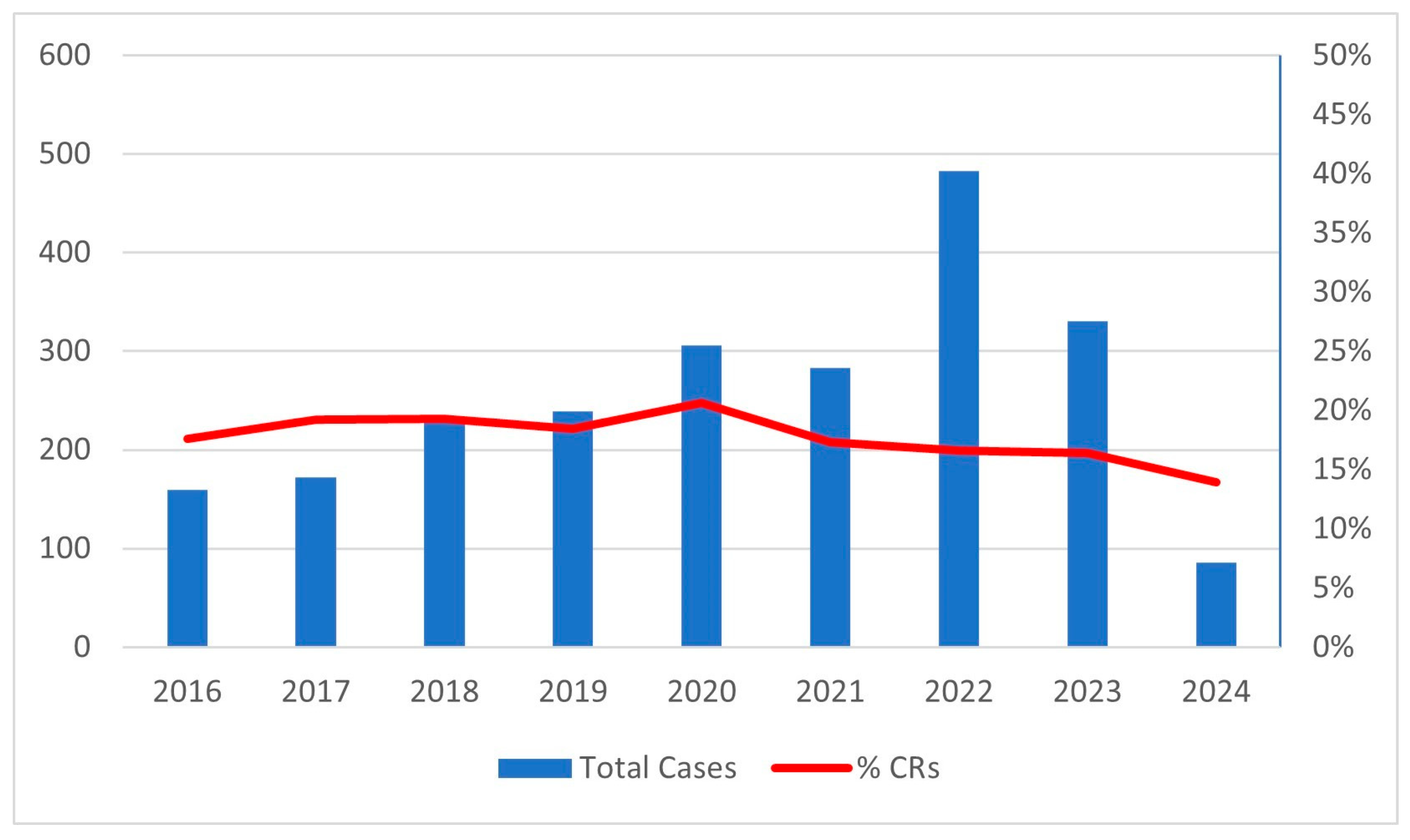
3.1. Time Trend of Enrollments
3.2. Comparison Between CR and NCR Groups Before Matching
3.3. Comparison Between CR and NCR Groups After Matching
4. Discussion
5. Conclusions
Author Contributions
Funding
Informed Consent Statement
Data Availability Statement
Acknowledgments
Conflicts of Interest
Abbreviations
| CRLM | Colorectal Liver Metastases |
| CRs | Combined Resections |
| NCRs | Non-Combined Resections |
| MILR | Minimally Invasive Liver Resection |
| OR | Odds Ratio |
| CI | Confidence Interval |
| CD | Clavien–Dindo classification |
| SSI | Superficial Site Infection |
| RBC | Red Blood Cells |
| BMI | Body Mass Index |
| MI | Minimally Invasive |
References
- Keum, N.N.; Giovannucci, E. Global Burden of Colorectal Cancer: Emerging Trends, Risk Factors and Prevention Strategies. Nat. Rev. Gastroenterol. Hepatol. 2019, 16, 713–732. [Google Scholar] [CrossRef]
- Sung, H.; Ferlay, J.; Siegel, R.L.; Laversanne, M.; Soerjomataram, I.; Jemal, A.; Bray, F. Global Cancer Statistics 2020: GLOBOCAN Estimates of Incidence and Mortality Worldwide for 36 Cancers in 185 Countries. CA Cancer J. Clin. 2021, 71, 209–249. [Google Scholar] [CrossRef]
- Cervantes, A.; Adam, R.; Roselló, S.; Arnold, D.; Normanno, N.; Taïeb, J.; Seligmann, J.; De Baere, T.; Osterlund, P.; Yoshino, T.; et al. Metastatic Colorectal Cancer: ESMO Clinical Practice Guideline for Diagnosis, Treatment and Follow-up. Ann. Oncol. 2023, 34, 10–32. [Google Scholar] [CrossRef]
- Brouquet, A.; Mortenson, M.M.; Vauthey, J.N.; Rodriguez-Bigas, M.A.; Overman, M.J.; Chang, G.J.; Kopetz, S.; Garrett, C.; Curley, S.A.; Abdalla, E.K. Surgical Strategies for Synchronous Colorectal Liver Metastases in 156 Consecutive Patients: Classic, Combined or Reverse Strategy? J. Am. Coll. Surg. 2010, 210, 934–941. [Google Scholar] [CrossRef]
- Boudjema, K.; Locher, C.; Sabbagh, C.; Ortega-Deballon, P.; Heyd, B.; Bachellier, P.; Métairie, S.; Paye, F.; Bourlier, P.; Adam, R.; et al. Simultaneous versus Delayed Resection for Initially Resectable Synchronous Colorectal Cancer Liver Metastases: A Prospective, Open-Label, Randomized, Controlled Trial. Ann. Surg. 2021, 273, 49–56. [Google Scholar] [CrossRef]
- Frühling, P.; Strömberg, C.; Isaksson, B.; Urdzik, J. A Comparison of the Simultaneous, Liver-First, and Colorectal-First Strategies for Surgical Treatment of Synchronous Colorectal Liver Metastases at Two Major Liver-Surgery Institutions in Sweden. HPB 2023, 25, 26–36. [Google Scholar] [CrossRef]
- Radomski, S.N.; Chen, S.Y.; Stem, M.; Done, J.Z.; Efron, J.E.; Safar, B.; Atallah, C. Simultaneous Resection of Colorectal Cancer and Synchronous Colorectal Liver Metastases: A Risk Stratified Analysis of the NSQIP Database. J. Surg. Oncol. 2023, 128, 1095–1105. [Google Scholar] [CrossRef]
- Giuliante, F.; Viganò, L.; De Rose, A.M.; Mirza, D.F.; Lapointe, R.; Kaiser, G.; Barroso, E.; Ferrero, A.; Isoniemi, H.; Lopez-Ben, S.; et al. Liver-First Approach for Synchronous Colorectal Metastases: Analysis of 7360 Patients from the LiverMetSurvey Registry. Ann. Surg. Oncol. 2021, 28, 8198. [Google Scholar] [CrossRef]
- Hernandez Dominguez, O.; Yilmaz, S.; Steele, S.R. Stage IV Colorectal Cancer Management and Treatment. J. Clin. Med. 2023, 12, 2072. [Google Scholar] [CrossRef]
- Emile, S.H.; Horesh, N.; Garoufalia, Z.; Gefen, R.; Zhou, P.; Wexner, S.D. Propensity-Score Matched Outcomes of Resection of Stage IV Primary Colon Cancer with and without Simultaneous Resection of Liver Metastases. Updates Surg. 2024, 76, 845–853. [Google Scholar] [CrossRef]
- Wang, S.H.; Song, L.; Tang, J.Y.; Sun, W.-P.; Li, Z. Safety and Long-Term Prognosis of Simultaneous versus Staged Resection in Synchronous Colorectal Cancer with Liver Metastasis: A Systematic Review and Meta-Analysis. Eur. J. Med. Res. 2022, 27, 297. [Google Scholar] [CrossRef]
- Adam, R.; de Gramont, A.; Figueras, J.; Kokudo, N.; Kunstlinger, F.; Loyer, E.; Poston, G.; Rougier, P.; Rubbia-Brandt, L.; Sobrero, A.; et al. Managing Synchronous Liver Metastases from Colorectal Cancer: A Multidisciplinary International Consensus. Cancer Treat. Rev. 2015, 41, 729–741. [Google Scholar] [CrossRef]
- Mayo, S.C.; Pulitano, C.; Marques, H.; Lamelas, J.; Wolfgang, C.L.; De Saussure, W.; Choti, M.A.; Gindrat, I.; Aldrighetti, L.; Barrosso, E.; et al. Surgical Management of Patients with Synchronous Colorectal Liver Metastasis: A Multicenter International Analysis. J. Am. Coll. Surg. 2013, 216, 707–716; discussion 716. [Google Scholar] [CrossRef]
- Pinto, F.; Di Pangrazio, M.; Martinino, A.; Todeschini, L.; Toti, F.; Cristin, L.; Caimano, M.; Mattia, A.; Bianco, G.; Spoletini, G.; et al. Laparoscopic versus Open Liver Resection for Colorectal Liver Metastasis: An Umbrella Review. Front. Oncol. 2024, 14, 1340430. [Google Scholar] [CrossRef]
- Milazzo, M.; Todeschini, L.; Caimano, M.; Mattia, A.; Cristin, L.; Martinino, A.; Bianco, G.; Spoletini, G.; Giovinazzo, F. Surgical Resection in Colorectal Liver Metastasis: An Umbrella Review. Cancers 2024, 16, 1849. [Google Scholar] [CrossRef]
- Sijberden, J.P.; Zimmitti, G.; Conci, S.; Russolillo, N.; Masetti, M.; Cipriani, F.; Lanari, J.; Görgec, B.; Benedetti Cacciaguerra, A.; Rotellar, F.; et al. Simultaneous Resection of Colorectal Cancer and Synchronous Liver Metastases: What Determines the Risk of Unfavorable Outcomes? An International Multicenter Retrospective Cohort Study. Int. J. Surg. 2023, 109, 244–254. [Google Scholar] [CrossRef] [PubMed]
- Ratti, F.; Serenari, M.; Zanello, M.; Fuks, D.; Rottoli, M.; Masetti, M.; Tribillon, E.; Ravaioli, M.; Elmore, U.; Rosati, R.; et al. Team Strategy Optimization in Combined Resections for Synchronous Colorectal Liver Metastases. A Comparative Study with Bootstrapping Analysis. World J. Surg. 2021, 45, 3424–3435. [Google Scholar] [CrossRef]
- Siriwardena, A.K.; Serrablo, A.; Fretland, Å.A.; Wigmore, S.J.; Ramia-Angel, J.M.; Malik, H.Z.; Stättner, S.; Søreide, K.; Zmora, O.; Meijerink, M.; et al. The Multi-Societal European Consensus on the Terminology, Diagnosis and Management of Patients with Synchronous Colorectal Cancer and Liver Metastases: An E-AHPBA Consensus in Partnership with ESSO, ESCP, ESGAR, and CIRSE. HPB 2023, 25, 985–999. [Google Scholar] [CrossRef] [PubMed]
- Carrion-Alvarez, L.; Primavesi, F.; Søreide, K.; Sochorova, D.; Diaz-Nieto, R.; Dopazo, C.; Serrablo, A.; Edhemovic, I.; Stättner, S. Liver Metastases from Colorectal Cancer: A Joint ESSO–EAHPBA–UEMS Core Curriculum Collaboration. Eur. J. Surg. Oncol. 2025, 51, 109728. [Google Scholar] [CrossRef] [PubMed]
- Reddy, S.K.; Pawlik, T.M.; Zorzi, D.; Gleisner, A.L.; Ribero, D.; Assumpcao, L.; Barbas, A.S.; Abdalla, E.K.; Choti, M.A.; Vauthey, J.N.; et al. Simultaneous Resections of Colorectal Cancer and Synchronous Liver Metastases: A Multi-Institutional Analysis. Ann. Surg. Oncol. 2007, 14, 3481–3491. [Google Scholar] [CrossRef]
- Snyder, R.A.; Hao, S.; Irish, W.; Zervos, E.E.; Tuttle-Newhall, J.E.; Parikh, A.A. Thirty-Day Morbidity after Simultaneous Resection of Colorectal Cancer and Colorectal Liver Metastasis: American College of Surgeons NSQIP Analysis. J. Am. Coll. Surg. 2020, 230, 617–627.e9. [Google Scholar] [CrossRef]
- Gumiero, J.L.; de Oliveira, B.M.S.; de Neto, O.P.A.; Pandini, R.V.; Gerbasi, L.S.; Figueiredo, M.N.; Kruger, J.A.P.; Seid, V.E.; Araujo, S.E.A.; Tustumi, F. Timing of Resection of Synchronous Colorectal Liver Metastasis: A Systematic Review and Meta-Analysis. J. Surg. Oncol. 2022, 126, 175–188. [Google Scholar] [CrossRef]
- Ratti, F.; Fiorentini, G.; Cipriani, F.; Catena, M.; Paganelli, M.; Aldrighetti, L. Laparoscopic vs Open Surgery for Colorectal Liver Metastases. JAMA Surg. 2018, 153, 1028–1035. [Google Scholar] [CrossRef]
- Fretland, A.A.; Dagenborg, V.J.; Bjørnelv, G.M.W.; Kazaryan, A.M.; Kristiansen, R.; Fagerland, M.W.; Hausken, J.; Tønnessen, T.I.; Abildgaard, A.; Barkhatov, L.; et al. Laparoscopic Versus Open Resection for Colorectal Liver Metastases: The OSLO-COMET Randomized Controlled Trial. Ann. Surg. 2018, 267, 199–207. [Google Scholar] [CrossRef]
- Robles-Campos, R.; Lopez-Lopez, V.; Brusadin, R.; Lopez-Conesa, A.; Gil-Vazquez, P.J.; Navarro-Barrios, Á.; Parrilla, P. Open versus Minimally Invasive Liver Surgery for Colorectal Liver Metastases (LapOpHuva): A Prospective Randomized Controlled Trial. Surg. Endosc. 2019, 33, 3926–3936. [Google Scholar] [CrossRef]
- Masetti, M.; Fallani, G.; Ratti, F.; Ferrero, A.; Giuliante, F.; Cillo, U.; Guglielmi, A.; Ettorre, G.M.; Torzilli, G.; Vincenti, L.; et al. Minimally Invasive Treatment of Colorectal Liver Metastases: Does Robotic Surgery Provide Any Technical Advantages over Laparoscopy? A Multicenter Analysis from the IGoMILS (Italian Group of Minimally Invasive Liver Surgery) Registry. Updates Surg. 2022, 74, 535–545. [Google Scholar] [CrossRef] [PubMed]
- Ratti, F.; Cipriani, F.; Fiorentini, G.; Burgio, V.; Ronzoni, M.; Della Corte, A.; Cascinu, S.; De Cobelli, F.; Aldrighetti, L. Evolution of Surgical Treatment of Colorectal Liver Metastases in the Real World: Single Center Experience in 1212 Cases. Cancers 2021, 13, 1178. [Google Scholar] [CrossRef] [PubMed]
- Ratti, F.; Ferrero, A.; Guglielmi, A.; Cillo, U.; Giuliante, F.; Mazzaferro, V.; De Carlis, L.; Ettorre, G.M.; Gruttadauria, S.; Di Benedetto, F.; et al. Ten Years of Italian Mini-Invasiveness: The I Go MILS Registry as a Tool of Dissemination, Characterization and Networking. Updates Surg. 2023, 75, 1457–1469. [Google Scholar] [CrossRef]
- Aldrighetti, L.; Ratti, F.; Cillo, U.; Ferrero, A.; Ettorre, G.M.; Guglielmi, A.; Giuliante, F.; Calise, F. Diffusion, Outcomes and Implementation of Minimally Invasive Liver Surgery: A Snapshot from the I Go MILS (Italian Group of Minimally Invasive Liver Surgery) Registry. Updates Surg. 2017, 69, 271–283. [Google Scholar] [CrossRef] [PubMed]
- Dindo, D.; Demartines, N.; Clavien, P.A. Classification of Surgical Complications: A New Proposal with Evaluation in a Cohort of 6336 Patients and Results of a Survey. Ann. Surg. 2004, 240, 205–213. [Google Scholar] [CrossRef]
- Kawaguchi, Y.; Fuks, D.; Kokudo, N.; Gayet, B. Difficulty of Laparoscopic Liver Resection. Ann. Surg. 2018, 267, 13–17. [Google Scholar] [CrossRef]
- Austin, P.C. An Introduction to Propensity Score Methods for Reducing the Effects of Confounding in Observational Studies. Multivar. Behav. Res. 2011, 46, 399–424. [Google Scholar] [CrossRef]
- Heinz, P.; Wendel-Garcia, P.D.; Held, U. Impact of the Matching Algorithm on the Treatment Effect Estimate: A Neutral Comparison Study. Biom. J. 2024, 66, 2100292. [Google Scholar] [CrossRef] [PubMed]
- Rocca, A.; Cipriani, F.; Belli, G.; Berti, S.; Boggi, U.; Bottino, V.; Cillo, U.; Cescon, M.; Cimino, M.; Corcione, F.; et al. The Italian Consensus on Minimally Invasive Simultaneous Resections for Synchronous Liver Metastasis and Primary Colorectal Cancer: A Delphi Methodology. Updates Surg. 2021, 73, 1247–1265. [Google Scholar] [CrossRef] [PubMed]
- Viganò, L.; Cimino, M.; Aldrighetti, L.; Ferrero, A.; Cillo, U.; Guglielmi, A.; Ettorre, G.M.; Giuliante, F.; Dalla Valle, R.; Mazzaferro, V.; et al. Multicentre Evaluation of Case Volume in Minimally Invasive Hepatectomy. Br. J. Surg. 2020, 107, 443–451. [Google Scholar] [CrossRef]
- Torzilli, G.; Viganò, L.; Giuliante, F.; Pinna, A.D. Liver Surgery in Italy. Criteria to Identify the Hospital Units and the Tertiary Referral Centers Entitled to Perform It. Updates Surg. 2016, 68, 135–142. [Google Scholar] [CrossRef]
- Sijberden, J.P.; Alvarez Escribano, M.S.; Kasai, M.; Ferretti, C.; Cesaro, P.; Bnà, C.; Zaniboni, A.; Siriwardena, A.K.; Tanis, P.J.; Abu Hilal, M. Perioperative Safety and Oncological Efficacy of Simultaneous versus Colorectal and Liver First Two-Staged Resections in Patients with Synchronous Colorectal Liver Metastases: A Systematic Review and Network Meta-Analysis. HPB 2025, 27, 135–149. [Google Scholar] [CrossRef]
- Hata, T.; Motoi, F.; Ishida, M.; Naitoh, T.; Katayose, Y.; Egawa, S.; Unno, M. Effect of Hospital Volume on Surgical Outcomes After Pancreaticoduodenectomy: A Systematic Review and Meta-Analysis. Ann. Surg. 2016, 263, 664–672. [Google Scholar] [CrossRef] [PubMed]
- Di, J.; Lu, X.S.; Sun, M.; Zhao, Z.M.; Zhang, C.D. Hospital Volume-Mortality Association after Esophagectomy for Cancer: A Systematic Review and Meta-Analysis. Int. J. Surg. 2024, 110, 3021–3029. [Google Scholar] [CrossRef]
- Koh, Y.X.; Zhao, Y.; Tan, I.E.H.; Tan, H.L.; Chua, D.W.; Loh, W.L.; Tan, E.K.; Teo, J.Y.; Au, M.K.H.; Goh, B.K.P. The Impact of Hospital Volume on Liver Resection: A Systematic Review and Bayesian Network Meta-Analysis. Surgery 2024, 175, 393–403. [Google Scholar] [CrossRef]
- Luo, Q.; Wang, Y.; Zhang, X. Association between Hospital Volume and Outcomes in Ovarian Cancer: A Systematic Review. Front. Surg. 2025, 12, 1635555. [Google Scholar] [CrossRef] [PubMed]


| Before Matching | After Matching | |||||
|---|---|---|---|---|---|---|
| Combined n = 407 | Not Combined n = 1879 | p-Value | Combined n = 407 | Not Combined n = 822 | p-Value | |
| Age (years) median [25–75%] | 67 [58–75] | 67 [59–75] | 0.527 | 67 [58–75] | 67 [59–75] | 0.942 |
| Sex, male | 238 (58.48%) | 1155 (61.47%) | 0.262 | 238 (58.48%) | 495 (60.22%) | 0.558 |
| BMI (kg/m2) median [25–75%] | 25 [23–28] | 25 [23–28] | 0.465 | 25 [23–28] | 25 [23–28] | 0.709 |
| Portal hypertension | 0 | 11 (0.59%) | 0.231 | 0 | 5 (0.61%) | 0.177 |
| Underlying liver parenchyma | 0.279 | 0.898 | ||||
| Healthy | 318 (78.13%) | 1381 (73.50%) | 318 (78.13%) | 626 (76.16%) | ||
| Steatosis | 82 (20.15%) | 452 (24.06%) | 82 (20.15%) | 178 (21.65%) | ||
| Chronic hepatocellular dysfunction | 5 (1.23%) | 28 (1.49%) | 5 (1.23%) | 13 (1.58%) | ||
| Cirrhosis | 2 (0.49%) | 18 (0.96%) | 2 (0.49%) | 5 (0.61%) | ||
| Diameter of the largest lesion ≥ 3 cm | 124 (30.47%) | 737 (39.22%) | 0.001 | 124 (30.47%) | 260 (31.63%) | 0.679 |
| Liver first | NA | 276 (14.69%) | NA | 122 (14.84%) | ||
| Resection type | <0.001 | 0.005 | ||||
| Wedge resection | 221 (54.30%) | 655 (34.86%) | 221 (54.30%) | 368 (44.77%) | ||
| Anatomical segmentectomy | 72 (17.69%) | 494 (26.29%) | 72 (17.69%) | 187 (22.75%) | ||
| Left lateral sectionectomy | 33 (8.11%) | 170 (9.05%) | 33 (8.11%) | 105 (12.77%) | ||
| Right anterior sectionectomy | 43 (10.57%) | 226 (12.03%) | 43 (10.57%) | 73 (8.88%) | ||
| Right posterior sectionectomy | 2 (0.49%) | 82 (4.36%) | 2 (0.49%) | 20 (2.43%) | ||
| Left hepatectomy | 17 (4.18%) | 100 (5.32%) | 17 (4.18%) | 30 (3.65%) | ||
| Right hepatectomy | 8 (1.97%) | 103 (5.48%) | 8 (1.97%) | 25 (3.04%) | ||
| Right/left trisectionectomy | 4 (0.98%) | 16 (0.85%) | 4 (0.98%) | 5 (0.61%) | ||
| Central hepatectomy | 1 (0.25%) | 9 (0.48%) | 1 (0.25%) | 3 (0.36%) | ||
| ALPPS | 6 (1.47%) | 24 (1.28%) | 6 (1.47%) | 6 (0.73%) | ||
| Technical Complexity | <0.001 | 0.263 | ||||
| Grade I | 254 (62.41%) | 825 (43.91%) | 254 (62.41%) | 473 (57.54%) | ||
| Grade II | 124 (30.47%) | 781 (41.56%) | 124 (30.47%) | 282 (34.31%) | ||
| Grade III | 29 (7.13%) | 273 (14.53%) | 29 (7.13%) | 67 (8.15%) | ||
| Approach | 0.845 | 0.698 | ||||
| Hybrid | 8 (1.97%) | 37 (1.97%) | 8 (1.97%) | 20 (2.43%) | ||
| Laparoscopic | 341 (83.78%) | 1548 (82.38%) | 341 (83.78%) | 666 (81.02%) | ||
| Single-port | 0 | 1 (0.05%) | 0 | 1 (0.12%) | ||
| Robotic | 58 (14.25%) | 293 (15.59%) | 58 (14.25%) | 135 (16.42%) | ||
| High-volume center, >10 cases/year | 240 (58.97%) | 1320 (70.25%) | <0.001 | 240 (58.97%) | 526 (63.99%) | 0.087 |
| Before Matching | After Matching | |||||
|---|---|---|---|---|---|---|
| Combined n = 407 | Not Combined n = 1879 | p-Value | Combined n = 407 | Not Combined n = 822 | p-Value | |
| Operative time (min) median [25–75%] | 385 [290–483] | 300 [210–375] | <0.001 | 385 [290–483] | 270 [180–360] | <0.001 |
| Blood loss (mL) median [25–75%] | 150 [80–300] | 150 [90–300] | 0.265 | 150 [80–300] | 150 [50–260] | 0.346 |
| Pringle maneuver | 202 (49.63%) | 1244 (66.21%) | <0.001 | 202 (49.63%) | 517 (62.90%) | <0.001 |
| Intraoperative RBC transfusion | 35 (8.6%) | 57 (3.03%) | <0.001 | 35 (8.6%) | 22 (2.68%) | <0.001 |
| Conversion to laparotomy | 37 (9.09%) | 180 (9.58%) | 0.76 | 37 (9.09%) | 65 (7.91%) | 0.479 |
| Hemorrhage | 2 (0.49%) | 19 (1.01%) | 2 (0.49%) | 4 (0.49%) | ||
| Adhesions | 2 (0.49%) | 52 (2.77%) | 2 (0.49%) | 18 (2.19%) | ||
| Oncologic reasons | 28 (6.88%) | 94 (5%) | 28 (6.88%) | 38 (4.62%) | ||
| Iatrogenic injury | 0 | 7 (0.37%) | 0 | 1 (0.12%) | ||
| Anesthesiological reasons | 5 (1.23%) | 8 (0.43%) | 5 (1.23%) | 4 (0.49%) | ||
| Postoperative complications | 141 (34.64%) | 337 (17.94%) | <0.001 | 141 (34.64%) | 122 (14.84%) | <0.001 |
| Bleeding | 6 (1.47%) | 21 (1.12%) | 6 (1.47%) | 6 (0.73%) | ||
| Bile leak | 11 (2.70%) | 48 (2.55%) | 11 (2.70%) | 20 (2.43%) | ||
| Intestinal complications | 28 (6.88%) | 26 (1.38%) | 28 (6.88%) | 11 (1.34%) | ||
| SSI | 13 (3.19%) | 15 (0.80%) | 13 (3.19%) | 7 (0.85%) | ||
| Abdominal infections | 33 (8.11%) | 41 (2.18%) | 33 (8.11%) | 15 (1.82%) | ||
| Pneumonia | 15 (3.69%) | 51 (2.71%) | 15 (3.69%) | 16 (1.95%) | ||
| Liver failure | 5 (1.23%) | 39 (2.08%) | 5 (1.23%) | 9 (1.09%) | ||
| Postoperative major complication (CD > 2) | 47 (11.55%) | 101 (5.38%) | <0.001 | 47 (11.55%) | 42 (5.11%) | <0.001 |
| Length of hospital stay (days) median [25–75%] | 7 [6–11] | 5 [4–6] | <0.001 | 7 [6–11] | 5 [4–6] | <0.001 |
| 90-day mortality | 1 (0.25%) | 8 (0.43%) | 1 | 1 (0.25%) | 2 (0.24%) | 1 |
| Variable | OR (95% CI) | Univariate Analysis for Predictors of Postoperative Severe Complications (p-Value) | OR (95% CI) | Multivariate Analysis for Predictors of Postoperative Severe Complications (p-Value) |
|---|---|---|---|---|
| Age, continuous | 1.003 (0.988–1.019) | 0.676 | ||
| Sex, male | 1.20 (0.86–1.68) | 0.282 | ||
| BMI, continuous | 0.99 (0.95–1.03) | 0.646 | ||
| Underlying liver parenchyma | ||||
| Healthy | reference | |||
| Steatosis | 1.06 (0.72–1.57) | 0.752 | ||
| Chronic hepatocellular dysfunction | 1.47 (0.44–4.90) | 0.528 | ||
| Cirrhosis | 0.77 (0.10–5.85) | 0.805 | ||
| Diameter of the largest lesion ≥ 3 cm | 1.01 (0.71–1.42) | 0.964 | ||
| Technical complexity | ||||
| Grade I | reference | reference | ||
| Grade II | 1.10 (0.76–1.60) | 0.615 | 1.11 (0.75–1.64) | 0.614 |
| Grade III | 1.91 (1.21–3.00) | 0.005 | 1.79 (1.08–2.96) | 0.024 |
| Approach | ||||
| Laparoscopic | reference | |||
| Hybrid | 2.40 (0.99–5.78) | 0.052 | ||
| Robotic | 1.34 (0.88–2.08) | 0.172 | ||
| Approach, combined surgery | 2.30 (1.60–3.31) | <0.001 | 2.04 (1.35–3.08) | 0.001 |
| Operative time, continuous | 1.003 (1.002–1.004) | <0.001 | 1.002 (1.000–1.003) | 0.021 |
| Blood loss, continuous | 1.0007 (1.0002–1.0011) | 0.004 | 1.000 (0.999–1.001) | 0.622 |
| Pringle maneuver | 1.19 (0.83–1.69) | 0.343 | ||
| Intraoperative RBC transfusion | 2.04 (1.06–3.92) | 0.033 | 0.89 (0.41–1.91) | 0.759 |
| Conversion to laparotomy | 2.29 (1.47–3.56) | <0.001 | 1.79 (1.11–2.90) | 0.018 |
| High-volume center, >10 cases/year | 0.57 (0.41–0.80) | 0.001 | 0.57 (0.40–0.81) | 0.002 |
| Variable | OR (95% CI) | Univariate Analysis for Predictors of Postoperative Severe Complications (p-Value) | OR (95% CI) | Multivariate Analysis for Predictors of Postoperative Severe Complications (p-Value) |
|---|---|---|---|---|
| Age, continuous | 1.008 (0.989–1.028) | 0.411 | ||
| Sex, male | 0.91 (0.58–1.41) | 0.667 | ||
| BMI, continuous | 1.04 (0.99–1.07) | 0.134 | ||
| Underlying liver parenchyma | ||||
| Healthy | reference | |||
| Steatosis | 1.09 (0.65–1.83) | 0.743 | ||
| Chronic hepatocellular dysfunction | 0.77 (0.10–5.87) | 0.801 | ||
| Cirrhosis | 2.18 (0.26–18.39) | 0.473 | ||
| Diameter of the largest lesion ≥ 3 cm | 1.13 (0.71–1.78) | 0.603 | ||
| Technical Complexity | ||||
| Grade I | reference | reference | ||
| Grade II | 1.36 (0.85–2.19) | 0.203 | 1.27 (0.77–2.10) | 0.347 |
| Grade III | 2.72 (1.42–5.18) | 0.002 | 2.12 (1.05–4.31) | 0.037 |
| Approach | ||||
| Laparoscopic | reference | |||
| Hybrid | 2.34 (0.79–6.93) | 0.126 | ||
| Robotic | 1.44 (0.84–2.49) | 0.187 | ||
| Approach, combined surgery | 2.42 (1.57–3.74) | <0.001 | 1.92 (1.18–3.11) | 0.008 |
| Operative time, continuous | 1.003 (1.002–1.005) | <0.001 | 1.002 (1.001–1.004) | 0.011 |
| Blood loss, continuous | 1.001 (0.999–1.002) | 0.092 | ||
| Pringle maneuver | 1.51 (0.95–2.39) | 0.078 | ||
| Intraoperative RBC transfusion | 2.20 (1.01–4.80) | 0.048 | 0.94 (0.40–2.17) | 0.878 |
| Conversion to laparotomy | 2.69 (1.50–4.82) | 0.001 | 1.92 (1.02–3.63) | 0.044 |
| High-volume center, >10 cases/year | 0.38 (0.25–0.59) | <0.001 | 0.37 (0.24–0.58) | <0.001 |
Disclaimer/Publisher’s Note: The statements, opinions and data contained in all publications are solely those of the individual author(s) and contributor(s) and not of MDPI and/or the editor(s). MDPI and/or the editor(s) disclaim responsibility for any injury to people or property resulting from any ideas, methods, instructions or products referred to in the content. |
© 2026 by the authors. Licensee MDPI, Basel, Switzerland. This article is an open access article distributed under the terms and conditions of the Creative Commons Attribution (CC BY) license.
Share and Cite
Traina, G.; Ferrero, A.; Giuliante, F.; Ruzzenente, A.; Ercolani, G.; Cillo, U.; Mazzaferro, V.; Ettorre, G.M.; Belli, A.; Jovine, E.; et al. Does Minimally Invasive Approach Change Criteria of Allocation to Treatment Strategy in Synchronous Colorectal Metastases? An Italian National Registry-Based Analysis. Cancers 2026, 18, 479. https://doi.org/10.3390/cancers18030479
Traina G, Ferrero A, Giuliante F, Ruzzenente A, Ercolani G, Cillo U, Mazzaferro V, Ettorre GM, Belli A, Jovine E, et al. Does Minimally Invasive Approach Change Criteria of Allocation to Treatment Strategy in Synchronous Colorectal Metastases? An Italian National Registry-Based Analysis. Cancers. 2026; 18(3):479. https://doi.org/10.3390/cancers18030479
Chicago/Turabian StyleTraina, Giorgio, Alessandro Ferrero, Felice Giuliante, Andrea Ruzzenente, Giorgio Ercolani, Umberto Cillo, Vincenzo Mazzaferro, Giuseppe Maria Ettorre, Andrea Belli, Elio Jovine, and et al. 2026. "Does Minimally Invasive Approach Change Criteria of Allocation to Treatment Strategy in Synchronous Colorectal Metastases? An Italian National Registry-Based Analysis" Cancers 18, no. 3: 479. https://doi.org/10.3390/cancers18030479
APA StyleTraina, G., Ferrero, A., Giuliante, F., Ruzzenente, A., Ercolani, G., Cillo, U., Mazzaferro, V., Ettorre, G. M., Belli, A., Jovine, E., Marino, R., Sileri, P., & Ratti, F., on behalf of the I Go MILS Collaborative Group. (2026). Does Minimally Invasive Approach Change Criteria of Allocation to Treatment Strategy in Synchronous Colorectal Metastases? An Italian National Registry-Based Analysis. Cancers, 18(3), 479. https://doi.org/10.3390/cancers18030479