Cancer Prevention Clinical Trials: Advances and Challenges


Simple Summary
Abstract
1. Introduction
2. Challenges in Cancer Prevention Trial Design
2.1. Biological Complexity
2.2. Risk and Benefit Constraints
2.3. Measuring Preventive Efficacy
2.4. Cohort Identification
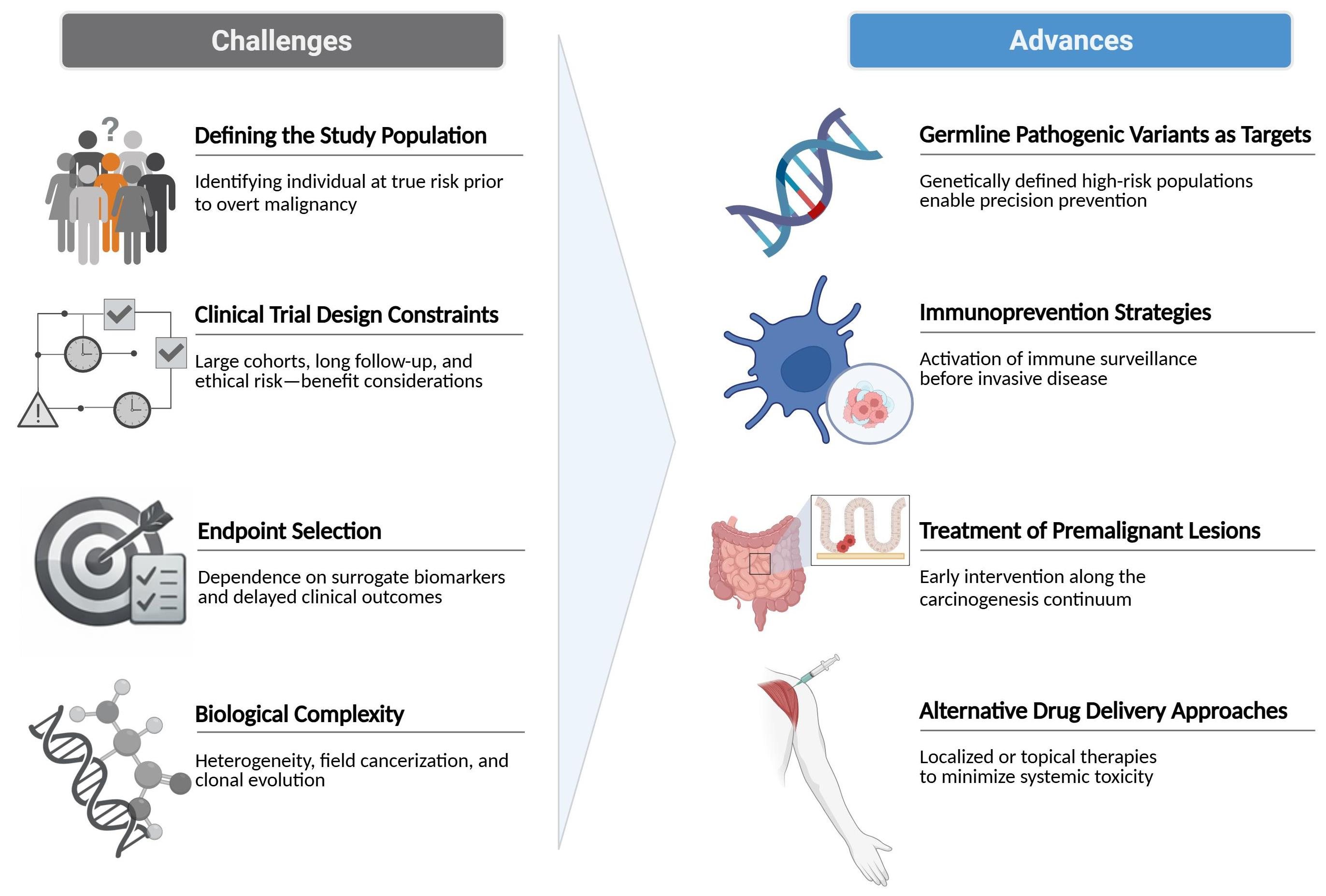
3. Advances in Prevention Trials: Transition to Precision Prevention
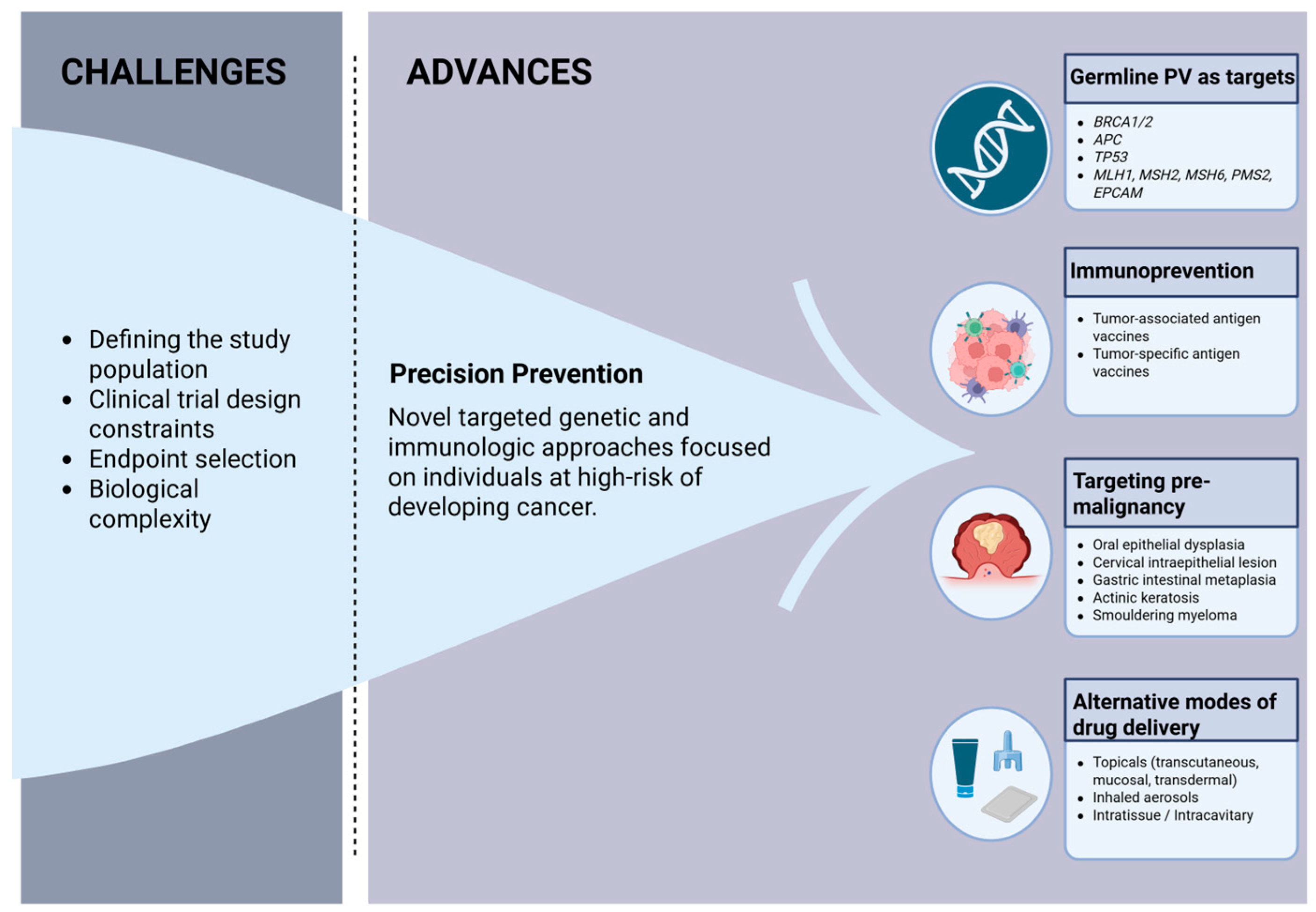
3.1. Overview of Precision Prevention
3.2. Germline Pathogenic Variants as Therapeutic Targets
3.3. Immunoprevention
3.4. Targeting Known Premalignancy
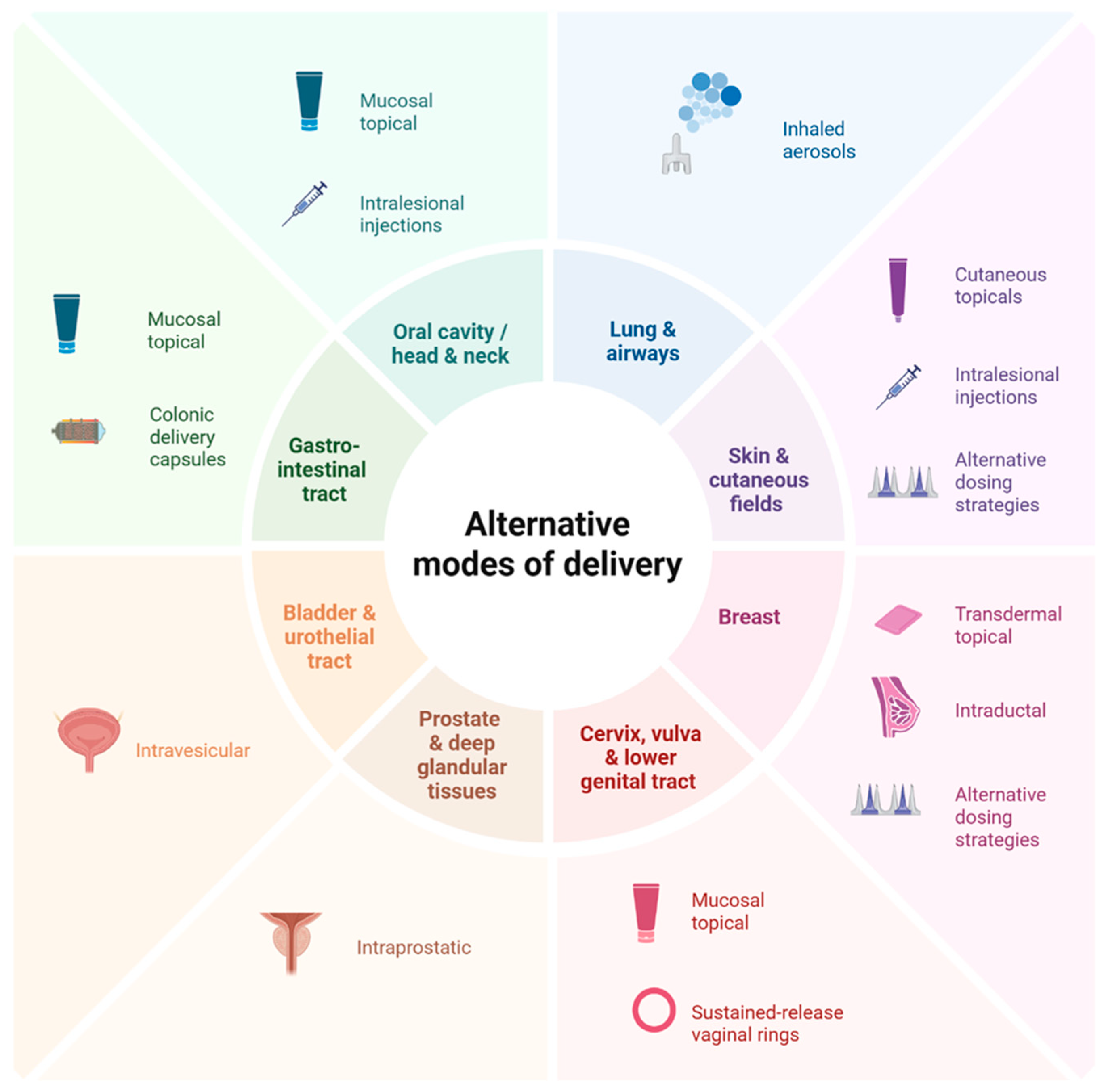
3.5. Alternative Modes of Drug Delivery
- Cutaneous topicals: Cutaneous cancer-prevention topicals leverage direct delivery to the skin for local action. Approved monotherapy topical treatments such as 5-FU and imiquimod, and the investigational combination of calcipotriol with 5-FU, have shown good clearance of actinic keratosis (AK), the precursor lesion to squamous cell carcinoma (SCC) of the skin [167,168]. Indeed, the combination of calcipotriol with 5-FU was noted to significantly lower the risk of SCC development within three years of treatment and produced a robust T-cell response [168], prompting investigation of its use in high-risk groups with AK, such as transplant recipients (NCT05699603) [169].
- Transdermal topicals: Transdermal topicals utilize the skin for systemic or loco-regional delivery of a drug, bypassing hepatic first-pass metabolism [170]. The transdermal tamoxifen metabolite 4-hydroxytamoxifen, delivered in gel form, was noted to have fewer systemic symptoms than oral tamoxifen, including reduced coagulation parameters, in patients with estrogen receptor-positive ductal carcinoma in situ of the breast, but has had mixed results on efficacy. One early randomized controlled trial noted that the gel matched the antiproliferative effect of oral tamoxifen [171], although this was not confirmed in a larger randomized trial by Khan et al., who suggested that future trials enhance metabolite delivery or use a more potent analog to improve response [172].
- Mucosal topicals: Mucosal topicals have been studied across various anatomical locations, including the cervix [164,171,173,174], vagina [175,176], vulva [177,178], anus [179], oral cavity [180,181], and the gastrointestinal tract. Of these, agents targeting vulvar intraepithelial neoplasia (VIN) and cervical intraepithelial neoplasia (CIN), precursors to vulvar and cervical carcinoma, respectively, have shown the most promise. For instance, imiquimod has been associated with high durable response rates for VIN [182] and has been effective at treating high-grade CIN [183]. Though not superior to surgical resection, imiquimod is estimated to prevent surgery in at least 40% of high-grade CIN cases and may represent a non-surgical option that mitigates the toxicities associated with surgery [183].
4. Conclusions
Author Contributions
Funding
Data Availability Statement
Acknowledgments
Conflicts of Interest
Abbreviations
| AK | Actinic keratosis |
| AMPK | 5′ adenosine monophosphate-activated protein kinase |
| CIN | Cervical intraepithelial neoplasia |
| COX | Cyclooxygenase |
| CSC | Cancer stem cell |
| CT | Computed tomography |
| ER | Estrogen receptor |
| FAP | Familial adenomatous polyposis |
| 5-FU | 5-Fluorouracil |
| HBOC | Hereditary breast and ovarian cancer |
| MDSC MRI | Myeloid-derived suppressor cells Magnetic Resonance Imaging |
| OXPHOS | Oxidative phosphorylation |
| PARPi | Poly (ADP-ribose) Polymerase (PARP) inhibitor |
| PR | Progesterone receptor |
| PV | Pathogenic variant |
| RANK | Receptor Activator of Nuclear Factor Kappa-B |
| RANKL | Receptor Activator of Nuclear Factor Kappa-B Ligand |
| SCC | Squamous cell carcinoma |
| TAA | Tumor-associated antigen |
| TSA | Tumor-specific antigen |
| VIN | vulvar intraepithelial neoplasia |
References
- Bray, F.; Laversanne, M.; Sung, H.; Ferlay, J.; Siegel, R.L.; Soerjomataram, I.; Jemal, A. Global cancer statistics 2022: GLOBOCAN estimates of incidence and mortality worldwide for 36 cancers in 185 countries. CA Cancer J. Clin. 2024, 74, 229–263. [Google Scholar] [CrossRef]
- Rebbeck, T.R.; Burns-White, K.; Chan, A.T.; Emmons, K.; Freedman, M.; Hunter, D.J.; Kraft, P.; Laden, F.; Mucci, L.; Parmigiani, G.; et al. Precision Prevention and Early Detection of Cancer: Fundamental Principles. Cancer Discov. 2018, 8, 803–811. [Google Scholar] [CrossRef] [PubMed]
- Dakubo, G.D.; Jakupciak, J.P.; Birch-Machin, M.A.; Parr, R.L. Clinical implications and utility of field cancerization. Cancer Cell Int. 2007, 7, 2. [Google Scholar] [CrossRef] [PubMed]
- De Bruin, E.C.; McGranahan, N.; Mitter, R.; Salm, M.; Wedge, D.C.; Yates, L.; Jamal-Hanjani, M.; Shafi, S.; Murugaesu, N.; Rowan, A.J.; et al. Spatial and temporal diversity in genomic instability processes defines lung cancer evolution. Science 2014, 346, 251–256. [Google Scholar] [CrossRef] [PubMed]
- Han, S.; Bommireddy, R.; Kim, P.; Selvaraj, P.; Shin, D.M. Chemoprevention of Head and Neck Cancer: A Review of Current Approaches and Future Perspectives. Cancer Prev. Res. 2024, 17, 443–455. [Google Scholar] [CrossRef]
- Willenbrink, T.J.; Ruiz, E.S.; Cornejo, C.M.; Schmults, C.D.; Arron, S.T.; Jambusaria-Pahlajani, A. Field cancerization: Definition, epidemiology, risk factors, and outcomes. J. Am. Acad. Dermatol. 2020, 83, 709–717. [Google Scholar] [CrossRef]
- Lomakin, A.; Svedlund, J.; Strell, C.; Gataric, M.; Shmatko, A.; Rukhovich, G.; Park, J.S.; Ju, Y.S.; Dentro, S.; Kleshchevnikov, V.; et al. Spatial genomics maps the structure, nature and evolution of cancer clones. Nature 2022, 611, 594–602. [Google Scholar] [CrossRef]
- Tang, T.-Y.; Colbert Maresso, K.; Ngeow, J.; Vilar, E.; Yap, T.A. Germline Mutations as Cancer Drug Targets. Cancer Discov. 2025, 15, 2213–2234. [Google Scholar] [CrossRef]
- Baron, J.A.; Sandler, R.S.; Bresalier, R.S.; Quan, H.; Riddell, R.; Lanas, A.; Bolognese, J.A.; Oxenius, B.; Horgan, K.; Loftus, S.; et al. A Randomized Trial of Rofecoxib for the Chemoprevention of Colorectal Adenomas. Gastroenterology 2006, 131, 1674–1682. [Google Scholar] [CrossRef]
- Bertagnolli, M.M.; Eagle, C.J.; Zauber, A.G.; Redston, M.; Solomon, S.D.; Kim, K.; Tang, J.; Rosenstein, R.B.; Wittes, J.; Corle, D.; et al. Celecoxib for the Prevention of Sporadic Colorectal Adenomas. N. Engl. J. Med. 2006, 355, 873–884. [Google Scholar] [CrossRef]
- Bresalier, R.S.; Sandler, R.S.; Quan, H.; Bolognese, J.A.; Oxenius, B.; Horgan, K.; Lines, C.; Riddell, R.; Morton, D.; Lanas, A.; et al. Cardiovascular Events Associated with Rofecoxib in a Colorectal Adenoma Chemoprevention Trial. N. Engl. J. Med. 2005, 352, 1092–1102. [Google Scholar] [CrossRef] [PubMed]
- Singh, D. Merck withdraws arthritis drug worldwide. BMJ 2004, 329, 816. [Google Scholar] [CrossRef] [PubMed][Green Version]
- Thompson, I.M.; Goodman, P.J.; Tangen, C.M.; Lucia, M.S.; Miller, G.J.; Ford, L.G.; Lieber, M.M.; Cespedes, R.D.; Atkins, J.N.; Lippman, S.M.; et al. The Influence of Finasteride on the Development of Prostate Cancer. N. Engl. J. Med. 2003, 349, 215–224. [Google Scholar] [CrossRef] [PubMed]
- Fisher, B.; Costantino, J.P.; Wickerham, D.L.; Redmond, C.K.; Kavanah, M.; Cronin, W.M.; Vogel, V.; Robidoux, A.; Dimitrov, N.; Atkins, J.; et al. Tamoxifen for Prevention of Breast Cancer: Report of the National Surgical Adjuvant Breast and Bowel Project P-1 Study. JNCI J. Natl. Cancer Inst. 1998, 90, 1371–1388. [Google Scholar] [CrossRef]
- Waters, E.A.; Cronin, K.A.; Graubard, B.I.; Han, P.K.; Freedman, A.N. Prevalence of Tamoxifen Use for Breast Cancer Chemoprevention Among U.S. Women. Cancer Epidemiol. Biomarkers Prev. 2010, 19, 443–446. [Google Scholar] [CrossRef]
- Szabo, E. Selecting targets for cancer prevention: Where do we go from here? Nat. Rev. Cancer 2006, 6, 867–874. [Google Scholar] [CrossRef]
- Freedman, A.N.; Yu, B.; Gail, M.H.; Costantino, J.P.; Graubard, B.I.; Vogel, V.G.; Anderson, G.L.; McCaskill-Stevens, W. Benefit/Risk Assessment for Breast Cancer Chemoprevention with Raloxifene or Tamoxifen for Women Age 50 Years or Older. J. Clin. Oncol. 2011, 29, 2327–2333. [Google Scholar] [CrossRef]
- Basch, E.; Reeve, B.B.; Mitchell, S.A.; Clauser, S.B.; Minasian, L.M.; Dueck, A.C.; Mendoza, T.R.; Hay, J.; Atkinson, T.M.; Abernethy, A.P.; et al. Development of the National Cancer Institute’s Patient-Reported Outcomes Version of the Common Terminology Criteria for Adverse Events (PRO-CTCAE). JNCI J. Natl. Cancer Inst. 2014, 106, dju244. [Google Scholar] [CrossRef]
- Smith, S.G.; Sestak, I.; Howell, A.; Forbes, J.; Cuzick, J. Participant-Reported Symptoms and Their Effect on Long-Term Adherence in the International Breast Cancer Intervention Study I (IBIS I). J. Clin. Oncol. 2017, 35, 2666–2673. [Google Scholar] [CrossRef]
- Atkinson, T.M.; Ryan, S.J.; Bennett, A.V.; Stover, A.M.; Saracino, R.M.; Rogak, L.J.; Jewell, S.T.; Matsoukas, K.; Li, Y.; Basch, E. The association between clinician-based common terminology criteria for adverse events (CTCAE) and patient-reported outcomes (PRO): A systematic review. Support. Care Cancer 2016, 24, 3669–3676. [Google Scholar] [CrossRef]
- Chlebowski, R.T.; Kim, J.; Haque, R. Adherence to Endocrine Therapy in Breast Cancer Adjuvant and Prevention Settings. Cancer Prev. Res. 2014, 7, 378–387. [Google Scholar] [CrossRef] [PubMed]
- Mitchell, S.A.; Kluetz, P.G.; Chingos, D.T.; Basch, E.M. Patient-Reported Outcomes in Cancer Clinical Trials: Measuring Symptomatic Adverse Events with the National Cancer Institute’s Patient-Reported Outcomes Version of the Common Terminology Criteria for Adverse Events (PRO-CTCAE). Am. Soc. Clin. Oncol. Educ. Book 2016, 35, 67–73. [Google Scholar] [CrossRef]
- Enserro, D.M.; Gunn, H.J.; Elsaid, M.I.; Duan, F.; Pugh, S.L. Challenges to and considerations of designing cancer prevention trials. JNCI Monogr. 2025, 2025, 49–55. [Google Scholar] [CrossRef] [PubMed]
- Ren, J.; Yan, G.; Yang, L.; Kong, L.; Guan, Y.; Sun, H.; Liu, C.; Liu, L.; Han, Y.; Wang, X. Cancer chemoprevention: Signaling pathways and strategic approaches. Signal Transduct. Target. Ther. 2025, 10, 113. [Google Scholar] [CrossRef]
- Schatzkin, A.; Gail, M. The promise and peril of surrogate end points in cancer research. Nat. Rev. Cancer 2002, 2, 19–27. [Google Scholar] [CrossRef]
- Szabo, E. Assessing efficacy in early-phase cancer prevention trials: The case of oral premalignancy. Cancer Prev. Res. 2008, 1, 312–315. [Google Scholar] [CrossRef][Green Version]
- Webb, A.B.; Berg, C.D.; Castle, P.E.; Crosby, D.; Etzioni, R.; Kessler, L.G.; Menon, U.; Parmar, M.; Steele, R.J.C.; Sasieni, P.D. Considerations for using potential surrogate endpoints in cancer screening trials. Lancet Oncol. 2024, 25, e183–e192. [Google Scholar] [CrossRef]
- Palma, V.D.M.; Koerich Laureano, N.; Frank, L.A.; Rados, P.V.; Visioli, F. Chemoprevention in oral leukoplakia: Challenges and current landscape. Front. Oral Health 2023, 4, 1191347. [Google Scholar] [CrossRef]
- Dixon-Zegeye, M.; Shaw, R.; Collins, L.; Perez-Smith, K.; Ooms, A.; Qiao, M.; Pantziarka, P.; Izatt, L.; Tischkowitz, M.; Harrison, R.E.; et al. Cancer Precision-Prevention trial of Metformin in adults with Li Fraumeni syndrome (MILI) undergoing yearly MRI surveillance: A randomised controlled trial protocol. Trials 2024, 25, 103. [Google Scholar] [CrossRef]
- Manrai, A.K.; Funke, B.H.; Rehm, H.L.; Olesen, M.S.; Maron, B.A.; Szolovits, P.; Margulies, D.M.; Loscalzo, J.; Kohane, I.S. Genetic Misdiagnoses and the Potential for Health Disparities. N. Engl. J. Med. 2016, 375, 655–665. [Google Scholar] [CrossRef]
- Szabo, E. Primer: First do no harm—When is it appropriate to plan a cancer prevention clinical trial? Nat. Clin. Pract. Oncol. 2008, 5, 348–356. [Google Scholar] [CrossRef] [PubMed]
- Roberts, M.C.; Dotson, W.D.; DeVore, C.S.; Bednar, E.M.; Bowen, D.J.; Ganiats, T.G.; Green, R.F.; Hurst, G.M.; Philp, A.R.; Ricker, C.N.; et al. Delivery Of Cascade Screening For Hereditary Conditions: A Scoping Review Of The Literature. Health Aff. 2018, 37, 801–808. [Google Scholar] [CrossRef] [PubMed]
- Cuzick, J.; Sestak, I.; Forbes, J.F.; Dowsett, M.; Knox, J.; Cawthorn, S.; Saunders, C.; Roche, N.; Mansel, R.E.; Von Minckwitz, G.; et al. Anastrozole for prevention of breast cancer in high-risk postmenopausal women (IBIS-II): An international, double-blind, randomised placebo-controlled trial. Lancet 2014, 383, 1041–1048. [Google Scholar] [CrossRef] [PubMed]
- Goss, P.E.; Ingle, J.N.; Alés-Martínez, J.E.; Cheung, A.M.; Chlebowski, R.T.; Wactawski-Wende, J.; McTiernan, A.; Robbins, J.; Johnson, K.C.; Martin, L.W.; et al. Exemestane for Breast-Cancer Prevention in Postmenopausal Women. N. Engl. J. Med. 2011, 364, 2381–2391. [Google Scholar] [CrossRef]
- August, G.J.; Gewirtz, A. Moving Toward a Precision-Based, Personalized Framework for Prevention Science: Introduction to the Special Issue. Prev. Sci. 2019, 20, 1–9. [Google Scholar] [CrossRef]
- Stanton, S.E.; Castle, P.E.; Finn, O.J.; Sei, S.; Emens, L.A. Advances and challenges in cancer immunoprevention and immune interception. J. Immunother. Cancer 2024, 12, e007815. [Google Scholar] [CrossRef]
- Omenn, G.S. Chemoprevention of Lung Cancer Is Proving Difficult and Frustrating, Requiring New Approaches. J. Natl. Cancer Inst. 2000, 92, 959–960. [Google Scholar] [CrossRef]
- Omenn, G.S.; Goodman, G.E.; Thornquist, M.D.; Balmes, J.; Cullen, M.R.; Glass, A.; Keogh, J.P.; Meyskens, F.L.; Valanis, B.; Williams, J.H.; et al. Risk factors for lung cancer and for intervention effects in CARET, the Beta-Carotene and Retinol Efficacy Trial. J. Natl. Cancer Inst. 1996, 88, 1550–1559. [Google Scholar] [CrossRef]
- The ATBC cancer prevention study group. The alpha-tocopherol, beta-carotene lung cancer prevention study: Design, methods, participant characteristics, and compliance. Ann. Epidemiol. 1994, 4, 1–10. [Google Scholar] [CrossRef]
- Blagden, S.P.; Dodd, K.W.; Brown, K.; Szabo, E. Precision Prevention Studies: A Targeted Approach to Cancer Prevention. Cancer Prev. Res. 2025, 18, 499–507. [Google Scholar] [CrossRef]
- Sanchez, P.; Van Dyke, A.L.; Petkov, V.I.; Yuan, Y.; Bonds, S.; Valenzuela, C.; Tuan, A.W.; Moravec, R.; Altekruse, S.F.; Singhi, A.D.; et al. NCI SEER-Linked Virtual Tissue Repository Pilot. J. Natl. Cancer Inst. Monogr. 2024, 2024, 180–190. [Google Scholar] [CrossRef] [PubMed]
- Rahman, N. Realizing the promise of cancer predisposition genes. Nature 2014, 505, 302–308. [Google Scholar] [CrossRef] [PubMed]
- Bryant, H.E.; Schultz, N.; Thomas, H.D.; Parker, K.M.; Flower, D.; Lopez, E.; Kyle, S.; Meuth, M.; Curtin, N.J.; Helleday, T. Specific killing of BRCA2-deficient tumours with inhibitors of poly(ADP-ribose) polymerase. Nature 2005, 434, 913–917. [Google Scholar] [CrossRef] [PubMed]
- Dziadkowiec, K.N.; Gąsiorowska, E.; Nowak-Markwitz, E.; Jankowska, A. PARP inhibitors: Review of mechanisms of action and BRCA1/2 mutation targeting. Prz. Menopauzalny Menopause Rev. 2016, 15, 215–219. [Google Scholar] [CrossRef]
- Helleday, T. The underlying mechanism for the PARP and BRCA synthetic lethality: Clearing up the misunderstandings. Mol. Oncol. 2011, 5, 387–393. [Google Scholar] [CrossRef]
- Fong, P.C.; Boss, D.S.; Yap, T.A.; Tutt, A.; Wu, P.; Mergui-Roelvink, M.; Mortimer, P.; Swaisland, H.; Lau, A.; O’Connor, M.J.; et al. Inhibition of Poly(ADP-Ribose) Polymerase in Tumors from BRCA Mutation Carriers. N. Engl. J. Med. 2009, 361, 123–134. [Google Scholar] [CrossRef]
- Coleman, R.L.; Oza, A.M.; Lorusso, D.; Aghajanian, C.; Oaknin, A.; Dean, A.; Colombo, N.; Weberpals, J.I.; Clamp, A.; Scambia, G.; et al. Rucaparib maintenance treatment for recurrent ovarian carcinoma after response to platinum therapy (ARIEL3): A randomised, double-blind, placebo-controlled, phase 3 trial. Lancet 2017, 390, 1949–1961. [Google Scholar] [CrossRef]
- Ledermann, J.; Harter, P.; Gourley, C.; Friedlander, M.; Vergote, I.; Rustin, G.; Scott, C.; Meier, W.; Shapira-Frommer, R.; Safra, T.; et al. Olaparib Maintenance Therapy in Platinum-Sensitive Relapsed Ovarian Cancer. N. Engl. J. Med. 2012, 366, 1382–1392. [Google Scholar] [CrossRef]
- Moore, K.; Colombo, N.; Scambia, G.; Kim, B.-G.; Oaknin, A.; Friedlander, M.; Lisyanskaya, A.; Floquet, A.; Leary, A.; Sonke, G.S.; et al. Maintenance Olaparib in Patients with Newly Diagnosed Advanced Ovarian Cancer. N. Engl. J. Med. 2018, 379, 2495–2505. [Google Scholar] [CrossRef]
- Litton, J.K.; Rugo, H.S.; Ettl, J.; Hurvitz, S.A.; Gonçalves, A.; Lee, K.-H.; Fehrenbacher, L.; Yerushalmi, R.; Mina, L.A.; Martin, M.; et al. Talazoparib in Patients with Advanced Breast Cancer and a Germline BRCA Mutation. N. Engl. J. Med. 2018, 379, 753–763. [Google Scholar] [CrossRef]
- Robson, M.; Im, S.-A.; Senkus, E.; Xu, B.; Domchek, S.M.; Masuda, N.; Delaloge, S.; Li, W.; Tung, N.; Armstrong, A.; et al. Olaparib for Metastatic Breast Cancer in Patients with a Germline BRCA Mutation. N. Engl. J. Med. 2017, 377, 523–533. [Google Scholar] [CrossRef] [PubMed]
- Tutt, A.N.J.; Garber, J.E.; Kaufman, B.; Viale, G.; Fumagalli, D.; Rastogi, P.; Gelber, R.D.; De Azambuja, E.; Fielding, A.; Balmaña, J.; et al. Adjuvant Olaparib for Patients with BRCA1—Or BRCA2 -Mutated Breast Cancer. N. Engl. J. Med. 2021, 384, 2394–2405. [Google Scholar] [CrossRef] [PubMed]
- Geyer, C.E.; Garber, J.E.; Gelber, R.D.; Yothers, G.; Taboada, M.; Ross, L.; Rastogi, P.; Cui, K.; Arahmani, A.; Aktan, G.; et al. Overall survival in the OlympiA phase III trial of adjuvant olaparib in patients with germline pathogenic variants in BRCA1/2 and high-risk, early breast cancer. Ann. Oncol. 2022, 33, 1250–1268. [Google Scholar] [CrossRef] [PubMed]
- To, C.; Kim, E.-H.; Royce, D.B.; Williams, C.R.; Collins, R.M.; Risingsong, R.; Sporn, M.B.; Liby, K.T. The PARP inhibitors, veliparib and olaparib, are effective chemopreventive agents for delaying mammary tumor development in BRCA1-deficient mice. Cancer Prev. Res. 2014, 7, 698–707. [Google Scholar] [CrossRef]
- Yap, T.A.; Im, S.-A.; Schram, A.M.; Sharp, A.; Balmana, J.; Baird, R.D.; Brown, J.S.; Schwaederle, M.; Pilling, E.A.; Moorthy, G.; et al. Abstract CT007: PETRA: First in class, first in human trial of the next generation PARP1-selective inhibitor AZD5305 in patients (pts) with BRCA1/2, PALB2 or RAD51C/D mutations. Cancer Res. 2022, 82, CT007. [Google Scholar] [CrossRef]
- Pilié, P.G.; Gay, C.M.; Byers, L.A.; O’Connor, M.J.; Yap, T.A. PARP Inhibitors: Extending Benefit Beyond BRCA-Mutant Cancers. Clin. Cancer Res. 2019, 25, 3759–3771. [Google Scholar] [CrossRef]
- Evans, D.G.; Shenton, A.; Woodward, E.; Lalloo, F.; Howell, A.; Maher, E.R. Penetrance estimates for BRCA1 and BRCA2 based on genetic testing in a Clinical Cancer Genetics service setting: Risks of breast/ovarian cancer quoted should reflect the cancer burden in the family. BMC Cancer 2008, 8, 155. [Google Scholar] [CrossRef]
- Colombo, N.; Moore, K.; Scambia, G.; Oaknin, A.; Friedlander, M.; Lisyanskaya, A.; Floquet, A.; Leary, A.; Sonke, G.S.; Gourley, C.; et al. Tolerability of maintenance olaparib in newly diagnosed patients with advanced ovarian cancer and a BRCA mutation in the randomized phase III SOLO1 trial. Gynecol. Oncol. 2021, 163, 41–49. [Google Scholar] [CrossRef]
- Bhulani, N.; Wood, M.; Tsai, J.; Bedrosian, I.; Hopkins, J.O.; Brunet, J.; Michaelson-Cohen, R.; Schmutzler, R.K.; Evans, G.D.; Gnant, M.; et al. A phase 3 study to determine the breast cancer risk reducing effect of denosumab in women carrying a germline BRCA1 mutation (BRCA-P Study). J. Clin. Oncol. 2022, 40, TPS10616. [Google Scholar] [CrossRef]
- Sigl, V.; Owusu-Boaitey, K.; Joshi, P.A.; Kavirayani, A.; Wirnsberger, G.; Novatchkova, M.; Kozieradzki, I.; Schramek, D.; Edokobi, N.; Hersl, J.; et al. RANKL/RANK control Brca1 mutation-driven mammary tumors. Cell Res. 2016, 26, 761–774. [Google Scholar] [CrossRef]
- Nolan, E.; Vaillant, F.; Branstetter, D.; Pal, B.; Giner, G.; Whitehead, L.; Lok, S.W.; Mann, G.B.; Kathleen Cuningham Foundation Consortium for Research into Familial Breast Cancer (kConFab); Rohrbach, K.; et al. RANK ligand as a potential target for breast cancer prevention in BRCA1-mutation carriers. Nat. Med. 2016, 22, 933–939. [Google Scholar] [CrossRef]
- Iman, A. Low-Dose Aspirin Can Prevent Bowel Cancer in People with Lynch Syndrome. Cancer Research UK. 24 June 2025. Available online: https://news.cancerresearchuk.org/2025/06/24/capp3-low-dose-of-aspirin-can-prevent-bowel-cancer-in-people-with-lynch-syndrome/ (accessed on 24 November 2025).
- Haldar, S.D.; Vilar, E.; Maitra, A.; Zaidi, N. Worth a Pound of Cure? Emerging Strategies and Challenges in Cancer Immunoprevention. Cancer Prev. Res. 2023, 16, 483–495. [Google Scholar] [CrossRef] [PubMed]
- Beasley, R.P.; Lin, C.-C.; Hwang, L.-Y.; Chien, C.-S. HEPATOCELLULAR CARCINOMA AND HEPATITIS B VIRUS. Lancet 1981, 318, 1129–1133. [Google Scholar] [CrossRef] [PubMed]
- Balaguer, F.; Stoffel, E.M.; Burke, C.A.; Dekker, E.; Samadder, N.J.; Van Cutsem, E.; Lynch, P.M.; Wise, P.E.; Hüneburg, R.; Lim, R.M.; et al. Combination of Sulindac and Eflornithine Delays the Need for Lower Gastrointestinal Surgery in Patients with Familial Adenomatous Polyposis: Post Hoc Analysis of a Randomized Clinical Trial. Dis. Colon Rectum 2022, 65, 536–545. [Google Scholar] [CrossRef] [PubMed]
- Burke, C.A.; Dekker, E.; Samadder, N.J.; Stoffel, E.; Cohen, A. Efficacy and safety of eflornithine (CPP-1X)/sulindac combination therapy versus each as monotherapy in patients with familial adenomatous polyposis (FAP): Design and rationale of a randomized, double-blind, Phase III trial. BMC Gastroenterol. 2016, 16, 87. [Google Scholar] [CrossRef]
- Burke, C.A.; Dekker, E.; Lynch, P.; Samadder, N.J.; Balaguer, F.; Hüneburg, R.; Burn, J.; Castells, A.; Gallinger, S.; Lim, R.; et al. Eflornithine plus Sulindac for Prevention of Progression in Familial Adenomatous Polyposis. N. Engl. J. Med. 2020, 383, 1028–1039. [Google Scholar] [CrossRef]
- Steinbach, G.; Lynch, P.M.; Phillips, R.K.S.; Wallace, M.H.; Hawk, E.; Gordon, G.B.; Wakabayashi, N.; Saunders, B.; Shen, Y.; Fujimura, T.; et al. The Effect of Celecoxib, a Cyclooxygenase-2 Inhibitor, in Familial Adenomatous Polyposis. N. Engl. J. Med. 2000, 342, 1946–1952. [Google Scholar] [CrossRef]
- Giardiello, F.M.; Hamilton, S.R.; Krush, A.J.; Piantadosi, S.; Hylind, L.M.; Celano, P.; Booker, S.V.; Robinson, C.R.; Offerhaus, G.J.A. Treatment of Colonic and Rectal Adenomas with Sulindac in Familial Adenomatous Polyposis. N. Engl. J. Med. 1993, 328, 1313–1316. [Google Scholar] [CrossRef]
- Wang, P.-Y.; Li, J.; Walcott, F.L.; Kang, J.-G.; Starost, M.F.; Talagala, S.L.; Zhuang, J.; Park, J.-H.; Huffstutler, R.D.; Bryla, C.M.; et al. Inhibiting mitochondrial respiration prevents cancer in a mouse model of Li-Fraumeni syndrome. J. Clin. Investig. 2017, 127, 132–136. [Google Scholar] [CrossRef]
- Lewis, C.M.; Vassos, E. Polygenic risk scores: From research tools to clinical instruments. Genome Med. 2020, 12, 44. [Google Scholar] [CrossRef]
- Mavaddat, N.; Michailidou, K.; Dennis, J.; Lush, M.; Fachal, L.; Lee, A.; Tyrer, J.P.; Chen, T.-H.; Wang, Q.; Bolla, M.K.; et al. Polygenic Risk Scores for Prediction of Breast Cancer and Breast Cancer Subtypes. Am. J. Hum. Genet. 2019, 104, 21–34. [Google Scholar] [CrossRef]
- Wray, N.R.; Ripke, S.; Mattheisen, M.; Trzaskowski, M.; Byrne, E.M.; Abdellaoui, A.; Adams, M.J.; Agerbo, E.; Air, T.M.; Andlauer, T.M.F.; et al. Genome-wide association analyses identify 44 risk variants and refine the genetic architecture of major depression. Nat. Genet. 2018, 50, 668–681. [Google Scholar] [CrossRef] [PubMed]
- Ndong Sima, C.A.A.; Step, K.; Swart, Y.; Schurz, H.; Uren, C.; Möller, M. Methodologies underpinning polygenic risk scores estimation: A comprehensive overview. Hum. Genet. 2024, 143, 1265–1280. [Google Scholar] [CrossRef] [PubMed]
- Martínez-Minguet, D.; Noel, R.; Simón, A.G.; Pastor, Ó. Challenges in clinical translation of polygenic risk score analyses: A systematic review. Genet. Med. 2025, 28, 101662. [Google Scholar] [CrossRef] [PubMed]
- Finn, O.J.; Beatty, P.L. Cancer immunoprevention. Curr. Opin. Immunol. 2016, 39, 52–58. [Google Scholar] [CrossRef]
- Roeser, J.C.; Leach, S.D.; McAllister, F. Emerging strategies for cancer immunoprevention. Oncogene 2015, 34, 6029–6039. [Google Scholar] [CrossRef]
- Chang, M.-H.; Chen, C.-J.; Lai, M.-S.; Hsu, H.-M.; Wu, T.-C.; Kong, M.-S.; Liang, D.-C.; Shau, W.-Y.; Chen, D.-S. Universal Hepatitis B Vaccination in Taiwan and the Incidence of Hepatocellular Carcinoma in Children. N. Engl. J. Med. 1997, 336, 1855–1859. [Google Scholar] [CrossRef]
- Chang, M.-H.; You, S.-L.; Chen, C.-J.; Liu, C.-J.; Lee, C.-M.; Lin, S.-M.; Chu, H.-C.; Wu, T.-C.; Yang, S.-S.; Kuo, H.-S.; et al. Decreased Incidence of Hepatocellular Carcinoma in Hepatitis B Vaccinees: A 20-Year Follow-up Study. JNCI J. Natl. Cancer Inst. 2009, 101, 1348–1355. [Google Scholar] [CrossRef]
- Falcaro, M.; Soldan, K.; Ndlela, B.; Sasieni, P. Effect of the HPV vaccination programme on incidence of cervical cancer and grade 3 cervical intraepithelial neoplasia by socioeconomic deprivation in England: Population based observational study. BMJ 2024, 385, e077341. [Google Scholar] [CrossRef]
- Lei, J.; Ploner, A.; Elfström, K.M.; Wang, J.; Roth, A.; Fang, F.; Sundström, K.; Dillner, J.; Sparén, P. HPV Vaccination and the Risk of Invasive Cervical Cancer. N. Engl. J. Med. 2020, 383, 1340–1348. [Google Scholar] [CrossRef]
- Ruzzi, F.; Riccardo, F.; Conti, L.; Tarone, L.; Semprini, M.S.; Bolli, E.; Barutello, G.; Quaglino, E.; Lollini, P.-L.; Cavallo, F. Cancer vaccines: Target antigens, vaccine platforms and preclinical models. Mol. Aspects Med. 2025, 101, 101324. [Google Scholar] [CrossRef] [PubMed]
- Bezu, L.; Kepp, O.; Cerrato, G.; Pol, J.; Fucikova, J.; Spisek, R.; Zitvogel, L.; Kroemer, G.; Galluzzi, L. Trial watch: Peptide-based vaccines in anticancer therapy. OncoImmunology 2018, 7, e1511506. [Google Scholar] [CrossRef]
- Goydos, J.S.; Elder, E.; Whiteside, T.L.; Finn, O.J.; Lotze, M.T. A Phase I Trial of a Synthetic Mucin Peptide Vaccine. J. Surg. Res. 1996, 63, 298–304. [Google Scholar] [CrossRef] [PubMed]
- Li, F.; Deng, L.; Jackson, K.R.; Talukder, A.H.; Katailiha, A.S.; Bradley, S.D.; Zou, Q.; Chen, C.; Huo, C.; Chiu, Y.; et al. Neoantigen vaccination induces clinical and immunologic responses in non-small cell lung cancer patients harboring EGFR mutations. J. Immunother. Cancer 2021, 9, e002531. [Google Scholar] [CrossRef] [PubMed]
- Ott, P.A.; Hu-Lieskovan, S.; Chmielowski, B.; Govindan, R.; Naing, A.; Bhardwaj, N.; Margolin, K.; Awad, M.M.; Hellmann, M.D.; Lin, J.J.; et al. A Phase Ib Trial of Personalized Neoantigen Therapy Plus Anti-PD-1 in Patients with Advanced Melanoma, Non-small Cell Lung Cancer, or Bladder Cancer. Cell 2020, 183, 347–362.e24. [Google Scholar] [CrossRef]
- Hu, L.; Zhang, Y.; Kong, X.; Wu, Z.; Wang, H. Impact of personalized peptide neoantigen vaccines on immunologic responses in patients with pancreatic cancer. J. Clin. Oncol. 2024, 42, e16351. [Google Scholar] [CrossRef]
- Ott, P.A.; Hu, Z.; Keskin, D.B.; Shukla, S.A.; Sun, J.; Bozym, D.J.; Zhang, W.; Luoma, A.; Giobbie-Hurder, A.; Peter, L.; et al. An immunogenic personal neoantigen vaccine for patients with melanoma. Nature 2017, 547, 217–221. [Google Scholar] [CrossRef]
- Weber, J.S.; Carlino, M.S.; Khattak, A.; Meniawy, T.; Ansstas, G.; Taylor, M.H.; Kim, K.B.; McKean, M.; Long, G.V.; Sullivan, R.J.; et al. Individualised neoantigen therapy mRNA-4157 (V940) plus pembrolizumab versus pembrolizumab monotherapy in resected melanoma (KEYNOTE-942): A randomised, phase 2b study. Lancet 2024, 403, 632–644. [Google Scholar] [CrossRef]
- Liu, J.; Fu, M.; Wang, M.; Wan, D.; Wei, Y.; Wei, X. Cancer vaccines as promising immuno-therapeutics: Platforms and current progress. J. Hematol. Oncol. 2022, 15, 28. [Google Scholar] [CrossRef]
- Wherry, E.J.; Kurachi, M. Molecular and cellular insights into T cell exhaustion. Nat. Rev. Immunol. 2015, 15, 486–499. [Google Scholar] [CrossRef]
- Chen, W.; Zhang, Z.; Zhang, S.; Zhu, P.; Ko, J.K.-S.; Yung, K.K.-L. MUC1: Structure, Function, and Clinic Application in Epithelial Cancers. Int. J. Mol. Sci. 2021, 22, 6567. [Google Scholar] [CrossRef] [PubMed]
- Saltos, A.; Khalil, F.; Smith, M.; Li, J.; Schell, M.; Antonia, S.J.; Gray, J.E. Clinical associations of mucin 1 in human lung cancer and precancerous lesions. Oncotarget 2018, 9, 35666–35675. [Google Scholar] [CrossRef] [PubMed]
- Beatty, P.L.; Narayanan, S.; Gariépy, J.; Ranganathan, S.; Finn, O.J. Vaccine against MUC1 antigen expressed in inflammatory bowel disease and cancer lessens colonic inflammation and prevents progression to colitis-associated colon cancer. Cancer Prev. Res. 2010, 3, 438–446. [Google Scholar] [CrossRef] [PubMed]
- Murwanti, R.; Denda-Nagai, K.; Sugiura, D.; Mogushi, K.; Gendler, S.J.; Irimura, T. Prevention of Inflammation-Driven Colon Carcinogenesis in Human MUC1 Transgenic Mice by Vaccination with MUC1 DNA and Dendritic Cells. Cancers 2023, 15, 1920. [Google Scholar] [CrossRef]
- Kimura, T.; McKolanis, J.R.; Dzubinski, L.A.; Islam, K.; Potter, D.M.; Salazar, A.M.; Schoen, R.E.; Finn, O.J. MUC1 vaccine for individuals with advanced adenoma of the colon: A cancer immunoprevention feasibility study. Cancer Prev. Res. 2013, 6, 18–26. [Google Scholar] [CrossRef]
- Lohmueller, J.J.; Sato, S.; Popova, L.; Chu, I.M.; Tucker, M.A.; Barberena, R.; Innocenti, G.M.; Cudic, M.; Ham, J.D.; Cheung, W.C.; et al. Antibodies elicited by the first non-viral prophylactic cancer vaccine show tumor-specificity and immunotherapeutic potential. Sci. Rep. 2016, 6, 31740. [Google Scholar] [CrossRef]
- Schoen, R.E.; Boardman, L.A.; Cruz-Correa, M.; Bansal, A.; Kastenberg, D.; Hur, C.; Dzubinski, L.; Kaufman, S.F.; Rodriguez, L.M.; Richmond, E.; et al. Randomized, Double-Blind, Placebo-Controlled Trial of MUC1 Peptide Vaccine for Prevention of Recurrent Colorectal Adenoma. Clin. Cancer Res. 2023, 29, 1678–1688. [Google Scholar] [CrossRef]
- Chu, X.; Tian, W.; Ning, J.; Xiao, G.; Zhou, Y.; Wang, Z.; Zhai, Z.; Tanzhu, G.; Yang, J.; Zhou, R. Cancer stem cells: Advances in knowledge and implications for cancer therapy. Signal Transduct. Target. Ther. 2024, 9, 170. [Google Scholar] [CrossRef]
- Quaglino, E.; Conti, L.; Cavallo, F. Breast cancer stem cell antigens as targets for immunotherapy. Semin. Immunol. 2020, 47, 101386. [Google Scholar] [CrossRef]
- Lanzardo, S.; Conti, L.; Rooke, R.; Ruiu, R.; Accart, N.; Bolli, E.; Arigoni, M.; Macagno, M.; Barrera, G.; Pizzimenti, S.; et al. Immunotargeting of Antigen xCT Attenuates Stem-like Cell Behavior and Metastatic Progression in Breast Cancer. Cancer Res. 2016, 76, 62–72. [Google Scholar] [CrossRef]
- Witt, K.; Ligtenberg, M.A.; Conti, L.; Lanzardo, S.; Ruiu, R.; Wallmann, T.; Tufvesson-Stiller, H.; Chambers, B.J.; Rolny, C.; Lladser, A.; et al. Cripto-1 Plasmid DNA Vaccination Targets Metastasis and Cancer Stem Cells in Murine Mammary Carcinoma. Cancer Immunol. Res. 2018, 6, 1417–1425. [Google Scholar] [CrossRef] [PubMed]
- Bolli, E.; O’Rourke, J.P.; Conti, L.; Lanzardo, S.; Rolih, V.; Christen, J.M.; Barutello, G.; Forni, M.; Pericle, F.; Cavallo, F. A Virus-Like-Particle immunotherapy targeting Epitope-Specific anti-xCT expressed on cancer stem cell inhibits the progression of metastatic cancer in vivo. Oncoimmunology 2018, 7, e1408746. [Google Scholar] [CrossRef] [PubMed]
- Donofrio, G.; Tebaldi, G.; Lanzardo, S.; Ruiu, R.; Bolli, E.; Ballatore, A.; Rolih, V.; Macchi, F.; Conti, L.; Cavallo, F. Bovine herpesvirus 4-based vector delivering the full length xCT DNA efficiently protects mice from mammary cancer metastases by targeting cancer stem cells. Oncoimmunology 2018, 7, e1494108. [Google Scholar] [CrossRef] [PubMed]
- Rolih, V.; Caldeira, J.; Bolli, E.; Salameh, A.; Conti, L.; Barutello, G.; Riccardo, F.; Magri, J.; Lamolinara, A.; Parra, K.; et al. Development of a VLP-Based Vaccine Displaying an xCT Extracellular Domain for the Treatment of Metastatic Breast Cancer. Cancers 2020, 12, 1492. [Google Scholar] [CrossRef]
- Finn, O.J.; Ward, J.; Krpata, T.; Fatis, S.; McKolanis, J.; Xue, J.; Beatty, P.; Jacqueline, C.; Kaufman, S.; Akerley, C.; et al. Abstract PR002: A pilot study of a MUC1 vaccine in current and former smokers at high risk for lung cancer. Cancer Prev. Res. 2023, 16, PR002. [Google Scholar] [CrossRef]
- Domchek, S.M.; Torres, A.; Aaron, M.; Miller, J.; Seger, P.; Knollman, H.M.; Reiss, K.A.; Shah, P.D.; Morrow, M.P.; Skolnik, J.; et al. Phase Ib study of a plasmid DNA–based immunotherapy encoding the hTERT, PSMA, and WT1 (INO-5401) +/− IL12 (INO-9012) followed by electroporation in cancer patients and healthy individuals with BRCA1/2 mutations. J. Clin. Oncol. 2025, 43, 10505. [Google Scholar] [CrossRef]
- Haldar, S.D.; Huff, A.; Diwan, E.A.; Ferguson, A.; Judkins, C.; Lu, J.; Wang, H.; Sinan, H.; Thoburn, C.; Bever, K.M.; et al. Abstract CT022: Mutant KRAS peptide-based vaccine in patients at high risk of developing pancreatic cancer: Preliminary analysis from a phase I study. Cancer Res. 2024, 84, CT022. [Google Scholar] [CrossRef]
- Haldar, S.D.; Judkins, C.; Ferguson, A.; Abou Diwan, E.; Lim, S.J.; Wang, H.; Nauroth, J.; Goggins, M.; Laheru, D.; Jaffee, E.M.; et al. A phase I study of a mutant KRAS-targeted long peptide vaccine in patients at high risk of developing pancreatic cancer. J. Clin. Oncol. 2023, 41, TPS758. [Google Scholar] [CrossRef]
- Vilar, E.; Willis, J.; D’Alise, M.; Hall, M.; Cruz-Correa, M.; Idos, G.E.; Thirumurthi, S.; Leoni, G.; Garzia, I.; Antonucci, L.; et al. 638 Nous-209 vaccine induces shared neoantigen immunogenicity for cancer interception in healthy lynch syndrome carriers: Results from phase Ib/II trial. J. Immunother. Cancer 2024, 12, A732. [Google Scholar]
- Willis, J.; D’Alise, A.M.; Hall, M.J.; Cruz-Correa, M.; Idos, G.E.; Thirumurthi, S.; Ballester, V.; Leoni, G.; Garzia, I.; Antonucci, L.; et al. Abstract 6427: Nous-209 off-the-shelf neoantigen immunotherapy induces robust neoantigen T cell response with the potential to intercept cancer in Lynch syndrome carriers. Cancer Res. 2025, 85, 6427. [Google Scholar] [CrossRef]
- Peng, M.; Mo, Y.; Wang, Y.; Wu, P.; Zhang, Y.; Xiong, F.; Guo, C.; Wu, X.; Li, Y.; Li, X.; et al. Neoantigen vaccine: An emerging tumor immunotherapy. Mol. Cancer 2019, 18, 128. [Google Scholar] [CrossRef] [PubMed]
- Hu, Z.; Guo, X.; Li, Z.; Meng, Z.; Huang, S. The neoantigens derived from transposable elements—A hidden treasure for cancer immunotherapy. Biochim. Biophys. Acta BBA—Rev. Cancer 2024, 1879, 189126. [Google Scholar] [CrossRef]
- Turajlic, S.; Litchfield, K.; Xu, H.; Rosenthal, R.; McGranahan, N.; Reading, J.L.; Wong, Y.N.S.; Rowan, A.; Kanu, N.; Al Bakir, M.; et al. Insertion-and-deletion-derived tumour-specific neoantigens and the immunogenic phenotype: A pan-cancer analysis. Lancet Oncol. 2017, 18, 1009–1021. [Google Scholar] [CrossRef] [PubMed]
- Wei, Z.; Zhou, C.; Zhang, Z.; Guan, M.; Zhang, C.; Liu, Z.; Liu, Q. The Landscape of Tumor Fusion Neoantigens: A Pan-Cancer Analysis. iScience 2019, 21, 249–260. [Google Scholar] [CrossRef]
- Van Dorst, M.M.A.R.; Pyuza, J.J.; Nkurunungi, G.; Kullaya, V.I.; Smits, H.H.; Hogendoorn, P.C.W.; Wammes, L.J.; Everts, B.; Elliott, A.M.; Jochems, S.P.; et al. Immunological factors linked to geographical variation in vaccine responses. Nat. Rev. Immunol. 2024, 24, 250–263. [Google Scholar] [CrossRef]
- Bolivar, A.M.; Duzagac, F.; Sinha, K.M.; Vilar, E. Advances in vaccine development for cancer prevention and treatment in Lynch Syndrome. Mol. Aspects Med. 2023, 93, 101204. [Google Scholar] [CrossRef]
- Pastor, D.M.; Schlom, J. Immunology of Lynch Syndrome. Curr. Oncol. Rep. 2021, 23, 96. [Google Scholar] [CrossRef]
- Gebert, J.; Gelincik, O.; Oezcan-Wahlbrink, M.; Marshall, J.D.; Hernandez-Sanchez, A.; Urban, K.; Long, M.; Cortes, E.; Tosti, E.; Katzenmaier, E.-M.; et al. Recurrent Frameshift Neoantigen Vaccine Elicits Protective Immunity with Reduced Tumor Burden and Improved Overall Survival in a Lynch Syndrome Mouse Model. Gastroenterology 2021, 161, 1288–1302.e13. [Google Scholar] [CrossRef]
- Solomon, A.; Alteber, Z.; Bassan, D.; Sharbi-Yunger, A.; Esbit, S.; Tzehoval, E.; Eisenbach, L. On the development of a neoantigen vaccine for the prevention of Lynch Syndrome. Int. J. Cancer 2022, 151, 107–119. [Google Scholar] [CrossRef]
- Kloor, M.; Reuschenbach, M.; Pauligk, C.; Karbach, J.; Rafiyan, M.-R.; Al-Batran, S.-E.; Tariverdian, M.; Jäger, E.; von Knebel Doeberitz, M. A Frameshift Peptide Neoantigen-Based Vaccine for Mismatch Repair-Deficient Cancers: A Phase I/IIa Clinical Trial. Clin. Cancer Res. 2020, 26, 4503–4510. [Google Scholar] [CrossRef]
- Fisher, B.; Dignam, J.; Wolmark, N.; Wickerham, D.L.; Fisher, E.R.; Mamounas, E.; Smith, R.; Begovic, M.; Dimitrov, N.V.; Margolese, R.G.; et al. Tamoxifen in treatment of intraductal breast cancer: National Surgical Adjuvant Breast and Bowel Project B-24 randomised controlled trial. Lancet 1999, 353, 1993–2000. [Google Scholar] [CrossRef]
- Jankowski, J.A.Z.; De Caestecker, J.; Love, S.B.; Reilly, G.; Watson, P.; Sanders, S.; Ang, Y.; Morris, D.; Bhandari, P.; Brooks, C.; et al. Esomeprazole and aspirin in Barrett’s oesophagus (AspECT): A randomised factorial trial. Lancet 2018, 392, 400–408. [Google Scholar] [CrossRef]
- The FUTURE II Study Group. Quadrivalent Vaccine against Human Papillomavirus to Prevent High-Grade Cervical Lesions. N. Engl. J. Med. 2007, 356, 1915–1927. [Google Scholar] [CrossRef] [PubMed]
- Sandler, R.S.; Halabi, S.; Baron, J.A.; Budinger, S.; Paskett, E.; Keresztes, R.; Petrelli, N.; Pipas, J.M.; Karp, D.D.; Loprinzi, C.L.; et al. A Randomized Trial of Aspirin to Prevent Colorectal Adenomas in Patients with Previous Colorectal Cancer. N. Engl. J. Med. 2003, 348, 883–890. [Google Scholar] [CrossRef] [PubMed]
- Reid, B.J.; Prevo, L.J.; Galipeau, P.C.; Sanchez, C.A.; Longton, G.; Levine, D.S.; Blount, P.L.; Rabinovitch, P.S. Predictors of progression in Barrett’s esophagus II: Baseline 17p (p53) loss of heterozygosity identifies a patient subset at increased risk for neoplastic progression. Am. J. Gastroenterol. 2001, 96, 2839–2848. [Google Scholar] [CrossRef] [PubMed]
- Dave, K.; Ali, A.; Magalhaes, M. Increased expression of PD-1 and PD-L1 in oral lesions progressing to oral squamous cell carcinoma: A pilot study. Sci. Rep. 2020, 10, 9705. [Google Scholar] [CrossRef]
- Rangel, R.; Pickering, C.R.; Sikora, A.G.; Spiotto, M.T. Genetic Changes Driving Immunosuppressive Microenvironments in Oral Premalignancy. Front. Immunol. 2022, 13, 840923. [Google Scholar] [CrossRef]
- Iyer, P.G.; Codipilly, D.C.; Chandar, A.K.; Agarwal, S.; Wang, K.K.; Leggett, C.L.; Latuche, L.R.; Schulte, P.J. Prediction of Progression in Barrett’s Esophagus Using a Tissue Systems Pathology Test: A Pooled Analysis of International Multicenter Studies. Clin. Gastroenterol. Hepatol. 2022, 20, 2772–2779.e8. [Google Scholar] [CrossRef]
- Campos-Carrillo, A.; Weitzel, J.N.; Sahoo, P.; Rockne, R.; Mokhnatkin, J.V.; Murtaza, M.; Gray, S.W.; Goetz, L.; Goel, A.; Schork, N.; et al. Circulating tumor DNA as an early cancer detection tool. Pharmacol. Ther. 2020, 207, 107458. [Google Scholar] [CrossRef]
- Pauwels, E.K.J.; Bourguignon, M.H. PARP Inhibition and Beyond in BRCA-Associated Breast Cancer in Women: A State-Of-The-Art Summary of Preclinical Research on Risk Reduction and Clinical Benefits. Med. Princ. Pract. Int. J. Kuwait Univ. Health Sci. Cent. 2022, 31, 303–312. [Google Scholar] [CrossRef]
- Botros, M.; de Boer, O.J.; Cardenas, B.; Bekkers, E.J.; Jansen, M.; van der Wel, M.J.; Sánchez, C.I.; Meijer, S.L. Deep Learning for Histopathological Assessment of Esophageal Adenocarcinoma Precursor Lesions. Mod. Pathol. 2024, 37, 100531. [Google Scholar] [CrossRef] [PubMed]
- Maldonado, F.; Duan, F.; Raghunath, S.M.; Rajagopalan, S.; Karwoski, R.A.; Garg, K.; Greco, E.; Nath, H.; Robb, R.A.; Bartholmai, B.J.; et al. Noninvasive Computed Tomography-based Risk Stratification of Lung Adenocarcinomas in the National Lung Screening Trial. Am. J. Respir. Crit. Care Med. 2015, 192, 737–744. [Google Scholar] [CrossRef] [PubMed]
- Maldonado, F.; Boland, J.M.; Raghunath, S.; Aubry, M.C.; Bartholmai, B.J.; Deandrade, M.; Hartman, T.E.; Karwoski, R.A.; Rajagopalan, S.; Sykes, A.-M.; et al. Noninvasive characterization of the histopathologic features of pulmonary nodules of the lung adenocarcinoma spectrum using computer-aided nodule assessment and risk yield (CANARY)—A pilot study. J. Thorac. Oncol. 2013, 8, 452–460. [Google Scholar] [CrossRef] [PubMed]
- DeWard, A.; Critchley-Thorne, R.J. Systems Biology Approaches in Cancer Pathology. In Cancer Systems Biology; Von Stechow, L., Ed.; Methods in Molecular Biology; Springer: New York, NY, USA, 2018; Volume 1711, pp. 261–273. ISBN 978-1-4939-7492-4. [Google Scholar]
- Prichard, J.W.; Davison, J.M.; Campbell, B.B.; Repa, K.A.; Reese, L.M.; Nguyen, X.M.; Li, J.; Foxwell, T.; Taylor, D.L.; Critchley-Thorne, R.J. TissueCypherTM: A systems biology approach to anatomic pathology. J. Pathol. Inform. 2015, 6, 48. [Google Scholar] [CrossRef]
- Critchley-Thorne, R.J.; Duits, L.C.; Prichard, J.W.; Davison, J.M.; Jobe, B.A.; Campbell, B.B.; Zhang, Y.; Repa, K.A.; Reese, L.M.; Li, J.; et al. A Tissue Systems Pathology Assay for High-Risk Barrett’s Esophagus. Cancer Epidemiol. Biomarkers Prev. 2016, 25, 958–968. [Google Scholar] [CrossRef]
- Critchley-Thorne, R.J.; Davison, J.M.; Prichard, J.W.; Reese, L.M.; Zhang, Y.; Repa, K.; Li, J.; Diehl, D.L.; Jhala, N.C.; Ginsberg, G.G.; et al. A Tissue Systems Pathology Test Detects Abnormalities Associated with Prevalent High-Grade Dysplasia and Esophageal Cancer in Barrett’s Esophagus. Cancer Epidemiol. Biomarkers Prev. 2017, 26, 240–248. [Google Scholar] [CrossRef]
- Davison, J.M.; Goldblum, J.; Grewal, U.S.; McGrath, K.; Fasanella, K.; Deitrick, C.; DeWard, A.D.; Bossart, E.A.; Hayward, S.L.; Zhang, Y.; et al. Independent Blinded Validation of a Tissue Systems Pathology Test to Predict Progression in Patients with Barrett’s Esophagus. Am. J. Gastroenterol. 2020, 115, 843–852. [Google Scholar] [CrossRef]
- Frei, N.F.; Khoshiwal, A.M.; Konte, K.; Bossart, E.A.; Stebbins, K.; Zhang, Y.; Pouw, R.E.; Ten Kate, F.J.W.; Seldenrijk, K.A.; Meijer, S.L.; et al. Tissue Systems Pathology Test Objectively Risk Stratifies Barrett’s Esophagus Patients with Low-Grade Dysplasia. Am. J. Gastroenterol. 2021, 116, 675–682. [Google Scholar] [CrossRef]
- Diehl, D.L.; Khara, H.S.; Akhtar, N.; Critchley-Thorne, R.J. TissueCypher Barrett’s esophagus assay impacts clinical decisions in the management of patients with Barrett’s esophagus. Endosc. Int. Open 2021, 9, E348–E355. [Google Scholar] [CrossRef]
- Srivastava, S.; Wagner, P.D.; Hughes, S.K.; Ghosh, S. PreCancer Atlas: Present and Future. Cancer Prev. Res. 2023, 16, 379–384. [Google Scholar] [CrossRef]
- De Bruijn, I.; Nikolov, M.; Lau, C.; Clayton, A.; Gibbs, D.L.; Mitraka, E.; Pozhidayeva, D.; Lash, A.; Sumer, S.O.; Altreuter, J.; et al. Sharing data from the Human Tumor Atlas Network through standards, infrastructure and community engagement. Nat. Methods 2025, 22, 664–671. [Google Scholar] [CrossRef] [PubMed]
- Rozenblatt-Rosen, O.; Regev, A.; Oberdoerffer, P.; Nawy, T.; Hupalowska, A.; Rood, J.E.; Ashenberg, O.; Cerami, E.; Coffey, R.J.; Demir, E.; et al. The Human Tumor Atlas Network: Charting Tumor Transitions across Space and Time at Single-Cell Resolution. Cell 2020, 181, 236–249. [Google Scholar] [CrossRef] [PubMed]
- Chen, B.; Scurrah, C.R.; McKinley, E.T.; Simmons, A.J.; Ramirez-Solano, M.A.; Zhu, X.; Markham, N.O.; Heiser, C.N.; Vega, P.N.; Rolong, A.; et al. Differential pre-malignant programs and microenvironment chart distinct paths to malignancy in human colorectal polyps. Cell 2021, 184, 6262–6280.e26. [Google Scholar] [CrossRef] [PubMed]
- Heiser, C.N.; Simmons, A.J.; Revetta, F.; McKinley, E.T.; Ramirez-Solano, M.A.; Wang, J.; Kaur, H.; Shao, J.; Ayers, G.D.; Wang, Y.; et al. Molecular cartography uncovers evolutionary and microenvironmental dynamics in sporadic colorectal tumors. Cell 2023, 186, 5620–5637.e16. [Google Scholar] [CrossRef]
- Islam, M.; Yang, Y.; Simmons, A.J.; Shah, V.M.; Musale, K.P.; Xu, Y.; Tasneem, N.; Chen, Z.; Trinh, L.T.; Molina, P.; et al. Temporal recording of mammalian development and precancer. Nature 2024, 634, 1187–1195. [Google Scholar] [CrossRef]
- Becker, W.R.; Nevins, S.A.; Chen, D.C.; Chiu, R.; Horning, A.M.; Guha, T.K.; Laquindanum, R.; Mills, M.; Chaib, H.; Ladabaum, U.; et al. Single-cell analyses define a continuum of cell state and composition changes in the malignant transformation of polyps to colorectal cancer. Nat. Genet. 2022, 54, 985–995. [Google Scholar] [CrossRef]
- Esplin, E.D.; Hanson, C.; Wu, S.; Horning, A.M.; Barapour, N.; Nevins, S.A.; Jiang, L.; Contrepois, K.; Lee, H.; Guha, T.K.; et al. Multiomic analysis of familial adenomatous polyposis reveals molecular pathways associated with early tumorigenesis. Nat. Cancer 2024, 5, 1737–1753. [Google Scholar] [CrossRef]
- Zhu, Y.; Lee, H.; White, S.; Weimer, A.K.; Monte, E.; Horning, A.; Nevins, S.A.; Esplin, E.D.; Paul, K.; Krieger, G.; et al. Global loss of promoter–enhancer connectivity and rebalancing of gene expression during early colorectal cancer carcinogenesis. Nat. Cancer 2024, 5, 1697–1712. [Google Scholar] [CrossRef]
- Gindra, R.H.; Zheng, Y.; Green, E.J.; Reid, M.E.; Mazzilli, S.A.; Merrick, D.T.; Burks, E.J.; Kolachalama, V.B.; Beane, J.E. Graph Perceiver Network for Lung Tumor and Bronchial Premalignant Lesion Stratification from Histopathology. Am. J. Pathol. 2024, 194, 1285–1293. [Google Scholar] [CrossRef]
- Gómez-López, S.; Alhendi, A.S.N.; Przybilla, M.J.; Bordeu, I.; Whiteman, Z.E.; Butler, T.; Rouhani, M.J.; Kalinke, L.; Uddin, I.; Otter, K.E.J.; et al. Aberrant basal cell clonal dynamics shape early lung carcinogenesis. Science 2025, 388, eads9145. [Google Scholar] [CrossRef]
- Yanagawa, J.; Tran, L.M.; Salehi-Rad, R.; Lim, R.J.; Dumitras, C.; Fung, E.; Wallace, W.D.; Prosper, A.E.; Fishbein, G.; Shea, C.; et al. Single-Cell Characterization of Pulmonary Nodules Implicates Suppression of Immunosurveillance across Early Stages of Lung Adenocarcinoma. Cancer Res. 2023, 83, 3305–3319. [Google Scholar] [CrossRef]
- Qin, X.; Strand, S.H.; Lee, M.R.; Saraswathibhatla, A.; van IJzendoorn, D.G.P.; Zhu, C.; Vennam, S.; Varma, S.; Hall, A.; Factor, R.E.; et al. Single Cell Expression Analysis of Ductal Carcinoma in Situ Identifies Complex Genotypic-Phenotypic Relationships Altering Epithelial Composition. BioRxiv 2024. BioRxiv:2023.10.10.561724. [Google Scholar] [CrossRef] [PubMed]
- Risom, T.; Glass, D.R.; Averbukh, I.; Liu, C.C.; Baranski, A.; Kagel, A.; McCaffrey, E.F.; Greenwald, N.F.; Rivero-Gutiérrez, B.; Strand, S.H.; et al. Transition to invasive breast cancer is associated with progressive changes in the structure and composition of tumor stroma. Cell 2022, 185, 299–310.e18. [Google Scholar] [CrossRef] [PubMed]
- Strand, S.H.; Rivero-Gutiérrez, B.; Houlahan, K.E.; Seoane, J.A.; King, L.M.; Risom, T.; Simpson, L.A.; Vennam, S.; Khan, A.; Cisneros, L.; et al. Molecular classification and biomarkers of clinical outcome in breast ductal carcinoma in situ: Analysis of TBCRC 038 and RAHBT cohorts. Cancer Cell 2022, 40, 1521–1536.e7. [Google Scholar] [CrossRef] [PubMed]
- Strand, S.H.; Houlahan, K.E.; Branch, V.; King, L.M.; Lynch, T.; Rivero-Guitiérrez, B.; Harmon, B.; Couch, F.; Gallagher, K.; Kilgore, M.; et al. Analysis of ductal carcinoma in situ by self-reported race reveals molecular differences related to outcome. Breast Cancer Res. BCR 2024, 26, 127. [Google Scholar] [CrossRef]
- Nirmal, A.J.; Maliga, Z.; Vallius, T.; Quattrochi, B.; Chen, A.A.; Jacobson, C.A.; Pelletier, R.J.; Yapp, C.; Arias-Camison, R.; Chen, Y.-A.; et al. The Spatial Landscape of Progression and Immunoediting in Primary Melanoma at Single-Cell Resolution. Cancer Discov. 2022, 12, 1518–1541. [Google Scholar] [CrossRef]
- Yapp, C.; Nirmal, A.J.; Zhou, F.; Wong, A.Y.H.; Tefft, J.B.; Lu, Y.D.; Shang, Z.; Maliga, Z.; Montero Llopis, P.; Murphy, G.F.; et al. Highly Multiplexed 3D Profiling of Cell States and Immune Niches in Human Tumours 2023. Nat. Methods 2023, 22, 2180–2193. [Google Scholar] [CrossRef]
- Cui Zhou, D.; Jayasinghe, R.G.; Chen, S.; Herndon, J.M.; Iglesia, M.D.; Navale, P.; Wendl, M.C.; Caravan, W.; Sato, K.; Storrs, E.; et al. Spatially restricted drivers and transitional cell populations cooperate with the microenvironment in untreated and chemo-resistant pancreatic cancer. Nat. Genet. 2022, 54, 1390–1405. [Google Scholar] [CrossRef]
- Srivastava, S.; Ghosh, S.; Kagan, J.; Mazurchuk, R.; Boja, E.; Chuaqui, R.; Chavarria-Johnson, E.; Davidsen, T.; Eary, J.; Haim, T.; et al. The Making of a PreCancer Atlas: Promises, Challenges, and Opportunities. Trends Cancer 2018, 4, 523–536. [Google Scholar] [CrossRef]
- Serrano, D.; Gandini, S.; Thomas, P.; Crew, K.D.; Kumar, N.B.; Vornik, L.A.; Lee, J.J.; Veronesi, P.; Viale, G.; Guerrieri-Gonzaga, A.; et al. Efficacy of Alternative Dose Regimens of Exemestane in Postmenopausal Women with Stage 0 to II Estrogen Receptor–Positive Breast Cancer: A Randomized Clinical Trial. JAMA Oncol. 2023, 9, 664. [Google Scholar] [CrossRef]
- Desravines, N.; Miele, K.; Carlson, R.; Chibwesha, C.; Rahangdale, L. Topical therapies for the treatment of cervical intraepithelial neoplasia (CIN) 2–3: A narrative review. Gynecol. Oncol. Rep. 2020, 33, 100608. [Google Scholar] [CrossRef]
- Maiman, M. Vaginal 5-fluorouracil for high-grade cervical dysplasia in human immunodeficiency virus infection: A randomized trial. Obstet. Gynecol. 1999, 94, 954–961. [Google Scholar] [CrossRef] [PubMed]
- Rahangdale, L.; Lippmann, Q.K.; Garcia, K.; Budwit, D.; Smith, J.S.; Van Le, L. Topical 5-fluorouracil for treatment of cervical intraepithelial neoplasia 2: A randomized controlled trial. Am. J. Obstet. Gynecol. 2014, 210, 314.e1–314.e8. [Google Scholar] [CrossRef] [PubMed]
- Al Rabadi, L.; Bergan, R. A Way Forward for Cancer Chemoprevention: Think Local. Cancer Prev. Res. 2017, 10, 14–35. [Google Scholar] [CrossRef] [PubMed]
- Jansen, M.H.E.; Kessels, J.P.H.M.; Nelemans, P.J.; Kouloubis, N.; Arits, A.H.M.M.; Van Pelt, H.P.A.; Quaedvlieg, P.J.F.; Essers, B.A.B.; Steijlen, P.M.; Kelleners-Smeets, N.W.J.; et al. Randomized Trial of Four Treatment Approaches for Actinic Keratosis. N. Engl. J. Med. 2019, 380, 935–946. [Google Scholar] [CrossRef]
- Rosenberg, A.R.; Tabacchi, M.; Ngo, K.H.; Wallendorf, M.; Rosman, I.S.; Cornelius, L.A.; Demehri, S. Skin cancer precursor immunotherapy for squamous cell carcinoma prevention. JCI Insight 2019, 4, e125476. [Google Scholar] [CrossRef]
- Azin, M.; Oka, T.; Hsu, C.P.; Malo, J.; Safa, K.; Curiel-Lewandrowski, C.N.; Anadkat, M.J.; Kulkarni, R.P.; House, M.; Bauman, J.E.; et al. 0426 UAZ22-10-01: A Phase IIa single-arm open-label clinical trial of calcipotriene plus 5-fluorouracil immunotherapy for skin cancer prevention in organ transplant recipients. J. Investig. Dermatol. 2025, 145, S73. [Google Scholar] [CrossRef]
- Bakhrushina, E.O.; Shumkova, M.M.; Avdonina, Y.V.; Ananian, A.A.; Babazadeh, M.; Pouya, G.; Grikh, V.V.; Zubareva, I.M.; Kosenkova, S.I.; Krasnyuk, I.I.; et al. Transdermal Drug Delivery Systems: Methods for Enhancing Skin Permeability and Their Evaluation. Pharmaceutics 2025, 17, 936. [Google Scholar] [CrossRef]
- Lee, O.; Page, K.; Ivancic, D.; Helenowski, I.; Parini, V.; Sullivan, M.E.; Margenthaler, J.A.; Chatterton, R.T.; Jovanovic, B.; Dunn, B.K.; et al. A randomized phase II presurgical trial of transdermal 4-hydroxytamoxifen gel versus oral tamoxifen in women with ductal carcinoma in situ of the breast. Clin. Cancer Res. 2014, 20, 3672–3682. [Google Scholar] [CrossRef]
- Khan, S.A.; Mi, X.; Xu, Y.; Blanco, L.Z.; Akasha, A.M.; Pilewskie, M.; Degnim, A.C.; AlHilli, Z.; Amin, A.L.; Hwang, E.S.; et al. Presurgical Oral Tamoxifen vs Transdermal 4-Hydroxytamoxifen in Women with Ductal Carcinoma In Situ: A Randomized Clinical Trial. JAMA Surg. 2023, 158, 1265–1273. [Google Scholar] [CrossRef]
- Fonseca, B.O.; Possati-Resende, J.C.; Salcedo, M.P.; Schmeler, K.M.; Accorsi, G.S.; Fregnani, J.H.T.G.; Antoniazzi, M.; Pantano, N.P.; Santana, I.V.V.; Matsushita, G.M.; et al. Topical Imiquimod for the Treatment of High-Grade Squamous Intraepithelial Lesions of the Cervix: A Randomized Controlled Trial. Obstet. Gynecol. 2021, 137, 1043–1053. [Google Scholar] [CrossRef] [PubMed]
- Snoeck, R.; Noel, J.-C.; Muller, C.; De Clercq, E.; Bossens, M. Cidofovir, a new approach for the treatment of cervix intraepithelial neoplasia grade III (CIN III). J. Med. Virol. 2000, 60, 205–209. [Google Scholar] [CrossRef]
- Buck, H.W.; Guth, K.J. Treatment of vaginal intraepithelial neoplasia (primarily low grade) with imiquimod 5% cream. J. Low. Genit. Tract Dis. 2003, 7, 290–293. [Google Scholar] [CrossRef] [PubMed]
- Sasagasako, N.; Kosaka, K.; Sagae, Y.; Itoh, K.; Aratake, J.; Yamada, K.; Inayama, Y.; Gou, R.; Kawamura, A.; Yamanishi, M.; et al. Recurrent vaginal intraepithelial neoplasia successfully treated with topical imiquimod: A case report. Mol. Clin. Oncol. 2020, 13, 19. [Google Scholar] [CrossRef]
- Simões, A.C.; Sarmento, A.C.; Aquino, A.C.; Eleutério, J., Jr.; Do Val Guimarães, I.C.; Falsetta, M.L.; Gonçalves, A.K. Treatment Interventions for Usual-Type Vulvar Intraepithelial Neoplasia: A Systematic Review and Meta-analysis. J. Low. Genit. Tract Dis. 2025, 29, 365–372. [Google Scholar] [CrossRef]
- Tristram, A.; Hurt, C.N.; Madden, T.; Powell, N.; Man, S.; Hibbitts, S.; Dutton, P.; Jones, S.; Nordin, A.J.; Naik, R.; et al. Activity, safety, and feasibility of cidofovir and imiquimod for treatment of vulval intraepithelial neoplasia (RT3VIN): A multicentre, open-label, randomised, phase 2 trial. Lancet Oncol. 2014, 15, 1361–1368. [Google Scholar] [CrossRef]
- Weis, S. Current treatment options for management of anal intraepithelial neoplasia. OncoTargets Ther. 2013, 6, 651. [Google Scholar] [CrossRef]
- Chau, L.; Jabara, J.T.; Lai, W.; Svider, P.F.; Warner, B.M.; Lin, H.-S.; Raza, S.N.; Fribley, A.M. Topical agents for oral cancer chemoprevention: A systematic review of the literature. Oral Oncol. 2017, 67, 153–159. [Google Scholar] [CrossRef]
- Gorsky, M.; Epstein, J.B. The effect of retinoids on premalignant oral lesions: Focus on topical therapy. Cancer 2002, 95, 1258–1264. [Google Scholar] [CrossRef]
- Terlou, A.; van Seters, M.; Ewing, P.C.; Aaronson, N.K.; Gundy, C.M.; Heijmans-Antonissen, C.; Quint, W.G.V.; Blok, L.J.; van Beurden, M.; Helmerhorst, T.J.M. Treatment of vulvar intraepithelial neoplasia with topical imiquimod: Seven years median follow-up of a randomized clinical trial. Gynecol. Oncol. 2011, 121, 157–162. [Google Scholar] [CrossRef]
- Hendriks, N.; Koeneman, M.M.; van de Sande, A.J.M.; Penders, C.G.J.; Piek, J.M.J.; Kooreman, L.F.S.; van Kuijk, S.M.J.; Hoosemans, L.; Sep, S.J.S.; de Vos Van Steenwijk, P.J.; et al. Topical Imiquimod Treatment of High-grade Cervical Intraepithelial Neoplasia (TOPIC-3): A Nonrandomized Multicenter Study. J. Immunother. 2022, 45, 180–186. [Google Scholar] [CrossRef] [PubMed]
- Deljavan Ghodrati, A.; Çomoğlu, T. MUCOADHESIVE POLYMERS IN COLON TARGETED DRUG DELIVERY SYSTEMS: A COMPREHENSIVE REVIEW. Ank. Univ. Eczacilik Fak. Derg. 2024, 48, 5. [Google Scholar] [CrossRef]
- Duggan, S.; Cummins, W.; O’ Donovan, O.; Hughes, H.; Owens, E. Thiolated polymers as mucoadhesive drug delivery systems. Eur. J. Pharm. Sci. 2017, 100, 64–78. [Google Scholar] [CrossRef] [PubMed]
- Shantha, K.L.; Ravichandran, P.; Rao, K.P. Azo polymeric hydrogels for colon targeted drug delivery. Biomaterials 1995, 16, 1313–1318. [Google Scholar] [CrossRef]
- Abbasi, M.; Sohail, M.; Minhas, M.U.; Mahmood, A.; Shah, S.A.; Munir, A.; Kashif, M.-U.-R. Folic acid-decorated alginate nanoparticles loaded hydrogel for the oral delivery of diferourylmethane in colorectal cancer. Int. J. Biol. Macromol. 2023, 233, 123585. [Google Scholar] [CrossRef]
- Philip, A.K.; Philip, B. Colon targeted drug delivery systems: A review on primary and novel approaches. Oman Med. J. 2010, 25, 79–87. [Google Scholar] [CrossRef]
- Piotrowska, U.; Orzechowska, K. Advances in Chitosan-Based Smart Hydrogels for Colorectal Cancer Treatment. Pharmaceuticals 2024, 17, 1260. [Google Scholar] [CrossRef]
- Noreen, S.; Pervaiz, F.; Ijaz, M.; Hanif, M.F.; Shoukat, H.; Maqbool, I.; Ashraf, M.A.; Mahmood, H. Novel thiol-functionalized hyaluronic acid-based pH-responsive hydrogel: A promising mucoadhesive drug delivery approach toward the treatment of colorectal cancer. Colloids Surf. B Biointerfaces 2025, 254, 114805. [Google Scholar] [CrossRef]
- Fernández-García, R.; Fraguas-Sánchez, A.I. Nanomedicines for Pulmonary Drug Delivery: Overcoming Barriers in the Treatment of Respiratory Infections and Lung Cancer. Pharmaceutics 2024, 16, 1584. [Google Scholar] [CrossRef]
- Brooks, A.D.; Tong, W.; Benedetti, F.; Kaneda, Y.; Miller, V.; Warrell, R.P. Inhaled aerosolization of all-trans-retinoic acid for targeted pulmonary delivery. Cancer Chemother. Pharmacol. 2000, 46, 313–318. [Google Scholar] [CrossRef]
- Dahl, A.R.; Grossi, I.M.; Houchens, D.P.; Scovell, L.J.; Placke, M.E.; Imondi, A.R.; Stoner, G.D.; De Luca, L.M.; Wang, D.; Mulshine, J.L. Inhaled isotretinoin (13-cis retinoic acid) is an effective lung cancer chemopreventive agent in A/J mice at low doses: A pilot study. Clin. Cancer Res. 2000, 6, 3015–3024. [Google Scholar] [PubMed]
- Wattenberg, L.W.; Wiedmann, T.S.; Estensen, R.D.; Zimmerman, C.L.; Steele, V.E.; Kelloff, G.J. Chemoprevention of pulmonary carcinogenesis by aerosolized budesonide in female A/J mice. Cancer Res. 1997, 57, 5489–5492. [Google Scholar] [PubMed]
- Yan, Y.; Cook, J.; McQuillan, J.; Zhang, G.; Hitzman, C.J.; Wang, Y.; Wiedmann, T.S.; You, M. Chemopreventive effect of aerosolized polyphenon E on lung tumorigenesis in A/J mice. Neoplasia 2007, 9, 401–405. [Google Scholar] [CrossRef] [PubMed]
- Lam, S.; leRiche, J.C.; McWilliams, A.; Macaulay, C.; Dyachkova, Y.; Szabo, E.; Mayo, J.; Schellenberg, R.; Coldman, A.; Hawk, E.; et al. A randomized phase IIb trial of pulmicort turbuhaler (budesonide) in people with dysplasia of the bronchial epithelium. Clin. Cancer Res. 2004, 10, 6502–6511. [Google Scholar] [CrossRef]
- Veronesi, G.; Szabo, E.; Decensi, A.; Guerrieri-Gonzaga, A.; Bellomi, M.; Radice, D.; Ferretti, S.; Pelosi, G.; Lazzeroni, M.; Serrano, D.; et al. Randomized phase II trial of inhaled budesonide versus placebo in high-risk individuals with CT screen-detected lung nodules. Cancer Prev. Res. 2011, 4, 34–42. [Google Scholar] [CrossRef]
- Good, L.M.; Miller, M.D.; High, W.A. Intralesional agents in the management of cutaneous malignancy: A review. J. Am. Acad. Dermatol. 2011, 64, 413–422. [Google Scholar] [CrossRef]
- Gulley, J.L.; Heery, C.R.; Madan, R.A.; Walter, B.A.; Merino, M.J.; Dahut, W.L.; Tsang, K.-Y.; Schlom, J.; Pinto, P.A. Phase I study of intraprostatic vaccine administration in men with locally recurrent or progressive prostate cancer. Cancer Immunol. Immunother. CII 2013, 62, 1521–1531. [Google Scholar] [CrossRef]
- Kim, S.; Woo, Y.R.; Cho, S.H.; Lee, J.D.; Kim, H.S. Clinical Efficacy of 5-Fluorouracil and Bleomycin in Dermatology. J. Clin. Med. 2024, 13, 335. [Google Scholar] [CrossRef]
- Love, S.M.; Zhang, W.; Gordon, E.J.; Rao, J.; Yang, H.; Li, J.; Zhang, B.; Wang, X.; Chen, G.; Zhang, B. A feasibility study of the intraductal administration of chemotherapy. Cancer Prev. Res. 2013, 6, 51–58. [Google Scholar] [CrossRef][Green Version]
- Lu, J.-L.; Xia, Q.-D.; Lu, Y.-H.; Liu, Z.; Zhou, P.; Hu, H.-L.; Wang, S.-G. Efficacy of intravesical therapies on the prevention of recurrence and progression of non-muscle-invasive bladder cancer: A systematic review and network meta-analysis. Cancer Med. 2020, 9, 7800–7809. [Google Scholar] [CrossRef]
- Nel, A.; Van Niekerk, N.; Kapiga, S.; Bekker, L.-G.; Gama, C.; Gill, K.; Kamali, A.; Kotze, P.; Louw, C.; Mabude, Z.; et al. Safety and Efficacy of a Dapivirine Vaginal Ring for HIV Prevention in Women. N. Engl. J. Med. 2016, 375, 2133–2143. [Google Scholar] [CrossRef]
- Porten, S.P.; Leapman, M.S.; Greene, K.L. Intravesical chemotherapy in non-muscle-invasive bladder cancer. Indian J. Urol. IJU 2015, 31, 297–303. [Google Scholar] [CrossRef]
- Saha, I.; Halder, J.; Rajwar, T.K.; Mahanty, R.; Pradhan, D.; Dash, P.; Das, C.; Rai, V.K.; Kar, B.; Ghosh, G.; et al. Novel Drug Delivery Approaches for the Localized Treatment of Cervical Cancer. AAPS PharmSciTech 2024, 25, 85. [Google Scholar] [CrossRef]
- Choradia, N.; Szabo, E. Repurposing Drugs for Cancer Prevention: Targeting Mechanisms Common to Chronic Diseases. Cancer J. 2024, 30, 345–351. [Google Scholar] [CrossRef]



| Cancer Predisposition Syndrome | Study | Population | Intervention | Putative Mechanism of Action | Design | Primary Endpoint(s) | Key Finding(s) |
|---|---|---|---|---|---|---|---|
| Hereditary breast and ovarian cancer (BRCA1/2) | BRCA-P Trial (NCT04711109) [59] | Women with germline BRCA1 PV | Denosumab versus placebo | Inhibition of RANKL and PR signaling in BRCA1 progenitors [60,61] | Phase III | Breast cancer risk reduction | Ongoing. Anticipate primary completion in July 2027 and study completion in December 2033. |
| Lynch syndrome (pathogenic mismatch repair including MLH1, MSH2, MSH6, PMS2, or EPCAM) | CaPP2 (ISRCTN59521990) [62] | Lynch syndrome carriers or high-risk relatives with prior cured neoplasm and intact colon | Aspirin 600 mg daily versus placebo | Mechanisms unclear (COX inhibition, possibly others) | Randomized | Development of colorectal cancer (size, number, and stage after two years of aspirin) | Over the 10-year follow-up, the incidence of colorectal cancer was less in participants who received aspirin versus placebo, 9% versus 13%, respectively. |
| CaPP3 (NCT02497820) | Lynch syndrome carriers | Aspirin. Blinded daily dose (600 mg versus 300 mg versus 100 mg) followed by open label dose of 100 mg daily | Mechanisms unclear (COX inhibition, possibly others) | Phase III, Randomized | Dose- dependent cancer prevention after ≥ 2 years of treatment via a comparison of cancer incidence rates after 5 years | Results pending publication. Per press releases in June 2025, CaPP3 has noted that lower doses of aspirin (100 mg daily) are as effective as higher doses at decreasing colorectal cancer incidence in Lynch syndrome carriers [63,64]. | |
| Familial adenomatous polyposis (APC) | NCT01483144 [65,66,67] | Adults with familial adenomatous polyposis (FAP) and polyps | Combination eflornithine + sulindac versus single-agent sulindac or single-agent eflornithine | Inhibition of ODC and polyamine synthesis (eflornithine) and COX inhibition, possibly others (sulindac) | Phase III, Randomized | Disease progression requiring polyp excision or major surgery or high-grade dysplasia | No significant reduction in disease progression was observed between the combination and single-agent arms [67]. However, post hoc analyses noted that combination therapy was superior to either single-agent at delaying or preventing lower GI surgery [65]. |
| Celecoxib in FAP Trial (No NCT) [68] | Adults with FAP and polyps | Celecoxib (100 mg or 400 mg twice daily) versus placebo | COX-2 inhibition, possibly others | Randomized | Adenoma regression at six months | Compared to placebo, celecoxib reduced the size and number of colorectal polyps, with a greater improvement observed in participants receiving celecoxib 400 mg twice daily. | |
| Sulindac in FAP Trial (No NCT) [69] | Adults with FAP with intact colons or subtotal colectomy or ≥5 adenomatous polyps | Sulindac versus placebo for 9 months | COX inhibition, possibly others | Randomized | Adenoma regression over 12 months, per endoscopic evaluation every three months | Compared to placebo, sulindac reduced the size and number of colorectal adenomas with the first notable and maximal effects at three and six months, respectively. However, polyp size and number increased at month 12 after terminating sulindac three months prior. | |
| Li Fraumeni syndrome (TP53) | MILI Trial (ISRCTN16699730) [29] | Germline pathogenic variant of TP53 with no active cancer | Metformin + annual MRI versus annual MRI surveillance | Mechanisms unclear (mitochondrial OXPHOS inhibition, others) [70] | Phase II, randomized | Cumulative cancer-free survival at 5 years | Ongoing. Anticipate recruitment completion in December 2025, final results in December 2030. |
| Study | Population | Antigen | Design | Primary Endpoint(s) | Key Finding(s) |
|---|---|---|---|---|---|
| Tumor Associated Antigen (TAA)-based Vaccines | |||||
| NCT007773097 [96,97] | Presence of high-risk colonic adenomas | MUC-1 | Phase I/II | Safety and vaccine immunogenicity | The first TAA vaccine trial in healthy participants at risk for colon cancer. Demonstrates safety, immunogenicity, and elucidation of long-term memory. Noted that non-responders exhibited high levels of myeloid-derived suppressor cells (MDSC), creating an immunosuppressive environment. |
| NCT02134925 [98] | Presence of high-risk colonic adenomas | MUC-1 | Phase II, randomized trial | Vaccine immunogenicity | The vaccine reduced adenoma recurrence in participants with an immune response to the vaccine, although an immune response occurred in only 25%. MDSC, IL-6, and IL-8 levels were significantly elevated in non-responders. |
| NCT03300817 [106] | Current and former heavy smokers | MUC-1 | Phase I | Safety and vaccine immunogenicity (IgG anti-MUC1 antibody titer) | Low vaccine response and high circulating levels of MDSCs suggest that immunosuppression may limit response to preventive vaccines in heavy smokers. |
| NCT05419011 | Lynch syndrome carriers | Three antigens [MUC-1, brachyury and carcino-embryonic antigen (CEA)] + IL-15 super agonist | Phase IIb | Incidence of colorectal neoplasms | Ongoing. Anticipate primary completion in July 2027 and study completion in January 2028. |
| NCT04367675 [107] | BRCA1/2 carriers without active cancer | DNA plasmid vaccine encoding three TAAs [human telomerase reverse transcriptase (hTERT), prostate specific membrane antigen (PSMA), Wilms tumor gene-1 (WT1)] +/− IL12 | Phase Ib | Safety | Demonstrated safety with most common adverse event being injection site reactions. |
| Tumor Specific Antigen (TSA)-based Vaccines | |||||
| NCT05013216 [108,109] | High-risk of developing pancreatic ductal adenocarcinoma (PDAC) due to family history or germline mutation | Synthetic long peptides corresponding to six common mutant KRAS (mKRAS) subtypes | Phase I | Safety and T-cell response | Ongoing with study completion, anticipated in May 2031. To date, the vaccine has been noted to elicit an appropriate mKRAS-specific T cell response. Minimal adverse effects were noted from the vaccine (e.g., injection site reaction, fatigue, chills, and headaches). |
| NCT05078866 [110,111] | Lynch syndrome with no active cancer | Frameshift neoantigen vaccine consisting of 209 neoepitopes from recurrent microsatellite mutations common in Lynch, as identified by extensive tumor sequencing | Phase Ib/II | Safety and immunogenicity | Ongoing with study completion, anticipated in September 2026. To date, the vaccine has been well tolerated and is noted to produce robust immunogenicity. |
Disclaimer/Publisher’s Note: The statements, opinions and data contained in all publications are solely those of the individual author(s) and contributor(s) and not of MDPI and/or the editor(s). MDPI and/or the editor(s) disclaim responsibility for any injury to people or property resulting from any ideas, methods, instructions or products referred to in the content. |
© 2026 by the authors. Licensee MDPI, Basel, Switzerland. This article is an open access article distributed under the terms and conditions of the Creative Commons Attribution (CC BY) license.
Share and Cite
Francis, E.R.; Syed, F.Z.; Rajan, A.; Szabo, E. Cancer Prevention Clinical Trials: Advances and Challenges. Cancers 2026, 18, 390. https://doi.org/10.3390/cancers18030390
Francis ER, Syed FZ, Rajan A, Szabo E. Cancer Prevention Clinical Trials: Advances and Challenges. Cancers. 2026; 18(3):390. https://doi.org/10.3390/cancers18030390
Chicago/Turabian StyleFrancis, Elizabeth R., Farzeen Z. Syed, Arun Rajan, and Eva Szabo. 2026. "Cancer Prevention Clinical Trials: Advances and Challenges" Cancers 18, no. 3: 390. https://doi.org/10.3390/cancers18030390
APA StyleFrancis, E. R., Syed, F. Z., Rajan, A., & Szabo, E. (2026). Cancer Prevention Clinical Trials: Advances and Challenges. Cancers, 18(3), 390. https://doi.org/10.3390/cancers18030390