Simple Summary
During post-treatment surveillance for anal squamous cell carcinoma (ASCC), clinical examination, anoscopy, and imaging frequently yield inconclusive findings that cannot be confidently classified as the presence or absence of disease. These clinically indeterminate findings (CIFs) delay care decisions and lead to additional procedures that carry financial, physical, and psychological burden. Circulating tumor tissue-modified viral (TTMV)-HPV DNA measured from plasma is accessible, repeatable, and independent of local post-treatment anatomic changes. In this multi-center retrospective cohort, TTMV-HPV DNA testing accurately resolved 92% of CIFs and positive tests often served as the earliest indicator of recurrence. These findings support the clinical utility of TTMV-HPV DNA to clarify indeterminate assessments post-treatment and help guide next steps in care.
Abstract
Background/Objectives: Surveillance for anal squamous cell carcinoma (ASCC) recurrence relies on clinical examination and imaging. Post-treatment edema, fibrosis, and inflammation can result in clinically indeterminate findings (CIFs) that delay diagnosis and increase patient and system burden. Circulating tumor tissue-modified viral (TTMV)-HPV DNA offers a biologically specific, noninvasive biomarker that may clarify equivocal assessments. Methods: In this multi-center retrospective study, 233 patients with HPV-associated ASCC were evaluated, including 185 with ≥1 post-treatment TTMV-HPV DNA test. CIFs were defined as exams or imaging results not definitively positive or negative for disease, and were paired with subsequent TTMV-HPV DNA tests. Concordance was defined by prespecified follow-up windows comparing TTMV-HPV DNA results with subsequent clinical outcomes. Results: Ninety patients (39%) experienced 214 CIFs, arising from exams (46%, 98) or imaging (54%, 116). Indeterminate rates by assessment were 7% for exams, 17% for imaging, and 1.3% for TTMV-HPV DNA testing. Overall, 52 CIF/TTMV-HPV DNA pairs were eligible for analysis, and TTMV-HPV DNA resolved disease status accurately for 48/52 (92%, 95% CI: 81.5–97.9). Negative tests predicted cancer-free status for 37/41 CIFs (90%), while 100% of positive tests (11/11) were concordant with clinically confirmed recurrence. In 73% of positive cases (8/11), TTMV-HPV DNA was the first indication of recurrence (median lead-time 29 days; IQR 25–147). Conclusions: TTMV-HPV DNA testing reliably clarifies clinically indeterminate findings during ASCC surveillance, demonstrating high accuracy (92%) and earlier detection of recurrence. These data support integration into post-treatment management to reduce diagnostic uncertainty and guide timely care.
Keywords:
TTMV-HPV DNA; HPV; ASCC; post-treatment; surveillance; anal cancer; ctDNA; circulating tumor DNA 1. Introduction
Human papillomavirus (HPV) underlies the vast majority of the estimated 11,000 annual new cases of anal squamous cell carcinoma (ASCC) in the United States [1,2,3]. Despite curative-intent chemoradiotherapy (CRT), up to 30% of patients experience persistent disease after treatment or recurrence [4,5,6]. Patterns of regression after CRT are highly variable, and HPV-positive tumors may continue to involute slowly for months in a phenomenon that has been well-described [7,8].
Standard surveillance begins 8–12 weeks after primary treatment, and includes visual exam, digital anorectal examination, and inguinal lymph node evaluation, with ongoing exams every 3–6 months for 5 years, plus biannual anoscopy and annual CT and MRI for 3 years [9]. For patients without complete clinical response, closer follow-up over the ensuing 6 months is recommended to distinguish regression from residual malignant disease.
In practice, however, the accuracy of surveillance examinations is constrained by many factors. Post-treatment edema, inflammation, and pain can obscure early recurrence and yield clinically indeterminate findings (CIFs). Limited fields of view, slow tumor regression and delayed healing may also present challenges. For these reasons, initial post-treatment imaging is often delayed up to 26 weeks [9,10,11]. The diagnostic accuracy of anoscopy also varies by operator experience and is not broadly available [12]. Finally, post-treatment fibrosis and hemorrhoids can present similarly to cancer recurrence, and vice versa. These limitations create significant clinical uncertainty, often leading to repeated evaluations, additional procedures, and patient anxiety.
Given these challenges, there remains a critical need for an accessible, reliable test independent of local anatomic changes to help differentiate residual or recurrent disease from benign post-treatment effects. In this work, we investigated the role of circulating tumor tissue modified viral (TTMV)-HPV DNA as a candidate biomarker to offer a tumor-specific and anatomically unrestrained surveillance tool. In prior work, Kabarriti et al. demonstrated high specificity (98.4%) and strong positive (96.0%) and negative (92.5%) predictive values for recurrence detection using TTMV-HPV DNA, which accurately resolved 94.3% of CIFs [13]. The present multi-center retrospective study expands on earlier work to further examine the utility of TTMV-HPV DNA testing for resolving CIFs encountered during routine ASCC surveillance. We examined the frequency and timing of CIFs, compared indeterminate rates across surveillance modalities, and assessed the accuracy of the TTMV-HPV DNA in predicting near-term disease status when standard assessments were inconclusive.
2. Materials and Methods
2.1. Study Design and Oversight
This multi-center retrospective clinical case series was conducted across ten participating U.S. centers with data-sharing and Institutional Review Board (IRB) approvals. A central independent IRB (WCG IRB, Cary, NC, USA) granted a waiver of written informed consent. The study adhered to site policies and recognized ethical standards.
2.2. Participants and Setting
The retrospective cohort of patients with biopsy-confirmed HPV-associated ASCC were eligible if they underwent at least one TTMV-HPV DNA test during routine clinical care between January 2020 and February 2025. Tumor HPV status was determined using p16 immunohistochemistry (IHC) and/or molecular assays, including TTMV-HPV DNA (blood or tissue), HPV polymerase chain reaction (PCR), or HPV RNA in situ hybridization (ISH). A pretreatment TTMV-HPV DNA test was not required.
2.3. Data Sources and Variables
Trained research personnel at each site abstracted a limited, de-identified dataset into a centralized electronic database. Variables included demographics (sex as a biological variable, race/ethnicity, smoking history, HIV status, transplant status, and cancer diagnosis date), tumor characteristics (primary site, stage, HPV testing method and result, and HPV genotype, if available), treatments (modality and start/end dates), and clinical assessments (date, modality, and outcome for exams, imaging, and biopsies). Clinical outcomes were coded as “active disease”, “indeterminate or suspicious”, or “no evidence of disease” (NED) based on clinical documentation. Vital status (alive or deceased, and date of death or last follow-up) was also collected.
2.4. Endpoints
The primary endpoint was concordance of TTMV-HPV DNA with near-term clinical outcome for CIF-associated tests, expressed as the proportion of CIF/TTMV-HPV DNA pairs correctly predicting presence or absence of disease within the prespecified windows. Secondary endpoints included the proportion of positive TTMV-HPV DNA tests that preceded clinical detection of recurrence (lead time; days), the rate of indeterminate TTMV-HPV DNA results compared with indeterminate rates for exams and imaging, and descriptive timing of CIF occurrence relative to completion of primary treatment.
2.5. Definition of CIFs and Pre-Specified Criteria
CIFs were defined a priori as post-treatment exam or imaging assessments performed during routine care that were classified as indeterminate because they could not be categorized as definitively positive or negative for disease. Each assessment was evaluated independently such that its classification did not depend on the results of other assessments. Because patients can undergo multiple assessments, they could experience multiple CIFs. Only assessments obtained after completion of primary treatment and before initiation of salvage therapy were included.
2.6. Pairing of CIFs with TTMV-HPV DNA Tests
To evaluate concordance of TTMV-HPV DNA with near-term clinical outcomes, each CIF was paired with the nearest subsequent TTMV-HPV DNA test obtained within 3 months. This interval reflects typical NCCN-concordant surveillance in the first 2 years after treatment and the follow-up timing for equivocal findings (Figure S1A). Each TTMV-HPV DNA test was uniquely paired to a single CIF.
2.7. Outcome Determination and Follow-Up Windows
Prespecified follow-up windows were used to adjudicate concordance between TTMV-HPV DNA results and clinical outcomes. Recurrence was defined as any exam, imaging study, or biopsy demonstrating active disease. Negative TTMV-HPV DNA results were considered concordant if no recurrence occurred before or within 3 months after the test, and discordant if recurrence occurred within that window. Positive TTMV-HPV DNA results were considered concordant if clinical recurrence was clinically documented at any time before or after the test. Positive tests without recurrence were only considered discordant if ≥6 months of follow-up was available. Tests lacking sufficient follow-up (≥3 months for concordant negatives and ≥6 months for discordant positives) were censored. One test was censored a priori because a biopsy performed 41 days before blood collection may have removed the lesion and may have altered TTMV-HPV DNA detectability. Indeterminate TTMV-HPV DNA tests were excluded from CIF/TTMV-HPV DNA pairing. The complete pairing, censoring, and outcome rubric is depicted in Figure S1B,C.
2.8. TTMV-HPV DNA Testing
Peripheral blood samples collected in DNA stabilizing tubes (Streck Inc., La Vista, NE, USA) per manufacturer guidelines were sent to the Naveris clinical laboratory for testing with the commercially available NavDx® assay (Naveris, Inc., Waltham, MA, USA), as previously described [13,14]. NavDx employs droplet digital PCR with algorithmic analysis of fragmentation patterns to detect tumor-derived HPV DNA from five high-risk subtypes (HPV-16, -18, -31, -33, and -35). Results are reported as negative, indeterminate, or positive, with quantitative TTMV-HPV DNA scores provided. The range for indeterminate results differed by genotype and date (HPV16: 5–12 before 13 June 2022, and 2–3 after that date; other HPV genotypes: 5–12 for all), and are pre-defined analytical thresholds established by Naveris, Inc. (Waltham, MA, USA). For positive results, detected HPV genotype(s) are reported.
2.9. Statistical Analysis
Continuous variables were summarized using the mean and standard deviation or median and interquartile range. Categorical variables were summarized as counts and percentages. Exact binomial 95% confidence intervals were calculated for concordance and modality-specific indeterminate rates. Two-sided p-values < 0.05 were considered statistically significant. Analyses were conducted using Python (version 3.12).
3. Results
3.1. Study Population
A total of 233 patients with HPV-associated ASCC were included across 10 U.S. centers, including longitudinal updates for 117 patients (50%) analyzed previously [13]. At least one post-treatment exam, imaging study, or biopsy was performed for 215 patients, of which 90 patients (42%) had ≥1 CIF.
Patient demographics and tumor characteristics are outlined in Table 1. Most patients were female (74%) and White (75%), with a mean age of 64 years (range: 30–91). HPV status was confirmed by p16 IHC alone for 193 patients (83%), whereas 15 (7%) had PCR or ISH, with or without other methods. The remaining patients had their HPV status confirmed by TTMV-HPV DNA (tissue or blood, N = 24, 10%) or by an unrecorded method (N = 1, 0.4%). Most tumors were staged T2-T3 (N = 154, 66%), N0-N1 (N = 220, 99%), and M0 (N = 217, 93%). Concurrent CRT was the predominant treatment approach (N = 200, 86%).
Table 1.
Patient and tumor characteristics.
While not required for study inclusion, pretreatment TTMV-HPV DNA testing was available for 123 patients (53%). In this subcohort, HPV status was established by p16 IHC in 91/123 (74%), by PCR and/or ISH with or without other methods in 9/123 (7%) and exclusively by TTMV-HPV DNA (blood or tissue) in 23/123 (19%). Of the 123 tested patients, 106 tested positive for pretreatment TTMV-HPV DNA (pretreatment sensitivity: 86.2%, 95% CI: 78.8–91.7).
There were 603 total post-treatment TTMV-HPV DNA tests across 185 patients. Successive TTMV-HPV DNA testing occurred at a median interval of 3.7 months (IQR: 3.0–6.2), reflecting a similar cadence to NCCN-recommended surveillance. Test performance metrics are summarized in Table S1.
3.2. Frequency and Timing of CIFs and Indeterminate TTMV-HPV DNA Tests
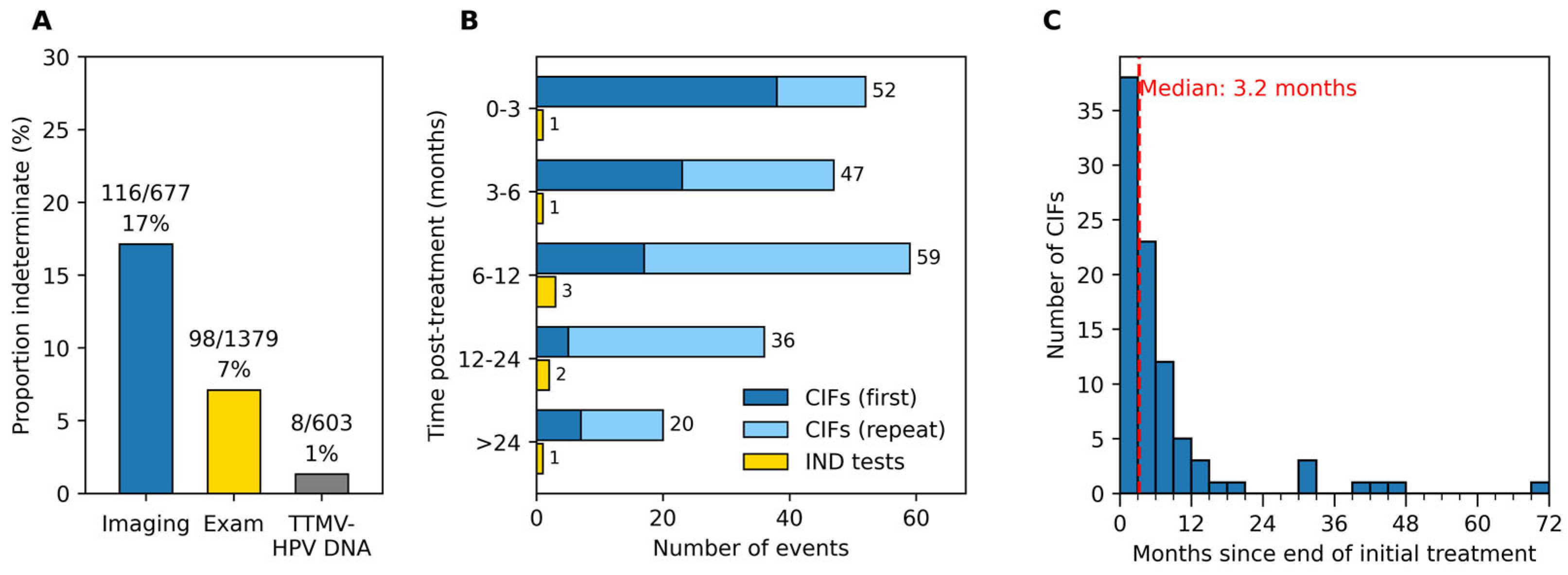
Of 215 patients with ≥1 post-treatment exams and/or imaging studies, 90 (42%) had ≥1 post-treatment CIF(s). Among these 90 patients, 214 CIFs were observed, with 46% (98/214) arising from clinical examination and 54% (116/214) from imaging. When normalized to the total number of assessments, CIFs occurred in 17% (116/677) of imaging studies and 7% (98/1379) of exams (Figure 1A; Table 2). Patients with CIFs experienced a median of 2 (range: 1–8); 59% (53/90) had multiple CIFs, with 32 patients having sequential indeterminate assessments. Those with sequential CIFs had a median interval of 42 days between their first and last inconclusive assessment (IQR: 12–162) and 80 days (IQR: 39–148) between their first indeterminate result and a conclusive follow-up. In contrast, only 4.3% (8/185) of patients with post-treatment TTMV-HPV DNA testing had an indeterminate result, representing 1.3% (8/603) of all TTMV-HPV DNA tests (Figure 1A, Table 2). No patient had more than 1 indeterminate TTMV-HPV DNA result.
Figure 1.
Frequency and timing of clinically indeterminate findings (CIFs) and indeterminate TTMV-HPV DNA tests after completion of initial treatment. (A) Proportion of post-treatment assessments that were indeterminate, stratified by modality. (B) Counts of CIFs and indeterminate TTMV-HPV DNA tests by surveillance stage. Surveillance stages were left-inclusive to avoid overlap at bin boundaries. Dark blue bars indicate the patient’s first CIF. Light blue bars indicate repeat CIFs or TTMV-HPV DNA tests. (C) Distribution of time in months from the end of initial treatment to each patient’s first CIF (3-month bins); red dashed line indicates the median.
Table 2.
Indeterminate rate by surveillance stage and assessment modality.
Of those patients with ≥1 year of clinical follow-up, 53% (63/119) experienced a CIF, compared to 59% (39/66) for patients with ≥2 years of clinical follow-up. The indeterminate rate remained stable during the first year after treatment, with comparable frequencies across the 0–3, 3–6, and 6–12 month intervals, but declined beyond 12 months (Figure 1B; Table 2). CIFs occurred most often between 6 and 12 months post-treatment (59/214, 28%), followed by 0–3 months (52/214, 24%), 3–6 months (47/214, 22%), 12–24 months (36/214, 17%), and ≥24 months (20/214, 9%). The median time from completion of treatment to the first CIF was 97 days (IQR: 52–204) (Figure 1C). The odds of having a CIF within the first year post-treatment were 1.86 times higher than those in the second year (95% CI: 1.23–2.80; Fisher’s exact test, p = 0.0026).
A patient’s first indeterminate TTMV-HPV DNA test occurred a median of 288 days post-treatment (IQR: 178–414). Indeterminate TTMV-HPV DNA tests occurred at a rate of 5/301 (0.017) in year 1 and 2/162 (0.012) in year 2.
3.3. Resolution of Indeterminate Disease Status by TTMV-HPV DNA Testing
To evaluate the performance of TTMV-HPV DNA to resolve indeterminate clinical disease status, CIFs were paired with TTMV-HPV DNA tests obtained within a 3-month window after the CIF. Each TTMV-HPV DNA result was then compared with subsequent clinical follow-up and classified as correctly or incorrectly predicting recurrence or the absence of recurrence in the 3 months following the test (Figure S1B,C).
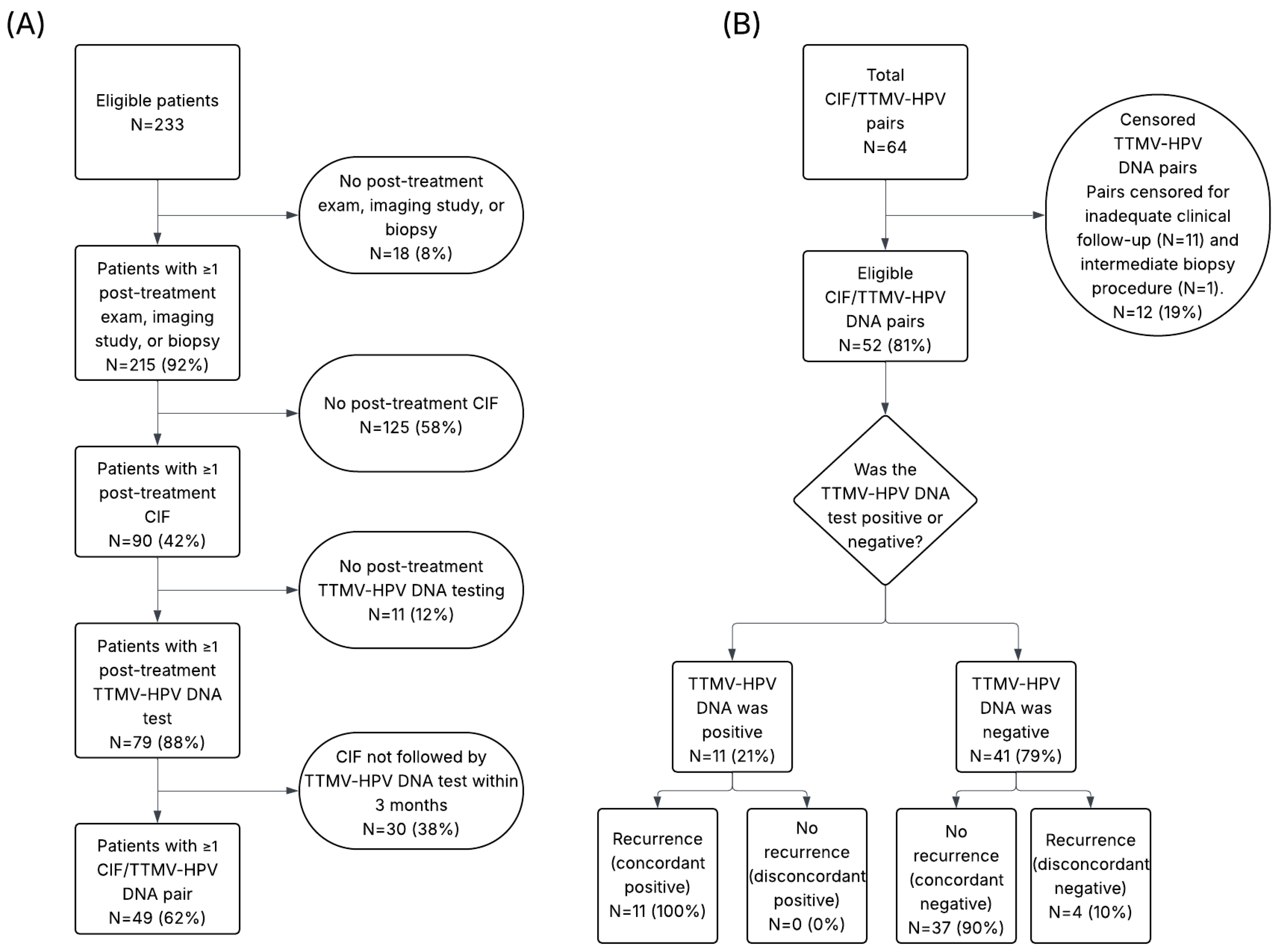
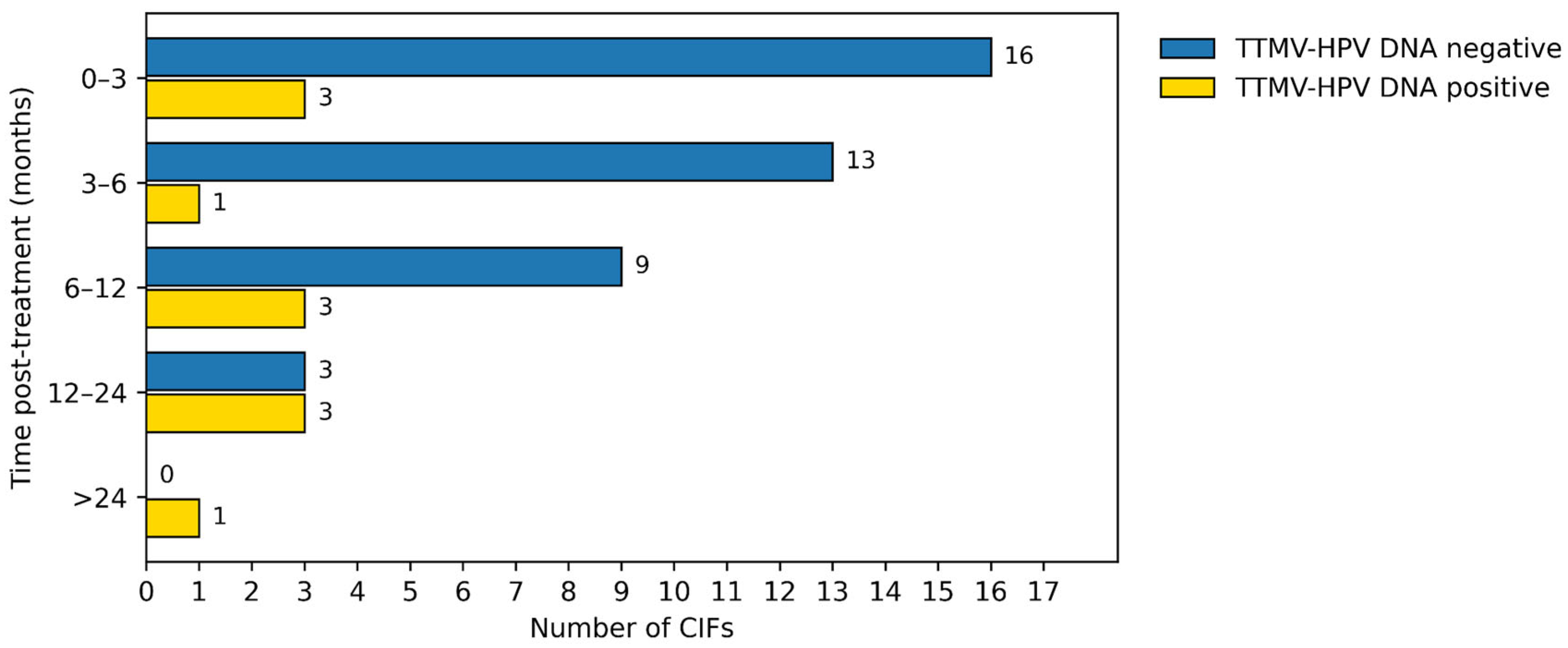
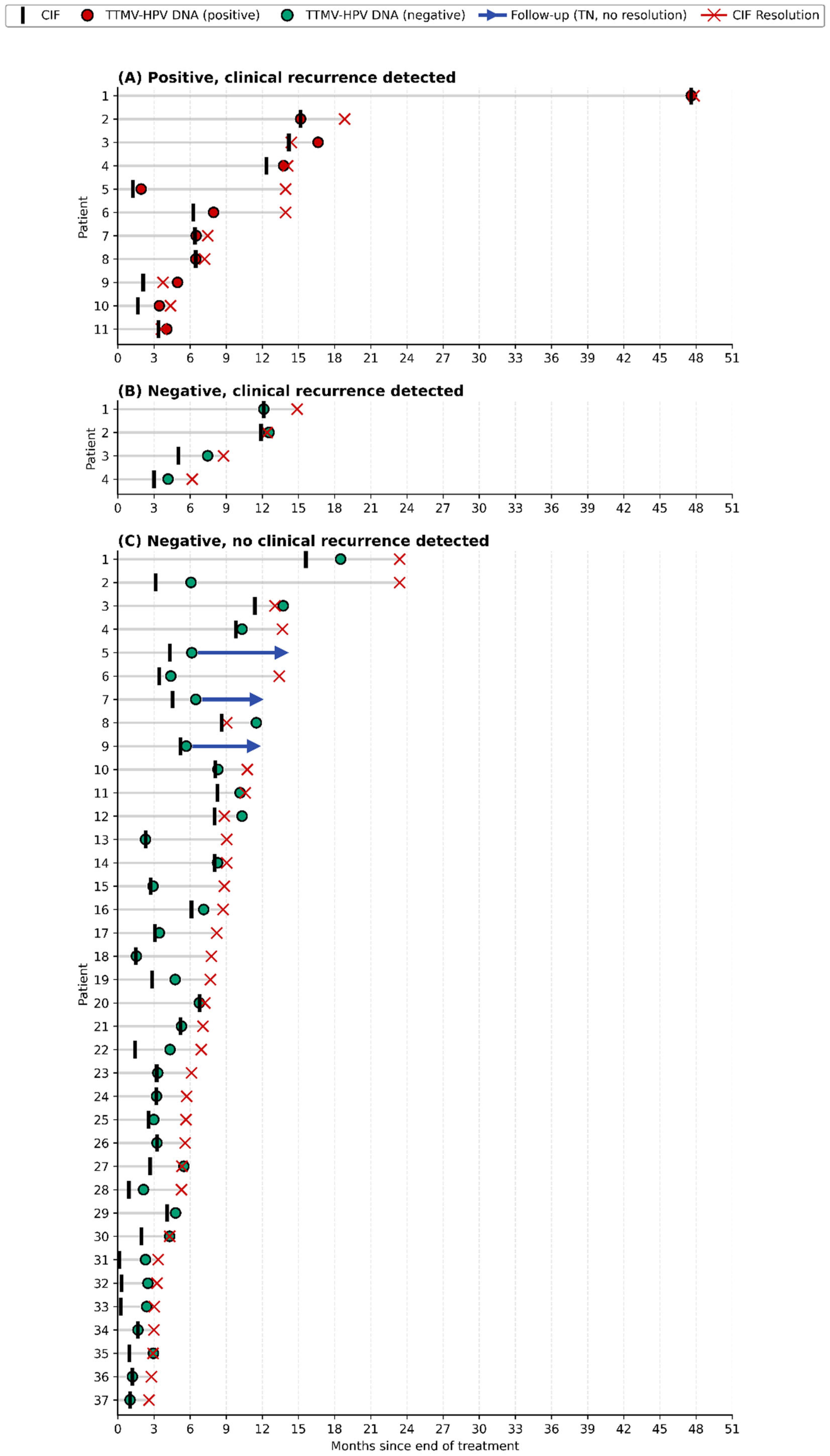
Of 214 CIFs, 64 (30%) were paired with a TTMV-HPV DNA test obtained within 3 months. After excluding one pair due to a potentially lesion-altering biopsy and 11 pairs with insufficient follow-up, 52 CIF/TTMV-HPV DNA pairs were evaluable (Figure 2). Most pairs occurred within the first 6 months post-treatment (33/52, 63%; Figure 3). Longitudinal follow-up for each evaluable CIF/TTMV-HPV DNA pair is shown in Figure 4.
Figure 2.
STARD chart depicting the flow of patients and CIF/TTMV-HPV DNA pairs through study inclusion and analysis. (A) Patient inclusion flow diagram. The total cohort included all study-eligible patients, of whom a subset underwent post-treatment TTMV-HPV DNA testing. Of these, patients with ≥1 CIF were identified, and those with a CIF occurring within 3 months before a TTMV-HPV DNA test were included as CIF/TTMV-HPV DNA pairs. (B) Flow of CIF/TTMV-HPV DNA pairs through censoring and classification. Pairs were excluded if follow-up was insufficient or if an intermediate biopsy interfered with TTMV-HPV DNA levels. The remaining pairs were classified as concordant or discordant based on recurrence status within the defined follow-up window. Percentages represent the proportion of patients within each step of the flow diagram relative to the group in the preceding row.
Figure 3.
Distribution of CIF/TTMV-HPV DNA pairs by time post-treatment, stratified by TTMV-HPV DNA result. Bars represent the number of CIF/TTMV-HPV DNA pairs occurring in each surveillance interval.
Figure 4.
Classification of CIFs by paired TTMV-HPV DNA test result and subsequent clinical outcome. Each horizontal line represents a CIF/TTMV-HPV DNA pair, with time zero marking the end of primary treatment. A vertical black bar indicates the CIF, and each colored circle represents the paired TTMV-HPV DNA test (red = positive, green = negative). A red X indicates resolution of the CIF to a definitive clinical status. In cases where clinical resolution is not achieved, a blue arrow extends to the end of clinical follow-up. Panels show clinically relevant subsets: (A) Positive TTMV-HPV DNA, clinical recurrence detected (positive concordant). (B) Negative TTMV-HPV DNA, clinical recurrence detected (negative discordant). (C) Negative TTMV-HPV DNA, no clinical recurrence detected (negative concordant).
Positive TTMV-HPV DNA tests occurred in 21% (11/52) of evaluated pairs. All positive tests were concordant with clinically confirmed recurrence (100% concordance). TTMV-HPV DNA testing was the first indication of recurrence in 73% (8/11) of these cases, with a median lead-time of 29 days (IQR: 19–129). In 75% (6/8) of instances in which TTMV-HPV DNA was the first indication of recurrence, the recurrence was detected within 6 months after testing. In 3 cases, the CIF-associated TTMV-HPV DNA test confirmed clinical recurrence detection.
Negative TTMV-HPV DNA results occurred in 79% (41/52) of evaluable pairs. Of these, 90% (37/41) were concordant with the absence of recurrence within the prespecified follow-up window. In 4 instances (4/41, 10%) negative tests were discordant and were associated with clinically confirmed locoregional recurrence (Figure 2B). Of those patients, 2 had low pretreatment TTMV-HPV DNA test scores (23 and 86; HPV16), and both had biopsy-proven, p16-positive recurrences. Biopsies were performed 61 and 84 days after negative testing, respectively. The other 2 patients were not tested for pretreatment TTMV-HPV DNA. The first patient had biopsy-proven, p16-positive recurrence. The second patient’s recurrence was diagnosed via sigmoidoscopy performed 40 days after the negative TTMV-HPV DNA test and was not biopsy-confirmed.
Overall, TTMV-HPV DNA testing correctly predicted the disease status for 92% of CIF-associated tests (48/52, 95% CI: 82–98; Figure 2B). TTMV-HPV DNA correctly predicted disease status for 96% (26/27) of CIFs performed within 4 months after treatment, and 88% (22/25) of CIFs performed after 4 months post-treatment.
3.4. Recurrence Detection Following Positive TTMV-HPV DNA Testing
Among patients undergoing post-treatment surveillance, discordance occasionally occurred when a positive TTMV-HPV DNA test was obtained before any clinical evidence of disease. Across the cohort, 30 positive tests were recorded in 11% of patients (21/185). In every case, the positive test served as the first indication of recurrence. At the time of each patient’s initial positive test, clinical status was recorded as “NED” in 57% (12/21), “indeterminate” in 24% (5/21), and “unknown” in 19% (4/21).
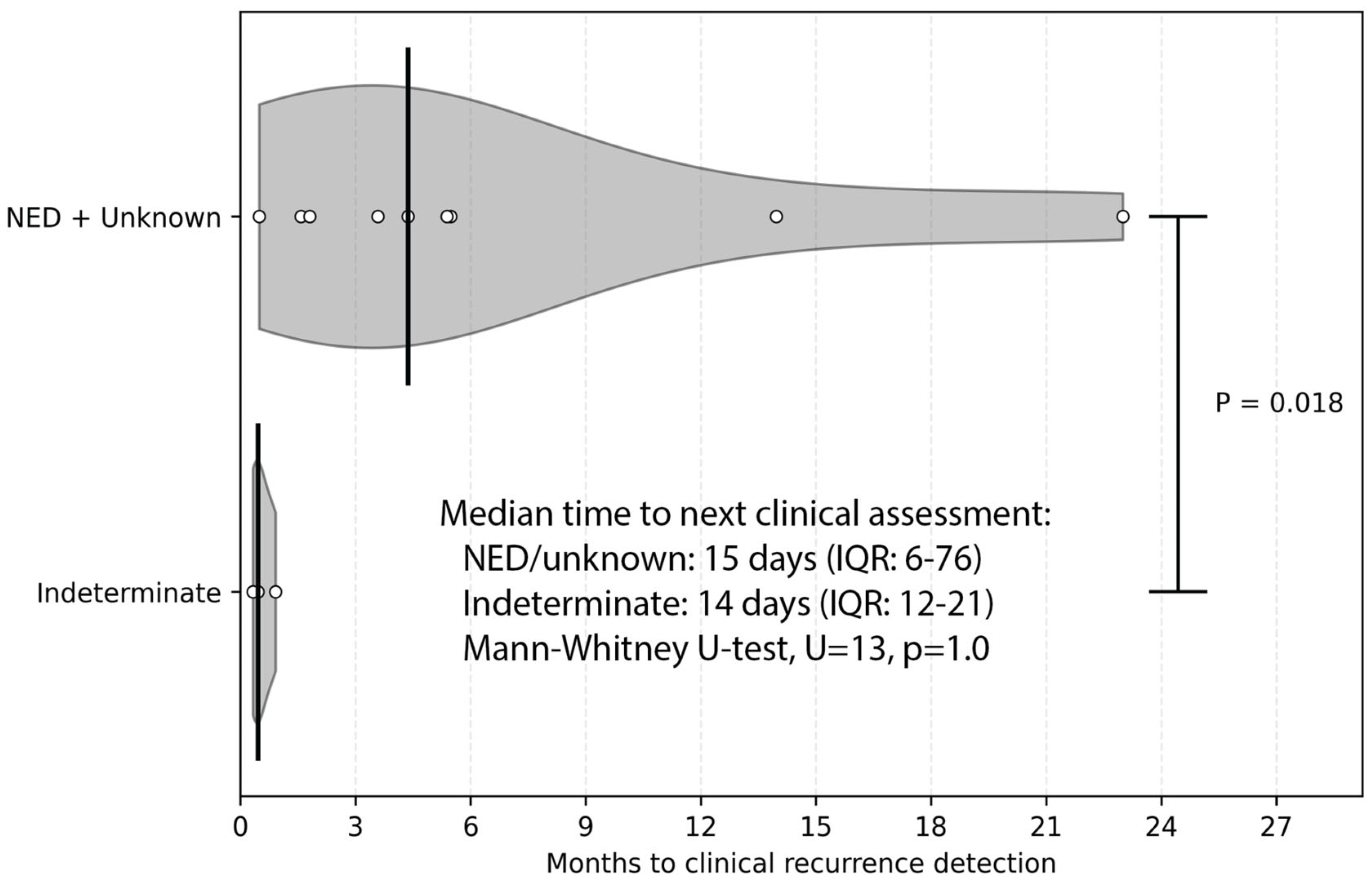
Eight patients lacked sufficient follow-up (≥6 months) to determine clinical correlation. Among the remaining 13 patients, recurrence was eventually confirmed in all cases (100%). Recurrence was identified more quickly when the paired clinical assessment was indeterminate compared with NED or unknown status (median 14 days vs. 133 days, Mann–Whitney U-test, U = 1, p = 0.018; Figure 5). To confirm that this difference was not driven by unequal follow-up cadence, we also evaluated the time from the positive TTMV-HPV DNA test to the next clinical assessment. The median time to the next assessment did not differ by disease status (14 days vs. 15 days), but the range was larger for patients with “unknown” or “NED” status (4–120 days) compared to those with “indeterminate” status (10–28 days). Overall, only 8 of 185 patients (4.3%) had unresolved positive tests due to limited follow-up, reflecting strong concordance between positive TTMV-HPV DNA results and clinical recurrence.
Figure 5.
Time to clinical recurrence detection following a positive TTMV-HPV DNA test by clinical status at the time of testing. Violin plots show the distribution of time to clinical recurrence detection in months for patients with indeterminate clinical status vs. no evidence of disease (NED) or unknown status at the time of testing. Individual observations are overlaid (white circles) and vertical lines indicate group medians. Patients with NED or unknown clinical status took longer to have their clinical recurrence detected than those with indeterminate status (Mann–Whitney U-test, U = 1, p = 0.018).
4. Discussion
Surveillance for ASCC is complicated by post-treatment anatomic and inflammatory changes, which frequently produce CIFs and delay diagnostic clarity. In this multi-center cohort, TTMV-HPV DNA testing resolved the vast majority of CIFs and often anticipated clinical confirmation of recurrence by several weeks. Importantly, the test demonstrated a very low indeterminate rate (1.3%) compared with clinical examination and imaging, reinforcing its value in situations where traditional methods are limited.
Clinical guidelines call for intensive anal cancer post-treatment assessment and surveillance, which include physical examination, CT, MRI, and/or PET/CT [9,16,17,18]. Each of these modalities has limitations in identifying recurrent or residual disease, with positive predictive values (PPV) for MRI, anoscopy, and digital anorectal exam ranging from 30% to 60% [19,20,21,22].
The limitations inherent in these surveillance modalities lead to clinical uncertainty. Many patients continue to show tumor regression and eventual resolution up to 6 months post treatment, with significant ongoing changes at the primary tumor site complicating visualization [11]. In addition, beginning post-treatment surveillance with imaging or physical examination can be limited by CRT-induced physical changes at the site of the primary tumor [23,24,25], including pain, fibrosis, and inflammation. It is unsurprising that ambiguous clinical examinations and diagnostic testing can place a significant psychological toll on patients, leading to increased anxiety [26,27,28,29,30,31,32].
A multi-modal approach to surveillance reduces uncertainty. Several studies illustrate the complementary nature of physical examination and imaging. Houard et al. reported that up to 10% of patients in one study had locoregional recurrence detected by PET/CT that was not observed with clinical examination [33]. Cutting through the uncertainty in CIFs in a timely fashion allows detection when the extent of disease is still limited, leading to the best outcomes from salvage surgical treatment [33,34,35,36].
The use of liquid biopsy assays can complement existing tools and overcome limitations of imaging and physical examination to detect cancer outside the field of view, lesions obscured by fibrosis or inflammation, or tumors smaller than the detection limits [13,37,38,39]. Within this cohort of patients with anal cancer, more than 40% experienced ≥1 CIF post-treatment, with 46% of CIFs occurring within the first 6 months post-treatment. In addition, nearly 25% of all patients experienced multiple post-treatment CIFs, with 14% of all patients having sequential indeterminate assessments, with a median of 80 days between the first inconclusive result and a conclusive confirmation of disease status. By comparison, TTMV-HPV DNA testing had an overall indeterminate rate of 1.3%, compared to 17% from imaging and 7% from clinical examination. The clinical validity of circulating tumor DNA in the post-treatment setting for ASCC has been shown repeatedly, with sensitivities greater than 85% [5,40,41,42,43,44]. TTMV-HPV DNA has demonstrated a per-patient PPV for recurrent disease of 96.0% and a point-in-time NPV of 92.5% [13]. Consistent with previous studies [13,39], TTMV-HPV DNA detection via liquid biopsy provides an accurate method for resolving post-treatment CIFs in patients with anal cancer. In this follow-on study to Kabarriti et al., more than 90% of TTMV-HPV DNA tests were concordant with subsequent exams or scans. These metrics suggest that patients with a CIF and negative TTMV-HPV DNA results, 90% (37/41) in this cohort, can confidently be considered recurrence-free. This high rate of accuracy can reassure patients of the response, as well as minimize unnecessary interventions and the accompanying risk for adverse events. Although less frequent, recurrent disease at the time of a CIF was confirmed in 100% of patients who had a paired-positive TTMV-HPV DNA test.
Providing additional information with a liquid biopsy assay to resolve clinical ambiguity has the potential to save both time and money compared to repeat procedures or imaging. With sample acquisition possible by clinic-based or mobile phlebotomy and a turn-around time of 1 week, testing for plasma TTMV-HPV DNA offers a way to substantially shorten the period of ambiguity and quickly define next steps. Access to mobile phlebotomy or local clinics can reduce the burden of both time and cost for patients, with improved equity in care. This study has limitations inherent to its retrospective design. Anal cancer is a rare disease, and the current cohort represents approximately 2% of the annual incidence. Patients were unselected and represented a broad population treated at ten geographically dispersed sites. Surveillance intervals and testing timing were not standardized, and clinicians may have been more likely to order TTMV-HPV DNA testing for patients with concerning findings, potentially enriching for patients with CIFs and potentially increasing the apparent clinical utility in this population. The small number of patients who did not receive TTMV-HPV DNA testing in surveillance precludes a robust comparison of CIFs between groups. Further, although positive test results are likely to prompt follow-up, this behavior could not be systematically captured. Finally, most tumors (83%) were assessed by p16 IHC, which may misclassify patients as HPV-positive 79% to 95% of the time [45,46,47], as p16 positivity does not always indicate transcriptionally active HPV, potentially affecting the accuracy of the TTMV-HPV DNA test interpretations.
Despite these limitations, this study represents one of the largest multi-center evaluations of CIFs in ASCC and provides robust evidence supporting the clinical utility of TTMV-HPV DNA testing in resolving indeterminate surveillance findings.
5. Conclusions
TTMV-HPV DNA assessment by liquid biopsy is a valuable adjunct to standard ASCC surveillance, offering high accuracy, low indeterminate rates, and early detection of recurrence. By reliably resolving clinically indeterminate findings, TTMV-HPV DNA provides actionable information that can accelerate appropriate diagnostic workup or reassure patients when no recurrence is present. These findings support its integration into routine post-treatment follow-up, particularly in the early months after CRT when CIFs are most prevalent and traditional surveillance modalities are most limited. This approach may reduce diagnostic delay, decrease unnecessary procedures, and lessen patient anxiety associated with prolonged uncertainty.
Supplementary Materials
The following supporting information can be downloaded at: https://www.mdpi.com/article/10.3390/cancers18010035/s1, Figure S1: Rule set for CIF/TTMV-HPV DNA pairing and outcome classification with NCCN-concordant surveillance cadence. Table S1: Post-treatment TTMV-HPV DNA metrics.
Author Contributions
Conceptualization, J.J., L.M.G., R.K., S.L. and S.L.L.; methodology, J.J., L.M.G., R.K., S.L. and S.L.L.; software, J.J.; validation, J.J. and L.M.G.; formal analysis, J.J.; investigation, all authors; resources, all authors; data curation, J.J.; writing—original draft preparation, J.J., L.M.G.; writing—review and editing, all authors; visualization, J.J.; supervision, L.M.G. and S.L.L.; project administration, J.J. and L.M.G. All authors have read and agreed to the published version of the manuscript.
Funding
This research received no funding outside of data and analytics support from Naveris.
Institutional Review Board Statement
The study was conducted in accordance with the Declaration of Helsinki and approved by a central, independent IRB (WCG IRB; sponsor protocol number: NAV-RWD-001, May 2025).
Informed Consent Statement
Patient consent was waived due to the retrospective nature of the study, which involved the use of de-identified data collected during routine clinical care. The study posed minimal risk to participants, as no additional interventions were performed, and patient privacy was protected in accordance with institutional and ethical guidelines.
Data Availability Statement
The data supporting this study’s findings are available from the corresponding author upon reasonable request and subject to institutional review and data-sharing agreements.
Conflicts of Interest
J.J. and L.M.G. are employees or contractors for Naveris, Inc. with stock holdings. C.J. received an honorarium from Naveris, Inc. for an invited talk. S.L. has provided expert witness services and consulting, unrelated to the current work. The remaining authors declare that the research was conducted in the absence of any commercial or financial relationships that could be construed as a potential conflict of interest.
Abbreviations
The following abbreviations are used in this manuscript:
| ASCC | Anal squamous cell carcinoma |
| CIF | Clinically indeterminate finding |
| CI | Confidence interval |
| CRT | Chemoradiotherapy |
| HPV | Human papillomavirus |
| IHC | Immunohistochemistry |
| IND | Indeterminate |
| IQR | Interquartile range |
| IRB | Institutional review board |
| ISH | In situ hybridization |
| NED | No evidence of disease |
| NPV | Negative predictive value |
| PCR | Polymerase chain reaction |
| PPV | Positive predictive value |
| RT | Radiotherapy |
| TTMV | Tumor tissue modified viral |
References
- American Cancer Society. Cancer Facts & Figures 2025. Available online: https://www.cancer.org/research/cancer-facts-statistics/all-cancer-facts-figures/2025-cancer-facts-figures.html (accessed on 29 September 2025).
- Surveillance Research Program, National Cancer Institute SEER*Explorer: An Interactive Website for SEER Cancer Statistics. Available online: https://seer.cancer.gov/statistics-network/explorer/ (accessed on 15 September 2025).
- McBride, A.A. Human Malignancies Associated with Persistent HPV Infection. Oncologist 2024, 29, 457–464. [Google Scholar] [CrossRef] [PubMed]
- Eng, C.; Messick, C.; Glynne-Jones, R. The Management and Prevention of Anal Squamous Cell Carcinoma. Am. Soc. Clin. Oncol. Educ. Book 2019, 39, 216–225. [Google Scholar] [CrossRef] [PubMed]
- Upadhyay, L.; Hartzell, M.; Parikh, A.R.; Strickland, M.R.; Klempner, S.; Malla, M. Recent Advances in the Management of Anal Cancer. Healthcare 2023, 11, 3010. [Google Scholar] [CrossRef] [PubMed]
- Littlejohn, J.B.; Brister, K.A. Management of Recurrent Anal Cancer. Surg. Oncol. Clin. 2025, 34, 91–101. [Google Scholar] [CrossRef]
- James, R.D.; Glynne-Jones, R.; Meadows, H.M.; Cunningham, D.; Myint, A.S.; Saunders, M.P.; Maughan, T.; McDonald, A.; Essapen, S.; Leslie, M.; et al. Mitomycin or Cisplatin Chemoradiation with or without Maintenance Chemotherapy for Treatment of Squamous-Cell Carcinoma of the Anus (ACT II): A Randomised, Phase 3, Open-Label, 2 × 2 Factorial Trial. Lancet Oncol. 2013, 14, 516–524. [Google Scholar] [CrossRef]
- Turchan, W.T.; Liauw, S.L. Chemoradiation for Anal Cancer: Clinical Outcomes and Strategies to Optimize the Therapeutic Ratio According to HPV Status. Semin. Radiat. Oncol. 2021, 31, 349–360. [Google Scholar] [CrossRef]
- NCCN Clinical Practice Guidelines in Oncology (NCCN Guidelines®) for Anal Cancer V.1.2025. © National Comprehensive Cancer Network, Inc. 2025. All Rights Reserved. Available online: https://www.nccn.org/ (accessed on 19 December 2024).
- Eng, C.; Ciombor, K.K.; Cho, M.; Dorth, J.A.; Rajdev, L.N.; Horowitz, D.P.; Gollub, M.J.; Jácome, A.A.; Lockney, N.A.; Muldoon, R.L.; et al. Anal Cancer: Emerging Standards in a Rare Disease. J. Clin. Oncol. 2022, 40, 2774–2788. [Google Scholar] [CrossRef]
- Glynne-Jones, R.; Sebag-Montefiore, D.; Meadows, H.M.; Cunningham, D.; Begum, R.; Adab, F.; Benstead, K.; Harte, R.J.; Stewart, J.; Beare, S.; et al. Best Time to Assess Complete Clinical Response after Chemoradiotherapy in Squamous Cell Carcinoma of the Anus (ACT II): A Post-Hoc Analysis of Randomised Controlled Phase 3 Trial. Lancet Oncol. 2017, 18, 347–356. [Google Scholar] [CrossRef]
- Hawkins, A.T.; Fang, S.H. Anal Squamous Intraepithelial Lesions and Anal Cancer Management in Low Resource Settings. Clin. Colon Rectal Surg. 2022, 35, 396–401. [Google Scholar] [CrossRef]
- Kabarriti, R.; Lloyd, S.; Jabalee, J.; Del Vecchio Fitz, C.; Tao, R.; Slater, T.; Jacobs, C.; Inocencio, S.; Rutenberg, M.; Matthiesen, C.; et al. Evaluating Tumor Tissue Modified Viral (TTMV)-HPV DNA for the Early Detection of Anal Squamous Cell Carcinoma Recurrence. Cancers 2025, 17, 174. [Google Scholar] [CrossRef]
- Gunning, A.; Kumar, S.; Williams, C.K.; Berger, B.M.; Naber, S.P.; Gupta, P.B.; Del Vecchio Fitz, C.; Kuperwasser, C. Analytical Validation of NavDx, a cfDNA-Based Fragmentomic Profiling Assay for HPV-Driven Cancers. Diagnostics 2023, 13, 725. [Google Scholar] [CrossRef] [PubMed]
- Amin, M.B. AJCC Cancer Staging Manual, 8th ed.; Edge, S.B., Greene, F.L., Byrd, D.R., Brookland, R.K., Washington, M.K., Gershenwald, J.E., Compton, C.C., Eds.; Springer Nature: Chicago, IL, USA, 2017; ISBN 978-3-319-40617-6. [Google Scholar]
- Horvat, N.; Liu, P.S.; Fowler, K.J.; Birkholz, J.H.; Cash, B.D.; Dane, B.; Eng, C.; Kambadakone, A.R.; Korngold, E.K.; Pietryga, J.A.; et al. ACR Appropriateness Criteria® Staging and Follow-up of Anal Cancer. J. Am. Coll. Radiol. 2025, 22, S396–S404. [Google Scholar] [CrossRef] [PubMed]
- Rao, S.; Guren, M.G.; Khan, K.; Brown, G.; Renehan, A.G.; Steigen, S.E.; Deutsch, E.; Martinelli, E.; Arnold, D. Anal Cancer: ESMO Clinical Practice Guidelines for Diagnosis, Treatment and Follow-Up☆. Ann. Oncol. 2021, 32, 1087–1100. [Google Scholar] [CrossRef] [PubMed]
- Kim, K.; Mercer, J.; John, V.; Mathew, S.; Kochhar, R. Imaging Features of Anal Carcinoma after Chemoradiation. RadioGraphics 2025, 45, e240119. [Google Scholar] [CrossRef]
- Adusumilli, P.; Elsayed, N.; Theophanous, S.; Samuel, R.; Cooper, R.; Casanova, N.; Tolan, D.J.; Gilbert, A.; Scarsbrook, A.F. Combined PET-CT and MRI for Response Evaluation in Patients with Squamous Cell Anal Carcinoma Treated with Curative-Intent Chemoradiotherapy. Eur. Radiol. 2022, 32, 5086–5096. [Google Scholar] [CrossRef]
- Brenes, D.; Kortum, A.; Carns, J.; Mutetwa, T.; Schwarz, R.; Liu, Y.; Sigel, K.; Richards-Kortum, R.; Anandasabapathy, S.; Gaisa, M.; et al. Automated In Vivo High-Resolution Imaging to Detect Human Papillomavirus–Associated Anal Precancer in Persons Living With HIV. Clin. Transl. Gastroenterol. 2023, 14, e00558. [Google Scholar] [CrossRef]
- Gimenez, F.; da Costa-e-Silva, I.T.; Daumas, A.; de Araújo, J.; Medeiros, S.G.; Ferreira, L. The Value of High-Resolution Anoscopy in the Diagnosis of Anal Cancer Precursor Lesions in Hiv-Positive Patients. Arq. Gastroenterol. 2011, 48, 136–145. [Google Scholar] [CrossRef]
- Ang, C.W.; Dawson, R.; Hall, C.; Farmer, M. The Diagnostic Value of Digital Rectal Examination in Primary Care for Palpable Rectal Tumour. Colorectal. Dis. 2008, 10, 789–792. [Google Scholar] [CrossRef]
- Stewart, D.B.; Gaertner, W.B.; Glasgow, S.C.; Herzig, D.O.; Feingold, D.; Steele, S.R. The American Society of Colon and Rectal Surgeons Clinical Practice Guidelines for Anal Squamous Cell Cancers (Revised 2018). Dis. Colon Rectum 2018, 61, 755–774. [Google Scholar] [CrossRef]
- Tonolini, M.; Bianco, R. MRI and CT of Anal Carcinoma: A Pictorial Review. Insights Imaging 2013, 4, 53–62. [Google Scholar] [CrossRef]
- Durot, C.; Dohan, A.; Boudiaf, M.; Servois, V.; Soyer, P.; Hoeffel, C. Cancer of the Anal Canal: Diagnosis, Staging and Follow-Up with MRI. Korean J. Radiol. 2017, 18, 946. [Google Scholar] [CrossRef] [PubMed]
- Bergerot, C.D.; Philip, E.J.; Bergerot, P.G.; Siddiq, N.; Tinianov, S.; Lustberg, M. Fear of Cancer Recurrence or Progression: What Is It and What Can We Do About It? Am. Soc. Clin. Oncol. Educ. Book 2022, 42, 18–27. [Google Scholar] [CrossRef] [PubMed]
- Bastien, A.J.; Ng, J.; Cong, I.; Garcia, J.; Walgama, E.S.; Luu, M.; Jang, J.K.; Mita, A.C.; Scher, K.S.; Moyers, J.T.; et al. Patient Perceptions Underlying ctDNA Molecular Surveillance for HPV(+) Oropharyngeal Squamous Cell Carcinoma. Oral Oncol. 2024, 156, 106894. [Google Scholar] [CrossRef] [PubMed]
- Ghodraty Jabloo, V.; Alibhai, S.M.H.; Fitch, M.; Tourangeau, A.E.; Ayala, A.P.; Puts, M.T.E. Antecedents and Outcomes of Uncertainty in Older Adults with Cancer: A Scoping Review of the Literature. Oncol. Nurs. Forum 2017, 44, E152–E167. [Google Scholar] [CrossRef]
- Smith, T.J.; Hillner, B.E. Bending the Cost Curve in Cancer Care. N. Engl. J. Med. 2011, 364, 2060–2065. [Google Scholar] [CrossRef]
- Guan, T.; Santacroce, S.J.; Chen, D.-G.; Song, L. Illness Uncertainty, Coping, and Quality of Life among Patients with Prostate Cancer. Psychooncology 2020, 29, 1019–1025. [Google Scholar] [CrossRef]
- Simard, S.; Thewes, B.; Humphris, G.; Dixon, M.; Hayden, C.; Mireskandari, S.; Ozakinci, G. Fear of Cancer Recurrence in Adult Cancer Survivors: A Systematic Review of Quantitative Studies. J. Cancer Surviv. Res. Pract. 2013, 7, 300–322. [Google Scholar] [CrossRef]
- Kim, A.; Chung, K.C.; Keir, C.; Patrick, D.L. Patient-Reported Outcomes Associated with Cancer Screening: A Systematic Review. BMC Cancer 2022, 22, 223. [Google Scholar] [CrossRef]
- Houard, C.; Pinaquy, J.-B.; Mesguich, C.; Henriques De Figueiredo, B.; Cazeau, A.-L.; Allard, J.-B.; Laharie, H.; Bordenave, L.; Fernandez, P.; Vendrely, V. Role of18 F-FDG PET/CT in Posttreatment Evaluation of Anal Carcinoma. J. Nucl. Med. 2017, 58, 1414–1420. [Google Scholar] [CrossRef]
- Mariani, P.; Ghanneme, A.; De la Rochefordière, A.; Girodet, J.; Falcou, M.C.; Salmon, R.J. Abdominoperineal Resection for Anal Cancer. Dis. Colon Rectum 2008, 51, 1495–1501. [Google Scholar] [CrossRef]
- Park, I.J.; Chang, G. Survival and Operative Outcomes After Salvage Surgery for Recurrent or Persistent Anal Cancer. Ann. Coloproctology 2020, 36, 361–373. [Google Scholar] [CrossRef] [PubMed]
- Hagemans, J.a.W.; Blinde, S.E.; Nuyttens, J.J.; Morshuis, W.G.; Mureau, M.a.M.; Rothbarth, J.; Verhoef, C.; Burger, J.W.A. Salvage Abdominoperineal Resection for Squamous Cell Anal Cancer: A 30-Year Single-Institution Experience. Ann. Surg. Oncol. 2018, 25, 1970–1979. [Google Scholar] [CrossRef] [PubMed]
- Berger, B.M.; Hanna, G.J.; Posner, M.R.; Genden, E.M.; Lautersztain, J.; Naber, S.P.; Del Vecchio Fitz, C.; Kuperwasser, C. Detection of Occult Recurrence Using Circulating Tumor Tissue Modified Viral HPV DNA among Patients Treated for HPV-Driven Oropharyngeal Carcinoma. Clin. Cancer Res. 2022, 28, 4292–4301. [Google Scholar] [CrossRef] [PubMed]
- Hanna, G.J.; Roof, S.A.; Jabalee, J.; Rettig, E.M.; Ferrandino, R.; Chen, S.; Posner, M.R.; Misiukiewicz, K.J.; Genden, E.M.; Chai, R.L.; et al. Negative Predictive Value of Circulating Tumor Tissue Modified Viral (TTMV)-HPV DNA for HPV-Driven Oropharyngeal Cancer Surveillance. Clin. Cancer Res. 2023, 29, 4306–4313. [Google Scholar] [CrossRef]
- Roof, S.A.; Jabalee, J.; Rettig, E.M.; Chennareddy, S.; Ferrandino, R.M.; Chen, S.; Posner, M.R.; Genden, E.M.; Chai, R.L.; Sims, J.; et al. Utility of TTMV-HPV DNA in Resolving Indeterminate Findings during Oropharyngeal Cancer Surveillance. Oral Oncol. 2024, 155, 106874. [Google Scholar] [CrossRef]
- Temperley, H.C.; Fannon, T.; O’Sullivan, N.J.; O’Neill, M.; Mac Curtain, B.M.; Gilham, C.; O’Sullivan, J.; O’Kane, G.; Mehigan, B.J.; O’Toole, S.; et al. Assessing Circulating Tumour DNA (ctDNA) as a Biomarker for Anal Cancer Management: A Systematic Review. Int. J. Mol. Sci. 2024, 25, 4005. [Google Scholar] [CrossRef]
- Bernard-Tessier, A.; Jeannot, E.; Guenat, D.; Debernardi, A.; Michel, M.; Proudhon, C.; Vincent-Salomon, A.; Bièche, I.; Pierga, J.-Y.; Buecher, B.; et al. Clinical Validity of HPV Circulating Tumor DNA in Advanced Anal Carcinoma: An Ancillary Study to the Epitopes-HPV02 Trial. Clin. Cancer Res. 2019, 25, 2109–2115. [Google Scholar] [CrossRef]
- Andrioaie, I.M.; Luchian, I.; Dămian, C.; Nichitean, G.; Andrese, E.P.; Pantilimonescu, T.F.; Trandabăț, B.; Prisacariu, L.J.; Budală, D.G.; Dimitriu, D.C.; et al. The Clinical Utility of Circulating HPV DNA Biomarker in Oropharyngeal, Cervical, Anal, and Skin HPV-Related Cancers: A Review. Pathogens 2023, 12, 908. [Google Scholar] [CrossRef]
- Elasifer, H.; Amukwaya, M.M.N.; Bhatia, R.; Cuschieri, K.; Gregory, J.M. The Role of Circulating Viral and Tumour DNA in the Diagnosis and Management of HPV Associated Anogenital Cancers, a Systematic Review and Meta-Analysis. J. Clin. Virol. 2023, 164, 105469. [Google Scholar] [CrossRef]
- Morris, V.K.; Xiao, W.; Lin, K.; Wong, C.W.; Wotman, M.T.; Holliday, E.B.; Huey, R.W.; Noticewala, S.S.; Ludmir, E.B.; Bent, A.H.; et al. Time Dependency for Human Papillomavirus Circulating Tumor DNA Detection after Chemoradiation as a Prognostic Biomarker for Localized Anal Cancer. Clin. Cancer Res. 2025, 31, 2399–2405. [Google Scholar] [CrossRef]
- Gallus, R.; Nauta, I.H.; Marklund, L.; Rizzo, D.; Crescio, C.; Mureddu, L.; Tropiano, P.; Delogu, G.; Bussu, F. Accuracy of P16 IHC in Classifying HPV-Driven OPSCC in Different Populations. Cancers 2023, 15, 656. [Google Scholar] [CrossRef]
- Alemany, L.; Saunier, M.; Alvarado-Cabrero, I.; Quirós, B.; Salmeron, J.; Shin, H.-R.; Pirog, E.C.; Guimerà, N.; Hernandez-Suarez, G.; Felix, A.; et al. Human Papillomavirus DNA Prevalence and Type Distribution in Anal Carcinomas Worldwide. Int. J. Cancer 2015, 136, 98–107. [Google Scholar] [CrossRef]
- Serup-Hansen, E.; Linnemann, D.; Skovrider-Ruminski, W.; Høgdall, E.; Geertsen, P.F.; Havsteen, H. Human Papillomavirus Genotyping and P16 Expression As Prognostic Factors for Patients With American Joint Committee on Cancer Stages I to III Carcinoma of the Anal Canal. J. Clin. Oncol. 2014, 32, 1812–1817. [Google Scholar] [CrossRef]
Disclaimer/Publisher’s Note: The statements, opinions and data contained in all publications are solely those of the individual author(s) and contributor(s) and not of MDPI and/or the editor(s). MDPI and/or the editor(s) disclaim responsibility for any injury to people or property resulting from any ideas, methods, instructions or products referred to in the content. |
© 2025 by the authors. Licensee MDPI, Basel, Switzerland. This article is an open access article distributed under the terms and conditions of the Creative Commons Attribution (CC BY) license.