Impact of Metformin Use on Survival in Patients with Gastric Cancer and Diabetes Mellitus Following Gastrectomy

 , , ,
, , , 
Abstract
1. Introduction
2. Materials and Methods
3. Results
4. Discussion
5. Limitations
6. Conclusions
Author Contributions
Funding
Acknowledgments
Conflicts of Interest
References
- Siegel, R.L.; Miller, K.D.; Jemal, A. Cancer statistics, 2016. CA Cancer J. Clin. 2016, 66, 7–30. [Google Scholar] [CrossRef] [PubMed]
- Hsu, J.T.; Liu, M.S.; Wang, F. Standard radical gastrectomy in octogenarians and nonagenarians with gastric cancer: Are short-term surgical results and long-term survival substantial? J. Gastrointest Surg. 2012, 16, 728–737. [Google Scholar] [CrossRef] [PubMed]
- Chang, S.C.; Liu, K.H.; Hung, C.Y. Adjuvant chemotherapy improves survival in stage III gastric cancer after D2 surgery. J. Cancer 2018, 9, 81–89. [Google Scholar] [CrossRef] [PubMed]
- Cheng, C.T.; Tsai, C.Y.; Hsu, J.T. Aggressive surgical approach for patients with T4 gastric carcinoma: Promise or myth? Ann. Surg. Oncol. 2011, 18, 1606–1614. [Google Scholar] [CrossRef] [PubMed]
- Giovannucci, E.; Harlan, D.M.; Archer, M.C. Diabetes and cancer: A consensus report. CA Cancer J. Clin. 2010, 60, 207–221. [Google Scholar] [CrossRef] [PubMed]
- Seshasai, S.R.; Kaptoge, S.; Tompson, A. Emerging Risk Factors Collaboration. Diabetes mellitus, fasting glucose, and risk of cause-specific death. N. Engl. J. Med. 2011, 364, 829–841. [Google Scholar]
- Coughlin, S.S.; Calle, E.E.; Teras, L.R. Diabetes mellitus as a predictor of cancer mortality in a large cohort of US adults. Am. J. Epidemiol. 2004, 159, 1160–1167. [Google Scholar] [CrossRef]
- Lee, M.S.; Hsu, C.C.; Wahlqvist, M.L. Type 2 diabetes increases and metformin reduces total, colorectal, liver and pancreatic cancer incidences in Taiwanese: A representative population prospective cohort study of 800,000 individuals. BMC Cancer 2011, 11, 20. [Google Scholar] [CrossRef]
- Lee, C.K.; Jung, M.; Jung, I. Cumulative metformin use and its impact on survival in gastric cancer patients after gastrectomy. Ann. Surg. 2016, 263, 96–102. [Google Scholar] [CrossRef]
- Ge, Z.; Ben, Q.; Qian, J. Diabetes mellitus and risk of gastric cancer: A systematic review and meta-analysis of observational studies. Eur. J. Gastroenterol Hepatol. 2011, 23, 1127–1135. [Google Scholar] [CrossRef]
- Tseng, C.H. Diabetes conveys a higher risk of gastric cancer mortality despite an age-standardised decreasing trend in the general population in Taiwan. Gut 2011, 60, 774–779. [Google Scholar] [CrossRef] [PubMed]
- Inzucchi, S.E.; Bergenstal, R.M.; Buse, J.B. Management of hyperglycemia in type 2 diabetes: A patient-centered approach: Position statement of the American Diabetes Association and the European Association for the Study of Diabetes. Diabetes Care 2012, 35, 1364–1379. [Google Scholar] [CrossRef] [PubMed]
- Cusi, K.; DeFronzo, R.A. Metformin: A review of its metabolic effects. Diabetes Rev. 1998, 6, 89–131. [Google Scholar]
- Kim, Y.I.; Kim, S.Y.; Cho, S.J. Long-term metformin use reduces gastric cancer risk in type 2 diabetics without insulin treatment: A nationwide cohort study. Aliment. Pharmacol. Ther. 2014, 39, 854–863. [Google Scholar] [CrossRef] [PubMed]
- Kato, K.; Gong, J.; Iwama, H. The antidiabetic drug metformin inhibits gastric cancer cell proliferation in vitro and in vivo. Mol. Cancer Ther. 2012, 11, 549–560. [Google Scholar] [CrossRef] [PubMed]
- Edge, S.B.; Byrd, D.R.; Comptom, C.C. American Joint Committee on Cancer. AJCC Cancer Staging Manual, 7th ed.; Springer: New York, NY, USA, 2009. [Google Scholar]
- WHO Collaborating Centre for Drug Statistics Methodology: ATC/DDD Index 2016. Available online: http://www.whocc.no/atc_ddd_index/ (accessed on 13 October 2016).
- Tseng, C.H. Metformin reduces gastric cancer risk in patients with type 2 diabetes mellitus. Aging 2016, 8, 1636–1649. [Google Scholar] [CrossRef]
- American Diabetes Association. 9. Pharmacologic approaches to glycemic treatment: Standards of Medical Care in Diabetes 2020. Diabetes Care 2020, 43 (Suppl. 1), S98–S110. [Google Scholar] [CrossRef]
- Dowling, R.J.; Niraula, S.; Stambolic, V. Metformin in cancer: Translational challenges. J. Mol. Endocrinol. 2012, 48, R31–R43. [Google Scholar] [CrossRef]
- Landman, G.W.; Kleefstra, N.; van Hateren, K.J. Metformin associated with lower cancer mortality in type 2 diabetes: ZODIAC-16. Diabetes Care 2010, 33, 322–326. [Google Scholar] [CrossRef]
- Sekikawa, A.; Fukui, H.; Maruo, T. Diabetes mellitus increases the risk of early gastric cancer development. Eur. J. Cancer 2014, 50, 2065–2071. [Google Scholar] [CrossRef]
- Yamagata, H.; Kiyohara, Y.; Nakamura, S. Impact of fasting plasma glucose levels on gastric cancer incidence in a general Japanese population the Hisayama study. Diabetes Care 2005, 28, 789–794. [Google Scholar] [CrossRef] [PubMed]
- Yeh, C.C.; Liao, C.C.; Chang, Y.C. Adverse outcomes after noncardiac surgery in patients with diabetes: A nationwide population-based retrospective cohort study. Diabetes Care 2013, 36, 3216–3221. [Google Scholar] [CrossRef] [PubMed]
- Tsai, M.S.; Lin, C.L.; Chang, S.N. Diabetes mellitus and increased postoperative risk of acute renal failure after hepatectomy for hepatocellular carcinoma: A nationwide population-based study. Ann. Surg. Oncol. 2014, 21, 3810–3816. [Google Scholar] [CrossRef]
- Tsai, M.S.; Wang, Y.C.; Kao, Y.H. Preexisting diabetes and risks of morbidity and mortality after gastrectomy for gastric cancer: A Nationwide Database Study. Medicine 2015, 94, e1467. [Google Scholar] [CrossRef] [PubMed]
- Johnson, J.A.; Carstensen, B.; Witte, D. Diabetes and cancer (1): Evaluating the temporal relationship between type 2 diabetes and cancer incidence. Diabetologia 2012, 55, 1607–1618. [Google Scholar] [CrossRef] [PubMed]
- Takahari, D.; Yamada, Y.; Okita, N.T. Relationships of insulin-like growth factor-1 receptor and epidermal growth factor receptor expression to clinical outcomes in patients with colorectal cancer. Oncology 2009, 76, 42–48. [Google Scholar] [CrossRef] [PubMed]
- Yu, G.; Fang, W.; Xia, T. Metformin potentiates rapamycin and cisplatin in gastric cancer in mice. Oncotarget 2015, 6, 12748–12762. [Google Scholar] [CrossRef]
- Kasznicki, J.; Sliwinska, A.; Drzewoski, J. Metformin in cancer prevention and therapy. Ann. Transl. Med. 2014, 2, 57. [Google Scholar]
- Sahra, I.B.; Regazzetti, C.; Robert, G. Metformin, independent of AMPK, induces mTOR inhibition and cell-cycle arrest through REDD1. Cancer Res. 2011, 71, 4366–4372. [Google Scholar] [CrossRef]
- Buzzai, M.; Jones, R.G.; Amaravadi, R.K. Systemic treatment with the antidiabetic drug metformin selectively impairs p53-deficient tumor cell growth. Cancer Res. 2007, 67, 6745–6752. [Google Scholar] [CrossRef]
- Dowling, R.J.; Zakikhani, M.; Fantus, I.G. Metformin inhibits mammalian target of rapamycin-dependent translation initiation in breast cancer cells. Cancer Res. 2007, 67, 10804–10812. [Google Scholar] [CrossRef] [PubMed]
- Zakikhani, M.; Dowling, R.; Fantus, I.G. Metformin is an AMP kinase-dependent growth inhibitor for breast cancer cells. Cancer Res. 2006, 66, 10269–10273. [Google Scholar] [CrossRef] [PubMed]
- Memmott, R.M.; Mercado, J.R.; Maier, C.R. Metformin prevents tobacco carcinogen-induced lung tumorigenesis. Cancer Prev. Res. 2010, 3, 1066–1076. [Google Scholar] [CrossRef] [PubMed]
- Drzewoski, J.; Drozdowska, A.; Sliwińska, A. Do we have enough data to confirm the link between antidiabetic drug use and cancer development? Pol. Arch. Med. Wewn. 2011, 121, 81–87. [Google Scholar] [CrossRef]
- Mohammed, A.; Janakiram, N.B.; Brewer, M. Antidiabetic drug metformin prevents progression of pancreatic cancer by targeting in part cancer stem cells and mTOR signaling. Transl. Oncol. 2013, 6, 649–659. [Google Scholar] [CrossRef]


| Parameters | Total Patients n = 2400 | Patients with Diabetes (n = 651) | p-Value | ||||
|---|---|---|---|---|---|---|---|
| Metformin Users n = 248 | Non-Metformin Users n = 403 | ||||||
| Gender | 0.8260 | ||||||
| Male | 1515 | (63.13) | 148 | (59.68) | 244 | (60.55) | |
| Female | 885 | (36.88) | 100 | (40.32) | 159 | (39.45) | |
| Age (Years) | 0.0006 | ||||||
| Mean ± Standard Deviation | 63.37 ± 13.17 | 65.49 ± 10.48 | 68.50 ± 10.94 | ||||
| Charlson Comorbidity Index Score | |||||||
| Mean ± Standard Deviation | 5.42 ± 3.20 | 5.69 ± 3.43 | 6.03 ± 3.45 | 0.2090 | |||
| ≤6 | 1333 | (55.54) | 160 | (64.52) | 213 | (52.85) | 0.0035 |
| >6 | 1067 | (44.46) | 88 | (35.48) | 190 | (47.15) | |
| Glycohaemoglobin (HbA1c, %) | <0.0001 | ||||||
| Mean ± Standard Deviation | 7.34 ± 1.39 | 6.33 ± 1.01 | |||||
| Glucose, AC (mg/dL) | <0.0001 | ||||||
| Mean ± Standard Deviation | 149.00 ± 49.27 | 116.33 ± 40.9 | |||||
| Type of Gastrectomy | <0.0001 | ||||||
| Total Gastrectomy | 646 | (26.92) | 37 | (14.92) | 122 | (30.27) | |
| Partial Gastrectomy | 1754 | (73.08) | 211 | (85.08) | 281 | (69.73) | |
| Number of Lymph Node Retrieved | 0.8016 | ||||||
| Mean ± Standard Deviation | 29.81 ± 16.07 | 29.17 ± 17.36 | 28.84 ± 15.94 | ||||
| Tumour Size (cm) | 0.0001 | ||||||
| Mean ± Standard Deviation | 4.30 ± 2.96 | 3.49 ± 2.38 | 4.32 ± 3.00 | ||||
| Differentiation | 0.0012 | ||||||
| Yes | 1395 | (58.13) | 111 | (44.76) | 233 | (57.82) | |
| No | 1005 | (41.88) | 137 | (55.24) | 170 | (42.18) | |
| Resection Margins | 0.0117 | ||||||
| Negative | 2236 | (93.17) | 242 | (97.58) | 375 | (93.05) | |
| Positive | 164 | (6.83) | 6 | (2.42) | 28 | (6.95) | |
| Stage (AJCC 7th ed.) | <0.0001 | ||||||
| I | 746 | (31.08) | 116 | (46.77) | 123 | (30.52) | |
| II | 460 | (19.17) | 49 | (19.76) | 88 | (21.84) | |
| III | 1194 | (49.75) | 83 | (33.47) | 192 | (47.64) | |
| Vascular Invasion | 0.2553 | ||||||
| No | 2091 | (87.13) | 224 | (90.32) | 361 | (89.58) | |
| Yes | 269 | (11.21) | 19 | (7.66) | 39 | (9.68) | |
| Unknown | 40 | (1.67) | 5 | (2.02) | 3 | (0.74) | |
| Lymphatic Invasion | 0.0026 | ||||||
| No | 1197 | (49.88) | 154 | (62.10) | 200 | (49.63) | |
| Yes | 1168 | (48.67) | 89 | (35.89) | 199 | (49.38) | |
| Unknown | 35 | (1.46) | 5 | (2.02) | 4 | (0.99) | |
| Perineural Invasion | 0.0009 | ||||||
| No | 1385 | (57.71) | 175 | (70.56) | 232 | (57.57) | |
| Yes | 975 | (40.63) | 67 | (27.02) | 166 | (41.19) | |
| Unknown | 40 | (1.67) | 6 | (2.42) | 5 | (1.24) | |
| Adjuvant Chemotherapy | 0.5224 | ||||||
| No | 951 | (39.63) | 119 | (47.98) | 183 | (45.41) | |
| Yes | 1449 | (60.38) | 129 | (52.02) | 220 | (54.59) | |
| Chemotherapy Regimen | 0.6432 | ||||||
| Fluoropyrimidine-Based | 1338 | (95.79) | 126 | (97.67) | 211 | (95.91) | |
| Platinum-Based | 50 | (3.45) | 2 | (1.55) | 7 | (3.18) | |
| Others | 11 | (0.76) | 1 | (0.78) | 2 | (0.91) | |
| Chemotherapy Duration (Months) | |||||||
| Mean ± Standard Deviation | 7.98 ± 6.74 | 8.10 ± 6.87 | 7.92 ± 6.68 | 0.8340 | |||
| Other Hypoglycaemic Medication | |||||||
| Sulfonylurea | 346 | (14.42) | 174 | (70.16) | 150 | (37.22) | <0.0001 |
| Meglitinide | 37 | (1.54) | 19 | (7.66) | 18 | (4.47) | 0.0873 |
| α-Glucosidase Inhibitor | 42 | (1.75) | 25 | (10.08) | 17 | (4.22) | 0.0031 |
| Thiazolidinedione | 52 | (2.17) | 33 | (13.31) | 19 | (4.71) | <0.0001 |
| Insulin | 320 | (13.33) | 149 | (60.08) | 124 | (30.77) | <0.0001 |
| Recurrence Pattern | 0.0002 | ||||||
| No | 1412 | (58.83) | 191 | (77.02) | 259 | (64.27) | |
| Locoregional | 235 | (23.79) | 22 | (8.87) | 27 | (6.70) | |
| Peritoneal | 355 | (35.93) | 14 | (5.65) | 53 | (13.15) | |
| Hemaetogenous | 398 | (40.28) | 21 | (8.47) | 64 | (15.88) | |
| Prognosis | Stage I–III | Stage I | Stage II | Stage III | ||||
|---|---|---|---|---|---|---|---|---|
| Non-Metformin Users (n = 403) | Metformin Users (n = 248) | Non-Metformin Users (n = 123) | Metformin Users (n = 116) | Non-Metformin Users (n = 88) | Metformin Users (n = 49) | Non-Metformin Users (n = 192) | Metformin Users (n = 83) | |
| Gastric Cancer Recurrence | ||||||||
| Number of Patients | 144 (37.02) a | 57 (24.89) a | 8 (6.78) b | 9 (8.49) b | 21 (25.00) c | 10 (21.28) c | 115 (61.50) d | 38 (50.00) d |
| Crude HR (95% CI) | 1 | 0.60 (0.45–0.82) * | 1 | 1.27 (0.49–3.27) | 1 | 0.84 (0.40–1.76) | 1 | 0.68 (0.48–0.96) * |
| Adjusted HR (95% CI) e | 1 | 0.61 (0.43–0.88) * | 1 | 1.45 (0.32–6.58) | 1 | 0.44 (0.16–1.21) | 1 | 0.55 (0.36–0.83) * |
| All-Cause Death | ||||||||
| Number of Patients | 251 (62.28) | 119 (47.98) | 48 (39.02) | 35 (30.17) | 45 (51.14) | 24 (48.98) | 158 (82.29) | 60 (72.29) |
| Crude HR (95% CI) | 1 | 0.63 (0.51–0.79) * | 1 | 0.74 (0.48–1.14) | 1 | 0.90 (0.55–1.47) | 1 | 0.64 (0.47–0.86) * |
| Adjusted HR (95% CI) e | 1 | 0.61 (0.47–0.79) * | 1 | 0.69 (0.37–1.28) | 1 | 0.95 (0.45–2.00) | 1 | 0.52 (0.38–0.73) * |
| Death from Gastric Cancer | ||||||||
| Number of Patients | 139 (34.49) | 59 (23.79) | 9 (7.32) | 8 (6.90) | 17 (19.32) | 11 (22.45) | 113 (58.85) | 40 (48.19) |
| Crude HR (95% CI) | 1 | 0.57 (0.42–0.77) * | 1 | 0.90 (0.35–2.33) | 1 | 1.09 (0.51–2.34) | 1 | 0.59 (0.41–0.85) * |
| Adjusted HR (95% CI) e | 1 | 0.54 (0.38–0.77) * | 1 | 1.70 (0.45–6.47) | 1 | 0.47 (0.16–1.40) | 1 | 0.45 (0.30–0.68) * |
| Death from Other Reasons | ||||||||
| Number of Patients | 112 (27.79) | 60 (24.19) | 39 (31.71) | 27 (23.28) | 28 (31.82) | 13 (26.53) | 45 (23.44) | 20 (24.10) |
| Crude HR (95% CI) | 1 | 0.71 (0.52–0.97) * | 1 | 0.74 (0.45–1.21) | 1 | 0.73 (0.38–1.42) | 1 | 0.76 (0.44–1.29) |
| Adjusted HR (95% CI) e | 1 | 0.75 (0.51–1.11) | 1 | 0.53 (0.27–1.03) | 1 | 2.35 (0.99–5.58) | 1 | 0.71 (0.37–1.36) |
| Prognosis | Stage I–III | Stage I | Stage II | Stage III | ||||
|---|---|---|---|---|---|---|---|---|
| without DM (n = 1749) | with DM (n = 651) | without DM (n = 507) | with DM (n = 239) | without DM (n = 323) | with DM (n = 137) | without DM (n = 919) | with DM (n = 275) | |
| Gastric Cancer Recurrence | ||||||||
| Number of Patients | 787 (44.16) a | 201 (32.52) a | 37 (7.09%) b | 17 (7.59) b | 99 (30.09) c | 31 (23.66) c | 651 (69.92) d | 153 (58.17) d |
| Crude HR (95% CI) | 1 | 0.67 (0.57–0.78) * | 1 | 1.06 (0.60–1.88) | 1 | 0.77 (0.52–1.16) | 1 | 0.71 (0.60–0.84) * |
| Adjusted HR (95% CI) e | 1 | 0.67 (0.54–0.82) * | 1 | 0.94 (0.48–1.86) | 1 | 0.51 (0.30–0.86) * | 1 | 0.68 (0.53–0.87) * |
| All-Cause Death | ||||||||
| Number of Patients | 1047 (59.86) | 370 (56.84) | 152 (29.98) | 83 (34.73) | 151 (46.75) | 69 (50.36) | 744 (80.96) | 218 (79.27) |
| Crude HR (95% CI) | 1 | 0.90 (0.80–1.01) | 1 | 1.22 (0.93–1.59) | 1 | 1.10 (0.83–1.47) | 1 | 0.93 (0.80–1.08) |
| Adjusted HR (95% CI) e | 1 | 0.70 (0.59–0.82) * | 1 | 0.78 (0.55–1.12) | 1 | 0.51 (0.35–0.74) * | 1 | 0.73 (0.59–0.90) * |
| Death from Gastric Cancer | ||||||||
| Number of Patients | 760 (43.45) | 198 (30.41) | 31 (6.11) | 17 (7.11) | 91 (28.17) | 28 (20.44) | 638 (69.42) | 153 (55.64) |
| Crude HR (95% CI) | 1 | 0.66 (0.57–0.78) * | 1 | 1.18 (0.65–1.13) | 1 | 0.76 (0.50–1.16) | 1 | 0.76 (0.64–0.91) * |
| Adjusted HR (95% CI) e | 1 | 0.62 (0.50–0.77) * | 1 | 0.97 (0.47–2.02) | 1 | 0.36 (0.19–0.67) * | 1 | 0.64 (0.50–0.82) * |
| Death from Other Reasons | ||||||||
| Number of Patients | 287 (16.41) | 172 (26.42) | 121 (23.87) | 66 (27.62) | 60 (18.58) | 41 (29.93) | 106 (11.53) | 65 (23.64) |
| Crude HR (95% CI) | 1 | 1.50 (1.24–1.81) * | 1 | 1.23 (0.91–1.65) | 1 | 1.61 (1.08–2.39) * | 1 | 1.89 (1.39–2.58) * |
| Adjusted HR (95% CI) e | 1 | 0.86 (0.67–1.10) | 1 | 0.73 (0.48–1.09) | 1 | 0.64 (0.38–1.09) | 1 | 1.26 (0.83–1.92) |
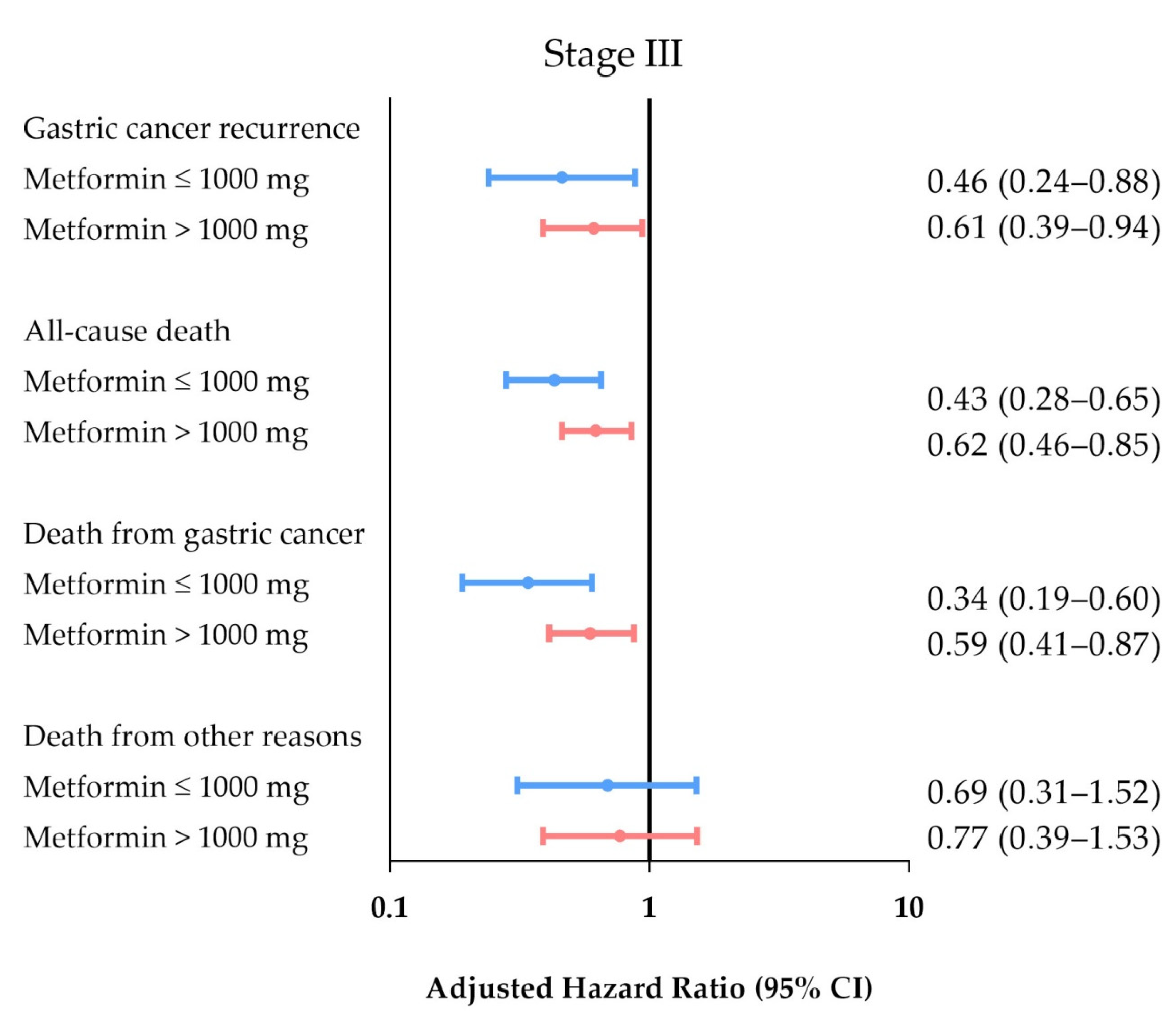
| Prognosis | Non-Metformin Users (n = 192) | Metformin ≤ 1000 mg/day (n = 32) | Metformin > 1000 mg/day (n = 51) |
|---|---|---|---|
| Gastric Cancer Recurrence | |||
| Number of Patients | 115 (61.50) a | 12 (41.38) a | 26 (55.32) a |
| Crude HR (95% CI) | 1 | 0.52 (0.30–0.90) * | 0.79 (0.53–1.18) |
| Adjusted HR (95% CI) b | 1 | 0.46 (0.24–0.88) * | 0.61 (0.39–0.94) * |
| All-Cause Death | |||
| Number of Patients | 158 (82.29) | 20 (62.50) | 40 (78.43) |
| Crude HR (95% CI) | 1 | 0.51 (0.32–0.81) * | 0.73 (0.52–1.03) |
| Adjusted HR (95% CI) b | 1 | 0.43 (0.28–0.65) * | 0.62 (0.46–0.85) * |
| Death from Gastric Cancer | |||
| Number of Patients | 113 (58.85) | 11 (34.38) | 29 (56.86) |
| Crude HR (95% CI) | 1 | 0.39 (0.21–0.73) * | 0.74 (0.49–1.11) |
| Adjusted HR (95% CI) b | 1 | 0.34 (0.19–0.60) * | 0.59 (0.41–0.87) * |
| Death from Other Reasons | |||
| Number of Patients | 45 (23.44) | 9 (28.13) | 11 (21.57) |
| Crude HR (95% CI) | 1 | 0.82 (0.40–1.68) | 0.72 (0.37–1.39) |
| Adjusted HR (95% CI) b | 1 | 0.69 (0.31–1.52) | 0.77 (0.39–1.53) |
© 2020 by the authors. Licensee MDPI, Basel, Switzerland. This article is an open access article distributed under the terms and conditions of the Creative Commons Attribution (CC BY) license (http://creativecommons.org/licenses/by/4.0/).
Share and Cite
Chung, W.-S.; Le, P.-H.; Kuo, C.-J.; Chen, T.-H.; Kuo, C.-F.; Chiou, M.-J.; Chou, W.-C.; Yeh, T.-S.; Hsu, J.-T. Impact of Metformin Use on Survival in Patients with Gastric Cancer and Diabetes Mellitus Following Gastrectomy. Cancers 2020, 12, 2013. https://doi.org/10.3390/cancers12082013
Chung W-S, Le P-H, Kuo C-J, Chen T-H, Kuo C-F, Chiou M-J, Chou W-C, Yeh T-S, Hsu J-T. Impact of Metformin Use on Survival in Patients with Gastric Cancer and Diabetes Mellitus Following Gastrectomy. Cancers. 2020; 12(8):2013. https://doi.org/10.3390/cancers12082013
Chicago/Turabian StyleChung, Wai-Shan, Po-Hsien Le, Chiang-Jung Kuo, Tsung-Hsing Chen, Chang-Fu Kuo, Meng-Jiun Chiou, Wen-Chi Chou, Ta-Sen Yeh, and Jun-Te Hsu. 2020. "Impact of Metformin Use on Survival in Patients with Gastric Cancer and Diabetes Mellitus Following Gastrectomy" Cancers 12, no. 8: 2013. https://doi.org/10.3390/cancers12082013
APA StyleChung, W.-S., Le, P.-H., Kuo, C.-J., Chen, T.-H., Kuo, C.-F., Chiou, M.-J., Chou, W.-C., Yeh, T.-S., & Hsu, J.-T. (2020). Impact of Metformin Use on Survival in Patients with Gastric Cancer and Diabetes Mellitus Following Gastrectomy. Cancers, 12(8), 2013. https://doi.org/10.3390/cancers12082013