


Abstract
Recently, Fe-based perovskite oxides, such as Ln1-xSrxFeO3-δ (Ln = La, Pr, Nd, Sm, Eu) have been proposed as potential alternative electrode materials for solid oxide fuel cells (SOFCs), due to their good phase stability, electrocatalytic activity, and low cost. This work presents the catalytic effect of BaCO3 nanoparticles modified on a cobalt-free La0.8Sr0.2FeO3-δ-Gd0.2Ce0.8O2-δ (LSF-GDC) composite cathode at an intermediate-temperature (IT)-SOFC. An electrochemical conductivity relaxation investigation (ECR) shows that the Kchem value of the modified LSF-GDC improves up to a factor of 17.47, demonstrating that the oxygen reduction process is effectively enhanced after surface impregnation by BaCO3. The area-specific resistance (ASR) of the LSF-GDC cathode, modified with 9.12 wt.% BaCO3, is 0.1 Ω.cm2 at 750 °C, which is about 2.2 times lower than that of the bare cathode (0.22 Ω.cm2). As a result, the anode-supported single cells, with the modified LSF-GDC cathode, deliver a high peak power density of 993 mW/cm2 at 750 °C, about 39.5% higher than that of the bare cell (712 mW/cm2). The single cells based on the modified cathode also displayed good performance stability for about 100 h at 700 °C. This study demonstrates the effectiveness of BaCO3 nanoparticles for improving the performance of IT-SOFC cathode materials.
1. Introduction
Energy consumption has been increasing globally, due to high population and demand growth. Fuel cells are energy conversion devices that provide enormous promise for delivering substantial environmental benefits. The solid oxide fuel cell (SOFC) is one of the most energy-efficient conversion devices: it can directly convert chemical energy stored in fuels into electricity with high conversion efficiency [1,2,3,4,5]. Unfortunately, the requisite high working temperatures hinder the commercialization of SOFC technology, by entailing various problems such as limiting the choice of materials, longer startup/shutdown times, and causing chemical and mechanical compatibility problems. Recently, extensive studies have been focused on reducing the working temperature of the SOFC to an intermediate operating temperature range (IT) [6,7]. Lowering the working temperature leads to an increase in the polarization resistance of the cathode materials. Therefore, extensive studies have been dedicated to developing cathode materials with high electrocatalysis at intermediate operating temperatures, to promote the commercialization of SOFC technology. Mixed ionic-electronic conductors (MIECs), especially cobalt-based perovskite oxides, have been widely studied as potential cathode materials of SOFCs, due to their high electronic/ionic conduction and catalytic activity [8,9,10,11]. However, cobalt-based materials suffer from poor structural stability, inadequate electrolyte compatibility, and relatively high price, which limit the practical application of SOFCs [12,13], necessitating the development of cobalt-free cathode material with high electrochemical performance in IT-SOFCs. Recently, Fe-based perovskite, such as Ln1-xSrxFeO3 (Ln = La, Pr, Nd, Sm, Eu, and Gd) [14,15,16], and Ba1-xSrxFeO3 [17,18], have shown promise as cathode materials for IT-SOFCs, owing to good catalytic activity for the ORR, high chemical stability, and comparatively low cost. Among ferrites-based materials, La1-xSrxFeO3-δ (LSF) has been extensively studied for its use as a potential cobalt-free cathode of SOFCs [19,20]. However, its performance is still inadequate compared to the requirements of cathode materials for IT-SOFCs. Consequently, several approaches have been proposed, to enhance the performance of LSF electrode materials for IT-SOFCs, such as developing composite cathodes, doping other metal ions, and surface modification [21,22,23].
Surface modification of La0.8Sr0.2FeO3-δ (LSF) cathode materials via impregnation of nanoparticles are an effective strategy for enhancing the electrochemical performance of SOFCs. For example, Qiuyun Lin, et al., [24] reported a peak power density (MPD) of 726 mW/cm2 at 750 °C on a La0.6Sr0.4CoO3-δ (LCF)-impregnated LSF-GDC cathode, much higher than that of the bare cathode (298 mW/cm2). Tao Hong, et al., [25], also reported an MPD of 0.53 mW/cm2 at 800 °C, for a BaCO3-infiltrated LSF cathode, higher than that of a cell with a bare LSF cathode (0.3 mW/cm2) and the polarization resistance was reduced to 0.84 Ω.cm2 at 700 °C. However, to the best of our knowledge, the surface modification of an LSF-GDC composite cathode via the impregnation of BaCO3 has not been reported to date.
This study reports the pronounced performance of LSF-GDC cathodes of IT-SOFCs via impregnation by BaCO3 nanoparticles. The most common BaCO3 nanoparticle was chosen as the impregnating catalyst, due to its being widely accessible at a very low cost [26]. The ECR was investigated to examine the catalytic effect of BaCO3 on the ORR kinetics of the LSF-GDC cathode. The ASR of bare and BaCO3 modified cathodes was studied, using the symmetrical cell of LSF-GDC|GDC|YSZ|GDC|LSF-GDC, and the performance of the cathodes was evaluated using an anode-supported single cell. The surface-modified LSF-GDC cathode with BaCO3 nanoparticle is expected to achieve high electrochemical performance.
2. Experimental Section
2.1. Materials Preparation
LSF and GDC powders were prepared via a modified Pechini method [27]. Stoichiometric amounts of La(NO3)3, Sr(NO3)2, and Fe(NO3)3·9H2O were dissolved in distilled water. Subsequently, citric acid was added, and the molar ratio of total metal ion to citric acid was 1:1.5. Ammonia solution was added to adjust the pH value of the solution to about 7–8, and the obtained precursor was heated in an electric oven until self-combustion was complete. The GDC powders were also prepared through the above procedure, where Gd (NO3)3 and Ce(NO3)3·6H2O were used as precursors of metal nitrates. The porous ash products were calcined at 700 and 1000 °C for 3 h, to form GDC and LSF powders with fluorite structure and perovskite structure, respectively. Finally, the as-prepared GDC and LSF powders (40:60 by weight ratio) were mixed using a ball mill to form LSF-GDC composite powders.
2.2. Cell Fabrication and Testing
Symmetrical cells of LSF- GDC|GDC|YSZ|GDC|LSF-GDC were prepared and employed for electrochemical impedance measurement. The commercially available YSZ powders were dry pressed under 250 MPa to form pellets, and then sintered at 1450 °C for 10 h. The LSF-GDC and GDC powders were mixed with 10 and 5 wt.% ethyl cellulose, respectively, in terpineol, to prepare the compounding slurries. The as-prepared GDC slurries were symmetrically spin-coated onto the YSZ pellet, and sintered at 1300 °C for 3 h. The LSF-GDC slurries were coated on the surface of the GDC layer and finally sintered at 1000 °C for 3 h, to obtain the symmetrical cell where the area of the applied electrode was about 0.567 cm2. Electrochemical impedance spectroscopy (EIS) test was carried out, using an IM6 electrochemical workstation (ZAHNER, Germany) from 0.01 Hz to 1 MHz, over a temperature range of 650–750 °C with an AC amplitude of 5 mV.
Anode-supported single cells of NiO-YSZ|YSZ|GDC|LSF-GDC were fabricated and applied for electrochemical performance measurement. The well-mixed of NiO, YSZ powder, and starch, with a 60:40:20 weight ratio respectively, were pressed to form green pellets, and sintered at 1000 °C for 3 h. The YSZ slurries were prepared using a similar method as for the buffer slurries. The electrolyte slurry was subsequently coated three times on the NiO-YSZ anode support, and each coating was heated at 450 °C for 30 min, followed by sintering at 1400 °C for 10 h. The GDC buffer layer slurries were then coated onto the YSZ surface, and sintered at 1300 °C for 3 h. Finally, the LSF-GDC slurries were coated onto the buffer layer’s surface and sintered at 1000 °C for 3 h. The fuel cells’ performance was measured from 650 to 750 °C, with humidified H2 as fuel and ambient air as oxidant.
An appropriate amount of barium acetate (Ba (OAc)2) was dissolved in a mixed solvent (distilled water 1:1 ethanol) to prepare 0.3 mol. L−1 Ba (OAc)2 as a precursor solution for the impregnation process. The as-prepared Ba (OAc)2 precursor solution was dropped onto the surface of the LSF-GDC using a pipette, and dried in a vacuum chamber, then heated at 800 °C for 2 h in air. The loading of the BaCO3 was estimated by measuring the weight change of the cathode after and before each impregnation process.
2.3. Characterizations
The thermal decomposition temperatures of the Ba(OAc)2 were characterized using a thermo-gravimetric analysis instrument. The measurement was carried out in the air atmospheres from room temperature to 800 °C, with a heating rate of 10 min−1. The crystal structures of the synthesized sample were analyzed by X-ray diffraction (XRD, DX-2800), using Cu-Ka radiation with a 2θ range from 20° to 80°. The microstructure and elemental mapping analysis of the sample were performed using a Gemini 300, field emission scanning electron microscope (FESEM), and energy-dispersive X-ray spectroscopy (EDS, Oxford), respectively. For the electrical conductivity relaxation study, the LSF-GDC powders were pressed at 300 MPa, followed by sintering at 1400 °C for 5 h, to obtain dense LSF-GDC samples with approximate dimensions of 1.2 mm × 4.8 mm × 10 mm. The electrical conductivity relaxation test was conducted using a dc four-probe technique. While the oxygen partial pressure shifted from PO2 = 0.2 bar (PO2 = 0.2 and PN2 = 0.0) to PO2 = 0.1 bar (PO2 = 0.1 and PN2 = 0.1), the change in electrical conductivity as function time was recorded. The surface exchange coefficient (kchem) was estimated by fitting electrical conductivity relaxation curves.
3. Results and Discussion
3.1. Thermal Analysis and Chemical Compatibility
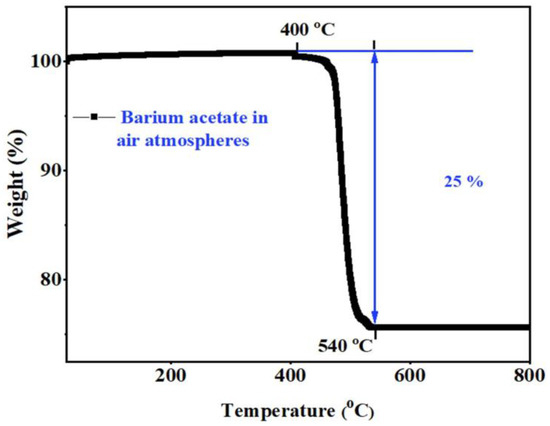
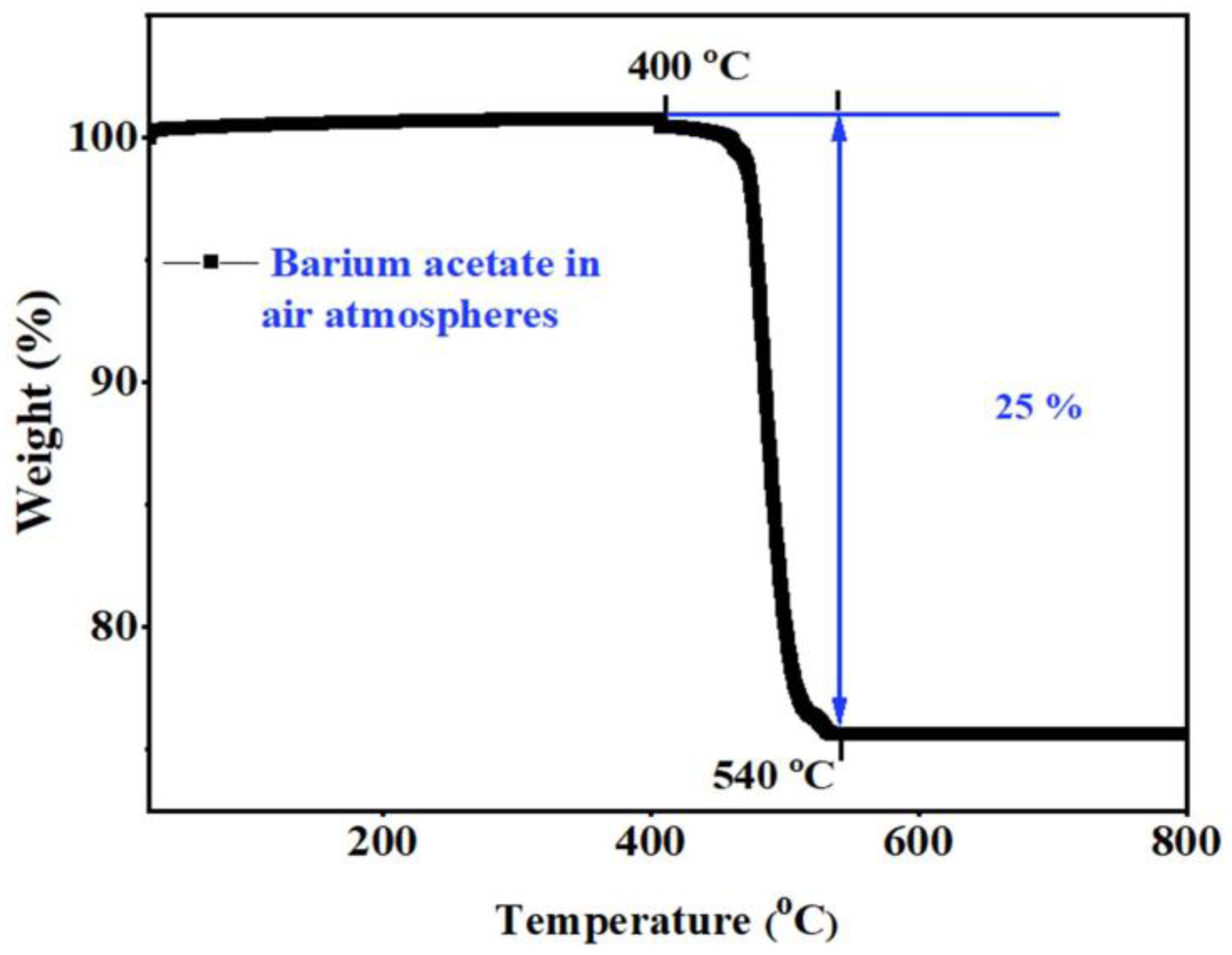
Figure 1 shows the thermal decomposition of Ba(OAc)2 in the temperature range of 25–800 °C in air. The weight loss started from 400 °C up to 534 °C; approximately 25% weight loss was recorded. The weight loss may have corresponded to the removal of moisture and carbon dioxide. The weight loss percentage was close to the theoretical value of the decomposition reaction of Ba(Ac)2 = BaCO3 + CO2 + H2O [28,29]. Furthermore, no extra weight loss was observed between 534 and 800 °C, and this may have been associated with the formation of BaCO3, which was stable in the operating temperature range.
Figure 1.
Thermogravimetric curves of Ba(OAc)2.
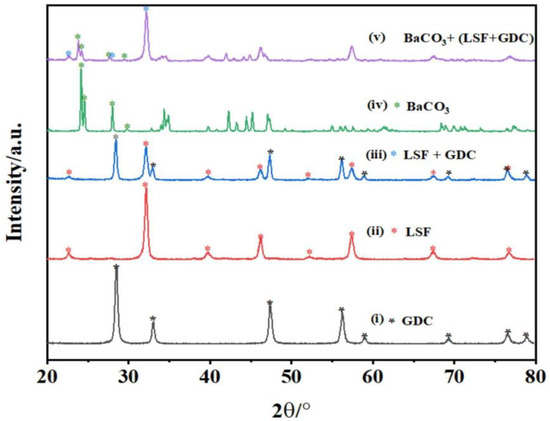
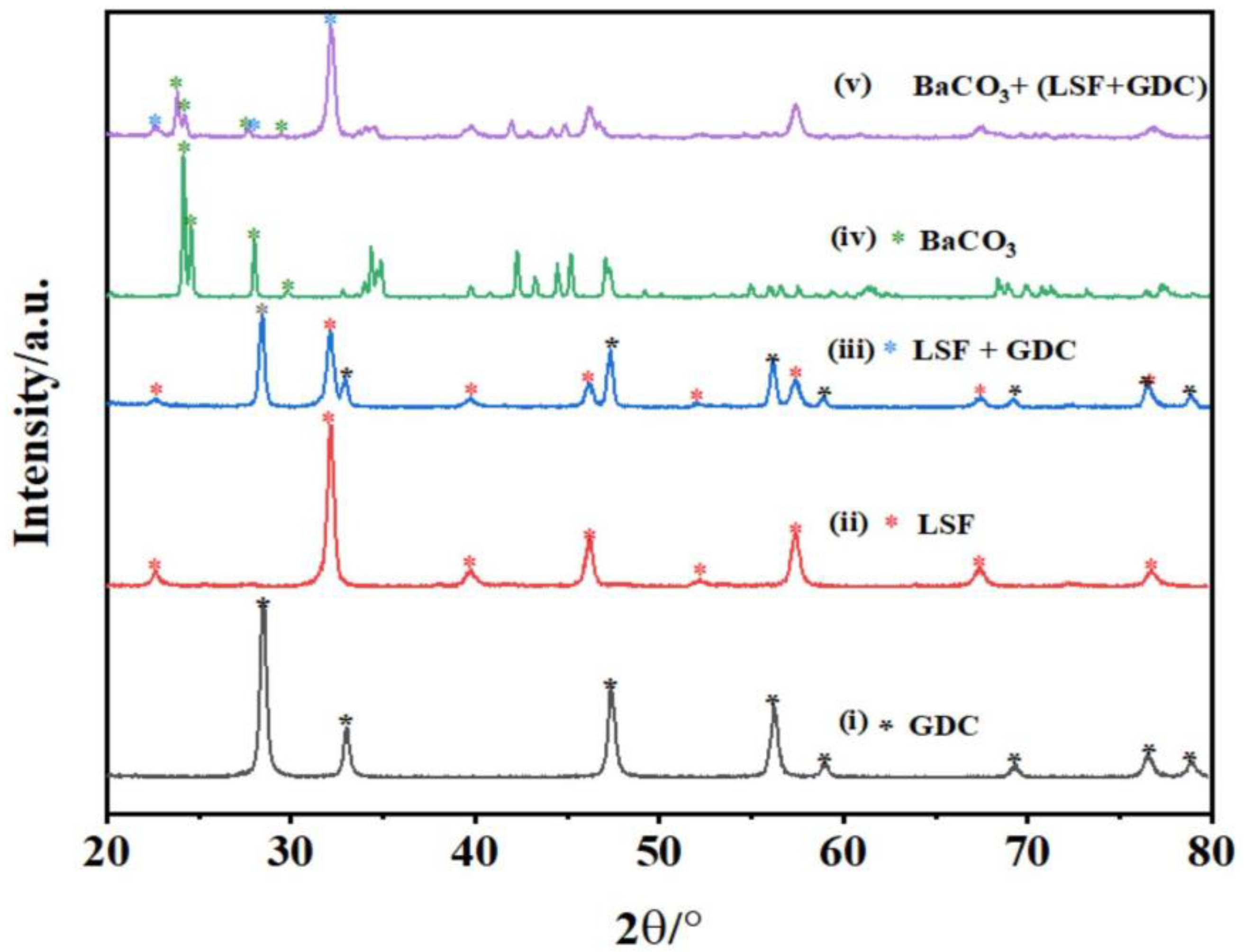
The XRD patterns of the powders and the chemical compatibility of the mixed powders of the LSF + GDC and BaCO3 + (LSF + GDC) are presented in Figure 2. After calcination of the GDC powder at 700 °C in air, the XRD patterns exhibited a cubic fluorite phase (PDF# 50-0201), and the refined lattice parameters were a = b = c 5.411 Å, with the space group Fm-3 m, as shown in Figure 2i. Figure 2ii displays the XRD patterns of LSF powders calcined at 1000 °C. As is shown, all peaks can be indexed in an orthorhombic perovskite structure (PDF # 35-1480), and the refined lattice parameters were a = 5.532 Å, b = 5.553 Å, c = 7.835 Å, with the space group Pbn (62). The chemical compatibility between LSF and GDC was analyzed by mixing LSF and GDC powders at a weight ratio of 1:1 and heating at 1000 °C for 5 h in the air. The diffraction peaks of the LSF + GDC composite powder show that no obvious solid-state reaction was observed between LSF and GDC, as shown in Figure 2iii. Barium acetate (Ba(OAc)2 was thermally heated at 800 °C for 2 h, and this led to the formation of orthorhombic structured BaCO3 with a space group of Pmcn (62) as shown in Figure 2iv. Next, (LSF + GDC) and Ba (OAc)2 powders were mixed (50:50 wt.% in weight ratio) and co-heated at 800 °C for 5 h in air, to analyze the chemical compatibility between the composite cathode and BaCO3 powders. As shown in Figure 2v, the peaks belong to either BaCO3 or (LSF + GDC), and this could indicate that Ba (OAc)2 thermally decomposes into BaCO3 in the presence of (LSF + GDC), without any solid-state reaction being observed between the two-phase. These results also indicate that a BaCO3-impregnated (LSF + GDC) cathode, can be successfully prepared by the impregnation of Ba (OAc)2, and could be stable during the conduction testing.
Figure 2.
XRD patterns of the LSF and GDC powders, and the composite of LSF + GDC and BaCO3 + (LSF + GDC).
3.2. Microstructure Analysis
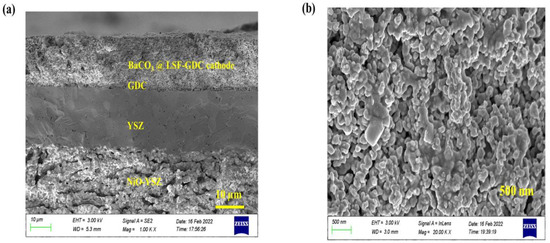
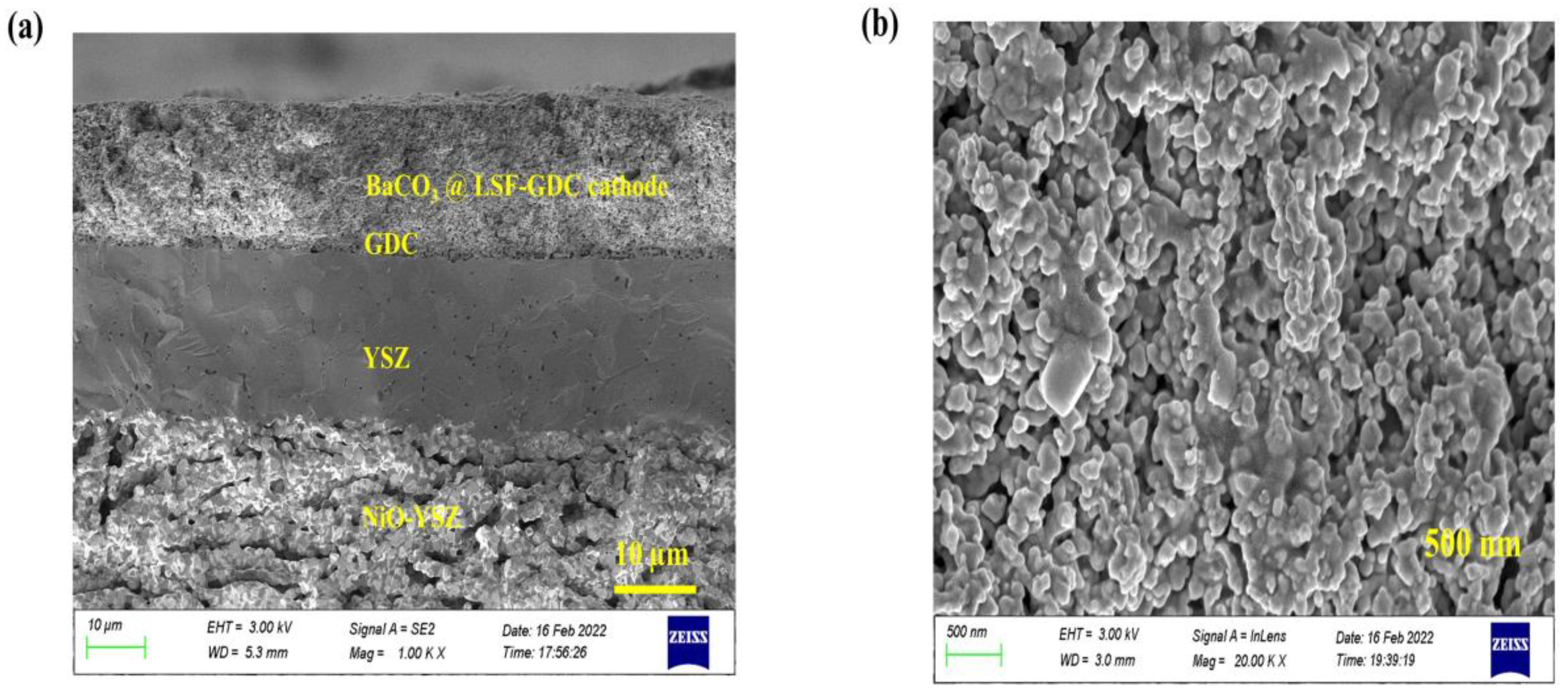
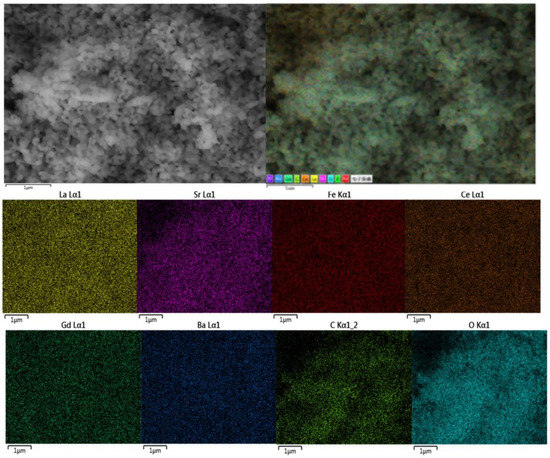
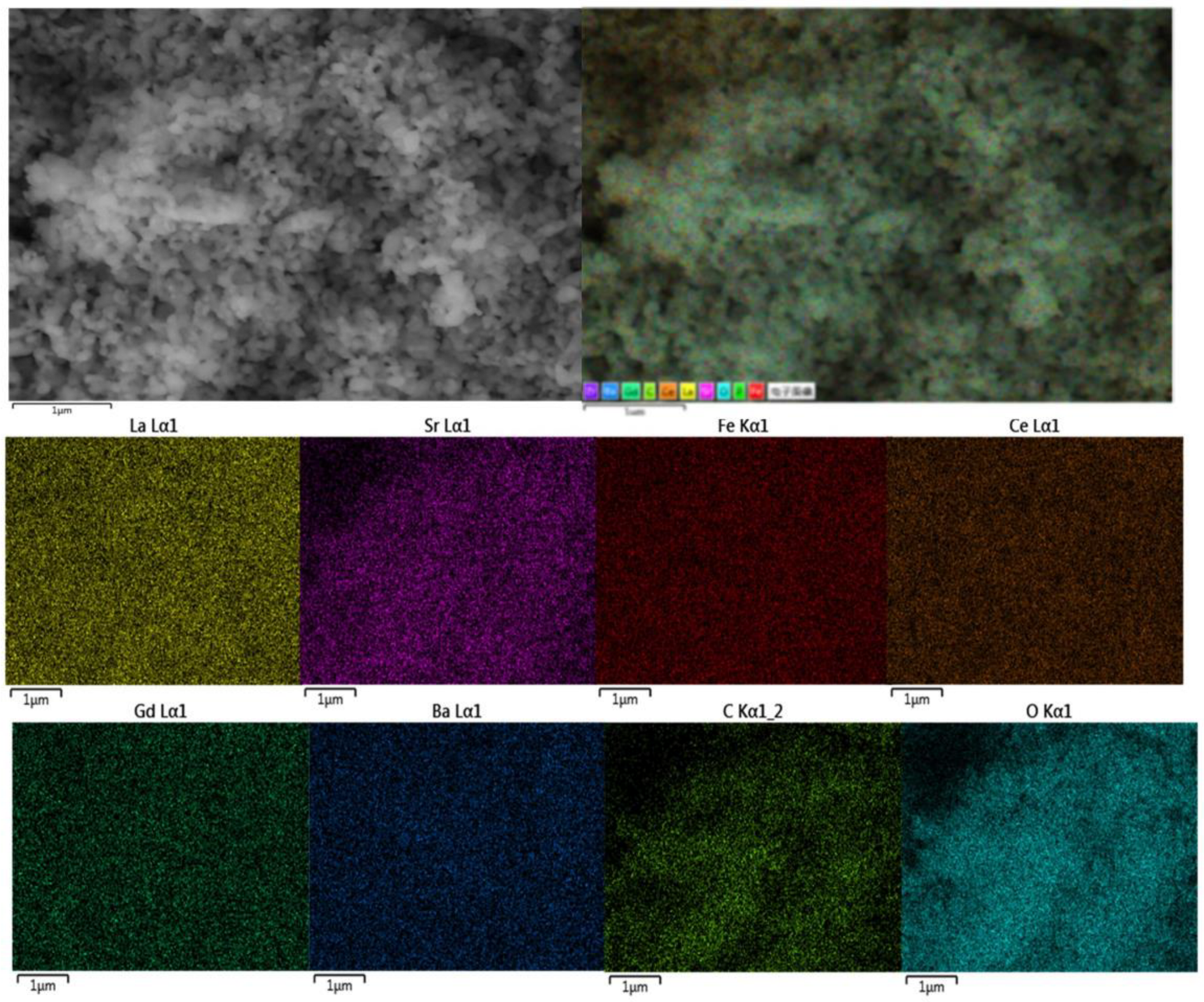
Figure 3a shows a typical SEM image of anode-support single cells with thicknesses of electrolyte (YSZ) ~18 μm and buffer layer (GDC) ~2 µm. The YSZ electrolyte layer has a suitable density and is well-adhered to both the GDC layer and NiO-YSZ anode supports, which effectively block the gas component diffusion to the opposite electrode. The microstructure of the targeted cathodes attaches well to the buffer layer (GDC) surface. The BaCO3 nanoparticles are distributed on the surface of the cathode; which can be seen in Figure 3b. The porosity of the pre-existing cathode remains unchanged. The element mapping image of an impregnated LSF-GDC cathode was obtained using EDS, as shown in Figure 4. The EDS results show that the elements including La, Sr, Fe, Ce, Gd, Ba, C, and O are uniformly distributed in the impregnated cathode. The presence of Ba and C, within the surface of the cathode, suggests that BaCO3 was successfully impregnated on the surface of the LSF-GDC composite cathode.
Figure 3.
SEM images of (a) NiO-YSZ|YSZ|GDC|LSF-GDC and (b) BaCO3 nanoparticles modified LSF-GDC cathode.
Figure 4.
EDS elemental mappings of the modified LSF-GDC.
3.3. Electrochemical Activity
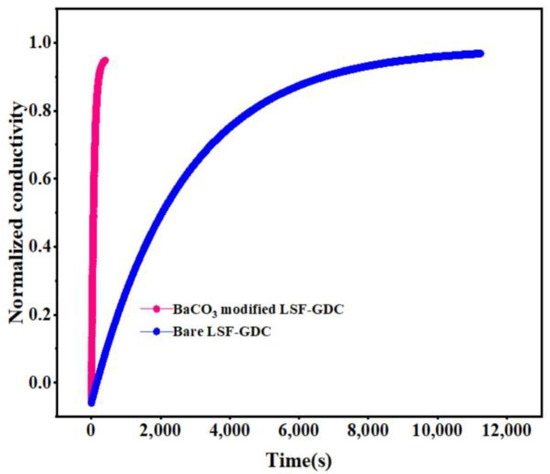
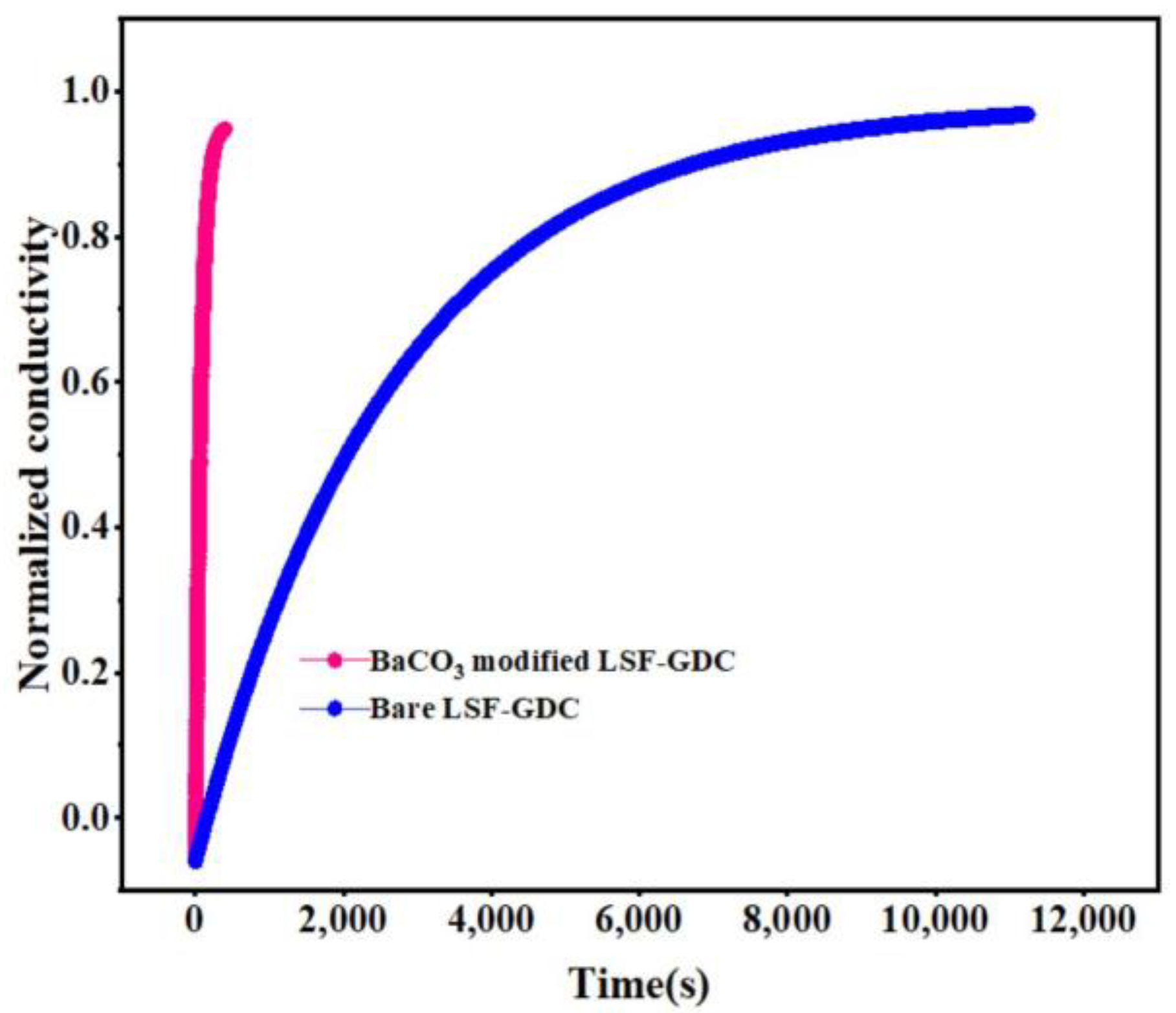
Abrupt oxygen partial pressure causes oxygen incorporation within the cathode materials and in turn, changes the cathode materials’ conductivity. The oxygen surface exchange capacity of cathode materials suggests the adsorption and dissociation rate of the oxygen, which affects the reaction kinetics of the materials. Figure 5 shows the normalized conductivity response curves of the bare LSF-GDC and BaCO3-modified LSF-GDC samples after abruptly switching the oxygen partial pressure (PO2) from 0.21 to 0.1 atm at 750 °C. The relaxation time, to reach re-equilibrium, for 0.65 mg/cm2 BaCO3-modified LSF-GDC after PO2 abruptly switching, was ~400 s, which is 27.5 times faster than the bare LSF-GDC (11,000 s). The faster re-equilibrium time may have been attributable to the enhancement of the surface oxygen exchange process since the bulk diffusion rate should have been the same for the two samples (bare and surface-modified); as a result, the oxygen surface exchange coefficient (Kchem) value of the modified LSF-GDC was 2.194 × 10⁻⁴ cms−1. However, the Kchem value of the bare sample was 1.256 × 10⁻⁵ cms−1. The Kchem value of the modified LSF-GDC improved up to a factor of 17.47, demonstrating that the oxygen reduction process was effectively enhanced after impregnation by the BaCO3 nanoparticles, and this concurred with the EIS values. The reduced re-equilibrium time and enhanced oxygen surface exchange coefficient may have been associated with the synergistic oxygen reduction reaction catalytic activity of BaCO3 nanoparticles. The Kchem value modified LSF-GDC was comparable with previously reported LSF/LSCF materials modified by SrCO3, CaO, MgO, and BaCO3, as shown in Table 1. However, a further theoretical study is required, to reveal the enhancement mechanism.
Figure 5.
The electrical conductivity relaxation responses curves of bare LSF-GDC and BaCO3-modified LSF-GDC bars at 750 °C.
Table 1.
Comparison of the Kchem (cm s−1) of LSF/LSCF modified with alkali earth metal compounds.
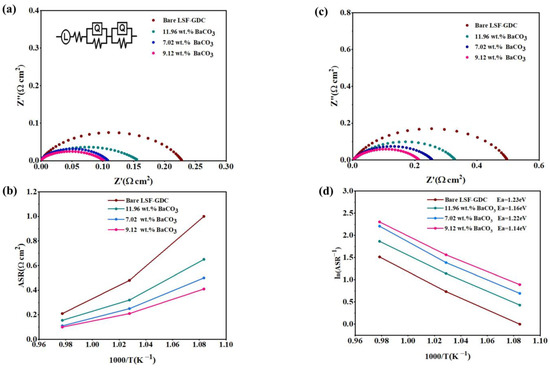
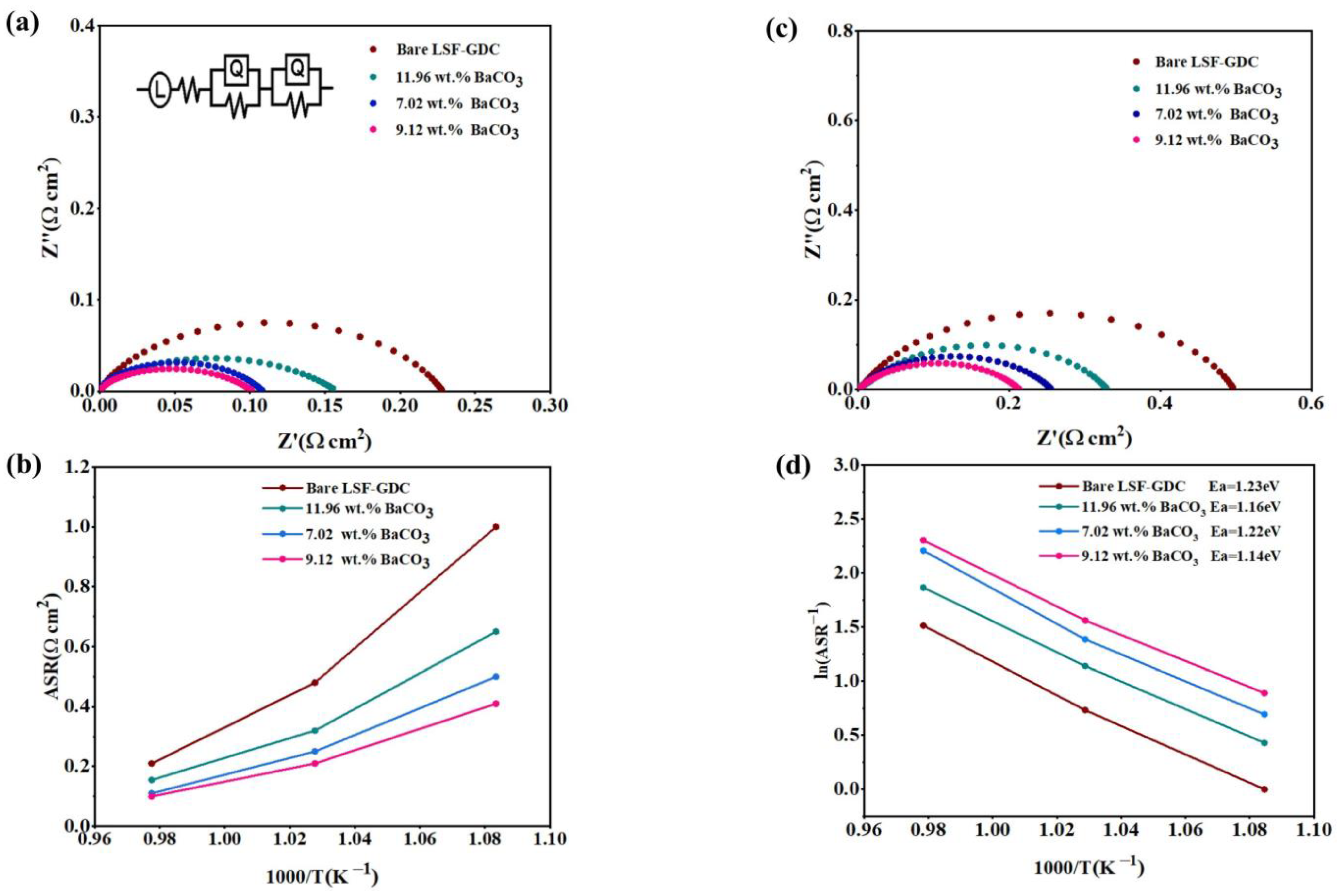
The EIS spectra of the symmetric cell LSC-GDC|YSZ|LSF-GDC with different loadings of BaCO3 are shown in Figure 6. For simple analysis, the ohmic impedances that come from the electrolyte and silver wires were subtracted. The experimental data were fitted by the electrical equivalent circuit model of L–Ro-(RHQH)-(RLQL), where, L, Ro, RHQH, and RLQL, represent inductance, ohmic impedance, a high frequency, and low-frequency arc, respectively. The area-specific resistance (ASR) of the cathode was estimated from the difference between the total impedance of the cell and the ohmic impedance. The ASR values at 750 °C were determined as 0.31, 0.15, 0.11, and 0.1 Ω.cm2 at 750 °C for bare LSF-GDC, and 11.96, 7.02, and 9.12 wt.% BaCO3, respectively, as presented in Figure 6a. The lowest ASR values were attained with optimum loading of 9.12 wt.% BaCO3 at different temperatures. The ASR values decreased from 0.48 to 0.21 Ω.cm2 at 700 °C, and 0.31 to 0.1 at 750 °C, when 9.12 wt.% BaCO3 nanoparticles were loaded. However, when the loading further increased to 11.96 wt.% BaCO3, the ASR slightly increased to 0.15 Ω.cm2: this may have been associated with the blockage of the active pore of the cathode with inert BaCO3 nanoparticles, which led to a delay in the diffusion of oxygen to the active area. The enhancement performance of the LSF-GDC cathode may have been associated with the accelerated oxygen surface exchange process after the impregnation of the optimum BaCO3. Figure 6d demonstrates the Arrhenius plot for the ASR values of the different BaCO3 nanoparticles’ loading and the corresponding activation energy values. The activation energies (Ea), calculated from the Arrhenius plots, were 1.228, 1.163, 1.226, and 1.143 eV for bare LSF-GDC, and 11.96, 7.02, and 9.12 wt.% BaCO3, respectively. The lowest activation energy was achieved for 9.12 wt.% BaCO3, indicating that the oxygen reduction process was effectively enhanced with the optimum loading of BaCO3 nanoparticles.
Figure 6.
Comparison of EIS spectra for different loadings of BaCO3 on LSF-GDC at (a) 750 °C, (b) 700 °C, (c) ASR, as a function of temperature, and (d) corresponding Arrhenius plots of ASR.
3.4. Cell Performance
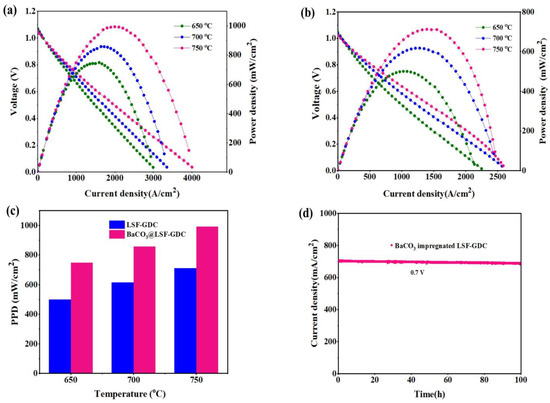
Figure 7 displays the performance of a single cell measured between 650 and 750 °C. The open-circuit voltage (OCV) varied from ~1.031 to ~1.047 V, close to the theoretical value, suggesting that the YSZ electrolyte was completely dense. The peak power densities (PPD), with an 8.21 wt.% BaCO3-modified LSF-GDC cathode, were 993, 858, and 748 mW/cm2 at 750, 700, and 650 °C, respectively, as shown in Figure 7a. The peak power densities (PPD) of a single cell with a bare LSF-GDC cathode were 712, 617, and 501 mW/cm2 at 750, 700, and 650 °C, respectively, as displayed in Figure 7b. Comparatively, the peak power densities (PPD) of the modified cathode were much higher than that of the bare cathode, as shown in Figure 7c. For example, the peak power densities at 750 °C were 712 and 993 mW/cm2 for the bare and for the modified LSF-GDC, respectively, enhanced by 39.5% via the impregnation of BaCO3 nanoparticles. This enhancement was significantly higher compared to the previous report on anode-supported cells based on LSF/LSF-GDC cathodes [22,25,33]. Figure 7d displays the stability of NiO-YSZ-anode-supported SOFC with modified LSF-GDC cathode under a fixed voltage of 0.7 V. It was found that the measured current density of the single-cell was kept stable at ~700 mA/cm2, indicating excellent performance stability for about 100 h at 700 °C.
Figure 7.
Performance of anode-supported cell NiO-YSZ|YSZ|GDC|LSF-GDC with (a) 8.21 wt.% BaCO3-modified LSF-GDC cathode, (b) bare LSF-GDC cathode, (c) comparative peak power densities (PPD), and (d) stability test at 700 °C, under fixed voltage (0.7 V).
Recently, the La0.6Sr0.4Co0.2Fe0.8O3-δ-Gd0.2Ce0.8O2-δ composite cathode has been widely studied as the state-of-the-art composite cathode material of SOFC at reduced temperature, due to its high electrical and satisfactory ionic conductivities properties.
Comparatively speaking, the peak power densities (PPD) of a single ell with BaCO3 modified LSF-GDC are comparable with the state-of-the-art LSCF-GDC composite cathode at 750 and 700 °C, as shown in Table 2. At 650 °C, the performance observed in this study was superior to that of the LSCF-GDC composite cathode. The results indicate the vital role of the impregnation of BaCO3 nanoparticles in enhancing the performance of SOFC cathode materials at a reduced temperature.
Table 2.
Comparison of the peak power densities (mW/cm2) of BaCO3-modified LSF-GDC composite cathode with state-of-the-art LSCFGDC composite cathode.
Recent studies have shown that surface modification of cathode materials with alkali earth metal compounds greatly enhances electrochemical activity [30,31,32]. The most common BaCO3 nanoparticle has demonstrated outstanding catalytic activity toward oxygen reduction reaction for IT-SOFCs [26]. LSF-GDC modified by 0.65 mg/cm2 BaCO3 could enhance the oxygen exchange coefficient from 1.256 10−5 to 2.194 10−4 cms−1 at 750 °C. An electrochemical conductivity relaxation investigation (ECR) showed that the Kchem value of the impregnated LSF-GDC was improved up to a factor of 17.47, demonstrating that the oxygen reduction process is effectively enhanced after impregnation by BaCO3. The pronounced performance of the LSF-GDC cathode could be attributed to the enhanced kinetics. A theoretic study is required to reveal the enhancement mechanism. Furthermore, our studies can be extended to low-temperature solid-oxide fuel cells.
4. Conclusions
In summary, the impregnation of barium acetate (Ba(OAc)2) process results in BaCO3 nanoparticles on the LSF-GDC surface, with no solid-state reaction being observed between the two phases. The modified LSF-GDC sample with 0.65 mg/cm2 BaCO3 enhanced the oxygen surface exchange process kinetics values (Kchem) from 1.256 10−5 to 2.194 10−4 cms−1 at 750 °C. As compared to the bare LSF-GDC cathode, the surface-modified LSF-GDC cathode significantly enhanced the catalytic activity, as proved by lower ASRs and higher power densities. The improvement in electrochemical performance may be attributable to the accelerated oxygen surface exchange process through BaCO3 impregnation. Furthermore, the single cells based on the modified cathode displayed excellent performance stability under a fixed voltage of 0.7 V for more than 100 h at 700 °C. The performance of the single-cell was comparable to the most extensively studied LSCF-GDC composite cathode of IT-SOFC. The electrochemical results reported here indicate that such a simple and cost-effective strategy is a potential approach to improving the performance of IT-SOFC cathodes, although further theoretic study is still required, to reveal the detailed mechanism for the electrochemical activity of BaCO3 nanoparticles for the oxygen reduction reaction.
Author Contributions
Conceptualization, B.L. and H.G.D.; methodology, analysis, and validation, H.G.D., Y.Y., B.S.T., Q.Y., K.S., S.Z., D.T., Y.C. and B.L.; writing—original draft preparation, H.G.D.; writing—review and editing, H.G.D., T.L. and B.L.; supervision, B.L. All authors have read and agreed to the published version of the manuscript.
Funding
This research was funded by the Fundamental Research Funds for the Central Universities of the University of Electronic Science and Technology of China (A03018023601020), the Key Research and Development Project of Anhui Province (201904a07020002), and the Anhui Provincial Department of Education (gxbjZD2021074).
Institutional Review Board Statement
Not applicable.
Data Availability Statement
Not applicable.
Conflicts of Interest
The authors declare no conflict of interest.
References
- Li, M.; Sun, Z.; Yang, W.; Hong, T.; Zhu, Z.; Zhang, Y.; Wu, X.; Xia, C. Mechanism for the enhanced oxygen reduction reaction of La0.6 Sr0.4Co0.2Fe0.8O3-δ by strontium carbonate. Phys. Chem. Chem. 2017, 19, 503–509. [Google Scholar]
- Wachsman, E.D.; Lee, K.T. Lowering the temperature of solid oxide fuel cells. Science 2011, 334, 935–939. [Google Scholar] [CrossRef] [Scilit] [PubMed]
- Tung, T.T.; Mouss, M.; Tripathi, K.M.; Kim, T.; Nine, M.J.; Nanjundan, A.K.; Dubal, D.; Losic, D. Coupling graphene microribbons with carbon nanofibers: New carbon hybrids for high-performing lithium and potassium-ion batteries. Sustain. Mater. Technol. 2022, 32, e00393. [Google Scholar] [CrossRef] [Scilit]
- Jung, S.H.; Huong, P.T.; Sahani, S.; Tripathi, K.M.; Park, B.J.; Han, Y.H.; Kim, T.Y. Biomass-Derived Graphene-Based Materials Embedded with Onion-Like Carbons for High Power Supercapacitors. Electrochem. Soc. 2022, 169, 010509. [Google Scholar] [CrossRef] [Scilit]
- Dhiman, N.; Pradhan, D.; Mohanty, P. Heteroatom (N and P) enriched nanoporous carbon as an efficient electrocatalyst for the hydrazine oxidation reaction. Fuel 2022, 314, 122722. [Google Scholar] [CrossRef] [Scilit]
- Tsipis, E.V.; Kharton, V.V. Electrode materials and reaction mechanisms in solid oxide fuel cells: A brief review. J. Solid State Electrochem. 2008, 12, 1367–1391. [Google Scholar] [CrossRef] [Scilit]
- Xia, C.; Liu, M. Novel cathodes for low-temperature solid oxide fuel cells. Adv. Mater. 2002, 14, 521–523. [Google Scholar] [CrossRef]
- Gao, Z.; Mogni, L.V.; Miller, E.C.; Railsback, J.G.; Barnett, S.A. A perspective on low-temperature solid oxide fuel cells. Energy Environ. Sci. 2016, 9, 1602–1644. [Google Scholar] [CrossRef] [Scilit]
- Dyck, C.; Yu, Z.; Krstic, V. Thermal expansion matching of Gd1−xSrxCoO3−δ composite cathodes to Ce0.8Gd0.2O1.95 IT-SOFC electrolytes. Solid State Ion. 2004, 171, 17–23. [Google Scholar] [CrossRef] [Scilit]
- Mastin, J.; Einarsrud, M.-A.; Grande, T. Structural and Thermal Properties of La1-xSrxCoO3-δ. Chem. Mate. 2006, 18, 6047–6053. [Google Scholar] [CrossRef] [Scilit]
- Lee, K.; Manthiram, A. LaSr3Fe3-yCoyO10-δ (0 ≤ y ≤ 1.5) Intergrowth Oxide Cathodes for Intermediate Temperature Solid Oxide Fuel Cells. Chem. Mater. 2006, 18, 1621–1626. [Google Scholar] [CrossRef] [Scilit]
- Ji, H.-I.; Hwang, J.; Yoon, K.J.; Son, J.-W.; Kim, B.-K.; Lee, H.-W.; Lee, J.-H. Enhanced oxygen diffusion in epitaxial lanthanum–strontium–cobaltite thin film cathodes for micro solid oxide fuel cells. Energy Environ. Sci. 2013, 6, 116–120. [Google Scholar] [CrossRef] [Scilit]
- Li, Y.; Zhang, W.; Zheng, Y.; Chen, J.; Yu, B.; Chen, Y.; Liu, M. Controlling cation segregation in perovskite-based electrodes for high electro-catalytic activity and durability. Chem. Soc. Rev. 2017, 46, 6345–6378. [Google Scholar] [CrossRef] [Scilit] [PubMed]
- Yokokawa, H.; Tu, H.; Iwanschitz, B.; Mai, A. Fundamental mechanisms limiting solid oxide fuel cell durability. J. Power Sources 2008, 182, 400–412. [Google Scholar] [CrossRef] [Scilit]
- Baharuddin, N.A.; Muchtar, A.; Somalu, M.R. Short review on cobalt-free cathodes for solid oxide fuel cells. J. Hydrog. Energy 2017, 42, 9149–9155. [Google Scholar] [CrossRef] [Scilit]
- Ren, Y.; Küngas, R.; Gorte, R.J.; Deng, C. The effect of A-site cation (Ln = La, Pr, Sm) on the crystal structure, conductivity, and oxygen reduction properties of Sr-doped ferrite perovskites. Solid State Ion. 2012, 212, 47–54. [Google Scholar] [CrossRef] [Scilit]
- Fu, X.; Liu, M.; Meng, X.; Lü, S.; Wang, D.; Zhang, Y.; Liu, H.; Song, M.; Li, Z.; Wang, L. Cobalt-free perovskite Ln0.5Sr0.5Fe0.8Cu0.2O3-δ (Ln = Pr, Nd, Sm, and Gd) as cathode for the intermediate-temperature solid oxide fuel cell. Ionics 2020, 26, 1285–1295. [Google Scholar] [CrossRef] [Scilit]
- Vázquez, S.; Basbus, J.; Soldati, A.L.; Napolitano, F.; Serquis, A.; Suescun, L. Effect of the symmetric cell preparation temperature on the activity of Ba0.5Sr0.5Fe0.8Cu0.2O3-δ as cathode for intermediate temperature Solid Oxide Fuel Cells. J. Power Sources. 2015, 274, 318–323. [Google Scholar] [CrossRef] [Scilit]
- Long, W.; Xu, H.; He, T. Preparation and electrochemical performance of cobalt-free cathode material Ba0.5Sr0.5Fe0.9Nb0.1O3-δ for intermediate-temperature solid oxide fuel cells. Chem. Res. Chin. Univ. 2014, 30, 806–810. [Google Scholar] [CrossRef] [Scilit]
- Hansen, K.K. Evaluation of based SOFC cathodes using cone-shaped electrodes and EIS. Solid State Ion. 2020, 344, 115096. [Google Scholar] [CrossRef] [Scilit]
- Paiva, J.A.E.; Daza, P.C.C.; Rodrigues, F.A.; Ortiz-Mosquera, J.F.; da Silva, C.R.M.; Munoz, M.M.; Meneses, R.A.M. Synthesis and electrical properties of strontium-doped lanthanum ferrite with perovskite-type structure. Ceram. Int. 2020, 46, 18419–18427. [Google Scholar] [CrossRef] [Scilit]
- Tatko, M.; Mosiałek, M.; Kędra, A.; Bielańska, E.; Ruggiero-Mikołajczyk, M.; Nowak, P. Thermal shock resistant composite cathode material Sm0.5Sr0.5CoO3–δ–La0.6Sr0.4FeO3–δ for solid oxide fuel cells. J. Solid State Electrochem. 2016, 20, 143–151. [Google Scholar] [CrossRef] [Scilit]
- Zhang, X.; Li, J.; Wang, L.; Guo, X.; Sun, H.; Zhang, H.; Hu, Q. Improved electrochemical performance of Bi-doped La0.8Sr0.2FeO3-δ nanofiber cathode for IT-SOFCs via electrospinning. Ceram. Int. 2021, 47, 534–540. [Google Scholar] [CrossRef] [Scilit]
- Khoshkalam, M.; Tripković, Ð.; Tong, X.; Faghihi-Sani, M.A.; Chen, M.; Hendriksen, P.V. Improving oxygen incorporation rate on (La0.6Sr0.4)0.98FeO3-δ via Pr2Ni1-xCuxO4+δ surface decoration. J. Power Sources 2020, 457, 228035. [Google Scholar] [CrossRef] [Scilit]
- Lin, Q.; Lin, J.; Liu, T.; Xia, C.; Chen, C. Solid oxide fuel cells supported on cathodes with large straight open pores and catalyst-decorated surfaces. Solid State Ion. 2018, 323, 130–135. [Google Scholar] [CrossRef] [Scilit]
- Hong, T.; Chen, F.; Xia, C. Barium carbonate nanoparticle to enhance oxygen reduction activity of strontium doped lanthanum ferrite for solid oxide fuel cell. J. Power Sources 2015, 278, 741–750. [Google Scholar] [CrossRef] [Scilit]
- Hong, T.; Brinkman, K.S.; Xia, C. Barium Carbonate Nanoparticles as Synergistic Catalysts for the Oxygen Reduction Reaction on La0.6Sr0.4Co0.2Fe0.8O3-δ Solid-Oxide Fuel Cell Cathodes. Chem. Electro. Chem. 2016, 3, 805–813. [Google Scholar]
- Pechini, M.P. Method of preparing lead and alkaline earth titanates and niobates and coating method using the same to form a capacitor. U.S. Patent 3,330,697, 26 August 1967. [Google Scholar]
- Hong, T.; Lee, S.; Ohodnicki, P.; Brinkman, K. A highly scalable spray coating technique for electrode infiltration: Barium carbonate infiltrated La0.6Sr0.4Co0.2Fe0.8O3-δ perovskite structured electrocatalyst with demonstrated long-term durability. Int. J. Hydrog. Energy 2017, 42, 24978–24988. [Google Scholar] [CrossRef] [Scilit]
- Leng, Y.; Chan, S.H.; Liu, Q. Development of LSCF-GDC composite cathodes for low-temperature solid oxide fuel cells with thin-film GDC electrolyte. Int. J. Hydrog. Energy 2008, 33, 3808–3817. [Google Scholar] [CrossRef] [Scilit]
- Yang, Y.; Li, M.; Ren, Y.; Li, Y.; Xia, C. Magnesium oxide as a synergistic catalyst for oxygen reduction reaction on strontium doped lanthanum cobalt ferrite. Int. J. Hydrog. Energy 2018, 43, 3797–3802. [Google Scholar] [CrossRef] [Scilit]
- Zhang, L.; Hong, T.; Li, Y.; Xia, C. CaO effect on the electrochemical performance of lanthanum strontium cobalt ferrite cathode for the intermediate-temperature solid oxide fuel cell. Int. J. Hydrog. Energy 2017, 42, 17242–17250. [Google Scholar] [CrossRef] [Scilit]
- Hwang, U.-Y.; Park, H.-S.; Koo, K.-K. The behavior of barium acetate and titanium isopropoxide during the formation of crystalline barium titanate. Ind. Eng. Chem. Res. 2004, 43, 728–734. [Google Scholar] [CrossRef] [Scilit]
- Guan, C.; Wang, Y.; Chen, K.; Xiao, G.; Lin, X.; Zhou, J.; Song, S.; Wang, J.-Q.; Zhu, Z.; Zhou, X.-D. Molten salt synthesis of Nb-doped (La, Sr) FeO3 as the oxygen electrode for reversible solid oxide cells. Mater. Lett. 2019, 245, 114–117. [Google Scholar] [CrossRef] [Scilit]
- Gao, Z.; Barnett, S.A. Reduced-Temperature Firing of Anode Supported Solid Oxide Fuel Cells. ECS Trans. 2013, 58, 231. [Google Scholar] [CrossRef] [Scilit]
- Von Dollen, P.; Barnett, S. A Study of Screen Printed Yttria Stabilized Zirconia Layers for Solid Oxide Fuel Cells. J. Am. Ceram Soc. 2005, 88, 3361–3368. [Google Scholar] [CrossRef] [Scilit]
- Choi, M.-B.; Singh, B.; Wachsman, E.D.; Song, S.-J. Performance of La0.1Sr0.9Co0.8Fe0.2O3-δ and La0.1Sr0.9Co0.8Fe0.2O3-δ-Ce0.9Gd0.1O2 Oxygen Electrodes with Ce0.9Gd0.1O2 Barrier Layer in Reversible Solid Oxide Fuel Cells. J. Power Sources 2013, 239, 361–373. [Google Scholar] [CrossRef] [Scilit]
- Kilner, J.A.; Burriel, M. Materials for intermediate-temperature solid-oxide fuel cells, Annu. Rev. Mater. Res. 2014, 44, 365–393. [Google Scholar] [CrossRef] [Scilit]

Publisher’s Note: MDPI stays neutral with regard to jurisdictional claims in published maps and institutional affiliations. |
© 2022 by the authors. Licensee MDPI, Basel, Switzerland. This article is an open access article distributed under the terms and conditions of the Creative Commons Attribution (CC BY) license (https://creativecommons.org/licenses/by/4.0/).