Botulinum Toxin Type A for the Prevention of Migraines: An Umbrella Review of Systematic Reviews

 , , , , , ,
  ,
,  , and
, and
Abstract
1. Introduction
2. Results
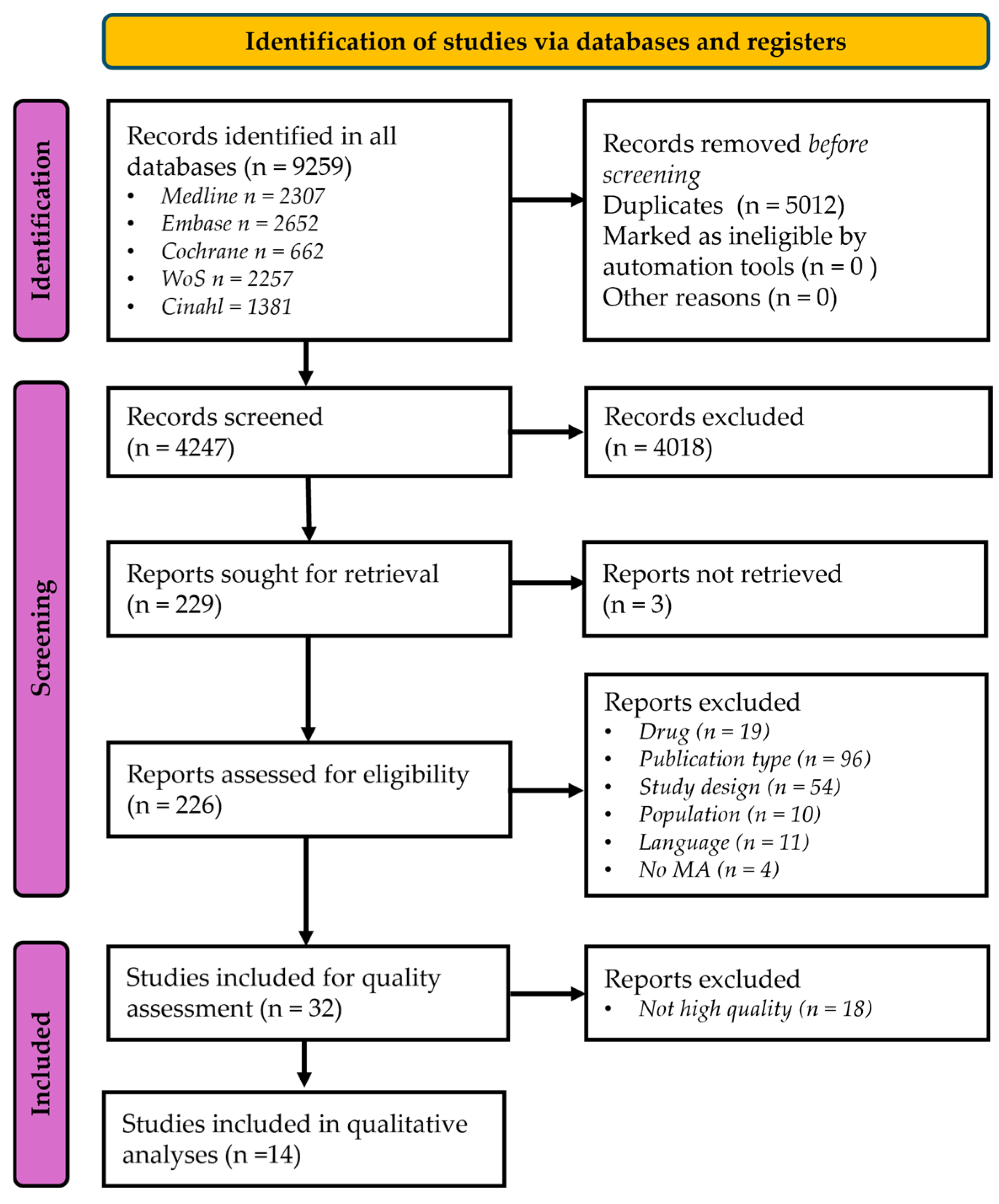
2.1. Study Selection
2.2. Study Characteristics
2.3. Doses and Injection Protocols
2.4. Headache Frequency
2.5. Headache Severity
2.6. Quality of Life
2.7. Use of Rescue Medication and Adverse Events
2.8. Cost-Effectiveness
2.9. Synthesis Across Outcomes
3. Discussion
4. Conclusions
5. Materials and Methods
5.1. Protocol
5.2. Inclusion Criteria
5.3. Exclusion Criteria
5.4. Search Strategy
5.5. Study Selection
5.6. Assessment of Methodological Quality and Risk of Bias
5.7. Data Extraction
5.8. Data Synthesis and Visualization
5.9. Meta-Analysis
Supplementary Materials
Author Contributions
Funding
Institutional Review Board Statement
Informed Consent Statement
Data Availability Statement
Acknowledgments
Conflicts of Interest
Abbreviations
| BDI | Becks Depression Index |
| BoNT-A | Botulinum toxin type-A |
| CGRP | Calcitonin gene-related peptide |
| CGRPmAbs | CGRP monoclonal antibodies |
| HIT-6 | Headache Impact Test-6 |
| MeSH | Medical Subject Headings |
| MIDAS | Migraine Disability Assessment |
| MSQ | Migraine-Specific Questionnaire |
| PHQ-9 | Patient History Questionnaire-9 |
| PICOTS | Population, Intervention, Comparators, Outcomes, Timing, and Study design |
| PREEMT | Phase III Research Evaluating Migraine Prophylaxis Therapy |
| PRISMA | Preferred Reporting Items for Systematic Reviews and Meta-Analyses |
| QoL | Quality of life |
| SP | Substance P |
| SRs | Systematic reviews |
| VAS | Visual Analog Scale |
References
- Steiner, T.J.; Stovner, L.J.; Jensen, R.; Uluduz, D.; Katsarava, Z. Lifting The Burden: The Global Campaign Against Headache. Migraine remains second among the world’s causes of disability, and first among young women: Findings from GBD2019. J. Headache Pain 2020, 21, 137. [Google Scholar] [CrossRef] [PubMed]
- American Headache Society. The American Headache Society position statement on integrating new migraine treatments into clinical practice. Headache J. Head Face Pain 2019, 59, 1–18. [Google Scholar] [CrossRef] [PubMed]
- Olesen, J. Headache Classification Committee of the International Headache Society (IHS) the International Classification of Headache Disorders, 3rd edition. Cephalalgia 2018, 38, 1–211. [Google Scholar] [CrossRef]
- Dong, L.; Dong, W.; Jin, Y.; Jiang, Y.; Li, Z.; Yu, D. The global burden of migraine: A 30-Year trend review and future projections by age, sex, country, and region. Pain Ther. 2025, 14, 297–315. [Google Scholar] [CrossRef]
- Vetvik, K.G.; MacGregor, E.A. Sex differences in the epidemiology, clinical features, and pathophysiology of migraine. Lancet Neurol. 2017, 16, 76–87. [Google Scholar] [CrossRef]
- Peres, M.F.P.; Sacco, S.; Pozo-Rosich, P.; Tassorelli, C.; Ahmed, F.; Burstein, R.; Ashina, S.; Uluduz, D.; Husoy, A.K.; Steiner, T.J. Migraine is the most disabling neurological disease among children and adolescents, and second after stroke among adults: A call to action. Cephalalgia 2024, 44, 3331024241267309. [Google Scholar] [CrossRef]
- Herd, C.P.; Tomlinson, C.L.; Rick, C.; Scotton, W.; Edwards, J.; Ives, N.; Clarke, C.E.; Sinclair, A. Botulinum toxins for the prevention of migraine in adults. Cochrane Database Syst. Rev. 2018, 6, CD011616. [Google Scholar] [CrossRef] [PubMed]
- Hervias, T. An update on migraine: Current and new treatment options. JAAPA 2024, 37, 1–7. [Google Scholar] [CrossRef]
- Agostoni, E.C.; Barbanti, P.; Calabresi, P.; Colombo, B.; Cortelli, P.; Frediani, F.; Geppetti, P.; Grazzi, L.; Leone, M.; Martelletti, P. Current and emerging evidence-based treatment options in chronic migraine: A narrative review. J. Headache Pain 2019, 20, 92. [Google Scholar] [CrossRef]
- Zhao, C.; Li, C.; Yu, X.; Dai, X.; Zou, W. Effectiveness and safety of pharmacological prophylaxis for chronic migraine: A systematic review and network meta-analysis. J. Neurol. 2024, 271, 5762–5777. [Google Scholar] [CrossRef]
- Bigal, M.E.; Serrano, D.; Reed, M.; Lipton, R.B. Chronic migraine in the population: Burden, diagnosis, and satisfaction with treatment. Neurology 2008, 71, 559–566. [Google Scholar] [CrossRef]
- Hepp, Z.; Dodick, D.W.; Varon, S.F.; Gillard, P.; Hansen, R.N.; Devine, E.B. Adherence to oral migraine-preventive medications among patients with chronic migraine. Cephalalgia 2015, 35, 478–488. [Google Scholar] [CrossRef] [PubMed]
- Bruloy, E.; Sinna, R.; Grolleau, J.-L.; Bout-Roumazeilles, A.; Berard, E.; Chaput, B. Botulinum toxin versus placebo: A meta-analysis of prophylactic treatment for migraine. Plast. Reconstr. Surg. 2019, 143, 239–250. [Google Scholar] [CrossRef]
- Shen, B.; Wang, L. Impact of the botulinum-A toxin on prevention of adult migraine disorders. J. Integr. Neurosci. 2020, 19, 201–208. [Google Scholar] [CrossRef]
- Jabbari, B. Botulinum Toxin Treatment of Pain Disorders; Springer: Berlin/Heidelberg, Germany, 2015. [Google Scholar]
- Gazerani, P.; Staahl, C.; Drewes, A.M.; Arendt-Nielsen, L. The effects of Botulinum Toxin type A on capsaicin-evoked pain, flare, and secondary hyperalgesia in an experimental human model of trigeminal sensitization. Pain 2006, 122, 315–325. [Google Scholar] [CrossRef]
- Khan, J.; Al Asoom, L.I.; Al Sunni, A.; Rafique, N.; Latif, R.; Al Saif, S.; Almandil, N.B.; Almohazey, D.; AbdulAzeez, S.; Borgio, J.F. Genetics, pathophysiology, diagnosis, treatment, management, and prevention of migraine. Biomed. Pharmacother. 2021, 139, 111557. [Google Scholar] [CrossRef]
- Wattiez, A.-S.; Sowers, L.P.; Russo, A.F. Calcitonin gene-related peptide (CGRP): Role in migraine pathophysiology and therapeutic targeting. Expert Opin. Ther. Targets 2020, 24, 91–100. [Google Scholar] [CrossRef]
- Mathew, N.T. Pathophysiology of chronic migraine and mode of action of preventive medications. Headache J. Head Face Pain 2011, 51, 84–92. [Google Scholar] [CrossRef]
- Mazzocchio, R.; Caleo, M. More than at the neuromuscular synapse: Actions of botulinum neurotoxin A in the central nervous system. Neuroscientist 2015, 21, 44–61. [Google Scholar] [CrossRef] [PubMed]
- Aoki, K. Review of a proposed mechanism for the antinociceptive action of botulinum toxin type A. Neurotoxicology 2005, 26, 785–793. [Google Scholar] [CrossRef] [PubMed]
- Prudenzano, M.P. Botulinum Toxin and Migraine: Goals and Perspectives. Toxins 2024, 16, 530. [Google Scholar] [CrossRef]
- Silberstein, S.D.; Diener, H.C.; Dodick, D.W.; Sommer, K.; Lipton, R.B. Sustained benefits of onabotulinumtoxinA treatment in chronic migraine: An analysis of the pooled Phase 3 REsearch Evaluating Migraine Prophylaxis Therapy (PREEMPT) randomized controlled trials. Headache J. Head Face Pain 2024, 64, 838–848. [Google Scholar] [CrossRef]
- Herd, C.P.; Tomlinson, C.L.; Rick, C.; Scotton, W.J.; Edwards, J.; Ives, N.J.; Clarke, C.E.; Sinclair, A. Cochrane systematic review and meta-analysis of botulinum toxin for the prevention of migraine. BMJ Open 2019, 9, e027953. [Google Scholar] [CrossRef]
- Carr, W.W.; Jain, N.; Sublett, J.W. Immunogenicity of botulinum toxin formulations: Potential therapeutic implications. Adv. Ther. 2021, 38, 5046–5064. [Google Scholar] [CrossRef]
- Shuhendler, A.J.; Lee, S.; Siu, M.; Ondovcik, S.; Lam, K.; Alabdullatif, A.; Zhang, X.; Machado, M.; Einarson, T.R. Efficacy of botulinum toxin type A for the prophylaxis of episodic migraine headaches: A meta-analysis of randomized, double-blind, placebo-controlled trials. Pharmacotherapy 2009, 29, 784–791. [Google Scholar] [CrossRef]
- Jackson, J.L.; Kuriyama, A.; Hayashino, Y. Botulinum toxin A for prophylactic treatment of migraine and tension headaches in adults: A meta-analysis. JAMA 2012, 307, 1736–1745. [Google Scholar] [CrossRef] [PubMed]
- Shamliyan, T.A.; Kane, R.L.; Taylor, F.R. AHRQ Comparative Effectiveness Reviews. In Migraine in Adults: Preventive Pharmacologic Treatments; Agency for Healthcare Research and Quality (US): Rockville, MD, USA, 2013. [Google Scholar]
- Zheng, H.; Huang, S.L.; Chen, Y.Y.; Tang, T.C.; Qin, D.; Chen, M. Topiramate, acupuncture, and BoNT-A for chronic migraine: A network meta-analysis. Acta Neurol. Scand. 2021, 143, 558–568. [Google Scholar] [CrossRef] [PubMed]
- Affatato, O.; Moulin, T.C.; Pisanu, C.; Babasieva, V.S.; Russo, M.; Aydinlar, E.I.; Torelli, P.; Chubarev, V.N.; Tarasov, V.V.; Schiöth, H.B.; et al. High efficacy of onabotulinumtoxinA treatment in patients with comorbid migraine and depression: A meta-analysis. J. Transl. Med. 2021, 19, 133. [Google Scholar] [CrossRef] [PubMed]
- Chen, Y.Y.; Ye, X.Q.; Tang, T.C.; She, T.W.; Chen, M.; Zheng, H. Calcitonin Gene-Related Peptide Monoclonal Antibodies Versus Botulinum Neurotoxin a in the Preventive Treatment of Chronic Migraine: An Adjusted Indirect Treatment Comparison Meta-Analysis. Front. Pharmacol. 2021, 12, 671845. [Google Scholar] [CrossRef]
- Frank, F.; Ulmer, H.; Sidoroff, V.; Broessner, G. CGRP-antibodies, topiramate and botulinum toxin type A in episodic and chronic migraine: A systematic review and meta-analysis. Cephalalgia 2021, 41, 1222–1239. [Google Scholar] [CrossRef]
- Lanteri-Minet, M.; Ducros, A.; Francois, C.; Olewinska, E.; Nikodem, M.; Dupont-Benjamin, L. Effectiveness of onabotulinumtoxinA (BOTOX®) for the preventive treatment of chronic migraine: A meta-analysis on 10 years of real-world data. Cephalalgia 2022, 42, 1543–1564. [Google Scholar] [CrossRef] [PubMed]
- Corasaniti, M.T.; Bagetta, G.; Nicotera, P.; Tarsitano, A.; Tonin, P.; Sandrini, G.; Lawrence, G.W.; Scuteri, D. Safety of Onabotulinumtoxin A in Chronic Migraine: A Systematic Review and Meta-Analysis of Randomized Clinical Trials. Toxins 2023, 15, 332. [Google Scholar] [CrossRef] [PubMed]
- Lindsay, R.; Kalifa, A.; Kuziek, J.; Kabbouche, M.; Hershey, A.D.; Orr, S.L. The safety and efficacy of onabotulinumtoxinA injections for children and adolescents with chronic migraine: A systematic review and meta-analysis. Headache 2024, 64, 1200–1216. [Google Scholar] [CrossRef]
- Dodick, D.W.; Turkel, C.C.; DeGryse, R.E.; Aurora, S.K.; Silberstein, S.D.; Lipton, R.B.; Diener, H.C.; Brin, M.F. OnabotulinumtoxinA for treatment of chronic migraine: Pooled results from the double-blind, randomized, placebo-controlled phases of the PREEMPT clinical program. Headache 2010, 50, 921–936. [Google Scholar] [CrossRef]
- Matak, I.; Bolcskei, K.; Bach-Rojecky, L.; Helyes, Z. Mechanisms of Botulinum Toxin Type A Action on Pain. Toxins 2019, 11, 459. [Google Scholar] [CrossRef]
- Do, T.P.; Hvedstrup, J.; Schytz, H.W. Botulinum toxin: A review of the mode of action in migraine. Acta Neurol. Scand. 2018, 137, 442–451. [Google Scholar] [CrossRef]
- Meents, J.E.; Neeb, L.; Reuter, U. TRPV1 in migraine pathophysiology. Trends Mol. Med. 2010, 16, 153–159. [Google Scholar] [CrossRef] [PubMed]
- Meents, J.E.; Hoffmann, J.; Chaplan, S.R.; Neeb, L.; Schuh-Hofer, S.; Wickenden, A.; Reuter, U. Two TRPV1 receptor antagonists are effective in two different experimental models of migraine. J. Headache Pain 2015, 16, 57. [Google Scholar] [CrossRef]
- Edelmayer, R.M.; Le, L.N.; Yan, J.; Wei, X.; Nassini, R.; Materazzi, S.; Preti, D.; Appendino, G.; Geppetti, P.; Dodick, D.W.; et al. Activation of TRPA1 on dural afferents: A potential mechanism of headache pain. Pain 2012, 153, 1949–1958. [Google Scholar] [CrossRef]
- Trevisan, G.; Benemei, S.; Materazzi, S.; De Logu, F.; De Siena, G.; Fusi, C.; Fortes Rossato, M.; Coppi, E.; Marone, I.M.; Ferreira, J.; et al. TRPA1 mediates trigeminal neuropathic pain in mice downstream of monocytes/macrophages and oxidative stress. Brain 2016, 139, 1361–1377. [Google Scholar] [CrossRef]
- Gouin, O.; L’Herondelle, K.; Lebonvallet, N.; Le Gall-Ianotto, C.; Sakka, M.; Buhé, V.; Plée-Gautier, E.; Carré, J.L.; Lefeuvre, L.; Misery, L.; et al. TRPV1 and TRPA1 in cutaneous neurogenic and chronic inflammation: Pro-inflammatory response induced by their activation and their sensitization. Protein Cell 2017, 8, 644–661. [Google Scholar] [CrossRef]
- Khanal, S.; Underwood, M.; Naghdi, S.; Brown, A.; Duncan, C.; Matharu, M.; Mistry, H. A systematic review of economic evaluations of pharmacological treatments for adults with chronic migraine. J. Headache Pain 2022, 23, 122. [Google Scholar] [CrossRef]
- Kendall, M.; Enright, D. Provision of medicines information: The example of the British National Formulary. Br. J. Clin. Pharmacol. 2012, 73, 934–938. [Google Scholar] [CrossRef] [PubMed][Green Version]
- Batty, A.J.; Hansen, R.N.; Bloudek, L.M.; Varon, S.F.; Hayward, E.J.; Pennington, B.W.; Lipton, R.B.; Sullivan, S.D. The cost-effectiveness of onabotulinumtoxinA for the prophylaxis of headache in adults with chronic migraine in the UK. J. Med. Econ. 2013, 16, 877–887. [Google Scholar] [CrossRef] [PubMed]
- De la Torre Canales, G.; Câmara-Souza, M.B.; Ernberg, M.; Al-Moraissi, E.A.; Grigoriadis, A.; Poluha, R.L.; Christidis, M.; Jasim, H.; Lövgren, A.; Christidis, N. Botulinum Toxin-A for the Treatment of Myogenous Temporomandibular Disorders: An Umbrella Review of Systematic Reviews. Drugs 2024, 84, 779–809. [Google Scholar] [CrossRef]
- Naghdi, S.; Underwood, M.; Madan, J.; Brown, A.; Duncan, C.; Matharu, M.; Aksentyte, A.; Davies, N.; Rees, S.; Cooklin, A.; et al. Clinical effectiveness of pharmacological interventions for managing chronic migraine in adults: A systematic review and network meta-analysis. J. Headache Pain 2023, 24, 164. [Google Scholar] [CrossRef]
- Clark, J.M.; Sanders, S.; Carter, M.; Honeyman, D.; Cleo, G.; Auld, Y.; Booth, D.; Condron, P.; Dalais, C.; Bateup, S. Improving the translation of search strategies using the Polyglot Search Translator: A randomized controlled trial. J. Med. Libr. Assoc. JMLA 2020, 108, 195. [Google Scholar] [CrossRef]
- Ouzzani, M.; Hammady, H.; Fedorowicz, Z.; Elmagarmid, A. Rayyan—A web and mobile app for systematic reviews. Syst. Rev. 2016, 5, 210. [Google Scholar] [CrossRef]
- Johnson, N.; Phillips, M. Rayyan for systematic reviews. J. Electron. Resour. Librariansh. 2018, 30, 46–48. [Google Scholar] [CrossRef]
- Bramer, W.M.; Giustini, D.; de Jonge, G.B.; Holland, L.; Bekhuis, T. De-duplication of database search results for systematic reviews in EndNote. J. Med. Libr. Assoc. 2016, 104, 240–243. [Google Scholar] [CrossRef] [PubMed]
- Shea, B.J.; Grimshaw, J.M.; Wells, G.A.; Boers, M.; Andersson, N.; Hamel, C.; Porter, A.C.; Tugwell, P.; Moher, D.; Bouter, L.M. Development of AMSTAR: A measurement tool to assess the methodological quality of systematic reviews. BMC Med. Res. Methodol. 2007, 7, 10. [Google Scholar] [CrossRef] [PubMed]


| Author, Year | Outcome Intervention(s) | Number of Studies/ Participants | Results/Findings | Heterogeneity |
|---|---|---|---|---|
| Change in monthly migraine days | ||||
| Affatato, 2021 [30] | BoNT-A vs. baseline, 6 months, CM | 5/180 | MD: −6.70 (95% CI [−9.70 to −3.70]), p < 0.01 | I2 = 100%, Q = 1110, p = 0.00 |
| Herd, 2018 [7] | BoNT-A vs. placebo, 12 weeks, EM | 1/418 | MD: −0.20 (95% CI [−0.77 to 0.37]), p = 0.490 | NA |
| BoNT-A vs. placebo, 12 weeks, CM | 4/1497 | MD: −3.07 (95% CI [−4.73 to −1.41]), p < 0.001 | I2 = 76%, Chi2 = 13, p = 0.006 | |
| Chen, 2021 [31] | BoNT-A vs. placebo, 12 weeks, CM | NR/110 | SMD: 0 (95% CI [−0.43, 0.43]), NS | I2 = 43%, Q = 1.7, p = 0.187 |
| Galcanezumab 120 mg vs. BoNT-A, 12 weeks, CM | NR | SMD: −0.87 (95% CI [−1.50 to −0.24]), p < 0.05 | ||
| Fremanezumab 675 mg vs. BoNT-A, 12 weeks, CM | NR | SMD: −0.48 (95% CI [−1.10 to 0.15]), NS | ||
| Eptinezumab 300 mg vs. BoNT-A, 12 weeks, CM | NR | SMD: −0.38 [95% CI [−1.05 to 0.28]), NS | ||
| NMA, 12 weeks, CM | 4/2452 | Galcanezumab 120 mg: P score = 0.92 | ||
| Fremanezumab 675 g: P-score = 0.63 | ||||
| Eptinezumab 300 mg: P score = 0.55 | ||||
| BoNT-A: P score = 0.17 | ||||
| Zhao et al., 2024 [10] | BoNT-A vs. placebo, time NR, CM | NR | WMD: −3.88 (95% CI [−0.48 to −7.28]), p < 0.05 | NR |
| BoNT-A vs. topiramate, time NR, CM | NR | WMD: 0.69 (95% CI [−2.97 to 4.35]), NS | ||
| NMA, time NR, CM | 21/6654 | BoNT-A: SUCRA = 0.67 | ||
| Topiramate: SUCRA = 0.58 | ||||
| Eptinezumab: SUCRA = 0.48 | ||||
| Galcanezumab: SUCRA = 0.45 | ||||
| Fremanezumab: SUCRA = 0.37 | ||||
| Zheng, 2020 [29] | BoNT-A vs. placebo, 12 weeks, CM | 2/110 | SMD: 0.01 (95% CI [−0.38 to 0.41]), NS | I2 = 39% |
| Topiramate vs. BoNT-A, 12 weeks, CM | NR | SMD: −0.41 (95% CI [−0.94 to 0.12]), NS | ||
| NMA, 12 weeks, CM | 4/295 | Topiramate: P score = 0.96 | ||
| BoNT-A: P score = 0.27 | ||||
| Change in monthly headache days | ||||
| Lanteri-Minet, 2022 [33] | BoNT-A vs. baseline, 24 weeks, CM | 7/2089 | MD: −10.64 (95% CI [−12.31 to −8.97]), p < 0.05 | I2 = 94%, τ2 = 3.9, p < 0.01 |
| BoNT-A vs. baseline 52 weeks, CM | 5/1579 | MD: −10.32 (95% CI [−14.92 to −5.73]), p < 0.05 | I2 = 99%, τ2 = 25, p < 0.01 | |
| Lindsay, 2024 [35] | BoNT-A vs. baseline, after 2−2.6 injection cycles (appr 6 months), CM | 5/204 | Hedge’s g: −0.97 (95% CI [−0.58 to −1.35]), p < 0.001 Large effect size | I2 = 66%, τ2 = 0.1, p = 0.02 |
| Chen, 2021 [31] | BoNT-A vs. placebo, 12 weeks, CM | NR/835 | SMD: −0.58 (95% CI [−0.86 to −0.29]), p < 0.05 | I2 = 83%, Q = 23, p < 0.001 |
| BoNT-A vs. galcanezumab 120 mg, 12 weeks, CM | 6/2809 | SMD: 0.31 (95% CI [−0.31 to 0.94]), NS | ||
| BoNT-A vs. fremanezumab 675 mg, 12 weeks, CM | SMD: 0.23 (95% CI [−0.39 to 0.86]), NS | |||
| BoNT-A vs. eptinezumab 300 mg, 12 weeks, CM | SMD: 0.17 (95% CI [−0.49 to 0.83]), NS | |||
| NMA, 12 weeks, CM | 6/2809 | BoNT-A: P score = 0.80 | ||
| Eptinezumab 300 mg: P score = 0.62 | ||||
| Fremanezumab 675 mg: P-score = 0.53 | ||||
| Galcanezumab 120 mg: P score = 0.46 | ||||
| Zheng, 2020 [29] | BoNT-A vs. placebo, 12 weeks, CM | 9/948 | SMD: −0.79 (95% CI [−1.15 to −0.43]), p < 0.05 | I2 = 86% |
| Topiramate vs. BoNT-A, 12 weeks, CM | NR | SMD: −0.27 (95% CI [−0.79 to 0.25]), NS | ||
| Acupuncture vs. BoNT-A, 12 weeks, CM | NR | SMD: −0.82 (95% CI [−1.48 to −0.16]) p < 0.05) | ||
| NMA, 12 weeks, CM | 18/1203 | Acupuncture: P score = 0.98 | ||
| Topiramate: P score = 0.72 | ||||
| BoNT-A: P score = 0.53 | ||||
| Change in monthly migraine episodes | ||||
| Shuhendler, 2009 [26] | Change from baseline BoNT-A vs. placebo, 90 days, EM | 9/2090 | SMD: −0.05 (95% CI [−0.13 to 0.04]), p = 0.28 | I2 = 0%, chi2 = 16, p = 0.28 |
| Herd, 2018 [7] | BoNT-A vs. placebo, 12 weeks, EM | 3/1096 | MD: 0.13 (95% CI [−0.17 to 0.43]), p = 0.41 | I2 = 0%, Chi2= 1.5, p = 0.48 |
| BoNT-A vs. placebo, 12 weeks, CM | 1/679 | MD: 0.10 (95% CI [−0.71 to 0.91]), p = 0.30 | NA | |
| Change in monthly headache episodes | ||||
| Jackson, 2012 [27] | BoNT-A vs. placebo, 84 to 270 days, EM | 9/1838 | MD: 0.05 (95% CI [−0.26 to 0.36]), NS | I2 = 30%, Q = 11, p = 0.18 |
| BoNT-A vs. placebo, 84 to 270 days, CM | 5/1508 | MD: −2.30 (95% CI [−3.66 to −0.94]), p < 0.05 | I2 = 32%, Q = 5.9, p = 0.21 | |
| Shen, 2020 [14] | BoNT-A vs. placebo, 84–395 days, EM | 5/2770 | MD: −0.01 (95% CI [−0.19 to 0.18]), NS | I2 = 0%, τ2 = 0, p = 0.77 |
| BoNT-A vs. placebo, 84–395 days, CM | 6/241 | MD: −1.68 (95% CI [−3.31 to −0.06]), p < 0.05 | I2 = 61%, τ2 = 2.2, p = 0.02 | |
| Bruloy, 2018 [13] | BoNT-A vs. placebo, 3 months, EM | 11/2837 | MD: −0.17 (95% CI, [−0.41 to 0.08]), p = 0.18 | I2 = 52%, chi2 = 52, p = 0.001 |
| BoNT-A vs. placebo, 3 months, CM | 6/1546 | MD: −1.56 (95% CI, [−3.05 to −0.07]), p = 0.04 | I2 = 37%, chi2 = 7.9, p = 0.16 | |
| ≥50% reduction in monthly migraine frequency (days/episodes) | ||||
| Lanteri-Minet, 2022 [33] | BoNT-A vs. baseline, 24 weeks, CM | 7/1359 | RR: 46.57 (95% CI [29.50 to 63.65]), p < 0.05 | I2 = 95%, τ2 = 496, p < 0.01 |
| Frank, 2021 [32] | BoNT-A vs. placebo, 12–38 weeks, EM | 4/1047 | OR: 1.14 (95% CI [0.76 to 1.70]), NS | NR |
| BoNT-A vs. placebo, 12–38 weeks, CM | 2/1425 | OR: 1.51 (95% CI [1.10 to 2.09]), p < 0.05 | NR | |
| Shamliyan, 2013 [28] | BoNT-A vs. placebo, 6 months, CM | 3/459 | RR: 1.5 (95% CI [1.2 to 1.8]), p < 0.05 NNTB: 6 (95% CI [4 to 12] | NR |
| Zhao et al., 2024 [10] | BoNT-A vs. placebo, time NR, CM | NR | RR: 0.96 (95% CI [0.55 to 1.69]), NS | NR |
| Topiramate vs. BoNT-A, time NR, CM | NR | RR: 48.01 (95% CI [2.88 to 799.5]), p < 0.05 | ||
| NMA, time NR, CM | 9/4558 | Topiramate: SUCRA = 0.99 | ||
| Fremanezumab: SUCRA = 0.78 | ||||
| Galcanezumab: SUCRA = 0.66 | ||||
| Eptinezumab: SUCRA = 0.40 | ||||
| BoNT-A: SUCRA = 0.15 | ||||
| ≥50% reduction in monthly headache frequency (days/episodes) | ||||
| Jackson, 2012 [27] | BoNT-A vs. placebo, 84–270 days, EM | 2/421 | RR: 1.00 (95% CI [0.85 to 1.18]), NS | |
| BoNT-A vs. placebo, 84–270 days, CM | 2/92 | RR: 2.21 (95% CI [1.30 to 3.78]), p < 0.05 | I2 = 0%, Q = 0.1, p = 0.86) | |
| Shen, 2020 [14] | BoNT-A vs. placebo, 84–395 days, EM | 2/1100 | RR: 1.13 (95% CI [0.92 to 1.38]), NS | I2 = 34%, τ2 = 0.1, p = 0.17 |
| BoNT-A vs. placebo, 84–395 days, CM | 3/1476 | RR: 1.42 (95% CI [0.61 to 3.31]), NS | I2 = 85%, τ2 = 0.4, p < 0.01 | |
| Chen, 2021 [31] | BoNT-A vs. placebo, 3 months, CM | NR/117 | RR: 1.43 (95% CI [0.56 to 3.64)], NS | I2 = 79%, Q = 4.8, p = 0.028 |
| BoNT-A vs. galcanezumab 120 mg, 3 months, CM | NR | RR: 1.25 (95% CI [0.27 to 5.79]), NS | ||
| BoNT-A vs. eptinezumab 300 mg, 12 weeks, CM | NR | RR: 0.93 (95% CI [0.20 to 4.26]), NS | ||
| NMA, 12 weeks, CM | 4/1826 | Galcanezumab 120 mg: P score = 0.67 | ||
| BoNT-A: P score = 0.57 | ||||
| Eptinezumab 300 mg: P score 0.53 | ||||
| Author, Year | Outcome Intervention(s) | Number of Studies/Participants | Results/Findings | Heterogeneity |
|---|---|---|---|---|
| Affatato, 2021 [30] | BoNT-A vs. baseline, 6 months, CM | 2/75 | MD: −1.70 (95% CI [−3.27 to −0.13]), p = 0.03 | I2 = 99%, Q = 211, p = 0.00 |
| Lindsay, 2024 [35] | BoNT-A vs. baseline, after 2–2.6 injection cycles (appr 6 months), CM | 5/204 | Hedge’s g: −1.24 (95% CI [−0.55 to −1.94]), p = 0.0005 | I2 = 89, τ2 = 0.6, p = 0.00 |
| Herd, 2018 [7] | BoNT-A vs. placebo 12 weeks, EM | 1/32 | MD: −4.90 (95% CI [−6.56 to −3.24]), p < 0.001 | NA |
| BoNT-A vs. placebo, 12 weeks, CM | 2/75 | MD: −2.70 (95% CI [−3.31 to −2.09]), p < 0.001 | I2 = 0%, Chi2 = 0.0, p = 0.98 | |
| Shen, 2020 [14] | VAS, BoNT-A vs. placebo, 84–395 days, EM and CM combined | 3/185 | MD: −3.13 (95% CI [−4.82 to −1.43]), p < 0.05 | I2 = 87%, τ2 = 2.6, p < 0.01 |
| Author, Year | Outcome Intervention(s) | Number of Studies/Participants | Results/Findings | Heterogeneity |
|---|---|---|---|---|
| HIT-6 score | ||||
| Affatato, 2021 [30] | BoNT-A vs. baseline, 6 months, CM | 3/102 | MD: −5.60 (95% CI [−9.56 to 1.63]), p = 0.01 | I2 = 99%; Q = 398, p = 0.00 |
| Lanteri-Minet, 2022 [33] | BoNT-A vs. baseline, 24 weeks, CM | 1/211 | MD: –11.70 (95% CI [−13.86 to −9.54]), p < 0.05 | NA |
| BoNT-A vs. baseline, 52 weeks, CM | 1/211 | MD: –11.80 (95% CI [−14.70 to −8.90]), p < 0.05 | NA | |
| Shen, 2020 [14] | BoNT-A vs. placebo, 84–395 days, migraine | 2/1452 | MD: −4.03 (95% CI [−8.32 to 0.26]), NS | I2 = 57%, τ2 = 5.8, p = 0.13 |
| Chen, 2021 [31] | BoNT-A vs. placebo, 12 weeks, CM | NR/117 | SMD: −0.44 (95% CI [−1.35 to 0.48]), NS | I2 88%; Q = 8.6, p = 0.003 |
| Fremanezumab 675 mg vs. BoNT-A, 12 weeks, CM | NR | SMD: –3.82 (95% CI [−5.37 to −2.28]), p < 0.05 | ||
| Eptinezumab 300 mg vs. BoNT-A, 12 weeks, CM | NR | RR: −0.70 (95% CI [−2.25 to 0.85]), NS | ||
| NMA, 12 weeks, CM | 4/1981 | Fremanezumab 675 mg: P score = 0.88 | ||
| Eptinezumab 300 mg: P score = 0.65 | ||||
| BoNT-A: P score 0.40 | ||||
| MIDAS score | ||||
| Affatato, 2021 [30] | BoNT-A vs. baseline, 6 months, CM | 3/92 | MD: −36.86 (95% CI [−53.34 to −20.38]), p < 0.01 | I2 97%, Q = 56, p = 0.00 |
| Lanteri-Minet, 2022 [33] | BoNT-A vs. baseline, 24 weeks, CM | 4/425 | MD: 44.74 (95% CI [28.50 to 60.99]), p < 0.05 | I2 = 56%, τ 2 = 148, p = 0.08 |
| Shen, 2020 [14] | BoNT-A vs. placebo, 84–395 days, migraine | 1/68 | MD: −15.80 (95% CI [−25.47 to −6.13]), p < 0.05 | NA |
| Chen, 2021 [31] | BoNT-A vs. placebo, 12 weeks, CM | NR/117 | SMD: −0.46 (95% CI [−0.72, −0.20]), p < 0.05 | I2 = 0%, Q = 0.9, p = 0.339 |
| Galcanezumab 120 mg vs. BoNT-A, 12 weeks, CM | NR | SMD: −1.88 (95% CI [−2.20 to −1.56]), p < 0.05 | ||
| NMA, 12 weeks, CM | 3/1320 | Galcanezumab 120 mg: P score = 1.00 | ||
| BoNT-A: P-score = 0.33 | ||||
| Zhao, 2024 [10] | BoNT-A vs. placebo, time NR, CM | NR | WMD: −7.55 (95% CI [−26.22 to 15.37]), NS | NR |
| Topiramate vs. BoNT-A, time NR, CM | NR | WMD: −2.56 (95% CI [−30.43 to 35.41]), NS | ||
| Galcanezumab vs. BoNT-A, time NR, CM | NR | WMD: −0.51 95% CI [−29.41 to 33]), NS | ||
| NMA, time NR, CM | 9/3410 | Galcanezumab: SUCRA = 0.61 | ||
| BoNT-A: SUCRA = 0.60 | ||||
| Topiramate: SUCRA = 0.56 | ||||
| Zheng, 2020 [29] | BoNT-A vs. placebo, 12 weeks, CM | 5/196 | SMD: −0.71 (95% CI [−1.58 to 0.16]), NS | I2 = 93% |
| Topiramate vs. BoNT-A, 12 weeks, CM | NR | SMD: 0.23 (95% CI [−0.73 to 1.19]), NS | ||
| Acupuncture vs. BoNT-A, 12 weeks, CM | NR | SMD: −1.01 (95% CI [−2.99 to 0.96]), NS | ||
| NMA, 12 weeks, CM | 11/507 | Acupuncture: P score = 0.91 | ||
| BoNT-A: P score = 0.59 | ||||
| Topiramate: P score = 0.41 | ||||
| BDI and PHQ scores | ||||
| Affatato, 2021 [30] | BDI BoNT-A vs. baseline, 3 months, CM | 2/87 | MD: −8.94 (95% CI [−10.04 to −7.84]), p < 0.01 | I2 = 79%, Q = 4.8, p = 0.03 |
| BDI-II BoNT-A vs. baseline, 6 months, CM | 2/84 | MD: −5.90 (95% CI [−9.92 to −1.88]), p < 0.01 | I2 = 97%, Q = 33, p = 0.00 | |
| PHQ-9 BoNT-A vs. baseline, 6 months, CM | 3/445 | MD: −4.49 (95% CI [−4.58 to −4.39]), p < 0.01 | I2 = 11%, Q = 1.1, p = 0.29 | |
| MSQ and combined measures | ||||
| Lanteri-Minet, 2022 [33] | MSQ BoNT-A vs. baseline, 24 weeks, CM | 1/972 | MD: 23.60 (95% CI [21.56 to 25.64]), p < 0.05 | NA |
| MSQ BoNT-A vs. baseline, 52 weeks, CM | 1/972 | MD: 30.90 (95% CI [28.29 to 33.51]), p < 0.05 | NA | |
| Bruloy, 2018 [13] | HIT-6, MIDAS, BDI combined, BoNT-A vs. placebo, 3 months, EM | 2/278 | MD: −0.41 (95% CI [−0.79 to −0.03]), p < 0.04 | I2 = 57%, Chi2 = 11, p = 0.04 |
| HIT-6, MIDAS, BDI combined, BoNT-A vs. placebo, 3 months, CM | 3/1520 | MD: −0.39 (95% CI [−0.51 to −0.28]), p < 0.001 | I2 = 14%, Chi2 = 3.5, p = 0.32 | |
| HIT-6, MIDAS, BDI combined, BoNT-A vs. placebo, 3 months, EM and CM combined | 5/1798 | MD: −0.43 (95% CI [−0.59 to −0.27]), p < 0.001 | I2 = 41%, Chi2 = 15, p = 0.09 | |
| Author, Year | Outcome Intervention(s) | Number of Studies/Participants | Results/Findings | Heterogeneity |
|---|---|---|---|---|
| Use of rescue medicine | ||||
| Lanteri-Minet, 2022 [33] | BoNT-A vs. baseline, 24 weeks, | 3/378 | MD: −7.40 (95% CI [−13.04 to −1.77]), p < 0.05 | I2 = 85%, τ 2 = 18.9, p < 0.01 |
| BoNT-A vs. baseline, 52 weeks | 3/378 | MD: −5.99 (95% CI [−15.60 to 3.61]), NS | I2 = 99%, τ 2 = 66.4, p < 0.01 | |
| Herd, 2018 [7] | BoNT-A vs. placebo, 12 weeks | 2/717 | MD: −1.29 (95% CI [−3.09 to 0.52], p = 0.16) | I2 = 37%, Chi2 = 1.6, p = 0.16 |
| Zheng, 2020 [29] | BoNT-A vs. placebo, 12 weeks | 2/81 | MD: −0.82 (95% CI [−1.39 to −0.25]), p < 0.05 | I2 = 95% |
| Topiramate vs. BoNT-A, 12 weeks | NR | MD: 0.67 (95% CI [0.07 to 1.27]), p < 0.05 | ||
| Acupuncture vs. BoNT-A, 12 weeks | NR/168 | MD: −0.23 (95% CI [−0.74 to 0.29]), NS | ||
| NMA, 12 weeks | 7/386 | Acupuncture: P score = 0.94 | ||
| BoNT-A: P score = 0.73 | ||||
| Topiramate: P score = 0.26 | ||||
| All AEs | ||||
| Bruloy, 2018 [13] | BoNT-A vs. placebo, 3 months | 13/3146 | RR: 1.32 (95% CI, 1.11 to 1.57), p = 0.002 | I2 = 66%, Chi2 = 50.7, p < 0.0001 |
| Jackson, 2012 [27] | BoNT-A vs. placebo, 84–270 days | 25/2955 | RR: 1.25 (95% CI [1.14 to 1.36]), p < 0.05 | I2 = 61%, Q = 61, p = 0.15 |
| Shamliyan, 2013 [28] | BoNT-A vs. placebo, 3–6 months | 9/5031 | RR: 1.6 (95% CI [1.3 to 2.0]), p < 0.05 NNTH: 6 (95% CI [5 to 11]) | I2 = 81% |
| Herd, 2018 [7] | BoNT-A vs. placebo, 12 weeks | 13/3325 | RR: 1.28 [95% CI [1.12 to 1.47]), p = 0.0003 | I2 = 63%, Chi2 = 26.7, p = 0.003 |
| BoNT-A vs. topiramate and valproate,12 weeks | 2/114 | RR: 0.84 (95% CI [0.37 to 1.88]), NS | NR | |
| Zhao, 2024 [10] | BoNT-A vs. placebo, time NR | NR | RR: 0.88, (95% CI [0.59 to 1.39], NS) | NR |
| Topiramate vs. BoNT-A, time NR | NR | RR: 0.34, (95% CI [0.21 to 0.55]), p < 0.05 | ||
| NMA, time NR | 19/8067 | Eptinezumab: SUCRA = 0.90 | ||
| BoNT-A: SUCRA = 0.80 | ||||
| Galcanezumab: SUCRA = 0.49 | ||||
| Fremanezumab: SUCRA = 0.45 | ||||
| Topiramate: SUCRA = 0.08 | ||||
| Zheng, 2020 [29] | BoNT- vs. placebo, 12 weeks | 7/240 | RR: 1.11 [0.74 to 1.66]), NS | NR |
| NMA, 12 weeks | 17/650 | Topiramate: P score = 0.94 | ||
| BoNT-A: P score = 0.62 | ||||
| Acupuncture: P score = 0.00 | ||||
| BoNT-A vs. placebo, 24 weeks | 4/751 1/30 | RR: 1.20 [1.11 to 1.31]), p < 0.05 | ||
| NMA, 24 weeks | 5/751 | Topiramate: P score = 0.96 | ||
| BoNT-A: P score = 0.54 | ||||
| Treatment-related AEs | ||||
| Shen, 2020 [14] | BoNT-A vs. placebo, 84–395 days | 16/3715 | RR: 1.54 (95% CI [1.25 to 1.93]), p < 0.05 | I2 = 80, p < 0.01 |
| Corasaniti, 2023 [34] | BoNT-A vs. placebo, 3–56 months | 4/3169 | RR: 2.29 (95% CI [1.98 to 2.66]), p < 0.001 | I2 = 0%, Chi2 = 2.19, p = 0.53 |
| BoNT-A vs. topiramate, 3–56 months | 3/396 | RR: 0.73 (95% CI [0.23 to 2.34]), p = 0.59 | I2 = 96%, Chi2 = 46.4, p < 0.0001 | |
| Chen, 2021 [31] | BoNT-A vs. placebo, 12 weeks | NR/137 | RR: 1.03 (95% CI [0.72 to 1.49]), NS | I2 = 0%; Q = 0.87, p = 0.647 |
| BoNT-A vs. galcanezumab 120 mg, 12 weeks | NR | RR: 1.73 (95% CI [0.60 to 5.05]), NS | ||
| BoNT-A vs. fremanezumab 675 mg, 12 weeks | NR | RR: 1.13 (95% CI [0.76 to 1.68]), NS | ||
| NMA, 12 weeks | 5/2516 | BoNT-A: P-score = 0.72. | ||
| Fremanezumab 675 mg: P score = 0.51 | ||||
| Galcanezumab 120 mg: P score = 0.24 | ||||
| BoNT-A vs. placebo, 24 weeks | NR/347 | RR: 2.44 (95% CI [1.81 to 3.30]), p < 0.05 | NA (too few studies) | |
| NMA, 24 weeks | 2/1321 | Eptinezumab 300 mg: P score = 0.52 | ||
| BoNT-A: P-score = 0.02 | ||||
| Zheng, 2020 [29] | BoNT-A vs. placebo, 12 weeks | 3/137 | RR: 1.03 [0.72 to 1.49]), NS | I2 = 0% |
| Topiramate vs. BoNT-A, 12 weeks | NR | RR 1.46, (95% CI [0.96 to 2.22] NS | ||
| NMA, 12 weeks | 4/290 | Topiramate: P score = 0.96 | ||
| BoNT-A: P score = 0.30 | ||||
| BoNT-A vs. placebo, 24 weeks | 3/718 | RR: 2.33 [1.86 to 2.92]), p < 0.05 | ||
| Topiramate vs. BoNT-A, 24 weeks | NR | RR 1.39 (95% CI [1 to 1.94]), NS | ||
| NMA, 24 weeks | 4/748 | Topiramate: P score = 0.99 | ||
| BoNT-A: P score = 0.51 | ||||
| Author, Year | Diagnosis | Headache Frequency as Primary Outcomes |
|---|---|---|
| BoNT-A vs. baseline or placebo | ||
| Bruloy, 2018 [13] | EM | Non-significant improvement with negligible effect compared to placebo for number of headache episodes |
| Herd, 2018 [7] | EM | Non-significant improvement with negligible effect compared to placebo number of migraine days |
| Frank, 2021 [32] | EM | Non-significant improvement with negligible effect compared to placebo ≥ 50% reduction in migraine days |
| Jackson, 2012 [27] | EM | Negligible effect compared to placebo for number of headache episodes |
| Shen, 2020 [14] | EM | Negligible effect compared to placebo for number of headache episodes |
| Shuhendler, 2009 [26] | EM | Non-significant improvement with negligible effect compared to placebo for number of migraine episodes |
| Affatato, 2021 [30] | CM | Significant improvement after BoNT-A compared to baseline for number of migraine days |
| Lanteri-Minet, 2022 [33] | CM | Significant improvement after BoNT-A compared to baseline for number of headache days |
| Lindsay, 2024 [35] | CM | Significant improvement after BoNT-A compared to baseline for number of headache episodes |
| Bruloy, 2018 [13] | CM | Effect favoring BoNT-A compared to placebo for number of headache episodes |
| Chen, 2021 [31] | CM | Significant improvement compared to placebo for number of headache days, but non-significant effect for number of migraine days |
| Frank, 2021 [32] | CM | Effect favoring BoNT-A compared to placebo for ≥50% reduction in migraine days |
| Herd, 2018 [7] | CM | Effect favoring BoNT-A compared to placebo for number of migraine days |
| Jackson, 2012 [27] | CM | Significant improvement after BoNT-A compared to placebo for number of headache episodes |
| Shamliyan, 2013 [28] | CM | Effect favoring BoNT-A compared to placebo for ≥50% reduction in migraine episodes |
| Shen, 2020, [14] | CM | Effect favoring BoNT-A compared to placebo for the number of headache episodes, but non-significant effect for ≥50% reduction in headache episodes |
| Zhao, 2024 [10] | CM | Effect favoring BoNT-A compared to placebo for number of headache days, but non-significant effect for migraine days |
| Zheng, 2020 [29] | CM | Effect favoring BoNT-A compared to placebo for number of headache days, but non-significant effect for number of migraine days |
| BoNT-A vs. other treatments | ||
| Chen, 2021 [31] | CM | Non-significant effect compared to eptinezumab, fremanezumab, and galcanezumab for headache days |
| Chen, 2021 [31] | CM | Effect favoring galcanezumab and fremanezumab compared to BoNT-A migraine days |
| Zhao, 2024 [10] | CM | Non-significant effect compared to topiramate, propranolol, eptinezumab, erenumab, valproate, fremanezumab, flunarizine, and galcanezumab for number of migraine days. For ≥50% reduction in days, topiramate and fremanezumab were the most effective |
| Zheng, 2020 [29] | CM | Effect favoring topiramate compared to BoNT-A for number of migraine days. Effect favoring topiramate and acupuncture for number of headache days |
| Author, year | Diagnosis | Headache frequency as secondary outcomes |
| Jackson, 2012 [27] | EM | Negligible effect compared to placebo for > 50% red headache ep |
| Herd, 2018 [7] | EM | Non-significant improvement with negligible effect compared to placebo for migraine ep |
| Chen, 2021 [31] | CM | Non-significant improvement with negligible effect compared to placebo for ≥50% red headache ep |
| Herd, 2018 [7] | CM | Significant improvement compared to placebo for headache days, but non-significant effect for number of migraine episodes |
| Jackson, 2012 [27] | CM | Effect favoring BoNT-A compared to baseline for ≥50% reduction in headache episodes |
| Lanteri-Minet, 2022 [33] | CM | Significant improvement after BoNT-A compared to baseline for ≥50% reduction in migraine days |
| Zhao, 2024 [10] | CM | Non-significant improvement with negligible effect compared to placebo for ≥50% reduction in migraine days |
| Zheng, 2020 [29] | CM | Non-significant improvement with negligible effect compared to placebo for ≥50% red headache days |
| Author, year | Diagnosis | Migraine severity |
| BoNT-A vs. baseline or placebo | ||
| Affato, 2021 [30] | CM | Significant improvement after BoNT-A compared to baseline |
| Lindsay, 2024 [35] | CM | Significant improvement after BoNT-A compared to baseline |
| Herd, 2018 [7] | CM and EM | Significant improvement after BoNT-A compared to placebo |
| Shen, 2020 [14] | CM and EM | Significant improvement after BoNT-A compared to placebo |
| Author, year | Diagnosis | Adverse events |
| BoNT-A vs. baseline or placebo | ||
| Bruloy, 2018 [13] | NA | Indicates moderate risk for adverse events |
| Chen, 2021 [31] | NA | Indicates high risk for adverse events |
| Corasaniti, 2023 [34] | NA | Indicates high risk for adverse events |
| Herd, 2018 [7] | NA | Indicates moderate risk for adverse events |
| Jackson, 2012 [27] | NA | Indicates moderate risk for adverse events |
| Shamliyan, 2013 [28] | NA | Indicates high risk for adverse events and high risk of discontinuation |
| Zhao, 2024 [10] | NA | Indicates low risk for adverse events |
| Zheng, 2020 [29] | NA | Indicates high risk for adverse events |
| BoNT-A vs. other treatments | ||
| Chen, 2021 [31] | NA | No significant differences to galcanezumab and fremanezumab, but high risk |
| Corasaniti, 2023 [34] | NA | No significant differences to topiramate, but high risk |
| Herd, 2018 [7] | NA | Favors BoNT-A compared to topiramate and valproate, but moderate risk |
| Zhao, 2024 [10] | NA | Significantly fewer adverse events than topiramate, but more than erenumab; however, still low risk |
| Zheng, 2020 [29] | NA | Favors BoNT-A compared to topiramate (even though not significant), but high risk |
Disclaimer/Publisher’s Note: The statements, opinions and data contained in all publications are solely those of the individual author(s) and contributor(s) and not of MDPI and/or the editor(s). MDPI and/or the editor(s) disclaim responsibility for any injury to people or property resulting from any ideas, methods, instructions or products referred to in the content. |
© 2026 by the authors. Licensee MDPI, Basel, Switzerland. This article is an open access article distributed under the terms and conditions of the Creative Commons Attribution (CC BY) license.
Share and Cite
Chamani, G.; Jasim, H.; Minston, A.; Dias, M.F.; Poluha, R.L.; Gonçalves, D.A.G.; Christidis, M.; Al-Moraissi, E.A.; Christidis, N.; De la Torre Canales, G.; et al. Botulinum Toxin Type A for the Prevention of Migraines: An Umbrella Review of Systematic Reviews. Toxins 2026, 18, 33. https://doi.org/10.3390/toxins18010033
Chamani G, Jasim H, Minston A, Dias MF, Poluha RL, Gonçalves DAG, Christidis M, Al-Moraissi EA, Christidis N, De la Torre Canales G, et al. Botulinum Toxin Type A for the Prevention of Migraines: An Umbrella Review of Systematic Reviews. Toxins. 2026; 18(1):33. https://doi.org/10.3390/toxins18010033
Chicago/Turabian StyleChamani, Goli, Hajer Jasim, Ava Minston, Marlon Ferreira Dias, Rodrigo Lorenzi Poluha, Daniela A. Godoi Gonçalves, Maria Christidis, Essam Ahmed Al-Moraissi, Nikolaos Christidis, Giancarlo De la Torre Canales, and et al. 2026. "Botulinum Toxin Type A for the Prevention of Migraines: An Umbrella Review of Systematic Reviews" Toxins 18, no. 1: 33. https://doi.org/10.3390/toxins18010033
APA StyleChamani, G., Jasim, H., Minston, A., Dias, M. F., Poluha, R. L., Gonçalves, D. A. G., Christidis, M., Al-Moraissi, E. A., Christidis, N., De la Torre Canales, G., & Ernberg, M. (2026). Botulinum Toxin Type A for the Prevention of Migraines: An Umbrella Review of Systematic Reviews. Toxins, 18(1), 33. https://doi.org/10.3390/toxins18010033