Short Peptides from Asian Scorpions: Bioactive Molecules with Promising Therapeutic Potential


 , and
, and
Abstract
1. Introduction
2. Previous Research on Peptides Derived from Scorpion Venom
3. Pharmacological Activity of Scorpion Venom Peptides
3.1. Analgesic Activity of Scorpion Venom Peptides
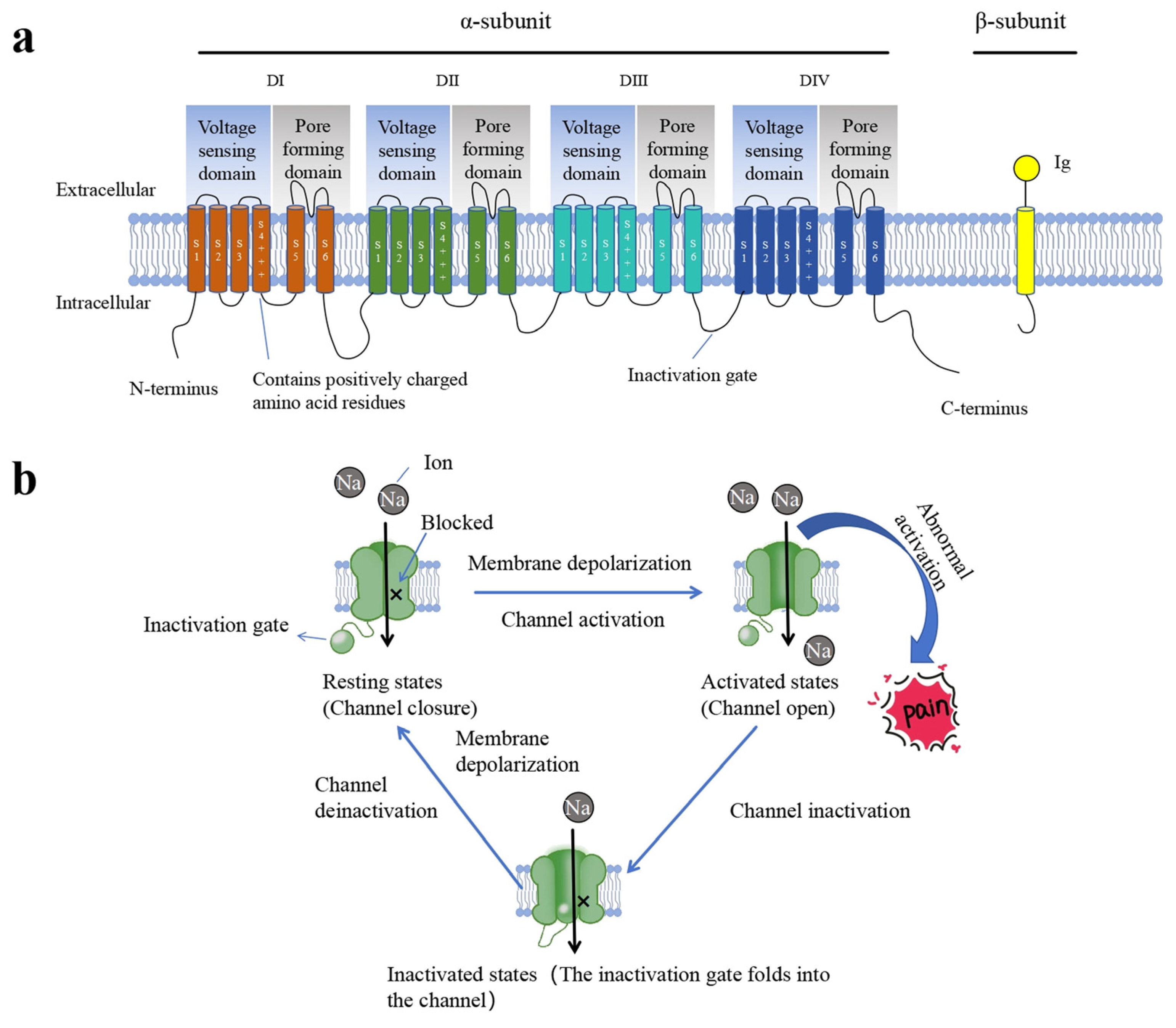
3.1.1. VGSCs, VGPCs, and Pain
3.1.2. Blockers Targeting VGSCs and Activators Targeting VGPCs for the Treatment of Pain
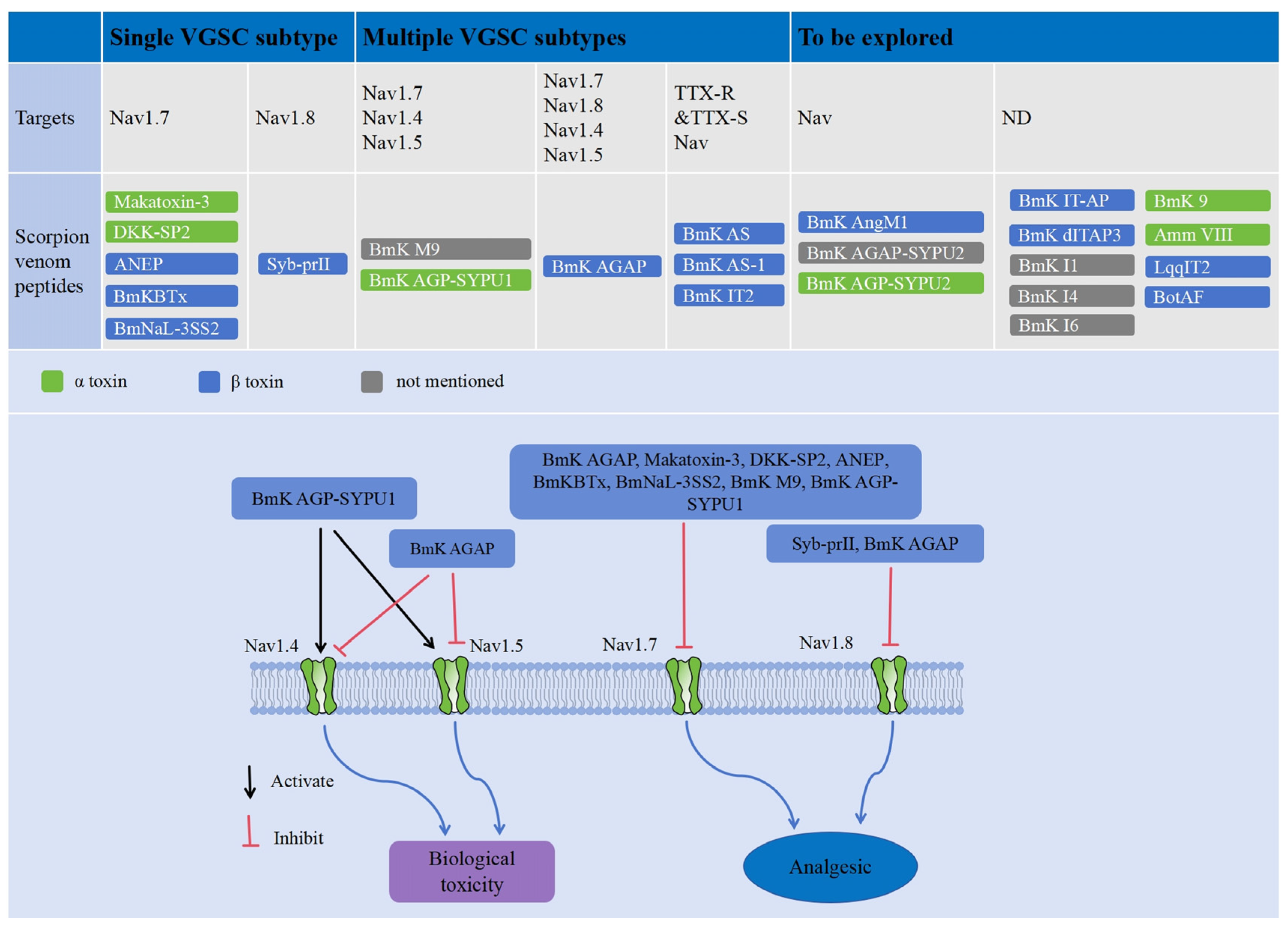
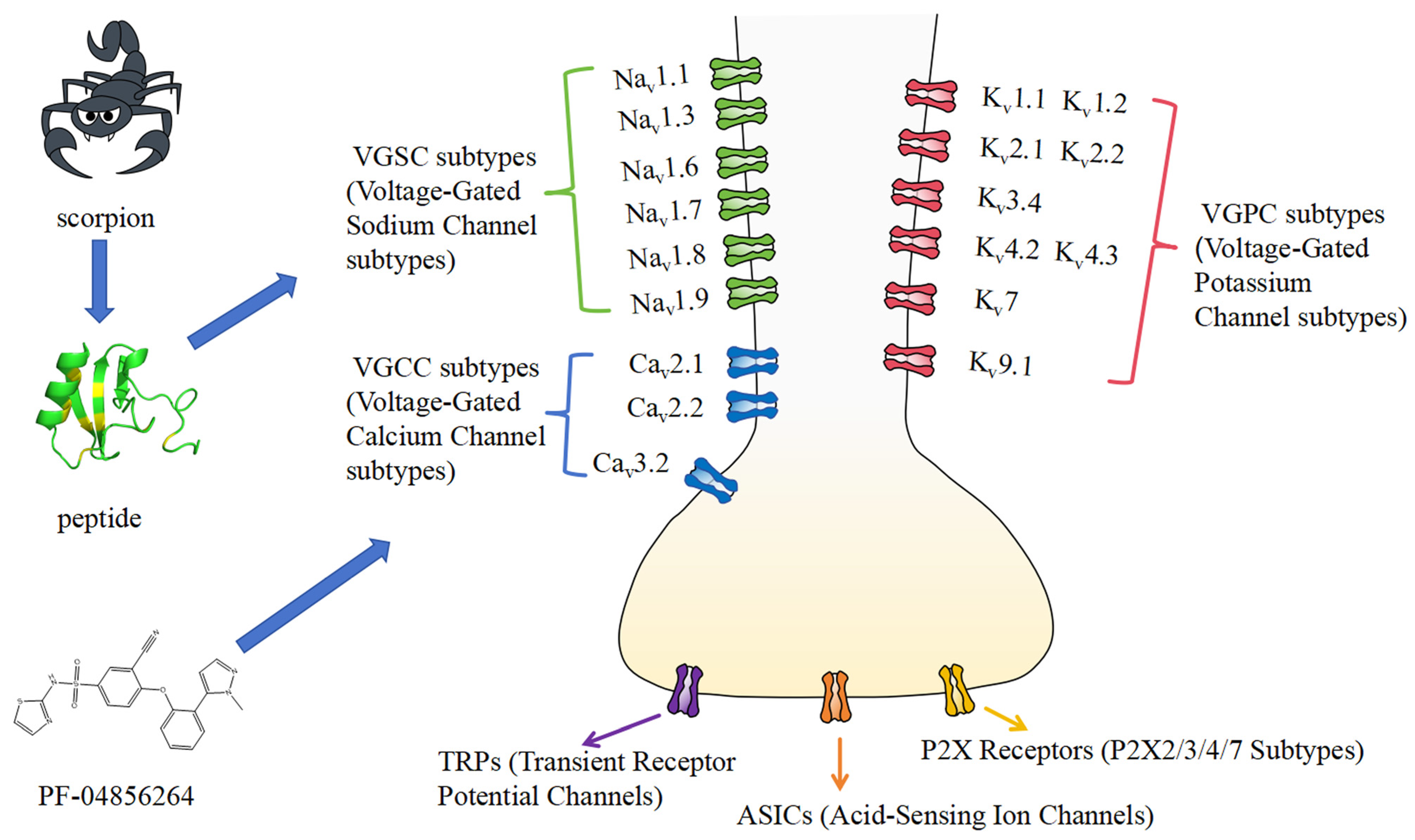
3.1.3. Scorpion Venom Peptides Targeting VGSCs and VGPCs for the Treatment of Pain
3.2. Antibacterial Activity of Scorpion Venom Peptides
3.3. Anticancer Activity of Scorpion Venom Peptides
3.4. Anticoagulant Activity of Scorpion Venom Peptides
4. Conclusions
Author Contributions
Funding
Institutional Review Board Statement
Informed Consent Statement
Data Availability Statement
Acknowledgments
Conflicts of Interest
Appendix A

| Scorpion Venom Peptides | Sequences a | Targets | Animal Pain Models | Accession Numbers b | Species c/ References |
|---|---|---|---|---|---|
| Makatoxin-3 | GRDAYIAKKENCTYFCALNQYCNDLCTKNGAKSGYCQWAGRYGNACWCIDLPDKVPIRIPGPCIGR | Nav1.7 | Formalin test, acetic acid writhing test, and CFA-induced inflammatory pain model | P59853 | BMK [73,74] |
| ANEP | DGYIRGSNGCKISCLWGNEGCNKECKGFGAYYGYCWTWGLACWCEGLPDDKTWKSESNTCGGKK | Nav1.7 | Acetic acid writhing test | Q9BKJ0 | BMK [75] |
| DKK-SP2 | VRDAYIAKPENCVYECAKNEYCNDLCTKNGAKSGYCQWLGKYGNGCWCIELPDNVPIRVPGKCQR | Nav1.7 | Acetic acid writhing test | BMK [76] | |
| BmKBTx | DDDPGNYPTNAYGNKYYCTILGENEYCRKICKLHGVTYGYCYNSRCWCEKLEDKDVTI | Nav 1.7 | Acetic acid writhing test | BMK [77,78] | |
| BmNaL-3SS2 | VKDRFLIINGSYELCVYAENLGEDCENLCKQQKATDGFCRQPHCFCTDMPDDYATRPDTVDPIM | Nav 1.7 | Acetic acid writhing test | BMK [78] | |
| Syb-prII | not mentioned | Nav1.8 | Formalin test | BMK [79,80] | |
| BmK AS | DNGYLLDKYTGCKVWCVINNESCNSECKIRGGYYGYCYFWKLACFCQGARKSELWNYNTNKCNGKL | TTX-R and TTX-S Nav | Formalin test | Q9UAC9 | BMK [81,82] |
| BmK AS-1 | DNGYLLNKYTGCKIWCVINNESCNSECKLRRGNYGYCYFWKLACYCEGAPKSELWAYETNKCDGKL | TTX-R and TTX-S Nav | Heat radiation method | Q9UAC8 | BMK [82,83] |
| BmK IT2 | DGYIKGKSGCRVACLIGNQGCLKDCRAYGASYGYCWTWGLACWCEGLPDNKTWKSESNTCG | TTX-R and TTX-S Nav | Formalin test | P68727 | BMK [84] |
| BmK M9 | VRDAYIAKPENCVYHCATNEGCNKLCTDNGAESGYCQWGGRYGNACWCIKLPDRVPIRVPGKCH | Nav1.7 Nav1.4 Nav1.5 | P45698 | BMK [85] | |
| BmK AGAP | VRDGYIADDKNCAYFCGRNAYCDDECKKNGAESGYCQWAGVYGNACWCYKLPDKVPIRVPGKCNGG | Nav1.7 Nav1.8 Nav1.4 Nav1.5 | Acetic acid writhing test, hot-plate test | AAP34332.1 | BMK [86,87,88] |
| BmK AGP-SYPU1 | GRDAYIAQNYNCVYHCFRDDYCNGLCTENGADSGYCYLAGKYGHACWCINLPDDKPIRIPGKCHRR | Nav1.7 Nav1.4 Nav1.5 | Acetic acid writhing test | E7CAU3 | BMK [89,90,91,92] |
| BmK IT-AP | KKNGYAVDSSGKVAECLFNNYCNNECTKVYYADKGYCCLLKCYCFGLADDKPVLDIWDSTKNYCDVQIIDLS | ND | Acetic acid writhing test | O77091 | BMK [93] |
| BmK dITAP3 | DGYIRGSNGCKVSCLWGNEGCNKECRAYGASYGYCWTWGLACWCEGLPDDKTWKSESNTCG | ND | Acetic acid writhing test | Q9XY87 | BMK [94] |
| BmK AngM1 | VRDAYIAKPENCVYECGITQDCNKLCTENGAESGYCQWGGKYGNACWCIKLPDSVPIRVPGKCQR | Nav | Acetic acid writhing test | O61705 | BMK [96] |
| BmK I1 | not mentioned | ND | Acetic acid writhing test | BMK [97] | |
| BmK I4 | KKNGYAVDSSGKVAECLFNNYCNNECTKVYYADKGYCCLLKCYCFGLADDKPVLDIWDSTKNYCDVQIIDLS | ND | Acetic acid writhing test | BMK [97] | |
| BmK I6 | not mentioned | ND | Acetic acid writhing test | BMK [97] | |
| BmK 9 | VRDAYIAKPENCVYHCATNEGCNKLCTDNGAESGYCQWGGRYGNACWCIKLPDSVPIRVPGKCHR | ND | Acetic acid writhing test | BMK [98] | |
| BmK AGAP-SYPU2 | VKDGYIVDDKNCAYFCGRNAYCDDECEKNGAESGYCQWAGVYGNACWCYKLPDKVPIRVPGRCNG | Nav | Acetic acid writhing test, hot-plate test | G4V3T9 | BMK [99] |
| BmK AGP-SYPU2 | VKDGYIADDRNCPYFCGRNAYCDGECKKNRAESGYCQWASKYGNACWCYKLPDDARIMKPGRCNGG | Nav | Acetic acid writhing test | Q9NJC7 | BMK [100,101] |
| Amm VIII | LKDGYIVNDINCTYFCGRNAYCNELCIKLKGESGYCQWASPYGNSCYCYKLPDHVRTKGPGRCND | ND | Hot-plate pain test, tail-flick test | Q7YXD3 | AMM [102,103] |
| LqqIT2 | DGYIRKRDGCKLSCLFGNEGCNKECKSYGGSYGYCWTWGLACWCEGLPDEKTWKSETNTCG | ND | Hot-plate pain test, tail-flick test | P19855 | LQQ [102] |
| BotAF | DNGYVLDKYNGCKVCQVINNEACNSECKSRGGYYGYCYFWKLACYCEGANKSELWQYKTNRCRA | ND | Acetic acid writhing test, Formalin test, hot-plate test, tail-flick test | BOT [104] | |
| Cell8 | KKDGYPVNMEECRYNCWKNAYCDKLCKEKKGQSGYCYGWNLSCWCIGLPDNTNTKMNPFCQTAD | Nav1.7 | ND | CE [105] | |
| IMe-AGAP | VRDGYIADDKNCAYFCGRNAYCDEECKKNGAESGYCQWAGQYGNACWCYNLPDKVPIKVPGKCNGG | Nav1.8 Nav1.9 | ND | ME [106] |
| Scorpion Venom Peptides | Biological Activity | References |
|---|---|---|
| Makatoxin-3 | Analgesic, targeting Nav1.7 channel | [73,74] |
| ANEP | Analgesic, targeting Nav1.7 channel | [75] |
| DKK-SP2 | Analgesic, targeting Nav1.7 channel | [76] |
| BmKBTx | Analgesic, targeting Nav1.7 channel | [77,78] |
| BmNaL-3SS2 | Analgesic, targeting Nav1.7 channel | [78] |
| Syb-prII | Analgesic, targeting Nav1.8 channel | [79,80] |
| BmK AS | Analgesic, targeting TTX-R and TTX-S Nav channels | [81,82] |
| BmK AS-1 | Analgesic, targeting TTX-R and TTX-S Nav channels | [82,83] |
| BmK IT2 | Analgesic, targeting TTX-R and TTX-S Nav channels | [84] |
| BmK M9 | Analgesic, targeting Nav1.7, Nav1.4, and Nav1.5 channels | [85] |
| BmK AGAP | Analgesic, anticancer, targeting Nav1.7, Nav1.8, Nav1.4, and Nav1.5 channels | [86,87,88] |
| BmK AGP-SYPU1 | Analgesic, targeting Nav1.7, Nav1.4, and Nav1.5 channels | [89,90,91,92] |
| BmK IT-AP | Analgesic | [93] |
| BmK dITAP3 | Analgesic | [94] |
| BmK AngM1 | Analgesic | [96] |
| BmK I1 | Analgesic | [97] |
| BmK I4 | Analgesic | [97] |
| BmK I6 | Analgesic | [97] |
| BmK 9 | Analgesic | [98] |
| BmK AGAP-SYPU2 | Analgesic, anticancer | [99] |
| BmK AGP-SYPU2 | Analgesic | [100,101] |
| Amm VIII | Analgesic | [102,103] |
| LqqIT2 | Analgesic | [102] |
| BotAF | Analgesic | [104] |
| Cell8 | Targeting Nav1.7 | [105] |
| IMe-AGAP | Targeting Nav1.7 and Nav1.8, anticancer | [106,151] |
| TtAP-1 | Antibacterial | [109] |
| Im-5 | Antibacterial | [110] |
| UyCT3 | Antibacterial | [111] |
| UyCT5 | Antibacterial | [111] |
| Pantinin-3 | Antibacterial, anticancer | [112] |
| Meucin-18 | Antibacterial | [113] |
| VmCT1 | Antibacterial, anticancer | [114,115,152] |
| BmKn2 | Antibacterial, anticancer | [116,117,118] |
| Hp1404 | Antibacterial | [116] |
| Bactridine 1 | Antibacterial | [129] |
| Heteroscorpine-1 | Antibacterial | [130] |
| Kn2-7 | Antibacterial | [119] |
| Kn2-7K | Antibacterial | [119] |
| Hp1404-T1e | Antibacterial | [120] |
| CeHS-1 | Antibacterial | [131] |
| CeHS-1 GP | Antibacterial | [131] |
| CeHS-1 GPK | Antibacterial | [131] |
| Margatoxin | Anticancer, non-selective Kv1.3 inhibitor | [134,135,136,153] |
| BmKCT | Anticancer | [137,138,139] |
| Smp24 | Anticancer, antibacterial | [140,141,142,143] |
| Smp43 | Anticancer, antibacterial | [144] |
| Pantinin-1 | Anticancer, antibacterial | [112,145] |
| Pantinin-2 | Anticancer, antibacterial | [112,145] |
| Pantinin-3 | Anticancer, antibacterial | [112,145] |
| TsAP-1 | Anticancer, antibacterial | [146] |
| TsAP-2 | Anticancer, antibacterial | [146] |
| AaeAP1a | Anticancer, antibacterial | [147] |
| AaeAP2a | Anticancer, antibacterial | [147] |
| TanP | Anticoagulant | [148] |
| P8(HA18-3-B-8) | Anticoagulant | [149] |
| LeuTrp | Anticoagulant | [150] |
| IIeTrp | Anticoagulant | [150] |
References
- Cragg, G.M.; Newman, D.J. Natural-Source Medicines Have a Long History in Traditional Medicine. Pure Appl. Chem. 2005, 77, 1923–1942. [Google Scholar] [CrossRef]
- Desborough, M.J.R.; Keeling, D.M. The Aspirin Story—From Willow to Wonder Drug. Br. J. Haematol. 2017, 177, 674–683. [Google Scholar] [CrossRef]
- Kumar, M.; Kaur, P.; Garg, R.; Patil, R.K.; Patil, H.C. A Study on Antibacterial Property of Curcuma longa—Herbal and Traditional Medicine. Adesh Univ. J. Med. Sci. Res. 2020, 2, 103–108. [Google Scholar] [CrossRef]
- Cho, I.-H. Effects of Panax ginseng in Neurodegenerative Diseases. J. Ginseng Res. 2012, 36, 342–353. [Google Scholar] [CrossRef] [PubMed]
- King, G.F. Venoms as a Platform for Human Drugs: Translating Toxins into Therapeutics. Expert Opin. Biol. Ther. 2011, 11, 1469–1484. [Google Scholar] [CrossRef] [PubMed]
- Mory, R.N.; Mindell, D.; Bloom, D.A. The Leech and the Physician: Biology, Etymology, and Medical Practice with Hirudinea medicinalis. World J. Surg. 2000, 24, 878–883. [Google Scholar] [CrossRef]
- Utkin, Y.N. Animal Venom Studies: Current Benefits and Future Developments. World J. Biol. Chem. 2015, 6, 28–33. [Google Scholar] [CrossRef] [PubMed]
- Wang, Z.; Sang, M.; Zhang, Y.; Chen, S.; Li, S.; Chen, Y.; Xu, E.; Zhou, Q.; Xu, W.; Zhao, C.; et al. BmKK2, a Thermostable Kv1.3 Blocker from Buthus martensii Karsch (BmK) Scorpion, Inhibits the Activation of Macrophages via Kv1.3-NF-κB- NLRP3 Axis. J. Ethnopharmacol. 2023, 314, 116624. [Google Scholar] [CrossRef] [PubMed]
- Zhou, X.H.; Yang, D.; Zhang, J.H.; Liu, C.M.; Lei, K.J. Purification and N-Terminal Partial Sequence of Anti-Epilepsy Peptide from Venom of the Scorpion Buthus martensii Karsch. Biochem. J. 1989, 257, 509–517. [Google Scholar] [CrossRef]
- Roy, A.; Bharadvaja, N. Venom-Derived Bioactive Compounds as Potential Anticancer Agents: A Review. Int. J. Pept. Res. Ther. 2021, 27, 129–147. [Google Scholar] [CrossRef]
- Sima, P.; Vetvicka, V. Bioactive Substances with Anti-Neoplastic Efficacy from Marine Invertebrates: Porifera and Coelenterata. World J. Clin. Oncol. 2011, 2, 355–361. [Google Scholar] [CrossRef] [PubMed]
- Walewska, A.; Han, T.S.; Zhang, M.-M.; Yoshikami, D.; Bulaj, G.; Rolka, K. Expanding Chemical Diversity of Conotoxins: Peptoid–Peptide Chimeras of the Sodium Channel Blocker μ-KIIIA and Its Selenopeptide Analogues. Eur. J. Med. Chem. 2013, 65, 144–150. [Google Scholar] [CrossRef] [PubMed]
- Wei, M.; Chen, J.; Song, Y.; Monserrat, J.-P.; Zhang, Y.; Shen, L. Progress on Synthesis and Structure-Activity Relationships of Lamellarins over the Past Decade. Eur. J. Med. Chem. 2024, 269, 116294. [Google Scholar] [CrossRef]
- Romero, H.K.; Christensen, S.B.; Di Cesare Mannelli, L.; Gajewiak, J.; Ramachandra, R.; Elmslie, K.S.; Vetter, D.E.; Ghelardini, C.; Iadonato, S.P.; Mercado, J.L.; et al. Inhibition of A9α10 Nicotinic Acetylcholine Receptors Prevents Chemotherapy-Induced Neuropathic Pain. Proc. Natl. Acad. Sci. USA 2017, 114, E1825–E1832. [Google Scholar] [CrossRef]
- Muller, J.A.I.; Chan, L.Y.; Toffoli-Kadri, M.C.; Mortari, M.R.; Craik, D.J.; Koehbach, J. Antinociceptive Peptides from Venomous Arthropods. Toxin Rev. 2023, 42, 362–381. [Google Scholar] [CrossRef]
- Davoine, C.; Bouckaert, C.; Fillet, M.; Pochet, L. Factor XII/XIIa Inhibitors: Their Discovery, Development, and Potential Indications. Eur. J. Med. Chem. 2020, 208, 112753. [Google Scholar] [CrossRef] [PubMed]
- Ra Mans, D.; Pawirodihardjo, J.; Djotaroeno, M.; Friperson, P. Exploring the Global Animal Biodiversity in the Search for New Drugs -Amphibians. J. Transl. Sci. 2021, 7, 1–17. [Google Scholar] [CrossRef]
- Holford, M.; Daly, M.; King, G.F.; Norton, R.S. Venoms to the Rescue. Science 2018, 361, 842–844. [Google Scholar] [CrossRef]
- Pennington, M.W.; Czerwinski, A.; Norton, R.S. Peptide Therapeutics from Venom: Current Status and Potential. Bioorg. Med. Chem. 2018, 26, 2738–2758. [Google Scholar] [CrossRef] [PubMed]
- de Castro Figueiredo Bordon, K.; Cologna, C.T.; Fornari-Baldo, E.C.; Pinheiro-Júnior, E.L.; Cerni, F.A.; Amorim, F.G.; Anjolette, F.A.P.; Cordeiro, F.A.; Wiezel, G.A.; Cardoso, I.A.; et al. From Animal Poisons and Venoms to Medicines: Achievements, Challenges and Perspectives in Drug Discovery. Front. Pharmacol. 2020, 11, 1132. [Google Scholar] [CrossRef]
- Miljanich, G.P. Ziconotide: Neuronal Calcium Channel Blocker for Treating Severe Chronic Pain. Curr. Med. Chem. 2004, 11, 3029–3040. [Google Scholar] [CrossRef] [PubMed]
- Liang, Z.; Zhao, Z. The Original Source of Modern Research on Chinese Medicinal Materials: Bencao Texts. J. Altern. Complement. Integr. Med. 2017, 3, 1–9. [Google Scholar] [CrossRef]
- Bartosz, M.; Kedziora, J.; Bartosz, G. Antioxidant and Prooxidant Properties of Captopril and Enalapril. Free Radic. Biol. Med. 1997, 23, 729–735. [Google Scholar] [CrossRef] [PubMed]
- Huang, D.; Qian, J.; Liu, Z.; Xu, Y.; Zhao, X.; Qiao, Z.; Fang, W.; Jiang, L.; Hu, W.; Shen, C.; et al. Effects of Intracoronary Pro-Urokinase or Tirofiban on Coronary Flow During Primary Percutaneous Coronary Intervention for Acute Myocardial Infarction: A Multi-Center, Placebo-Controlled, Single-Blind, Randomized Clinical Trial. Front. Cardiovasc. Med. 2021, 8, 710994. [Google Scholar] [CrossRef]
- Abo Elhamd, M.; Youssef, A.O.; Attia, M.S. Terbium-Based Photoprobe Enables Ultrasensitive and Selective Detection of Tirofiban in Pharmaceuticals. J. Photochem. Photobiol. A: Chem. 2024, 453, 115682. [Google Scholar] [CrossRef]
- Tardiff, B.E.; Jennings, L.K.; Harrington, R.A.; Gretler, D.; Potthoff, R.F.; Vorchheimer, D.A.; Eisenberg, P.R.; Lincoff, A.M.; Labinaz, M.; Joseph, D.M.; et al. Pharmacodynamics and Pharmacokinetics of Eptifibatide in Patients with Acute Coronary Syndromes: Prospective Analysis from PURSUIT. Circulation 2001, 104, 399–405. [Google Scholar] [CrossRef]
- Tonin, G.; Klen, J. Eptifibatide, an Older Therapeutic Peptide with New Indications: From Clinical Pharmacology to Everyday Clinical Practice. Int. J. Mol. Sci. 2023, 24, 5446. [Google Scholar] [CrossRef]
- Itoh, N.; Tanaka, N.; Mihashi, S.; Yamashina, I. Molecular Cloning and Sequence Analysis of cDNA for Batroxobin, a Thrombin-like Snake Venom Enzyme. J. Biol. Chem. 1987, 262, 3132–3135. [Google Scholar] [CrossRef]
- Veizaj, D.; Exter, P.L.D.; Bos, M.H. Russell’s Viper Venom: From Diagnostic to Bypassing Agent for Hemophilia? J. Thromb. Haemost. 2023, 21, 1429–1431. [Google Scholar] [CrossRef] [PubMed]
- Copley, K.; McCowen, K.; Hiles, R.; Nielsen, L.; Young, A.; Parkes, D. Investigation of Exenatide Elimination and Its In Vivo and In Vitro Degradation. Curr. Drug Metab. 2006, 7, 367–374. [Google Scholar] [CrossRef]
- Ghanbarnezhad, M.M.; Shahsavani, M.B.; Mali, P.S.; Upadhyay, M.; Kumar, A.; Albaghlani, R.M.; Niazi, A.; Yousefi, R. Developing a Novel Exenatide-Based Incretin Mimic (αB-Ex): Expression, Purification and Structural-Functional Characterization. Biochim. Biophys. Acta Gen. Subj. 2022, 1866, 130150. [Google Scholar] [CrossRef] [PubMed]
- Werner, U.; Haschke, G.; Herling, A.W.; Kramer, W. Pharmacological Profile of Lixisenatide: A New GLP-1 Receptor Agonist for the Treatment of Type 2 Diabetes. Regul. Pept. 2010, 164, 58–64. [Google Scholar] [CrossRef] [PubMed]
- Warkentin, T.E.; Koster, A. Bivalirudin: A Review. Expert Opin. Pharmacother. 2005, 6, 1349–1371. [Google Scholar] [CrossRef] [PubMed]
- Nowak, G. Pharmacology of Recombinant Hirudin. Semin. Thromb. Hemostasis. 2002, 28, 415–424. [Google Scholar] [CrossRef] [PubMed]
- Aridoss, G.; Kim, D.; Kim, J.I.; Kang, J.E. Ziconotide (ω-conotoxin MVIIA)—Efficient Solid-phase Synthesis of a Linear Precursor Peptide and Its Strategic Native Folding. Pept. Sci. 2021, 113, e24223. [Google Scholar] [CrossRef]
- Miranda, F.; Kupeyan, C.; Rochat, H.; Rochat, C.; Lissitzky, S. Purification of Animal Neurotoxins. Eur. J. Biochem. 1970, 16, 514–523. [Google Scholar] [CrossRef]
- Goudet, C.; Chi, C.-W.; Tytgat, J. An Overview of Toxins and Genes from the Venom of the Asian Scorpion Buthus martensi Karsch. Toxicon 2002, 40, 1239–1258. [Google Scholar] [CrossRef] [PubMed]
- Almaaytah, A.; Albalas, Q. Scorpion Venom Peptides with No Disulfide Bridges: A Review. Peptides 2014, 51, 35–45. [Google Scholar] [CrossRef]
- Miyashita, M.; Otsuki, J.; Hanai, Y.; Nakagawa, Y.; Miyagawa, H. Characterization of Peptide Components in the Venom of the Scorpion Liocheles australasiae (Hemiscorpiidae). Toxicon 2007, 50, 428–437. [Google Scholar] [CrossRef] [PubMed]
- Possani, L.D.; Merino, E.; Corona, M.; Bolivar, F.; Becerril, B. Peptides and Genes Coding for Scorpion Toxins That Affect Ion-Channels. Biochimie 2000, 82, 861–868. [Google Scholar] [CrossRef]
- Guerrero-Vargas, J.A.; Mourão, C.B.F.; Quintero-Hernández, V.; Possani, L.D.; Schwartz, E.F. Identification and Phylogenetic Analysis of Tityus pachyurus and Tityus obscurus Novel Putative Na+-Channel Scorpion Toxins. PLoS ONE 2012, 7, e30478. [Google Scholar] [CrossRef]
- Zou, X.; He, Y.; Qiao, J.; Zhang, C.; Cao, Z. The Natural Scorpion Peptide, BmK NT1 Activates Voltage-Gated Sodium Channels and Produces Neurotoxicity in Primary Cultured Cerebellar Granule Cells. Toxicon 2016, 109, 33–41. [Google Scholar] [CrossRef]
- De Lera Ruiz, M.; Kraus, R.L. Voltage-Gated Sodium Channels: Structure, Function, Pharmacology, and Clinical Indications. J. Med. Chem. 2015, 58, 7093–7118. [Google Scholar] [CrossRef] [PubMed]
- O’Malley, H.A.; Isom, L.L. Sodium Channel β Subunits: Emerging Targets in Channelopathies. Annu. Rev. Physiol. 2015, 77, 481–504. [Google Scholar] [CrossRef] [PubMed]
- Chen, C.; Calhoun, J.D.; Zhang, Y.; Lopez-Santiago, L.; Zhou, N.; Davis, T.H.; Salzer, J.L.; Isom, L.L. Identification of the Cysteine Residue Responsible for Disulfide Linkage of Na+ Channel α and β2 Subunits. J. Biol. Chem. 2012, 287, 39061–39069. [Google Scholar] [CrossRef]
- Dib-Hajj, S.D.; Waxman, S.G. Sodium Channels in Human Pain Disorders: Genetics and Pharmacogenomics. Annu. Rev. Neurosci. 2019, 42, 87–106. [Google Scholar] [CrossRef]
- Huang, J.; Vanoye, C.G.; Cutts, A.; Goldberg, Y.P.; Dib-Hajj, S.D.; Cohen, C.J.; Waxman, S.G.; George, A.L. Sodium Channel NaV1.9 Mutations Associated with Insensitivity to Pain Dampen Neuronal Excitability. J. Clin. Investig. 2017, 127, 2805–2814. [Google Scholar] [CrossRef]
- Black, J.A.; Frézel, N.; Dib-Hajj, S.D.; Waxman, S.G. Expression of Nav1.7 in DRG Neurons Extends from Peripheral Terminals in the Skin to Central Preterminal Branches and Terminals in the Dorsal Horn. Mol. Pain. 2012, 8, 82. [Google Scholar] [CrossRef] [PubMed]
- Du, X.; Gamper, N. Potassium Channels in Peripheral Pain Pathways: Expression, Function and Therapeutic Potential. Curr. Neuropharmacol. 2013, 11, 621–640. [Google Scholar] [CrossRef] [PubMed]
- Brown, B.S.; Yu, S.P. Modulation and Genetic Identification of the M Channel. Mol. Biol. 2000, 73, 135–166. [Google Scholar] [CrossRef] [PubMed]
- Chien, L.-Y.; Cheng, J.-K.; Chu, D.; Cheng, C.-F.; Tsaur, M.-L. Reduced Expression of A-Type Potassium Channels in Primary Sensory Neurons Induces Mechanical Hypersensitivity. J. Neurosci. 2007, 27, 9855–9865. [Google Scholar] [CrossRef] [PubMed]
- Takeda, M.; Tsuboi, Y.; Kitagawa, J.; Nakagawa, K.; Iwata, K.; Matsumoto, S. Potassium Channels as a Potential Therapeutic Target for Trigeminal Neuropathic and Inflammatory Pain. Mol. Pain. 2011, 7, 5. [Google Scholar] [CrossRef] [PubMed]
- Fan, L.; Guan, X.; Wang, W.; Zhao, J.-Y.; Zhang, H.; Tiwari, V.; Hoffman, P.N.; Li, M.; Tao, Y.-X. Impaired Neuropathic Pain and Preserved Acute Pain in Rats Overexpressing Voltage-Gated Potassium Channel Subunit Kv1.2 in Primary Afferent Neurons. Mol. Pain 2014, 10, 8. [Google Scholar] [CrossRef]
- Sánchez, J.D.; Gómez-Carpintero, J.; González, J.F.; Menéndez, J.C. Twenty-First Century Antiepileptic Drugs. An Overview of Their Targets and Synthetic Approaches. Eur. J. Med. Chem. 2024, 272, 116476. [Google Scholar] [CrossRef]
- Fu, W.; Vasylyev, D.; Bi, Y.; Zhang, M.; Sun, G.; Khleborodova, A.; Huang, G.; Zhao, L.; Zhou, R.; Li, Y.; et al. Nav1.7 as a Chondrocyte Regulator and Therapeutic Target for Osteoarthritis. Nature 2024, 625, 557–565. [Google Scholar] [CrossRef] [PubMed]
- Voute, M.; Morel, V.; Pickering, G. Topical Lidocaine for Chronic Pain Treatment. Drug Des. Dev. Ther. 2021, 15, 4091–4103. [Google Scholar] [CrossRef]
- Ribeiro, M.A.; Costa, P.F. The Sensitivity of Sodium Channels in Immature and Mature Rat CA1 Neurones to the Local Anaesthetics Procaine and Lidocaine. Dev. Brain Res. 2003, 146, 59–70. [Google Scholar] [CrossRef] [PubMed]
- Gambeta, E.; Chichorro, J.G.; Zamponi, G.W. Trigeminal Neuralgia: An Overview from Pathophysiology to Pharmacological Treatments. Mol. Pain. 2020, 16, 1–18. [Google Scholar] [CrossRef] [PubMed]
- Cheng, K.-I.; Wang, H.-C.; Lai, C.-S.; Tsai, H.-P.; Kwan, A.-L.; Ho, S.-T.; Wang, J.-J.; Chang, L.-L. Pre-Emptive Intrathecal Quinidine Alleviates Spinal Nerve Ligation-Induced Peripheral Neuropathic Pain. J. Pharm. Pharmacol. 2011, 63, 1063–1069. [Google Scholar] [CrossRef] [PubMed]
- Iacob, E.; Hagn, E.E.; Sindt, J.; Brogan, S.; Tadler, S.C.; Kennington, K.S.; Hare, B.D.; Bokat, C.E.; Donaldson, G.W.; Okifuji, A.; et al. Tertiary Care Clinical Experience with Intravenous Lidocaine Infusions for the Treatment of Chronic Pain. Pain. Med. 2018, 19, 1245–1253. [Google Scholar] [CrossRef] [PubMed]
- Davies, P.S.; Galer, B.S. Review of Lidocaine Patch 5% Studies in the Treatment of Postherpetic Neuralgia. Drugs 2004, 64, 937–947. [Google Scholar] [CrossRef] [PubMed]
- Witty, D.R.; Alvaro, G.; Derjean, D.; Giblin, G.M.P.; Gunn, K.; Large, C.; Macpherson, D.T.; Morisset, V.; Owen, D.; Palmer, J.; et al. Discovery of Vixotrigine: A Novel Use-Dependent Sodium Channel Blocker for the Treatment of Trigeminal Neuralgia. ACS Med. Chem. Lett. 2020, 11, 1678–1687. [Google Scholar] [CrossRef] [PubMed]
- Bagal, S.K.; Chapman, M.L.; Marron, B.E.; Prime, R.; Storer, R.I.; Swain, N.A. Recent Progress in Sodium Channel Modulators for Pain. Bioorg. Med. Chem. Lett. 2014, 24, 3690–3699. [Google Scholar] [CrossRef] [PubMed]
- Deuis, J.R.; Wingerd, J.S.; Winter, Z.; Durek, T.; Dekan, Z.; Sousa, S.R.; Zimmermann, K.; Hoffmann, T.; Weidner, C.; Nassar, M.A.; et al. Analgesic Effects of GpTx-1, PF-04856264 and CNV1014802 in a Mouse Model of NaV1.7-Mediated Pain. Toxins 2016, 8, 78. [Google Scholar] [CrossRef] [PubMed]
- Goldberg, Y.P.; Price, N.; Namdari, R.; Cohen, C.J.; Lamers, M.H.; Winters, C.; Price, J.; Young, C.E.; Verschoof, H.; Sherrington, R.; et al. Treatment of Nav1.7-Mediated Pain in Inherited Erythromelalgia Using a Novel Sodium Channel Blocker. Pain 2012, 153, 80–85. [Google Scholar] [CrossRef] [PubMed]
- Jones, J.; Correll, D.J.; Lechner, S.M.; Jazic, I.; Miao, X.; Shaw, D.; Simard, C.; Osteen, J.D.; Hare, B.; Beaton, A.; et al. Selective Inhibition of NaV1.8 with VX-548 for Acute Pain. N. Engl. J. Med. 2023, 389, 393–405. [Google Scholar] [CrossRef]
- Wang, Y.; Hu, S.; Chen, Y.; Chen, M.; Zhang, D.; Liu, W.; Chen, C.; Gan, Y.; Luo, M.; Ke, B. Discovery of a Novel Series of Pyridone Amides as NaV1.8 inhibitors. Bioorg. Med. Chem. Lett. 2024, 101, 129655. [Google Scholar] [CrossRef] [PubMed]
- de Greef, B.T.A.; Hoeijmakers, J.G.J.; Geerts, M.; Oakes, M.; Church, T.J.E.; Waxman, S.G.; Dib-Hajj, S.D.; Faber, C.G.; Merkies, I.S.J. Lacosamide in Patients with Nav1.7 Mutations-Related Small Fibre Neuropathy: A Randomized Controlled Trial. Brain 2019, 142, 263–275. [Google Scholar] [CrossRef] [PubMed]
- Zhao, Y.; Kotecha, M.; Finnigan, H.; Serenko, M.; Naik, H. Evaluation of the Effect of Uridine Diphosphate-Glucuronosyltransferases (UGT) Inhibition by Valproic Acid on Vixotrigine Pharmacokinetics in Healthy Volunteers. Clin. Drug Invest. 2022, 42, 829–837. [Google Scholar] [CrossRef]
- Faber, C.G.; Attal, N.; Lauria, G.; Dworkin, R.H.; Freeman, R.; Dawson, K.T.; Finnigan, H.; Hajihosseini, A.; Naik, H.; Serenko, M.; et al. Efficacy and Safety of Vixotrigine in Idiopathic or Diabetes-Associated Painful Small Fibre Neuropathy (CONVEY): A Phase 2 Placebo-Controlled Enriched-Enrolment Randomised Withdrawal Study. eClinicalMedicine 2023, 59, 101971. [Google Scholar] [CrossRef] [PubMed]
- Vicente-Baz, J.; Lopez-Garcia, J.A.; Rivera-Arconada, I. Effects of Novel Subtype Selective M-Current Activators on Spinal Reflexes in Vitro: Comparison with Retigabine. Neuropharmacology 2016, 109, 131–138. [Google Scholar] [CrossRef]
- Qian, K.; Zhou, J.; Xiong, J.; Wang, Q.; Chen, L.; Zhuang, T.; Jin, J.; Zhang, G.; Hao, C.; Huang, L.; et al. Discovery of a Novel KV7.2/7.3 Channels Agonist for the Treatment of Neuropathic Pain. Eur. J. Med. Chem. 2024, 280, 116953. [Google Scholar] [CrossRef] [PubMed]
- Lu, W.; Cheng, X.; Chen, J.; Wang, M.; Chen, Y.; Liu, J.; Sang, M.; Zhao, N.; Yan, H.; Cheng, X.; et al. A Buthus martensii Karsch Scorpion Sting Targets Nav1.7 in Mice and Mimics a Phenotype of Human Chronic Pain. Pain 2022, 163, e202–e214. [Google Scholar] [CrossRef] [PubMed]
- Chen, Y.; Xu, E.; Sang, M.; Wang, Z.; Zhang, Y.; Ye, J.; Zhou, Q.; Zhao, C.; Hu, C.; Lu, W.; et al. Makatoxin-3, a Thermostable Nav1.7 Agonist from Buthus martensii Karsch (BmK) Scorpion Elicits Non-Narcotic Analgesia in Inflammatory Pain Models. J. Ethnopharmacol. 2022, 288, 114998. [Google Scholar] [CrossRef]
- Song, Y.; Liu, Z.; Zhang, Q.; Li, C.; Jin, W.; Liu, L.; Zhang, J.; Zhang, J. Investigation of Binding Modes and Functional Surface of Scorpion Toxins ANEP to Sodium Channels 1.7. Toxins 2017, 9, 387. [Google Scholar] [CrossRef] [PubMed]
- Liu, Y.; Li, Y.; Zhu, Y.; Zhang, L.; Ji, J.; Gui, M.; Li, C.; Song, Y. Study of Anti-Inflammatory and Analgesic Activity of Scorpion Toxins DKK-SP1/2 from Scorpion Buthus martensii Karsch (BmK). Toxins 2021, 13, 498. [Google Scholar] [CrossRef]
- Zeng, X.-C.; Luo, F.; Li, W.-X. Molecular Dissection of Venom from Chinese Scorpion Mesobuthus martensii: Identification and Characterization of Four Novel Disulfide-Bridged Venom Peptides. Peptides 2006, 27, 1745–1754. [Google Scholar] [CrossRef] [PubMed]
- Lin, S.; Wang, X.; Hu, X.; Zhao, Y.; Zhao, M.; Zhang, J.; Cui, Y. Recombinant Expression, Functional Characterization of Two Scorpion Venom Toxins with Three Disulfide Bridges from the Chinese Scorpion Buthus martensii Karsch. Protein Pept. Lett. 2017, 24, 235–240. [Google Scholar] [CrossRef] [PubMed]
- Li, C.; Ban, M.; Bai, F.; Chen, J.; Jin, X.; Song, Y. Anti-Nociceptive and Anti-Inflammation Effect Mechanisms of Mutants of Syb-prII, a Recombinant Neurotoxic Polypeptide. Toxins 2019, 11, 699. [Google Scholar] [CrossRef]
- Bai, F.; Song, Y.; Cao, Y.; Ban, M.; Zhang, Z.; Sun, Y.; Feng, Y.; Li, C. Scorpion Neurotoxin Syb-prII-1 Exerts Analgesic Effect through Nav1.8 Channel and MAPKs Pathway. Int. J. Mol. Sci. 2022, 23, 7065. [Google Scholar] [CrossRef] [PubMed]
- Liu, T.; Pang, X.-Y.; Jiang, F.; Bai, Z.-T.; Ji, Y.-H. Anti-Nociceptive Effects Induced by Intrathecal Injection of BmK AS, a Polypeptide from the Venom of Chinese-Scorpion Buthus martensi Karsch, in Rat Formalin Test. J. Ethnopharmacol. 2008, 117, 332–338. [Google Scholar] [CrossRef] [PubMed]
- Ji, Y.-H.; Li, Y.-J.; Zhang, J.-W.; Song, B.-L.; Yamaki, T.; Mochizuki, T.; Hoshino, M.; Yanaihara, N. Covalent Structures of BmK AS and BmK AS-1, Two Novel Bioactive Polypeptides Purified from Chinese Scorpion Buthus martensi Karsch. Toxicon 1999, 37, 519–536. [Google Scholar] [CrossRef]
- Tan, Z.-Y.; Mao, X.; Xiao, H.; Zhao, Z.-Q.; Ji, Y.-H. Buthus martensi Karsch Agonist of Skeletal-Muscle RyR-1, a Scorpion Active Polypeptide: Antinociceptive Effect on Rat Peripheral Nervous System and Spinal Cord, and Inhibition of Voltage-Gated Na+ Currents in Dorsal Root Ganglion Neurons. Neurosci. Lett. 2001, 297, 65–68. [Google Scholar] [CrossRef] [PubMed]
- Bai, Z.-T.; Liu, T.; Pang, X.-Y.; Chai, Z.-F.; Ji, Y.-H. Suppression by Intrathecal BmK IT2 on Rat Spontaneous Pain Behaviors and Spinal C-Fos Expression Induced by Formalin. Brain Res. Bull. 2007, 73, 248–253. [Google Scholar] [CrossRef]
- Yang, F.; Liu, S.; Zhang, Y.; Qin, C.; Xu, L.; Li, W.; Cao, Z.; Li, W.; Wu, Y. Expression of Recombinant α-Toxin BmKM9 from Scorpion Buthus martensii Karsch and Its Functional Characterization on Sodium Channels. Peptides 2018, 99, 153–160. [Google Scholar] [CrossRef]
- Ma, R.; Cui, Y.; Zhou, Y.; Bao, Y.-M.; Yang, W.-Y.; Liu, Y.-F.; Wu, C.-F.; Zhang, J.-H. Location of the Analgesic Domain in Scorpion Toxin BmK AGAP by Mutagenesis of Disulfide Bridges. Biochem. Biophys. Res. Commun. 2010, 394, 330–334. [Google Scholar] [CrossRef] [PubMed]
- Xu, Y.; Meng, X.; Hou, X.; Sun, J.; Kong, X.; Sun, Y.; Liu, Z.; Ma, Y.; Niu, Y.; Song, Y.; et al. A Mutant of the Buthus martensii Karsch Antitumor-Analgesic Peptide Exhibits Reduced Inhibition to hNav1.4 and hNav1.5 Channels While Retaining Analgesic Activity. J. Biol. Chem. 2017, 292, 18270–18280. [Google Scholar] [CrossRef]
- Liu, Y.-F.; Ma, R.-L.; Wang, S.-L.; Duan, Z.-Y.; Zhang, J.-H.; Wu, L.-J.; Wu, C.-F. Expression of an Antitumor-Analgesic Peptide from the Venom of Chinese Scorpion Buthus martensii Karsch in Escherichia coli. Protein Expr. Purif. 2003, 27, 253–258. [Google Scholar] [CrossRef]
- Meng, X.; Xu, Y.; Zhao, M.; Wang, F.; Ma, Y.; Jin, Y.; Liu, Y.; Song, Y.; Zhang, J. The Functional Property Changes of Muscular Nav1.4 and Cardiac Nav1.5 Induced by Scorpion Toxin BmK AGP-SYPU1 Mutants Y42F and Y5F. Biochemistry 2015, 54, 2988–2996. [Google Scholar] [CrossRef]
- Meng, X.; Xu, Y.; Wang, F.; Zhao, M.; Hou, X.; Ma, Y.; Jin, Y.; Liu, Y.; Song, Y.; Zhang, J. The Roles of Conserved Aromatic Residues (Tyr5 and Tyr42) in Interaction of Scorpion Toxin BmK AGP-SYPU1 with Human Nav1. Int. J. Biol. Macromol. 2017, 99, 105–111. [Google Scholar] [CrossRef] [PubMed]
- Wang, Y.; Wang, L.; Cui, Y.; Song, Y.-B.; Liu, Y.-F.; Zhang, R.; Wu, C.-F.; Zhang, J.-H. Purification, Characterization and Functional Expression of a New Peptide with an Analgesic Effect from Chinese Scorpion Buthus martensii Karsch (BmK AGP-SYPU1). Biomed. Chromatogr. 2011, 25, 801–807. [Google Scholar] [CrossRef] [PubMed]
- Wang, Y.; Song, Y.-B.; Yang, G.-Z.; Cui, Y.; Zhao, Y.-S.; Liu, Y.-F.; Ma, Y.; Wu, C.-F.; Zhang, J.-H. Arginine Residues in the C-Terminal and Their Relationship with the Analgesic Activity of the Toxin from the Chinese Scorpion Buthus martensii Karsch (BmK AGP-SYPU1). Appl. Biochem. Biotechnol. 2012, 168, 247–255. [Google Scholar] [CrossRef]
- Xiong, Y.M.; Lan, Z.D.; Wang, M.; Liu, B.; Liu, X.Q.; Fei, H.; Xu, L.G.; Xia, Q.C.; Wang, C.G.; Wang, D.C.; et al. Molecular Characterization of a New Excitatory Insect Neurotoxin with an Analgesic Effect on Mice from the Scorpion Buthus martensi Karsch. Toxicon 1999, 37, 1165–1180. [Google Scholar] [CrossRef] [PubMed]
- Guan, R.; Wang, C.G.; Wang, M.; Wang, D.C. A Depressant Insect Toxin with a Novel Analgesic Effect from Scorpion Buthus martensii Karsch. Biochim. Biophys. Acta 2001, 1549, 9–18. [Google Scholar] [CrossRef] [PubMed]
- Guan, R.J.; Wang, M.; Wang, D.; Wang, D.C. A New Insect Neurotoxin AngP1 with Analgesic Effect from the Scorpion Buthus martensii Karsch: Purification and Characterization. J. Pept. Res. 2001, 58, 27–35. [Google Scholar] [CrossRef]
- Cao, Z.-Y.; Mi, Z.-M.; Cheng, G.-F.; Shen, W.-Q.; Xiao, X.; Liu, X.-M.; Liang, X.-T.; Yu, D.-Q. Purification and Characterization of a New Peptide with Analgesic Effect from the Scorpion Buthus martensi Karch. J. Pept. Res. 2004, 64, 33–41. [Google Scholar] [CrossRef] [PubMed]
- Guan, R.J.; Liu, X.Q.; Liu, B.; Wang, M.; Wang, D.C. Crystallization and Preliminary X-Ray Analyses of Insect Neurotoxins with Analgesic Effect from the Scorpion Buthus martensii Karsch. Acta Crystallogr. Sect. D Biol. Crystallogr. 2000, 56, 1012–1014. [Google Scholar] [CrossRef] [PubMed]
- Wang, Y.; Hao, Z.; Shao, J.; Song, Y.; Li, C.; Li, C.; Zhao, Y.; Liu, Y.; Wei, T.; Wu, C.; et al. The Role of Ser54 in the Antinociceptive Activity of BmK9, a Neurotoxin from the Scorpion Buthus martensii Karsch. Toxicon 2011, 58, 527–532. [Google Scholar] [CrossRef]
- Shao, J.-H.; Cui, Y.; Zhao, M.-Y.; Wu, C.-F.; Liu, Y.-F.; Zhang, J.-H. Purification, Characterization, and Bioactivity of a New Analgesic-Antitumor Peptide from Chinese Scorpion Buthus martensii Karsch. Peptides 2014, 53, 89–96. [Google Scholar] [CrossRef] [PubMed]
- Zhang, R.; Yang, Z.; Liu, Y.F.; Cui, Y.; Zhang, J.H. Purification, Characterization and cDNA Cloning of an Analgesic Peptide from the Chinese Scorpion Buthus martensii Karsch (BmK AGP-SYPU2). Mol. Biol. 2011, 45, 879–885. [Google Scholar] [CrossRef]
- Zhang, R.; Cui, Y.; Zhang, X.; Yang, Z.; Zhao, Y.; Song, Y.; Wu, C.; Zhang, J. Soluble Expression, Purification and the Role of C-Terminal Glycine Residues in Scorpion Toxin BmK AGP-SYPU2. BMB Rep. 2010, 43, 801–806. [Google Scholar] [CrossRef]
- Martin-Eauclaire, M.-F.; Abbas, N.; Sauze, N.; Mercier, L.; Berge-Lefranc, J.-L.; Condo, J.; Bougis, P.E.; Guieu, R. Involvement of Endogenous Opioid System in Scorpion Toxin-Induced Antinociception in Mice. Neurosci. Lett. 2010, 482, 45–50. [Google Scholar] [CrossRef] [PubMed]
- Alami, M.; Vacher, H.; Bosmans, F.; Devaux, C.; Rosso, J.-P.; Bougis, P.E.; Tytgat, J.; Darbon, H.; Martin-Eauclaire, M.-F. Characterization of Amm VIII from Androctonus mauretanicus mauretanicus: A New Scorpion Toxin That Discriminates between Neuronal and Skeletal Sodium Channels. Biochem. J. 2003, 375, 551–560. [Google Scholar] [CrossRef] [PubMed]
- Maatoug, R.; Jebali, J.; Guieu, R.; De Waard, M.; Kharrat, R. BotAF, a New Buthus occitanus tunetanus Scorpion Toxin, Produces Potent Analgesia in Rodents. Toxicon 2018, 149, 72–85. [Google Scholar] [CrossRef]
- Vandendriessche, T.; Olamendi-Portugal, T.; Zamudio, F.Z.; Possani, L.D.; Tytgat, J. Isolation and Characterization of Two Novel Scorpion Toxins: The α-Toxin-like CeII8, Specific for Nav1.7 Channels and the Classical Anti-Mammalian CeII9, Specific for Nav1.4 Channels. Toxicon 2010, 56, 613–623. [Google Scholar] [CrossRef] [PubMed]
- Dehghan, Z.; Ayat, H.; Mohammad Ahadi, A. Expression, Purification and Docking Studies on IMe-AGAP, the First Antitumor-Analgesic Like Peptide from Iranian Scorpion Mesobuthus eupeus. Iran. J. Pharm. Res. 2020, 19, 206–216. [Google Scholar] [CrossRef] [PubMed]
- Hoang, A.N.; Vo, H.D.M.; Vo, N.P.; Kudryashova, K.S.; Nekrasova, O.V.; Feofanov, A.V.; Kirpichnikov, M.P.; Andreeva, T.V.; Serebryakova, M.V.; Tsetlin, V.I.; et al. Vietnamese Heterometrus laoticus Scorpion Venom: Evidence for Analgesic and Anti-Inflammatory Activity and Isolation of New Polypeptide Toxin Acting on Kv1.3 Potassium Channel. Toxicon 2014, 77, 40–48. [Google Scholar] [CrossRef] [PubMed]
- Wu, B.; Zhu, Y.; Shi, J.; Tao, J.; Ji, Y. BmP02 Atypically Delays Kv4.2 Inactivation: Implication for a Unique Interaction between Scorpion Toxin and Potassium Channel. Toxins 2016, 8, 280. [Google Scholar] [CrossRef] [PubMed]
- Mechkarska, M.; Cunning, T.S.; Taggart, M.G.; Ternan, N.G.; Leprince, J.; Coquet, L.; Jouenne, T.; Tena-Garcés, J.; Calvete, J.J.; Conlon, J.M. Identification of an Antimicrobial Peptide from the Venom of the Trinidad Thick-Tailed Scorpion Tityus trinitatis with Potent Activity against ESKAPE Pathogens and Clostridioides difficile. Antibiotics 2023, 12, 1404. [Google Scholar] [CrossRef]
- Miyashita, M.; Kitanaka, A.; Yakio, M.; Yamazaki, Y.; Nakagawa, Y.; Miyagawa, H. Complete de Novo Sequencing of Antimicrobial Peptides in the Venom of the Scorpion Isometrus maculatus. Toxicon 2017, 139, 1–12. [Google Scholar] [CrossRef] [PubMed]
- Luna-Ramírez, K.; Quintero-Hernández, V.; Vargas-Jaimes, L.; Batista, C.V.F.; Winkel, K.D.; Possani, L.D. Characterization of the Venom from the Australian Scorpion Urodacus yaschenkoi: Molecular Mass Analysis of Components, cDNA Sequences and Peptides with Antimicrobial Activity. Toxicon 2013, 63, 44–54. [Google Scholar] [CrossRef]
- Zeng, X.-C.; Zhou, L.; Shi, W.; Luo, X.; Zhang, L.; Nie, Y.; Wang, J.; Wu, S.; Cao, B.; Cao, H. Three New Antimicrobial Peptides from the Scorpion Pandinus imperator. Peptides 2013, 45, 28–34. [Google Scholar] [CrossRef]
- Gao, B.; Sherman, P.; Luo, L.; Bowie, J.; Zhu, S. Structural and Functional Characterization of Two Genetically Related Meucin Peptides Highlights Evolutionary Divergence and Convergence in Antimicrobial Peptides. FASEB J. 2009, 23, 1230–1245. [Google Scholar] [CrossRef] [PubMed]
- Pedron, C.N.; Torres, M.D.T.; Lima, J.A.D.S.; Silva, P.I.; Silva, F.D.; Oliveira, V.X. Novel Designed VmCT1 Analogs with Increased Antimicrobial Activity. Eur. J. Med. Chem. 2017, 126, 456–463. [Google Scholar] [CrossRef]
- Ramírez-Carreto, S.; Quintero-Hernández, V.; Jiménez-Vargas, J.M.; Corzo, G.; Possani, L.D.; Becerril, B.; Ortiz, E. Gene Cloning and Functional Characterization of Four Novel Antimicrobial-like Peptides from Scorpions of the Family Vaejovidae. Peptides 2012, 34, 290–295. [Google Scholar] [CrossRef] [PubMed]
- Li, Z.; Xu, X.; Meng, L.; Zhang, Q.; Cao, L.; Li, W.; Wu, Y.; Cao, Z. Hp1404, a New Antimicrobial Peptide from the Scorpion Heterometrus petersii. PLoS ONE 2014, 9, e97539. [Google Scholar] [CrossRef]
- Zeng, X.-C.; Wang, S.-X.; Zhu, Y.; Zhu, S.-Y.; Li, W.-X. Identification and Functional Characterization of Novel Scorpion Venom Peptides with No Disulfide Bridge from Buthus martensii Karsch. Peptides 2004, 25, 143–150. [Google Scholar] [CrossRef] [PubMed]
- Cao, L.; Dai, C.; Li, Z.; Fan, Z.; Song, Y.; Wu, Y.; Cao, Z.; Li, W. Antibacterial Activity and Mechanism of a Scorpion Venom Peptide Derivative In Vitro and In Vivo. PLoS ONE 2012, 7, e40135. [Google Scholar] [CrossRef]
- Luo, X.; Ye, X.; Ding, L.; Zhu, W.; Yi, P.; Zhao, Z.; Gao, H.; Shu, Z.; Li, S.; Sang, M.; et al. Fine-Tuning of Alkaline Residues on the Hydrophilic Face Provides a Non-Toxic Cationic α-Helical Antimicrobial Peptide Against Antibiotic-Resistant ESKAPE Pathogens. Front. Microbiol. 2021, 12, 684591. [Google Scholar] [CrossRef]
- Kim, M.K.; Kang, H.K.; Ko, S.J.; Hong, M.J.; Bang, J.K.; Seo, C.H.; Park, Y. Mechanisms Driving the Antibacterial and Antibiofilm Properties of Hp1404 and Its Analogue Peptides against Multidrug-Resistant Pseudomonas aeruginosa. Sci. Rep. 2018, 8, 1763. [Google Scholar] [CrossRef]
- Iacob, S.A.; Iacob, D.G. Antibacterial Function of the Human Cathelicidin-18 Peptide (LL-37) between Theory and Practice. Protein Pept. Lett. 2014, 21, 1247–1256. [Google Scholar] [CrossRef] [PubMed]
- Martynowycz, M.W.; Rice, A.; Andreev, K.; Nobre, T.M.; Kuzmenko, I.; Wereszczynski, J.; Gidalevitz, D. Salmonella Membrane Structural Remodeling Increases Resistance to Antimicrobial Peptide LL-37. ACS Infect. Dis. 2019, 5, 1214–1222. [Google Scholar] [CrossRef] [PubMed]
- Duperthuy, M.; Sjöström, A.E.; Sabharwal, D.; Damghani, F.; Uhlin, B.E.; Wai, S.N. Role of the Vibrio cholerae Matrix Protein Bap1 in Cross-Resistance to Antimicrobial Peptides. PLoS Pathog. 2013, 9, e1003620. [Google Scholar] [CrossRef] [PubMed]
- McQuade, R.; Roxas, B.; Viswanathan, V.K.; Vedantam, G. Clostridium difficile Clinical Isolates Exhibit Variable Susceptibility and Proteome Alterations upon Exposure to Mammalian Cationic Antimicrobial Peptides. Anaerobe 2012, 18, 614–620. [Google Scholar] [CrossRef] [PubMed]
- Leszczyńska, K.; Namiot, D.; Byfield, F.J.; Cruz, K.; Żendzian-Piotrowska, M.; Fein, D.E.; Savage, P.B.; Diamond, S.; McCulloch, C.A.; Janmey, P.A.; et al. Antibacterial Activity of the Human Host Defence Peptide LL-37 and Selected Synthetic Cationic Lipids against Bacteria Associated with Oral and Upper Respiratory Tract Infections. J. Antimicrob. Chemother. 2013, 68, 610–618. [Google Scholar] [CrossRef] [PubMed]
- Lofton, H.; Pränting, M.; Thulin, E.; Andersson, D.I. Mechanisms and Fitness Costs of Resistance to Antimicrobial Peptides LL-37, CNY100HL and Wheat Germ Histones. PLoS ONE 2013, 8, e68875. [Google Scholar] [CrossRef] [PubMed]
- Sallum, U.W.; Chen, T.T. Inducible Resistance of Fish Bacterial Pathogens to the Antimicrobial Peptide Cecropin B. Antimicrob. Agents Chemother. 2008, 52, 3006–3012. [Google Scholar] [CrossRef]
- Maria-Neto, S.; de Almeida, K.C.; Macedo, M.L.R.; Franco, O.L. Understanding Bacterial Resistance to Antimicrobial Peptides: From the Surface to Deep Inside. Biochim. Biophys. Acta 2015, 1848, 3078–3088. [Google Scholar] [CrossRef]
- Díaz, P.; D’Suze, G.; Salazar, V.; Sevcik, C.; Shannon, J.D.; Sherman, N.E.; Fox, J.W. Antibacterial Activity of Six Novel Peptides from Tityus discrepans Scorpion Venom. A Fluorescent Probe Study of Microbial Membrane Na+ Permeability Changes. Toxicon 2009, 54, 802–817. [Google Scholar] [CrossRef]
- Uawonggul, N.; Thammasirirak, S.; Chaveerach, A.; Arkaravichien, T.; Bunyatratchata, W.; Ruangjirachuporn, W.; Jearranaiprepame, P.; Nakamura, T.; Matsuda, M.; Kobayashi, M.; et al. Purification and Characterization of Heteroscorpine-1 (HS-1) Toxin from Heterometrus laoticus Scorpion Venom. Toxicon 2007, 49, 19–29. [Google Scholar] [CrossRef]
- Erviana, R.; Saengkun, Y.; Rungsa, P.; Jangpromma, N.; Tippayawat, P.; Klaynongsruang, S.; Daduang, J.; Daduang, S. Novel Antimicrobial Peptides from a Cecropin-Like Region of Heteroscorpine-1 from Heterometrus laoticus Venom with Membrane Disruption Activity. Molecules 2021, 26, 5872. [Google Scholar] [CrossRef]
- Wang, J.; Ma, K.; Ruan, M.; Wang, Y.; Li, Y.; Fu, Y.V.; Song, Y.; Sun, H.; Wang, J. A Novel Cecropin B-Derived Peptide with Antibacterial and Potential Anti-Inflammatory Properties. PeerJ 2018, 6, e5369. [Google Scholar] [CrossRef] [PubMed]
- Kampo, S.; Ahmmed, B.; Zhou, T.; Owusu, L.; Anabah, T.W.; Doudou, N.R.; Kuugbee, E.D.; Cui, Y.; Lu, Z.; Yan, Q.; et al. Scorpion Venom Analgesic Peptide, BmK AGAP Inhibits Stemness, and Epithelial-Mesenchymal Transition by Down-Regulating PTX3 in Breast Cancer. Front. Oncol. 2019, 9, 21. [Google Scholar] [CrossRef] [PubMed]
- Jang, S.H.; Choi, S.Y.; Ryu, P.D.; Lee, S.Y. Anti-Proliferative Effect of Kv1.3 Blockers in A549 Human Lung Adenocarcinoma in Vitro and in Vivo. Eur. J. Pharmacol. 2011, 651, 26–32. [Google Scholar] [CrossRef] [PubMed]
- Fraser, S.P.; Grimes, J.A.; Djamgoz, M.B.A. Effects of Voltage-Gated Ion Channel Modulators on Rat Prostatic Cancer Cell Proliferation: Comparison of Strongly and Weakly Metastatic Cell Lines. Prostate 2000, 44, 61–76. [Google Scholar] [CrossRef] [PubMed]
- Teisseyre, A.; Gąsiorowska, J.; Michalak, K. Voltage-Gated Potassium Channels Kv1.3--Potentially New Molecular Target in Cancer Diagnostics and Therapy. Adv. Clin. Exp. Med. 2015, 24, 517–524. [Google Scholar] [CrossRef] [PubMed]
- Zeng, X.-C.; Li, W.-X.; Zhu, S.-Y.; Peng, F.; Zhu, Z.-H.; Wu, K.-L.; Yiang, F.-H. Cloning and Characterization of a cDNA Sequence Encoding the Precursor of a Chlorotoxin-like Peptide from the Chinese Scorpion Buthus martensii Karsch. Toxicon 2000, 38, 1009–1014. [Google Scholar] [CrossRef]
- Fan, S.; Sun, Z.; Jiang, D.; Dai, C.; Ma, Y.; Zhao, Z.; Liu, H.; Wu, Y.; Cao, Z.; Li, W. BmKCT Toxin Inhibits Glioma Proliferation and Tumor Metastasis. Cancer Lett. 2010, 291, 158–166. [Google Scholar] [CrossRef] [PubMed]
- Du, J.; Wang, R.; Yin, L.; Fu, Y.; Cai, Y.; Zhang, Z.; Liang, A. BmK CT Enhances the Sensitivity of Temozolomide-Induced Apoptosis of Malignant Glioma U251 Cells in Vitro through Blocking the AKT Signaling Pathway. Oncol. Lett. 2018, 15, 1537–1544. [Google Scholar] [CrossRef] [PubMed]
- Nguyen, T.; Guo, R.; Chai, J.; Wu, J.; Liu, J.; Chen, X.; Abdel-Rahman, M.A.; Xia, H.; Xu, X. Smp24, a Scorpion-Venom Peptide, Exhibits Potent Antitumor Effects against Hepatoma HepG2 Cells via Multi-Mechanisms In Vivo and In Vitro. Toxins 2022, 14, 717. [Google Scholar] [CrossRef]
- Elrayess, R.A.; Mohallal, M.E.; El-Shahat, Y.M.; Ebaid, H.M.; Miller, K.; Strong, P.N.; Abdel-Rahman, M.A. Cytotoxic Effects of Smp24 and Smp43 Scorpion Venom Antimicrobial Peptides on Tumour and Non-Tumour Cell Lines. Int. J. Pept. Res. Ther. 2020, 26, 1409–1415. [Google Scholar] [CrossRef]
- Guo, R.; Liu, J.; Chai, J.; Gao, Y.; Abdel-Rahman, M.A.; Xu, X. Scorpion Peptide Smp24 Exhibits a Potent Antitumor Effect on Human Lung Cancer Cells by Damaging the Membrane and Cytoskeleton In Vivo and In Vitro. Toxins 2022, 14, 438. [Google Scholar] [CrossRef] [PubMed]
- Fawzy, B.S.; Nafie, M.S.; Ali, I.A.I.; El-Baz, L.M.F.; Xu, X.; Abdel-Rahman, M.A. Scorpion Venom Peptide Smp24 Revealed Apoptotic and Antiangiogenic Activities in Solid-Ehrlich Carcinoma Bearing Mice. Int. J. Pept. Res. Ther. 2023, 29, 29. [Google Scholar] [CrossRef]
- Chai, J.; Yang, W.; Gao, Y.; Guo, R.; Peng, Q.; Abdel-Rahman, M.A.; Xu, X. Antitumor Effects of Scorpion Peptide Smp43 through Mitochondrial Dysfunction and Membrane Disruption on Hepatocellular Carcinoma. J. Nat. Prod. 2021, 84, 3147–3160. [Google Scholar] [CrossRef] [PubMed]
- Crusca, E.; Basso, L.G.M.; Altei, W.F.; Marchetto, R. Biophysical Characterization and Antitumor Activity of Synthetic Pantinin Peptides from Scorpion’s Venom. Biochim. Biophys. Acta Biomembr. 2018, 1860, 2155–2165. [Google Scholar] [CrossRef]
- Guo, X.; Ma, C.; Du, Q.; Wei, R.; Wang, L.; Zhou, M.; Chen, T.; Shaw, C. Two Peptides, TsAP-1 and TsAP-2, from the Venom of the Brazilian Yellow Scorpion, Tityus serrulatus: Evaluation of Their Antimicrobial and Anticancer Activities. Biochimie 2013, 95, 1784–1794. [Google Scholar] [CrossRef] [PubMed]
- Du, Q.; Hou, X.; Wang, L.; Zhang, Y.; Xi, X.; Wang, H.; Zhou, M.; Duan, J.; Wei, M.; Chen, T.; et al. AaeAP1 and AaeAP2: Novel Antimicrobial Peptides from the Venom of the Scorpion, Androctonus aeneas: Structural Characterisation, Molecular Cloning of Biosynthetic Precursor-Encoding cDNAs and Engineering of Analogues with Enhanced Antimicrobial and Anticancer Activities. Toxins 2015, 7, 219–237. [Google Scholar] [CrossRef] [PubMed]
- de Melo, M.M.A.; Oliveira, V.d.S.; Neto, M.F.d.Q.; Paiva, W.d.S.; Torres-Rêgo, M.; Silva, S.R.B.; Pontes, D.d.L.; Rocha, H.A.O.; de Souza, M.Â.F.; da Silva-Júnior, A.A.; et al. TanP: A Multifunctional Anionic Peptide From Tityus stigmurus Scorpion Venom. Front. Mol. Biosci. 2022, 8, 785316. [Google Scholar] [CrossRef]
- Ren, Y.; Wu, H.; Lai, F.; Yang, M.; Li, X.; Tang, Y. Isolation and Identification of a Novel Anticoagulant Peptide from Enzymatic Hydrolysates of Scorpion (Buthus martensii Karsch) Protein. Food Res. Int. 2014, 64, 931–938. [Google Scholar] [CrossRef] [PubMed]
- Tran, T.V.; Hoang, A.N.; Nguyen, T.T.T.; Phung, T.V.; Nguyen, K.C.; Osipov, A.V.; Ivanov, I.A.; Tsetlin, V.I.; Utkin, Y.N. Anticoagulant Activity of Low-Molecular Weight Compounds from Heterometrus laoticus Scorpion Venom. Toxins 2017, 9, 343. [Google Scholar] [CrossRef] [PubMed]
- Seifi, R.; Ayat, H.; Ahadi, A.M. Design and Construction of a Chimeric Peptide, MeICT/IMe-AGAP, from Two Anti-Cancer Toxins of Iranian Mesobuthus eupeus Scorpion. Mol. Biol. Res. Commun. 2023, 12, 27–36. [Google Scholar] [CrossRef] [PubMed]
- Pedron, C.N.; de Oliveira, C.S.; da Silva, A.F.; Andrade, G.P.; da Silva Pinhal, M.A.; Cerchiaro, G.; da Silva Junior, P.I.; da Silva, F.D.; Torres, M.D.T.; Oliveira, V.X. The Effect of Lysine Substitutions in the Biological Activities of the Scorpion Venom Peptide VmCT1. Eur. J. Pharm. Sci. 2019, 136, 104952. [Google Scholar] [CrossRef] [PubMed]
- Bartok, A.; Toth, A.; Somodi, S.; Szanto, T.G.; Hajdu, P.; Panyi, G.; Varga, Z. Margatoxin Is a Non-Selective Inhibitor of Human Kv1.3 K+ Channels. Toxicon 2014, 87, 6–16. [Google Scholar] [CrossRef] [PubMed]


| Molecule | Species Origin of Venom Toxin | Production | Structure or Sequence | Use | Developing Company | References |
|---|---|---|---|---|---|---|
| Captopril | Bothrops jararaca | Synthetic | [2S]-1-[3-mercapto-2-methyl-propionyl]-L-proline | Hypertension | Bristol-Myers Squibb | [22,23] |
| Enalapril | Bothrops jararaca | Synthetic | [S]-1-[N-(1-[ethoxycarbonyl]-3-phenylpropyl)-L-alanyl]-L-proline | Hypertension | Merck | [22,23] |
| Tirofiban | Echis carinatus | Synthetic | N-(butylsulfonyl)-O-[4-(4-piperidinyl) butyl]-L-tyrosine | Acute coronary syndrome | Merck | [24,25] |
| Eptifibatide | Sistrurus miliarius | Synthetic | CRGDWPC | Acute coronary syndrome | [26,27] | |
| Batroxobin | Bothrops moojeni | Purified from venom | 231 amino acids | Anticoagulant | [28,29] | |
| Cobratide | Naja atra | Purified from venom | LECHNQQSSQTPTTTGCSGGETNCYKKRWRDHRGYRTERGCGCPSVKNGIEINCCTTDRCNN | Pain | [29] | |
| Exenatide | Heloderma suspectum | Synthetic | HGEGTFTSDLSKQMEEEAVRLFIEWLKNGGPSSGAPPPS | Type 2 diabetes mellitus | Amylin | [30,31] |
| Lixisenatide | Heloderma suspectum | Synthetic | HGEGTFTSDLSKQMEEEAVRLFIEWLKNGGPSSGAPPSKKKKKK | Type 2 diabetes mellitus | Sanofi Aventis and Zealand | [32] |
| Bivalirudin | Hirudo medicinalis | Synthetic | FPRPGGGGNGDFEEIPEEYL | Anticoagulant | Biogen | [33] |
| Desirudin | Hirudo medicinalis | Recombinant | VVYTDCTESGQNLCLCEGSNVCGQGNKCILGSDGEKNQCVTGEGTPKPQSHNDGDFEEIPEEYLQ | Prevention of venous thrombotic events | [34] | |
| Lepirudin | Hirudo medicinalis | Recombinant | LTYTDCTESGQNLCLCEGSNVCGQGNKCILGSDGEKNQCVTGEGTPKPQSHNDGDFEEIPEEYLQ | Heparin-induced thrombocytopenia | [34] | |
| Ziconotide | Conus magus | Synthetic | CKGKGAKCSRLMYDCCTGSCRSGKC | Severe chronic pain | Elan | [35] |
| VGSC Blockers | Targets | Classification | Indication | Source | References | |
|---|---|---|---|---|---|---|
| Marketed drugs | Carbamazepine | VGSC | Antiepileptic drugs | Neuropathic pain | Directly synthesized dibenzazepine family drugs | [55] |
| Lidocaine | VGSC | Local anesthetics | Neuropathic pain, Postoperative pain | The analogs of isogarmine | [56] | |
| Procaine | VGSC | Local anesthetics | Neuropathic pain, Postoperative pain | The structural derivatives of the alkaloid cocaine isolated from the coca plant | [57] | |
| Oxcarbazepine | VGSC | Antiepileptic drugs | Neuropathic pain | The 10-position ketone derivative of carbamazepine | [58] | |
| Quinidine | VGSC | Antiarrhythmic drugs | Neuropathic pain | Cinchona bark | [59] | |
| Drugs in Research | AZD3161 | Nav1.7 | Nav1.7 blockers | Neuropathic pain, Inflammatory pain | Artificial design synthesis | [63] |
| CNV1014802 | Nav1.7 | Nav1.7 blockers | Trigeminal neuralgia | Compounds designed based on pyrrolidine | [63,64] | |
| PF-05089771 | Nav1.7 | Nav1.7 blockers | Neuropathic pain | Compounds designed based on aryl sulfonamide | [63] | |
| PF-04856264 | Nav1.7 | Nav1.7 blockers | Osteoarthritis | Compounds designed based on aryl sulfonamide | [64] | |
| XEN402 | Nav1.7 | Nav1.7 blockers | Erythromelalgia | Compounds designed based on pyrrolidine | [65] | |
| VX-548 | Nav1.8 | Nav1.8 blockers | Acute pain, Neuropathic pain | Compounds designed based on pyridone amide | [66] | |
| PF-04531083 | Nav1.8 | Nav1.8 blockers | Neuropathic pain | Compounds designed based on phenyl imidazole | [63] | |
| VX-150 | Nav1.8 | Nav1.8 blockers | Various pain indications | Compounds designed based on pyridone amide | [67] | |
| 2j | Nav1.8 | Nav1.8 blockers | Neuropathic pain, Inflammatory pain | The derivative compounds of VX-150 | [67] | |
| Lacosamide | Nav1.3, Nav1.7, Nav1.8 | Non-selective sodium channel blockers | Neuropathic pain | Functionalized amino acid | [68] | |
| Vixotrigine | VGSC | Non-selective sodium channel blockers | Neuropathic pain | Compounds designed based on pyrrolidine | [69,70] |
| Scorpion Venom Peptides | Sequences | Classification | pI and Net Charge a | Pathogens | MIC and Hemolysis | Species b/ References | |
|---|---|---|---|---|---|---|---|
| Natural peptide | TtAP-1 | FLGSLFSIGSKLLPGVFKLFSRKKQ | NDBP | pI = 11.3, +6 | S. aureus, S. epidermidis, E. faecalis, E. faecium, C. difficile, E. coli, P. aeruginosa, A. baumannii, K. pneumoniae | 3.13–12.5 µg/mL, LC50 = 18 µg/mL | TT [109] |
| Im-5 | FLGSLFSIGSKLLPGVIKLFQRKKQ | NDBP | pI = 11.3, +6 | S. aureus, E. coli, B. subtilis | 0.5–10 µM, EC50 = 28 µM | IM [110] | |
| UyCT3 | ILSAIWSGIKSLF | NDBP | pI = 8.8, +2 | S. aureus, E. coli, P. aeruginosa | 6–15 µM, 95% hemolysis at 50 µM | UY [111] | |
| UyCT5 | IWSAIWSGIKGLL | NDBP | pI = 8.8, +2 | S. aureus, E. coli, P. aeruginosa | 1–15 µM, 93% hemolysis at 50 µM | UY [111] | |
| Pantinin-3 | FLSTIWNGIKSLL | NDBP | pI = 9.69, +1 | S. aureus, B. megaterium, M. luteus, MRSA, E. coli, K. oxytoca, S. enterica, CT | 4–87 µM, 70% hemolysis at 16 µM, 100% hemolysis at 32 µM | PI [112] | |
| Meucin-18 | FFGHLFKLATKIIPSLFQ | NDBP | pI = 10, +2 | Bacillus sp. DM-1, M. Luteus, B. megaterium, A. tumerfaciens, E.coli, S. typhimurium, S. oneidensis, Stenotrophomonus sp. YC-1, A. fumigatus, G. candidum, N. crassa, C. albicans, S. cerevisiae, Beauveria spp. | 0.25–25.1 µM, 74% hemolysis at 6.25 µM | ME [113] | |
| VmCT1 | FLGALWNVAKSVF | NDBP | pI = 8.8, +2 | S. aureus, E. coli, P. aeruginosa, B. subtilis, S. typhi, S. agalactiae | 5–25µM, 12% hemolysis at 50 µM | VMS [114,115] | |
| BmKn2 | FIGAIARLLSKIF | NDBP | pI = 11, +2 | S. aureus, M. luteus, B. subtilis, E. coli, P. aeruginosa | 0.6–21.3 µg/mL, HC50 = 17.13 µg/mL, 91.8% hemolysis at 25 µg/mL | BMK [116,117,118] | |
| Hp1404 | GILGKLWEGVKSIF | NDBP | pI = 8.6, +2 | S. aureus, S. epidermidis, M. luteus, B. subtillis, MRSA, E. faecium, S. agalactiae | 6.25–25 µg/mL, (4.04–16.16 µM) HC50 = 226.6 µg/mL (146.5 µM) | HP [116] | |
| Bactridine 1 | KDGYIIEHRGCKYSCFFGTNSWCNTECTLKKGSSGYCAWPACWCYGLPDNVKIFDSNNLKC | DBP | pI = 8.2, +3 | B. subtilis, M. luteus, E. faecalis, Y. enterocolitica, P. aeruginosa, A. calcoaceticus | 22–77 µM, 0.2% hemolysis at 90 µM, 1% hemolysis at 180 µM | TD [129] | |
| Heteroscorpine-1 | GWINEEKIQKKIDEKIGNNILGGMAKAVVHKLAKGEFQCVANIDTMGNCETHCQKTSGEKGFCHGTKCKCGKPLSY | DBP | pI = 8.8, +7 | S. aureus, P. aeruginosa | HL [130] | ||
| Partially derived peptides | Kn2-7 | FIKRIARLLRKIF | NDBP | pI = 12.3, +6 | S. aureus, E. coli | 5–10 µg/mL, 6.9% hemolysis at 25 µg/mL, 41% hemolysis at 100 µg/mL | [119] |
| Kn2-7K | FIKKIAKLLKKIF | NDBP | pI = 10.6, +6 | S. aureus, E. coli | 5 µg/mL, 12.2% hemolysis at 100 µg/mL | [119] | |
| Hp1404-T1e | ILKKLLKKVKKI | NDBP | pI = 10.7, +6 | P. aeruginosa | 0.78–12.5 µM | [120] | |
| CeHS-1 | GWINEEKIQKKIDEKIGNNILGGMAKAVVHKLAKGEFQ | NDBP | pI = 9.2, +2 | K. pneumoniae, E. coli, B. subtilis, S. aureus, P. aeruginosa, resistant K. pneumoniae, MRSA | 16–128 µg/mL | [131] | |
| CeHS-1 GP | GWINKIQKKIEKIGNNILGGMAKAGPVVHKLAKGEFQ | NDBP | pI = 10.1, +5 | K. pneumoniae, E. coli, B. subtilis, S. aureus, P. aeruginosa, resistant K. pneumoniae, MRSA | 16–128 µg/mL | [131] | |
| CeHS-1 GPK | GWINKIQKKIEKIGNKILGGMAKAGPVVHKLAKGEFQ | NDBP | pI = 10.2, +6 | K. pneumoniae, E. coli, B. subtilis, S. aureus, P. aeruginosa, resistant K. pneumoniae, MRSA | 8–128 µg/mL | [131] |
| Scorpion Venom Peptides | Sequences | Classification | Cancer Cells | Modes of Action | Species a/ References |
|---|---|---|---|---|---|
| BmK AGAP | VRDGYIADDKNCAYFCGRNAYCDDECKKNGAESGYCQWAGVYGNACWCYKLPDKVPIRVPGKCNGG | DBP | Anti-breast cancer (MCF-7, MDA-MB-231) | Inhibits cell invasion and migration | BMK [133] |
| Margatoxin | TIINVKCTSPKQCLPPCKAQFGQSAGAKCMNGKCKCYPH | DBP | Anti-lung cancer (A549), anti-prostate cancer (AT-2) | Inhibits cell proliferation | CM [134,135,136] |
| BmKCT | CGPCFTTDANMARKCRECCGGIGKCFGPQCLCNRI | DBP | Anti-glioma (C6 and U251) | Inhibits cell proliferation and invasion, induces apoptosis | BMK [137,138,139] |
| Smp24 | IWSFLIKAATKLLPSLFGGGKKDS | NDBP | Anti-leukemia cells (KG1-a and CCRF-CEM), anti-lung cancer (A549, H3122, PC-9, and H460), anti-liver cancer (HepG2) | Induces cell necrosis, induces cellular pyroptosis, inhibits cell migration | SMP [140,141,142,143] |
| Smp43 | GVWDWIKKTAGKIWNSEPVKALKSQALNAAKNFVAEKIGATPS | NDBP | Anti-liver cancer (HepG2), anti-lung cancer (A549) | Inhibits cell growth | SMP [144] |
| Pantinin-1 | GILGKLWEGFKSIV | NDBP | Anti-breast cancer (MDA-MB-231), anti-prostate cancer (DU-145) | Induces apoptosis | PI [145] |
| Pantinin-2 | IFGAIWKGISSLL | NDBP | Anti-breast cancer (MDA-MB-231), anti-prostate cancer (DU-145) | Induces apoptosis | PI [145] |
| Pantinin-3 | FLSTIWNGIKSLL | NDBP | Anti-breast cancer (MDA-MB-231), anti-prostate cancer (DU-145) | Induces apoptosis | PI [145] |
| TsAP-1 | FLSLIPSLVGGSISAFK | NDBP | Anti-lung cancer (NCI-HI57, NCI-H838) | Inhibits cell proliferation | TSE [146] |
| TsAP-2 | FLGMIPGLIGGLISAFK | NDBP | Anti-lung cancer (NCI-HI57, NCI-H838), anti-prostate cancer (PC3), anti-breast cancer (MCF-7), anti-glioma (U251) | Inhibits cell proliferation | TSE [146] |
| AaeAP1a | FLFKLIPKVIKGLVKAIRK | NDBP | Anti-prostate cancer (PC3), anti-lung cancer (NCI-H460), anti-breast cancer (MDA-MB-435S and MCF-7) | Inhibits cell proliferation | AAE [147] |
| AaeAP2a | FLFKLIPKAIKGLVKAIRK | NDBP | Anti-prostate cancer (PC3), anti-lung cancer (NCI-H460), anti-breast cancer (MDA-MB-435S and MCF-7) | Inhibits cell proliferation | AAE [147] |
Disclaimer/Publisher’s Note: The statements, opinions and data contained in all publications are solely those of the individual author(s) and contributor(s) and not of MDPI and/or the editor(s). MDPI and/or the editor(s) disclaim responsibility for any injury to people or property resulting from any ideas, methods, instructions or products referred to in the content. |
© 2025 by the authors. Licensee MDPI, Basel, Switzerland. This article is an open access article distributed under the terms and conditions of the Creative Commons Attribution (CC BY) license (https://creativecommons.org/licenses/by/4.0/).
Share and Cite
Xin, K.; Sun, R.; Xiao, W.; Lu, W.; Sun, C.; Lou, J.; Xu, Y.; Chen, T.; Wu, D.; Gao, Y. Short Peptides from Asian Scorpions: Bioactive Molecules with Promising Therapeutic Potential. Toxins 2025, 17, 114. https://doi.org/10.3390/toxins17030114
Xin K, Sun R, Xiao W, Lu W, Sun C, Lou J, Xu Y, Chen T, Wu D, Gao Y. Short Peptides from Asian Scorpions: Bioactive Molecules with Promising Therapeutic Potential. Toxins. 2025; 17(3):114. https://doi.org/10.3390/toxins17030114
Chicago/Turabian StyleXin, Kaiyun, Ruize Sun, Wanyang Xiao, Weijie Lu, Chenhui Sun, Jietao Lou, Yanyan Xu, Tianbao Chen, Di Wu, and Yitian Gao. 2025. "Short Peptides from Asian Scorpions: Bioactive Molecules with Promising Therapeutic Potential" Toxins 17, no. 3: 114. https://doi.org/10.3390/toxins17030114
APA StyleXin, K., Sun, R., Xiao, W., Lu, W., Sun, C., Lou, J., Xu, Y., Chen, T., Wu, D., & Gao, Y. (2025). Short Peptides from Asian Scorpions: Bioactive Molecules with Promising Therapeutic Potential. Toxins, 17(3), 114. https://doi.org/10.3390/toxins17030114