


Abstract
Parental feeding practices can be crucial to preventing childhood obesity. This study aimed to validate a self-applicable instrument for evaluating the diverse parental feeding behaviors of Mexican caregivers based on the theoretical constructs of coercive control, structure, and autonomy support. The scale’s content validity achieved significant values when assessed by expert judges, with moderate intensity in congruence (Kendall’s W = 0.462; p = 0.000) and clarity (Kendall’s W = 0.369; p = 0.001). The participants were 1185 Mexican adults (32.7 ± 7.6 years of age, 97% women, and 90% mothers) responsible for the main meal of at least one child (4.8 ± 3 years old). The data were subdivided randomly for an exploratory factor analysis (n = 581) and a confirmatory factorial analysis (n = 604). The first analysis grouped the items into 11 factors, with an accumulated variance of 63.9%. In the confirmatory analysis, a 10-factor model showed a better fit (CMIN = 1531.5, p < 0.001, CMIN/df = 2.20, RSEA = 0.045, CFI = 0.92, TLI, 0.91, and NFI = 0.87). The factors in this model were (1) the disposition of non-recommended foods, (2) nutritional education, (3) pressure to eat, (4) praise for healthy eating, (5) monitoring of consumption, (6) structured offer of fruits and vegetables, (7) consumption conditioning, (8) overt restriction, (9) guided choices, and (10) covert restriction. The Cronbach’s alpha value was 0.816. Therefore, this scale presents good psychometric properties with which to evaluate the frequency of child caregivers’ feeding behaviors in the context of ten different feeding practices in Mexico’s urban areas and contributes to the knowledge of current practices in the Mexican population. It also evaluates changes resulting from future interventions that promote eating practices that favor the formation of healthy eating habits.
1. Introduction
Globally, at least one in three children under the age of five is malnourished or overweight [1]. In Mexico, both problems are present. However, childhood obesity has the most significant impact, as Mexico is considered a country with one of the highest worldwide rates of obesity [2], which has aroused a growing interest in the study of obesity. It has been noted that a fundamental step in the search for a means of preventing childhood obesity is the analysis of parental feeding practices [3,4], which are a set of behaviors and actions that parents carry out to influence the eating behavior of their children [5]. This definition can be applied to many behaviors carried out by parents, but there needs to be more clarity about its operationalization and its consequences on child eating behavior [6].
The results of some studies suggest practices that can be beneficial for the development of healthy eating habits by promoting autonomy, stimulating self-regulation and self-control, such as providing nutritional education, involving children in the selection of foods, diet, motivation, modeling, reasoning, and negotiation, among others [5,6,7]. However, it has been found that parents receive little guidance on how to contribute to the development of their children’s feeding autonomy from an early age and how to manage the problems of feeding children, for example, knowing how to face a refusal to consume food [8].
The family context determines lifestyle development, including activity and eating patterns [3]. Recently, an observational study of Mexican caregiver–child interactions in a natural feeding context, in which parental feeding behaviors were operationalized from previous theoretical proposals [5,6], revealed that the adults offered low proportions of fruits and vegetables to the children during their meals, and that eating together with the child, praising the child’s intake, and highlighting the properties of foods were highly probable behaviors to appear with the acceptance of food. Still, these behaviors were infrequent in the caregivers [9]. However, this observational study evaluated a few parents (n = 10), and evaluating a larger sample would be very costly. A questionnaire for assessing family eating practices is a valuable research tool for nutritionists, psychologists, nurses, and other specialists seeking to understand and promote healthy eating habits in children [10].
Current measures only assess select parental feeding practices and conceptualize these practices differently [10], and fewer culturally appropriate instruments exist for the Latina population. In Mexico, two instruments have been adapted for the study of parental feeding practices, both with good psychometric properties. The Child Feeding Questionnaire [11], adapted and validated for Mexico [12], presents a Cronbach’s alpha of 0.858, which was validated in a sample of mothers of children between 5 and 12 years of age, and the Comprehensive Feeding Practices Questionnaire [13], adapted for Mexico [14], obtained a Cronbach’s alpha > 0.60; its validation process also occurred in a sample of mothers, but they had preschool-age children. In addition, these adaptations only consider one of each child’s caregivers: the mother. These questionnaires have not been applied to other caregivers such as grandmothers, parents, or other individuals responsible for feeding children.
Although there are instruments for measuring parental feeding practices that have been validated in the Mexican population, these include items that do not directly reference behaviors but rather attitudes and beliefs about infant feeding. For example, the Child Feeding Questionnaire [11,12] presents item 30, which says, “If I did not guide or regulate their feeding, my child would eat less than he/she should”, and item 28, “I have to be especially careful to make sure my daughter eats enough”, both of which refer to beliefs and not necessarily to actions. Similarly, the Comprehensive Feeding Practices Questionnaire [13,14] presents items such as item 46, which indicates, “I try to eat healthy foods in front of my child even though I will not be my favorites”, and item 47, “I try to show enthusiasm about healthy foods”, which refer to behaviors, but lack precision when evaluating the attempt and not the performance of the behavior. In the study of parental eating practices, it is imperative to establish which behaviors are carried out and at what frequency.
For its part, the HomeSTEAD survey [10], which consists of three subscales and 86 items, assesses 24 parental feeding practices based on the authors’ proposed theoretical classification [5], i.e., coercive control, structure, and autonomy support practices; the latter two represent positive constructs that promote healthy eating behaviors in children. Each of the subscales of the instrument proposed by the authors shows an acceptable internal consistency (Cronbach’s alpha > 0.62). However, the sample with which this instrument was validated comprised inhabitants of the United States of America. Recently, a Portuguese version of the HomeSTEAD family food practices survey was validated in a sample of parents of children aged 3–12 years old and proved an acceptable level of internal consistency (Cronbach’s alpha > 0.61) [15]. At present, the survey has undergone no validation in the Spanish-speaking population.
In addition, several items in this survey have the same lack of precision with respect to specific behaviors; for instance, “My child learns to eat healthy snacks from me” is an affirmation that does not describe how the parent achieves the result. The following is another example: “How often do you plan your family’s meals to provide a variety of food groups?” This question does not specifical ask how often the participant includes a variety of food groups in their family’s meals.
Therefore, this work aimed to develop and validate a self-applicable instrument that evaluates the frequency with which caregivers of children between the ages of 1 and 11 perform parental eating behaviors that can describe parental feeding practices according to the classification in Table 1 [5]. The items developed in this instrument are not a translation of the HomeSTEAD survey, since they were written with a focus on defining the constructs based on Mexican culture, and care was taken to ensure that each item refers to specific, observable behaviors.

Table 1.
The theoretical basis of the instrument.
2. Materials and Methods
The scale construction and validation process followed the steps shown in the diagram in Figure 1.
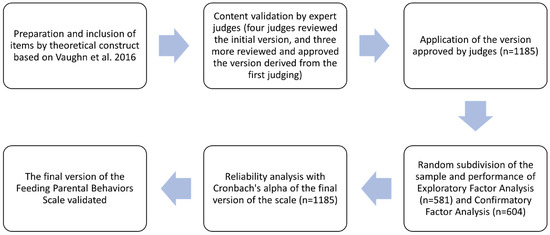
Figure 1.
Diagram of the process of validating the Scale of Parental Feeding Behaviors.
2.1. The Development of the Scale on Parental Feeding Behavior
The objective of this instrument is to evaluate the weekly frequency with which caregivers utilize behavioral strategies when feeding children between 1 and 11 years of age. The items were developed by three experts (bilingual psychologists), considering the constructs [5] shown in Table 1. The operational definitions allowed the constructs to be included as instrument dimensions.
2.2. Content Validation by Expert Judges
The content validation method [16] provided an instrument for measuring the judges’ verdicts on the items and the stages in the content validation process.
The experts were selected according to their knowledge and experience concerning parental feeding practices (two psychologists), psychometry (one psychologist), or both (two psychologists and one nurse). All are postgraduates in their fields (five Ph.D. degrees and one Master’s degree). The six expert judges are from different states in the country’s north, center, and south (Aguascalientes, Guanajuato, Jalisco, Nuevo León, and Veracruz).
In the first stage, four judges evaluated each item of the first version of the instrument in terms of its congruence (whether the item has a logical relationship with the dimension or indicator that measures) and clarity (whether the item is easily understood; if its syntax and semantics are adequate) on a scale from 1 to 4, according to a widely used instrument [16]. The mode and median of each item were obtained for the judges’ evaluations, and the agreement between judges was calculated via Kendall’s W to validate the content of the congruence criteria (Kendall’s W = 0.462, X2= 118.24, and p = 0.000) and clarity (Kendall’s W = 0.369, X2 = 94.518, and p = 0.008. Likewise, the judges were asked to provide comments, observations, or suggestions for each item’s correction. Items that obtained a median score equal to or less than 3.5 were corrected, considering all of the judges’ observations. In the second stage, the updated version was sent to three final expert judges (psychologist researchers with Ph.D. degrees in parental feeding practices and with experience in psychometry) who agreed to approve the final version, which contained 80 items.
The cultural adequacy of the instrument was assessed in a field test, as recommended by the literature [17], with 13 Mexican mothers of children 1–5 years of age. These participants indicated that the items were clear and understandable.
2.3. The Application and Validation of the Instrument
2.3.1. Participants
The participants comprised 1185 Mexican adults responsible for the main meal of at least one child in Mexico’s urban zone. The participants were identified through non-probabilistic sampling via the initial dissemination of the publication in an essential educational institution, in addition to its promotion on social networks in November 2022, taking into account the following considerations about the public to which it was directed: men and women between 18 and 65 years of age from Mexico’s urban areas, with children between 1 and 12 years of age, with interests in parenting, paternity, maternity, and fitness. In total, 1210 caregivers provided answers to the scale via a digital form, but we eliminated data from 25 caregivers with children whose ages fell outside of the age range. The final sample was subdivided into two random subsamples for the EFA (n = 581) and CFA (n = 604).
2.3.2. Materials and Instruments
Each participating caregiver provided their digital informed consent. The scale, which comprised 80 items regarding the frequency of parental behaviors exhibited while feeding a child in the last week, was distributed via Google Forms. The participants’ response options were never (1), a few times (2), sometimes (3), many times (4), and always (5).
2.3.3. Data Analysis
Skewness and kurtosis values were used to analyze the normality assumption for each item’s distribution. We excluded items with high skewness values and kurtosis > |1.5|. We confirmed the adequacy of the sampling using the Kaiser–Meyer–Olkin (KMO) measure (≥0.6), and the factorability of the data was confirmed using Bartlett’s test of sphericity (p < 0.05). We performed an exploratory factor analysis (EFA), according to recommendations [18,19], using the maximum likelihood extraction method and Kaiser’s Oblimin rotation to study the scale’s psychometric properties via SPSS v. 29. Modeling was carried out by eliminating the items with a factorial weight of less than 0.350 or those with a weight greater than 0.300 for more than one factor. A confirmatory factorial analysis (CFA) was then performed using AMOS v.29. For reliability, Cronbach’s alpha value was calculated for the final version of the scale (40 items), and McDonald’s omega value was calculated for each dimension.
3. Results
3.1. Participants
The caregivers were 32.7 (7.6) years old, with a mean BMI of 26.9 (9.3). Among the participants, 52.7% reported answering the scale while thinking about their behaviors when feeding a girl, while the rest did so while thinking about feeding a boy. The child’s age was 4.8 (3) years. According to the regionalization reported in the Encuesta Nacional de Salud y Nutrición, 35.4% of participants lived in the urban areas of the western region, 30.9% lived in the northern part, 24.5% lived in the central region, and 9.2% lived in the southern region [20]. Finally, 97% of the participants were women, 2.4% were men, and 0.6% preferred not to indicate their gender; 89.9% were mothers, 2.6% were fathers, 2.5% were aunts, 1.9% were grandparents, 0.6% were cousins, and 2.2% were unrelated to the child. Table 2 presents the economic income ranges and academic levels of the participants.
Table 2.
Economic income ranges and academic levels of the participants.
3.2. Exploratory Factorial Analysis
The KMO (0.892) value and Bartlett’s test of sphericity (X2 = 13,141.025, df = 1176, p = 0.000) indicated an adequate sample and the utility of the factorial analysis. The items were grouped into 11 factors in the EFA, which explained 63.9% of the accumulated variance.
As shown in Table 3, the eleven factors obtained from the rotation, given its coincidence with the theoretical construct, were named as follows: (1) disposition of non-recommended foods (DNR), (2) nutritional education (EN), (3) pressure to eat (P), (4) praise for healthy eating (El), (5) meal times (MT), (6) monitoring of consumption (Mn), (7) structured offer of fruits and vegetables (OFV), (8) consumption conditioning (Co), (9) overt restriction (RO), (10) guided choices (EG), and (11) covert restriction (RC). This version of the instrument comprised 49 items.
Table 3.
Factorial rotation matrix of the EFA items and internal consistency with Cronbach’s alpha and McDonald’s omega.
3.3. Confirmatory Factor Analysis
Different models were used for the CFA, as indicated in Table 4. The proposal with ten factors and 40 items showed the best properties and fit (CMIN = 1531.5, p < 0.001, CMIN/df = 2.20, RSEA = 0.045, CFI = 0.92, TLI, 0.91, and NFI = 0.87). Among the eleven items that showed a weight of less than 0.490 were those belonging to the meal time (MT) factor, so this factor was eliminated in the final version of the instrument.
Table 4.
Comparison of values of each confirmatory factor analysis model.
Regarding the correlations between the ten factors, as shown in Figure 2, correlations were high among the factors of coercive control, specifically the correlation of the practice disposition of non-recommended foods (DNR) with overt (RO, −0.736) and covert restriction (RC, −0.791), as well as pressure to eat (P, 0.402) and the consumption conditioning (Co, 0.49). P correlated with Co (0.65). Factors of RC were correlated with RO (0.795) and negatively correlated with Co (−0.32). There were also correlations between the positive practices of autonomy or structure, specifically monitoring (Mn) with the structured offer of fruits and vegetables (OFV, 0.56), as well as with nutritional education (EN, 0.43) and guided choices (EG, 0.41). The EG correlated with OFV (0.48) and EN (0.33). The EN correlated with OFV (0.36) and praise behaviors (El, 0.41). In addition, positive correlations were observed between the practice of CR with OFV (0.61), with Mn (0.49), and with EG (0.32). The behaviors of RA correlated with Mn (0.41), OFV (0.44), and with EG (0.3). The practice of Co correlated with El (0.36). The practice of DNR was negatively correlated with Mn (−0.31), with OFV (−0.45), and with CR (−0.79).
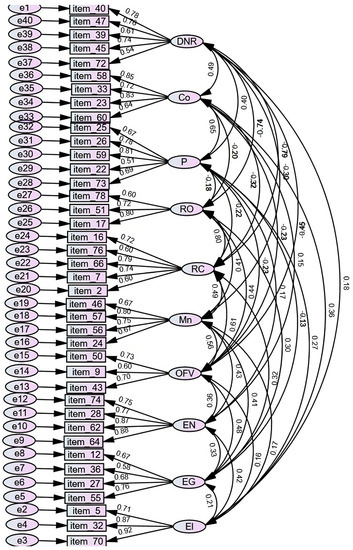
Figure 2.
Confirmatory factor analysis diagram of the final model with ten factors and 40 items. Note: DNR = disposition of non-recommended foods; RO = overt restriction; RC =covert restriction; P = pressure to eat; Co = consumption conditioning; Mn = monitoring; OFV = structured offer of fruits and vegetables; EN = nutritional education; EG = guided choices; El = praise for healthy eating.
3.4. Consistency Analysis
The final version with 40 items obtained a Cronbach’s alpha value of 0.816, and a single-item consistency analysis showed a Cronbach’s alpha greater than 0.8 in all cases (Table 5), indicating a reliable instrument. In addition, McDonald’s omega was acceptable for each dimension (>0.7) (see Table 3).
Table 5.
Consistency analysis, subtracting the unique elements.
4. Discussion
The present work provides evidence of the construct validity and internal consistency of the self-applicable Scale on Parental Feeding Behaviors (ECOPAL). For this reason, it is considered suitable for evaluating the frequency with which caregivers or adults responsible for feeding children between 1 and 12 years of age perform positive and negative parental eating behaviors to promote healthy eating. The scale’s internal consistency was analyzed, and evidence of its construct validity was provided. Similarly, the scale provides empirical evidence of the theoretical basis [6] with respect to the classification of parental feeding practices. The results were compared with the results of two other instruments with the same theoretical basis, the HomeSTEAD family food practices survey [10,15], which does not have a Spanish version, and the Comprehensive Feeding Practices Questionnaire in Spanish to Mexican Mothers [14], which changes the original construct of parental feeding practices to include attitudes and beliefs towards food.
The dimensions of the ECOPAL scale showed adequate consistency (>0.68); some were better than the original version of the HomeSTEAD survey (>0.62) and its Portuguese version (>0.61). Although the ECOPAL questionnaire evaluates fewer practices than the three subscales of the HomeSTEAD survey, it can determine them globally and comprehensively on the same scale. It can account for the frequency of behaviors of each practice and provide information regarding their relative frequency to other practices.
Compared with the Comprehensive Feeding Practices Questionnaire for Mexican Mothers (CIPA) [14], ECOPAL presented better consistency of global scale (α = 0.64 vs. α = 0.816, respectively). The CIPA remained the modeling’s dimension with high consistency (α = 0.965) but with items that evaluate beliefs on modeling more than actions.
The instrument resulting from the psychometric validation process shows adequate construct validity, since it presents nine of the thirteen theoretical constructs, namely restriction (overt and covert); pressure to eat; the consumption conditioning; food disposal (not recommended and fruits and vegetables); guided choices; unstructured practices (meal times); intake monitoring; nutritional education; and motivation for healthy eating (praise). In addition, some components were grouped by the type of food they offer, such as the structured offer of fruits and vegetables (OFV) and the disposition of non-recommended foods (DNR). This finding is particularly relevant because it accounts for the practice of food availability and is part of the structure construct [5].
The MT factor, which refers to a lack of structure at meal times, is obtained via the EFA. These items can account for unstructured eating practices. However, the MT factor was not maintained in the CFA; it is considered theoretically relevant, since meal times and accompanying the child and sharing food are indicated as part of the modeling climate for children’s eating behaviors [21].
The constructs not maintained in the instrument from the EFA were modeling, eating habits, the involvement of the child in eating, and negotiation. It should be noted that these practices belong to categories of structure and autonomy support. Five items that presented significant biases were lost from the beginning, as evidenced by high kurtosis and asymmetry values (>1.5); these were structure practices such as modeling and eating habits. The values could have occurred since caregivers reported having performed these behaviors with extreme scores, such as never or always. The negotiation construct disappeared due to the low communality (<0.3) presented by the items from the extraction method and was affected by having only included three items in this factor since its creation. Reviewing the wording and including more items in future applications to evaluate this parental practice would be convenient. Although a minimum of three or four items per factor is recommended [22], if there is a minimum of 200 cases, which this study fulfills, having 581 cases for the EFA, current recommendations indicate that the more items there are that accurately measure a factor, the more determined this factor will be and the more stable the factorial solution will be [19]. Finally, the items regarding the child’s involvement in feeding were lost for two reasons: two items had saturations lower than 0.3, and the rest presented saturations > 0.3 with more than one factor, which was shared with the nutritional education factor and with consumption motivation. After considering the reviewed literature regarding recommendations for conducting an exploratory factor analysis [19,22], these items were eliminated, and a detailed assessment is required to determine whether their modification is recommended for their inclusion in a new version of the scale [19], or if it is necessary to add new items with similar content to adequately sample the content of the factor [18].
Of the factors resulting from the EFA and CFA, four of these report parental feeding practices associated with the formation of unhealthy eating habits; these are the disposal of non-recommended foods (DNR), the pressure to eat (P), consumption conditioning (Co), and overt restriction (RO), which are considered coercive control practices. On the other hand, the factors associated with the promotion of healthy eating habits are those practices that support autonomy, in this case, nutritional education (EN), praise for healthy eating (El), guided choices (EG), and those relating to structure, namely the structured offer of fruits and vegetables (OFV), monitoring of consumption(Mn), and covert restriction (CR). This classification is based on the reviewed literature [5,9,21] and is supported by the correlations found in the CFA.
The correlations shown by the CFA strengthen the categorization of the practices of open or manifest restriction, the conditioning of consumption, and the pressure to eat as coercive control, since they had positive and high correlations between them but negative correlations with other practices, while the practices of monitoring, the structured offer of fruits and vegetables, nutritional education, praising healthy eating, and guided choices had positive correlations between them and negative correlations with the practices of coercive control, thus strengthening their categorization as practices of autonomy support and structure that, unlike the coercive practices, have been associated in the literature with the formation of healthy eating habits. The disposition of non-recommended foods practice had negative correlations with the structure practices; likewise,: monitoring and the offering of fruits and vegetables had correlations with the practices of overt and covert restriction, but did not correlate with behaviors supporting autonomy, inferring the confusing role that caregivers bringing these foods home can play in promoting healthy eating in children. Regarding covert restriction, positive correlations were obtained with structure practices, such as monitoring and offering fruits and vegetables, and with autonomy support practices, such as guided choices, in addition to a negative correlation with the practice of the disposition of non-recommended food. The preceding result could suggest that this practice, when related to the limited availability of foods not recommended for daily consumption, is considered a practice of structure rather than coercive control, an aspect already discussed in the literature [5,9].
The limitations of this study are the same as those linked to the self-report questionnaires, such as the effects of memory bias or social desire [23], which were taken care of with a frequency scale made explicit in the instructions to consider the events of the last week. Regarding social desirability, care was taken to present the items randomly and to use some reversible ones. However, in the factorial analysis, some of these elements were eliminated. Some authors recently indicated that inverse items could contribute more to confusion than to verifying answers, evidencing that these items required adjustments to the method [24].
Some limitations of this study may be related to the process of selecting samples from social networks, because we considered filters such as having an interest in paternity issues, which represents a bias in the representation of Mexican caregivers, since there may be a significant number of them who do not search for parenting issues on social networks; this might explain the high academic level or low economic level of the sample, which are other possible biases.
Another limitation of this study was the loss of items that evaluated modeling, which is a practice of great interest; a review of the wording of these items is necessary to reduce the response bias of never or always, and conducting a future factorial analysis with them is necessary to be able to include the evaluation of this practice.
Finally, the application of this scale occurred online. Although it is undeniable that this has advantages, such as the possibility of reaching a global population, achieving very large sample sizes, the flexibility of the survey design, the speed and timeliness of administration, and ability to force response completion [25], it is also true that it presents drawbacks. Some prominent factors are the inability to provide clear, one-on-one instructions to respondents, inherent sampling biases, a self-selection bias, variability among respondents in their ability to access the survey due to device limitations, and connectivity issues, among others (for reviews, see [25]).
5. Conclusions
Based on the results previously described and discussed, it is concluded that the instrument presented herein, the Scale on Parental Feeding Behavior (ECOPAL), which contains 40 items in its final version, has adequate internal consistency indexes and shows evidence of construct validity. We consider it adequate and useful for evaluating the frequency of parental eating behaviors, both positive and negative, which factor into the formation of healthy eating habits in children. The above is very useful when planning interventions at both the primary and secondary levels to prevent health problems related to poor nutrition, such as childhood obesity, as well as in the prevention of eating disorders, and more specifically by guiding caregivers on how to deal with or prevent problems with feeding behavior, such as food selectivity, neophobia, emotional eating, or over-eating, more effectively.
Author Contributions
Conceptualization: M.L.G.-T., X.G.-O., G.N.-C. and L.A.G.-O.; formal analysis: M.L.G.-T., X.G.-O. and G.N.-C.; Funding acquisition: M.L.G.-T.; Investigation, M.L.G.-T. and L.A.G.-O.; Methodology: M.L.G.-T. and X.G.-O.; Validation: M.L.G.-T., X.G.-O., G.N.-C. and L.A.G.-O.; Writing—review and editing: M.L.G.-T., X.G.-O. and G.N.-C. All authors have read and agreed to the published version of the manuscript.
Funding
The first author thanks the Gonzalo Rio Arronte Foundation (S.719) and the Autonomous University of Aguascalientes (PIPS22-3) for funding this study.
Institutional Review Board Statement
The present work adhered to the ethical guidelines of the Declaration of Helsinki and was approved by the bioethics committee of the Autonomous University of Aguascalientes CIB-UAA-PIPS22-3 since the informed consent complied with the established guidelines and evidence of the protection of information and ethical treatment of the data was shown.
Informed Consent Statement
Informed consent was obtained from all subjects involved in the study.
Data Availability Statement
Data are available upon request due to privacy restrictions. The data presented in this study are available upon request from the corresponding author.
Acknowledgments
The first author thanks the Gonzalo Rio Arronte Foundation (S.719), the Autonomous University of Aguascalientes (PIPS22-3) for funding this study, and the Technologic of Monterrey for allowing the first author to carry out a research stay with the second author.
Conflicts of Interest
The authors declare no conflict of interest.
References
- Fondo de las Naciones Unidas para la Infancia (UNICEF). Estado Mundial de la Infancia 2019—Niños, Alimentos y Nutrición; UNICEF: Geneva, Switzerland, 2019; Available online: https://www.unicef.org/mexico/media/2436/file/Resumen%20ejecutivo%20espa%C3%B1ol.pdf (accessed on 5 May 2022).
- Fondo de las Naciones Unidas para la Infancia (UNICEF). Salud y Nutrición; UNICEF: Geneva, Switzerland, 2018; Available online: https://www.unicef.org/mexico/spanish/17047_17494.html (accessed on 5 May 2022).
- Padilla-Vinueza, V.E.P.; Tisalema, H.; Gavilanez, R.I.A.; Cunalata, E.I.J.; Carrión, A.A.M.; Aguilar, A.D.S. Obesidad infantil y métodos de intervención. Dominio Cienc. 2022, 8, 961–971. [Google Scholar] [CrossRef]
- Martínez-Munguía, C.; Navarro-Contreras, G. Factores Psicológicos, Sociales y Culturales del Sobrepeso y la Obesidad Infantil y Juvenil en México. Rev. Médica Inst. Mex. Seguro Soc. 2014, 52, S94–S101. Available online: https://www.redalyc.org/articulo.oa?id=457745485016 (accessed on 5 May 2022).
- Vaughn, A.E.; Ward, D.S.; Fisher, J.O.; Faith, M.S.; Hughes, S.O.; Kremers, S.P.; Musher-Eizenman, D.R.; O’connor, T.M.; Patrick, H.; Power, T.G. Fundamental constructs in food parenting practices: A content map to guide future research. Nutr. Rev. 2016, 74, 98–117. [Google Scholar] [CrossRef]
- González-Torres, M.L.; Esqueda, C.N.; Vacio, M.A. Prácticas alimentarias parentales y su relación con la conducta alimentaria infantil: Problemas para la explicación. Rev. Mex. Trastor. Aliment. 2018, 9, 129–142. [Google Scholar] [CrossRef][Green Version]
- Shloim, N.; Edelson, L.R.; Martin, N.; Hetherington, M.M. Parenting Styles, Feeding Styles, Feeding Practices, and Weight Status in 4–12 Year-Old Children: A Systematic Review of the Literature. Front. Psychol. 2015, 6, 1849. [Google Scholar] [CrossRef]
- Castrillón, I.C.; Giraldo, O. Prácticas de alimentación de los padres y conductas alimentarias en niños: ¿existe información suficiente para el abordaje de los problemas de alimentación? Rev. Psicol. Univ. Antioq. 2014, 6, 57–74. [Google Scholar] [CrossRef]
- González-Torres, M.L.; González, L.A.; Altamirano, A.; Pedroza, F. Interacciones cuidador-niño durante la alimentación y el aprendizaje temprano de hábitos alimentarios. In Aportaciones Actuales a la Psicología Social (IV); Díaz, R., Reyes, L.I., López, F., Eds.; Asociación Mexicana de Psicología Social: Ciudad de México, Mexico, 2018; pp. 2133–2149. [Google Scholar]
- Vaughn, A.E.; Dearth-Wesley, T.; Tabak, R.G.; Bryant, M.; Ward, D.S. Development of a comprehensive assessment of food parenting practices: The home self-administered tool for environmental assessment of activity and diet family food practices survey. J. Acad. Nutr. Diet. 2017, 117, 214–227. [Google Scholar] [CrossRef]
- Birch, L.L.; Fisher, J.O.; Grimm-Thomas, K.; Markey, C.N.; Sawyer, R. Confirmatory factor analysis of the Child Feeding Questionnaire: A measure of parental attitudes, beliefs, and practices about child feeding and obesity proneness. Appetite 2001, 36, 20–201. [Google Scholar] [CrossRef]
- Navarro-Contreras, G.; Lagunes, I.R. Validación Psicométrica de la Adaptación Mexicana del Child Feeding Questionnaire. Acta Investig. Psicol. 2016, 6, 2337–2349. [Google Scholar] [CrossRef]
- Musher-Eizenman, D.; Holub, S. Comprehensive Feeding Practices Questionnaire: Validation of a New Measure of Parental Feeding Practices. J. Pediatr. Psychol. 2007, 32, 960–972. [Google Scholar] [CrossRef]
- Ángel, J.G.; Flores, Y.P.; Trujillo, P.E.H.; Ávila, H.A.; Gutiérrez, J.M.V. Confirmatory factor analysis of the Comprehensive Feeding Practices Questionnaire in Mexican mothers of preschool children. Nutr. Hosp. 2021, 38, 827–832. [Google Scholar] [CrossRef]
- Afonso, L.; Castro, J.; Parente, N.; Torres, S. A Comprehensive Assessment of Food Parenting Practices: Psychometric Properties of the Portuguese Version of the HomeSTEAD Family Food Practices Survey and Associations with Children’s Weight and Food Intake. Eur. J. Investig. Health Psychol. Educ. 2020, 10, 424–440. [Google Scholar] [CrossRef]
- Escobar-Pérez, J.; Cuervo-Martínez, Á. Validez de Contenido y Juicio de Expertos: Una Aproximación a su Utilización. Av. Medición 2008, 6, 27–36. Available online: https://gc.scalahed.com/recursos/files/r161r/w25645w/Juicio_de_expertos_u4.pdf (accessed on 1 February 2022).
- Van Widenfelt, B.M.; Treffers, P.D.A.; de Beurs, E.; Siebelink, B.M.; Koudijs, E. Translation and Cross-Cultural Adaptation of Assessment Instruments Used in Psychological Research with Children and Families. Clin. Child. Fam. Psychol. Rev. 2005, 8, 135–147. [Google Scholar] [CrossRef]
- Costello, A.B.; Osborne, J. Best practices in exploratory factor analysis: Four recommendations for getting the most from your analysis. Pract. Assess. Res. Eval. 2005, 10, 7. [Google Scholar] [CrossRef]
- Lloret-Segura, S.; Ferreres-Traver, A.; Hernández-Baeza, A.; Tomás-Marco, I. El análisis factorial exploratorio de los ítems: Una guía práctica, revisada y actualizada. An. Psicol. Ann. Psychol. 2014, 30, 1151–1169. [Google Scholar] [CrossRef]
- Shamah-Levy, T.; Vielma-Orozco, E.; Heredia-Hernández, O.; Romero-Martínez, M.; Mojica-Cuevas, J.; Cuevas-Nasu, L.; Santaella-Castell, J.A.; Rivera-Dommarco, J. Encuesta Nacional de Salud y Nutrición [ENSANUT] 2018–19: Resultados Nacionales; Instituto Nacional de Salud Pública: Cuernavaca, Mexico, 2020; Available online: https://ensanut.insp.mx/encuestas/ensanut2018/doctos/informes/ensanut_2018_informe_final.pdf (accessed on 5 May 2022).
- Jimeno-Martínez, A.; Maneschy, I.; Rupérez, A.I.; Moreno, L.A. Factores Determinantes del Comportamiento Alimentario y su Impacto Sobre la Ingesta y la Obesidad en Niños. J. Behav. Feed. 2021, 1, 60–71. Available online: http://148.202.248.171/revistaiican/index.php/JBF/article/view/20 (accessed on 8 July 2022).
- Ferrando, P.J.; Anguiano-Carrasco, C. El Análisis Factorial Como Técnica de Investigación en Psicología. Papeles Psicól. 2010, 31, 18–33. Available online: https://www.redalyc.org/pdf/778/77812441003.pdf (accessed on 9 September 2022).
- Del Valle, M.; Zamora, E.V. El uso de las Medidas de Auto-Informe: Ventajas y Limitaciones en la Investigación en Psicología. Altern. Psicol. 2021, 47, 22–35. Available online: https://ri.conicet.gov.ar/handle/11336/173600 (accessed on 8 July 2022).
- Tomás, J.M.; Requena, P.S.; Germes, A.O.; Llinares, L.G.; Moral, J.C.M. Efectos de Método Asociados a Ítems Invertidos vs. Ítems en Negativo. Rev. Mex. Psicol. 2012, 29, 105–115. Available online: https://www.redalyc.org/articulo.oa?id=243030190001 (accessed on 8 July 2022).
- Jaeger, S.R.; Cardello, A.V. Factors affecting data quality of online questionnaires: Issues and metrics for sensory and consumer research. Food Qual. Prefer. 2022, 102, 104676. [Google Scholar] [CrossRef]
Disclaimer/Publisher’s Note: The statements, opinions and data contained in all publications are solely those of the individual author(s) and contributor(s) and not of MDPI and/or the editor(s). MDPI and/or the editor(s) disclaim responsibility for any injury to people or property resulting from any ideas, methods, instructions or products referred to in the content. |
© 2023 by the authors. Licensee MDPI, Basel, Switzerland. This article is an open access article distributed under the terms and conditions of the Creative Commons Attribution (CC BY) license (https://creativecommons.org/licenses/by/4.0/).