Resting Energy Expenditure in the Elderly: Systematic Review and Comparison of Equations in an Experimental Population
 ,
,  , , ,
, , ,  ,
,  and
and 
Abstract
1. Introduction
2. Materials and Methods
2.1. Data Sources
2.2. Eligibility Criteria
2.2.1. Types of Study
2.2.2. Types of Predictive Equations
2.3. Data Sources
2.4. Data Collection
2.5. Data Extraction
2.6. Data Synthesis
2.7. Predictive Equation Testing
2.8. Statistical Methods
3. Results
3.1. Literature Review Results
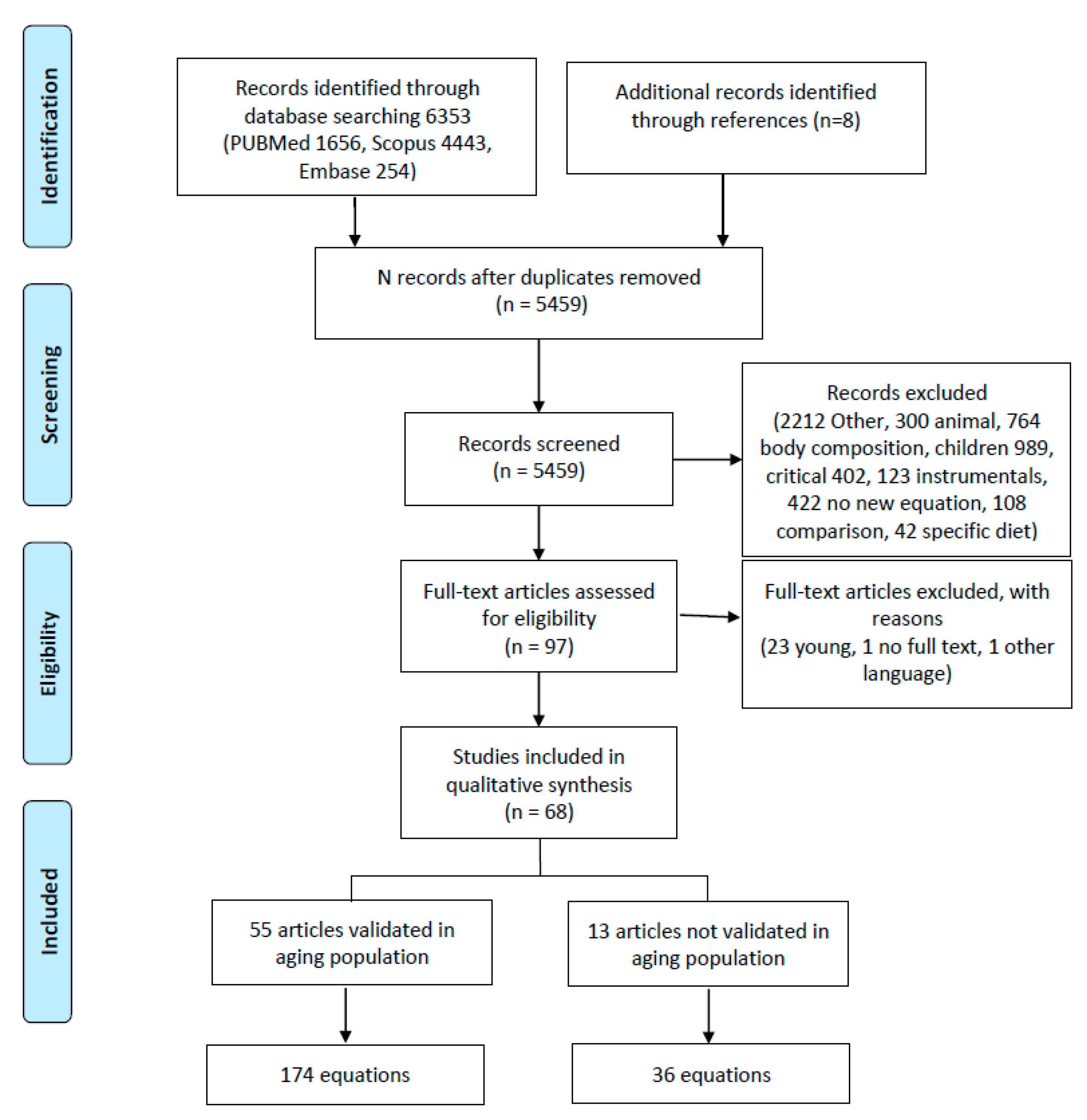
3.1.1. Study Selection
3.1.2. Energy Expenditure Assessment
3.1.3. Equation Characteristics
3.1.4. Precision and Agreement among Equations
3.2. Results for the Sample Population
3.2.1. Characteristics of the Sample
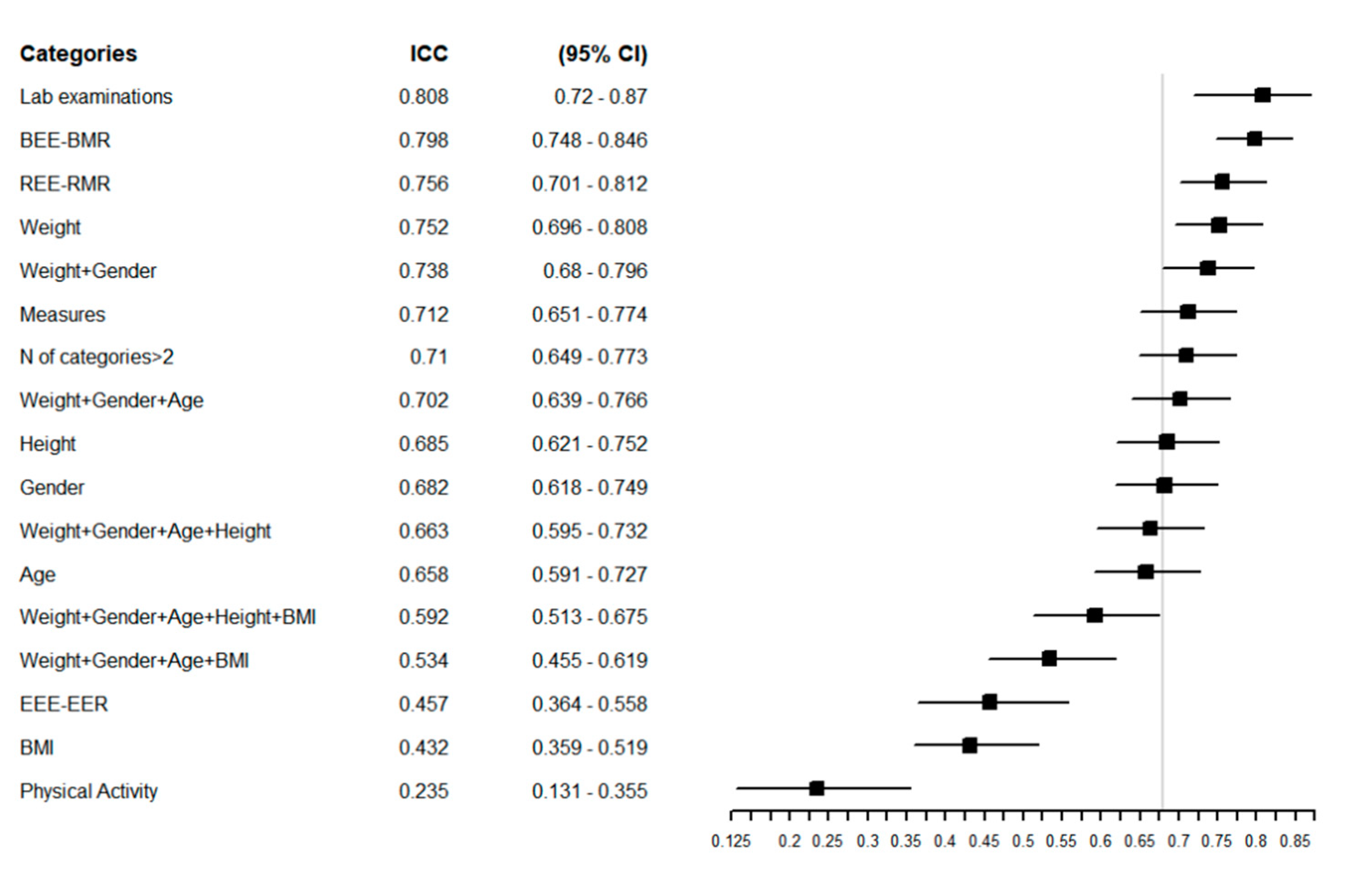
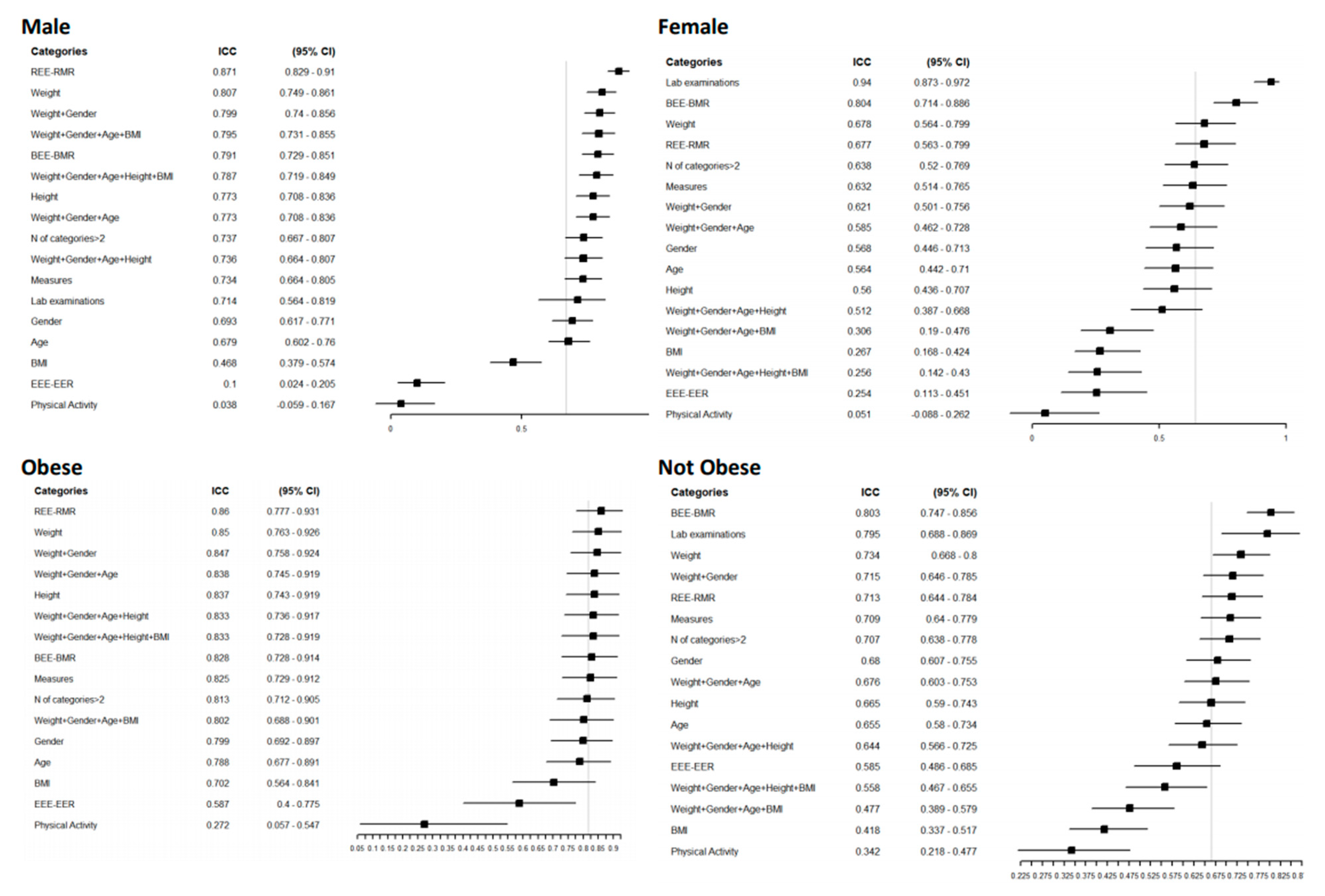
3.2.2. Equation Agreement Testing in the Sample Population
3.3. Web Tool for the Practical Implementation of Equations
4. Discussion
Limitations
5. Conclusions
Supplementary Materials
Author Contributions
Funding
Institutional Review Board Statement
Informed Consent Statement
Data Availability Statement
Acknowledgments
Conflicts of Interest
References
- Sullivan, D.H.; Sun, S.; Walls, R.C.; Kovacevich, D.S. Protein-Energy Undernutrition Among Elderly Hospitalized Patients: A Prospective Study. Nutr. Clin. Pract. 1999, 14, 327–328. [Google Scholar] [CrossRef]
- Ahmed, T.; Haboubi, N. Assessment and management of nutrition in older people and its importance to health. Clin. Interv. Aging 2010, 5, 207–216. [Google Scholar]
- Leslie, W.; Hankey, C. Aging, Nutritional Status and Health. Healthcare 2015, 3, 648–658. [Google Scholar] [CrossRef]
- Neyens, J.; Halfens, R.; Spreeuwenberg, M.; Meijers, J.; Luiking, Y.; Verlaan, G.; Schols, J. Malnutrition is associated with an increased risk of falls and impaired activity in elderly patients in Dutch residential long-term care (LTC): A cross-sectional study. Arch. Gerontol. Geriatr. 2013, 56, 265–269. [Google Scholar] [CrossRef]
- Evans, C. Malnutrition in the Elderly: A Multifactorial Failure to Thrive. Perm. J. 2005, 9, 38–41. [Google Scholar] [CrossRef]
- Naseer, M.; Forssell, H.; Fagerström, C. Malnutrition, functional ability and mortality among older people aged ≥60 years: A 7-year longitudinal study. Eur. J. Clin. Nutr. 2016, 70, 399–404. [Google Scholar] [CrossRef]
- Wells, J.L.; Dumbrell, A.C. Nutrition and Aging: Assessment and Treatment of Compromised Nutritional Status in Frail Elderly Patients. Clin. Interv. Aging 2006, 1, 67–79. [Google Scholar] [CrossRef]
- Veronese, N.; Cereda, E.; Solmi, M.; Fowler, S.A.; Manzato, E.; Maggi, S.; Manu, P.; Abe, E.; Hayashi, K.; Allard, J.P.; et al. Inverse relationship between body mass index and mortality in older nursing home residents: A meta-analysis of 19,538 elderly subjects. Obes. Rev. 2015, 16, 1001–1015. [Google Scholar] [CrossRef]
- Elia, M.; Zellipour, L.; Stratton, R. To screen or not to screen for adult malnutrition? Clin. Nutr. 2005, 24, 867–884. [Google Scholar] [CrossRef]
- Moreira, V.G.; Lourenço, R.A. Prevalence and factors associated with frailty in an older population from the city of Rio de Janeiro, Brazil: The FIBRA-RJ Study. Clinics 2013, 68, 979–985. [Google Scholar] [CrossRef]
- Goates, S.; Du, K.; Braunschweig, C.A.; Arensberg, M.B. Economic Burden of Disease-Associated Malnutrition at the State Level. PLoS ONE 2016, 11, e0161833. [Google Scholar] [CrossRef]
- Drewnowski, A.; Evans, W.J. Nutrition, Physical Activity, and Quality of Life in Older AdultsSummary. J Gerontol. A Biol. Sci. Med. Sci. 2001, 56, 89–94. [Google Scholar] [CrossRef]
- Frankenfield, D.C.; Ashcraft, C.M. Estimating Energy Needs in Nutrition Support Patients. J. Parenter. Enter. Nutr. 2011, 35, 563–570. [Google Scholar] [CrossRef]
- Siervo, M.; Bertoli, S.; Battezzati, A.; Wells, J.C.; Lara, J.; Ferraris, C.; Tagliabue, A. Accuracy of predictive equations for the measurement of resting energy expenditure in older subjects. Clin. Nutr. 2014, 33, 613–619. [Google Scholar] [CrossRef]
- Elizabeth Weekes, C. Controversies in the determination of energy requirements. Proc. Nutr. Soc. 2007, 66, 367–377. [Google Scholar] [CrossRef]
- Leibel, R.L. Changes in Energy Expenditure Resulting from Altered Body Weight. N. Engl. J. Med. 1995, 332, 8. [Google Scholar] [CrossRef]
- Noreik, M.; Maurmann, M.; Meier, V.; Becker, I.; Röhrig, G.; Polidori, M.C.; Schulz, R.-J. Resting energy expenditure (REE) in an old-old population: Implications for metabolic stress. Exp. Gerontol. 2014, 59, 47–50. [Google Scholar] [CrossRef]
- Dionne, I.; Després, J.P.; Bouchard, C.; Tremblay, A. Gender difference in the effect of body composition on energy metabolism. Int. J. Obes. Relat. Metab. Disord. 1999, 23, 312–319. [Google Scholar] [CrossRef]
- Bogardus, C.; Lillioja, S.; Ravussin, E.; Abbott, W.; Zawadzki, J.K.; Young, A.; Knowler, W.C.; Jacobowitz, R.; Moll, P.P. Familial dependence of the resting metabolic rate. N. Engl. J. Med. 1986, 315, 96–100. [Google Scholar] [CrossRef]
- Bedogni, G.; Bertoli, S.; Leone, A.; De Amicis, R.; Lucchetti, E.; Agosti, F.; Marazzi, N.; Battezzati, A.; Sartorio, A. External validation of equations to estimate resting energy expenditure in 14,952 adults with overweight and obesity and 1948 adults with normal weight from Italy. Clin. Nutr. 2019, 38, 457–464. [Google Scholar] [CrossRef]
- Sabounchi, N.S.; Rahmandad, H.; Ammerman, A. Best-fitting prediction equations for basal metabolic rate: Informing obesity interventions in diverse populations. Int. J. Obes. 2013, 37, 1364–1370. [Google Scholar] [CrossRef]
- Madden, A.M.; Mulrooney, H.M.; Shah, S. Estimation of energy expenditure using prediction equations in overweight and obese adults: A systematic review. J. Hum. Nutr. Diet. 2016, 29, 458–476. [Google Scholar] [CrossRef]
- Levine, J.A. Measurement of energy expenditure. Public Health Nutr. 2005, 8, 1123–1132. [Google Scholar] [CrossRef]
- Schoeller, D.A.; van Santen, E. Measurement of energy expenditure in humans by doubly labeled water method. J. Appl. Physiol. Respir. Env. Exerc. Physiol. 1982, 53, 955–959. [Google Scholar] [CrossRef]
- Karlsson, M.; Olsson, E.; Becker, W.; Karlstrom, B.; Cederholm, T.; Sjogren, P. Ability to predict resting energy expenditure with six equations compared to indirect calorimetry in octogenarian men. Exp. Gerontol. 2017, 92, 52–55. [Google Scholar] [CrossRef]
- da Rocha, E.E.M.; Alves, V.G.F.; Silva, M.H.N.; Chiesa, C.A.; da Fonseca, R.B.V. Can measured resting energy expenditure be estimated by formulae in daily clinical nutrition practice? Curr. Opin. Clin. Nutr. Metab. Care 2005, 8, 319–328. [Google Scholar] [CrossRef]
- Parker, E.A.; Feinberg, T.M.; Wappel, S.; Verceles, A.C. Considerations When Using Predictive Equations to Estimate Energy Needs Among Older, Hospitalized Patients: A Narrative Review. Curr. Nutr. Rep. 2017, 6, 102–110. [Google Scholar] [CrossRef]
- Liberati, A.; Altman, D.G.; Tetzlaff, J.; Mulrow, C.; Gøtzsche, P.C.; Ioannidis, J.P.A.; Clarke, M.; Devereaux, P.J.; Kleijnen, J.; Moher, D. The PRISMA statement for reporting systematic reviews and meta-analyses of studies that evaluate healthcare interventions: Explanation and elaboration. BMJ 2009, 339, b2700. [Google Scholar] [CrossRef]
- Gibson, R.S. Nutritional Assessment: A Laboratory Manual; Oxford University Press: Oxford, UK, 1993; ISBN 0-19-508547-7. [Google Scholar]
- National Heart, Lung, Blood Institute; North American Association for the Study of Obesity. Overweight The Practical Guide: Identification, Evaluation, and Treatment of Overweight and Obesity in Adults; NIH Publication: Bethesda, MD, USA, 2000. [Google Scholar]
- Shrout, P.E.; Fleiss, J.L. Intraclass correlations: Uses in assessing rater reliability. Psychol. Bull. 1979, 86, 420–428. [Google Scholar] [CrossRef]
- R Core Team. R: A Language and Environment for Statistical Computing; R Foundation for Statistical Computing: Vienna, Austria, 2020. [Google Scholar]
- Harrell, F.E., Jr. rms: Regression Modeling Strategies; R Package Version 6.0-1; R Foundation for Statistical Computing: Vienna, Austria, 2020. [Google Scholar]
- Gamer, M.; Lemon, J.; Gamer, M.M.; Robinson, A.; Kendall’s, W. Package ‘irr.’ Various Coefficients of Interrater Reliability and Agreement; R Foundation for Statistical Computing: Vienna, Austria, 2012. [Google Scholar]
- Aleman-Mateo, H.; Rush, E.; Esparza-Romero, J.; Ferriolli, E.; Ramirez-Zea, M.; Bour, A.; Yuchingtat, G.; Ndour, R.; Mokhtar, N.; Valencia, M.E.; et al. Prediction of fat-free mass by bioelectrical impedance analysis in older adults from developing countries: A cross-validation study using the deuterium dilution method. J. Nutr. Health Aging 2010, 14, 418–426. [Google Scholar] [CrossRef]
- Anjos, L.A.; Wahrlich, V.; Vasconcellos, M.T. BMR in a Brazilian adult probability sample: The Nutrition, Physical Activity and Health Survey. Public Health Nutr. 2014, 17, 853–860. [Google Scholar] [CrossRef]
- Arciero, P.J.; Goran, M.I.; Gardner, A.M.; Ades, P.A.; Tyzbir, R.S.; Poehlman, E.T. A Practical Equation to Predict Resting Metabolic Rate in Older Females. J. Am. Geriatr. Soc. 1993, 41, 389–395. [Google Scholar] [CrossRef]
- Arciero, P.J.; Goran, M.I.; Gardner, A.W.; Ades, P.A.; Tyzbir, R.S.; Poehlman, E.T. A practical equation to predict resting metabolic rate in older men. Metabolism 1993, 42, 950–957. [Google Scholar] [CrossRef]
- Bernstein, R.S.; Thornton, J.C.; Yang, M.U.; Wang, J.; Redmond, A.M.; Pierson, R.N.; Pi-Sunyer, F.X.; Van Itallie, T.B. Prediction of the resting metabolic rate in obese patients. Am. J. Clin. Nutr. 1983, 37, 595–602. [Google Scholar] [CrossRef]
- Camps, S.G.; Wang, N.X.; Tan, W.S.K.; Henry, C.J. Estimation of basal metabolic rate in Chinese: Are the current prediction equations applicable? Nutr. J. 2016, 15, 79. [Google Scholar] [CrossRef]
- Carrasco, N.F.; Reyes, S.E.; Núñez, B.C.; Riedemann, S.K.; Rimler, S.O.; Sánchez, G.G.; Sarrat, G.G. Measured and predicted resting energy expenditure in obese and non-obese Chilean subjects. A proposal of predictive equations for the Chilean population. Rev. Med. Chile 2002, 130, 51–60. [Google Scholar]
- Cole, T.J.; Henry, C.J.K. The Oxford Brookes basal metabolic rate database—A reanalysis. Public Health Nutr. 2005, 8, 1202–1212. [Google Scholar] [CrossRef]
- Cunningham, J.J. A reanalysis of the factors influencing basal metabolic rate in normal adults. Am. J. Clin. Nutr. 1980, 33, 2372–2374. [Google Scholar] [CrossRef]
- European Communities. Nutrient and Energy Intakes for the European Community; Office for Official Pubblications of the European Communities: Luxembourg, 1993; ISBN 92-826-6409-0. [Google Scholar]
- Frankenfield, D.C. Bias and accuracy of resting metabolic rate equations in non-obese and obese adults. Clin. Nutr. 2013, 32, 976–982. [Google Scholar] [CrossRef]
- Frankenfield, D.C.; Rowe, W.A.; Smith, J.S.; Cooney, R.N. Validation of several established equations for resting metabolic rate in obese and nonobese people. J. Am. Diet. Assoc. 2003, 103, 1152–1159. [Google Scholar] [CrossRef]
- Fredrix, E.W.; Soeters, P.B.; Deerenberg, I.M.; Kester, A.D.; von Meyenfeldt, M.F.; Saris, W.H. Resting and sleeping energy expenditure in the elderly. Eur. J. Clin. Nutr. 1990, 44, 741–747. [Google Scholar] [PubMed]
- Freni, S.C.; Lewis, S.M.; Mayhugh, M.A.; Jairaj, K.; Arani, R.B.; Turturro, A.; Hart, R.W. Improved equations for estimating the resting metabolic rate. Hum. Ecol. Risk Assess. 2000, 6, 1039–1054. [Google Scholar] [CrossRef]
- Gaillard, C.; Alix, E.; Salle, A.; Berrut, G.; Ritz, P. A practical approach to estimate resting energy expenditure in frail elderly people. J. Nutr. Health Aging 2008, 12, 277–280. [Google Scholar] [CrossRef] [PubMed]
- Ganpule, A.A.; Tanaka, S.; Ishikawa-Takata, K.; Tabata, I. Interindividual variability in sleeping metabolic rate in Japanese subjects. Eur. J. Clin. Nutr. 2007, 61, 1256–1261. [Google Scholar] [CrossRef]
- Gougeon, R.; Lamarche, M.; Yale, J.-F.; Venuta, T. The prediction of resting energy expenditure in type 2 diabetes mellitus is improved by factoring for glycemia. Int. J. Obes. Relat. Metab. Disord. 2002, 26, 1547–1552. [Google Scholar] [CrossRef]
- Harris, A.; Benedict, F.G. A biometric study of human basal metabolism. Proc. Natl. Acad. Sci. USA 1918, 4, 370–373. [Google Scholar] [CrossRef]
- Hedayati, K.K.; Dittmar, M. Body circumferences are predictors of weight adjusted resting energy expenditure in older people. J. Nutr. Health Aging 2011, 15, 803–808. [Google Scholar] [CrossRef]
- Henry, C.J.K. Basal metabolic rate studies in humans: Measurement and development of new equations. Public Health Nutr. 2005, 8, 1133–1152. [Google Scholar] [CrossRef]
- Huang, K.C.; Kormas, N.; Steinbeck, K.; Loughnan, G.; Caterson, I.D. Resting metabolic rate in severely obese diabetic and nondiabetic subjects. Obes. Res. 2004, 12, 840–845. [Google Scholar] [CrossRef]
- Ikeda, K.; Fujimoto, S.; Goto, M.; Yamada, C.; Hamasaki, A.; Ida, M.; Nagashima, K.; Shide, K.; Kawamura, T.; Inagaki, N. A new equation to estimate basal energy expenditure of patients with diabetes. Clin. Nutr. 2013, 32, 777–782. [Google Scholar] [CrossRef] [PubMed]
- Institute of Medicine (U.S.) (Ed.) Dietary Reference Intakes for Energy, Carbohydrate, Fiber, Fat, Fatty Acids, Cholesterol, Protein, and Amino Acids; National Academies Press: Washington, DC, USA, 2005; ISBN 978-0-309-08525-0. [Google Scholar]
- Kashiwazaki, H.; Suzuki, T.; Inaoka, T. Postprandial resting metabolic rate and body composition in the moderately obese and normal-weight adult subjects at sitting posture. J. Nutr. Sci. Vitam. 1988, 34, 399–411. [Google Scholar] [CrossRef] [PubMed]
- Korth, O.; Bosy-Westphal, A.; Zschoche, P.; Gluer, C.C.; Heller, M.; Muller, M.J. Influence of methods used in body composition analysis on the prediction of resting energy expenditure. Eur. J. Clin. Nutr. 2007, 61, 582–589. [Google Scholar] [CrossRef] [PubMed]
- Kruizenga, H.M.; Hofsteenge, G.H.; Weijs, P.J.M. Predicting resting energy expenditure in underweight, normal weight, overweight, and obese adult hospital patients. Nutr. Metab. 2016, 13, 1–9. [Google Scholar] [CrossRef] [PubMed]
- Lam, Y.Y.; Redman, L.M.; Smith, S.R.; Bray, G.A.; Greenway, F.L.; Johannsen, D.; Ravussin, E. Determinants of sedentary 24-h energy expenditure: Equations for energy prescription and adjustment in a respiratory chamber. Am. J. Clin. Nutr. 2014, 99, 834–842. [Google Scholar] [CrossRef] [PubMed]
- Lazzer, S.; Bedogni, G.; Lafortuna, C.L.; Marazzi, N.; Busti, C.; Galli, R.; De Col, A.; Agosti, F.; Sartorio, A. Relationship between basal metabolic rate, gender, age, and body composition in 8780 white obese subjects. Obesity 2010, 18, 71–78. [Google Scholar] [CrossRef]
- Leung, R.; Woo, J.; Chan, D.; Tang, N. Validation of prediction equations for basal metabolic rate in chinese subjects. Eur. J. Clin. Nutr. 2000, 54, 551–554. [Google Scholar] [CrossRef][Green Version]
- Liu, H.Y.; Lu, Y.F.; Chen, W.J. Predictive equations for basal metabolic rate in Chinese adults: A cross-validation study. J. Am. Diet Assoc. 1995, 95, 1403–1408. [Google Scholar] [CrossRef]
- Livingston, E.H.; Kohlstadt, I. Simplified resting metabolic rate-predicting formulas for normal-sized and obese individuals. Obes. Res. 2005, 13, 1255–1262. [Google Scholar] [CrossRef]
- Lührmann, P.M.; Herbert, B.M.; Krems, C.; Neuhäuser-Berthold, M. A new equation especially developed for predicting resting metabolic rate in the elderly for easy use in practice. Eur. J. Nutr. 2002, 41, 108–113. [Google Scholar] [CrossRef]
- Lv, Y.; Miao, Y.; Qiao, L.; Liu, Y.; Zhang, X.; Zhang, J.; Zhang, R.; Nan, J.; Chi, F.; Zhang, L.; et al. Development and application of a new equation for estimating energy requirement in metabolic syndrome in a Chinese population. Int. J. Clin. Exp. Med. 2017, 10, 13721–13731. [Google Scholar]
- Metsios, G.S.; Stavropoulos-Kalinoglou, A.; Panoulas, V.F.; Koutedakis, Y.; Nevill, A.M.; Douglas, K.M.J.; Kita, M.; Kitas, G.D. New resting energy expenditure prediction equations for patients with rheumatoid arthritis. Rheumatology 2008, 47, 500–506. [Google Scholar] [CrossRef] [PubMed]
- Mifflin, M.D.; St Jeor, S.T.; Hill, L.A.; Scott, B.J.; Daugherty, S.A.; Koh, Y.O. A new predictive equation for resting energy expenditure in healthy individuals. Am. J. Clin. Nutr. 1990, 51, 241–247. [Google Scholar] [CrossRef] [PubMed]
- Moore, J.A.; Angelillo, V.A. Equations for the prediction of resting energy expenditure in chronic obstructive lung disease. Chest 1988, 94, 1260–1263. [Google Scholar] [CrossRef] [PubMed]
- Muller, M.J.; Bosy-Westphal, A.; Klaus, S.; Kreymann, G.; Luhrmann, P.M.; Neuhauser-Berthold, M.; Noack, R.; Pirke, K.M.; Platte, P.; Selberg, O.; et al. World Health Organization equations have shortcomings for predicting resting energy expenditure in persons from a modern, affluent population: Generation of a new reference standard from a retrospective analysis of a German database of resting energy expenditure. Am. J. Clin. Nutr. 2004, 80, 1379–1390. [Google Scholar] [CrossRef]
- Obisesan, T.O.; Toth, M.J.; Poehlman, E.T. Prediction of resting energy needs in older men with heart failure. Eur. J. Clin. Nutr. 1997, 51, 678–681. [Google Scholar] [CrossRef]
- Owen, O.E. Resting metabolic requirements of men and women. Mayo Clin. Proc. 1988, 63, 503–510. [Google Scholar] [CrossRef]
- Pavlidou, E.; Petridis, D.; Fasoulas, A.; Giaginis, C. Current clinical status on the estimation of energy requirement: Searching for a reliable equation to predict energy requirement in multiple populations. Curr. Nutr. Food Sci. 2018, 14, 375–385. [Google Scholar] [CrossRef]
- Quenouille, M.H. Statistical Studies of Recorded Energy Expenditure of Man; Commonwealth Agricultural Bureaux: Aberdeen, UK, 1951. [Google Scholar]
- Quiroz-Olguin, G.; Serralde-Zuniga, A.E.; Saldana-Morales, M.V.; Gulias-Herrero, A.; Guevara-Cruz, M. Validating an energy expenditure prediction equation in overweight and obese Mexican patients. Nutr. Hosp. 2014, 30, 749–755. [Google Scholar] [CrossRef]
- Schofield, W.N. Predicting basal metabolic rate, new standards and review of previous work. Hum. Nutr. Clin. Nutr. 1985, 39 (Suppl. S1), 5–41. [Google Scholar]
- Segura-Badilla, O.; Kammar-García, A.; Vera-López, O.; Aguilar-Alonso, P.; Lazcano-Hernández, M.; Avila-Sosa, R.; Navarro-Cruz, A.R. Simplified equation for resting energy expenditure in a population of elderly chileans compared to indirect calorimetry. NFS J. 2018, 13, 23–29. [Google Scholar] [CrossRef]
- Silver, H.J.; Wall, R.; Hollingsworth, E.; Pruitt, A.; Shotwell, M.; Simmons, S. Simple kcal/kg formula is comparable to prediction equations for estimating resting energy expenditure in older cognitively impaired long term care residents. J. Nutr. Health Aging 2013, 17, 39–44. [Google Scholar] [CrossRef]
- Sridhar, M.K.; Banham, S.W.; Lean, M.E.J. Predicting resting energy expenditure in patients with musculoskeletal deformities. Clin. Nutr. 1994, 13, 286–290. [Google Scholar] [CrossRef]
- Staats, B.A.; Gastineau, C.F.; Offord, K.P. Predictive equations for basal caloric requirement derived from the data of Boothby, Berkson, and Dunn. Mayo Clin. Proc. 1988, 63, 409–410. [Google Scholar] [CrossRef]
- Tabata, I.; Ebine, N.; Kawashima, Y.; Ishikawa-Takata, K.; Tanaka, S.; Higuchi, M.; Yoshitake, Y. Dietary reference intakes for Japanese 2010: Energy. J. Nutr. Sci. Vitaminol. 2013, 59, S26–S35. [Google Scholar] [CrossRef]
- Tabata, S.; Kinoshita, N.; Yamada, S.; Matsumoto, H. Accuracy of basal metabolic rate estimated by predictive equations in Japanese with type 2 diabetes. Asia Pac. J. Clin. Nutr. 2018, 27, 763–769. [Google Scholar] [CrossRef]
- Weijs, P.J.M.; Vansant, G.A.A.M. Validity of predictive equations for resting energy expenditure in Belgian normal weight to morbid obese women. Clin. Nutr. 2010, 29, 347–351. [Google Scholar] [CrossRef]
- World Health Organization; Food and Agriculture Organization of the United Nations; United Nations University Energy and Protein Requirements. Report of a Joint FAO/WHO/UNU Expert Consultation; World Health Organization: Geneva, Switzerland, 1985. [Google Scholar]
- Wilms, B.; Schmid, S.M.; Ernst, B.; Thurnheer, M.; Mueller, M.J.; Schultes, B. Poor prediction of resting energy expenditure in obese women by established equations. Metabolism 2010, 59, 1181–1189. [Google Scholar] [CrossRef]
- Xue, J.; Li, S.; Zhang, Y.; Hong, P. Accuracy of Predictive Resting-Metabolic-Rate Equations in Chinese Mainland Adults. Int. J. Environ. Res. Public Health 2019, 16, 2747. [Google Scholar] [CrossRef]
- de la Cruz Marcos, S.; de Mateo Silleras, B.; Camina Martín, M.A.; Enciso, L.C.; de la Torre, A.M.; Galgani, J.E.; Redondo del Río, M.P. Proposal for a new formula for estimating resting energy expenditure for healthy spanish population. Nutr. Hosp. 2015, 32, 2346–2352. [Google Scholar] [CrossRef]
- De Lorenzo, A.; Tagliabue, A.; Andreoli, A.; Testolin, G.; Comelli, M.; Deurenberg, P. Measured and predicted resting metabolic rate in Italian males and females, aged. Eur. J. Clin. Nutr. 2001, 55, 208–214. [Google Scholar] [CrossRef]
- de Luis, D.A.; Aller, R.; Izaola, O.; Romero, E. Prediction equation of resting energy expenditure in an adult Spanish population of obese adult population. Ann. Nutr. Metab. 2006, 50, 193–196. [Google Scholar] [CrossRef]
- Lazzer, S.; Agosti, F.; Resnik, M.; Marazzi, N.; Mornati, D.; Sartorio, A. Prediction of resting energy expenditure in severely obese Italian males. J. Endocrinol. Investig. 2007, 30, 754–761. [Google Scholar] [CrossRef]
- Lazzer, S.; Agosti, F.; Silvestri, P.; Derumeaux-Burel, H.; Sartorio, A. Prediction of resting energy expenditure in severely obese Italian women. J. Endocrinol. Investig. 2007, 30, 20–27. [Google Scholar] [CrossRef]
- Orozco-Ruiz, X.; Guevara-Cruz, M.; Ontiveros, E.P.; Torres, N.; Medina-Vera, I.; Villanueva-Luna, P.; Lafortuna, C.L.; Prinelli, F.; Tovar, A.R. Development and validation of a new prediction equation for energy expenditure in Mexican adults with overweight and obesity. Faseb. J. 2017, 37, 2198–2205. [Google Scholar] [CrossRef]
- Roza, A.M.; Shizgal, H.M. The Harris Benedict equation reevaluated: Resting energy requirements and the body cell mass. Am. J. Clin. Nutr. 1984, 40, 168–182. [Google Scholar] [CrossRef]
- Siervo, M.; Boschi, V.; Falconi, C. Which REE prediction equation should we use in normal-weight, overweight and obese women? Clin. Nutr. 2003, 22, 193–204. [Google Scholar] [CrossRef]
- Soares, M.J.; Francis, D.G.; Shetty, P.S. Predictive equations for basal metabolic rates of Indian males. Eur. J. Clin. Nutr. 1993, 47, 389–394. [Google Scholar]
- Valencia, M.E.; Moya, S.Y.; McNeill, G.; Haggarty, P. Basal metabolic rate and body fatness of adult men in northern Mexico. Eur. J. Clin. Nutr. 1994, 48, 205–211. [Google Scholar]
- Vander Weg, M.W.; Watson, J.M.; Klesges, R.C.; Eck Clemens, L.H.; Slawson, D.L.; McClanahan, B.S. Development and cross-validation of a prediction equation for estimating resting energy expenditure in healthy African-American and European-American women. Eur. J. Clin. Nutr. 2004, 58, 474–480. [Google Scholar] [CrossRef]
- Wright, T.G.; Dawson, B.; Jalleh, G.; Guelfi, K.J. Accuracy of resting metabolic rate prediction in overweight and obese Australian adults. Obes. Res. Clin. Pract. 2016, 10, S74–S83. [Google Scholar] [CrossRef]
- Yang, X.; Li, M.; Mao, D.; Zeng, G.; Zhuo, Q.; Hu, W.; Piao, J.; Yang, X.; Huang, C. Basal energy expenditure in southern Chinese healthy adults: Measurement and development of a new equation. Br. J. Nutr. 2010, 104, 1817–1823. [Google Scholar] [CrossRef] [PubMed]
- Yangmei, L.; Yanxia, M.; Liangmei, Q.; Jinhui, Z.; Yu, H.; Minwen, Z. Controlling energetic intake based on a novel logistic regression model for the metabolic syndrome in a Chinese population. Br. J. Nutr. 2011, 105, 256–262. [Google Scholar] [CrossRef] [PubMed]
- Aleman-Mateo, H.; Salazar, G.; Hernandez-Triana, M.; Valencia, M.E. Total energy expenditure, resting metabolic rate and physical activity level in free-living rural elderly men and women from Cuba, Chile and Mexico. Eur. J. Clin. Nutr. 2006, 60, 1258–1265. [Google Scholar] [CrossRef] [PubMed][Green Version]
- Holdy, K.E. Monitoring energy metabolism with indirect calorimetry: Instruments, interpretation, and clinical application. Nutr. Clin. Pract. 2004, 19, 447–454. [Google Scholar] [CrossRef]
- Oshima, T.; Berger, M.M.; De Waele, E.; Guttormsen, A.B.; Heidegger, C.-P.; Hiesmayr, M.; Singer, P.; Wernerman, J.; Pichard, C. Indirect calorimetry in nutritional therapy. A position paper by the ICALIC study group. Clin. Nutr. 2017, 36, 651–662. [Google Scholar] [CrossRef]
- Gaillard, C.; Alix, E.; Sallé, A.; Berrut, G.; Ritz, P. Energy requirements in frail elderly people: A review of the literature. Clin. Nutr. 2007, 26, 16–24. [Google Scholar] [CrossRef]
- Melzer, K.; Laurie Karsegard, V.; Genton, L.; Kossovsky, M.P.; Kayser, B.; Pichard, C. Comparison of equations for estimating resting metabolic rate in healthy subjects over 70 years of age. Clin. Nutr. 2007, 26, 498–505. [Google Scholar] [CrossRef]
- Neelemaat, F.; van Bokhorst-de van der Schueren, M.A.E.; Thijs, A.; Seidell, J.C.; Weijs, P.J.M. Resting energy expenditure in malnourished older patients at hospital admission and three months after discharge: Predictive equations versus measurements. Clin. Nutr. 2012, 31, 958–966. [Google Scholar] [CrossRef]
- Siervo, M.; Labanca, F.; Colantuoni, A. Validity of some prediction equations to assess resting energy expenditure (REE) in 29 elderly obese subjects (>60 years). Eating and Weight Disorders-Studies on Anorexia. Bulim. Obes. 2008, 13, e14–e19. [Google Scholar] [CrossRef]
- Frankenfield, D.; Roth-Yousey, L.; Compher, C. Comparison of predictive equations for resting metabolic rate in healthy nonobese and obese adults: A systematic review. J. Am. Diet Assoc. 2005, 105, 775–789. [Google Scholar] [CrossRef]
- Schwartz, A.; Kuk, J.L.; Lamothe, G.; Doucet, E. Greater than predicted decrease in resting energy expenditure and weight loss: Results from a systematic review. Obesity 2012, 20, 2307–2310. [Google Scholar] [CrossRef] [PubMed]
- Wahrlich, V.; dos Anjos, L.A. Historical and methodological aspects of the measurement and prediction of basal metabolic rate: A review. Cad. Saude Publica 2001, 17, 801–817. [Google Scholar] [CrossRef] [PubMed]
- Cereda, E.; Klersy, C.; Rondanelli, M.; Caccialanza, R. Energy Balance in Patients with Pressure Ulcers: A Systematic Review and Meta-Analysis of Observational Studies. J. Am. Diet. Assoc. 2011, 111, 1868–1876. [Google Scholar] [CrossRef] [PubMed]
- Miles, J.M. Energy expenditure in hospitalized patients: Implications for nutritional support. Mayo Clin. Proc. 2006, 81, 809–816. [Google Scholar] [CrossRef] [PubMed]
- Compher, C.; Cato, R.; Bader, J.; Kinosian, B. Harris-Benedict equations do not adequately predict energy requirements in elderly hospitalized African Americans. J. Natl. Med. Assoc. 2004, 96, 209–214. [Google Scholar] [PubMed]
- Hasson, R.E.; Howe, C.A.; Jones, B.L.; Freedson, P.S. Accuracy of four resting metabolic rate prediction equations: Effects of sex, body mass index, age, and race/ethnicity. J. Sci. Med. Sport 2011, 14, 344–351. [Google Scholar] [CrossRef] [PubMed]
- Rocca, W.A.; Boyd, C.M.; Grossardt, B.R.; Bobo, W.V.; Rutten, L.J.; Roger, V.L.; Ebbert, J.O.; Therneau, T.M.; Yawn, B.P.; Sauver, J.L.S. The prevalence of multimorbidity in a geographically defined American population: Patterns by age, sex, and ethnicity. Mayo Clin. Proc. 2014, 89, 1336–1349. [Google Scholar] [CrossRef] [PubMed]
- Anziani: Le Condizioni di Salute in Italia e in Europa. Available online: https://www.istat.it/it/files/2017/09/Condizioni_Salute_anziani_anno_2015.pdf (accessed on 7 September 2020).
- Wells, J.C.K.; Williams, J.E.; Haroun, D.; Fewtrell, M.S.; Colantuoni, A.; Siervo, M. Aggregate predictions improve accuracy when calculating metabolic variables used to guide treatment. Am. J. Clin. Nutr. 2009, 89, 491–499. [Google Scholar] [CrossRef]
- Elmadfa, I.; Meyer, A.L. Developing Suitable Methods of Nutritional Status Assessment: A Continuous Challenge. Adv. Nutr. 2014, 5, 590S–598S. [Google Scholar] [CrossRef]
- Mattes, R.D.; Hollis, J.; Hayes, D.; Stunkard, A.J. Appetite: Measurement and Manipulation Misgivings. J. Am. Diet. Assoc. 2005, 105, 87–97. [Google Scholar] [CrossRef]
- López-Gómez, J.J.; Calleja-Fernández, A.; Ballesteros-Pomar, M.D.; Vidal-Casariego, A.; Brea-Laranjo, C.; Fariza-Vicente, E.; Arias-García, R.M.; Cano-Rodríguez, I. Screening of the nutritional risk in elderly hospitalized patients with different tools. Endocrinol. Y Nutr. 2011, 58, 104–111. [Google Scholar] [CrossRef] [PubMed]



| Parameter | Inclusion Criteria | Exclusion Criteria |
|---|---|---|
| Population | Adult aged >18 years |
|
| Intervention or exposure | REE, RMR, BMR, BEE assessed by a brand-new equation | |
| Comparison | Indirect calorimetry, doubly-labeled-water method, or other already validated equations | |
| Outcomes | Predicted caloric intake | |
| Study design | Observational studies | None |
| Author | Equation | Study Design | Country | Gold Standard | BMI | Age | N° Patients | Health Status | R2 |
| Aleman [35] | M: RMR (MJ/day) = 1.6447 + 0.05714 W + 0.449 (1) | CrS | Cuba, Chile, Mexico | DLW | 24.3 ± 4.2 | 70.1 ± 5.4 | 19 | healthy | 0.75 |
| F: RMR (MJ/day) = 1.6447 + 0.05714 W + 0.449 (0) | |||||||||
| Anjos [36] | M: BMR (KJ/day) = 9.99 W + 7.14 H (m) − 2.79 A − 450.5 | CrS | Brazil | IC | 15.5–45.3 | 42.6 SE: 1.4 | 190 | healthy | 0.87 |
| F: BMR (KJ/day) = 8.95 W + 8.87 H (m) − 0.70 A − 814.3 | 25.4 SE: 0.3 | 44.9 SE: 1.0 | 339 | 0.83 | |||||
| Arciero [37] | F: RMR = 7.8 W + 4.7 H − 39.5 (Menopausal status) + 143.5 | CrS | USA | IC | 63.3 ± 7 | 61.8 ± 8 | 75 | healthy | 0.59 |
| Arciero [38] | M: RMR = 9.7 W − 6.1 (CS) − 1.8 A + 0.1 LTA + 1060 | CrS | USA | IC | 77 ± 9 | 63 ± 8 | 61 | 0.76 | |
| Bernstein [39] | M: RMR = 11.02 W + 10.23 H − 5.8 A − 1032 | CrS | USA | MC | - | 40.4 ± 12.6 | 48 | healthy | 0.66 |
| F: RMR = 7.48 W − 0.42 H − 3 A + 844 | 39.4 ± 12.0 | 154 | 0.45 | ||||||
| M: RMR = 1372 BSA + 6.2 A − 1079 | 0.65 | ||||||||
| F: RMR = 758 BSA − 2.3 A − 53 | 0.42 | ||||||||
| Camps [40] | M: BMR (kJ/day) = 52.6 W + 828 (1) + 1960 | CrS | China | IC | 26.9 ± 4.9 | 21–67 | 121 | healthy | 0.81 |
| F: BMR (kJ/day) = 52.6 W + 828 (0) + 1960 | CrS | 25.8 ± 5.9 | 33.4 ± 11.2 | 111 | |||||
| Carrasco [41] | F: BMR ≥ 30 A = W 10.9 + 593 | CrS | Chile | IC | 18.5–69.7 | 18–74 | 816 | healthy | - |
| M: BMR ≥30 A =W 11.2 + 753 | 18–71 | 441 | |||||||
| F, 18–74 A: BMR = W 10.9 − A 2.85 + 716 | 816 | ||||||||
| M, 18–74 A= W 11.1 − A 2.5 + 864 | 441 | ||||||||
| Cole & Henry [42] | BMR (MJ/day) = exp (−0.1614 − 0.00255 A + 0.4721 ln W + 0.2952 ln H) | CrS | Mixed | - | - | 18–80 | 1207 | healthy | - |
| M: BMR (MJ/day) = exp (−0.2630 − 0.00277 A + 0.4877 * ln W + 0.3367 * ln H) | 6425 | ||||||||
| F: BMR (MJ/day) = e (−0.1934 − 0.00199 A + 0.4764 ln W + 0.0194 ln H) | 1030 | ||||||||
| BMR (MJ/day) = exp e (−0.0713 − 0.0209 A + 0.4075 ln W + 0.3540 ln H) | 3224 | ||||||||
| Cunningham [43] | BMR (cal/day) = 500 + 22 LBM | CrS | USA | IC | 59.8 ± 11 | 29 ± 11 | 223 | healthy | - |
| BMR (cal/day) = 601.2 + 21 LBM − 2.6 A | |||||||||
| European Communities [44] | M: BMR (MJ/day), 60 − 74 A = 0.0499 W + 2.93 | Re | - | - | Schofield data | - | - | healthy | - |
| F: BMR (MJ/day), 60 − 74 A = 0.0386 W + 2.88 | |||||||||
| M: BMR (MJ/day), >75 A = 0.035 W + 3.43 | |||||||||
| F: BMR (MJ/day), >75 A = 0.0410 W + 2.61 | |||||||||
| Frankenfield [45] | M: O: RMR = W 10 + H 3 − A 5 + 244 + 440 | CrS | USA | IC | 18.6 ± 1.5 | 18–85 | 337 | healthy | 0.84 |
| M: NW: RMR = W 10 + H 3 − A 5 + 207 + 454 | obese | ||||||||
| M: O: RMR = W 10 − A 5 + 274 + 865 | |||||||||
| M: NW: RMR = W 11 − A 6 + 230 + 838 | |||||||||
| Frankenfield [46] | M: RMR = 66 + 13.75 W + 5.0 H − 6.76 A | CrS | USA | IC | 18.8–96.8 | 18–78 | 54 | diabetic | - |
| F: RMR = 655 + 9.56 W + 1.85 H − 4.68 A | 76 | ||||||||
| Fredrix [47] | M: REE = 1641 + 10.7 W − 9.0 A − 203 (1) | CrS | Netherlands | IC | 25.5 ± 2.6 | 51–82 | 18 | healthy | 0.92 |
| F: REE = 1641 + 10.7 W − 9.0 A − 203 (2) | 26.4 ± 2.4 | 66 ± 7 | 22 | ||||||
| Freni [48] | M: RMR = 635.8 + 12.98 W | CrS | USA | IC | - | 25–74 | 76 | healthy | 0.61 |
| M: RMR = 1007.5 + 12.48 W − 7.84A | 0.7 | ||||||||
| M: RMR = 1002.8 + 12.15 W − 7.35 A + 154.56 smoke | 0.71 | ||||||||
| M: RMR = 687.2 + 11.08 W − 6.84 A + 162.00 smoke + 7.48 bpdif | 0.76 | ||||||||
| M: RMR = 1138.2 + 11.44 W − 7.13 A + 228.62 smoke + 5.79 bpdif + 137.93 race − 67.85 T + 163.92 3 meal | 0.81 | ||||||||
| F: RMR = 681.5 + 9.16 W | 0.58 | ||||||||
| F: RMR = 785.2 + 9.36 W − 2.48 A | 0.6 | ||||||||
| F: RMR = 771.1 + 9.95 W − 2.58 A + 110.54 smoke | 0.62 | ||||||||
| F: RMR = 711.4 + 9.15 W − 3.88 A + 112.56 smoke + 3.07 bpdif | 0.64 | ||||||||
| F: RMR = −1492.0 + 9.58 W − 3.55 A + 81.00 smoke + 1.94 bpdif + 78.31 race + 4.19 pulse + 51.93 BT | 0.71 | ||||||||
| Gaillard [49] | Eq1: BMI > 21, REE = 18.84 W | CrS | France | IC | 25.2 ± 5.5 | 80.7 ± 8.6 | 187 (60) | diseased | 0.005 |
| Eq1: BMI ≤ 21, REE = 22.29 W | 0.006 | ||||||||
| Eq2: REE = 82.6 + 9.5 W + 6.5 H − 6.1 A | 0.164 | ||||||||
| Eq3: REE = 497 + 11.6 W | 0.232 | ||||||||
| Ganpule [50] | M: RMR = 0.0481 W + 0.0234 H − 0.0138 A − 0.5473 (0) + 0.1238 | CrS | Japan | IC | 23.4 ± 3.1 | 36 ± 16 | 71 | healthy | 0.834 |
| F: RMR = 0.0481 W + 0.0234 H − 0.0138 A − 0.5473 (1) + 0.1238 | 21.4 ± 3.3 | 37 ± 16 | 66 | ||||||
| Gougeon [51] | REE (KJ/day) = 4044 + 79 W + 78 FPG − 43 HC | CrS | IC | 37 ± 1 | 54 ± 2 | 25 | healthy | 0.813 | |
| Harris & Benedict [52] | F: RMR = 1.8496 H + 9.5634 W − 4.6756 A + 655.0955 | CrS | USA | IC | - | 29 ± 14 | 103 | healthy | 0.59 |
| M: RMR = 66.4730 + 13.7516 W + 5.0033 H − 6.7550 A | 136 | ||||||||
| Hedayati & Dittmar [53] | M: REE = 41.567 − 0.226 AC | CrS | Germany | IC | 26.0 ± 2.67 | 68.4 ± 4.48 | 51 | healthy | - |
| F: REE = 46.155 − 0.273 HC | 25.0 ± 3.29 | 68.1 ± 5.15 | 49 | ||||||
| F: REE = 69.865 − 0.229 HC − 0.173 H (m) | 25.0 ± 3.29 | 68.1 ± 5.15 | 49 | ||||||
| F: REE = 68.143 − 0.025 HC − 0.210 H (m) − 0.519 BMI | 25.0 ± 3.29 | 68.1 ± 5.15 | 49 | ||||||
| Henry [54] | M > 60 A: BMR = 13.5 W +514 | Re | Mixed | IC | - | - | 534 | healthy | - |
| F > 60 A: BMR = 10.1 W + 569 | 334 | ||||||||
| M 60–70 A: 13.0 W + 567 | 270 | ||||||||
| M > 70 A: BMR = 13.7 W + 481 | 264 | ||||||||
| F 60–70 A: BMR = 10.2 W + 572 | 185 | ||||||||
| F > 70 A: BMR = 10.0 + 577 | 155 | ||||||||
| Huang [55] | M, O, diabetic: RMR = 71.767 − 2.337 A + 257.293 (1) + 9.996 W + 4.132 H + 145.959 DM (1) | - | Australia | IC | 48.0 ± 7.9 | 51.9 ± 11.7 | 61 | healthy | 0.75 |
| M, O, non-diabetic: RMR = 71.767 − 2.337 A + 257.293 (1) + 9.996 W + 4.132 H + 145.959 DM (0) | 47.1 ± 9.2 | 43.9 ± 12.9 | 218 | ||||||
| F, O, diabetic: RMR = 71.767 − 2.337 A + 257.293 (0) + 9.996 W + 4.132 H + 145.959 DM (1) | 47.4 ± 8.8 | 51.6 ± 11.9 | 81 | ||||||
| F, O, non-diabetic: RMR = 71.767 − 2.337 A + 257.293 (0) + 9.996 W + 4.132 H + 145.959 DM (0) | 46.0 ± 8.2 | 43.7 ± 12.4 | 678 | ||||||
| Ikeda [56] | M: BEE = 10 W − 3 A + 125 (1) + 750 | P | Japan | IC | 23.9 ± 5.3 | 58.3 ± 10.3 | 39 | healthy | 0.81 |
| F: BEE = 10 W − 3 A + 125 (0) + 750 | 24.2 ± 3.8 | 61.8 ± 12.2 | 29 | ||||||
| Institute of Medicine (U.S.) [57] | M: BEE (NW, OW, O) = 293 − 3.8 A + 456.4 H (m) + 10.12 W | - | - | DLW | - | - | - | - | 0.64 |
| F: BEE (NW, OW, O) = 247 − 2.67 A + 401.5 H (m) + 8.6 W | 0.62 | ||||||||
| M: BEE (NW) = 204 − 4 A + 450.5 H (m) + 11.69 W | 0.46 | ||||||||
| F: BEE (NW) = 255 − 2.35 A + 361.6 H (m) + 9.39 W | 0.39 | ||||||||
| M, 18.5 ≤ BMI ≤ 25, EER = 661.8 − 9.53 A + PAL 15.91 W + 539.6 H (m) | |||||||||
| F, 18.5 ≤ BMI ≤ 25, EER = 354.1 − 6.91 A + PAL 9.36 W + 726 H (m) | |||||||||
| M, BMI > 25, EER = 1085.6 − 10.08 A + PAL 13.7 W + 416 H (m) | |||||||||
| F, BMI > 25, EER = 447.6 − 7.95 A + PAL 11.4 W + 619 H (m) | |||||||||
| Kashiwazaki [58] | RMR = 22.7 W − 13.6 SSF + 350.6 | P | Japan | IC | 23.6 ± 3.1 | 36.5 ± 10.4 | 134 (66) | healthy | - |
| Korth [59] | REE (kJ/day) = 65.6 W + 2284 | CrS | Germany | IC | - | - | - | healthy | 0.46 |
| M: REE (kJ/day) = 41.5 W − 19.1 A + 35.0 H + 1107.4 (1) − 1731.2 | 25.9 ± 7.4 | 37.1 15.1 | 50 | 0.71 | |||||
| F: REE (kJ/day) = 41.5 W − 19.1 A + 35.0 H + 1107.4 (0) − 1731.2 | 25.5 ± 4.4 | 35.3 ± 15.4 | 54 | ||||||
| Kruizenga [60] | M: BMI < 25: REE = 11.355 W + 7.224 H − 4.649 A + 135.265 (1) − 137.475 | P | Netherlands | IC | 23.4 ± 7.2 | 53 ± 15.6 | 260 | diseased | - |
| F: BMI < 25: REE = 11.355 W + 7.224 H − 4.649 A + 135.265 (0) − 137.475 | 253 | ||||||||
| Lam [61] | M, AA: 24EE = 11.6 W + 8.03 H − 3.45 A + 217 (1) − 52 (1) − 235 | Re | USA | IC | 29.3 ± 7.0 | 34.5 ± 11.9 | 211 | healthy | 0.797 |
| M, wh: 24EE = 11.6 W + 8.03 H − 3.45 A + 217 (1) − 52 (0) − 235 | 211 | ||||||||
| F, AA: 24EE = 11.6 W + 8.03 H − 3.45 A + 217 (0) − 52 (1) − 235 | 270 | ||||||||
| F, wh. 24EE = 11.6 W + 8.03 H − 3.45 A + 217 (0) − 52 (0) − 235 | 270 | ||||||||
| Lazzer [62] | M: BMR (kJ/day) = 46 W − 14 A + 1140 (1) + 3252 | P | Italy | IC | 41.6 ± 6.8 | 46.3 ± 13.8 | 2000 | healthy | 0.6 |
| F: BMR (kj/day) = 46 W − 14 A + 1140 (0) + 3252 | 41.9 ± 6.5 | 47.8 ± 13.9 | 5368 | ||||||
| Leung [63] | REE (KJ/day): 57.562 W − 26.795 A + 3340.2 | P | China | IC | 23.6 ± 3.8, 23.1 ± 4.1 | 45 ± 17, 72 ± −10 | 70 | healthy | 0.619 |
| Liu [64] | M: BMR = 13.88 W + 4.16 H − 3.43 A − 112.40 (0) + 54.34 | CrS | China | IC | 22.6 ± 2.4 | 44 ± 15.0 | 102 | healthy | 0.81 |
| F: BMR = 13.88 W + 4.16 H − 3.43 A − 112.40 (1) + 54.34 | 21.5 ± 2.2 | 43.6 ± 13.7 | 121 | 0.81 | |||||
| BMR = 20.29 W + 29.34 | 0.65 | ||||||||
| BMR = 13.51 W + 11.93 H − 1506.60 | 0.75 | ||||||||
| M: BMR = 14.73 W − 3.87 A − 150.90 (0) + 755.30 | 0.8 | ||||||||
| F: BMR = 14.73 W − 3.87 A − 150.90 (1) + 755.30 | 0.8 | ||||||||
| Livingston & Kohlstadt [65] | F: RMR = 248 W0.4356 − 5.09 A | R | USA | IC | - | - | - | healthy | 0.67 |
| M: RMR = 293 W 0.4330 − 5.92 A | 0.73 | ||||||||
| F: RMR = 196 W 0.4613 | 0.67 | ||||||||
| M: RMR = 246 W 0.4473 | 0.73 | ||||||||
| RMR = 202 W 0.4722 | 0.64 | ||||||||
| RMR = 261 W 0.4456 − 6.52 A | 0.68 | ||||||||
| Lührmann [66] | M: RMR (kJ/day) = 3169 + 50.0 W − 15.3 A + 746 (1) | Lo | Germany | IC | 26.3 ± 3.1 | 66.9 ± 5.2 | 107 | healthy | 0.74 |
| F: RMR (kJ/day) = 3169 + 50.0 W − 15.3 A + 746 (0) | 26.4 ± 3.7 | 67.8 ± 5.7 | 179 | ||||||
| RMR (kJ/day) =1238 + 66.4 W | 0.62 | ||||||||
| F: RMR (kJ/day) = 2078 + 50.8 W + 751 (0) | 0.73 | ||||||||
| M: RMR (kJ/day) = 2078 + 50.8 W + 751 (1) | |||||||||
| Lv [67] | M: EER (MJ/day) = −0.030 A + 0.287 (1) + 0.131 H − 0.104 W − 0.031 WC + 0.263 PL − 5.172 | CT | China | IC | 27.16 ± 3.45 | 54 ± 7 | 135 | healthy | - |
| F: EER (MJ/day) = −0.030 A + 0.287 (0) + 0.131 H − 0.104 W − 0.031 WC + 0.263 PL − 5.172 | 81 | ||||||||
| Metsios [68] | REE = 598.8 W 0.47 A −0.29 CRP0.066 | R | United Kingdom | IC | 26.2 ± 5.6 | 62.0 ± 10.2 | 82 | Rheumatoid arthritis | 0.62 |
| Mifflin [69] | M: RMR = 9.99 W + 6.25 H − 4.92 A + 166 (1) − 161 | Obs | Mixed americans | IC | 27.5 ± 4.1 | 44.4 ± 14.3 | 251 | healthy | 0.71 |
| F: RMR = 9.99 W + 6.25 H − 4.92 A + 166 (0) − 161 | 26.2 ± 4.9 | 44.6 ± 12.7 | 247 | ||||||
| REE = 15.1 W + 371 | 0.56 | ||||||||
| M: REE = 12.3 W + 704 | 0.36 | ||||||||
| F: REE = 10.9 W + 586 | 0.5 | ||||||||
| F: REE (kJ) = 282.630 + (−15.124 A) + 24.481 H + 31.870 W + 243.226 (1) | |||||||||
| Moore & Angelillo [70] | M: REE = 11.5 W + 952 | P | USA | IC | - | - | 93 | COPD | - |
| F: REE = 14.1 W + 515 | 31 | ||||||||
| Müller [71] | M: REE (MJ/day) = 0.047 W + 1.009 (1) − 0.01452 A + 3.21 | Re | Germany | IC | 27.1 ± 7.7 | 44.2 ± 17.3 | 388 | - | 0.73 |
| F: REE (MJ/day) = 0.047 W + 1.009 (0) − 0.01452 A + 3.21 | 658 | ||||||||
| M, BMI ≤ 18.5: REE (MJ/day) = 0.07122 W − 0.02149 A + 0.82 (1) + 0.731 | |||||||||
| F: BMI ≤ 18.5: REE (MJ/day) = 0.07122 W − 0.02149 A + 0.82 (0) + 0.731 | |||||||||
| M, BMI > 18.5–25: REE (MJ/day) = 0.02219 W + 0.02118 H + 0.884 (1) − 0.01191 A + 1.233 | |||||||||
| F, BMI > 18.5–25: REE (MJ/day) = 0.02219 W + 0.02118 H + 0.884 (0) − 0.01191 A + 1.233 | |||||||||
| M, 25 < BMI < 30: REE (MJ/day) = 0.04507 W + 1.006 (1) − 0.01553 A + 3.407 | |||||||||
| F, 25 < BMI < 30: REE (MJ/day) = 0.04507 W + 1.006 (0) − 0.01553 A + 3.407 | |||||||||
| M, BMI ≥30: REE (MJ/day) = 0.05 W + 1.103 (1) − 0.01586 A + 2.924 | |||||||||
| F, BMI ≥ 30: REE (MJ/day) = 0.05 W + 1.103 (0) − 0.01586 A + 2.924 | |||||||||
| F: REE (MJ/day) = 0.047 W + 1.009 (0) − 0.01452 H + 3.21 | 0.73 | ||||||||
| Obisesan [72] | RMR = 12.2 W + 1.6 FPG (gm/dL) + 103 (NYHA; III, IV) − 144 (albumin mg/dL) + 755 | P | Mixed | IC | 25.4 ± 5.5 | 70 ± 7 | - | - | 0.83 |
| Owen [73] | F, 18–65 A, athletic: RMR = 50.4 + 21.1 W | P | Mixed | - | - | 18–56 | - | heart failure | - |
| M, non-athletic: RMR = 879 + 10.2 W | Mixed | 28.2 ± 7.5 | 38 ± 15.6 | 60 | |||||
| F: nonathletic: RMR = 795 + 7.18 W | 20–59 | 18–65 | 44 | ||||||
| Pavlidou [74] | M: RMR = 25.41 BMI (−0.2115) | CT | Greece | fitmate | 32.0 ± 6.9 | 10–77 | 105 | - | - |
| F: RMR = 21.09 BMI (−0.1786) | 29.8 ± 7.6 | 12–76 | 278 | ||||||
| RMR = 21.53 BMI−0.152 | |||||||||
| Quenouille [75] | BMR = 2.975 H + 8.90 W + 11.7 BSA + 3.0 h − 4.0 AT + 293.8 | S | Northern Europe | - | - | - | - | - | - |
| Quiroz-Alguin [76] | M: REE = 12.204 W − 244.892 (0) + 83.954 WrC − 402.204 | P | Mexico | IC | 34.7 ± 5.7 | 18–70 | 38 | obese | 0.52 |
| F: REE = 12.204 W − 244.892 (1) + 83.954 WrC − 402.204 | 39 | ||||||||
| Sabounchi [21] | BMR = 301 + 10.2W + 3.09 H − 3.09 A | Me | Mixed | IC | - | - | - | obese | - |
| Schofield [77] | M, ≥60 A: REE = 11.711 W + 587.7 | ||||||||
| F, ≥ 60 A: REE= 9.082 W + 658.5 | |||||||||
| Segura-Badilla [78] | Eq1, F: REE = 11.701 W + 5.75 H − 7.824 A − 35.95 | CrS | Chile | IC | 28.0 ± 4.9 | 67.6 ± 4.5 | 50 | - | 0.673 |
| Eq1, M: 346.867 + 4.317 W + 7.967 H − 10.16 A | 28.1 ± 3.1 | 68.2 ± 4.0 | 13 | ||||||
| Eq2, F: REE = 11.774 W + 7.37 H − 817.918 | 0.649 | ||||||||
| Eq2, M: REE = 4.255 W +7.819 H − 316.398 | |||||||||
| Eq3, F: REE = 9427.775 + 84.689 W − 55.063 H − 174.811 BMI − 8.798 A | 0.711 | ||||||||
| Eq3, M: REE = 41.687 H + 95.416 BMI − 13.978 A − 30.019 W − 5008.038 | |||||||||
| Eq4, F, NW: REE = 896.249 + 14.361 W − 0.055 H − 10.389 A | 0.733 | ||||||||
| Eq4, F, OW: REE = 17.211 W + 4.437 H − 7.499 A − 314.07 | |||||||||
| Eq4, M, NW: REE = 151.717 H + 24.108 A − 137.022 W − 15817.35 | |||||||||
| Eq4, F, OW: REE = 19.995 + 3.252 W + 9.488 H − 7.61 A | |||||||||
| Silver [79] | REE = 21–23 W | Re | USA | IC | 23.0 ± 4.0 | 86.1 ± 7.3 | 10 | cognitive impairment | - |
| Sridhar [80] | REE (MJ/day) = 0.295 MAMC + 0.0483 AS − 0.0324 A − 6.25 | - | - | IC | - | 59.6 ± 8.8 | 20 (5) | musculoskeletal deformities | 0.861 |
| REE (MJ/day) = 2.38 + 0.0553 W | 0.702 | ||||||||
| REE (MJ/day) = 0.0554 W + 4.1 − 0.029 A | 0.745 | ||||||||
| REE (MJ/day) = 0.0436 W + 0.0304 AS − 0.0275 A − 0.26 | 0.804 | ||||||||
| REE (MJ/day) = 0.0102 W + 0.0427 AS + 0241 MAMC − 0.0318 A − 4.88 | 0.856 | ||||||||
| REE (MJ/day) = 0.399 MAMC − 2.27 | 0.694 | ||||||||
| REE (MJ/day) = 0.393 MAMC − 0.0247 A − 170 | 0.714 | ||||||||
| Staats [81] | M: BCR (Kcal/h) = (43.66 − 0.1329 A) BSA | Re | Germany | - | - | 20–74 | 639 | diabete | - |
| F: BCR (Kcal/h) = (38.65 − 0.0909 A) BSA | 828 | ||||||||
| Tabata [82] | M, 50–69 A, BMR = 21.5 (65.0) | Re | Japan | DLW | 22.7 ± 2.9 | 39 ± 10 | - | healthy | - |
| F, 50–69 A, BMR = 20.7 (53.6) | |||||||||
| M, ≥70 A: BMR = 21.5 (59.7) | |||||||||
| F, ≥70 A: BMR = 20.7 (49.0) | |||||||||
| Tabata [83] | BMR = 797 + 15.7 W − 8.30A | - | Japan | - | 25.7 ± 4.1 | 60 ± 12 | 69 | diabetes | 0.67 |
| M: BMR = 957 − 11.6 A + 38.5 BMI + 200 (1) | 25.7 ± 4.1 | 57 ± 12 | 37 | 0.67 | |||||
| F: BMR = 957 − 11.6 A + 38.5 BMI + 200 (0) | 26.1 ± 3.4 | 64 ± 11 | 32 | ||||||
| Weijs [84] | M: BMI > 25: REE = 14.038 W + 4.498 H − 0.977 A + 137.566 (1) − 221.631 | P | Belgium, Germany | IC | 35.2 ± 7.7 | 18–71 | 95 | obese | 0.69 |
| F: BMI > 25: REE = 14.038 W + 4.498 H − 0.977 A + 137.566 (0) − 221.631 | 41 | 0.69 | |||||||
| WHO [85] | M > 60 A: BMR = 8.8 W + 1128 H − 1071 | ||||||||
| F > 60 A: RMR = 9.2 W + 637 H − 302 | |||||||||
| Wilms [86] | F: REE = 816.714 + 11.035 W − 3.435 A | P | Germany | IC | 42.8 ± 7.0 | 41.7 ± 13.2 | 273 | obese | 0.57 |
| Xue [87] | M: RMR = 13.9 W + 247 (1) − 5.39 A +855 | CrS | China | IC | 16.7–38.2 | 18–67 | 315 | healthy | 0.607 |
| F: RMR = 13.9 W + 247 (0) − 5.39 A +855 | |||||||||
| Equations validated in a population aged lower than 65 | |||||||||
| De la Cruz Marcos [88] | M: REE = 1 376.4 − 308 (0) + 11.1 W − 8 A | CrS | Spain | IC | 22.2 ± 1.9 | 19–65 | 45 | healthy | 0.68 |
| F: REE = 1 376.4 − 308 (1) + 11.1 W − 8 A | CrS | 50 | |||||||
| De Lorenzo [89] | M: RMR (kJ/day) = 53.284 W + 20.957 H − 23.859 A + 487 | CrS | Italy | IC | 26.7 ± 4.3 | 28.7 ± 11.4 | 127 | healthy | 0.597 |
| F: RMR (kJ/day) = 46.322 W + 15.744 H − 16.66 A + 944 | CrS | 27.8 ± 5.1 | 41 ± 11.5 | 193 | 0.597 | ||||
| de Luis [90] | M: REE = 58.6 + 6.1 W + 1023.7 H (m) − 9.5 A | CrS | Spain | IC | 35.6 ± 5.7 | 43.7 ± 15.3 | 60 | obese | - |
| F: REE = 1272.5 + 9.8 W − 61.6 H (m) − 8.2 A | CrS | 34.9 ± 5.2 | 46.6 ± 17.5 | 140 | |||||
| Lazzer [91] | M: REE (MJ/day) = 0.048 W + 4.655 H − 0.020 A − 3.605 | P | Italy | IC | 45.4 | 20–65 | 164 | obese | 0.68 |
| Lazzer [92] | F: REE (MJ/day) = 0.042 W + 3.619 H − 2.678 | P | Italy | IC | 45.6 | 19–60 | 182 | obese | 0.66 |
| Orozco-Ruiz [93] | F: REE = 12.114 W − 6.541 A + 835.952 | CrS | Mexico | IC | 31.4 ± 4.34 | 39.1 ± 10.9 | 303 | obese | 0.51 |
| M: REE = 12.114 W − 6.541 A + 1094.991 | 107 | ||||||||
| Roza & Shizgal [94] | M: RMR = 88.362 + 4.799 H + 13.397 W − 5.677 A | Re | USA | IC | - | 30 ± 14 | 168 | healthy | - |
| F: RMR = 447.593 + 3.098 H + 9.247 W − 4.330 A | 31 ± 14 | 169 | |||||||
| M: RMR = 77.607 + 4.923H + 13.702 W − 6.673 A | |||||||||
| F: RMR = 667.051 + 1.729 H + 9.74 W − 4.737 A | |||||||||
| M: RMR = 75.9 + 1.3 A + 53.7BMI | |||||||||
| F: RMR = 490.8 − 1.5A + 45.8 BMI | |||||||||
| Siervo [95] | F: REE = 542.2 + 11.5 W | P | Italy | IC | 31.81 ± 4.97 | 23.78 ± 3.79 | 157 | obese | 0.59 |
| Soares [96] | BMR (kj/day) = 48.7 W − 14.1 A + 3599 | P | Indian | IC | 121 | healthy | |||
| Valencia, & Haggarty [97] | F: BMR = 10.98 W + 520 | P | Mexico | IC | 18–40 | healthy | |||
| M: BMR = 14.21 W + 42 | 32 | ||||||||
| Vander Weg [98] | F: AA: REE = 147.45 − 3.56 A + 8.39 W + 4.74 H − 64.98 (1) | CrS | USA | IC | 25.2 | 18–39 | 239 | healthy | 0.51 |
| F: wh: REE = 147.45 − 3.56 A + 8.39 W + 4.74 H − 64.98 (0) | 18–37 | ||||||||
| Wright [99] | M: RMR = 9.27 W + 4.58 H − 6.53 A + 451.44 | R | Australia | IC | 32.0 ± 5.6 | 46.4 ± 10.4 | 154 | obese | - |
| F: RMR = 9.02 W + 5.88 H − 7.47 A + 110.76 | 32.9 ± 5.8 | 47.4 ± 11.0 | 124 | ||||||
| M, OW: RMR = 2.91 W − 1.83 H − 11.12 A + 2372.11 | |||||||||
| F, OW: RMR = − 4.28 W + 20.17 H − 7.50 A − 1295.89 | |||||||||
| M, O: RMR = 9.19 W + 12.96 H − 2.34 A − 1233.82 | |||||||||
| F, O: RMR = 7.23 W + 6.83 H − 6.78 A + 113.90 | |||||||||
| Yang [100] | M: BEE (kJ/day) = 277 + 89 W + 600 (1) | P | China | IC | 21.03 ± 0.17 | 30.66 ± 0.94 | 79 | healthy | 0.48 |
| F: BEE (kJ/day) = 277 + 89 W + 600 (0) | 20.81 ± 0.18 | 31.01 ± 0.87 | 86 | ||||||
| BEE (kJ/day) = 6285 BSA − 4611 | 0.5 | ||||||||
| BEE (kJ/day) = 103 H − 11189 | 0.45 | ||||||||
| BEE (kJ/day) = 114 W − 801 | 0.44 | ||||||||
| M: BEE (kJ/day) = 105 W − 58 | 0.27 | ||||||||
| F: BEE (kJ/day) = 69 W + 1355 | 0.24 | ||||||||
| Yangmei [101] | M: ER (MJ/day) = 13.5 − 0.025 A + 0.215 AI − 0.006 WC + 0.342 AT − 0.268 BMI + 0.623 (1) | P | China | IC | 27.40 ± 2.34 | 53 ± 21(F) | 1292 | Metabolic syndrome | - |
| F: ER (MJ/day) = 13.5 − 0.025 A + 0.215 AI − 0.006 WC + 0.342 AT − 0.268 BMI + 0.623 (0) | |||||||||
| Variable | Level | N | Statistics |
|---|---|---|---|
| Anthropometric characteristics | |||
| Age | 87 | 74.0/83.0/90.0 | |
| Gender | Female | 87 | 68% (60) |
| Ethnicity | Caucasian | 87 | 100% (87) |
| Menopausal Status | pre | 60 | 3% (2) |
| peri | 13% (8) | ||
| post | 83% (50) | ||
| Measurements | |||
| Mean Chest Skinfold | 66 | 10.0/13.5/17.0 | |
| Mean Subscapular Skinfold | 60 | 13.0/16.1/19.1 | |
| Waist Circumference | 44 | 86.8/95.8/103.0 | |
| Wrist Circumference | 74 | 15.0/16.0/17.0 | |
| Arm Circumference | 73 | 23.0/26.0/28.4 | |
| Weight (Kg) | 86 | 51.6/62.0/69.7 | |
| Height (cm) | 74 | 144/151/157 | |
| Clinical condition | |||
| Diabetes | yes | 85 | 75% (64) |
| Dysphagia | yes | 87 | 51% (44) |
| Fall Risk | yes | 86 | 1% (1) |
| Hospital Admission | yes | 59 | 76% (45) |
| Charlson Comorbidity Index | 87 | 4/5/6 | |
| Parkinson/Alzheimer | yes | 13 | 46% (6) |
| Blood examinations | Glycemia | 47 | 79.0/92.0/101.0 |
| Urea (mmol/L) | 41 | 5.00/7.00/9.90 | |
| Creatinine (umol/L) | 55 | 69.5/83.0/133.0 | |
| C Reactive Protein | 17 | 2.52/3.86/11.83 | |
| Physical activity | |||
| Physical Activity (IOM) | Sedentary | 87 | 39% (34) |
| Low Active | - | 18% (16) | |
| Active | - | 39% (34) | |
| Very Active | - | 3% (3) | |
Publisher’s Note: MDPI stays neutral with regard to jurisdictional claims in published maps and institutional affiliations. |
© 2021 by the authors. Licensee MDPI, Basel, Switzerland. This article is an open access article distributed under the terms and conditions of the Creative Commons Attribution (CC BY) license (http://creativecommons.org/licenses/by/4.0/).
Share and Cite
Ocagli, H.; Lanera, C.; Azzolina, D.; Piras, G.; Soltanmohammadi, R.; Gallipoli, S.; Gafare, C.E.; Cavion, M.; Roccon, D.; Vedovelli, L.; et al. Resting Energy Expenditure in the Elderly: Systematic Review and Comparison of Equations in an Experimental Population. Nutrients 2021, 13, 458. https://doi.org/10.3390/nu13020458
Ocagli H, Lanera C, Azzolina D, Piras G, Soltanmohammadi R, Gallipoli S, Gafare CE, Cavion M, Roccon D, Vedovelli L, et al. Resting Energy Expenditure in the Elderly: Systematic Review and Comparison of Equations in an Experimental Population. Nutrients. 2021; 13(2):458. https://doi.org/10.3390/nu13020458
Chicago/Turabian StyleOcagli, Honoria, Corrado Lanera, Danila Azzolina, Gianluca Piras, Rozita Soltanmohammadi, Silvia Gallipoli, Claudia Elena Gafare, Monica Cavion, Daniele Roccon, Luca Vedovelli, and et al. 2021. "Resting Energy Expenditure in the Elderly: Systematic Review and Comparison of Equations in an Experimental Population" Nutrients 13, no. 2: 458. https://doi.org/10.3390/nu13020458
APA StyleOcagli, H., Lanera, C., Azzolina, D., Piras, G., Soltanmohammadi, R., Gallipoli, S., Gafare, C. E., Cavion, M., Roccon, D., Vedovelli, L., Lorenzoni, G., & Gregori, D. (2021). Resting Energy Expenditure in the Elderly: Systematic Review and Comparison of Equations in an Experimental Population. Nutrients, 13(2), 458. https://doi.org/10.3390/nu13020458