Skip to Content
Remote SensingRemote Sensing
  • Article
  • Open Access

10 February 2026

Advancing Ecological Restoration in a Mining City: Insights from Ecological Quality Dynamics and Driving Mechanisms

,
,
,
,
,
and
1
School of Future Technology, China University of Geosciences, Wuhan 430074, China
2
Hubei Key Laboratory of Regional Ecology and Environmental Change, School of Geography and Information Engineering, China University of Geosciences, Wuhan 430078, China
3
Hunan Center of Natural Resources Affairs, Changsha 410004, China
*
Author to whom correspondence should be addressed.
This article belongs to the Section Ecological Remote Sensing

Highlights

What are the main findings?
  • Constructed an EDS (Elements-Disturbances-Status) cyclical logic framework for assessing ecological restoration in mining areas.
  • Revealed spatiotemporal patterns and key driving mechanisms of ecological quality in mining cities using an ensemble learning model.
What is the implication of the main findings?
  • Provides a transferable framework for dynamic evaluation of ecological restoration effectiveness in human-disturbed regions.
  • Offers practical insights for enhancing ecological resilience and informing adaptive management policies in mining cities.

Abstract

Ecological restoration in mining cities is essential for regional sustainable development, yet limited scientific understanding of its patterns and mechanisms has widened the gap between intended goals and actual outcomes. Taking Huangshi, a typical mining city, as a case study, this paper constructs an “elements-disturbances-status” (EDS) framework. By integrating interpretable machine learning, the study reveals the staged dynamics of city-wide ecological quality and its drivers, offering new perspectives for tailored restoration strategies. The results showed that: (1) ecological restoration followed a positive trajectory, advancing in three stages: negatively driven stage (2000–2010), rapid improvement stage (2010–2015), and stabilization and adjustment stage (2015–2023); (2) the excellent-grade areas followed a V-shaped trend (35.57% → 17.30% → 28.27% → 30.77%), while good-grade areas steadily expanded, forming a broad, high-quality ecological restoration landscape. Poor-grade areas shrank from 23.67% to 5.41%, indicating effective remediation of severely degraded zones. Although typical mining sites exhibited positive successional trends, ecological quality in core extraction zones warranted continued attention; (3) anthropogenic disturbances were the dominant drivers of spatial heterogeneity in ecological restoration. The ecological footprint of mining disturbances contracted over time, with the distance threshold for negative impact decreasing from 5 km to 3 km. However, annual precipitation exceeding 1419–1543 mm began to suppress ecological quality improvement. The persistent suppressive effect of high urbanization highlights the conflict between urban expansion and ecological protection, especially in areas with high precipitation. This study offers practical insights for enhancing ecological resilience and adaptive management in mining cities.

1. Introduction

The global pursuit of sustainable development, guided by the United Nations Sustainable Development Goals (SDGs), demands a careful balance between economic growth and environmental protection. Mineral resources underpin industrial progress and are essential to achieving targets like SDG 9: Industry, Innovation, and Infrastructure. However, in mining cities, intensive mining has often led to systemic land degradation, vegetation loss, biodiversity decline, and hydrological disruption [1,2] threatening key goals such as SDG 15: Life on Land, and SDG 6: Clean Water and Sanitation. As these cities enter the transition phase, ecological restoration serves not merely as a remedy for isolated mining pits but as a critical strategy for rebuilding the regional ecological security pattern and achieving urban sustainability [3,4,5]. Aligned with the “UN Decade on Restoration” [6,7], a scientific and systematic assessment of restoration effectiveness in mining cities has become a critical foundation for advancing sustainable mining. In resource-exhausted mining cities, socioeconomic transformation fundamentally reshapes ecological quality through multiple pathways [8,9]. The transition from resource-dependent economies to diversified development alters land use patterns, shifts disturbance regimes, and reallocates restoration investments [2,10,11]. Urbanization expansion converts natural and agricultural land, while industrial restructuring may reduce mining intensity but introduce new pressures from alternative developments [12]. Economic decline in exhausted mining areas often limits restoration capacity, whereas successful transformation can mobilize resources for ecological rehabilitation [13,14]. Understanding these socioeconomic-ecological couplings is essential for designing restoration strategies that align with regional development trajectories.
In recent years, ecological quality assessment (EQA) has advanced rapidly in both concepts and tools. Remote sensing, with its macro-scale coverage, temporal continuity, and multi-dimensional information, has become an essential technical support for EQA [15,16]. Existing approaches can be broadly grouped into three streams. (i) Land-cover dynamics–based assessment uses changes in land-use/land-cover to proxy ecological quality in mining areas [11,17]. This stream is mature and easy to implement, and, thus, widely adopted [18], yet it captures broad landscape conversion better than fine-scale ecological functions or quality gradients. (ii) Spectral-index–based assessment employs indices such as NDVI, EVI, SAVI, and NDWI to monitor vegetation and moisture conditions; time-series NDVI, for example, has been used to quantify pre-/post-mining vegetation loss and recovery [18,19,20,21]. Although efficient for large-area monitoring, these indices can be sensitive to atmospheric and soil background effects, which may obscure subtle quality changes [22]. (iii) Multi-index composite frameworks integrate structure, process, and function through indicator systems, often within PSR/DPSIR/VOR-type paradigms [23,24,25]. These frameworks illuminate human–environment coupling and have been applied to ecological security, health, vulnerability, and resilience [26,27,28,29]. However, the assessment of regional ecological quality under mining disturbances remains relatively limited.
In practice, the complexity of factor associations and the absence of a trajectory-based reading often create gaps between intended goals and realized outcomes in regional ecological restoration under mining impact [30,31,32]. In these landscapes, ecological quality reflects the joint influence of natural and human factors [33]. However, the assessment of regional ecosystem quality under mining disturbances remains relatively limited. Although many studies have examined individual drivers of ecological change across spatial scales, ecosystem types, and disturbance regimes [34,35,36], the integrated understanding of how multiple factors interact through nonlinear pathways to influence ecological quality in resource-exhausted cities remains relatively limited. In particular, the identification of critical thresholds, interaction effects, and context-dependent mechanisms during restoration processes requires further investigation [37,38]. Interpretable machine learning offers a practical toolkit for this task. XGBoost models non-linear relationships without strict distributional assumptions and benefits from increasing data richness [39], while SHAP provides transparent, locally faithful explanations of factor importance, marginal effects, interactions, and threshold-like behavior [40], with growing applications in ecological health, ecological quality, and urban thermal environments [41,42,43].
Given the above context, Huangshi is a typical mining city in China with rich mineral reserves and a long mining history. This study takes Huangshi as the case with the following objectives: (1) to develop a novel framework for EQA and quantitatively analyze its spatiotemporal differentiation; (2) to identify the key drivers and interactions of EQA; (3) to explore the stages, outcomes, and bottlenecks of ecological restoration and propose practical strategies for ecological adaptive management. The findings provide a consistent and interpretable basis for restoration, implementation, and management in mining areas and support regional sustainable development.

2. Study Area and Data

2.1. Study Area

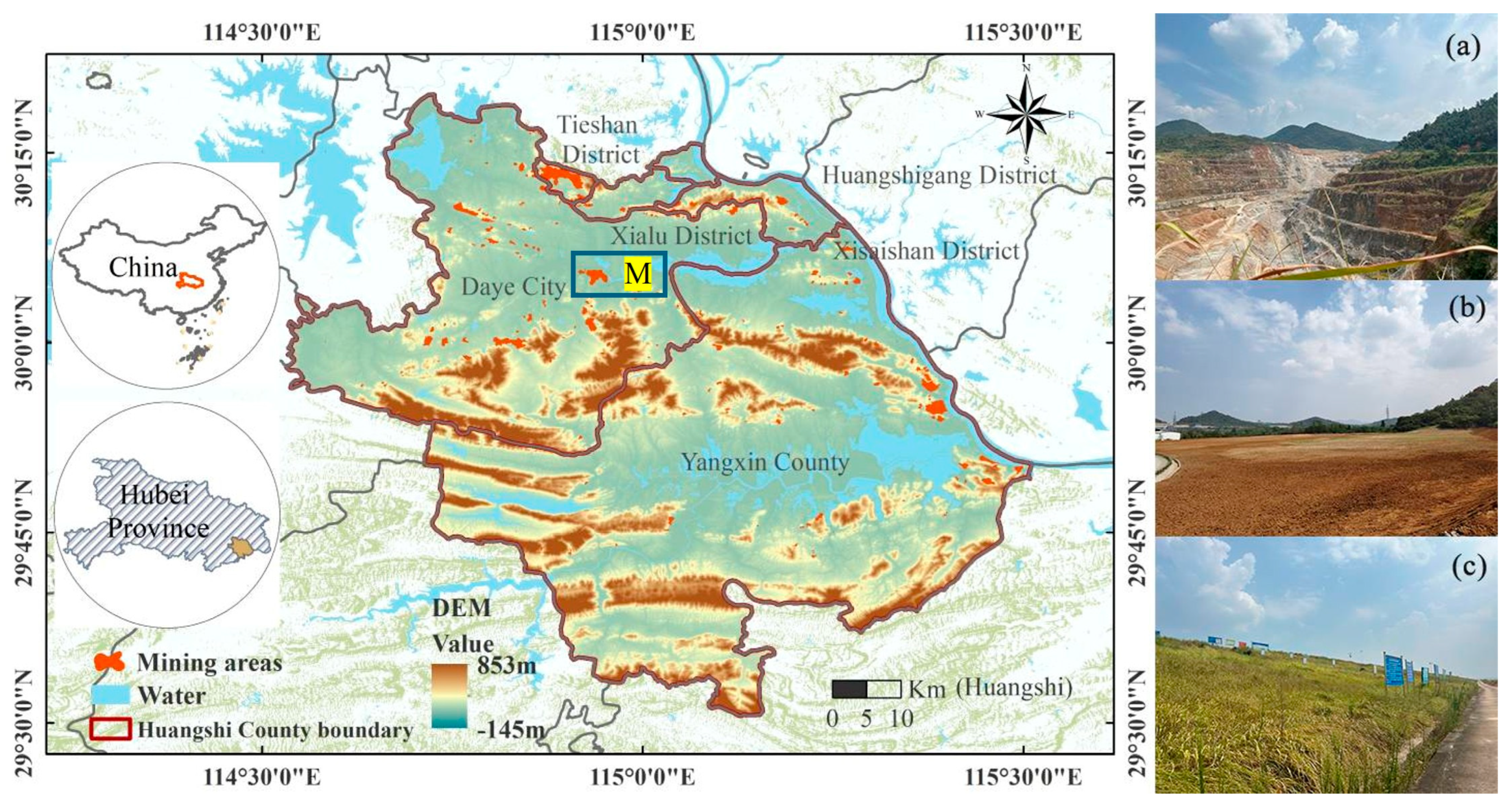
Huangshi (114°31′–115°30′E, 29°30′–30°15′N) is located in southeastern Hubei Province, on the southern bank of the middle Yangtze River, covering an area of 4583 km2. It borders the Jianghan Plain to the north and transitions into the Mufu Mountain ridges to the south, featuring a distinct three-tiered landform of plains, hills, and mountains (Figure 1). As the core of the Yangtze River Metallogenic Belt, Huangshi contains 79 identified minerals in four categories. Copper, iron, and gold are concentrated in the north, spanning 40% of the city’s area and forming the Tieshan-Jinshandian-Lingxiang mineral belt, the largest polymetallic mining cluster in southeastern Hubei. However, intensive mining has driven economic growth at the cost of land degradation, water pollution, and biodiversity loss [44,45,46]. Huangshi represents a typical case for mining area ecological research due to three distinctive attributes [44,47,48]: (1) the world’s longest documented mining history (3000+ years), evidenced by the Tonglushan Ancient Copper Mine with over 400,000 tons of ancient slag; (2) designation as one of China’s 69 national resource-exhausted cities in 2009, having depleted over 70% of recoverable reserves; and (3) strategic location within the Yangtze River Economic Belt under the 2021 Yangtze River Protection Law. The special spatial overlap of resource-rich and ecologically sensitive areas makes Huangshi an ideal case for studying the complex interactions between mineral exploitation and ecological restoration.
Figure 1. The location of the study area. (a) mining areas under exploitation; (b) mining areas under reclamation; (c) reclaimed mining areas. Note: panels (ac) represent different restoration stages within the same mining area, with the mining site location marked as “M” in the main map. Negative elevation values are deep open-pit mining excavations.

2.2. Data Sources and Processing

Multi-source data were collected in this study for EQA and driving factors analysis, including remote sensing imagery, land use, topographic, geological, meteorological, vegetation, soil, and socioeconomic data. Landsat image preprocessing involved selecting images from the vegetation growing season (May to September) with less than 20% cloud cover, removing clouds using bitwise operations, and generating median composite images. Cross-sensor spectral consistency was ensured through: (i) using Landsat Collection 2 Level-2 Surface Reflectance products with standardized atmospheric correction [49], and (ii) temporal compositing to reduce sensor-specific artifacts [50,51]. To ensure consistency, all the spatial data were resampled into a 30 m resolution. Unless otherwise noted, all data correspond to 2000, 2010, 2015, and 2023. Detailed information on the study data is listed in Table 1. The selected years were chosen to align with key restoration policy milestones in Huangshi [52,53,54]. Specifically, 2000 represents the pre-restoration baseline; 2010 captures the initiation of systematic mine restoration following Huangshi’s designation as a national resource-exhausted pilot city (2009); 2015 reflects the intensified intervention stage associated with the “Ecological City” strategy (2013) and the “Green Huangshi” campaign (2014–2015); and 2023 provides a long-term evaluation after large-scale restoration (8200 acres; 96% remediation rate for historical abandoned mines) and the National Garden City award (2018). This policy-informed sampling supports phase-based assessment of ecosystem responses.
Table 1. Data sources.

3. Methodology

3.1. EDS-Guided Ecological Quality Indicator System

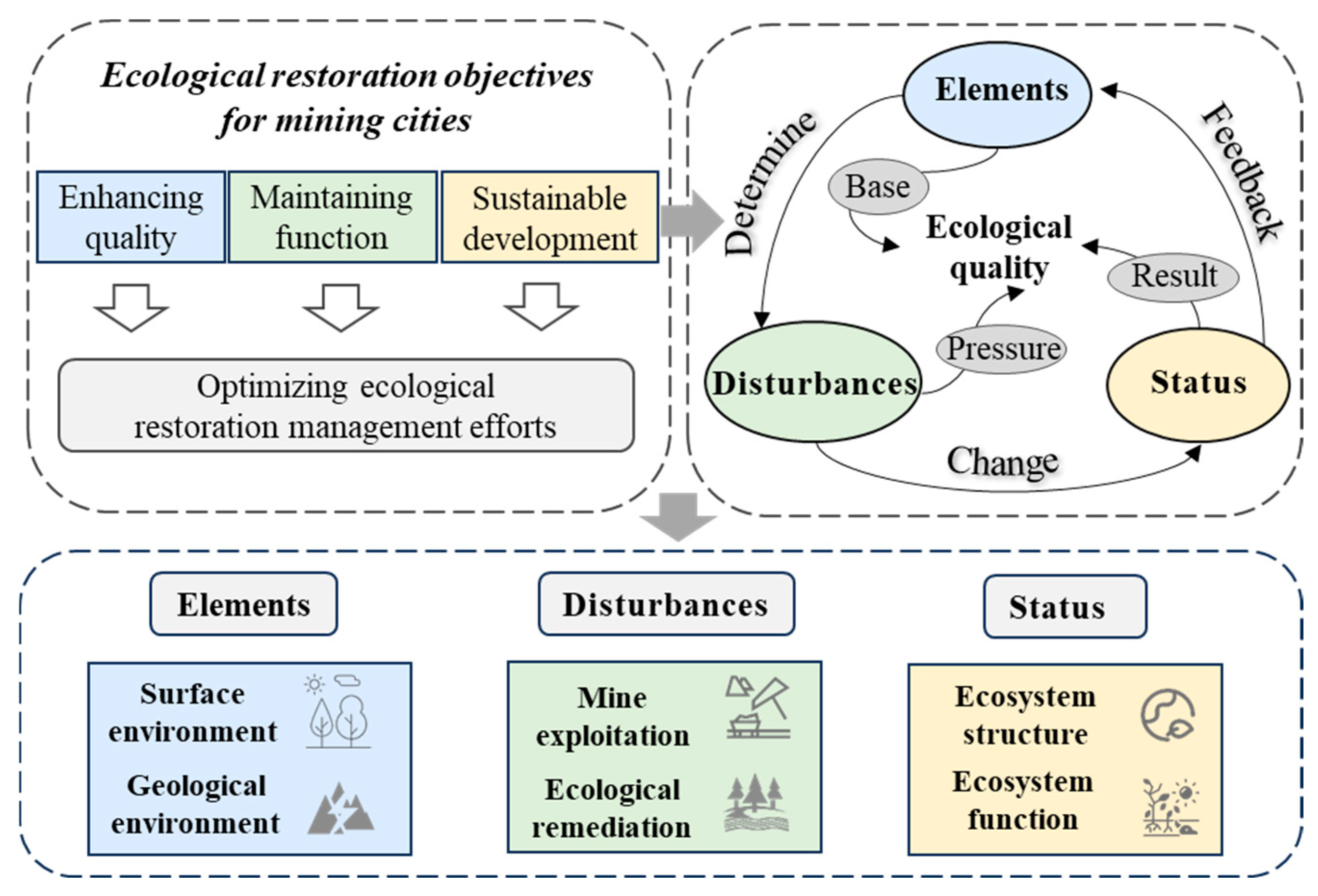
This study develops an Elements-Disturbances-Status (EDS) framework for ecological quality assessment (EQA) in mining cities (Figure 2). The framework structures the indicator system by distinguishing Elements, Disturbances, and Status, thereby supporting consistent construction and interpretation of the composite EQA index. Its conceptual foundation aligns with the systems science paradigm of “baseline conditions-process mechanism-response patterns” [55,56]. The Elements layer provides the material foundation and spatial framework for ecological restoration, determining disturbance-response dynamics and recovery potential [57]. In mining city ecosystems, surface and geological environments form an integrated regulatory network that governs material cycling and energy flow [58], shaping the ecosystem characteristics and its capacity to withstand external disturbances. The Disturbances layer represents external forces that alter the structure and properties of ecosystem elements. Mining, as a high-intensity anthropogenic disturbance, imposes multifaceted stress on the Elements layer by degrading vegetation, reshaping landforms, and destabilizing rock strata [59]. The severity and persistence of ecosystem degradation are governed by the intensity and frequency of the disturbances, exhibiting a nonlinear “pressure-response” relationship. Furthermore, ecological restoration practices suggest that integrated strategies, such as vegetation recovery, soil enhancement, terrain reshaping, and hydrological regulation, can effectively reverse the degradation trajectory of the Elements layer [60]. The Status layer represents the dynamic response of the Elements layer to disturbances, quantified through multidimensional indicators of ecosystem health and functionality. Its evolution initiates a bidirectional feedback mechanism that shapes the trajectory of ecological succession [61]: mining activities induce negative feedback, accelerating system disorder, while restoration efforts generate positive feedback, promoting structural reorganization. This feedback between system state and process forms the basis of the dynamic memory effect in ecosystem succession. Beyond its conceptual foundation, the EDS framework also serves as an operational scaffold for the subsequent analysis. It ensures that indicators representing the three complementary dimensions—Elements, Disturbances, and Status—are consistently retained during weighting and aggregation, thereby preserving dimensional completeness in the composite ecological quality index. In addition, potential drivers are selected and organized in a way that is conceptually aligned with the EDS components, which supports a more mechanistic interpretation of ecological quality dynamics.
Figure 2. EDS framework.
With reference to previous studies [44,46,62,63,64,65], 15 indicators (Table 2) across elements, disturbances, and status were selected, considering mining processes, geographical conditions, and ecological dynamics. Details on indicators processing were provided in Appendix A.
Table 2. Indicators system for EQA.

3.2. A Game Combination Weighting Model for Multidimensional Heterogeneity

3.2.1. Objective Weighting I: Entropy

Entropy weight is an objective weighting approach based on entropy value, which allocates weights by quantifying the dispersion of indicators [66,67]. It effectively mitigates subjective bias and is suitable for multi-criteria evaluation scenarios. In MERA, the greater entropy reflects a more uniform distribution, implying a smaller contribution to the system and a lower weight.
P i j = x i j i = 1 n   x i j
E j = 1 l n   n i = 1 n   p i j l n   ( p i j )
W j = ( 1 E j ) / j = 1 m   ( 1 E j )
where m is the number of indicators, n is the number of pixels in the study area, Pij is the indicator characteristic ratio, Ej is the information entropy of the i-th indicator, and Wj is the weight value.

3.2.2. Objective Weighting II: CRITIC

The Criteria Importance Through Intercriteria Correlation (CRITIC) method is an objective weighting approach based on the comparison intensity and correlation of indicators [68]. By considering information content and redundancy, indicators with high differentiation and substantial information receive higher weights, while those with greater redundancy are assigned lower weights, thereby enhancing the scientific rigor of the evaluation.
σ j = 1 n i = 1 n   ( x i j x j ¯ ) 2
x j ¯ = 1 n i = 1 n   x i j
r j k = i = 1 n   ( x i j x j ¯ ) ( x i k x k ¯ ) i = 1 n   ( x i j x j ¯ ) 2 i = 1 n   ( x i k x k ¯ ) 2
C j = σ j × k = 1 m   ( 1 | r j k | )
W j = C j j = 1 m   C j
where σ j is the standard deviation, x ¯ j is the normalized mean of the j-th indicator, r j k is the correlation between the j-th and k-th indicators, C j is the information capacity that integrates comparison intensity and conflict to assess the importance of each evaluation factor, and W j is the weight of each indicator.

3.2.3. Cooperative Combination of Weighting Schemes

Cooperative game theory was applied to derive initial weights by integrating the Entropy and CRITIC methods. Entropy and CRITIC provide complementary objective weights: entropy emphasizes indicator dispersion (information content) [66,67], whereas CRITIC accounts for both contrast intensity and inter-criteria correlation/conflict, reducing redundancy when indicators are correlated [69]. Therefore, we use cooperative game theory to obtain a compromise weight vector that minimizes discrepancies between the two schemes, improving robustness of the composite index; this combination has been applied in environmental assessments [70,71,72]. Cooperative game approach minimized discrepancies between the individual weighting methods, thereby determining the optimal composite weight [73,74], enhancing the reliability of decision-making. Through this approach, indicators across all three EDS dimensions are retained with objective weights, ensuring that no single dimension is underweighted or excluded from the comprehensive assessment. Specifically, the model aimed to determine an optimal weight vector W * that minimized the deviation from individual indicator weight vectors W k .
m i n k = 1 M   α k W k W * 2 , k = 1,2 , , M
where M is the number of weighting methods; W k is the weight vector derived from the k-th method; α k is the composite weight coefficient; W * is the optimal composite weight vector.
To ensure that the optimal weight vector W * was a linear combination of all individual indicator weight vectors, the model incorporated the following constraints:
k = 1 M   α k W k W k T = W * W T , k = 1,2 , , M
α k * = α k k = 1 M   α k
where α k * is the normalized weight coefficient, ensuring that the sum of all weight coefficients equals 1.
W * = k = 1 M   α k * W k
The game theory combination ensures model stability through three mechanisms: (1) the optimization objective (Equation (9)) simultaneously minimizes squared deviations from all individual weighting schemes, producing balanced rather than biased composite weights; (2) the iterative solution process converges to a Nash equilibrium where neither weighting method can unilaterally improve the combined result, guaranteeing solution uniqueness and stability even under substantial inter-method divergence; and (3) the normalization constraint (Equation (11)) bounds the solution space, preventing extreme weight allocations. This framework has been validated in multi-criteria environmental assessments, including flood risk assessment [73], water resources evaluation [74] and ecological security evaluation [66]. Based on the above process, the final comprehensive weight is obtained (Appendix B).

3.2.4. EQA Synthesis, Mapping, and Grading

Based on the weights W * , the comprehensive score Z i was calculated, with higher values indicating better ecosystem structure, function, and integrity.
Z i = i = 1 m   W j * x i j
Ecological quality grades classification translated comprehensive index into actionable insights for decision makers, supporting targeted environmental management in mining areas. Most studies adopt composite indices or multi-indicator evaluation results, applying methods such as equal intervals, natural breaks, or expert judgment [66,75]. The classification process, grounded in objectivity and regional adaptability (Appendix C), comprised three steps. First, the Natural Breaks (Jenks) method was applied to the 2023 comprehensive index to establish preliminary boundaries based on data distribution characteristics. Second, field investigations were conducted at representative mining sites during 2023–2024, encompassing project documentation review, systematic plot-level surveys with GPS positioning and photographic records, and high-resolution imagery verification using both satellite (World Imagery Wayback) and UAV (DJI MAVIC 3 Multispectral) platforms. Third, 298 validation plots stratified across all five grades were used to calibrate thresholds through integration of statistical results, ground-truth data, and expert judgment. The final thresholds for the integrated ecological quality in Huangshi were determined as follows: excellent [0.8–1], good [0.65–0.8], moderate [0.52–0.65], fair [0.36–0.52], and poor [0–0.36].

3.3. Identification of Key Driving Factors of Ecological Quality

3.3.1. Selecting Potential Drivers: Climate, Anthropogenic Disturbances, and Economic Factors

This study selected nine driving factors spanning climate change, anthropogenic disturbances, and economic development. The calculation methods for the driving factors were provided in Appendix D. For climate change, precipitation (D1) and temperature (D2) were selected, as they directly influence vegetation growth, water cycling, and soil recovery, shaping the natural foundation of ecological quality in mining areas. For anthropogenic disturbances, the selected factors included distance to mining area (D3), urbanization level (D4), agricultural production (D5), population density (D6), and land use change (D7). The distribution of mining areas defines the extent of ecological degradation [76], while urbanization indicates human influence on land use, either through disturbance or restoration potential [77]. Agricultural production supports vegetation recovery but may also intensify soil erosion. Population density influences social pressures on ecological quality, while land use change determines the recovery potential and trajectory of different land types [11]. For economic development, the overall economic level (D8) and mining industry development (D9) were selected. Economic growth defines financial capacity for ecological restoration, whereas mining industry development indicates resource dependency, influencing the balance between ecological recovery and economic expansion.
The driving factors are conceptually linked to the EDS framework as external forces that shape ecological quality dynamics. Climate change factors (D1–D2) primarily influence the Elements layer by affecting vegetation growth, hydrological processes, and soil stability [78,79]. Anthropogenic disturbances (D3–D7) correspond to the Disturbances layer, representing the spatial extent and intensity of human-induced pressures, including mining activities, urbanization, and land use change [80,81]. Economic development factors (D8–D9) affect both the Disturbances layer (through resource extraction intensity) and the Status layer (through restoration investment capacity) [82]. This driver-response relationship enables a mechanistic interpretation of how external forces shape the internal ecological conditions captured by the EDS indicators.

3.3.2. Optimized XGBoost Model for Driver Relationship Modeling

XGBoost is an enhanced gradient-boosting decision tree-based method that incorporates regularization, weighted split finding, and cache optimization to improve prediction accuracy while mitigating the risks of overfitting [39]. It employs an approximate greedy algorithm for efficient tree splitting and leverages second-order Taylor expansion to refine the loss function and accelerate convergence.
L ( t ) = i = 1 n   g i f t ( x i d ) + 1 2 h i f t 2 ( x i d ) + γ T + 1 2 λ j = 1 T   θ j 2
where L ( t ) is the objective loss function; n is the number of samples; d is the number of features; x i d is the d-th feature of the i-th sample; g i and h i denote the first-order and second-order gradients, respectively; f t ( x i d ) is the prediction of the t-th decision tree; T is the number of leaf nodes; γ is a hyperparameter controlling tree complexity; λ is the L2 regularization parameter; and θ j is the weight of the j-th leaf node.
Bayesian optimization was used to tune XGBoost hyperparameters, improving model performance [83]. It builds a surrogate model to predict the objective function and selects optimal hyperparameters using an acquisition function. This approach improves search efficiency and reduces computational costs, making it well-suited for high-dimensional, complex models [84]. The objective is to find the optimal hyperparameter θ * that minimized the loss function L(θ):
θ * = a r g   m i n θ Θ   L ( θ )
where Θ is the hyperparameter search range; L(θ) represents the loss function. Bayesian optimization iteratively updates the surrogate model p ( f | D ) to refine hyperparameter selection. The optimization parameters were listed in Appendix E.

3.3.3. SHAP Analysis for Enhanced XGBoost Interpretability

XGBoost is inherently a black-box model, characterized by complex internal decision logic that hinders the interpretation of individual input contributions to predictions [85]. To enhance interpretability, SHAP was employed to interpret the outputs of the XGBoost model. SHAP enables the quantitative assessment of each driving factor’s contribution to ecological quality while exploring its underlying mechanisms and interactions among variables [86].
ϕ d = S F { d }   | S | ! ( | F | | S | 1 ) ! | F | ! g ( S { d } ) g ( S )
where ϕ j is the Shapley value of feature j; F is the set of all features; S is a subset of F that excludes feature; g S is the model output when predicting with only the feature set S; g S d is the model output when feature d is added to S; S ! and F S 1 ! are weighting coefficients that ensure fair contribution calculations across all feature combinations.

4. Results

4.1. Spatiotemporal Patterns of Ecological Quality in Mining Areas

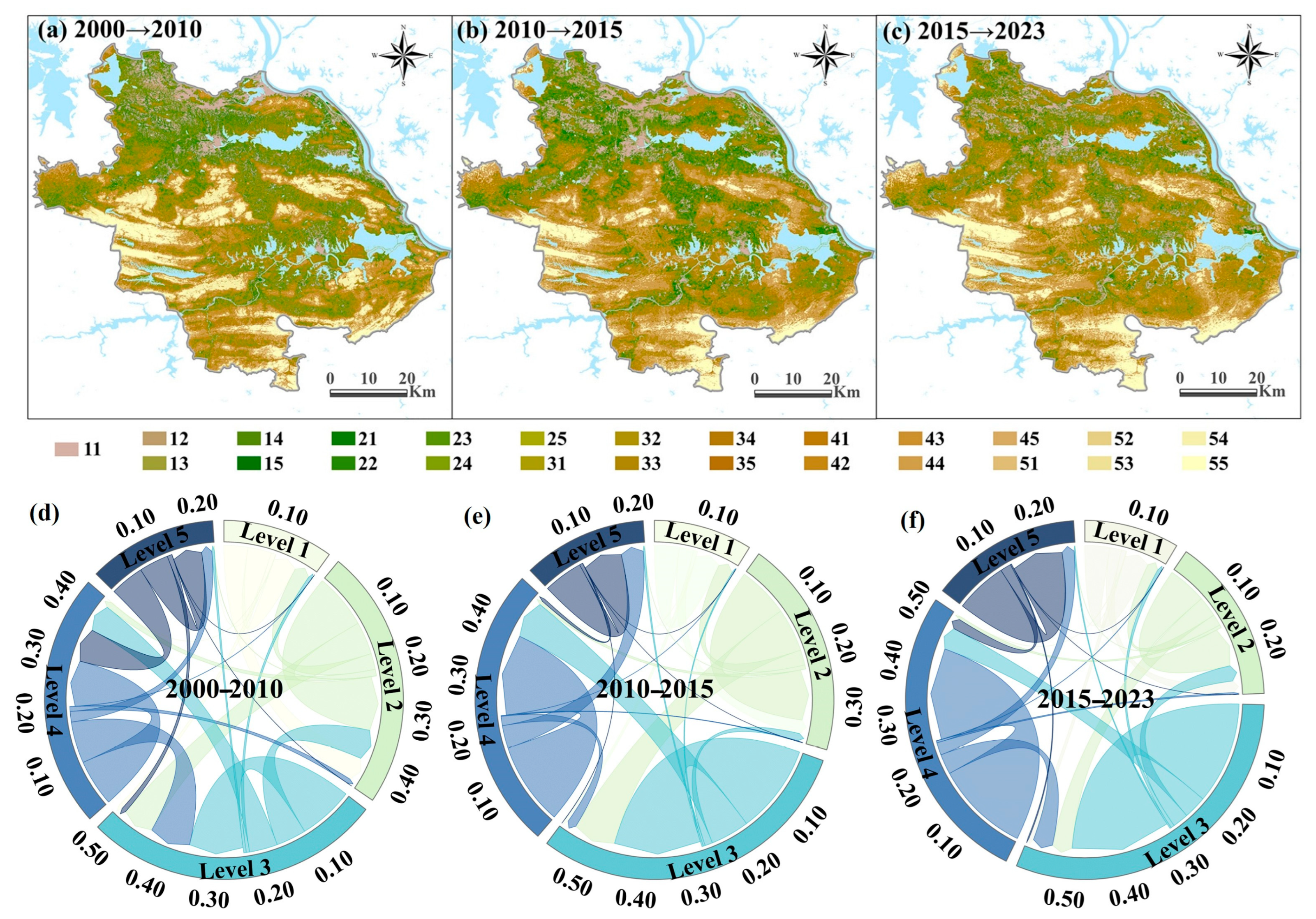
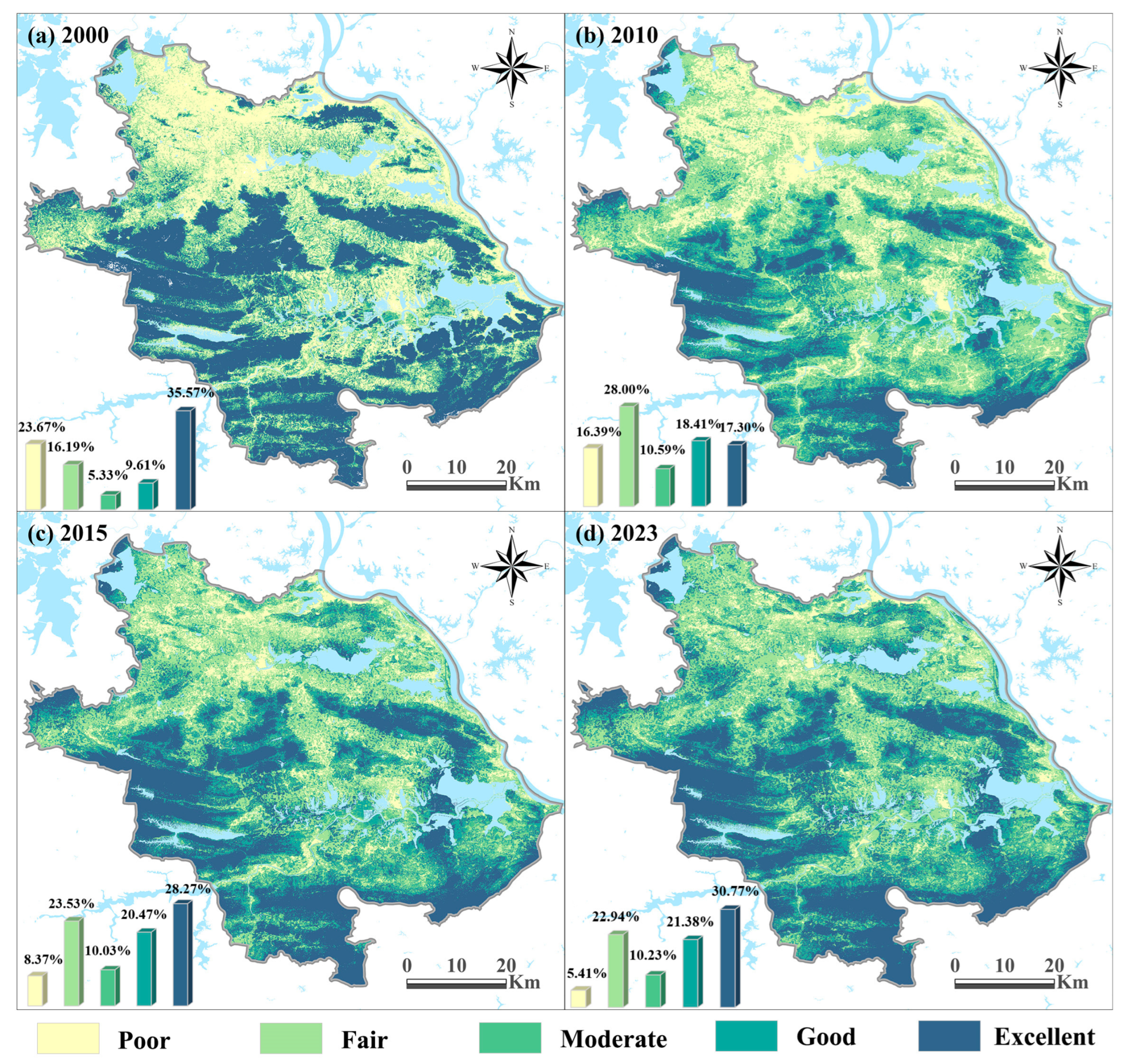
From 2000 to 2023, ecological quality in the Huangshi showed an overall positive trend, with strong spatial heterogeneity among different grades (Figure 3a–d). Excellent-grade areas exhibited a V-shaped trend. Initially dominant in 2000 (35.57%) across the central, southern, and western regions in large contiguous patches, they underwent fragmentation before regaining prominence by 2023 (30.77%) through core area expansion and patch consolidation. Good-grade areas have shown consistent improvement, increasing from 9.61% (2000) to 21.38% (2023). Initially appearing as small patches or zones adjacent to excellent-grade areas, they gradually expanded and consolidated, ultimately forming the core of a high-quality ecological restoration landscape alongside excellent-grade areas. Moderate-grade areas primarily served as transitional zones or scattered patches, with their proportion fluctuating over time. Expanding from 5.33% initially to 10.59% by 2010, their extent then stabilized, indicating transitional dynamics and a phase of ecological equilibrium in the restoration process. Fair-grade areas were mainly concentrated in the northern and eastern parts of Huangshi, along with several scattered patches. Ecological restoration followed a trajectory of initial degradation followed by improvement, with their proportion rising from 16.19% (2000) to 28% (2010) due to rapid expansion and spatial aggregation. By 2023, this proportion declined to 22.94%, with shrinking coverage and increased fragmentation, indicating a gradual improvement in degraded zones. Poor-grade areas were primarily located along the northern and eastern margins of the study area and near water bodies. Their proportion declined significantly from 23.67% in 2000 to 5.41% in 2023. Large contiguous patches nearly disappeared, leaving only a few highly fragmented remnants, suggesting effective control and substantial restoration of the most ecologically degraded zones.
Figure 3. Spatiotemporal analysis of ecological quality in mining areas.

4.2. Trajectories and Transitions of Ecological Quality in Mining Areas

The transition matrix was used to examine the direction and magnitude of ecological quality changes in mining areas (Figure 4a–f). From 2000 to 2010 (Figure 4a,d), areas with declining ecological quality levels (32.21%) outnumbered those with improvements (18.97%), indicating a predominant negative transition. Significant degradation from excellent-grade areas to good (11.60%), moderate (4.46%), and poor (4.33%) grade was a major driver of ecological decline, mainly occurring in central mining areas, northern forest edges, and southern core forest margins. These shifts were largely caused by vegetation loss and land disturbance from mining and agriculture. Poor-grade areas showed relative stability, with 12.25% unchanged and 9.38% improving to fair-grade, primarily near croplands and water bodies. Notable differences were observed among the moderate-grade areas. Degradation from good to fair (3.57%) grade was notable, while only 0.93% of moderate-grade areas remained stable, with most shifting to lower grades; from 2010 to 2015 (Figure 4b,e), ecological quality significantly improved, with upward transitions (39.57%) exceeding downward ones (4.15%). Excellent-grade areas exhibited the highest stability, with 16.34% remaining unchanged and minimal degradation. In 2015, excellent-grade areas also absorbed 11.73% of the areas converted from lower levels, primarily in high-altitude primary forests and key water buffer zones. Fair-grade areas showed a strong positive recovery trend, with 6.76% upgrading to moderate-grade and 5.34% to good-grade. Areas initially rated as good-grade mainly improved to excellent-grade (9.46%), while moderate-grade areas transitioned to good-grade (6.41%) and excellent-grade (1.32%). Even in the most degraded poor-grade areas, the dominant transition was toward fair-grade (8.33%), mainly around the northwestern mining zones and scattered near croplands; From 2015 to 2023 (Figure 4c,f), upward transitions in ecological quality (19.75%) slightly exceeded downward ones (10.24%), indicating a continued but slower positive trend of ecological quality. Good-grade and excellent-grade areas showed strong stability, with 24.95% and 12.76% remaining unchanged, respectively. Additionally, in 2023, 5.67% of excellent-grade and 6.09% of good-grade areas resulted from upward transitions from lower classes, serving as key drivers of ecological improvement during this period. Poor-grade areas showed notable upward transitions, with 3.62% improving to moderate and 2.46% to good. However, degradation from higher grade also emerged in some regions, 1.87% of good areas declined to moderate, and 1.94% of moderate areas to fair. These patterns indicated that ecological quality is not a strictly linear process but is characterized by fluctuations and occasional setbacks.
Figure 4. Spatial changes and quantitative transitions of ecological quality from 2000 to 2023. (ac): Spatial distribution; (df): Changes in quantity. Note: The numbers 1, 2, 3, 4, and 5 represent ecological quality grades of poor, fair, moderate, good, and excellent, respectively. The first digit represents the initial grade, and the second digit represents the post-transition grade (e.g., “12” indicates a transition from poor to fair).

4.3. Spatiotemporal Variations in Ecological Quality at Typical Mining Sites

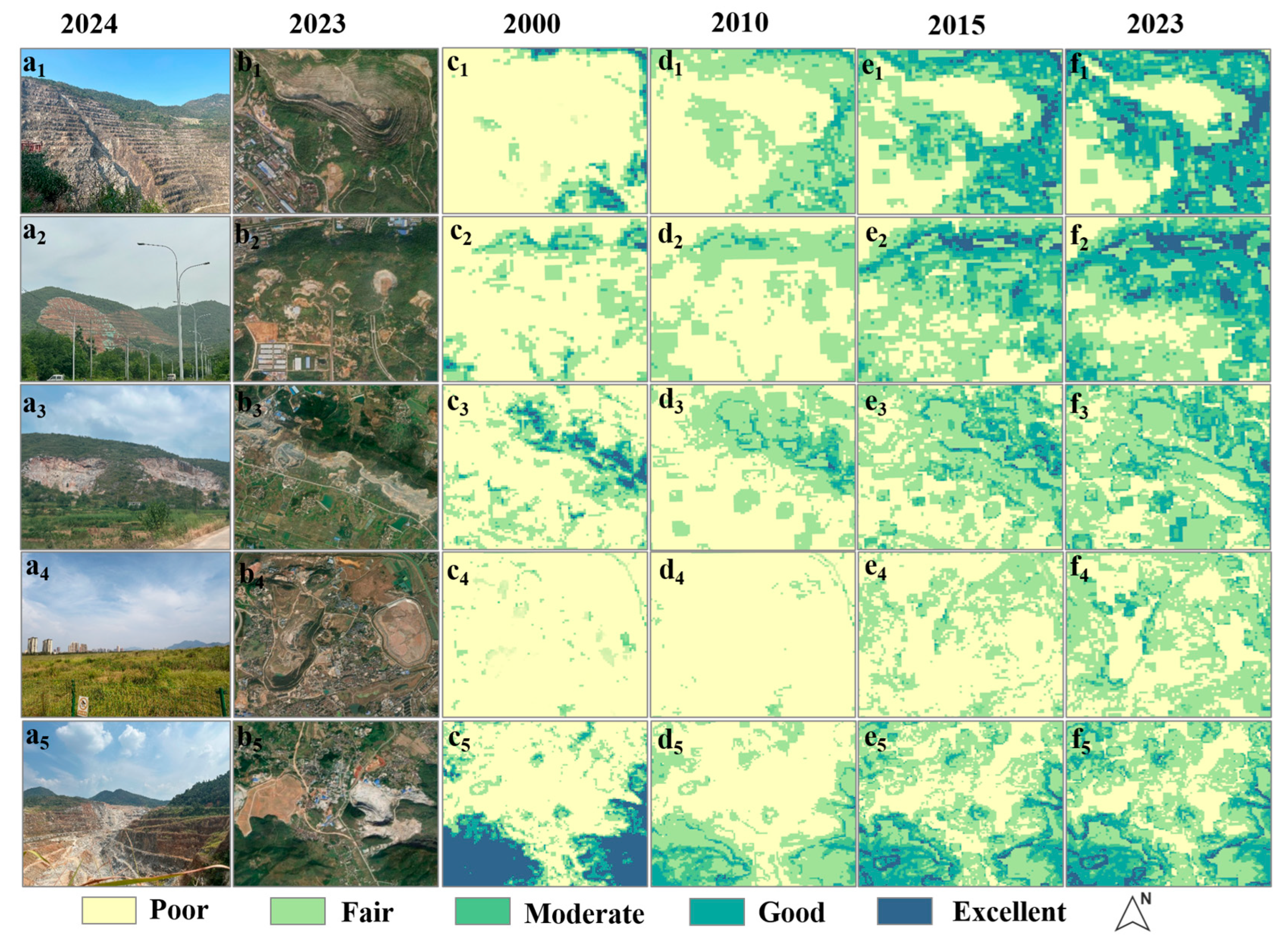
Huangshi National Mining Park (Figure 5a1–f1) was originally an iron ore mining site. After the cessation of mining activities, it was transformed in 2006 into China’s first national mining park. In 2000 (Figure 5c1), the area was predominantly classified as poor and fair grades, indicating a degraded ecological baseline. By 2010 (Figure 5d1), moderate-grade areas had expanded. In 2015 (Figure 5d1), moderate and good areas became dominant, accompanied by the emergence of excellent-grade patches. By 2023 (Figure 5f1), most of the area had reached good and excellent grades, reflecting a mature stage of ecological restoration.
Figure 5. Ecological quality of different mine sites: (a1a5): 2024 mining site photos; (b1b5): 2023 imagery from World Imagery Wayback; (a1f1): Huangshi National Mining Park; (a2f2): Huangjingshan Mine; (a3f3): Jinshandian Iron Mine; (a4f4): Tonglushan Mining Area; (a5f5): Tongshankou Copper Mine.
Huangjingshan Mine, formerly a limestone mining site, has a centralized ecological restoration launched in 2009. From 2000 (Figure 5c2) to 2010 (Figure 5d2), ecological quality in this area was primarily classified as poor and fair grades, exhibiting a fragmented spatial pattern. After 2015 (Figure 5e2), moderate and good grade areas expanded significantly, and the connectivity of higher-level restoration areas improved and gradually stabilized.
Jinshandian Iron Mine, an active site under development, has promoted green mining since 2010 through a “simultaneous mining and restoration” model. In 2000 (Figure 5c3) and 2010 (Figure 5d3), the area was predominantly classified as poor and fair grades, with scattered, fragmented patches of moderate-grade areas. By 2015 (Figure 5e3), the moderate and good grades areas had expanded in a patchy distribution, and different ecological quality grades remained relatively stable.
Tonglushan Mine, focused on copper and iron extraction, ceased open-pit operations in 2015, after which ecological restoration was initiated. In 2000 (Figure 5c4) and 2010 (Figure 5d4), the area was almost entirely dominated by poor and fair grades, indicating severe ecological degradation. In 2015 (Figure 5e4), poor-grade areas moderately expanded. By 2023 (Figure 5f4), moderate-grade areas had emerged, but patches of poor and fair grades still prevailed, suggesting that ecological recovery progressed slowly and remained spatially uneven.
Tongshankou Copper Mine, an active site under development, substantially increased its environmental investment in 2021 in response to government inspections and rectification mandates. In 2000 (Figure 5c5), excellent-grade areas were observed around the mining exploitation region, indicating a favorable baseline for early restoration. By 2010 (Figure 5d5), restoration regressed to primarily poor and fair grades, and the previously existing excellent-grade areas had significantly shrunk. In 2015 (Figure 5e5) and 2023 (Figure 5f5), moderate and good grade areas expanded, accompanied by the emergence of linear, strip-like excellent-grade patches.

4.4. Key Driving Factors and Their Nonlinear Effects in Ecological Quality

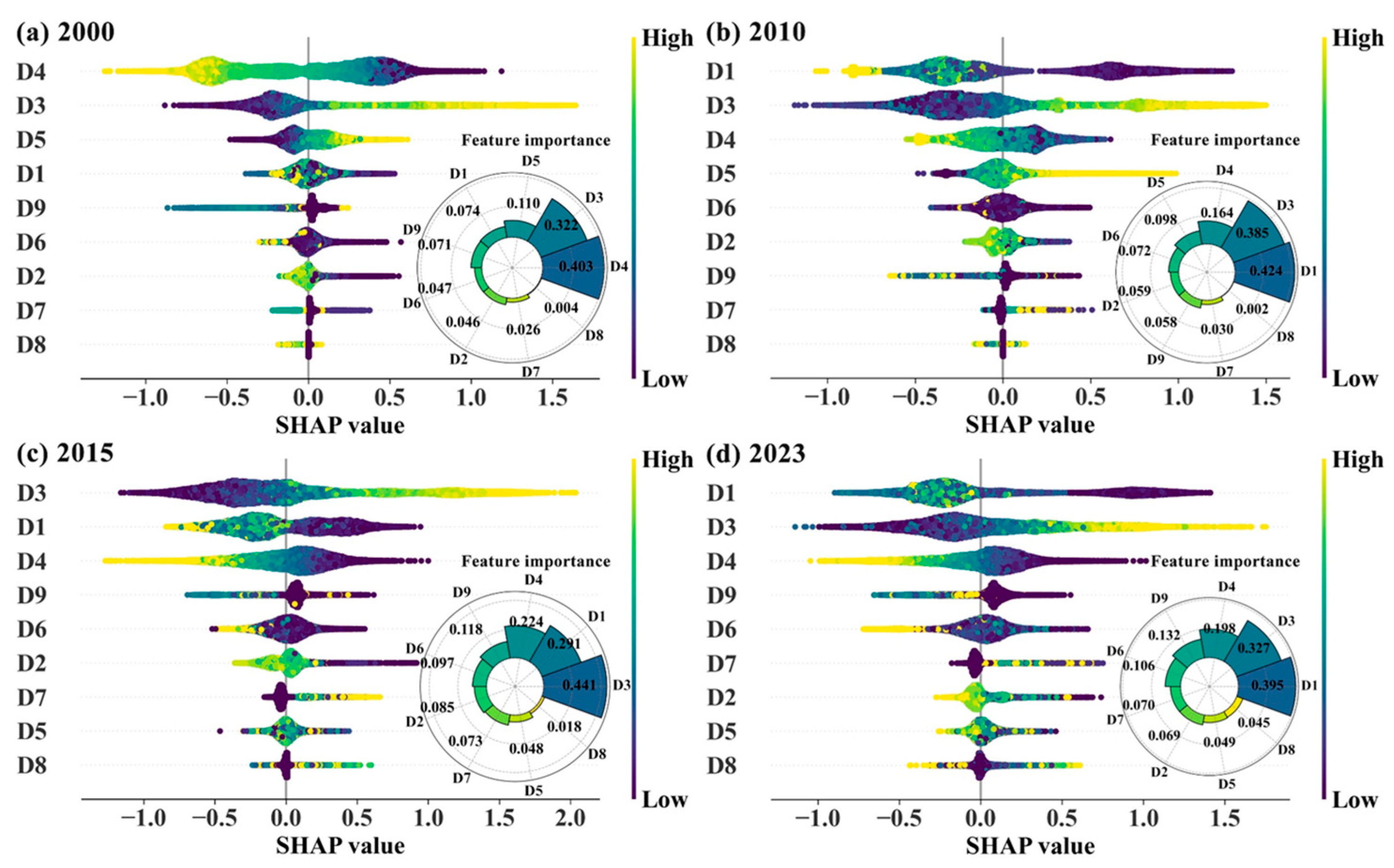
From 2000 to 2023, the drivers of ecological quality in Huangshi shifted dynamically (Figure 6a–d). Based on the cumulative feature importance within each category, the ranking was: anthropogenic disturbances > climate change > economic development. Anthropogenic disturbances dominated the spatial heterogeneity of restoration. Distance to mining sites (D3) and urbanization (D4) were consistently the top drivers. A critical shift occurred: D4 was dominant in 2000 (importance: 0.403), followed by D3 (0.322); however, D3 surpassed urbanization to become the primary driver by 2015 (0.441). This indicates that while urban expansion consistently impeded recovery, the ecological buffering effect of distance from mining sites became increasingly decisive. Meanwhile, agricultural production (D5) declined significantly (0.110 in 2000 → 0.049 in 2023); Climate influence was driven almost exclusively by precipitation (D1). D1 surged from a minor factor in 2000 (0.074) to a decisive driver in 2010 (0.424) and remained high in 2023 (0.395), determining the natural potential for recovery. In contrast, temperature (D2) remained negligible (importance < 0.1); Economic factors showed limited direct impact, but cumulative mining pressure grew. Overall economic level (D8) had minimal influence (importance < 0.05). However, the specific impact of mining industry development (D9) intensified, rising from 0.071 (2000) to 0.132 (2023), reflecting the accumulating ecological debt of prolonged resource extraction.
Figure 6. Relative importance of different driving factors.
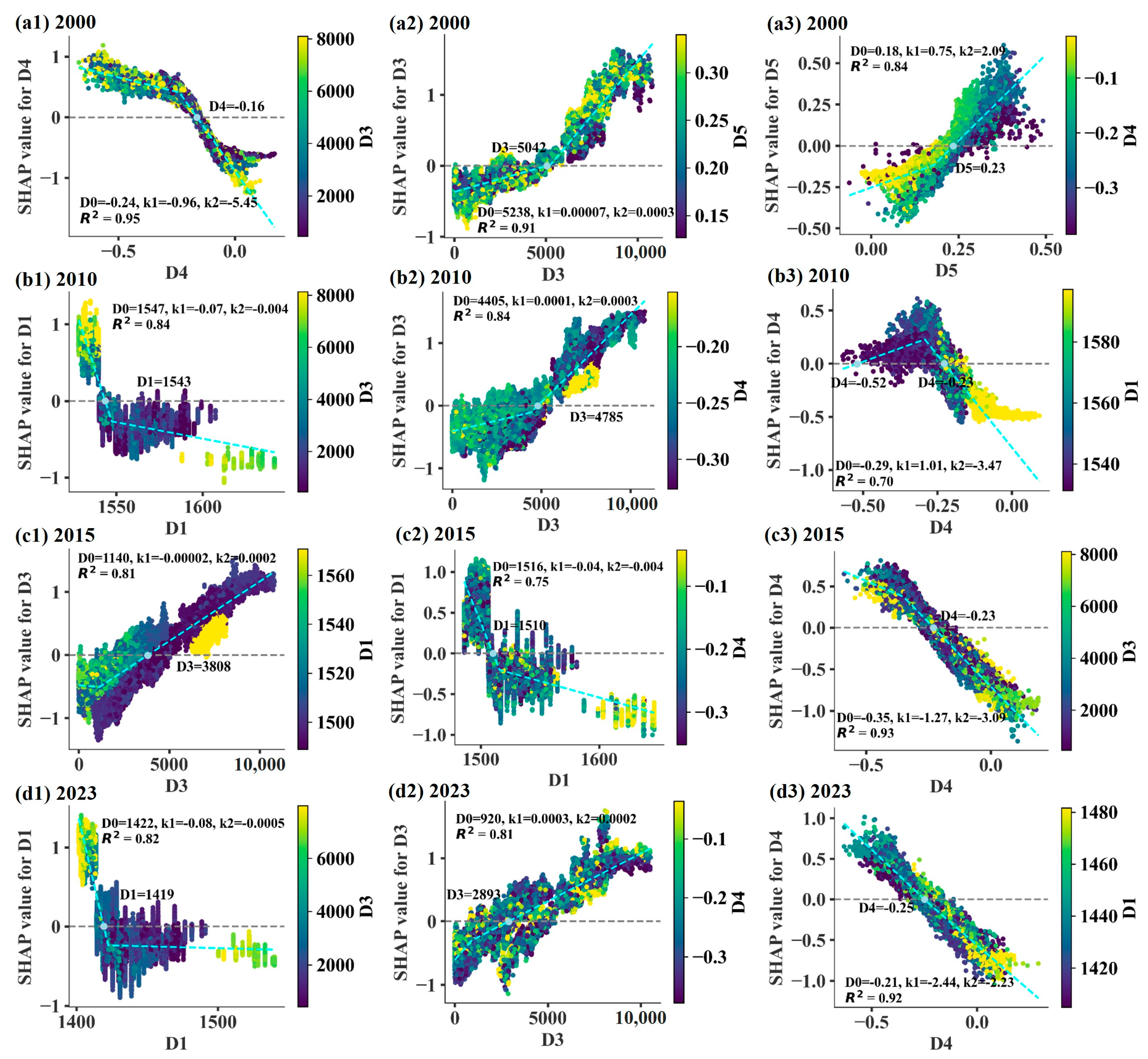
The top three drivers from 2000 to 2023, including precipitation (D1), distance to mining sites (D3), urbanization level (D4), and agricultural production (D5), were analyzed for their marginal and interaction effects (Figure 7a1–d3). Specifically, the ecological footprint of mining disturbances contracted over time. The threshold at which distance to mining sites (D3) shifted from a suppressive to a facilitative effect consistently declined (2000: 5042 m → 2023: 2893 m) (Figure 7a2,b2,c1,d2). This indicates that restoration efforts have successfully mitigated disturbances in the urban periphery, transforming the areas 3–5 km from mining sites into recovery zones. In 2000 and 2010, SHAP values showed an accelerated increase with growing distance, while the inflection points in 2015 (1146 m) and 2023 (920 m) shifted closer to the mining sites, confirming the shrinking radius of mining impact. The threshold for urbanization (D4) shifting from facilitation to constraint exhibited a downward trend (2000: −0.16 → 2023: −0.25). Although urbanization remained a dominant stressor, its negative intensity diminished in later stages, as indicated by the V-shaped rebound of inflection points (Figure 7d3). Conversely, precipitation (D1) became a stricter constraint over time. The threshold for its negative tipping point dropped (2010: 1543 mm → 2023: 1419 mm), below which SHAP values declined sharply (Figure 7b1,c2,d1), indicating an increasingly sensitive ecological response to excessive rainfall. Agricultural production (D5) was a critical driver only in 2000 (Figure 7a3), shifting from suppression to facilitation at a threshold of 0.23, marking a shift from suppression to facilitation.
Figure 7. Relationships between key driving factors and ecological quality (D0 is the breakpoint, k1 and k2 are the slopes of the piecewise fitting functions, respectively). The blue dashed line represents the multi-stage fitting of the data. (a1a3) represent the interaction dependencies between D4 and D3, D3 and D5, and D5 and D4 in 2000, respectively; (b1b3) represent the interaction dependencies between D1 and D3, D3 and D4, and D4 and D1 in 2010, respectively; (c1c3) represent the interaction dependencies between D3 and D1, D1 and D4, and D4 and D3 in 2015, respectively; and (d1d3) represent the interaction dependencies between D1 and D3, D3 and D4, and D4 and D1 in 2023, respectively.
Further analysis was conducted to examine interaction effects among the following variable pairs: D3–D4 (2000–2023), D3–D1 (2010–2023), D4–D1 (2010–2023), D5–D4 (2000), and D5–D3 (2000). The interaction between distance from the mining areas (D3) and urbanization level (D4) showed a pronounced inhibitory effect of urbanization near mining areas in 2000 (Figure 7a1). Over time, this evolved into a pattern where high urbanization and greater distance jointly promoted the improvement of ecological quality in peripheral areas (Figure 7b2,c3); however, the negative impact of high urbanization on ecological restoration persisted and, in later stages, may have weakened or even offset the ecological benefits associated with increased distance (Figure 7d2); from 2010 to 2023, the interaction between precipitation (D1) and distance to mining areas (D3) consistently exhibited a positive synergistic effect on ecological quality. When annual precipitation dropped below 1543 mm in 2010 (Figure 7b1) and 1419 mm in 2023 (Figure 7d1), its marginal effect on the improvement of ecological quality became positive. Under these conditions, the promotive effects were more prevalent in areas farther from the mining areas. In 2015 (Figure 7c1), the positive effect of greater distance from the mining area (D3 > 3808 m) on ecological restoration was amplified under relatively high annual precipitation (D1 > 1500 mm). The synergy between favorable precipitation and greater distance from mining areas was found to enhance ecological quality more effectively. In 2010 (Figure 7b3), the interaction between urbanization level (D4) and annual precipitation (D1) indicated a potential positive synergy, as the promotive effect of urbanization on the improvement of ecological quality was more evident under moderate-to-low precipitation levels. In 2015 (Figure 7c2), the interaction shifted toward a diminishing effect under environmental stress, as the negative impact of precipitation (D1 > 1510 mm) on ecological quality intensified with rising urbanization. By 2023 (Figure 7d3), a pronounced inhibitory effect emerged when both urbanization level (D4) and precipitation (D1) reached high levels. As D1 increased, the SHAP value of D4 declined to its minimum, indicating synergistic suppression of ecological quality under intensified urbanization and heavy rainfall. In 2000, agricultural production (D5) interacted with both distance from mining areas (D3) (Figure 7a2) and urbanization level (D4) (Figure 7a3). Higher D5 values were generally associated with the positive effect of greater distance from mining areas (D3), suggesting that agricultural activity near the mining areas has intensified ecological stress and hindered the improvement of ecological quality (Figure 7a2). When agricultural production (D5) positively influenced ecological restoration, observed in areas with lower urbanization level (D4), suggesting that low-urbanization regions were more conducive to the restorative benefits of agricultural activity (Figure 7a3).

5. Discussion

5.1. Spatiotemporal Response of Ecological Quality Dynamics to Ecological Restoration Engineering

Ecological quality dynamics in Huangshi exhibited a three-phase trajectory characterized by negative dominance, a subsequent positive leap, and stable adjustment. From 2000 to 2010, ecological degradation areas (32.21%) outpaced improvement areas (18.97%). Between 2010 and 2015, improvement areas surged to 39.57%, far exceeding degradation areas (4.15%), due to policy interventions and major restoration projects. After Huangshi was designated a “resource-exhausted pilot city” in 2009, it actively pursued resource transformation and ecological protection. From 2010, efforts focused on rehabilitating quarries and optimizing the mining layout. In 2013, the city adopted the “Ecological City” strategy and launched greening projects, resulting in continuous ecological improvements. From 2015 to 2023, recovery slowed, with improvement (19.75%) only modestly exceeding degradation (10.24%). This suggests that ecological restoration in mining areas involves fluctuations and potential reversals [63]. This staged restoration pattern aligns with the findings of Li et al., who developed an adaptive management model for Huangshi and reported comparable phased characteristics in ecological recovery trajectories [46]. Early stages require strong interventions to counter degradation, while later stages face challenges such as diminishing returns and stability thresholds [32,87], calling for refined strategies focused on regulating intrinsic ecological mechanisms. Moreover, ecological restoration grades follow distinct trajectories influenced by initial conditions, disturbance history, spatial context, and intervention intensity [88,89]. For example, the transitional fluctuations observed in good-grade areas and the degradation-improvement cycles in fair-grade areas highlight the heterogeneous and phased nature of the ecological restoration process. Spatially, the concentration of persistent degradation in the northern mineral belt and higher recovery potential in the southern hilly regions identified in this study are consistent with Xi et al., who evaluated the geological environment carrying capacity of Huangshi and reported similar spatial differentiation patterns [44].This calls for adaptive management informed by landscape ecology and systems thinking [46,90]. A positive restoration trend was observed at typical mining sites. For instance, the ecological transformation of Huangshi National Mining Park from predominantly poor-grade (2000) to excellent-grade (2023) corresponds well with Chen et al., who documented similar recovery trajectories through tourism and recreation value assessment [45]. However, restoration in extraction zones and adjacent areas remains limited, requiring ongoing intervention.

5.2. Impacts of Key Drivers on Mining Ecological Quality Improvement

In resource-exhausted regions, the evolution of ecological quality is driven by a complex interplay of anthropogenic and natural factors, where human interventions often determine the spatial patterns of restoration [2,91]. Mining activities caused a spatial attenuation effect on ecological restoration. Specifically, the threshold distance for negative ecological impact decreased from 5 km to 3 km, indicating that the ecological footprint of mining disturbances has contracted over time. This confirms that maintaining buffer zones from mining disturbances is essential for natural restoration [92]. The 3 km threshold corresponds to identifiable boundaries in Huangshi: topographic transitions from mining-affected lowlands to surrounding hill slopes, and small watershed divides that constrain pollutant transport. This finding is comparable to other mining studies: Zhang et al. [93] reported average disturbance distances of 2.25 km with most impacts within 3 km buffers, and Wu et al. [94] established similar thresholds in semi-arid grasslands. The temporal contraction from 5 km to 3 km indicates enhanced landscape recovery capacity [58], providing empirical evidence for future buffer zone policy design. Similarly, Zhang et al. [95] observed nonlinear improvement trends in ecological variables during restoration. Identifying these threshold inflection points at various management stages can guide intervention strategies [96]. The shift in dominant drivers from urbanization (D4) in 2000 to distance from mining sites (D3) by 2015 reflects Huangshi’s policy-driven transformation. Before 2009, rapid urban expansion was the primary ecological stressor. Following Huangshi’s designation as a “resource-exhausted city” pilot site in 2009 [97], mining governance became the policy priority, with systematic mine closures and restoration projects implemented from 2010 and the “Ecological City” strategy adopted in 2013 [46]. The persistent suppression by high urbanization highlights the conflict between urban expansion and ecological protection, particularly in high-precipitation areas (D1 > 1543 mm) where combined pressures amplify ecological stress. Excessive precipitation (>1419–1543 mm annually) intensifies soil erosion on unconsolidated mining slopes, which subsequently mobilizes heavy metal pollutants from mining residues into adjacent ecological systems [98] and increases the frequency of geological hazards that destabilize rehabilitated surfaces [99,100,101]. Huangshi’s monsoon climate concentrates 60–70% of annual precipitation during May–August, amplifying these cascading risks in the geologically fragile northern mining cluster. Furthermore, climate change may exacerbate mining impacts, rendering degraded surfaces around mining sites more vulnerable to extreme climate events [102]. We also found that in areas distant from mining sites with lower urbanization, agricultural production positively influenced ecological quality [103]. Compared to isolated abandoned mines or high-intensity urban zones, agricultural landscapes containing non-intensive farmland, forests, and grasslands offer greater habitat diversity and connectivity [104,105]. This softened matrix aids species dispersal and regional restoration. Building on this, multifunctional landscape designs, such as promoting agroforestry systems around mining sites, can be applied to balance production and ecological functions [106,107]. In contrast, economic development had a relatively weak direct influence on ecological quality. However, the negative cumulative effects of mining development became more evident in later stages. The monocultural economic structure initially exacerbates conflicts between ecological concerns and social stability [8], highlighting the urgent need for an ecological transformation model in resource-exhausted cities.

5.3. From Insight to Action: Building an Adaptive Management Framework for Sustainable Mining

Grounded in the EDS framework, the ecological quality spatiotemporal differentiation and driving mechanisms were identified in Huangshi. Ecological restoration efforts should enhance the sustainability of mining ecology through a progression of “element-based optimization-disturbance process regulation-dynamic status management”. Huangshi’s southern mountainous areas, hilly central regions, and low-urbanized zones have distinct advantages in ecological restoration, suggesting that native topography and landforms offer restoration potential. These features, combined with the three-tiered landform structure, form the foundation of ecological restoration. At the element optimization level, efforts should focus on creating a collaborative restoration system that integrates topography, soil, hydrology, and vegetation [19]. This includes combining human interventions with natural processes and developing stable ecosystems through local plant species, natural succession, and micro-topography optimization, as demonstrated by the successful transformation of Huangshi National Mining Park. Disturbance is both the starting point of ecological degradation in mining areas and the core focus of restoration interventions. Traditional restoration models often aim at disturbance suppression, but our findings indicate that maintaining appropriate buffer distances (3–5 km) from mining sites is essential for natural recovery [108]. The focus should shift from process governance to risk adaptation at the disturbance regulation level. First, promote green mining by integrating dynamic boundary mining with ecological restoration to manage ecological risks throughout the mining lifecycle. For active sites such as Jinshandian Iron Mine and Tongshankou Copper Mine, differentiated buffer zones should be established based on the identified disturbance thresholds. Second, implement adaptive management [13] to adjust governance strategies based on disturbance dynamics; given that annual precipitation exceeding 1419–1543 mm suppresses ecosystem recovery, enhanced drainage and erosion control measures should be prioritized during high-precipitation years. The dynamic evolution of the Status layer exhibits path dependency, requiring multidimensional monitoring and threshold-based early warnings for adaptive regulation. Nature-based solutions (NbSs) [109] should be introduced during stable periods, such as near-natural forestry management, to enhance the self-sustaining capacity of the mining ecosystem. Sites with different restoration trajectories require differentiated approaches: Huangshi National Mining Park and Huangjingshan Mine should transition to maintenance-focused strategies, while Tonglushan Mining Area warrants intensified intervention given its slower recovery.

5.4. Limitations and Prospects

There are several limitations in this study. First, the driving factors did not include institutional variables such as community participation and policy interventions, potentially underestimating management interventions. For instance, community involvement has been shown to influence ecological quality [110,111], yet this social dimension was not addressed. Second, while the XGBoost effectively captures nonlinear relationships, it is limited in revealing long-term causal mechanisms, which require integration with field-based data. Future research could incorporate social perception data to examine how local communities perceive and respond to ecological restoration. Additionally, integrating multi-source data and conducting cross-regional comparisons could help identify broader restoration patterns across different geological and climatic contexts.

6. Conclusions

To systematically understand and address the complex ecological challenges caused by mining activities, the spatiotemporal patterns and multidimensional driving mechanisms of ecological quality in mining areas were revealed by the EDS framework and ensemble learning models. Ecological restoration in Huangshi has followed a generally positive trajectory. After early degradation (2000–2010), significant recovery occurred from 2010 to 2015, driven by policy and engineering interventions. Since 2015, ecological restoration progress has slowed and stabilized, reflecting diminishing returns from conventional approaches. Ecological restoration in mining areas must transition from focusing on engineering solutions to emphasizing ecosystem functions, processes, and long-term stability. Spatially, good and excellent restoration grades jointly constituted the extensive, high-quality ecological landscape of Huangshi, while poor-grade areas remain concentrated in core mining areas, showing minimal progress. Furthermore, anthropogenic disturbances have a significantly greater impact on the improved ecological quality in mining areas than climate or economic factors. Ecological quality improves beyond 3–5 km from mining areas, with this threshold decreasing over time, suggesting that ecological restoration strategies should expand beyond immediate mining areas. However, urbanization generally hinders restoration, especially in high precipitation areas. While precipitation initially benefits restoration, excessive precipitation weakens or reverses these effects. Current or future restoration efforts may be at risk of degradation due to extreme climate events. In low-urbanization areas further from mining sites, agricultural production positively contributes to improving ecological quality. The direct impact of economic development is relatively weak, but the cumulative negative effects of mining development become more pronounced in later stages. Building on these findings, we recommend that future efforts in mining areas follow the pathway of “element-based optimization-disturbance process regulation-dynamic status management” to enhance ecosystem resilience and promote sustainable mining landscapes.

Author Contributions

Y.L.: Writing—review and editing, Writing—original draft, Formal analysis, Validation, Software, Resources, Methodology, Data curation, Conceptualization. L.W.: Conceptualization, Methodology, Software, Reviewing and Editing, Supervision, Project administration, Funding acquisition. L.C.: Methodology, Software, Formal analysis, Supervision, data. Z.N.: Methodology: Software, Supervision, data. X.S.: Methodology: Software, Supervision. H.F.: Methodology: Software, Supervision. Q.H.: Methodology: Software. All authors have read and agreed to the published version of the manuscript.

Funding

This research was funded by Research on the Inversion of Multi-Aerosol Characteristics of Domestic Satellites Based on the Coordination of Radiation Intensity and Polarization Information (NO. 42371354) and Research on Satellite Remote Sensing Detection Mechanism and Algorithm Model of High-Resolution Aerosol Properties (NO. 42375129).

Data Availability Statement

Data will be made available on request.

Acknowledgments

This work was financially supported by the National Natural Science Foundation of China (42375129 and 42371354).

Conflicts of Interest

The authors report there are no competing interests to declare.

Appendix A. The Indicator Calculation of EQA

Fifteen indicators were selected from the dimensions of elements, disturbance and status for EQA, and the calculation formulas are as follows:
(1)
Elements
M N D W I = G r e e n S W I R 1 G r e e n + S W I R 1  
M S I = S W I R 1 N I R
WETTM = 0.135 × Blue + 0.2021 × Green + 0.3102 × Red + 0.1594 × NIR − 0.6806 × SWIR1 − 0.6109 × SWIR2
WETOLI = 0.1511 × Blue + 0.1972 × Green + 0.3283 × Red + 0.3407 × NIR − 0.7117 × SWIR1 − 0.4559 × SWIR2
EVI = 2.5 × (NIRRed)/(NIR + 6 × Red − 7.5 × Blue + 1)
GCI = NIR/Green − 1
where Blue denotes the reflectance in the blue spectral band; Green refers to the reflectance in the green band; Red indicates the reflectance in the red band; NIR represents the near-infrared band; and SWIR1 and SWIR2 correspond to the reflectance values in the first and second shortwave infrared bands, respectively.
S H D I = i 1 m   p i × l n   p i
where Pi is the proportion of landscape occupied by patch type i; m is the total number of patch types within the landscape.
The soil erosion indicator is calculated using the InVEST model, primarily based on the Sediment Delivery Ratio (SDR) module. The calculation considers the interception of upstream sediment by each land parcel, as shown in the following formula.
Soil Erosion = R × K × LS × C × P × (1 − SDR)
where R is the rainfall erosivity factor; K is the soil erodibility factor; LS is the slope length and steepness factor; C is the vegetation cover factor; P is the soil conservation practices factor; SDR is the ratio of sediment delivered from the slope surface to the watershed outlet.
Elevation data were obtained from NASA, a recent dataset noted for its high quality and extensive coverage. Slope data were derived using the DEM and processed via Google Earth Engine (GEE). Geological hazard information was compiled from the Hubei Province records, and the Euclidean distance to recorded geological hazard points was calculated to generate a spatial proxy of hazard exposure.
(2)
Disturbances
In this study, the distribution of mining areas was used to characterize the mining activities and its vector data were analyzed by Euclidean distance, and Vegetation coverage (VC) was selected as the primary index of ecological restoration activities, the formula was as follows:
VC = (NDVI − NDVIsoil)/(NDVIveg − NDVIsoil)
where NDVI is the Normalized Vegetation Index; NDVIsoil is the NDVI of the soil; NDVIveg is the NDVI of the maximum value of the vegetation cover image element. The value of NDVI at 5% cumulative frequency is taken as NDVIsoil, and the value of NDVI at 95% cumulative frequency is taken as NDVIveg.
(3)
Status
CONTAG   = 1 + i = 1 m   k = 1 m   P i g i k k = 1 m   g i k ln P i g i k k = 1 m   g i k 2 l n   ( m )
where g i k is the number of adjacent grid cells between type i and type k, P i is the proportion of the landscape area occupied by type i.
Patch density = NP/A
where NP is the number of patches; A is the total area of the study area.
For NPP calculation, the main input data include continuous monthly average temperature, monthly total precipitation, monthly total solar radiation, monthly NDVI and maximum light energy utilization data. The formulas are as follows:
N P P ( x , t ) = A P A R ( x , t ) × ε ( x , t )
A P A R x , t = S O L x , t × F P A R x , t × 0.48
ε x , t = T ε 1 x , t × T ε 2 x , t × W ε x , t × ε m a x
where x represents the specific image element in the raster data; NPP (x, t) is the net primary productivity of vegetation on image element x in month t, determined by the product of the photosynthetically active radiation (APAR) absorbed by vegetation and the light energy conversion rate (ε). APAR (x, t) is the photosynthetically active radiation absorbed by vegetation on image element x in month t (MJ/m2), SOL is the total solar radiation (MJ/ m2), FPAR is the absorption rate of photosynthetically limited radiation by vegetation. ε ( x , t ) is the actual light energy utilization of vegetation on image element x in month t. T ε 1 and T ε 2   denote the stress effects of low and high temperatures on light energy utilization, respectively, W ε is the molecule of the effect of water stress, and W ε is the maximum light energy utilization (gC/MJ) under ideal conditions.
(4)
Normalization of multi-source heterogeneous data
Normalization is a standard procedure in EQA. Range normalization eliminates dimensional differences and value range effects, ensuring that indicators are evaluated on a union scale.
x i j = x i j x m i n j x m a x j x m i n j  
x i j = x m a x j x i j x m a x j x m i n j
where x i j is the normalized value of the i-th pixel under the j-th indicator; x m i n j and x m a x j are the minimum and maximum values of the j-th indicator, respectively.

Appendix B

Table A1. Different weighting of ecological quality indicators.
IndicatorsEntropy WeightCRITIC WeightCombined Weight
200020102015202320002010201520232000201020152023
MNDWI0.09 0.10 0.11 0.11 0.06 0.07 0.07 0.07 0.08 0.09 0.10 0.10
MSI0.09 0.06 0.04 0.08 0.08 0.08 0.08 0.08 0.09 0.06 0.05 0.08
WET0.09 0.07 0.06 0.04 0.08 0.08 0.08 0.08 0.09 0.07 0.06 0.05
Soil erosion0.01 0.01 0.01 0.01 0.09 0.08 0.08 0.08 0.02 0.02 0.02 0.03
EVI0.09 0.11 0.10 0.08 0.08 0.08 0.08 0.08 0.08 0.10 0.09 0.08
GCI0.10 0.11 0.10 0.08 0.07 0.08 0.08 0.08 0.09 0.10 0.10 0.08
SHDI0.04 0.04 0.05 0.05 0.04 0.04 0.04 0.04 0.04 0.04 0.05 0.05
DEM0.09 0.10 0.10 0.10 0.07 0.07 0.07 0.07 0.09 0.09 0.09 0.09
Slope0.06 0.06 0.06 0.07 0.05 0.05 0.05 0.05 0.06 0.06 0.06 0.06
Geological disaster0.08 0.09 0.09 0.09 0.06 0.06 0.06 0.06 0.08 0.08 0.08 0.08
Mine distribution0.07 0.07 0.08 0.08 0.05 0.05 0.05 0.05 0.07 0.07 0.07 0.07
Vegetation cover0.06 0.05 0.04 0.04 0.07 0.07 0.07 0.07 0.06 0.05 0.05 0.05
CONTAG0.03 0.03 0.04 0.04 0.03 0.03 0.04 0.04 0.03 0.03 0.04 0.04
Patch density0.02 0.02 0.02 0.02 0.08 0.08 0.08 0.08 0.03 0.03 0.03 0.03
NPP0.09 0.10 0.11 0.11 0.07 0.08 0.08 0.08 0.09 0.10 0.10 0.10

Appendix C. Grading Process of Ecosystem Quality in Mining Areas

The ecosystem quality classification process in this study involved the following steps:
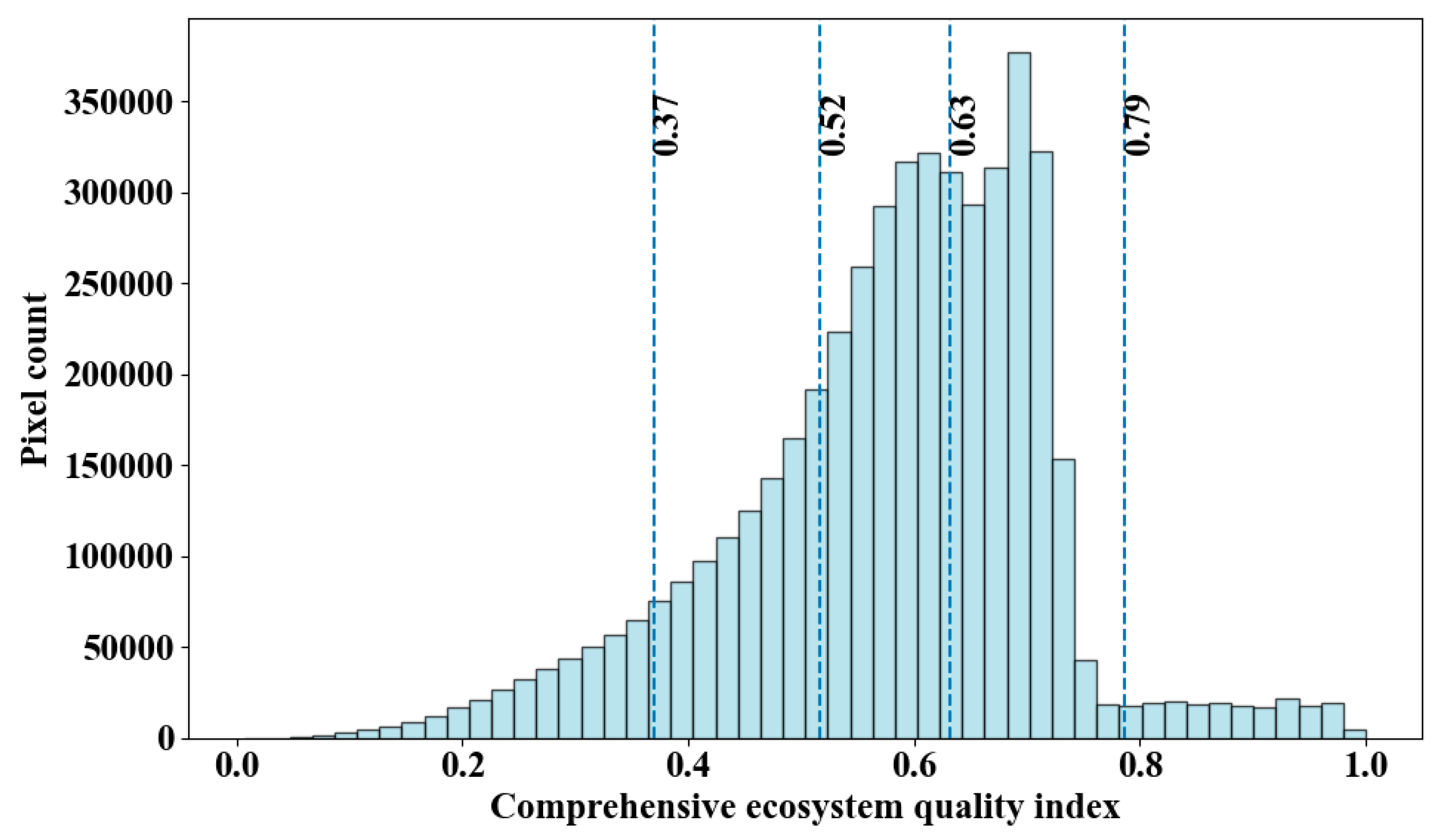
Step 1: Preliminary threshold setting. Based on the data of the comprehensive ecosystem quality index in 2023, the overall value distribution was analyzed (Figure A1). Natural Breaks (Jenks) method, commonly used in geospatial data analysis, was applied to preliminarily classify the index into five levels: excellent (0.79–1), good (0.63–0.79), moderate (0.52–0.63), fair (0.37–0.52), and poor (0–0.37). Natural Breaks identifies natural groupings in data by maximizing inter-class variance and minimizing intra-class variance based on the statistical properties of dataset.
Figure A1. Statistical summary of comprehensive ecosystem quality index in 2023.
Remotesensing 18 00558 g0a1
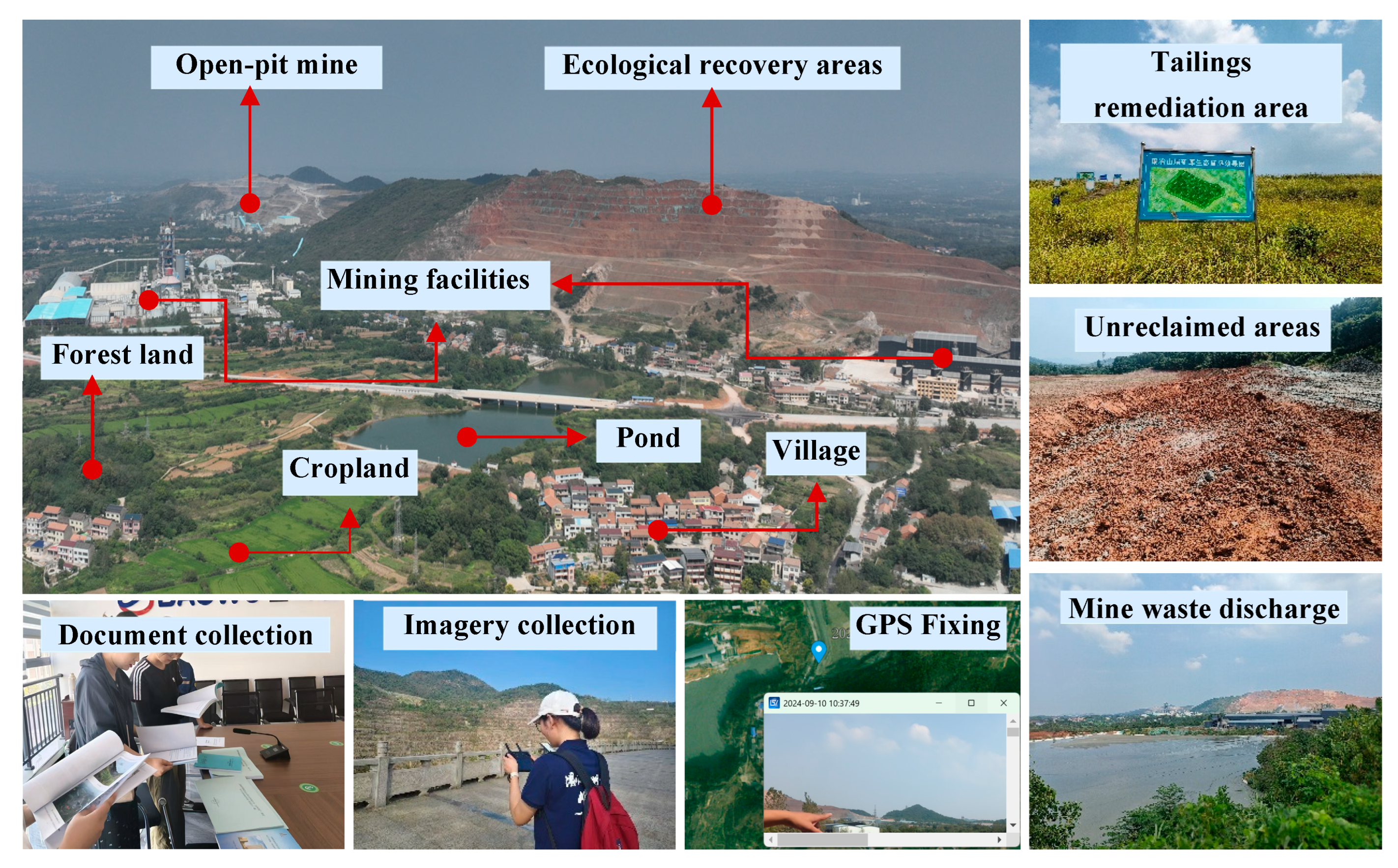
Step 2: Field investigation. After the preliminary threshold classification, adjustments were made using comprehensive field survey data collected in 2023 and 2024 from typical mining areas in Huangshi. The field survey included the following components (Figure A2): (i) Project background analysis: A thorough review of ecological restoration project documents, environmental impact assessment reports, completion acceptance reports, and detailed construction records for the surveyed mining sites. (ii) Samples data collection: Representative plots were selected within areas of different preliminary restoration levels. Geographic coordinates were precisely recorded using GPS tools, along with ground photographs and detailed documentation of vegetation type, coverage, soil exposure, topography, and evidence of human activities. (iii) High-resolution imagery verification: High-resolution satellite imagery from World Imagery Wayback, captured during or near the field survey period, was used for cross-validation. In addition, DJI MAVIC 3 Multispectral Unmanned Aerial Vehicle (UAV) imagery was acquired through systematic aerial photography in key mining areas and typical restoration plots to support threshold refinement.
Figure A2. Field investigation of mine ecological restoration (Images taken by the author during the field survey in September 2024).
Remotesensing 18 00558 g0a2
Step 3: To ensure objective and representative threshold calibration, a stratified sampling approach combined with typical region selection was adopted. Based on the remote sensing image characteristics of different ecological quality grades (Table A2) and field investigation, 298 standard plots (minimum evaluation units corresponding to remote sensing pixels) were selected across restoration grades: excellent (64), good (63), moderate (56), fair (54), and poor (61). By integrating Natural Breaks results, field verification, and expert consultation, the final threshold ranges for comprehensive ecosystem quality index were established in Huangshi: excellent [0.8–1], good [0.65–0.8), moderate [0.52–0.65), fair [0.36–0.52), and poor [0–0.36).
Table A2. Representative remote sensing imagery for different EQA grades.
GradeTypical LandscapeFeature Description
ExcellentRemotesensing 18 00558 i001Dominated by continuous, healthy vegetation (typically dense forest or well-established restoration cover) with a uniform dark-green tone, low bare-soil exposure, and high landscape connectivity. Water-buffer zones and stable natural patches are common; mining scars are largely absent or fully integrated into surrounding greenery.
GoodRemotesensing 18 00558 i002Vegetation cover remains high but shows moderate heterogeneity (e.g., mosaic of forest–cropland–restored slopes). Mining traces are limited and often appear as small, isolated patches; restored areas are recognizable by consistent greening and improved patch cohesion compared with degraded classes.
ModerateRemotesensing 18 00558 i003Transitional landscapes with patchy vegetation and noticeable soil exposure. Typical patterns include mixed cropland/village edges and restoration-in-progress zones, where greening occurs in discontinuous strips or blocks, reflecting partial recovery and moderate fragmentation.
FairRemotesensing 18 00558 i004Cropland-dominated mosaic with large, regular fields and frequent seasonal bare soil, showing bright yellow–brown tones. Linear canals/roads and scattered settlements are prominent, while vegetation is mainly limited to narrow shelterbelts and riparian strips, resulting in fragmented cover and low connectivity.
PoorRemotesensing 18 00558 i005Highly disturbed mine–urban interface with extensive impervious/industrial surfaces and transport corridors, adjacent to open-pit excavation and exposed substrates. Strongly heterogeneous bright gray–tan tones, sharp engineered boundaries, and minimal fragmented vegetation.

Appendix D. The Driving Factors Calculation of EQA

In this study, nine driving factors were selected from climate change, social activities and economic development, and the data processing process was as follows:
(1) For climate change, precipitation (D1) and temperature (D2) were selected as representative variables, which were clipped from the study area vector boundary.
(2) For social activities, five driving factors were selected: distance to mining area (D3), urbanization level (D4), agricultural production (D5), population density (D6) and land use (D7). The urbanization level (D4) was characterized by Normalized Difference Built-up Index (NDBI). Agricultural production (D5) was characterized by the Normalized Difference Tillage Index (NDTI). Population density (D6) and land use (D7) were clipped from the study area vector boundary.
N D B I = S W I R 1 N I R S W I R 1 + N I R
N D B I = S W I R 1 S W I R 2 S W I R 1 + S W I R 2
(3) For economic development, overall economic level (D8) and mining development level (D9), were selected. The overall economic level was characterized by nighttime light data, which was obtained from the boundary cropping of the study area. The level of mining development was characterized by the distribution of mining and metallurgical companies, which was obtained by kernel density analysis.
To ensure consistency, all the spatial data were resampled into 30 m resolution.

Appendix E

Table A3. Optimization parameters and their functions.
ParametersFunctionsSearch RangeFinal Value
2000201020152023
n_estimatorsDefines the number of trees in XGBoost, corresponding to model iterations count100~1000650360643656
max_depthControls the maximum depth of each tree, influencing model complexity3~106.679.099.248.88
reg_alphaRegulates L1 regularization strength to prevent overfitting0.01~1.00.510.880.980.84
min_child_weightSets the minimum sample weight per leaf node to mitigate overfitting1~104.127.624.074.84
colsample_bynodeControls the feature sampling ratio for each tree node0.5~10.980.990.80.91
subsampleControls the sample sampling ratio for training each tree0.5~10.750.970.960.91
learning_rateRegulates each tree’s contribution to the final prediction0.01~0.30.130.160.120.08
scale_pos_weightHandles class imbalance0.5~20.850.761.131.74

References

  1. Campbell, T.; Dixon, K.W.; Bradshaw, S.D.; Gann, G.D.; Hartley, W.; Lambers, H.; Wardell-Johnson, G. Standards-Based Evaluation Inform Ecological Restoration Outcomes for a Major Mining Activity in a Global Biodiversity Hotspot. Restor. Ecol. 2024, 32, e14236. [Google Scholar] [CrossRef]
  2. Worlanyo, A.S.; Li, J. Evaluating the Environmental and Economic Impact of Mining for Post-Mined Land Restoration and Land-Use: A Review. J. Environ. Manag. 2021, 279, 111623. [Google Scholar] [CrossRef] [PubMed]
  3. Ma, W.-B.; Li, H.-D.; Lei, S.-G.; Xu, X.-H.; Xue, S.-G. Good Governance Can Save China’s Mine Ecosystems. Science 2024, 383, 157–158. [Google Scholar] [CrossRef]
  4. Peng, J.; Xu, D.; Xu, Z.; Tang, H.; Jiang, H.; Dong, J.; Liu, Y. Ten Key Issues for Ecological Restoration of Territorial Space. Natl. Sci. Rev. 2024, 11, nwae176. [Google Scholar] [CrossRef]
  5. Strassburg, B.B.N.; Iribarrem, A.; Beyer, H.L.; Cordeiro, C.L.; Crouzeilles, R.; Jakovac, C.C.; Braga Junqueira, A.; Lacerda, E.; Latawiec, A.E.; Balmford, A.; et al. Global Priority Areas for Ecosystem Restoration. Nature 2020, 586, 724–729. [Google Scholar] [CrossRef] [PubMed]
  6. Aronson, J.; Goodwin, N.; Orlando, L.; Eisenberg, C.; Cross, A.T. A World of Possibilities: Six Restoration Strategies to Support the United Nation’s Decade on Ecosystem Restoration. Restor. Ecol. 2020, 28, 730–736. [Google Scholar] [CrossRef]
  7. Fischer, J.; Riechers, M.; Loos, J.; Martin-Lopez, B.; Temperton, V.M. Making the UN Decade on Ecosystem Restoration a Social-Ecological Endeavour. Trends Ecol. Evol. 2021, 36, 20–28. [Google Scholar] [CrossRef]
  8. Yuan, D.; Dong, J. Research on Ecological Restoration and Its Impact on Society in Coal Resource-Based Areas: Lessons from the Ruhr Area in Germany and the Liulin Area in China. Geoforum 2024, 154, 104038. [Google Scholar] [CrossRef]
  9. Jiao, W.; Zhang, X.; Li, C.; Guo, J. Sustainable Transition of Mining Cities in China: Literature Review and Policy Analysis. Resour. Policy 2021, 74, 101867. [Google Scholar] [CrossRef]
  10. Zhang, M.; Wang, J.; Feng, Y. Temporal and Spatial Change of Land Use in a Large-Scale Opencast Coal Mine Area: A Complex Network Approach. Land Use Policy 2019, 86, 375–386. [Google Scholar] [CrossRef]
  11. Sonter, L.J.; Moran, C.J.; Barrett, D.J.; Soares-Filho, B.S. Processes of Land Use Change in Mining Regions. J. Clean. Prod. 2014, 84, 494–501. [Google Scholar] [CrossRef]
  12. Liu, J.; Hou, X.; Wang, Z.; Shen, Y. Study the Effect of Industrial Structure Optimization on Urban Land-Use Efficiency in China. Land Use Policy 2021, 105, 105390. [Google Scholar] [CrossRef]
  13. Hu, X.; Hassink, R. Exploring Adaptation and Adaptability in Uneven Economic Resilience: A Tale of Two Chinese Mining Regions. Camb. J. Reg. Econ. Soc. 2017, 10, 527–541. [Google Scholar] [CrossRef]
  14. Jiang, S.; Feng, F.; Zhang, X.; Xu, C.; Jia, B.; Lafortezza, R. Ecological Transformation Is the Key to Improve Ecosystem Health for Resource-Exhausted Cities: A Case Study in China Based on Future Development Scenarios. Sci. Total Environ. 2024, 921, 171147. [Google Scholar] [CrossRef]
  15. Chen, W.; Gu, T.; Xiang, J.; Luo, T.; Zeng, J.; Yuan, Y. Ecological Restoration Zoning of Territorial Space in China: An Ecosystem Health Perspective. J. Environ. Manag. 2024, 364, 121371. [Google Scholar] [CrossRef]
  16. Cai, Y.; Zhang, F.; Duan, P.; Jim, C.Y.; Chan, N.W.; Shi, J.; Liu, C.; Wang, J.; Bahtebay, J.; Ma, X. Vegetation Cover Changes in China Induced by Ecological Restoration-Protection Projects and Land-Use Changes from 2000 to 2020. Catena 2022, 217, 106530. [Google Scholar] [CrossRef]
  17. Redondo-Vega, J.M.; Gómez-Villar, A.; Santos-González, J.; González-Gutiérrez, R.B.; Álvarez-Martínez, J. Changes in Land Use Due to Mining in the North-Western Mountains of Spain during the Previous 50years. CATENA 2017, 149, 844–856. [Google Scholar] [CrossRef]
  18. Aires, U.R.V.; Santos, B.S.M.; Coelho, C.D.; da Silva, D.D.; Calijuri, M.L. Changes in Land Use and Land Cover as a Result of the Failure of a Mining Tailings Dam in Mariana, MG, Brazil. Land Use Policy 2018, 70, 63–70. [Google Scholar] [CrossRef]
  19. Li, G.; He, T.; Zhang, M.; Wu, C. Spatiotemporal Variations in the Eco-Health Condition of China’s Long-Term Stable Cultivated Land Using Google Earth Engine from 2001 to 2019. Appl. Geogr. 2022, 149, 102819. [Google Scholar] [CrossRef]
  20. Karan, S.K.; Samadder, S.R.; Maiti, S.K. Assessment of the Capability of Remote Sensing and GIS Techniques for Monitoring Reclamation Success in Coal Mine Degraded Lands. J. Environ. Manag. 2016, 182, 272–283. [Google Scholar] [CrossRef] [PubMed]
  21. Yang, Z.; Li, J.; Zipper, C.E.; Shen, Y.; Miao, H.; Donovan, P.F. Identification of the Disturbance and Trajectory Types in Mining Areas Using Multitemporal Remote Sensing Images. Sci. Total Environ. 2018, 644, 916–927. [Google Scholar] [CrossRef]
  22. Chen, X.; Guo, Z.; Chen, J.; Yang, W.; Yao, Y.; Zhang, C.; Cui, X.; Cao, X. Replacing the Red Band with the Red-SWIR Band (0.74ρred+0.26ρswir) Can Reduce the Sensitivity of Vegetation Indices to Soil Background. Remote Sens. 2019, 11, 851. [Google Scholar] [CrossRef]
  23. Lu, W.; Xu, C.; Wu, J.; Cheng, S. Ecological Effect Assessment Based on the DPSIR Model of a Polluted Urban River during Restoration: A Case Study of the Nanfei River, China. Ecol. Indic. 2019, 96, 146–152. [Google Scholar] [CrossRef]
  24. Bao, N.; Li, W.; Gu, X.; Liu, Y. Biomass Estimation for Semiarid Vegetation and Mine Rehabilitation Using Worldview-3 and Sentinel-1 SAR Imagery. Remote Sens. 2019, 11, 2855. [Google Scholar] [CrossRef]
  25. Liu, X.; Li, H.; Wang, S.; Liu, K.; Li, L.; Li, D. Ecological Security Assessment of “Grain-for-Green” Program Typical Areas in Northern China Based on Multi-Source Remote Sensing Data. Remote Sens. 2023, 15, 5732. [Google Scholar] [CrossRef]
  26. Li, Y.; Dong, S.; Wen, L.; Wang, X.; Wu, Y. Three-Dimensional Framework of Vigor, Organization, and Resilience (VOR) for Assessing Rangeland Health: A Case Study from the Alpine Meadow of the Qinghai-Tibetan Plateau, China. Ecohealth 2013, 10, 423–433. [Google Scholar] [CrossRef]
  27. Malekmohammadi, B.; Jahanishakib, F. Vulnerability Assessment of Wetland Landscape Ecosystem Services Using Driver-Pressure-State-Impact-Response (DPSIR) Model. Ecol. Indic. 2017, 82, 293–303. [Google Scholar] [CrossRef]
  28. Zhao, R.; Fang, C.; Liu, H.; Liu, X. Evaluating Urban Ecosystem Resilience Using the DPSIR Framework and the ENA Model: A Case Study of 35 Cities in China. Sustain. Cities Soc. 2021, 72, 102997. [Google Scholar] [CrossRef]
  29. Zhang, P.; Wang, Q.; Liu, Y.; Zhang, J. Potential Ecological Risk Assessment Based on Loss of Ecosystem Services Due to Land Use and Land Cover Change: A Case Study of Beijing-Tianjin-Hebei Region. Appl. Geogr. 2024, 171, 103389. [Google Scholar] [CrossRef]
  30. Lamb, D.; Erskine, P.D.; Fletcher, A. Widening Gap between Expectations and Practice in Australian Minesite Rehabilitation. Ecol. Manag. Restor. 2015, 16, 186–195. [Google Scholar] [CrossRef]
  31. Niu, L.; Shao, Q. Soil Conservation Service Spatiotemporal Variability and Its Driving Mechanism on the Guizhou Plateau, China. Remote Sens. 2020, 12, 2187. [Google Scholar] [CrossRef]
  32. Harries, K.L.; Woinarski, J.; Rumpff, L.; Gardener, M.; Erskine, P.D. Characteristics and Gaps in the Assessment of Progress in Mine Restoration: Insights from Five Decades of Published Literature Relating to Native Ecosystem Restoration after Mining. Restor. Ecol. 2024, 32, e14016. [Google Scholar] [CrossRef]
  33. He, J.; Shi, X. Detection of Social-Ecological Drivers and Impact Thresholds of Ecological Degradation and Ecological Restoration in the Last Three Decades. J. Environ. Manag. 2022, 318, 115513. [Google Scholar] [CrossRef]
  34. Stefanes, M.; Ochoa-Quintero, J.M.; de Oliveira Roque, F.; Sugai, L.S.M.; Tambosi, L.R.; Lourival, R.; Laurance, S. Incorporating Resilience and Cost in Ecological Restoration Strategies at Landscape Scale. Ecol. Soc. 2016, 21, 54. [Google Scholar] [CrossRef]
  35. Xiao, W.; Ruan, L.; Yue, W.; Zhou, Y.; Zhang, L.; Hu, Y. Construction of a multi-scale effectiveness evaluation system for ecological restoration and protection of territorial space. Chin. J. Appl. Ecol. 2023, 34, 2566–2574. [Google Scholar] [CrossRef]
  36. Zhang, M.; Wang, J.; Li, S.; Feng, D.; Cao, E. Dynamic Changes in Landscape Pattern in a Large-Scale Opencast Coal Mine Area from 1986 to 2015: A Complex Network Approach. Catena 2020, 194, 104738. [Google Scholar] [CrossRef]
  37. Zhu, S.; Zhao, Y.; Huang, J.; Wang, S. Analysis of Spatial-Temporal Differentiation and Influencing Factors of Ecosystem Services in Resource-Based Cities in Semiarid Regions. Remote Sens. 2023, 15, 871. [Google Scholar] [CrossRef]
  38. Deng, F.; Zhu, S.; Guo, J.; Sun, X. Exploring the Quality of Ecosystem Services and the Segmental Impact of Influencing Factors in Resource-Based Cities. J. Environ. Manag. 2025, 375, 124411. [Google Scholar] [CrossRef]
  39. Chen, T.; Guestrin, C. XGBoost: A Scalable Tree Boosting System. In Proceedings of the 22nd ACM SIGKDD International Conference on Knowledge Discovery and Data Mining, San Francisco, CA, USA, 13–17 August 2016; Association for Computing Machinery: New York, NY, USA, 2016; pp. 785–794. [Google Scholar] [CrossRef]
  40. Lundberg, S.M.; Lee, S.-I. A Unified Approach to Interpreting Model Predictions. In Advances in Neural Information Processing Systems; Curran Associates, Inc.: Nice, France, 2017; Volume 30. [Google Scholar]
  41. Ouyang, N.; Rui, X.; Zhang, X.; Tang, H.; Xie, Y. Spatiotemporal Evolution of Ecosystem Health and Its Driving Factors in the Southwestern Karst Regions of China. Ecol. Indic. 2024, 166, 112530. [Google Scholar] [CrossRef]
  42. Ye, Z.; Gong, J.; Teng, W.; Yang, Z.; Wang, Y.; Xu, T.; Jin, T. Climate Change and Human Activities Have Resulted in Substantial Alterations to Ecosystem Quality within the Yarlung Zangbo River Basin. Ecol. Front. 2025, 45, 925–938. [Google Scholar] [CrossRef]
  43. Wang, Z.; Zhou, R.; Rui, J.; Yu, Y. Revealing the Impact of Urban Spatial Morphology on Land Surface Temperature in Plain and Plateau Cities Using Explainable Machine Learning. Sustain. Cities Soc. 2025, 118, 106046. [Google Scholar] [CrossRef]
  44. Xi, X.; Wang, S.; Yao, L.; Zhang, Y.; Niu, R.; Zhou, Y. Evaluation on Geological Environment Carrying Capacity of Mining City—A Case Study in Huangshi City, Hubei Province, China. Int. J. Appl. Earth Obs. Geoinf. 2021, 102, 102410. [Google Scholar] [CrossRef]
  45. Chen, H.; You, S.; Ren, C. Evaluation of tourism and recreation value of mining heritage in the context of transformation of resource-depleted cities: Take Huangshi National Mine Park as an example. J. Nat. Sci. Hunan Norm. Univ. 2023, 46, 33–41. [Google Scholar]
  46. Li, Y.; Wang, L.; Cao, Q.; Gu, X.; Lu, Y.; Luo, Y. Exploring an Adaptive Management Model for “Status-Optimization-Regulation” of Mining City in Transition: A Case Study of Huangshi, China. Appl. Geogr. 2024, 172, 103438. [Google Scholar] [CrossRef]
  47. Zheng, X.; Fu, Q.; Wu, X. Spatial Pattern of “City-Brown-Green” in Resource-Exhausted Cities:A Case Study of Huangshi City, Hubei Province. Landsc. Archit. 2021, 28, 28–33. [Google Scholar] [CrossRef]
  48. Zhang, C.; Fang, S. Identifying and Zoning Key Areas of Ecological Restoration for Territory in Resource-Based Cities: A Case Study of Huangshi City, China. Sustainability 2021, 13, 3931. [Google Scholar] [CrossRef]
  49. Vermote, E.; Justice, C.; Claverie, M.; Franch, B. Preliminary Analysis of the Performance of the Landsat 8/OLI Land Surface Reflectance Product. Remote Sens. Environ. 2016, 185, 46–56. [Google Scholar] [CrossRef] [PubMed]
  50. Markham, B.; Barsi, J.; Kvaran, G.; Ong, L.; Kaita, E.; Biggar, S.; Czapla-Myers, J.; Mishra, N.; Helder, D. Landsat-8 Operational Land Imager Radiometric Calibration and Stability. Remote Sens. 2014, 6, 12275–12308. [Google Scholar] [CrossRef]
  51. Roy, D.P.; Kovalskyy, V.; Zhang, H.K.; Vermote, E.F.; Yan, L.; Kumar, S.S.; Egorov, A. Characterization of Landsat-7 to Landsat-8 Reflective Wavelength and Normalized Difference Vegetation Index Continuity. Remote Sens. Environ. 2016, 185, 57–70. [Google Scholar] [CrossRef] [PubMed]
  52. National Development and Reform Commission (NDRC). Guidance on Cultivating and Developing Modern Metropolitan Circles (No. NDRC Planning [2019] 328); NDRC: Beijing, China, 2019. Available online: https://zfxxgk.ndrc.gov.cn/web/iteminfo.jsp?id=807 (accessed on 2 February 2026).
  53. Hubei Provincial People’s Government. A Green Transformation of a Historic Mining City: The Story of Huangshi’s Journey to Becoming a “National Forest City”; Hubei Provincial People’s Government: Wuhan, China, 2018. Available online: https://www.hubei.gov.cn/hbfb/szsm/201811/t20181105_1548563.shtml (accessed on 2 February 2026).
  54. Huangshi Municipal Ecology and Environment Bureau. Mountains Regaining Green: An Overview of Huangshi’s Progress in Mine Ecological Restoration; Huangshi Municipal Ecology and Environment Bureau: Huangshi, China, 2023. Available online: https://sthjj.huangshi.gov.cn/ztzl/sjhbdczgjxs/mtbd2/202312/t20231218_1081159.html (accessed on 2 February 2026).
  55. Rounsevell, M.D.A.; Pedroli, B.; Erb, K.-H.; Gramberger, M.; Busck, A.G.; Haberl, H.; Kristensen, S.; Kuemmerle, T.; Lavorel, S.; Lindner, M.; et al. Challenges for Land System Science. Land Use Policy 2012, 29, 899–910. [Google Scholar] [CrossRef]
  56. Schuurman, G.W.; Cole, D.N.; Cravens, A.E.; Covington, S.; Crausbay, S.D.; Hoffman, C.H.; Lawrence, D.J.; Magness, D.R.; Morton, J.M.; Nelson, E.A.; et al. Navigating Ecological Transformation: Resist–Accept–Direct as a Path to a New Resource Management Paradigm. Bioscience 2022, 72, 16–29. [Google Scholar] [CrossRef]
  57. Zhu, S.-C.; Zheng, H.-X.; Liu, W.-S.; Liu, C.; Guo, M.-N.; Huot, H.; Morel, J.L.; Qiu, R.-L.; Chao, Y.; Tang, Y.-T. Plant-Soil Feedbacks for the Restoration of Degraded Mine Lands: A Review. Front. Microbiol. 2022, 12, 751794. [Google Scholar] [CrossRef]
  58. Doley, D.; Audet, P. Adopting Novel Ecosystems as Suitable Rehabilitation Alternatives for Former Mine Sites. Ecol. Process. 2013, 2, 22. [Google Scholar] [CrossRef]
  59. Suding, K.N.; Gross, K.L.; Houseman, G.R. Alternative States and Positive Feedbacks in Restoration Ecology. Trends Ecol. Evol. 2004, 19, 46–53. [Google Scholar] [CrossRef]
  60. Lei, S.; Bian, Z.; Yang, Y. Discussion on the guided restoration for mine ecosystem. J. China Coal Soc. 2022, 47, 915–921. [Google Scholar] [CrossRef]
  61. Maes, S.L.; Perring, M.P.; Cohen, R.; Akinnifesi, F.K.; Bargués-Tobella, A.; Bastin, J.-F.; Bauters, M.; Bernardino, P.N.; Brancalion, P.H.S.; Bullock, J.M.; et al. Explore before You Restore: Incorporating Complex Systems Thinking in Ecosystem Restoration. J. Appl. Ecol. 2024, 61, 922–939. [Google Scholar] [CrossRef]
  62. Sun, Q.; Bai, Z.; Cao, Y.; Xie, M.; Hu, X.; Jiang, Y.; Lu, Y. Ecological risk assessment of land destruction in large open-pit mine. Trans. Chin. Soc. Agric. Eng. 2015, 31, 278–288. [Google Scholar] [CrossRef]
  63. Young, R.E.; Gann, G.D.; Walder, B.; Liu, J.; Cui, W.; Newton, V.; Nelson, C.R.; Tashe, N.; Jasper, D.; Silveira, F.A.O.; et al. International Principles and Standards for the Ecological Restoration and Recovery of Mine Sites. Restor. Ecol. 2022, 30, e13771. [Google Scholar] [CrossRef]
  64. Yue, W.; Xia, H.; Liu, Y.; Xu, J.; Xiong, J. Assessing Ecological Conservation Redline from Element, Structure, and Function Dimensions: A Case of Zhejiang Province, China. Environ. Impact Assess. Rev. 2024, 106, 107485. [Google Scholar] [CrossRef]
  65. Zhang, J.; Li, H.; Long, B.; Huang, D. Harmony in Extraction: A Variable Weight Theory Approach to Unraveling the Ecological Security Veins in China’s Rare Earth Mining under Variable Pressures. IEEE J. Sel. Top. Appl. Earth Obs. Remote Sens. 2024, 17, 10726–10739. [Google Scholar] [CrossRef]
  66. Xiao, W.; Lv, X.; Zhao, Y.; Sun, H.; Li, J. Ecological Resilience Assessment of an Arid Coal Mining Area Using Index of Entropy and Linear Weighted Analysis: A Case Study of Shendong Coalfield, China. Ecol. Indic. 2020, 109, 105843. [Google Scholar] [CrossRef]
  67. Zhu, Y.; Tian, D.; Yan, F. Effectiveness of Entropy Weight Method in Decision-Making. Math. Probl. Eng. 2020, 2020, e3564835. [Google Scholar] [CrossRef]
  68. Diakoulaki, D.; Mavrotas, G.; Papayannakis, L. Determining Objective Weights in Multiple Criteria Problems: The Critic Method. Comput. Oper. Res. 1995, 22, 763–770. [Google Scholar] [CrossRef]
  69. Žižović, M.; Miljković, B.; Marinković, D. Objective Methods for Determining Criteria Weight Coefficients: A Modification of the CRITIC Method. Decis. Mak. Appl. Manag. Eng. 2020, 3, 149–161. [Google Scholar] [CrossRef]
  70. Zhang, J.; Zhang, S. Assessing Integrated Effectiveness of Rural Socio-Economic Development and Environmental Protection of Wenchuan County in Southwestern China: An Approach Using Game Theory and VIKOR. Land 2022, 11, 1912. [Google Scholar] [CrossRef]
  71. Liu, H.; Li, Z.; He, Q. Suitability Assessment of Multilayer Urban Underground Space Based on Entropy and CRITIC Combined Weighting Method: A Case Study in Xiong’an New Area, China. Appl. Sci. 2023, 13, 10231. [Google Scholar] [CrossRef]
  72. Ruan, X.; Sun, H.; Yu, Q.; Shou, W.; Wang, J. A Game-Theoretic Combination Weighting–TOPSIS Integrated Model for Sustainable Floodplain Risk Assessment Under Multi-Return-Period Scenarios. Sustainability 2025, 17, 5622. [Google Scholar] [CrossRef]
  73. Peng, J.; Zhang, J. Urban Flooding Risk Assessment Based on GIS- Game Theory Combination Weight: A Case Study of Zhengzhou City. Int. J. Disaster Risk Reduct. 2022, 77, 103080. [Google Scholar] [CrossRef]
  74. Li, Q.; Liu, Z.; Yang, Y.; Han, Y.; Wang, X. Evaluation of Water Resources Carrying Capacity in Tarim River Basin under Game Theory Combination Weights. Ecol. Indic. 2023, 154, 110609. [Google Scholar] [CrossRef]
  75. Xu, W.; Wang, J.; Zhang, M.; Li, S. Construction of Landscape Ecological Network Based on Landscape Ecological Risk Assessment in a Large-Scale Opencast Coal Mine Area. J. Clean. Prod. 2021, 286, 125523. [Google Scholar] [CrossRef]
  76. Zhang, T.; Zhang, S.; Cao, Q.; Wang, H.; Li, Y. The Spatiotemporal Dynamics of Ecosystem Services Bundles and the Social-Economic-Ecological Drivers in the Yellow River Delta Region. Ecol. Indic. 2022, 135, 108573. [Google Scholar] [CrossRef]
  77. Klaus, V.H.; Kiehl, K. A Conceptual Framework for Urban Ecological Restoration and Rehabilitation. Basic Appl. Ecol. 2021, 52, 82–94. [Google Scholar] [CrossRef]
  78. Liu, S.; Li, W.; Qiao, W.; Wang, Q.; Hu, Y.; Wang, Z. Effect of Natural Conditions and Mining Activities on Vegetation Variations in Arid and Semiarid Mining Regions. Ecol. Indic. 2019, 103, 331–345. [Google Scholar] [CrossRef]
  79. Chen, L.; Zhang, H.; Zhang, X.; Liu, P.; Zhang, W.; Ma, X. Vegetation Changes in Coal Mining Areas: Naturally or Anthropogenically Driven? Catena 2022, 208, 105712. [Google Scholar] [CrossRef]
  80. Feng, Y.; Wang, J.; Bai, Z.; Reading, L. Effects of Surface Coal Mining and Land Reclamation on Soil Properties: A Review. Earth-Sci. Rev. 2019, 191, 12–25. [Google Scholar] [CrossRef]
  81. Jing, Z.; Wang, J.; Zhu, Y.; Feng, Y. Effects of Land Subsidence Resulted from Coal Mining on Soil Nutrient Distributions in a Loess Area of China. J. Clean. Prod. 2018, 177, 350–361. [Google Scholar] [CrossRef]
  82. Zhu, D.; Chen, T.; Zhen, N.; Niu, R. Monitoring the Effects of Open-Pit Mining on the Eco-Environment Using a Moving Window-Based Remote Sensing Ecological Index. Environ. Sci. Pollut. Res. 2020, 27, 15716–15728. [Google Scholar] [CrossRef]
  83. Turner, R.; Eriksson, D.; McCourt, M.; Kiili, J.; Laaksonen, E.; Xu, Z.; Guyon, I. Bayesian Optimization Is Superior to Random Search for Machine Learning Hyperparameter Tuning: Analysis of the Black-Box Optimization Challenge 2020. In Proceedings of the Neurips 2020 Competition and Demonstration Track, Virtual, 6–14 December 2021; PMLR, 2021; pp. 3–26. [Google Scholar] [CrossRef]
  84. Klein, A.; Falkner, S.; Bartels, S.; Hennig, P.; Hutter, F. Fast Bayesian Optimization of Machine Learning Hyperparameters on Large Datasets. In Proceedings of the 20th International Conference on Artificial Intelligence and Statistics, Lauderdale, FL, USA, 20–22 April 2017; PMLR, 2017; pp. 528–536. [Google Scholar] [CrossRef]
  85. Hassija, V.; Chamola, V.; Mahapatra, A.; Singal, A.; Goel, D.; Huang, K.; Scardapane, S.; Spinelli, I.; Mahmud, M.; Hussain, A. Interpreting Black-Box Models: A Review on Explainable Artificial Intelligence. Cogn. Comput. 2024, 16, 45–74. [Google Scholar] [CrossRef]
  86. Mosca, E.; Szigeti, F.; Tragianni, S.; Gallagher, D.; Groh, G. SHAP-Based Explanation Methods: A Review for NLP Interpretability. In Proceedings of the 29th International Conference on Computational Linguistics, Gyeongju, Republic of Korea, 12–17 October 2022; Calzolari, N., Huang, C.-R., Kim, H., Pustejovsky, J., Wanner, L., Choi, K.-S., Ryu, P.-M., Chen, H.-H., Donatelli, L., Ji, H., et al., Eds.; International Committee on Computational Linguistics: Gyeongju, Republic of Korea, 2022; pp. 4593–4603. [Google Scholar] [CrossRef]
  87. Sun, J.; Yuan, X.; Liu, H.; Liu, G.; Zhang, G. Emergy Evaluation of a Swamp Dike-Pond Complex: A New Ecological Restoration Mode of Coal-Mining Subsidence Areas in China. Ecol. Indic. 2019, 107, 105660. [Google Scholar] [CrossRef]
  88. Jin, X.; Fang, D.; Chen, B.; Wang, H. Multiobjective Layout Optimization for Low Impact Development Considering Its Ecosystem Services. Resour. Conserv. Recycl. 2024, 209, 107794. [Google Scholar] [CrossRef]
  89. Wang, T.; Li, H.; Huang, Y. The Complex Ecological Network’s Resilience of the Wuhan Metropolitan Area. Ecol. Indic. 2021, 130, 108101. [Google Scholar] [CrossRef]
  90. Lynch, A.J.; Thompson, L.M.; Morton, J.M.; Beever, E.A.; Clifford, M.; Limpinsel, D.; Magill, R.T.; Magness, D.R.; Melvin, T.A.; Newman, R.A.; et al. RAD Adaptive Management for Transforming Ecosystems. Bioscience 2022, 72, 45–56. [Google Scholar] [CrossRef]
  91. Bandyopadhyay, S.; Maiti, S.K. Evaluation of Ecological Restoration Success in Mining-Degraded Lands. Environ. Qual. Manag. 2019, 29, 89–100. [Google Scholar] [CrossRef]
  92. Jaiswal, P. Restoration Planning of Mining Wastelands. J. Bot. Res. 2023, 5, 12–21. [Google Scholar] [CrossRef]
  93. Zhang, C.; Zheng, H.; Li, J.; Qin, T.; Guo, J.; Du, M. A Method for Identifying the Spatial Range of Mining Disturbance Based on Contribution Quantification and Significance Test. Int. J. Environ. Res. Public. Health 2022, 19, 5176. [Google Scholar] [CrossRef]
  94. Wu, Z.; Lei, S.; Lu, Q.; Bian, Z.; Ge, S. Spatial Distribution of the Impact of Surface Mining on the Landscape Ecological Health of Semi-Arid Grasslands. Ecol. Indic. 2020, 111, 105996. [Google Scholar] [CrossRef]
  95. Zhang, D.; Jia, Q.; Xu, X.; Yao, S.; Chen, H.; Hou, X. Contribution of Ecological Policies to Vegetation Restoration: A Case Study from Wuqi County in Shaanxi Province, China. Land Use Policy 2018, 73, 400–411. [Google Scholar] [CrossRef]
  96. Zhang, J.; Rao, Y.; Geng, Y.; Fu, M.; Prishchepov, A.V. A Novel Understanding of Land Use Characteristics Caused by Mining Activities: A Case Study of Wu’an, China. Ecol. Eng. 2017, 99, 54–69. [Google Scholar] [CrossRef]
  97. Gu, Q.; Wu, Z.; Xie, D. Transformation and Development of Resource-Based Cities in China: A Review and Bibliometric Analysis. Front. Environ. Sci. 2022, 10, 975669. [Google Scholar] [CrossRef]
  98. Li, Z.; Ma, Z.; van der Kuijp, T.J.; Yuan, Z.; Huang, L. A Review of Soil Heavy Metal Pollution from Mines in China: Pollution and Health Risk Assessment. Sci. Total Environ. 2014, 468–469, 843–853. [Google Scholar] [CrossRef]
  99. Rout, T.K.; Masto, R.E.; Ram, L.C.; George, J.; Padhy, P.K. Assessment of Human Health Risks from Heavy Metals in Outdoor Dust Samples in a Coal Mining Area. Environ. Geochem. Health 2013, 35, 347–356. [Google Scholar] [CrossRef]
  100. Loupasakis, C.; Angelitsa, V.; Rozos, D.; Spanou, N. Mining Geohazards—Land Subsidence Caused by the Dewatering of Opencast Coal Mines: The Case Study of the Amyntaio Coal Mine, Florina, Greece. Nat. Hazards 2014, 70, 675–691. [Google Scholar] [CrossRef]
  101. Yang, Y.-Y.; Xu, Y.-S.; Shen, S.-L.; Yuan, Y.; Yin, Z.-Y. Mining-Induced Geo-Hazards with Environmental Protection Measures in Yunnan, China: An Overview. Bull. Eng. Geol. Environ. 2015, 74, 141–150. [Google Scholar] [CrossRef]
  102. Phillips, J. Climate Change and Surface Mining: A Review of Environment-Human Interactions & Their Spatial Dynamics. Appl. Geogr. 2016, 74, 95–108. [Google Scholar] [CrossRef]
  103. Barral, M.P.; Rey Benayas, J.M.; Meli, P.; Maceira, N.O. Quantifying the Impacts of Ecological Restoration on Biodiversity and Ecosystem Services in Agroecosystems: A Global Meta-Analysis. Agric. Ecosyst. Environ. 2015, 202, 223–231. [Google Scholar] [CrossRef]
  104. Knapp, M.; Teder, T.; Lukas, V.; Štrobl, M.; Knappová, J.; Landis, D.A.; González, E. Ecologically-Informed Precision Conservation: A Framework for Increasing Biodiversity in Intensively Managed Agricultural Landscapes with Minimal Sacrifice in Crop Production. Biol. Conserv. 2023, 288, 110343. [Google Scholar] [CrossRef]
  105. Liccari, F.; Boscutti, F.; Bacaro, G.; Sigura, M. Connectivity, Landscape Structure, and Plant Diversity across Agricultural Landscapes: Novel Insight into Effective Ecological Network Planning. J. Environ. Manag. 2022, 317, 115358. [Google Scholar] [CrossRef]
  106. Gulpinar Sekban, D.U.; Acar, C. Determining Usages in Post-Mining Sites According to Landscape Design Approaches. Land Degrad. Dev. 2021, 32, 2661–2676. [Google Scholar] [CrossRef]
  107. Lovell, S.T.; Johnston, D.M. Creating Multifunctional Landscapes: How Can the Field of Ecology Inform the Design of the Landscape? Front. Ecol. Environ. 2009, 7, 212–220. [Google Scholar] [CrossRef]
  108. Reyer, C.P.O.; Rammig, A.; Brouwers, N.; Langerwisch, F. Forest Resilience, Tipping Points and Global Change Processes. J. Ecol. 2015, 103, 1–4. [Google Scholar] [CrossRef]
  109. Quintero-Angel, M.; Cerón-Hernández, V.A.; Ospina-Salazar, D.I. Applications and Perspectives for Land Restoration through Nature-Based Solutions. Curr. Opin. Environ. Sci. Health 2023, 36, 100518. [Google Scholar] [CrossRef]
  110. Fox, H.; Cundill, G. Towards Increased Community-Engaged Ecological Restoration: A Review of Current Practice and Future Directions. Ecol. Restor. 2018, 36, 208–218. [Google Scholar] [CrossRef]
  111. Galbraith, M.; Towns, D.R.; Bollard, B.; MacDonald, E.A. Ecological Restoration Success from Community and Agency Perspectives: Exploring the Differences. Restor. Ecol. 2021, 29, e13405. [Google Scholar] [CrossRef]
Disclaimer/Publisher’s Note: The statements, opinions and data contained in all publications are solely those of the individual author(s) and contributor(s) and not of MDPI and/or the editor(s). MDPI and/or the editor(s) disclaim responsibility for any injury to people or property resulting from any ideas, methods, instructions or products referred to in the content.

Article Metrics

Citations

Article Access Statistics

Multiple requests from the same IP address are counted as one view.