Quantitative Analysis of Lightning Rod Impacts on the Radiation Pattern and Polarimetric Characteristics of S-Band Weather Radar
 , , , ,
Highlights
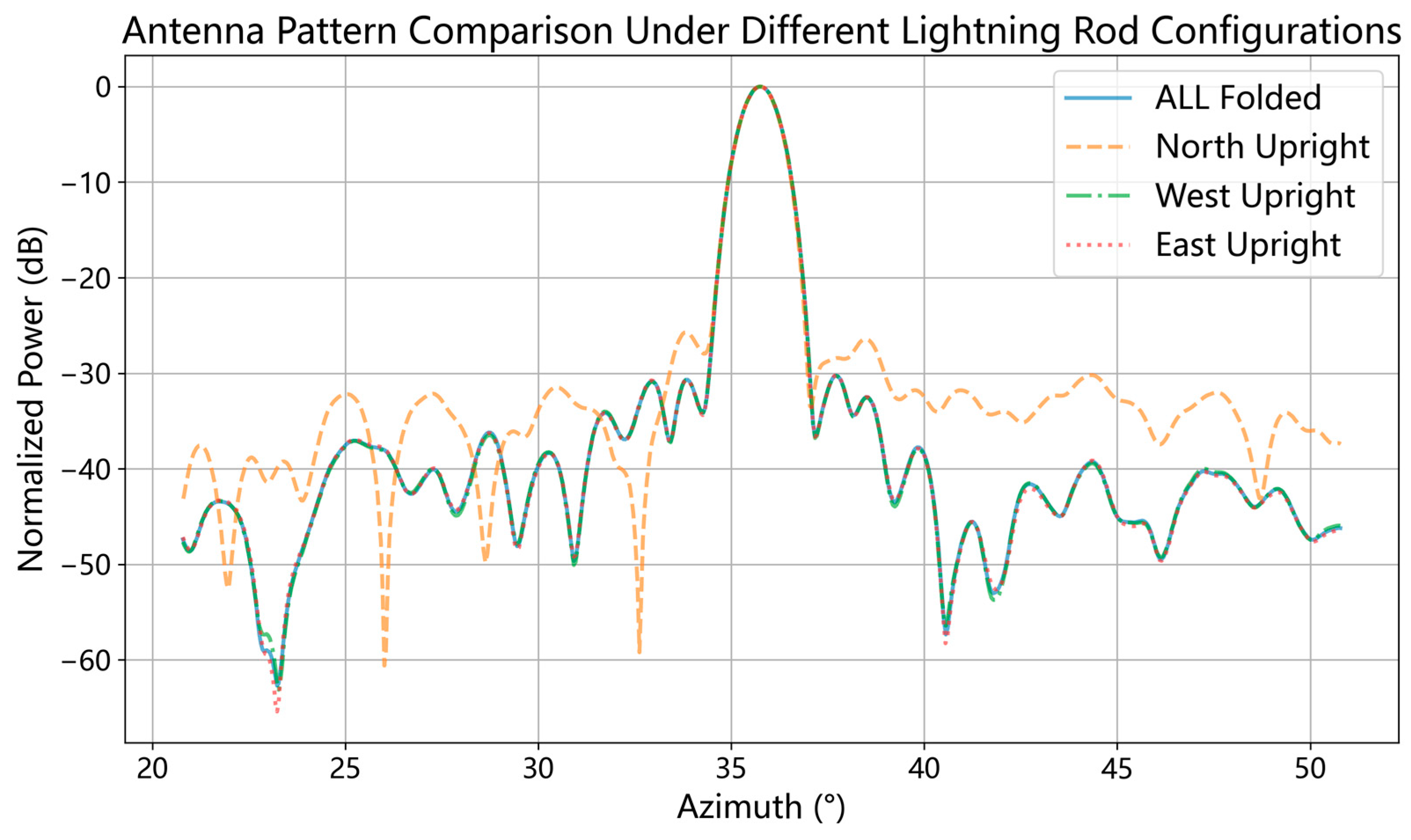
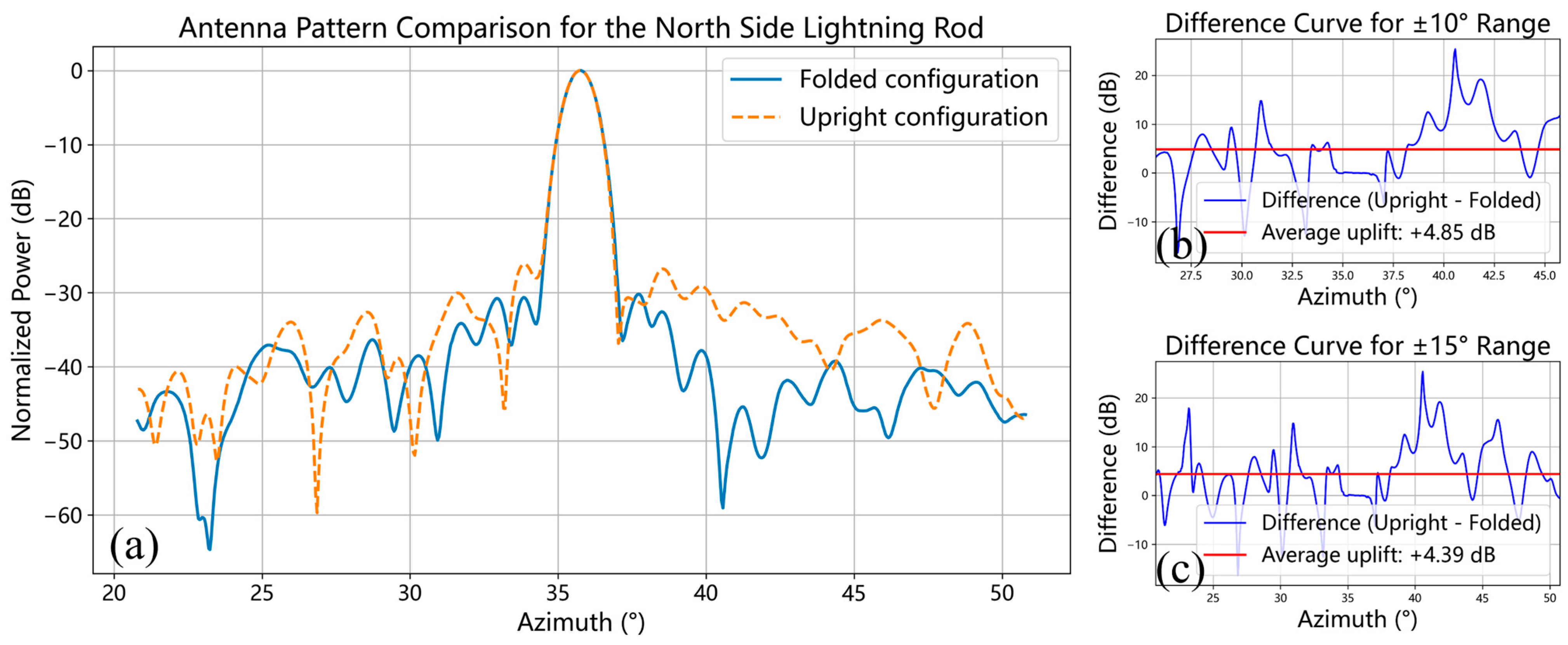
- Lightning rods significantly increase the sidelobe levels of an S-band dual-polarization weather radar by up to 4.55 dB, while leaving the main-beam pointing and beamwidth essentially unchanged.
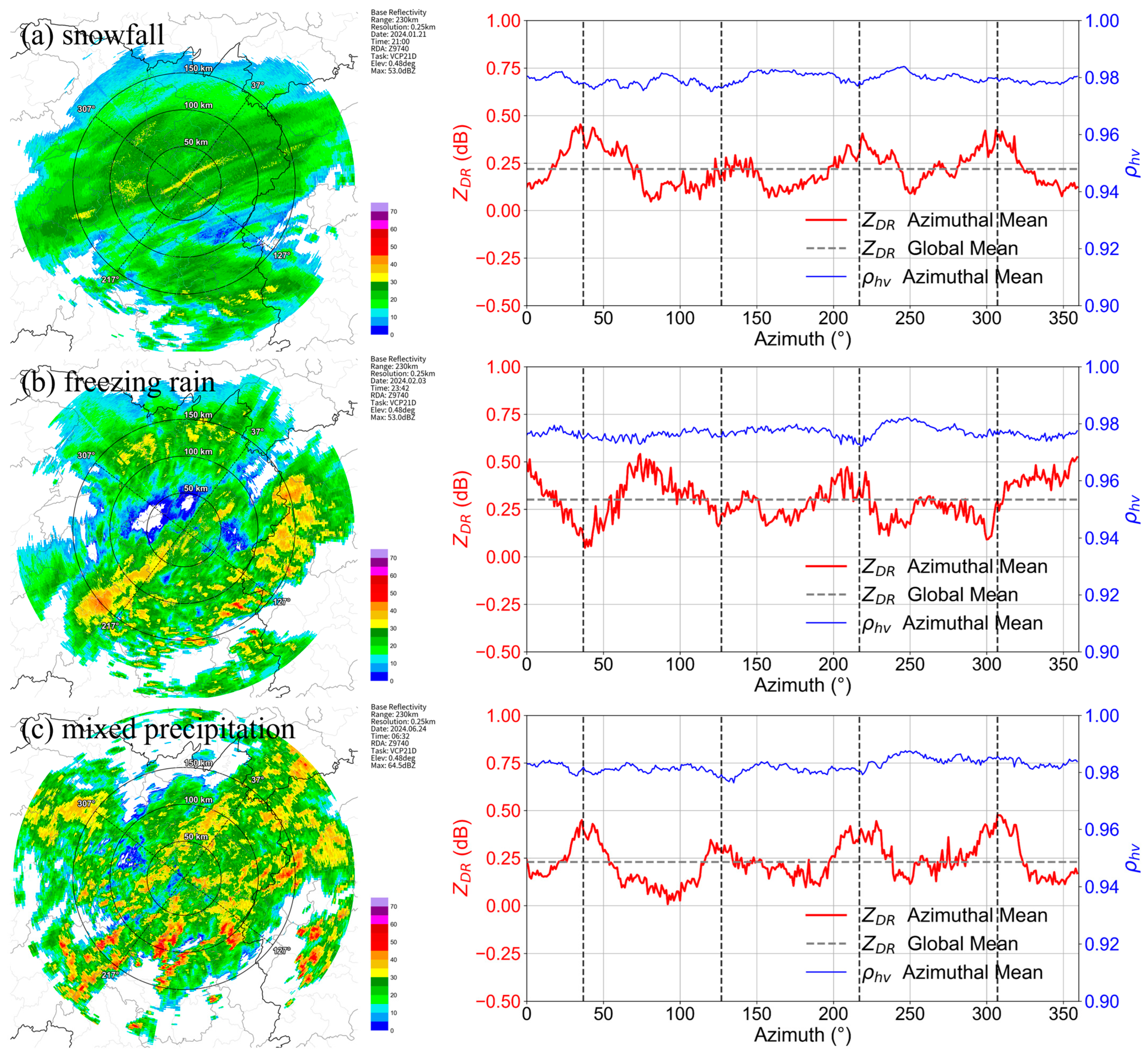
- Lightning rods introduce localized, azimuth-dependent polarimetric disturbances, producing a roughly 0.24–0.25 dB positive bias in snowfall and mixed-phase precipitation, whereas freezing-rain cases show no persistent azimuthal anomaly.
- The clear directionality and posture-dependent behavior of the interference indicates that lightning rod geometry and placement should be explicitly considered in radar-antenna structural design, installation, and site planning.
- The quantified biases provide a practical reference for developing polarimetric quality-control schemes and bias-correction approaches for lightning-rod–induced disturbances in dual-polarization radar products.
Abstract
1. Introduction
2. Materials and Methods
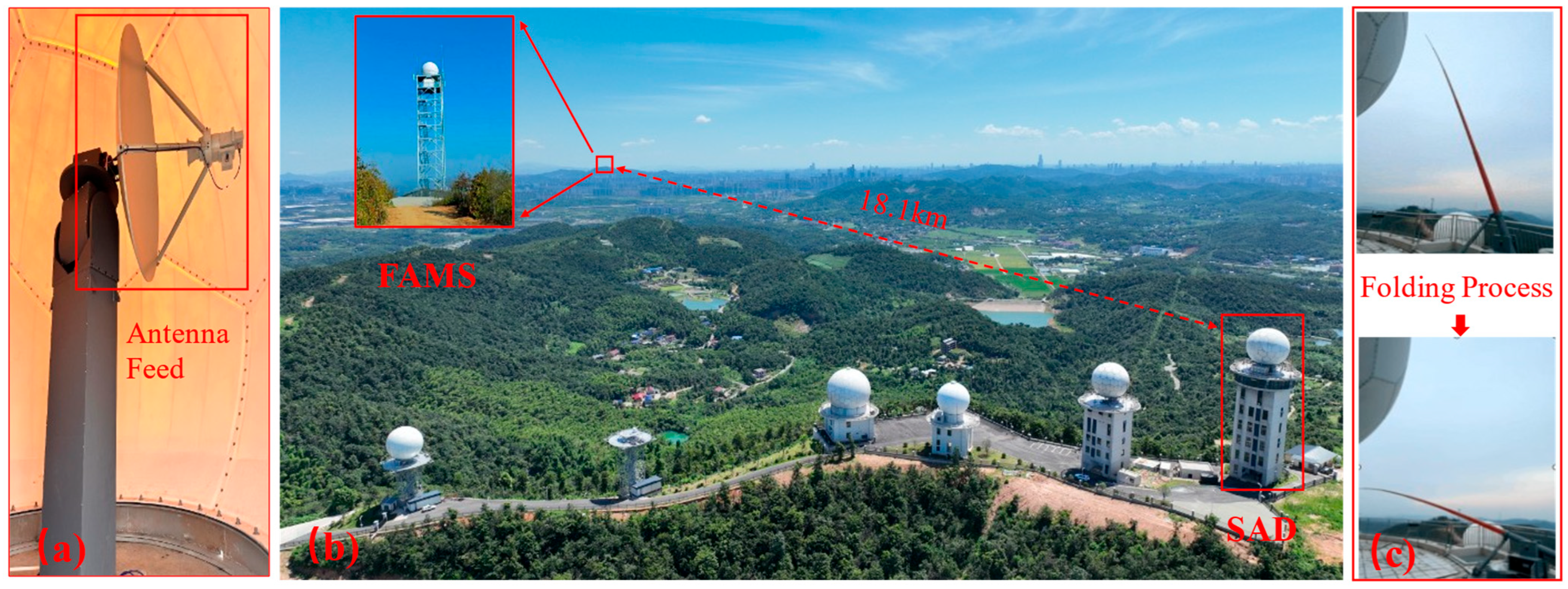
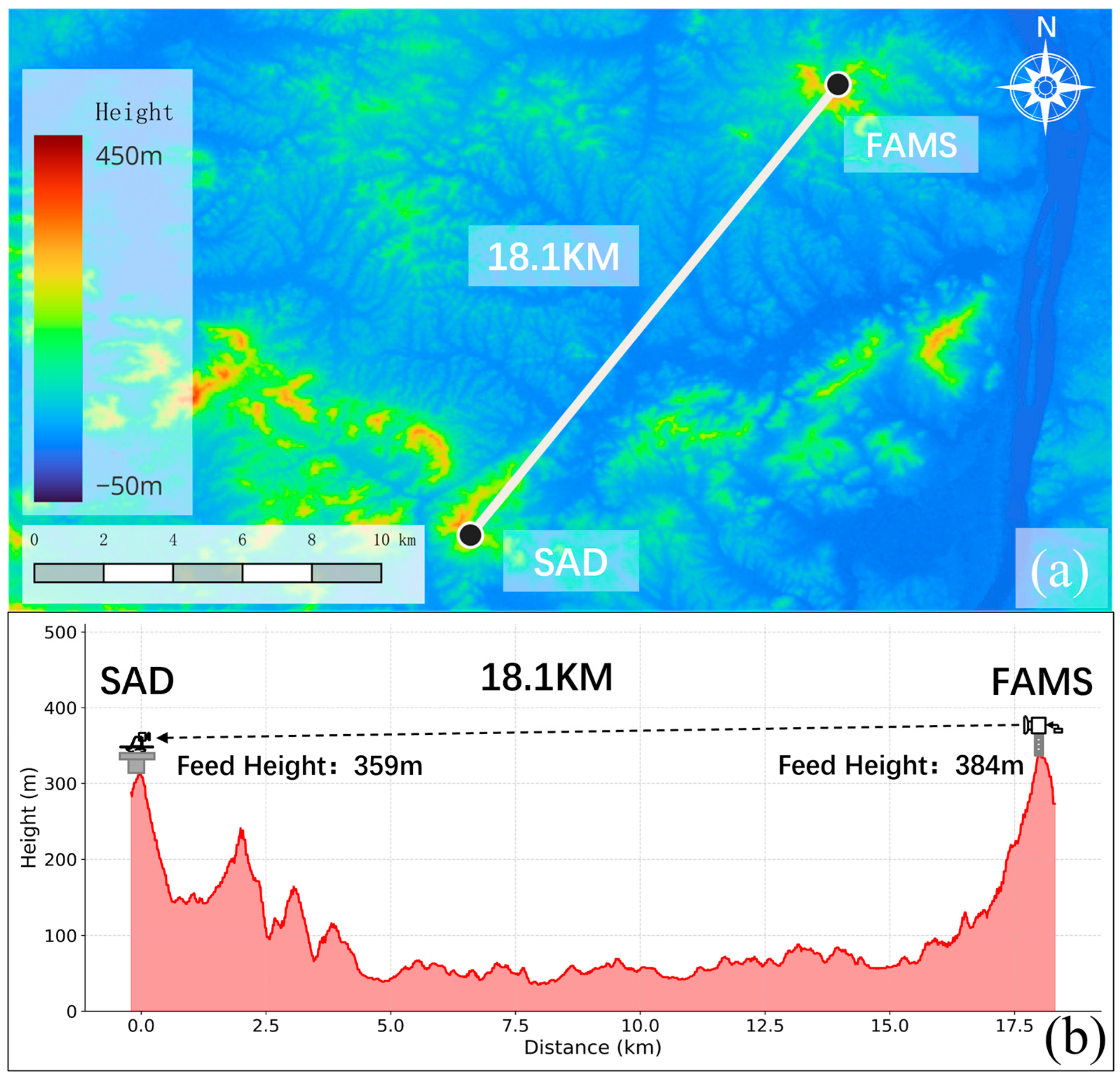
2.1. Instruments and Experimental Setup
2.1.1. SAD Radar
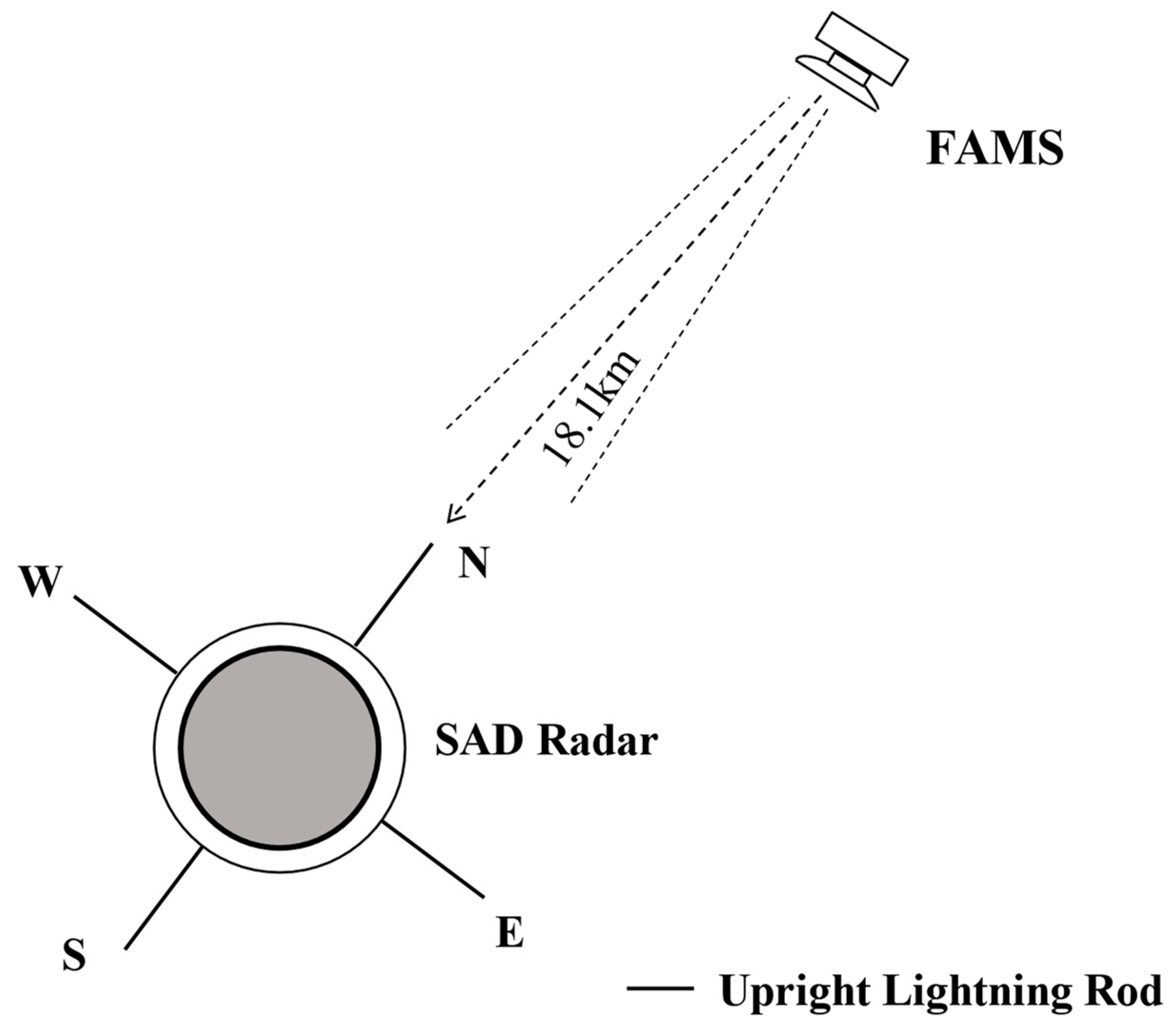
2.1.2. Lightning Rod
2.1.3. FAMS
2.2. Data Processing and Analysis
2.2.1. Power Normalization
2.2.2. Main-Beam Interpolation and HPBW Calculation
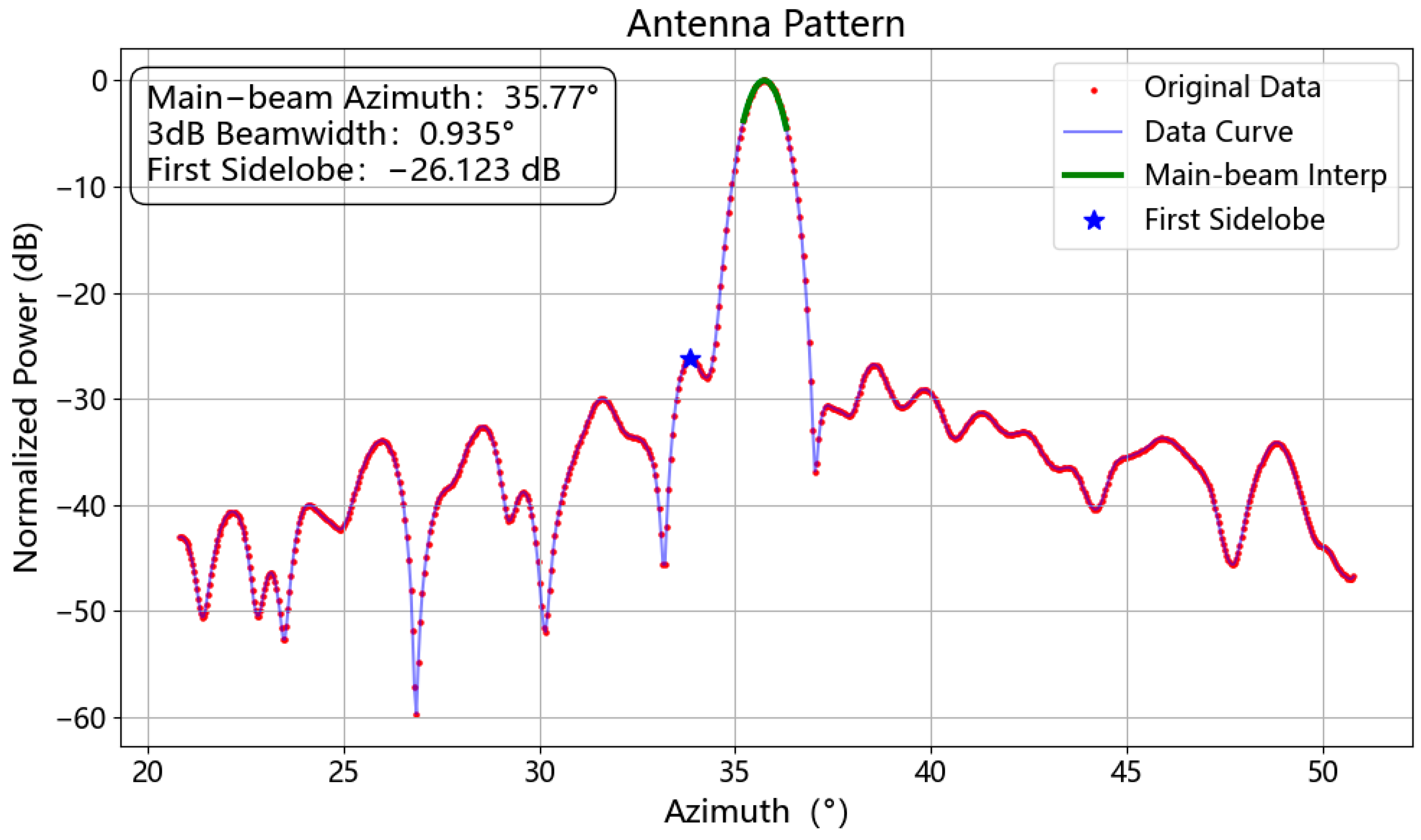
2.2.3. First Sidelobe Detection and Statistical Analysis
| Algorithm 1. Extraction procedure for antenna pattern parameters |
| Input: IQ data , azimuth sequence Output: , HPBW, first sidelobe level 1. Power Calculation and Normalization For each azimuth : Compute mean power Convert to dB: Normalize: 2. Main-Beam Interpolation Apply linear interpolation to obtain Determine 3. HPBW Calculation Compute dB Find and HPBW = 4. First Sidelobe Detection Define Identify local maxima within to form |
3. Results
3.1. Antenna Radiation Pattern Differences Between Upright and Folded Lightning-Rod States
3.2. Impact of Lightning Rod Elevation Angle on the Antenna Radiation Pattern
3.3. Impact of Lightning Rods at Different Azimuth Configurations on the Antenna Radiation Pattern
3.4. Analysis of Lightning Rod Effects on Dual-Polarization Parameters
4. Discussion
5. Conclusions
Author Contributions
Funding
Data Availability Statement
Acknowledgments
Conflicts of Interest
References
- Sokol, Z.; Szturc, J.; Orellana-Alvear, J.; Popová, J.; Jurczyk, A.; Célleri, R. The Role of Weather Radar in Rainfall Estimation and Its Application in Meteorological and Hydrological Modelling—A Review. Remote Sens. 2021, 13, 351. [Google Scholar] [CrossRef]
- Xu, L.; Lu, W.; Yu, H.; Yao, F.; Sun, X.; Fu, K. SFTformer: A Spatial-Frequency-Temporal Correlation-Decoupling Transformer for Radar Echo Extrapolation. IEEE Trans. Geosci. Remote Sens. 2024, 62, 4102415. [Google Scholar] [CrossRef]
- Zhang, H.; Zheng, J.; Liu, C. Deep Learning-Based Automatic Identification of Gust Fronts from Weather Radar Data. J. Meteorol. Res. 2024, 38, 1021–1031. [Google Scholar] [CrossRef]
- Gorgucci, E.; Bechini, R.; Baldini, L.; Cremonini, R.; Chandrasekar, V. The Influence of Antenna Radome on Weather Radar Calibration and Its Real-Time Assessment. J. Atmos. Ocean. Technol. 2013, 30, 676–689. [Google Scholar] [CrossRef]
- Zhang, G.; Mahale, V.N.; Putnam, B.J.; Qi, Y.; Cao, Q.; Byrd, A.D.; Bukovcic, P.; Zrnic, D.S.; Gao, J.; Xue, M.; et al. Current Status and Future Challenges of Weather Radar Polarimetry: Bridging the Gap between Radar Meteorology/Hydrology/Engineering and Numerical Weather Prediction. Adv. Atmos. Sci. 2019, 36, 571–588. [Google Scholar] [CrossRef]
- Hanft, W.; Zhang, J.; Simpson, M. Dual-Pol VPR Corrections for Improved Operational Radar QPE in MRMS. J. Hydrometeorol. 2023, 24, 353–371. [Google Scholar] [CrossRef]
- Zhao, H.; Liu, Y. Experimental Application of a Thinning Scheme for the Assimilation of Surface Observation Data in GRAPES-3DVAR. J. Trop. Meteorol. 2018, 24, 334–345. [Google Scholar] [CrossRef]
- Hald, C.; Schaper, M.; Böhm, A.; Frech, M.; Petersen, J.; Lange, B.; Rohrdantz, B. Evaluation of the Effects of Different Lightning Protection Rods on the Data Quality of C-Band Weather Radars. Atmos. Meas. Tech. 2024, 17, 4695–4707. [Google Scholar] [CrossRef]
- Wang, H.; Yu, H.; Wen, H.; Shu, Z. The Impact of Lightning Rods on the Differential Reflectivity of X-Band Radar. Atmosphere 2025, 16, 204. [Google Scholar] [CrossRef]
- Wang, C.; Wu, C.; Liu, L. Data Quality Analysis and Control Method of X-Band Dual Polarization Radar. Plateau Meteorol. 2019, 38, 636–649. [Google Scholar] [CrossRef]
- Gao, Y.; Zeng, Q.; Liu, Y.; Zhang, F.; Wang, H.; Ren, Z. WTC-MobResNet: A Deep Learning Approach for Detecting Wind Turbine Clutter in Weather Radar Data. Remote Sens. 2025, 17, 2763. [Google Scholar] [CrossRef]
- Tan, S.; Chen, H. A Conditional Generative Adversarial Network for Weather Radar Beam Blockage Correction. IEEE Trans. Geosci. Remote Sens. 2023, 61, 4103014. [Google Scholar] [CrossRef]
- Ye, F.; Wang, X.; Li, L.; Chen, Y.; Lei, Y.; Yu, H.; Yin, J.; Shi, L.; Yang, Q.; Huang, Z. Weather Radar Calibration Method Based on UAV-Suspended Metal Sphere. Sensors 2024, 24, 4611. [Google Scholar] [CrossRef]
- Wang, X.; Shao, N.; Cao, J.; Ma, J.; Liu, J.; Yang, T.; Ye, F.; Sun, H. ARC-Based Absolute Calibration Method for Weather Radar Reflectivity. IEEE Trans. Geosci. Remote Sens. 2025, 63, 5107611. [Google Scholar] [CrossRef]
- Wang, X.; Lei, Y.; Fu, Y.; Ye, F.; Wu, B.; Leng, L.; Zhu, C.; Hu, H. Analysis of Consistency and Bias Traceability in Ground-Based Weather Radar Reflectivity Using FY-3G Precipitation Measurement Radar. IEEE Trans. Geosci. Remote Sens. 2025, 63, 5103013. [Google Scholar] [CrossRef]
- Loulli, E.; Michaelides, S.; Bühl, J.; Loukas, A.; Hadjimitsis, D. Calibration of Two X-Band Ground Radars Against GPM DPR Ku-Band. Remote Sens. 2025, 17, 1712. [Google Scholar] [CrossRef]
- Thompson, R.; Kendo, T.; Wells, B. Huffman Radar Site: Far-Field Calibration and Testing Range. In Proceedings of the 2022 Antenna Measurement Techniques Association Symposium (AMTA), Denver, CO, USA, 9–14 October 2022. [Google Scholar] [CrossRef]
- Liu, S.; Zhong, Y. Several Calibration Methods for the Planar Phased Array Radar. In Proceedings of the 2024 9th International Conference on Electronic Technology and Information Science (ICETIS), Hangzhou, China, 17–19 May 2024. [Google Scholar] [CrossRef]
- Patel, B.V.; Colak, E.; Vyas, A. Processing of Weather Radar Raw IQ-Data towards the Identification and Correction of Wind Turbine Interference-Project RIWER: Removing the Influence of Wind Park Echoes in Weather Radar Measurements. Adv. Radio Sci. 2023, 20, 67–76. [Google Scholar] [CrossRef]
- Virtanen, P.; Gommers, R.; Oliphant, T.E.; Haberland, M.; Reddy, T.; Cournapeau, D.; Burovski, E.; Peterson, P.; Weckesser, W.; Bright, J.; et al. SciPy 1.0: Fundamental Algorithms for Scientific Computing in Python. Nat. Methods 2020, 17, 261–272. [Google Scholar] [CrossRef] [PubMed]
- Notaros, B. Meteorological Electromagnetics: Optical and Radar Measurements, Modeling, and Characterization of Snowflakes and Snow. IEEE Antennas Propag. Mag. 2021, 63, 14–27. [Google Scholar] [CrossRef]
- Jones, K.F. Freezing Fraction in Freezing Rain. Weather Forecast. 2022, 37, 163–178. [Google Scholar] [CrossRef]
- Kumjian, M.R.; Prat, O.P.; Reimel, K.J.; van Lier-Walqui, M.; Morrison, H.C. Dual-Polarization Radar Fingerprints of Precipitation Physics: A Review. Remote Sens. 2022, 14, 3706. [Google Scholar] [CrossRef]






| Parameter | Value |
|---|---|
| Antenna diameter (m) | 8.5 |
| Operating frequency (GHz) | 2.845 |
| Detection range (km) | 460 |
| Resolution (m) | 62.5/150/250 |
| Peak power (kW) | ≥650 |
| Pulse width (µs) | 0.42/0.83/1.57/4.70 |
| PRF (Hz) | 300–1300 |
| Beamwidth (°) | 0.91° (H)/0.86° (V) |
| Antenna gain (dB) | 45.23 dB (H)/45.29 dB (V) |
| Segment Length (m) | Segment Diameter (mm) | Deployment |
|---|---|---|
| 3 + 3 + 3 + 3.3 + 3.2 | 120 + 100 + 80 + 62 + 44 | North, South |
| 2.6 + 2.6 + 2.6 + 2.6 + 2.5 + 2.4 | 127 + 100 + 85 + 69 + 54 + 41 | East, West |
| Parameter | Accuracy |
|---|---|
| Antenna gain | ±0.5 dB (wind speed < 3.3 m/s) |
| Beamwidth | ±0.05° |
| Beam pointing | 0.05° RMS |
| Sidelobe level | ±2.0 dB (within ±2°) |
| Cross-polar isolation | ±3 dB (for isolation ≥ 35 dB) |
| Dual-polarization orthogonality | ±0.1° (tower-top swing < 0.02°) |
| States | Main-Beam Azimuth (°) | HPBW (°) | First Sidelobe Level (dB) |
|---|---|---|---|
| Upright | 35.763 ± 0.006 | 0.932 ± 0.005 | −26.139 ± 0.031 |
| Folded | 35.760 ± 0.010 | 0.932 ± 0.006 | −30.202 ± 0.009 |
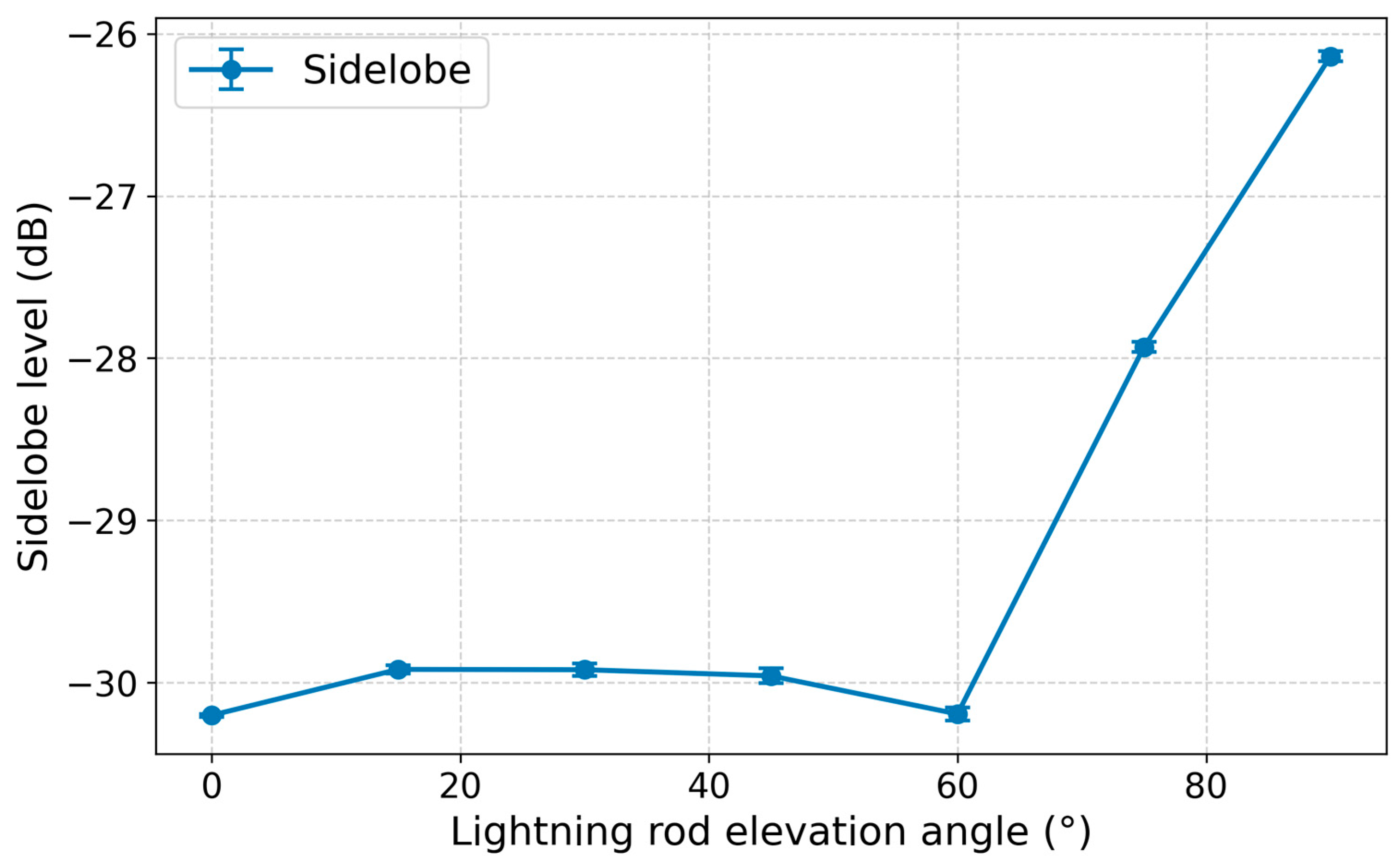
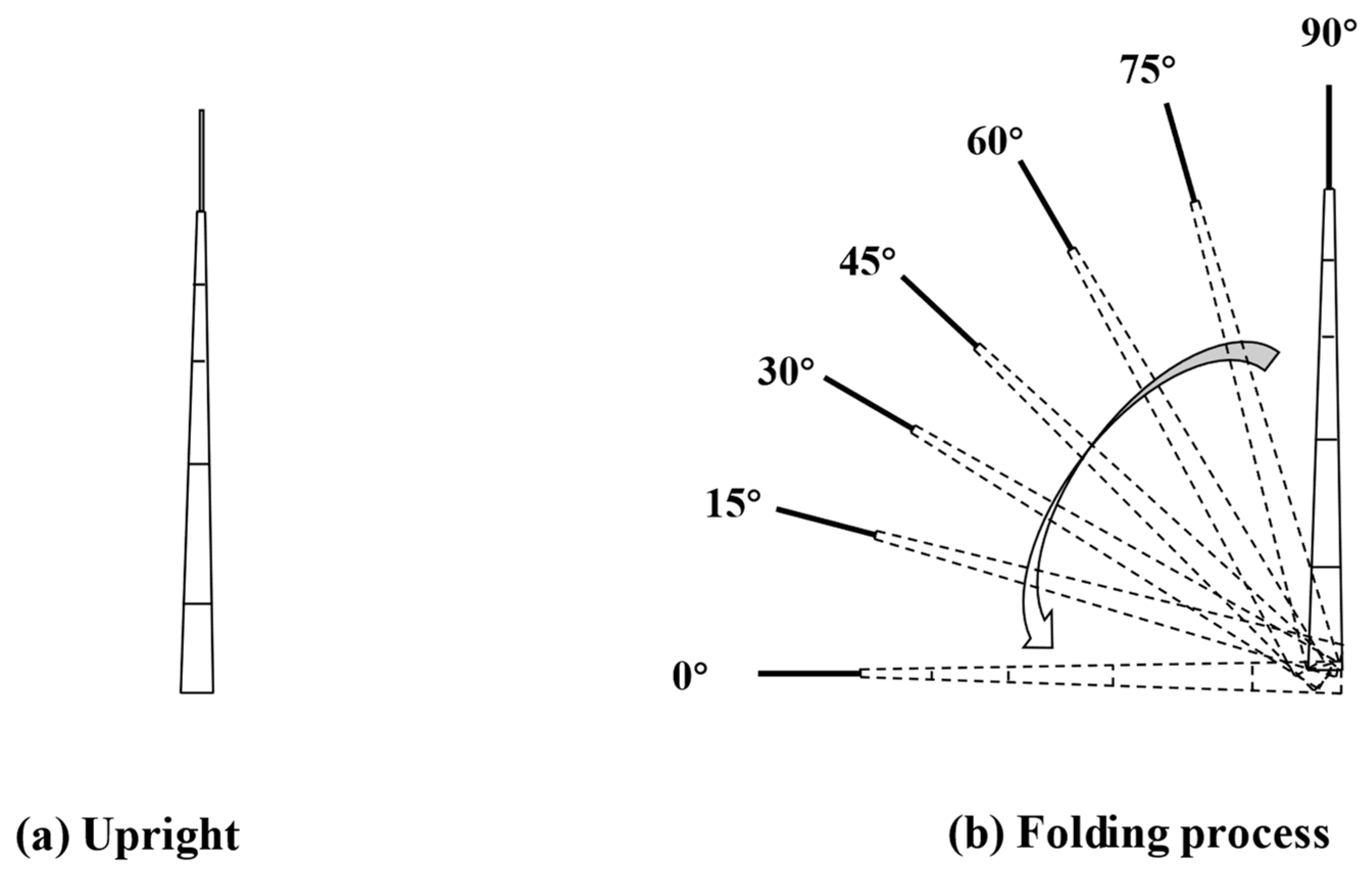
| Rod Elevation Angle (°) | Main-Beam Azimuth (°) | HPBW (°) | First Sidelobe Level (dB) |
|---|---|---|---|
| 90° | 35.763 ± 0.006 | 0.932 ± 0.005 | −26.139 ± 0.031 |
| 75° | 35.753 ± 0.021 | 0.929 ± 0.004 | −27.932 ± 0.031 |
| 60° | 35.763 ± 0.015 | 0.930 ± 0.002 | −30.194 ± 0.040 |
| 45° | 35.757 ± 0.015 | 0.938 ± 0.004 | −29.959 ± 0.046 |
| 30° | 35.753 ± 0.015 | 0.932 ± 0.006 | −29.921 ± 0.040 |
| 15° | 35.760 ± 0.000 | 0.934 ± 0.005 | −29.919 ± 0.025 |
| 0° | 35.760 ± 0.010 | 0.932 ± 0.006 | −30.202 ± 0.009 |
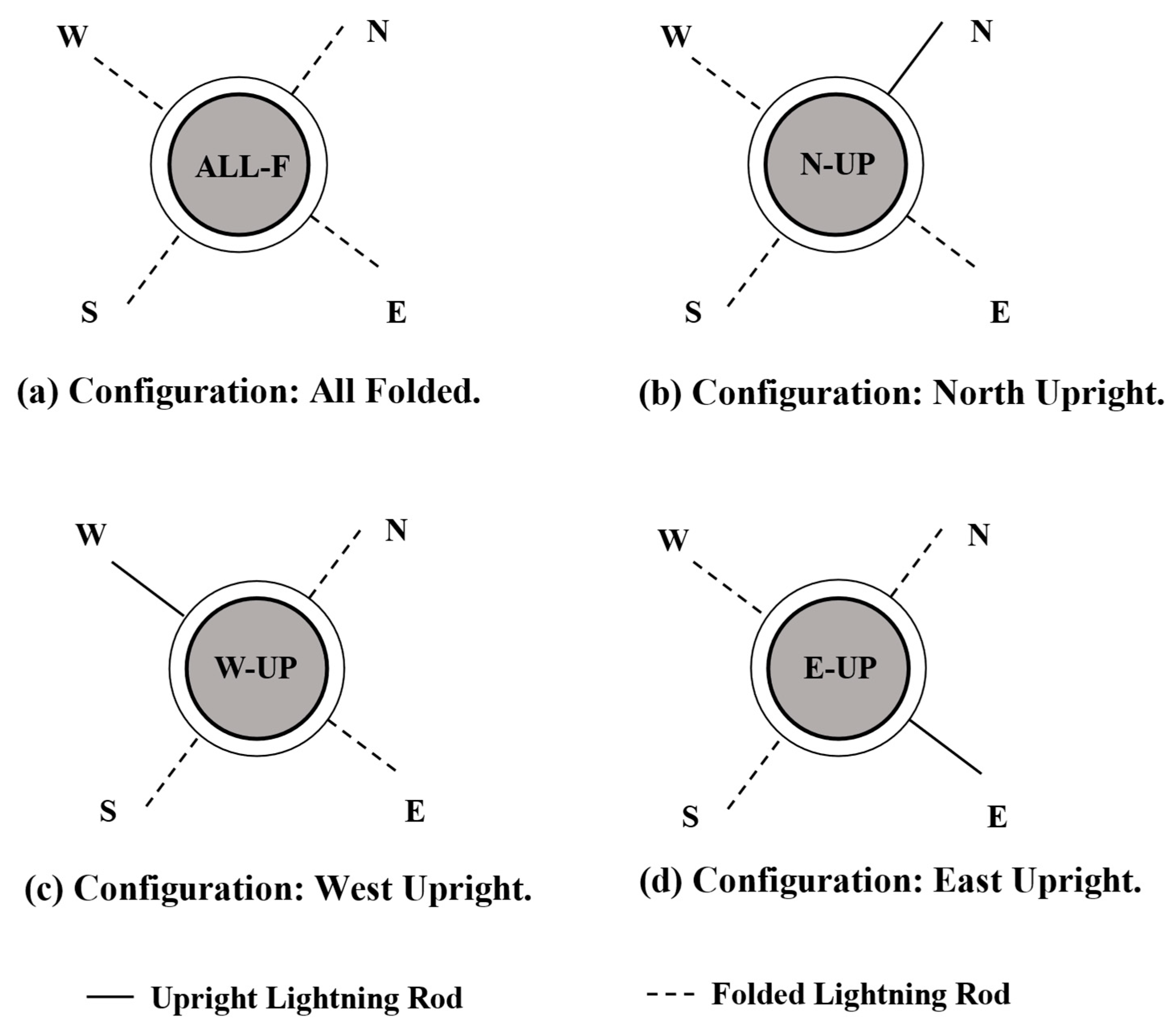
| Configuration | Main-Beam Azimuth (°) | HPBW (°) | First Sidelobe Level (dB) |
|---|---|---|---|
| All folded | 35.760 ± 0.017 | 0.931 ± 0.001 | −30.275 ± 0.039 |
| North upright | 35.763 ± 0.006 | 0.926 ± 0.006 | −25.727 ± 0.014 |
| West upright | 35.750 ± 0.010 | 0.935 ± 0.006 | −30.258 ± 0.032 |
| East upright | 35.750 ± 0.010 | 0.932 ± 0.007 | −30.149 ± 0.046 |
| Precipitation Type | Anomaly Amplitude (dB) | Affected Azimuth Width (°) | Severity |
|---|---|---|---|
| Snowfall | ±0.24 | 40–55 | Moderate |
| Freezing rain | ±0.25 * | N/A | Not significant |
| Mixed precipitation | ±0.25 | 20–40 | Moderate |
Disclaimer/Publisher’s Note: The statements, opinions and data contained in all publications are solely those of the individual author(s) and contributor(s) and not of MDPI and/or the editor(s). MDPI and/or the editor(s) disclaim responsibility for any injury to people or property resulting from any ideas, methods, instructions or products referred to in the content. |
© 2026 by the authors. Licensee MDPI, Basel, Switzerland. This article is an open access article distributed under the terms and conditions of the Creative Commons Attribution (CC BY) license.
Share and Cite
Wang, X.; Yin, J.; Ye, F.; Yang, T.; Xie, Y.; Yu, H.; Hu, D. Quantitative Analysis of Lightning Rod Impacts on the Radiation Pattern and Polarimetric Characteristics of S-Band Weather Radar. Remote Sens. 2026, 18, 392. https://doi.org/10.3390/rs18030392
Wang X, Yin J, Ye F, Yang T, Xie Y, Yu H, Hu D. Quantitative Analysis of Lightning Rod Impacts on the Radiation Pattern and Polarimetric Characteristics of S-Band Weather Radar. Remote Sensing. 2026; 18(3):392. https://doi.org/10.3390/rs18030392
Chicago/Turabian StyleWang, Xiaopeng, Jiazhi Yin, Fei Ye, Ting Yang, Yi Xie, Haifeng Yu, and Dongming Hu. 2026. "Quantitative Analysis of Lightning Rod Impacts on the Radiation Pattern and Polarimetric Characteristics of S-Band Weather Radar" Remote Sensing 18, no. 3: 392. https://doi.org/10.3390/rs18030392
APA StyleWang, X., Yin, J., Ye, F., Yang, T., Xie, Y., Yu, H., & Hu, D. (2026). Quantitative Analysis of Lightning Rod Impacts on the Radiation Pattern and Polarimetric Characteristics of S-Band Weather Radar. Remote Sensing, 18(3), 392. https://doi.org/10.3390/rs18030392