Author Contributions
Conceptualization, B.B., D.F., G.A.D. and A.S.; methodology, B.B., D.F., G.A.D. and A.S.; software, B.B., D.F. and A.S.; validation, B.B. and A.S.; formal analysis, B.B.; investigation, D.F., G.A.D. and A.S.; data curation, B.B., D.F., G.A.D. and A.S.; writing—original draft preparation, B.B., D.F., G.A.D. and A.S.; writing—review and editing, B.B., D.F., G.A.D. and A.S.; visualization, B.B., D.F., G.A.D. and A.S.; supervision, D.F., G.A.D. and A.S.; project administration, D.F., G.A.D. and A.S.; funding acquisition D.F., G.A.D. and A.S. All authors have read and agreed to the published version of the manuscript.
Figure 1.
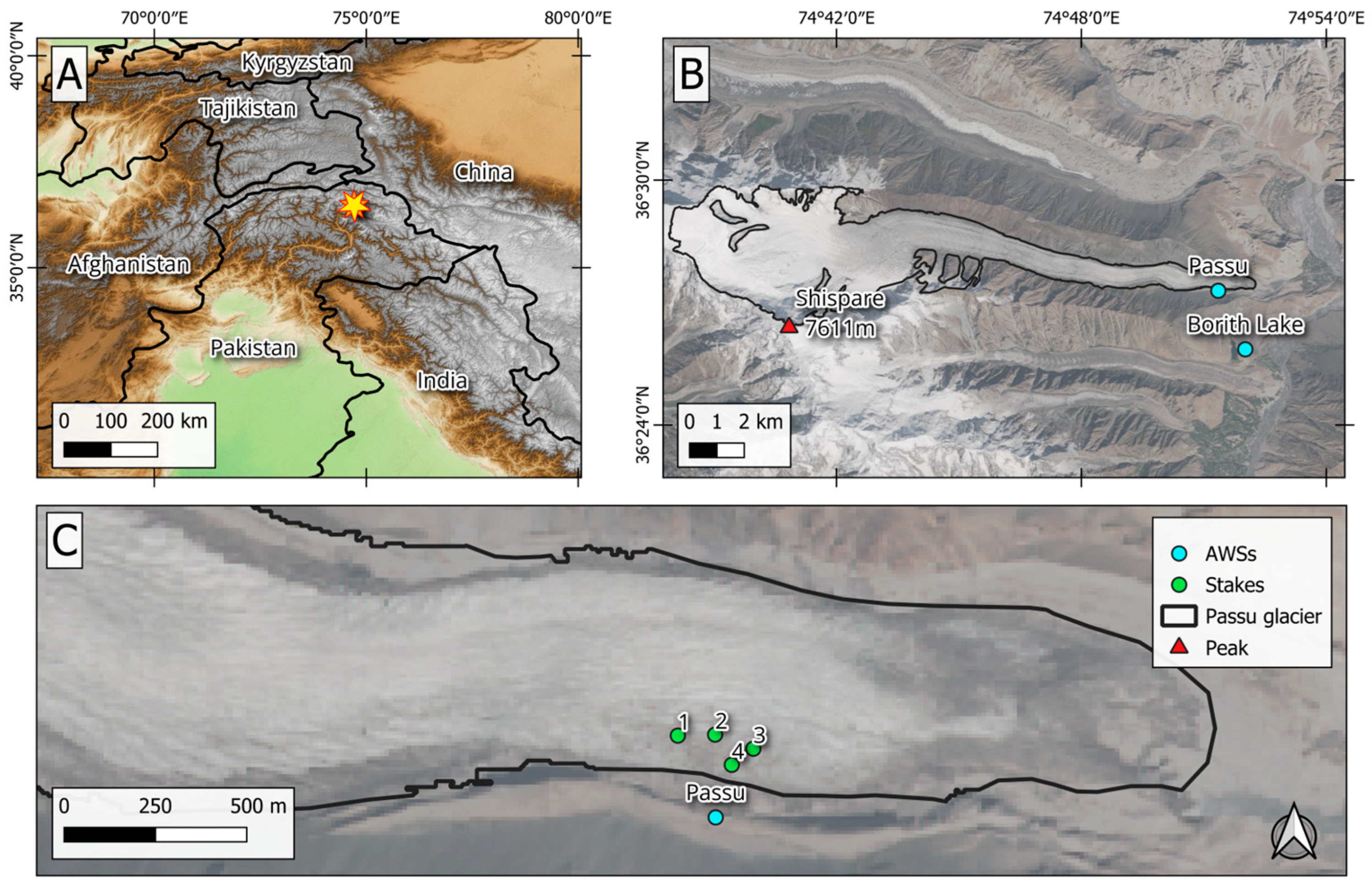
(A) Geographic location of Passu Glacier in the Hunza Valley (Pakistan); (B) Magnified image of Passu Glacier showing the locations of the Passu and Borith Lake AWSs; (C) location of the four ablation stakes installed and monitored during the 2023 field campaign. Backgrounds: (A) SRTM30 Colored Hillshade (OpenStreetMaps—terrestris); (B,C) Highlight Optimized Natural Color product of Sentinel-2 scene (12 September 2023).
Figure 1.
(A) Geographic location of Passu Glacier in the Hunza Valley (Pakistan); (B) Magnified image of Passu Glacier showing the locations of the Passu and Borith Lake AWSs; (C) location of the four ablation stakes installed and monitored during the 2023 field campaign. Backgrounds: (A) SRTM30 Colored Hillshade (OpenStreetMaps—terrestris); (B,C) Highlight Optimized Natural Color product of Sentinel-2 scene (12 September 2023).
Figure 2.
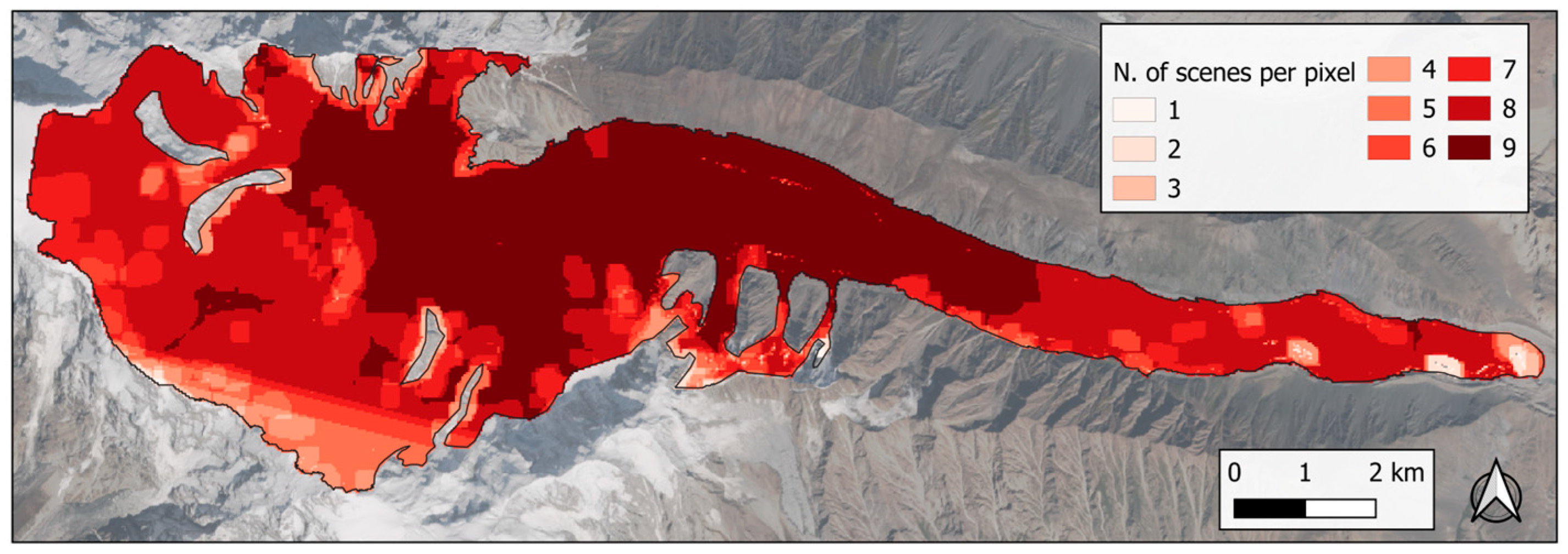
Density map of the number of valid Landsat 8 scenes available per pixel. Background: Highlight Optimized Natural Color product from Sentinel-2 (12 September 2023).
Figure 2.
Density map of the number of valid Landsat 8 scenes available per pixel. Background: Highlight Optimized Natural Color product from Sentinel-2 (12 September 2023).
Figure 3.
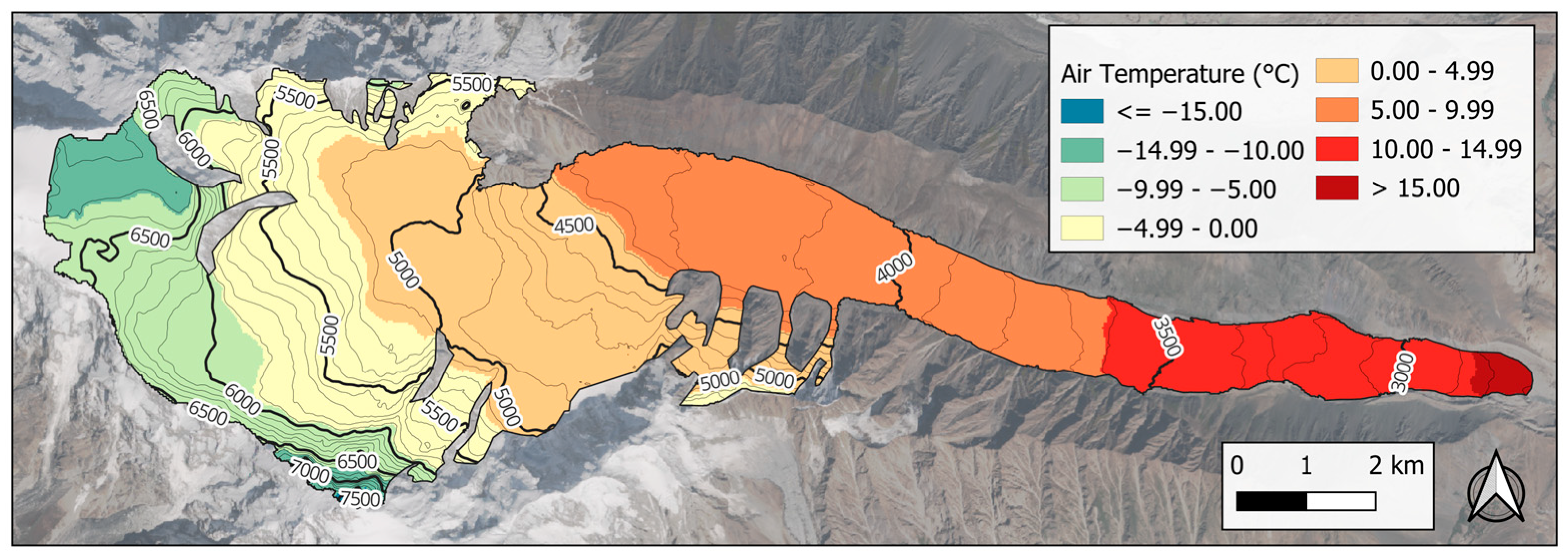
Spatial distribution of mean daily air temperature over the Passu Glacier, modeled from Passu AWS data during the period 5 August–13 October 2023. Background: Sentinel-2 Highlight Optimized Natural Color image acquired on 12 September 2023.
Figure 3.
Spatial distribution of mean daily air temperature over the Passu Glacier, modeled from Passu AWS data during the period 5 August–13 October 2023. Background: Sentinel-2 Highlight Optimized Natural Color image acquired on 12 September 2023.
Figure 4.
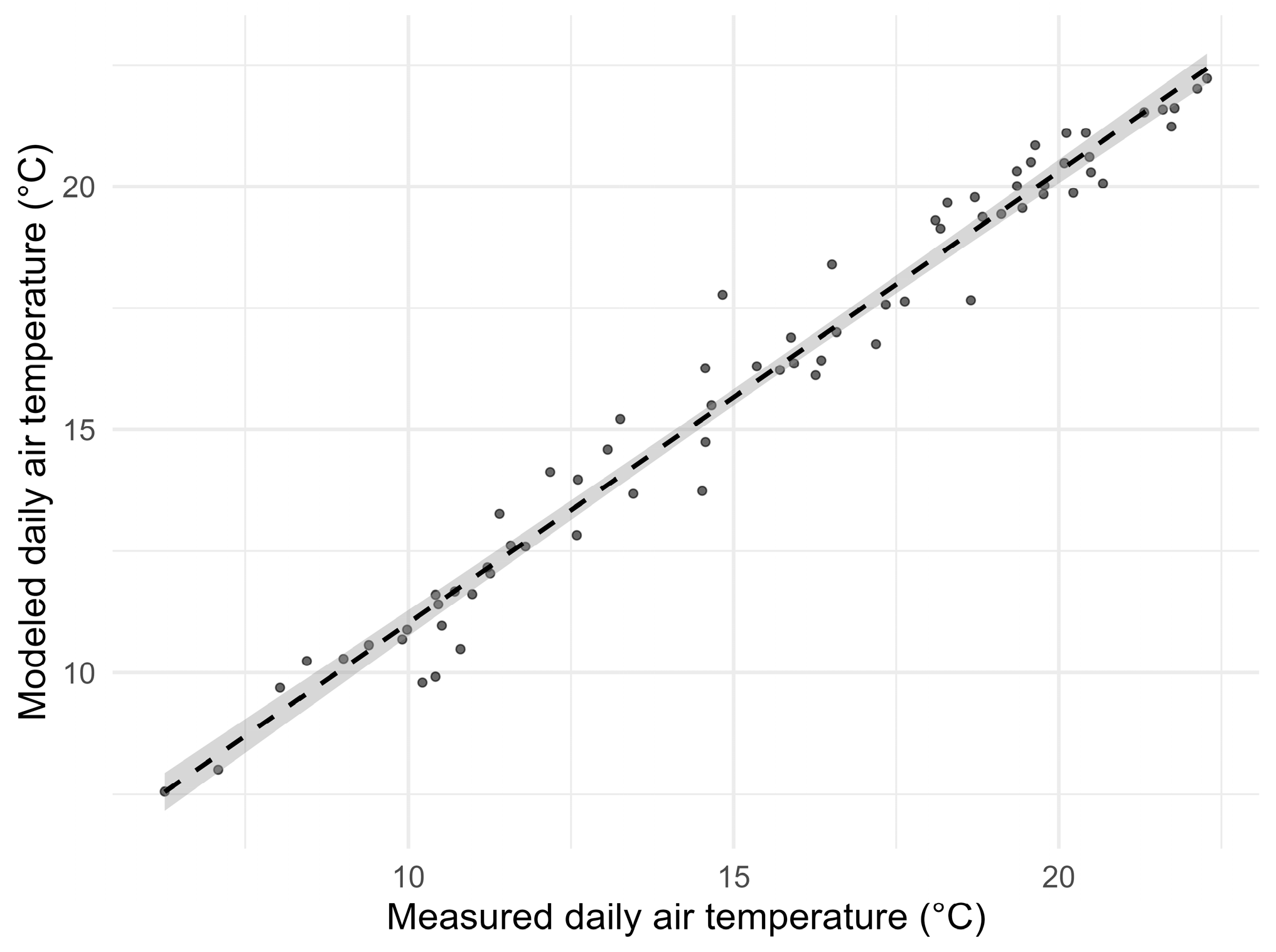
Daily mean air temperatures from 5 August to 13 October 2023 recorded by Borith Lake AWS (x-axis) versus modeled daily mean air temperatures (y-axis) at Borith Lake using Passu AWS air temperature and the atmospheric lapse rate. The plot includes the linear regression line (dashed black) and the 95% confidence interval (shaded gray area).
Figure 4.
Daily mean air temperatures from 5 August to 13 October 2023 recorded by Borith Lake AWS (x-axis) versus modeled daily mean air temperatures (y-axis) at Borith Lake using Passu AWS air temperature and the atmospheric lapse rate. The plot includes the linear regression line (dashed black) and the 95% confidence interval (shaded gray area).
Figure 5.
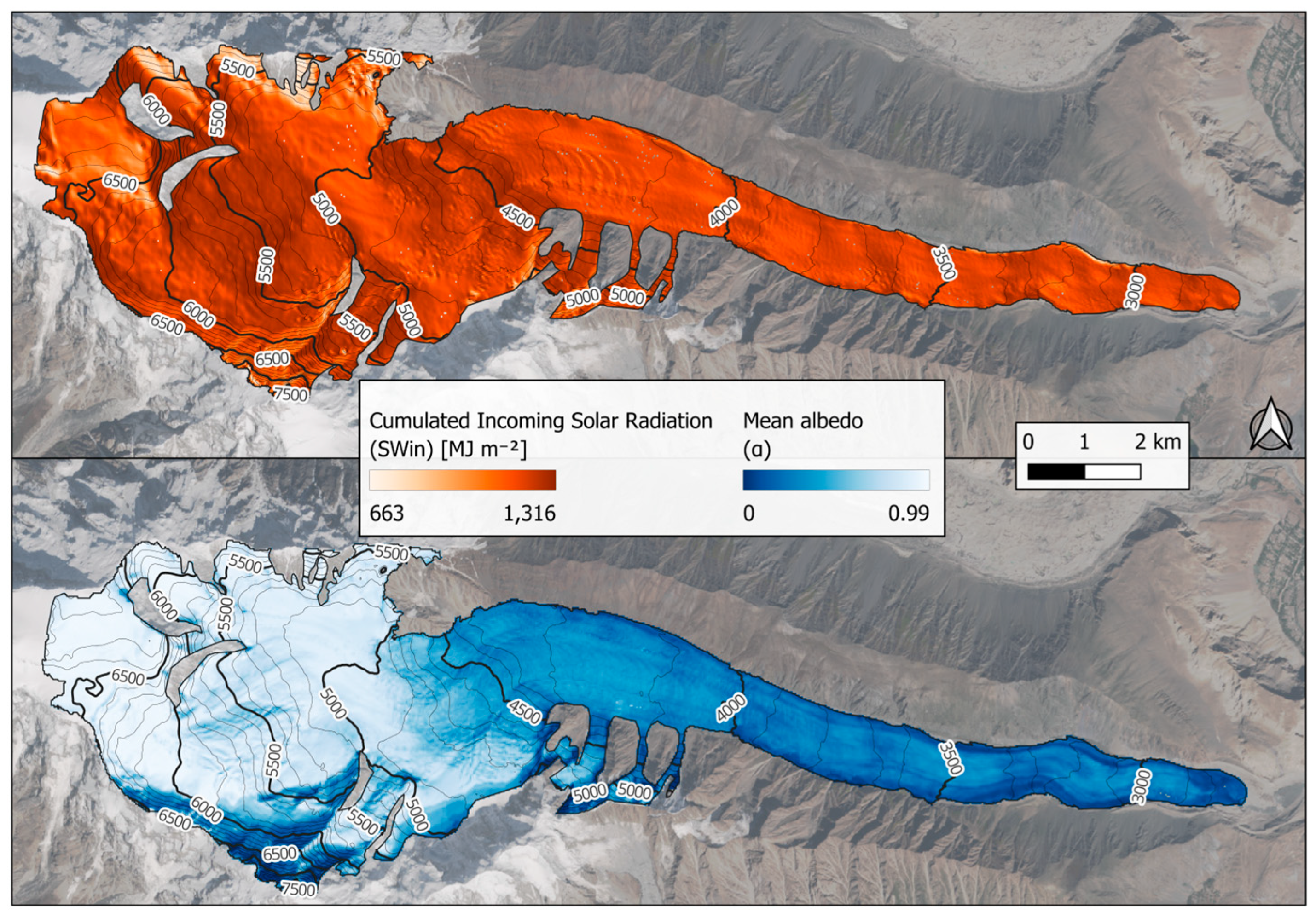
Cumulative modeled incoming shortwave radiation (SWin) and mean albedo over the Passu Glacier for the period 5 August–13 October 2023. Background: Sentinel-2 Highlight Optimized Natural Color image acquired on 12 September 2023.
Figure 5.
Cumulative modeled incoming shortwave radiation (SWin) and mean albedo over the Passu Glacier for the period 5 August–13 October 2023. Background: Sentinel-2 Highlight Optimized Natural Color image acquired on 12 September 2023.
Figure 6.
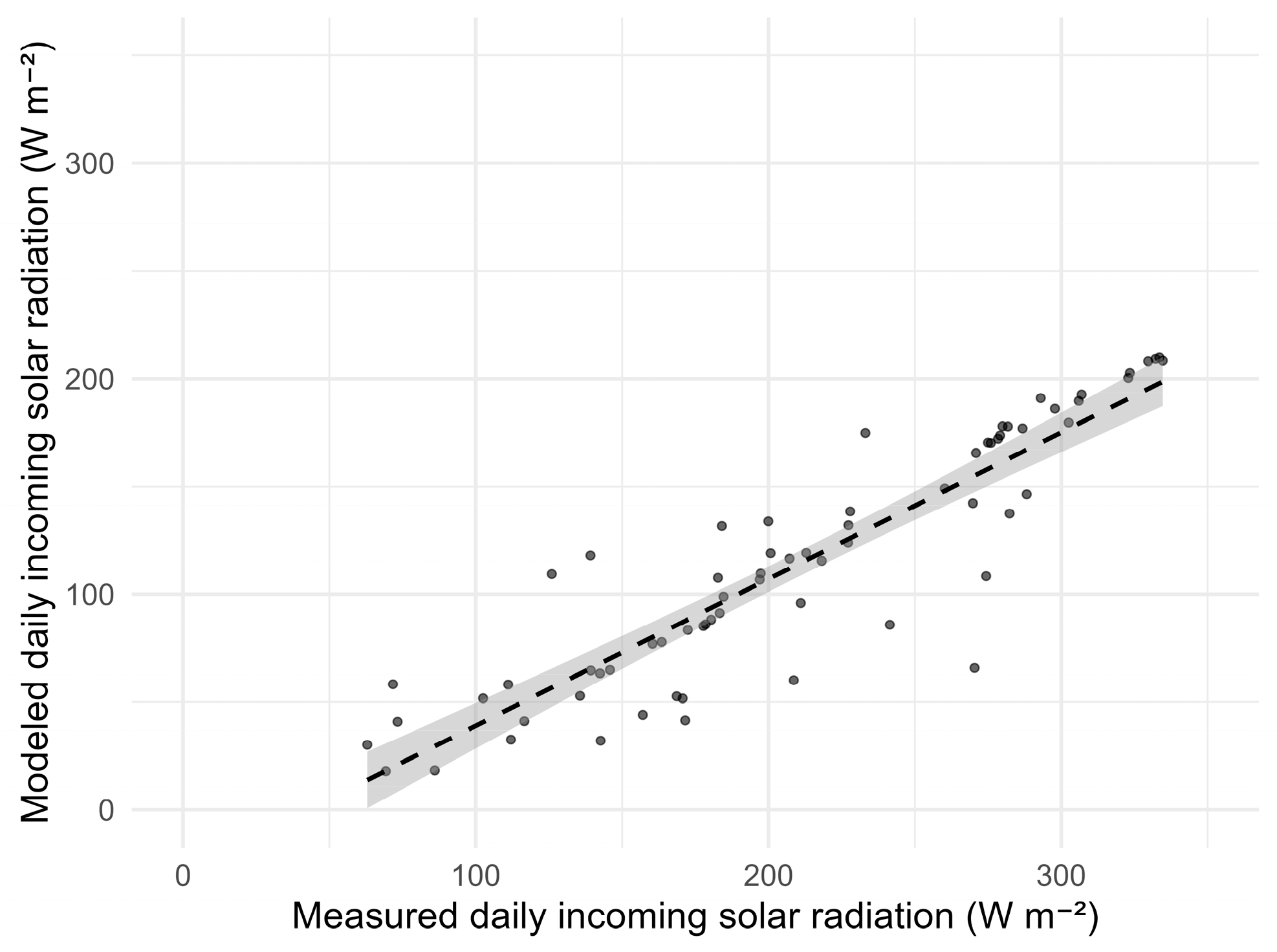
Comparison between modeled and measured daily mean incoming shortwave radiation (SWin) at Borith Lake AWS from 5 August to 13 October 2023. The plot includes the linear regression line (dashed black) and the 95% confidence interval (shaded gray area).
Figure 6.
Comparison between modeled and measured daily mean incoming shortwave radiation (SWin) at Borith Lake AWS from 5 August to 13 October 2023. The plot includes the linear regression line (dashed black) and the 95% confidence interval (shaded gray area).
Figure 7.
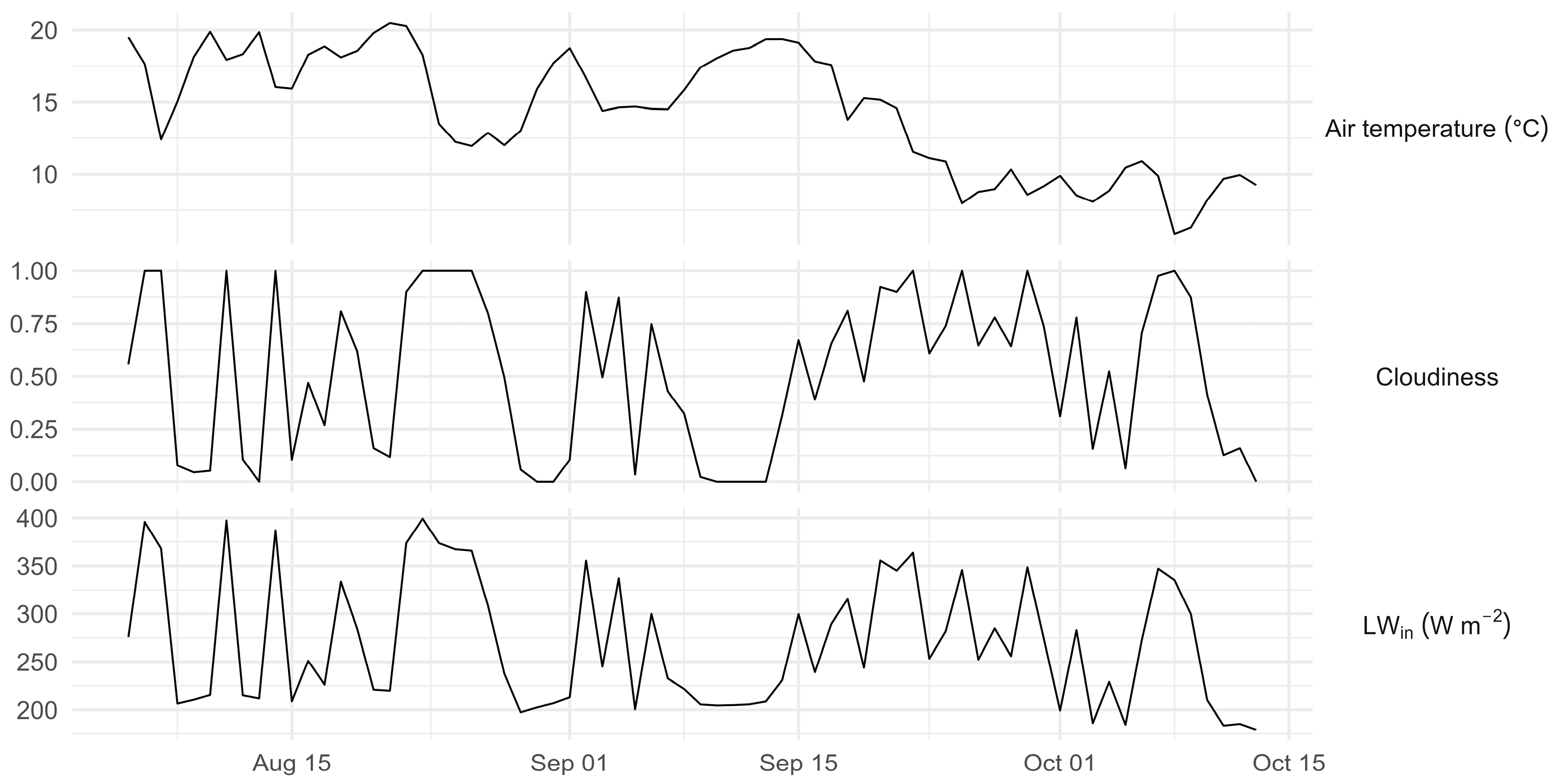
Temporal distribution of air temperature (°C), cloudiness, and incoming longwave radiation (W m−2) recorded at Passu AWS from 5 August to 13 October 2023 (daily values).
Figure 7.
Temporal distribution of air temperature (°C), cloudiness, and incoming longwave radiation (W m−2) recorded at Passu AWS from 5 August to 13 October 2023 (daily values).
Figure 8.
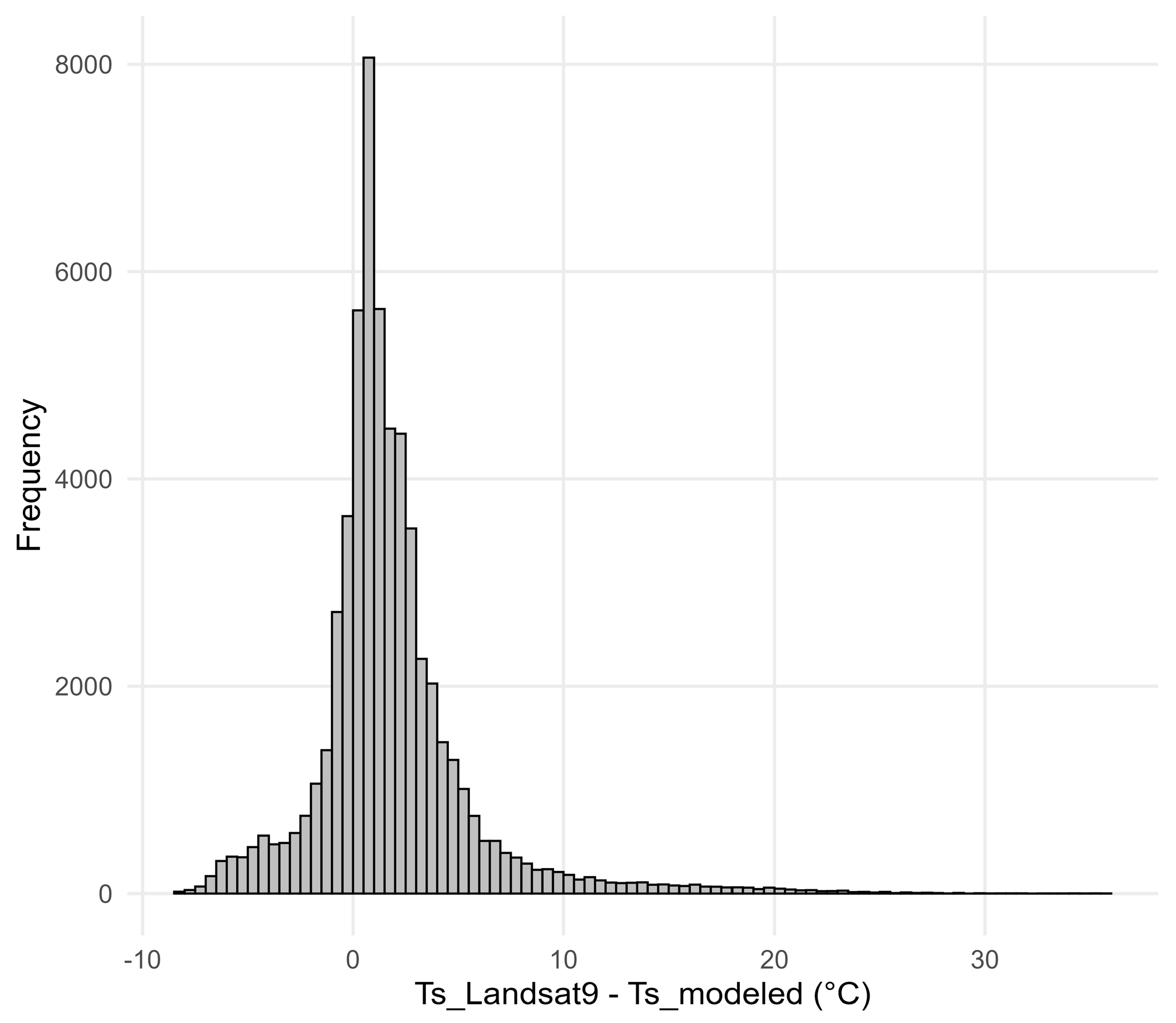
Histogram showing the difference between surface temperatures retrieved from the Landsat 9 scene (Ts_Landsat9) and those modeled using the empirical relationship based on air temperature (Ts_modeled). Each bin has a width of 0.5 °C.
Figure 8.
Histogram showing the difference between surface temperatures retrieved from the Landsat 9 scene (Ts_Landsat9) and those modeled using the empirical relationship based on air temperature (Ts_modeled). Each bin has a width of 0.5 °C.
Figure 9.
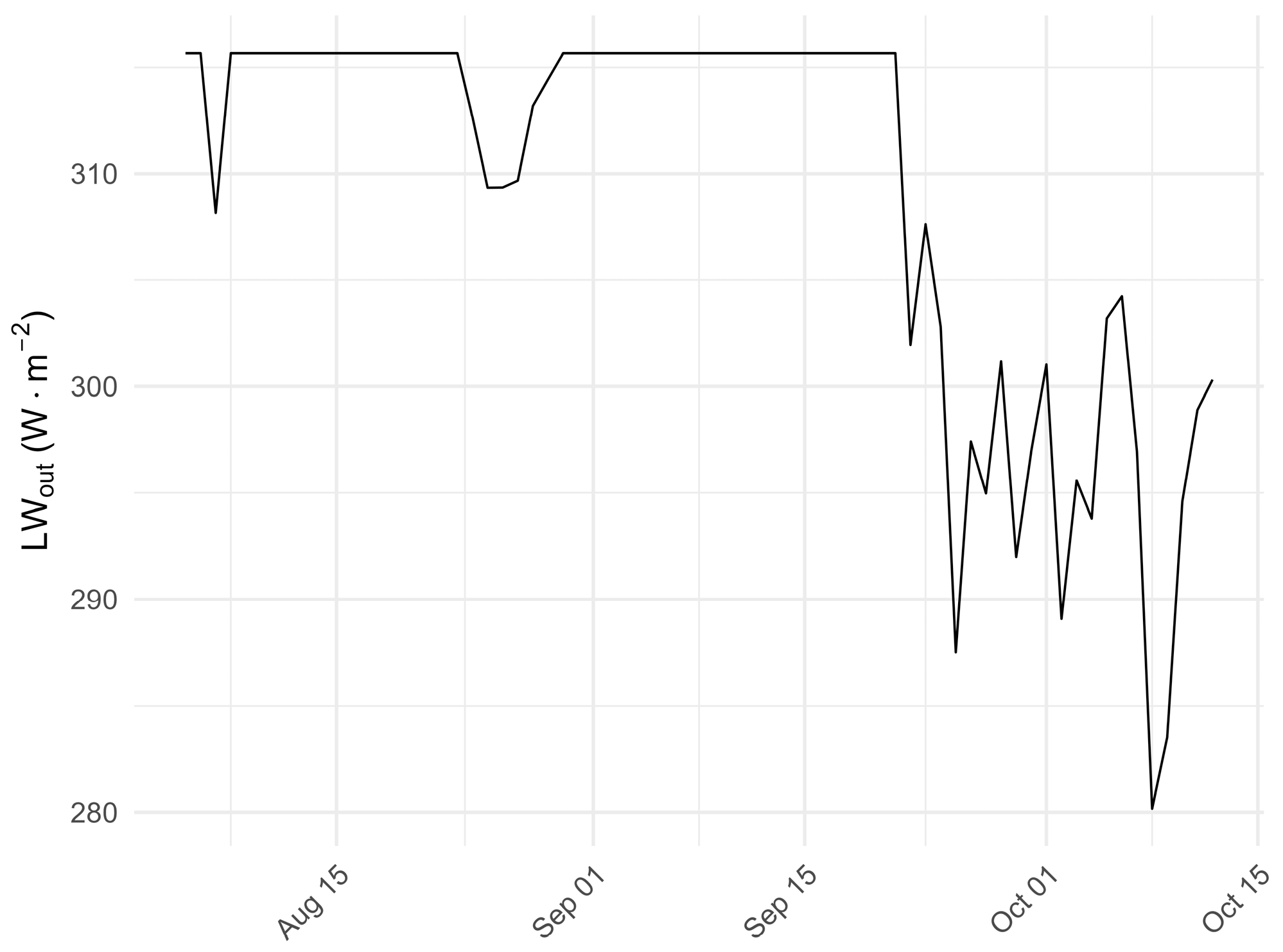
Temporal distribution of outgoing longwave radiation (W m−2) over the Passu Glacier from 5 August to 13 October 2023 (daily values).
Figure 9.
Temporal distribution of outgoing longwave radiation (W m−2) over the Passu Glacier from 5 August to 13 October 2023 (daily values).
Figure 10.
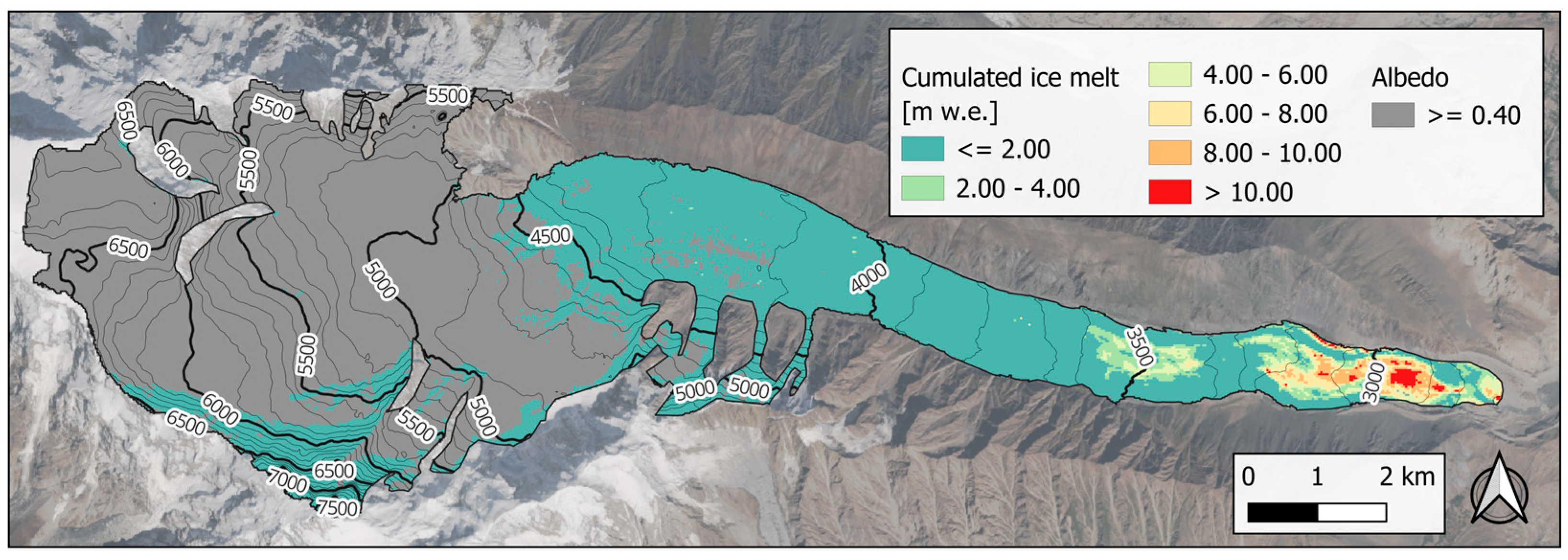
Cumulative ice melt (m w.e.) distributed over the Passu Glacier from 5 August to 13 October 2023 and area with albedo ≥ 0.40. Background: Sentinel-2 Highlight Optimized Natural Color image acquired on 12 September 2023.
Figure 10.
Cumulative ice melt (m w.e.) distributed over the Passu Glacier from 5 August to 13 October 2023 and area with albedo ≥ 0.40. Background: Sentinel-2 Highlight Optimized Natural Color image acquired on 12 September 2023.
Figure 11.
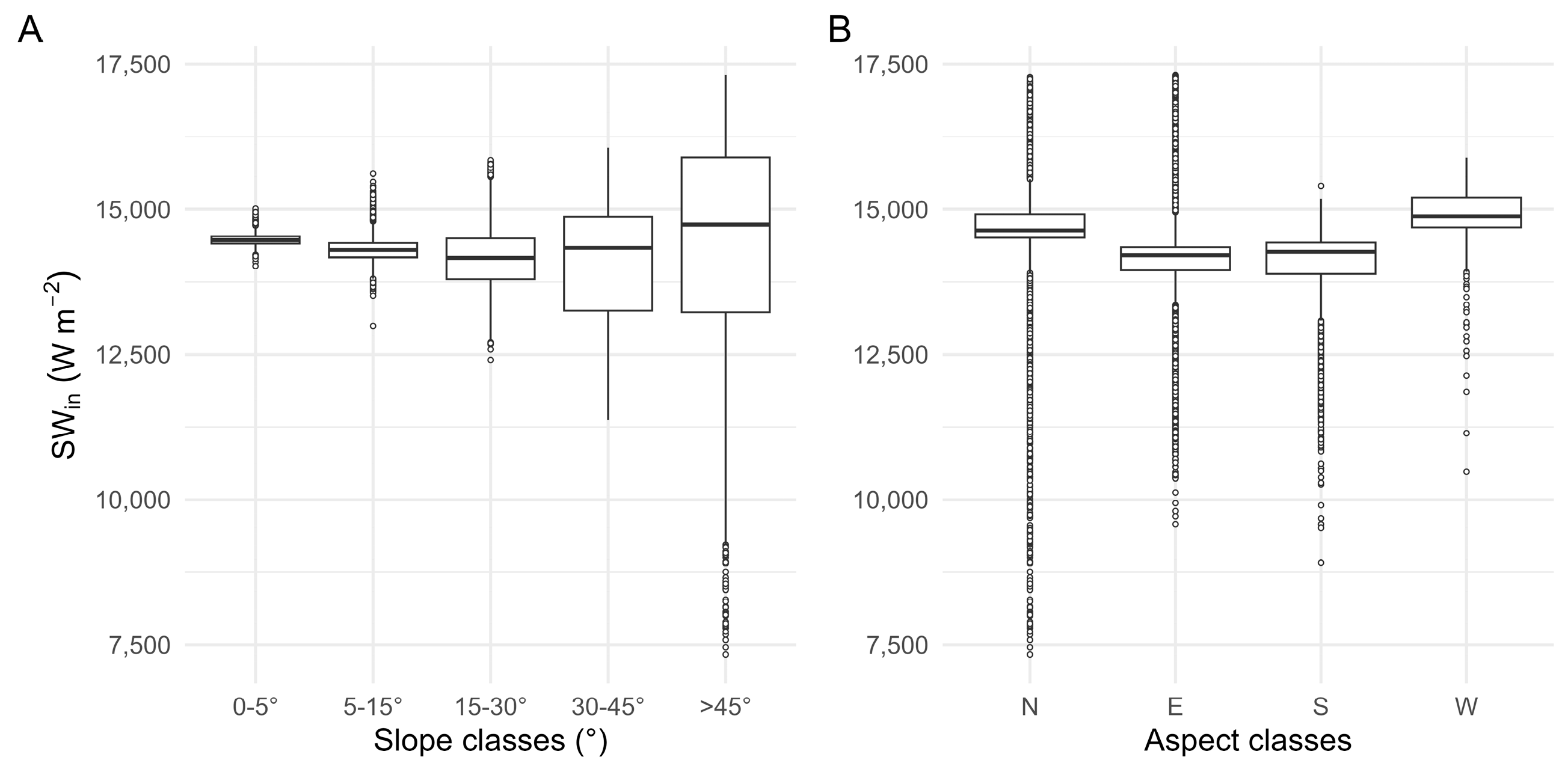
Boxplot of cumulative modeled SWin (from 5 august to 13 October 2023) over (A) slope classes; (B) aspect classes.
Figure 11.
Boxplot of cumulative modeled SWin (from 5 august to 13 October 2023) over (A) slope classes; (B) aspect classes.
Figure 12.
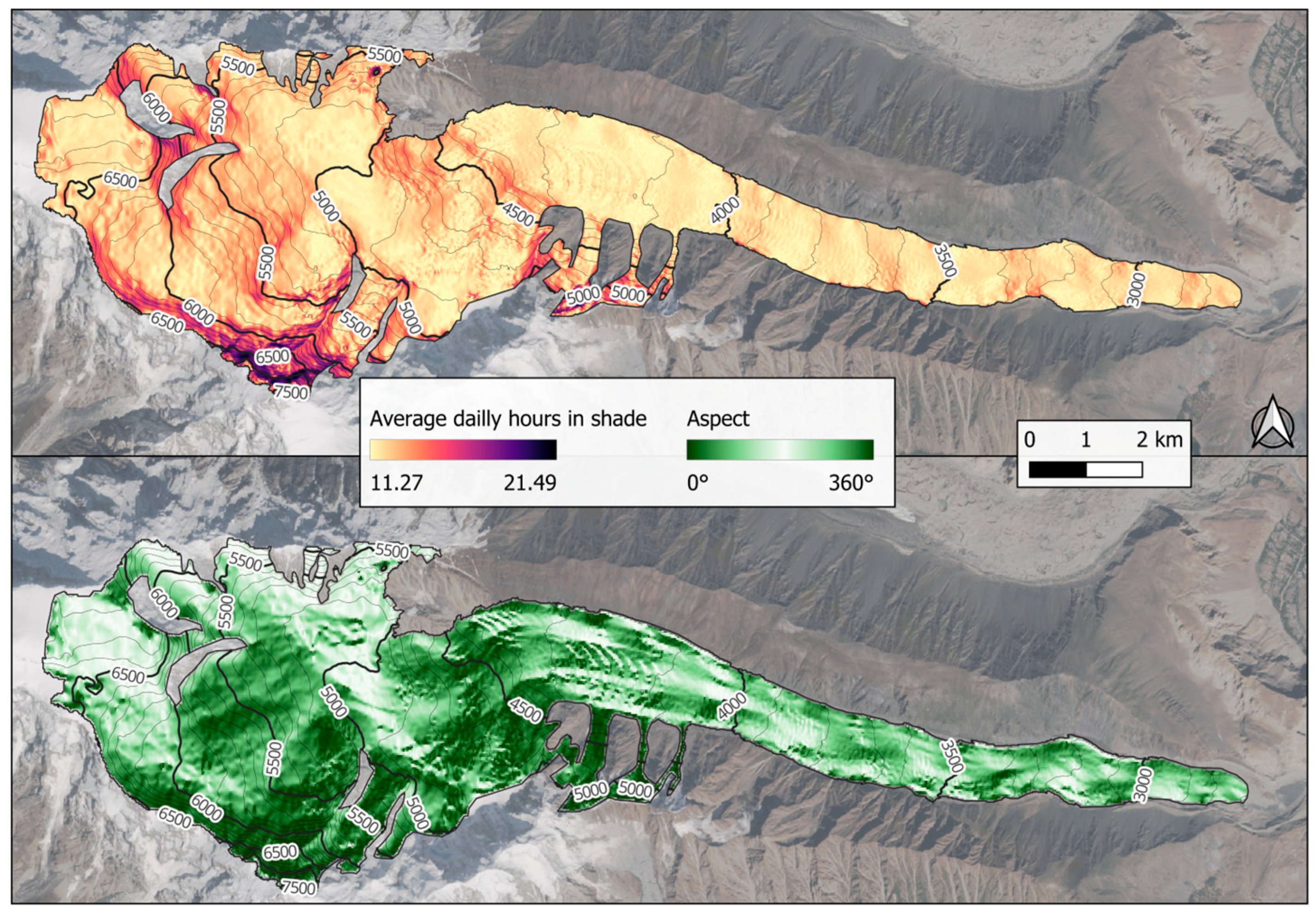
Average number of daily hours in shade for each pixel (up) and aspect (down) across the glacier. Aspect values are reported as degrees clockwise from north (azimuth). Background: Sentinel-2 Highlight Optimized Natural Color image acquired on 12 September 2023.
Figure 12.
Average number of daily hours in shade for each pixel (up) and aspect (down) across the glacier. Aspect values are reported as degrees clockwise from north (azimuth). Background: Sentinel-2 Highlight Optimized Natural Color image acquired on 12 September 2023.
Table 1.
Location (latitude and longitude) and description of local conditions (elevation, slope, and aspect) per ablation stake.
Table 1.
Location (latitude and longitude) and description of local conditions (elevation, slope, and aspect) per ablation stake.
| Ablation Stake | Latitude | Longitude | Elevation (m a.s.l.) | Slope | Aspect
(Azimuth Angle) |
|---|
| 1 | 36.457°N | 74.855°E | 2932 | 89.10° | 165.47° |
| 2 | 36.457°N | 74.856°E | 2926 | 89.10° | 160.20° |
| 3 | 36.457°N | 74.857°E | 2917 | 89.10° | 173.66° |
| 4 | 36.456°N | 74.856°E | 2916 | 89.10° | 173.05° |
Table 2.
Description of each variable used for calculation of SWin. For each variable it is reported whether it is considered constant, modeled, or measured.
Table 2.
Description of each variable used for calculation of SWin. For each variable it is reported whether it is considered constant, modeled, or measured.
| Symbol | Parameter | Assessment Method |
|---|
| I | Average solar irradiance | Constant |
| E | Eccentricity factor | Modeled, temporally variable |
| k | Unit conversion factor | Constant |
| δpoint | Solar declination | Modeled, temporally and spatially variable |
| Φpoint | Latitude | Derived from DSM |
| Spoint | Slope | Modeled from DSM |
| wsr-point/wss-point | Sunrise/sunset hour angles | Modeled, temporally and spatially variable |
| Apoint | Aspect | Modeled from DSM |
| τA | Atmospheric transmissivity | Modeled, temporally variable |
| SWin-exo-point | Sloped exo-atmospheric incoming solar radiation at each pixel | Modeled, temporally and spatially variable |
| SWin-exo-shade-point | Sloped exo-atmospheric incoming solar radiation, considering shading conditions at each pixel | Modeled, temporally and spatially variable |
| SWin-point | Incoming solar radiation at each pixel | Modeled, temporally and spatially variable |
| SWin-exo-Passu | Sloped exo-atmospheric incoming solar radiation at Passu AWS pixel | Modeled, temporally variable |
| SWin-Passu | Incoming solar radiation at Passu AWS | Measured |
Table 3.
Code scene, acquisition date, and glacier coverage percentage of Landsat 8 OLI images.
Table 3.
Code scene, acquisition date, and glacier coverage percentage of Landsat 8 OLI images.
| Code Scene | Acquisition Date | Glacier Coverage (%) |
|---|
| LC81500342023221LGN00 | 09 Aug 2023 | 85 |
| LC81500352023221LGN00 | 09 Aug 2023 | 89 |
| LC81500342023253LGN00 | 10 Sept 2023 | 88 |
| LC81500352023253LGN00 | 10 Sept 2023 | 90 |
| LC81490352023262LGN00 | 19 Sept 2023 | 90 |
| LC81500342023269LGN00 | 26 Sept 2023 | 50 |
| LC81490352023278LGN00 | 05 Oct 2023 | 98 |
| LC81500342023285LGN00 | 12 Oct 2023 | 97 |
| LC81500352023285LGN00 | 12 Oct 2023 | 94 |
Table 4.
Distribution and validation methods for each modeled parameter.
Table 4.
Distribution and validation methods for each modeled parameter.
| Parameter | Distribution | Input Data | Method | Data for Validation | Reference |
|---|
| TA-point | Spatial and temporal | Passu AWS | Elevation gradient | Borith AWS | Senese et al. (2014) [28] |
| SWin-point | Spatial and temporal | Passu AWS | Astronomical, geographical and geometrical parameters | Borith AWS | Senese et al. (2016) [29] |
| αpoint | Spatial only | Satellite (Landsat) | Empirical method | Borith AWS | Fugazza et al. (2016) [46] |
| LWin | Temporal only | Passu AWS | Empirical method | Borith AWS | Senese et al. (2016) [29] |
| LWout-point | Spatial and temporal | Passu AWS | Empirical method | Satellite (Landsat 9 TIRS) | Oerlemans (2000) [38] |
Table 5.
Code scene, acquisition date, and acquisition time of Landsat 8/9 TIRS images.
Table 5.
Code scene, acquisition date, and acquisition time of Landsat 8/9 TIRS images.
| Code Scene | Acquisition Date | Acquisition Time |
|---|
| LC91490352023222LGN00 | 10 Aug 2023 | 05:35:10 UTC |
| LC91490352023254LGN00 | 11 Sept 2023 | 05:35:27 UTC |
| LC81490352023278LGN00 | 05 Oct 2023 | 05:35:30 UTC |
Table 6.
Measured and modeled ice melt (m w.e.) at each ablation stake. The modeled values were calculated applying the LOOCV. The difference (∆M) between modeled and measured ice melt are also reported.
Table 6.
Measured and modeled ice melt (m w.e.) at each ablation stake. The modeled values were calculated applying the LOOCV. The difference (∆M) between modeled and measured ice melt are also reported.
| Stake | Measured Melt (m w.e.) | LOOCV Modeled Melt (m w.e.) | ΔM
(m w.e.) |
|---|
| 1 | 4.55 | 5.14 | +0.60 |
| 2 | 5.28 | 4.60 | −0.68 |
| 3 | 6.91 | 4.98 | −1.93 |
| 4 | 5.13 | 5.21 | +0.08 |
Table 7.
Standardized regression results for cumulative melt. The table reports standardized coefficient (|β|), standard error (SE), t-statistic (t), p-value (p), unique R2, and variance inflation factor (VIF).
Table 7.
Standardized regression results for cumulative melt. The table reports standardized coefficient (|β|), standard error (SE), t-statistic (t), p-value (p), unique R2, and variance inflation factor (VIF).
| Predictor | β | SE | t | p | Unique R2 | VIF |
|---|
| Elevation | −0.501 | 0.016 | −31.57 | <2 × 10⁻¹⁶ | 0.199 | 1.262 |
| Slope | −0.101 | 0.016 | −6.455 | 1.3 × 10⁻¹⁰ | 0.008 | 1.236 |
| Aspect south component | +0.164 | 0.016 | +10.441 | <2 × 10⁻¹⁶ | 0.022 | 1.231 |
| Aspect east component | −0.025 | 0.016 | −1.635 | 0.102 | < 0.001 | 1.236 |
Table 8.
Correlation matrix of topographic predictors.
Table 8.
Correlation matrix of topographic predictors.
| Predictor | Elevation | Slope | Aspect South Component | Aspect East Component |
|---|
| Elevation | 1.000 | −0.431 | 0.108 | 0.142 |
| Slope | −0.431 | 1.000 | 0.026 | −0.027 |
| Aspect south component | 0.108 | 0.026 | 1.000 | 0.426 |
| Aspect east component | 0.142 | −0.027 | 0.426 | 1.000 |
Table 9.
Model results for thinned sample (n = 111). The R2 of the model is 0.319.
Table 9.
Model results for thinned sample (n = 111). The R2 of the model is 0.319.
| Predictor | β | Unique R2 |
|---|
| Elevation | −0.340 | 0.222 |
| Slope | −0.047 | 0.003 |
| Aspect south component | 0.045 | 0.003 |
| Aspect east component | 0.015 | 0.001 |
Table 10.
Model summary (full dataset). The table reports sample size (n), R2, adjusted R2 (R2 adj), and residual standard error (RMSE).
Table 10.
Model summary (full dataset). The table reports sample size (n), R2, adjusted R2 (R2 adj), and residual standard error (RMSE).
| n | R2 | R2 adj | RMSE |
|---|
| 3891 | 0.226 | 0.225 | 0.880 |
Table 11.
Performance statistics of ice melt model (m w.e.) using different albedo values.
Table 11.
Performance statistics of ice melt model (m w.e.) using different albedo values.
| Acquisition Date | % Available Pixels for Albedo Scene over the Whole Glacier | BE | MAE | RMSE | BRRMSE |
|---|
| 9 Aug 2023 | 89% | −0.02 | 0.04 | 0.23 | 0.23 |
| 19 Sept 2023 | 90% | 0.00 | 0.04 | 0.19 | 0.19 |
| 5 Oct 2023 | 98% | 0.07 | 0.10 | 0.46 | 0.46 |