1. Introduction
Global navigation satellite systems (GNSS) play a crucial role in position, navigation and timing (PNT) applications and provide precise navigation positions (longitude, latitude, and altitude) [
1]. In recent years, there has been increasing demand for higher navigation accuracy and diverse navigation services, such as vehicle accident avoidance [
2], path planning [
3], and precise unmanned aerial vehicle navigation [
4]. Multicarrier navigation modulation has become a feasible technology for meeting new navigation requirements because it enhances navigation accuracy and provides diverse navigation services. For example, orthogonal frequency division multiplexing (OFDM) [
5,
6], chirp [
7,
8] and frequency hopping [
9,
10] are employed as multicarrier navigation signal. Additionally, orthogonal multicarrier BOC (OMBOC) contains a series of orthogonal BOC signals and has good compatibility with BOC-like signals [
11]. The bandwidth of OMBOC can be flexibly configured according to the applicable scenario, suggesting its potential utility in integrated communication and navigation systems.
New navigation services require more navigation signals, and the envelope of the multicarrier navigation signal varies over time. This variation prevents the spaceborne high-power amplifier (HPA) from reaching its maximum efficiency [
1,
12]. Due to the limited transmission power of satellites, an HPA is required to operate in the nonlinear saturation regions to yield a high efficiency. Clipping is a simple and efficient technology for improving transmission efficiency in communication systems [
12,
13], but it has not been applied to navigation systems yet.
To minimize distortions introduced by the HPA while operating it in its saturation region, the navigation signal must have a constant envelope. There were only two navigation signals (C/A and P(Y)) in the original GPS, and quadrature phase shift keying (QPSK) can be used for constant-envelope multiplexing (CEM) [
14]. Moreover, when the number of navigation signals is more than two, more complicated multiplexing methods are needed, such as majority vote (MV) [
15], coherent adaptive subcarrier modulation [
16], interplexing [
17], and phase-optimized constant-envelope transmission (POCET) [
18]. However, these methods only incorporate multiple bipolar direct sequence spreads (DSSs) into CEM, and the signal components are designed using the same central frequency.
Various innovative dual-frequency CEM techniques are being adopted for next-generation GNSS. These techniques are used for additional navigation services and offer diverse reception strategies [
19]. For instance, the alternate binary offset carrier (AltBOC) is a CEM approach with four equal-power signals and is used as a Galileo E5 signal [
20]. In contrast, the asymmetric constant-envelope BOC (ACE-BOC) can flexibly adjust a subcarrier’s power [
21]. Both the AltBOC and ACE-BOC solve the CEM problem via analytical approaches and can multiplex up to four navigation signals. Moreover, there are many AltBOC and ACE-BOC derivatives, such as the time division AltBOC [
22], generalized AltBOC [
23], unbalanced AltBOC [
24], generalized constant-envelope BOC [
25], interlacing general AltBOC [
26], bipolar subcarrier ACE-BOC (BS-ACEBOC) [
27], and asymmetric constant-envelope FH-BOC (ACE-FHBOC) [
28]. However, the listed dual-frequency CEM approaches are limited in providing a maximum of four navigation services, which fall short of the requirements for new navigation services and subcarriers.
With the further growth of subcarriers, many universal CEM optimizations have been proposed. These CEM technologies can multiplex multicarrier navigation signals (more than 4) into a CEM signal. For multicarrier navigation signals, CEM via intermodulation construction (CEMIC) provides a generalized CEM solution [
29]. CEMIC adds intermodulation components to the original signal to keep the envelope of the integrated signal constant, and a coefficient optimization method for intermodulation components has been proposed. Based on CEMIC, a series of innovative works have been conducted to improve navigation performance and reduce generation complexity [
30,
31,
32,
33,
34,
35,
36]. For example, Ma et al. proposed a multicarrier CEM technique involving subcarrier vectorization [
31], and Bhadouria et al. modified the cost function to improve multiplexing efficiency [
35].
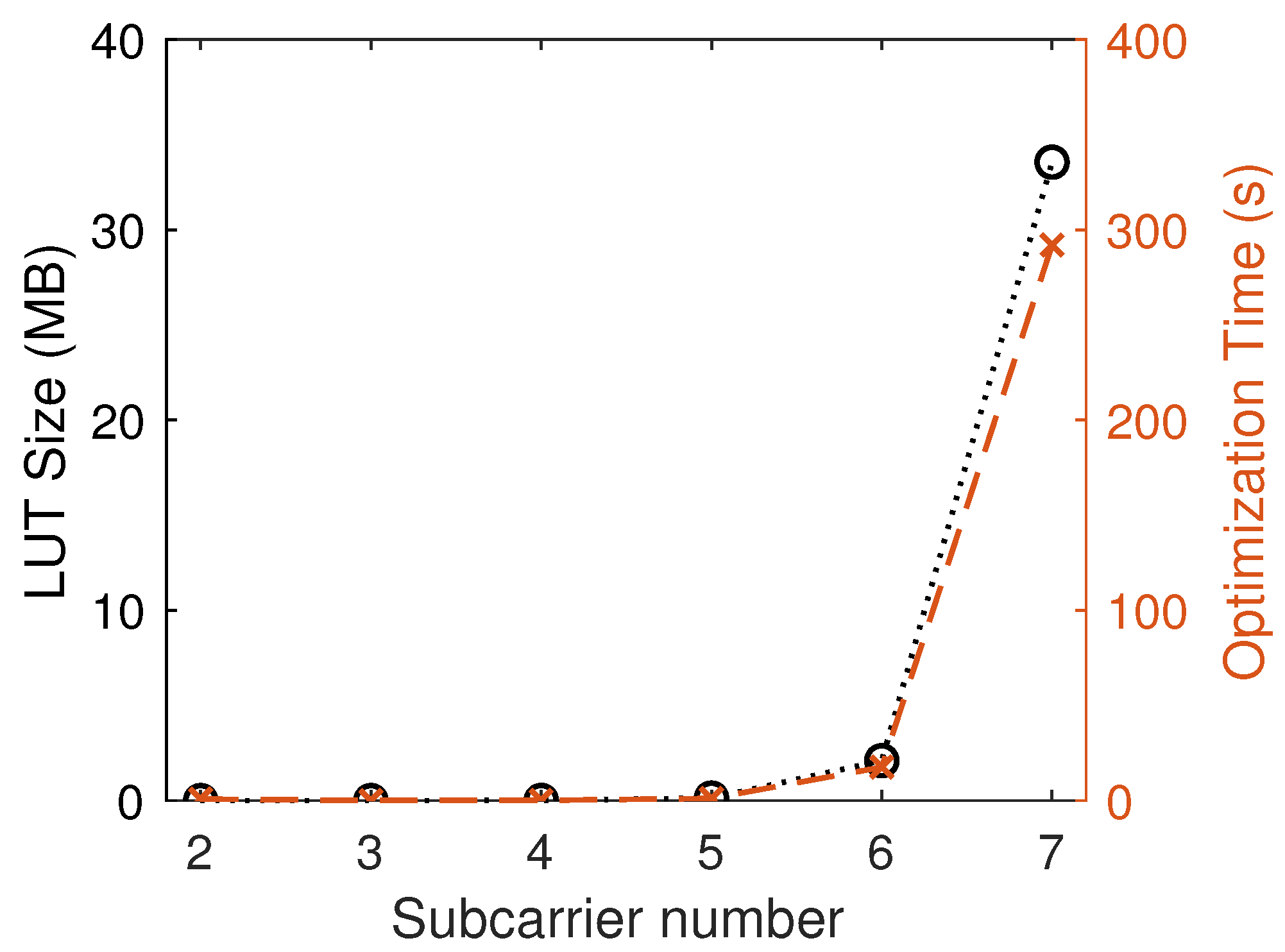
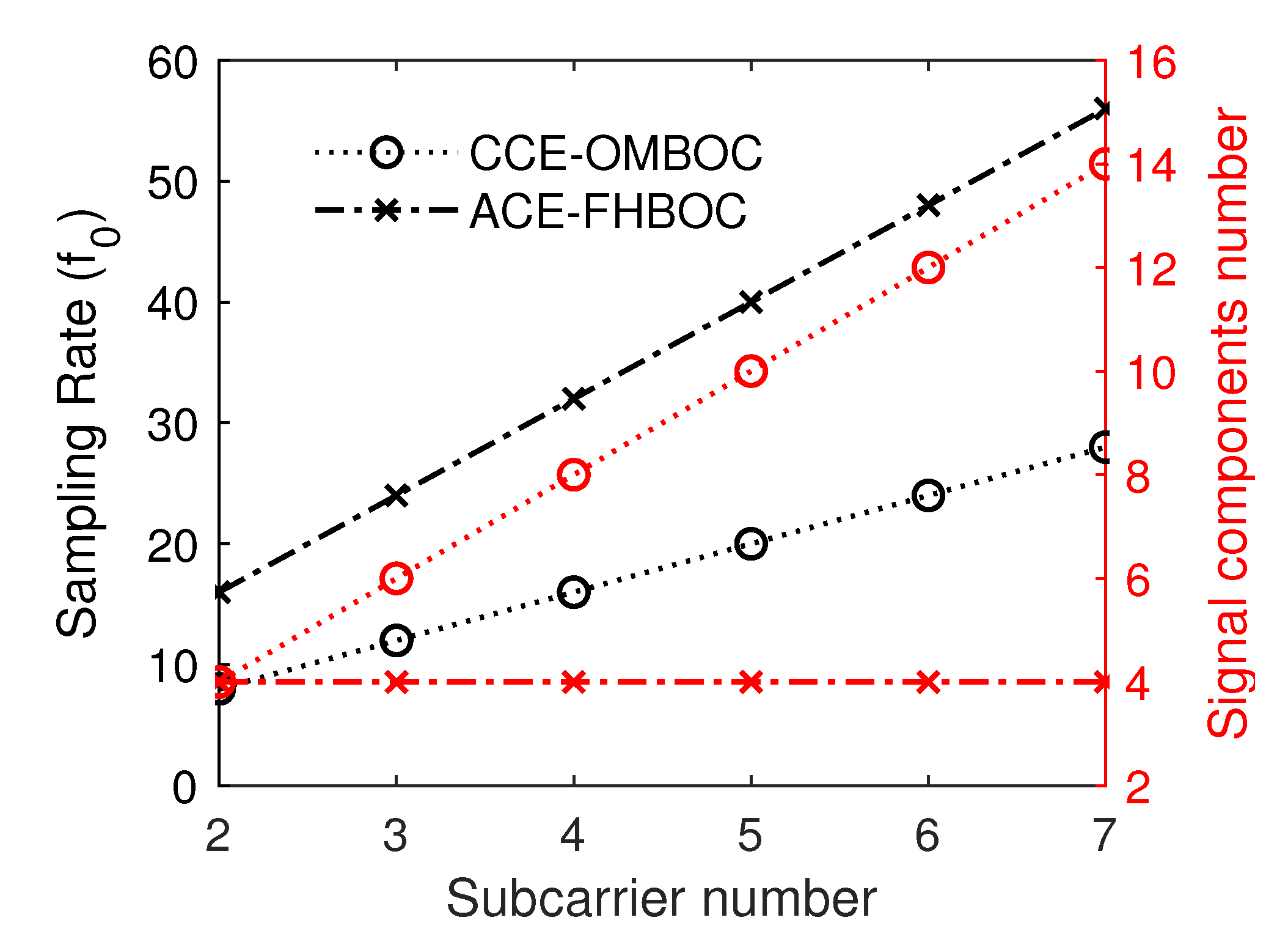
However, existing multicarrier CEM optimization methods have several limitations. First, a quantitative analysis of transmission and multiplexing efficiency for multicarrier navigation OMBOC signals is lacking. The relationship between efficiency and subcarrier numbers is rarely mentioned. Second, the CEMIC optimization process is complicated when the number of subcarriers is large. CEMIC depends on intermodulation optimization, and the number of intermodulations increases with the number of subcarriers, increasing the optimization difficulty. Finally, the sampling rate is crucial for the cost of signal generation, and previous studies have rarely considered reducing the sampling rate. There are at least eight sampling points for every subcarrier period in previous works [
29,
30,
31]. With the increase in subcarriers, the sampling rate increases quickly, thus increasing the cost of CEM generation.
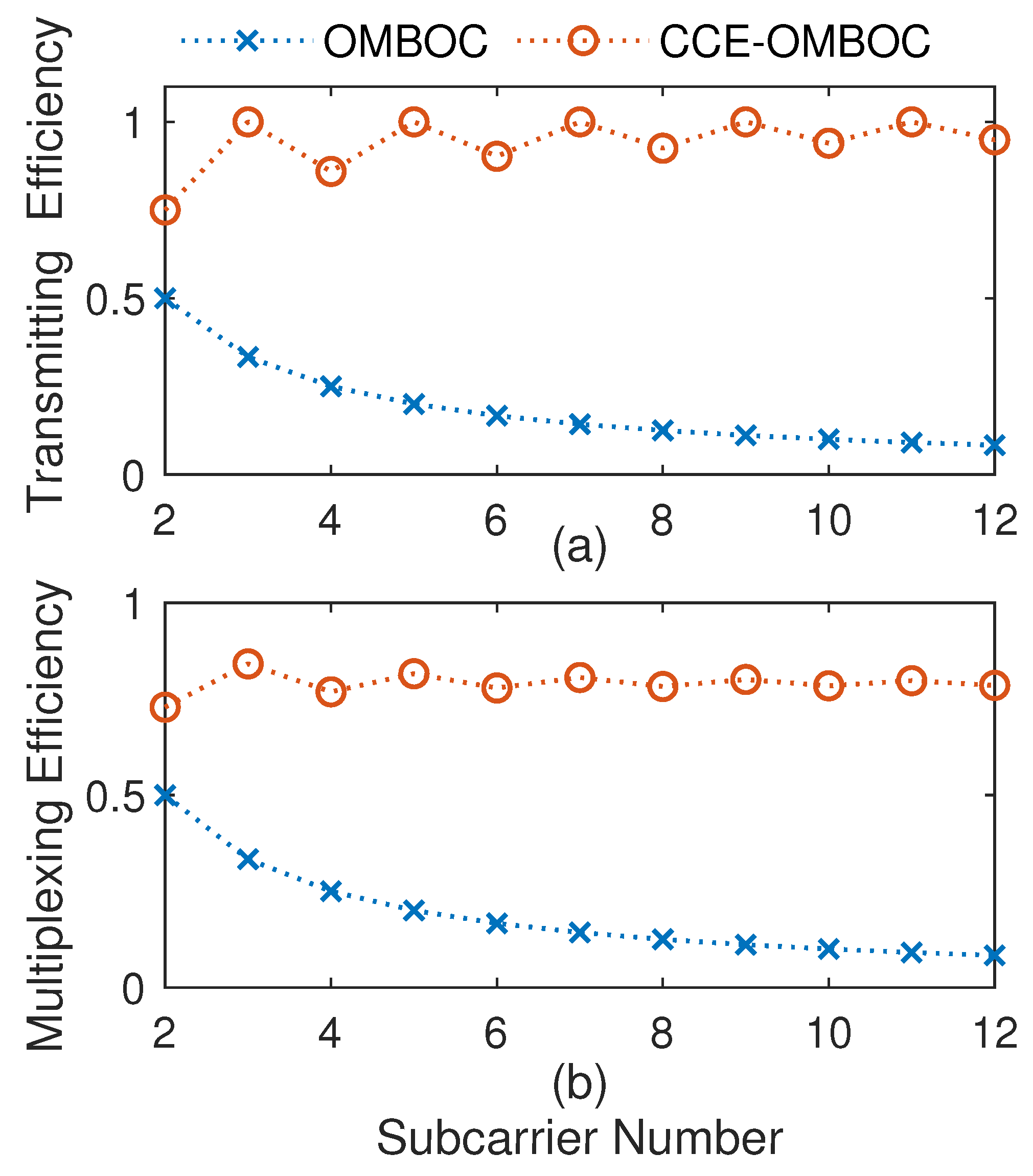
This paper proposes a new multicarrier constant-envelope modulation method called the clipped constant envelope for the OMBOC (CCE-OMBOC). OMBOC has a series of BOC signals located at different frequencies, and its expressions of transmission and multiplexing efficiency are presented. With the increased number of subcarriers, the transmission and multiplexing efficiency drop off (to lower than 50%). To improve this low efficiency, the CCE-OMBOC is introduced; it is a specialized clipped OMBOC whose clipping level is the minimum non-negative amplitude of the OMBOC. Furthermore, experimental results demonstrate that the CCE-OMBOC offers better transmission and multiplexing efficiency than other clipped OMBOCs. The derived cross-correlation function (CCF) of the CCE-OMBOC has a fixed ratio with that of the OMBOC, which indicates that clipping has no negative effect on navigation performance. Compared to the original OMBOC, the CCE-OMBOC significantly enhances the transmission and multiplexing efficiency. We compare the CCE-OMBOC with several representative CEM modulations and find that the CCE-OMBOC offers optimal multiplexing efficiency, good tracking accuracy, and excellent compatibility.
The main contributions of this paper can be summarized as follows:
A CEM method based on clipping, called the CCE-OMBOC, is proposed to enhance the transmission efficiency of a multicarrier navigation signal OMBOC. The generation of the CCE-OMBOC only adds a hard limit to the original OMBOC and is simple. We confirm that the CCE-OMBOC is more efficient than other clipped OMBOCs. Compared with the original navigation signal, the CCE-OMBOC significantly improves the transmission and multiplexing efficiency.
The expressions of the transmission and multiplexing efficiency are proposed based on the amplitude distribution, which is significant within theoretical analysis. The derived CCF of CCE-OMBOC has a fixed ratio with that of the OMBOC, and we prove that the CCE-OMBOC has a navigation performance equivalent to that of OMBOC, except for enhancing signal power.
A low sampling rate is suggested for the CCE-OMBOC and OMBOC, which reduces the cost of signal generation.
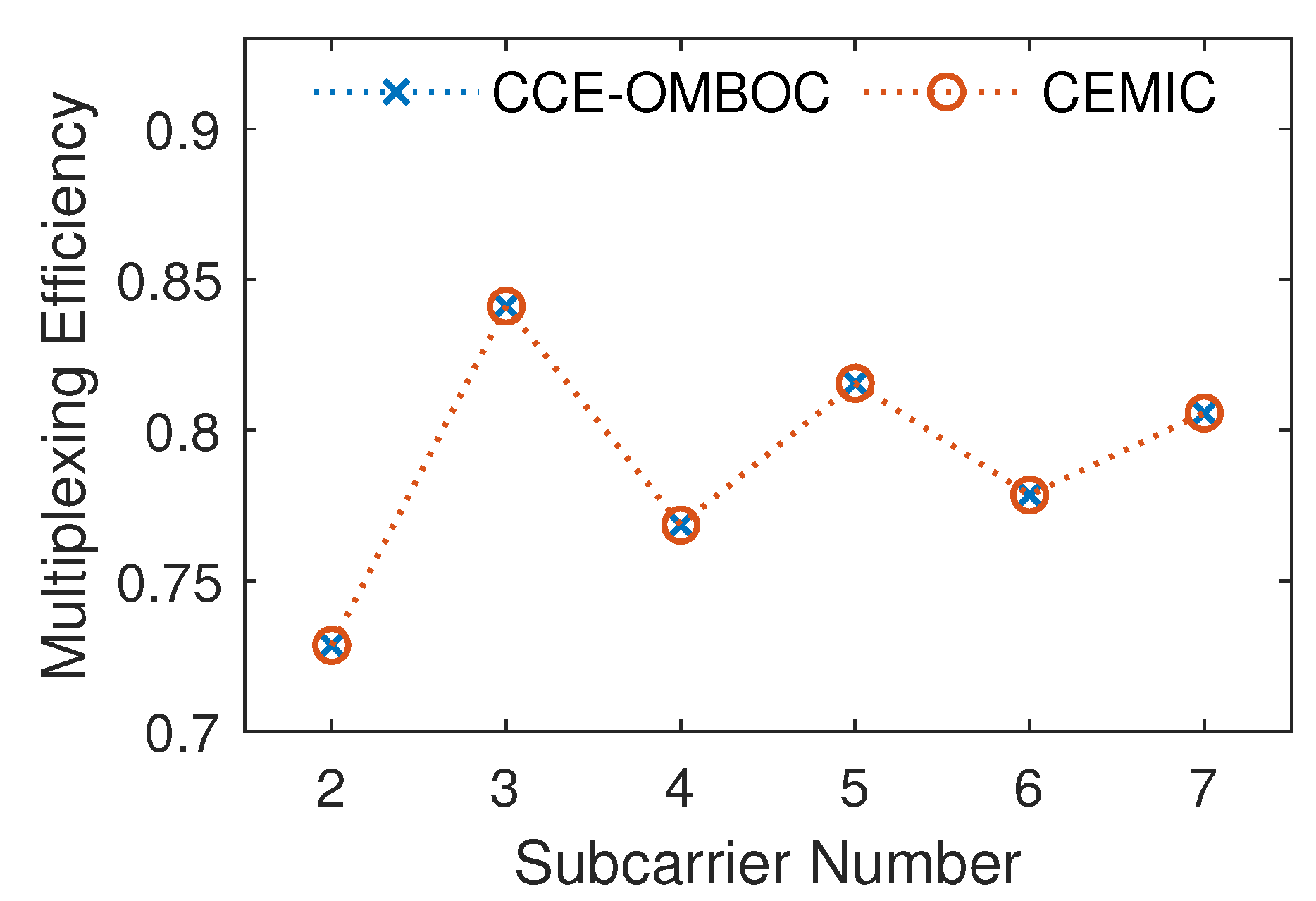
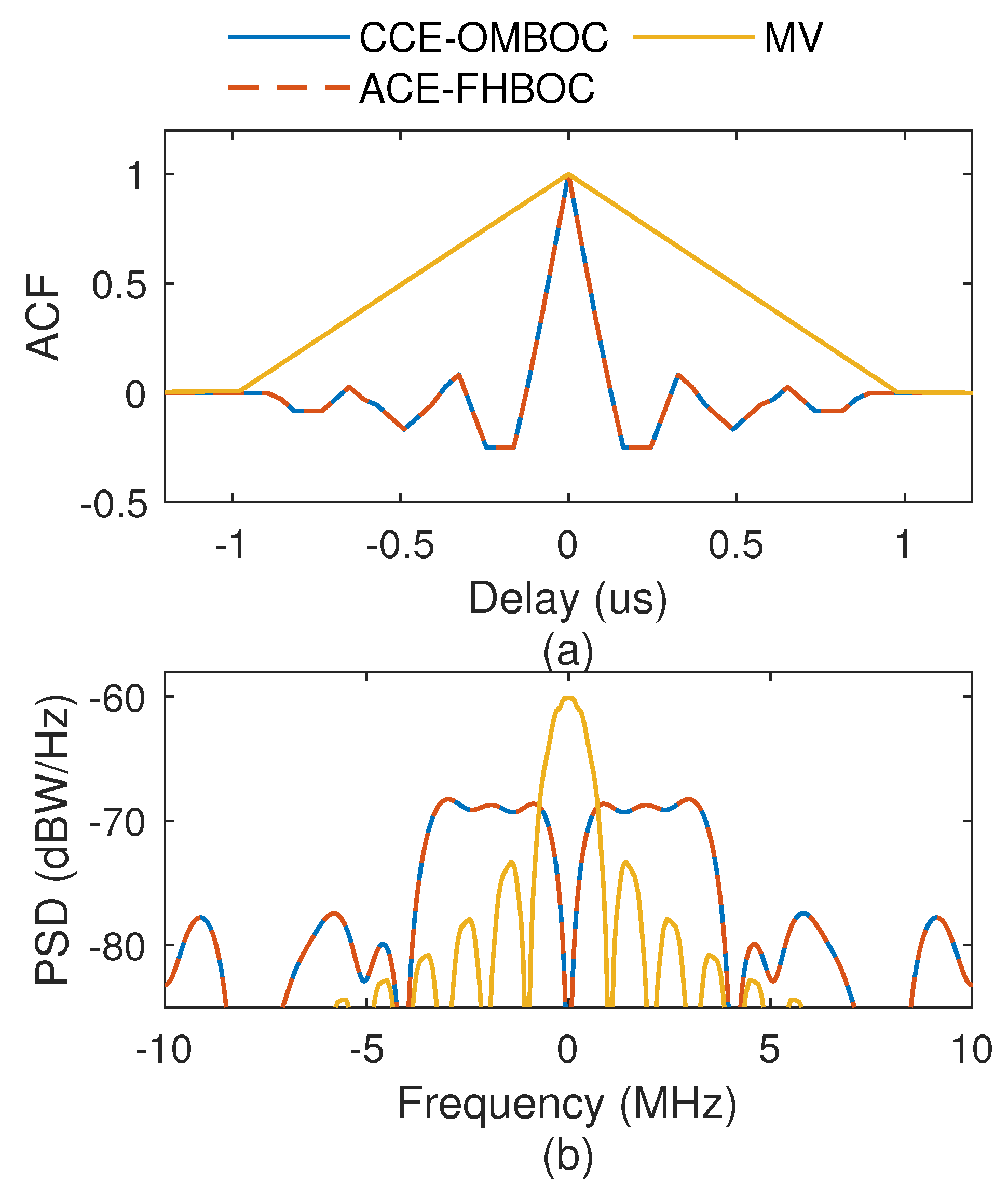
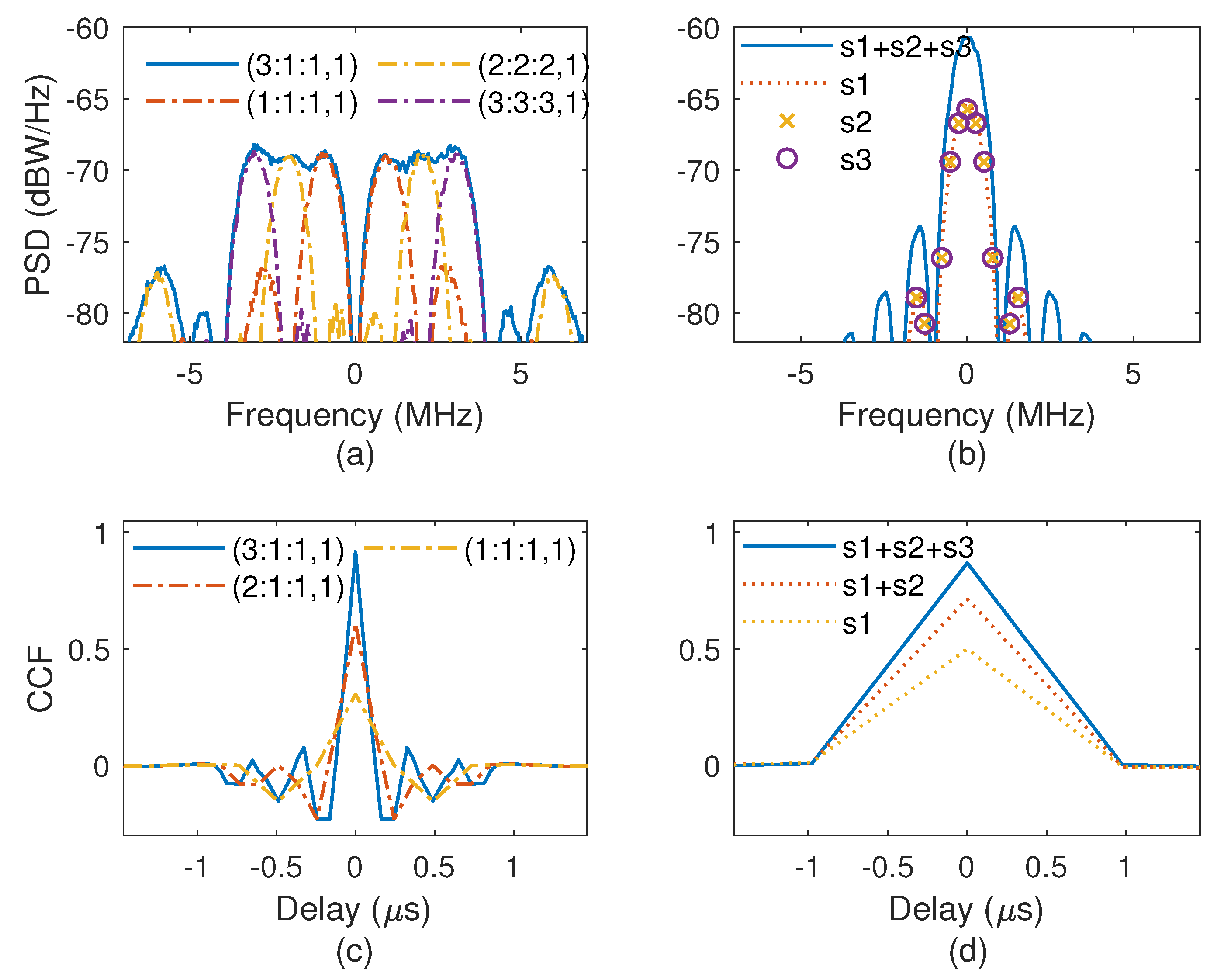
The CCE-OMBOC is compared with several typical modulations: CEMIC, MV and ACE-FHBOC. The CCE-OMBOC has the following characteristics: (1) optimal multiplexing efficiency (approximately for any number of subcarriers); (2) excellent tracking performance with a simple generation process; and (3) an efficient frequency spectrum and excellent compatibility. The CCE-OMBOC is a potential method for next-generation GNSS and integrated communication and navigation.
The remainder of this paper is organized as follows.
Section 2 introduces the signal model and efficient expressions based on the signal vector.
Section 3 describes the CCE-OMBOC and discusses the effect of the clipping process.
Section 4 analyzes the navigation performance of the CCE-OMBOC.
Section 5 compares the CCE-OMBOC signal with existing CEM modulations in terms of multiplexing efficiency and navigation performance, and the paper concludes in
Section 6.
2. A Multicarrier Navigation Signal: OMBOC
Based on the multicarrier OMBOC signal model, this section presents the vector expression of the OMBOC, as well as its transmission efficiency and multiplexing efficiency. These results lay a foundation for the theoretical analysis in this paper.
2.1. Signal Model
OMBOC is a type of multicarrier navigation modulation that offers excellent compatibility and navigation performance, making it suitable for integrated communication and navigation systems, as well as new-generation GNSS [
11]. Its bandwidth can be flexibly configured using different subcarriers to adapt to various navigation scenarios. The baseband signal of OMBOC,
, is expressed as follows:
where
K indicates the number of subcarriers, and
is the
i-th subcarrier signal with a binary offset carrier (BOC). Both BOC and sinusoid can be used to accomplish spectrum split to avoid interference between subcarriers. BOC has a simpler generation and constant envelope, which is conducive to navigation performance. Hence, the BOC is adopted in the signal model. For traditional GNSS signals, the term
subcarrier usually refers to square waves in BOC signals [
37]. However, this paper defines the
subcarrier as a navigation signal
at a specified frequency in multicarrier navigation signal OMBOC, which is similar to the communication system.
In the context of an OMBOC, each subcarrier
i includes two DSSS signal components, denoted by
and
, which are in the in-phase (I) and quadrature (Q) branches, respectively. They can be obtained by modulating navigation data, spreading code, and square wave subcarriers. Therefore,
can be expressed as follows:
where
is the spreading code chip duration, and
is a positive integer.
MHz is a commonplace reference frequency widely adopted in GNSS [
37].
(resp.
) is the navigation data modulated by the pseudorandom noise (PRN) spreading code in the in-phase (resp. quadrature) branch.
and
are the square wave symbols in the cosine and sine phases, respectively, which are defined as follows:
where
is the frequency corresponding to subcarrier
i, and
denotes the subcarrier frequency coefficient. Although this paper utilizes sine and cosine forms of BOC signals in the I and Q branches, any form of BOC signal can be applied to either branch. The CEM method proposed in this paper applies to all such combinations.
Thus, the OMBOC with
K subcarriers has
signal components that are independent of each other and located in the in-phase and quadrature branches, respectively. The OMBOC can be expressed as follows:
The coefficients and determine the configuration of OMBOC and directly influence the navigation performance of OMBOC. OMBOC can be flexibly configured according to different navigation scenarios. For brevity, this paper configures OMBOC with an equally spaced subcarrier whose frequency coefficient is . This equally spaced subcarrier improves spectral efficiency but reduces subcarrier interference. Thus, we represent the OMBOC modulation as OMBOC . It is worth noting that the technology described later can be applied to any OMBOC configuration.
The autocorrelation function (ACF) in the receiver’s correlator is commonly utilized in evaluating navigation signals [
1]. However, for CEM, the composite signal after multiplexing differs from the local replica signal, and the use of ACF is pointless for evaluating the multiplexing methods. Hence, this paper uses the cross-correlation function (CCF) instead of the ACF for assessing the navigation modulation performance.
According to (
4), the OMBOC has
signal components, which are mutually orthogonal because they use different pseudorandom noise (PRN) sequences. Hence, the CCF
of the OMBOC is the sum of its signal component CCFs:
where
denotes the time delay.
(resp.
) is the CCF of subcarrier
i in the in-phase (resp. quadrature) branch. The detailed expressions of
and
are listed in
Appendix A.1.
2.2. Vector Expression and Amplitude Distribution
The OMBOC can be easily represented in vector form, simplifying the subsequent analysis. According to the signal model (
4), OMBOC
includes
K subcarriers, with each subcarrier containing two signal components located in the in-phase and quadrature branches. In other words, the OMBOC has
orthogonal signal components
:
Note that the above component is a bipolar signal because the navigation data, PRN code, and square wave subcarriers are all bipolar signals.
A truth table is used to describe the value combinations of OMBOC
with
signal components, where
is the number of component combinations (
Table 1). Specifically, for component value combination
in
Table 1,
denotes the component value of
, whose occurrence probability is
with
.
is the value of the OMBOC signal as a vector. In contrast,
is the amplitude of the OMBOC signal, and it is a scalar.
is used to refer to the amplitude value, which differs from the vector form of the OMBOC signal
. With a sufficiently long signal duration, it is reasonable to assume that every possible value combination of the
signal components has occurred.
Importantly, the probability of a combination in
Table 1 is the product of the probabilities of all signal components; these components are independent of each other because they use different PRN sequences. In the case of ideal PRN codes, the probability of a signal component being 1 or
is
. Thus, each combination of component values has an equal probability
.
The vector expression of the OMBOC can be defined according to
Table 1. First, we denote the
component value matrix
where
is referred to as the
component value vector of the
i-th signal component, whose elements correspond to column
in
Table 1.
(resp.
) represent the real (resp. imaginary) part of subcarrier
i (
).
Then, the
component coefficient vector is determined by the power and phase of the signal components. Given that the signal components in OMBOC have equal power and are uniformly distributed across the I and Q branches, the default
is as follows:
Finally, the OMBOC
signal value vector can be expressed by
and
:
where
corresponds to the OMBOC signal of the
i-th component combination in
Table 1.
Furthermore, the amplitude distribution of the OMBOC can be derived from
Table 1. The amplitude of the OMBOC signal
is a random variable, which can take possible values
with corresponding probabilities
. Hence, the amplitude vector of the OMBOC is defined as
, and its corresponding probability matrix is
, where
M, the number of OMBOC signal amplitudes, is determined by its parameter
. The elements in
are arranged in ascending order, i.e.,
. The probabilities
can be calculated by
Table 1:
This indicates that
is the summed probability for all cases where
equals
.
According to the signal component vectors, the vector and amplitude distribution of the OMBOC signal are derived, which lay the foundation for subsequent theoretical analysis.
2.3. Transmission and Multiplexing Efficiency
For the GNSS, the transmission and multiplexing efficiency should be as high as possible [
1]. To maximize the transmission efficiency in a spaceborne HPA, the transmitted signal is usually designed to have a constant envelope, so the HPA operates in full saturation. The purpose of CEM technology is to improve the multiplexing efficiency when the transmitted signal has a constant envelope. Transmission efficiency, denoted as
, represents the ratio of average power to peak power, and it can be defined by the amplitude distribution of the transmitted signal, as follows:
where
is the amplitude vector for the transmitted signal, and
A indicates the maximum signal amplitude of the transmitter. The numerator is the average of the transmitted power, while the denominator is the peak of the transmitted power. To maximize the transmission efficiency, the average of the transmitted power should be as close to the peak of the transmitted power as possible.
Additionally, the multiplexing efficiency is the output power of the receiver correlator for the amplitude-normalized transmitted signal, and the multiplexing efficiency
can be calculated as follows:
where
is the amplitude vector of the power-normalized replica signal in the receiver. Due to the multiplexing, the average output amplitude
of the correlator is usually smaller than the peak amplitude of the transmitter, and multiplexing efficiency
can be used to evaluate the multiplexing loss. Unlike transmission efficiency, where the numerator
represents average transmitted power, the numerator
is an average output amplitude of the correlator, and the numerator should be squared for calculating the average power.
The transmitted signals are usually required to have constant envelopes, so their transmission efficiency is equal to 1. However, the multicarrier modulation OMBOC does not have a constant envelope. With the increase in OMBOC subcarriers, the fluctuation in the signal amplitude leads to a substantial waste of HPA power, and the transmission efficiency significantly decreases. The low transmission efficiency of the multicarrier OMBOC also results in low multiplexing efficiency and is a major problem that needs to be addressed. This paper addresses the challenge of low transmission and multiplexing efficiency in multicarrier OMBOC signals by introducing clipping technology. This approach aims to mitigate amplitude fluctuations, thereby enhancing both transmission and multiplexing efficiency and ultimately improving the overall performance of the GNSS system.
3. CCE-OMBOC: CEM Based on Clipping
The CCE-OMBOC for an OMBOC is proposed here, which is a specialized clipped OMBOC. Next, the CCF of the CCE-OMBOC is derived, revealing a fixed ratio with the CCF of the original OMBOC. Compared with other clipped OMBOCs, the CCE-OMBOC has the highest transmission and multiplexing efficiency (approximately 80%).
3.1. Generation of CCE-OMBOC via the Clipping Process
Clipping technology provides a hard limit for the OMBOC signal, thus offering a straightforward approach. The expression of the clipped signal
is as follows:
where
T is the preset clipping level, which can be chosen from the amplitude vector of the OMBOC.
represents the phase of the OMBOC signal
. The clipping process compresses only the signal’s amplitude, leaving the phase unaffected.
Additionally, when the clipping level is set to the minimum non-negative element
in the amplitude vector
, the resulting clipped OMBOC can become a CEM signal and is called the CCE-OMBOC. The definition of the CCE-OMBOC
is as follows:
Thus, CCE-OMBOC is a specialized form of clipped OMBOC, with its clipping level set to the minimum non-negative amplitude of the original OMBOC. Furthermore, the CCE-OMBOC can also be described as a composite of original OMBOC and IM components, as detailed further in
Section 3.2.
OMBOC(3: 1: 1, 1) and OMBOC(4: 1: 1, 1) are used as examples to demonstrate the performance improvement achieved through clipping. OMBOC(
K: 1: 1, 1) consists of
K subcarriers, each containing two signal components. The signal components of OMBOC(
K: 1: 1, 1) are BOC signals with different subcarrier frequencies, which are evenly distributed across the in-phase and quadrature branches.
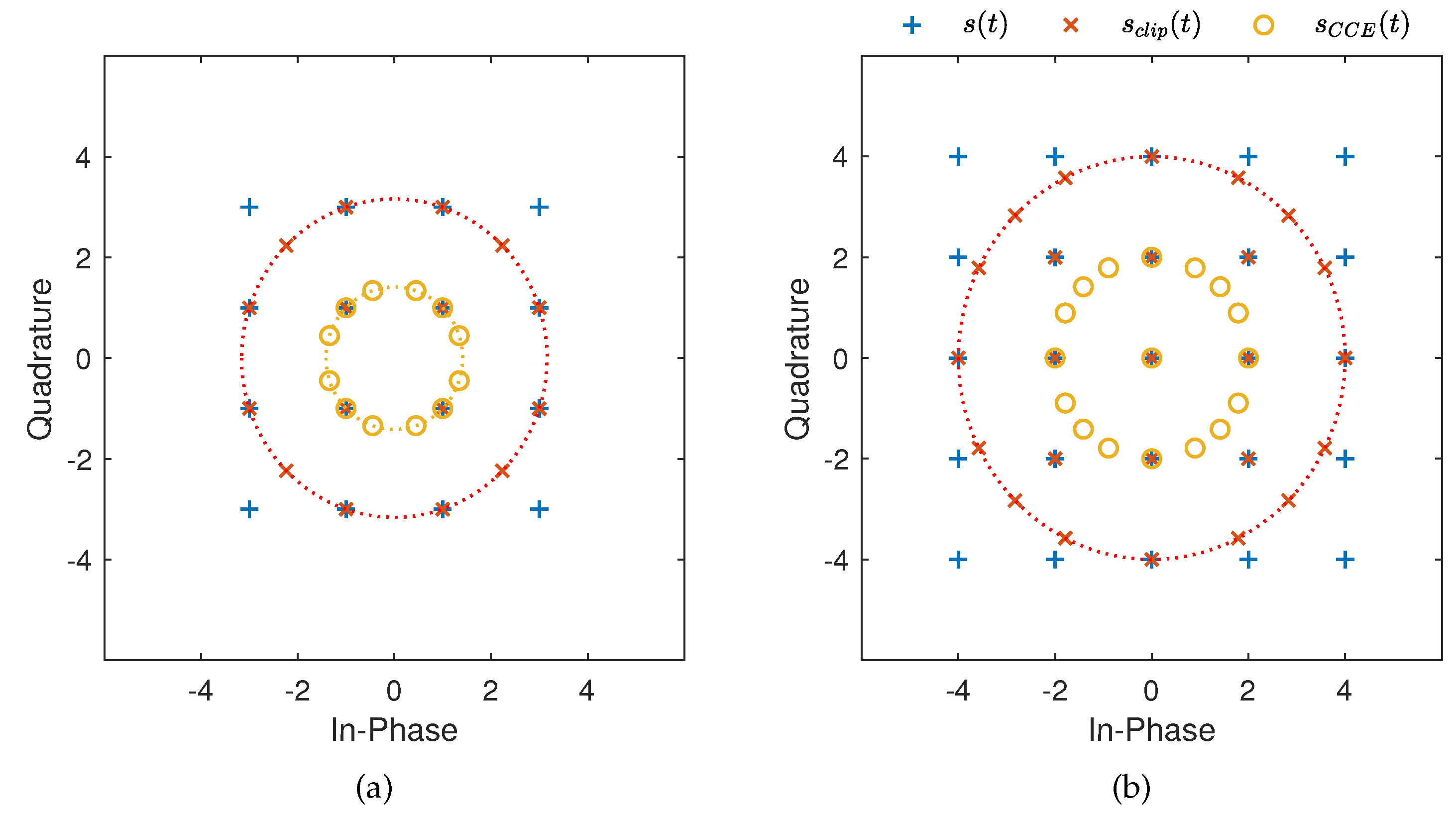
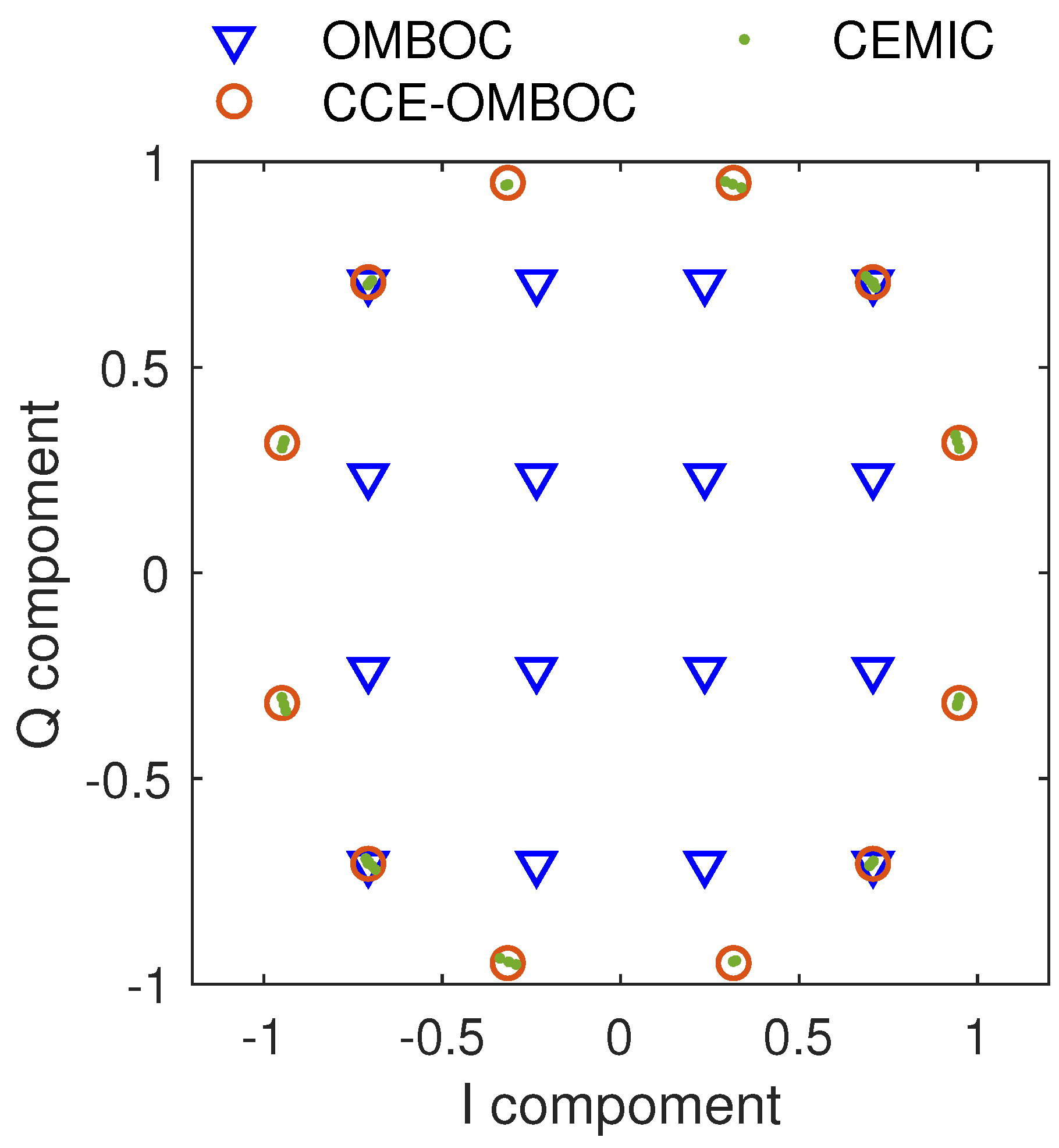
Figure 1 illustrates the constellations of OMBOC(
K: 1: 1, 1) before and after clipping, with the corresponding efficiency improvements presented in
Table 2. We observe the following: (1) When the amplitude of the OMBOC signal exceeds the clipping level
T, the signal amplitude is compressed by the clipping process without altering the original phase. In contrast, when the amplitude is less than or equal to
T, clipping has no effect on the signal. (2) When the clipping level is set to the minimum non-negative amplitude
, the clipped OMBOC equals the CCE-OMBOC, with all multiplexing signals, except the zero value, located on a circle. To avoid a zero value in OMBOC, it is recommended to set the number of subcarriers to an odd number. (3) The transmission and multiplexing efficiency of OMBOC is significantly enhanced through the clipping process. CCE-OMBOC(3: 1: 1, 1) is a CEM with a transmission efficiency of 1 and a multiplexing efficiency of 84.11%. (4) When the number of subcarriers is even, CCE-OMBOC includes a zero value, resulting in a transmission efficiency less than 1. Except for the zero value, all values of CCE-OMBOC lie in a circle, making it an approximate CEM. For example, CCE-OMBOC(4: 1: 1, 1) contains a zero value, with all other values lying in a circle, resulting in a transmission efficiency of 85.94%.
Overall, CCE-OMBOC is a specific form of clipped OMBOC, where the clipping level corresponds to the minimum non-negative amplitude of the original OMBOC. The clipping process significantly enhances the transmission and multiplexing efficiency of OMBOC. The impact of the clipping level on transmission and multiplexing efficiency will be further discussed in the subsequent subsection.
3.2. CCF of CCE-OMBOC
The CCF can be used to describe navigation performance and may be distorted by CEM, indicating that CEM hurts navigation performance. CEM technology is necessary to minimize the potential negative impact, and we find that the CCF of CCE-OMBOC has a fixed ratio which is comparable to that of the original OMBOC. Hence, CCE-OMBOC has a navigation performance that is identical to that of the original OMBOC signal.
The CCF is closely related to the component coefficient vector and can be derived according to the vectorized expression of the clipped OMBOC. The
clipped signal value vector can be obtained based on the original OMBOC
signal value vector and clipping level
T:
where
(resp.
) is the
i-th element of the
signal value vector (resp.
clipped signal value vector ). In addition,
can be obtained by adding the original
signal value vector with an intermodulation (IM)
value vector [
29], as follows:
where
denotes the
component coefficient vector for the original OMBOC signal in the clipped signal, and the dimension of
is the same as
. For the GNSS, the intermodulation (IM) term should not influence the correlation characteristic in the receiver, i.e.,
Hence, the value subspace of
must be the orthogonal complement of the space expanded by the
component value vector , i.e.,
, where
span
. Furthermore, it is easy to verify that
are orthogonal to each other and can be a basis set for
. It can be proven that dim
and dim
. A basis set
of
can be constructed from the basis set
[
29]:
where
is an IM vector (IMV), and
is the Hadamard product (element-wise product) of
k specific component value vectors:
.
Thus,
can be expressed as a linear combination of elements in its basis set
:
where
is denoted as the IM
coefficient vector, and entry
corresponds to the weight of
in
.
We define the
augmented component value matrix and the
augmented coefficient vector . Substituting (
19) into (
16), we can obtain a concise form of
:
It can be easily proven that
, indicating orthogonality and normalization.
Consequently, the
augmented coefficient vector contains a signal component and IM coefficient vector, and it can be derived by the known
clipped signal value vector and
augmented component value matrix :
OMBOC(3: 1: 1, 1) and OMBOC(4: 1: 1, 1) are used as examples to derive the CCF of the CCE-OMBOC. The
component coefficient vector plays a crucial role in influencing the CCF of the CCE-OMBOC. The parameters and clipping results are presented in
Table 3.
has the same elements, indicating that each signal component of CCE-OMBOC has equal power. The
component coefficient vector maintains a fixed ratio
with
:
where
is a positive scalar.
Then, the CCF of the clipped OMBOC can be derived based on the
component coefficient vector. By comparing (
9) with (
16), the clipped OMBOC can be considered the sum of the original OMBOC signal and IM signal. The IM signal is orthogonal to each signal component in the correlator. There, the correlation between the IM term and the original navigation signal is 0. The correlation
between the clipped and original signals depends solely on the
component coefficient vector of the clipped signal:
where
is the
i-th element of the clipped
component coefficient vector and its absolute value
equal to
.
Substituting (
5) into (
23), the CCF of CCE-OMBOC can be derived from the original OMBOC as follows:
This shows that the CCF of CCE-OMBOC has a fixed ratio
, compared to that of the original OMBOC. Therefore, except for the difference in signal power, CCE-OMBOC exhibits navigation performance that is identical to the original OMBOC. To verify the accuracy of (
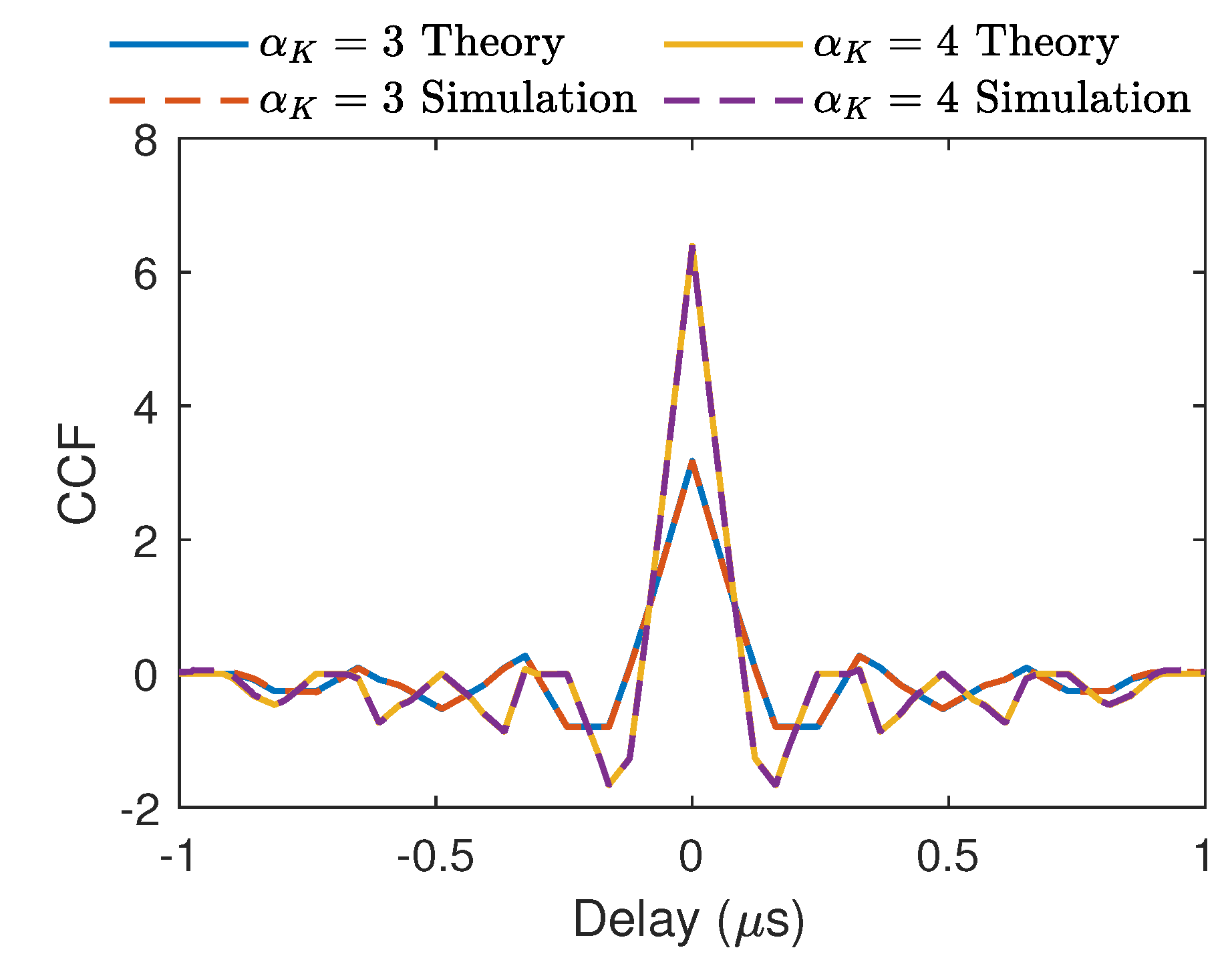
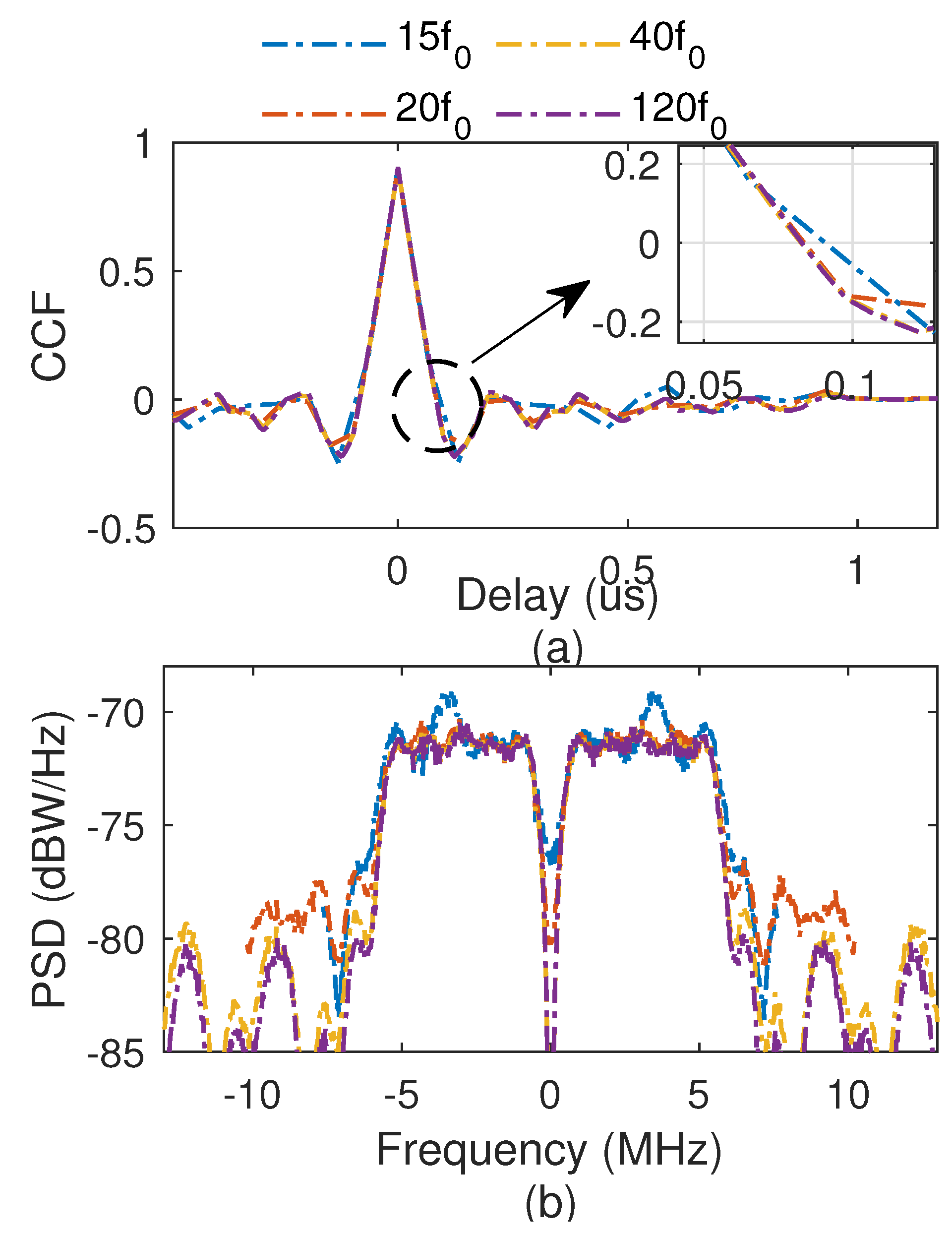
23), we compared the theoretical CCF with the simulated CCF by using CCE-OMBOC(3: 1: 1, 1) and (4: 1: 1, 1).
Figure 2 illustrates that the simulated and theoretical correlations are identical.
Additionally, the fixed ratio
represents the correlation loss caused by multiplexing in CCE-OMBOC(
K: 1: 1, 1), with its value falling within the range (0,1). The correlation loss can be translated into multiplexing efficiency as follows:
where
is the maximum amplitude of CCE-OMBOC and equals
. Even though
is less than 1, CCE-OMBOC significantly enhances multiplexing efficiency compared to OMBOC because the maximum amplitude
of CCE-OMBOC also decreases. Moreover, it has been confirmed that the calculation results of
in (
12) and (
25) are consistent.
In summary, we first derive the CCF expression of CCE-OMBOC, which maintains a fixed ratio relative to the CCF of OMBOC. Apart from enhancing multiplexing efficiency, CCE-OMBOC retains an identical normalized CCF compared to the original OMBOC, resulting in equivalent navigation performance. Thus, the clipping process of CCE-OMBOC has no unfavorable effect on navigation performance.
3.3. Effect of Clipping Level
The clipping level significantly impacts the transmission and multiplexing efficiency of the clipped OMBOC, and it can be chosen according to the amplitude distribution of the OMBOC. Indeed, the complementary cumulative distribution function (CCDF)
is often used to describe the amplitude distribution, and its definition is as follows:
where
denotes the absolute operator.
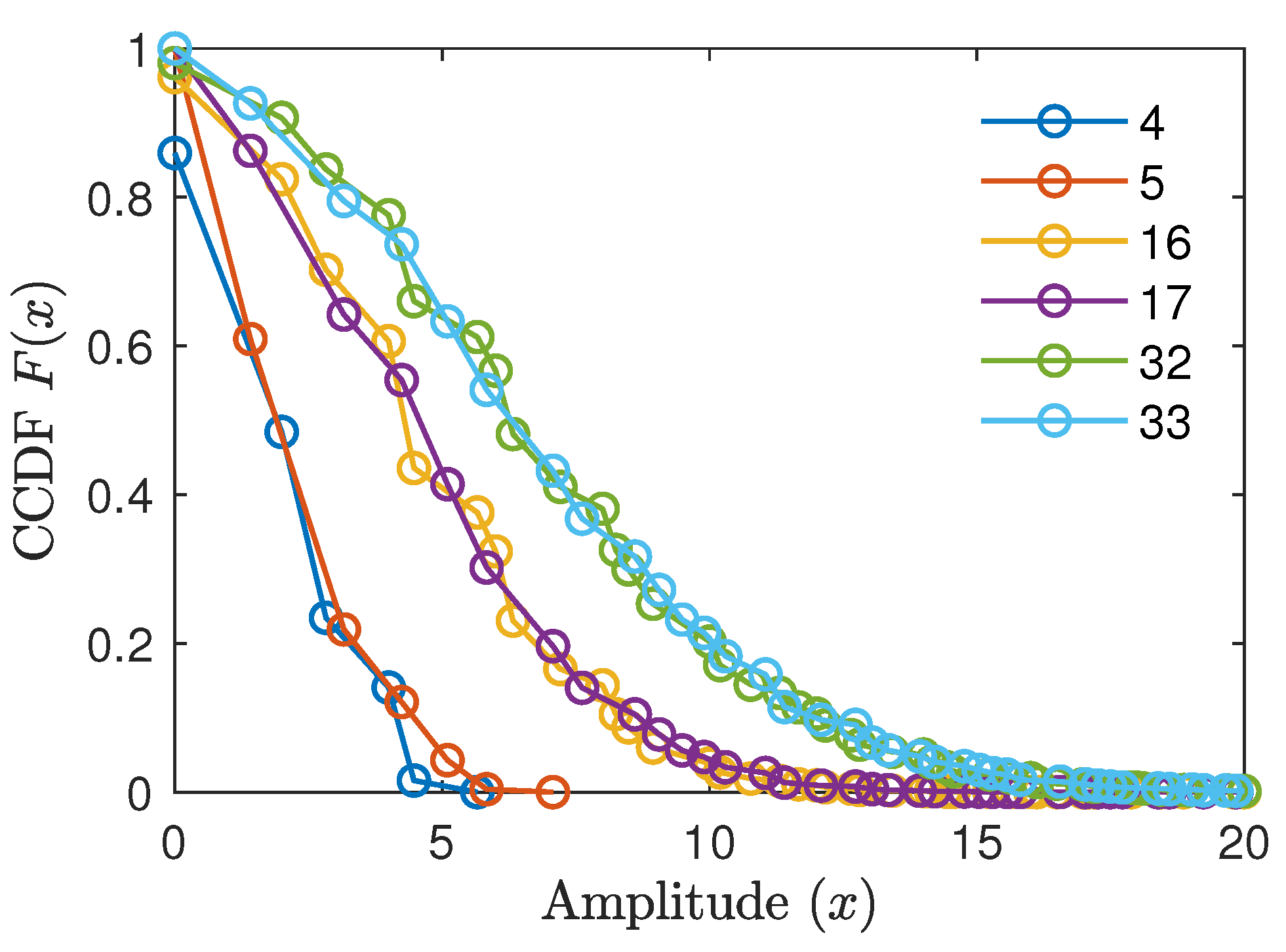
The amplitude distribution of OMBOCs with different numbers of subcarriers is shown in
Figure 3, and we can draw the following conclusions: (1) For different numbers of subcarriers, the OMBOC has different amplitude distributions. (2) Most of the OMBOC amplitude is less than its maximum amplitude; hence, an enormous amount of power for the transmitter’s HPA is wasted. (3) When the number of subcarriers is odd (resp. even), the minimum non-negative amplitude of the OMBOC is
(resp. 2).
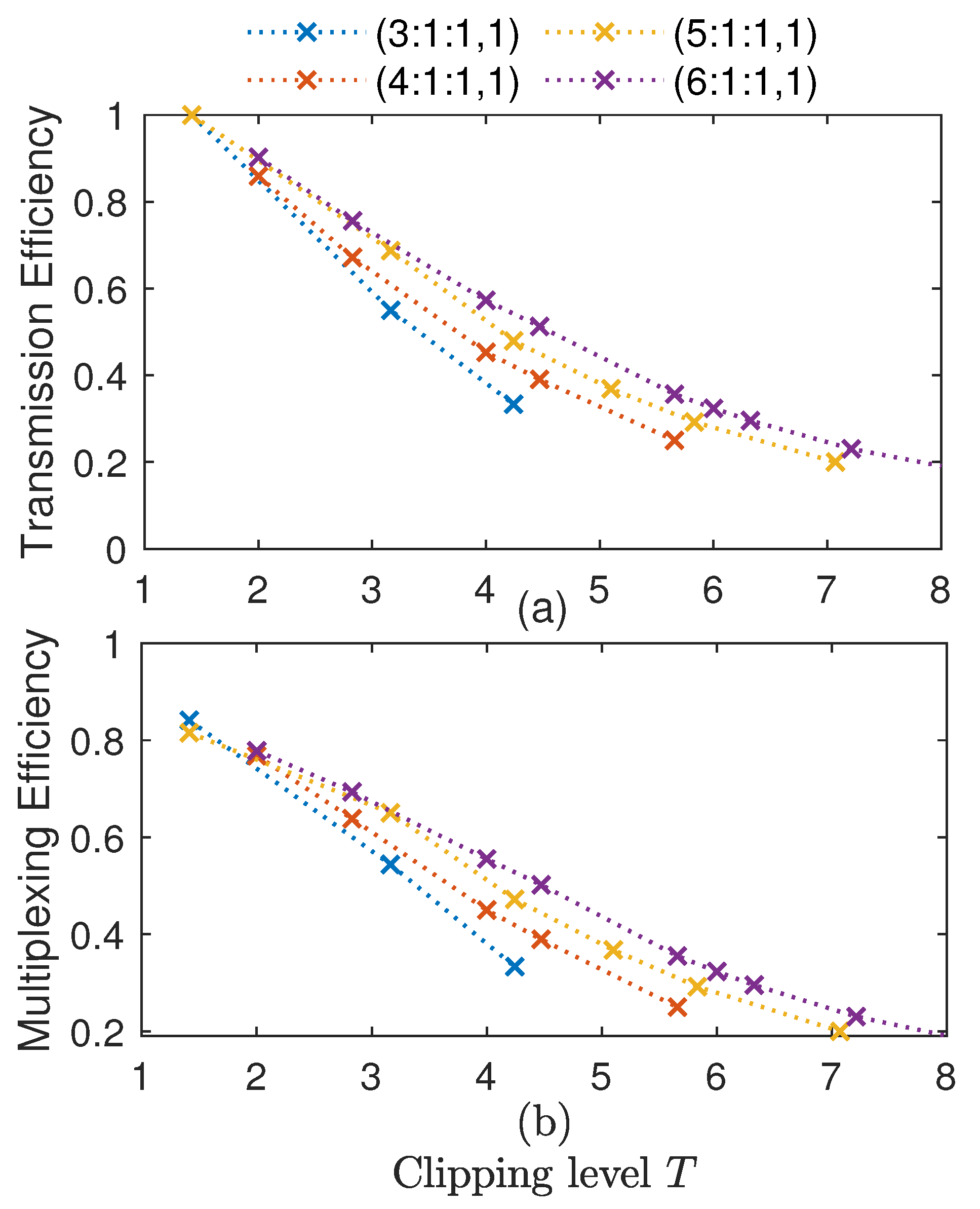
Therefore, the clipping level can be chosen according to the OMBOC amplitude distribution. For different OMBOC signals, the relationship between the transmission efficiency
and multiplexing efficiency
with different clipping levels
T is shown in
Figure 4. We make the following observations:
(1) When the number of subcarriers is odd and the clipping level is , reaches 1. The clipped OMBOC equals CCE-OMBOC and has a constant envelope. (2) On the other hand, when the number of subcarriers is even, the transmission efficiency of the CCE-OMBOC is greater than but less than 1. The reason is that the original OMBOC’s amplitude vector has zero elements and the largest cannot be 1. Thus, the CCE-OMBOC is not a strictly constant envelope due to the zero value. (3) The smaller the clipping level T is, the less power waste there is in the transmitter, leading to higher and . Hence, the CCE-OMBOC has the maximum transmission and multiplexing efficiency, relative to other clipped OMBOCs. Moreover, the multiplexing efficiency of CCE-OMBOC is approximately .
Hence, the CCE-OMBOC with an odd number of subcarriers has a strictly constant envelope, i.e., ; in contrast, the CCE-OMBOC with an even number of subcarriers has a zero point, which slightly reduces the transmission efficiency. CCE-OMBOC has a maximum transmission and multiplexing efficiency, relative to other clipped OMBOCs. The multiplexing efficiency of CCE-OMBOC is approximately .
6. Conclusions
Based on the clipping method, this paper presents a multicarrier CEM technology called the CCE-OMBOC to address the low efficiency of multicarrier navigation signals. We analyzed the function of the clipping level and found that the CCE-OMBOC has better transmission and multiplexing efficiency than other clipped OMBOCs. According to the derived analytical CCF of the clipped OMBOC, the clipping process does not adversely affect navigation performance. We presented the expression of the transmission and multiplexing efficiency and found that the greater the number of subcarriers, the lower the transmission and multiplexing efficiency. The CCE-OMBOC significantly enhances these efficiencies. A proper sampling rate for the CCE-OMBOC is also suggested for its generation system.
The CCE-OMBOC has been compared with several traditional navigation modulation methods. Compared with CEMIC, the CCE-OMBOC has optimal multiplexing efficiency and a simple generation process. Compared with the MV and ACE-FHBOC, the CCE-OMBOC has high tracking accuracy, excellent compatibility, and a low sampling rate. Hence, the CCE-OMBOC is a promising multicarrier broadband navigation modulation method for next-generation GNSS. Due to its flexible bandwidth, it can also be used to integrate communication and navigation.
Based on the CCE-OMBOC, future works will explore CEM methods with arbitrary power allocations for subcarriers and reception strategies for multicarrier navigation signals.