You are currently viewing a new version of our website. To view the old version click .
Remote Sensing
  • Article
  • Open Access

28 September 2023

High-Quality Object Detection Method for UAV Images Based on Improved DINO and Masked Image Modeling


,
,
,
,
,
and
1
Institute of Data and Target Engineering, PLA Strategic Support Force Information Engineering University, Zhengzhou 450001, China
2
27th Research Institute, China Electronic Technology Group Corporation, Zhengzhou 450047, China
*
Author to whom correspondence should be addressed.
This article belongs to the Special Issue Advances and Challenges on Multisource Remote Sensing Image Fusion: Datasets, New Technologies, and Applications

Abstract

The extensive application of unmanned aerial vehicle (UAV) technology has increased academic interest in object detection algorithms for UAV images. Nevertheless, these algorithms present issues such as low accuracy, inadequate stability, and insufficient pre-training model utilization. Therefore, a high-quality object detection method based on a performance-improved object detection baseline and pretraining algorithm is proposed. To fully extract global and local feature information, a hybrid backbone based on the combination of convolutional neural network (CNN) and vision transformer (ViT) is constructed using an excellent object detection method as the baseline network for feature extraction. This backbone is then combined with a more stable and generalizable optimizer to obtain high-quality object detection results. Because the domain gap between natural and UAV aerial photography scenes hinders the application of mainstream pre-training models to downstream UAV image object detection tasks, this study applies the masked image modeling (MIM) method to aerospace remote sensing datasets with a lower volume than mainstream natural scene datasets to produce a pre-training model for the proposed method and further improve UAV image object detection accuracy. Experimental results for two UAV imagery datasets show that the proposed method achieves better object detection performance compared to state-of-the-art (SOTA) methods with fewer pre-training datasets and parameters.

1. Introduction

With the widespread application of unmanned aerial vehicle (UAV) imaging technology, object detection methods capable of obtaining information from UAV images have provided services for urban planning, environmental monitoring, and disaster rescue and significantly reduced the need for human, material, and financial resources. Many UAV image object detection methods have been developed, and convolutional neural network (CNN)-based methods have become mainstream [1,2,3]. Methods based on CNNs mainly include two-stage methods that present high accuracy (such as the region-based CNN (R-CNN) series [4,5,6,7,8,9]) and one-stage methods that present high speed (you only look once (YOLO) series [10], single shot detector (SSD) [11], RetinaNet [12], and fully convolutional one-stage object detector (FCOS) [13]). With the emergence of transformers, especially visual transformers (ViTs) [14], an increasing number of object detection methods have been proposed based on the attention mechanism [15], such as detection transformer (DETR) [16], deformable DETR [17], denoising DETR (DN-DETR) [18], dynamic anchor box DETR (DAB-DETR) [19], shifted window transformer (Swin Transformer) [20], and pyramid vision transformer (PVT) [21,22].
CNN- and ViT-based object detection methods have shown strong performances in different scenarios; nevertheless, the following challenges remain [23,24,25,26]: (1) scene differences, weather changes, sensor performance, and other issues resulting in varied UAV image quality, which hinders high-precision and highly robust object detection; (2) the complexity of the shooting scene and the uneven distribution of objects leading to the presence of noise and fuzzy boundaries on the features extracted using deep learning, which interferes with the performance; (3) different sizes and scales of objects in the images obtained by UAV affecting the accuracy of object detection; and (4) the domain gap between natural scene images and UAV images reducing the accuracy of pre-training models based on natural scene datasets when migrating to downstream UAV image object detection tasks.
To address the above-mentioned challenges, this study constructs a high-quality object detection method for UAV images. The object features extracted from UAV images were fully extracted and the object detection performance in UAV images was enhanced by fusing a high-performance feature extraction backbone and an optimizer with high stability and generalizability in the baseline network and utilizing the aero-space remote sensing scene dataset associated with the UAV image domain to obtain a pretraining model. First, based on the design concept of MetaFormer [27], we constructed a global–local hybrid feature extraction backbone that combines CNN and ViT to fully extract global and local features for the baseline network. Second, AdaBelief [28], which uses an adaptable step size, was used to achieve faster convergence, higher accuracy, better stability, stronger generalizability, and a more reasonable dynamic adjustment of the learning rate. Finally, by employing a dataset which has a very small domain gap with UAV images and a lower data volume relative to mainstream natural scene datasets, a pretraining model was developed based on the masked image modeling (MIM) method. Moreover, the object detection performance of the UAV images was further improved when migrating to downstream tasks. The results of the ablation study and experiments indicate that the proposed method can obtain results with comparable advantages to mainstream and state-of-the-art (SOTA) algorithms. The main contributions of this study are as follows:
(1)
A high-quality UAV image object detection method was developed using the SOTA object detection method as the baseline network;
(2)
A global–local hybrid backbone for feature extraction that combines the advantages of CNN and ViT was built for the baseline network;
(3)
AdaBelief, an optimizer with better stability and generalizability, was used to achieve faster convergence and higher training accuracy by reasonably adjusting the learning rate;
(4)
A pre-training model that better meets the downstream task requirements of UAV images was obtained using the MIM method and an aerospace image dataset with a much lower data volume than current mainstream natural scene datasets. This model further improved the object detection performance of UAV images.
The organization of the remainder of this article is as follows. In Section 2, several mainstream and SOTA object detection methods are reviewed. In Section 3, the proposed method is described. In Section 4, experiments comparing the proposed method with different methods are presented, and the limitations are discussed. Finally, in Section 5, the research is summarized, conclusions are drawn, and perspectives on future research are presented.

3. Proposed Method

3.1. Overall Framework

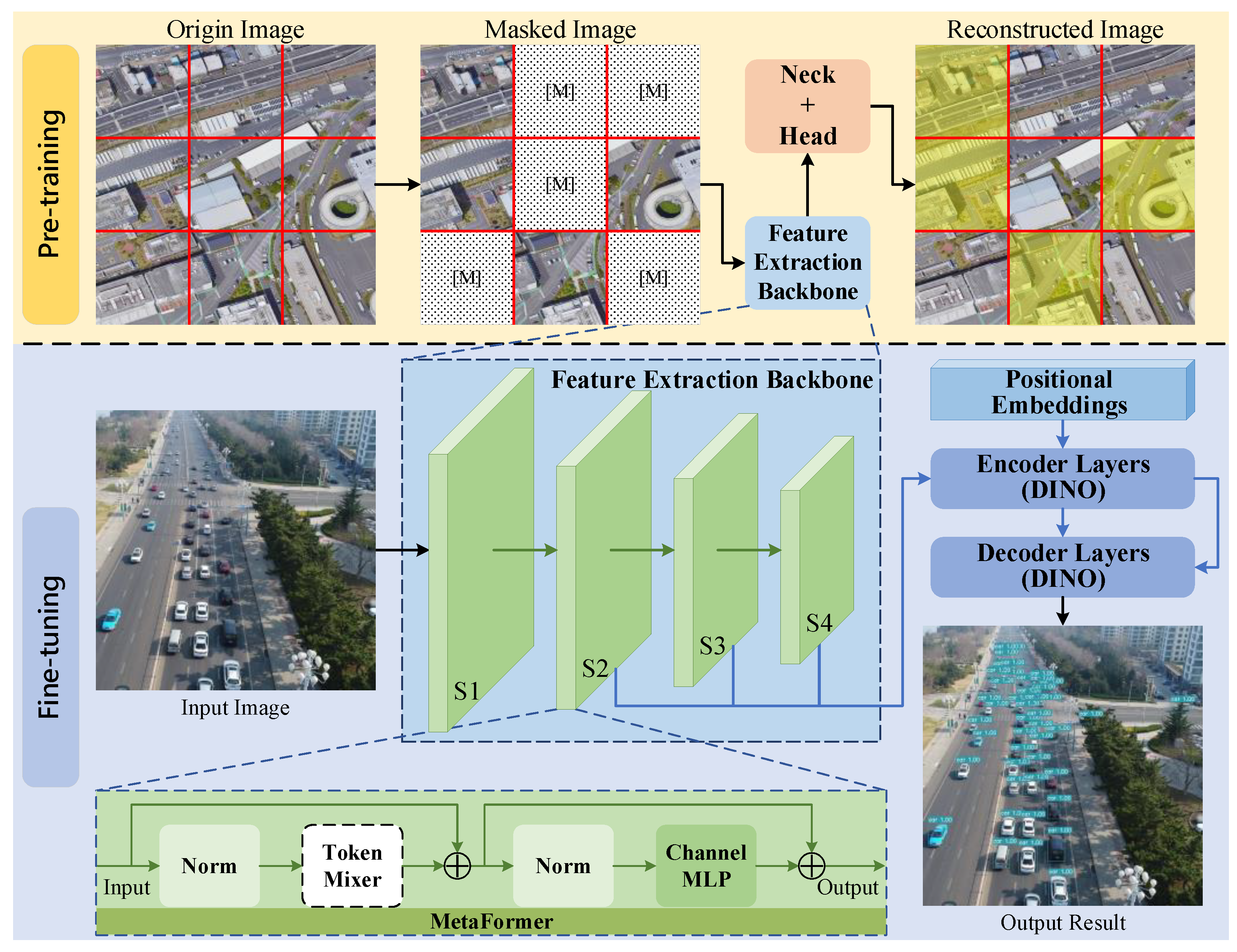
As shown in Figure 1, the main process of the proposed method can be divided into two steps: pre-training and fine-tuning.
Figure 1. Pipeline of the proposed method for UAV images. In the reconstructed image of the pre-training step, the yellow part represents the unmasked content of the image. The features extracted from the feature extraction backbone are fed into the encoder and decoder layers for feature enhancement and result computation.
(1)
In the pre-training step, a self-supervised training method based on SIMMIM was adopted. With the help of the significant similarity between the aerospace remote sensing images and UAV images, an aerospace remote sensing dataset, which has a much lower volume than the mainstream natural scene dataset, was applied to obtain the pre-training model of the proposed feature extraction backbone; thus, the pre-training model can better adapt to object detection in UAV images.
(2)
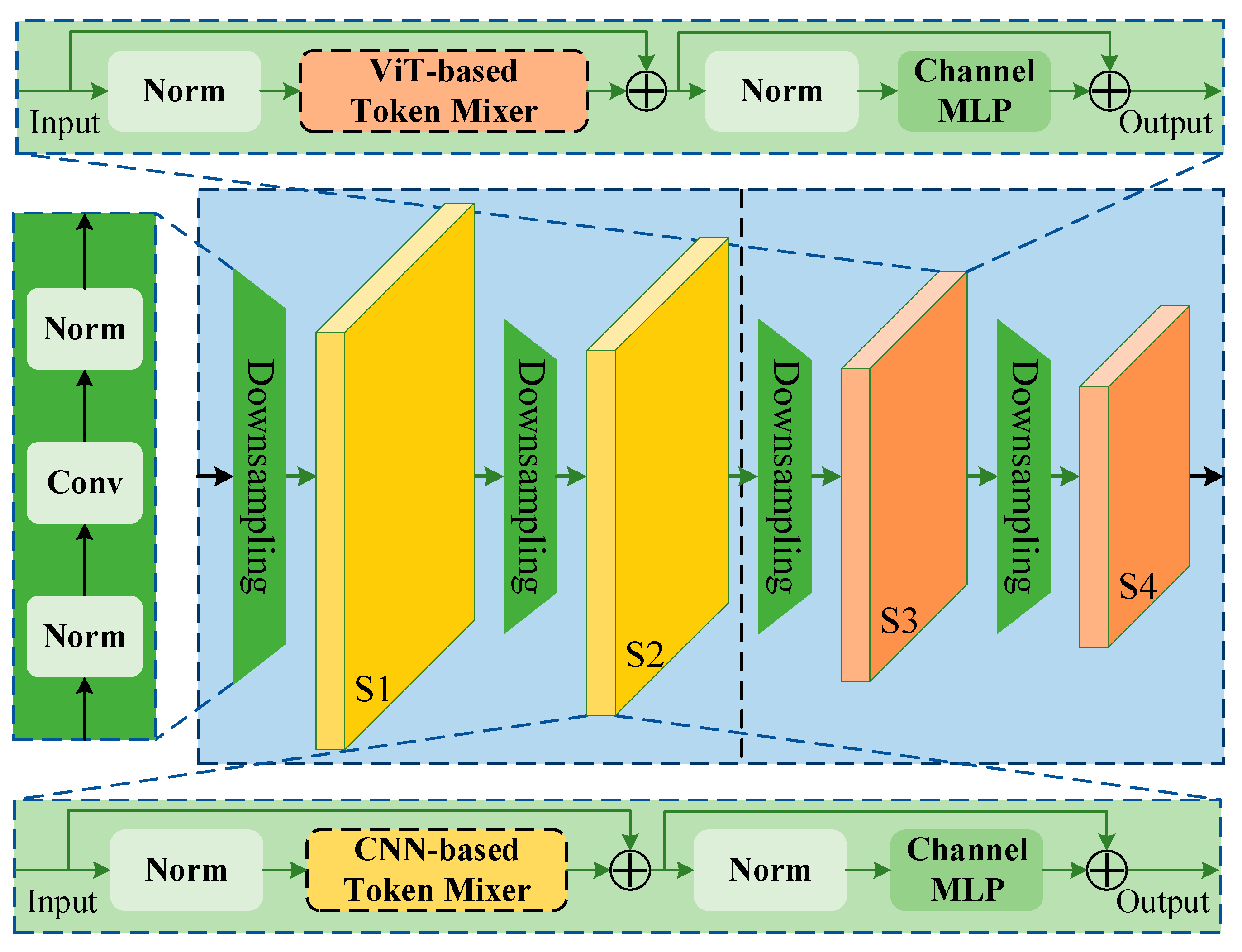
In the fine-tuning step, DINO, which utilizes denoising methods to achieve high-precision object-detection accuracy, was used as the baseline network. In this study, we designed a backbone based on MetaFormer, as shown in Figure 1, and embedded a token mixer suitable for masked image training by combining the CNN and ViT to extract features, which will be transmitted to the encoder layers. The feature extraction backbone has four stages: S1, S2, S3, and S4, with each containing one downsampling module that was not presented and several MetaFormer blocks, introduced in Section 3.2 in detail. Notably, only the extraction features of stages of S2, S3, and S4 in the backbone are input to the encoder layers, which can further reduce computational complexity while maintaining a high performance. After that, the model used the optimizer AdaBelief, which has better stability and generalizability, to further improve network performance.

3.2. Global–Local Hybrid Feature Extraction Backbone

Relevant research shows that the excellent performance of ViTs is mainly attributed to the MetaFormer [27] structure. In addition, MetaFormer can further improve the performance by using different token mixers, especially mixed with CNN and ViT, which can fully utilize the advantages of convolutions and transformers to achieve better results. Therefore, to extract features efficiently, this study designed a global–local hybrid feature extraction backbone based on MetaFormer, as shown in Figure 2, and the process is as follows:
Figure 2. Architecture of the proposed feature extraction backbone. The backbone draws on the design philosophy of the MetaFormer and accomplishes global and local feature extraction hybridization. The backbone consists of four stages (S1, S2, S3, and S4), and each stage contains multiple MetaFormer blocks. The MetaFormer blocks in the first two stages (S1 and S2) contain the CNN-based token mixer, and the MetaFormer blocks in the last two stages (S3 and S4) contain the ViT-based token mixer. The downsampling module is employed to reduce the size of the input image or the feature from the pre-stage.
First, input data I are fed through the downsampling module to obtain the following features:
X = D o w n S a m p l i n g ( I )
where X N × C represents the embedded tokens, and N and C represent the sequence length and dimension obtained through downsampling, respectively.
Subsequently, the embedding token X is input into the following stage. Each stage contains several MetaFormer blocks, and each MetaFormer block contains two residual modules. The first module is primarily used to extract and mix tokens and establish relationships between each token, which can be formulated as
X = T o k e n M i x e r ( N o r m ( X ) ) + X
where N o r m represents standardization, which corresponds to layer normalization (LN) in this article, and T o k e n M i x e r is a module for mixing tokens and is mainly used to propagate token information. There are two types of token mixers: CNN-based and ViT-based token mixers, which are introduced in detail in Section 3.2.1 and Section 3.2.2. The second residual network contains a channel multilayer perceptron (MLP) with nonlinear activation, which can be represented as
X = σ ( N o r m ( X ) W 1 ) W 2 + X
where W 1 C × r C and W 2 r C × C are leachable parameters and σ ( ) represents the nonlinear activation function.

3.2.1. CNN-Based Token Mixer

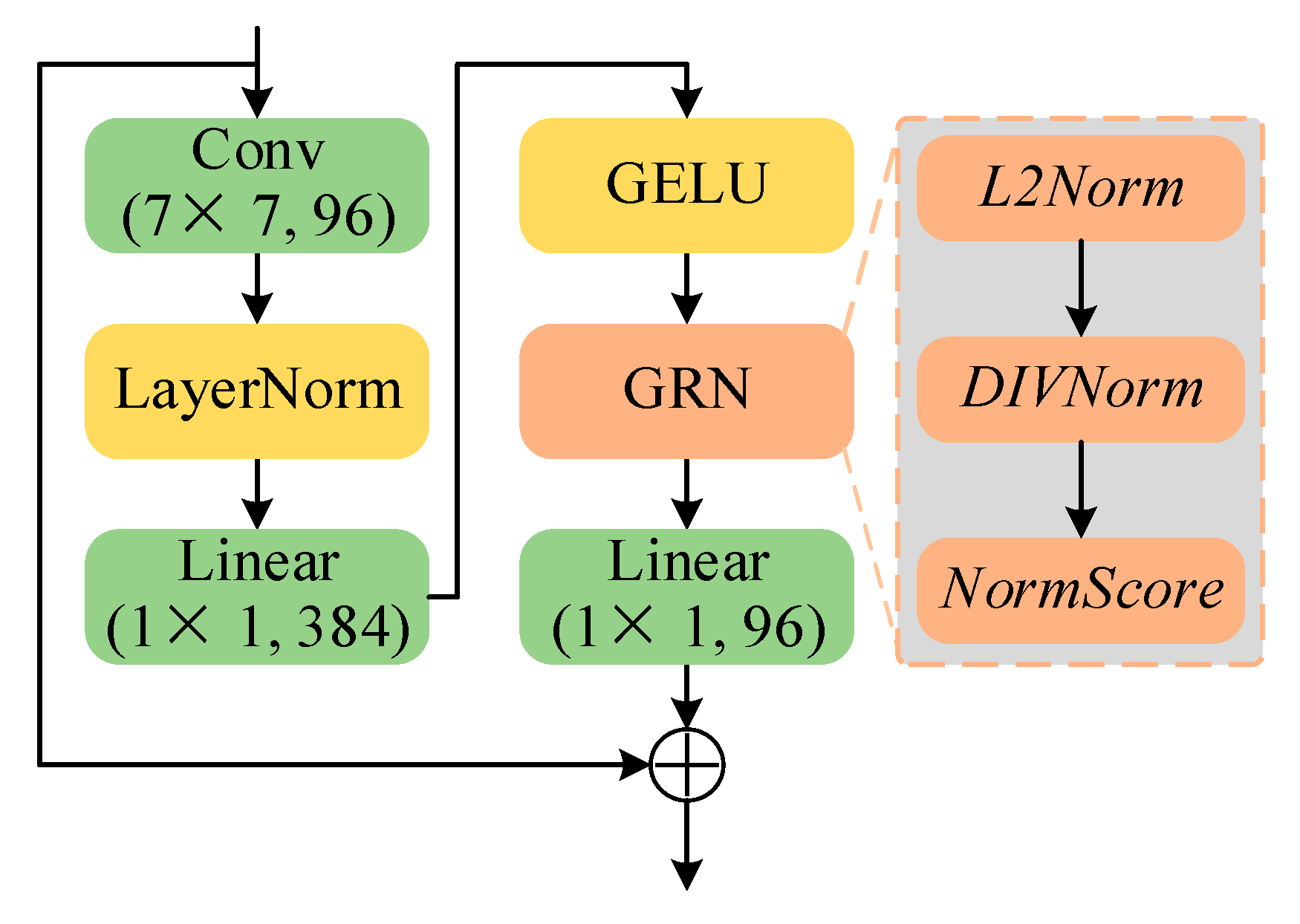
Based on the standard ConvNet module, the ConvNeXt [35] module showed better performance in terms of accuracy, scalability, and robustness than models such as the Swin Transformer by utilizing different designs that have been validated by various methods over the past decade. More importantly, ConvNeXt maintains the efficiency of ConvNet, does not require complex modules such as shift window attention and relative position encoding, and is very easy to implement during training and testing. However, ConvNeXt is primarily aimed at supervised learning tasks, and the expected results cannot be obtained directly using ConvNeXt for unsupervised tasks [36]. Therefore, based on ConvNeXt, a new global response normalization (GRN) module was used in ConvNeXt v2 [36] to improve the feature competition between channels. The feature competition is enhanced when GRN is combined with the masked autoencoder method, which can achieve better performance. Given its excellent characteristics, the CNN-based token mixer was based on ConvNeXt v2, as shown in Figure 3.
Figure 3. Architecture of the CNN-based token mixer for global feature extraction.
GRN can increase the contrast and selectivity of channels and is the main reason why ConvNeXt v2 can effectively utilize MAE for pre-training. In Figure 3, when spatial feature maps X R H × W × C are input into GRN, a feature aggregation layer implemented using the L2-norm in the L2Norm module had to be crossed to obtain the aggregated features:
X L 2 = G ( X ) = L 2 - n o r m ( X )
where X L 2 = { X 1 , X 2 , , X C } and X i represent the scalars of the statistics of the i-th aggregated channel. In GRN, DIVNorm uses the response normalization to calculate the relative importance score of aggregated features under a certain channel compared to features under other channels:
X N i = N ( X i ) = X i j = 1 , 2 , , C X j
Finally, the scores obtained from the NormScore module were used to calibrate the original inputs.
X i = X i X N i
Meanwhile, to facilitate the optimization of GRN, the final GRN structure is
X i = γ X i X N i + β + X i
where γ and β are two leachable parameters that are initialized with 0.

3.2.2. ViT-Based Token Mixer

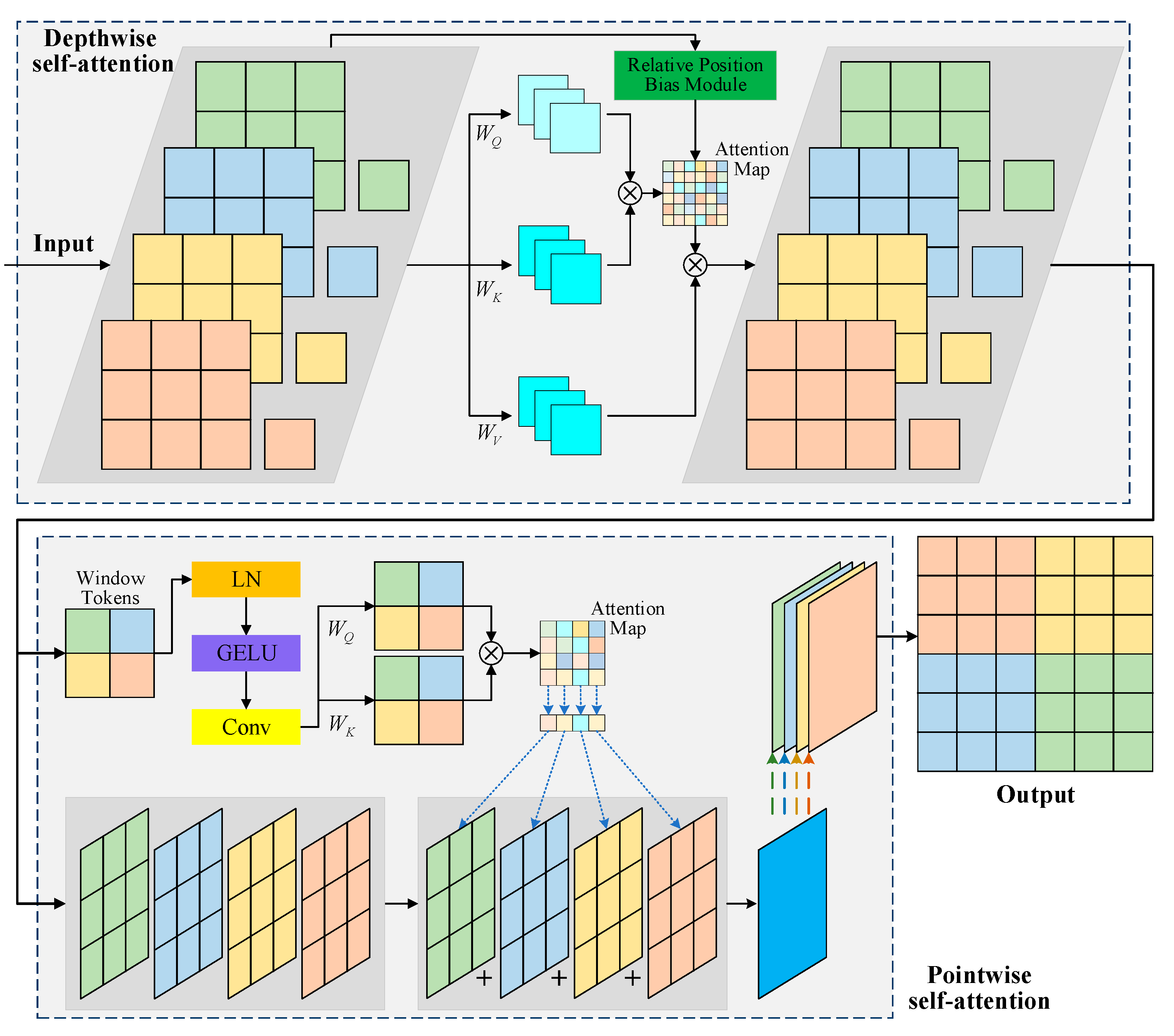
ViT requires a large computational workload to achieve excellent performance. To address this problem, SepViT [42] combines depthwise and pointwise self-attention to construct a deep separable self-attention module. Local features within each window are obtained using depthwise self-attention, global attention is obtained between different windows using pointwise self-attention, and depthwise and pointwise self-attention are combined to capture local and global dependencies. To add bias to depthwise self-attention, this study draws on Swin Transformer [20] and DAT [44] and adopts relative position bias B r e l a t i v e to encode the relative positions between each query and key, thereby enhancing the spatial information of the attention mechanism. The ViT-based token mixer constructed in this study is illustrated in Figure 4.
Figure 4. Architecture of the ViT-based token mixer for local feature extraction, which is an improved SepViT with relative position bias. Four windows are obtained when input data are divided in depthwise self-attention.
In depthwise self-attention, a series of windows are obtained after input data are divided (as shown in Figure 4). For each window, a window token is created that can achieve a global representation of the window, thereby modeling the relationship for attention in the subsequent processing.
Then, the operations of depthwise self-attention are carried out on each window and the corresponding window token to achieve the fusion of spatial information within each channel. The process can be expressed as follows.
Q = x W Q , K = x W K , V = x W v
z ˜ = Q K T / d + B r e l a t i v e
D W A ( x ) = σ ( z ˜ ) V
where x represents the feature tokens; W Q , W K , and W V represent the linear layers for obtaining the query, key, and value, respectively; and σ is the softmax function. After obtaining z ˜ , a learnable relative position offset B r e l a t i v e ( q ) is added to z ˜ , and then D W A ( x ) can be obtained using the self-attention mechanism calculation method.
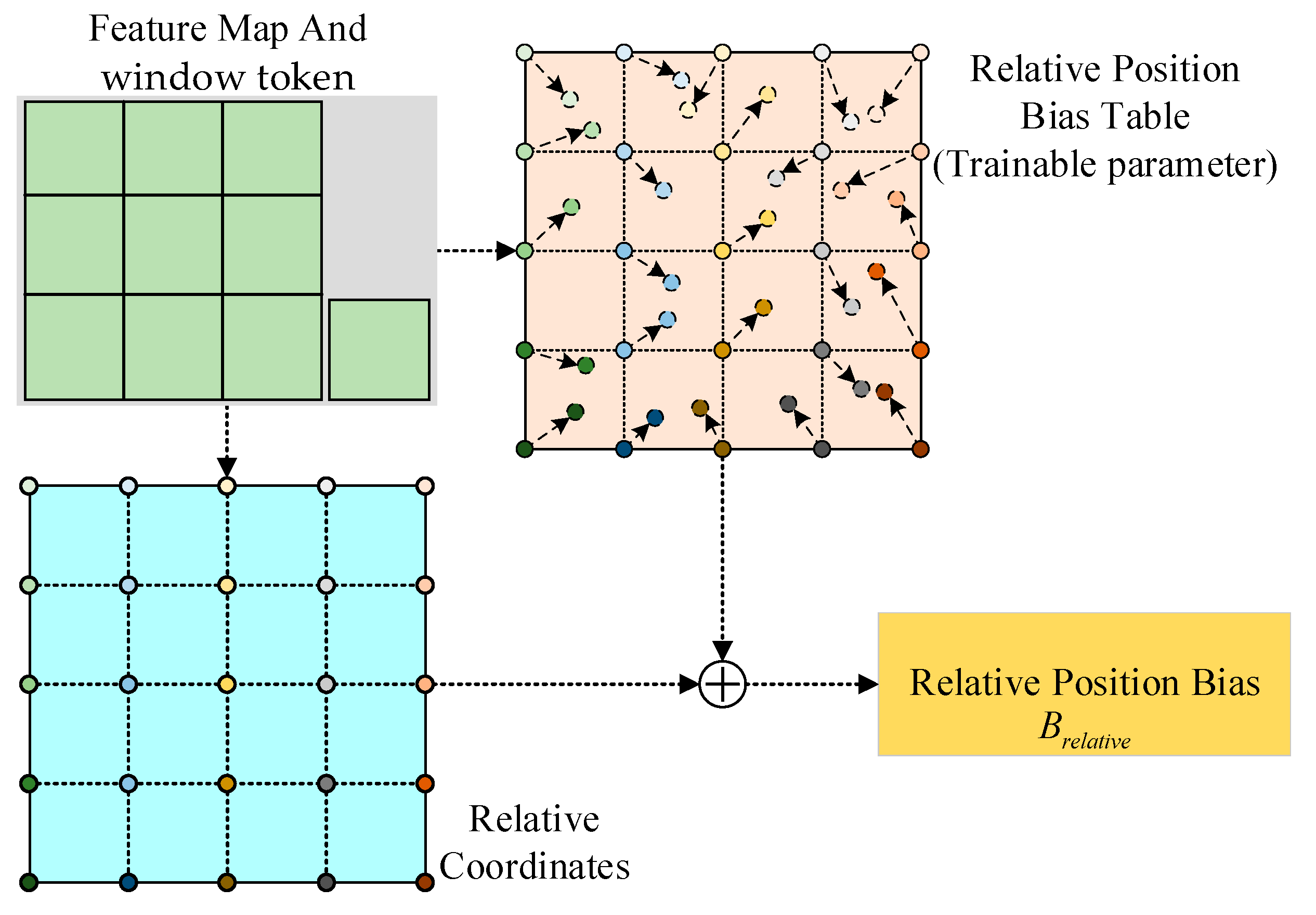
For the window and corresponding window token obtained by depthwise self-attention, due to the changes in their shape, this article constructs a reference window that is one size larger than the input feature map, as shown in Figure 5. A relative position encoding B r e l a t i v e ( H × W + 1 ) × ( H × W + 1 ) was obtained, where H and W represent the height and width of the window, respectively. The relative positions of a feature map on different coordinate systems are within the ranges [ H , H ] and [ W , W ] . This project constructs a small-scale offset matrix B ^ ( 2 H 1 ) × ( 2 W 1 ) , calculates the relative displacement within the normalized range [ 1 , + 1 ] , and interpolates B r e l a t i v e from B ^ ( 2 H 1 ) × ( 2 W 1 ) to obtain all possible offset values. In addition, the relative position deviation learned in pre-training can also be initialized by bicubic interpolation to create a fine-tuning model with different window sizes.
Figure 5. Relative position bias module.

3.3. Efficient Optimizer for Training

The optimizers used in most models are stochastic gradient descent (SGD) with acceleration strategies or adaptive AdamW. AdamW is faster than SGD but has poor generalizability. However, AdamW is widely used in complex networks owing to its stability.
In this study, the proposed method is relatively complex, and to obtain faster, better, and more stable optimization results, a more efficient optimizer is required. AdaBelief [28] was used as the optimizer in this study because of its fast convergence, which is similar to that of AdamW, and its better generalizability and training stability, which are similar to those of SGD.
AdaBelief is a modification based on Adam in which the step size is adjusted based on the current gradient direction. The prediction of the next time step is represented by the exponential moving average of the noise gradient. If the current gradient differs significantly from the prediction, then the current gradient direction is not trusted, and only a small step is taken; otherwise, the current gradient is trusted and a large step is taken. Many experimental results have shown that AdaBelief has faster convergence and higher precision in image classification and language modeling, which indicate that it shows better performance.
Using f as the optimization objective function, θ t as the t-th iteration model parameter, B t as the training parameter, and η as the learning rate, the optimization steps of AdaBelief are as follows:
g t = θ t 1 f ( B t , θ t 1 )
θ t = θ t 1 η g t
M t = ( 1 β 1 ) g t + β 1 M t 1
s t = ( 1 β 2 ) ( g t M t ) 2 + β 2 s t 1
where M t is the momentum direction, and β 1 and β 2 are hyperparameters. The optimization process can be expressed as
θ t = θ t 1 α M t s t + ε
where α represents the learning rate, and ε is used to prevent the parameters from dividing by 0.

3.4. Masked-Based Pretraining Model

Currently, the backbones of various object detection methods are trained on natural scene datasets and migrate to downstream tasks. Owing to the domain gap between natural and UAV aerial photography scenes, existing pre-training models cannot be well applied to the object detection of the UAV image. Therefore, directly using existing pre-training models affects the accuracy improvement of UAV image object detection. In addition, existing natural scene datasets are too large, and require enormous computational resources during the pre-training process, which hinders academic research and practical implementation.
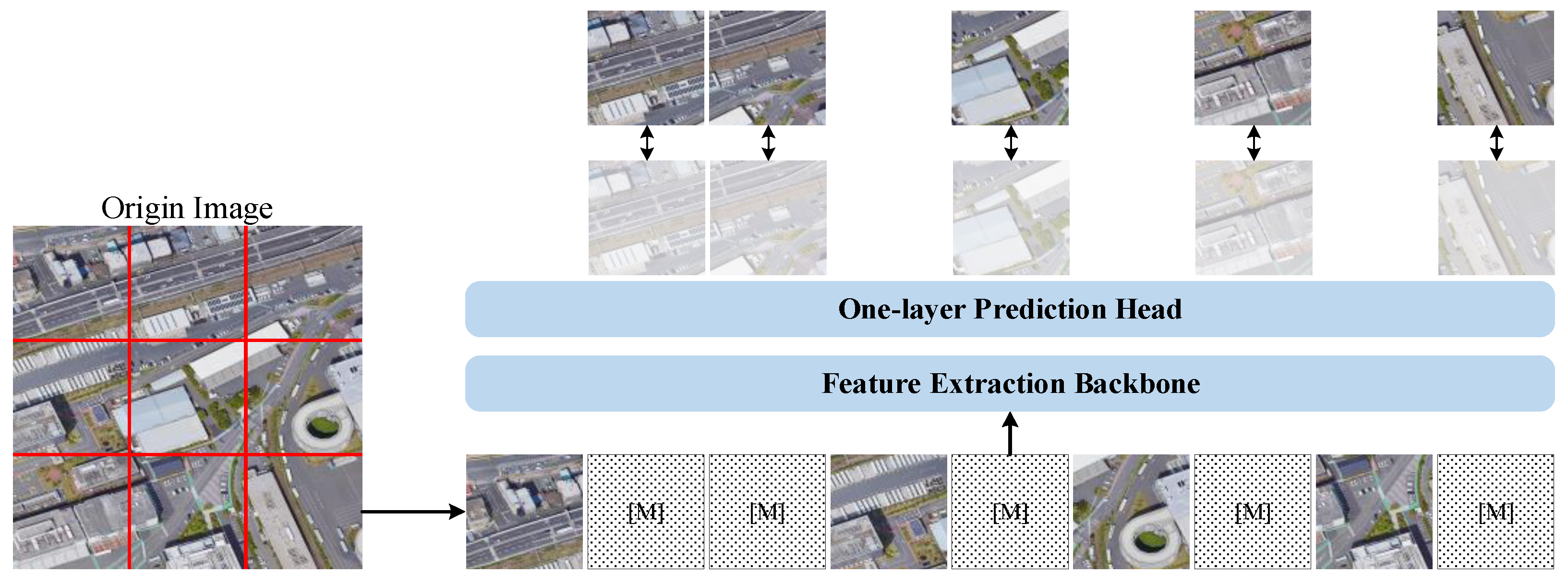
In response to the proposed overall framework and hybrid backbone, this study utilized publicly available aerospace remote sensing datasets with much less data volume than natural scene datasets (such as ImageNet-1k), which are similar to UAV images, to achieve better support for the object detection of UAV images. The pre-training process is implemented based on the SIMMIM model, as shown in Figure 6.
Figure 6. Pre-training model training process based on SIMMIM.
Compared to MAE, SIMMIM has a lightweight decoder and receives structured inputs, making it more suitable for extracting features using complex backbones containing ViTs. Additionally, during the model prediction process, SIMMIM directly predicts the pixels contained in the masked area through regression. However, because many currently designed backbones use down-sampled feature maps, SIMMIM maps each feature vector back to its original size and assigns this vector to predict the corresponding pixels to predict the original image data at full resolution.
In this study, the input image was first segmented according to a given patch size, and the divided image was then masked using a random mask strategy according to the mask rate. The masked image was used as the input for the subsequent process. The masked input data were then input into an encoder structure containing the proposed backbone, which extracts potential features for the masked images to predict the raw information of the masked area. In this study, the learned encoder structure was transferred to the model structure.

4. Experiments and Results

4.1. Experiments Setting

4.1.1. Pre-Training Datasets

FAIR1M [65]: This dataset is a fine-grained high-resolution dataset of remote sensing scenes suitable for object detection with over 40,000 images and 1 million instances. The resolutions of images in FAIR1M range from 0.3 to 0.8 m and are distributed across multiple countries and regions in Asia, America, and Europe. All images in FAIR1M were annotated using directed bounding boxes involving 5 categories and 37 subcategories. A comparison with the current mainstream dataset used for pre-training is shown in Table 1.
Table 1. Information on the different datasets used for pre-training.
As shown in Table 1, the FAIR1M images have fewer images and categories than the COCO 2017, ImageNet-1k, and Objects365 datasets; however, the number of instances is relatively large. Moreover, the storage space required for FAIR1M is relatively low. Therefore, FAIR1M has high data quality and instance density. Compared to DOTA v2.0, FAIR1M has a slightly lower instance density but only occupies 31% of the storage space; moreover, it includes richer fine-grained categories, making it suitable for conducting model pretraining tasks and transferring to downstream tasks. More importantly, compared to the mainstream datasets used for pre-training, such as COCO 2017 and ImageNet-1k, the FAIR1M dataset mainly consists of remote sensing images. The acquisition method and environment of the image in FAIR1M dataset are similar to UAV images, and the resolution is also relatively similar, which indicates that the domain gap between FAIR1M and UAV images is relatively smaller.

4.1.2. Fine-Tuning Datasets

The fine-tuning datasets used for object detection tasks in this study included the AFO and UAVDT.
UAVDT [68]: This dataset is based on vehicle traffic content captured by UAVs, contains approximately 8000 frames of images selected from 10 h of raw video, and can be used in the tasks of object detection, single-object tracking, and multi-object tracking. In the UAVDT dataset, 75.0%, 15.0%, and 10.0% of the UAV images were used for training, testing, and validation, respectively.
AFO [69]: This dataset was extracted from over 50 UAV videos for deep learning with resolutions ranging from 1280 × 720 to 3840 × 2160 , and it includes 3647 images with 39,991 manually labeled individuals and floating objects on water, many of which are small-scale objects that are difficult to detect. In this dataset, 76.6%, 14.1%, and 9.3% of the images were used for training, testing, and validation, respectively.

4.1.3. Implementation Details

The processes of pre-training and fine-tuning in this study used the same training workbench running on an NVIDIA GeForce RTX 3090 GPU.
The process of obtaining a pre-trained model of the proposed backbone in this study was based on SIMMIM using the aerospace remote sensing dataset FAIR1M. The relevant hyperparameters in SIMMIM are shown in Table 2.
Table 2. Relevant hyperparameters in SIMMIM during pre-training.
All backbones involved in the comparison used the officially released models to initialize the parameters, and these models are obtained based on the ImageNet-1K dataset. Except for ResNet-50, ResNet-101, and ResNeXt-101, which had 200 training epochs, all other backbones had 300 training epochs. Some 50 epochs were employed in the fine-tuning stage. The images in UAVDT and AFO were resized to 448, and the random flip was 0.5. The optimizers used in the proposed and comparative methods were AdaBelief and AdamW, respectively. All optimizers used a learning rate of 0.0001 and a weight decay of 0.0001.

4.1.4. Evaluation Metrics

The metric used to evaluate the performance of the proposed and comparative method was mean average accuracy (mAP) of the dataset [37,45], which was obtained as follows:
A P i = 0 1 P i ( R ) d R
m A P = 1 C i = 1 C A P i
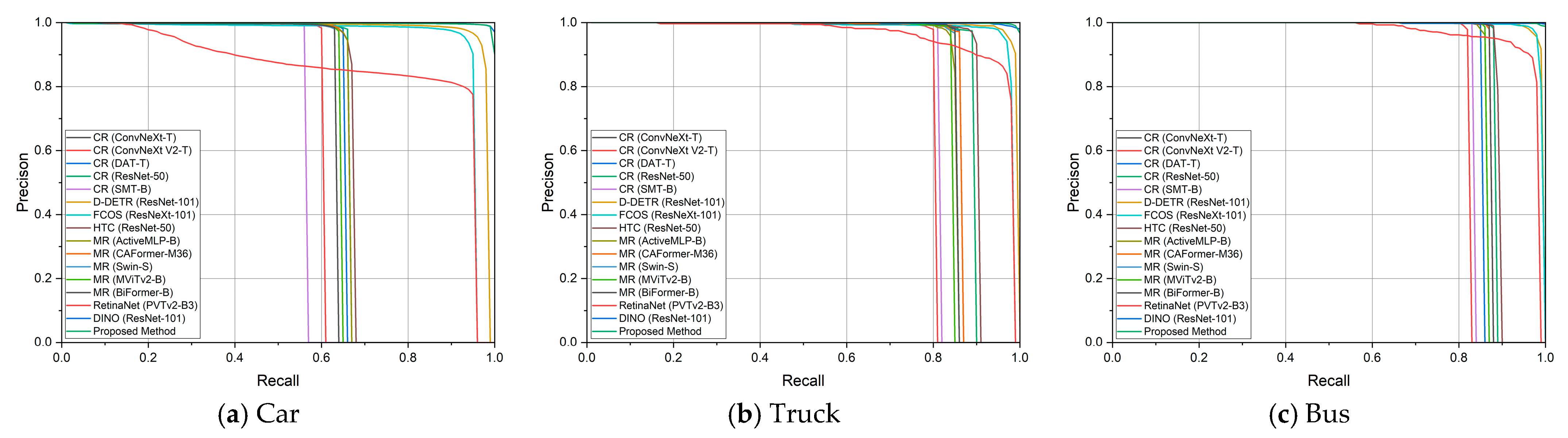
where R , P i ( ) , and A P i represent the recall rate accuracy rate, and average accuracy of category i , respectively, C represents the number of categories, and i = ( 1 , 2 , , C ) . The precision recall (PR) curve was also used to indicate the different performances of each method. For a specific category, the PR curve was obtained by calculating the precision and recall values.
P r e c i s i o n = T P T P + F P
R e c a l l = T P T P + F N
where TP represents a true positive, which means that the intersection-over-union (IoU) between the obtained bounding box and ground truth (GT) is greater than a given threshold; otherwise, a false positive (FP) was obtained. When an object in the GT region does not have a corresponding bounding box in the detection results, the GT is treated as a false negative (FN).

4.2. Ablation Study

The most significant feature of DINO is its use of comparative denoising training methods to achieve high-performance end-to-end object recognition. However, the performance of DINO is poor when applied to detect objects in UAV images. Therefore, DINO was used in this study as the baseline to construct a method for obtaining high-quality object detection results for UAV images. DINO was implemented in MMDetection, an object detection toolbox and benchmark, and the hyperparameters were consistent with the vanilla DINO [39], where the number of queries was 900, a six-layer transformer encoder in the encoder layers and a six-layer transformer decoder in the decoder layers were used, and the hidden feature dimension was 256. Based on the baseline network, an ablation study was conducted using a backbone, an optimizer, and a dataset.
Global–Local Hybrid Feature Extraction Backbone: Based on MetaFormer, this study used a CNN-based token mixer in the first two stages and a ViT-based token mixer in the latter two stages. By combining the characteristics of CNN and ViT, a global–local hybrid feature extraction backbone was constructed, which contained stages S1, S2, S3, and S4. The block depths were 6, 12, 14, and 2, and the dimensions were 64, 128, 320, and 512. Although the network has four stages, the proposed method in this study only uses features from S2 to S4 for transmission to the encoder layers (as shown in Figure 1).
Efficient Optimizer: This study used AdaBelief as the optimizer to modify the step size based on different gradient conditions obtained and to achieve faster convergence, higher precision, and better performance.
Based on the UAVDT and AFO datasets, the ablation study was conducted and the results are listed in Table 3. The vanilla backbone for DINO was ResNet-101, and the default optimizer was AdamW. The proposed method adopts the proposed global–local hybrid feature extraction backbone and conducts pre-training on the FAIR1M dataset. The optimizers used were AdamW and AdaBelief.
Table 3. Results of ablation study based on the UAVDT and AFO datasets. The proposed backbone is the global–local hybrid feature extraction backbone.
As shown in Table 3, the proposed method significantly reduced the number of parameters by more than 10%. Simultaneously, the proposed method achieved the same or even better performance than the comparison methods with the AdamW optimizer, but did not significantly improve the model complexity. When different optimizers are used, the proposed method in this study can effectively enhance the object detection accuracy, particularly for the AFO dataset.

4.3. Experiment Results

In this section, the performance comparison results between the proposed method and mainstream SOTA methods based on the UAVDT and AFO datasets are present.

4.3.1. Experimental Results for UAVDT

The input images of UAVDT were resized to 448 × 448 without maintaining the scale. A detailed comparison was conducted, and the evaluation metrics included the object detection precision, model parameters, and computational complexity, as shown in Table 4.
Table 4. Performance comparison for object detection for the UAVDT dataset. All models have a fine-tuning training epoch of 50. The unit of model parameter quantity is million, and the model complexity is represented by floating point operations per second (FLOPs). The values marked with red, green, and blue represent the three best-performing models.
As shown in Table 4, for mAP, the proposed method achieved a very similar performance to that of the optimal model (Vanilla DINO) and reduced the number of parameters by 12.88%. Some metrics, such as AP75, were better than those of the optimal model. In addition, the proposed method has a more significant performance advantage while maintaining a minimum quantity of parameters. For example, the proposed method has slightly fewer parameters than Deformable DETR, but significantly improves the performance. In addition, the proposed method has achieved a high performance in terms of object detection of small size. However, the FLOPs of the proposed method increased significantly.
A comparison of the P–R curves between the proposed and comparative methods in different categories is shown in Figure 7. The results indicate that the proposed method achieved strong performance in different categories.
Figure 7. P–R curves of different categories obtained using different methods on the UAVDT dataset.
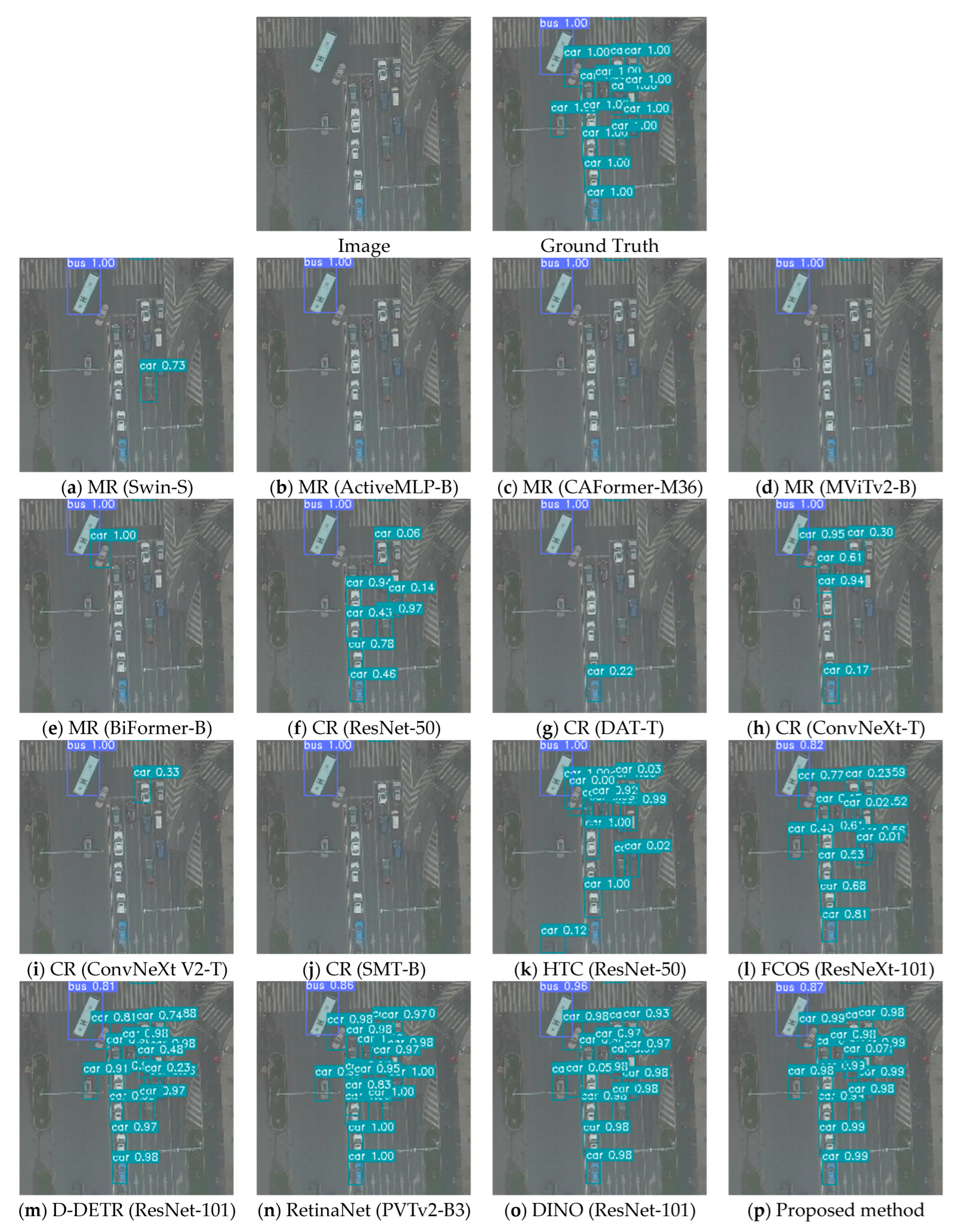
To intuitively demonstrate the effectiveness of the proposed method, partial object detection results from the UAVDT dataset were selected, and are shown in Figure 8 and Figure 9. The findings show that the proposed method can obtain relatively high performances in low-visibility and poor imaging environments (for example, during nighttime), and has fewer object detection errors, especially for small objects.
Figure 8. Visualization results of object detection for the first selected image in the UAVDT dataset. MR represents Mask R-CNN, CR represents Cascade R-CNN, and D-DETR represents Deformable DETR.
Figure 9. Visualization results of object detection for the second selected image in the UAVDT dataset. MR represents Mask R-CNN, CR represents Cascade R-CNN, and D-DETR represents Deformable DETR.

4.3.2. Experimental Results for AFO

The input images of AFO were reshaped as that of the UAVDT without maintaining the scale. A detailed comparison was conducted, and the evaluation metrics included object detection precision, model parameters, and computational complexity, as shown in Table 5.
Table 5. Performance comparison for object detection for the AFO dataset. All models have a fine-tuning training epoch of 50. The unit of model parameter quantity is million, and the model complexity is represented by FLOPs. The values marked with red, green, and blue represent the three best-performing ones.
The proposed method has obvious advantages for object detection (Table 5). For mAP, the proposed method obtained optimal performance in terms of AP and AP75, and high performance in terms of AP 50. In addition, the proposed method showed a strong performance in the detection of objects of different sizes, especially for small objects, and was significantly better than other methods, proving its effectiveness for multi-scale objects.
A comparison of the P–R curves between the proposed and comparative methods in different categories is shown in Figure 10. The results indicate that the proposed method achieved high performance in different categories.
Figure 10. P–R curves of different categories obtained using different methods on the AFO dataset.
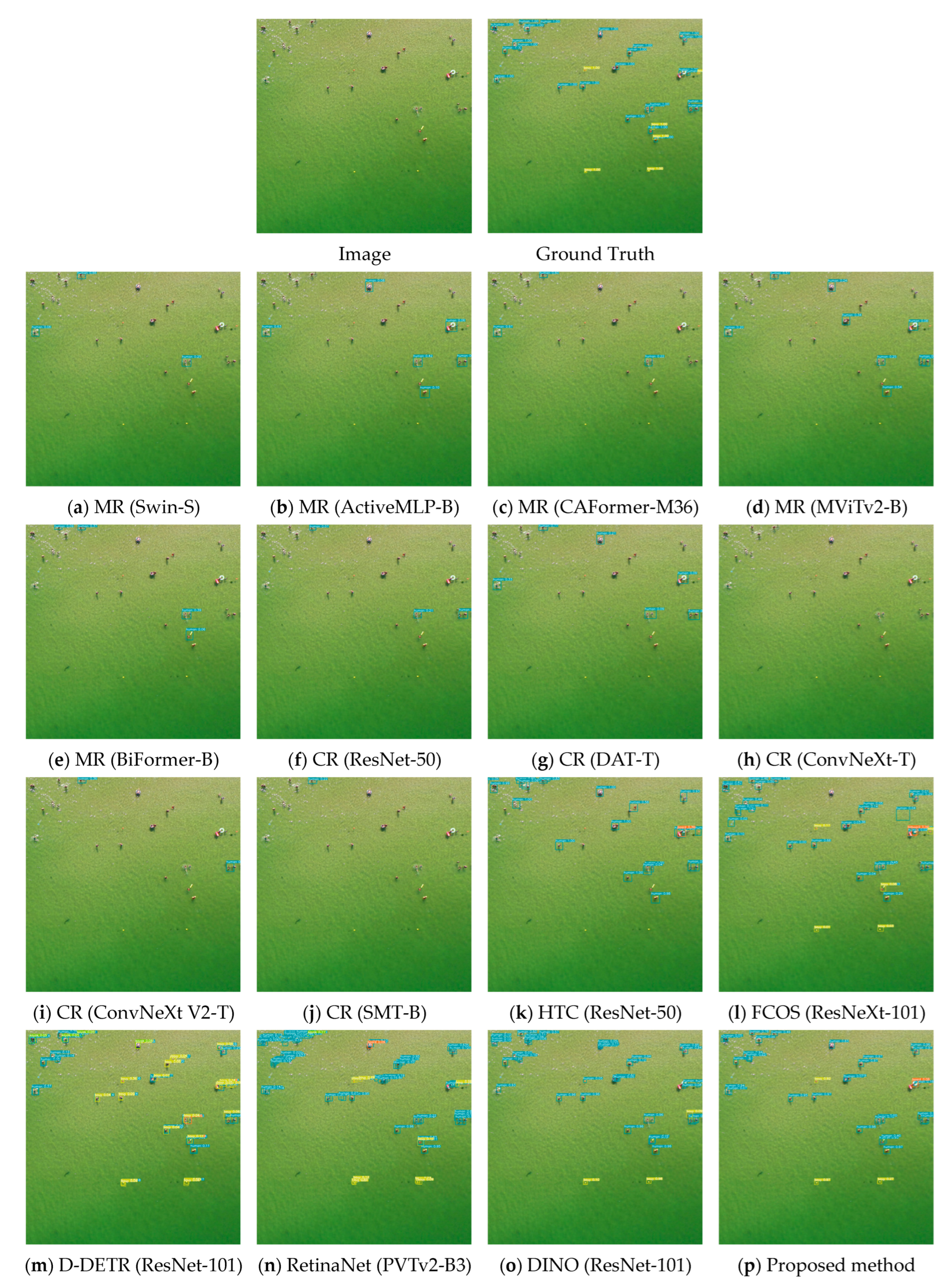
To intuitively demonstrate the better performance of the proposed method, the results of partial object detection for the AFO dataset were selected, and are shown in Figure 11. The proposed method achieves relatively good results in low-visibility and poor imaging environments (for example, at nighttime), and has fewer object detection errors, especially for small objects.
Figure 11. Visualization results of object detection for the selected image for the AFO dataset. MR represents Mask R-CNN, CR represents Cascade R-CNN, and D-DETR represents Deformable DETR.

4.4. Limitations

Based on the SOTA model DINO, this study presented a higher-performance global–local hybrid feature extraction backbone for UAV image object detection, utilized a pretraining method SIMMIM to construct a pretraining model, combined it with a more robust optimizer to achieve better performance compared to other SOTA models, and effectively reduced the number of parameters. Nevertheless, the computational complexity of the proposed method is still high, and the completion of convergence takes a long time. In addition, the proposed method has no significant advantage in some metrics, and requires further improvements. Finally, the image processing efficiency of the proposed method is lower than that of the other SOTA models, and requires further optimization.

5. Conclusions

In this study, a high-quality object-detection method for UAV images was developed, and DINO was used as the baseline. Based on MetaFormer, a CNN and ViT hybrid feature extraction backbone that can fully extract global and local feature information was constructed, and an optimizer with better stability and generalizability was adopted to obtain more efficient convergence and better performance during training. More importantly, the proposed method can achieve optimal and high performances of some metrics and reduce the number of parameters, as indicated in Table 4 and Table 5. Simultaneously, to solve the problem of inappropriateness of pretrained models based on natural scenes for the object detection of UAV images, FAIR1M, an aerospace remote sensing scene dataset, which is much smaller than the natural scene dataset, was employed for the pretraining process based on the SIMMIM method. Then, it was migrated to the proposed method to fully extract features in UAV images to accomplish high-quality object detection, especially according to the AP75 metrics, to achieve optimal results for the UAVDT and AFO datasets.
The proposed method achieved better object detection accuracy compared to SOTA methods with fewer pretraining datasets and parameters, which can further promote the effective application of UAV images. However, the proposed method has shortcomings, as discussed in Section 4.4; therefore, the construction of high-precision and -throughput and lightweight models will be considered in subsequent studies. For this purpose, lighter network structures (e.g., RetinaNet), a more efficient backbone (e.g., MobileViT), and more reasonable training methods (e.g., knowledge distillation) will be adopted.

Author Contributions

Conceptualization, W.L. (Wanjie Lu) and C.L.; methodology, C.N. and W.L. (Wei Liu); validation, S.W.; formal analysis, S.W. and J.Y.; investigation, W.L. (Wanjie Lu); resources, W.L. (Wei Liu) and J.Y.; data curation, W.L. (Wei Liu) and J.Y.; writing—original draft preparation, W.L. (Wanjie Lu); writing—review and editing, C.L., C.N. and W.L. (Wei Liu); visualization, W.L. (Wanjie Lu); supervision, T.H.; project administration, W.L. (Wei Liu) and T.H.; funding acquisition, W.L. (Wanjie Lu). All authors have read and agreed to the published version of the manuscript.

Funding

This research was funded in part by the National Natural Science Foundation of China under Grant 42201472. We would like to express our sincere appreciation to the anonymous reviewers and editors for their constructive comments and suggestions.

Data Availability Statement

The UAVDT datasets were freely provided by Baidu, https://aistudio.baidu.com/aistudio/datasetdetail/106756 (accessed on 10 August 2023); the AFO datasets were freely provided by Kaggle, https://www.kaggle.com/datasets/jangsienicajzkowy/afo-aerial-dataset-of-floating-objects (accessed on 10 August 2023); The FAIR1M datasets were freely provided by Chinese Academy of Sciences, https://aistudio.baidu.com/aistudio/datasetdetail/78453 (accessed on 10 August 2023).

Acknowledgments

We gratefully thank the anonymous reviewers and editors for their constructive comments and suggestions. Simultaneously, we gratefully thank OpenMMLab for their object detection toolbox MMDetection.

Conflicts of Interest

The authors declare no conflict of interest.

References

  1. Adrian, C.; Carlos, S.; Alejandro, R.R.; Pascual, C. A review of deep learning methods and applications for unmanned aerial vehicles. J. Sens. 2017, 2017, 3296874. [Google Scholar]
  2. Wu, X.; Li, W.; Hong, D.; Tao, R.; Du, Q. Deep learning for unmanned aerial vehicle-based object detection and tracking: A survey. IEEE Geosci. Remote Sens. Mag. 2022, 10, 91–124. [Google Scholar] [CrossRef]
  3. Fan, Z.; Liu, Y.; Liu, Y.; Zhang, L.; Zhang, J.; Sun, Y.; Ai, H. 3mrs: An effective coarse-to-fine matching method for multimodal remote sensing imagery. Remote Sens. 2022, 14, 478. [Google Scholar] [CrossRef]
  4. Girshick, R.; Donahue, J.; Darrell, T.; Malik, J. Rich feature hierarchies for accurate object detection and semantic segmentation. In Proceedings of the 2014 IEEE Conference on Computer Vision and Pattern Recognition, Columbus, OH, USA, 23–28 June 2013; pp. 580–587. [Google Scholar]
  5. Girshick, R. Fast R-Cnn. In Proceedings of the 2015 IEEE International Conference on Computer Vision, Santiago, Chile, 7–13 December 2015; pp. 1440–1448. [Google Scholar]
  6. Ren, S.; He, K.; Girshick, R.; Sun, J. Faster R-Cnn: Towards real-time object detection with region proposal networks. IEEE Trans. Pattern Anal. Mach. Intell. 2017, 39, 1137–1149. [Google Scholar] [CrossRef] [PubMed]
  7. He, K.; Gkioxari, G.; Dollár, P.; Girshick, R. Mask R-Cnn. In Proceedings of the 2017 IEEE Conference on Computer Vision and Pattern Recognition, Venice, Italy, 22–29 October 2017; pp. 2980–2988. [Google Scholar]
  8. Cai, Z.; Vasconcelos, N. Cascade R-Cnn: Delving into high quality object detection. In Proceedings of the 2018 IEEE/CVF Conference on Computer Vision and Pattern Recognition, Salt Lake City, UT, USA, 18–23 June 2017; pp. 6154–6162. [Google Scholar]
  9. Zhang, H.; Chang, H.; Ma, B.; Wang, N.; Chen, X. Dynamic R-Cnn: Towards high quality object detection via dynamic training. In Proceedings of the 2020 European Conference on Computer Vision, Glasgow, UK, 23–28 August 2020; pp. 260–275. [Google Scholar]
  10. Wang, S. Research towards YOLO-series algorithms: Comparison and analysis of object detection models for real-time UAV applications. In Proceedings of the 2021 2nd International Conference on Internet of Things, Artificial Intelligence and Mechanical Automation, Hangzhou, China, 14–16 May 2021; p. 012021. [Google Scholar]
  11. Liu, W.; Anguelov, D.; Erhan, D.; Szegedy, C.; Reed, S.; Fu, C.Y.; Berg, A.C. Ssd: Single shot multibox detector. In Proceedings of the 14th European Conference, Amsterdam, The Netherlands, 11–14 October 2015; pp. 21–37. [Google Scholar]
  12. Lin, T.Y.; Goyal, P.; Girshick, R.; He, K.; Dollár, P. Focal loss for dense object detection. IEEE Trans. Pattern Anal. Mach. Intell. 2017, 42, 318–327. [Google Scholar] [CrossRef] [PubMed]
  13. Tian, Z.; Shen, C.; Chen, H.; He, T. Fcos: Fully convolutional one-stage object detection. In Proceedings of the 2019 IEEE/CVF International Conference on Computer Vision, Seoul, Republic of Korea, 27–28 October 2020; pp. 9626–9635. [Google Scholar]
  14. Dosovitskiy, A.; Beyer, L.; Kolesnikov, A.; Weissenborn, D.; Zhai, X.; Unterthiner, T.; Dehghani, M.; Minderer, M.; Heigold, G.; Gelly, S. An image is worth 16x16 words: Transformers for image recognition at scale. In Proceedings of the Ninth International Conference on Learning Representations, Vienna, Austria, 4 May 2021. [Google Scholar]
  15. Han, K.; Wang, Y.; Chen, H.; Chen, X.; Guo, J.; Liu, Z.; Tang, Y.; Xiao, A.; Xu, C.; Xu, Y.; et al. A survey on vision transformer. IEEE Trans. Pattern Anal. Mach. Intell. 2023, 45, 87–110. [Google Scholar] [CrossRef]
  16. Carion, N.; Massa, F.; Synnaeve, G.; Usunier, N.; Kirillov, A.; Zagoruyko, S. End-to-end object detection with transformers. In Proceedings of the 2020 European Conference on Computer Vision, Glasgow, UK, 23–28 August 2020; pp. 213–229. [Google Scholar]
  17. Zhu, X.; Su, W.; Lu, L.; Li, B.; Wang, X.; Dai, J. Deformable detr: Deformable transformers for end-to-end object detection. In Proceedings of the 10th International Conference on Learning Representations, Virtually, 25–29 April 2021. [Google Scholar]
  18. Li, F.; Zhang, H.; Liu, S.; Guo, J.; Ni, L.M.; Zhang, L. Dn-Detr: Accelerate detr training by introducing query denoising. In Proceedings of the 2022 IEEE Conference on Computer Vision and Pattern Recognition, New Orleans, LA, USA, 18–24 June 2022; pp. 13619–13627. [Google Scholar]
  19. Liu, S.; Li, F.; Zhang, H.; Yang, X.; Qi, X.; Su, H.; Zhu, J.; Zhang, L. Dab-detr: Dynamic anchor boxes are better queries for detr. In Proceedings of the 10th International Conference on Learning Representations, Virtually, 25–29 April 2022. [Google Scholar]
  20. Liu, Z.; Lin, Y.; Cao, Y.; Hu, H.; Wei, Y.; Zhang, Z.; Lin, S.; Guo, B. Swin transformer: Hierarchical vision transformer using shifted windows. In Proceedings of the 2021 IEEE/CVF International Conference on Computer Vision, Montreal, QC, Canada, 10–17 October 2021; pp. 9992–10002. [Google Scholar]
  21. Wang, W.; Xie, E.; Li, X.; Fan, D.P.; Shao, L. Pyramid vision transformer: A versatile backbone for dense prediction without convolutions. In Proceedings of the 2021 IEEE/CVF International Conference on Computer Vision, Montreal, QC, Canada, 10–17 October 2021; pp. 548–558. [Google Scholar]
  22. Wang, W.; Xie, E.; Li, X.; Fan, D.-P. PVT v2: Improved baselines with pyramid vision transformer. Comput. Vis. Media 2022, 2022, 415–424. [Google Scholar] [CrossRef]
  23. Deng, S.; Li, S.; Xie, K.; Song, W.; Liao, X.; Hao, A.; Qin, H. A Global-local self-adaptive network for drone-view object detection. IEEE Trans. Image Process. 2021, 30, 1556–1569. [Google Scholar] [CrossRef]
  24. Cheng, G.; Si, Y.; Hong, H.; Yao, X.; Guo, L. Cross-scale feature fusion for object detection in optical remote sensing images. IEEE Geosci. Remote Sens. Lett. 2021, 18, 431–435. [Google Scholar] [CrossRef]
  25. Li, J.; Chen, L.; Shen, J.; Xiao, X.; Liu, X.; Sun, X.; Wang, X.; Li, D. Improved neural network with spatial pyramid pooling and online datasets preprocessing for underwater target detection based on side scan sonar imagery. Remote Sens. 2023, 15, 440. [Google Scholar] [CrossRef]
  26. Xu, B.; Zhang, L.; Liu, Y.; Ai, H.; Wang, B.; Sun, Y.; Fan, Z. Robust hierarchical structure from motion for large-scale unstructured image sets. ISPRS J. Photogramm. Remote Sens. 2021, 181, 367–384. [Google Scholar] [CrossRef]
  27. Yu, W.; Luo, M.; Zhou, P.; Si, C.; Zhou, Y.; Wang, X.; Feng, J.; Yan, S. Metaformer is actually what you need for vision. In Proceedings of the 2022 IEEE/CVF Conference on Computer Vision and Pattern Recognition, New Orleans, LA, USA, 18–24 June 2022; pp. 10809–10819. [Google Scholar]
  28. Zhuang, J.; Tang, T.; Ding, Y.; Tatikonda, S.C.; Dvornek, N.; Papademetris, X.; Duncan, J. Adabelief optimizer: Adapting stepsizes by the belief in observed gradients. In Proceedings of the 34th Conference on Neural Information Processing Systems, Vancouver, BC, Canada, 6–12 December 2020; pp. 18795–18806. [Google Scholar]
  29. Liu, Y.; Mo, F.; Tao, P. Matching multi-source optical satellite imagery exploiting a multi-stage approach. Remote Sens. 2017, 9, 1249. [Google Scholar] [CrossRef]
  30. Fan, Z.; Zhang, L.; Liu, Y.; Wang, Q.; Zlatanova, S. Exploiting high geopositioning accuracy of sar data to obtain accurate geometric orientation of optical satellite images. Remote Sens. 2021, 13, 3535. [Google Scholar] [CrossRef]
  31. Lin, T.-Y.; Dollár, P.; Girshick, R.; He, K.; Hariharan, B.; Belongie, S. Feature pyramid networks for object detection. In Proceedings of the 2017 IEEE Conference on Computer Vision and Pattern Recognition, Honolulu, HI, USA, 21–26 July 2017; pp. 936–944. [Google Scholar]
  32. Liu, S.; Qi, L.; Qin, H.; Shi, J.; Jia, J. Path aggregation network for instance segmentation. In Proceedings of the 2018 IEEE/CVF Conference on Computer Vision and Pattern Recognition, Salt Lake City, UT, USA, 18–23 June 2018; pp. 8759–8768. [Google Scholar]
  33. Li, C.; Xu, C.; Cui, Z.; Wang, D.; Jie, Z.; Zhang, T.; Yang, J. learning object-wise semantic representation for detection in remote sensing imagery. In Proceedings of the 2019 IEEE/CVF Conference on Computer Vision and Pattern Recognition, Seoul, Republic of Korea, 15–20 June 2019; pp. 20–27. [Google Scholar]
  34. Chen, X.; Li, H.; Wu, Q.; Ngan, K.N.; Xu, L. High-quality R-Cnn object detection using multi-path detection calibration network. IEEE Trans. Circuits Syst. Video Technol. 2021, 31, 715–727. [Google Scholar] [CrossRef]
  35. Liu, Z.; Mao, H.; Wu, C.Y.; Feichtenhofer, C.; Darrell, T.; Xie, S. A Convnet for the 2020s. In Proceedings of the 2022 IEEE/CVF Conference on Computer Vision and Pattern Recognition, New Orleans, LA, USA, 18–24 June 2022; pp. 11966–11976. [Google Scholar]
  36. Woo, S.; Debnath, S.; Hu, R.; Chen, X.; Liu, Z.; Kweon, I.S.; Xie, S. Convnext V2: Co-designing and scaling convnets with masked autoencoders. In Proceedings of the 2023 IEEE/CVF Conference on Computer Vision and Pattern Recognition, Vancouver, BC, Canada, 18–22 June 2023; pp. 16133–16142. [Google Scholar]
  37. Wang, G.; Zhuang, Y.; Chen, H.; Liu, X.; Zhang, T.; Li, L.; Dong, S.; Sang, Q. Fsod-net: Full-scale object detection from optical remote sensing imagery. IEEE Trans. Geosci. Remote Sens. 2022, 60, 5602918. [Google Scholar] [CrossRef]
  38. Ma, W.; Li, N.; Zhu, H.; Jiao, L.; Tang, X.; Guo, Y.; Hou, B. Feature split–merge–enhancement network for remote sensing object detection. IEEE Trans. Geosci. Remote Sens. 2022, 60, 5616217. [Google Scholar] [CrossRef]
  39. Zhang, H.; Li, F.; Liu, S.; Zhang, L.; Su, H.; Zhu, J.; Ni, L.M.; Shum, H.-Y. Dino: Detr with improved denoising anchor boxes for end-to-end object detection. In Proceedings of the Eleventh International Conference on Learning Representations, Kigali, Rwanda, 1–5 May 2023. [Google Scholar]
  40. Liu, Z.; Hu, H.; Lin, Y.; Yao, Z.; Xie, Z.; Wei, Y.; Ning, J.; Cao, Y.; Zhang, Z.; Dong, L.; et al. Swin transformer V2: Scaling up capacity and resolution. In Proceedings of the 2022 IEEE/CVF Conference on Computer Vision and Pattern Recognition, New Orleans, LA, USA, 18–24 June 2022; pp. 11999–12009. [Google Scholar]
  41. Dong, X.; Bao, J.; Chen, D.; Zhang, W.; Yu, N.; Yuan, L.; Chen, D.; Guo, B. Cswin transformer: A general vision transformer backbone with cross-shaped windows. In Proceedings of the 2022 IEEE/CVF Conference on Computer Vision and Pattern Recognition, New Orleans, LA, USA, 18–24 June 2022; pp. 12114–12124. [Google Scholar]
  42. Li, W.; Wang, X.; Xia, X.; Wu, J.; Xiao, X.; Zheng, M.; Wen, S. Sepvit: Separable vision transformer. arXiv 2022, arXiv:2203.15380. [Google Scholar]
  43. Wang, W.; Yao, L.; Chen, L.; Lin, B.; Cai, D.; He, X.; Liu, W. Crossformer: A versatile vision transformer hinging on cross-scale attention. In Proceedings of the International Conference on Learning Representations, Online, 25–29 April 2022. [Google Scholar]
  44. Xia, Z.; Pan, X.; Song, S.; Li, L.E.; Huang, G. Vision transformer with deformable attention. In Proceedings of the 2022 IEEE/CVF Conference on Computer Vision and Pattern Recognition, New Orleans, LA, USA, 18–24 June 2022; pp. 4784–4793. [Google Scholar]
  45. Wei, Z.; Liang, D.; Zhang, D.; Zhang, L.; Geng, Q.; Wei, M.; Zhou, H. Learning calibrated-guidance for object detection in aerial images. IEEE J. Sel. Top. Appl. Earth Obs. Remote Sens. 2022, 15, 2721–2733. [Google Scholar] [CrossRef]
  46. Wang, D.; Zhang, Q.; Xu, Y.; Zhang, J.; Du, B.; Tao, D.; Zhang, L. Advancing plain vision transformer towards remote sensing foundation model. IEEE Trans. Geosci. Remote Sens. 2022, 61, 5607315. [Google Scholar] [CrossRef]
  47. Liu, Y.; Li, Q.; Yuan, Y.; Du, Q.; Wang, Q. Abnet: Adaptive balanced network for multiscale object detection in remote sensing imagery. IEEE Trans. Geosci. Remote Sens. 2022, 60, 5614914. [Google Scholar] [CrossRef]
  48. Wang, L.; Li, R.; Zhang, C.; Fang, S.; Duan, C.; Meng, X.; Atkinson, P.M. Unetformer: A unet-like transformer for efficient semantic segmentation of remote sensing urban scene imagery. ISPRS J. Photogramm. Remote Sens. 2022, 190, 196–214. [Google Scholar] [CrossRef]
  49. Guo, J.; Han, K.; Wu, H.; Tang, Y.; Chen, X.; Wang, Y.; Xu, C. Cmt: Convolutional neural networks meet vision transformers. In Proceedings of the 2022 IEEE/CVF Conference on Computer Vision and Pattern Recognition, New Orleans, LA, USA, 18–24 June 2022; pp. 12165–12175. [Google Scholar]
  50. Touvron, H.; Cord, M.; Douze, M.; Massa, F.; Sablayrolles, A.; Jegou, H. Training data-efficient image transformers & distillation through attention. In Proceedings of the Proceedings of the 38th International Conference on Machine Learning, Online, 18–24 July 2021; pp. 10347–10357. [Google Scholar]
  51. Chen, Y.; Dai, X.; Chen, D.; Liu, M.; Dong, X.; Yuan, L.; Liu, Z. Mobile-former: Bridging mobilenet and transformer. In Proceedings of the 2022 IEEE/CVF Conference on Computer Vision and Pattern Recognition, New Orleans, LA, USA, 18–24 June 2022; pp. 5260–5269. [Google Scholar]
  52. Lee, Y.; Kim, J.; Willette, J.; Hwang, S.J. Mpvit: Multi-path vision transformer for dense prediction. In Proceedings of the 2022 IEEE/CVF Conference on Computer Vision and Pattern Recognition, New Orleans, LA, USA, 18–24 June 2022; pp. 7277–7286. [Google Scholar]
  53. Peng, Z.; Guo, Z.; Huang, W.; Wang, Y.; Xie, L.; Jiao, J.; Tian, Q.; Ye, Q. Conformer: Local features coupling global representations for recognition and detection. IEEE Trans. Pattern Anal. Mach. Intell. 2023, 45, 9454–9468. [Google Scholar] [CrossRef] [PubMed]
  54. Wang, J.; Wang, Y.; Wu, Y.; Zhang, K.; Wang, Q. Frpnet: A feature-reflowing pyramid network for object detection of remote sensing images. IEEE Geosci. Remote Sens. Lett. 2022, 19, 8004405. [Google Scholar] [CrossRef]
  55. Pan, X.; Ge, C.; Lu, R.; Song, S.; Chen, G.; Huang, Z.; Huang, G. On the integration of self-attention and convolution. In Proceedings of the 2022 IEEE/CVF Conference on Computer Vision and Pattern Recognition, New Orleans, LA, USA, 18–24 June 2022; pp. 805–815. [Google Scholar]
  56. Li, G.; Liu, Z.; Lin, W.; Ling, H. Multi-content complementation network for salient object detection in optical remote sensing images. IEEE Trans. Geosci. Remote Sens. 2022, 60, 5614513. [Google Scholar] [CrossRef]
  57. Deng, J.; Dong, W.; Socher, R.; Li, L.J.; Li, K.; Fei-Fei, L. Imagenet: A large-scale hierarchical image database. In Proceedings of the 2009 IEEE Conference on Computer Vision and Pattern Recognition, Miami, FL, USA, 20–25 June 2009; pp. 248–255. [Google Scholar]
  58. Lin, T.Y.; Maire, M.; Belongie, S.; Hays, J.; Zitnick, C.L. Microsoft coco: Common objects in context. In Proceedings of the 2014 European Conference on Computer Vision, Zurich, Switzerland, 8–10 October 2014; pp. 740–755. [Google Scholar]
  59. Zou, Z.; Chen, K.; Shi, Z.; Guo, Y.; Ye, J. Object detection in 20 years: A survey. Proc. IEEE 2023, 111, 257–276. [Google Scholar] [CrossRef]
  60. Wang, D.; Zhang, J.; Du, B.; Xia, G.S.; Tao, D. An empirical study of remote sensing pretraining. IEEE Trans. Geosci. Remote Sens. 2022, 61, 5608020. [Google Scholar] [CrossRef]
  61. He, K.; Chen, X.; Xie, S.; Li, Y.; Dollár, P.; Girshick, R. Masked autoencoders are scalable vision learners. In Proceedings of the 2022 IEEE/CVF Conference on Computer Vision and Pattern Recognition, New Orleans, LA, USA, 18–24 June 2022; pp. 15979–15988. [Google Scholar]
  62. Xie, Z.; Zhang, Z.; Cao, Y.; Lin, Y.; Bao, J.; Yao, Z.; Dai, Q.; Hu, H. Simmim: A simple framework for masked image modeling. In Proceedings of the 2022 IEEE/CVF Conference on Computer Vision and Pattern Recognition, New Orleans, LA, USA, 18–24 June 2022; pp. 9643–9653. [Google Scholar]
  63. Zhang, Q.; Xu, Y.; Zhang, J.; Tao, D. Vitaev2: Vision transformer advanced by exploring inductive bias for image recognition and beyond. Int. J. Comput. Vis. 2023, 131, 1141–1162. [Google Scholar] [CrossRef]
  64. Gao, P.; Ma, T.; Li, H.; Lin, Z.; Dai, J.; Qiao, Y. Mcmae: Masked convolution meets masked autoencoders. In Proceedings of the Advances in Neural Information Processing Systems, New Orleans, LA, USA; 2022; pp. 35632–35644. [Google Scholar]
  65. Sun, X.; Wang, P.; Yan, Z.; Xu, F.; Wang, R.; Diao, W.; Chen, J.; Li, J.; Feng, Y.; Xu, T.; et al. Fair1m: A benchmark dataset for fine-grained object recognition in high-resolution remote sensing imagery. ISPRS J. Photogramm. Remote Sens. 2022, 184, 116–130. [Google Scholar] [CrossRef]
  66. Shao, S.; Li, Z.; Zhang, T.; Peng, C.; Yu, G.; Zhang, X.; Li, J.; Sun, J. Objects365: A large-scale, high-quality dataset for object detection. In Proceedings of the 2019 IEEE/CVF International Conference on Computer Vision (ICCV), Seoul, Republic of Korea, 27 October–2 November 2019; pp. 8429–8438. [Google Scholar]
  67. Xia, G.S.; Bai, X.; Ding, J.; Zhu, Z.; Belongie, S.; Luo, J.; Datcu, M.; Pelillo, M.; Zhang, L. Dota: A large-scale dataset for object detection in aerial images. In Proceedings of the 2018 IEEE/CVF Conference on Computer Vision and Pattern Recognition, Salt Lake City, UT, USA, 18–23 June 2018; pp. 3974–3983. [Google Scholar]
  68. Yu, H.; Li, G.; Zhang, W.; Huang, Q.; Du, D.; Tian, Q.; Sebe, N. The unmanned aerial vehicle benchmark: Object detection and tracking. Int. J. Comput. Vis. 2018, 2020, 1141–1159. [Google Scholar] [CrossRef]
  69. Gasienica-Józkowy, J.; Knapik, M.; Cyganek, B. An ensemble deep learning method with optimized weights for drone-based water rescue and surveillance. Integr. Comput. Aided Eng. 2021, 28, 221–235. [Google Scholar] [CrossRef]
  70. Wei, G.; Zhang, Z.; Lan, C.; Lu, Y.; Chen, Z. ActiveMLP: An MLP-like architecture with active token mixer. arXiv 2022, arXiv:2203.06108. [Google Scholar]
  71. Li, Y.; Wu, C.Y.; Fan, H.; Mangalam, K.; Xiong, B.; Malik, J.; Feichtenhofer, C. Mvitv2: Improved multiscale vision transformers for classification and detection. In Proceedings of the 2022 IEEE/CVF Conference on Computer Vision and Pattern Recognition, New Orleans, LA, USA, 18–24 June 2022; pp. 4794–4804. [Google Scholar]
  72. Zhu, L.; Wang, X.; Ke, Z.; Zhang, W.; Lau, R. Biformer: Vision transformer with Bi-level routing attention. In Proceedings of the 2023 IEEE/CVF Conference on Computer Vision and Pattern Recognition (CVPR), 17–24 June 2023; pp. 10323–10333. [Google Scholar]
  73. He, K.; Zhang, X.; Ren, S.; Sun, J. Deep residual learning for image recognition. In Proceedings of the 2016 IEEE Conference on Computer Vision and Pattern Recognition, Las Vegas, NV, USA, 27–30 June 2016; pp. 770–778. [Google Scholar]
  74. Lin, W.; Wu, Z.; Chen, J.; Huang, J.; Jin, L. Scale-aware modulation meet transformer. arXiv 2023, arXiv:2307.08579. [Google Scholar]
  75. Chen, K.; Pang, J.; Wang, J.; Xiong, Y.; Li, X.; Sun, S.; Feng, W.; Liu, Z.; Shi, J.; Ouyang, W.; et al. Hybrid task cascade for instance segmentation. In Proceedings of the 2019 IEEE/CVF Conference on Computer Vision and Pattern Recognition, Seoul, Republic of Korea, 15–20 June 2019; pp. 4969–4978. [Google Scholar]
  76. Xie, S.; Girshick, R.; Dollár, P.; Tu, Z.; He, K. Aggregated residual transformations for deep neural networks. In Proceedings of the 2017 IEEE Conference on Computer Vision and Pattern Recognition, Honolulu, HI, USA, 21–26 July 2017; pp. 5987–5995. [Google Scholar]
Disclaimer/Publisher’s Note: The statements, opinions and data contained in all publications are solely those of the individual author(s) and contributor(s) and not of MDPI and/or the editor(s). MDPI and/or the editor(s) disclaim responsibility for any injury to people or property resulting from any ideas, methods, instructions or products referred to in the content.

Article Metrics

Citations

Article Access Statistics

Multiple requests from the same IP address are counted as one view.