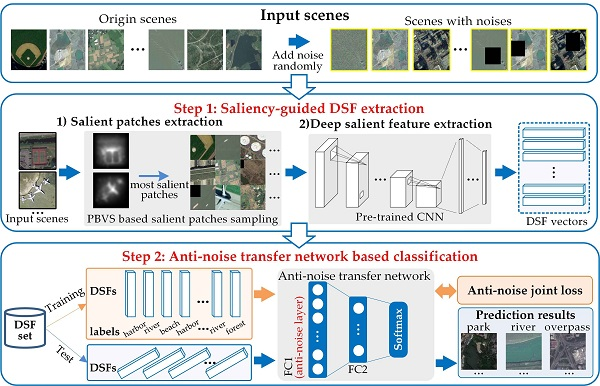
Deep Salient Feature Based Anti-Noise Transfer Network for Scene Classification of Remote Sensing Imagery




Abstract
1. Introduction
- We propose a novel DSF representation using “visual attention” mechanisms. DSF can achieve discriminative high-level feature representation learnt from pre-trained CNN for the RS scenes.
- An anti-noise transfer network is improved to learn and enhance the robust and anti-noise structure information of RS scene, where a joint loss is used to minimize the network by considering anti-noise constraint and softmax classification loss. The simple architecture of the anti-noise transfer network makes it easier to be trained with the limited availability of training data.
- The proposed DSFATN is evaluated on several public RS scene classification benchmarks. The significant performance demonstrated our method is of great robustness and efficiency in various scales, occlusions, and noise conditions and advanced the state-of-the-arts methods.
2. The Proposed DSFATN Method
2.1. Framework of DSFATN
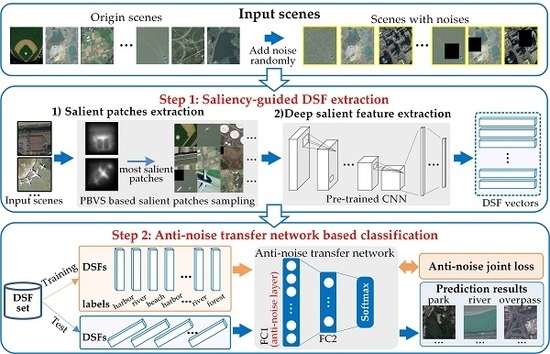
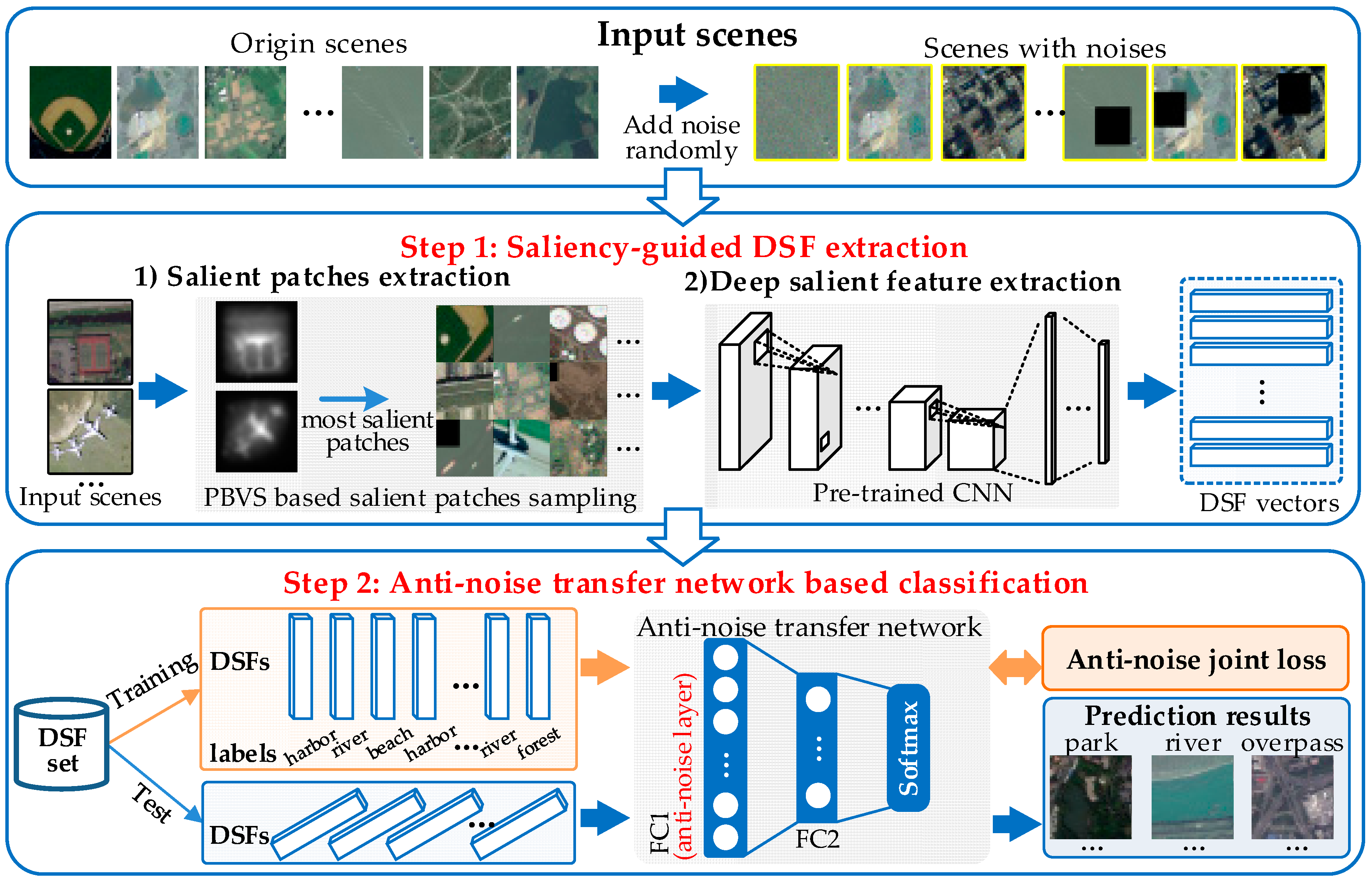
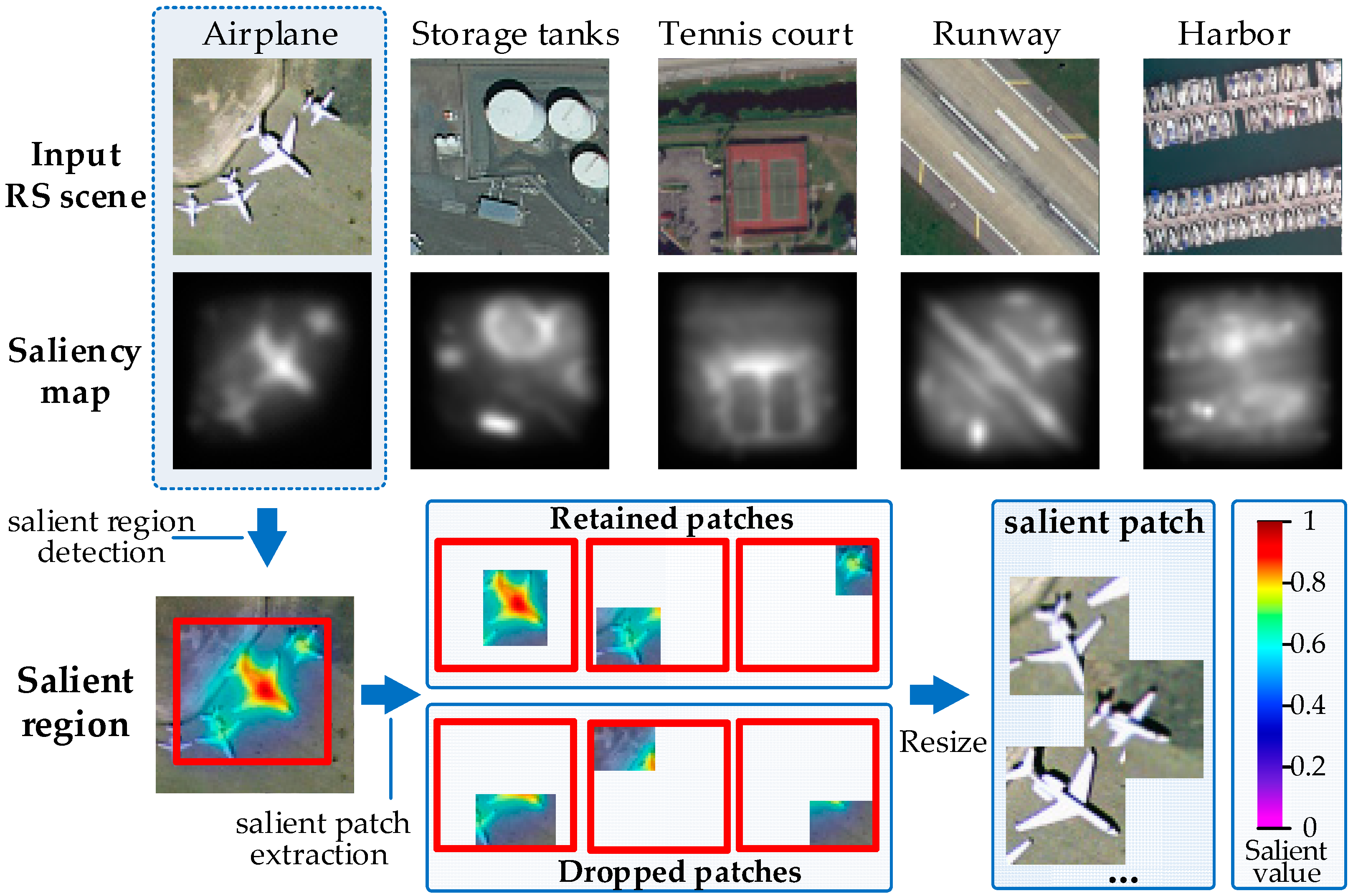
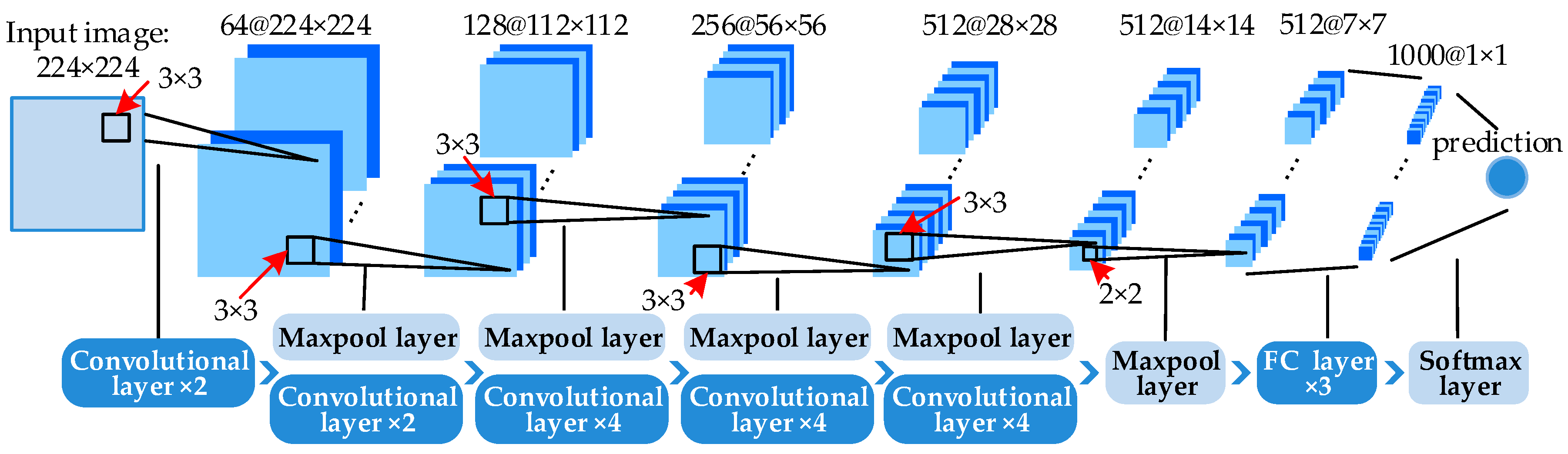
- Saliency-guided DSF extraction: To achieve discriminative high-level feature representation for RS scenes, we introduce saliency-guided DSF extraction. Instead of using the whole RS scene for feature extraction, saliency-guided DSF extraction produces a novel DSF representation based on saliency-guided RS scene patches using “visual attention” mechanisms. First, we conduct an improved patch-based visual saliency (PBVS) method to detect salient region and sample multi-scales salient patches in an image. Next, the multi-scales salient patches are fed to a pre-trained CNN model to extract the DSF. The saliency-guided DSF extraction ensures the most informative and representative parts are definitely centrally focused in the salient patches. Compared with randomly or densely sampling methods, the saliency-guided sampling is also more targeted and effective. The different scales of the salient patches also help to improve the scale invariance of DSF in the anti-noise transfer network training process.
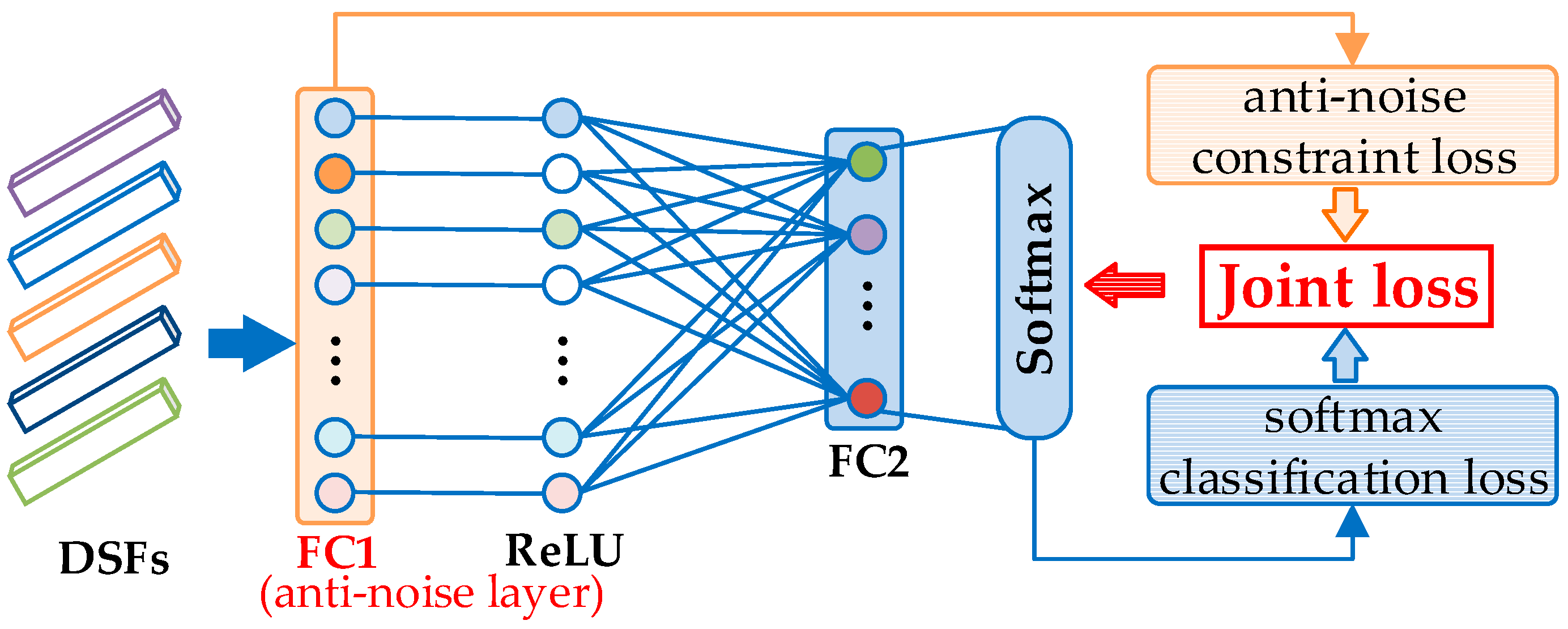
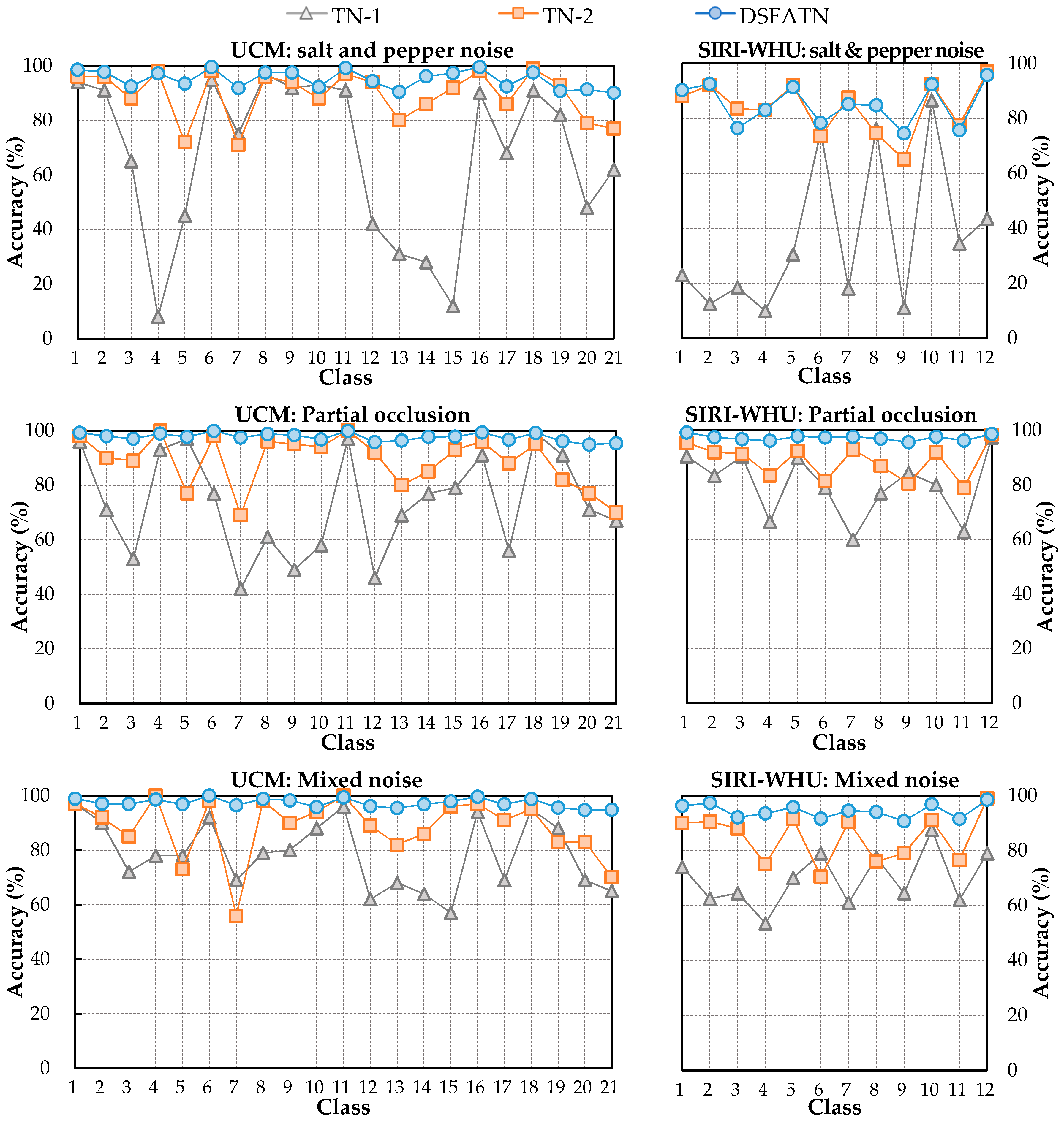
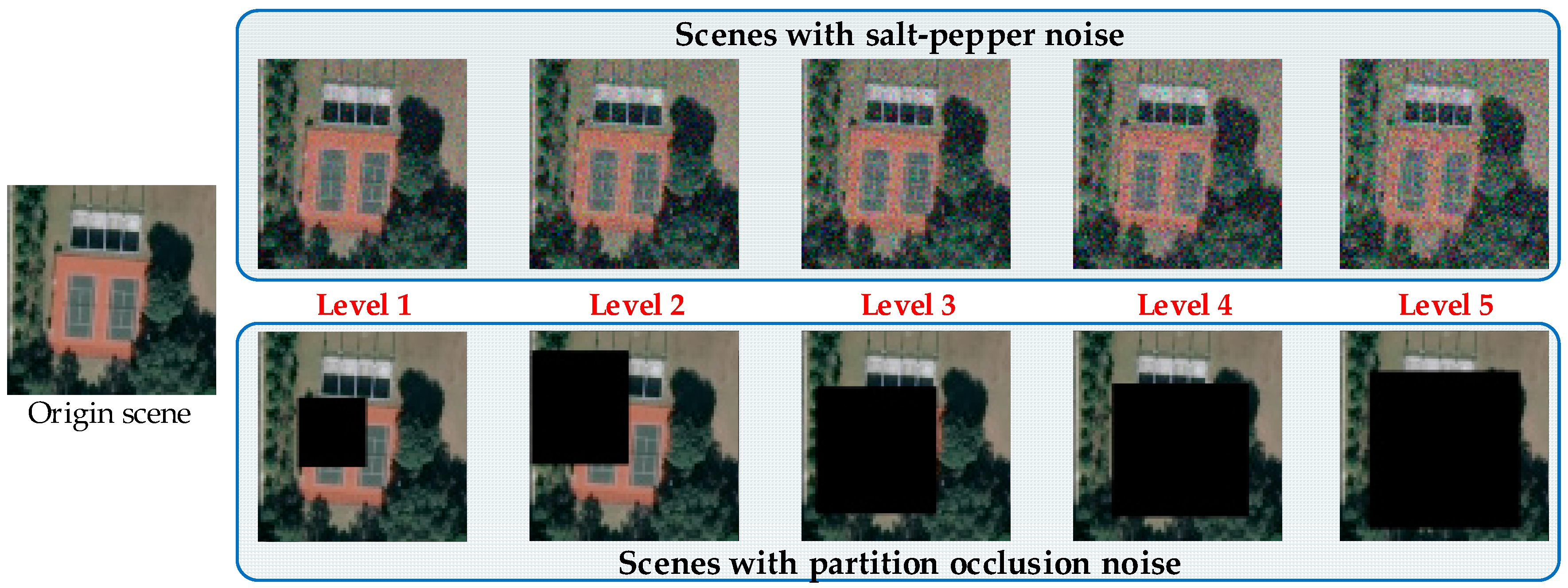
- Anti-noise transfer network based classification: To suppress the influences of various scales and noises of RS scenes, an anti-noise transfer network is trained as the classifier successively. It introduces an anti-noise layer to tackle with DSFs extracted from RS scene patches in low quality even with various noises. Except for the anti-noise layer, the anti-noise transfer network only has a fully-connected (FC) layer and a softmax layer, which is a simple CNN architecture and can be trained easily. Different from the traditional CNN model, we optimize a new objective function to train the anti-noise transfer network by imposing an anti-noise constraint, which enforces the training samples before and after adding noises to share the similar features. Meanwhile, for anti-noise transfer network learning, the input scenes contain origin scenes and scenes with various noises, such as: (1) salt and pepper noise; (2) partial occlusions; and (3) their mixed noise. The whole framework works perfectly on three different scale RS scene datasets and even outperforms the state-of-the-art methods.
2.2. Saliency-Guided DSF Extraction
2.2.1. Salient Patch Extraction
| Algorithm 1. The iterative sampling procedure. | |
| Input: Salient region of RS image scene s | |
| Output: | |
| 1: | Initialization: |
| 2: | set salient patch set |
| 3: | set salient patches’ number |
| 4: | Iterations: |
| 5: | while () |
| 6: | randomly sampled a patch in |
| 7: | if (each salient value in central box) |
| 8: | put to P and note as in |
| 9: | |
| 10: | Return |
2.2.2. DSF Extraction
2.3. Anti-Noise Transfer Network Based Classification
2.3.1. DSF Based Anti-Noise Transfer Network Architecture
2.3.2. Joint Loss Function Learning
3. Experiments and Analysis
3.1. Dataset and Experimental Protocol
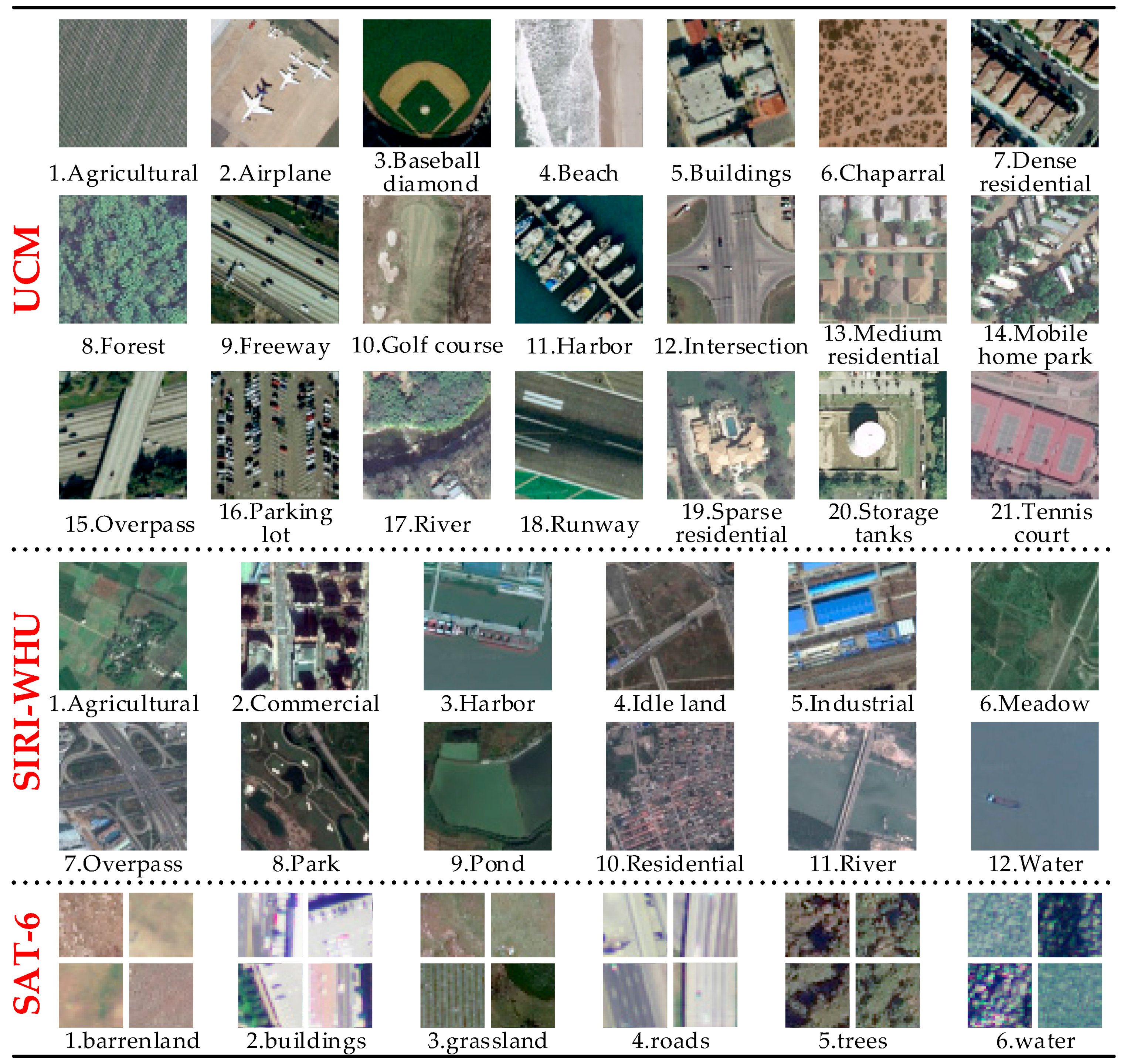
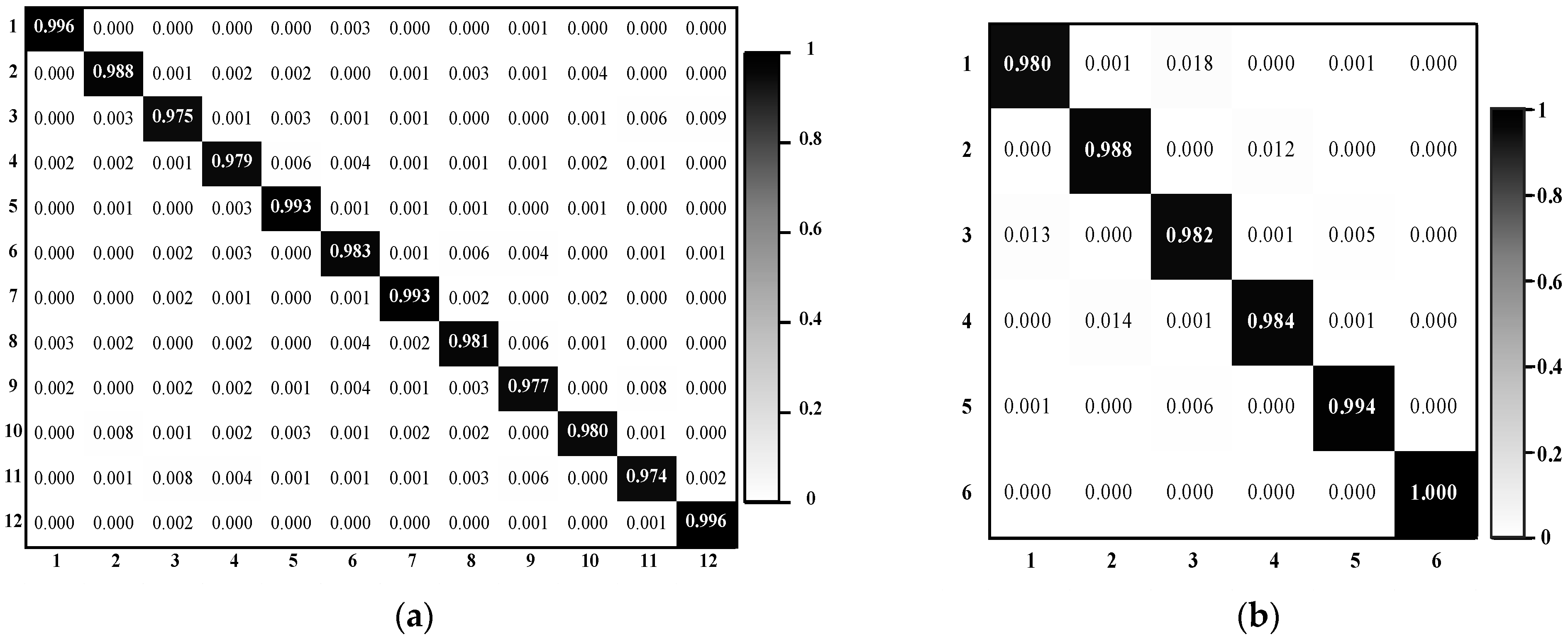
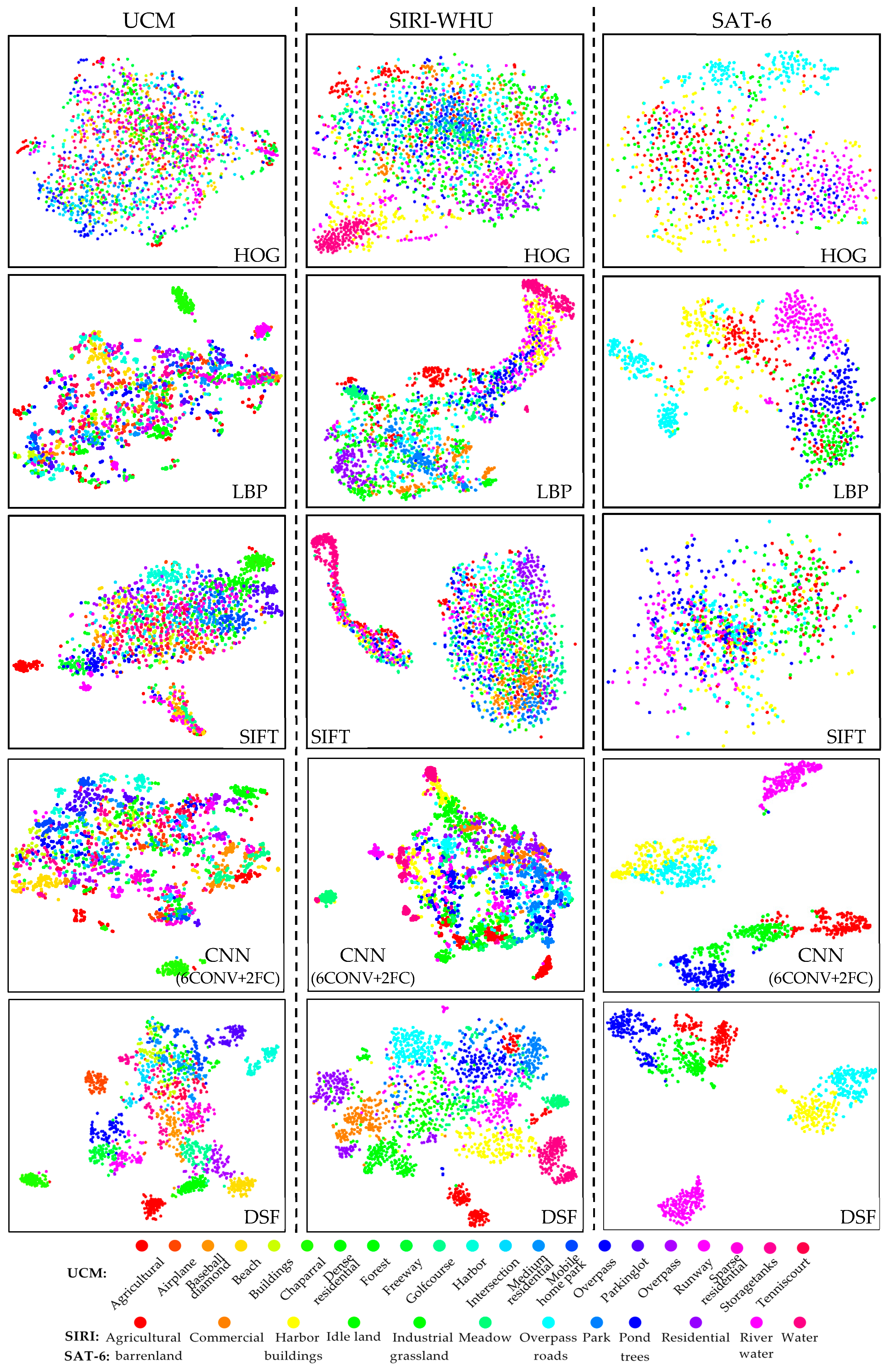
- UC Merced Land Use Dataset [1] (UCM) is collected from the large aerial orthoimagery of USGS National Map Urban Area Imagery collection. There are 100 images for each of 21 classes. Each image measures 256 × 256 pixels, with a 1-ft spatial resolution.
- The Google image dataset designed by RS_IDEA Group in Wuhan University (SIRI-WHU) [10] is acquired from Google Earth (Google Inc., Mountain View, CA, USA) and mainly covers urban areas in China. It contains 12 scene categories. Each class consists of 200 images with a size of 200 × 200 pixels and a spatial resolution of 2 m.
- SAT-6 dataset [46] is extracted from the National Agriculture Imagery Program and consists of a total of 405,000 image patches of size 28 × 28 and covering six classes. We choose 200 images from each class for our experiments.
3.2. Performance on Different Datasets
3.3. Representative Ability Comparison of Different Features
3.4. Evaluation of Image Distortion
3.4.1. Evaluation of Noises
3.4.2 Evaluation of Multiple Scales
3.5. The Analysis of Influence Factors
3.5.1. Influence of Salient Patches’ Number α
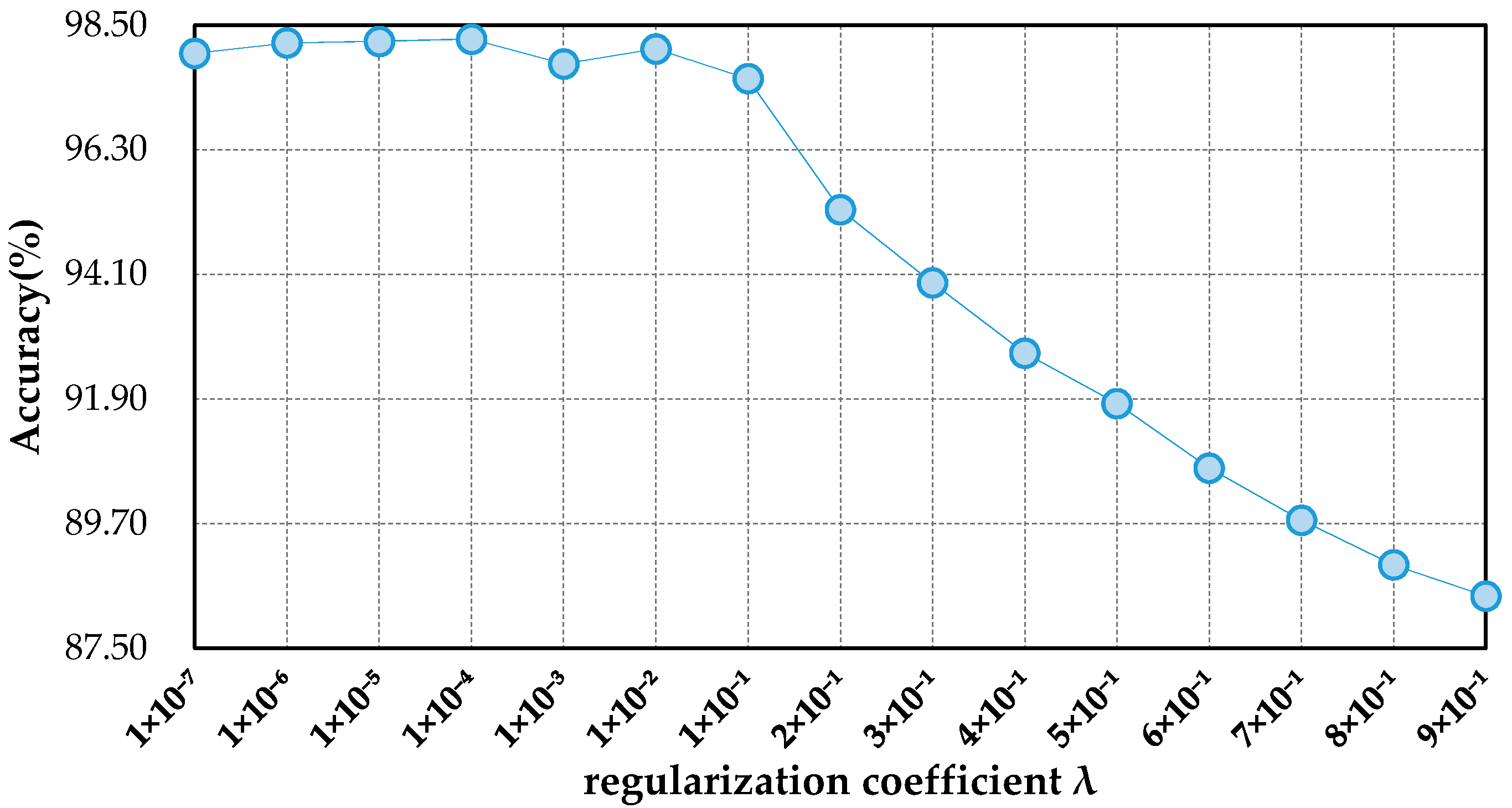
3.5.2. Influence of the Regularization Coefficient
3.5.3. Influence of Pre-Trained CNNs
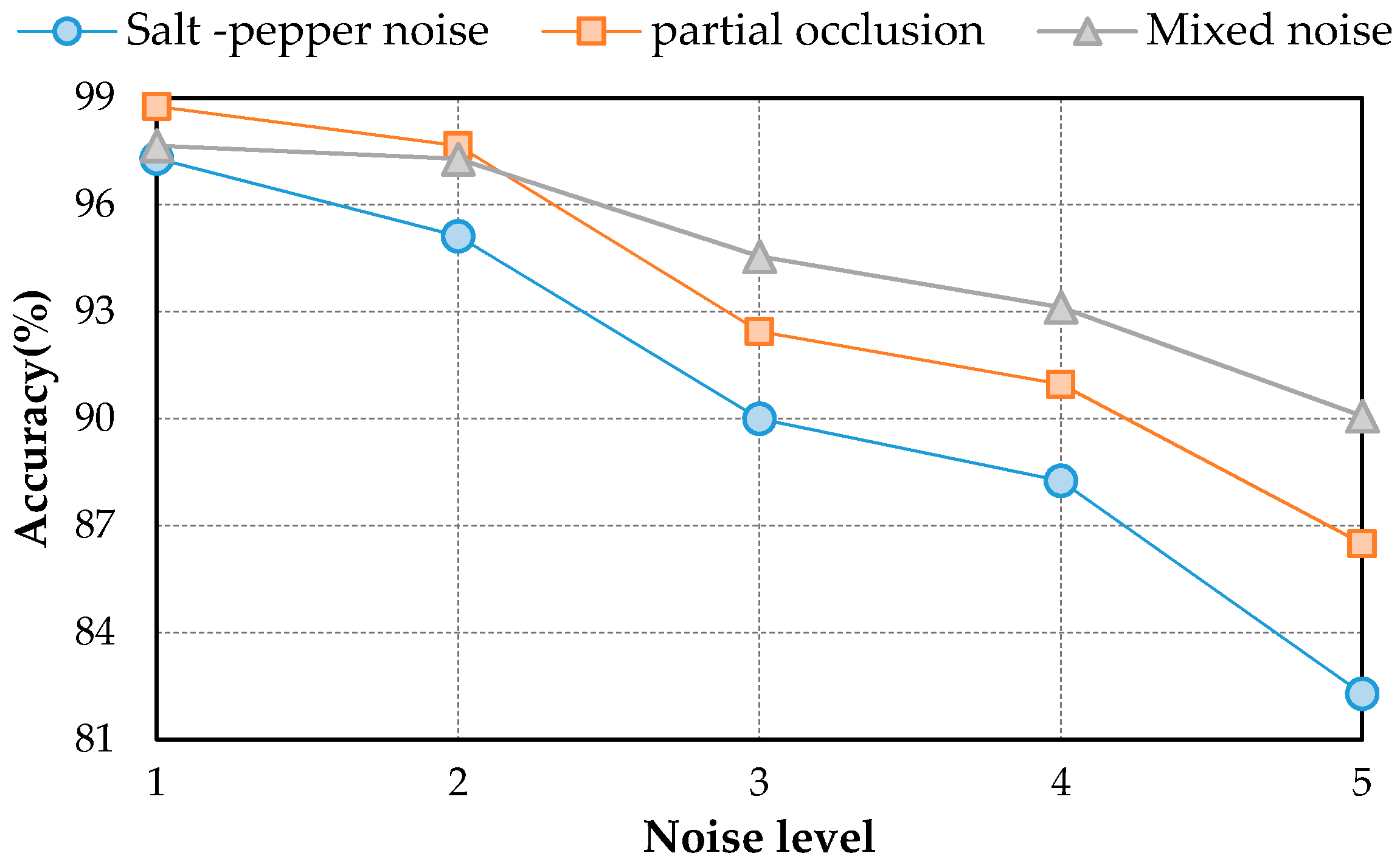
3.5.4. Influence of Noise Levels
4. Conclusions
Acknowledgments
Author Contributions
Conflicts of Interest
References
- Yang, Y.; Newsam, S. Bag-of-visual-words and spatial extensions for land-use classification. In Proceedings of the 18th SIGSPATIAL International Conference on Advances in Geographic Information Systems, San Jose, CA, USA, 3–5 November 2010; pp. 270–279. [Google Scholar]
- Cheriyadat, A.M. Unsupervised feature learning for aerial scene classification. IEEE Trans. Geosci. Remote Sens. 2014, 52, 439–451. [Google Scholar] [CrossRef] [Scilit]
- Yang, W.; Yin, X.; Xia, G.S. Learning high-level features for satellite image classification with limited labeled samples. IEEE Trans. Geosci. Remote Sens. 2015, 53, 4472–4482. [Google Scholar] [CrossRef] [Scilit]
- Shao, W.; Yang, W.; Xia, G.S. Extreme value theory-based calibration for the fusion of multiple features in high-resolution satellite scene classification. Int. J. Remote Sens. 2013, 34, 8588–8602. [Google Scholar] [CrossRef] [Scilit]
- Wang, Q.; Meng, Z.; Li, X. Locality Adaptive Discriminant Analysis for Spectral–Spatial Classification of Hyperspectral Images. IEEE Geosci. Remote Sens. Lett. 2017, 14, 2077–2081. [Google Scholar] [CrossRef] [Scilit]
- Bosch, A.; Muñoz, X.; Martí, R. Which is the best way to organize/classify images by content? Image Vis. Comput. 2007, 25, 778–791. [Google Scholar] [CrossRef] [Scilit]
- Zhong, Y.; Zhu, Q.; Zhang, L. Scene classification based on the multifeature fusion probabilistic topic model for high spatial resolution remote sensing imagery. IEEE Trans. Geosci. Remote Sens. 2015, 53, 6207–6222. [Google Scholar] [CrossRef] [Scilit]
- Zhou, L.; Zhou, Z.; Hu, D. Scene classification using a multi-resolution bag-of-features model. Pattern Recognit. 2013, 46, 424–433. [Google Scholar] [CrossRef] [Scilit]
- Zhao, B.; Zhong, Y.; Zhang, L.; Huang, B. The fisher kernel coding framework for high spatial resolution scene classification. Remote Sens. 2016, 8, 157. [Google Scholar] [CrossRef] [Scilit]
- Zhao, B.; Zhong, Y.; Xia, G.-S.; Zhang, L. Dirichlet-derived multiple topic scene classification model fusing heterogeneous features for high spatial resolution remote sensing imagery. IEEE Trans. Geosci. Remote Sens. 2016, 54, 2108–2123. [Google Scholar] [CrossRef] [Scilit]
- Zhong, Y.; Fei, F.; Zhang, L. Large patch convolutional neural networks for the scene classification of high spatial resolution imagery. J. Appl. Remote Sens. 2016, 10, 025006. [Google Scholar] [CrossRef] [Scilit]
- Lazebnik, S.; Schmid, C.; Ponce, J. Beyond bags of features: Spatial pyramid matching for recognizing natural scene categories. In Proceedings of the IEEE Conference on Computer Vision and Pattern Recognition, New York, NY, USA, 17–22 June 2006; Volume 2, pp. 2169–2178. [Google Scholar]
- Yang, Y.; Newsam, S. Spatial pyramid co-occurrence for image classification. In Proceedings of the IEEE International Conference on Computer Vision, Barcelona, Spain, 6–13 November 2011; pp. 1465–1472. [Google Scholar]
- Blei, D.M.; Ng, A.Y.; Jordan, M.I. Latent dirichlet allocation. J. Mach. Learn. Res. 2003, 3, 993–1022. [Google Scholar]
- Lienou, M.; Maitre, H.; Datcu, M. Semantic annotation of satellite images using latent dirichlet allocation. IEEE Geosci. Remote Sens. Lett. 2010, 7, 28–32. [Google Scholar] [CrossRef] [Scilit]
- Vaduva, C.; Gavat, I.; Datcu, M. Latent dirichlet allocation for spatial analysis of satellite images. IEEE Trans. Geosci. Remote Sens. 2013, 51, 2770–2786. [Google Scholar] [CrossRef] [Scilit]
- Bosch, A.; Zisserman, A.; Muñoz, X. Scene classification using a hybrid generative/discriminative approach. IEEE Trans. Pattern Anal. Mach. Intell. 2008, 30, 712–727. [Google Scholar] [CrossRef] [Scilit] [PubMed]
- Cheng, G.; Guo, L.; Zhao, T.; Han, J.; Li, H.; Fang, J. Automatic landslide detection from remote-sensing imagery using a scene classification method based on BoVW and pLSA. Int. J. Remote Sens. 2013, 34, 45–59. [Google Scholar] [CrossRef] [Scilit]
- Simonyan, K.; Zisserman, A. Very deep convolutional networks for large-scale image recognition. In Proceedings of the International Conference on Learning Representations, San Diego, CA, USA, 7–9 May 2015. [Google Scholar]
- Zou, Z.; Shi, Z. Ship detection in spaceborne optical image with SVD networks. IEEE Trans. Geosci. Remote Sens. 2016, 54, 5832–5845. [Google Scholar] [CrossRef] [Scilit]
- Gao, J.; Wang, Q.; Yuan, Y. Embedding structured contour and location prior in siamesed fully convolutional networks for road detection. In Proceedings of the IEEE International Conference on Robotics and Automation, Singapore, 29 May–3 June 2017; pp. 219–224. [Google Scholar]
- Li, C.; Wand, M. Combining markov random fields and convolutional neural networks for image synthesis. arXiv, 2016; arXiv:1601.04589.
- Zhang, L.; Zhang, L.; Du, B. Deep Learning for Remote Sensing Data: A Technical Tutorial on the State of the Art. IEEE Geosci. Remote Sens. Mag. 2016, 4, 22–40. [Google Scholar] [CrossRef] [Scilit]
- Zhu, X.X.; Tuia, D.; Mou, L.; Xia, G.S.; Zhang, L.; Xu, F. Deep Learning in Remote Sensing: A Comprehensive Review and List of Resources. IEEE Geosci. Remote Sens. Mag. 2017, 5, 8–36. [Google Scholar] [CrossRef] [Scilit]
- Lu, X.; Zheng, X.; Yuan, Y. Remote sensing scene classification by unsupervised representation learning. IEEE Trans. Geosci. Remote Sens. 2017, 55, 5148–5157. [Google Scholar] [CrossRef] [Scilit]
- Chen, Y.; Zhao, X.; Jia, X. Spectral–spatial classification of hyperspectral data based on deep belief network. IEEE J. Sel. Top. Appl. Earth Obs. Remote Sens. 2015, 8, 2381–2392. [Google Scholar] [CrossRef] [Scilit]
- Deng, J.; Dong, W.; Socher, R.; Li, L.J.; Li, K.; Fei-Fei, L. Imagenet: A large-scale hierarchical image database. In Proceedings of the IEEE Conference on Computer Vision and Pattern Recognition, Miami, FL, USA, 20–25 June 2009; pp. 248–255. [Google Scholar]
- Li, H.; Fu, K.; Yan, M.; Sun, X.; Sun, H.; Diao, W. Vehicle detection in remote sensing images using denoising-based convolutional neural networks. Remote Sens. Lett. 2017, 8, 262–270. [Google Scholar] [CrossRef] [Scilit]
- Yang, Y.; Zhuang, Y.; Bi, F.; Shi, H.; Xie, Y. M-FCN: Effective fully convolutional network-based airplane detection framework. IEEE Geosci. Remote Sens. Lett. 2017, 14, 1293–1297. [Google Scholar] [CrossRef] [Scilit]
- Chen, X.; Xiang, S.; Liu, C.L.; Pan, C.H. Vehicle detection in satellite images by hybrid deep convolutional neural networks. IEEE Geosci. Remote Sens. Lett. 2017, 11, 1797–1801. [Google Scholar] [CrossRef] [Scilit]
- Simard, P.Y.; Steinkraus, D.; Platt, J.C. Best practices for convolutional neural networks applied to visual document analysis. In Proceedings of the Seventh International Conference on Document Analysis and Recognition, Edinburgh, UK, 3–6 August 2003; pp. 958–962. [Google Scholar]
- Dieleman, S.; Willett, K.W.; Dambre, J. Rotation-invariant convolutional neural networks for galaxy morphology prediction. Mon. Not. R. Astron. Soc. 2015, 450, 1441–1459. [Google Scholar] [CrossRef] [Scilit]
- Zhang, F.; Du, B.; Zhang, L. Saliency-guided unsupervised feature learning for scene classification. IEEE Trans. Geosci. Remote Sens. 2015, 53, 2175–2184. [Google Scholar] [CrossRef] [Scilit]
- Castelluccio, M.; Poggi, G.; Sansone, C.; Verdoliva, L. Land use classification in remote sensing images by convolutional neural networks. arXiv, 2015; arXiv:1508.00092.
- Szegedy, C.; Liu, W.; Jia, Y.; Sermanet, P.; Reed, S.; Anguelov, D. Going deeper with convolutions. In Proceedings of the IEEE Conference on Computer Vision and Pattern Recognition, Boston, MA, USA, 11–12 June 2015; pp. 1–9. [Google Scholar]
- Penatti, O.A.; Nogueira, K.; dos Santos, J.A. Do deep features generalize from everyday objects to remote sensing and aerial scenes domains? In Proceedings of the IEEE Conference on Computer Vision and Pattern Recognition Workshops, Boston, MA, USA, 12 June 2015; pp. 44–51. [Google Scholar]
- Hu, F.; Xia, G.S.; Hu, J.; Zhang, L. Transferring deep convolutional neural networks for the scene classification of high-resolution remote sensing imagery. Remote Sens. 2015, 7, 14680–14707. [Google Scholar] [CrossRef] [Scilit]
- Gong, Y.; Wang, L.; Guo, R.; Lazebnik, S. Multi-scale orderless pooling of deep convolutional activation features. In The European Conference on Computer Vision (ECCV); Springer: Cham, Swizerland, 2014; pp. 392–407. [Google Scholar]
- Lee, H.; Grosse, R.; Ranganath, R.; Ng, A.Y. Convolutional deep belief networks for scalable unsupervised learning of hierarchical representations. In Proceedings of the 26th annual international conference on machine learning, Montreal, QC, Canada, 14–18 June 2009; pp. 609–616. [Google Scholar]
- Itti, L.; Koch, C.; Niebur, E. A model of saliency-based visual attention for rapid scene analysis. IEEE Trans. Pattern Anal. Mach. Intell. 1998, 20, 1254–1259. [Google Scholar] [CrossRef] [Scilit]
- Harel, J.; Koch, C.; Perona, P. Graph-based visual saliency. In Proceedings of the Advances in Neural Information Processing Systems, Vancouver, BC, Canada, 3 December 2007; pp. 545–552. [Google Scholar]
- Harel, J. A Saliency Implementation in MATLAB. Available online: http://www.vision.caltech.edu/~harel/share/gbvs.php (accessed on 10 January 2018).
- Caldwell, D.R. Unlocking the mysteries of the bounding box. Coord. Online J. Map Geogr. Round Tab. Am. Libr. Assoc. 2005. Available online: http://www.stonybrook.edu/libmap/coordinates/seriesa/no2/a2.pdf (accessed on 10 January 2018).
- Glorot, X.; Bordes, A.; Bengio, Y. Deep sparse rectifier neural networks. In Proceedings of the Fourteenth International Conference on Artificial Intelligence and Statistics, Lauderdale, FL, USA, 11–13 April 2011; pp. 315–323. [Google Scholar]
- Peng, X.; Lu, C.; Yi, Z.; Tang, H. Connections between Nuclear Norm and Frobenius-Norm-Based Representations. IEEE Trans. Neural Netw. Learn. Syst. 2016. [Google Scholar] [CrossRef] [Scilit] [PubMed]
- Basu, S.; Ganguly, S.; Mukhopadhyay, S.; Dibiano, R.; Karki, M.; Nemani, R. Deepsat: A learning framework for satellite imagery. In Proceedings of the 23rd ACM SIGSPATIAL International Conference on Advances in Geographic Information Systems, Seattle, WA, USA, 3–6 November 2015; p. 37. [Google Scholar]
- Chen, S.; Tian, Y. Pyramid of spatial relatons for scene-level land use classification. IEEE Trans. Geosci. Remote Sens. 2015, 53, 1947–1957. [Google Scholar] [CrossRef] [Scilit]
- Krizhevsky, A.; Sutskever, I.; Hinton, G.E. ImageNet classification with deep convolutional neural networks. In Proceedings of the Twenty-Sixth International Conference on Neural Information Processing Systems, Lake Tahoe, NY, USA, 3–8 December 2012; pp. 1097–1105. [Google Scholar]
- Breiman, L. Random forests. Mach. Learn. 2001, 45, 5–32. [Google Scholar] [CrossRef] [Scilit]
- Dalal, N.; Triggs, B. Histograms of oriented gradients for human detection. In Proceedings of the IEEE Computer Society Conference on Computer Vision and Pattern Recognition, San Diego, CA, USA, 20–26 June 2005; pp. 886–893. [Google Scholar] [CrossRef]
- Lowe, D.G. Distinctive image features from scale-invariant keypoints. Int. J. Comput. Vis. 2004, 60, 91–110. [Google Scholar] [CrossRef] [Scilit]
- Ojala, T.; Pietikainen, M.; Maenpaa, T. Multiresolution gray-scale and rotation invariant texture classification with local binary patterns. IEEE Trans. Pattern Anal. Mach. Intell. 2002, 24, 971–987. [Google Scholar] [CrossRef] [Scilit]
- Van der Maaten, L.; Hinton, G. Visualizing data using t-SNE. J. Mach. Learn. Res. 2008, 9, 2579–2605. [Google Scholar]
- Jia, Y.; Shelhamer, E.; Donahue, J.; Karayev, S.; Long, J.; Girshick, R.; Guadarrama, S.; Darrell, T. Caffe: Convolutional architecture for fast feature embedding. In Proceedings of the ACM International Conference on Multimedia, Orlando, FL, USA, 3–7 November 2014. [Google Scholar]
- Chatfield, K.; Simonyan, K.; Vedaldi, A.; Zisserman, A. Return of the devil in the details: Delving deep into convolutional nets. In Proceedings of the British Machine Vision Conference, Nottingham, UK, 1–5 September 2014. [Google Scholar]
- Ioffe, S.; Szegedy, C. Batch normalization: Accelerating deep network training by reducing internal covariate shift. In Proceedings of the International Conference on Machine Learning, Lille, France, 6–11 July 2015; pp. 448–456. [Google Scholar]
- Szegedy, C.; Vanhoucke, V.; Ioffe, S.; Shlens, J.; Wojna, Z. Rethinking the inception architecture for computer vision. In Proceedings of the IEEE Conference on Computer Vision and Pattern Recognition, Las Vegas, NV, USA, 26 June–1 July 2016; pp. 2818–2826. [Google Scholar]
- He, K.; Zhang, X.; Ren, S.; Sun, J. Deep residual learning for image recognition. In Proceedings of the IEEE conference on computer vision and pattern recognition, Las Vegas, NV, USA, 26 June–1 July 2016; pp. 770–778. [Google Scholar]

| UCM | SIRI-WHU | SAT-6 | |
|---|---|---|---|
| Training | 1680 | 1920 | 960 |
| Test | 420 | 480 | 240 |
| Total | 2100 | 2400 | 1200 |
| Rank | Methods | Accuracy (%) |
|---|---|---|
| 1 | RF [49] | 44.77 |
| 2 | CNN(6conv+2fc) | 76.40 |
| 3 | SPCK++ [13] | 77.38 |
| 4 | LDA [15] | 81.92 ± 1.12 |
| 5 | SG + UFL [33] | 82.72 ± 1.18 |
| 6 | PSR [47] | 89.10 |
| 7 | OverFeat [36] | 90.91 ± 1.19 |
| 8 | Caffe-Net [36] | 93.42 ± 1.00 |
| 9 | GoogLeNet [34] | 97.10 |
| 10 | DSFATN | 2 |
| Methods | RF [49] | LDA [15] | CNN(6conv+2fc) | SPM [12] | DSFATN |
|---|---|---|---|---|---|
| Accuracy (%) | 0 | 60.32 ± 1.20 | 78.20 | 77.69 ± 1.01 | 98.46 |
| Methods | RF [49] | CNN(6conv+2fc) | DeepSat [46] | DSFATN |
|---|---|---|---|---|
| Accuracy (%) | 89.29 | 92.67 | 93.92 | 91.96 |
| Features | UCM | SIRI-WHU | SAT-6 | |||
|---|---|---|---|---|---|---|
| Accuracy (%) | Kappa | Accuracy (%) | Kappa | Accuracy (%) | Kappa | |
| Raw image | 33.10 | 0.3361 | 35.83 | 0.3469 | 87.08 | 0.8116 |
| HOG [50] | 52.14 | 0.4975 | 44.79 | 0.3977 | 57.92 | 0.4950 |
| SIFT [51] | 58.33 | 0.5625 | 53.96 | 0.4977 | 45.00 | 0.3400 |
| LBP [52] | 31.43 | 0.2800 | 46.25 | 0.4136 | 77.08 | 0.7250 |
| CNN(6conv+2fc) | 63.10 | 0.6424 | 60.42 | 0.5523 | 94.58 | 0.9188 |
| DSF | 98.07 | 0.9801 | 88.96 | 0.8766 | 96.25 | 0.9437 |
| Model | Multi-Scales Salient Patch Sampling | Anti-Noise Layer Training |
|---|---|---|
| TN-1 | × | × |
| TN-2 | × | √ |
| DSFATN | √ | √ |
| Model | Classification Accuracy (%) | |||||
|---|---|---|---|---|---|---|
| UCM | SIRI-WHU | |||||
| Salt and Pepper Noise | Partial Occlusion | Mixed Noise | Salt and Pepper Noise | Partial Occlusion | Mixed Noise | |
| RF | 0.0 | 0.0 | 0.0 | 0.0 | 0.0 | |
| CNN(6conv+2fc) | 1.60 | 0.32.00 | 0.380 | 0.460 | 0.5520 | 0.66240 |
| TN-1 | -0.2 | -0.04 | -0.05 | -0.06 | -0.07 | -0.08 |
| TN-2 | -0.4 | 88.76 | 88.33 | 83.83 | 52.1 | 84.79 |
| DSFATN | 0.0 | 0.0 | 0.0 | 0.0 | 0.0 | 0.0 |
| Features | Classification Accuracy (%) | |||||
|---|---|---|---|---|---|---|
| UCM | SIRI-WHU | |||||
| Salt and Pepper Noise | Partial Occlusion | Mixed Noise | Salt and Pepper Noise | Partial Occlusion | Mixed Noise | |
| HOG [50] | 41.19 | 34.76 | 25.47 | 40.21 | 40.63 | 31.46 |
| SIFT [51] | 62.62 | 41.43 | 44.05 | 51.25 | 46.46 | 46.46 |
| LBP [52] | 25.00 | 18.10 | 10.48 | 37.92 | 39.38 | 25.42 |
| CNN(6conv+2fc) | 56.19 | 38.57 | 47.62 | 52.92 | 65.63 | 53.96 |
| DSF | 89.76 | 83.10 | 82.62 | 79.58 | 87.29 | 83.54 |
| 96.61 | 98.04 | 97.70 | 86.39 | 97.52 | 94.56 | |
| Models | 25% | 50% | 75% | 100% | 125% | STD |
|---|---|---|---|---|---|---|
| CNN(6conv+2fc) | 76.60 | 80.00 | 77.80 | 76.40 | 80.00 | 1.58 |
| TN-2 | 92.20 | 91.40 | 91.60 | 92.60 | 91.20 | 0.52 |
| DSFATN | 97.87 | 98.53 | 98.46 | 98.25 | 98.22 | 0.23 |
| Models | 25% | 50% | 75% | 100% | 125% | STD |
|---|---|---|---|---|---|---|
| CNN(6conv+2fc) | 77.00 | 77.40 | 77.00 | 78.20 | 75.40 | 0.91 |
| TN-2 | 87.60 | 89.20 | 89.60 | 90.00 | 90.60 | 1.01 |
| DSFATN | 98.30 | 98.39 | 98.73 | 98.46 | 98.92 | 0.23 |
| No. | Pre-Trained CNNs | Classification Accuracy (%) |
|---|---|---|
| 1 | Alexnet [48] | 96.85 |
| 2 | Caffenet [54] | 97.35 |
| 3 | VGG -F [55] | 97.54 |
| 4 | VGG -M [55] | 97.57 |
| 5 | VGG -S [55] | 97.12 |
| 6 | VGG-16 [19] | 97.91 |
| 7 | VGG-19 [19] | 1.4 |
| 8 | Inceptionv1 [35] | 91.25 |
| 9 | Inceptionv2 [56] | 90.54 |
| 10 | Inceptionv3 [57] | 91.82 |
| 11 | Resnetv1_50 [58] | 97.89 |
| 12 | Resnetv1_101 [58] | 97.94 |
| Level | Salt and Pepper Noise Density | Partial Occlusion Covering Scale |
|---|---|---|
| 1 | 0.05 | 10–20% |
| 2 | 0.1 | 20–30% |
| 3 | 0.15 | 30–40% |
| 4 | 0.2 | 40–50% |
| 5 | 0.25 | 50–60% |
© 2018 by the authors. Licensee MDPI, Basel, Switzerland. This article is an open access article distributed under the terms and conditions of the Creative Commons Attribution (CC BY) license (http://creativecommons.org/licenses/by/4.0/).
Share and Cite
Gong, X.; Xie, Z.; Liu, Y.; Shi, X.; Zheng, Z. Deep Salient Feature Based Anti-Noise Transfer Network for Scene Classification of Remote Sensing Imagery. Remote Sens. 2018, 10, 410. https://doi.org/10.3390/rs10030410
Gong X, Xie Z, Liu Y, Shi X, Zheng Z. Deep Salient Feature Based Anti-Noise Transfer Network for Scene Classification of Remote Sensing Imagery. Remote Sensing. 2018; 10(3):410. https://doi.org/10.3390/rs10030410
Chicago/Turabian StyleGong, Xi, Zhong Xie, Yuanyuan Liu, Xuguo Shi, and Zhuo Zheng. 2018. "Deep Salient Feature Based Anti-Noise Transfer Network for Scene Classification of Remote Sensing Imagery" Remote Sensing 10, no. 3: 410. https://doi.org/10.3390/rs10030410
APA StyleGong, X., Xie, Z., Liu, Y., Shi, X., & Zheng, Z. (2018). Deep Salient Feature Based Anti-Noise Transfer Network for Scene Classification of Remote Sensing Imagery. Remote Sensing, 10(3), 410. https://doi.org/10.3390/rs10030410