

Integrated Metrics for Improving the Life Cycle Approach to Assessing Product System Sustainability


 ,
,
Abstract
1. Introduction
1.1. Background
1.2. Life Cycle Assessment of Product Systems
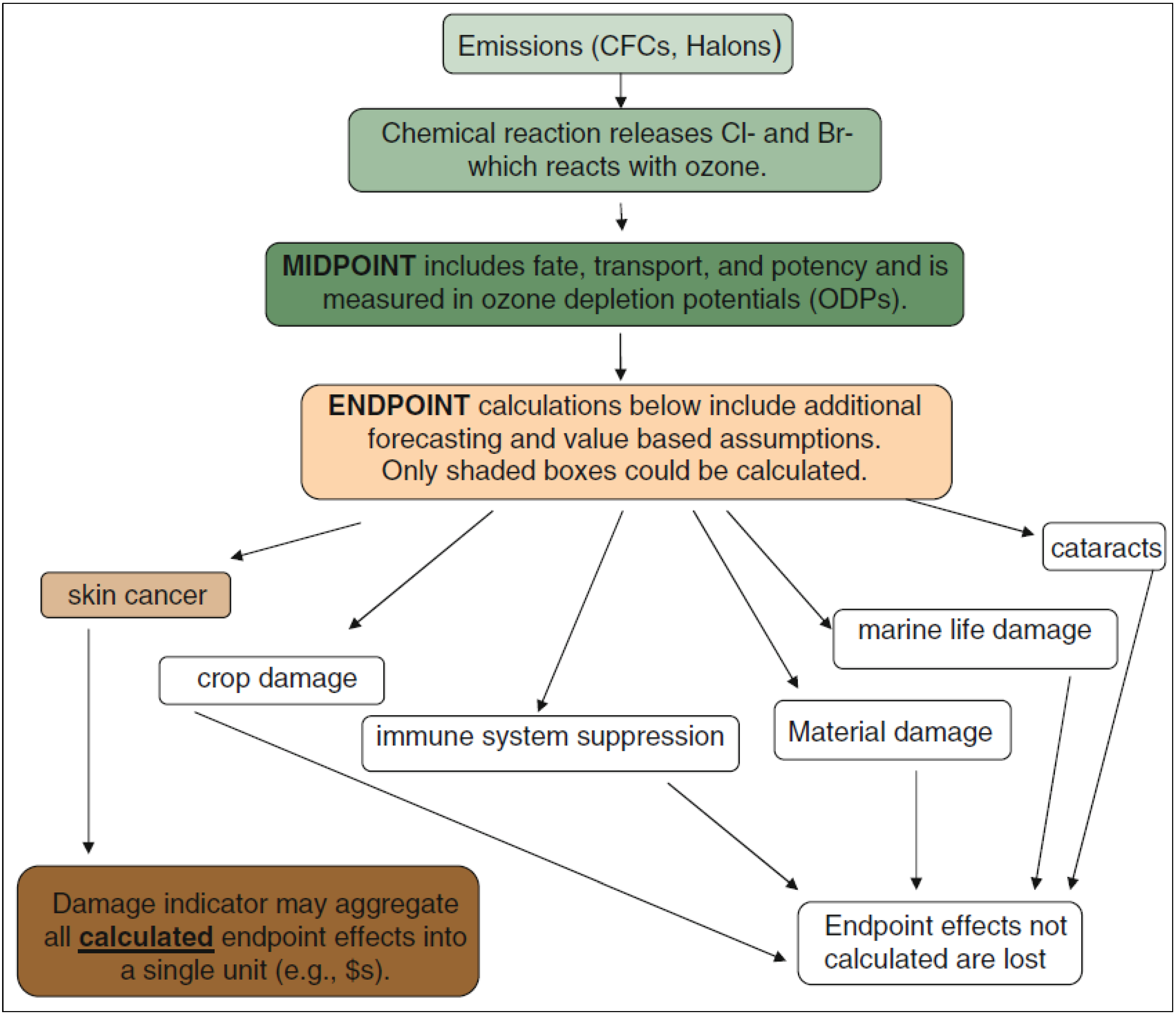
2. Integrated Metrics for Product System Analysis
2.1. Definition of Integrated Metrics
- (1)
- Based on a physical or economic principle. Integrated metrics are based on established scientific or economic theory (e.g., thermodynamics or market theory) and underscored by clearly defined mathematical relationships between resources or emissions and the environment, human population, or the economy.
- (2)
- Founded on a systems approach. Integrated metrics are founded on a systems approach, attempting to be holistic in consideration of all relationships between a system, its parts, and the larger context.
- (3)
- Not directly measureable. Integrated indicators are abstract quantities. They describe the system as a whole and thus are not apparent in any physical property of the system, or any of the individual components or impacts of a system.
2.2. Selected Integrated Metrics for Product System Application
2.2.1. Ecological Footprint
2.2.1.1. The Ecological Footprint Method

2.2.1.2. Sustainability Criteria: EF for Product Systems
2.2.2. Emergy
2.2.2.1. The Emergy Method

2.2.2.2. Sustainability Criteria: EME for Product Systems
2.2.3. Green Net Value Added
2.2.3.1. The Green Net Value Added (GNVA) Method
2.2.3.2. Sustainability Criteria: GNVA for Product Systems
2.2.4. Fisher Information
2.2.4.1. Fisher Information Method

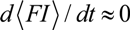 ); (2) progressive decrease in FI indicates increasing variation in system variables, thereby signifying loss of dynamic order and movement away from stability and sustainability; (3) steadily increasing FI indicates the system is changing at a slower rate and becoming more organized; however this increase does not ensure there is a shift unless the system actually settles into a new regime ( ); and (4) a sharp decrease in FI between two stable dynamic regimes denotes a regime shift [63,64,65] . Although increasing FI is indicative of higher dynamic order, it does not automatically represent a transition to a preferred state (e.g., oligotrophic vs. eutrophic lake or an economically viable business vs. one nearing economic collapse). Such information on the characteristics of the condition can only be determined by assessing the underlying variables [66].
2.2.4.2. Sustainability Criteria: FI for Product Systems
2.2.5. Other Integrated Metrics
3. Using Integrated Metrics in LCA

| Metric | Underlying system principle | Resource or emissions-oriented? | Captures temporal changes? | Quantity | Key Indicators (per functional unit of product) | Key References |
|---|---|---|---|---|---|---|
| Ecological Footprint (EF) | Primary production (Biological) | BOTH | N | Land area | Total EF | [44] |
| Emergy (EME) | Thermodynamics | Resource | N | Energy | Total emergy; % renewable emergy | [77] |
| Green Net Value Added (GNVA) | Economics | Emissions | N | Money | Full cost; Externality cost | [51] |
| Fisher Information (FI) | Information theory | BOTH | Y | Information | FI/time; Var(FI)/time | [63] |
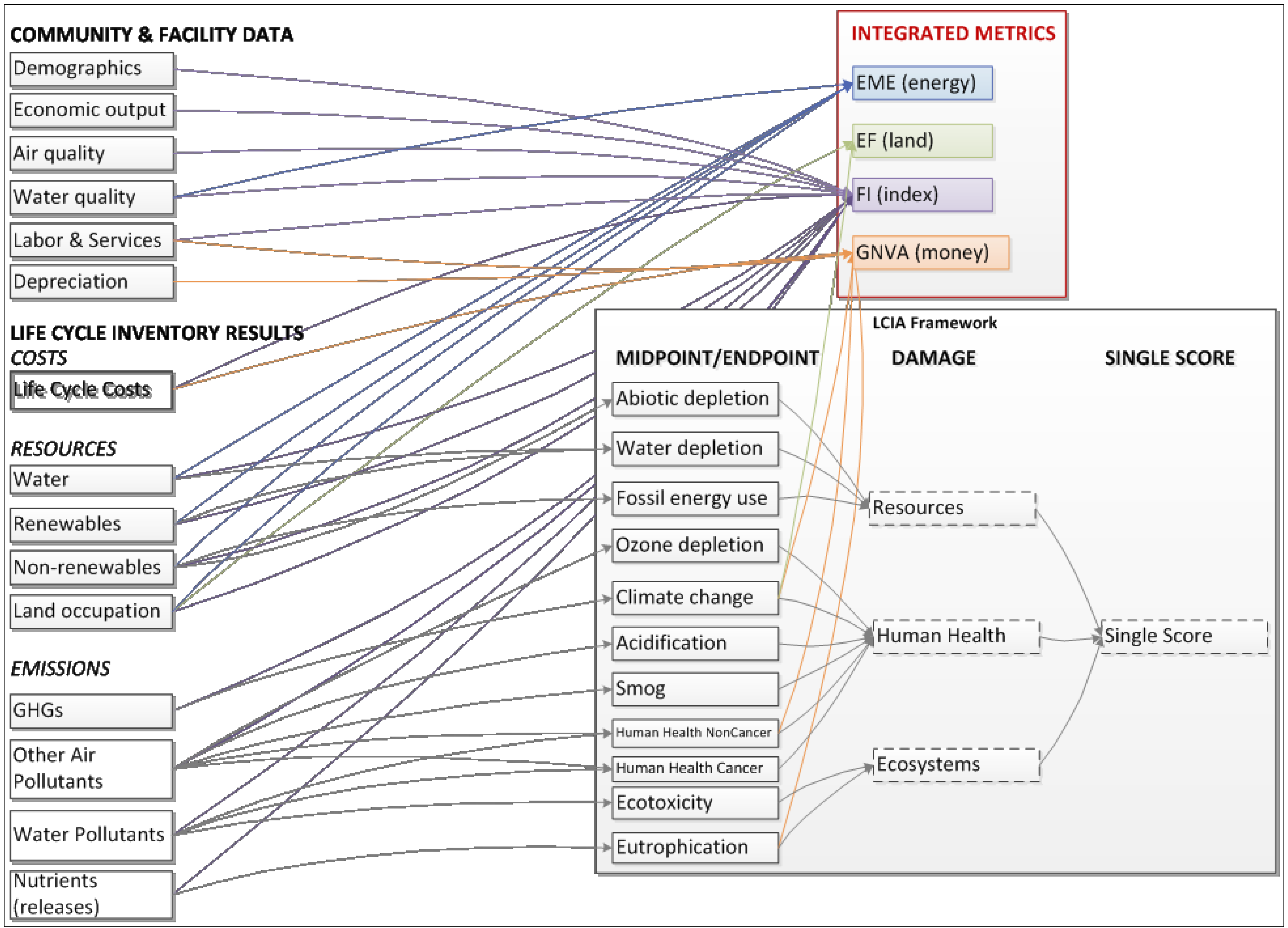
3.1. The Relationship between Integrated Metrics and LCIA Indicators: Theory


3.2. The Relationship of Integrated Metrics to LCIA Indicators: Illustration


4. Discussion and Future Work
4.1. The Use of Integrated Metrics to Characterize Product Systems
- (1)
- Use for relative comparison. Integrated metrics rarely provide absolute values of system condition, due to limitations in full information for the system and lack of complete understanding of environmental or economic relationships. However, as long as comparable data are used and systems are equivalently characterized in respect to their environment, they can be used for making relative comparisons (i.e., more or less sustainable). This relativism also extends to the interpretation of trends in the sustainability metrics. While they cannot be used to state that a process, product or system is absolutely sustainable, they reflect conditions that are indicative of movement toward or away from sustainability [41].
- (2)
- Use alongside specific environmental, economic, and social indicators. Integrated metrics do not replace the function of specific modeled indicators or measurements of stress or damage to a particular receptor. These indicators are still critical for tracking, assessing, and managing environmental, economic, and social problems.
- (3)
- Use multiple sustainability criteria. While an integrated metric only provides a single perspective of system condition, multiple perspectives based on different scientific principles are possible and expected to be helpful. As discussed above, each integrated sustainability metric represents a particular aspect of system condition which is tied to sustainability through a specific criterion that indicates, in relative terms, whether one option is more or less sustainable than another option [78]. While this makes it difficult to select the appropriate set of integrated metrics, multiple metrics may provide a more diverse and robust perspective or “signals” of system condition. Furthermore, the reliability of a sustainability assessment increases with the number of integrated metrics and associated sustainability criteria that support it.
4.2. Integrated Metrics and LCIA Indicators
4.3. Communication of Integrated Metrics
4.4. Limitations and Challenges of Using Integrated Metrics
4.5. Future Work
5. Conclusions
Supplementary Materials
Acknowledgments
Author Contributions
Conflict of Interest
Disclaimer
References
- Haberl, H.; Erb, K.H.; Krausmann, F.; Gaube, V.; Bondeau, A.; Plutzar, C.; Gingrich, S.; Lucht, W.; Fischer-Kowalski, M. Quantifying and mapping the human appropriation of net primary production in earth’s terrestrial ecosystems. Proc. Natl. Acad. Sci. USA 2007, 104, 12942–12947. [Google Scholar]
- Running, S. A measurable planetary boundary for the biosphere. Science 2012, 337, 1458–1459. [Google Scholar] [CrossRef]
- Wackernagel, M.; Schulz, N.B.; Deumling, D.; Linares, A.C.; Jenkins, M.; Kapos, V.; Monfreda, C.; Loh, J.; Myers, N.; Norgaard, R.; et al. Tracking the ecological overshoot of the human economy. Proc. Natl. Acad. Sci. USA 2002, 99, 9266–9271. [Google Scholar] [CrossRef]
- UN. A 10-Year Framework of Programmes on Sustainable Consumption and Production Patterns. In Proceedings of the Rio+20 UN Conference on Sustainable Development, Rio de Janeiro, Brazil, 20–22 June 2012.
- NAS. Sustainability and the U.S. EPA; Committee on Incorporating Sustainability in the U.S. Environmental Protection Agency, National Research Council, National Academy of Sciences: Washington, DC, USA, 2011. [Google Scholar]
- NAS. Science in the EPA—The Road Ahead; National Academies Press: Washington, DC, USA, 2012. [Google Scholar]
- US EPA. Life Cycle Assessment: Principles and Practice; National Risk Management Research Laboratory, US Environmental Protection Agency: Cincinnati, OH, USA, 2006. [Google Scholar]
- ISO 14044: Environmental Management—Life Cycle Assessment—Requirements and Guidelines; International Standards Organization: Geneva, Switzerland, 2006.
- Bare, J.; Gloria, T. Environmental impact assessment taxonomy providing comprehensive coverage of midpoints, endpoints, damages, and areas of protection. J. Clean Prod. 2008, 16, 1021–1035. [Google Scholar]
- Bare, J. Life cycle impact assessment research developments and needs. Clean Technol. Envir. 2010, 12, 341–351. [Google Scholar] [CrossRef]
- Benoît, C.; Mazijn, B. Guidelines for Social Life Cycle Assessment of Products. Available online: http://www.unep.fr/shared/publications/pdf/DTIx1164xPA-guidelines_sLCA.pdf (accessed on 21 December 2013).
- Zamagni, A.; Pesonen, H.L.; Swarr, T. From LCA to life cycle sustainability assessment: Concept, practice and future directions. Int. J. LCA 2013, 18, 1637–1641. [Google Scholar] [CrossRef]
- Valdivia, S.; Ugaya, C.M.L.; Sonnemon, G.; Hildenbrand, J. Towards a Life Cycle Sustainability Assessment: Making Informed Choices on Products; UNEP: Paris, France, 2011. [Google Scholar]
- Norris, G.A. Integrating life cycle cost analysis and LCA. Int. J. LCA 2001, 6, 118–121. [Google Scholar]
- Weidema, B.P. The integration of economic and social aspects in life cycle impact assessment. Int. J. LCA 2006, 11, 89–96. [Google Scholar] [CrossRef]
- Mazijn, B.; Doom, R.; Peeters, H.; Spillemaeckers, S.; Vanhoutte, G.; Taverniers, L.; Lavrysen, L.; VanBraeckel, D.; Rivera, D. Ecological, Social and Economical Aspects of Integrated Product Policy—Integrated Product Assessment and the Development of the Label “Sustainable Development”: Final Report. Available online: http://www.bernardmazijn.be/fileadmin/pdf/sd-label_products_bernardmazijn.pdf (accessed on 13 November 2013).
- Dreyer, L.C.; Hauschild, M.Z. A framework for social life cycle impact assessment. Int. J. LCA 2006, 11, 88–97. [Google Scholar] [CrossRef]
- Dreyer, L.C.; Hauschild, M.Z.; Schierbeck, J. Characterisation of social impacts in LCA. Int. J. LCA 2010, 15, 247–259. [Google Scholar] [CrossRef]
- Hunkeler, D. Societal LCA methodology and case study. Int. J. LCA 2006, 11, 371–382. [Google Scholar] [CrossRef]
- Norris, G.A. Social impacts in product life cycles: Towards life cycle attribute assessment. Int. J. LCA 2006, 11, 97–104. [Google Scholar] [CrossRef]
- Labuschagne, C.; Brent, A.C. Social indicators for sustainable product and technology life cycle management in the process Industry. Int. J. LCA 2006, 11, 3–15. [Google Scholar]
- Fiksel, J.; Eason, T.; Frederickson, H. A Framework for Sustainability Indicators at EPA; National Risk Management Research Laboratory: Cincinnati, OH, USA, 2012. [Google Scholar]
- Samson, R.; Lafontaine, M.; Saad, R.; Tom, M.; Charron-Doucet, F.; Clement, E.; Couture, J.M.; Lamarche, V.; Gilbert, D.; Reveret, J.P.; et al. Environmental and Socioeconomic Life Cycle Assessment of Canadian Milk. Available online: https://www.dairyresearch.ca/file.php?filename=/ var/www/cdrplive/files/news/19/LCA-DFCExecSum_e.pdf (accessed on 3 December 2013).
- Friedberg, S. Calculating sustainability in supply chain capitalism. Econ. Soc. 2013, 42, 571–596. [Google Scholar]
- Hoof, G.; Vieira, M.; Gausman, M.; Weisbrod, A. Indicator selection in life cycle assessment to enable decision making: Issues and solutions. Int. J. LCA 2013, 18, 1–13. [Google Scholar]
- Mark Goedkoop, M.; Sprienm, R. PRe The Eco-Indicator 99: A damage oriented method for life cycle impact assessment. Available online: http://www.pre-sustainability.com/download/misc/EI99_annexe_v3.pdf (accessed on 12 September 2013).
- Itsubo, N.; Inaba, A. LIME—A Comprehensive Japanese LCIA Methodology Based on Endpoint Modeling. In Proceedings of the 6th International Conference on EcoBalance, Tsukuba, Japan, 25–27 October 2004.
- Morgan, M.G.; Henrion, M. Uncertainty: A Guide to Dealing with Uncertainty in Quantitative Risk and Policy Analysis; Cambridge University Press: New York, NY, USA, 1990. [Google Scholar]
- Morgan, M.G.; Keith, D.W. Subjective Judgments by Climate Experts. Env. Sci. Tech. 1995, 29, 465A–476A. [Google Scholar]
- Morgan, M.G.; Florig, H.K.; DeKaye, M.L.; Fischbeck, P. Categorizing risks for risk ranking. Risk Anal. 2000, 20, 49–58. [Google Scholar]
- Tversky, A.; Kahneman, D. Judgment under uncertainty: Heuristics and biases. Science 1974, 185, 1124–1131. [Google Scholar]
- Margni, M.; Curran, M.A. Life cycle impact assessment. In Life Cycle Assessment Handbook: A Guide for Environmentally Sustainable Products; Curran, M.A., Ed.; Scriviner: Beverely, MA, USA, 2012. [Google Scholar]
- Cabezas, H. Sustainability indicators and metrics. Sustainability: Multidisciplinary Perspectives; Cabezas, H., Diwekar, U.M., Eds.; Bethem Science: Sharjah, UAE. Available online: http://public.eblib.com/EBLPublic/PublicView.do?ptiID=1049021 (accessed on 3 November 2013).
- Saisana, M.; Tarantola, S. State-of-the-Art Report on Current Methodologies and Practices for Composite Indicator Development. Available online: http://en.youscribe.com/catalogue/reports-and-theses/state-of-the-art-report-on-current-methodologies-and-practices-for-1122162 (accessed on 1 November 2013).
- Environmental Sustainability Index: Benchmarking National Environmental Stewardship. Available online: http://www.yale.edu/esi/ESI2005_Main_Report.pdf (accessed on 17 December 2013).
- Campbell, D.E.; Garmestani, A.S. An energy systems view of sustainability: Emergy evaluation of the San Luis Basin, Colorado. J. Environ. Manag. 2012, 95, 72–97. [Google Scholar] [CrossRef]
- Eason, T.; Cabezas, H. Evaluating the sustainability of a regional system using Fisher information in the San Luis Basin, Colorado. J. Environ. Manag. 2012, 94, 41–49. [Google Scholar] [CrossRef]
- Heberling, M.T.; Templeton, J.J.; Wu, S. Green Net Regional Product for the San Luis Basin, Colorado: An economic measure of regional sustainability. J. Environ. Manag. 2012, 111, 287–297. [Google Scholar] [CrossRef]
- Hopton, M.E.; Cabezas, H.; Campbell, D.; Eason, T.; Garmestani, A.S.; Heberling, M.T.; Karunanithi, A.T.; Templeton, J.J.; White, D.; Zanowick, M. Development of a multidisciplinary approach to assess regional sustainability. Int. J. Sustain. Dev. World Ecol. 2010, 17, 48–56. [Google Scholar]
- Hopton, M.E.; White, D. A simplified ecological footprint at a regional scale. J. Environ. Manag. 2012, 111, 279–286. [Google Scholar] [CrossRef]
- US EPA. San Luis Basin Sustainability Metrics Project: A Methodology for Evaluating Regional Sustainability; United States Environmental Protection Agency, Office of Research and Development, National Risk Management Research Laboratory: Cincinnati, OH, USA, 2010. [Google Scholar]
- Foley, J.A.; DeFries, R.; Asner, G.P.; Barford, C.; Bonan, G.; Carpenter, S.R.; Chapin, F.S.; Coe, M.T.; Daily, G.C.; Gibbs, H.K. Global consequences of land use. Science 2005, 309, 570–574. [Google Scholar] [CrossRef]
- Haberl, H.; Wackernagel, M.; Wrbka, T. Land use and sustainability indicators. An introduction. Land Use Pol. 2004, 21, 193–198. [Google Scholar] [CrossRef]
- Wackernagel, M.; Rees, W. Our Ecological Footprint—Reducing Human Impact on the Earth; New Society Publishers: Gabriola Island, BC, Canada, 1996; p. 160. [Google Scholar]
- Contribution of Working Group I to the Fourth Assessment Report of the Intergovernmental Panel on Climate Change, 2007; Solomon, S.; Qin, D.; Manning, M.; Chen, Z.; Marquis, M.; Averyt, K.B.; Tignor, M.; Miller, H.L. (Eds.) Cambridge University Press: New York, NY, USA, 2007.
- Bare, J.C.; Norris, G.A.; Pennington, D.W.; McKone, T. TRACI: The tool for the reduction and assessment of chemical and other environmental impacts. J. Ind. Ecol. 2002, 6, 49–78. [Google Scholar] [CrossRef]
- Lee, S.-J.; Hawkins, T.; Ingwersen, W.; Young, D. Exploring the use of ecological footprint in life cycle impact assessment: Findings from a comparison of transportation fuels. J. Ind. Ecol. 2014. accepted. [Google Scholar]
- Rugani, B.; Huijbregts, M.A.J.; Mutel, C.; Bastianoni, S.; Hellweg, S. Solar energy demand (SED) of commodity life cycles. Environ. Sci. Technol. 2011, 45, 5426–5433. [Google Scholar] [CrossRef]
- Ness, B.; Urbel-Piirsalu, E.; Anderberg, S.; Olsson, L. Categorising tools for sustainability assessment. Ecol. Econ. 2007, 60, 498–508. [Google Scholar] [CrossRef]
- Ingwersen, W.W. Emergy as a life cycle impact assessment indicator: A gold mining case study. J. Ind. Ecol. 2011, 15, 550–567. [Google Scholar] [CrossRef]
- Atkinson, G. Measuring corporate sustainability. J. Environ. Plann. Manag. 2000, 43, 235–252. [Google Scholar] [CrossRef]
- Riahi-Belkaoui, A. Net value added and earnings determination. Rev. Quant. Finance Acc. 1999, 13, 393–399. [Google Scholar] [CrossRef]
- Krewitt, W.; Heck, T.; Trukenmuller, A.; Friedrich, R. Environmental damage costs from fossil electricity generation in Germany and Europe. Energy Pol. 1999, 27, 173–183. [Google Scholar] [CrossRef]
- Muller, N.Z.; Mendelsohn, R. Measuring the damages of air pollution in the United States. J. Environ. Econ. Manag. 2007, 54, 1–14. [Google Scholar] [CrossRef]
- Muller, N.Z.; Mendelsohn, R. The Air Pollution Emission Experiments and Policy Analysis Model (APEEP). Available online: http://www.econ.yale.edu/~nordhaus/Resources/muller_JEEM_Appendix.pdf (accessed on 4 April 2013).
- Muller, N.Z.; Mendelsohn, R.; Nordhaus, W. Environmental accounting for pollution in the United States economy. Amer. Econ. Rev. 2011, 101, 1649–1675. [Google Scholar] [CrossRef]
- Tol, R.S.J. The Social Cost of Carbon: Trends, Outliers and Catastrophes. Available online: http://www.economics-ejournal.org/economics/discussionpapers/2007-44 (accessed on 2 February 2013).
- US-EPA. Guidlines for Preparing Economic Analysis. Available online: http://yosemite.epa.gov/ee/epa/eerm.nsf/vwAN/EE-0568-50.pdf/$file/EE-0568-50.pdf (accessed on 4 February 2013).
- Fann, N.; Baker, K.R.; Fulcher, C.M. Characterizing the PM2.5-related health benefits of emission reductions for 17 industrial, area and mobile emission sectors across the U.S. Environ. Int. 2012, 49, 141–151. [Google Scholar] [CrossRef]
- Voinov, A.; Farley, J. Reconciling sustainability, systems theory and discounting. Ecol. Econ. 2007, 63, 104–113. [Google Scholar] [CrossRef]
- Fath, B.D.; Cabezas, H.; Pawlowski, C.W. Regime changes in ecological systems: An information theory approach. J. Theor. Biol. 2003, 222, 517–530. [Google Scholar] [CrossRef]
- Fisher, R.A. On the mathematical foundations of theoretical statistics. Philos. Trans. R. Soc. London. 1922, 222, 309–368. [Google Scholar] [CrossRef]
- Mayer, A.L.; Pawlowski, C.W.; Fath, B.D.; Cabezas, H. Applications of fisher information to the sustainable management of environmental systems. In Exploratory Data Analysis Using Fisher Information; Frieden, B.R., Gatenby, R.A., Eds.; Springer: London, UK, 2007; pp. 217–244. [Google Scholar]
- Karunanithi, A.T.; Cabezas, H.; Frieden, B.R.; Pawlowski, C.W. Detection and assessment of ecosystem regime shifts from fisher information. Ecol. Soc. 2008, 13. Article 22. [Google Scholar]
- Eason, T.; Garmestani, A. Cross-scale dynamics of a regional urban system through time. Région Dével. 2012, 36, 55–77. [Google Scholar]
- Eason, T. A Framework for Sustainability Indicators at EPA; US Environmental Protection Agency: Cincinnati, OH, USA, 2012. [Google Scholar]
- Gonzalez-Mejia, A.M. Fisher Information—Sustainability Analysis of Several US Metropolitan Statistical Areas. Ph.D. Thesis, University of Cincinnati, Cincinnati, OH, USA, 2011. [Google Scholar]
- Gonzalez-Mejía, A.M.; Eason, T.N.; Cabezas, H.; Suidan, M.T. Assessing Sustainability in Real Urban Systems: The Greater Cincinnati Metropolitan Area in Ohio, Kentucky, and Indiana. Environ. Sci. Tech. 2012, 46, 9620–9629. [Google Scholar] [CrossRef]
- Haberl, H.; Erb, K.-H.; Gingrich, S.; Kastner, T.; Krausmann, F. Human appropriation of net primary production, stocks and flows of carbon, and biodiversity. In Ecosystem Services and Carbon Sequestration in the Biosphere; Springer: New York, NY, USA, 2013; pp. 313–331. [Google Scholar]
- Gong, M.; Wall, G. On exergy and sustainable development—Part 2: Indicators and methods. Int. J. Exergy 2001, 1, 217–233. [Google Scholar] [CrossRef]
- Fath, B.D.; Scharler, U.M.; Ulanowicz, R.E.; Hannon, B. Ecological network analysis: Network construction. Ecol. Model. 2007, 208, 49–55. [Google Scholar] [CrossRef]
- Zhang, Y.; Baral, A.; Bakshi, B.R. Accounting for ecosystem services in life cycle assessment, part II: Toward an ecologically based LCA. Environ. Sci. Technol. 2010, 44, 2624–2631. [Google Scholar] [CrossRef]
- Andersen, M.; Skjoett-Larsen, T. Corporate social responsibility in global supply chains. Supply Chain Manag. 2009, 14, 75–86. [Google Scholar] [CrossRef]
- Vance, L.; Cabezas, H.; Heckl, I.; Bertok, B.; Friedler, F. Synthesis of sustainable energy supply chain by the P-graph framework. Ind. Eng. Chem. Res. 2012, 52, 266–274. [Google Scholar]
- Michalek, J.J.; Chester, M.; Jaramillo, P.; Samaras, C.; Shiau, C.-S.N.; Lave, L.B. Valuation of plug-in vehicle life-cycle air emissions and oil displacement benefits. Proc. Natl. Acad. Sci. USA 2011, 108, 16554–16558. [Google Scholar] [CrossRef]
- National Research Council. Hidden Costs of Energy: Unpriced Consequences of Energy Production and Use; The National Academies Press: Washington, DC, USA, 2010. [Google Scholar]
- Odum, H.T. Environmental Accounting; John Wiley & Sons: New York, NY, USA, 1996. [Google Scholar]
- Mayer, A.L. Strengths and weaknesses of common sustainability indices for multidimensional systems. Environ. Int. 2008, 34, 277–291. [Google Scholar] [CrossRef]
- Raugei, M.; Rugani, B.; Benetto, E.; Ingwersen, W.W. Integrating Emergy into LCA: Potential added value and lingering obstacles. Ecol. Model. 2014, 271, 4–9. [Google Scholar] [CrossRef]
- Finnveden, G. Valuation methods within LCA—Where are the values? Int. J. Life Cycle Assess. 1997, 2, 163–169. [Google Scholar] [CrossRef]
- Reap, J.; Roman, F.; Duncan, S.; Bras, B. A survey of unresolved problems in life cycle assessment. Int. J. Life Cycle Assess. 2008, 13, 374–388. [Google Scholar] [CrossRef]
- Schmidt, J.H. Development of LCIA characterisation factors for land use impacts on biodiversity. J. Clean Prod. 2008, 16, 1929–1942. [Google Scholar] [CrossRef]
- Pfister, S.; Koehler, A.; Hellweg, S. Assessing the environmental impacts of freshwater consumption in LCA. Environ. Sci. Tech. 2009, 43, 4098–4104. [Google Scholar] [CrossRef]
- Lenzen, M. Uncertainty in Impact and Externality Assessments—Implications for Decision-Making. Int. J. LCA 2006, 11, 189–199. [Google Scholar] [CrossRef]
- Beynon, M.J.; Munday, M. Considering the effects of imprecision and uncertainty in ecological footprint estimation: An approach in a fuzzy environment. Ecol. Econ. 2008, 67, 373–383. [Google Scholar] [CrossRef]
- Ingwersen, W.W. Uncertainty characterization for emergy values. Ecol. Model. 2010, 221, 445–452. [Google Scholar] [CrossRef]
- Li, L.; Lu, H.; Campbell, D.E.; Ren, H. Methods for estimating the uncertainty in emergy table-form models. Ecol. Model. 2011, 222, 2615–2622. [Google Scholar] [CrossRef]
© 2014 by the authors; licensee MDPI, Basel, Switzerland. This article is an open access article distributed under the terms and conditions of the Creative Commons Attribution license (http://creativecommons.org/licenses/by/3.0/).
Share and Cite
Ingwersen, W.; Cabezas, H.; Weisbrod, A.V.; Eason, T.; Demeke, B.; Ma, X.; Hawkins, T.R.; Lee, S.-J.; Bare, J.C.; Ceja, M. Integrated Metrics for Improving the Life Cycle Approach to Assessing Product System Sustainability. Sustainability 2014, 6, 1386-1413. https://doi.org/10.3390/su6031386
Ingwersen W, Cabezas H, Weisbrod AV, Eason T, Demeke B, Ma X, Hawkins TR, Lee S-J, Bare JC, Ceja M. Integrated Metrics for Improving the Life Cycle Approach to Assessing Product System Sustainability. Sustainability. 2014; 6(3):1386-1413. https://doi.org/10.3390/su6031386
Chicago/Turabian StyleIngwersen, Wesley, Heriberto Cabezas, Anne V. Weisbrod, Tarsha Eason, Bayou Demeke, Xin Ma, Troy R. Hawkins, Seung-Jin Lee, Jane C. Bare, and Manuel Ceja. 2014. "Integrated Metrics for Improving the Life Cycle Approach to Assessing Product System Sustainability" Sustainability 6, no. 3: 1386-1413. https://doi.org/10.3390/su6031386
APA StyleIngwersen, W., Cabezas, H., Weisbrod, A. V., Eason, T., Demeke, B., Ma, X., Hawkins, T. R., Lee, S.-J., Bare, J. C., & Ceja, M. (2014). Integrated Metrics for Improving the Life Cycle Approach to Assessing Product System Sustainability. Sustainability, 6(3), 1386-1413. https://doi.org/10.3390/su6031386

