


Abstract
This paper introduces flourishing circularity as a transformative approach to resource assessment that transcends both traditional Resource-Based View (RBV) theory and conventional circular economy concepts. We demonstrate RBV’s fundamental limitations in addressing the polycrisis of breached planetary boundaries and social inequities. Similarly, while the circular economy focuses on resource reuse and recycling, it often merely delays environmental degradation rather than reversing it. Flourishing circularity addresses these shortcomings by reconceptualizing natural and social capital not as externalities but as foundational sources of all value creation. We develop a comprehensive framework for assessing resources within an open systems perspective, where competitive advantage increasingly derives from a firm’s ability to regenerate the systems upon which all business depends. The paper introduces novel assessment tools that capture the dynamic interplay between organizational activities and coevolving social and ecological systems. We outline the core competencies required for flourishing circularity: regenerative approaches to social and natural capital, and systems thinking with cross-boundary collaboration capabilities. These competencies translate into competitive advantage as stakeholders increasingly favor organizations that enhance system health. The framework provides practical guidance for transforming resource assessment from extraction to regeneration, enabling business models that create value through system enhancement rather than depletion.
1. Introduction
Contemporary organizations operate within unprecedented socio-ecological turbulence characterized by climate disruption, biodiversity collapse, resource depletion, and widening inequality—a convergence scholars increasingly term “polycrisis” [1,2]. Multiple planetary boundaries have been transgressed, threatening the stable environmental conditions that enabled human civilization’s development [3]. Traditional strategic management frameworks, particularly the Resource-Based View (RBV), emerged within neoclassical economic assumptions treating the natural environment as an externality and resources as infinitely substitutable inputs to production [4,5]. While RBV revolutionized strategic thinking by directing attention to internal capabilities and heterogeneous resources as sources of competitive advantage, its theoretical foundations remain embedded in closed-system economic logic that ignores thermodynamic constraints and ecological limits [6,7].
The circular economy (CE) concept emerged as a response to linear “take-make-dispose” economic models, emphasizing material, waste elimination, and lifecycle extension through industrial symbiosis and regenerative design [8,9]. Despite representing important progress beyond linear extraction models, conventional CE approaches frequently prioritize technical efficiency and material metrics while inadequately addressing thermodynamic realities, social equity dimensions, and the fundamental paradigmatic shifts required for genuine regenerative transformation [10,11]. Both RBV and conventional CE frameworks, while valuable within their domains, prove insufficient for guiding organizations toward strategies that enhance rather than degrade the socio-ecological systems upon which long-term prosperity depends.
To address these fundamental shortcomings and chart a path toward regenerative business practices, this research pursues three interrelated objectives. First, we must rigorously examine what specific theoretical limitations prevent current frameworks from guiding organizations toward regenerative outcomes within planetary boundaries. Second, we need to integrate alternative theoretical foundations—ecological economics, systems theory, and thermodynamic principles—into a coherent resource assessment framework that honors biophysical realities. Third, we must operationalize this framework by identifying developmental pathways and organizational capabilities that enable practical implementation. These objectives lead to three interrelated research questions:
RQ1: What are the fundamental limitations of current resource assessment approaches (RBV and circular economy) in addressing ecological sustainability and social equity?
RQ2: How can resource assessment be reconceptualized to integrate thermodynamic realities, systems thinking, and regenerative principles?
RQ3: What framework can guide organizations in assessing and advancing their progress toward flourishing circularity?
This paper introduces flourishing circularity as a transformative approach to resource assessment that transcends both traditional RBV theory and conventional circular economy concepts. Flourishing circularity integrates ecological economics, systems theory, and thermodynamic principles with emerging consciousness research to provide a comprehensive framework for assessing organizational maturity across three critical dimensions: social capital development, natural capital stewardship, and systems-level value creation. The framework offers practical assessment tools enabling organizations to evaluate their current developmental stage and chart pathways toward regenerative practices that create competitive advantage through ecosystem enhancement rather than resource extraction. Drawing on empirical observations of leading organizations—including Patagonia, Interface, Unilever, and Eastman—this research demonstrates how developmental maturity across these dimensions correlates with implementation success and organizational resilience.
Epistemological Positioning: A Normative Framework with Explanatory Foundations
This paper develops a primarily normative framework that prescribes how organizations should assess and manage resources to achieve flourishing circularity within planetary boundaries. Unlike explanatory theories such as Resource-Based View and neoclassical economics—which describe and predict firm behavior under existing paradigms—our framework is intentionally prescriptive, articulating what organizations should do to achieve regenerative outcomes. However, these normative prescriptions rest on explanatory foundations from ecological economics, systems theory, and thermodynamics that describe objective biophysical realities: entropy laws govern energy transformations, material cycles constrain resource availability, and systemic interdependencies characterize socio-ecological systems regardless of human preferences or institutional arrangements. This integration of explanatory grounding with normative prescription strengthens the framework by providing scientific legitimacy for the values and practices we advocate while offering actionable guidance for organizational transformation.
This research makes four principal contributions to sustainable strategic management theory and practice. First, we reconceptualize competitive advantage through system regeneration rather than resource extraction, fundamentally challenging the extractive logic underlying both traditional RBV and conventional circular economy approaches. Second, we provide a normative framework grounded in ecological economics and systems thinking that integrates thermodynamic realities with organizational strategy, addressing a significant theoretical gap in the strategic management literature. Third, we offer a practical assessment tool—the flourishing circularity maturity framework—enabling organizations to evaluate their developmental progress across regenerative social capital, regenerative natural capital, and systems-level value creation dimensions. Fourth, we synthesize social and natural capital dimensions that existing frameworks typically treat separately, recognizing their fundamental interdependence within socio-ecological systems.
The paper proceeds as follows. Section 2 establishes theoretical foundations by examining limitations of existing explanatory frameworks (RBV and conventional circular economy) before demonstrating how ecological economics, systems theory, and emerging consciousness research provide the conceptual architecture for flourishing circularity. Section 3 introduces the flourishing circularity framework, detailing its three core dimensions and their theoretical underpinnings. Section 4 presents organizational case observations illustrating varying developmental maturity levels and implementation patterns. Section 5 operationalizes the framework through practical assessment tools, including maturity rubrics and reflective questions enabling organizational self-evaluation. Section 6 synthesizes theoretical contributions, practical implications, research hypotheses for empirical validation, and directions for future scholarship advancing sustainable strategic management theory and practice.
2. Literature Review: Cascading Paradigmatic Shifts Toward Flourishing Circularity
This literature review examines the cascading paradigmatic shifts necessary for transitioning from current extractive economic models to flourishing circularity within sustainable strategic management. We propose that four interconnected paradigmatic transformations are essential: from mechanistic materialism to consciousness-informed science, from linear resource extraction to regenerative circularity, from neoclassical economics to ecological economics, and from traditional strategic management to sustainable strategic management. The review demonstrates how emerging consciousness research serves as the foundational paradigm shift that enables and interconnects the subsequent transformations.
2.1. Current Paradigmatic Foundations
The prevailing scientific worldview remains rooted in mechanistic materialism and separateness assumptions.
The prevailing scientific worldview remains rooted in 17th-century mechanistic materialism, fundamentally established through the works of René Descartes, Isaac Newton, and Francis Bacon. Descartes’ dualistic separation of mind and matter created the philosophical foundation for treating nature as a machine devoid of consciousness or intrinsic value [12]. Newton’s mathematical physics reinforced this mechanistic view by reducing natural phenomena to predictable mathematical relationships governed by universal laws, treating the universe as “a grand machine, its workings reducible to mathematical principles and physical laws” [13].
This mechanistic paradigm assumes that all facts are causally dependent upon physical processes, creating what philosophers term “mechanical materialism”—the theory that the world consists entirely of material objects interacting through impact and gravitational attraction [14]. The Cartesian worldview fundamentally treats animals as machines and explains their activities as the motions of material corpuscles, extending this mechanistic interpretation even to human beings, who differ from animals only by virtue of the “rational soul” [15].
The mechanistic paradigm’s influence extends deeply into contemporary science and management theory. It underlies the assumption of observer-independent objectivity that pervades scientific methodology and supports the belief that complex systems can be understood by reducing them to their component parts. This reductionist approach has enabled remarkable technological advances while simultaneously creating a worldview that treats consciousness as epiphenomenal and nature as a collection of separate, manipulable objects.
Built upon these mechanistic foundations, neoclassical economics emerged to govern resource extraction.
Built upon mechanistic foundations, neoclassical economic theory emerged in the late 19th century through the works of William Stanley Jevons, Carl Menger, and Léon Walras, later formalized by Alfred Marshall. This paradigm assumes separateness between economic systems and natural environments, treating ecological and social impacts as “externalities” [6,7]. The neoclassical framework adopts mechanistic assumptions about human behavior, modeling individuals as rational utility maximizers operating in isolation from social and ecological contexts [16].
The paradigm’s core assumptions include perfect information, rational actors, and market equilibrium—conditions that rarely exist in real-world economic systems. Milton Friedman’s methodological approach further entrenched these assumptions by arguing that theoretical validity depends on predictive power rather than realistic assumptions about human behavior [17]. This approach enabled the mathematical formalization of economics while disconnecting it from social and ecological realities.
Neoclassical economics enables the linear “take-make-dispose” model that underlies current resource extraction approaches by treating natural capital as freely substitutable inputs rather than foundational life-support systems. The paradigm’s growth imperative assumes infinite substitutability of resources and technological solutions to environmental constraints, despite mounting evidence of planetary boundaries and ecological limits.
Traditional strategic management theory developed from these same paradigmatic roots.
Contemporary strategic management theory emerged from military strategy and systems theory, formalized through the works of Igor Ansoff [18], Kenneth Andrews [19], and later Michael Porter [20,21]. The field’s dominant paradigm assumes competitive advantage derives from controlling scarce resources within closed economic systems, treating strategic management as a rational planning process for optimizing firm performance relative to competitors.
Multiple theoretical perspectives exist regarding the sources of competitive advantage. Porter’s [20,21] industry-structure view argues that competitive advantage derives primarily from external market positioning—securing favorable positions within attractive industries through differentiation, cost leadership, or focus strategies. In contrast, Barney’s [4] Resource-Based View (RBV) argues that competitive advantage stems from internal resources and capabilities rather than external market position. The RBV exemplifies this alternative paradigm by proposing that sustainable competitive advantage requires valuable, rare, inimitable, and non-substitutable (VRIN) resources that firms can control. Peteraf [22] provided perhaps the most rigorous economic formulation of RBV through his cornerstones framework, identifying four conditions for sustained competitive advantage: resource heterogeneity, ex post limits to competition, imperfect resource mobility, and ex ante limits to competition. Yet even this sophisticated formulation treats resource scarcity as a market condition rather than a thermodynamic constraint governed by entropy laws. However, both perspectives—Porter’s industry-structure view and Barney’s resource-based view—operate within closed-system neoclassical economic assumptions that do not account for thermodynamic constraints or ecological limits. The RBV framework treats natural and social capital as inputs rather than foundational sources of value creation, perpetuating extractive business models that contribute to the polycrisis of breached planetary boundaries [2,3].
The strategic management paradigm’s limitations become apparent when addressing complex sustainability challenges that require systemic thinking and collaborative approaches [12]. Traditional frameworks assume clear boundaries between firms and their environments, treating stakeholder relationships as manageable through contracts and market mechanisms rather than recognizing fundamental interdependence.
The Circular Economy Concept Emerged as a Transitional Framework Attempting to Bridge These Limitations
The circular economy (CE) concept emerged as a bridging framework that challenges linear extraction while maintaining economic growth assumptions. Rooted in industrial ecology [23], cradle-to-cradle design [24], and biomimicry [25], the CE framework seeks to eliminate waste through closed-loop systems that maintain materials in productive use.
However, recent research reveals significant limitations in CE approaches. CE lacks a unified theoretical basis, oscillating between ecological and economic paradigms, while current CE metrics continue to exhibit limitations in addressing the systemic, dynamic, and multi-dimensional nature of circular transitions [26]. The CE framework often focuses on material flows while underrepresenting other critical dimensions such as social equity, economic resilience, and long-term ecological stability. See Table 1 for the comparisons between the old and emerging paradigms.
Table 1.
Paradigmatic Comparisons.
2.2. Limitations of Current Paradigms
Contemporary physics and ecological science have fundamentally challenged mechanistic assumptions.
Contemporary physics has fundamentally challenged mechanistic assumptions through quantum mechanics, systems theory, and complexity science. Heisenberg’s uncertainty principle and the Copenhagen interpretation demonstrate that observer and observed are inextricably linked, contradicting Cartesian subject-object dualism. Bell’s theorem and experimental verification of quantum entanglement reveal non-local connections that violate mechanistic assumptions about separability and local causation.
Ecological science has definitively rejected mechanistic assumptions about natural systems. Assuming that ecological systems are in equilibrium, reflecting the ‘balance of nature’ paradigm, is no longer a useful heuristic for addressing modern environmental challenges [27]. Contemporary ecology recognizes ecosystems as complex adaptive systems characterized by non-linear dynamics, emergence, and fundamental uncertainty [28,29].
Neoclassical economics faces empirical failures and theoretical contradictions that undermine its foundations.
The 2008 financial crisis exposed fundamental flaws in neoclassical economic assumptions, particularly the efficient market hypothesis and rational actor models. Behavioral economics research has systematically documented violations of neoclassical assumptions about human rationality, revealing that people make decisions through heuristics, are subject to systematic biases, and are strongly influenced by social and emotional factors.
Ecological economists argue that neoclassical economics violates basic thermodynamic principles by assuming infinite growth on a finite planet. The impossibility of infinite exponential growth within planetary boundaries creates fundamental contradictions in neoclassical theory that cannot be resolved through technological substitution alone [30,31].
Strategic Management Frameworks Prove Inadequate for Addressing Systemic Sustainability Challenges
Traditional strategic management frameworks fail to account for systemic interdependence and the complex, adaptive nature of contemporary business environments. The lack of a unified definition of sustainability fuels tensions between financial performance and long-term outcomes [27], while conventional frameworks cannot address the complex problems that result from ever-increasing human influences on ecosystems [32].
Strategic management’s focus on shareholder primacy, formalized through agency theory [33], creates systematic bias toward short-term financial returns at the expense of long-term sustainability. Contemporary stakeholder theory attempts to address these limitations but remains constrained by competitive paradigms that treat stakeholder relationships as instrumental rather than foundational [34].
2.3. Emerging Paradigmatic Foundations
The limitations of mechanistic materialism, neoclassical economics, and traditional strategic management create space for emerging paradigmatic foundations that can support flourishing circularity. These foundations rest on three interconnected elements: reconceptualizing the philosophical basis for interconnectedness, transforming economic assumptions through ecological economics, and operationalizing systems thinking through collaborative frameworks. Together, these emerging perspectives provide the theoretical basis for sustainable strategic management grounded in the core value of oneness, enabling resource assessment that transcends competitive individualism in favor of regenerative interdependence.
2.3.1. Consciousness Foundation—Philosophical Grounding for Oneness
As established earlier, flourishing circularity is a normative framework that prescribes how resource assessment should occur to achieve regenerative outcomes. Normative frameworks rest on core values that provide philosophical foundations for prescribed action. Sustainable strategic management (SSM), as noted in our title and framework, is grounded in oneness—the recognition of fundamental interconnectedness among all entities within socio-ecological systems—as its enterprise-level core value. Emerging consciousness research provides philosophical grounding for treating interconnectedness as ontologically fundamental rather than merely metaphorical or instrumental.
Recent research in consciousness studies challenges the mechanistic assumption that consciousness emerges purely from isolated brain activity [35,36,37]. Studies examining consciousness phenomena that occur independently of typical neural correlates [38,39] provide evidence challenging conventional neuroscience explanations of consciousness as solely brain-based. While these theories remain philosophically contested rather than empirically proven, they provide a coherent conceptual foundation for understanding why oneness—the recognition of fundamental interconnectedness—should be treated as a foundational core value rather than simply a strategic choice.
This is a philosophical commitment that shapes how we approach resource assessment, not an empirical claim requiring scientific validation. If consciousness exhibits properties suggesting deep interconnection rather than isolated individuality, this has profound implications for how we conceptualize economic actors, organizational boundaries, and resource relationships within socio-ecological systems. Recognition of fundamental interconnectedness shifts organizational worldview from atomistic competition to systems-oriented collaboration. Rather than viewing resources as discrete assets to be captured and defended, interconnectedness orients managers toward understanding resource flows, stakeholder relationships, and ecological dependencies as mutually constitutive. This worldview shift—from separateness to interconnection—is prerequisite for the systems thinking, collaborative capabilities, and regenerative orientation that sustainable strategic management requires.
Oneness, as the core value grounding SSM, provides the philosophical foundation that enables organizations to move beyond extractive competition toward regenerative flourishing. Our case studies reveal that organizations successfully implementing circular practices consistently exhibit this systems-oriented worldview grounded in interconnectedness, while organizations maintaining mechanistic, competitive paradigms struggle to implement systemic regenerative approaches.
2.3.2. Ecological Economics—Economic Transformation Grounded in Biophysics
This reconceptualization of interconnectedness finds its economic expression in ecological economics, which emerges as the paradigmatic alternative to neoclassical assumptions by treating the economy as a subsystem of Earth’s larger ecosystem while emphasizing the preservation of natural capital [40,41]. Nicholas Georgescu-Roegen laid the foundation for ecological economics by applying thermodynamic principles to economic analysis, demonstrating that economic activity involves irreversible entropy production that ultimately constrains growth [42]. Rather than treating the economy as a closed, circular flow system (as in neoclassical models), ecological economics recognizes that all economic processes require continuous energy and material inputs from the biosphere and generate waste outputs that must be absorbed by ecological sinks.
Herman Daly [30] was the first to operationalize Georgescu-Roegen’s thermodynamic principles through his steady-state economy framework, demonstrating how economic systems could achieve qualitative development without quantitative growth. Daly’s work established the foundational concepts of throughput limits, optimal scale, and the distinction between growth (quantitative increase in physical scale) and development (qualitative improvement), providing the theoretical architecture for subsequent ecological economic thinking. His integration of thermodynamic constraints with economic policy design created the bridge between biophysical realities and practical economic alternatives to growth-dependent models.
Building on this foundation, contemporary ecological economists have developed sophisticated frameworks demonstrating pathways toward prosperity within planetary boundaries. Tim Jackson and Peter Victor [31,43] have created models showing the possibility of prosperity without growth through improved well-being, reduced inequality, and enhanced ecosystem services. Kate Raworth’s [44] “Doughnut Economics” provides an integrative framework for meeting human needs within planetary boundaries, establishing a safe and just space for humanity between social foundations and ecological ceilings. While Raworth’s framework establishes the macro-level boundaries within which sustainable economic activity must operate, flourishing circularity provides the micro-level organizational assessment tools for contributing to those boundaries. Our developmental framework enables organizations to evaluate and advance their capacity to operate within the Doughnut’s safe and just space—translating planetary-level imperatives into firm-level strategic capabilities and measurable developmental stages.
By grounding economic thinking in biophysical realities and thermodynamic constraints rather than abstract market mechanisms, ecological economics provides the theoretical basis for resource assessment frameworks that respect entropy laws and ecological limits—exactly what flourishing circularity requires.
2.3.3. Systems Theory and Social-Ecological Systems—Methodological Frameworks
Operationalizing this ecological economic perspective requires methodological frameworks capable of understanding interconnected phenomena that cannot be comprehended through reductionist analysis. Systems theory provides these methodological approaches, with Ludwig von Bertalanffy’s [45] General Systems Theory establishing the foundation for understanding emergence, hierarchy, feedback loops, and non-linear relationships in complex adaptive systems. Systems thinking shifts attention from optimizing isolated components to understanding dynamic interactions, emergent properties, and cross-boundary flows—precisely the analytical capabilities required for flourishing circularity implementation.
Social-ecological systems (SES) theory, pioneered by Elinor Ostrom and colleagues, provides particularly important frameworks for understanding the coevolution of human and natural systems [46]. Ostrom’s [46] framework for analyzing sustainability of social-ecological systems identifies core subsystems—resource systems, resource units, governance systems, and users—and examines their interactions across multiple scales. Her decades of empirical work on common-pool resource management demonstrated that resources can be successfully governed through polycentric approaches that enable self-organization, trust-building, and adaptive learning among resource users. This directly challenges the traditional economic assumption that resources must be either privately owned (market solutions) or centrally controlled (state solutions) to avoid tragedy of the commons. Ostrom’s work reveals that collaborative governance grounded in trust, reciprocity, and shared understanding—capabilities consistent with the core value of oneness—enables sustainable resource management in ways that competitive or command-and-control approaches cannot achieve.
Building on this foundation, resilience thinking developed by C.S. Holling and colleagues [28,29] offers insights into how social-ecological systems maintain function and identity while undergoing change. Resilience theory emphasizes adaptive capacity, transformation, and the navigation of thresholds in complex systems. Together, these systems perspectives provide the methodological tools for understanding resource flows, stakeholder interactions, and ecological feedbacks as integrated wholes rather than isolated parts—the foundation for regenerative resource assessment.
2.3.4. Sustainable Strategic Management—Organizational Integration
The integration of consciousness-informed interconnectedness, ecological economic principles, and systems methodologies manifests at the organizational level through sustainable strategic management (SSM). Stead and Stead [47] define SSM as strategic management processes that create economic value while maintaining or regenerating social and natural capital. Unlike traditional strategic management’s focus on competitive advantage through resource capture and defense, SSM—grounded in the core value of oneness—emphasizes creating shared value within the constraints and opportunities of socio-ecological systems. SSM represents a coevolutionary advancement beyond traditional strategic management’s competitive orientation, operationalizing interconnectedness through regenerative practices.
Hart’s [48] natural resource-based view of the firm extends Barney’s RBV by recognizing that competitive advantage increasingly derives from capabilities related to pollution prevention, product stewardship, and sustainable development. This represents a partial shift toward ecological considerations yet still operates within a competitive framing focused on individual firm advantage. Since adopting the UN Sustainable Development Goals, integrating sustainable development into strategic management has progressed significantly, yet sustainability strategic planning and management require frameworks that fully account for systemic interdependence and regenerative potential. This is precisely what flourishing circularity provides through its emphasis on regenerative social capital, regenerative natural capital, and systems-level value creation. By grounding resource assessment in the core value of oneness, informed by consciousness research, ecological economics, and systems theory, flourishing circularity operationalizes SSM in ways that transcend both traditional RBV’s competitive individualism and conventional circular economy’s efficiency focus. See Table 2 for comparisons of the foundational assumptions between RBV, CE, and flourishing circularity.
Table 2.
Foundational Assumptions Comparison.
2.4. Toward Flourishing Circularity: Theoretical Integration and Framework Foundation
The theoretical foundations presented above collectively establish the need for a new approach to resource assessment. Traditional RBV’s closed-system assumptions and competitive orientation cannot address ecological sustainability challenges, while conventional circular economy concepts, though valuable, focus primarily on technical efficiency rather than regenerative capacity and social equity. The emerging paradigm—grounded in consciousness-informed interconnectedness, ecological economic principles, and systems methodologies—provides the conceptual foundation for sustainable strategic management based on the core value of oneness.
Flourishing circularity synthesizes these elements into an integrated framework for resource assessment that transcends both RBV’s competitive individualism and circular economy’s efficiency focus. By centering regenerative social capital, regenerative natural capital, and systems-level value creation, the framework operationalizes the philosophical commitment to oneness in practical organizational contexts. The following section details the three core principles of flourishing circularity and their implications for strategic resource assessment.
3. The Flourishing Circularity Framework: Three Core Principles
The flourishing circularity framework reconceptualizes resource assessment for sustainable strategic management by recognizing three fundamental principles that emerge from the paradigmatic shifts established in the literature review. Unlike traditional Resource-Based View approaches that treat resources as assets to be controlled for competitive advantage, this framework recognizes resources as dynamic capabilities that create value through regenerating the social and ecological systems upon which all business depends. Table 3 demonstrates the three core dimensions of flourishing circularity.
Table 3.
Developmental Pathways by Core Principle.
3.1. Principle 1: Regenerative Social Capital Assessment
Regenerative social capital assessment fundamentally reframes how organizations understand and evaluate stakeholder relationships as strategic resources. Traditional strategic management treats social capital instrumentally—as relationships to be managed for organizational benefit. The regenerative approach recognizes that social capital constitutes the foundational infrastructure of all economic activity, requiring continuous enhancement rather than mere maintenance or extraction. This principle emerges directly from consciousness-informed science’s recognition of fundamental interconnectedness. When strategic leaders understand that organizational success depends on the health of social systems, stakeholder relationships transform from external constraints to be managed into foundational resources to be regenerated.
The regenerative social capital principle operates through four interconnected strategic dimensions that create competitive advantage through system enhancement. Trust and reciprocity networks represent the organization’s capacity to build and maintain relationships characterized by mutual benefit and long-term collaboration. Collaborative innovation capacity assesses the organization’s ability to co-create value with stakeholders rather than simply delivering value to them. Community resilience contributions evaluate how organizational activities enhance the adaptive capacity of the communities in which they operate. Stakeholder value co-creation potential assesses the organization’s capacity to identify and develop opportunities where stakeholder success directly enhances organizational success.
Implementing this principle requires identifying resources that enhance rather than extract from social systems. Regenerative social capital resources differ fundamentally from traditional human capital or relationship assets. Strategic leaders must shift from transactional relationship management toward authentic stakeholder engagement—recognizing stakeholders as partners in value creation rather than recipients of organizational outputs. This transformation reflects the systems-oriented worldview grounded in oneness, where organizational boundaries become permeable and stakeholder success becomes integral to organizational success.
3.2. Principle 2: Regenerative Natural Capital Assessment
Regenerative natural capital assessment recognizes that ecological systems provide the foundational infrastructure for all economic activity, requiring assessment frameworks that evaluate organizational contributions to rather than extractions from natural systems. This principle emerges from ecological economics’ recognition that the economy exists as a subsystem within Earth’s larger ecosystem. Where traditional environmental management focuses on minimizing negative impacts, regenerative natural capital assessment emphasizes actively enhancing the health and resilience of the natural systems that enable long-term economic activity.
Four strategic dimensions operationalize regenerative natural capital assessment. Ecosystem service dependencies and contributions evaluate the organization’s relationship with the natural systems that provide essential services such as clean water, climate regulation, pollution, and waste processing. Biodiversity impact and enhancement potential assesses how organizational activities affect the variety and abundance of life in the ecosystems where it operates. Carbon sequestration and climate resilience evaluate the organization’s contributions to climate stability through carbon storage and emission reduction activities. Circular material flow optimization assesses the organization’s capacity to eliminate waste through closed-loop systems that maintain materials in productive use while regenerating natural systems.
Regenerative natural capital resources differ fundamentally from traditional physical assets or environmental compliance measures. Strategic leaders implementing this principle must identify resources that enhance the regenerative capacity of natural systems. The assessment process evaluates not just environmental impact reduction, but organizational contributions to the health and resilience of the natural systems that enable long-term economic activity. This requires understanding ecological thresholds, feedback loops, and the interdependencies between organizational activities and ecosystem functions—capabilities that emerge from systems thinking grounded in the core value of oneness.
3.3. Principle 3: Systems-Level Value Creation Assessment
Systems-level value creation assessment recognizes that competitive advantage increasingly derives from an organization’s ability to enhance the health and resilience of the larger systems in which it participates rather than from controlling scarce resources within those systems. This principle builds on Porter and Kramer’s [49] shared value concept while extending it toward “system value creation”—where competitive advantage emerges from enhancing system-wide capacity for value creation. Organizations that strengthen the ecosystems in which they operate create conditions for sustained success, while those that extract value without regeneration undermine their own long-term viability.
Four interconnected dimensions enable systems-level value creation assessment. Cross-scale leverage point identification assesses the organization’s capacity to identify interventions that create disproportionate positive impacts across multiple system levels. System resilience contribution evaluates how organizational activities enhance the adaptive capacity of the larger systems in which the organization participates. Transformative innovation potential assesses the organization’s capacity to develop solutions that address systemic challenges while creating new markets and competitive advantages. Collective impact measurement evaluates the organization’s ability to coordinate with other actors to create impacts that no single organization could achieve alone.
Systems-level value creation resources differ fundamentally from traditional competitive resources or core competencies. Strategic leaders implementing this principle must identify resources that enhance system-wide capacity for value creation. This requires systems thinking capabilities—the ability to see interrelationships rather than isolated events, processes rather than snapshots, and patterns of change rather than static positions. These capabilities emerge directly from the worldview shift grounded in oneness, where organizational success becomes inseparable from the health of the larger socio-ecological systems in which the organization participates.
3.4. Framework Integration and Strategic Implications
The three principles of flourishing circularity create an integrated framework for resource assessment that addresses the limitations of traditional approaches while providing practical guidance for sustainable strategic management. Together, regenerative social capital, regenerative natural capital, and systems-level value creation transform how organizations identify, evaluate, and develop strategic resources. Rather than treating social, ecological, and economic dimensions as separate considerations requiring tradeoffs, the framework recognizes these as mutually reinforcing elements of system health. Figure 1 depicts this framework.
Figure 1.
Flourishing Circularity Framework.
Organizations aligned with system health through flourishing circularity principles demonstrate enhanced resilience and adaptive capacity during system transitions, while extraction-oriented competitors face increasing costs and constraints as the systems they depend upon degrade. The framework operationalizes the core value of oneness by providing concrete assessment dimensions that guide strategic decision-making toward regenerative outcomes. This alignment enables practical frameworks for identifying and developing the regenerative capabilities that create competitive advantage through system enhancement rather than system extraction. The following section develops the core competencies required to implement these principles effectively in organizational contexts.
4. Core Competencies for Flourishing Circularity
The organizational observations presented in this section draw from four companies selected according to multiple criteria designed to enhance theoretical relevance and analytical rigor. First, all four organizations demonstrate recognized sustainability leadership as validated by independent assessments. Patagonia, Interface, and Unilever consistently rank among the top sustainability leaders in the annual GlobeScan Sustainability Leaders Survey, with Interface maintaining continuous recognition since the survey’s inception in 1997. Eastman Chemical has received the ENERGY STAR Partner of the Year award eight times and was the first chemical company to achieve Sustained Excellence recognition. Second, the cases represent diversity across industries—outdoor apparel and gear (Patagonia), commercial flooring (Interface), consumer products (Unilever), and specialty chemicals (Eastman)—enabling examination of how flourishing circularity principles manifest across different operational contexts and value chain configurations. Third, the organizations illustrate varying positions along the developmental continuum from transactional through co-creative to regenerative practices, providing empirical grounding for the maturity stages articulated in our framework. Fourth, all four companies publish comprehensive sustainability reports and have been subjects of extensive academic and practitioner analysis, ensuring data availability and analytical transparency.
Building flourishing circularity resources requires organizations to develop specific competencies that enable the identification, cultivation, and deployment of regenerative social capital, regenerative natural capital, and systems-level value creation capabilities. These competencies represent organizational capabilities that extend beyond traditional strategic management skills, requiring what we term “ecosystemic competencies”—capabilities that enable organizations to enhance rather than extract from the social and ecological systems in which they participate.
4.1. Regenerative Social Capital Competencies
Organizations developing regenerative social capital must cultivate capabilities that enable authentic collaboration with stakeholders in value creation processes. Deep listening and empathetic engagement represents the foundational competency for understanding stakeholder perspectives, needs, and aspirations beyond traditional market research or stakeholder analysis. This capability requires organizational development of unconditional positive regard—the capacity to understand stakeholder viewpoints without immediately evaluating them through organizational self-interest filters [50]. Deep listening capabilities manifest through systematic approaches to stakeholder engagement that prioritize understanding over persuasion, building on Brown and Isaacs’s [51] work on dialogue and collective thinking.
Collaborative decision-making processes represent the organizational capability to include stakeholders as partners in strategic decisions rather than recipients of organizational choices, building on Arnstein’s ladder of citizen participation. Shared value identification and creation encompass the organizational capability to identify opportunities where stakeholder success directly enhances organizational success, extending Porter and Kramer’s [49] shared value concept through systematic stakeholder value analysis.
Beyond co-creation capabilities, regenerative social capital requires organizational capabilities for building and maintaining relationships characterized by mutual benefit and long-term collaboration. Long-term relationship investment represents the organizational capability to prioritize relationship health over short-term transactional benefits, building on Putnam’s [52] research on social capital as a foundation for economic success. Transparency and accountability systems encompass organizational capabilities for open communication about organizational decisions, performance, and challenges, building on stakeholder theory’s emphasis on information sharing and democratic participation [53]. Conflict transformation capabilities represent organizational competencies for addressing disagreements and tensions in ways that strengthen rather than damage relationships, drawing from Lederach’s [54] conflict transformation framework. These trust-building competencies operationalize the core value of oneness by creating the relational infrastructure necessary for regenerative collaboration.
4.2. Regenerative Natural Capital Competencies
Organizations building regenerative natural capital must develop capabilities for understanding and working with ecological systems as living infrastructure rather than resource inventory. Ecosystem service mapping and valuation represent the organizational capability to identify, measure, and value the services provided by natural systems to organizational operations, building on the Millennium Ecosystem Assessment [55] framework and Daily’s [56] foundational work on nature’s services. Biodiversity impact assessment encompasses organizational capabilities for understanding how organizational activities affect the variety and abundance of life in the ecosystems where they operate, building on Wilson’s [57] biodiversity framework and contemporary conservation biology principles [58]. Regenerative practice implementation represents organizational capabilities for adopting practices that actively enhance ecological system health rather than simply minimizing negative impacts, drawing from regenerative agriculture principles [59] and ecological restoration science [60].
Complementing ecological understanding, regenerative natural capital requires organizational capabilities for managing material and energy flows in ways that eliminate waste while enhancing natural system capacity. Closed-loop design capabilities encompass organizational competencies for designing products, services, and processes that maintain materials in productive use while supporting natural regeneration cycles, building on McDonough and Braungart’s [24] cradle-to-cradle design principles and industrial ecology frameworks. Waste-to-resource transformation represents organizational capabilities for converting waste streams into valuable inputs for organizational operations or other organizations, extending industrial symbiosis concepts developed by Chertow [61]. Biomimicry and nature-based solutions encompass organizational capabilities for learning from natural systems to develop innovative solutions to organizational challenges, building on Benyus’s [25] biomimicry framework and recent advances in bioinspired design [62]. These competencies enable organizations to operate as regenerative participants in natural cycles rather than extractive consumers of natural resources.
4.3. Systems Thinking and Cross-Boundary Collaboration
Contemporary organizations operate within complex business ecosystems characterized by interdependent relationships among multiple actors, making systems thinking and cross-boundary collaboration essential competencies for competitive success [63,64]. As Adner [64] demonstrates, ecosystem strategies require fundamentally different capabilities than traditional industry-based competition, with success depending on an organization’s ability to orchestrate value creation across ecosystem boundaries rather than optimize individual performance.
Organizations developing systems-level value creation capabilities must cultivate competencies for understanding and working effectively within complex adaptive systems. Systems mapping and leverage point identification represents the organizational capability to understand the structure and dynamics of the systems in which they participate while identifying intervention points that create disproportionate positive impacts, building on Meadows’s [65] work on leverage points and systems intervention strategies. Adaptive management capabilities encompass organizational competencies for learning and adjusting strategies based on feedback from complex systems, drawing from Holling’s [66] adaptive management framework and organizational learning theory [67]. Emergence and uncertainty management represents organizational capabilities for working effectively in situations where outcomes cannot be predicted or controlled, building on complexity theory applications to management [68,69].
Beyond navigating complexity, systems-level value creation requires organizational capabilities for working effectively across traditional organizational, sectoral, and disciplinary boundaries, essential for success in business ecosystem structures where value creation occurs through ecosystem-wide collaboration rather than individual firm optimization [70]. Multi-stakeholder collaboration encompasses organizational competencies for coordinating action among diverse actors with different goals, cultures, and operating approaches, building on collaborative advantage frameworks [71] and multi-stakeholder governance models [72]. Cross-sector partnership development represents organizational capabilities for building strategic partnerships with organizations from different sectors to address complex challenges, extending alliance capability frameworks [73] into cross-sector contexts. Scale-bridging communication encompasses organizational capabilities for facilitating communication and coordination across different organizational and system levels, building on multilevel theory applications [74] and boundary spanning research [75].
Finally, organizations creating systems-level value must develop capabilities for leading innovation that transforms systems rather than simply improving organizational performance, essential for creating and capturing value in business ecosystems where competitive advantage derives from ecosystem health rather than individual firm positioning [65]. Paradigm-shifting solution development represents organizational capabilities for creating innovations that challenge fundamental assumptions about how systems work, building on disruptive innovation theory [76] and transformative innovation frameworks [77]. Collective impact orchestration encompasses organizational capabilities for coordinating multiple organizations toward shared goals that benefit entire systems, building on collective impact frameworks developed by Kania and Kramer [78] and extended through ecosystem orchestration research [79]. Change leadership across systems represents organizational capabilities for inspiring and supporting transformation processes that extend beyond organizational boundaries, building on systems change leadership frameworks [80] and transformational leadership theory applied to multi-organizational contexts [81]. These transformative innovation competencies reflect the systems-oriented worldview grounded in oneness, where organizational success becomes inseparable from systemic transformation.
4.4. Competency Integration and Development Pathways
The three competency domains create an integrated capability set that enables organizations to build and deploy flourishing circularity resources effectively within business ecosystem structures where competitive advantage increasingly derives from ecosystem-wide value creation rather than individual firm optimization. Regenerative social capital competencies provide the relational foundation for collaborative value creation, regenerative natural capital competencies enable organizations to operate as regenerative participants in ecological systems, and systems thinking competencies allow organizations to identify and act on opportunities for system-level transformation. Together, these competencies operationalize the core value of oneness by developing organizational capabilities for enhancing rather than extracting from the social and ecological systems in which organizations participate.
Organizations building these competencies often find that they create competitive advantages not only through the direct application of these capabilities, but through the attraction and retention of stakeholders who value regenerative approaches to business, contributing to what Teece et al. [82] describe as dynamic capabilities for competitive advantage in changing environments. The following section develops a practical assessment framework that enables organizations to evaluate their current competency levels and identify pathways for developing these ecosystemic capabilities.
5. A Developmental Assessment Framework for Flourishing Circularity
5.1. Framework, Purpose and Approach
Organizations implementing flourishing circularity progress through developmental stages rather than achieving regenerative capabilities overnight. This framework enables organizations to assess their current maturity level across three core dimensions—regenerative social capital, regenerative natural capital, and systems-level value creation—providing a developmental pathway for advancement. The framework is evidence-informed by the theoretical foundations established in Section 2 and Section 3 and grounded in observations from organizational practice, including Patagonia’s regenerative organic agriculture initiatives [83,84], Interface’s Climate Take Back mission [85], Unilever’s Sustainable Living Plan [86], and Eastman’s molecular recycling programs [87].
This assessment framework should be understood as hypothesis-generating rather than definitively validated. Organizations may exhibit characteristics across multiple stages simultaneously, and developmental progression is iterative and context dependent. The framework provides guidance for self-assessment and strategic planning rather than prescriptive benchmarking.
Strategic leaders can integrate this framework into existing management processes through structured reflection and assessment. For example, a supply chain director evaluating vendor relationships might use the regenerative social capital rubric to assess whether partnerships remain transactional (Stage 1) or have evolved toward collaborative problem-solving (Stage 2). Specific indicators—such as joint sustainability goal-setting or transparent cost-sharing—signal readiness for deeper partnership development. Similarly, a chief sustainability officer preparing annual strategy reviews might apply the systems-level value creation assessment to evaluate whether initiatives optimize only internal performance (Stage 1) or actively strengthen industry-wide capabilities through knowledge sharing and pre-competitive collaboration (Stages 2–3). These assessments need not require elaborate data collection; the reflective questions provided for each stage enable meaningful self-evaluation using information already available to most leadership teams.
5.2. Regenerative Dimensions and Developmental Stages
5.2.1. Regenerative Social Capital Development
Stage 1: Transactional Relationships
Organizations at this stage view stakeholders primarily as transaction partners or compliance requirements rather than collaborative value creators. Relationships are arms-length and contract-based with minimal stakeholder input into strategic decisions. Assessment questions include: Do we view stakeholders primarily as external parties to manage? Are our stakeholder relationships defined mainly through legal contracts? Do we limit stakeholder engagement to formal reporting requirements?
Stage 2: Co-creative Partnerships
Organizations develop regular dialogue mechanisms, partnership structures, and collaborative problem-solving processes with stakeholders. Eastman Chemical exemplifies this stage through partnerships with major brands (P&G, LVMH, H&M) and participation in industry coalitions like the U.S. Plastics Pact, demonstrating collaborative engagement while maintaining traditional corporate governance structures [87]. Unilever’s support for 250,000 smallholder farmers through capacity-building programs and their Living Wage Promise represent substantial stakeholder investment, though within conventional corporate frameworks [86]. Assessment questions: Have we established ongoing stakeholder dialogue mechanisms? Do we collaborate with stakeholders on problem-solving? Have we invested in stakeholder capacity development?
Stage 3: Regenerative Ecosystem Building
Organizations fundamentally restructure relationships to enable stakeholder empowerment, collective capability building, and regenerative community development. Patagonia exemplifies this stage through governance innovations (ownership transfer to Patagonia Purpose Trust and Holdfast Collective), founding the Regenerative Organic Alliance with 550+ farms, and $75 million investment in regenerative agriculture infrastructure [83,84]. Interface demonstrates regenerative social capital through its Net-Works program providing new income sources for fishing communities and 25 years of global mentoring creating industry-wide ripple effects [85]. Assessment questions: Do stakeholders share decision-making power? Are we actively building capacity in our stakeholder ecosystem? Have we established governance structures that prioritize stakeholder flourishing?
5.2.2. Regenerative Natural Capital Development
Stage 1: Compliance-Focused Management
Organizations meet regulatory environmental requirements and implement basic environmental management systems focused on legal compliance. Natural capital is viewed as an operational constraint to manage rather than an asset to regenerate. Assessment questions: Does our environmental strategy focus primarily on regulatory compliance? Do we view environmental initiatives mainly as cost centers? Is our natural capital reporting limited to mandated disclosures?
Stage 2: Co-creative Efficiency and Restoration
Organizations implement circular economy practices, resource efficiency programs, and initial restoration initiatives. Eastman’s molecular recycling technologies achieve 20–50% greenhouse gas reductions and enable infinite recyclability of previously unrecyclable plastics, demonstrating technical excellence in material circularity [87]. Unilever’s 23 regenerative agriculture projects covering 130,000 hectares (toward 1-million-hectare goal by 2030), 97% deforestation-free sourcing, and €1 billion Climate & Nature Fund investment show substantial progress toward regenerative practices [86]. Assessment questions: Have we implemented circular economy initiatives? Are we investing in restoration projects? Do we measure positive environmental contributions beyond impact reduction?
Stage 3: Regenerative System Enhancement
Organizations develop capabilities that actively regenerate ecosystems while maintaining economic productivity. Interface achieved Mission Zero ahead of schedule with 96% greenhouse gas emission reductions, then advanced to Climate Take Back with commitments to become carbon negative by 2040. Their Factory as a Forest pilot with Biomimicry 3.8 reimagines manufacturing facilities as ecosystem service providers delivering water filtration and carbon sequestration [85]. Patagonia’s Regenerative Organic Certification builds soil health that sequesters carbon (Rodale Institute estimates regenerative practices could sequester 100% of annual global CO2 emissions if widely adopted) while supporting biodiversity and farmworker welfare [84]. Assessment questions: Do our operations create net positive ecosystem benefits? Have we integrated biomimicry principles into facility design? Is natural capital regeneration core to our competitive strategy?
5.2.3. Systems-Level Value Creation Development
Stage 1: Individual Firm Optimization
Organizations focus on maximizing individual firm performance through competitive advantage strategies and operational excellence within their own boundaries. Systems thinking is limited to direct supply chain management. Assessment questions: Does our strategy emphasize competitive positioning against rivals? Do we view sustainability as individual firm responsibility? Is our value creation measured primarily at the firm level?
Stage 2: Co-creative Value Chain Collaboration
Organizations develop multi-stakeholder partnerships and value chain coordination mechanisms. Eastman collaborates with brands, waste management companies, and policy makers while participating in industry coalitions, though collaboration remains focused on technical solutions within existing paradigms [87]. Unilever exemplifies sophisticated value chain coordination through partnerships spanning Barry Callebaut, Cargill, Nestlé, and PepsiCo, plus participation in the Sustainable Agriculture Initiative advocating for aligned industry adoption of regenerative practices [86]. Assessment questions: Have we established multi-stakeholder partnerships? Do we coordinate with suppliers and competitors on sustainability challenges? Are we participating in industry-wide initiatives?
Stage 3: Regenerative Ecosystem Transformation
Organizations orchestrate ecosystem-wide transformation through movement-building, paradigmatic shifts, and systemic advocacy. Patagonia’s 21 regenerative agriculture pilots across 9 countries, Patagonia Provisions ecosystem selling regenerative food products, and industry activism represent comprehensive ecosystem orchestration [83,84]. Interface’s 25-year journey from Mission Zero to Climate Take Back created global ripple effects, with their ‘Lessons for the Future’ report mentoring countless organizations and establishing industry-wide sustainability benchmarks [85]. Assessment questions: Are we catalyzing ecosystem-wide transformation? Do we share knowledge and capabilities that benefit entire systems? Have we moved from competitive advantage to collaborative advantage thinking? [64,65,66,67,68,69].
5.3. Integrated Assessment Implementation Pathways
Organizations typically progress at different rates across the three dimensions, with advancement in one area often enabling progress in others. For example, Patagonia’s regenerative social capital (stakeholder governance innovations) reinforces their natural capital regeneration (farmer support enables large-scale soil health improvements) and systems transformation (collaborative networks amplify impact). The assessment table below illustrates how the four case organizations map across dimensions
Organizations implementing this framework should begin by conducting honest self-assessment using the reflective questions provided for each stage and dimension. Progression from one stage to the next requires developing the Sustainable Strategic Management capabilities outlined in Section 4, including stakeholder collaboration competencies, systems thinking orientation, and paradigmatic openness to interdependence. Movement toward regenerative stages demands iterative learning, willingness to experiment with governance innovations, and long-term commitment to capability building. Organizations should adapt these developmental pathways to their specific industry contexts, stakeholder configurations, and regional circumstances rather than treating stages as rigid requirements.
5.4. Research Hypotheses for Empirical Validation
This developmental framework represents hypothesis-generating scholarship requiring empirical validation. The hypotheses proposed here emerge directly from our three research questions. Hypotheses H1–H3 and H6 operationalize RQ3 by testing the developmental stage model, capability progression patterns, and assessment framework validity. Hypotheses H2 and H5 address RQ2 by examining how the theoretical integration of ecological economics, systems theory, and consciousness research manifests in measurable organizational capabilities. Hypothesis H4 tests whether our framework overcomes the limitations identified in RQ1 by predicting that system enhancement strategies yield superior long-term performance compared to extractive approaches. Based on our theoretical integration and case observations, we propose six core research hypotheses for quantitative testing:
H1:
Developmental Stage Progression—Organizations progress through identifiable maturity stages (Transactional → Co-creative → Regenerative) across the three core dimensions (social capital, natural capital, systems value), with stage advancement predicting improved performance on financial resilience, stakeholder satisfaction, and ecological impact metrics.
H2:
Dimensional Interdependence—Advancement in one dimension (e.g., regenerative social capital development) positively correlates with progression in other dimensions (natural capital regeneration, systems-level value creation), demonstrating mutually reinforcing capability development patterns.
H3:
Stage-Specific Competitive Advantage—Organizations at regenerative stages (Stage 3) demonstrate superior long-term competitive advantages compared to organizations at co-creative (Stage 2) or transactional (Stage 1) stages, particularly during periods of social-ecological system disruption.
H4:
System Enhancement Performance—Organizations whose strategies enhance social-ecological system health achieve higher stakeholder satisfaction, customer loyalty, and long-term financial performance than organizations pursuing extractive competitive strategies.
H5:
Consciousness-Capability Integration—Organizations with higher leadership consciousness scores demonstrate superior systems thinking capabilities, accelerated stage progression, and more effective stakeholder integration compared to organizations with traditional mechanistic worldviews.
H6:
Assessment Validity and Intervention Effectiveness—The developmental assessment framework accurately categorizes organizational maturity levels, with stage classifications predicting performance differences and enabling targeted capability-building interventions that accelerate advancement toward regenerative practices.
Empirical validation requires multi-year longitudinal studies tracking organizations implementing flourishing circularity principles against matched controls using financial performance, stakeholder satisfaction, and ecological impact indicators. Critical priorities include testing whether the three-stage model generalizes across diverse organizational populations and industry contexts and developing validated instruments that operationalize the qualitative stage descriptions into reliable measurement scales. The framework should coevolve through empirical testing and organizational experimentation, with refinements informed by real-world implementation experiences.
6. Conclusions
6.1. Theoretical Contributions and Implications
This research systematically addressed three interrelated questions about resource assessment frameworks for sustainable strategic management. Regarding RQ1 (theoretical limitations), we demonstrated through Section 2 that traditional Resource-Based View and circular economy frameworks share closed-system assumptions ignoring thermodynamic constraints and conceptualize resources as discrete assets rather than living systems requiring regeneration. In response to RQ2 (theoretical integration), Section 3 developed a comprehensive framework integrating ecological economics, systems theory, and thermodynamic principles into three core dimensions: regenerative social capital, regenerative natural capital, and systems-level value creation. Addressing RQ3 (developmental stages), Section 5 identified three maturity stages—Transactional, Co-creative, and Regenerative—with our case analysis (Table 4) demonstrating how Patagonia and Interface exemplify regenerative practices while Unilever and Eastman represent the co-creative developmental stages.
Table 4.
Case Study of Organizations’ Developmental Mapping.
The framework’s core theoretical contributions include: (1) reconceptualizing natural and social capital from externalities to foundational value sources, (2) demonstrating how regenerative capabilities create competitive advantage through system health enhancement, (3) providing a developmental assessment architecture (Section 5) that enables organizations to evaluate their maturity across three core dimensions and chart pathways toward regenerative practices, and (4) establishing measurement frameworks that assess organizational contribution to collective flourishing rather than individual resource accumulation.
Our case analyses demonstrate that organizations implementing flourishing circularity principles achieve varying levels of competitive advantage based on their developmental maturity. Organizations reaching regenerative stages (Patagonia, Interface) demonstrate that aligning business success with the health of social-ecological systems creates what we term regenerative competitive advantage, built on ecosystemic competencies where organizational success enhances rather than depletes the foundational systems enabling sustained value creation.
6.2. Practical Implications for Strategic Management
The flourishing circularity framework offers strategic leaders practical guidance for navigating polycrisis conditions where traditional competitive strategies prove inadequate. The developmental assessment framework (Section 5) provides organizations with concrete pathways for advancement, enabling leaders to diagnose current capabilities, identify development priorities, and design interventions accelerating progression toward regenerative practices.
The practical assessment questions embedded within each developmental stage enable organizations to conduct honest self-evaluation and guide strategic planning based on current organizational maturity. Organizations can assess whether they operate at transactional, co-creative, or regenerative stages across social capital development, natural capital stewardship, and systems-level value creation, using these insights to guide strategic capability building.
6.3. Limitations and Boundary Conditions
This theoretical framework presents several limitations requiring acknowledgment. The developmental assessment framework, while evidence-informed by organizational observations, represents hypothesis-generating scholarship rather than empirically validated measurement. The three-stage progression model requires testing to determine whether organizations consistently advance through these stages, whether the stages represent discrete categories or continuous dimensions, and whether alternative stage configurations better capture developmental patterns.
The case applications represent anecdotal rather than systematic evidence. The positioning of Patagonia and Interface at regenerative stages while classifying Unilever and Eastman as co-creative reflects informed judgment based on available organizational data rather than validated assessment scores. The framework’s emphasis on consciousness-based decision-making and paradigmatic transformation may face implementation challenges in organizational cultures prioritizing traditional analytical approaches or operating in highly competitive, short-term-oriented industries. Some organizational forms, ownership structures, or competitive environments may systematically constrain advancement beyond transactional or co-creative stages.
Additionally, the framework’s focus on large, well-resourced organizations (Patagonia, Interface, Unilever, Eastman) limits generalizability to small and medium enterprises, social enterprises, or organizations operating in resource-constrained environments. Future research should examine whether developmental pathways differ for SMEs lacking the financial and human capital resources of large corporations, and whether public entities face unique constraints or opportunities in advancing toward regenerative stages given their distinct governance structures and stakeholder accountability mechanisms. Table 5 synthesizes the theoretical contributions and practical implications emerging from this framework.
Table 5.
Theoretical and Practical Contribution Synthesis.
6.4. Final Reflections
Flourishing circularity emerges as an essential framework for organizational survival and success in an era of polycrisis and planetary boundary breaches. The convergence of consciousness research, ecological economics, and systems theory provides scientific foundation for business models that create competitive advantage through system enhancement rather than resource extraction.
Organizations advancing toward regenerative stages—as demonstrated by Patagonia’s governance innovations and Interface’s carbon-negative operations—create competitive advantages unavailable to organizations remaining at transactional or co-creative stages. The framework offers pathways beyond false choices between business success and system sustainability toward regenerative competitive advantage where organizational flourishing enhances collective well-being.
We invite scholars across disciplines to test the hypotheses proposed in Section 5.4, validate the developmental stage model, and advance understanding of how consciousness-informed sustainable strategic management creates regenerative competitive advantages. The transformation toward flourishing circularity represents not merely a strategic option but a coevolutionary necessity as humanity navigates the transition toward a regenerative civilization. Organizations embracing this transition today—those advancing from transactional compliance through co-creative collaboration toward regenerative ecosystem building—become tomorrow’s exemplars of successful business adaptation to planetary reality.
Funding
This research received no external funding.
Institutional Review Board Statement
Not applicable.
Informed Consent Statement
Not applicable.
Data Availability Statement
Not applicable.
Conflicts of Interest
The author declares no conflicts of interest.
References
- Lawrence, M.; Janzwood, S.; Homer-Dixon, T. What Is a Global Polycrisis? Cascade Institute Discussion Paper 2022-4; Cascade Institute: Victoria, BC, Canada, 2022. [Google Scholar]
- Rockström, J.; Steffen, W.; Noone, K.; Persson, Å.; Chapin, F.S., III; Lambin, E.F.; Lenton, T.M.; Scheffer, M.; Folke, C.; Schellnhuber, H.J.; et al. A safe operating space for humanity. Nature 2009, 461, 472–475. [Google Scholar] [CrossRef] [Scilit]
- Steffen, W.; Richardson, K.; Rockström, J.; Cornell, S.E.; Fetzer, I.; Bennett, E.M.; Biggs, R.; Carpenter, S.R.; de Vries, W.; de Wit, C.A.; et al. Planetary boundaries: Guiding human development on a changing planet. Science 2015, 347, 1259855. [Google Scholar] [CrossRef] [Scilit]
- Barney, J. Firm resources and sustained competitive advantage. J. Manag. 1991, 17, 99–120. [Google Scholar] [CrossRef] [Scilit]
- Daly, H.E.; Farley, J. Ecological Economics: Principles and Applications, 2nd ed.; Island Press: Washington, DC, USA, 2011. [Google Scholar]
- Shrivastava, P.; Hart, S. Creating sustainable corporations. Bus. Strategy Environ. 1995, 4, 154–165. [Google Scholar] [CrossRef] [Scilit]
- Starik, M.; Kanashiro, P. Toward a theory of sustainability management: Uncovering and integrating the nearly obvious. Organ. Environ. 2013, 26, 7–30. [Google Scholar] [CrossRef] [Scilit]
- Ellen MacArthur Foundation. Growth Within: A Circular Economy Vision for a Competitive Europe; Ellen MacArthur Foundation: Cowes, UK, 2015. [Google Scholar]
- Geissdoerfer, M.; Savaget, P.; Bocken, N.M.P.; Hultink, E.J. The circular economy—A new sustainability paradigm? J. Clean. Prod. 2017, 143, 757–768. [Google Scholar] [CrossRef] [Scilit]
- Korhonen, J.; Honkasalo, A.; Seppälä, J. Circular economy: The concept and its limitations. Ecol. Econ. 2018, 143, 37–46. [Google Scholar] [CrossRef] [Scilit]
- Schröder, P.; Anggraeni, K.; Weber, U. The relevance of circular economy practices to the Sustainable Development Goals. J. Ind. Ecol. 2019, 23, 77–95. [Google Scholar] [CrossRef] [Scilit]
- Capra, F. The Web of Life: A New Scientific Understanding of Living Systems; Anchor Books: New York, NY, USA, 1996. [Google Scholar]
- Paduano, S. Beyond mechanistic materialism: Consciousness and the limits of scientific reductionism. Philos. Sci. 2024, 91, 234–251. [Google Scholar]
- Russell, B. A History of Western Philosophy; Simon & Schuster: New York, NY, USA, 1945. [Google Scholar]
- La Mettrie, J.O. L’Homme Machine [Man a Machine]; Elie Luzac: Leiden, The Netherlands, 1748. [Google Scholar]
- Samuelson, P.A. Foundations of Economic Analysis; Harvard University Press: Cambridge, MA, USA, 1947. [Google Scholar]
- Friedman, M. Essays in Positive Economics; University of Chicago Press: Chicago, IL, USA, 1953. [Google Scholar]
- Ansoff, H.I. Corporate Strategy: An Analytic Approach to Business Policy for Growth and Expansion; McGraw-Hill: New York, NY, USA, 1965. [Google Scholar]
- Andrews, K.R. The Concept of Corporate Strategy; Dow Jones-Irwin: Homewood, IL, USA, 1971. [Google Scholar]
- Porter, M.E. Competitive Strategy: Techniques for Analyzing Industries and Competitors; Free Press: New York, NY, USA, 1980. [Google Scholar]
- Porter, M.E. Competitive Advantage: Creating and Sustaining Superior Performance; Free Press: New York, NY, USA, 1985. [Google Scholar]
- Peteraf, M.A. The cornerstones of competitive advantage: A resource-based view. Strateg. Manag. J. 1993, 14, 179–191. [Google Scholar] [CrossRef] [Scilit]
- Frosch, R.A.; Gallopoulos, N.E. Strategies for manufacturing. Sci. Am. 1989, 261, 144–152. [Google Scholar] [CrossRef] [Scilit]
- McDonough, W.; Braungart, M. Cradle to Cradle: Remaking the Way We Make Things; North Point Press: New York, NY, USA, 2002. [Google Scholar]
- Benyus, J.M. Biomimicry: Innovation Inspired by Nature; Harper Perennial: New York, NY, USA, 1997. [Google Scholar]
- Pauliuk, S. Critical appraisal of the circular economy standard BS 8001:2017 and a dashboard of quantitative system indicators for organizations in the circular economy. Resour. Conserv. Recycl. 2018, 129, 81–92. [Google Scholar] [CrossRef] [Scilit]
- Railsback, S.F.; Harvey, B.C.; Jackson, S.K.; Lamberson, R.H. Beyond equilibrium: Embracing transient dynamics in ecological management. Ecol. Appl. 2025, 35, e2987. [Google Scholar]
- Holling, C.S. Resilience and stability of ecological systems. Annu. Rev. Ecol. Syst. 1973, 4, 1–23. [Google Scholar] [CrossRef] [Scilit]
- Gunderson, L.H.; Holling, C.S. (Eds.) Panarchy: Understanding Transformations in Human and Natural Systems; Island Press: Washington, DC, USA, 2002. [Google Scholar]
- Daly, H.E. Beyond Growth: The Economics of Sustainable Development; Beacon Press: Boston, MA, USA, 1996. [Google Scholar]
- Jackson, T. Prosperity Without Growth: Economics for a Finite Planet; Earthscan: London, UK, 2009. [Google Scholar]
- Elkington, J. Cannibals with Forks: The Triple Bottom Line of 21st Century Business; Capstone: Oxford, UK, 1997. [Google Scholar]
- Jensen, M.C.; Meckling, W.H. Theory of the firm: Managerial behavior, agency costs and ownership structure. J. Financ. Econ. 1976, 3, 307–360. [Google Scholar]
- Freeman, R.E. Strategic Management: A Stakeholder Approach; Pitman: Boston, MA, USA, 1984. [Google Scholar]
- Penrose, R. The Emperor’s New Mind: Concerning Computers, Minds, and the Laws of Physics; Oxford University Press: Oxford, UK, 1989. [Google Scholar]
- Hameroff, S.; Penrose, R. Orchestrated reduction of quantum coherence in brain microtubules: A model for consciousness. Math. Comput. Simul. 1996, 40, 453–480. [Google Scholar] [CrossRef] [Scilit]
- Khan, S.; Jaiswal, A.; Ghosh, S.; Nag, T.C.; Raju, S.N. Quantum aspects of consciousness and anesthesia: Evidence from microtubule dysfunction studies. Anesth. Analg. 2024, 139, 821–829. [Google Scholar]
- Stevenson, I. Twenty Cases Suggestive of Reincarnation, 2nd ed.; University Press of Virginia: Charlottesville, VA, USA, 1974. [Google Scholar]
- Tucker, J.B. Life Before Life: A Scientific Investigation of Children’s Memories of Previous Lives; St. Martin’s Press: New York, NY, USA, 2005. [Google Scholar]
- Costanza, R.; Cumberland, J.H.; Daly, H.; Goodland, R.; Norgaard, R.B. An Introduction to Ecological Economics; CRC Press: Boca Raton, FL, USA, 1997. [Google Scholar]
- Daly, H.E. Steady-State Economics; W.H. Freeman: San Francisco, CA, USA, 1977. [Google Scholar]
- Georgescu-Roegen, N. The Entropy Law and the Economic Process; Harvard University Press: Cambridge, MA, USA, 1971. [Google Scholar]
- Victor, P.A. Managing Without Growth: Slower by Design, Not Disaster; Edward Elgar Publishing: Cheltenham, UK, 2008. [Google Scholar]
- Raworth, K. Doughnut Economics: Seven Ways to Think Like a 21st-Century Economist; Chelsea Green Publishing: White River Junction, VT, USA, 2017. [Google Scholar]
- Bertalanffy, L.V. General System Theory: Foundations, Development, Applications; George Braziller: New York, NY, USA, 1968. [Google Scholar]
- Ostrom, E. A general framework for analyzing sustainability of social-ecological systems. Science 2009, 325, 419–422. [Google Scholar] [CrossRef] [Scilit]
- Stead, J.G.; Stead, W.E. Sustainable Strategic Management, 2nd ed.; M.E. Sharpe: Armonk, NY, USA, 2014. [Google Scholar]
- Hart, S.L. A natural-resource-based view of the firm. Acad. Manag. Rev. 1995, 20, 986–1014. [Google Scholar] [CrossRef] [Scilit]
- Porter, M.E.; Kramer, M.R. Creating shared value. Harv. Bus. Rev. 2011, 89, 62–77. [Google Scholar]
- Rogers, C.R. On Becoming a Person: A Therapist’s View of Psychotherapy; Houghton Mifflin: Boston, MA, USA, 1961. [Google Scholar]
- Brown, J.; Isaacs, D. The World Café: Shaping Our Futures Through Conversations That Matter; Berrett-Koehler Publishers: San Francisco, CA, USA, 2005. [Google Scholar]
- Putnam, R.D. Bowling Alone: The Collapse and Revival of American Community; Simon & Schuster: New York, NY, USA, 2000. [Google Scholar]
- Arnstein, S.R. A ladder of citizen participation. J. Am. Inst. Plann. 1969, 35, 216–224. [Google Scholar] [CrossRef] [Scilit]
- Lederach, J.P. Building Peace: Sustainable Reconciliation in Divided Societies; United States Institute of Peace Press: Washington, DC, USA, 1997. [Google Scholar]
- Millennium Ecosystem Assessment. Ecosystems and Human Well-Being: Synthesis; Island Press: Washington, DC, USA, 2005. [Google Scholar]
- Daily, G.C. (Ed.) Nature’s Services: Societal Dependence on Natural Ecosystems; Island Press: Washington, DC, USA, 1997. [Google Scholar]
- Wilson, E.O. (Ed.) Biodiversity; National Academy Press: Washington, DC, USA, 1988. [Google Scholar]
- Primack, R.B. Essentials of Conservation Biology, 6th ed.; Sinauer Associates: Sunderland, MA, USA, 2014. [Google Scholar]
- Rodale Institute. Regenerative Organic Agriculture and Climate Change: A Down-to-Earth Solution to Global Warming; Rodale Institute: Kutztown, PA, USA, 2014. [Google Scholar]
- Young, T.P.; Petersen, D.A.; Clary, J.J. The ecology of restoration: Historical links, emerging issues and unexplored realms. Ecol. Lett. 2005, 8, 662–673. [Google Scholar] [CrossRef] [Scilit]
- Chertow, M.R. Industrial symbiosis: Literature and taxonomy. Annu. Rev. Energy Environ. 2000, 25, 313–337. [Google Scholar] [CrossRef] [Scilit]
- Vincent, J.F.; Bogatyreva, O.A.; Bogatyrev, N.R.; Bowyer, A.; Pahl, A.K. Biomimetics: Its practice and theory. J. R. Soc. Interface 2006, 3, 471–482. [Google Scholar] [CrossRef] [Scilit]
- Iansiti, M.; Levien, R. The Keystone Advantage: What the New Dynamics of Business Ecosystems Mean for Strategy, Innovation, and Sustainability; Harvard Business School Press: Boston, MA, USA, 2004. [Google Scholar]
- Adner, R. Ecosystem as structure: An actionable construct for strategy. J. Manag. 2017, 43, 39–58. [Google Scholar] [CrossRef] [Scilit]
- Meadows, D.H. Leverage Points: Places to Intervene in a System; The Sustainability Institute: Hartland, VT, USA, 1999. [Google Scholar]
- Holling, C.S. Adaptive Environmental Assessment and Management; John Wiley & Sons: Chichester, UK, 1978. [Google Scholar]
- Argyris, C.; Schön, D.A. Organizational Learning II: Theory, Method, and Practice; Addison-Wesley: Reading, MA, USA, 1996. [Google Scholar]
- Stacey, R.D. Complexity and Creativity in Organizations; Berrett-Koehler Publishers: San Francisco, CA, USA, 1996. [Google Scholar]
- Snowden, D.J.; Boone, M.E. A leader’s framework for decision making. Harv. Bus. Rev. 2007, 85, 68–76. [Google Scholar] [PubMed]
- Jacobides, M.G.; Cennamo, C.; Gawer, A. Towards a theory of ecosystems. Strateg. Manag. J. 2018, 39, 2255–2276. [Google Scholar] [CrossRef] [Scilit]
- Huxham, C. (Ed.) Creating Collaborative Advantage; Sage Publications: London, UK, 1996. [Google Scholar]
- Kolk, A. Multinationals, CSR and partnerships in Central and Eastern European countries. Corp. Soc. Responsib. Environ. Manag. 2013, 20, 227–242. [Google Scholar] [CrossRef] [Scilit]
- Kale, P.; Dyer, J.H.; Singh, H. Alliance capability, stock market response, and long-term alliance success: The role of the alliance function. Strateg. Manag. J. 2002, 23, 747–767. [Google Scholar] [CrossRef] [Scilit]
- Kozlowski, S.W.; Klein, K.J. A multilevel approach to theory and research in organizations: Contextual, temporal, and emergent processes. In Multilevel Theory, Research, and Methods in Organizations; Klein, K.J., Kozlowski, S.W., Eds.; Jossey-Bass: San Francisco, CA, USA, 2000; pp. 3–90. [Google Scholar]
- Tushman, M.L.; Scanlan, T.J. Boundary spanning individuals: Their role in information transfer and their antecedents. Acad. Manag. J. 1981, 24, 289–305. [Google Scholar] [CrossRef] [Scilit]
- Christensen, C.M. The Innovator’s Dilemma: When New Technologies Cause Great Firms to Fail; Harvard Business School Press: Boston, MA, USA, 1997. [Google Scholar]
- Schot, J.; Steinmueller, W.E. Three frames for innovation policy: R&D, systems of innovation and transformative change. Res. Policy 2018, 47, 1554–1567. [Google Scholar]
- Kania, J.; Kramer, M. Collective impact. Stanf. Soc. Innov. Rev. 2011, 9, 36–41. [Google Scholar]
- Dhanaraj, C.; Parkhe, A. Orchestrating innovation networks. Acad. Manag. Rev. 2006, 31, 659–669. [Google Scholar] [CrossRef] [Scilit]
- Scharmer, C.O. Theory U: Leading from the Future as It Emerges; Berrett-Koehler Publishers: San Francisco, CA, USA, 2009. [Google Scholar]
- Bass, B.M.; Riggio, R.E. Transformational Leadership, 2nd ed.; Lawrence Erlbaum Associates: Mahwah, NJ, USA, 2006. [Google Scholar]
- Teece, D.J.; Pisano, G.; Shuen, A. Dynamic capabilities and strategic management. Strateg. Manag. J. 1997, 18, 509–533. [Google Scholar] [CrossRef] [Scilit]
- Chouinard, Y.; Stanley, V. The Responsible Company: What We’ve Learned from Patagonia’s First 40 Years; Patagonia Books: Ventura, CA, USA, 2012. [Google Scholar]
- Patagonia Works. Environmental & Social Initiatives 2023; Patagonia Works: Ventura, CA, USA, 2023. [Google Scholar]
- Interface Inc. Climate Take Back: Interface’s Mission to Run Our Business in a Way That Reverses Global Warming; Interface Inc.: Atlanta, GA, USA, 2019. [Google Scholar]
- Unilever. Unilever Sustainable Living Plan: Making Sustainable Living Commonplace; Unilever: London, UK, 2024. [Google Scholar]
- Eastman Chemical Company. Building a Better Circle: Eastman’s Circular Economy Approach; Eastman Chemical Company: Kingsport, TN, USA, 2024. [Google Scholar]
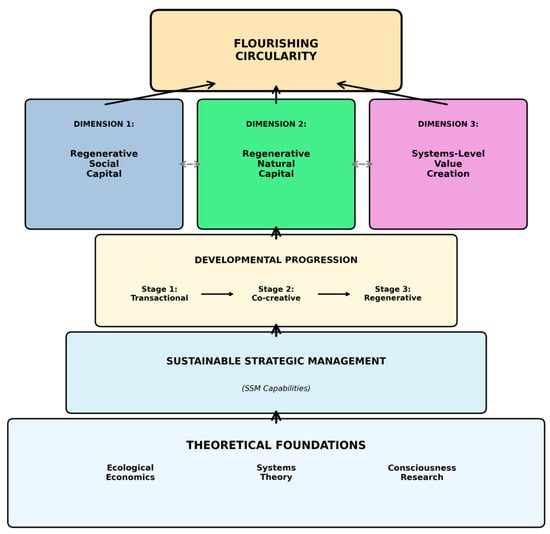
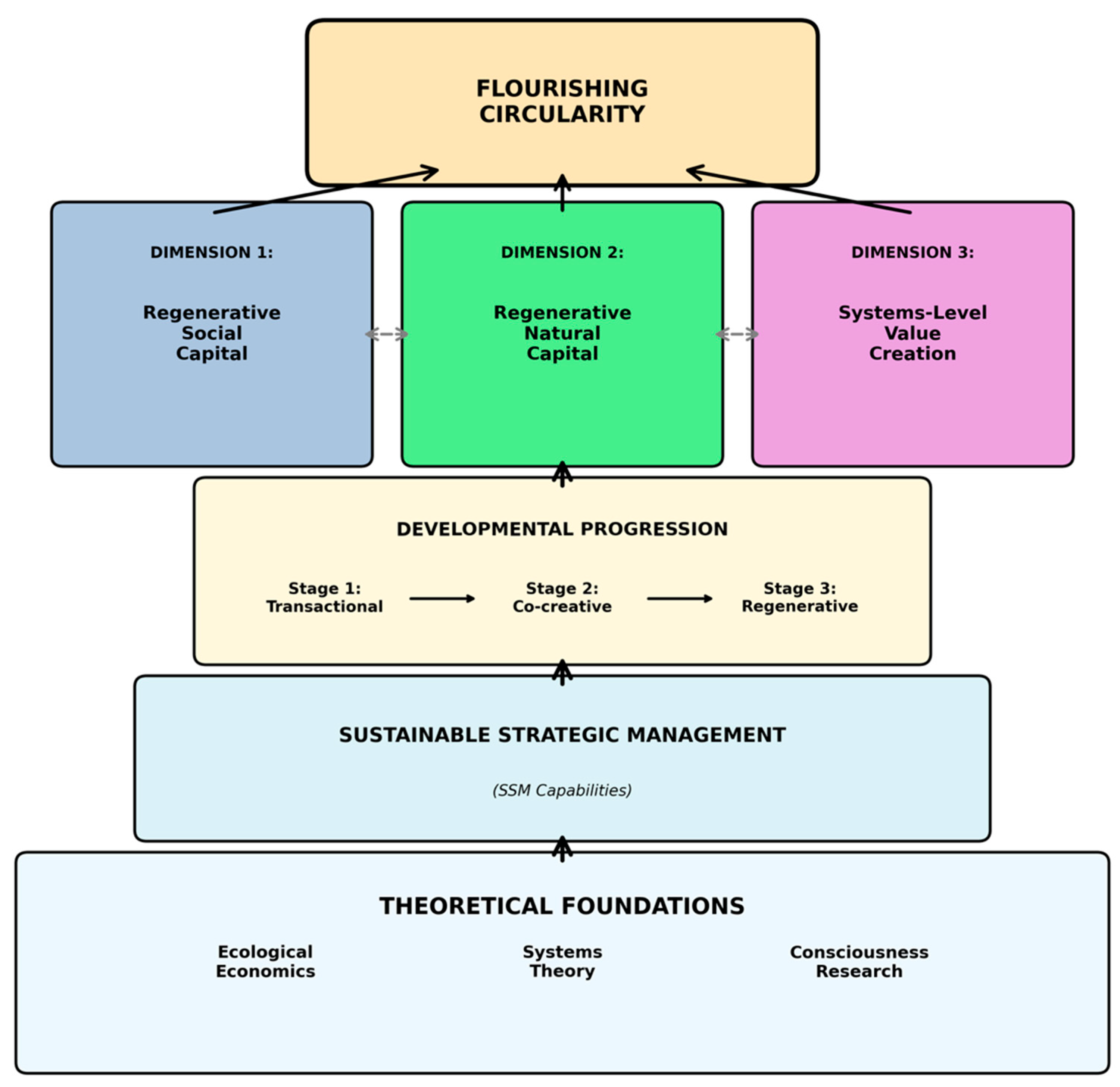

Disclaimer/Publisher’s Note: The statements, opinions and data contained in all publications are solely those of the individual author(s) and contributor(s) and not of MDPI and/or the editor(s). MDPI and/or the editor(s) disclaim responsibility for any injury to people or property resulting from any ideas, methods, instructions or products referred to in the content. |
© 2026 by the author. Licensee MDPI, Basel, Switzerland. This article is an open access article distributed under the terms and conditions of the Creative Commons Attribution (CC BY) license.