Model for Predicting the Rockburst Intensity Grade in Gently Dipping Rock Strata via MIPSO-RF

 ,
,  , , ,
, , ,
Abstract
1. Introduction
2. Dataset Establishment and Analysis
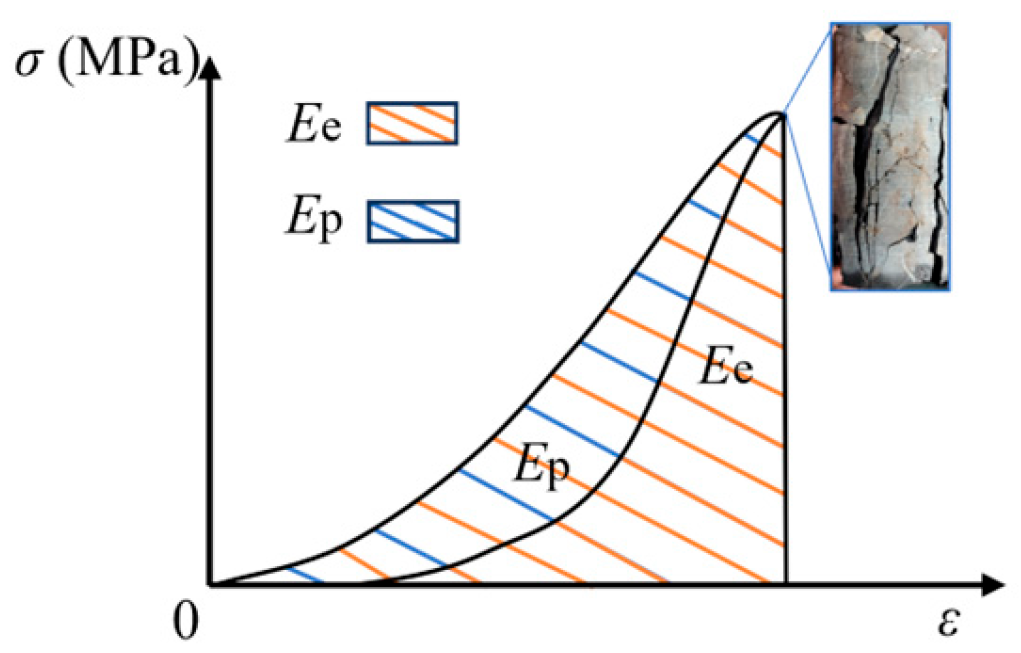
2.1. Determination of the Rockburst Intensity Grade Prediction Indicator
2.2. Establishment of a Rockburst Sample Dataset
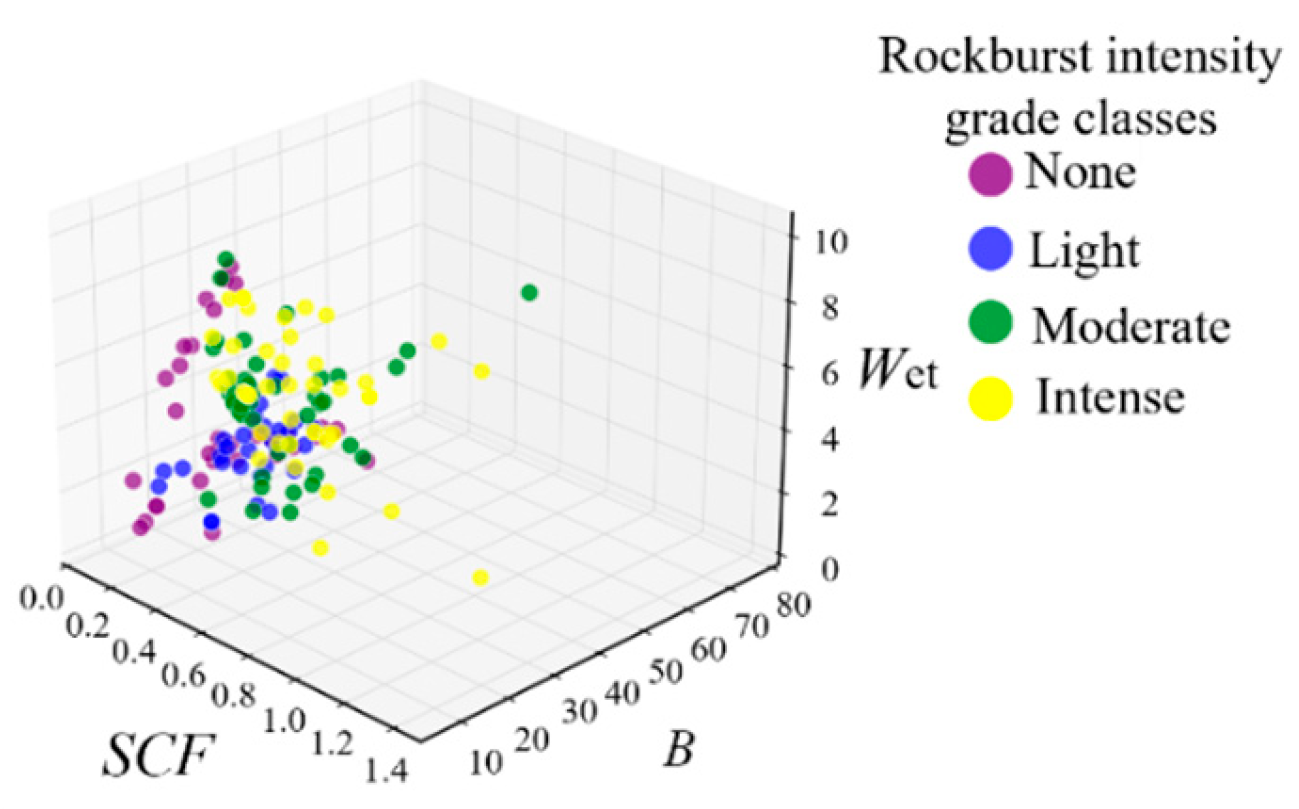
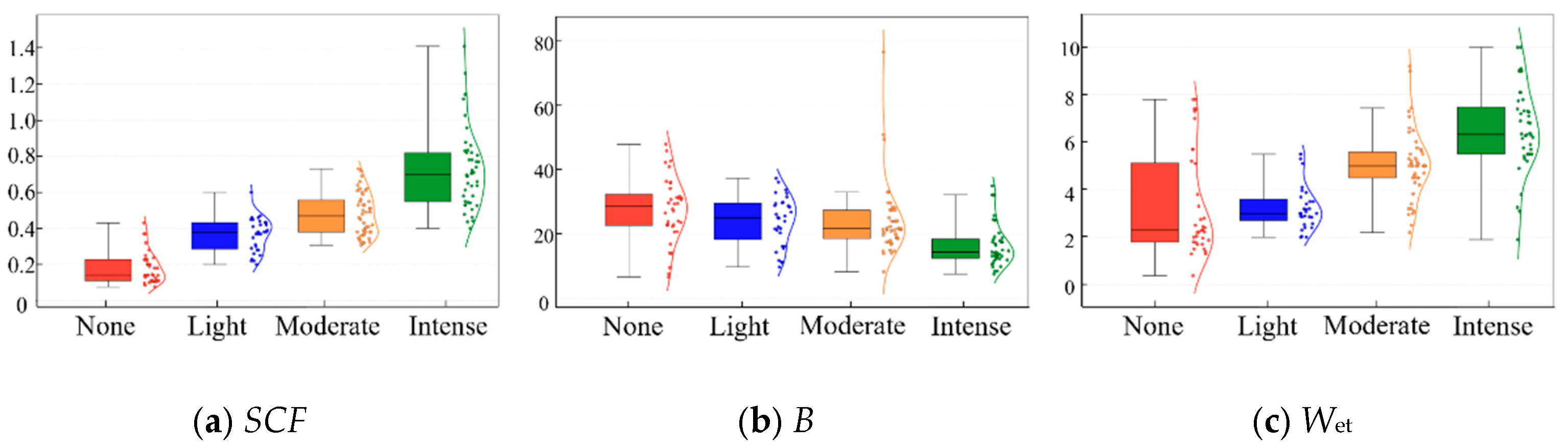
2.3. Data Visualization Analysis
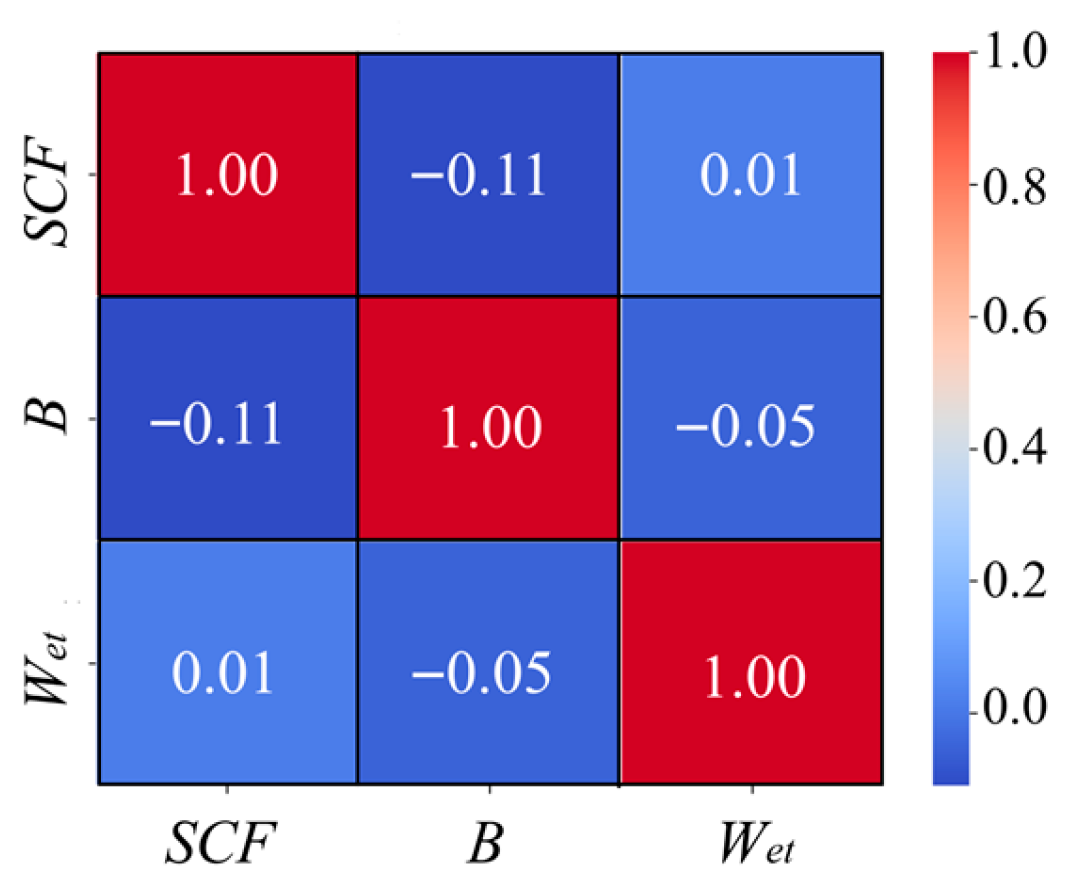
2.4. Analysis of Relationships
3. Construction of the MIPSO-RF Prediction Model
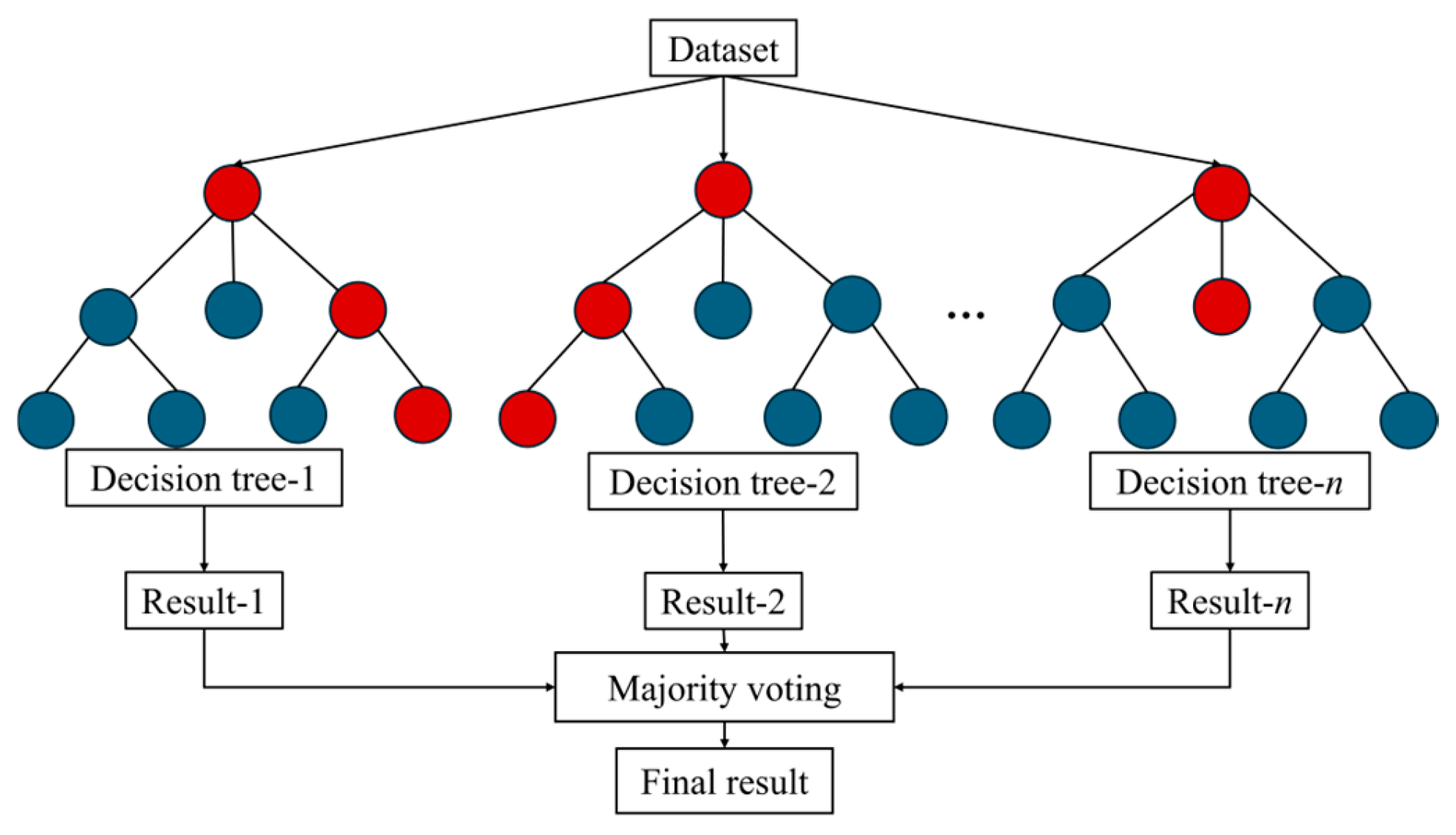
3.1. Random Forest
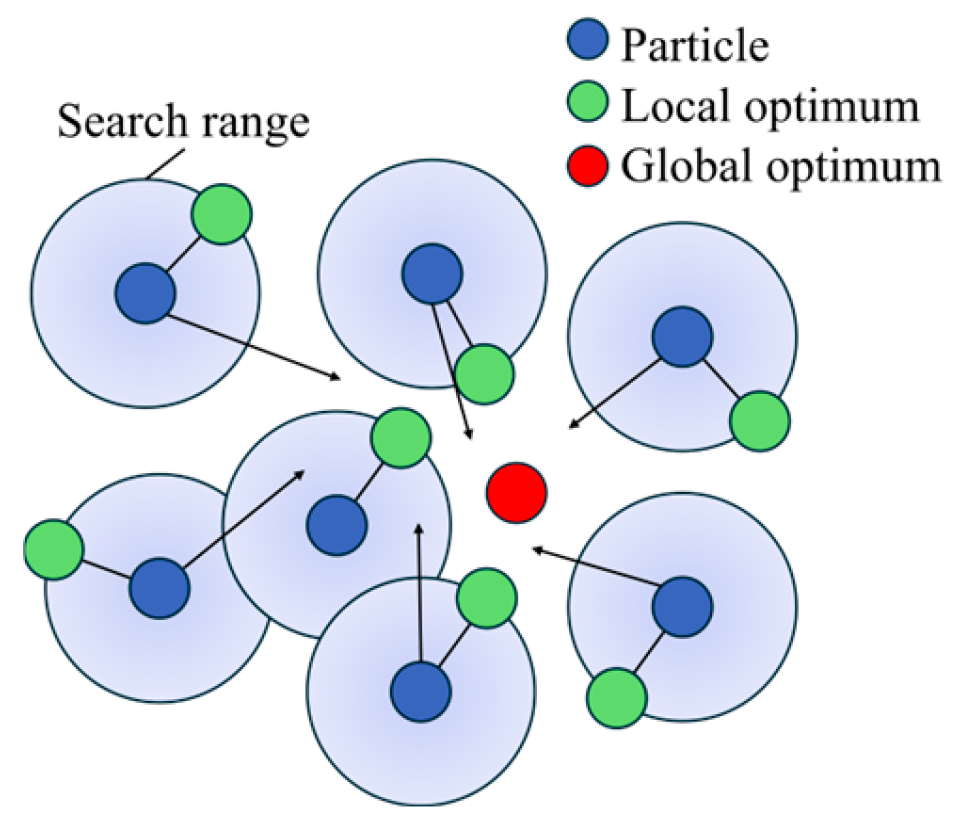
3.2. Particle Swarm Optimization
3.3. Optimization Strategy
3.3.1. One-Dimensional Compound Chaotic Map
3.3.2. Dynamic Self-Adaptive Feature Weighting
3.3.3. Levy Flight
3.3.4. Cauchy–Gaussian Hybrid Mutation Mechanism
3.3.5. Step Length Factor Dynamic Adjustment Strategy
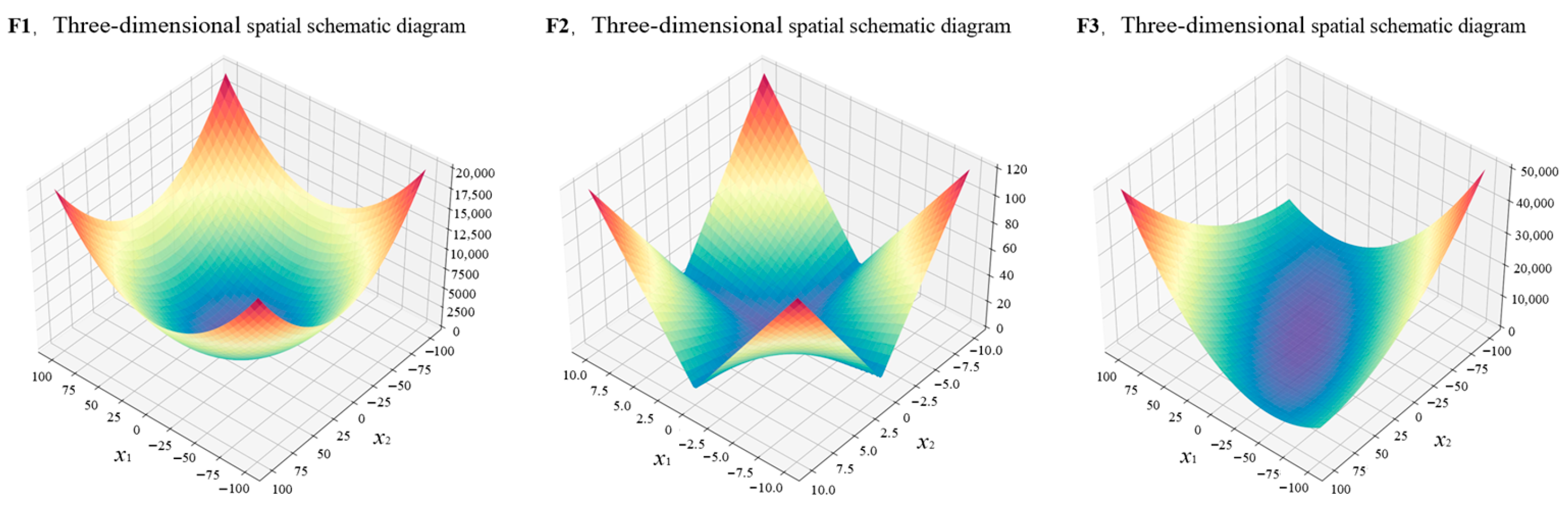
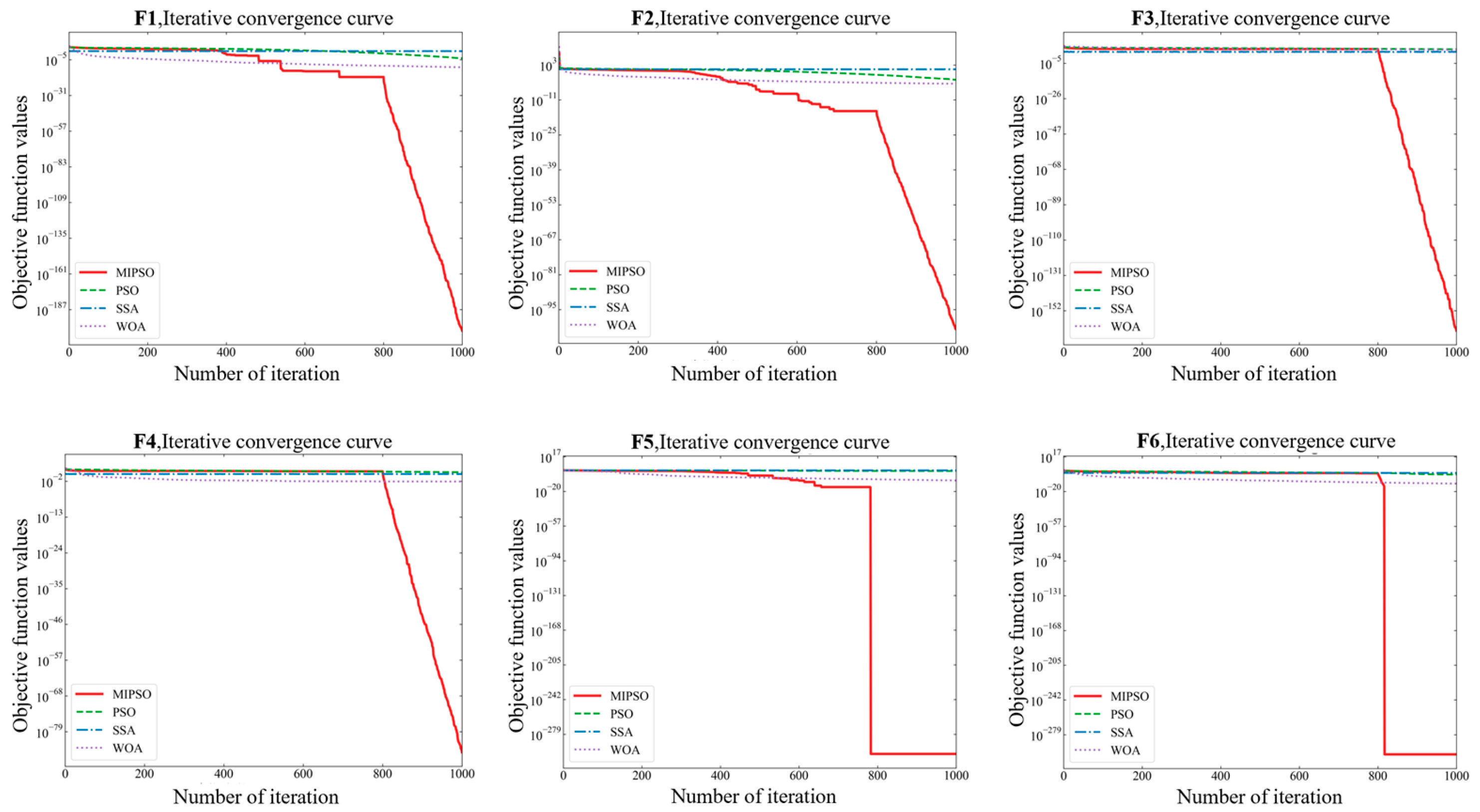
3.4. Algorithm Validation
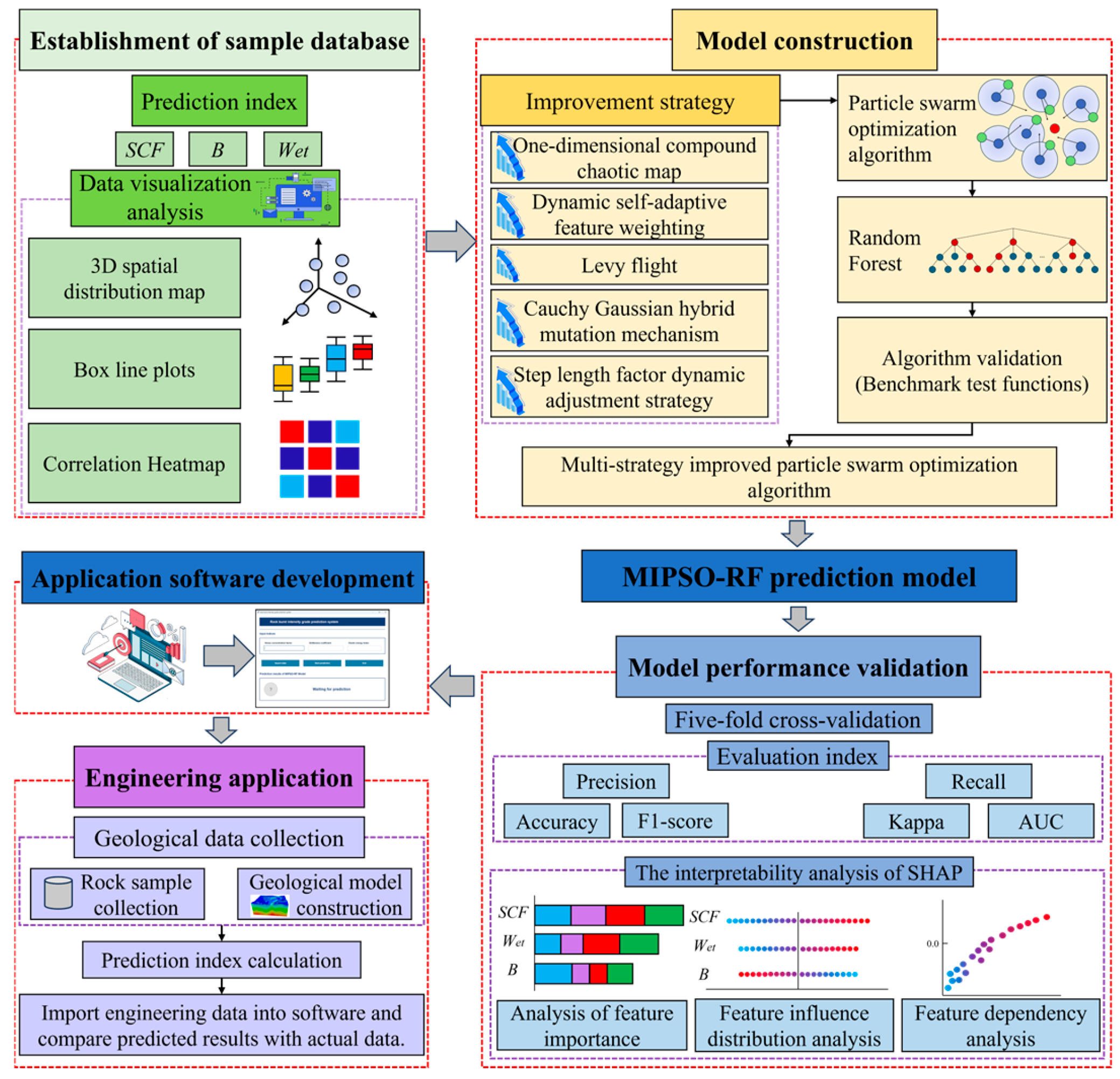
3.5. Prediction Framework Construction
4. Performance Testing
4.1. Test of Predictors
4.2. Shapley Interpretability Analysis
4.2.1. Feature Importance Analysis
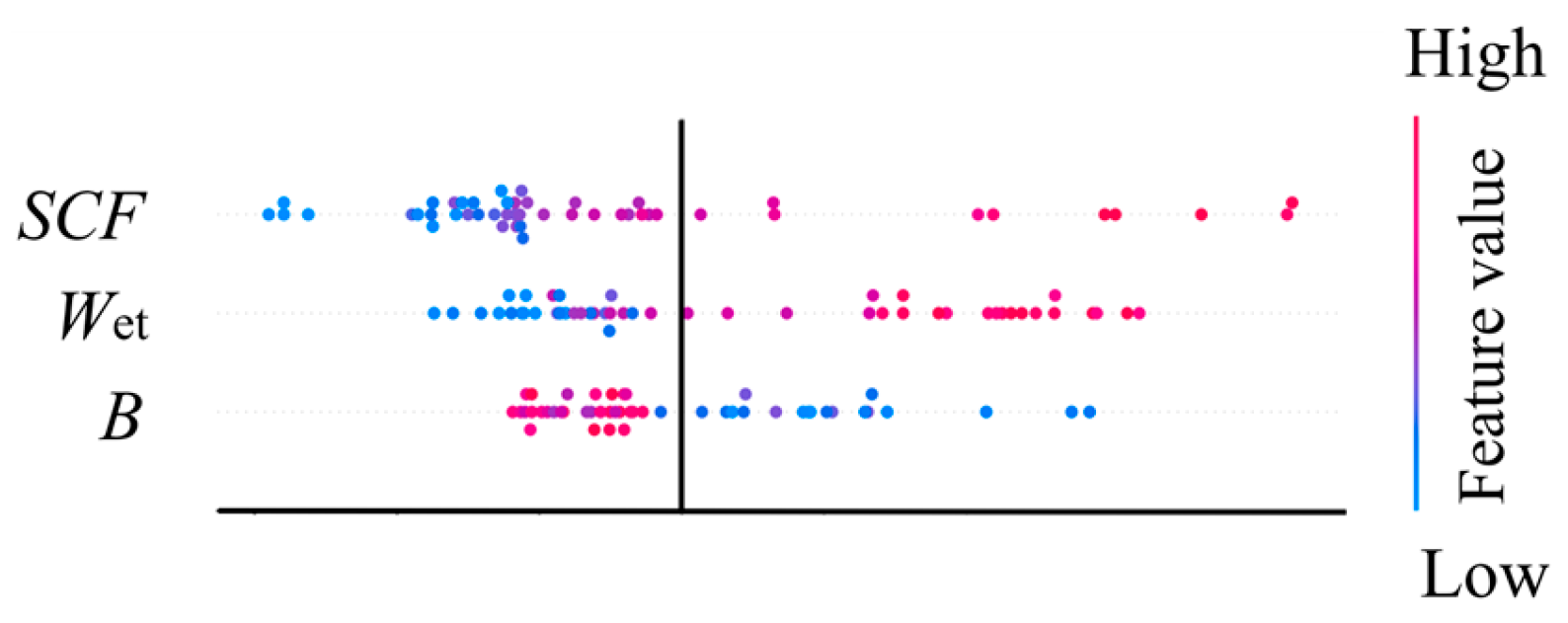
4.2.2. Feature Impact Distribution Analysis
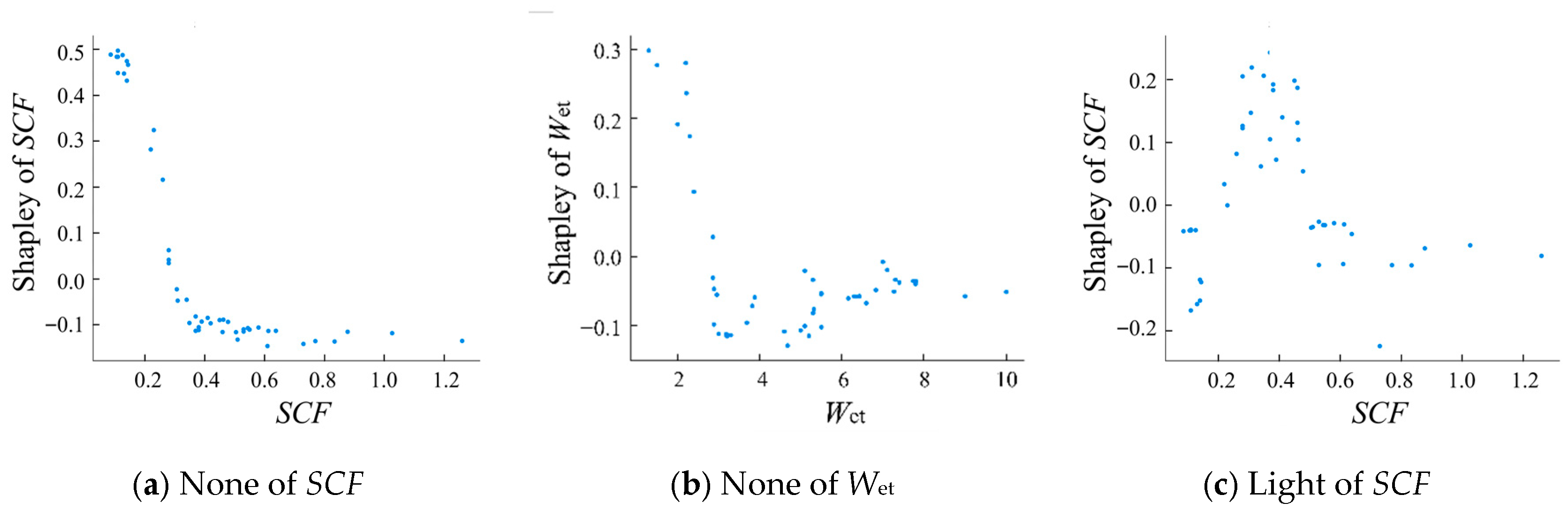
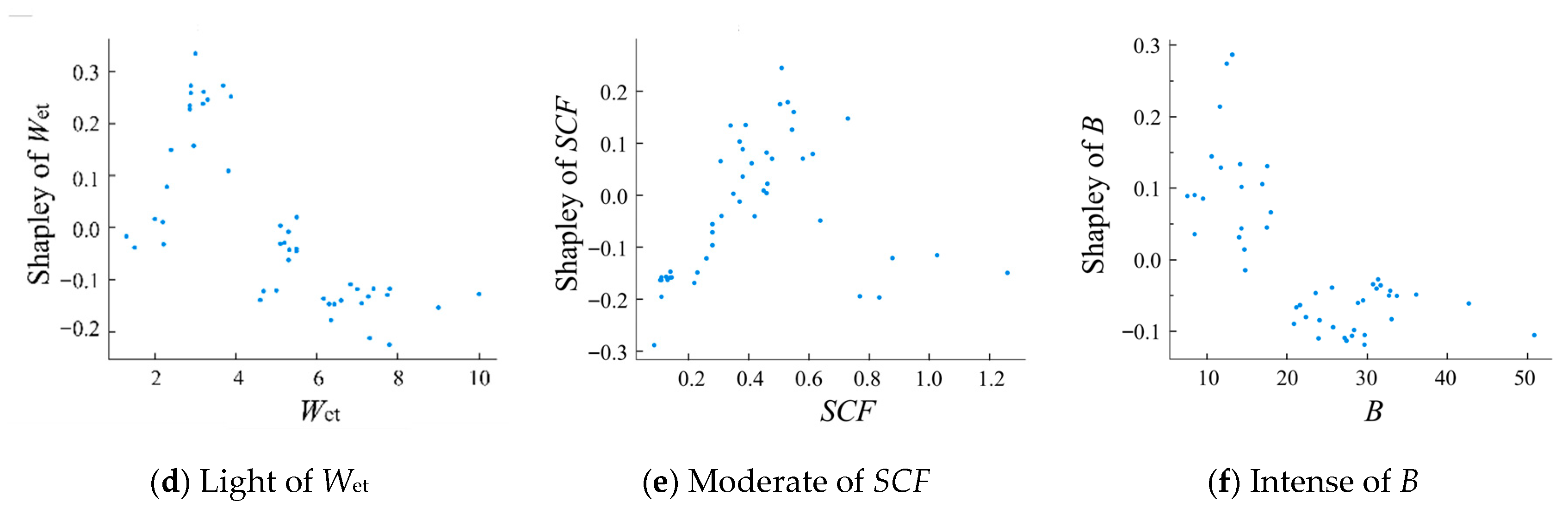
4.2.3. Feature Dependency Analysis
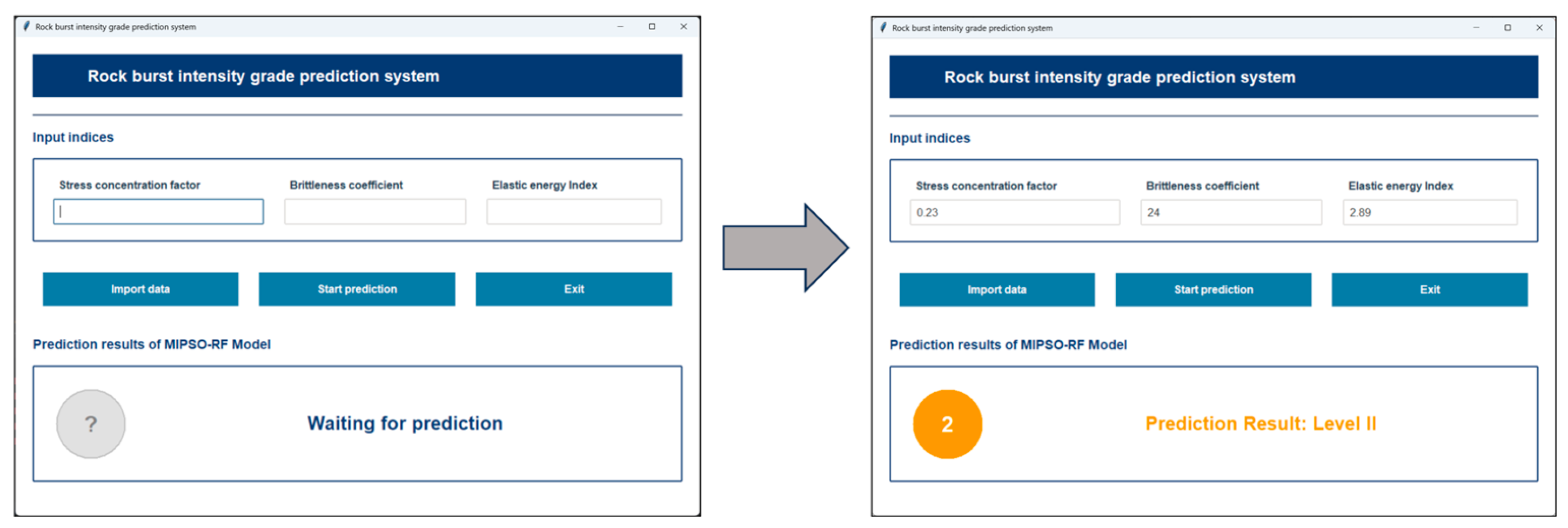
4.3. Application Software Development
5. Engineering Examples
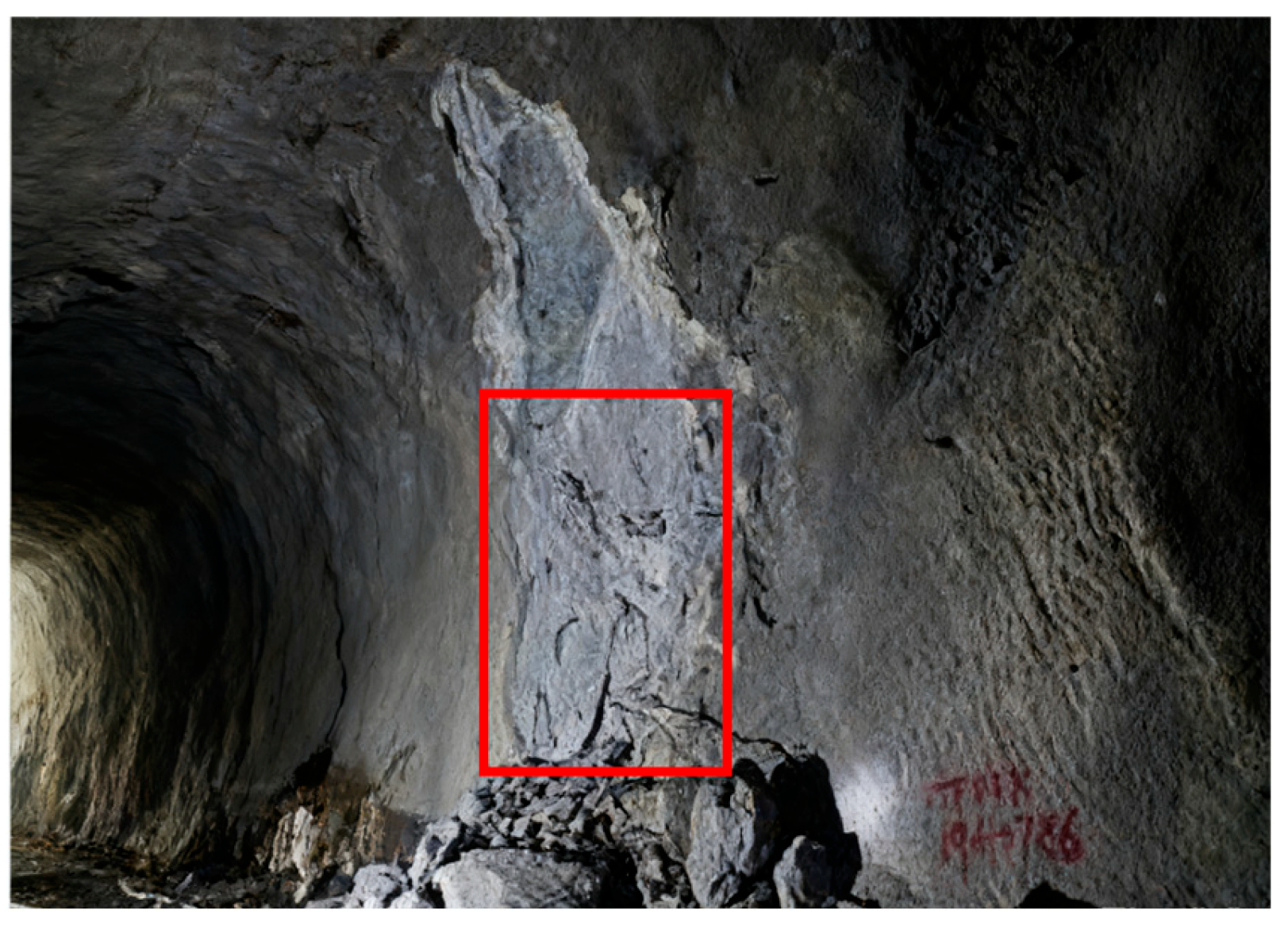
5.1. Project Background
5.2. Rock Burst Prediction Indicator Parameter Acquisition
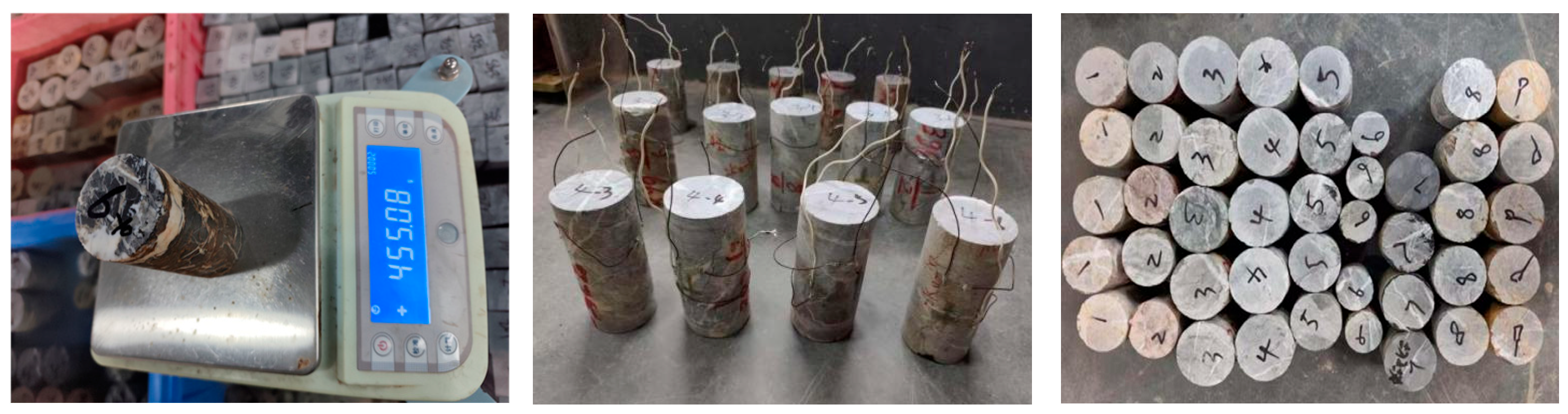
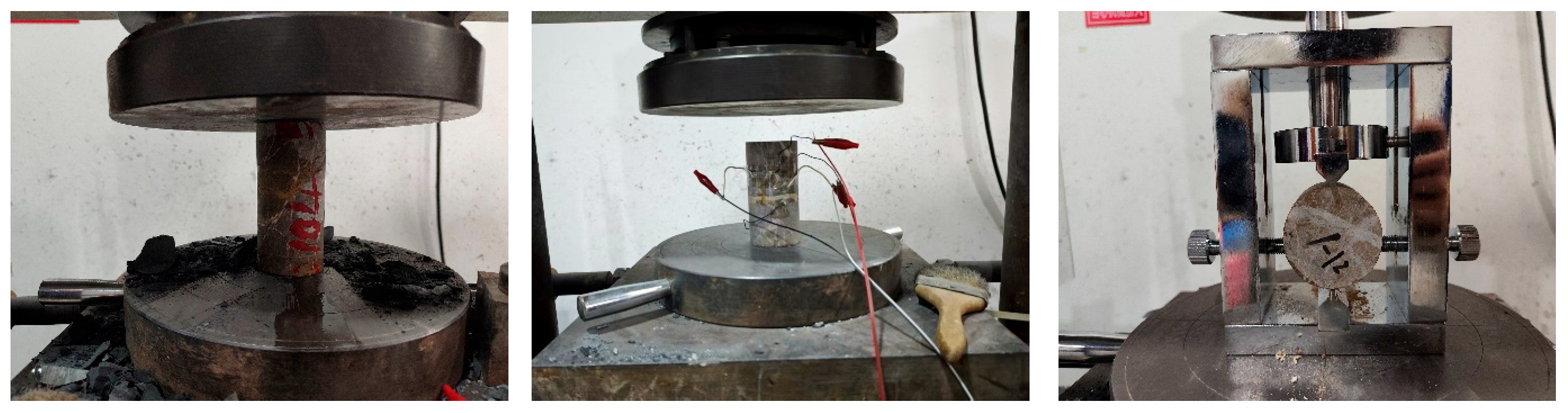
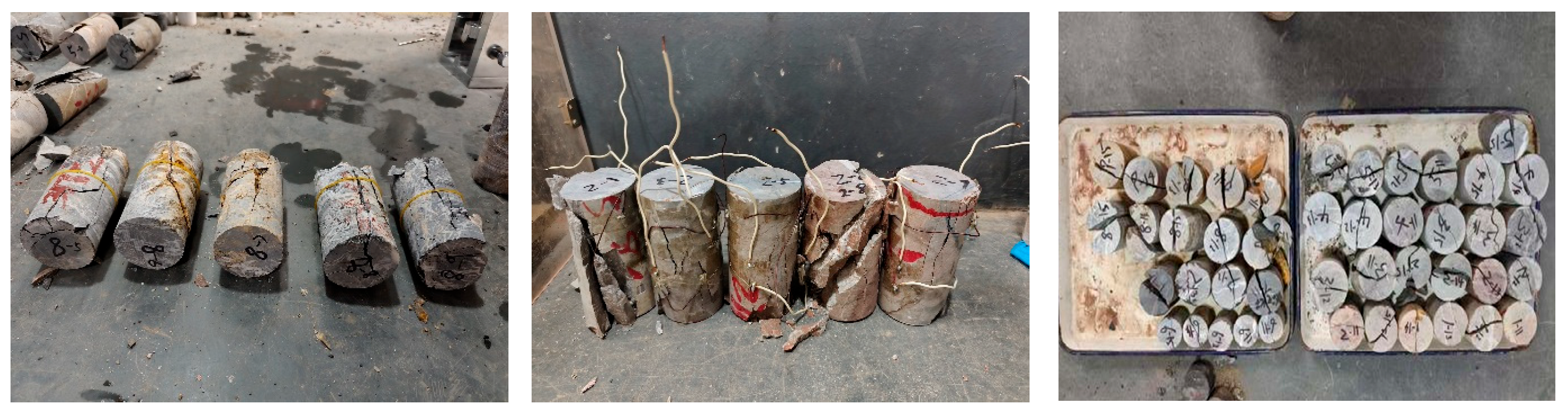
5.2.1. Laboratory Rock Mechanics Tests
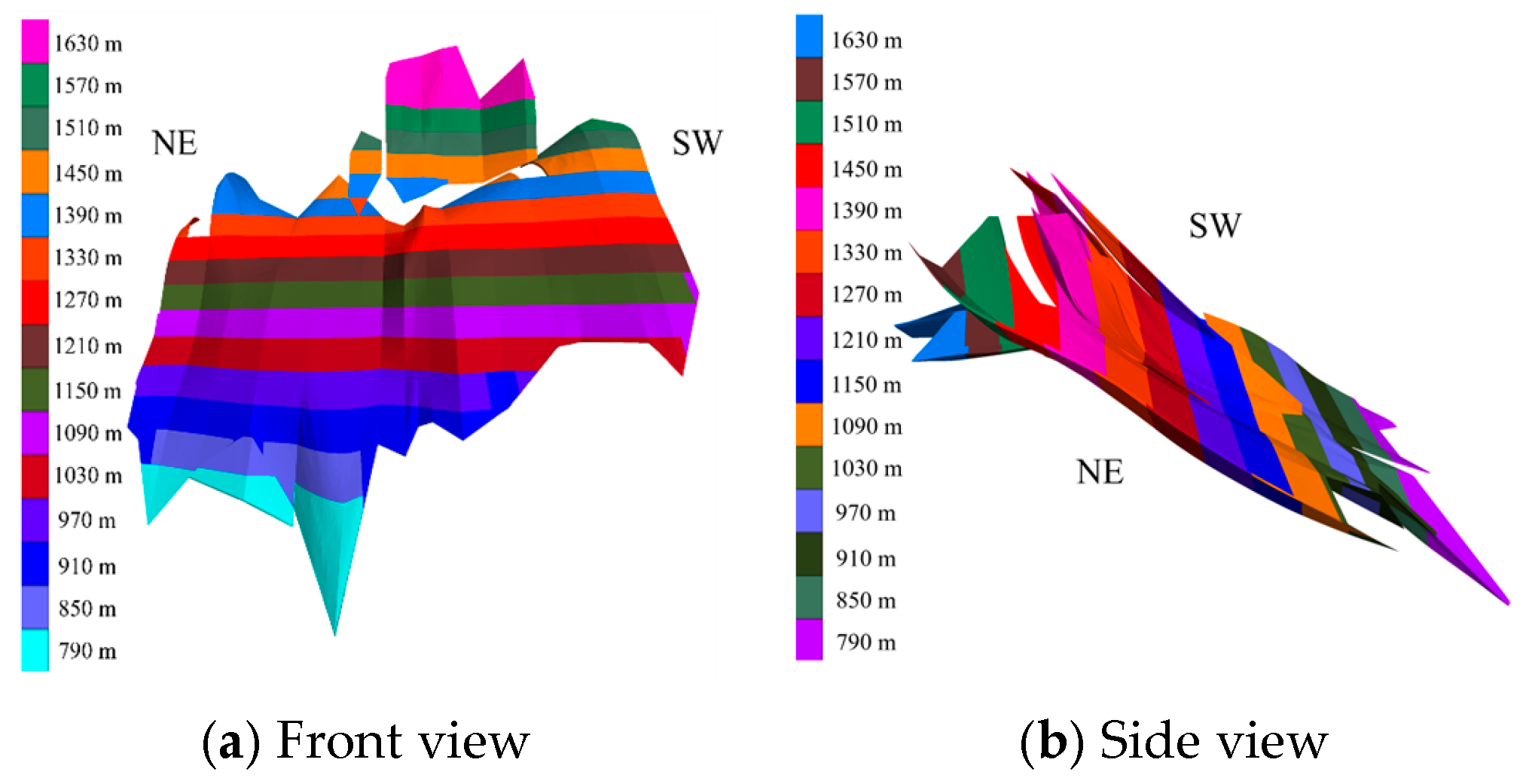
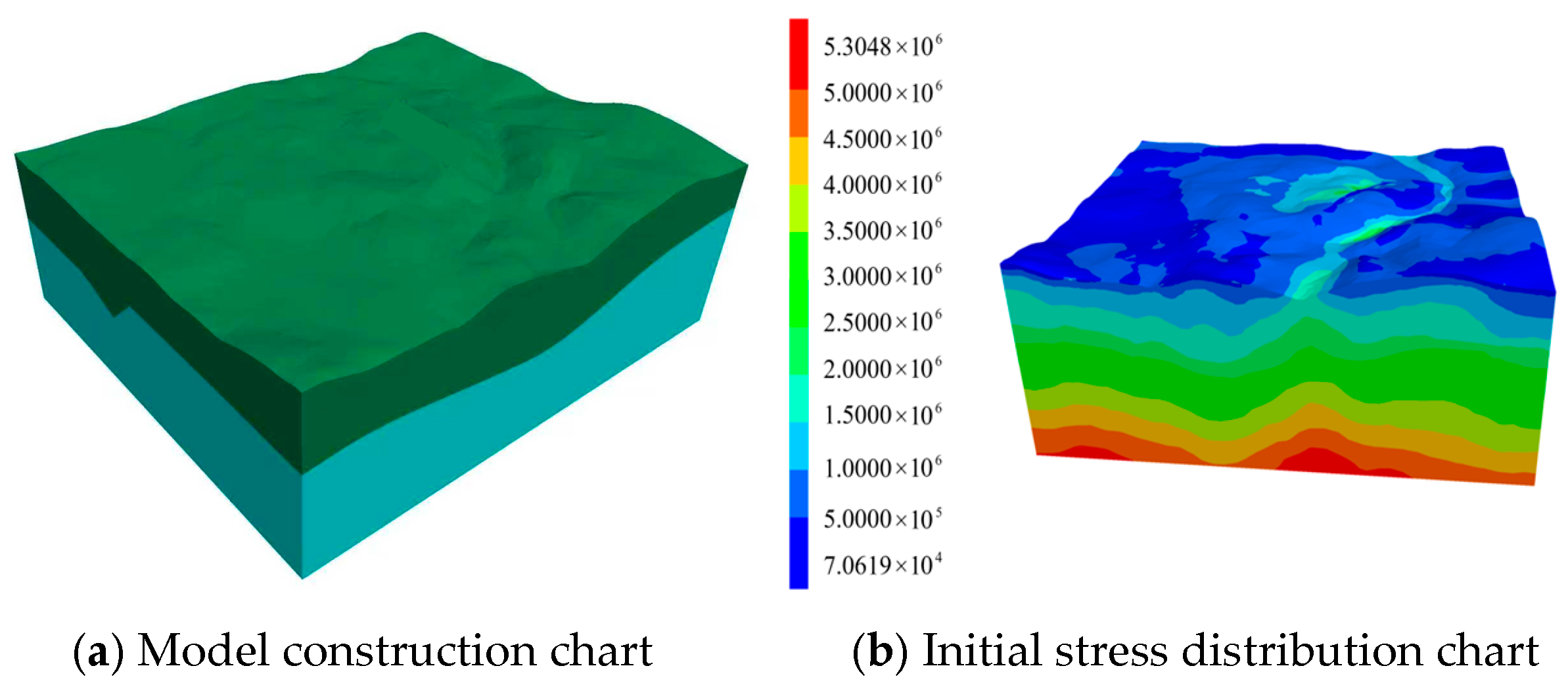
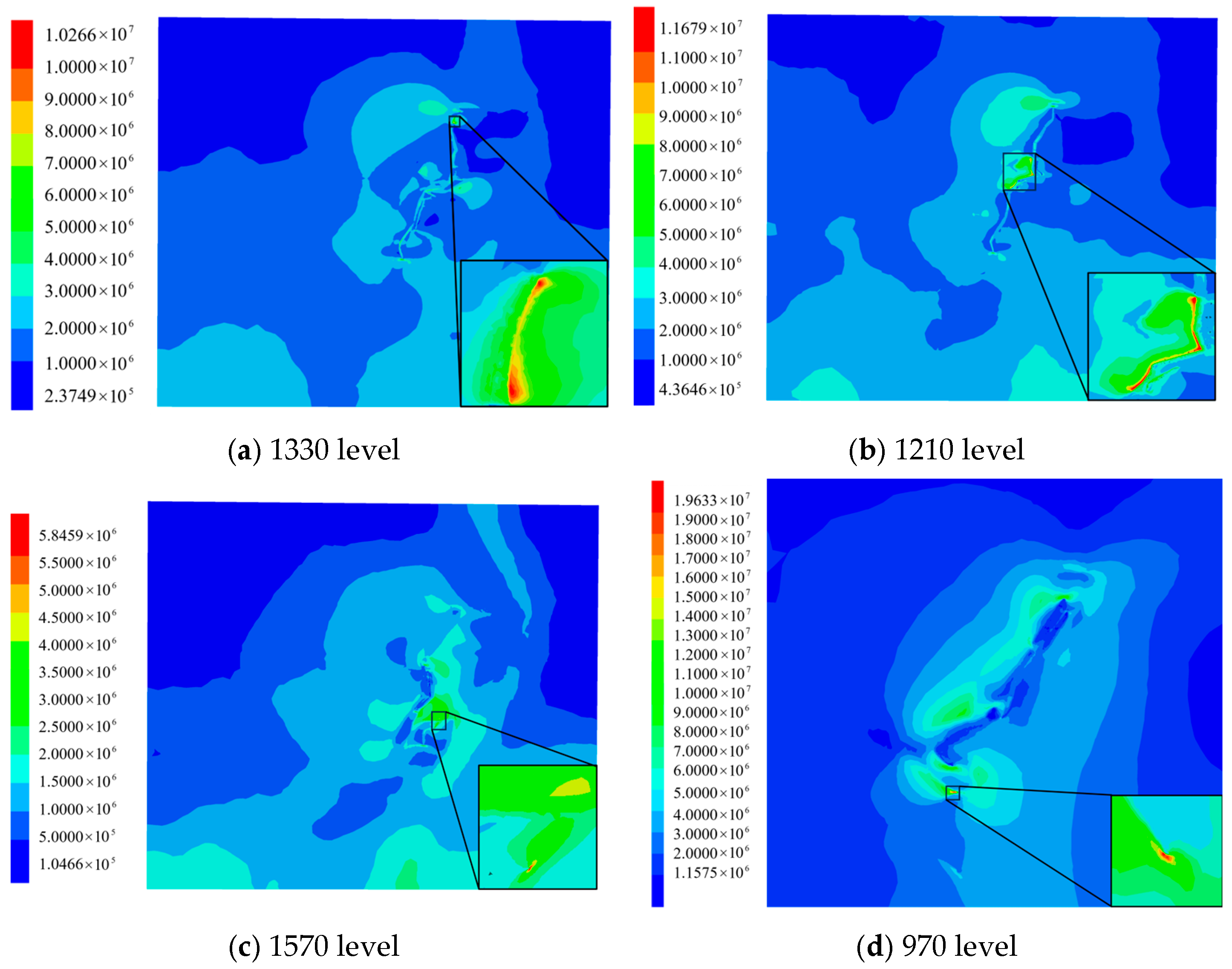
5.2.2. Numerical Simulation of the Maximum Tangential Stress
5.3. Engineering Applications
6. Conclusions and Future Plans
6.1. Conclusions
6.2. Future Plans
Author Contributions
Funding
Institutional Review Board Statement
Informed Consent Statement
Data Availability Statement
Conflicts of Interest
References
- Jiang, F.; Zhou, H.; Liu, C.; Sheng, J. Progress, prediction and prevention of rockbursts in underground metal mines. Chin. J. Rock Mech. Eng. 2019, 38, 956–972. [Google Scholar] [CrossRef]
- Li, J.; Fu, H.; Hu, K.; Chen, W. Data preprocessing and machine learning modeling for rockburst assessment. Sustainability 2023, 15, 13282. [Google Scholar] [CrossRef]
- Cao, Z.; Zhang, S.; Xue, Y.; Wang, Z.; Du, F.; Li, Z.; Huang, C.; Wang, S.; Yu, Y.; Wang, W.; et al. Disaster-Causing Mechanism of Spalling Rock Burst Based on Folding Catastrophe Model in Coal Mine. Rock Mech. Rock Eng. 2025, 58, 7591–7604. [Google Scholar] [CrossRef]
- Chen, H.; Li, Z. Comparative study on the effect of rockburst prevention and control measure in deep drift. Chin. Nonferr. Met. Min. Sect. 2023, 75, 37–45. [Google Scholar] [CrossRef]
- Wu, L. Research on Rockburst Prediction Method and Application Based on SSA-RF Model. Master’s Thesis, North China University of Technology, Beijing, China, 2024. [Google Scholar] [CrossRef]
- Lin, M.; Lu, X.; Xia, Y.; Zhang, L.; Liao, Q.; Zhang, T. Model experimental investigation on the effects of rockburst on gently inclined structural planes under gradient stresses. Chin. Explos. Shock Waves 2025, 45, 170–183. [Google Scholar] [CrossRef]
- Feng, X.; Xiao, Y.; Feng, G.; Yao, Z.; Chen, B.; Yang, C.; Su, G. Study on the development process of rockbursts. Chin. J. Rock Mech. Eng. 2019, 38, 649–673. [Google Scholar] [CrossRef]
- Feng, X.; Chen, B.; Ming, H.; Wu, S.; Xiao, Y.; Feng, G.; Zhou, H.; Qiu, S. Evolution law and mechanism of rockbursts in deep tunnels: Immediate rockburst. Chin. J. Rock Mech. Eng. 2012, 31, 433–444. [Google Scholar] [CrossRef]
- Zhou, H.; Meng, F.; Zhang, C.; Yang, F.; Lu, J. Characteristics of shear failure of structural plane and slip rockburst. Chin. J. Rock Mech. Eng. 2015, 34, 1729–1738. [Google Scholar] [CrossRef]
- Su, G.; Yan, X.; Jiang, J. Influence of weak dynamic disturbances on rockburst occurring in the borehole containing a small-scale single structural plane: An experimental study. Chin. J. Rock Mech. Eng. 2024, 57, 5997–6030. [Google Scholar] [CrossRef]
- Chen, B.; Zhang, Z.; Lan, Q.; Liu, Z.; Tan, Y. Experiment study on damage properties and acoustic emission characteristics of layered shale under uniaxial compression. Materials 2023, 16, 4317. [Google Scholar] [CrossRef]
- Feng, F.; Zhao, X.; Chen, S.; Li, X.; Li, D.; Huang, W. Effect of structural plane position on hard tunnel failure during excavation unloading subjected to high stresses in deep level mines. J. Cent. South Univ. 2021, 52, 2588–2600. [Google Scholar] [CrossRef]
- Wu, S.; Wu, Z.; Zhang, C. Rock burst prediction probability model based on case analysis. Tunn. Undergr. Space Technol. 2019, 93, 103069. [Google Scholar] [CrossRef]
- Wang, Y.; Li, W.; Li, Q.; Xu, Y.; Tan, G. Method of fuzzy comprehensive evaluations for rockburst prediction. Chin. J. Rock Mech. Eng. 1998, 17, 15–23. [Google Scholar]
- Liang, W.; Zhao, G. A review of long-term and short-term rockburst risk evaluationsin deep hard rock. Chin. J. Rock Mech. Eng. 2022, 41, 19–39. [Google Scholar] [CrossRef]
- Xue, Y.; Bai, C.; Qiu, D.; Kong, F.; Li, Z. Predicting rockburst with database using particle swarm optimization and extreme learning machine. Tunn. Undergr. Space Technol. 2020, 98, 103287. [Google Scholar] [CrossRef]
- Wang, Q.; Wang, C.; Liu, Y.; Xu, J.; Wang, T.; Li, Y.; Liu, Q. Exploration and Improvement of Fuzzy Evaluation Model for Rockburst. Min. Metall. Explor. 2024, 41, 559–587. [Google Scholar] [CrossRef]
- Liu, R.; Ye, Y.; Hu, N.; Chen, H.; Wang, X. Classified prediction model of rockburst using rough sets-normal cloud. Neural Comput. Appl. 2019, 31, 8185–8193. [Google Scholar] [CrossRef]
- Qiao, M.; Zhou, Z.; Li, Y.; Li, J.; Liu, J. Optimization of rockburst tendency prediction method based on subjective and objective weighting-matter-element extension model. Chin. Nonferr. Met. Eng. 2022, 12, 119–130. [Google Scholar] [CrossRef]
- Liang, W.; Zhao, G.; Wu, H.; Dai, B. Risk assessment of rockburst via an extended MABAC method under fuzzy environment. Tunn. Undergr. Space Technol. 2019, 83, 533–544. [Google Scholar] [CrossRef]
- Jin, C.; Ji, Z.; Gong, L.; An, X.; Zhou, Y. Evaluation model of rockburst intensity of diversion tunnel based on WOA-SVM. Chin. Saf. Sci. J. 2023, 33, 41–48. [Google Scholar] [CrossRef]
- Wang, W.; Zhang, Q.; Guo, S.; Liang, B.; Liu, C. Prediction of rock burst intensity based on SSA-BP neural network. Chin. Nonferr. Met. Min. Sect. 2024, 76, 77–83+91. [Google Scholar] [CrossRef]
- Li, K.; Wu, Y.; Du, F.; Zhang, X.; Wang, Y. Prediction of rockburst intensity grade based on convolutional neural network. Chin. Coal Geol. Explor. 2023, 51, 94–103. [Google Scholar] [CrossRef]
- Wang, Y.; Zhou, Z.; Li, G.; Liu, J. Prediction model and accuracy optimization of rockburst grade based on data preprocessing. Chin. Min. Res. Dev. 2024, 44, 101–109. [Google Scholar] [CrossRef]
- Wu, H.; Guo, Y.; He, J.; Su, L. Rock burst classification prediction model based on GWO-SVM. Chin. Subgr. Eng. 2023, 01, 49–54. [Google Scholar] [CrossRef]
- Zhou, G.; Hu, G. Parameter optimization of random forest based on grid algorithm and particle swarm optimization. J. Anhui Univ. (Nat. Sci. Ed.) 2025, 49, 27–34. [Google Scholar] [CrossRef]
- Li, J.; Wang, Y.; Zhang, T.; Zhou, Y.; Luo, H.; Liu, X. Rockburst intensity prediction model based on Newton-Raphson-based optimizer and BP neural network. Min. Res. Dev. 2025, 45, 127–133. [Google Scholar] [CrossRef]
- Wang, M.; Zhao, G.; Liang, W.; Wang, N. A comparative study on the development of hybrid SSA-RF and PSO-RF models for predicting the uniaxial compressive strength of rocks. Case Stud. Constr. Mater. 2023, 18, 2214–5095. [Google Scholar] [CrossRef]
- Guo, R.; Zhang, S. Landslide susceptibility assessment based on random forest method with mean particle swarm optimization. Chin. J. Nat. Disasters 2025, 34, 119–128. [Google Scholar] [CrossRef]
- Man, K.; Wu, L.; Liu, X.; Song, Z.; Liu, Z.; Liu, R.; Cao, Z. Rockburst Grade Prediction Based on Grey Correlation Analysis and SSA-RF Model. Met. Mine 2023, 5, 202–212. [Google Scholar] [CrossRef]
- Gao, L.; Liu, Z.; Zhang, H. Prediction of rockburst classification of railway tunnel based on hybrid PSO-RBF neural network. J. Railw. Sci. Eng. 2021, 18, 450–458. [Google Scholar] [CrossRef]
- Su, S.; Gao, T.; Zhu, Y.; Fang, X.; Fan, T. Rockburst Prediction via Multiscale Graph Convolutional Neural Network. Rock Mech. Rock Eng. 2025, 58, 659–677. [Google Scholar] [CrossRef]
- Dong, W.; Zhang, Q.; Wang, X.; Dong, H.; Wang, C.; Wang, S. Real-time rockburst warning using microseismic multi-feature parameters based on the PSO-GRNN model. Nat. Hazards 2025, 121, 24035–24066. [Google Scholar] [CrossRef]
- Mei, H.; Wang, Y.; Zhang, X.; Wang, J.; Qi, G.; Han, Y.; Zheng, W. Interpretability analysis of rockburst risk prediction in coal mines based on machine learning-SHAP. J. Appl. Geophys. 2025, 243, 105982. [Google Scholar] [CrossRef]
- Gao, M.; Li, T.; Ji, S.; Bai, S.; Zhang, Y.; He, Z.; Zhang, L. A prediction model for high-geothermal rockburst intensity using a genetic projection pursuit algorithm. J. Rock Mech. Geotech. Eng. 2025, 17, 7612–7627. [Google Scholar] [CrossRef]
- Liu, J.; Zhou, Z.; Liu, J.; Hong, Z. Prediction of rockburst grade based on principal component analysis and improved Bayesian discriminant analysis. J. Min. Strata Control Eng. 2022, 4, 16–26. [Google Scholar] [CrossRef]
- Lin, H.; Zhang, W.; Guo, S.; Zhang, X.; Li, W.; Zhang, J. Study on the Energy Evolution Mechanism and Fractal Characteristics of Coal Failure under Dynamic Loading. ACS Omega 2025, 10, 54710–54719. [Google Scholar] [CrossRef] [PubMed]
- Armaghani, D.; Yang, P.; He, X.; Pradhan, B.; Zhou, J.; Sheng, D. Toward precise long-term rockburst forecasting: A fusion of SVM and cutting-edge meta-heuristic algorithms. Nat. Resour. Res. 2024, 33, 2037–2062. [Google Scholar] [CrossRef]
- Pu, Y.; Apel, D.B. Bob Lingga. Rockburst prediction in kimberlite using decision tree with incomplete data. J. Sustain. Min. 2018, 17, 158–165. [Google Scholar] [CrossRef]
- Ge, H.; Zhang, J.; Ma, C.; Hui, K.; Li, Y.; Wu, Z. Rockburst intensity grading prediction based on the LOF-ENN-KNN model. Sci. Rep. 2025, 15, 29385. [Google Scholar] [CrossRef]
- Li, M.; Li, K.; Qin, Q.; Wu, S.; Liu, Y.; Liu, B. Discussion and selection of machine learning algorithm model for rockburst in-tensity grade prediction. Chin. J. Rock Mech. Eng. 2021, 40, 2806–2816. [Google Scholar] [CrossRef]
- Shen, P. Research on Rockburst Prediction Model Based on Neural Network. Master’s Thesis, Tibet University, Lhasa, China, 2024. [Google Scholar] [CrossRef]
- Hu, A.; Wang, W.; Yang, J.; Kou, Y.; Yu, B. Prediction model of rockburst based on variable weight Bayesian and its application. Chin. J. Undergr. Space Eng. 2024, 20, 1837–1845. [Google Scholar] [CrossRef]
- Basnet, P.; Mahtab, S.; Jin, A. A comprehensive review of intelligent machine learning based predicting methods in long-term and short-term rock burst prediction. Tunn. Undergr. Space Technol. 2023, 142, 105434. [Google Scholar] [CrossRef]
- Tian, R. Research and Application of Rockburst Intensity Classification Prediction Model based on Machine Learning Algorithms. Ph.D. Thesis, Inner Mongolia University of Science & Technology, Baotou, China, 2020. [Google Scholar] [CrossRef]
- Gao, Y.; Zhu, Q.; Wu, S.; Chen, L. Rockburst prediction study based on AVOA-XGBoost model. J. Huazhong Univ. of Sci. Tech. 2023, 51, 151–157. [Google Scholar] [CrossRef]
- Shi, J.; Shang, G. Research on short-term wind power prediction method based on machine learning algorithm: Taking RF-PSO-STM model as an example. Chin. Intell. Percept. Eng. 2025, 2, 91–99. [Google Scholar] [CrossRef]
- Wan, H.; Yang, L.; Qu, J.; Peng, J. A PSO-RF-based prediction model for molybdenite flotation concentrate grade. Chin. Conserv. Util. Miner. Resour. 2025, 45, 76–86. [Google Scholar] [CrossRef]
- Chen, J.; Li, Y.; Liu, X.; Liu, Z. Improved artificial bee colony optimization underwater localization algorithm by Logistic chaos mapping and differential evolution. Adv. Eng. Sci. 2025, 57, 57–67. [Google Scholar] [CrossRef]
- Wang, X.; Chen, K.; Yuan, S.; Wang, H. Control of continuous rotary electro-Hydraulic servo system based on improved sparrow search algorithm. J. Jilin Univ. (Eng. Technol. Ed.) 2025, 1, 7. [Google Scholar] [CrossRef]
- Huang, X.; Xu, Z.; Wang, J.; Cao, R.; Li, W. A multi-objective optimal matching method based on mixed-variable particle swarm optimization. Chin. Mod. Mach. Tool Autom. Manuf. Tech. 2025, 08, 14–19. [Google Scholar] [CrossRef]
- Liu, C. Improved Grey Wolf Optimization Algorithm and its Application Research. Master’s Thesis, Harbin Normal University, Harbin, China, 2023. [Google Scholar]
- Zhang, F. Research and Application of Harmony Particle Swarm Optimization Algorithm. Master’s Thesis, Lanzhou University of Technology, Lanzhou, China, 2020. [Google Scholar] [CrossRef]
- Bi, X.; Mou, Q.; Gong, S. Whale optimization algorithm combined with dynamic probability threshold and a adaptive muta-tion. Chin. Microelectron. Comput. 2019, 36, 78–83+88. [Google Scholar] [CrossRef]
- Liao, J.; Wang, H.; Wang, X. Fruit fly optimization algorithm with chaotic dynamical step factor. Chin. Transd. Microsyst. Technol. 2019, 38, 139–142. [Google Scholar] [CrossRef]
- Zhu, M. Research on the Improvement and Application of Sparrow Algorithm. Master’s Thesis, Guangxi Minzu University, Nanning, China, 2024. [Google Scholar] [CrossRef]
- Liu, Z. Interpretability Study of Deep Kernel Method (DKM). Master’s Thesis, China University of Petroleum, Beijing, China, 2024. [Google Scholar] [CrossRef]
- Yu, B.; Xing, H.; Ge, W.; Yan, J.; Li, A. Explainable machine learning-based land subsidence susceptibility mapping: From fea-ture importance to individual model contributions in ensembled system. Earth Sci. Inform 2025, 18, 407. [Google Scholar] [CrossRef]















| Source | Model | Prediction Indicator | Number of Dataset Samples |
|---|---|---|---|
| Jin et al., 2023 [21] | WOA-SVM | σc, σt, σθ, Wet | 120 |
| Wang et al., 2024 [22] | SSA-BP | σc, σt, σθ, Wet, σc/σt, σθ/σc | 100 |
| Li et al., 2023, [23] | MICE-CNN | σc, σt, σθ, Wet, σc/σt, σθ/σc | 120 |
| Wang et al., 2024 [24] | GA-XGBoost | σc, σt, σθ, Wet | 471 |
| Wu et al., 2023 [25] | GWO-SVM | σc, σt, σθ | 153 |
| Zhou et al., 2025 [26] | BKA-CNN-SVM | σc, σt, σθ, Wet, σc/σt, σθ/σc | 284 |
| Li et al., 2025 [27] | NRBO-BPNN | σc/σt, σθ/σc | 100 |
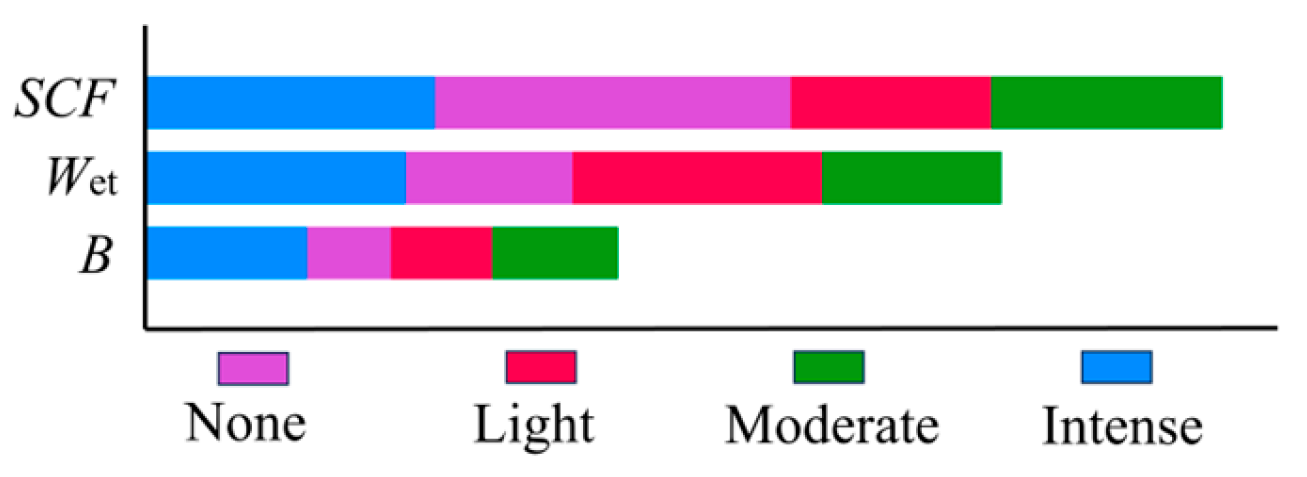
| SCF | B | Wet | |
|---|---|---|---|
| None | <0.3 | >40 | <2.0 |
| Light | 0.3–0.5 | 26.7–40 | 2.0–3.5 |
| Moderate | 0.5–0.7 | 14.5–26.7 | 3.5–5.0 |
| Intense | >0.7 | <14.5 | >5.0 |
| Number | SCF | B | Wet | Burial Depth | Lithology (Rock Structure) | Rockburst Intensity Grade |
|---|---|---|---|---|---|---|
| 1 | 0.14 | 16.89 | 5.2 | 204 | Rock shale (fragmented) | I |
| 2 | 0.22 | 25.00 | 3.00 | 412 | Sandstone (intact) | II |
| 3 | 0.55 | 14.72 | 6.43 | 600 | Limestone (relatively intact) | III |
| 4 | 0.78 | 11.94 | 7.30 | 1316 | Limestone (relatively intact) | IV |
| … | … | … | … | … | … | … |
| 154 | 0.18 | 34.18 | 2.45 | 115 | Limestone (fragmented) | I |
| 155 | 0.29 | 29. 51 | 4.10 | 326 | Limestone (intact) | II |
| 156 | 0.56 | 33.09 | 5.62 | 617 | Rock shale (intact) | III |
| 157 | 0.83 | 14.44 | 7.32 | 987 | Granite (intact) | IV |
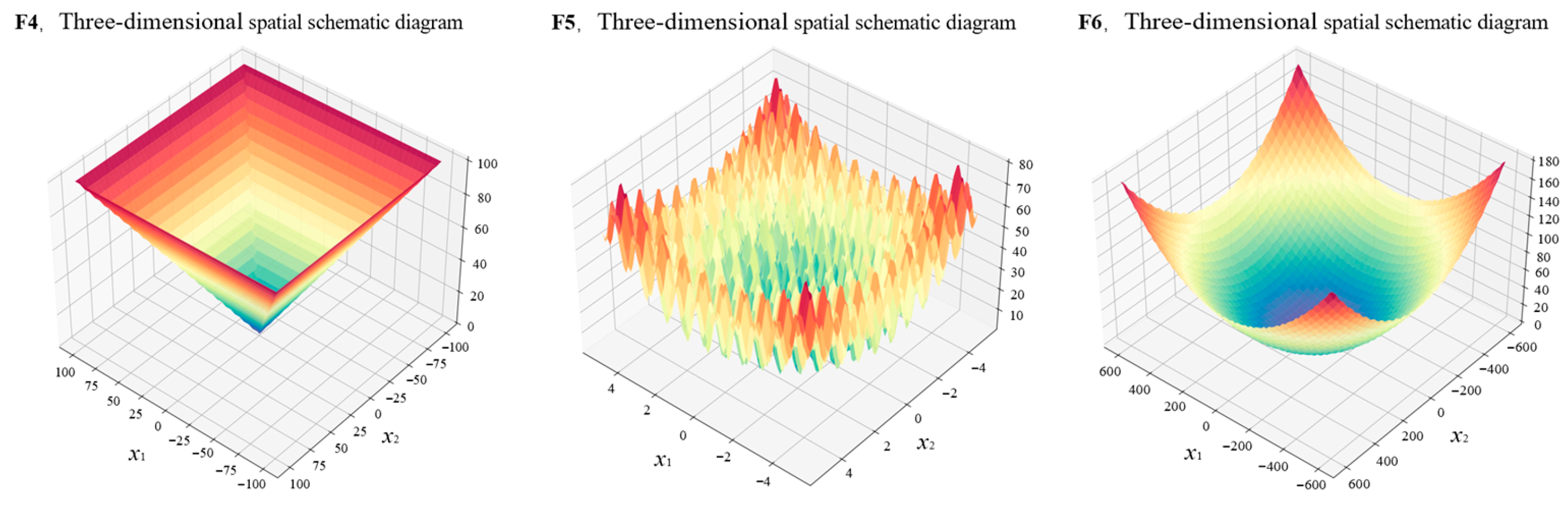
| Number | Function Types | Benchmark Test Functions | Range |
|---|---|---|---|
| F1 | unimodal function | [−100, 100] | |
| F2 | unimodal function | [−10, 10] | |
| F3 | unimodal function | [−100, 100] | |
| F4 | unimodal function | [−100, 100] | |
| F5 | multimodal function | [−5.12, 5.12] | |
| F6 | multimodal function | [−600, 600] |
| Function | Index | MIPSO | PSO | SAA | WOA |
|---|---|---|---|---|---|
| F1 | Mean | 4.87 × 10−196 | 9.10 × 101 | 1.91 × 101 | 1.32 × 10⁻¹¹ |
| Std | 0.00 × 100 | 3.77 × 101 | 3.29 × 100 | 1.04 × 10⁻¹¹ | |
| F2 | Mean | 5.20 × 10−101 | 3.17 × 100 | 1.93 × 101 | 1.59 × 10⁻⁵ |
| Std | 1.56 × 10−100 | 3.16 × 100 | 1.22 × 100 | 6.03 × 10⁻⁶ | |
| F3 | Mean | 1.71 × 10−161 | 3.63 × 10³ | 5.67 × 101 | 8.14 × 10² |
| Std | 5.01 × 10−161 | 1.03 × 10³ | 2.19 × 101 | 1.96 × 10³ | |
| F4 | Mean | 1.45 × 10−86 | 1.26 × 101 | 1.72 × 100 | 3.16 × 10⁻³ |
| Std | 1.97 × 10−86 | 1.69 × 100 | 1.82 × 10⁻¹ | 3.06 × 10⁻³ | |
| F5 | Mean | 0.00 × 100 | 8.16 × 101 | 2.46 × 10² | 1.79 × 10⁻⁹ |
| Std | 0.00 × 100 | 1.65 × 101 | 3.36 × 101 | 1.52 × 10⁻⁹ | |
| F6 | Mean | 0.00 × 100 | 1.63 × 100 | 5.96 × 10⁻¹ | 1.26 × 10⁻¹² |
| Std | 0.00 × 100 | 2.63 × 10⁻¹ | 6.18 × 10⁻² | 9.45 × 10⁻¹³ |
| Model | Accuracy | F1-Score | Precision | Recall | Kappa | AUC |
|---|---|---|---|---|---|---|
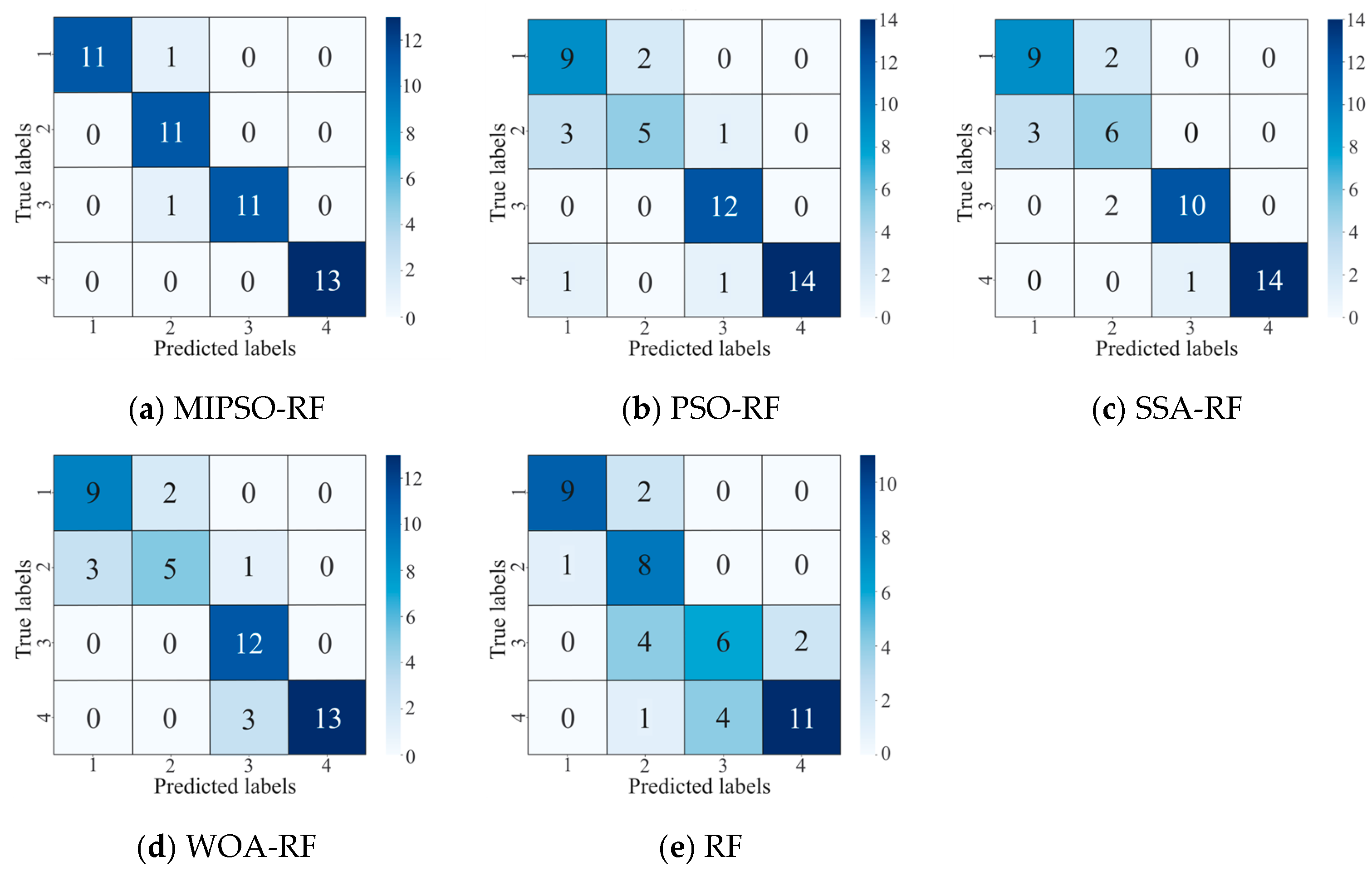
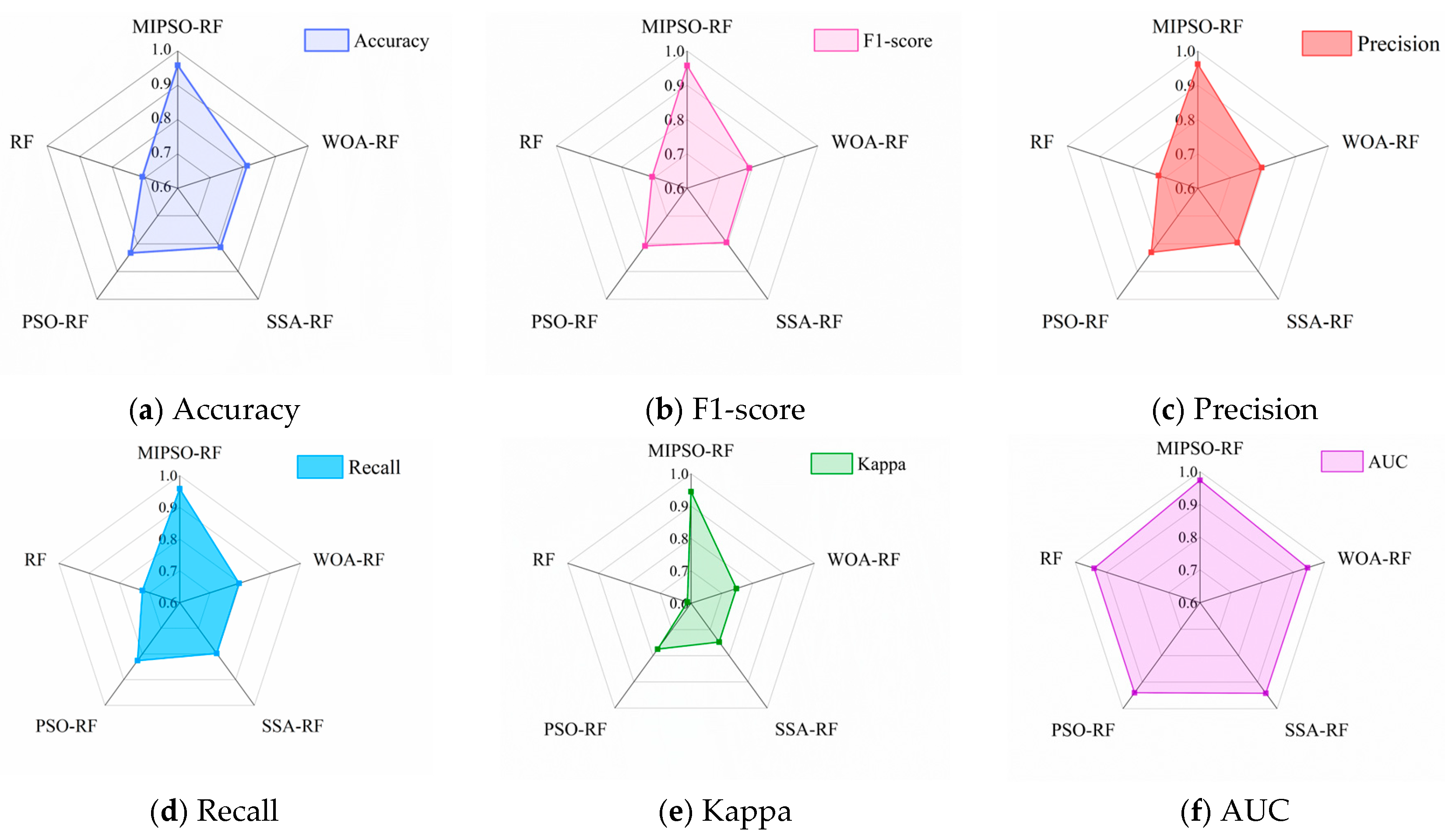
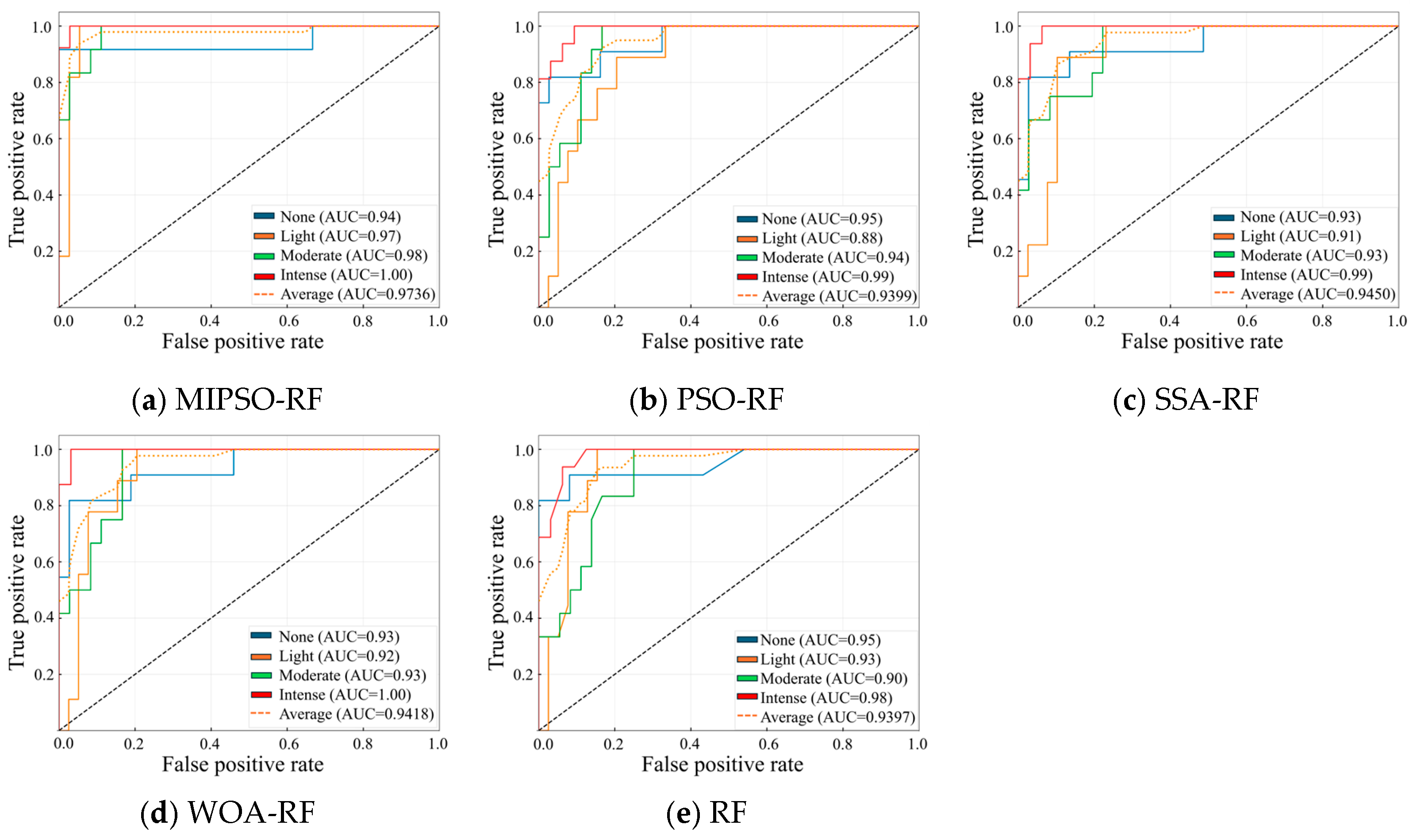
| RF | 70.83% | 0.7070 | 71.98% | 72.36% | 0.6118 | 0.9397 |
| WOA-RF | 81.25% | 0.7903 | 79.58% | 79.66% | 0.7472 | 0.9450 |
| SSA-RF | 81.25% | 0.7952 | 79.58% | 79.83% | 0.7479 | 0.9418 |
| PSO-RF | 83.33% | 0.8079 | 83.05% | 82.61% | 0.7749 | 0.9399 |
| MIPSO-RF | 95.83% | 0.9574 | 96.15% | 95.83% | 0.9444 | 0.9736 |
| First Cycle | Second Cycle | Third Cycle | Fourth Cycle |
|---|---|---|---|
| 1330–1390 level | 1450–1510 level 1150–1270 levels | 1570–1630 level 1030–1090 level | 970–1030 level |
| Cycle Division | Level/m | σc/MPa | σt/MPa | Wet | σθ/MPa |
|---|---|---|---|---|---|
| Third cycle | 1630 | 30.45 | 2.80 | 1.17 | 4.2 |
| 1570 | 36.29 | 2.65 | 2.28 | 5.84 | |
| Second cycle | 1510 | 44.35 | 2.74 | 1.47 | 6.21 |
| 1450 | 50.40 | 2.49 | 1.93 | 11.11 | |
| First cycle | 1390 | 52.48 | 2.12 | 2.24 | 12.55 |
| 1330 | 46.69 | 2.55 | 2.64 | 10.26 | |
| Second cycle | 1270 | 48.26 | 2.34 | 2.31 | 8.24 |
| 1210 | 50.71 | 2.34 | 3.39 | 11.67 | |
| 1150 | 60.36 | 2.53 | 3.49 | 11.4 | |
| Third cycle | 1090 | 60.73 | 2.96 | 3.21 | 8.54 |
| 1030 | 64.84 | 3.14 | 3.92 | 13.70 | |
| Fourth cycle | 970 | 68.17 | 3.26 | 3.52 | 19.63 |
| Cycle Division | Level/m | SCF | B | Wet | Truth | Prediction |
|---|---|---|---|---|---|---|
| Third cycle | 1630 | 0.14 | 10.88 | 1.17 | I | I |
| 1570 | 0.16 | 13.69 | 2.28 | I | I | |
| Second cycle | 1510 | 0.14 | 16.19 | 1.47 | I | I |
| 1450 | 0.22 | 20.24 | 1.93 | II | II | |
| First cycle | 1390 | 0.24 | 22.40 | 2.24 | II | II |
| 1330 | 0.22 | 18.31 | 2.64 | II | II | |
| 1270 | 0.17 | 20.62 | 2.31 | II | II | |
| Second cycle | 1210 | 0.23 | 21.67 | 3.39 | III | III |
| 1150 | 0.19 | 23.86 | 3.1 | II | II | |
| Third cycle | 1090 | 0.14 | 20.52 | 3.21 | II | II |
| 1030 | 0.21 | 20.65 | 2.85 | II | II | |
| Fourth cycle | 970 | 0.29 | 20.91 | 3.52 | III | III |
Disclaimer/Publisher’s Note: The statements, opinions and data contained in all publications are solely those of the individual author(s) and contributor(s) and not of MDPI and/or the editor(s). MDPI and/or the editor(s) disclaim responsibility for any injury to people or property resulting from any ideas, methods, instructions or products referred to in the content. |
© 2026 by the authors. Licensee MDPI, Basel, Switzerland. This article is an open access article distributed under the terms and conditions of the Creative Commons Attribution (CC BY) license.
Share and Cite
Ma, J.; Hou, K.; Sun, H.; Zhe, Y.; Cheng, Q.; Zhu, Z.; Wang, L.; Wang, Z. Model for Predicting the Rockburst Intensity Grade in Gently Dipping Rock Strata via MIPSO-RF. Sustainability 2026, 18, 809. https://doi.org/10.3390/su18020809
Ma J, Hou K, Sun H, Zhe Y, Cheng Q, Zhu Z, Wang L, Wang Z. Model for Predicting the Rockburst Intensity Grade in Gently Dipping Rock Strata via MIPSO-RF. Sustainability. 2026; 18(2):809. https://doi.org/10.3390/su18020809
Chicago/Turabian StyleMa, Junwei, Kepeng Hou, Huafen Sun, Yalei Zhe, Qunzhi Cheng, Zhigang Zhu, Lidie Wang, and Zixu Wang. 2026. "Model for Predicting the Rockburst Intensity Grade in Gently Dipping Rock Strata via MIPSO-RF" Sustainability 18, no. 2: 809. https://doi.org/10.3390/su18020809
APA StyleMa, J., Hou, K., Sun, H., Zhe, Y., Cheng, Q., Zhu, Z., Wang, L., & Wang, Z. (2026). Model for Predicting the Rockburst Intensity Grade in Gently Dipping Rock Strata via MIPSO-RF. Sustainability, 18(2), 809. https://doi.org/10.3390/su18020809