The Concept of Multifunctional Social Spaces as a High-Quality Intergenerational Premise: Sustainable Environmental Education Impetus



Abstract
1. Introduction
- (1)
- In most listed countries, the female population is dominant (most noticeably in Russia), usually due to the longer life expectancy of women. However, in the countries with the largest populations—namely China and India—there are fewer women.
- (2)
- Fertility rates (the number of live births per woman) are falling in all countries and, as of 2024–2025, only Saudi Arabia, South Africa, Brazil, and Indonesia exceed the so-called replacement level of 2.10–2.15.
- (3)
- GDP per capita based on PPP has reached the level of European countries and Japan only in a few “Second World” countries, but it is still significantly behind the United States; according to the estimates based on PPP, the weakest “West” economy today is the Euro Zone.
- (4)
- The largest number of USD millionaires (calculated at the current USD exchange rate) live in the United States [2]. However, when converted to PPP, the number of millionaires in the United States may be significantly lower: as recently as 2020, their number in the United States was estimated at about 6.5 million people [3], unlike the 2025 estimate of 24 million. The perception of wealth, however, has not followed the same level of abundance [4].
- (5)
- In terms of the Gini coefficient (wealth inequality), South Africa, Japan, and Brazil stand out among other countries.
- (6)
- Analyzing the share of the population over 64, three groups of countries can be distinguished: for most countries, the indicator is 5–9%, including India and China; Russia and the United States have average values of about 13%; and the indicator reaches the highest value among the EU countries and in Japan, at 22–23%.
- (7)
- The only country in which mass urbanization has not yet led to an excess of the urban population is India; in other countries, the urban population accounts for 60–90%.
2. Materials and Methods
- -
- The concept of an MSS as of an intergenerational club premise;
- -
- The advantages and disadvantages of the residence area: respondents should justify whether they consider, now, or would consider moving to another place they are familiar with firsthand; the experience of moving;
- -
- The hypothesizes of the study (they are listed below);
- -
- Key cultural and natural landmarks of their region (city) that newcomers could be recommended to explore; the readiness to learn more and promote local environmental issues;
- -
- The advantages of local intergenerational policies (if any) in comparison with other suitable examples they know about quite well;
- -
- The rating of preferred communication instruments and/or leisure activities that will attract one to visit an MSS on a 100% scale (Section 3);
- -
- Desirable additions to the suggested basic communication and leisure activities set.
- -
- Retirees, who have a stamina but do not live at the same agglomeration with their children and grandchildren if there are any;
- -
- Teenagers, whose parents moved from other regions and they are looking for adaptation and help lacking grandparents’ participation.
3. Findings/Results
3.1. The Nature of Intergenerational Conflicts and the Role of Grandparents After Retirement
“…It is important for me to have s possibility to express some of my thoughts to young people…” (the respondent of 67 years old–signed “years” below), “…Attention and support from young people is always gratifying…” (72 years), “…I can listen to advices from unfamiliar elders when they clearly understand my problem…” (14 years).
“…Working effectively is possible up to a certain point…” (70 years), “At some point, I chose to retire to help to my grandchildren…” (72 years), “…Meetings with friends are important to me… I can listen my mate on her granddaughter news, despite I don’t have my own…” (66 years).
“I’m ready to teach humanities to children and teenagers at the social center, why not?” (71 year), “We’ve already had similar classes, and I helped them to learn the native language…” (67 years), “…Sometimes I needed help with my homework, I received it from my church community member…” (13 years).
3.2. Possible Lifestyles of Retirees and the Urban Spaces as a Structuring Factor in Behavior
- Social isolation type. Retirement is characterized by a reduction in social ties and communications. Separation from children leads to “outside the company” feelings. The process includes three stages: segregation from the former job-associated environment; transition to the state, in which a retired worker can no longer implement his usual competencies; and incorporation as a retiree in the same social group. About 60–75% of retirees.
- Personality profiling type. Active life position allows one to perceive the reduction in life opportunities relatively painlessly, being included in communities besides the former main job [47,48]. To support the profiling type in Japan, the retired workers can visit their former employer’s offices, even if they, in fact, can no longer perform usual functional duties. About 10–25% of retirees.
“Yes, I will agree to the offer to give short, free lectures on regular basis … as I consider it is my duty to convey the spirit of our times. There are always interested listeners…” (69 years). “I can give some professional advises to those who plan to work in the sphere…”
“…It’s convenient (using social media instruments), I can now talk to my grandchildren in the North of the country almost anytime…” (70 years), “…The opportunity to see each other with my children doesn’t come along very often … We miss their visits and the family gathered … although I can reach them via video chat ” (75 years), “…It can be difficult to reach my family and friends sometimes… A locally accessible meeting center is a good idea…” (68 years).
“…No, I haven’t thought about moving, since my children live here…” (68 years), “…We already moved to another country with our children once, firstly it was hard…” (72 years), “…We would have moved closer to our daughter, but the capital is very expensive…” (67 years).
“…Our place’s comfortable infrastructure is of great importance for us…” (70 years), “…We moved here, in part, because of the good climate…” (68 years), “…Few other cities have such a wealth of history. We’re staying here and don’t want to leave…” (73 years).
3.3. The Types of MSS
- Municipal pensioner social centers in Moscow and its suburbs: since 2020, more than 30 units of “My Social Center” (URL: https://vk.com/moitscentr?ysclid=mkb3feltth723416519 (accessed on 8 October 2025) (in Russian)) have opened with financial assistance from Sberbank (now Sber). Also, some social centers for senior citizens opened within the “Moscow Longevity” project (Moscow Longevity (Home)—the largest health, educational, and leisure project of the Mayor of Moscow for Muscovites over 55 (since 2018)—URL: www.after55.moscow (accessed on 8 October 2025) in the suburbs, providing spaces for intellectual leisure and communication for the elderly.
- 2.
- Centers for communication and joint training for residents of micro districts, neighborhoods, and large homeowners’ associations created on the initiative of large developers and/or municipal authorities. For example, the Baltic Sails club in the Ogni Zaliva residence in St. Petersburg (www.ognizaliva.ru accessed on 15 October 2025). This format is one of the promising manifestations of the “civic consciousness” of developers of urban residential real estate (multi-apartment buildings). Such initiative of the regional medium-sized business is viable as it addresses different age strata and attracts local sport and civic society activists. Such format was considered in this issue as Type 3 “MSS organized within civic local residents’ communities with the business sponsor initiative”.
- 3.
- The example of a unique format for an MSS is the “House of Art”, created in Sochi in 2025 by a popular local artist and blogger (https://t.me/domtvorchestv accessed on 15 October 2025). This center offers opportunities for both adults and children to meet for art exhibitions and charity projects and hosts various classes (yoga, qigong, chess, Go, and others), including for pensioners. Such format could be considered as Type 4 “MSS organized by local cultural leader initiative supported by business sponsors”.
- 4.
- “Interest clubs,” for example, dog clubs or sports clubs, or music and art classes for children, where relatively young pensioners communicate with each other and with their grandchildren (retirees usually take and meet the grandchildren after classes). The number of pensioners who own dogs in Russia, however, is not so large (according to an estimate, no more than 3–4%) (Pet ownership statistics by country 2025—URL: https://worldpopulationreview.com/country-rankings/pet-ownership-statistics-by-country (accessed on 8 October 2025)). Somewhat more widespread is the activity of older people associated with various activities of their grandchildren, where integrative communication is also possible: according to the authors’ estimate, 12–15% of Russian pensioners are connected to such activities. Such format was considered as Type 5 “Latent MSS around children sports and personal hobbies”.
3.4. Table Survey Results
“…I’ll visit [new MSS club] along with my company [of peers]…” (16 years), “It would be interesting to at it [MSS] with my friends” (18 years), “I’m ready to stop by and see what’s going on there in MSS…” (13 years)”.
3.5. Interview Interpretations
“It’s important to be willing to listen…” (18 years), “I understand that my views may be too traditional and seemingly ‘simple’, … they can be discussed, but for this to happen, there must be attention…” (70 years), “…I believe that in the case of any learning, patience is important on the part of the teacher…” (67 years), “…it’s more common to study with peers … but sometimes only elders can help.” (15 years).
- -
- knowledge about the local flora and fauna unique spices:
- -
- knowledge on the local environmental threats;
- -
- the ways of resolving environmental threats in the past, today, and in future;
- -
- thematic meetings.
“Issues such as caring for local nature, understanding what threatens it and how to avoid it should be raised within the local community…” (65 years), “…An approach that allows one to move from simple questions about local animal and bird species, cleaning up trash in the forest to professional knowledge about pollution and the fight against it, can be justified in certain conditions…” (67 years), “…if it is possible to care for flowers at MSS club, I will consider this a personal contribution to the environment…” (12 years).
4. Discussion: Conceptual MSS-Effects Model and It Development
- -
- cultural, educational, musical, and art events: could be age-addressed but also unite reference groups of different ages;
- -
- involvement of retirees in helping children who are lagging behind in their studies (native language, literature, history, other disciplines);
- -
- involvement of retirees in training and refereeing of youth teams, taking into account the “sports specifics” of a region;
- -
- environment awareness activities via the representative wall pictures, photo albums, comics, thematic meetings, and so on.
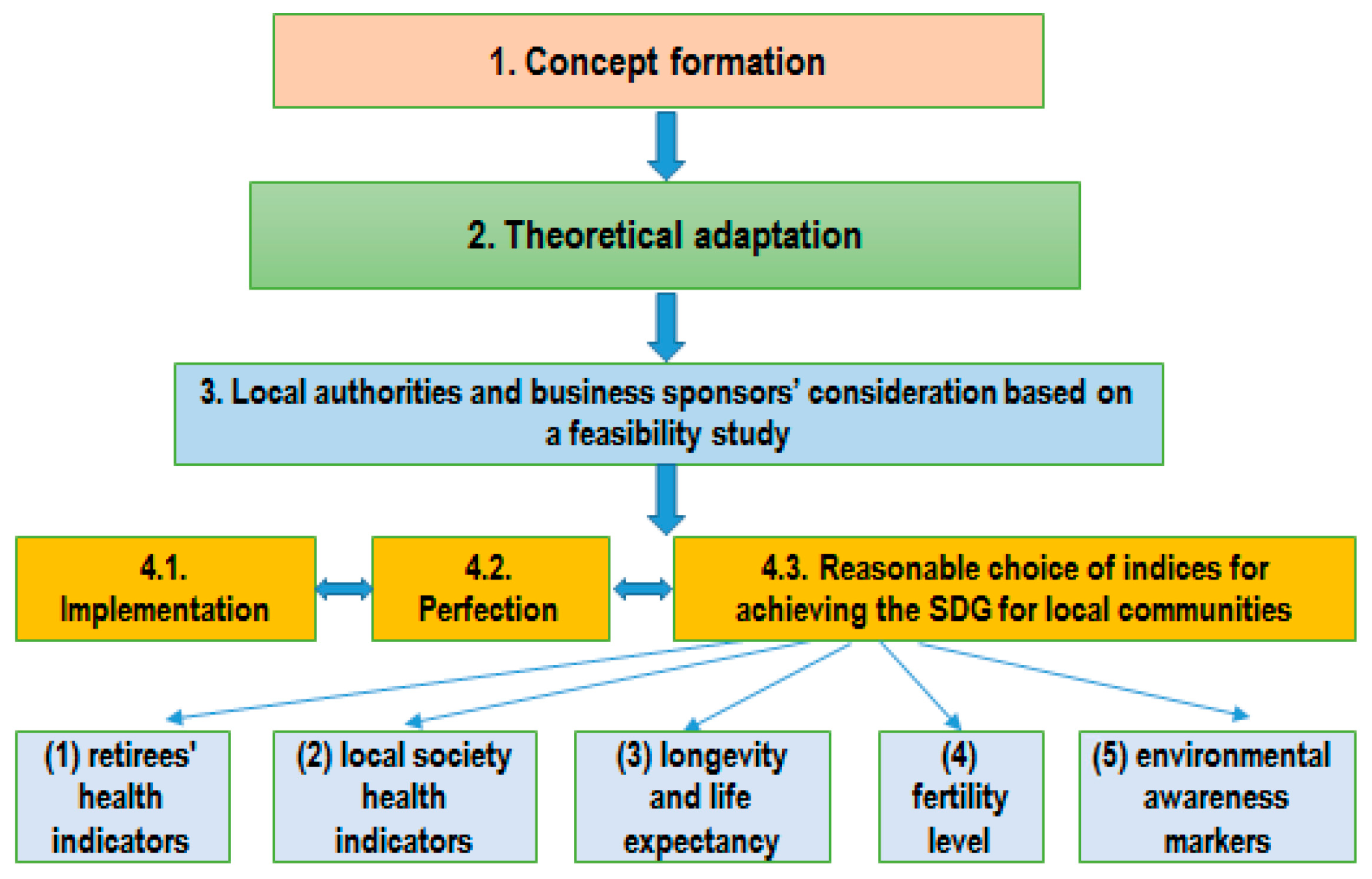
- Theoretical adaptation.
- Local authorities and business sponsors’ consideration based on feasibility study for specific MSS premise project.
- Implementation and perfection of MSS project, reasonable choice of indices for achieving the SDG (long and middle term) and environmental or ecological awareness markers (short term) for local communities.
- Monitoring of the influence of MSS introduction on such basic social indices as population health, longevity and life expectancy, fertility level in the mid-term and in the long-term.
- MSS concept adaptation for national cultures; addressed studies concerning the possibilities of MSS introduction in the rural areas.
- Extensive qualitative studies and surveys ensuring sufficient sample.
- The development of a feasibility study standard for the typical MSS-project.
- The studies which are supposed to analyze the dynamics of social indices due to the MSS introduction and continuous operation in the given region.
5. Conclusions
Author Contributions
Funding
Institutional Review Board Statement
Informed Consent Statement
Data Availability Statement
Acknowledgments
Conflicts of Interest
References
- Haynes, J.A. Quarter Century of the "Clash of Civilizations"; Routledge: Abingdon, UK, 2021; 202p, ISBN 978-1-000-38383-6. [Google Scholar]
- UBS. Global Wealth Report 2025. Available online: https://www.ubs.com/global/en/wealthmanagement/insights/global-wealth-report.html (accessed on 6 October 2025).
- Capgemini, S.A. World Wealth Report 2020. Available online: https://www.capgemini.com/news/press-releases/research-world-wealth-report-2020 (accessed on 6 October 2025).
- There Are 24 Million Millionaires in the US, But the Perception of Wealth Has Changed. 2025. Available online: https://www.mk.ru/economics/2025/07/30/v-ssha-naschitali-24-milliona-millionerov-no-oshhushhenie-bogatstva-izmenilos.html (accessed on 6 October 2025). (In Russian)
- The Rise of Singlehood Is Reshaping the World. The Great Relationship Recession. In Good Ways and Bad. Available online: https://www.economist.com/leaders/2025/11/06/the-rise-of-singlehood-is-reshaping-the-world (accessed on 18 November 2025).
- Biznews. The Economist: Good and Bad—Rise of Singlehood Reshaping the World. Available online: https://www.biznews.com/health/economist-rise-singlehood-reshaping-world (accessed on 18 November 2025).
- Dobin, A. The Burden Women Bear in Different Cultures. A Conversation with Psychologist and Psychotherapist. 2025. Available online: https://smotrim.ru/audio/2868160 (accessed on 6 October 2025). (In Russian)
- Yurak, V.V.; Dushin, A.V.; Mochalova, L.A. Vs sustainable development: Scenarios for the future. J. Min. Inst. 2020, 242, 242–247. [Google Scholar] [CrossRef]
- Atstāja, D. Leveraging Sustainable Development Goals to Transform Higher Education and Advance Sustainability Science. Sustainability 2025, 17, 7807. [Google Scholar] [CrossRef]
- Warners, M.; Walker, S.E.; Bruyere, B.L.; Tamlyn, K.; Zarestky, J. Bridging Nature, Well-Being, and Sustainability Through Experiential Learning in Higher Education. Sustainability 2026, 18, 154. [Google Scholar] [CrossRef]
- Zhang, X.; Jung, W.; Asari, M. Systematic Review of Environmental Education Teaching Practices in Schools: Trends and Gaps (2015–2024). Sustainability 2025, 17, 8561. [Google Scholar] [CrossRef]
- Duan, S.; Yin, F. Interaction Mechanism and Coupling Strategy of Higher Education and Innovation Capability in China Based on Interprovincial Panel Data from 2010 to 2022. Sustainability 2025, 17, 6797. [Google Scholar] [CrossRef]
- Yuca, Z.; Dabaj, F. Sustainable Mobile Microlearning: Evaluating Learners’ Perceptions and Learning Outcomes in IT Education. Sustainability 2025, 17, 10860. [Google Scholar] [CrossRef]
- Al-saedi, A.Z.M.; Rasul, H.Q. New Roadmap toward Social Sustainability, from Physical Structures to Perceived Spaces. Sustainability 2024, 16, 7716. [Google Scholar] [CrossRef]
- Morujão, C.; Dimas, S.; Relvas, S. The Philosophy of Ortega y Gasset Reevaluated; Springer: Berlin/Heidelberg, Germany, 2021; 173p, ISBN 978-3-030-79248-0. [Google Scholar]
- Feuer, L.S. The Conflict of Generations: The Character and Significance of Student Movements; Basic Books: London, UK; New York, NY, USA, 1969; 543p. [Google Scholar]
- Dubin, B. Word—Writing—Literature. Essays on the Sociology of Modern Culture; New Literary Review: Moscow, Russia, 2001; 412p, ISBN 5-86793-180-7. (In Russian) [Google Scholar]
- Yu, L. Conversations About Russian Culture. The Life and Traditions of the Russian Nobility (XVIII-Early XIX Century); AST: Moscow, Russia, 2024; 225p, ISBN 978-5-17-159822-8. (In Russian) [Google Scholar]
- Korinfsky, A.A. Narodnaya Rus: A Round Table of Legends, Beliefs, Customs and Proverbs of the Russian People; Kaplin, A.D., Platonov, O.A., Eds.; Institute of Russian Civilization: Moscow, Russia, 2013; 944p, ISBN 978-5-4261-0023-7. (In Russian) [Google Scholar]
- Bennett, M.M.; Beehr, T.A.; Ivanitskaya, L.V. Work-family conflict: Differences across generations and life cycles. J. Manag. Psychol. 2017, 32, 314–332. [Google Scholar] [CrossRef]
- Massel, L.V.; Komendantova, N.; Massel, A.G.; Tsvetkova, A.Y.; Zaikov, K.S.; Marinina, O.A. Resilience of socio-environment and energy systems: Intelligent information technologies for risk assessment of natural and technogenic threats. J. Infrastruct. Policy Dev. 2024, 61, 4700. [Google Scholar] [CrossRef]
- Suvorov, A.V. The Science of Victory; AST: Moscow, Russia, 2023; 384p, ISBN 978-5-17-157345-4. (In Russian) [Google Scholar]
- Kozhevnikov, V.M. Shield and Sword; Veche: Moscow, Russia, 2023; ISBN 978-544-8419829. (In Russian) [Google Scholar]
- Rahim, M.A.; Katz, J.P. Forty years of conflict: The effects of gender and generation on conflict-management strategies. Int. J. Confl. Manag. 2019, 31, 1–16. [Google Scholar] [CrossRef]
- Annosi, M.C.; Hughes, M.; Gennaro, D.; Oppedisano, R.; Buonocore, F. Bridging generations: Managing cognitive conflicts during technology adoption in multigenerational family firms. J. Fam. Bus. Strategy 2025, 16, 100695. [Google Scholar] [CrossRef]
- Beal, C. Loneliness in older women: A review of the literature. Issues Ment. Health Nurs. 2006, 27, 795–813. [Google Scholar] [CrossRef]
- Lederman, Z. Dying a lonely death: A conceptual and normative analysis. Bioethics 2024, 38, 282–291. [Google Scholar] [CrossRef] [PubMed]
- Kohlhase, J.E. The new urban world 2050: Perspectives, prospects and problems. Reg. Sci. Policy Pract. 2013, 5, 153–166. [Google Scholar] [CrossRef]
- Oblova, I.S.; Gerasimova, I.G.; Goman, I.V. The scientific career through a gender lens: A contrastive analysis of the EU and Russia. Glob. J. Eng. Educ. 2022, 24, 21–27. Available online: http://www.wiete.com.au/journals/GJEE/Publish/vol24no1/03-Gerasimova-I(1).pdf (accessed on 16 October 2025).
- Samylovskaya, E.A.; Kudryavtseva, R.A.; Medvedev, D.A.; Grinyaev, S.N.; Nordmann, A. Transformation of the Personnel Training System for Oil and Gas Projects in the Russian Arctic. Resources 2021, 9, 137. [Google Scholar] [CrossRef]
- Gerasimova, I.G.; Oblova, I.S. Sustainable Development of Soft Skills with the Purpose of Enhancing the Employability of Engineering Students. Sustainability 2025, 17, 2426. [Google Scholar] [CrossRef]
- United Nations Population Division. World Population Prospects: The 2008 Revision; United Nations: New York, NY, USA, 2009; Available online: https://digitallibrary.un.org/record/3924414?ln=en&v=pdf (accessed on 16 October 2025).
- United Nations Population Division. World Population Prospects 2024: Summary of Results; United Nations: New York, NY, USA, 2024; 69p. Available online: https://reliefweb.int/report/world/world-population-prospects-2024-summary-results (accessed on 16 October 2025).
- OECD. International Migration Outlook 2025. Available online: https://www.oecd.org/en/publications/international-migration-outlook-2025_ae26c893-en.html (accessed on 18 November 2025).
- Bağlamında, U.; Dinamikleri, U.G. International Migration Dynamics in the Context of OECD Countries. Available online: https://www.researchgate.net/publication/366740687_International_Migration_Dynamics_in_the_Context_of_OECD_Countries (accessed on 18 November 2025).
- Goujon, A. Human Population Growth; Elsevier: Amsterdam, The Netherlands, 2025. [Google Scholar] [CrossRef]
- IOM (UN Migration Agency). World Migration Report 2024; IOM (UN Migration Agency): Geneva, Switzerland, 2024; 404p; ISBN 978-92-9268-969-8. Available online: https://worldmigrationreport.iom.int (accessed on 18 November 2025).
- IOM (UN Migration Agency). Global Overview of Migration Routes (January–April 2025); IOM (UN Migration Agency): Geneva, Switzerland, 2025. 66p. Available online: https://reliefweb.int/report/world/global-overview-migration-routes-january-april-2025 (accessed on 18 November 2025).
- WHO. World Health Statistics 2025: Monitoring Health for the SDGs, Sustainable Development Goals; Global Report; WHO: Geneva, Switzerland, 2025; 76p; ISBN 978-92-4-009470-3. Available online: https://www.who.int/publications/i/item/9789240110496 (accessed on 18 November 2025).
- Naughton, L.; Padeiro, M.; Bueno-Larraz, B. Vulnerability in context; hard numbers, tricky words and grey areas for gerontology. J. Aging Stud. 2023, 65, 101131. [Google Scholar] [CrossRef]
- Collins, J.; Page, L. The heritability of fertility makes world population stabilization unlikely in the foreseeable future. EHum. Behav. 2019, 40, 105–111. [Google Scholar] [CrossRef]
- Grenier, A. The qualitative embedded case study method: Exploring and refining gerontological concepts via qualitative research with older people. J. Aging Stud. 2023, 65, 101138. [Google Scholar] [CrossRef]
- Eberstadt, N. Depopulation globally and in the Asia-Pacific: The shape of things to come. Fertil. Steril. 2025. [Google Scholar] [CrossRef]
- Höppner, G. Distributed age(ing): Features of a material gerontology. J. Aging Stud. 2023, 67, 101185. [Google Scholar] [CrossRef]
- Kapucu, N.; Ge, Y.; Rott, E.; Isgandar, H. Urban resilience: Multidimensional perspectives, challenges and prospects for future research. Urban Gov. 2024, 4, 162–179. [Google Scholar] [CrossRef]
- Gilleard, C.; Higgs, P. Ageing without senescence: A critical absence in social gerontology? J. Aging Stud. 2023, 66, 101166. [Google Scholar] [CrossRef] [PubMed]
- Von Zglinicki, T. Research on ageing in Germany Experimental. Gerontology 2000, 35, 259–270. [Google Scholar] [CrossRef]
- Kafková, M.P.; Vidovićová, L. Ageing in rural areas as a mode of active ageing. J. Rural Stud. 2025, 117, 103679. [Google Scholar] [CrossRef]
- Golovina, E.I.; Khloponina, V.S.; Tsiglianu, P.P.; Zhu, R. Organizational, Economic and Regulatory Aspects of Groundwater Resources Extraction by Individuals (Case of the Russian Federation). Resources 2023, 12, 89. [Google Scholar] [CrossRef]
- Pashkevich, N.V.; Khloponina, V.S.; Pozdnyakov, N.A.; Avericheva, A.A. Analysing the problems of reproducing the mineral resource base of scarce strategic minerals. J. Min. Inst. 2024, 270, 1004–1023. [Google Scholar]
- Vasilev, Y.N.; Vasileva, P.A.; Batova, O.V.; Tsvetkova, A.Y. Assessment of Factors Influencing Educational Effectiveness in Higher Educational Institutions. Sustainability 2024, 16, 4886. [Google Scholar] [CrossRef]
- Caradec, V.; Glevarec, H. Presentation: Age et usages des medias. Reseau 2003, 119, 9–23. [Google Scholar]
- Kok, A.A.L.; Huisman, M.; Giltay, E.J.; Lunansky, G. Adopting a complex systems approach to functional ageing: Bridging the gap between gerontological theory and empirical research. Lancet Healthy Longev. 2025, 6, 100673. [Google Scholar] [CrossRef] [PubMed]
- Haas, M.G.; Sunde, U. Decomposing longevity: How life expectancy changes around the world. J. Econ. Ageing 2025, 32, 100587. [Google Scholar] [CrossRef]
- Banks, S.P. Intergenerational ties across borders: Grandparenting narratives by expatriate retirees in Mexico. J. Aging Stud. 2009, 23, 178–187. [Google Scholar] [CrossRef]
- Artero, M. The politics of pro-migrant volunteering: Exploring the role of pro-migrant volunteering in the local migration governance. Cities 2024, 154, 105325. [Google Scholar] [CrossRef]
- Fang, Y.; Shi, Z. Children of migrant parents: Migrating together or left behind. Habitat Int. 2018, 76, 62–68. [Google Scholar] [CrossRef]
- Radó, M.; Boissonneault, M. Short and long-term change in subjective well-being among voluntary and involuntary retirees. J. Econ. Ageing 2020, 17, 100178. [Google Scholar] [CrossRef]
- Iqbal, S.; Fischl, C.; Asai, R. Older persons’ Social Participation, Health and Well-Being Through Digital Engagement. Act. Adapt. Aging 2025, 49, 534–563. [Google Scholar] [CrossRef]
- Kong, Z.; Zhu, A. The impact of internet use on the subjective age of older adults. Front. Public Health 2025, 13, 1590684. [Google Scholar] [CrossRef]
- Liu, J.; Wang, Y.; Wu, Q.; Liu, X.; Hu, B. A study on the relationship between internet use and cognitive functioning of older adults under the perspective of smart aging. Front. Public Health 2025, 13, 1546929. [Google Scholar] [CrossRef] [PubMed]
- Proulx, M.U.; Tremblay, D. Marketing territorial et positionnement mondial. Global positioning of the peripheries with territorial marketing. Geogr. Econ. Soc. 2006, 8, 239–255. [Google Scholar]
- Almeida, G.G.F. Unraveling Power Relations: An Analytical Matrix for Territorial Brands. Sustainability 2024, 16, 2795. [Google Scholar] [CrossRef]
- Suiçmez, I.; Altinay, F.; Dağlı, G.; Altinay, Z. Artificial intelligence application for museum to experiential transformation of cultural heritage and learning. Smart Learn. Environ. 2025, 12, 45. [Google Scholar] [CrossRef]
- Cherepovitsyn, A.E.; Lipina, S.A.; Evseeva, O.O. Innovative approach to the development of mineral raw materials of the arctic zone of the Russian Federation. J. Min. Inst. 2018, 232, 438–444. [Google Scholar] [CrossRef]
- Stepanova, N.; Gritsenko, D.; Gavrilyeva, T.; Belokur, A. Sustainable Development in Sparsely Populated Territories: Case of the Russian Arctic and Far East. Sustainability 2020, 12, 2367. [Google Scholar] [CrossRef]
- Bykowa, E.; Voronetskaya, V. A Compensation Strategy for the Negative Impacts of Infrastructure Facilities on Land Use. Science 2025, 7, 95. [Google Scholar] [CrossRef]
- Breck, B.M.; Dennis, C.B.; Leedahl, S.N. Implementing reverse mentoring to address social isolation among older adults. J. Gerontol. Soc. 2018, 61, 513–525. [Google Scholar] [CrossRef]
- Sánchez-Cazalla, V.; Gutiérrez-Domingo, T. Impact of intergenerational programmes on older adults for active ageing. A systematic review. Arch. Gerontol. Geriatr. Plus 2025, 2, 100176. [Google Scholar] [CrossRef]
- Liougas, M.P.; Fortino, A.; Brozowski, K.; McMurray, J. Social inclusion programming for older adults living in age-friendly cities: A scoping review. BMJ Open 2025, 15, e088439. [Google Scholar] [CrossRef] [PubMed]
- Yang, S.; van Oostrum, M. The self-governing redevelopment approach of Maquanying: Incremental socio-spatial transformation in one of Beijing’s urban villages. Habitat Int. 2020, 104, 102235. [Google Scholar]
- Zetterberg, L.; Eriksson, M.; Ravry, C.; Santosa, A.; Ng, N. Neighbourhood social sustainable development and spatial scale: A qualitative case study in Sweden. Local Environ. 2023, 28, 793–810. [Google Scholar] [CrossRef]
- Dyachkova, I.; Bykowa, E.; Dudina, V.; Banikevich, T. An Assessment of the Impact of the Protection Zone Regime for Cultural Heritage Sites on the Value of Land for Individual Housing Construction in the Context of a Low-Activity Market. Heritage 2024, 7, 2682–2708. [Google Scholar] [CrossRef]
- Bourdieu, P. Bourdieu Social Space; Spring: Berlin/Heidelberg, Germany, 2014; 576p, ISBN 978-5-903354-03-0. [Google Scholar]
- Simmel, G. On Culture: Selected Writings Theory, Culture & Society; SAGE Publications: London, UK, 1997. 314p. Available online: https://psv4.userapi.com/s/v1/d/aP9q4lGaVIsW1aJLucdjXWg7tBFqrriRF2hiJJORBB8wp23a6ZN3ppMt_g2oICqMqRMTkxhqY7-kRBRlgzLOysEwOmAr9RnaLslslWDpLlKKMRLQLzsCXw/David_Patrick_Frisby_Mike_Featherstone-Simmel.pdf (accessed on 19 September 2025).
- Sampson, R.J.; Raudenbush, S.W.; Earls, F. Systematic Social Observation of Public Spaces: A New Look at Disorder in Urban Neighborhood. Am. J. Sociol. 1999, 105, 603–651. [Google Scholar] [CrossRef]
- Abdulghafour, S.H.; Al-Rawe, M.K. Vertical hierarchy of urban space and place-making. Turk. J. Comput. Math. Educ. 2021, 12, 730–741. [Google Scholar]
- Perry, M. Finding space for the creative class: A review of the issues. Urban Policy Res. 2011, 29, 325–341. [Google Scholar] [CrossRef]
- Rao, Y.; Dai, D. Creative class concentrations in Shanghai, China: What is the role of neighborhood social tolerance and life quality supportive conditions? Soc. Indic. Res. 2017, 132, 1237–1246. [Google Scholar] [CrossRef]
- Galushka, A.S.; Niyazmetov, A.K.; Okulov, M.O. Crystal of Growth. Towards the Russian Economic Miracle; “Nashe Zavtra” LLC: Moscow, Russia, 2021; 360p, ISBN 978-5-9243-0299-7. (In Russian) [Google Scholar]
- LaRouche, L.H., Jr. The Science of Physical Economy as the Platonic Epistemological Basis for All Branches of Human Knowledge. Exec. Intell. Rev. 1994, 21, 51. Available online: https://larouchepub.com/lar/2018/4548-the_science_of_physical_econom.html (accessed on 10 December 2025).
- Marinina, O.A.; Nechitailo, A.R.; Stroykov, G.A.; Tsvetkova, A.Y.; Reshneva, E.A.; Turovskaya, L.G. Technical and Economic Assessment of Energy Efficiency of Electrification of Hydrocarbon Production Facilities in Underdeveloped Areas. Sustainability 2023, 15, 9614. [Google Scholar] [CrossRef]
- Stoffelen, A.; Groote, P. Strategic coupling of administrative rationality and cultural imaginaries in municipal amalgamations. Political Geogr. 2024, 115, 103227. [Google Scholar] [CrossRef]
- Dempsey, A.; Dempsey, D. Due Season. In A Programm for Post-Primary Schools About Being Young and Growing Old; National Council for the Elderly Publication: Dublin, Germany, 1993; 65p. [Google Scholar]
- Nguyen-Phuong-Mai, M. A critical analysis of cultural metaphors and static cultural frameworks with insight from cultural neuroscience and evolutionary biology. Cross Cult. Strateg. Manag. 2017, 24, 530–553. [Google Scholar] [CrossRef]
- Koç, S.; Altinay, F.; Koç, A.; Dagli, G. Cooperation of Emotional Intelligence and Social Activities in Education: Effects on School Culture and Value Acquisition. Sustainability 2024, 16, 6022. [Google Scholar] [CrossRef]
- Krzeczkowska, A.; Spalding, D.M.; McGeown, W.J.; Gow, A.J.; Carlson, M.C.; Brown Nicholls, L.A. A systematic review of the impacts of intergenerational engagement on older adults’ cognitive, social, and health outcomes. Ageing Res. Rev. 2021, 71, 101400. [Google Scholar] [CrossRef] [PubMed]
- Polko, A. Governing the urban commons: Lessons from Ostrom’s work and commoning practice in cities. Cities 2024, 155, 105476. [Google Scholar] [CrossRef]
- Kuyken, K.; Ebrahimi, M.; Saives, A. Towards a taxonomy of intergenerational knowledge transfer practices. Learn. Organ. 2018, 25, 81–91. [Google Scholar] [CrossRef]
- Peters, R.; Ee, N.; Ward, S.A.; Kelly, C.; Henderson, K.A.; Taylor, N.F. Intergenerational Programmes bringing together community dwelling non-familial older adults and children: A Systematic Review. Arch. Gerontol. Geriatr. 2021, 94, 104356. [Google Scholar] [CrossRef]
- Semenova, T.Y.; Martínez Santoyo, J.Y. Economic Strategy for Developing the Oil Industry in Mexico by Incorporating Environmental Factors. Sustainability 2024, 16, 36. [Google Scholar] [CrossRef]
- Semenova, T.Y.; Martinez Santoyo, J. Determining Priority Areas for the Technological Development of Oil Companies in Mexico. Resources 2025, 14, 18. [Google Scholar] [CrossRef]
- Gonçalves, M.; Yeo, A.; Farcas, D. Overcoming ageism through a new intergenerational learning paradigm: Challenges and findings. Qual. Ageing Older Adults 2016, 17, 239–245. [Google Scholar] [CrossRef]
- Qu, T. A bridge too far? Social network structure as a determinant of depression in later life. Soc. Sci. Med. 2024, 345, 116684. [Google Scholar] [CrossRef] [PubMed]
- Chand, M. Aging in South Asia: Challenges and opportunities. South Asian J. Bus. Stud. 2018, 7, 189–206. [Google Scholar] [CrossRef]
- Tse, M.M.Y.; Tse, P.P.-S.; Ip, K.Y.; Lam, H.Y.; Chong, P.S.; Kwok, T.T.O.; Sun, G.Y.; Chu, S.K.W.; To, K.P. Connect Active Programme (CAP): A Pilot RCT to Enhance Physical Activity and Intergenerational Relationships Through Dyadic Digital Walking Exercises. Healthcare 2025, 13, 2043. [Google Scholar] [CrossRef]
- Lai, H.; Lau, S.S.Y.; Su, Y.; Sun, C.-Y. Aging-in-Place Attachment Among Older Adults in Macau’s High-Density Community Spaces: A Multi-Dimensional Empirical Study. World 2025, 6, 101. [Google Scholar] [CrossRef]
- Gonzálvez-Torralbo, H.; Silva-Villar, A. Community care and social participation: An ethnography of clubs for older people in Peñalolén (Chile) during and after the pandemic. J. Aging Stud. 2024, 71, 101271. [Google Scholar] [CrossRef]
- Mohan, R.; Saleem, F.; Voderhobli, K.; Sheikh-Akbari, A. Ensuring Sustainable Digital Inclusion among the Elderly: A Comprehensive Analysis. Sustainability 2024, 16, 7485. [Google Scholar] [CrossRef]
- Madera, F.; Olcese, M.; Cardinali, P.; Migliorini, L. Nature connectedness in adolescents and young adults: A systematic review. J. Environ. Psychol. 2025, 107, 102761. [Google Scholar] [CrossRef]
- Buffel, T.; De Backer, F.; Peeters, J.; Dury, S.; Verté, D. Promoting Sustainable Communities through Intergenerational Practice. Procedia-Soc. Behav. Sci. 2014, 116, 1785–1791. [Google Scholar] [CrossRef]
- Li, C.; Köster, R. Exploring the Opportunities and Challenges of European Design Policy to Enable Innovation. The Case of Designscapes Project. Sustainability 2020, 12, 5132. [Google Scholar] [CrossRef]
- Roaldsnes, A. Social capital and the intergenerational transmission of cultural capital: How parents’ social networks influence children’s accumulation of cultural capital. Poetics 2024, 102, 101873. [Google Scholar] [CrossRef]
- Vasilev, Y.N.; Cherepovitsyn, A.E.; Tsvetkova, A.Y.; Komendantova, N.E. Promoting Public Awareness of Carbon Capture and Storage Technologies in the Russian Federation: A System of Educational Activities. Energies 2021, 14, 1408. [Google Scholar] [CrossRef]
- Sidorenko, A.A.; Sidorenko, S.A. A Comprehensive Strategy for Safe and Efficient Mining of Thick, Spontaneous Combustion-prone Coal Seams under Geodynamic Hazard Conditions. Int. J. Eng. 2025, 39, 818–827. [Google Scholar] [CrossRef]
- CMAAP of Russia. Study 13. Thirteen Medium-Term Challenges; CMAAP: Moscow, Russia, 2025; 41p. Available online: http://www.forecast.ru/_ARCHIVE/Mon_13/2025/TT13_2025.pdf (accessed on 18 September 2025). (In Russian)


| Country | Population, Million People | Share of Women, % | Share of People Aged > 64 in Population, % | Share of City Residents, % | 2000s Fertility Rate | 2020s Fertility Rate | GDP per Capita at PPP, Thousand USD | Share of USD Millionaires, % | Gini Coefficient |
|---|---|---|---|---|---|---|---|---|---|
| 1 | 2 | 3 | 4 | 5 | 6 | 7 | 8 | 9 | 10 |
| Brazil | 223.1 | 50.80% | 6.69% | 91.40% | 2.20 | 2.15 | 19.6 | 0.17% | 0.52 |
| China * | 1479.7 | 48.10% | 8.82% | 67.50% | 1.63 | 1.02 | 23.8 | 0.43% | 0.39 |
| India | 1475.6 | 48.40% | 5.40% | 37.08% | 3.00 | 1.96 | 9.8 | 0.06% | 0.43 |
| Russia ** | 146.3 ** | 53.70% | 13.02% | 75.27% | 1.42 | 1.47 | 41.7 | 0.29% | 0.41 |
| Turkey | 92.3 | 50.10% | 6.20% | 76.92% | 2.30 | 1.62 | 35.3 | 0.07% | 0.45 |
| Iran | 89.7 | 49.30% | 4.96% | 73.32% | 1.80 | 1.69 | 16.2 | 0.06% | 0.35 |
| Mexico | 138.7 | 50.70% | 6.49% | 87.86% | 3.00 | 1.97 | 22.8 | 0.24% | 0.45 |
| Saudi Arabia | 39.4 | 44.80% | 2.91% | 92.12% | 3.70 | 2.25 | 62.7 | 0.86% | 0.46 |
| UAE | 11.0 | 30.50% | 0.91% | 81.15% | 2.50 | 1.21 | 42.5 | 2.19% | 0.33 |
| Indonesia | 292.7 | 50.10% | 6.09% | 59.63% | 2.47 | 2.15 | 14.5 | 0.06% | 0.37 |
| Vietnam | 103.3 | 50.60% | 5.49% | 41.38% | 1.98 | 1.91 | 14.4 | 0.02% | 0.35 |
| SAR | 62.7 | 50.50% | 5.64% | 66.60% | 2.50 | 2.22 | 13.6 | 0.07% | 0.63 |
| EU (Euro Zone) | 450.4 | 50.70% | 21.70% | 74.63% | 1.52 | 1.43 | 38.1 | 1.27% | 0.35 |
| USA | 344.6 | 50.60% | 13.05% | 83.51% | 2.04 | 1.63 | 75.5 | 6.91% | 0.42 |
| Japan | 125.8 | 51.30% | 22.90% | 93.10% | 1.33 | 1.24 | 46.1 | 2.25% | 0.56 |
| Country | >64, Million People | Full-Time Work, % | Own Business/Part-Time Job, % | Family Occupied, % | Diseases, % | The Rest (“Free”), % |
|---|---|---|---|---|---|---|
| 1 | 2 | 3 | 4 | 5 | 6 | 7 |
| Brazil | 14.9 | 8% | 4% | 26% | 25% | 37% |
| China * | 130.5 | 11% | 5% | 19% | 23% | 42% |
| India | 79.7 | 9% | 8% | 25% | 25% | 33% |
| Russia ** | 19.0 | 23% | 11% | 23% | 22% | 21% |
| Turkey | 5.7 | 11% | 7% | 25% | 23% | 34% |
| Iran | 4.5 | 9% | 5% | 26% | 18% | 42% |
| Mexico | 9.0 | 11% | 7% | 29% | 24% | 29% |
| Saudi Arabia | 1.1 | 5% | 3% | 17% | 23% | 52% |
| UAE | 0.1 | 3% | 4% | 18% | 25% | 50% |
| Indonesia | 17.8 | 14% | 9% | 40% | 15% | 22% |
| Vietnam | 5.7 | 19% | 11% | 30% | 20% | 20% |
| SAR | 3.5 | 14% | 7% | 26% | 23% | 30% |
| EU | 97.7 | 13% | 8% | 16% | 23% | 40% |
| USA | 45.0 | 19% | 12% | 19% | 16% | 34% |
| Japan | 28.8 | 14% | 9% | 17% | 24% | 36% |
| MSS Type | Area, sq. m | CS: City + Suburbs/ R: Rural | 1 per Thousand of Local Retirees | Supported by | Notes |
|---|---|---|---|---|---|
| 1 | 2 | 3 | 4 | 5 | 6 |
| 1. MSS organized within central state or regional policy | 120–250 | CS/R | 15–30 | State, PPP | The regions could differ due to the budget |
| 2. MSS organized within civic religious communities | 50–500 | CS/R | 1–500 | Churches, business | Differ a lot due to the church specifics |
| 3. MSS organized within civic local residents communities with the business sponsor initiative | 20–150 | CS | 100–300 | Business | Usually are devoted to the certain sports or hobby |
| 4. MSS organized by local cultural leader initiative | 100–500 | CS | 500–1000 | Personal, Business | With the support of state representatives |
| 5. Latent MSS around children sports and hobbies | - | CS/R | 1–10 | Personal | Ex-territorial institutional communicative phenomenon which could led to further retirees’ socialization |
| Preferred Communication and Leisure Activities | Saint Petersburg | Sochi | Moscow | Phoenix, Arizona | San Francisco, California | New York, New York |
|---|---|---|---|---|---|---|
| 1 | 2 | 3 | 4 | 5 | 6 | 7 |
| Number of pensioners surveyed (60–75) | 15 | 10 | 12 | 10 | 6 | 7 |
| Preferences of pensioners | ||||||
| 1. Total area of the premises(s), m2 | 120–155 | 80–180 | 120–250 | 120–160 | 80–200 | 200–300 |
| 2. Preferred activities and instruments: | ||||||
| - Chess, checkers, backgammon, Go, lotto (bingo) | 93% | 90% | 92% | 80% | 67% | 72% |
| - Performance musical equipment (microphone, amplifiers, speakers) and musical events | 76% | 70% | 75% | 70% | 50% | 72% |
| - Library of 500–1000 books, 2–3 periodicals | 80% | 80% | 83% | 50% | 65% | 72% |
| - Community kitchen | 43% | 52% | 47% | 67% | 65% | 57% |
| - Equipment for showing movies and karaoke (TV or projector, screen, microphone) | 33% | 50% | 37% | 50% | 55% | 42% |
| - Table tennis (1–2 tables) | 20% | 30% | 33% | 30% | 17% | 42% |
| - Billiards (1–2 tables) | 27% | 20% | 25% | 20% | 34% | 14% |
| - Computer games | 13% | 10% | 8% | 10% | 17% | 14% |
| - Materials on local natural and cultural landmarks | 100% | 100% | 100% | 100% | 100% | 100% |
| Number of young people surveyed (12–18) | 8 | 7 | 7 | 5 | 4 | 4 |
| Preferences of young people | ||||||
| 1. Total area of the premises(s), m2 | 100–150 | 120–200 | 150–200 | - | - | - |
| 2. Preferred activities and instruments: | ||||||
| - Computer games | 88% | 74% | 86% | 80% | 75% | 100% |
| - Performance musical equipment (microphone, amplifiers, speakers) and musical events | 75% | 72% | 72% | 60% | 75% | 100% |
| - Equipment for showing movies and karaoke (TV or projector, screen, microphone) | 50% | 72% | 57% | 60% | 75% | 75% |
| - Community kitchen | 50% | 57% | 43% | 60% | 75% | 50% |
| - Library of 500–1000 books, 2–3 periodicals | 38% | 43% | 43% | 40% | 25% | 25% |
| - Billiards (1–2 tables) | 38% | 43% | 28% | 20% | 25% | 25% |
| - Table tennis (1–2 tables) | 25% | 28% | 28% | 20% | 25% | 50% |
| - Chess, checkers, backgammon, Go, lotto (bingo) | 25% | 14% | 14% | 20% | 25% | 25% |
| - Materials on local natural and cultural landmarks | 100% | 100% | 100% | 100% | 100% | 100% |
Disclaimer/Publisher’s Note: The statements, opinions and data contained in all publications are solely those of the individual author(s) and contributor(s) and not of MDPI and/or the editor(s). MDPI and/or the editor(s) disclaim responsibility for any injury to people or property resulting from any ideas, methods, instructions or products referred to in the content. |
© 2026 by the authors. Licensee MDPI, Basel, Switzerland. This article is an open access article distributed under the terms and conditions of the Creative Commons Attribution (CC BY) license.
Share and Cite
Radushinsky, D.A.; Radushinskaya, A.I.; Smirnova, E.E. The Concept of Multifunctional Social Spaces as a High-Quality Intergenerational Premise: Sustainable Environmental Education Impetus. Sustainability 2026, 18, 806. https://doi.org/10.3390/su18020806
Radushinsky DA, Radushinskaya AI, Smirnova EE. The Concept of Multifunctional Social Spaces as a High-Quality Intergenerational Premise: Sustainable Environmental Education Impetus. Sustainability. 2026; 18(2):806. https://doi.org/10.3390/su18020806
Chicago/Turabian StyleRadushinsky, Dmitry A., Alexandra I. Radushinskaya, and Ekaterina E. Smirnova. 2026. "The Concept of Multifunctional Social Spaces as a High-Quality Intergenerational Premise: Sustainable Environmental Education Impetus" Sustainability 18, no. 2: 806. https://doi.org/10.3390/su18020806
APA StyleRadushinsky, D. A., Radushinskaya, A. I., & Smirnova, E. E. (2026). The Concept of Multifunctional Social Spaces as a High-Quality Intergenerational Premise: Sustainable Environmental Education Impetus. Sustainability, 18(2), 806. https://doi.org/10.3390/su18020806