You are currently on the new version of our website. Access the old version .
SustainabilitySustainability
  • Article
  • Open Access

22 January 2026

Heat-Tolerant Quinoa as a Multipurpose Crop in the Tropics

,
,
and
1
Department of Agro-Environmental Sciences, University of Puerto Rico Mayaguez, Mayaguez, PR 00681, USA
2
Northern Crops Institute, North Dakota State University, Fargo, ND 58102, USA
3
Department of Food Science, Purdue University, West Lafayette, IN 47907, USA
*
Author to whom correspondence should be addressed.
Sustainability2026, 18(2), 1120;https://doi.org/10.3390/su18021120 
(registering DOI)
This article belongs to the Special Issue Sustainable Agricultural Production and Crop Plants Protection

Abstract

Quinoa (Chenopodium quinoa Willd.) is increasingly valued as a climate-resilient crop due to its nutritional quality and adaptability; however, there is limited information on the nutritional composition of heat-tolerant genotypes grown in tropical environments or the potential of quinoa leaves as an additional nutrient source. This study assessed the nutritional composition of leaves and grains from three heat-tolerant quinoa genotypes (Ames 13746 (Pison), Ames 13748 (Copacabana), and Ames 13745 (Kaslae)) to support their use as multipurpose crops in warm regions. Crude protein, amino acid, dietary fiber fraction, total fat, total starch, and mineral (Ca, Mg, P, K, Fe, and Zn) concentrations were quantified using AOAC, AACCI, and AOCS standardized methods. The grains exhibited a balanced essential amino acid profile, with lysine concentrations exceeding those of most staple cereals. The protein contents in the leaves and grains did not differ among genotypes (p > 0.05), although combustion analysis yielded consistently higher values than the Kjeldahl method. The leaves differed significantly in insoluble and total dietary fiber (p < 0.05), with Kaslae presenting the highest levels. In grains, the dietary fiber, total fat, total starch, and mineral contents did not vary among genotypes. The leaf mineral composition differed in terms of Ca and P, while Mg, Fe, K, and Zn levels remained similar across genotypes. These findings underscore quinoa’s potential as a nutrient-dense, multipurpose crop for food production in tropical environments.

1. Introduction

Quinoa (Chenopodium quinoa Willd.), a pseudocereal domesticated in the Andean region, has gained global attention due to its high nutritional quality and broad tolerance to abiotic stresses, including drought, salinity, heat, and frost [1,2]. In the past five years, research has focused on quinoa’s potential as a climate-resilient crop capable of expanding into nontraditional production areas under warming conditions due to its extensive genetic diversity and adaptive plasticity in different environments [3].
Recent field evaluations have demonstrated that selected quinoa genotypes can maintain agronomic performance and seed quality under hot arid, Mediterranean, and tropical lowland conditions, including environments characterized by high daytime temperatures and a limited water supply [4,5,6]. These findings reinforce quinoa’s relevance for warm and climate-vulnerable regions where conventional cereals fail to sustain productivity.
From a nutritional perspective, quinoa grains are recognized for their high-quality plant protein, balanced essential amino acid composition, high dietary fiber content, and high micronutrient density, particularly iron, zinc, magnesium, and calcium [1,2,3,4,5,6,7]. Contemporary reviews and compositional studies continue to confirm that the nutritional quality of quinoa grain frequently exceeds that of major cereals, supporting its role in addressing malnutrition and strengthening food security in diverse food systems [8].
Beyond the grain, recent research has highlighted the nutritional potential of quinoa vegetative tissues—particularly young leaves—as an underutilized food resource [9]. Multiple studies published since 2022 report that quinoa leaves contain elevated levels of protein, dietary fiber, minerals, and bioactive compounds, which, in some cases, surpass those of widely consumed leafy vegetables such as spinach and amaranth [10,11,12,13]. These findings have renewed interest in quinoa as a crop capable of providing edible biomass beyond seed harvest.
From a botanical and physiological perspective, quinoa leaves and grains represent complementary edible tissues rather than nutritionally equivalent foods. Leaves are metabolically active organs involved in photosynthesis, nitrogen assimilation, and mineral uptake, which favors the accumulation of protein, structural polysaccharides (dietary fiber), and minerals [14]. In contrast, grains function primarily as storage organs, accumulating starch, storage proteins, and lipids during seed development [1]. This functional differentiation underpins the contrasting nutrient profiles observed between vegetative and reproductive tissues, and is consistent with recent physiological and compositional analyses of quinoa and related species [3,5,8].
Many leafy tissues from plants in the Amaranthaceae family are consumed. Species such as Chenopodium album and Amaranthus spp. have long been consumed as leafy vegetables or processed into dried leaf products, particularly during periods of food scarcity, providing accessible sources of protein and micronutrients [12]. Recent ethnobotanical and nutritional studies have reaffirmed the continued relevance of these practices in contemporary food systems and support the evaluation of quinoa leaves as an additional edible component rather than a direct substitute for grain [15].
Because seeds and leaves differ in tissue function, their macromolecules also differ in form and localization. Seed nutrients are dominated by reserve starches, storage proteins, and seed lipids, whereas leaf nutrients are associated with photosynthetic tissues and cell-wall polysaccharides that contribute to dietary fiber [16]. These differences influence their culinary use, processing requirements, and potential food safety considerations, emphasizing the importance of evaluating quinoa leaves within appropriate preparation and utilization contexts rather than assuming equivalence to grain-based foods. This perspective aligns with recent work documenting the quinoa leaf composition, bioactives, and antinutritional components in different environments [7,8,9,10].
Despite recent advances, significant gaps remain in our understanding of the nutritional content of heat-tolerant quinoa genotypes under tropical conditions, as sustained high temperatures may influence nutrient accumulation, mineral partitioning, and overall quality. Recent studies have emphasized that genotype × environment interactions, soil properties, water availability, and analytical methodology contribute substantially to variation in the protein, amino acid, dietary fiber, lipid, starch, and micronutrient contents in quinoa [17].
Therefore, the objective of this study was to characterize and compare the nutritional composition of leaves and grains from three heat-tolerant quinoa genotypes cultivated under tropical conditions by quantifying the protein content, amino acid profiles, dietary fiber fractions, fat, starch, and mineral contents, and by evaluating genotype-related differences. We hypothesized that quinoa leaves would contain higher protein and dietary fiber concentrations than grains, whereas grains would remain a primary source of essential amino acids and key micronutrients. These results demonstrate quinoa’s value as a multipurpose crop for diversified and resilient food systems in warm climate regions.

2. Materials and Methods

2.1. Materials

2.1.1. Plant Material and Experimental Design

Three quinoa genotypes (Ames 13745 (Kaslae), Ames 13746 (Pison), and Ames 13748 (Copacabana)) were obtained from the USDA Germplasm Bank for nutritional characterization. The study consisted of two consecutive cycles: an initial cycle for leaf and grain production, followed by a second cycle to generate additional grain quantities required for the compositional analyses. Each genotype was planted in a completely randomized design (CRD) with four replicates.
The experiment was conducted at the University of Puerto Rico Mayagüez (UPRM) during December 2017 and January 2018. Seeds were planted in Vertisol soil. No fertilizers were applied, and weed and insect control were performed manually. The study was carried out under tropical coastal conditions characterized by mean daytime temperatures ranging from 25 to 30 °C during the growing period, maximum daily temperatures frequently exceeding 32 °C, and approximately 794 mm of annual rainfall. These temperature conditions exceed the optimal growth range reported for many quinoa cultivars and are therefore considered representative of moderate to high heat stress environments for quinoa production.

2.1.2. Leaf Production

Young, tender leaves were harvested four weeks after planting from each replicate. Samples were immediately transported to the laboratory, dried in a forced air oven at 65 °C for 72 h, and ground using a Wiley mill fitted with a 1 mm screen. The ground leaf material was stored in sterile Whirl Pak® bags until the subsequent chemical analyses.

2.1.3. Grain Harvesting and Preparation

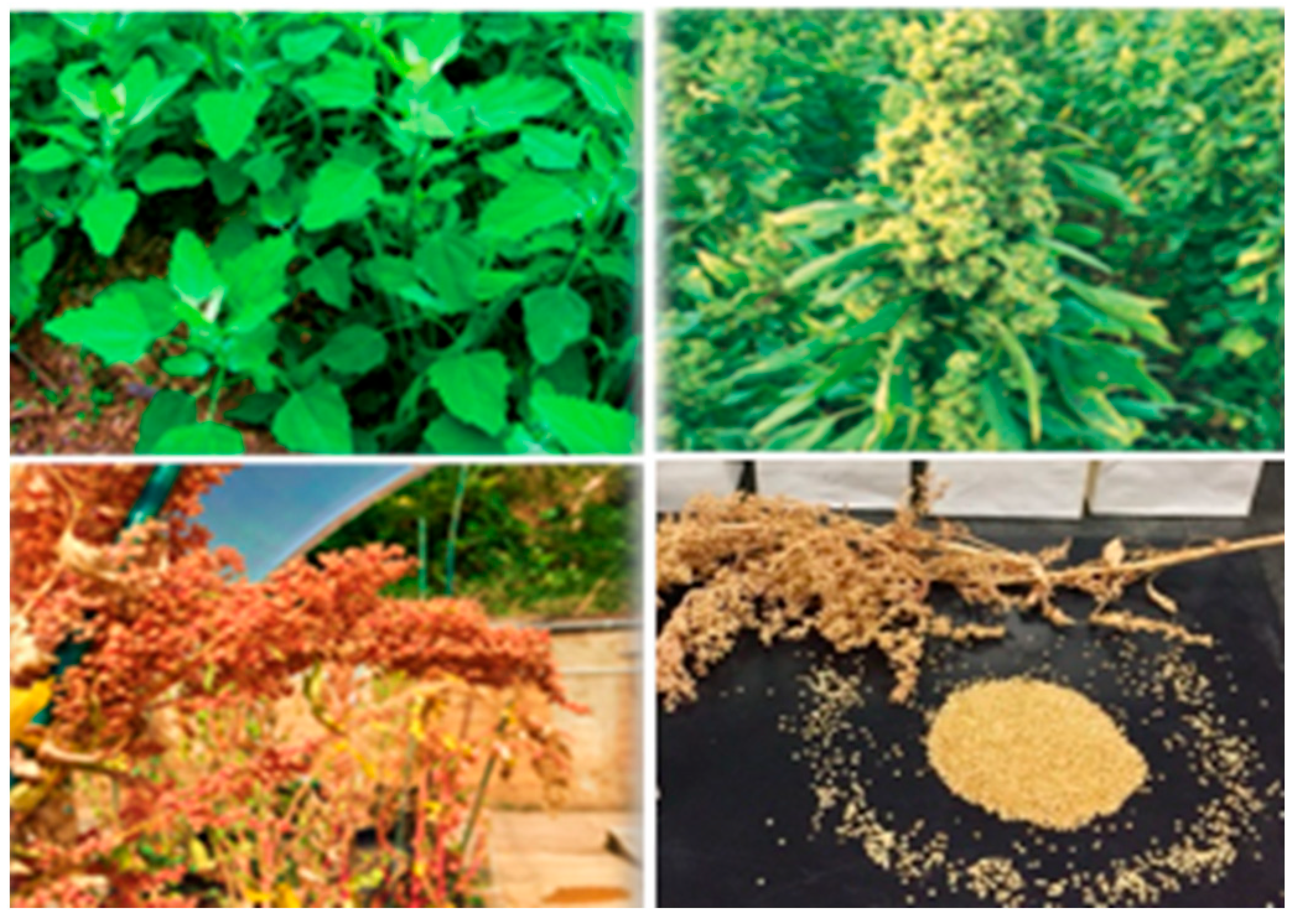
Grains were harvested at physiological maturity (13 weeks after planting; Figure 1). Seeds were manually threshed, air dried, cleaned, and milled to pass through a 1 mm screen using the same milling procedure employed for the leaf samples. The milled grain material was stored in Whirl-Pak® bags until analysis.
Figure 1. Quinoa leaves, flowers, and seeds.

2.2. Methods

2.2.1. Protein Content

The protein content was determined using two methods:
Nitrogen Combustion: This was conducted with a LECO FP-528 nitrogen/protein analyzer according to American Association of Cereal Chemists International (AACCI) method 46-30.01 [18].
Kjeldahl Method: Kjeldahl block digestion and steam distillation were utilized as per AACCI method 46-11.02 [18].

2.2.2. Amino Acid Profile

Following Association of Official Analytical Collaboration (AOAC) method 982.30, the amino acid profile was determined using ion-exchange high-performance chromatography [19].

2.2.3. Total Crude Fat Content

The total crude fat content was measured using Soxhlet extraction with hexane as the solvent, following AOAC method 920.39 [19].

2.2.4. Mineral Content

The macro- and micromineral contents were determined using the dry ash method to obtain a mineral residue. This residue was dissolved in acid, and the mineral concentrations were analyzed using Inductively Coupled Plasma (ICP) Emission Spectroscopy (PerkinElmer, ICP-AES, Waltham, MA, USA), which measures the mineral content by detecting the light emitted from ionized samples.

2.2.5. Total Starch Content

The total starch content was assessed using a total starch assay kit from Megazyme (Megazyme, Ltd. Intl., Bray, Ireland) following AACCI method 76-13.01 [18].

2.2.6. Dietary Fiber Content

The dietary fiber content was determined according to AACCI method 32-07.01 [20] using an Ankom automated dietary fiber analyzer (Ankom Technology, New York, NY, USA).

2.3. Statistical Analysis

Data were analyzed using a completely randomized design (CRD). Genotype was the fixed factor for the leaf and grain compositional data analyses. Analysis of variance (ANOVA) was conducted using SAS 9.4 (SAS Institute Inc., Cary, NC, USA). When significant effects were detected (p < 0.05), means were separated using Tukey’s test. Data are reported as means ± standard deviations.

3. Results and Discussion

3.1. Protein Content in Quinoa Leaves and Grains Using Kjeldahl and Combustion Methods

No significant interaction was observed between nitrogen determination method and quinoa genotype (p > 0.05), and the crude protein content in the leaves and grains did not differ among genotypes. However, the nitrogen determination method itself exhibited a significant main effect (p < 0.05), with consistently higher protein values obtained using the combustion method compared with the Kjeldahl method. In leaves, the protein concentrations averaged 33.32% using the combustion method and 29.37% using the Kjeldahl method, a difference of approximately four percentage points. A similar pattern was observed in grains, where the mean protein levels were 16.62% (combustion) and 12.43% (Kjeldahl) (Table 1).
Table 1. Effect of nitrogen determination method (Kjeldahl and combustion) on crude protein content (%) in leaves and grains of three quinoa genotypes.
Previous studies have reported large variations in quinoa leaf protein content, with values ranging from 23 to 35% dry weight depending on the genotype, developmental stage, and environmental conditions [10,13,14,21]. The leaf protein levels observed in our study (29.37% (Kjeldahl) and 33.32% (combustion)) fall within the upper end of these published ranges.
The grain protein values obtained using the combustion method (16.62%) fall within the range recently reported for quinoa seeds. Multiple studies have documented seed protein concentrations between 15% and 19% (dry matter) across diverse genotypes [22,23,24].
The grain protein content obtained using the combustion method (16.62%) exceeded the typical values reported for major cereals such as barley (10.8%), maize (10.2%), oats (11.6%), rice (7.6%), rye (13.4%), and wheat (14.3%), as summarized by Jancurová et al. [25]. Comparable protein levels have been documented in quinoa in previous studies. For instance, Jubete and Schoenlechner [26,27] reported crude protein concentrations ranging from 12.9% to 16.5% using the combustion method, aligning closely with the value observed in our study (16.62%). Similarly, Nascimento et al. [28] reported 12.1 to 12.5% crude protein values using the Kjeldahl method, which is consistent with the mean Kjeldahl value obtained in this study (12.43% across all genotypes; Table 1).

3.2. Amino Acid Profiles of Quinoa Grains

The amino acid profiles were determined using pooled material from the four field replicates (n = 1 composite sample per genotype) for Ames 13746 (Pison), Ames 13748 (Copacabana), and Ames 13745 (Kaslae); therefore, the values are presented as representative profiles rather than estimates of within-genotype variability (Table 2 and Table 3).
Table 2. Essential amino acid content of quinoa grains from the three genotypes.
Table 3. Nonessential amino acid content of quinoa grains from the three genotypes.
All genotypes exhibited a well-balanced amino acid profile, with leucine, lysine, valine, and phenylalanine representing the most abundant essential amino acids. The mean values across all the genotypes were 0.93 g/100 g leucine, 0.87 g/100 g lysine, 0.66 g/100 g valine, and 0.61 g/100 g phenylalanine. Kaslae showed slightly lower essential amino acid concentrations than Pison and Copacabana, although the overall patterns were similar.
These results agree with previous studies reporting that quinoa provides all nine essential amino acids in nutritionally meaningful proportions and contains a higher lysine content compared with most cereal grains, making it an important complement to plant-based diets [20,28]. Recent analyses have reported comparable essential amino acid values, including 0.80–1.10 g/100 g of leucine, 0.70–1.00 g/100 g of lysine, 0.55–0.75 g/100 g of valine, and 0.50–0.70 g/100 g of phenylalanine in quinoa seeds [22,29,30]. The values obtained in this study fall within these reported ranges, suggesting that the heat-tolerant genotypes evaluated maintain high amino acid quality under tropical conditions.
The nonessential amino acid profiles (Table 3) were dominated by glutamic acid (2.17 g/100 g) and aspartic acid (1.19 g/100 g), consistent with the characteristic amino acid profile of quinoa seed proteins. Arginine was also present at appreciable levels (1.30 g/100 g). These findings align with recent reports indicating that quinoa is rich in acidic and basic amino acids, which contribute to its functional properties and digestibility [20,26,31].

3.3. Dietary Fiber Content in Quinoa Leaves and Grains

Significant differences (p < 0.05) were observed between the genotypes regarding insoluble dietary fiber (IDF) and total dietary fiber (TDF) in the leaves, while soluble dietary fiber (SDF) did not show a significant difference. Kaslae exhibited the highest IDF and TDF values, exceeding Pison and Copacabana by more than 2.5% (Table 4). The mean SDF content across the three genotypes was 6.4%, which is consistent with the range (5 to 7%) previously reported for quinoa foliage by Pathan et al. [14] and Gómez et al. [9].
Table 4. Percentage of insoluble (IDF), soluble (SDF), and total (TDF) dietary fiber in leaves of quinoa genotypes.
Quinoa leaves exhibit higher fiber concentrations than grains. Villacrés et al. [13] reported that quinoa foliage contains substantial levels of insoluble dietary fiber (IDF), ranging from 12.8% to 17.4% (dry weight), while soluble dietary fiber (SDF) levels typically range from 5.4% to 6.8%, resulting in total dietary fiber (TDF) values of approximately 18 to 24%. These values closely align with our findings of 11 to 16% IDF and 18 to 22% TDF, confirming that quinoa leaves represent a highly fiber-dense plant component.
In contrast, the genotypes did not show significant differences in grain dietary fiber content (p > 0.05), with average values of 6.20% IDF, 5.23% SDF, and 11.43% TDF. These findings are consistent with the reported limited variability in grain fiber content across quinoa germplasms. Nowak et al. [1] observed similarly narrow differences between diverse accessions, and Repo-Carrasco et al. [32] documented grain fiber values ranging from 8 to 14% regardless of genotype. Bhargava et al. [33] likewise reported crude fiber contents ranging from 5 to 9% in multiple quinoa populations, emphasizing the stability of the grain fiber content in leaf tissues. Together with the results from Carrasco and Serna [34] and Navruz and Sanlier [35], these data confirm that quinoa grain dietary fiber exhibits relatively low variability across environments and genetic backgrounds.

3.4. Total Fat and Total Starch Content in Quinoa Grains

Analysis of variance indicated no significant genotype effects on grain fat or starch content (p > 0.05; Table 5).
Table 5. Total fat and total starch contents of grains of three quinoa genotypes.
The mean total fat content across the three quinoa genotypes was 5.29%. Recent studies reported comparable values: Arguello-Hernández et al. [36] documented a broad lipid range of 1.8 to 9.5% across diverse quinoa varieties; Xi et al. [37] reported an average seed lipid level of 5.3%; and Matías et al. [38] observed a fat content of approximately 5.4% in quinoa grown under varying Mediterranean rainfed and irrigated conditions. Global reviews of quinoa composition similarly indicate that the total fat content typically falls between 4.0% and 7.1% [39]. When compared with conventional cereals, Narvruz and Sanlier [35] reported markedly lower fat levels in rice (3.2%), barley (1.3%), wheat (2.47%), maize (4.74%), and rye (1.63%), reinforcing quinoa’s relatively richer lipid profile.
Starch plays a central role in the functional properties of quinoa and quinoa-based foods. In the present study, the mean total starch content across the genotypes was 49.21%, a value that lies slightly below many of the ranges reported in the literature. Several recent studies described starch as the predominant seed component. For instance, Mu et al. [39] reported a broad range of 53.2 to 73.4% depending on the genotype and environment. Similarly, Junejo et al. [40] documented seed starch contents spanning 30 to 70%, underlining the genotypic and environmental variability. Another study by Pathan et al. [8] found starch levels of 58.1 to 64.2% in quinoa seeds. Moreover, a recent broad survey of 22 quinoa varieties found starch contents ranging from 42.5% to 64.0%, confirming that some quinoa lines naturally exhibit lower starch accumulation [41]. Taken together, these findings highlight the strong effects of genotype, growing environment, and postharvest processing on quinoa starch content, which helps explain why the 49.21% measured in our study falls toward the lower end of published values.

3.5. Mineral Concentration in Quinoa Leaves and Grains

Significant differences (p < 0.05) were observed among genotypes for leaf calcium (Ca) and phosphorus (P), whereas magnesium (Mg), iron (Fe), potassium (K), and zinc (Zn) did not show significant differences (Table 6). Pison exhibited the highest Ca concentration, while Kaslae showed the highest P content among the three genotypes. In contrast, the mineral concentrations in the grains were not significantly different across genotypes, with mean values of 0.04% Ca, 0.15% Mg, 0.30% P, and 0.79% K, 14.69 mg/100 g Fe, and 8.10 mg/100 g Zn.
Table 6. Mineral concentration in leaves of three quinoa genotypes.
The higher accumulation of Ca and P in leaves reflects their physiological roles in actively growing tissues. Calcium is largely immobile in the phloem and therefore accumulates in transpiring leaves, where it contributes to cell wall structure and membrane stability, while limited remobilization restricts its translocation to seeds. Phosphorus, although more mobile, is preferentially allocated to metabolically active tissues to support energy metabolism and nucleic acid synthesis during vegetative growth. Similar mineral partitioning patterns between leaves and grains have been reported in quinoa and other Amaranthaceae species, where leaf tissues consistently exhibit higher Ca and P concentrations than seeds. In contrast, grain mineral deposition is more tightly regulated and buffered against environmental variation, resulting in relatively stable grain mineral concentrations across genotypes [13,16,32].
The mineral profile observed in this study agrees with recent findings showing that quinoa leaves consistently contain higher Ca and Mg contents than grains, along with elevated Fe and Zn concentrations. Villacrés et al. [13] and Gómez et al. [9] reported that quinoa foliage contains Ca, Mg, Fe, and Zn contents exceeding those of grains and, in some cases, spinach and other leafy vegetables, highlighting its value as a nutrient-dense leafy green.
The quinoa grains were found to contain Fe (14.69 mg/100 g) and Zn (8.10 mg/100 g) contents that are consistent with the ranges reported in recent compositional surveys. Studies by Nowak et al. [1], Angeli et al. [2], and more recent evaluations by Matías et al. [38] and Flórez-Martínez et al. [3] indicate that the typical Fe levels are 10 to 16 mg/100 g and typical Zn levels are 4 to 8 mg/100 g across diverse genotypes. Reviews by Mu et al. [33] and Afzal et al. [7] further emphasize that mineral variability is strongly influenced by genotype, soil nutrient availability, and heat or drought stress, which is supported by Tovar et al. [16], who experimentally showed that high temperatures can significantly alter seed Ca, Mg, Fe, and Zn concentrations.
Overall, these findings demonstrate that quinoa grains have substantially higher Fe, Mg, and Zn contents than common cereals such as wheat, rice, and maize, supporting their use as a nutrient-dense grain in gluten-free and cereal-based diets.
While the present study focused on laboratory-based nutritional characterization, the compositional data generated here provide a foundation for future research aimed at developing simplified field-level indicators, training materials, or farmer-friendly guidelines for assessing quinoa leaf quality in smallholder production systems.

4. Conclusions

This study provides new evidence on the nutritional composition of heat-tolerant quinoa genotypes cultivated under tropical conditions. The grain samples exhibited balanced essential amino acid profiles and protein levels that are comparable to those reported in other studies from around the world, while the leaves consistently showed significantly higher protein and dietary fiber concentrations, supporting their use as an additional edible plant component. Kaslae showed the highest leaf fiber content, whereas the grain fat, starch, and mineral concentrations were similar across genotypes.
The complementary mineral distribution, with higher Fe and Zn contents in the grains and elevated Ca and P levels in the leaves, reflects the physiological nutrient partitioning between storage and vegetative tissues. These findings indicate that heat-tolerant quinoa genotypes can maintain nutritional quality under thermal stress, providing a compositional baseline that is relevant for crop adaptation, stress-resilient production systems, and plant performance in warm environments.

Author Contributions

Conceptualization, E.V.T., A.M.L.R. and E.V.; Methodology, E.V.T., S.S., A.M.L.R. and E.V.; Software, S.S.; Validation, S.S. and E.V.; Formal analysis, E.V.T. and S.S.; Investigation, E.V.T. and E.V.; Resources, S.S. and E.V.; Data curation, E.V.T., A.M.L.R. and E.V.; Writing—original draft, E.V.T.; Writing—review & editing, E.V.T., A.M.L.R. and E.V.; Visualization, E.V.T. and E.V.; Supervision, S.S., A.M.L.R. and E.V.; Project administration, E.V.; Funding acquisition, S.S. and E.V. All authors have read and agreed to the published version of the manuscript.

Funding

This work was supported by the USDA National Institute of Food and Agriculture: 7006389.

Institutional Review Board Statement

Not applicable.

Data Availability Statement

Data are contained within the article.

Conflicts of Interest

The authors declare no conflict of interest.

References

  1. Casalvara, R.F.A.; Ferreira, B.M.R.; Gonçalves, J.E.; Yamaguchi, N.U.; Comar, A.F.; Marques de Souza, C.G.; Castoldi, R. Biotechnological, nutritional, and therapeutic applications of quinoa (Chenopodium quinoa Willd.) and its by-products: A review of the past five-year findings. Nutrients 2024, 16, 840. [Google Scholar] [CrossRef] [PubMed]
  2. Angeli, V.; Miguel Silva, P.; Crispim Massuela, D.; Khan, M.W.; Hamar, A.; Khajehei, F.; Graeff-Hönninger, S.; Piatti, C. Quinoa (Chenopodium quinoa Willd.): An Overview of the Potentials of the “Golden Grain” and Socio-Economic and Environmental Aspects of Its Cultivation and Marketization. Foods 2020, 9, 216. [Google Scholar] [CrossRef] [PubMed]
  3. Flórez-Martínez, D.H.; Rodríguez-Cortina, J.; Chavez-Oliveros, L.F.; Aguilera-Arango, G.A.; Morales-Castañeda, A. Current trends and prospects in quinoa research: An approach for strategic knowledge areas. Food Sci. Nutr. 2023, 12, e3891. [Google Scholar] [CrossRef] [PubMed]
  4. Maamri, K.; Zidane, O.D.; Chaabena, A.; Fiene, G.; Bazile, D. Adaptation of Some Quinoa Genotypes (Chenopodium quinoa Willd.), Grown in a Saharan Climate in Algeria. Life 2022, 12, 1854. [Google Scholar] [CrossRef]
  5. Oustani, M.; Maamri, K.; Benbelkacem, A.; Ghezlaoui, S.; Djekoun, A.; Patanita, M. Agronomic performance and seed quality of quinoa grown in hot–arid environments of Algeria. Sci. Rep. 2023, 13, 6772. [Google Scholar] [CrossRef]
  6. Hlásná Cepková, P.; Dostalíková, L.; Viehmannová, I.; Jágr, M.; Janovská, D. Diversity of quinoa genetic resources for sustainable production: A survey on nutritive characteristics as influenced by environmental conditions. Front. Sustain. Food Syst. 2022, 6, 960159. [Google Scholar] [CrossRef]
  7. Afzal, I.; Haq, M.Z.U.; Ahmed, S.; Hirich, A.; Bazile, D. Challenges and Perspectives for Integrating Quinoa into the Agri-Food System. Plants 2023, 12, 3361. [Google Scholar] [CrossRef]
  8. Pathan, S.; Eivazi, F.; Valliyodan, B.; Paul, K.; Ndunguru, G.; Clark, K. Nutritional composition and bioactive components in quinoa. Foods 2019, 11, 257. [Google Scholar] [CrossRef]
  9. Gómez, M.J.R.; Magro, P.C.; Blázquez, M.R.; Maestro-Gaitán, I.; Sánchez Iñiguez, F.M.; Cruz Sobrado, V.; Matías Prieto, J. Nutritional composition of quinoa leafy greens: An underutilized plant-based food with the potential of contributing to current dietary trends. Food Res. Int. 2024, 178, 113862. [Google Scholar] [CrossRef]
  10. Stoleru, V.; Jacobsen, S.E.; Vitanescu, M.; Jitareanu, G.; Butnariu, M.; Munteanu, N.; Stan, T.; Teliban, G.C.; Cojocaru, A.; Mihalache, G. Nutritional and antinutritional compounds in leaves of quinoa. Food Biosci. 2022, 45, 101494. [Google Scholar] [CrossRef]
  11. Xiao, F.; Guo, F. Impacts of essential amino acids on energy balance. Mol. Metab. 2022, 57, 101393. [Google Scholar] [CrossRef] [PubMed]
  12. Vidal Torres, E.; Valencia, E.; Simsek, S.; Ramírez, A.M.L. Amaranth: Multipurpose Agroindustrial Crop. Agronomy 2024, 14, 2323. [Google Scholar] [CrossRef]
  13. Villacrés, E.; Quelal, M.; Galarza, S.; Iza, D.; Silva, E. Nutritional value and bioactive compounds of quinoa leaves and grains. Plants 2022, 11, 213. [Google Scholar] [CrossRef]
  14. Pathan, S.; Ndunguru, G.; Ayele, A.G. Comparison of the Nutritional Composition of Quinoa (Chenopodium quinoa Willd.) Inflorescences, Green Leaves, and Grains. Crops 2024, 4, 72–81. [Google Scholar] [CrossRef]
  15. Olguín, P.; Contreras, S.; Rojas, C.; Fuentes, F. Genotype-by-environment interaction stability analysis of new quinoa (Chenopodium quinoa Willd.) varieties in the Mediterranean zone of Chile. Plants 2025, 14, 3007. [Google Scholar] [CrossRef]
  16. Tovar, J.C.; Berry, J.C.; Quillatupa, C.; Castillo, S.E.; Acosta-Gamboa, L.; Fahlgren, N.; Gehan, M.A. Heat Stress Changes Mineral Nutrient Concentrations in Chenopodium quinoa Seed. Plant Direct 2022, 6, e384. [Google Scholar] [CrossRef]
  17. Pathan, S.; Ndunguru, G.; Clark, K.; Ayele, A.G. Yield and Nutritional Responses of Quinoa (Chenopodium quinoa Willd.) Genotypes to Irrigated, Rainfed, and Drought-Stress Environments. Front. Sustain. Food Syst. 2023, 7, 1242187. [Google Scholar] [CrossRef]
  18. Cereals and Grains Association. AACC International Approved Methods of Analysis. Available online: http://methods.aaccnet.org/ (accessed on 20 October 2025).
  19. AOAC International. Official Methods of Analysis. Available online: http://www.aoacofficialmethod.org (accessed on 20 October 2025).
  20. AACC International. Approved Method 32-07.01: Insoluble, Soluble, and Total Dietary Fiber in Foods. In Approved Methods of Analysis, 11th ed.; AACC International: Saint Paul, MN, USA, 2010. [Google Scholar]
  21. Rubinovich, L.; Dagan, R.; Lugasi, Y.; Galili, S.; Asher, A. The potential of young vegetative quinoa (Chenopodium quinoa) as a new sustainable protein-rich winter leafy crop under Mediterranean climate. PLoS ONE 2023, 18, e0290000. [Google Scholar] [CrossRef]
  22. Manzanilla-Valdez, M.L.; Boesch, C.; Orfila, C.; Montaño, S.; Hernández-Álvarez, A.J. Unveiling the nutritional spectrum: A comprehensive analysis of protein quality and antinutritional factors in three varieties of quinoa (Chenopodium quinoa Willd.). Food Chem. X 2024, 24, 101814. [Google Scholar] [CrossRef] [PubMed]
  23. Ali, A.A.; Ali, A.H.; Nassar, M.A.; Farag, M.F.; Rady, A.M.; Salem, M.M.; El-Aassar, S.A.; Salama, A.B. Quinoa as a functional crop with emphasis on distribution, nutritional composition, and biological effects. Discov. Food 2025, 5, 285. [Google Scholar] [CrossRef]
  24. El-Hakim, A.F.; Mady, E.; Abou Tahoun, A.M.; Ghaly, M.S.A.; Eissa, M.A. Seed quality and protein classification of some quinoa varieties. J. Ecol. Eng. 2022, 23, 24–33. [Google Scholar] [CrossRef]
  25. Jancurová, M.; Minarovičová, L.; Dandár, A. Quinoa—A review. Czech J. Food Sci. 2009, 27, 71–79. [Google Scholar] [CrossRef]
  26. Jubete, A.; Arendt, E.; Gallagher, E. Nutritive value and chemical composition of pseudocereals as gluten-free ingredients. Int. J. Food Sci. Nutr. 2009, 60, 240–257. [Google Scholar] [CrossRef]
  27. Schoenlechner, R.; Drausinger, J.; Ottenschläger, V.; Jurackova, K.; Berghofer, E. Functional properties of gluten-free pasta produced from amaranth, quinoa, and buckwheat. Plant Foods Hum. Nutr. 2010, 65, 339–349. [Google Scholar] [CrossRef] [PubMed]
  28. Nascimento, A.; Mota, C.; Coelho, I.; Guefão, S.; Santos, M.; Matos, A.S. Characterisation of nutrient profiles of quinoa, amaranth and purple corn. Food Chem. 2014, 148, 420–426. [Google Scholar] [CrossRef] [PubMed]
  29. Craine, E.B.; Murphy, K.M. Corrigendum: Seed Composition and Amino Acid Profiles for Quinoa Grown in Washington State. Front. Nutr. 2020, 7, 605674. [Google Scholar] [CrossRef]
  30. Escuredo, O.; González-Martín, M.I.; Wells-Moncada, G.; Fischer, S.; Hernández-Hierro, J.M. Amino acid profile of quinoa using NIR spectroscopy. J. Cereal Sci. 2014, 60, 67–74. [Google Scholar] [CrossRef]
  31. Alsaleem, K.A.; Moftah, R.F.; El-Geddawy, M.M.A. Nutritional and functional properties of quinoa protein isolates. Processes 2024, 12, 2822. [Google Scholar] [CrossRef]
  32. Repo-Carrasco, R.; Espinoza, C.; Jacobsen, S.-E. Nutritional value and use of the Andean crops quinoa (Chenopodium quinoa) and kañiwa (Chenopodium pallidicaule). Food Rev. Int. 2003, 26, 203–223. [Google Scholar] [CrossRef]
  33. Bhargava, A.; Shukla, S.; Ohri, D. Genetic variability and interrelationship among morphological and quality traits in quinoa (Chenopodium quinoa Willd.). Field Crops Res. 2007, 101, 104–116. [Google Scholar] [CrossRef]
  34. Carrasco, V.; Serna, R. Quinoa as a source of dietary fiber. Cienc. Tecnol. Aliment. 2011, 31, 225–230. [Google Scholar]
  35. Navruz, S.; Sanlier, N. Nutritional and health benefits of quinoa. J. Cereal Sci. 2016, 69, 371–376. [Google Scholar] [CrossRef]
  36. Arguello-Hernández, P.; Samaniego, I.; Leguizamo, A.; Bernalte-García, M.J.; Ayuso-Yuste, M.C. Nutritional and Functional Properties of Quinoa (Chenopodium quinoa Willd.) Chimborazo Ecotype: Insights into Chemical Composition. Agriculture 2024, 14, 396. [Google Scholar] [CrossRef]
  37. Xi, X.; Fan, G.; Xue, H.; Peng, S.; Huang, W.; Zhan, J. Harnessing the Potential of Quinoa: Nutritional Profiling, Bioactive Components, and Implications for Health Promotion. Antioxidants 2024, 13, 829. [Google Scholar] [CrossRef]
  38. Matías, J.; Rodríguez, M.J.; Cruz, V.; Calvo, P.; Granado-Rodríguez, S.; Poza-Viejo, L.; Fernández-García, N.; Olmos, E.; Reguera, M. Assessment of the changes in seed yield and nutritional quality of quinoa grown under rainfed Mediterranean environments. Front. Plant Sci. 2023, 14, 1268014. [Google Scholar] [CrossRef]
  39. Mu, H.; Xue, S.; Sun, Q.; Shi, J.; Zhang, D.; Wang, D.; Wei, J. Research Progress of Quinoa Seeds (Chenopodium quinoa Willd.): Nutritional Components, Technological Treatment, and Application. Foods 2023, 12, 2087. [Google Scholar] [CrossRef] [PubMed]
  40. Junejo, S.A.; Wang, J.; Liu, Y.; Jia, R.; Zhou, Y.; Li, S. Multi-Scale Structures and Functional Properties of Quinoa Starch Extracted by Alkali, Wet-Milling, and Enzymatic Methods. Foods 2022, 11, 2625. [Google Scholar] [CrossRef]
  41. Guo, S.; Zhao, C.; Zhou, J.; Zhang, Z.; Wang, W.; Zhu, Y.; Dong, C.; Ren, G. Influence of the Nutritional Composition of Quinoa (Chenopodium quinoa Willd.) on the Sensory Quality of Cooked Quinoa. Foods 2025, 14, 988. [Google Scholar] [CrossRef] [PubMed]
Disclaimer/Publisher’s Note: The statements, opinions and data contained in all publications are solely those of the individual author(s) and contributor(s) and not of MDPI and/or the editor(s). MDPI and/or the editor(s) disclaim responsibility for any injury to people or property resulting from any ideas, methods, instructions or products referred to in the content.

Article Metrics

Citations

Article Access Statistics

Article metric data becomes available approximately 24 hours after publication online.