Article

Environmental and Mechanical Trade-Off Optimization of Waste-Derived Concrete Using Surrogate Modeling and Pareto Analysis

Built Environment, Institute for Sustainable Industries and Liveable Cities, Victoria University, Melbourne, VIC 3011, Australia
Sustainability 2026, 18(2), 1119; https://doi.org/10.3390/su18021119
Submission received: 16 December 2025 / Revised: 19 January 2026 / Accepted: 19 January 2026 / Published: 21 January 2026
(This article belongs to the Special Issue Advanced Materials and Technologies for Environmental Sustainability)

Abstract

Concrete production contributes approximately 4–8% of global cardon dioxide emissions, largely due to Portland cement. Incorporating municipal solid waste (MSW) into concrete offers a pathway to reduce cement demand while supporting circular economy objectives. This study evaluates the mechanical performance, environmental impacts, and optimization potential of concrete incorporating three MSW-derived materials: cardboard kraft fibers (KFs), recycled high-density polyethylene (HDPE), and textile fibers. A maximum 10% cement replacement strategy was adopted. Compressive strength was assessed at 7, 14, and 28 days, and a cradle-to-gate life cycle assessment (LCA) was conducted using OpenLCA to quantify global warming potential (GWP100) and other midpoint impacts. A surrogate-based optimization implemented using Non-dominated Sorting Genetic Algorithm II (NSGA-II) was applied to minimize cost and GWP while enforcing compressive strength as a feasibility constraint. The results show that fiber-based wastes significantly reduce embodied carbon, with KF achieving the largest GWP reduction (19%) and textile waste achieving moderate reductions (10%) relative to the control. HDPE-modified concrete exhibited near-control mechanical performance but increased GWP and fossil depletion due to polymer processing burdens. The optimization results revealed well-defined Pareto trade-offs for KF and textile concretes, identifying clear compromise solutions between cost and emissions, while HDPE was consistently dominated. Overall, textile waste emerged as the most balanced option, offering favorable environmental gains with minimal cost and acceptable mechanical performance. The integrated LCA optimization framework demonstrates a robust approach for evaluating MSW-derived concrete and supports evidence-based decision-making toward low-carbon, circular construction materials.

1. Introduction

Municipal solid waste (MSW) generation continues to rise globally, driven by rapid urbanization, population growth, and resource-intensive consumption patterns [1]. Recent estimates indicate that the world generated around 2.2 billion tons of solid waste in 2020, with annual volumes projected to increase by roughly 70% to 3.9 billion tons by 2050 [2]. High-income countries generate a disproportionate share of this waste, with one-third leading to uncontrolled dumping, open burning, and poorly engineered landfills [3]. Plastics alone account for over 10% of global MSW, with approximately 79% of plastic waste resulting in landfill [4]. Plastic bottles are predominantly manufactured from polyethylene terephthalate (PET) and high-density polyethylene (HDPE), both of which are considered high-quality, marketable resins with strong economic value in recycling streams [5]. PET accounts for approximately 55% of the global recycled plastics market, while HDPE contributes an additional 33% [6], highlighting their dominance within secondary material flows. These polymers also represent a substantial proportion of post-consumer plastics collected for recycling. In the United States, PET bottles constituted 38% of the more than five billion pounds of post-consumer plastics recovered in 2022, with HDPE bottles contributing a further 17% [7]. Other high-volume MSW streams include textiles and paper/cardboard, which collectively represent 92 and 72 million tons generated annually worldwide, respectively [8,9]. It is important to note that 11% of plastic waste is also derived from textiles, with only 8% of textile fibers sourced from recycled sources [8]. As a result, HDPE, cardboard, and post-consumer textiles typically end their life cycle in landfills, contributing to greenhouse gas (GHG) emissions, leachate generation, microplastic dispersion, and the irreversible loss of fiber and polymer resources [10].
Contemporary MSW management systems generally follow a hierarchy of prevention, reuse, recycling, energy recovery, and disposal. However, many cities still rely heavily on mixed collection, mechanical treatment, incineration, and landfilling [11]. Integrated MSW system analyses show that material recovery is often constrained by inadequate source separation, contamination, and limited markets for secondary materials, which particularly affects heterogeneous, low-value waste streams such as mixed plastics, composite packaging, and blended textiles [12]. Strategic policy frameworks in the EU and elsewhere increasingly promote circular economy models and higher recycling targets, yet recent assessments still highlight substantial gaps between these ambitions, as large fractions of MSW continue to be routed to waste-to-energy facilities or landfills [13]. This context underscores the need to identify high-volume, technically robust end uses that can absorb difficult-to-recycle MSW streams. The building and construction industry is responsible for high material consumption, negative environmental emissions, and excessive waste creation [14,15,16]. Approximately 39% of global energy-related carbon dioxide (CO2) emissions are related to construction activities [17]. Globally, construction and demolition waste is expected to grow to 27 billion tons by 2050, whilst virgin resource consumption is approximately 30% [18,19]. In addition to the total amount of negative emissions created, 79% of CO2 emissions are from cement and steel production alone [20]. Concrete is the most utilized resource after water [21]. Due to the large production and material composition of concrete, it can accommodate a variety of fibrous and particle fillers, making them attractive sinks for waste-derived materials [22]. Substituting portions of virgin resources with MSW-derived constituents is possible to extend material life cycles, reduce demand for primary resources, and lower embodied energy and emissions associated with conventional concrete production [23,24]. Moreover, engineered MSW additions can modify the microstructure and fracture behavior of cementitious composites, enhancing tensile bridging, crack deflection, pore refinement, and density control [25]. However, it is important to note that a high dosage of MSW materials in cementitious composites has been shown to reduce mechanical properties and composite workability [26].
Researchers have examined waste plastics, as both aggregate and fibrous reinforcement in concrete [27,28]. A systematic review reports that HDPE fibers can significantly enhance post-cracking toughness, flexural residual strength, and impact resistance [29]. Experimental studies on HDPE aggregates and fibers have shown that moderate dosages may reduce drying shrinkage and chloride ion penetration, although high replacement levels typically lower stiffness and compressive strength due to weak bonding and increased air content in the interfacial transition zone [30]. A recent study on cement-based materials incorporating waste cardboard concluded that the waste fibers can improve crack control, flexural behavior, and toughness [31]. Experimental investigations on recycled cardboard kraft fibers (KFs) used as partial cement replacement have reported enhanced tensile capacity and crack-bridging behavior, with the potential to improve freeze–thaw and thermal cycling resistance when mix design and curing are carefully optimized [32,33]. Textile waste represents another major MSW stream with growing attention in concrete research [34,35]. Laboratory studies have demonstrated that incorporating recycled textile fibers within cementitious composites can enhance ductility, energy absorption, and resistance to crack propagation, while reducing spalling risk under thermal loading [36,37,38]. Recent experimental and life cycle analyses of concrete containing textile waste fibers have shown that appropriately dosed fibers can increase compressive and tensile strengths, while lowering the overall GHG footprint compared [39,40].
The integration of MSW within concrete presents a promising pathway to simultaneously reduce landfill burdens, conserve natural resources, and lower the embodied carbon of construction materials. However, the sustainable adoption of MSW-derived composites requires a holistic understanding that extends beyond material substitution alone. Mechanical performance must be rigorously evaluated to ensure that waste-derived fibers can provide equivalent or enhanced structural behavior compared to conventional mixes. At the same time, life cycle assessment (LCA) is essential for quantifying the true environmental benefits and trade-offs associated with diverting MSW streams. This is critical for materials such as plastics, cardboard fibers, and textiles within cementitious systems, due to the preprocessing and transportation requirements that can influence overall impact profiles. Coupling these assessments with optimization techniques enables the identification of mix designs that balance mechanical strength, cost, and environmental performance. This can provide evidence-based pathways for maximizing circular economy benefits. Linking mechanical testing, LCA, and multi-objective optimization therefore offers a robust, interdisciplinary framework for determining which MSW materials deliver the greatest structural and environmental value in concrete, supporting the transition toward low-carbon and resource-efficient construction practices.
Moreover, optimization approaches are often applied without considering the discrete nature of practical mix design spaces, limiting their interpretability for real-world applications. This study addresses these gaps by combining experimental compressive strength testing, cradle-to-gate life cycle assessment, and surrogate-based multi-objective optimization to systematically evaluate the trade-offs between environmental performance and structural feasibility. The primary aim of this study is to evaluate the mechanical performance, environmental impacts, and cost–carbon trade-offs of concrete incorporating kraft, textile fibers, and recycled HDPE under a constrained cement replacement strategy. A secondary aim is to apply a surrogate-based multi-objective optimization framework to identify feasible and balanced mix designs that minimize cost and global warming potential while satisfying minimum compressive strength requirements. The novelty of this work lies in the integrated coupling of experimental testing, life cycle assessment, and Pareto-based optimization to explicitly distinguish beneficial from non-beneficial waste streams for circular concrete applications. The remainder of this paper is structured as follows. Section 2 describes the materials, mix design methodology, experimental testing procedures, life cycle assessment framework, and multi-objective optimization approach. Section 3 presents and discusses the mechanical performance, environmental impacts, and optimization results for each waste stream. Section 4 synthesizes the findings through a comparative interpretation of environmental–mechanical trade-offs. Finally, Section 5 summarizes the key conclusions, practical implications, and directions for future research.

2. Materials and Methods

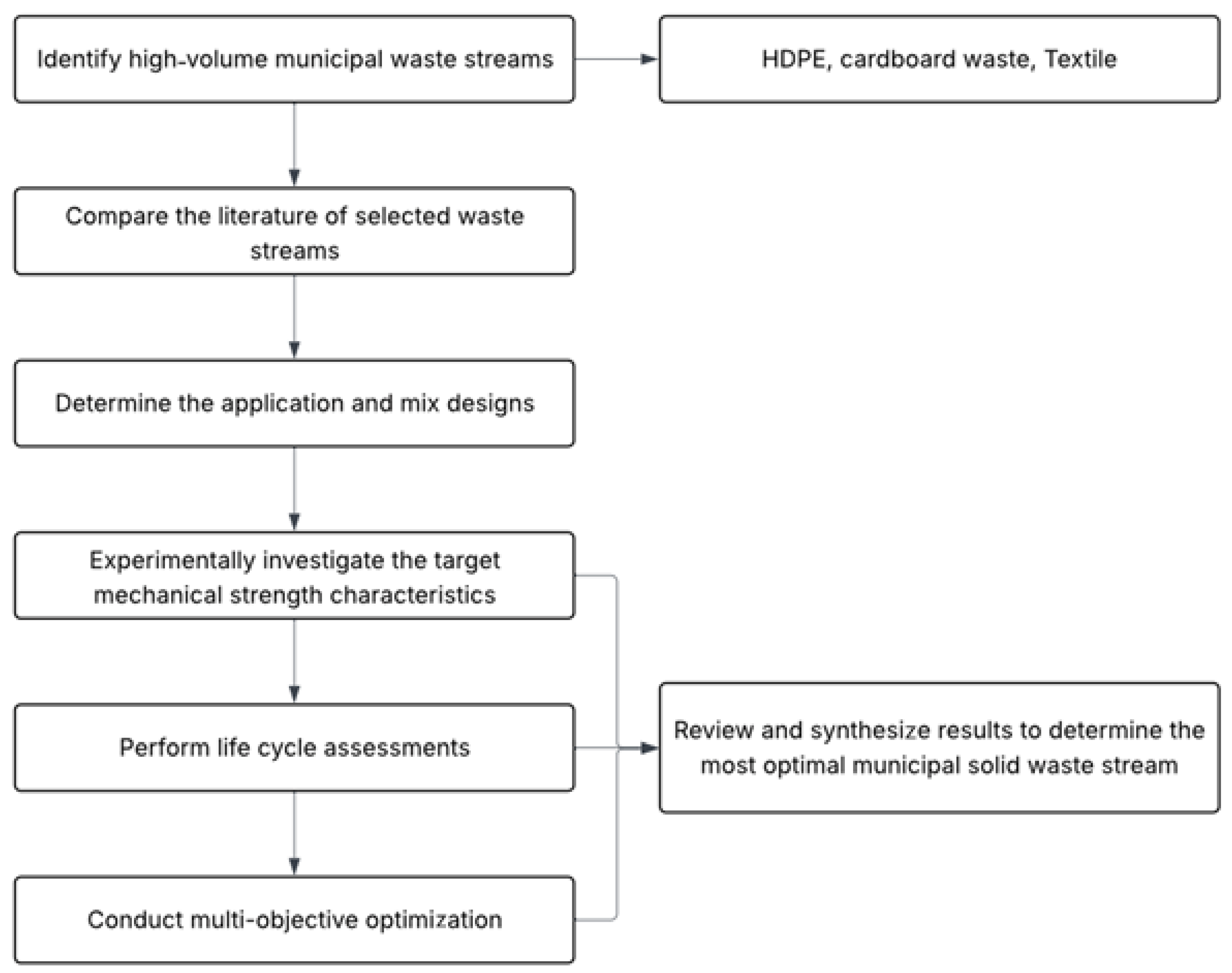
This study is intended as a feasibility-level assessment rather than a comprehensive durability or performance characterization of waste-modified concrete. Compressive strength was selected as the primary mechanical indicator, as it represents the minimum structural performance criterion required to screen viable mixtures prior to more detailed fresh and hardened-state investigations. Figure 1 demonstrates the research methodology in this study. As shown, this research integrates a mixed method framework, consisting of experimental mechanical testing, environmental life cycle assessment (LCA), and multi-objective optimization. Firstly, laboratory-based testing was conducted to evaluate the mechanical performance of concrete incorporating three municipal solid waste (MSW) streams, HDPE, waste cardboard KFs, and post-consumer textile fibers. Compressive strength testing was performed at 7, 14, and 28 days in accordance with relevant standards to quantify the structural implications of each waste addition. Following the mechanical testing, a comparative cradle-to-gate LCA was developed using the OpenLCA to assess the environmental impacts associated with each modified concrete mix. Inventory data were harmonized across all scenarios to ensure consistency in system boundaries, allocation procedures, and impact characterization. The mechanical and environmental datasets were then integrated through a surrogate-based multi-objective optimization (MOO) procedure. The optimization minimized cost and GWP, with compressive strength enforced as a feasibility constraint, generating a set of Pareto-optimal solutions that characterize the trade-offs between structural performance, environmental impacts, and economic feasibility. This multi-objective framework enabled the systematic identification of MSW materials and dosage levels that provide the greatest reductions in environmental burdens and overall costs, while maintaining the mechanical properties within acceptable performance thresholds. Through this combined experimental, LCA, optimization framework, the study establishes a robust basis for evaluating the viability of MSW-derived materials in circular economy concrete applications. The present study intentionally adopts cement replacement rather than fiber reinforcement or aggregate substitution in order to directly target reductions in cement-related greenhouse gas emissions, which dominate the cradle-to-gate environmental profile of concrete. While fiber addition as reinforcement and HDPE aggregate substitution are established approaches for improving mechanical performance, they typically do not achieve equivalent reductions in embodied carbon unless cement content is explicitly reduced.

2.1. Materials and Mix Design

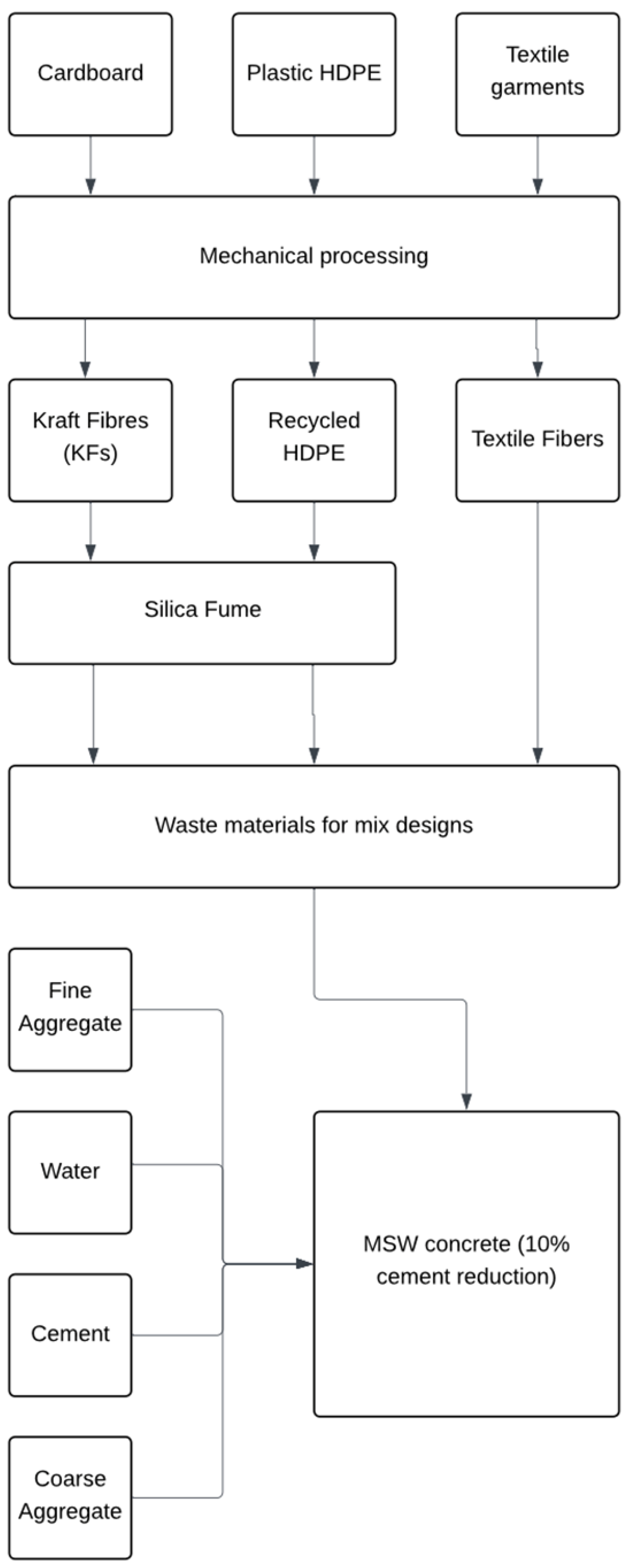
Each MSW material was processed to achieve workable particle size and morphologies suitable for integration into the cementitious matrices. HDPE plastics were sourced from plastic milk bottles and granulated into 3–4 mm chips. Silica fume (SF) was added to the granulated HDPE waste to create a silica fume plastic milk bottle. Cardboard waste underwent pulping, drying, and mechanical refinement into short cellulose fibers (2–5 mm). This transformation included the coating of SF on the fiber walls to ensure durability, as shown in previous studies [41,42]. The result was the silica fume-modified cardboard kraft fibers. Textile waste, derived from polyester-dominant blends, was cut and shredded into 1–2 mm fibers. It is important to note that SF–textile fibers were unworkable due to the refined 1–2 mm short fibers, creating fiber clumps. A baseline 40 MPa control mix was developed using ordinary Portland cement (OPC), natural sand, and coarse aggregates. Table 1 demonstrates the mix designs of the various composite materials.
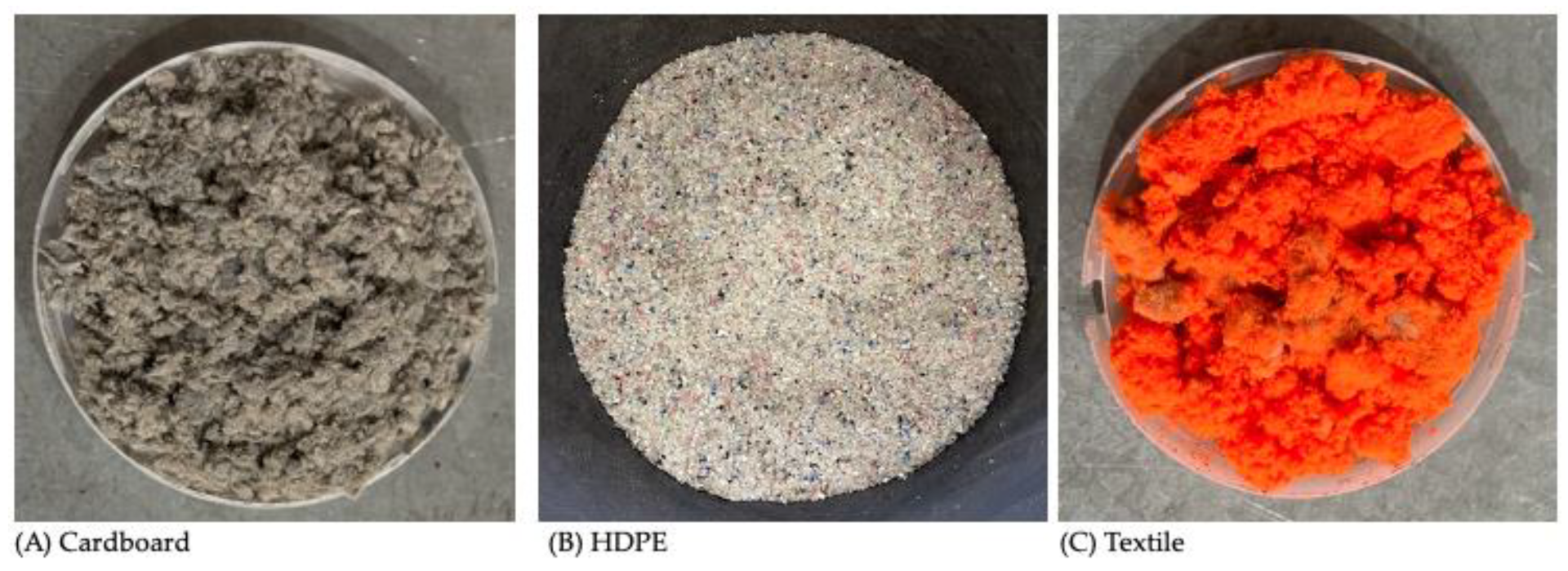
A maximum cement replacement level of 10% was selected due to the significant reductions in mechanical performance commonly reported at higher replacement ratios when incorporating waste-derived fibers or fillers. Numerous studies indicate that replacement levels exceeding approximately 10–15% introduce dilution effects, reduced hydration product formation, and increased porosity, leading to disproportionate losses in compressive strength [43,44,45]. Accordingly, 10% represents a practical upper limit for balancing strength retention with environmental benefit. The chemical compositions reported in Table 2 highlight the high silica content of silica fume and the calcium-dominant nature of OPC, which directly influence the hydration behavior, matrix densification, and fiber–matrix interaction in the composite mixes. The weight of the MSW varied due to the density variations and was adjusted to volume to ensure workability amongst the cementitious matrix. Figure 2 and Figure 3 illustrate the MSW materials utilized in this study and the mix design methodology, respectively.

2.2. Mechanical Testing

Compressive strength testing was performed using a Matest C088-11 N Servo-Plus, the equipment was manufactured by Matest S.p.A., Treviolo (Bergamo), Italy. Evolution testing frame was equipped with a Cyber-Plus Evolution data acquisition system. All concrete constituents were prepared and mixed using a laboratory mortar mixer in accordance with AS/NZS 1012.2 [46]. Fiber modification using silica fume (SF) followed the requirements of AS/NZS 3582.3 [47]. Fine and coarse aggregates were sourced and characterized according to AS/NZS 1141.5 [48] and AS/NZS 1141.6.2 [49], respectively. Ordinary Portland cement (OPC) served as the primary binder and met AS/NZS 3972 [50]. Potable water was used for all mix designs. Specimen preparation and curing were undertaken under controlled laboratory conditions consistent with AS/NZS 1012.8.2 [51]. The procedures adopted ensure that the resulting specimens reflect material behavior representative of practical industry applications.

2.3. Life Cycle Assessment

To evaluate and compare the environmental impacts of concrete incorporating the selected waste materials, a life cycle assessment (LCA) was conducted. The analysis was performed using OpenLCA version 2.4 software in combination with the Ecoinvent v3.8 database [52,53]. The LCA framework followed the requirements of ISO 14044 [54], which outlines four key phases of assessment: (i) goal and scope definition, (ii) life cycle inventory analysis, (iii) impact assessment, and (iv) interpretation. These phases were systematically applied to ensure methodological transparency, reproducibility, and alignment with international LCA standards.

2.3.1. Scope and System Boundary

Previous life cycle assessment (LCA) studies have evaluated the environmental benefits of incorporating various waste materials into cementitious composites, demonstrating the potential reductions in embodied carbon and resource depletion [55,56,57,58,59]. Examples include the reuse of polyethylene plastics and recycled concrete aggregates as supplementary materials in concrete production. The LCA conducted in this study aimed to identify, quantify, and compare the environmental impacts associated with producing concrete incorporating MSW materials under a maximum 10% cement reduction strategy. A secondary objective was to evaluate the potential for diverting these waste streams from landfill and demonstrate their viability as circular economy resources. All concrete mixes were prepared under controlled laboratory conditions to ensure environmental differences were attributable solely to material composition rather than external production variables.
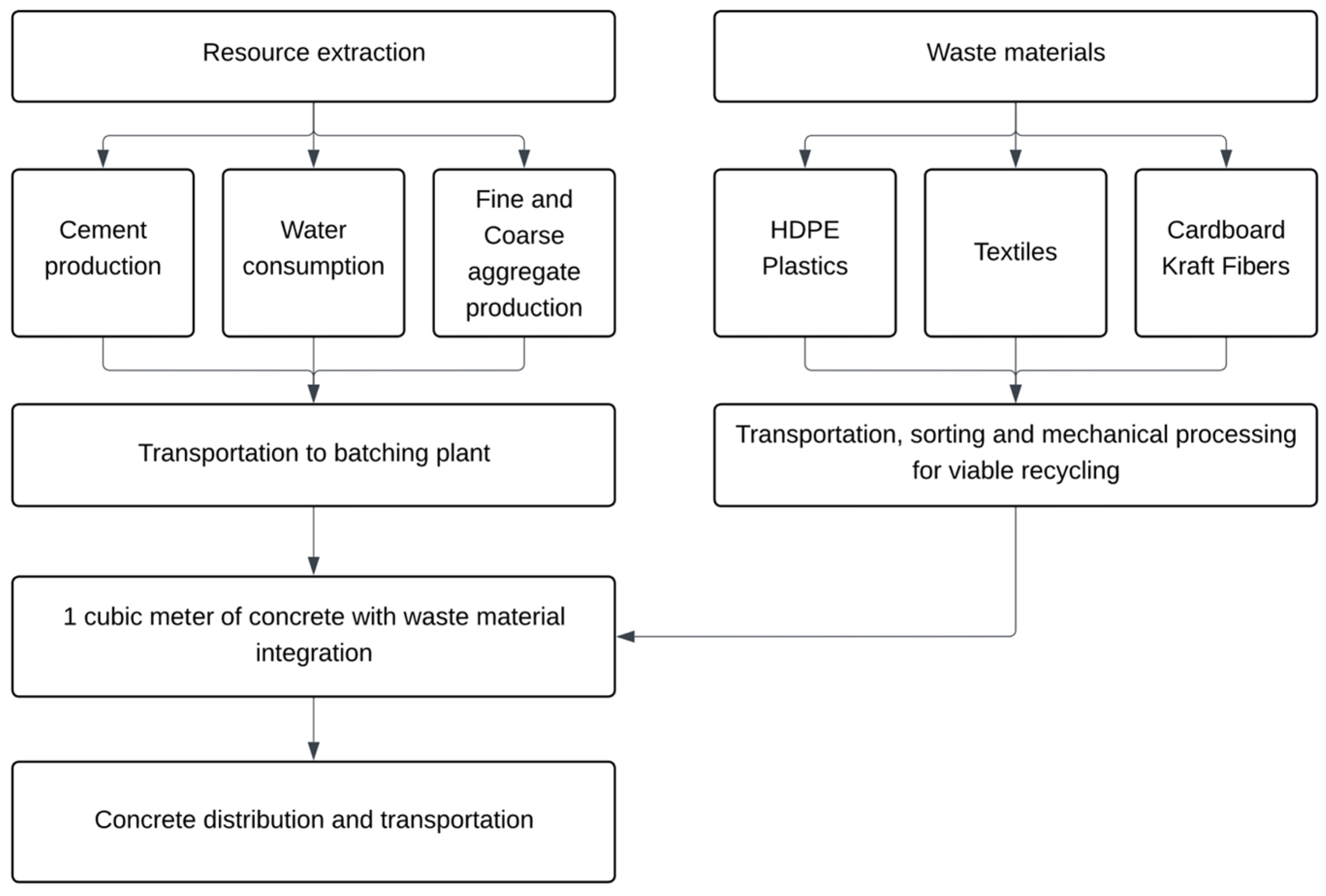
The functional unit for the assessment was defined as 1 m3 of concrete, providing a consistent basis for comparing inputs, outputs, and overall environmental burdens. A cradle-to-gate system boundary was adopted, as shown in Figure 4, encompassing raw material extraction, processing, transport, concrete batching, and production. Downstream life cycle stages including construction, operational performance, maintenance, and end-of-life disposal were excluded on the basis that these phases are assumed to be equivalent across all mixes and therefore do not influence comparative results. The scope and system boundaries of the LCA necessarily incorporate several assumptions and limitations aligned with the research objectives. End-of-life performance was not considered, as all mix designs were assumed to exhibit similar disposal pathways. Likewise, the service life of the waste-modified concretes was assumed to be equivalent to that of the control mix.

2.3.2. Life Cycle Impact Assessment

A life cycle impact assessment (LCIA) consists of three key components: (i) the selection of impact categories, (ii) the classification of inventory flows into the appropriate categories, and (iii) the calculation of category-specific indicator results. This stage of the LCA quantifies the environmental burdens associated with each concrete mix. The present study adopts a problem-oriented, or “midpoint,” assessment approach, which evaluates impacts at an intermediate point in the cause–effect chain and is widely used for concrete and construction materials research.
Based on current global environmental priorities, seven midpoint impact categories were selected for analysis: terrestrial acidification potential (TAP100, kg SO2-eq), global warming potential (GWP100, kg CO2-eq), terrestrial ecotoxicity potential (TEP100, kg 1,4-DCB-eq), marine eutrophication potential (MEP100, kg N-eq), human carcinogenic toxicity potential (HTP100, kg 1,4-DCB-eq), stratospheric ozone depletion potential (ODP100, kg CFC-11-eq), and fossil depletion (FDP, kg oil-eq). Normalization factors for these categories are presented in Table 3. The LCIA was carried out using the ReCiPe 2016 Hierarchist (H) midpoint method, which integrates elements of the Eco-indicator 99 and CML characterization frameworks. All material and energy flows within the system boundary were modeled in OpenLCA using the Ecoinvent v3.8 database.

2.4. Multi-Objective Optimization

The optimization of waste-modified concrete typically involves balancing economic feasibility with environmental performance. Multi-objective optimization (MOO) offers a structured approach for evaluating such conflicting criteria by identifying the best achievable compromise solutions within a defined design space [60]. MOO enables the identification of cost and environmental trade-offs that reflect the most efficient combinations of these objectives. Moreover, multi-objective methods evaluate several performance dimensions concurrently and determine which solutions are non-dominated within the feasible domain. The resulting set of non-dominated designs forms the Pareto-optimal frontier, representing mixes for which no further improvement in one objective is possible without a deterioration in another. This aligns closely with practical engineering decision-making, where cost, emissions, constructability, and performance constraints often conflict. Evolutionary multi-objective algorithms such as the Non-dominated Sorting Genetic Algorithm II (NSGA-II) are widely adopted in materials engineering due to their ability to efficiently explore continuous or semi-continuous design spaces and produce well-distributed Pareto fronts [61]. NSGA-II has been used in previous cementitious materials research to optimize cost–durability trade-offs, and to balance strength, embodied carbon, and economic performance in geopolymer and binder optimization systems [62,63]. Its global search capability and diversity-preserving mechanisms make it suitable for identifying optimal waste utilization scenarios in concrete.
In this study, a surrogate-based optimization framework was implemented to identify cost- and carbon-efficient MSW-modified concrete mixtures using NSGA-II. The optimization considered the MSW replacement level r (0–10% by cement mass) because this range corresponded to experimentally validated mix designs and ensured compliance with minimum compressive strength requirements. Total material cost and cradle-to-gate GHG emissions were defined as the two optimization objectives. Strength was not included as an explicit objective but served as a feasibility constraint to ensure that all candidate mixtures retained acceptable mechanical performance. Unlike earlier optimization studies employing multi-gene chromosomes, the present optimization utilized a single-gene chromosome representing the continuous replacement level, enabling smooth interpolation between the experimentally tested mixes. NSGA-II was then applied as a Pareto-ranking engine to generate a non-dominated set of mix designs, which represents the best achievable cost–carbon trade-offs for each MSW material.

2.4.1. Multi-Objective Optimization Inputs

A functional unit of 1 cubic meter (m3) of concrete was adopted with aggregates and water remaining constant across all mixes. The amount of cement varied with each MSW replacement. Cement and waste contents were interpolated between the control mix and the experimentally validated 10% mixes.

2.4.2. Cost Modeling Equations

Total material cost included coarse and fine aggregates, water, cement, and MSW fibers. Aggregate and water costs were constant across all mixtures; variation in total cost resulted from changes in binder composition. Letting C 0 and C 10 denote the total cost at 0% and 10% replacement, respectively, the total cost was modeled as follows:
C ( r ) = C 0 + ( r 10 ) ( C 10 C 0 )
where
C ( r ) = total material cost (AUD/m3) at replacement level r ;
C 0 = cost of the control mix (AUD/m3);
C 10 = cost of the 10% MSW replacement mix (AUD/m3);
r 10 = cement replacement level (%).
It is important to note that the costs remained consistent with the linear unit pricing of cement and waste materials in Australia.

2.4.3. Environmental Impact Modeling

Cradle-to-gate LCA values for GHG (kg CO2-eq/m3) were obtained from OpenLCA for 0%, 2%, 5%, 8%, and 10% replacement levels for each waste stream. To enable continuous optimization, a quadratic surrogate function was fitted as follows:
G ( r ) = a r 2 + b r + c .
where
G ( r ) = cradle-to-gate GWP100 (kg CO2-eq/m3);
r = cement replacement level (%);
a, b, c = regression coefficients.

2.4.4. Multi-Objective Optimization Problem

The optimization problem was formulated as a bi-objective Pareto minimization problem, in which economic cost and global warming potential (GWP) were minimized simultaneously, subject to a mechanical feasibility constraint on compressive strength. Rather than aggregating objectives through weighting or scalarization, the optimization sought to identify a set of Pareto-optimal solutions that explicitly represent the trade-off between environmental and economic performance.
The optimization problem is defined as follows:
Pareto min r   R f ( r ) = [ C ( r ) G ( r ) ] Subject   to : R = {   r   R   | 0 r 10 , f c ( r ) f c , m i n
where r denotes the cement replacement ratio (%), C ( r ) is the total material cost (AUD/m3), and G ( r ) is the global warming potential (kg CO2-eq/m3). The vector-valued objective function f ( r ) maps each feasible replacement ratio to a two-dimensional objective space comprising economic and environmental performance.
Compressive strength f c ( r ) was not treated as an optimization objective, but instead imposed as a feasibility constraint, where f c , m i n represents the minimum acceptable strength required to ensure structural viability. This constraint excludes mechanically non-viable mixtures from the solution space prior to Pareto evaluation, ensuring that all Pareto-optimal solutions satisfy practical constructability requirements.
As no single solution simultaneously minimizes both objectives, the optimization yields a Pareto front consisting of non-dominated solutions, where any reduction in cost is accompanied by an increase in GWP, and vice versa. These trade-offs are subsequently analyzed to identify representative solutions corresponding to distinct performance regions.

2.4.5. NSGA-II Implementation

NSGA-II was applied with the following parameters:
  • Population size: 80;
  • Generations: 80–100;
  • Simulated binary crossover: p c = 0.9   , η c = 20 ;
  • Polynomial mutation: p m = 1.0   , η m = 20 ;
  • Binary tournament selection;
  • Elitist replacement;
  • Crowding distance for diversity preservation.
The optimized solution was identified from the Pareto-optimal set using a knee point selection criterion based on the maximum perpendicular distance from the line connecting the two extreme Pareto solutions. This approach identifies the solution that provides the most balanced trade-off between cost and global warming potential, where further improvement in one objective would result in a disproportionate degradation of the other. Objective values for each candidate solution were evaluated using the surrogate functions at each generation. To support practical decision-making, three characteristic points were extracted from each Pareto frontier:
Region 1 (minimum-GHG solution);
Region 2 (Optimized solution);
Region 3 (minimum-cost solution).
d i = ( p 3 p 1 ) × ( p i p 1 ) p 3 p 1
where
p i = [ C i , G i ] is a Pareto-optimal solution;
p 1 = minimum-cost solution;
p 3 = minimum-GWP solution;
d i = perpendicular distance from the chord.
Where d i is the perpendicular distance of each Pareto solution p i from the straight line connecting the minimum-cost point ( p 1 ) and the minimum-GHG point ( p 3 ). It is important to note that only non-dominated solutions satisfying f c ( r ) f c , m i n were considered for Region 2.

2.4.6. Assumptions and Limitations

The MOO modeling included the following assumptions and limitations:
  • Both cost and environment impact were represented using continuous surrogate models.
  • 10% MSW replacement of cement was utilized as the maximum input.
  • Laboratory costs of materials were utilized.
  • Costs were limited to cradle-to-gate system bounds.
  • 25 MPa concrete mix design was used.
  • Cost scaling reflects relative differences but does not include MSW processing market variability.
  • Workability constraints were enforced to a maximum of 10% due to experimental inputs.
  • GHG data are strictly cradle-to-gate.

3. Results

3.1. Mechanical Results

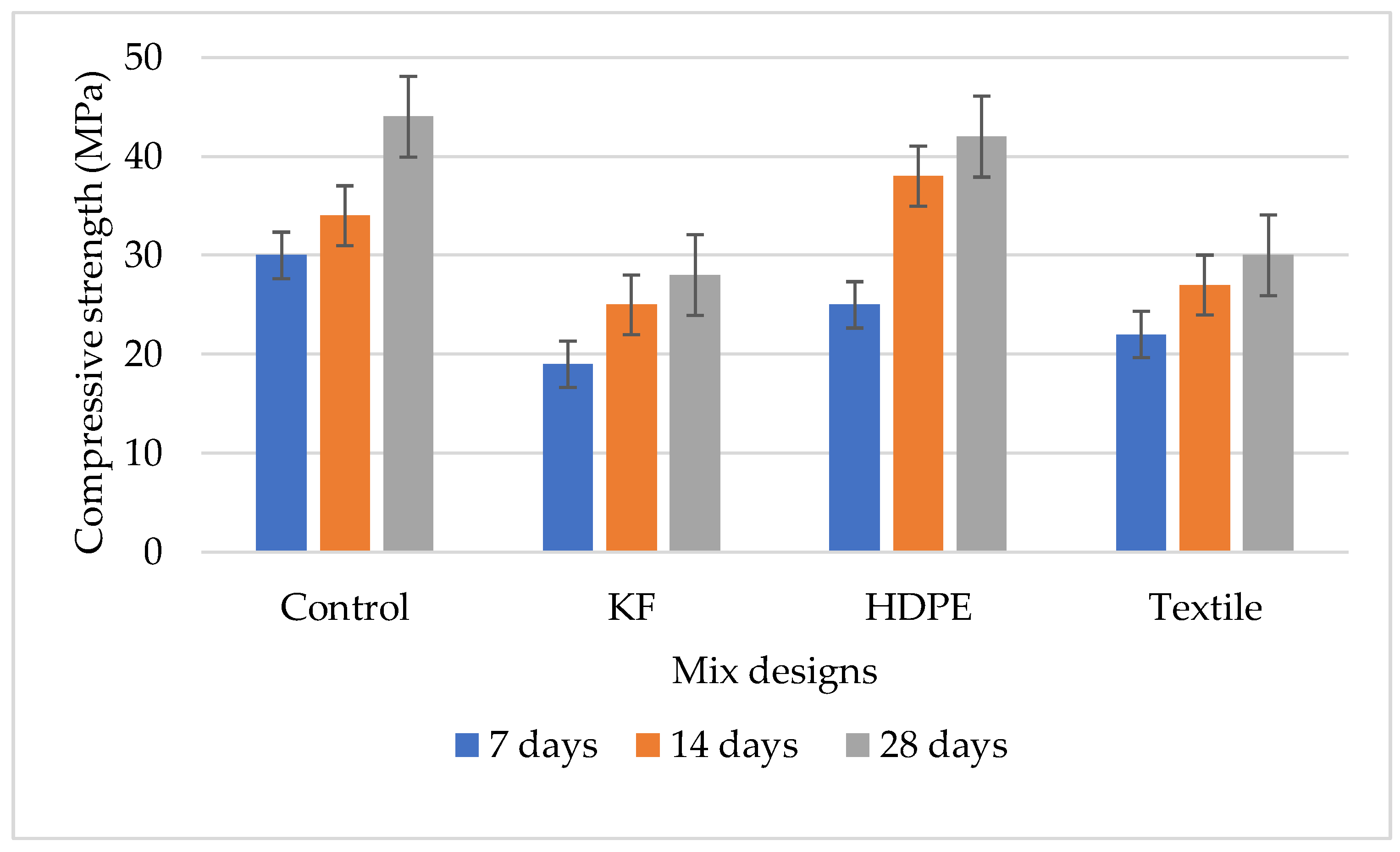
The compressive strength results of all mix design controls at 7, 14, and 28 days are graphically shown in Figure 5. At 7 days, the control mix achieved a compressive strength of 30 MPa, providing the highest early-age performance among the samples. HDPE-modified concrete reached 25 MPa at 7 days, which was the highest-achieving MSW mix design. Textile-modified concrete recorded 22 MPa, while KF concrete exhibited the lowest early strength at 19 MPa. The reduced early-age strength in waste-based mixes is attributed to partial cement replacement and the presence of the fiber types, which can disrupt early hydration continuity and reduce effective load transfer during the initial curing period. In contrast, HDPE maintained a relatively higher early strength, suggesting limited interference with early cement hydration despite polymer inclusion. By 14 days, all mixes demonstrated significant strength gains, indicating ongoing hydration and matrix densification. The control mix increased to 34 MPa, while HDPE exhibited the highest strength at this age (38 MPa), exceeding the control. Textile-modified concrete reached 27 MPa, and KF increased to 25 MPa. The accelerated strength gain observed in HDPE-modified concrete between 7 and 14 days suggests improved particle packing and reduced microcracking effects during intermediate curing, whereas fiber-based wastes continued to exhibit slower strength development due to weaker interfacial bonding and increased porosity at the fiber–matrix interface.
At 28 days, the control mix achieved its maximum strength of 44 MPa. This was a 10% increase compared to the mix design target of 40 MPa. HDPE-modified concrete reached 42 MPa, closely approaching the control, indicating long-term strength penalties associated with polymer incorporation were minimal. Textile and KF waste concrete attained 30 MPa and 28 MPa, respectively. This reflected the cumulative effect of cement reduction and fiber matrix incompatibility on long-term mechanical performance. The reduced compressive strength observed in the textile and KF mix designs can be attributed to changes in the microstructural characteristics within the cementitious matrix. Partial cement replacement inherently reduces the availability of hydration products, leading to a lower volume of calcium silicate hydrate (C-S-H) and a less dense paste structure [64]. In fiber-reinforced mixes, the fiber matrix interfacial transition zone (ITZ) represents a critical weakness, as the chemical affinity between fibers and the cement matrix can result in poor stress transfer under compression [65]. In comparison, HDPE exhibited long-term strength relative to the control. The reduced volume of textile and KF fibers can create a non-uniform fiber dispersion. This has created fiber agglomerations and micro voids, which have increased the porosity and promoted crack initiation. The relatively inert and smooth surface of HDPE limits chemical interaction with the matrix but also avoids significant disruption of hydration continuity, resulting in less pronounced long-term strength loss.
Across all curing ages, strength gain trends differed by waste type. HDPE demonstrated the most favorable mechanical behavior, with rapid intermediate-age strength development and near-control performance at 28 days. Textile waste showed moderate and consistent strength gains, indicating acceptable long-term performance despite reduced early strength. KF exhibited the slowest strength development and lowest ultimate strength. The results indicate that MSW incorporation influences the rate of strength development, with polymer-based wastes showing better mechanical retention and fiber-based wastes exhibiting greater strength reductions. Moreover, the observed reductions in compressive strength for fiber-based MSW concretes are consistent with previous studies reporting dilution effects and interfacial transition zone (ITZ) weakening. This behavior is attributed to dilution effects associated with partial cement replacement and the formation of a weaker ITZ between the cement matrix and fiber inclusions, which limits stress transfer under compression. Similar strength reductions and age-dependent trends have been reported for waste fiber-reinforced concretes at low cement replacement levels [31,32]. In contrast, HDPE-modified concrete exhibited comparatively higher strength retention, particularly at later ages, suggesting that polymer inclusions do not significantly impede hydration continuity. This trend is consistent with previous studies reporting that discrete plastic particles act primarily as inert inclusions, resulting in moderate strength penalties but preserving long-term strength development [29,43]. The results confirm that fiber-based wastes prioritize environmental performance over compressive strength retention.

3.2. Life Cycle Assessment

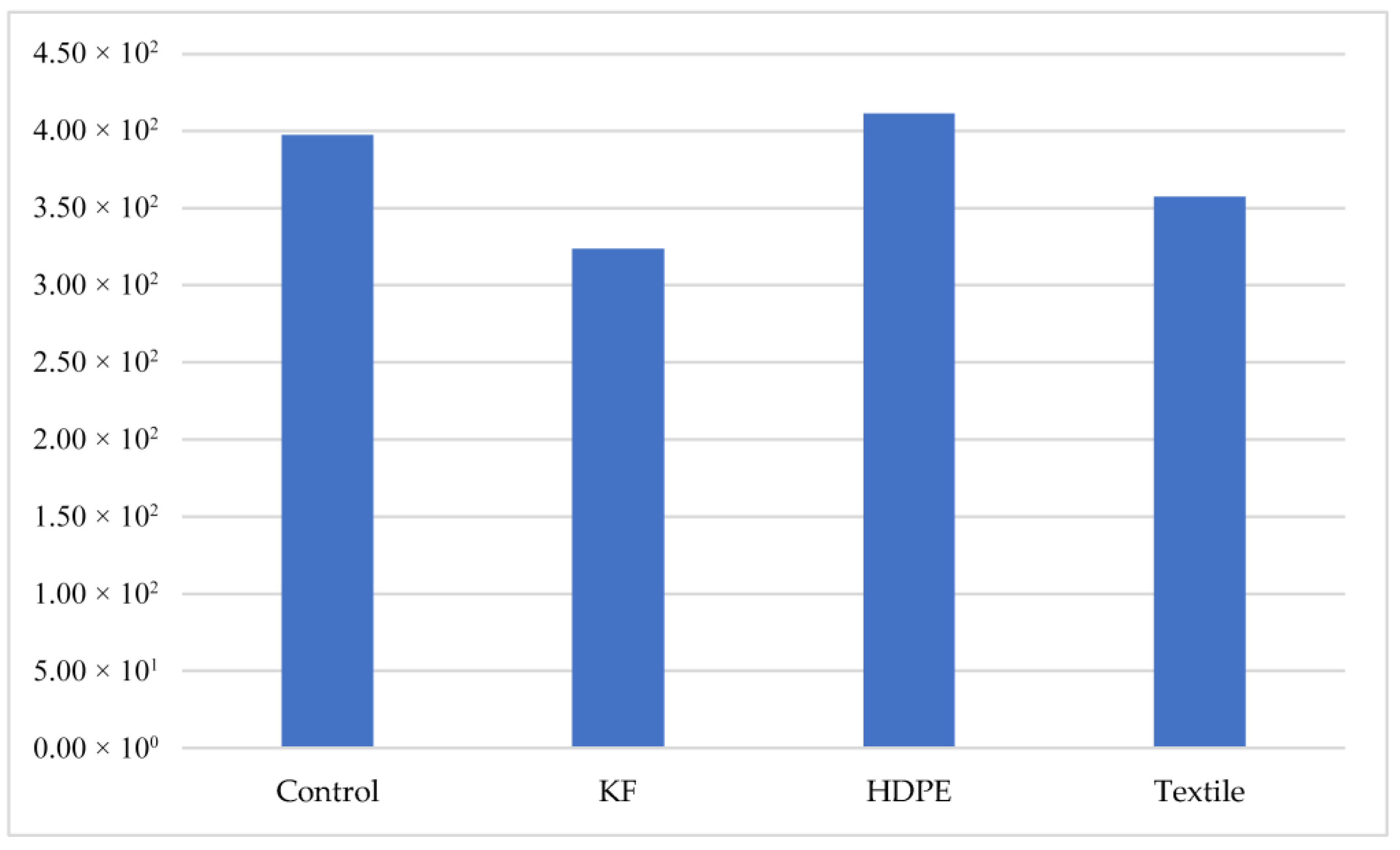
The life cycle assessment results presented in Table 4 and illustrated in Figure 6 demonstrate clear differences in environmental performance between the conventional control concrete and concretes incorporating MSW materials. Across all assessed impact categories, the control mix consistently exhibits the highest environmental burdens, confirming the dominant contribution of Portland cement to cradle-to-gate impacts.
The global warming potential (GWP100) results reveal that MSW incorporation can substantially reduce embodied carbon, although the magnitude of benefit is strongly dependent on the waste stream. The control mix records a cradle-to-gate GWP of 397 kg CO2-eq per m3, while the KF-modified concrete achieves the lowest value at 323 kg CO2-eq, corresponding to an 18.6% reduction relative to the control. Textile waste concrete also demonstrates a notable improvement, reducing GWP to 357 kg CO2-eq, resulting in a 10.1% reduction. In contrast, HDPE-modified concrete records the highest GWP among the MSW mixes (411 kg CO2-eq), marginally exceeding the control. The superior carbon performance of the KF mix reflects the combined effect of cement reduction and the relatively low embodied emissions associated with kraft fiber processing compared to clinker production. Conversely, the elevated GWP of the HDPE mix is attributed to the fossil-derived nature of polymer production and upstream processing burdens, which offset the benefits of cement displacement. Fossil depletion potential (FDP) follows a similar trend, with the control mix exhibiting 44.2 kg oil-eq, KF showing the lowest value (41.1 kg oil-eq), textile waste remaining comparable to the control (43.5 kg oil-eq), and HDPE displaying a pronounced increase (89.6 kg oil-eq). This sharp increase highlights the sensitivity of fossil depletion indicators to polymer-based materials, even when recycled. It is important to note that there is a high energy requirement to process HDPE due to energy-intensive, washing, and reprocessing requirements associated with recycled polymers. KFs and textile materials can be processed with lower labor-intensive machinery, thus requiring lower-voltage equipment. Additionally, the recycling process of HDPE requires sorting to remove contaminated materials, whereas contaminated KF and textile materials can be removed during the processing cycles.
KF demonstrates the most favorable performance of terrestrial acidification potential (TAP), (0.758 kg SO2-eq), representing a 7% reduction relative to the control (0.815 kg SO2-eq). Textile waste yields a marginal improvement (0.814 kg SO2-eq), whereas HDPE results in the highest acidification burden (0.916 kg SO2-eq), exceeding the control. This pattern indicates that cement reduction alone is insufficient to guarantee improvements in acidification when the substitute material carries higher upstream emissions. Marine eutrophication potential (MEP) shows pronounced benefits for fiber-based wastes. The control mix records 0.275 kg N-eq, while KF achieves a substantial reduction to 0.180 kg N-eq (35% reduction). Textile waste also improves performance (0.210 kg N-eq), whereas HDPE remains effectively unchanged relative to the control (0.276 kg N-eq). These reductions are primarily driven by lower cement-related nitrogen oxide and ammonia emissions in the upstream supply chain. Across terrestrial ecotoxicity potential (TEP), all MSW mixes outperform the control (0.0123 kg 1,4-DCB-eq). Textile waste exhibits the lowest impact (0.0111 kg 1,4-DCB-eq), followed by KF (0.0117 kg 1,4-DCB-eq), while HDPE shows a slight increase relative to other MSW options (0.0127 kg 1,4-DCB-eq). Although absolute differences are small, they indicate that fiber-based wastes provide modest but consistent reductions in toxicity-related indicators.
Human carcinogenic toxicity potential (HTP) reveals more complex trade-offs. KF and HDPE concretes achieve lower impacts of 69.6 kg and 65.6 kg 1,4-DCB-eq, respectively, compared with the control of 78.3 kg 1,4-DCB-eq, indicating benefits associated with reduced cement production. However, textile waste concrete exhibits a markedly higher value of 99.7 kg 1,4-DCB-eq, suggesting that upstream textile processing and chemical additives contribute disproportionately to carcinogenic toxicity within the defined system boundary. Ozone layer depletion potential (ODP) follows a consistent downward trend across all MSW mixes. The control mix records 1.26 × 10⁻⁵ kg CFC-11-eq, while KF and HDPE both reduce this to 1.17 × 10⁻⁵ kg CFC-11-eq, and textile waste achieves the lowest value of 1.10 × 10⁻⁵ kg CFC-11-equation Although absolute differences are small, they reinforce the general trend that reductions in cement content translate into lower impacts across multiple environmental indicators.
The results demonstrate that cement reduction remains the primary driver of environmental improvement, but the net benefit of MSW incorporation is highly sensitive to the processing intensity and material origin of the waste stream. KF consistently delivers the most balanced environmental performance, achieving the lowest impacts across most categories due to its biogenic origin, relatively low processing energy, and effective cement displacement. Textile waste offers moderate benefits in several categories but exhibits elevated human toxicity impacts, warranting caution and further supply chain refinement. HDPE performs poorly in fossil depletion and GWP despite being recycled, highlighting that polymer-based wastes may introduce trade-offs that undermine climate and resource benefits. Moreover, MSW incorporation can deliver meaningful environmental gains; however, not all waste streams are equally beneficial, and integration should prioritize wastes that minimize both cement demand and upstream processing burdens.

3.3. Optimization Results

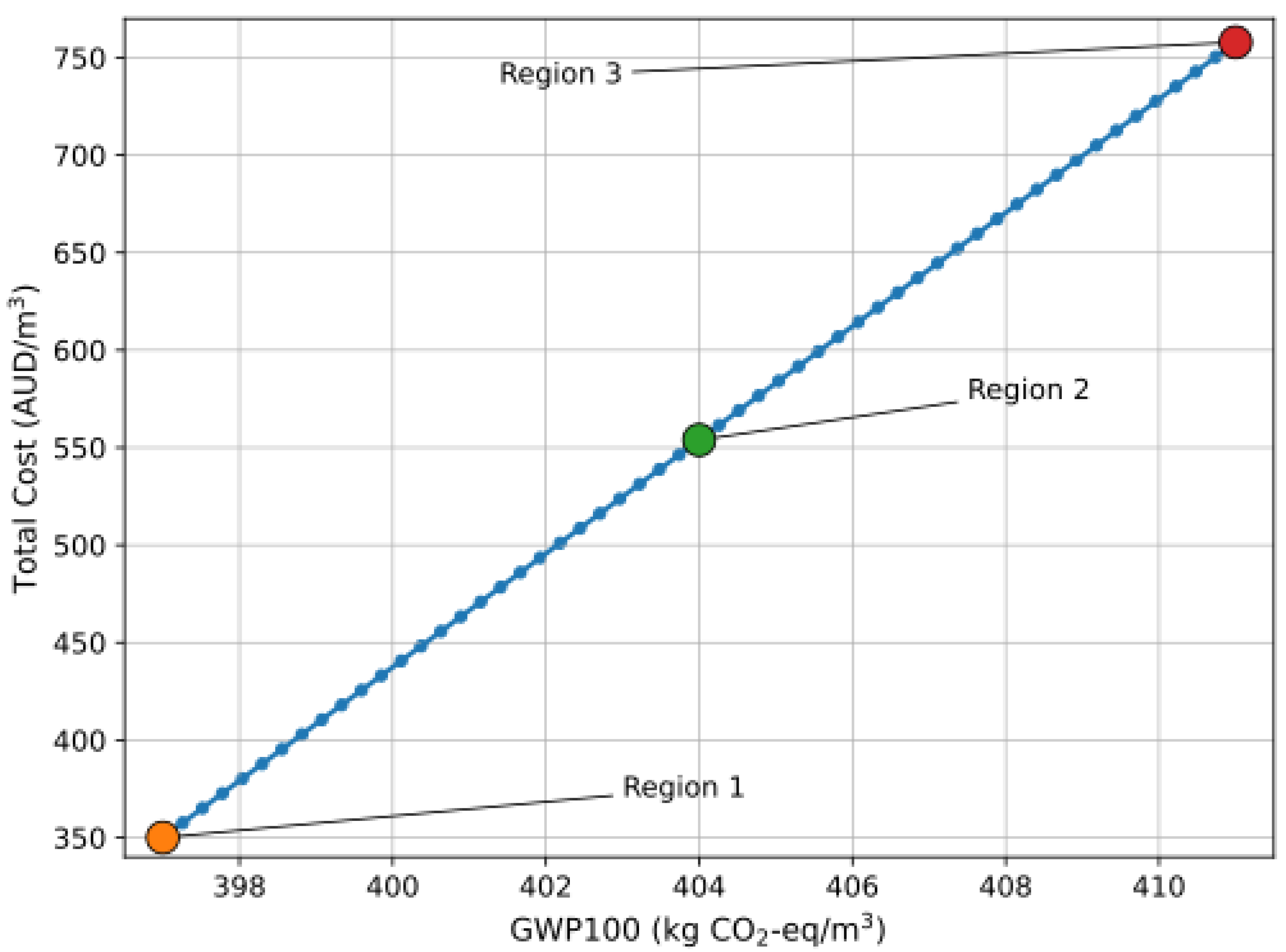
The NSGA-II optimization produced well-defined Pareto frontiers for all three MSWs that span the entire 0–10% replacement domain. The fronts were almost linear, reflecting the underlying monotonic and near-linear dependencies of both cost and GWP on the replacement level. Cost increased with greater MSW content due to higher material cost premiums, while GWP decreased for fiber-based waste materials that had a lower embodied carbon intensity than cement. The strength-feasible domain contained all solutions in this 0–10% range; therefore, the filtered front coincided with the raw Pareto set.

3.3.1. KF MOO Results

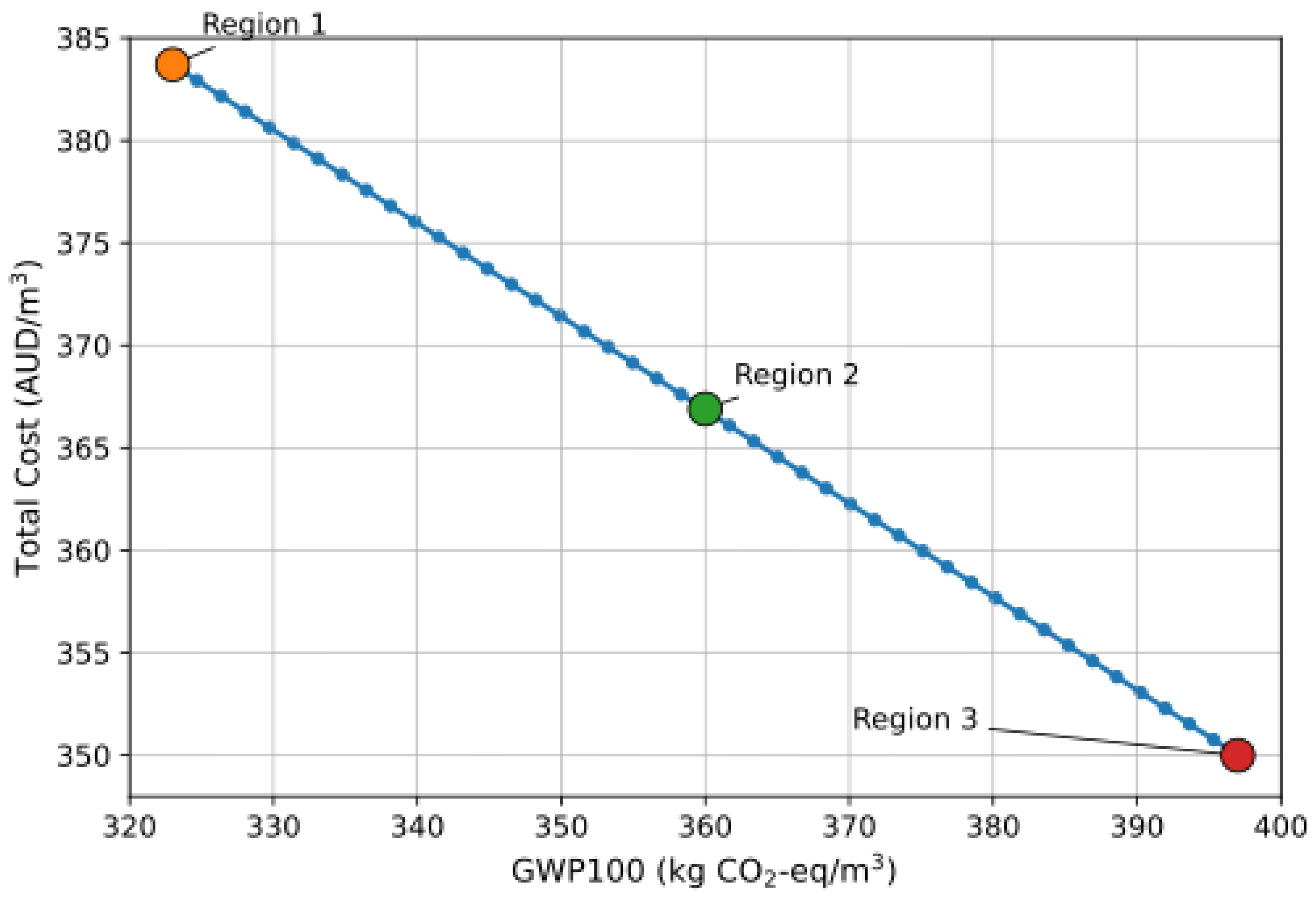
The Pareto frontier for KF-modified concrete is shown in Figure 7. The results reveal a clear and well-defined trade-off between total material cost and cradle-to-gate global warming potential (GWP100) as cement replacement increases from 0 to 10%. All solutions along the frontier are non-dominated, indicating that any reduction in embodied carbon is accompanied by an increase in cost. As summarized in Table 5, the minimum-cost solution (Region 3) corresponds to the control mix with no cement replacement, yielding a cost of 350 AUD/m3 and a GWP of 397 kg CO2-eq/m3. Increasing the cement replacement level to 5%, to Region 2, reduces GWP by approximately 9% to 360 kg CO2-eq/m3. This compromised region has a moderate cost increase to 366.9 AUD/m3. The minimum-GWP solution is shown as Region 1, with a 10% cement replacement with KF. This achieves the largest environmental benefit, lowering GWP to 323 kg CO2-eq/m3, equaling a 19% reduction. However, this yields the highest cost of 383.7 AUD/m3. These results indicate that KF incorporation offers substantial carbon mitigation potential, but with a pronounced cost–carbon trade-off driven by the relatively high unit cost of fiber compared with cement savings. Moreover, KF produces a strong carbon reduction of 74 kg CO2-eq at 10%, but increases the cost due to high fiber unit pricing relative to cement savings. This forms a clear cost–carbon trade-off; hence, the full range is Pareto-efficient.

3.3.2. Textile MOO Results

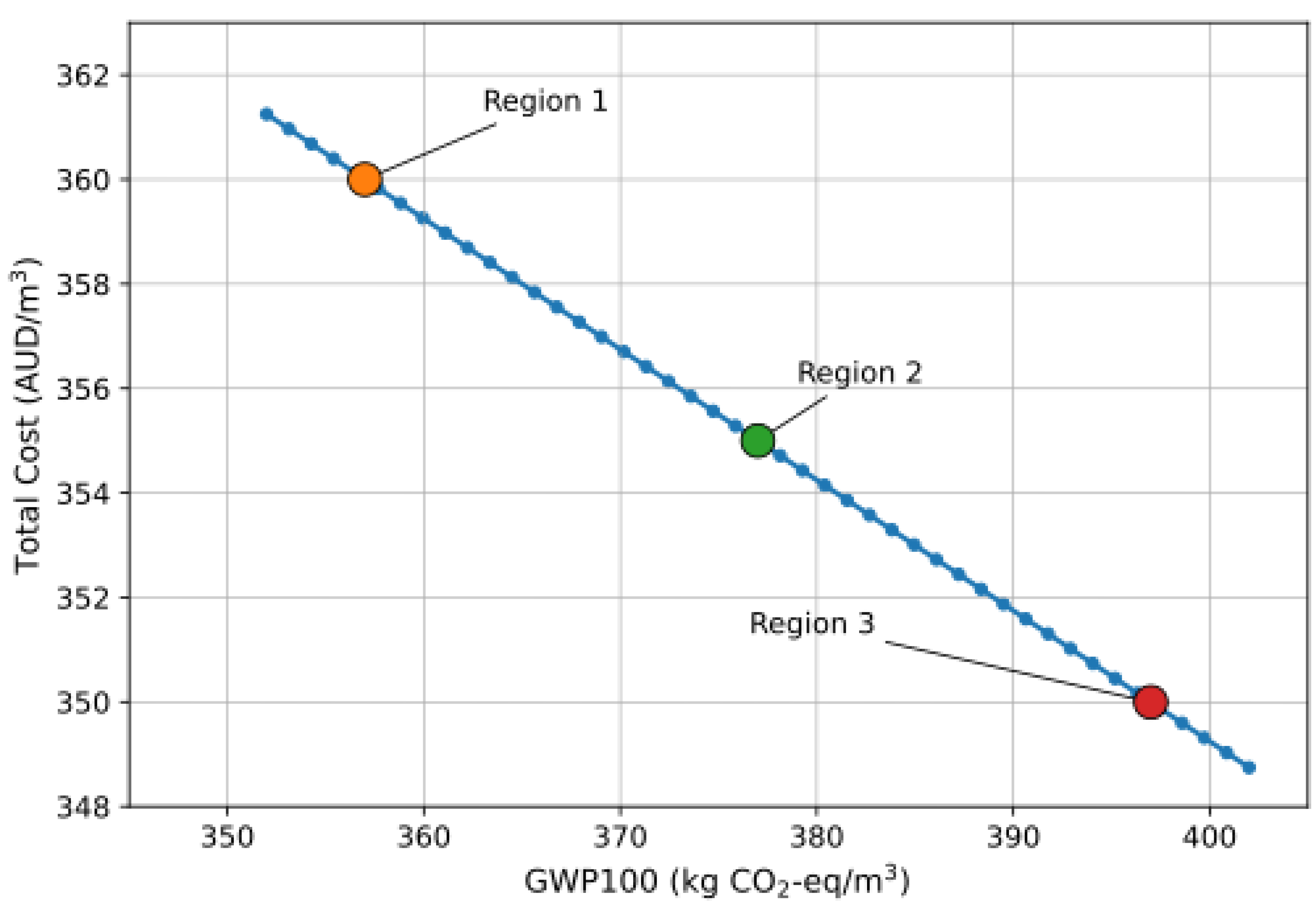
The Pareto frontier for textile waste-modified concrete is graphically illustrated in Figure 8. The results exhibit a similar but less steep trade-off between cost and GWP compared with KF concrete. All solutions along the frontier are non-dominated, indicating that textile waste provides a continuous spectrum of viable design choices across the examined replacement range. As reported in Table 6, the control mix in Region 3 represents the minimum-cost solution. Region 2 demonstrates the compromised solution, reducing 5% cement consumption GWP from 397 to 377 kg CO2-eq/m3. This solution increases the cost marginally to 355.0 AUD/m3. At the maximum replacement level (Region 1, 10%), GWP is further reduced to 357 kg CO2-eq/m3, with a total cost of 360.0 AUD/m3. The relatively shallow slope of the Pareto front demonstrates that textile waste offers comparatively favorable cost–carbon efficiency, enabling meaningful emissions reductions with minimal economic penalty. This positions textile waste as a robust compromise option for practical implementation where both cost sensitivity and environmental performance are critical.

3.3.3. HDPE MOO Results

In contrast to the fiber-based wastes, the optimization results for HDPE-modified concrete show no meaningful Pareto trade-off, as illustrated in Figure 9. All solutions with HDPE replacement are dominated by the control mix, exhibiting both higher cost and higher GWP across the entire replacement range. As shown in Table 7, increasing the replacement level to 5% (Region 2) raises the cost substantially to 553.9 AUD/m3 while also increasing GWP to 404 kg CO2-eq/m3. At 10% replacement (Region 3), the cost escalates further to 757.9 AUD/m3 and GWP increases to 411 kg CO2-eq/m3. Consequently, the only non-dominated solution for HDPE is the control mix (Region 1). These findings indicate that, under the defined system boundary and cost assumptions, HDPE does not constitute an environmentally or economically optimal cement substitute, primarily due to its high material cost and fossil-derived embodied emissions.

4. Summary of Findings

Table 8 summarizes the optimization results for each MSW-modified mix design. The optimization results are strongly aligned with the LCA findings, confirming that cement reduction is the dominant driver of environmental improvement but not the sole determinant of optimal performance. Fiber-based wastes (KF and textile waste) exhibited lower cradle-to-gate global warming potential in the LCA, generating well-defined Pareto frontiers that explicitly quantify cost–carbon trade-offs. In contrast, HDPE-modified concrete, which showed elevated fossil depletion and marginally higher GWP in the LCA, was consistently identified as a dominated option in the optimization. This confirms that material substitution alone does not guarantee environmental benefit and highlights the importance of upstream processing burdens and material origin in shaping sustainability outcomes. Textile waste emerged as the most balanced option across the LCA and optimization analyses, achieving moderate GWP reductions with minimal cost penalties. Kraft fibers delivered the largest carbon reductions but at a higher economic cost, suggesting its suitability in applications where embodied carbon reduction is prioritized over cost minimization. These findings reinforce the value of multi-objective optimization in translating LCA results into actionable design guidance by identifying feasible compromise solutions rather than single “optimal” mixes.
The mechanical results provide critical context for interpreting the optimization outcomes. While all MSW-modified concretes exhibited reduced early-age strength relative to the control, acceptable 28-day compressive strengths were achieved for HDPE, with KF and textile waste mix designs showing the greatest strength reduction. The slower strength development observed in fiber-based mixes is consistent with weakened fiber–matrix interfacial transition zones, and increased porosity due to fiber dispersion challenges. Importantly, the optimization framework treated compressive strength as a feasibility constraint rather than an objective, ensuring that only structurally viable mixtures were considered. This approach reflects practical engineering decision-making, where minimum performance thresholds must be met before environmental or economic benefits can be realized. HDPE-modified concrete highlights a key tension between mechanical performance and environmental outcomes. Although mechanically favorable, HDPE was rejected by the optimization due to its higher cost and fossil-derived environmental burdens, illustrating that mechanical performance alone is insufficient to justify material substitution within a sustainability framework. Moreover, unlike the other waste streams, HDPE-modified concrete did not exhibit a clear knee point along the Pareto front, with the Region 2 and Region 3 solutions showing elevated GWP and no meaningful compromise between environmental and economic objectives. This is shown in Table 8 via the asterisk (*) for the HDPE composite optimization results.
The results emphasize that not all waste streams are equally suitable for high-value reuse in concrete. Fiber-based wastes derived from biogenic or low-processing sources align more closely with circular economy principles by enabling material recirculation while reducing reliance on carbon-intensive clinker. Textile waste represents a promising pathway for closing material loops, offering a favorable balance between environmental benefit, economic feasibility, and structural performance. The findings also highlight the importance of functional substitution rather than simple waste diversion. Incorporating MSW into concrete should aim to displace high-impact materials without introducing disproportionate upstream burdens or compromising structural integrity. The integrated LCA and optimization framework adopted in this study provides a transparent decision support tool for identifying such opportunities and avoiding unintended environmental trade-offs.
While the results offer robust insights, several limitations warrant further investigation. The LCA was restricted to cradle-to-gate system boundaries and did not consider construction, use-phase durability, or end-of-life scenarios, which may further influence the relative performance of MSW-modified concretes. Future work should extend the framework to include durability-related indicators and end-of-life recyclability to better capture long-term circular economy benefits. Additionally, optimization was conducted using a single continuous decision variable. Expanding the design space to include multi-variable optimization, such as combined waste streams, supplementary cementitious materials, or curing regimes, would enable the identification of higher-dimensional Pareto-optimal solutions.

5. Conclusions and Future Directions

This study investigated the feasibility of incorporating municipal solid waste materials into structural concrete through an integrated framework combining mechanical testing, life cycle assessment, and multi-objective optimization. Three high-volume MSW streams, kraft fibers (KF), textile fibers, and recycled HDPE, were evaluated under a maximum 10% cement replacement strategy to quantify trade-offs between compressive strength, environmental performance, and economic feasibility.
Mechanical testing demonstrated that MSW incorporation influences both the rate and magnitude of strength development. While all waste-modified concretes exhibited reduced early-age strength relative to the control, acceptable 28-day compressive strengths were achieved for HDPE concrete. Textile and kraft fiber mixes showed the greatest strength reductions. These trends were attributed to fiber matrix interfacial transition zone weakening and increased porosity associated with fiber dispersion. Importantly, all mixtures satisfied minimum structural feasibility requirements, supporting their inclusion within the optimization framework. The LCA results confirmed that cement reduction is the dominant driver of environmental improvement, particularly for global warming potential. KF-modified concrete achieved the largest carbon reductions of 19%, followed by textile waste (10%), while HDPE increased both GWP and fossil depletion despite being recycled. These findings demonstrate that waste origin and processing intensity critically influence environmental outcomes and that recycled content alone does not guarantee sustainability benefits.
Multi-objective optimization using NSGA-II translated these environmental and mechanical results into actionable decision guidance. Fiber-based wastes generated well-defined Pareto frontiers, enabling explicit identification of minimum-cost, compromise, and minimum-GWP solutions. Textile waste emerged as the most balanced material, offering meaningful carbon reductions with minimal cost penalties, whereas KF provided maximum carbon savings at a higher cost. In contrast, HDPE-modified concrete was consistently identified as a dominated solution, reinforcing the need for integrated environmental and economic assessment. The results highlight that high-value reuse of MSW in concrete requires functional substitution that displaces carbon-intensive materials without introducing disproportionate upstream burdens or compromising performance. The integrated LCA optimization framework developed in this study provides a robust, scalable decision support tool for identifying MSW utilization pathways that are environmentally beneficial, economically viable, and structurally feasible. Practically, the results indicate that fiber-based waste materials can be incorporated at low replacement levels to reduce environmental burdens without compromising strength, while HDPE-modified concretes are less suitable due to their unfavorable trade-off profile. The proposed optimization approach offers a transparent decision support tool for practitioners seeking to balance cost, emissions, and structural feasibility. The key findings of this study are as follows:
  • Fiber-based MSW concretes exhibited consistent reductions in compressive strength relative to the control, but remained mechanically feasible at low replacement levels.
  • HDPE-modified concrete demonstrated improved strength retention while achieving moderate reductions in global warming potential.
  • Pareto-based optimization revealed clear trade-offs between environmental performance and mechanical feasibility, with no distinct knee point observed for HDPE scenarios.
These findings highlight the importance of integrated mechanical–environmental evaluation when assessing the suitability of MSW materials in concrete. Future research should extend this framework to include durability-related indicators, end-of-life scenarios, and multi-variable optimization involving combined waste streams, supplementary cementitious materials, and curing regimes. Such extensions will further strengthen the role of MSW-derived concretes in advancing low-carbon and circular construction systems.


Funding

This research received no external funding.

Institutional Review Board Statement

Not applicable.

Informed Consent Statement

Not applicable.

Data Availability Statement

The raw data supporting the conclusions of this article will be made available by the authors on request.

Conflicts of Interest

The author declares no conflict of interest.

References

  1. Shen, D.; Su, L.; Ding, H.; Long, Y.; Hui, C. Study on the growth and decline patterns and environmental drivers of pathogens during the stabilization process of simulated landfilling municipal solid waste. Waste Manag. 2025, 201, 114791. [Google Scholar] [CrossRef]
  2. The World Bank Group. How the World Bank Is Tackling the Growing Global Waste Crisis. Available online: https://blogs.worldbank.org/en/sustainablecities/how-the-world-bank-is-tackling-the-growing-global-waste-crisis (accessed on 12 November 2025).
  3. The World Bank Group. What a Waste 2.0 A Global Snapshot of Solid Waste Management to 2050. Available online: https://datatopics.worldbank.org/what-a-waste/trends_in_solid_waste_management.html (accessed on 12 November 2025).
  4. Geyer, R.; Jambeck, J.R.; Law, K.L. Production, use, and fate of all plastics ever made. Sci. Adv. 2017, 3, e1700782. [Google Scholar] [CrossRef]
  5. Hahladakis, J.N.; Iacovidou, E. Closing the loop on plastic packaging materials: What is quality and how does it affect their circularity? Sci. Total Environ. 2018, 630, 1394–1400. [Google Scholar] [CrossRef] [PubMed]
  6. Locock, K.; Deane, J.; Kosior, E.; Prabaharan, H.; Skidmore, M.; Hutt, O.E. The Recycled Plastics Market: Global Analysis and Trends; CSIRO: Canberra, Australia, 2017.
  7. Taylor, R.L.C.; Williams, H.; Zhang, S. Plastic waste imports & coastal litter: Evidence from citizen science data. Ecol. Econ. 2026, 241, 108848. [Google Scholar] [CrossRef]
  8. UN Environment Programme. Unsustainable Fashion and Textiles in Focus for International Day of Zero Waste 2025. Available online: https://www.unep.org/news-and-stories/press-release/unsustainable-fashion-and-textiles-focus-international-day-zero (accessed on 12 November 2025).
  9. Landfill Alternatives. Cardboard Waste: Facts and Statistics. Available online: https://landfillalternatives.co.uk/news/cardboard-waste-facts-and-statistics (accessed on 15 November 2025).
  10. Australia Government, Department of Climate Change, Energy, the Environment and Water. Resource Recovery and Waste Materials Analysis. Available online: https://www.dcceew.gov.au/environment/protection/waste/publications/national-waste-resource-recovery-reporting/resource-recovery-waste-material-analysis-2024 (accessed on 15 November 2025).
  11. Malinauskaite, J.; Jouhara, H.; Czajczyńska, D.; Stanchev, P.; Katsou, E.; Rostkowski, P.; Thorne, R.J.; Colón, J.; Ponsá, S.; Al-Mansour, F.; et al. Municipal solid waste management and waste-to-energy in the context of a circular economy and energy recycling in Europe. Energy 2017, 141, 2013–2044. [Google Scholar] [CrossRef]
  12. Ionescu, G.; Rada, E.C.; Cioca, L.I. Municipal solid waste sorting and treatment schemes for the maximization of material and energy recovery in a latest EU member. Environ. Eng. Manag. 2015, 14, 2537–2544. [Google Scholar] [CrossRef]
  13. Lee, P.; Sims, E.; Bertham, O.; Symington, H.; Bell, N.; Pfaltzgraff, L.; Sjögren, P.; Wilts, H.; O’Brien, M. Towards a Circular Economy—Waste Management in the EU; European Union: Brussels, Belgium, 2017. [Google Scholar]
  14. Haigh, R. A Review and Thermal Conductivity Experimental Program of Mattress Waste Material as Insulation in Building and Construction Systems. Constr. Mater. 2024, 4, 401–424. [Google Scholar] [CrossRef]
  15. Li, Z.; Dong, H.; Zhao, X.; Wang, K.; Gao, X. Utilisation of Bayer red mud for high-performance geopolymer: Competitive roles of different activators. Case Stud. Constr. Mater. 2025, 23, e05047. [Google Scholar] [CrossRef]
  16. Li, Z.; Dong, H.; Wang, Y.; Men, J.; Wang, J.; Zhao, X.; Zou, S. Valorization of Alkali–Thermal Activated Red Mud for High-Performance Geopolymer: Performance Evaluation and Environmental Effects. Buildings 2025, 15, 2471. [Google Scholar] [CrossRef]
  17. Hernandez Aros, L.; Buitrago Mejia, A.; Binns Hernández, H.A.; Gutierrez Portela, F. Sustainability reporting in the construction sector: Trends, models, metrics and challenges towards achieving the SDGs. Res. Glob. 2025, 11, 100300. [Google Scholar] [CrossRef]
  18. Unsal, Z.; Ekinci, M.O.; Ilcan, H.; Sahin, O.; Selcuk, S.; Sahmaran, M. Life cycle assessment of geopolymer materials utilizing construction and demolition waste. Environ. Res. 2025, 285, 122359. [Google Scholar] [CrossRef]
  19. Martin, H.; Chebrolu, D.; Chadee, A.; Brooks, T. Too good to waste: Examining circular economy opportunities, barriers, and indicators for sustainable construction and demolition waste management. Sustain. Prod. Consum. 2024, 48, 460–480. [Google Scholar] [CrossRef]
  20. Chen, L.; Huang, L.; Hu, Y.; Chen, Z.; Liu, Z.; Hua, J.; Dong, L.; Feng, J.; Leng, W. System dynamic analysis on building construction associated carbon emissions using project-level data: Drivers, mitigation pathway, and policy insights. Environ. Technol. Innov. 2025, 40, 104607. [Google Scholar] [CrossRef]
  21. Griffiths, S.; Sovacool, B.K.; Furszyfer Del Rio, D.D.; Foley, A.M.; Bazilian, M.D.; Kim, J.; Uratani, J.M. Decarbonizing the cement and concrete industry: A systematic review of socio-technical systems, technological innovations, and policy options. Renew. Sustain. Energy Rev. 2023, 180, 113291. [Google Scholar] [CrossRef]
  22. Haigh, R. A Decade Review of Research Trends Using Waste Materials in the Building and Construction Industry: A Pathway towards a Circular Economy. Waste 2023, 1, 935–959. [Google Scholar] [CrossRef]
  23. Haigh, R.; Sandanayake, M.; Bouras, Y.; Vrcelj, Z. A life cycle assessment of cardboard waste in low stress grade concrete applications. Environ. Manag. 2024, 354, 120428. [Google Scholar] [CrossRef]
  24. Sasi, S.; Joseph, P.; Haigh, R.; Sandanayake, M.; Vrcelj, Z.; Yaghoubi, E. A Review on the Effects of Waste Textile Polymer Fiber on Concrete Strength: Exploring the Key Parameters. Buildings 2024, 14, 1486. [Google Scholar] [CrossRef]
  25. Haigh, R.; Sandanayake, M.; Joseph, P.; Yaghoubi, E.; Vrcelj, Z. The mechanical and microstructural performance of waste textile and cardboard materials in concrete. Struct. Concr. 2024, 25, 4033–4047. [Google Scholar] [CrossRef]
  26. Sinkhonde, D.; Bezabih, T. On the computational evaluation of carbon dioxide emissions of concrete mixes incorporating waste materials: A strength-based approach. Clean. Waste Syst. 2024, 8, 100149. [Google Scholar] [CrossRef]
  27. Rao, J.; Hagare, D.; Tao, Z. Upcycling mixed plastic waste as a replacement for natural aggregates in concrete: A critical review. J. Build. Eng. 2025, 114, 114037. [Google Scholar] [CrossRef]
  28. Musa, A.E.S.; Ahmed, A.; Ahmad, S.; Mohamed, K.; Al-Fakih, A.; Al-Osta, M.A. Properties of concrete incorporating plastic wastes and its applications: A comprehensive review. J. Build. Eng. 2025, 101, 111843. [Google Scholar] [CrossRef]
  29. Magbool, H.M. Sustainability of utilizing recycled plastic fiber in green concrete: A systematic review. Case Stud. Constr. Mater. 2025, 22, e04432. [Google Scholar] [CrossRef]
  30. Feng, D.; Lin, Z.; Gu, Y.; Liang, S. Resource utilization of construction waste in soft ground treatment by microbial-induced carbonate precipitation technology. Sustain. Mater. Technol. 2026, 47, e01788. [Google Scholar] [CrossRef]
  31. Mahdi, S.; Venkatesan, S.; Gravina, R.J. Flexural behaviour and post-cracking performance of polypropylene fibre-reinforced waste cardboard blended concrete. Case Stud. Constr. Mater. 2024, 21, e03806. [Google Scholar] [CrossRef]
  32. Haigh, R.; Joseph, P.; Sandanayake, M.; Bouras, Y.; Vrcelj, Z. Thermal Characterizations of Waste Cardboard Kraft Fibres in the Context of Their Use as a Partial Cement Substitute within Concrete Composites. Materials 2022, 15, 8964. [Google Scholar] [CrossRef]
  33. Haigh, R.; Sandanayake, M.; Yaghoubi, E.; Joseph, P.; Vrcelj, Z. The mechanical and microstructural investigations of concrete incorporating waste textile and cardboard fibers following thermal and freeze–thaw cycles. Struct. Concr. 2025, 26, 2757–2772. [Google Scholar] [CrossRef]
  34. Ali, W.; Shahzada, K.; Shah, R.; Jamshaid, H.; Noor, U.A. Seismic capacity assessment of lightweight precast concrete infill wall panels with textile waste core in reinforced concrete frame structures. Structures 2025, 79, 109669. [Google Scholar] [CrossRef]
  35. Kufner, F.; Steinhauer, J.; Rucker-Gramm, P.; Horstmann, M. Holistic sustainability assessment of textile-reinforced concrete compared to structural concrete using the example of a roof construction. Clean. Environ. Syst. 2025, 19, 100331. [Google Scholar] [CrossRef]
  36. Binte Shahid, N.; Mutsuddy, R.; Islam, S.R. Synergistic impact of supplementary cementitious materials (silica fume and fly ash) and nylon fiber on properties of recycled brick aggregate concrete. Case Stud. Constr. Mater. 2025, 22, e04484. [Google Scholar] [CrossRef]
  37. Lal, M.; Chidambaram, R.S. Flexural strengthening of RC beams with glass fiber textile reinforced concrete and hybrid anchorage technique. Constr. Build. Mater. 2025, 505, 144615. [Google Scholar] [CrossRef]
  38. Zhang, X.; Wang, X.; Liang, X.; Zhang, Y.; Wu, Z. Study on the factors influencing bending spalling failure in BFRP textile-reinforced concrete. J. Build. Eng. 2025, 99, 111468. [Google Scholar] [CrossRef]
  39. Jayalath, A.; Sofi, M.; Ginigaddara, T.; Gou, H.; Mendis, P.; Aye, L. Mechanical properties and life cycle greenhouse gas analysis of textile waste fibre-based concrete. Constr. Build. Mater. 2024, 428, 136267. [Google Scholar] [CrossRef]
  40. Sandanayake, M.; Kraus, R.; Haigh, R.; Yaghoubi, E.; Vrcelj, Z. Tex-Crete—Carbon and Cost Assessment of Concrete with Textile and Carboard Fibres—Case Studies Towards Circular Economy. Appl. Sci. 2025, 15, 6962. [Google Scholar] [CrossRef]
  41. Haigh, R. The mechanical behaviour of waste plastic milk bottle fibres with surface modification using silica fume to supplement 10% cement in concrete materials. Constr. Build. Mater. 2024, 416, 135215. [Google Scholar] [CrossRef]
  42. Haigh, R.; Bouras, Y.; Sandanayake, M.; Vrcelj, Z. The mechanical performance of recycled cardboard kraft fibres within cement and concrete composites. Constr. Build. Mater. 2022, 317, 125920. [Google Scholar] [CrossRef]
  43. Almeshal, I.; Tayeh, B.A.; Alyousef, R.; Alabduljabbar, H.; Mohamed, A.M. Eco-friendly concrete containing recycled plastic as partial replacement for sand. J. Mater. Res. Technol. 2020, 9, 4631–4643. [Google Scholar] [CrossRef]
  44. Aziminezhad, M.; Bediwy, A.; Mohamedelhassan, E. Durability performance of low-carbon concrete incorporating optimized ratio of multiple waste materials (glass powder, biomass fly ash, and shredded rubber). Results Eng. 2025, 27, 106392. [Google Scholar] [CrossRef]
  45. Turk, O.; Yehia, S.; Abdelfatah, A.; Elchalakani, M. Sustainable concrete production: The potential of utilizing recycled waste materials. J. Build. Eng. 2024, 98, 111467. [Google Scholar] [CrossRef]
  46. AS/NZS-1012.2; Methods of Testing Concrete. Preparing Concrete Mixes in the Laboratory. Standards Australia: Sydney, Australia, 2014.
  47. AS/NZS-3582.3; Supplementary Cementitious Materials. Part 3: Amorphous Silica. Standards Australia: Sydney, Australia, 2016.
  48. AS/NZS-1141.5; Methods for Sampling and Testing Aggregates—Particle Density and Water Absorption of Fine Aggregate. Standards Australia: Sydney, Australia, 2000.
  49. AS/NZS-1141.6.2; Methods for Sampling and Testing Aggregates—Particle Density and Water Absorption of Coarse Aggregate—Pycnometer Method. Standards Australia: Sydney, Australia, 2016.
  50. AS/NZS-3972; General Purpose and Blended Cements. Standards Australia: Sydney, Australia, 2010.
  51. AS/NZS-1012.8.2; Methods of Testing Concrete. Method for Making and Curing Concrete—Flexure Test Specimens. Standards Australia: Sydney, Australia, 2014.
  52. OpenLCA. The Open Source Life Cycle and Sustainability Assessment Software. Available online: https://www.openlca.org (accessed on 19 September 2025).
  53. Ecoinvent. For the Availability of Envrionmental Data Worldwide. Available online: https://ecoinvent.org (accessed on 19 September 2025).
  54. ISO 14044:2006; Environmental Management—Life Cycle Assessment—Requirements and Guidelines. International Organisation for Standardisation: Geneva, Switzerland, 2006.
  55. Jian, S.-M.; Wu, B.; Hu, N. Environmental impacts of three waste concrete recycling strategies for prefabricated components through comparative life cycle assessment. J. Clean. Prod. 2021, 328, 129463. [Google Scholar] [CrossRef]
  56. Haigh, R. A Life Cycle Assessment of HDPE Plastic Milk Bottle Waste Within Concrete Composites and Their Potential in Residential Building and Construction Applications. Urban Sci. 2025, 9, 116. [Google Scholar] [CrossRef]
  57. Goh, P.G.; Maghfouri, M.; Onn, C.C.; Loo, S.C. Life cycle assessment on recycled e-waste concrete. Case Stud. Constr. Mater. 2022, 17, e01412. [Google Scholar] [CrossRef]
  58. Nikbin, I.M.; Dezhampanah, S.; Charkhtab, S.; Mehdipour, S.; Shahvareh, I.; Ebrahimi, M.; Pournasir, A.; Pourghorban, H. Life cycle assessment and mechanical properties of high strength steel fiber reinforced concrete containing waste PET bottle. Constr. Build. Mater. 2022, 337, 127553. [Google Scholar] [CrossRef]
  59. Zhang, Y.; Luo, W.; Wang, J.; Wang, Y.; Xu, Y.; Xiao, J. A review of life cycle assessment of recycled aggregate concrete. Constr. Build. Mater. 2019, 209, 115–125. [Google Scholar] [CrossRef]
  60. Afshari, H.; Hare, W.; Tesfamariam, S. Constrained multi-objective optimization algorithms: Review and comparison with application in reinforced concrete structures. Appl. Soft Comput. 2019, 83, 105631. [Google Scholar] [CrossRef]
  61. Sandanayake, M.; Gunasekara, C.; Law, D.; Zhang, G.; Setunge, S.; Wanijuru, D. Sustainable criterion selection framework for green building materials—An optimisation based study of fly-ash Geopolymer concrete. Sustain. Mater. Technol. 2020, 25, e00178. [Google Scholar] [CrossRef]
  62. Chen, H.; Deng, T.; Du, T.; Chen, B.; Skibniewski, M.J.; Zhang, L. An RF and LSSVM–NSGA-II method for the multi-objective optimization of high-performance concrete durability. Cem. Concr. Compos. 2022, 129, 104446. [Google Scholar] [CrossRef]
  63. Huang, Y.; Huo, Z.; Ma, G.; Zhang, L.; Wang, F.; Zhang, J. Multi-objective optimization of fly ash-slag based geopolymer considering strength, cost and CO2 emission: A new framework based on tree-based ensemble models and NSGA-II. J. Build. Eng. 2023, 68, 106070. [Google Scholar] [CrossRef]
  64. Han, T.; Aponte, D.; Valls, S.; Bizinotto, M.B. Impact of Recycled Concrete and Ceramic Fillers on the Performance of Cementitious Systems: Microstructural, Mechanical, and Durability Aspects. Recycling 2025, 10, 108. [Google Scholar] [CrossRef]
  65. Yu, Z.; Yang, J.; Xu, J.; Qin, L.; Zhang, X.; Tian, Y.; Gao, F.; Qi, X.; Sun, J.; Bao, J.; et al. Interfacial strength characteristics of steel fibers embedded in ultra-high-performance concrete under salt freeze-thaw environments. Constr. Build. Mater. 2025, 475, 141215. [Google Scholar] [CrossRef]
Figure 1. Overview of the integrated research methodology adopted in this study, combining laboratory-based compressive strength testing, cradle-to-gate life cycle assessment (LCA), and surrogate-based multi-objective optimization to evaluate environmental–mechanical trade-offs in MSW-modified concrete.
Sustainability 18 01119 g001
Figure 2. Waste materials used in study.
Sustainability 18 01119 g002
Figure 3. MSW concrete methodology.
Sustainability 18 01119 g003
Figure 4. Cradle-to-gate system boundary used for the life cycle assessment of control and MSW-modified concrete mixes, including raw material extraction, processing, transport, and concrete production. Use-phase and end-of-life stages were excluded.
Sustainability 18 01119 g004
Figure 5. Compressive strength development of control and MSW-modified concrete mixes at 7, 14, and 28 days. Error bars represent ± one standard deviation based on replicate specimens (n = 3).
Sustainability 18 01119 g005
Figure 6. Cradle-to-gate global warming potential (GWP100) of control and MSW-modified concrete mixes, expressed per cubic meter of concrete (kg CO2-eq/m3).
Sustainability 18 01119 g006
Figure 7. KF MOO trade-offs.
Sustainability 18 01119 g007
Figure 8. Textile MOO trade-offs.
Sustainability 18 01119 g008
Figure 9. HDPE MOO trade-offs.
Sustainability 18 01119 g009
Table 1. Mix proportions of control and MSW-modified concrete mixes, expressed per cubic meter of concrete. Cement replacement was limited to a maximum of 10% by mass.
Mix Designs OPC (kg)Waste (kg) Fine Aggregate (kg)Coarse Aggregate (kg)Water (kg)
Control 424 5871241195
KF3826.65871241195
HDPE382305871241195
Textile3824.165871241195
Table 2. Chemical composition of silica fume and ordinary Portland cement (OPC), expressed as mass percentages (wt.%). Reported values represent manufacturer specifications and/or standard-compliant ranges.
ChemicalMaterial Component %
Silica Fume (wt%)Ordinary Portland Cement (wt%)
SiO2>=75–<10019–23
Al2O3-2.5–6
Fe2O3--
TiO2--
SO4--
P2O5--
CaO-61–67
MgO--
Na2O--
K2O--
Loss on ignition (LOI)--
Amorphous silica (crystalline free)>=0.3–<1-
CaSO4.2H2O -3–8
CaCO3 -0–7.5
Fe2O3-0–6
SO3-1.5–4.5
Values are expressed as mass percentages (wt.%). Ranges represent manufacturer specifications and/or standard-compliant composition limits. Blank entries indicate components not reported or not present in significant quantities.
Table 3. LCA normalization factors [53].
Impact CategoryNormalization Factors
UnitValue
Terrestrial acidification potential KgSO2-eq4.10 × 101
Global warming potential GWP100 in Kg CO2-eq7.99 × 103
Terrestrial ecotoxicity potential Kg 1, 4-DCB-eq1.04 × 103
Marine eutrophication potentialKg-N-eq4.61 × 100
Human carcinogenic toxicity potential Kg 1, 4-DCB-eq2.77 × 100
Stratospheric ozone layer depletion potential Kg CFC-11-eq5.90 × 10−2
Fossil Depletion Kg oil-eq1.20 × 105
Table 4. LCA results.
Impact CategoryUnitControlKFHDPETextile
Terrestrial acidification potential KgSO2-eq8.15 × 10−17.58 × 10−19.16 × 10−18.14 × 10⁻¹
Global warming potentialGWP100 in Kg CO2-eq3.97 × 1023.23 × 1024.11 × 1023.57 × 102
Terrestrial ecotoxicity potentialKg 1, 4-DCB-eq1.23 × 10−21.17 × 10−21.27 × 10−21.11 × 10⁻²
Marine eutrophication potentialKg-N-eq2.75 × 10−11.80 × 10−12.76 × 10−12.10 × 10⁻¹
Human carcinogenic toxicity potentialKg 1, 4-DCB-eq7.83 × 1016.96 × 1016.56 × 1019.97 × 101
Ozone layer depletion potentialKg CFC-11-eq1.26 × 10−51.17 × 10−51.17 × 10−51.10 × 10⁻⁵
Fossil depletionkg oil-Eq4.42 × 1014.11 × 1018.96 × 1014.35 × 101
Table 5. KF cement replacement at various intervals.
Waste r (%)Cost (AUD/m3)GWP (kg CO2-eq/m3)
0350.000397.0
2356.744382.2
5366.860360.0
8376.976337.8
10383.720323.0
Table 6. Textile cement replacement at various intervals.
Waste r (%)Cost (AUD/m3)GWP (kg CO2-eq/m3)
0350.000397.0
2352.008389.0
5355.020377.0
8358.032365.0
10360.040357.0
Table 7. HDPE cement replacement at various intervals.
Waste r (%)Cost (AUD/m3)GWP (kg CO2-eq/m3)
0350.000397.0
2431.576399.8
5553.940404.0
8676.304408.2
10757.880411.0
Table 8. Summarized optimization results.
MaterialRegionReplacement (%)Cost (AUD/m3)GWP100 (kg CO2-eq/m3)
KFRegion 1 (min cost)0350.00397.0
KFRegion 2 (compromise)5366.86360.0
KFRegion 3 (min GWP)10383.72323.0
TextileRegion 1 (min cost)0350.00397.0
TextileRegion 2 (compromise)5355.02377.0
TextileRegion 3 (min GWP)10360.04357.0
HDPERegion 1 (min cost)0350.00397.0
HDPERegion 2 *5553.94404.0
HDPERegion 3 *10757.88411.0
* Indicates that no distinct knee point was identified on the Pareto front for this scenario.
Disclaimer/Publisher’s Note: The statements, opinions and data contained in all publications are solely those of the individual author(s) and contributor(s) and not of MDPI and/or the editor(s). MDPI and/or the editor(s) disclaim responsibility for any injury to people or property resulting from any ideas, methods, instructions or products referred to in the content.