ESG-Driven Traceability Adoption: An Impact Thinking Multi-Dimensional Framework for the Fashion and Textile Industry


Abstract
1. Introduction
2. Conceptual Background
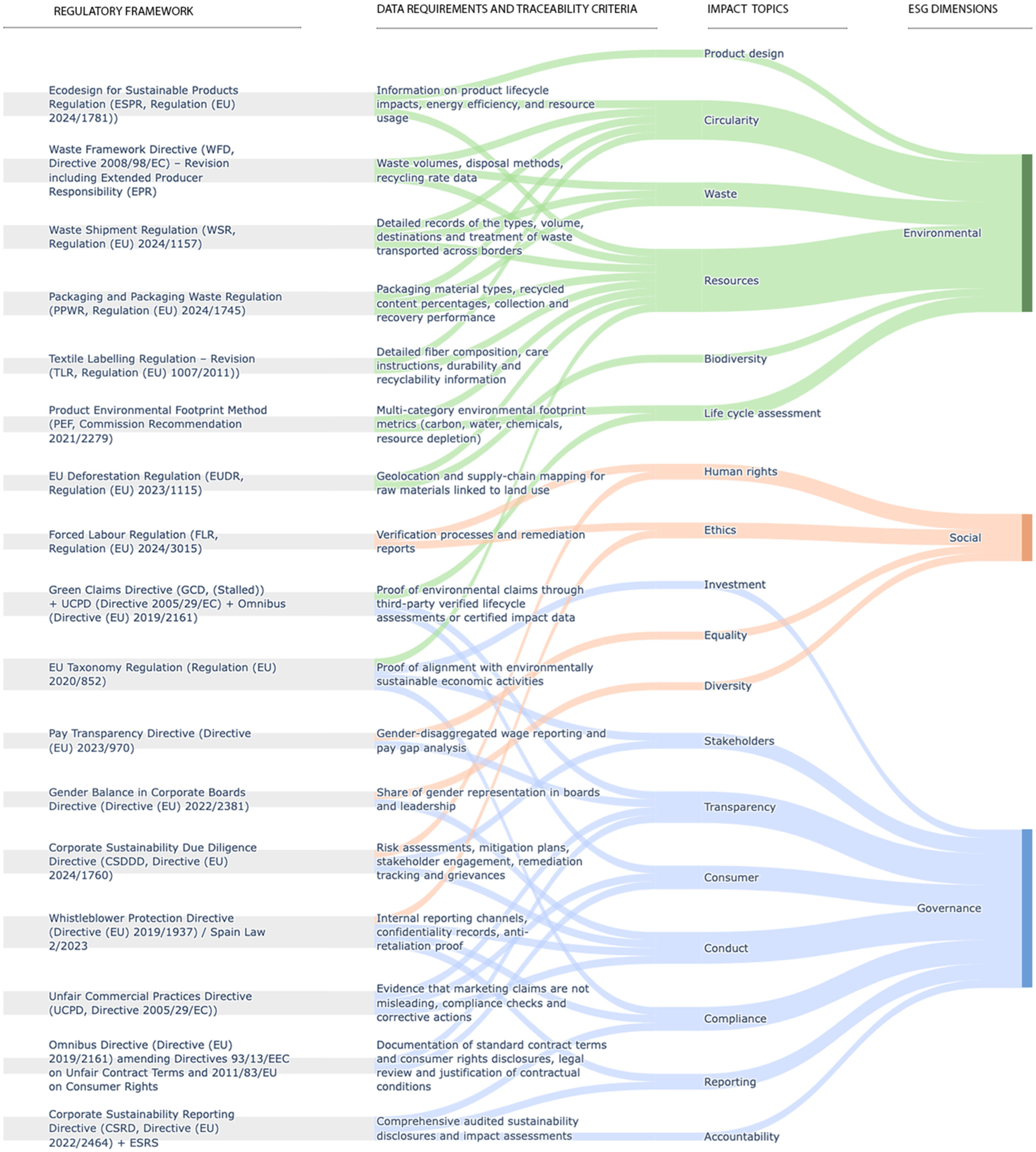
Regulatory Complexity and Its Implications for ESG and Traceability
3. Materials and Methods
3.1. Literature Review
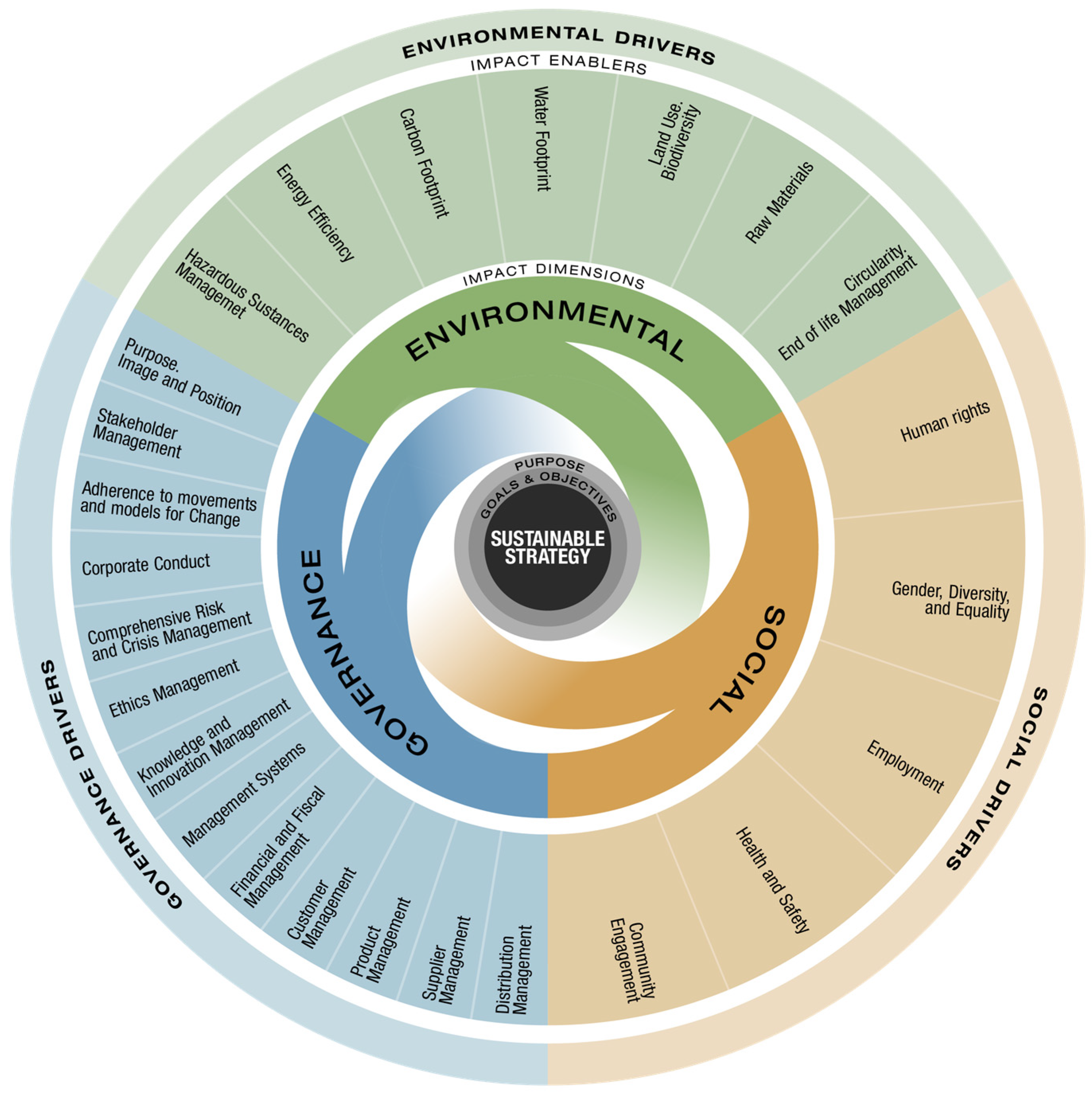
3.1.1. Exploring Impact Dimensions and Drivers for Introducing Traceability Influencing Sustainable Strategy Schemes (SSC) Assessment from the Literature
Environmental
Social
Governance
3.2. Online Survey
3.2.1. Delphi Subjects (Experts) Selection and Sample Definition
3.2.2. Structured Questionnaire Based on Phase 1 (Literature Review)
3.2.3. Delphi Survey Round 1
3.2.4. Evaluation and Analysis of Results from Rounds 1 and 2
3.2.5. Validation of the Survey
3.2.6. Results of Round 1
3.2.7. Results of Round 2
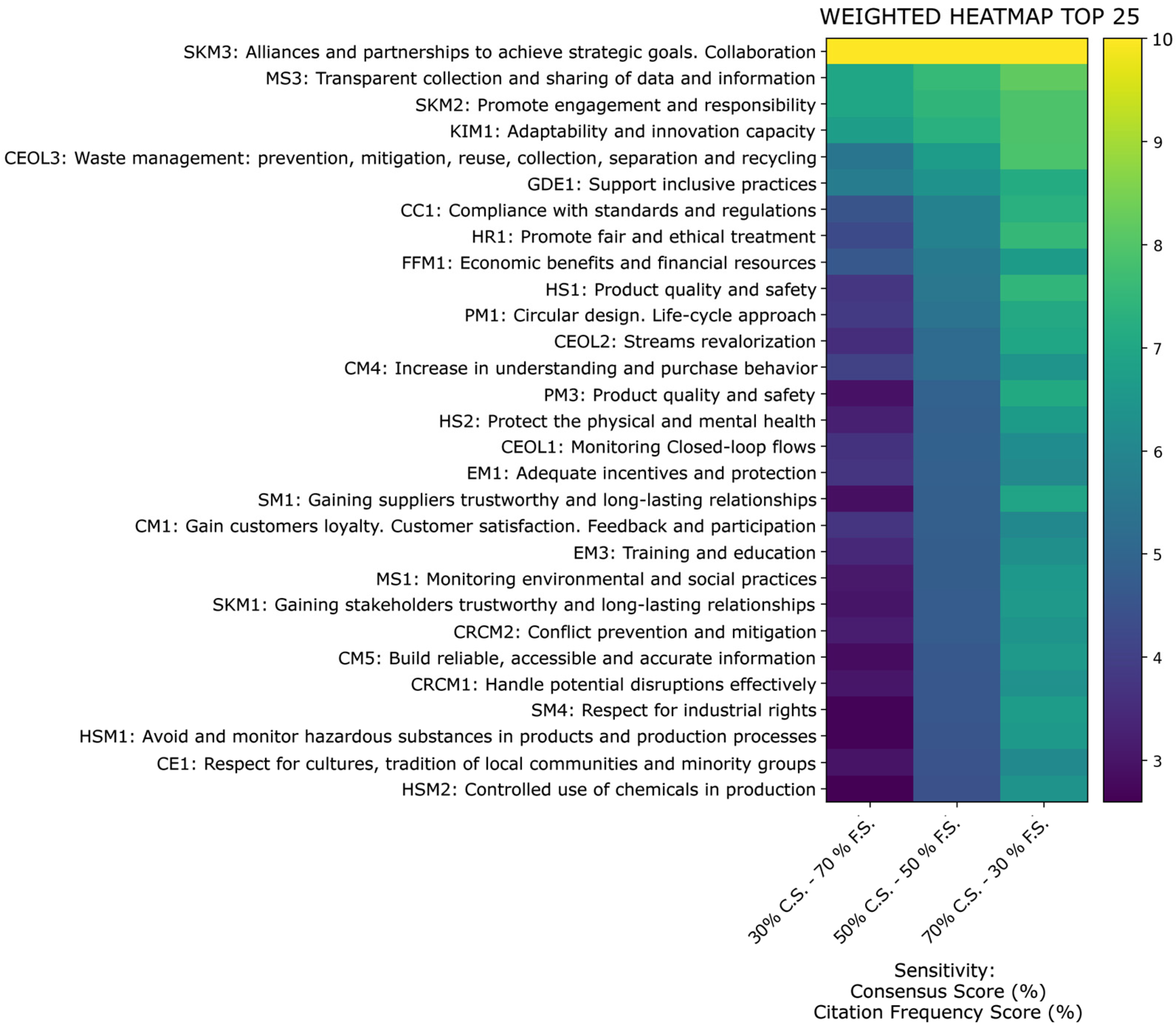
3.3. Scoring Process
4. Results
5. Discussion and Implications of Findings
6. Conclusions
Author Contributions
Funding
Institutional Review Board Statement
Informed Consent Statement
Data Availability Statement
Conflicts of Interest
Abbreviations
| CS | Consensus Score |
| CSDDD | Corporate Sustainability Due Diligence |
| CSV | Creating Shared Value |
| EFRAG | European Financial Reporting Advisory Group |
| EoL | End of Life |
| ESG | Environmental, Social, and Governance |
| ESRS | European Sustainability Reporting Standards |
| EU | European Union |
| FS | Final Score |
| FrS | Frequency Score |
| GCD | Green Claims Directive |
| GRI | Global Reporting Initiative |
| IFRS | International Financial Reporting Standards |
| IQR | Interquartile Range |
| ISO | International Organization for Standardization |
| ISSB | International Sustainability Standards Board |
| ITA | Impact Thinking Approach |
| KPIs | Key Performance Indicators |
| NGOs | Non-Governmental Organizations |
| OS | Overall Score |
| RQs | Research Questions |
| SSC | Sustainable Strategy Schemes |
| TBL | Triple Bottom Line |
| TFP | Total Factor Productivity |
Appendix A

| Sample (n = 21) | Country | Highest Degree | Stakeholder Group | Job Position | Current Area of Study/Expertise | Years of Expertise |
|---|---|---|---|---|---|---|
| 1 | Spain | Bachelor’s degree | Auditing Companies | Executive | Circular Economy | 5–10 |
| 2 | Spain | Master’s degree | NGOs | Management | Supply Chain Management Circular Economy | 5–10 |
| 3 | Denmark | Doctorate | Academia | Project Manager | Industrial ecology | 5–10 |
| 4 | Germany | Bachelor’s degree | NGOs | Executive | Fashion Design Sustainable Fashion Circular Economy End Of Life (EOL) | 10–20 |
| 5 | Spain | Bachelor’s degree | Brands/ Retailers | Management | Sustainable Fashion Supply Chain Management Traceability | More than 20 |
| 6 | Spain | Professional degree | Manufacturer | Senior Team Member | Sustainable Fashion Supply Chain Management Traceability Compliance | More than 20 |
| 7 | Spain | Master’s degree | Auditing Companies | Management | Supply Chain Management Compliance | 10–20 |
| 8 | Pakistan | Bachelor’s degree | Manufacturer | Management | Textile Science and Technology | 10–20 |
| 9 | Australia | Bachelor’s degree | Brands/ Retailers | Project Manager | Supply Chain Management Traceability Apparel Production and Manufacturing Compliance Sustainable Fashion | 10–20 |
| 10 | Republic of Ireland | Bachelor’s degree | Brands/ Retailers | Executive | Sustainable Fashion Circular Economy | More than 20 |
| 11 | Sweden | Master’s degree | Society | Junior Team Member | Sustainable Fashion | Less than 5 |
| 12 | Spain | Master’s degree | Suppliers | Executive | Sustainable Fashion Fashion Innovation Supply Chain Management | 5–10 |
| 13 | Hong Kong | Master’s degree | Manufacturer | Management | Fashion Design | More than 20 |
| 14 | France | Master’s degree | Society | Project Manager | Textile Engineering Circular Economy Sustainable Fashion | Less than 5 |
| 15 | Chile | Professional degree | Sector Associations | Consultant | Textile Engineering | More than 20 |
| 16 | Spain | Master’s degree | Brands/ Retailers | Project Manager | Apparel Production and Manufacturing Sustainable Fashion Circular Economy Supply Chain Management Traceability Compliance ESG Product Lifecycle End Of Life (EOL) | 5–10 |
| 17 | Spain | Professional degree | Auditing Companies | Executive | Fashion Innovation Sustainable Fashion Circular Economy Supply Chain Management Traceability | More than 20 |
| 18 | Belgium | Master’s degree | Brands/Retailers | Executive | Circular Economy Sustainable Fashion Apparel Production and Manufacturing Traceability Supply Chain Management End Of Life (EOL) ESG Product Lifecycle Compliance | 5–10 |
| 19 | Bangladesh | Master’s degree | Sector Associations | Senior Team Member | ESG Compliance Circular Economy | 5–10 |
| 20 | Sweden | Doctorate | Academia | Senior Team Member | Textile Science and Technology | 10–20 |
| 21 | Belgium | Doctorate | Suppliers | Executive | Environmental Science ESG Sustainable Fashion | 10–20 |
| ESG Dimension | Impact Driver | Frequency (n = 69) | Frequency Score (FrS) | IQR R1 | M R1 | IQR R2 | M R2 | Consensus Score (CS) | Weighted Overall (WO) | Final Score (FS) * |
|---|---|---|---|---|---|---|---|---|---|---|
| E1. Hazardous Substances Management (HSM) | HSM1: Avoid and monitor hazardous substances in products and production processes | 6 | 0.007712082 | 0.48 | 4.66 | - | - | 0.82016 | 0.413936041 | 4.55 |
| HSM2: Controlled use of chemicals in production | 58 | 0.074550129 | 0.78 | 4.55 | - | - | 0.73255 | 0.403550064 | 4.43 | |
| E2. Energy Efficiency (EE) | EE1: Reduce and monitor energy footprint | 29 | 0.037275064 | 0.50 | 4.38 | - | - | 0.7665 | 0.401887532 | 4.42 |
| EE2: Energy-efficient production systems | 37 | 0.047557841 | 0.68 | 4.33 | - | - | 0.71878 | 0.38316892 | 4.21 | |
| EE3: Use renewable energy | 20 | 0.025706941 | 0.66 | 4.23 | - | - | 0.70641 | 0.36605847 | 4.02 | |
| E3. Carbon Footprint (CF) | CF1: Reduce and monitor carbon footprint | 12 | 0.015424165 | 0.62 | 4.50 | - | - | 0.7605 | 0.387962082 | 4.26 |
| CF2: Prevent greenhouse gas emissions. Decarbonization | 14 | 0.017994859 | 0.51 | 4.44 | - | - | 0.77478 | 0.396387429 | 4.36 | |
| E4. Water Footprint (WF) | WF1: Reduce and monitor water footprint | 9 | 0.011568123 | 0.51 | 4.55 | - | - | 0.793975 | 0.402771562 | 4.43 |
| WF2: Water-efficient production systems. Reuse of water | 16 | 0.020565553 | 0.71 | 4.50 | - | - | 0.74025 | 0.380407776 | 4.18 | |
| E5. Land Use and Biodiversity (LUB) | LUB1: Reduce and monitor biodiversity impacts of activities | 49 | 0.062982005 | 0.68 | 4.33 | - | - | 0.71878 | 0.390881003 | 4.30 |
| LUB2: Avoid land and soil degradation | 16 | 0.020565553 | 0.61 | 4.44 | - | - | 0.75258 | 0.386572776 | 4.25 | |
| E6. Raw Materials (RM) | RM1: Dematerialization. Material use reduction | 52 | 0.066838046 | 0.85 | 4.38 | - | - | 0.68985 | 0.378344023 | 4.16 |
| RM2: Reduce and monitor material footprint | 31 | 0.039845758 | 0.62 | 4.50 | - | - | 0.7605 | 0.400172879 | 4.40 | |
| RM3: Origin, composition, and processing | 38 | 0.048843188 | 0.61 | 4.44 | - | - | 0.75258 | 0.400711594 | 4.40 | |
| E7. Circularity and End-of-Life Management (CEOL) | CEOL1: Monitoring closed-loop flows | 156 | 0.200514139 | 0.73 | 4.22 | - | - | 0.68997 | 0.445242069 | 4.89 |
| CEOL2: Streams revalorization | 102 | 0.131105398 | 0.83 | 3.88 | 0.49 | 4.65 | 0.816075 | 0.473590199 | 5.20 | |
| CEOL3: Waste management: prevention, mitigation, reuse, collection, separation, and recycling | 303 | 0.389460154 | 0.48 | 4.66 | - | - | 0.82016 | 0.604810077 | 6.65 | |
| CEOL4: Safe disposal. Type and method | 4 | 0.005141388 | 0.70 | 4.44 | - | - | 0.7326 | 0.368870694 | 4.05 | |
| CEOL5: Promote regenerative systems | 3 | 0.003856041 | 0.83 | 4.11 | 0.72 | 4.53 | 0.74292 | 0.373388021 | 4.10 | |
| S1. Human Rights (HR) | HR1: Promote fair and ethical treatment | 164 | 0.210796915 | 0.43 | 4.77 | - | - | 0.851445 | 0.531120958 | 5.84 |
| S2. Gender, Diversity and Equality (GDE) | GDE1: Support inclusive practices | 371 | 0.476863753 | 0.73 | 4.22 | - | - | 0.68997 | 0.583416877 | 6.41 |
| S3. Employment (EM) | EM1: Adequate incentives and protection | 171 | 0.219794344 | 0.76 | 4.11 | - | - | 0.66582 | 0.442807172 | 4.87 |
| EM2: Improve well-being and satisfaction | 15 | 0.019280206 | 0.70 | 4.44 | - | - | 0.7326 | 0.375940103 | 4.13 | |
| EM3: Training and education | 119 | 0.152956298 | 0.68 | 4.33 | - | - | 0.71878 | 0.435868149 | 4.79 | |
| S4. Health and Safety (HS) | HS1: Product quality and safety | 104 | 0.133676093 | 0.38 | 4.83 | - | - | 0.87423 | 0.503953046 | 5.54 |
| HS2: Protect the physical and mental health | 80 | 0.102827763 | 0.51 | 4.50 | - | - | 0.78525 | 0.444038882 | 4.88 | |
| HS3: Fosters a safe and supportive workplace culture | 59 | 0.075835476 | 0.70 | 4.44 | - | - | 0.7326 | 0.404217738 | 4.44 | |
| HS4: Enhances overall productivity and morale | 22 | 0.028277635 | 0.80 | 4.05 | 1.05 | 3.81 | 0.561975 | 0.295126317 | 3.24 | |
| S5. Community Engagement (CE) | CE1: Respect for cultures and traditions of local communities and minority groups | 73 | 0.093830334 | 0.70 | 4.39 | - | - | 0.72435 | 0.409090167 | 4.50 |
| CE2: Cultural heritage and belonging | 21 | 0.026992288 | 0.75 | 4.28 | - | - | 0.6955 | 0.361246144 | 3.97 | |
| CE3: Relocation and migration | 17 | 0.0218509 | 0.81 | 4.22 | - | - | 0.67309 | 0.34747045 | 3.82 | |
| CE4: Ensuring living conditions, maintenance of well-being | 13 | 0.016709512 | 0.70 | 4.55 | - | - | 0.75075 | 0.383729756 | 4.22 | |
| G1. Purpose, Image and Position (PIP) | PIP1: Building identity | 9 | 0.011568123 | 0.84 | 4.00 | - | - | 0.632 | 0.321784062 | 3.54 |
| PIP2: Reinforce and protect reputation | 14 | 0.017994859 | 0.84 | 3.67 | - | - | 0.57986 | 0.298927429 | 3.28 | |
| G2. Stakeholder Management (SKM) | SKM1: Gaining stakeholders’ trust and long-lasting relationships | 54 | 0.06940874 | 0.51 | 4.55 | - | - | 0.793975 | 0.43169187 | 4.74 |
| SKM2: Promote engagement and responsibility | 493 | 0.633676093 | 0.68 | 4.33 | - | - | 0.71878 | 0.676228046 | 7.43 | |
| SKM3: Alliances and partnerships to achieve strategic goals. Collaboration | 778 | 1.000000000 | 0.48 | 4.66 | - | - | 0.82016 | 0.91008 | 10.00 | |
| G3. Adherence to Movements and Models for Change (AMMC) | AMMC1: Spotlight notions of aspiration or success | 2 | 0.002570694 | 0.61 | 3.44 | - | - | 0.58308 | 0.292825347 | 3.22 |
| AMMC2: Embrace support dialogue with leadership and policymakers | 58 | 0.074550129 | 0.62 | 4.17 | - | - | 0.70473 | 0.389640064 | 4.28 | |
| G4. Awards and Recognitions (AAR) | AAR1: Market position advantage | 5 | 0.006426735 | 0.96 | 3.11 | 0.75 | 3.23 | 0.524875 | 0.265650868 | 2.92 |
| G5. Corporate Conduct (CC) | CC1: Compliance with standards and regulations | 211 | 0.271208226 | 0.51 | 4.55 | - | - | 0.793975 | 0.532591613 | 5.85 |
| CC2: Formal and informal relational models | 3 | 0.003856041 | 0.70 | 3.55 | - | - | 0.58575 | 0.294803021 | 3.24 | |
| CC3: Spotlight new role models | 2 | 0.002570694 | 0.51 | 3.53 | - | - | 0.615985 | 0.309277847 | 3.40 | |
| CC4: Aligns leadership with broader organizational values. Top-management involvement | 30 | 0.038560411 | 0.63 | 4.11 | - | - | 0.692535 | 0.365547706 | 4.02 | |
| G6. Comprehensive Risk and Crisis Management (CRCM) | CRCM1: Handle potential disruptions effectively | 68 | 0.087403599 | 0.43 | 4.22 | - | - | 0.75327 | 0.420336799 | 4.62 |
| CRCM2: Conflict prevention and mitigation | 82 | 0.105398458 | 0.46 | 4.28 | - | - | 0.75756 | 0.431479229 | 4.74 | |
| G7. Ethics Management (ETM) | ETM1: Strengthen trust | 23 | 0.029562982 | 0.73 | 4.22 | - | - | 0.68997 | 0.359766491 | 3.95 |
| ETM2: Corporate culture. Behavioral performance | 50 | 0.064267352 | 0.68 | 4.11 | - | - | 0.68226 | 0.373263676 | 4.10 | |
| G8. Knowledge and Innovation Management (KIM) | KIM1: Adaptability and innovation capacity | 460 | 0.59125964 | 0.59 | 4.33 | - | - | 0.738265 | 0.66476232 | 7.30 |
| KIM2: Amplify credibility | 17 | 0.0218509 | 0.67 | 3.72 | - | - | 0.61938 | 0.32061545 | 3.52 | |
| KIM3: Community growth and development | 47 | 0.060411311 | 0.72 | 3.94 | - | - | 0.64616 | 0.353285656 | 3.88 | |
| KIM4: Encourage a culture of continuous improvement and responsible growth | 33 | 0.042416452 | 0.81 | 4.22 | - | - | 0.67309 | 0.357753226 | 3.93 | |
| G9. Management Systems (MS) | MS1: Monitoring environmental and social practices | 67 | 0.086118252 | 0.61 | 4.61 | - | - | 0.781395 | 0.433756626 | 4.77 |
| MS2: Align operational activities with sustainability goals | 39 | 0.050128535 | 0.70 | 4.55 | - | - | 0.75075 | 0.800878535 | 4.40 | |
| MS3: Transparent collection and sharing of data and information | 478 | 0.614395887 | 0.62 | 4.50 | - | - | 0.7605 | 0.687447943 | 7.55 | |
| G10. Financial and Fiscal Management (FFM) | FFM1: Economic benefits and financial resources | 259 | 0.332904884 | 0.84 | 4.33 | - | - | 0.68414 | 0.508522442 | 5.59 |
| G11. Customer Management (CM) | CM1: Gain customers’ loyalty. Customer satisfaction. Feedback and participation | 168 | 0.215938303 | 0.72 | 4.05 | - | - | 0.6642 | 0.880138303 | 4.84 |
| CM2: Motivate and mobilize the public to advocate for broader change | 17 | 0.0218509 | 0.92 | 4.17 | - | - | 0.64218 | 0.33201545 | 3.65 | |
| CM3: Encourage more responsible lifestyles | 35 | 0.044987147 | 0.97 | 4.00 | - | - | 0.606 | 0.325493573 | 3.58 | |
| CM4: Increase in understanding and purchase behavior | 189 | 0.242930591 | 0.77 | 4.33 | - | - | 0.699295 | 0.471112796 | 5.18 | |
| CM5: Build reliable, accessible, and accurate information | 31 | 0.039845758 | 0.50 | 4.61 | - | - | 0.80675 | 0.423297879 | 4.65 | |
| CM6: Emotional product connection | 37 | 0.047557841 | 0.81 | 4.22 | - | - | 0.67309 | 0.36032392 | 3.96 | |
| CM7: Customer health and safety | 26 | 0.033419023 | 0.62 | 4.53 | - | - | 0.76557 | 0.399494512 | 4.39 | |
| CM8: End of life responsibility | 8 | 0.010282776 | 0.70 | 4.44 | - | - | 0.7326 | 0.371441388 | 4.08 | |
| CM9: Take back engagement | 19 | 0.024421594 | 0.70 | 4.44 | - | - | 0.7326 | 0.378510797 | 4.16 | |
| G12. Product Management (PM) | PM1: Circular design. Life-cycle approach | 138 | 0.177377892 | 0.50 | 4.61 | - | - | 0.80675 | 0.492063946 | 5.41 |
| PM2: Reduce and monitor product impact | 31 | 0.039845758 | 1.00 | 4.22 | - | - | 0.633 | 0.336422879 | 3.70 | |
| PM3: Product quality and safety | 20 | 0.025706941 | 0.38 | 4.83 | - | - | 0.87423 | 0.44996847 | 4.94 | |
| PM4: Product performance reliability | 43 | 0.055269923 | 0.71 | 4.50 | - | - | 0.74025 | 0.397759961 | 4.37 | |
| PM5: Care and maintenance | 9 | 0.011568123 | 0.70 | 4.44 | - | - | 0.7326 | 0.372084062 | 4.09 | |
| PM6: Product authentication and protection | 10 | 0.01285347 | 0.81 | 4.22 | - | - | 0.67309 | 0.342971735 | 3.77 | |
| PM7: Build reliable product communication | 21 | 0.026992288 | 0.78 | 4.44 | - | - | 0.71484 | 0.370916144 | 4.08 | |
| G13. Supplier Management (SM) | SM1: Gaining suppliers’ trust and long-lasting relationships | 20 | 0.025706941 | 0.42 | 4.77 | - | - | 0.85383 | 0.43976847 | 4.83 |
| SM2: Obtain certifications and comply with standards | 11 | 0.014138817 | 0.61 | 4.44 | - | - | 0.75258 | 0.383359409 | 4.21 | |
| SM3: Evaluate the location and performance of suppliers | 7 | 0.008997429 | 0.75 | 4.28 | - | - | 0.6955 | 0.352248715 | 3.87 | |
| SM4: Respect for industrial rights | 1 | 0.001285347 | 0.46 | 4.72 | - | - | 0.83544 | 0.418362674 | 4.60 | |
| G14. Distribution Management (DM) | DM1: Effective functioning. Optimization of the logistics and packaging of products | 36 | 0.046272494 | 0.83 | 4.11 | - | - | 0.651435 | 0.348853747 | 3.83 |
| DM2: Inventory reduction. Reverse logistics | 18 | 0.023136247 | 0.75 | 4.27 | - | - | 0.693875 | 0.358505623 | 3.94 |
References
- Elkington, J. Cannibals with Forks: The Triple Bottom Line of 21st Century Business; Capstone: Oxford, UK, 1997. [Google Scholar]
- Elkington, J. Enter the triple bottom line. In The Triple Bottom Line: Does It All Add Up? Assessing the Sustainability of Business and CSR; Henriques, A., Richardson, J., Eds.; Earthscan: Barcelona, Spain, 2004; pp. 1–16. [Google Scholar]
- United Nations Global Compact. Who Cares Wins: Connecting Financial Markets to a Changing World. Recommendations by the Financial Industry to Better Integrate Environmental. Social and Governance Issues in Analysis, Asset Management, and Securities Brokerage; United Nations: New York, NY, USA, 2004; Available online: https://documents1.worldbank.org/curated/en/280911488968799581/pdf/113237-WP-WhoCaresWins-2004.pdf (accessed on 4 April 2025).
- Sustainability Accounting Standards Board. SASB Conceptual Framework. Available online: https://www.sasb.org (accessed on 27 May 2025).
- Van Tulder, R. Business & the Sustainable Development Goals: A Framework for Effective Corporate Involvement; Rotterdam School of Management, Erasmus University: South Holland, The Netherlands, 2018. [Google Scholar]
- Kumar, V.; Agrawal, T.K.; Wang, L.; Chen, Y. Contribution of traceability towards attaining sustainability in the textile sector. Text. Cloth. Sustain. 2017, 3, 10. [Google Scholar] [CrossRef] [Scilit]
- Burini, G.; Xu, J.; Pero, M.; Sandberg, E. Reverse supply chain configurations in the fashion and textile industry. Sustain. Prod. Consum. 2025, 56, 504–518. [Google Scholar] [CrossRef] [Scilit]
- Beigi, H.; Franconi, A. Design for Traceability (DfT): How to enhance transparency and accountability by designing products and materials with features that allow their entire lifecycle to be tracked and documented? In Proceedings of the 6th Product Lifetimes and the Environment Conference (PLATE 2025), Aalborg, Denmark, 2–4 July 2025. [Google Scholar] [CrossRef] [Scilit]
- Garcia-Torres, S.; Albareda, L.; Rey-Garcia, M.; Seuring, S. Traceability for sustainability: A literature review and conceptual framework. Supply Chain Manag. Int. J. 2019, 24, 85–106. [Google Scholar] [CrossRef] [Scilit]
- Luján-Ornelas, C.; Güereca, L.P.; Franco-García, M.-L.; Heldeweg, M. A life cycle thinking approach to analyse sustainability in the textile industry: A literature review. Sustainability 2020, 12, 10193. [Google Scholar] [CrossRef] [Scilit]
- Gayialis, S.P.; Kechagias, E.P.; Papadopoulos, G.A.; Masouras, D. A review and classification framework of traceability approaches for identifying product supply chain counterfeiting. Sustainability 2022, 14, 6666. [Google Scholar] [CrossRef] [Scilit]
- Riemens, J.; Andrée-Anne, L.; Samir, L. Lifecycle Traceability Towards Sustainable and Circular Value Chains: Analysis Framework and State of the Art in the Fashion Industry. IFAC Pap. 2022, 55, 1705–1710. [Google Scholar] [CrossRef] [Scilit]
- Shayganmehr, M.; Kumar, A.; Luthra, S.; Garza-Reyes, J.A. A framework for assessing sustainability in multi-tier supply chains using empirical evidence and fuzzy expert system. J. Clean. Prod. 2022, 330, 128302. [Google Scholar] [CrossRef] [Scilit]
- Warasthe, R.; Brandenburg, M.; Seuring, S. Sustainability, risk and performance in textile and apparel supply chains. Clean. Logist. Supply Chain 2022, 5, 100069. [Google Scholar] [CrossRef] [Scilit]
- O’Rourke, D.; Lollo, N. Incentivizing environmental improvements in supply chains through data-driven governance. Calif. Manag. Rev. 2021, 64, 47–66. [Google Scholar] [CrossRef] [Scilit]
- Khan, M.; Serafeim, G.; Yoon, A. Corporate sustainability: First evidence on materiality. Account. Rev. 2016, 91, 1697–1724. [Google Scholar] [CrossRef] [Scilit]
- Zhang, Y.; Chen, C.; Zhang, X. The impact of environmental, social, and governance performance on the total factor productivity of textile firms: A meditating-moderating model. Sustainability 2024, 16, 6783. [Google Scholar] [CrossRef] [Scilit]
- Ramesh, B. Factors Influencing Requirements Traceability Practice. Commun. ACM 1998, 41, 37–44. [Google Scholar] [CrossRef] [Scilit]
- Macchion, L. Corporate social responsibility and risk management: Charting the course for a sustainable future of the fashion industry. Glob. Sustain. 2024, 7, e39. [Google Scholar] [CrossRef] [Scilit]
- TrusTrace. The Traceability Playbook. Fashion for Good & Fashion Revolution. Available online: https://trustrace.com (accessed on 29 July 2025).
- Sancha, C.; Gimenez, C.; Sierra, V. Achieving a socially responsible supply chain through assessment and collaboration. J. Clean. Prod. 2016, 112, 1934–1947. [Google Scholar] [CrossRef] [Scilit]
- Wohlrab, R.; Knauss, E.; Steghöfer, J.P.; Maro, S.; Anjorin, A.; Pelliccione, P. Collaborative Traceability Management: A Multiple Case Study from the Perspectives of Organization, Process, and Culture. Requir. Eng. 2020, 25, 21–45. [Google Scholar] [CrossRef] [Scilit]
- Garcia-Torres, S.; Rey-Garcia, M.; Sáenz, J. Enhancing sustainable supply chains through traceability, transparency and stakeholder collaboration: A quantitative analysis. Bus. Strategy Environ. 2024, 33, 7607–7629. [Google Scholar] [CrossRef] [Scilit]
- Schaëfer, K.; Kähkönen, A.-K.; Luzzini, D. Traceability in multi-tier supply chains: Insights from five case studies. Supply Chain Manag. Int. J. 2025, 30, 77–99. [Google Scholar] [CrossRef] [Scilit]
- Hristov, I.; Appolloni, A. Stakeholders’ engagement in performance management systems: An integrated approach for sustainability and business performance. Bus. Strategy Environ. 2021, 30, 221–235. [Google Scholar] [CrossRef] [Scilit]
- Stocker, M.; de Arruda, M.P.; da Silva, S.M. Stakeholder engagement in sustainability reporting: A classification model. Corp. Soc. Responsib. Environ. Manag. 2020, 27, 2071–2080. [Google Scholar] [CrossRef] [Scilit]
- Amfori; Fair Wear Foundation; Social Labor Convergence Program; Policy Hub—Circularity for Apparel and Footwear. Handbook for due Diligence Implementation in the Textile Sector: Existing Tools and Gap Assessment; Amfori: Woluwe-Saint-Pierre, Belgium, 2025; Available online: https://www.amfori.org (accessed on 13 June 2025).
- Global Fashion Agenda. Upstream Circularity Playbook; Global Fashion Agenda: Copenhagen, Denmark, 2024; Available online: https://globalfashionagenda.org (accessed on 4 May 2025).
- Lozano, R. Towards better embedding sustainability into companies’ systems: An analysis of voluntary corporate initiatives. J. Clean. Prod. 2012, 25, 14–26. [Google Scholar] [CrossRef] [Scilit]
- Evans, S.; Vladimirova, D.; Holgado, M.; Van Fossen, K.; Yang, M.; Silva, E.A.; Barlow, C.Y. Sustainable value creation—From concept towards implementation. In Sustainable Manufacturing; Springer: Berlin/Heidelberg, Germany, 2017; Volume 140, pp. 1–12. [Google Scholar] [CrossRef] [Scilit]
- Charnley, F.; Tiwari, D.; Hutabarat, W.; Moreno, M.; Okorie, O.; Tiwari, A. Simulation to enable a data-driven circular economy. Sustainability 2019, 11, 3379. [Google Scholar] [CrossRef] [Scilit]
- Doppelt, B. Leading Change Toward Sustainability: A Change-Management Guide for Business, Government and Civil Society, 2nd ed.; Routledge: London, UK, 2010. [Google Scholar] [CrossRef] [Scilit]
- Sancha, C.; Gutiérrez-Gutiérrez, L.; Tamayo-Torres, I.; Giménez Thomsen, C. From corporate governance to sustainability outcomes: The key role of operations management. Int. J. Oper. Prod. Manag. 2023, 43, 27–49. [Google Scholar] [CrossRef] [Scilit]
- Zhu, N.; Yang, J.; Agyemang, A.O. Unveiling sustainability: Tech-infused governance and ESG performance in the textile industry. Bus. Strategy Environ. 2025, 34, 1156–1170. [Google Scholar] [CrossRef] [Scilit]
- Wang, H.; Jiao, S.; Ma, C. The impact of ESG responsibility performance on corporate resilience. Int. Rev. Econ. Financ. 2024, 89, 101038. [Google Scholar] [CrossRef] [Scilit]
- Butturi, M.A.; Neri, A.; Mercalli, F.; Gamberini, R. Sustainability-oriented innovation in the textile manufacturing industry: Pre-consumer waste recovery and circular patterns. Environments 2025, 12, 82. [Google Scholar] [CrossRef] [Scilit]
- Harsanto, B.; Primiana, I.; Sarasi, V.; Satyakti, Y. Sustainability innovation in the textile industry: A systematic review. Sustainability 2023, 15, 1549. [Google Scholar] [CrossRef] [Scilit]
- Qian, S. The effect of ESG on enterprise value under the dual carbon goals: From the perspectives of financing constraints and green innovation. Int. Rev. Econ. Financ. 2024, 93, 318–331. [Google Scholar] [CrossRef] [Scilit]
- Jørgensen, S.; Mjøs, A.; Pedersen, L.J.T. Sustainability reporting and approaches to materiality: Tensions and potential resolutions. Sustain. Account. Manag. Policy J. 2021, 13, 341–361. [Google Scholar] [CrossRef] [Scilit]
- Liu, X.; Yang, Y.; Jiang, Y.; Fu, Y.; Zhong, R.Y.; Li, M.; Huang, G.Q. Data-driven ESG assessment for blockchain services: A comparative study in textiles and apparel industry. Resour. Conserv. Recycl. 2022, 185, 106837. [Google Scholar] [CrossRef] [Scilit]
- Global Reporting Initiative. GRI Standards 2021: Universal Standards; GRI: Amsterdam, The Netherlands, 2021; Available online: https://www.globalreporting.org (accessed on 18 September 2025).
- Nielsen, C. ESG reporting and metrics: From double materiality to key performance indicators. Sustainability 2023, 15, 16844. [Google Scholar] [CrossRef] [Scilit]
- Clément, A.; Robinot, É.; Trespeuch, L. The use of ESG scores in academic literature: A systematic literature review. J. Enterprising Communities People Places Glob. Econ. 2023, 19, 92–110. [Google Scholar] [CrossRef] [Scilit]
- Dziubaniuk, O.; Aarikka-Stenroos, L. Ethical value co-creation in circular economy ecosystems: A case study of the textile industry. J. Bus. Ind. Mark. 2025, 40, 1423–1438. [Google Scholar] [CrossRef] [Scilit]
- Zhou, G.; Li, Y.; Wang, X.; Zhang, Y. Exploring the influence of ESG performance on firm innovation and financial value: Evidence from global supply chains. Sustainability 2024, 16, 606. [Google Scholar] [CrossRef] [Scilit]
- Belas, J.; Balcerzak, A.P.; Dvorsky, J.; Streimikis, J. Influencing ESG perception in SMEs through CSR, business ethics, and HRM: An empirical study in V4 countries. Amfiteatru Econ. 2024, 26, 532–549. [Google Scholar] [CrossRef] [Scilit]
- Porter, M.E.; Kramer, M.R. Creating Shared Value. Harv. Bus. Rev. 2011, 89, 62–77. [Google Scholar]
- Carbonfact. The Definitive Guide for Textile Sustainability Regulations. Available online: https://www.carbonfact.com/ (accessed on 13 September 2025).
- Global Fashion Agenda. GFA Policy Matrix—EU; Global Fashion Agenda: Copenhagen, Denmark, 2025; Available online: https://globalfashionagenda.org/the-gfa-monitor/ (accessed on 13 September 2025).
- Laiker, A.; Pande, P. Contribution of policy and regulations to enhance transparency and traceability in the garment industry. Sci. Temper 2024, 15, 1. [Google Scholar] [CrossRef] [Scilit]
- Tang, S.; Higgins, C. Do not forget the “how” along with the “what”: Improving the transparency of sustainability reports. Calif. Manag. Rev. 2022, 65, 44–63. [Google Scholar] [CrossRef] [Scilit]
- European Parliament. P10_TA(2025)0324: Directive of the European Parliament and of the Council Amending Directives 2006/43/EC, 2013/34/EU, (EU) 2022/2464 and (EU) 2024/1760 as Regards Certain Corporate Sustainability Reporting and due Diligence Requirements. Available online: https://www.europarl.europa.eu/doceo/document/TA-10-2025-0324_EN.pdf (accessed on 17 December 2025).
- European Commission. Joint Research Centre Work Programme 2023–2024; Publications Office of the European Union: Luxembourg, 2025. [CrossRef]
- Niederberger, M.; Schifano, J.; Deckert, S.; Hirt, J.; Homberg, A.; Köberich, S.; Kuhn, R.; Rommel, A.; Sonnberger, M.; The DEWISS Network. Delphi studies in social and health sciences—Recommendations for an interdisciplinary standardized reporting (DELPHISTAR). Results A Delphi study. PLoS ONE 2024, 19, e0304651. [Google Scholar] [CrossRef] [Scilit]
- Ferrari, R. Writing narrative style literature reviews. Med. Writ. 2015, 24, 230–235. [Google Scholar] [CrossRef] [Scilit]
- ATLAS.ti. Scientific Software Development GmbH. ATLAS.ti, Version 22.4; ATLAS.ti Scientific Software Development GmbH: Berlin, Germany, 2024. Available online: https://atlasti.com (accessed on 14 July 2025).
- Kluyver, T.; Ragan-Kelley, B.; Pérez, F.; Granger, B.; Bussonnier, M.; Frederic, J.; Kelley, K.; Hamrick, J.; Grout, J.; Corlay, S.; et al. Jupyter Notebooks—A Publishing Format for Reproducible Computational Workflows. In Positioning and Power in Academic Publishing: Players, Agents and Agendas; Loizides, F., Schmidt, B., Eds.; IOS Press: Amsterdam, The Netherlands, 2016; pp. 87–90. [Google Scholar] [CrossRef] [Scilit]
- Eccles, R.; Serafeim, G. The performance frontier: Innovating for a sustainable strategy. Harv. Bus. Rev. 2013, 91, 50–60, 150. [Google Scholar] [PubMed]
- Molina-Azorín, J.F.; Tarí, J.J.; Claver-Cortés, E.; López-Gamero, M.D. Quality management, environmental management and firm performance: A review of empirical studies and issues of integration. Int. J. Manag. Rev. 2009, 11, 197–222. [Google Scholar] [CrossRef] [Scilit]
- Freudenthal, O.; Da Silveira, M.; Deladiennee, L. Unlocking the potential of data harmonization and FAIRness in chemical risk assessment: Lessons from practice and insights for policy development. Environ. Sci. Eur. 2024, 36, 194. [Google Scholar] [CrossRef] [Scilit]
- Green, C.; Bilyanska, A.; Bradley, M.; Dinsdale, J.; Hutt, L.; Backhaus, T.; Boons, F.; Bott, D.; Collins, C.; Cornell, S.E.; et al. A horizon scan to support chemical pollution-related policymaking for sustainable and climate-resilient economies. Environ. Toxicol. Chem. 2023, 42, 1212–1228. [Google Scholar] [CrossRef] [Scilit]
- Climate Impact Partners. The CarbonNeutral Protocol 2024: The Clear 2024, Credible, and Transparent Framework for Carbon Neutral Programs; Climate Impact Partners: London, UK, 2024; Available online: https://carbonneutral.com (accessed on 29 July 2025).
- Fu, B.; Shu, Z.; Liu, X. Blockchain enhanced emission trading framework in fashion apparel manufacturing industry. Sustainability 2018, 10, 1105. [Google Scholar] [CrossRef] [Scilit]
- Kozlowski, A.; Bardecki, M.; Searcy, C. Environmental impacts in the fashion industry: A life cycle and stakeholder framework. J. Corp. Citizsh. 2012, 2012, 17–36. [Google Scholar] [CrossRef] [Scilit]
- Natural Capital Coalition. Natural Capital Protocol. Available online: www.naturalcapitalcoalition.org/protocol (accessed on 2 June 2025).
- Gomes, K.; Morris, J.; Miggelbrink, J.; Guenther, E.; Caucci, S. Resource Nexus for decision-making: An industry–community synergistic approach for textile wastewater management. Local Environ. 2024, 30, 231–252. [Google Scholar] [CrossRef] [Scilit]
- Mikucioniene, D.; Mínguez-García, D.; Repon, M.R.; Milašius, R.; Priniotakis, G.; Chronis, I.; Kiskira, K.; Hogeboom, R.; Belda-Anaya, R.; Díaz-García, P. Understanding and addressing the water footprint in the textile sector: A review. Autex Res. J. 2024, 24, 20240004. [Google Scholar] [CrossRef] [Scilit]
- Isbell, F.; Craven, D.; Connolly, J.; Loreau, M.; Schmid, B.; Beierkuhnlein, C.; Bezemer, T.M.; Bonin, C.; Bruelheide, H.; de Luca, E.; et al. Biodiversity increases the resistance of ecosystem productivity to climate extremes. Nature 2015, 526, 574–577. [Google Scholar] [CrossRef] [Scilit]
- Thakker, A.M.; Sun, D. Sustainable development goals for textiles and fashion. Environ. Sci. Pollut. Res. 2023, 30, 101989–102009. [Google Scholar] [CrossRef] [Scilit]
- Santos, R.; Abreu, M.J. Impact assessment and product life cycle analysis of different jersey fabrics using conventional, post-industrial, and post-consumer recycled cotton fibers. Sustainability 2025, 17, 5700. [Google Scholar] [CrossRef] [Scilit]
- Textile Exchange. Materials Market Report; Textile Exchange: Lamesa, TX, USA, 2025; Available online: https://textileexchange.org/knowledge-center/reports/materials-market-report-2025/ (accessed on 18 September 2025).
- ZDHC Foundation. ZDHC Man-Made Cellulosic Fibres (MMCF) Guidelines (Version 2.2); Zero Discharge of Hazardous Chemicals: Amsterdam, The Netherlands, 2023; Available online: https://downloads.roadmaptozero.com/fibres/mmcf-guidelines (accessed on 29 July 2025).
- ISO 59004:2023; Circular Economy—Terminology: 2025, Principles and Guidance for Implementation. International Organization for Standardization: Geneva, Switzerland, 2023. Available online: https://www.iso.org/obp/ui#iso:std:iso:59004:dis:ed-1:v1:en (accessed on 29 July 2025).
- World Business Council for Sustainable Development (WBCSD). Circular Transition Indicators v4.0: Metrics for Business, by Business. Available online: https://www.wbcsd.org/Programs/Circular-Economy/Metrics-Measurement/Resources/Circular-Transition-Indicators-v4.0-Metrics-for-business-by-business (accessed on 12 March 2024).
- Abdelmeguid, A.; Afy-Shararah, M.; Salonitis, K. Towards circular fashion: Management strategies promoting circular behaviour along the value chain. Sustain. Prod. Consum. 2024, 48, 143–156. [Google Scholar] [CrossRef] [Scilit]
- Das, A.K.; Hossain, M.F.; Khan, B.U.; Shaown, M.M.R.; Asad, M.A.Z.; Akter, M. Circular economy: A sustainable model for waste reduction and wealth creation in the textile supply chain. SPE Polym. 2025, 6, e10171. [Google Scholar] [CrossRef] [Scilit]
- Sandin, G.; Peters, G.M. Environmental impact of textile reuse and recycling—A review. J. Clean. Prod. 2018, 184, 353–365. [Google Scholar] [CrossRef] [Scilit]
- Sandvik, I.M.; Stubbs, W. Circular Fashion Supply Chain Through Textile-to-Textile Recycling. J. Fash. Mark. Manag. Int. J. 2019, 23, 366–381. [Google Scholar] [CrossRef] [Scilit]
- D’Adamo, I.; Lupi, G.; Morone, P.; Settembre-Blundo, D. Towards the circular economy in the fashion industry: The second-hand market as a best practice of sustainable responsibility for businesses and consumers. Environ. Sci. Pollut. Res. 2022, 29, 46620–46633. [Google Scholar] [CrossRef] [Scilit]
- Ethical Trading Initiative. ETI Base Code. Available online: https://www.ethicaltrade.org/sites/default/files/shared_resources/ETI%20Base%20Code%20%28English%29_0.pdf (accessed on 15 June 2025).
- Fair Labor Association. Fair Labor Code; Fair Labor Association: Washington, DC, USA, 2021; Available online: https://www.fairlabor.org/wp-content/uploads/2022/03/FLA_Fair_Labor_Code_Final-D2021.pdf (accessed on 15 June 2025).
- Fair Labor Association. Principles of Fair Labor and Responsible Production; Fair Labor Association: Washington, DC, USA, 2022; Available online: https://www.fairlabor.org/wp-content/uploads/2022/05/Production_Principals_2022_REV_English.pdf (accessed on 15 June 2025).
- Fair Labor Association. Workplace Code of Conduct and Compliance Benchmarks; Fair Labor Association: Washington, DC, USA, 2023; Available online: https://www.fairlabor.org/wp-content/uploads/2023/11/Code-of-Conduct-and-Compliance-Benchmarks-Updated-October-2023.pdf (accessed on 15 June 2025).
- International Labour Organization. ILO Declaration on Social Justice for a Fair Globalization. In Proceedings of the 97th International Labour Conference, Geneva, Switzerland, 28 May–13 June 2008; Available online: https://www.ilo.org/sites/default/files/2024-12/ILO-Declaration-2008_En.pdf (accessed on 15 June 2025).
- United Nations Environment Programme. Guidelines for Social Life Cycle Assessment of Products and Organizations; Norris, C.B., Traverso, M., Neugebauer, S., Ekener, E., Schaubroeck, T., Garrido, S.R., Berger, M., Valdivia, S., Lehmann, A., Finkbeiner, M., et al., Eds.; UNEP: Nairobi, Kenya, 2020; Available online: https://www.lifecycleinitiative.org/wp-content/uploads/2021/01/Guidelines-for-Social-Life-Cycle-Assessment-of-Products-and-Organizations-2020-22.1.21sml.pdf (accessed on 29 July 2025).
- United Nations High Commissioner for Refugees. UNHCR Code of Conduct. Available online: https://www.unhcr.org (accessed on 15 June 2025).
- World Fair Trade Organization. WFTO Guarantee System Handbook (Updated August 2019 2013, Version 4.2); World Fair Trade Organization: Culemborg, The Netherlands, 2019; Available online: https://wfto.com/wp-content/uploads/2023/08/WFTO-Guarantee-System-Handbook-updated-August-2019.pdf (accessed on 15 June 2025).
- World Fair Trade Organization. WFTO Fair Trade Standard (Updated January 2023). Available online: https://wfto.com/wp-content/uploads/2023/08/2023_1_WFTO-Fair-Trade-Standard-1.pdf (accessed on 15 June 2025).
- Palakshappa, N.; Dodds, S.; Stangl, L.M. Understanding sustainable service ecosystems: A meso-level perspective. J. Serv. Mark. 2024, 38, 288–300. [Google Scholar] [CrossRef] [Scilit]
- Mogos, M.F.; Fragapane, G. Ways to Circular and Transparent Value Chains. In Advances in Production Management Systems. Smart Manufacturing and Logistics Systems: Turning Ideas into Action. IFIP Advances in Information and Communication Technology. APMS 2022; Kim, D.Y., von Cieminski, G., Romero, D., Eds.; Springer: Cham, Switzerland, 2022; Volume 664. [Google Scholar] [CrossRef] [Scilit]
- ISO 26000:2010; Guidance on Social Responsibility. International Organization for Standardization: Geneva, Switzerland, 2010. Available online: https://www.iso.org/standard/42546.html (accessed on 29 July 2025).
- ISO 45001:2024; Occupational Health and Safety Management Systems, 1st ed. International Organization for Standardization: Geneva, Switzerland, 2024. Available online: https://www.iso.org/obp/ui/#iso:std:iso:45001:ed-1:v1:en (accessed on 29 July 2025).
- Niinimäki, K. Eco-clothing, consumer identity and ideology. Sustain. Dev. 2010, 18, 150–162. [Google Scholar] [CrossRef] [Scilit]
- Thomas, K.; Durrani, H.; Brady, J.; Ludwig, K.; Yatvitskiy, M.; Clarke-Sather, A.R.; Cao, H.; Cobb, K. Fundamental challenges and opportunities for textile circularity. Sustainability 2024, 16, 11117. [Google Scholar] [CrossRef] [Scilit]
- Bertels, S.; Papania, L.; Papania, D. Embedding Sustainability in Organizational Culture: A Systematic Review of the Body of Knowledge; Network for Business Sustainability: London, ON, Canada, 2010. [Google Scholar]
- Benson, J.A.; Ross, D.L. Sundstrand: A Case Study in Transformation of Cultural Ethics. J. Bus. Ethics 1998, 17, 1517–1527. [Google Scholar] [CrossRef] [Scilit]
- Caniato, F.; Caridi, M.; Crippa, L.; Moretto, A. Environmental sustainability in fashion supply chains: An exploratory case-based research. Int. J. Prod. Econ. 2012, 135, 659–670. [Google Scholar] [CrossRef] [Scilit]
- Thorisdottir, T.S.; Johannsdottir, L. Corporate social responsibility influencing sustainability within the fashion industry. A systematic review. Sustainability 2020, 12, 9167. [Google Scholar] [CrossRef] [Scilit]
- Dal Mas, F.; Tucker, W.; Massaro, M.; Bagnoli, C. Corporate social responsibility in the retail business: A case study. Corp. Soc. Responsib. Environ. Manag. 2021, 28, 1765–1776. [Google Scholar] [CrossRef] [Scilit]
- Akins, R.B.; Tolson, H.; Cole, B.R. Stability of response characteristics of a Delphi panel: Application of bootstrap data expansion. BMC Med. Res. Methodol. 2005, 5, 37. [Google Scholar] [CrossRef] [Scilit] [PubMed]
- Skulmoski, G.J.; Hartman, F.T.; Krahn, J. The Delphi Method for Graduate Research. J. Inf. Technol. Educ. Res. 2007, 6, 1–21. [Google Scholar] [CrossRef] [Scilit]
- Goodarzi, Z.; Abbasi, E.; Farhadian, H. Achieving Consensus Deal with Methodological Issues in the Delphi Technique. Int. J. Agric. Manag. Dev. 2018, 8, 219–230. [Google Scholar]
- Humphrey-Murto, S.; Varpio, L.; Gonsalves, C.; Wood, T.J. Using consensus group methods such as Delphi and Nominal Group in medical education research. Med. Teach. 2017, 39, 14–19. [Google Scholar] [CrossRef] [Scilit]
- Alizadeh, S.; Sedigh Maroufi, S.; Sohrabi, Z.; Ramezani, G. Large or small panel in the Delphi study? Application of bootstrap technique. J. Evol. Med. Dent. Sci. 2020, 9, 1267–1271. [Google Scholar] [CrossRef] [Scilit]
- Noh, M.; Ulrich, P. Querying fashion professionals’ forecasting practices: The Delphi method. Int. J. Fash. Des. Technol. Educ. 2013, 6, 63–70. [Google Scholar] [CrossRef] [Scilit]
- Birko, S.; Dove, E.S.; Özdemir, V. Evaluation of nine consensus indices in Delphi foresight research and their dependency on Delphi survey characteristics: A simulation study and debate on Delphi design and interpretation. PLoS ONE 2015, 10, e0135162. [Google Scholar] [CrossRef] [Scilit]
- Giannarou, L.; Zervas, E. Using Delphi technique to build consensus in practice. Int. J. Bus. Sci. Appl. Manag. 2014, 9, 65–82. [Google Scholar] [CrossRef] [Scilit]
- Triola, M.F. Estadística, 12th ed.; Lossi, L., Murrieta, Sifuentes, J.E.M.G.M., de la Rosa Elizalde, A., Rodríguez, J.S., Eds.; Pearson Education: London, UK, 2018. [Google Scholar]
- Lynn, M.R. Determination and quantification of content validity. Nurs. Res. 1986, 35, 382–385. [Google Scholar] [CrossRef] [Scilit] [PubMed]
- Polit, D.F.; Beck, C.T.; Owen, S.V. Is the CVI an acceptable indicator of content validity? Appraisal and recommendations. Res. Nurs. Health 2007, 30, 459–467. [Google Scholar] [CrossRef] [Scilit]
- STANDARD 100; General and Special Requirements, Test Criteria and Limit Values. OEKO-TEX: Zurich, Switzerland, 2024. Available online: https://www.oeko-tex.com/fileadmin/user_upload/Marketing_Materialien/STANDARD_100/Standard/OEKO-TEX_STANDARD100_Standard_EN.pdf (accessed on 11 March 2025).
- Bluesign Technologies AG. Bluesign® System—Version 3.0: Criteria for Production Sites and Chemical Suppliers; Bluesign Technologies AG: St. Gallen, Switzerland, 2020; Available online: https://www.bluesign.com/wp-content/uploads/2023/10/bluesign_system_v3.0_2020-03.pdf (accessed on 11 March 2025).
- Schenten, J.; Führ, M.; Kleihauer, S.; Schönborn, J. Traceability as driver for more sustainable chemistry in the global textile supply chains. Curr. Opin. Green Sustain. Chem. 2019, 19, 40–46. [Google Scholar] [CrossRef] [Scilit]
- European Parliament Council. Regulation (EC) No 1907/2006 concerning the Registration, Evaluation, Authorisation and Restriction of Chemicals (REACH). Off. J. Eur. Union 2006, 396, 1–849. [Google Scholar]
- ISO 50001:2018; Energy Management Systems—Requirements with Guidance for Use (2nd ed.). International Organization for Standardization: Geneva, Switzerland, 2018. Available online: https://www.iso.org/obp/ui#iso:std:iso:50001:ed-2:v1:en (accessed on 29 July 2025).
- Gonçalves, A.; Silva, C. Looking for sustainability scoring in apparel: A review on environmental footprint, social impacts and transparency. Energies 2021, 14, 3032. [Google Scholar] [CrossRef] [Scilit]
- Reich, P.B.; Tilman, D.; Isbell, F.; Mueller, K.; Hobbie, S.E.; Flynn, D.F.B.; Eisenhauer, N. Impacts of biodiversity loss escalate through time as redundancy fades. Science 2012, 336, 589–592. [Google Scholar] [CrossRef] [Scilit]
- The Microfibre Consortium. The Microfibre Data Portal Annual Insights Report; The Microfibre Consortium: Tyne & Wear, UK, 2025; Available online: https://www.microfibreconsortium.com (accessed on 30 August 2025).
- Busto, M.; Pigatto, G. Traceability in the cotton textile chain: From rural producer to end consumer. Rev. Bras. Eng. Biossistemas 2024, 18, e1244. [Google Scholar] [CrossRef] [Scilit]
- Canopy. The Hot Button Report; Canopy: Vancouver, BC, Canada, 2024; Available online: https://canopyplanet.org (accessed on 2 August 2025).
- Changing Markets Foundation; The Forest Trust. Roadmap Towards Responsible Viscose and Modal Fibre Manufacturing, 2024. Available online: https://changingmarkets.org (accessed on 29 July 2025).
- Ahmed, W.A.H.; MacCarthy, B.L. Blockchain-enabled supply chain traceability in the textile and apparel supply chain: A case study of the fiber producer, Lenzing. Sustainability 2021, 13, 10496. [Google Scholar] [CrossRef] [Scilit]
- Manzini, E.; Vezzoli, C. A strategic design approach to develop sustainable product service systems: Examples taken from the ‘environmentally friendly innovation’ Italian prize. J. Clean. Prod. 2003, 11, 851–857. [Google Scholar] [CrossRef] [Scilit]
- Niinimäki, K. Fashion in a Circular Economy. In Sustainability in Fashion; Henninger, C., Alevizou, P., Goworek, H., Ryding, D., Eds.; Palgrave Macmillan: Cham, Switzerland, 2017. [Google Scholar] [CrossRef] [Scilit]
- Alves, L.; Cruz, E.F.; Lopes, S.I.; Rosado da Cruz, A.M. Towards circular economy in the textiles and clothing value chain through blockchain technology and IoT: A review. Waste Manag. Res. 2021, 40, 3–24. [Google Scholar] [CrossRef] [Scilit] [PubMed]
- Cruz, E.F.; Da Cruz, A.M.R. Digital solutions for engaging end-consumers in the circular economy of the textile and clothing value chain: A systematic review. Clean. Responsible Consum. 2022, 11, 100138. [Google Scholar] [CrossRef] [Scilit]
- Agrawal, R.; Yadav, V.S.; Majumdar, A.; Kumar, A.; Luthra, S.; Garza-Reyes, J.A. Opportunities for disruptive digital technologies to ensure circularity in supply chain: A critical review of drivers, barriers and challenges. Comput. Ind. Eng. 2022, 180, 109140. [Google Scholar] [CrossRef] [Scilit]
- Heras-Saizarbitoria, I.; Boiral, O.; Testa, F. ISO 59000 standards for the circular economy: A call for accuracy. Circ. Econ. Sustain. 2024, 4, 1669–1675. [Google Scholar] [CrossRef] [Scilit]
- Madsen, M.R.; Verschraegen, G. Making Human Rights Intelligible: An Introduction to Sociology of Human Rights. In Making Human Rights Intelligible: Towards a Sociology of Human Rights; Madsen, M.R., Verschraegen, G., Eds.; Bloomsbury Publishing: London, UK, 2019; pp. 1–22. [Google Scholar]
- SA8000®:2014; Social Accountability International Standard. Social Accountability International SAI: New York, NY, USA, 2014. Available online: https://sa-intl.org (accessed on 29 July 2025).
- Reimers, V.; Magnuson, B.; Chao, F. The Academic Conceptualisation of Ethical Clothing, Journal of Fashion Marketing and Management; Emerald Publishing: West Yorkshire, UK, 2016; Volume 20, pp. 383–399. [Google Scholar]
- Morsing, M.; Perrini, F. Corporate responsibility: Reflections on context and consequences. Scand. J. Manag. 2009, 25, 1–9. [Google Scholar] [CrossRef] [Scilit]
- Fracarolli Nunes, M.; Lee Park, C. Self-claimed sustainability: Building social and environmental reputations with words. Sustain. Prod. Consum. 2017, 11, 46–57. [Google Scholar] [CrossRef] [Scilit]
- Gomez-Trujillo, A.M.; Velez-Ocampo, J.; Gonzalez-Perez, M.A. A literature review on the causality between sustainability and corporate reputation: What goes first? Manag. Environ. Qual. Int. J. 2020, 31, 406–430. [Google Scholar] [CrossRef] [Scilit]
- Yu, H.; Ahn, M.; Han, E. Key driver of textile and apparel industry management: Fashion brand ESG and brand reputation. Front. Environ. Sci. 2023, 11, 1140004. [Google Scholar] [CrossRef] [Scilit]
- Barnett, M.L. Stakeholder influence capacity and the variability of financial returns to corporate social responsibility. Acad. Manag. Rev. 2007, 32, 794–816. [Google Scholar] [CrossRef] [Scilit]
- Global Impact Investing Network. Core Characteristics of Impact Investing; Global Impact Investing Network: New York, NY, USA, 2019; Available online: https://thegiin.org (accessed on 30 August 2025).
- Jiang, J. Optimization of corporate governance structures in ESG practice: Corporate social responsibility synergies with the environment. J. Infrastruct. Policy Dev. 2024, 8, 7570. [Google Scholar] [CrossRef] [Scilit]
- Coşkun, S.; Akgül, E. Sustainability management model based on risk analysis and implementation of the model. Sustainability 2022, 14, 4396. [Google Scholar] [CrossRef] [Scilit]
- Freise, M.; Seuring, S. Social and environmental risk management in supply chains: A survey in the clothing industry. Logist. Res. 2015, 8, 2. [Google Scholar] [CrossRef] [Scilit]
- Lusty, N.; Richards, H. Modern slavery legislation and the limits of ethical fashion. Cult. Stud. 2022, 38, 322–347. [Google Scholar] [CrossRef] [Scilit]
- Di Vaio, A.; Hassan, R.; D’Amore, G.; Tiscini, R. Responsible innovation and ethical corporate behavior in the Asian fashion industry: A systematic literature review and avenues ahead. Asia Pac. J. Manag. 2024, 41, 1129–1173. [Google Scholar] [CrossRef] [Scilit]
- ISO 56002:2019; Innovation Management Systems—Guidance, 1st ed. International Organization for Standardization: Geneva, Switzerland, 2019. Available online: https://www.iso.org/obp/ui#iso:std:iso:56002:ed-1:v1:en (accessed on 29 July 2025).
- Re, N.U.; Ghezzi, A.; Rangone, A.; Gottari, G. Managing open twin transition in SMEs: A case study in the fashion industry. In Proceedings of the 19th European Conference on Innovation and Entrepreneurship (ECIE 2019); Academic Conferences International: Reading, UK, 2019; pp. 794–803. [Google Scholar] [CrossRef] [Scilit]
- Agrawal, V.; Mohanty, R.P.; Agarwal, S.; Dixit, J.K.; Agrawal, A.M. Analyzing critical success factors for sustainable green supply chain management. Environ. Dev. Sustain. 2023, 25, 8233–8258. [Google Scholar] [CrossRef] [Scilit]
- Wu, D.; Lei, H.; Ning, J.; Ren, Z. Corporate responsibility in fashion: A comparative analysis of sustainability reporting indicators. In HCI International 2024 Posters; Springer: Berlin/Heidelberg, Germany, 2024; pp. 125–148. [Google Scholar] [CrossRef] [Scilit]
- Mondal, M.S.A.; Akter, N.; Ibrahim, A.M. Nexus of environmental accounting, sustainable production and financial performance: An integrated analysis using PLS-SEM, fsQCA, and NCA. Environ. Chall. 2024, 15, 100878. [Google Scholar] [CrossRef] [Scilit]
- Bianchi, C.; Birtwistle, G. Consumers’ attitudes to sustainable fashion: A consumer behaviour perspective. J. Fash. Mark. Manag. 2010, 14, 256–271. [Google Scholar]
- Bürklin, N. Engaging consumers in circular fashion through design and digital innovation. J. Fash. Mark. Manag. 2019, 23, 48–65. [Google Scholar] [CrossRef] [Scilit]
- Kleinhückelkotten, S.; Neitzke, H.-P. Sustainable consumer behavior: The role of values and habits. GAIA-Ecol. Perspect. Sci. Soc. 2019, 28, 240–248. [Google Scholar] [CrossRef] [Scilit]
- Badhwar, A.; Islam, S.; Tan, C.S.L.; Panwar, T.; Wigley, S.; Nayak, R. Towards sustainable clothing consumption: Exploring consumers’ intentions and behavior. Sustainability 2023, 16, 2738. [Google Scholar] [CrossRef] [Scilit]
- Cho, H.; Jo, D.; Kim, H. Understanding consumer perception towards sustainable apparel: A parallel mediation analysis on satisfaction and trust. Sustainability 2024, 16, 6835. [Google Scholar] [CrossRef] [Scilit]
- Maier, E.; Bornschein, R.; Manss, R.; Hesse, D. Financial consequences of adding bricks to clicks. Int. J. Res. Mark. 2023, 40, 609–628. [Google Scholar] [CrossRef] [Scilit]
- Garg, P.; Garg, Y.; Singh, S.; Chamola, P.; Kumar, V.; Raj, R.; Paliwal, M. Deciphering the antecedents of ethical fashion consumption and its linkage with consumer purchase intention. Int. J. Ethics Syst. 2025. Advance online publication. [Google Scholar] [CrossRef] [Scilit]
- ISO 14040:2006; Environmental Management—Life Cycle Assessment—Principles and Framework. International Organization for Standardization: Geneva, Switzerland, 2006. Available online: https://www.cscses.com/uploads/2016328/20160328110518251825.pdf (accessed on 29 July 2025).
- Cheng 2025, Z.; Xiao, J.; Xie, K.; Huang, X. Optimal product quality of supply chain based on information traceability in fashion and textiles industry: An adverse logistics perspective. Math. Probl. Eng. 2013, 2013, 629363. [Google Scholar] [CrossRef] [Scilit]
- Choudhury, R.A.K. Environmental Impacts of the Textile Industry and Its Assessment Through Life Cycle Assessment. In Roadmap to Sustainable Textiles and Clothing, 1st ed.; Muthu, S., Ed.; Springer: Berlin/Heidelberg, Germany, 2014; pp. 1–39. [Google Scholar] [CrossRef] [Scilit]
- Baker, M.J.; Kumar, V. The role of performance measurement in managing product performance. J. Bus. Res. 2020, 112, 505–515. [Google Scholar] [CrossRef] [Scilit]
- Hina, M.; Islam, N.; Luo, X. Towards sustainable consumption decision-making: Examining the interplay of blockchain transparency and information-seeking in reducing product uncertainty. Decis. Support Syst. 2024, 178, 114370. [Google Scholar] [CrossRef] [Scilit]
- Conlon, J. From PLM 1.0 to PLM 2.0: The evolving role of product lifecycle management (PLM) in the textile and apparel industries. J. Fash. Mark. Manag. Int. J. 2020, 24, 533–553. [Google Scholar] [CrossRef] [Scilit]
- Léger, A.; Bellemare, J.; Lapalme, J. Mass customization and socio-environmental responsibility and sustainability of the fashion brand and its supply chain. In Production Processes and Product Evolution in the Age of Disruption (CARV 2023); Springer: Berlin/Heidelberg, Germany, 2023; pp. 177–185. [Google Scholar] [CrossRef] [Scilit]
- Arrigo, E. Global sourcing in fast fashion retailers: Sourcing locations and sustainability considerations. Sustainability 2020, 12, 508. [Google Scholar] [CrossRef] [Scilit]
- Risberg, A. A systematic literature review on e-commerce logistics: Towards an e-commerce and omni-channel decision framework. Int. Rev. Retail. Distrib. Consum. Res. 2022, 33, 67–91. [Google Scholar] [CrossRef] [Scilit]
- Fares, N.; Lloret, J.; Kumar, V.; Frederico, G.F. Factors affecting omnichannel buying online and return in store: Evidence from fast-fashion retail. J. Enterp. Inf. Manag. 2023, 36, 952–978. [Google Scholar] [CrossRef] [Scilit]
- Wang, K.; Xiong, S.; Huang, Z.; Li, Q.; Xue, Z.; Zeng, X. Development of a Traceability Tag Based Data Warehouse for Textile Supply Chain. In Proceedings of the 18th International Conference on Intelligent Systems and Knowledge Engineering (ISKE), Fuzhou, China, 17–19 November 2023; pp. 651–658. [Google Scholar] [CrossRef] [Scilit]
- Mutambo, N.; Peirson-Smith, A.; KeChi-Okafor, C.; Irving-Munro, A.; Sheridan, K.J.; Prendergast-Miller, M.T.; Namdeo, A.; Stanton, T.; Gallidabino, M.D.; James, A. Mapping the environmental impact assessment landscape in the fashion and textile industries: Critical gaps and challenges. Sustainability 2024, 16, 8377. [Google Scholar] [CrossRef] [Scilit]


| Phase | Description | Outputs |
|---|---|---|
| Phase 1— Literature Review | Narrative review of academic and industry sources to identify ESG-related impact drivers for traceability adoption in the fashion and textile industry. Development of preliminary items and a conceptual framework. | Initial pool of impact drivers and draft items. |
| Screening and content analysis of sustainability reports from the fashion and textile industry to identify the frequency of appearance of drivers related to each impact dimension. | Scoring and prioritization of items | |
| Phase 2— Expert Panel Selection | Definition of the sample of Delphi participants. | Finalized expert panel and sample definition. |
| Phase 3— Questionnaire Development | Construction of a structured questionnaire derived from Phase 1 findings, refined to relevance, and alignment with ESG dimensions. Initial consultation to validate the clarity of the items. | Validated Delphi Round 1 questionnaire. |
| Phase 4— Delphi Survey Round 1 | Distribution of the initial questionnaire to the panel. Experts evaluate, rate, and comment on the importance and relevance of the proposed impact drivers. | Collected responses with qualitative and quantitative feedback. |
| Phase 5— Delphi Survey Round 2 | Evaluation of Round 1 results and redistribution of the refined questionnaire. Experts reconsider their judgments, considering group feedback, aiming to converge toward consensus. | Aggregated results, consensus analysis, distribution metrics, and verification of agreement. |
| Phase 6— Survey clarity validation | Evaluation of the clarity of the items and the overall survey | Validated questionnaire |
| Phase 7— Scoring and Final Consensus | Statistical analysis of ratings and application of scoring rules. Final validation of consensus on traceability impact drivers. | Consensus-based list of drivers with final scoring and prioritization. |
| ESG Dimension * | Impact Driver | Final Score (FS) | Relevance * | References |
|---|---|---|---|---|
| E1. Hazardous Substances Management (HSM) | HSM1: Avoid and monitor hazardous substances in products and processes | 4.55 | M | [60,61,64,65,111,112,113,114] |
| HSM2: Controlled use of chemicals in production | 4.43 | M | ||
| E2. Energy Efficiency (EE) | EE1: Reduce and monitor energy footprint | 4.42 | M | [64,66,115] |
| EE2: Energy-efficient production systems | 4.21 | M | ||
| EE3: Use renewable energy | 4.02 | L | ||
| E3. Carbon Footprint (CF) | CF1: Reduce and monitor carbon footprint | 4.26 | M | [62,63,64,116] |
| CF2: Prevent GHG emissions; decarbonization | 4.36 | M | ||
| E4. Water Footprint (WF) | WF1: Reduce and monitor water footprint | 4.43 | M | [64,66,67] |
| WF2: Water-efficient production systems, reuse of water | 4.18 | L | ||
| E5. Land Use and Biodiversity (LUB) | LUB1: Reduce and monitor biodiversity impacts | 4.30 | M | [68,69,117] |
| LUB2: Avoid land and soil degradation | 4.25 | M | ||
| E6. Raw Materials (RM) | RM1: Dematerialization; material use reduction | 4.16 | L | [62,69,70,71,72,118,119,120,121,122] |
| RM2: Reduce and monitor material footprint | 4.40 | M | ||
| RM3: Origin, composition, and processing | 4.40 | M | ||
| E7. Circularity and End-of-Life Management (CEOL) | CEOL1: Monitoring closed-loop flows | 4.89 | M | [7,8,12,31,36,73,74,75,76,77,78,79,94,123,124,125,126,127,128] |
| CEOL2: Streams revalorization | 5.20 | H | ||
| CEOL3: Waste management (prevention, reuse, recycling) | 6.65 | H | ||
| CEOL4: Safe disposal: type and method | 4.05 | L | ||
| CEOL5: Promote regenerative systems | 4.10 | L |
| ESG Dimension * | Impact Driver | Final Score (FS) | Relevance * | References |
|---|---|---|---|---|
| S1. Human Rights (HR) | HR1: Promote fair and ethical treatment | 5.84 | H | [27,44,79,80,81,82,83,84,85,86,87,88,116,129,130] |
| S2. Gender, Diversity and Equality (GDE) | GDE1: Support inclusive practices | 6.41 | H | [27,34,81,82,83,84,85,86,87,88,116,129,130] |
| S3. Employment (EM) | EM1: Adequate incentives and protection | 4.87 | M | [80,81,82,83,85,87,88,89,90,91,92,93,94,95,96,97,98,99,100,116,130] |
| EM2: Improve well-being and satisfaction | 4.13 | L | ||
| EM3: Training and education | 4.79 | M | ||
| S4. Health and Safety (HS) | HS1: Product quality and safety | 5.54 | H | [41,80,81,82,83,84,85,87,88,89,90,91,92,116,129,130,131] |
| HS2: Protect physical and mental health | 4.88 | M | ||
| HS3: Foster a safe and supportive workplace culture | 4.44 | M | ||
| S5. Community Engagement (CE) | CE1: Respect the cultures and traditions of the local communities | 4.50 | M | [85,89,90,91,92,93,94] |
| CE2: Cultural heritage and belonging | 3.97 | L | ||
| CE3: Relocation and migration | 3.82 | L | ||
| CE4: Ensuring living conditions and well-being | 4.22 | M |
| ESG Dimension * | Impact Driver | Final Score (FS) | Relevance * | References |
|---|---|---|---|---|
| G1. Purpose, Image, and Position (PIP) | PIP1: Building identity | 3.54 | L | [19,132,133,134,135] |
| PIP2: Reinforce and protect reputation | 3.28 | L | ||
| G2. Stakeholder Management (SKM) | SKM1: Long-lasting stakeholder relationships | 4.74 | M | [22,23,34,51,73,136,137,138] |
| SKM2: Promote engagement and responsibility | 7.43 | H | ||
| SKM3: Alliances and partnerships for strategic goals | 10.00 | H | ||
| G3. Movements and Models for Change (AMMC) | AMMC1: Spotlight notions of aspiration or success | 3.22 | L | [22,34,51,73,136,138] |
| AMMC2: Dialogue with leadership and policymakers | 4.28 | M | ||
| G4. Corporate Conduct (CC) | CC1: Compliance with standards and regulations | 5.85 | H | [16,19,42,51,95,97,98,99,132] |
| CC2: Formal and informal relational models | 3.24 | L | ||
| CC3: Spotlight new role models | 3.40 | L | ||
| CC4: Aligns leadership with organizational values | 4.02 | L | ||
| G5. Comprehensive Risk and Crisis Management (CRCM) | CRCM1: Handle potential disruptions effectively | 4.62 | M | [14,60,139,140] |
| CRCM2: Conflict prevention and mitigation | 4.74 | M | ||
| G6. Ethics Management (ETM) | ETM1: Strengthen trust | 3.95 | L | [19,44,96,132,141,142] |
| ETM2: Corporate culture and behavioral performance | 4.10 | L | ||
| G7. Knowledge and Innovation Management (KIM) | KIM1: Adaptability and innovation capacity | 7.30 | H | [34,36,37,38,58,95,124,143,144] |
| KIM2: Amplify credibility | 3.52 | L | ||
| KIM3: Community growth and development | 3.88 | L | ||
| KIM4: Culture of continuous improvement | 3.93 | L | ||
| G8. Management Systems (MS) | MS1: Monitoring environmental and social practices | 4.77 | M | [15,29,33,39,41,42,59,116,138,145,146,147,148] |
| MS2: Align operational activities with sustainability goals | 4.40 | M | ||
| MS3: Transparent data collection and sharing | 7.55 | H | ||
| G9. Financial and Fiscal Management (FFM) | FFM1: Economic benefits and financial resources | 5.59 | M | [38,39,41,137,147] |
| G10. Customer Management (CM) | CM1: Customer loyalty, satisfaction, feedback, and participation | 4.84 | M | [73,125,126,148,149,150,151,152,153,154] |
| CM2: Advocate for broader change | 3.65 | L | ||
| CM3: Promote responsible lifestyles | 3.58 | L | ||
| CM4: Increase in understanding and purchase behavior | 5.18 | H | ||
| CM5: Build reliable, accessible, and accurate information | 4.65 | M | ||
| CM6: Emotional product connection | 3.96 | L | ||
| CM7: Customer health and safety | 4.39 | M | ||
| CM8: End-of-life responsibility | 4.08 | L | ||
| CM9: Take-back engagement | 4.16 | L | ||
| G11. Product Management (PM) | PM1: Circular design and life-cycle approach | 5.41 | H | [8,10,123,148,151,155,156,157,158,159,160] |
| PM2: Reduce and monitor product impact | 3.70 | L | ||
| PM3: Product quality and safety | 4.94 | M | ||
| PM4: Product performance reliability | 4.37 | M | ||
| PM5: Care and maintenance | 4.09 | L | ||
| PM6: Product authentication and protection | 3.77 | L | ||
| PM7: Reliable product communication | 4.08 | L | ||
| G12. Supplier Management (SM) | SM1: Supplier relationships | 4.83 | M | [15,85,161,162] |
| SM2: Certifications and compliance | 4.21 | M | ||
| SM3: Supplier location and performance | 3.87 | L | ||
| SM4: Respect for industrial rights | 4.60 | M | ||
| G13. Distribution Management (DM) | DM1: Logistics and packaging optimization | 3.83 | L | [153,156,163,164,165] |
| DM2: Inventory reduction and reverse logistics | 3.94 | L |
| RQ | Findings | Implications |
|---|---|---|
| RQ1: How do ESG impact dimensions influence sustainability strategy formulation in the fashion and textile industry? | F1. Governance-related drivers emerge as the strongest enablers of strategic traceability adoption, surpassing environmental and social factors. | I1. Strengthening governance capabilities becomes essential, requiring organizations to formalize internal structures for data stewardship, cross-departmental coordination, and decision-making processes that ensure consistent validation and integration of traceability information across the value chain. |
| F2. Misalignment exists between regulatory expectations and operational readiness, particularly in circularity, ethical governance, and downstream processes. | I2. Organizations need to adapt internal workflows and systems to incorporate regulatory requirements, ensuring that design, sourcing, compliance, and quality functions operate under aligned criteria and shared information frameworks. | |
| F3. Impact materiality is widely recognized but insufficiently integrated with traceability practices. | I3. Materiality assessments should incorporate traceability-derived data to refine KPIs, sharpen risk identification, and support prioritization processes aligned with ESG reporting and due diligence obligations. | |
| RQ2: Which impact drivers most effectively enable strategic traceability adoption? | F4. Top-ranked drivers concentrate on governance: stakeholder engagement (SKM2–SKM3), transparent data management (MS3), innovation capacity (KIM1), and compliance (CC1). | I4. Effective traceability adoption requires operational mechanisms that guarantee multi-tier data reliability, standardized documentation flows, and transparent verification pathways, ensuring interoperability among suppliers and alignment with ESG oversight structures. |
| F5. Environmental and social drivers are relevant but less determinative, with strong consensus in circularity, chemical safety, and human rights. | I5. Organizations can leverage these domains as strategic entry points—using environmental and social impact controls to stabilize early traceability efforts—while progressively building governance capacity as the main driver for long-term traceability system integration. |
Disclaimer/Publisher’s Note: The statements, opinions and data contained in all publications are solely those of the individual author(s) and contributor(s) and not of MDPI and/or the editor(s). MDPI and/or the editor(s) disclaim responsibility for any injury to people or property resulting from any ideas, methods, instructions or products referred to in the content. |
© 2026 by the authors. Licensee MDPI, Basel, Switzerland. This article is an open access article distributed under the terms and conditions of the Creative Commons Attribution (CC BY) license.
Share and Cite
Tamames-Sobrino, M.; Rosas, D.A.; Gisbert-Payá, J. ESG-Driven Traceability Adoption: An Impact Thinking Multi-Dimensional Framework for the Fashion and Textile Industry. Sustainability 2026, 18, 1089. https://doi.org/10.3390/su18021089
Tamames-Sobrino M, Rosas DA, Gisbert-Payá J. ESG-Driven Traceability Adoption: An Impact Thinking Multi-Dimensional Framework for the Fashion and Textile Industry. Sustainability. 2026; 18(2):1089. https://doi.org/10.3390/su18021089
Chicago/Turabian StyleTamames-Sobrino, María, David Antonio Rosas, and Jaime Gisbert-Payá. 2026. "ESG-Driven Traceability Adoption: An Impact Thinking Multi-Dimensional Framework for the Fashion and Textile Industry" Sustainability 18, no. 2: 1089. https://doi.org/10.3390/su18021089
APA StyleTamames-Sobrino, M., Rosas, D. A., & Gisbert-Payá, J. (2026). ESG-Driven Traceability Adoption: An Impact Thinking Multi-Dimensional Framework for the Fashion and Textile Industry. Sustainability, 18(2), 1089. https://doi.org/10.3390/su18021089