Abstract
This study aimed to develop a typology of consumers based on their behavior in the areas of sustainable consumption and digitalization in the pharmaceutical market. The analysis considered factors including (i) Schwartz’s universal values, (ii) demographic, and (iii) socioeconomic determinants. The study was based on a survey conducted on a sample of Polish adults (n = 1247) between April and July 2024, using a computer-assisted web interviewing method via SurveyMonkey®. In the area of sustainability, the most frequently observed behaviors included: (i) packing purchased medicinal products into a personal bag, (ii) for medicinal products with short expiration dates owing to their origin, purchasing only the quantities that meet current needs without stockpiling, and (iii) for regularly used medicinal products, choosing larger packages. Whereas, in the area of digitalization, purchasing at an online pharmacy allows for (i) saving time and (ii) saving money, while also (iii) providing greater privacy. Importantly, the presence of four types of consumers was demonstrated, i.e., Sustainable-Active (20%), Digital-Adept (29%), Sustainable-Digital-Uninterested (21%), and Sustainable-Digital-Addicted (29%). In conclusion, within the pharmaceutical market, sustainability and digitalization are reflected in consumer behavior to varying degrees across consumer types, influenced by personal values.
1. Introduction
Since the beginning of the 21st century, intense and profound changes in consumer behavior have been taking place. These changes are so pronounced that they are referred to as the “new consumption” phenomenon [1]. Changes affect the hierarchy of needs, the level, methods, and means of satisfying them, as well as the criteria for making choices, and are aligned with specific market trends. Among the main trends currently observed in today’s market, including the pharmaceutical market, are sustainable consumption and the digitization of consumer behavior [2]. In literature, the connections between these phenomena are being highlighted [3,4,5]. Although sustainability and digitalization are undoubtedly interconnected, they differ in their impacts. Another important issue is whether consumers are aware of this. However, it is worth noting that a systematic review in this field conducted by Viu-Roig and Alvarez-Palau (2020) indicates that the net effect on energy consumption in the case of e-commerce is greater compared to traditional sales channels [6]. According to the literature, sustainability and digitalization in consumer behavior are primarily determined by demographic, socioeconomic, and psychological factors, which significantly shape the ways consumers adopt sustainable practices and engage with digital platforms [7,8]. It is also generally accepted that demographic determinants—particularly age and gender—often play a crucial role in consumer behavior in the pharmaceutical market, whereas socioeconomic determinants establish the broader framework for consumer behavior in the wider market [9,10,11]. It should be noted that the psychological background also plays a key role. Consumers in the broadly understood pharmaceutical market require special attention, as health is regarded as one of the most valued goods. According to the Constitution of the World Health Organization, health is considered a fundamental value essential for “complete physical, mental, and social well-being,” serving as the foundation for individual quality of life and a prerequisite for active social participation [12]. Based on the literature in the pharmaceutical sector and consumer behavior, it can be concluded that health consciousness shapes individuals’ lives and consumption choices, making it a key element of quality of life [13,14,15]. Smith (1991) emphasized that medicinal products can satisfy various levels of needs in Maslow’s hierarchy, extending beyond just physiological ones. He highlights lifestyle and personality traits as the psychological key factors [15]. However, the psychological profile of the consumer is one of the more interesting and important aspects of consumer research. In the study on this issue, such elements as personality, attitudes, habits, opinions, motives, emotions, norms, and values have also been identified [16,17,18]. However, in this study on the significance of sustainability and digitalization in consumer behavior in the pharmaceutical market, Schwartz’s theory of universal values may serve as a useful framework for understanding the value systems shaping consumer choices in the area of sustainable consumption and usage of digital tools. It should be noted that Schwartz’s theory identifies values such as self-direction, stimulation, hedonism, achievement, power, security, conformity, tradition, benevolence, and universalism [19].
For example, it has already been successfully applied in studies on the buying of organic foods [20], the spillover of environment-friendly consumer behavior [21], and the relationships among consumers’ personal values, ethical ideology, and beliefs [22]. Nonetheless, the listed studies are confined to the analysis of relations between sustainability and digitalization in different markets other than the pharmaceutical one. Research also shows that psychological factors are rarely taken into account when analyzing consumer choices and behavior in the context of sustainability and digitalization. Thus, the presented study addresses this research gap by exploring multidimensional relationships between sustainability and digitalization in the pharmaceutical market from the perspective of consumers’ values.
The aim of this study, therefore, was to develop a typology of consumers in the pharmaceutical market in the context of sustainability and digitalization. Selected demographic and socioeconomic characteristics were used to describe the identified types of consumers. The research verified the hypothesis that the relationship between sustainability and digitalization significantly differentiates consumer behavior in the pharmaceutical market, which allows for the identification of individual homogeneous types of consumers, among which the dominant type is the one involved in both phenomena and presents mostly security values according to Schwartz’s theory.
The study began with a comprehensive literature review designed to provide the research background and verify the proposed hypothesis. A quantitative research method was applied to gain deep insight into phenomena. It involved a survey with a standardized questionnaire of consumers in Poland. The analysis was divided into two parts. In the first, the characteristics of consumer behavior were presented along with trends for sustainable consumption and digitalization. In the second part, consumer typology was carried out, using several key factors, including (i) Schwartz’s universal values, (ii) demographic, and (iii) socioeconomic determinants, to describe identified types of consumers. The study ended with conclusions, limitations, and directions for further research.
2. Theoretical Background
2.1. Sustainable Consumption in the Pharmaceutical Market
Consumers are beginning to realize the long-term economic, social, and environmental consequences of the lifestyles typical of developed countries. They are becoming increasingly environmentally aware and responsible. There is also a noticeable trend toward reduced consumption [23]. Consumers have started acting in the market and in their households in line with the principles of sustainable consumption [24]. Sustainable consumption, understood as the process of satisfying the consumer’s needs leading to an improvement in the quality of life, and thus the level of consumer satisfaction with the entirety of existence, does not limit the possibility of satisfying the needs of other consumers and future generations and requires that the “use” of the product be perceived from the perspective of all stages of its life cycle—from the moment of production to the disposal stage [25]. The main areas of sustainable consumption should cover: meeting needs and the next stages of the decision-making process, improving resource efficiency, increasing the use of renewable energy sources, minimizing waste, perceiving products from a life-cycle perspective, and following the principle of equity in access to resources [26].
Sustainable consumer behavior may occur in the following areas: in the market, during the pre-purchase phase, and in the household, as part of the post-purchase phase [27]. Thanks to this distinction, sustainable market behavior can be categorized into the phase of obtaining means of satisfying needs—all actions and thought processes preceding the purchase of a product, and sustainable behavior in the household, within which the phases of use [24,28] and the disposal of post-consumer waste [29,30] are carried out.
The pre-purchase phase behaviors, as identified in the literature, are described as involving three main activities: purchasing ecological products [23,31], buying ethical or socially responsible products [32,33], and engaging in waste avoidance [31].
In the post-purchase phase, consumer activities such as collaborative consumption [34] and the disposal of post-consumer waste take place [30,35].
The market constitutes an important area of research, highlighting how everyday consumer decisions influence both environmental outcomes and purchasing behaviors. Therefore, sustainable consumption should be assumed to take the form of specific consumer behaviors [28]. In this approach, the criterion for recognizing a given behavior as sustainable is not the consumers’ intention, but an assessment of the effects of their actions. It is therefore an impact-oriented approach [26]. By adopting this approach, sustainable consumer behavior can be treated as a broad category encompassing a variety of differently motivated consumer activities with a common denominator of supporting sustainable development. Currently, several aspects in this area are also being studied in the pharmaceutical market, i.e., the disposal of medicinal products [36] and medicinal product packaging [37,38], and the presence of medicinal substances in the natural environment are of significant importance [39,40]. Vogler and Rooij (2018), in their study conducted on four pharmaceutical waste samples collected by the Vienna Municipal Waste Department between April 2015 and January 2016, revealed that out of 637 items analyzed, approximately 18.0% of the medicinal products were full packs. Moreover, 36.0% of the medicinal products examined had not expired [36]. Raju and coworkers (2016) highlighted that medicine packaging influences emissions introduced into the environment. In their study, primary data from the pharmaceutical industry and secondary data from a commercial life cycle assessment database available in Ganzheitliche Bilanzierung (in German) and from the literature were analyzed. The analysis revealed that the environmental performance of blister packaging made from poly(vinyl chloride) is generally better than that of aluminum blister packaging [37]. Moreover, Salmenperä and coworkers (2022) emphasized the necessity of reducing waste and increasing material circulation in the context of pharmaceutical packaging [38]. It is also important to note that many pharmaceutical substances undergo no biotransformation in organisms or only partial biotransformation, resulting in their subsequent presence in the environment [39,40]. In his review, Kümmerer (2009) highlighted, inter alia, the presence of antibiotics, antidepressants, beta-blockers, and nonsteroidal anti-inflammatory drugs in the environment [39]. In turn, Souza and coworkers (2021) emphasized that water and wastewater treatment plants were not originally designed to remove medicinal substances from effluents. As a result, pharmaceutical residues are increasingly being detected in ecosystems worldwide. This type of pollution is a pervasive issue with the potential to disrupt ecological balance [40]. The impact of broadly defined pharmaceutical industry on the natural environment, including its effects on human populations, represents a relatively new field of scientific research. Since the beginning of the previous decade, increasing attention has been devoted to the concept of green and sustainable pharmacy, highlighting its significance in addressing environmental challenges [41,42,43].
2.2. Digitalization of Consumer Behavior in the Pharmaceutical Market
The digitalization of consumer behavior represents the second significant trend observed in the contemporary market. There is the rapid development of new information technologies, which permeate all spheres of the modern consumer’s life, adding a new dimension to consumer behavior and consumption itself [2].
The digitalization of consumer behavior is not only a natural outcome of technological advancement but also a response to evolving economic and social realities. In an era of rapid digital technology adoption, particularly over the past decade, the consumer has become an active participant in the virtual purchasing ecosystem.
Although the concept of consumer behavior digitalization is difficult to define, it is also very broad. Furthermore, this phenomenon should be discussed in two perspectives: static, as a state, and dynamic, as a process. In the first approach, consumer behavior digitalization refers to the state of satisfying consumer needs through electronic media, particularly the Internet [44]. The dynamic digitalization of consumer behavior is considered in the context of the increasing saturation of social and economic life with Internet technologies, and the growing number of consumers who spend more and more time on online activities. In the dynamic, or process-based, virtualization can also be defined as the spectacular development of information and communication technologies over the years, enabling the use of Internet, mobile, and electronic solutions in consumption processes, influencing changes in existing and creating new consumer behaviors [45].
The digitalization of consumer behavior is therefore a multidirectional and multifaceted phenomenon, which is why it should be considered in terms of several types: mimetic, creative, and autonomous digitalization [46].
Mimetic digitalization is conceptualized as copying existing offline consumption behaviors into cyberspace. Creative digitalization, on the other hand, will encompass consumption behaviors that have no reflection outside of cyberspace. Autonomous digitalization is currently a utopian state and assumes the self-learning and self-organization of programs within cyberspace [47].
Most literature analyzes the digitalization of consumer behavior from a mimetic perspective. This means that contemporary research on the digitalization of consumer behavior focuses on analyzing behaviors not only in cyberspace but together with offline [48]. The digitalization of the pharmaceutical market manifests itself primarily through the use of the Internet and modern technologies to sell products, as well as to communicate and build relationships with the environment. On the other hand, this digitalization also affects consumer behavior, as consumers increasingly shift their activities to virtual channels.
Analogies can also be found in the pharmaceutical market. However, attention should be paid to several facts related to the complexity of the pharmaceutical market. It should be emphasized that the online distribution of medicinal products is strictly regulated by law, with online sales often being restricted [49,50,51]. It is worth noting that dietary supplements are also a key component of the pharmaceutical market. Many active substances are simultaneously registered as medicinal products and dietary supplements, which can lead to challenges in distinguishing between them. Their frequent use remains controversial [52,53,54].
Due to more liberal regulatory requirements, the online distribution of dietary supplements has become more widespread. It is also worth noting that the pandemic significantly accelerated the digitalization of the pharmaceutical sector [55,56]. Fittler and coworkers (2022) observed an increase in the frequency of online purchases among consumers in the Visegrad Group countries, with purchases of medicinal products (from 49.16% to 55.48%) and health product purchases (from 60.61% to 63.00%) since the onset of the COVID-19 pandemic [55]. According to the study conducted by Jairoun and coworkers (2021), 31.20% of the 131 consumers from the United Arab Emirates, recruited through social media platforms such as WhatsApp® and Facebook®, declared their purchasing medicinal products online after the COVID-19 pandemic [56]. It should be noted that the development of medical services significantly influences the functioning of the pharmaceutical market. In European and Asian countries, changes have also been observed in the provision of medical services, which are increasingly being delivered through telemedicine, alongside the development of virtual medical platforms [57,58].
3. Materials and Methods
3.1. Stages Sequence and Key Procedures
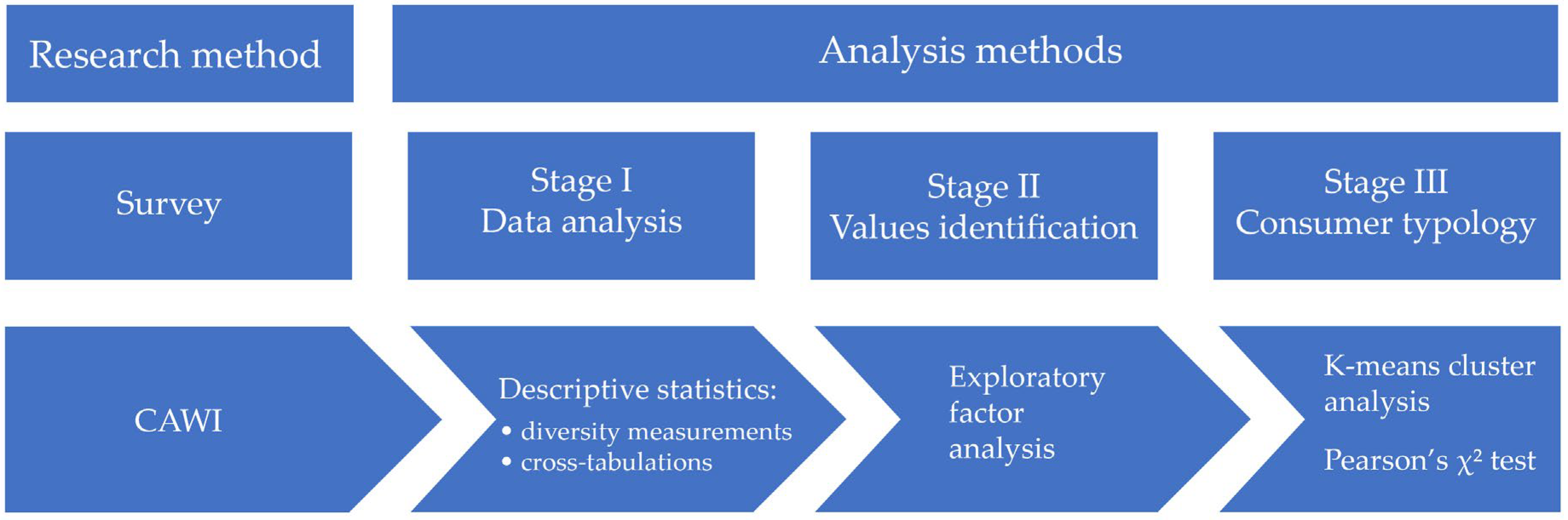
This study employed the survey method using the computer-assisted web interviewing (CAWI) technique, along with a three-stage data analysis process (Figure 1).
Figure 1.
Schematic illustrating the sequence of stages and key procedures. CAWI—computer-assisted web interviewing.
R software (version 4.3.3; R Core Team, Vienna, Austria) was used for the statistical analysis.
3.2. Methods
3.2.1. Data Collection
The quantitative study was conducted between April and July 2024. The survey was carried out on a sample of the adult (≥18) Polish population (n = 1247). Data were collected using SurveyMonkey® (SurveyMonkey HQ, Momentive Inc., San Mateo, CA, USA).
The questionnaire is provided in Appendix A. Table A1 and Table A2 contain demographic (Q1–Q6) and socioeconomic (Q7–Q9) sample characteristics. Table A3 and Table A4 contain the questions assessing pro-ecological consumer behaviors (Q10–Q22) and the digitization (Q23–Q29) of their behaviors. Table A5 shows the characterization of psychological determinants based on Schwartz’s theory of universal values (Q30–Q50) [19].
3.2.2. Validation of Value Dimensions
Exploratory factor analysis with Varimax rotation was used to identify the universal values in Schwartz’s theory, allowing for the extraction of factors describing these values. The validity of the conducting factor analysis was confirmed by (i) the Kaiser–Mayer–Olkin coefficient (KMO) [59] and (ii) Bartlett’s sphericity test [60].
The number of factors was determined using the Kaiser criterion (eigenvalues greater than or equal to 1), ensuring that each dimension was represented by at least one feature. This approach was combined with the consideration of the explained variance and the criterion of result interpretability [61,62].
The selection of the rotation method was guided by the principle of equitable consideration for all factors, and the Varimax method was applied, assuming no dependence between latent variables. The assignment of a given item to a specific factor was determined by analyzing its factor loadings. An item was considered part of a factor if its factor loading was at least 0.50. If an item had significant loadings on more than one factor, it was assigned to the factor with which it exhibited the strongest correlation. In cases where an item correlated similarly with two or more factors, it was excluded.
3.2.3. Consumer Typology
The typology of consumers based on sustainable consumption and digitalization was conducted using K-means (K-centroids cluster analysis) to identify the most similar types of consumers [63].
The number of consumer types was determined by repeating the clustering procedure for different group counts and then comparing the sum of the distances of all observations to their respective cluster representatives. A smaller distance indicates a better clustering solution [64].
The Pearson’s χ2 test was used to examine the relationship between identified types of consumers and the following variables: (i) Schwartz’s theory of universal values, (ii) the demographic, and (iii) socioeconomic determinants. Pearson residuals, as determined by the χ2 test results, were used to describe the nature of these relationships.
3.3. Research Sample
3.3.1. Demographic Characteristics of the Research Sample
Data indicate no significant gender predominance among consumers, who were primarily of working age (35–54 years; 45.2%). Single-person households were in the minority (14.2%), while the remaining households exhibited a relatively even distribution in size, with two-, three-, and four-or-more-person households each falling in the range of 28.0–29.3%, showing no single group dominance. Most households (53.4%) had no children under 18 years, and 75.1% had no members aged 65 or older. Additionally, the majority of consumers resided in urban areas (63.0%), including large cities with populations between 100,000 and 500,000 (25.8%). In contrast, a minority of consumers lived in rural areas (37.0%) (Table 1).
Table 1.
The demographic profile of the sample based on questions from Table A1 (n = 1247).
3.3.2. Socioeconomic Characteristics of the Research Sample
The socioeconomic profile of the consumers reveals a relatively well-educated population, with a majority holding higher education degrees (54.1%). The group demonstrates occupational diversity, with office workers (23.5%) and manual workers (16.6%) being the most represented. Their economic situation is predominantly stable, with 10.7% rating it as very good, 46.9% as good, and 36.6% as average (Table 2).
Table 2.
The socioeconomic profile of the sample based on questions from Table A2 (n = 1247).
4. Results and Discussion
4.1. Characterization of Consumers in the Pharmaceutical Market: Perspectives on Sustainability and Digitalization
4.1.1. Sustainable Consumption in the Pharmaceutical Market
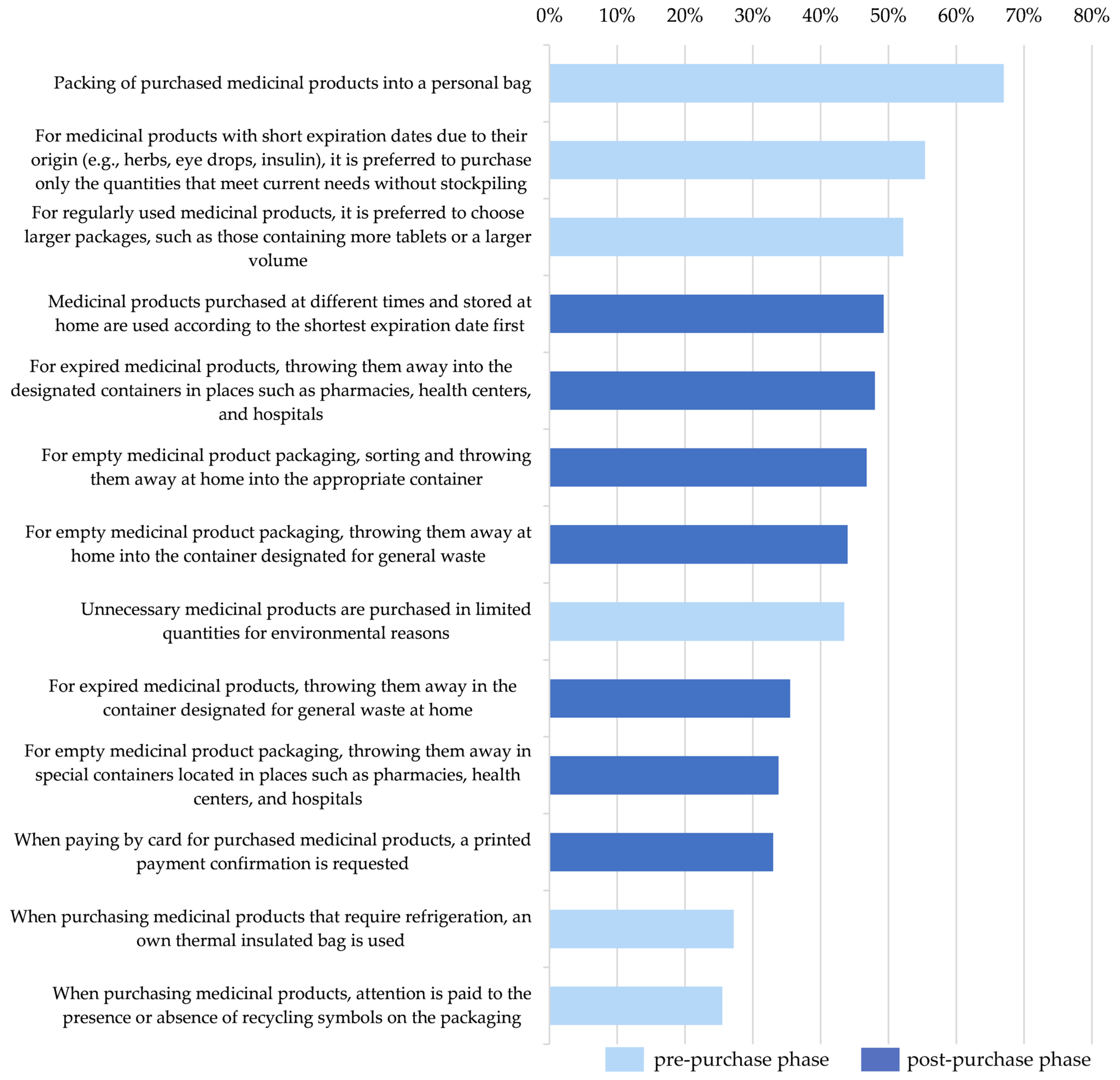
In this study, the following behaviors were identified as the pre-purchase phase: (i) packing purchased medicinal products into a personal bag (67.0%); (ii) purchasing medicinal products with short expiration dates owing to their origin only in the quantities that meet current needs without stockpiling (55.4%); (iii) purchasing larger packages for regularly used medicinal products (55.0%); (iv) purchasing unnecessary medicinal products in limited quantities for environmental reasons (43.5%); (v) when purchasing medicinal products that require refrigeration, using customer’s own thermally insulated bag (27.2%); and (vi) when purchasing medicinal products, attention is paid to the presence or absence of recycling symbols on the packaging (25.5%) (Figure 2).
Figure 2.
Distribution of positive answers (i.e., Somewhat frequently, Frequently, and Always/Constantly, based on questions from Table A3) regarding sustainability-related consumer behavior in the pharmaceutical market (n = 1247).
Considering the use of consumers’ own bags in the pharmaceutical sector, it is important to note that they serve two key functions. The first is merely transporting medicinal products from the pharmacy to the home. If this is done using single-use bags, it carries negative environmental consequences. The second, additional function is the protection of medicinal products from unfavorable temperature conditions during transportation, such as during periods of high heat. Thermally insulated bags are particularly recommended for transporting products that require storage at temperatures up to 15 °C, as they minimize the risk of quality deterioration and the potential need for disposal.
In this study, the most common activities concern packing the purchased medicinal products into a personal bag (67.0%) (Figure 2). It should be noted that this is a routine behavior currently observed also in pharmacies, reflecting the transfer of broader market trends to the pharmaceutical sector. Generally, the use of a personal bag reflects the introduction of taxes on single-use products in the European Union, such as charges on plastic bags, which account for so-called environmental costs previously excluded from their price. These measures effectively reduce consumption and support the transition to a circular economy. It is worth noting that the elimination of single-use plastic bags was initiated through the implementation of taxes, serving as an economic incentive. This measure not only encourages consumers to reduce their usage but also fosters lasting changes in behavior, contributing to the achievement of long-term environmental goals. The positive effects of legislative changes have been confirmed in scientific studies demonstrating their effectiveness in reducing environmental impact [65,66,67], as also reflected in this study.
However, the use of thermally insulated bags is particularly important for thermolabile products, including medicinal products. In this study, it was revealed that only 27.2% of consumers use a thermally insulated bag (Figure 2). It is important to emphasize that consumers hold the primary responsibility for ensuring the proper storage conditions, both at home and during transportation from the pharmacy to their residence, especially for temperature-sensitive medicinal products. Pharmacists may recommend the use of thermally insulated bags in an advisory capacity, noting that they are available at an additional cost. The results of this study suggest that the majority of consumers either purchase a new thermally insulated bag each time or do not use one at all, with the latter being the more likely option. Regardless of which interpretation is more accurate, two key points should be highlighted: (i) there seems to be a lack of awareness campaigns or educational initiatives about the importance of storing medicinal products at the correct temperature, or (ii) buying thermally insulated bags may be seen as an unnecessary expense, which discourages their use. Undoubtedly, the repeated purchase of new thermally insulated bags contributes to waste generation. Conversely, not using them can result in a decrease in the quality of medicinal products and the subsequent generation of pharmaceutical waste. Owning personal bags, including thermally insulated ones, is undoubtedly an eco-friendly, ethical, and socially responsible choice that reduces waste generation. The same conclusion applies to limiting the purchase of medicinal products for environmental reasons (43.5%) and prioritizing those with recycling symbols on their packaging (25.5%) (Figure 2). It should be noted that currently, such labeling, when present, primarily pertains to dietary supplements. The last two pre-purchase behaviors, related to purchasing medicinal products with short expiration dates owing to their origin, only in the quantities that meet current needs without stockpiling (55.4%), and purchasing larger packages for regularly used medicinal products (55.0%), may stem from ecological considerations (Figure 2). However, although ecological values are increasingly embraced by consumers, economic factors still prevail as the more rational determinant of purchasing behavior.
Also, in the post-purchase phase, striking analogies emerged in this study, i.e., (i) medicinal products that are purchased at different times and stored at home are used in an order that prioritizes those with the shortest expiration dates (49.3%); (ii) for expired medicinal products, disposing of them in designated containers in places such as pharmacies, health centers, and hospitals (48.0%); (iii) for empty medicinal product packaging, sorting and disposing of it at home in the appropriate container (46.8%) or (iv) disposing of it at home in the container designated for general waste (44.0%); (v) for expired medicinal products, disposing of them in the container designated for general waste at home (35.5%); (vi) for empty medicinal product packaging, disposing of it in special containers located in places such as pharmacies, health centers, and hospitals (33.8%); (vii) when paying by card for purchased medicinal products, requesting a printed payment confirmation (33.0%) (Figure 2).
When analyzing the broad issue of pharmaceutical waste, encompassing both expired medicinal products and their empty packaging, any effort directed toward their segregation should be regarded as highly desirable and beneficial. It is concerning, however, that despite awareness efforts, between 35.5% and 44.0% of such waste is still discarded in containers designated for general household waste (Figure 2). This issue may be attributed to a lack of proper knowledge or insufficient access to designated collection points equipped with specialized containers. The literature shows similar studies, with findings that reflect the observed results to varying extents. Consistent patterns in consumer behavior can be identified, although differences owing to local factors are also noticeable. It is important to highlight that access to proper infrastructure may be crucial for achieving sustainable consumption in this area. According to the study by Ehrhart and coworkers (2020) conducted in the Portland metropolitan area and the surrounding suburbs in counties such as Clackamas, Columbia, Multnomah, Washington, Yamhill, Clark, and Skamania (United States) from October 2017 to February 2018, involving 129 consumers, only 14.2% reported using safe disposal methods for leftover medicinal products. Moreover, recommendations for safe disposal from doctors, nurses, and pharmacists were noted in just 14.4% of cases. Only 14.0% of consumers know where the nearest special container is located [68]. Moreover, in the study of Vatovec and coworkers (2017) on the sources of medicinal product pollution conducted with 358 students from the University of Vermont (United States) between October and December 2014, it was revealed that, in the past 12 months, the most common method of disposing of all types of medicinal products was disposing of them in general household waste (25.0%) [69]. In turn, a study conducted by Rogowska and coworkers (2019) in Poland in 2015 on a sample of 450 consumers demonstrated that 65.1% were aware that expired or unused medicinal products could be returned to a pharmacy for proper disposal, and 56.9% believed that each pharmacy is obligated to accept them for this purpose [70].
In this study, other non-pharmaceutical waste generated by patients at the pharmacy includes printed confirmations of card payments. Notably, as many as 33.0% of patients requested this document, indicating a still considerable source of avoidable material waste (Figure 2).
The research therefore confirmed the previous considerations presented in the literature that sustainable behaviors in the pharmaceutical market occur in the pre-purchase and post-purchase phases. In the pre-purchase phase, pharmaceutical consumers primarily engage in waste avoidance and, to a lesser extent, in purchasing responsibly produced products (with recycling symbols). In turn, in the post-purchase phase, pharmaceutical consumers primarily manage their product resources and manage their post-purchase waste. Collaborative consumption was not indicated by consumers in the studied market. It should be emphasized that the conducted research employed an impact-oriented approach to sustainable behaviors.
4.1.2. Digitalization of Consumer Behavior in the Pharmaceutical Market
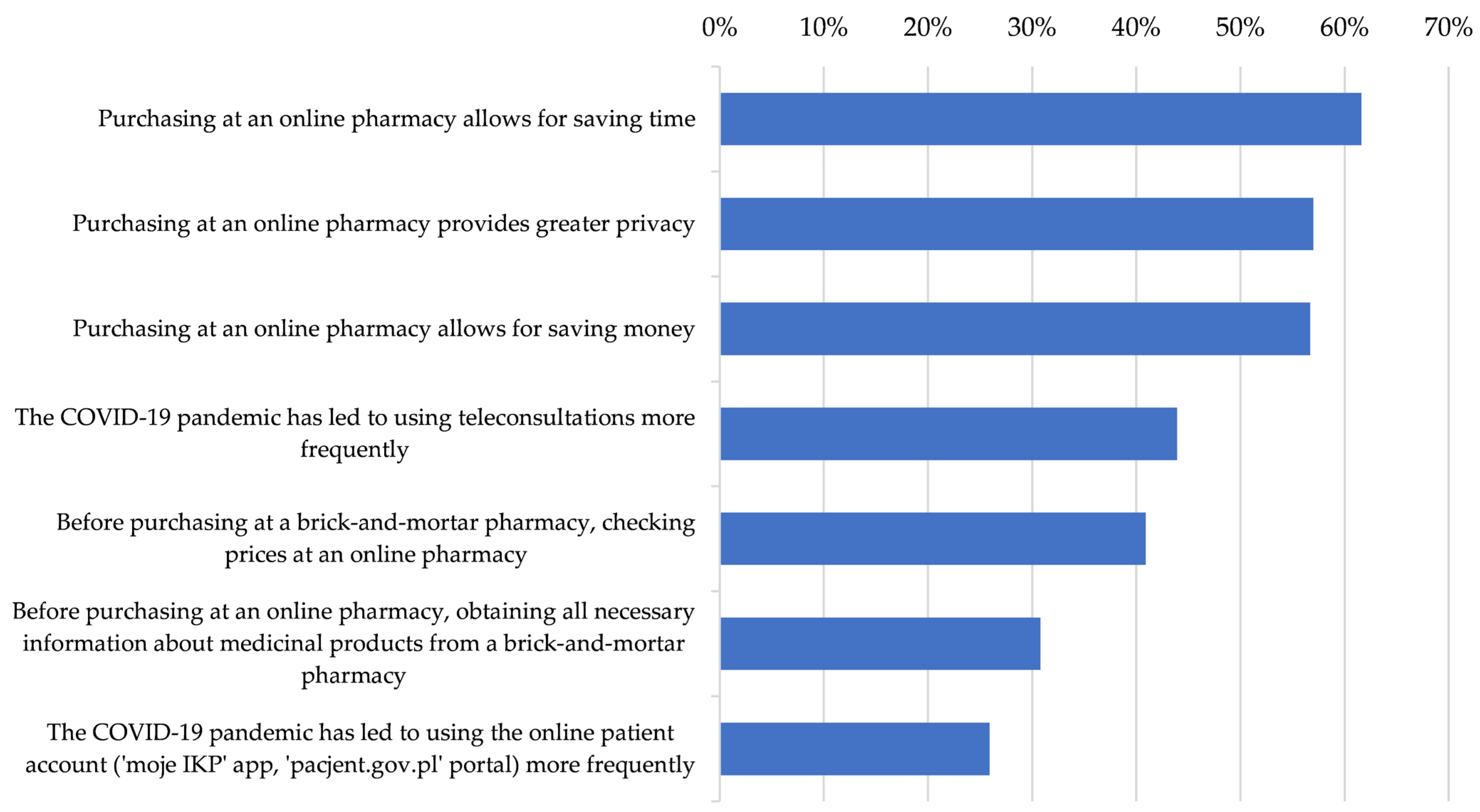
This part of the study focused on the digitalization of consumer behavior in the pharmaceutical market. It was revealed that purchasing medicinal products at an online pharmacy allows consumers to (i) save time (61.6%), (ii) ensure greater privacy (57.0%), and (iii) save money (56.7%). It is also worth noting that (iv) the COVID-19 pandemic has led many consumers (43.9%) to use teleconsultations more frequently. Consumers (40.9%) (v) also check prices at an online pharmacy before purchasing at a brick-and-mortar pharmacy, or (vi) they (30.8%) obtain all necessary information about medicinal products from a brick-and-mortar pharmacy before purchasing online. For the smallest group, (vii) the COVID-19 pandemic has increased the use of the online patient account (25.9%) (Figure 3).
Figure 3.
Distribution of positive answers (i.e., Somewhat frequently, Frequently, and Always/Constantly, based on questions from Table A4) regarding consumer behavior related to digitalization in the pharmaceutical market (n = 1247).
Most consumers (61.6%) identified purchasing from online pharmacies as a significant time-saving benefit (Figure 3). These findings align with the study of Fittler and coworkers (2018), which demonstrated that convenience, the ability to purchase outside standard operating hours, and the speed and simplicity of transactions play a key role in online pharmacy use [71].
The second most frequently reported factor was enhanced privacy (57.0%) during online purchases (Figure 3). Consumers may prefer purchasing medicinal products online to avoid discussing their health in public settings. A study by Le and Braunack-Mayer (2019) highlighted the necessity of creating designated retail spaces in brick-and-mortar pharmacies to establish discrete consultation zones with a pharmacist [72]. However, in Poland, pharmacies generally do not provide pharmaceutical care, especially in virtual environments. Online pharmacies in Poland primarily engage in sales, which undoubtedly offer greater privacy compared to brick-and-mortar pharmacies. Additionally, it should be noted that online pharmacies offer greater anonymity, particularly in the case of items considered intimate or non-normative by some consumers. Moreover, the model known as click-and-collect (i.e., reserving a product online for in-person pickup at a brick-and-mortar pharmacy) also helps enhance discretion, particularly in the case of Rx medications. This study also found that online purchases are viewed as more cost-effective (56.7%) (Figure 3). It should be noted that online environments provide better opportunities for quickly comparing prices and selecting a more economical pharmacy. Additionally, shipping is often free once a specific purchase threshold is exceeded.
As previously mentioned in Section 2.2, the COVID-19 pandemic accelerated the digitalization of the online pharmacy market and the development of virtual medical platforms [55,56,57,58]. This was reflected in the present study, as consumers reported more frequent use of teleconsultations (43.9%) and virtual medical platforms (25.9%) owing to the COVID-19 pandemic (Figure 3). It should be noted that this behavior significantly enhances the efficiency of medicinal product sales.
Consumers also exhibited two hybrid behaviors in this study. The first is referred to as ROPO (i.e., Research Online, Purchase Offline) because 40.9% of consumers check prices at an online pharmacy before purchasing at a brick-and-mortar pharmacy (Figure 3). The ROPO effect (i.e., Research Online, Purchase Offline) [73] may occur in cases where (i) consumers prefer to see the product in person, (ii) they exhibit greater trust in traditional brick-and-mortar stores, and (iii) they aim to avoid the costs and waiting times associated with delivery. It is important to emphasize that this effect is particularly characteristic of markets where the e-commerce sector is less developed. However, in Poland in 2023, 93.4% and 93.2% of urban and rural households, respectively, had access to the Internet. Furthermore, 89.3% and 82.1% of urban and rural residents, respectively, aged 16–74 used the Internet [74]. The ROPO effect observed in the presented research on the pharmaceutical market was relatively high, which can be explained by conducting direct research using the CAWI method. It should be pointed out that the consumers in the pharmaceutical market require special attention since health is considered one of the highest goods [13,14,15]. This may be due to a lack of trust in the online distribution channel for medicinal products and a higher level of trust in traditional distribution methods. The study of Kevrekidis and coworkers (2018), conducted on 300 consumers in the metropolitan area of Thessaloniki (Greece) between February and March 2016, revealed that 69.0% of consumers wanted a familiar relationship with the pharmacy staff [75]. For the quality of information provided about medicinal products and the establishment and maintenance of relationships with consumers, brick-and-mortar pharmacies clearly surpass online pharmacies, which may constitute an important factor shaping consumer purchasing preferences.
The second hybrid behavior in this study was the reverse ROPO effect (i.e., Research Offline, Purchase Online) [73], where 30.8% of consumers obtain all necessary information about medicinal products from a brick-and-mortar pharmacy before purchasing online (Figure 3). Research Offline may also be linked to the expertise provided by pharmacists, which reflects a high level of trust in their professional knowledge. Purchase Online may result from trust in this distribution channel for medicinal products, especially in highly digitalized societies as Poland. Moreover, as previously discussed, for the surveyed consumers, time, cost, and privacy are also important, and these are provided by online purchasing.
Taking into account the considerations presented in the literature so far, based on the conducted research, it can be stated that the digitization of consumer behavior in the pharmaceutical market primarily takes the form of mimetic digitization. This means that consumers treat electronic channels as complementary to traditional methods of purchasing medications or treat online channels as a source of information. A significant shift of consumer activities to virtual channels is also observed in the use of teleconsultations and online patient accounts.
4.1.3. Validation of Value Dimensions
It should be noted that values play a key role in shaping consumers’ attitudes, preferences, and behaviors. In this study, Schwartz’s theory of universal values was used to determine psychological determinants. This theory was selected because it reflects a complete motivational continuum, ranging from altruism, through openness to change and conservatism, to egoism [19].
This theory identifies values, as pointed out in Section 1, i.e., self-direction, stimulation, hedonism, achievement, power, security, conformity, tradition, benevolence, and universalism [19].
In this study, exploratory factor analysis with Varimax rotation was used to identify the values used in Schwartz’s theory of universal values. In the first step, the adequacy of each individual variable was calculated using the MSAh index. After eliminating two variables for which the MSAh index was lower than 0.5, the validity of factor analysis was confirmed by determining the KMO coefficient. Its values were obtained for 19 variables greater than 0.7, which indicated the validity of using factor analysis in identifying dimensions [59].
The validity was also confirmed by Bartlett’s sphericity test, where the null hypothesis assumed that the correlation matrix was an identity matrix, meaning no correlation between variables. This hypothesis was rejected as the p-value was <0.05, justifying the use of factor analysis [60].
Based on this analysis, the number of values was reduced to 6 factors latent variables, i.e., (i) hedonism, (ii) security, (iii) achievement and power, (iv) benevolence and universalism, (v) conformity and tradition, and (vi) self-direction and stimulation. The last four groups were formed through aggregation based on exploratory factor analysis (Table 3).
Table 3.
Factor loading values on exploratory factor analysis, based on questions from Table A5 (n = 1247).
As a result of the applied exploratory factor analysis and the adoption of the criterion of eigenvalue greater than or equal to 1, based on the Kaiser criterion, six factors were adopted for further analysis. Therefore, assuming the permissible number of six latent factors, a reduction of the input data set was achieved while maintaining the value of 57.0% (i.e., 0.57 for cumulative variance) of the information generated by the original set (consisting of 21 variables) (Table 4).
Table 4.
Summary of Schwartz’s identified factors and related indicators.
Based on the proportion of variance values presented in Table 4, it is evident that the first main factor (Factor 1), exhausting 15.0% of the total variability, was identified by variables describing the research area related to power and achievements. The second main factor (Factor 2), explaining nearly 13.0% of the total variability, concerns primarily universalism and benevolence. The next factors, containing variables related to tradition and conformism—Factor 3 (11.0%), stimulation and direction—Factor 4 (9.0%), hedonism—Factor 5 (5.0%), and security—Factor 6 (4.0%).
To confirm the validity of the six-factor solution obtained in the exploratory factor analysis, confirmatory factor analysis was conducted. The analysis showed that the theoretical model is confirmed by the empirical data (statistical values suggest a good fit of the model to the data, i.e., CFI = 0.951, RMSEA = 0.05, SRMR = 0.05).
4.2. Consumer Typology in the Pharmaceutical Market: Perspectives on Sustainability and Digitalization
4.2.1. Consumer Typology in the Pharmaceutical Market
The large diversity of consumer behavior in the area of sustainable consumption and digitalization, in the pharmaceutical market, prompts the analysis related to the typology of consumers. This analysis considered several key factors, including (i) Schwartz’s universal values, (ii) demographic determinants, and (iii) socioeconomic determinants. The typology consists of ranking and the logical ordering of elements of a given set according to the principle of comparing their features with the features of elements recognized as types within a given set [76,77].
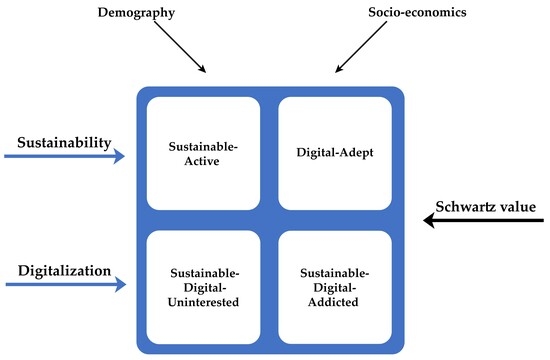
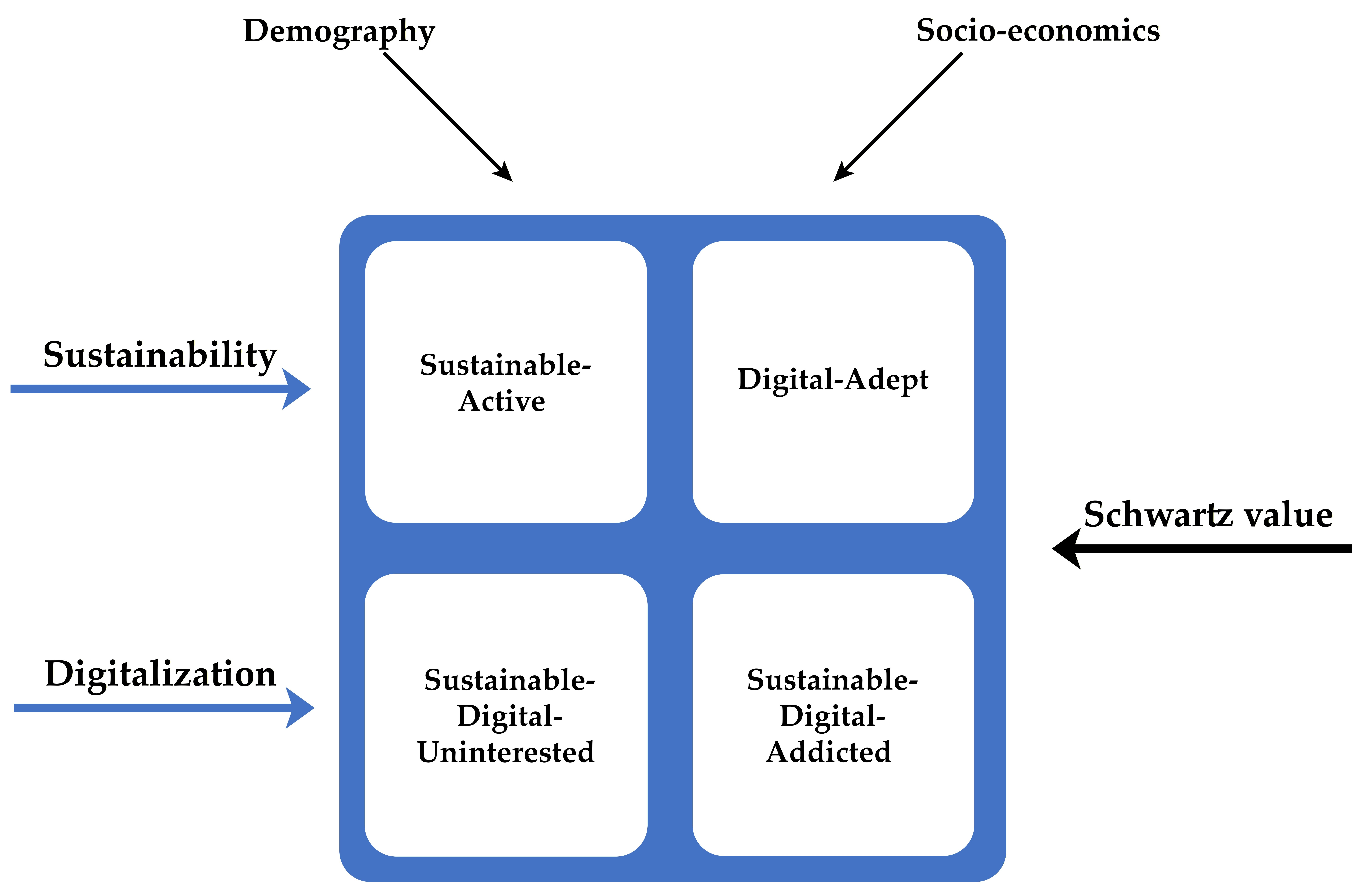
As a result of the conducted study, the presence of four types of consumers was demonstrated, i.e., Sustainable-Active (20%), Digital-Adept (29%), Sustainable-Digital-Uninterested (21%), and Sustainable-Digital-Addicted (29%).
4.2.2. Sustainable-Active
The first identified type of consumer is the Sustainable-Active. The study conducted among this type indicated several statistically significant variables, which are related to sustainable consumption and tradition, in the absence of digitalization tendencies.
First, in the aspect of sustainability, the analysis of Sustainable-Active revealed that this type of consumer strongly represents ecological attitudes, i.e., (i) they typically pack the purchased medicinal products in their own bag; (ii) they use medicinal products purchased at different times and stored at home according to the shortest expiration date first; (iii) in the case of medicinal products with short expiration dates owing to their origin, they prefer to purchase only the quantities that meet their current needs without stockpiling, and (iv) for regularly used medicinal products they prefer larger packages (Table 5). The reasons for using personal bags have already been discussed in Section 4.1.1, and the phenomenon itself raises no doubts. For the remaining identified behaviors, similar patterns may be observed in markets beyond the pharmaceutical sector and in geographic regions outside the studied area, as was pointed out below [78,79,80]. For consumers who report using medicinal products with the shortest expiration date first and purchasing only the necessary quantities without stockpiling for medicinal products with short expiration dates, this suggests that they engage in planning and make thoughtful purchasing decisions. Dusoruth and Peterson (2020) made insightful analogous observations in their study on food waste tendencies, conducted in 2016 during the Minnesota State Fair (United States) on a sample of 333 consumers. Their findings demonstrated that consumers categorized by the researchers as Planners had well-established shopping habits both prior to and during their purchases. Planners also exhibited strong food management and cooking skills [78].
Table 5.
Sustainable-Active type of consumers in the Polish pharmaceutical market (n = 1247).
Both Planners in the study of Dusoruth and Peterson (2020) [78] and Sustainable-Active from this study exhibit a deliberate approach to consumption, actively minimizing waste. It should be emphasized, however, that drawing analogies between the food market and the pharmaceutical market is not entirely accurate. In this article, the comparison was made owing to the lack of other available literature data. In the food market, there is a general assumption that the longer the shelf life, the lower the level of waste [79,80]. However, it should also be noted that, in this case, economic motivations may play a significant role, as deliberate purchasing and waste-minimizing behaviors often coincide with the intention of reducing unnecessary expense.
However, in the case of dietary supplements and medicinal products, their use by the expiration date is to some extent regulated by the healthcare system. Rx medications are purchased based on a doctor’s recommendation, whereas dietary supplements and OTC medications are mainly bought according to individual consumer needs. It should be noted that pharmacists dispense dietary and medicinal products in a way that ensures their dosing does not lead to use beyond their expiration date. In turn, the preference for larger packages of medicinal products may also stem from economic benefits, such as a lower unit price per tablet, as well as less frequent visits to healthcare providers and pharmacies, which also lead to cost savings.
Additionally, it is important to note that the consistent availability of medicinal products in the form of larger packages may further contribute to improved adherence to therapy. From an environmental perspective, this approach also reduces packaging waste. However, it simultaneously increases the risk of pharmaceutical wastage in cases where treatment regimens are altered. In this study, the selection of larger package sizes in the pharmaceutical market can be perceived as an economic, health, and environmental benefit. It is important to emphasize that, although larger packages may offer a quantity-discount benefit, they can also be associated with certain losses, as demonstrated in studies conducted outside the pharmaceutical market [81]. There is also a perspective that small packages enable consumers to better align their actual purchases with the quantity of the product they can realistically consume, as some consumers tend to buy oversized packages that go unused, ultimately resulting in product waste [82].
Regarding the remaining behaviors in the area of sustainability, they are strongly linked to ecological awareness. This type of consumer (v) also limits the purchase of unnecessary medicinal products for environmental reasons; (vi) they dispose of expired medicinal products, as well as (vii) empty medicinal products packaging in special containers located in places such as pharmacies, health centers, and hospitals; (viii) they sort out and dispose of empty packaging at home in the appropriate container (Table 5). This approach aligns with trends in the circular economy and waste minimization, emphasizing the potential benefits of consumer education in adopting sustainable practices [83,84,85]. The findings underscore the need to support infrastructure that facilitates the selective collection and recycling of medicinal product packaging. It should be emphasized that this consumer type does not pay attention to recycling symbols on packaging. This may be related to a lack of knowledge and awareness on this subject, which consequently makes it difficult for consumers to make fully ethical purchasing decisions.
Second, in the aspect of digitalization, the Sustainable-Active type tends not to use the Internet when purchasing dietary supplements and medicinal products (Table 5). It should be emphasized that Polish society is highly digitalized [74]. However, the lack of online purchases by the Sustainable-Active may stem from a lack of trust in this distribution channel, strong reliance on pharmacists, attachment to traditional purchasing locations, and well-developed social competencies.
Furthermore, the Sustainable-Active are primarily individuals who value tradition and conformity as well as universalism and benevolence (χ2 = 269.51; df = 15; p-value < 0.001) according to Schwartz’s theory of universal values (Table 5). In particular, they believe that (i) it is important to be modest and humble, they try not to attract attention to themselves, (ii) tradition is important to them, they try to follow religious or family traditions, (iii) it is also important always to behave properly, they want to avoid actions that people might consider inappropriate, and finally (iv) they believe that people should follow orders and they think that people should always adhere to rules and regulations, even when no one is watching what they do. Some Sustainable-Active believe that (v) it is important for all people in the world to be treated equally, they are convinced that everyone should have equal opportunities in life, (vi) it is also important to listen to people who are different from them, even when they disagree with them, they still want to understand their perspective, and (vii) they care for the natural environment: they are deeply convinced that people should take care of nature, and (viii) it is very important to them to help people around them, they want to care for their well-being.
Referring to the finding that Sustainable-Active consumers are not associated with digitalization, it is worth noting that Choden and coworkers (2019), based on data from the 2012 European Social Survey, reached a similar conclusion that tradition and conformity are negatively correlated with the use of communication technologies, irrespective of economic status [86]. However, the results of this study demonstrate a strong link between pro-environmental behavior and the aggregated values of tradition and conformity. It should be noted that, to our knowledge, no studies have been conducted on the relationship between sustainability and these values, regardless of whether they were aggregated in any way in the pharmaceutical market. Studies conducted in the 1990s and 2000s across diverse regions, including Latin America, the United States, and Europe (outside the pharmaceutical market), have shown opposite findings. Consumers with strong traditional or conservative values tend to be less environmentally conscious [87,88,89,90,91]. It is important to emphasize that our study is exclusively focused on the pharmaceutical market, which impacts differences in consumer behavior. The combination of a traditional lifestyle, broadly understood health, including behaviors in the pharmaceutical market, and sustainable development appears relatively evident, as demonstrated in these studies. It should be noted that the studies in the area of values and nature have shown that consumers whose priorities extend beyond their immediate needs are more likely to exhibit pro-environmental behaviors [91,92,93]. It should be noted that, within the framework of Schwartz’s universal value scale, conformity is defined as maintaining social order and adhering to social norms [19]. Therefore, in the context of the analyzed results, this approach was evident. However, according to the literature, there is no strict correlation between conformity and pro-environmental behaviors, just as in the case of tradition [87,88,89,90,91]. It can be stated that conformity, in itself, does not directly promote pro-environmental behavior. However, in this study, an indirect effect was demonstrated, as in Polish society, ecology and a pro-environmental lifestyle are becoming social norms [94,95,96] to which conformists may adapt [97]. Schwartz pointed out that conformity arises from the necessity of inhibiting inclinations that could lead to social disruption [19], which supports our thesis. The second defining value of Sustainable-Active is the aggregated value of universalism and benevolence. According to Schwartz’s theory of universal values, the motivational goals of universalism include understanding, appreciation, tolerance, and the protection of the well-being of all people and the environment. These values are fundamental to defining the Sustainable-Active consumer type examined in this study. Additionally, these consumers recognize the limited availability of natural resources [19]. It should be noted that in his refined theory, Schwartz (2012) also distinguishes universalism-nature as one of the nineteen values [98]. Moreover, Karp and coworkers (1996) revealed a positive influence of universalism on environmental behavior [88]. In the case of benevolence, the motivational goals preservation and enhancement of the well-being of individuals with whom one has frequent personal contact [19]. Generally, the association identified in this study between sustainability and the aggregated values of universalism and benevolence is reflected in the literature [87,88,89,91,97].
Finally, statistical analyses show that most of the Sustainable-Active are women (63.2%), possess higher education (53.4%), and rate the economic situation of their household as average (46.1%) (Table 5).
It is also important to note that although some variables did not reach statistical significance, they still provide valuable insights. Thus, this type of consumer in the pharmaceutical market is most often represented by people in the middle age group of 35–44 years (28.4%) and living in rural areas (38.3%). The Sustainable-Active are mostly manual workers (20.2%), retirees/pensioners (19.5%), and students (9.1%). They represent rather bigger households: 3 people (29.7%) and 4 or more people (30.9%). Most (52.4%) in their households do not include children or have only 1 child (24.8%). Also, most of these households do not include elderly people—over 65 years old (72.6%) or they have only 1 such person (17.3%).
4.2.3. Digital-Adept
The second identified type of consumer in the pharmaceutical market is the Digital-Adept. The study conducted among this type identified several statistically significant variables, which are related to digitalization and hedonism in the absence of pro-environmental tendencies (Table 6).
Table 6.
Digital-Adept type of consumers in the Polish pharmaceutical market (n = 1247).
First, the Digital-Adept do not exhibit any tendencies toward ecological behavior or sustainable consumption (Table 6). This is understandable because theory already indicated that the simultaneous pursuit of hedonism and conformity with tradition leads to strong psychological and/or social conflicts [19]. Since, according to this study, the Sustainable-Active do not use the Internet when purchasing dietary supplements and medicinal products (Table 5), Digital-Adept do not show pro-ecological tendencies (Table 6). Furthermore, other researchers have also generally not associated hedonism with sustainable development [87,88,89,90,91].
Second, it should be noted that, in the aspect of digitalization, the statistically significant characteristics of the Digital-Adept in the pharmaceutical market indicate that this group is highly active online, i.e., (i) purchasing at an online pharmacy provides greater privacy, (ii) saves time, and (iii) saves money (Table 6). Issues related to ensuring privacy in the pharmacy setting have already been addressed in Section 4.1.2. In turn, a review of selected sales regulations of online pharmacies in Poland showed that delivery times for orders are typically short, which allows for the quick satisfaction derived from the use of the purchased products. A report by IQVIA and the law firm Rymarz Zdort Maruta (2024) indicated that this distribution channel generally also offers lower prices than traditional brick-and-mortar pharmacies [99]. This can be considered a typical feature of e-commerce [100]. However, it should be noted that hedonic consumers tend to make more frequent purchases and spend larger amounts [101]. In the aspect of digitalization, the statistically significant characteristics of this type also revealed (iv) that these consumers, before purchasing at an online pharmacy, obtain all necessary information about medicinal products from a brick-and-mortar pharmacy; on the other hand, (v) before purchasing at a brick-and-mortar pharmacy, they check prices at an online pharmacy (Table 6). The issues of the ROPO effect and reverse ROPO effect have also already been addressed in Section 4.1.2. Moreover, the COVID-19 pandemic has led the Digital-Adept to (vi) purchase medicinal products online and (vii) use teleconsultations more frequently. Undoubtedly, the use of the virtual environment enables consumers to satisfy their needs more quickly and conveniently, a trend that has been notably reinforced by the pandemic context.
Furthermore, Schwartz emphasizes that hedonism has been focused specifically on pleasure or sensuous gratification [19]. The result of this study revealed that the Digital-Adept are most often consumers who identify with values such as hedonism (χ2 = 269.51; df = 15; p-value < 0.001). For this type of consumers (i) to have a good time is important and they don’t like to deny themselves anything, and (ii) it is important to them to do things that bring them pleasure and they look for opportunities to have fun (Table 6). Apart from this study and the pharmaceutical market, it is worth noting that hedonists browse websites without necessarily intending to make a purchase—the act of exploring, discovering new content, and engaging with the site’s aesthetic qualities serves as a source of enjoyment in itself [101,102,103]. Referring back to the study by Choden and coworkers (2019), it should be indicated that hedonism positively influences communication technology use [86]. Summarizing the previous two paragraphs, it can be noted that the Digital-Adept in the pharmaceutical market may treat instrumentally available digital tools, often in an un-compromising manner, to fulfill their personal needs and desires related to health.
Finally, statistical analyses also show that Digital-Adept consumers are most often men (55.6%) and typically rate their household’s economic situation as very good (52.7%) or good (31.5%) (Table 6).
Although not statistically significant, the Digital-Adept are most often younger consumers, below 34 years old (28.1%), with secondary—(41.9%) or higher-level (41.7%) education, and live mostly in rural areas (34.8%). Digital-Adept Hedonists are usually manual workers (17.9%) and managers, both middle and higher level (14.5%). They represent average size households: 2 people (29.7%) and 3 people (30.8%). Mostly (55.4%) in their households do not include children, or they have only 1 child (27.3%). Also, most of these households do not include elderly people above 65 years old (79.6%), or they have only 1 such person (13.4%).
4.2.4. Sustainable-Digital-Uninterested
In this study, the third identified type of consumer is very specific. Sustainable-Digital-Uninterested consumers have limited pro-ecological and digitalization tendencies, but at the same time, they are strongly associated with security in line with Schwartz’s theory of universal values (Table 7).
Table 7.
Sustainable-Digital-Uninterested type of consumers in the Polish pharmaceutical market (n = 1247).
First, in the aspect of sustainability, the Sustainable-Digital-Uninterested do not exhibit pro-ecological behavior practically. They choose the worst option for disposing of pharmaceutical waste, i.e., (i) throw away expired medicinal products and (ii) empty medicinal products packaging at home in the container designated for general waste. It can be pointed out that consumers identified as Uninterested–Secures may show pro-environmental tendencies, but mainly when environmental issues pose a direct threat to their well-being. However, the amount of pharmaceutical waste they generate appears to be negligible from their perspective in our assessment.
Second, statistically significant findings indicate that the Sustainable-Digital-Uninterested in the pharmaceutical market do not use the Internet for purchasing dietary supplements and medicinal products. A similar characteristic was already observed among Sustainable-Active; however, for the Sustainable-Digital-Uninterested, their lack of Internet use in the pharmaceutical market may stem from a lack of trust in this distribution channel and a strong reliance in pharmacists. This result reflected the study of Choden and coworkers (2019), which revealed that security and tradition negatively influence communication technology use [86].
Furthermore, the Sustainable-Digital-Uninterested are usually consumers who identify with values such as security according to Schwartz’s theory of universal values (χ2 = 269.51; df = 15; p-value < 0.001). For them (i) is important to live in a safe environment and avoid anything that could threaten their safety. For this type of consumer, (ii) it is also important that the state provides protection against all threats, and that it remains strong enough to defend its citizens (Table 7). It should be pointed out that Schwartz characterized security specifically as individual security, understood in terms of social order, family security, national security, reciprocation of favors, cleanliness, sense of belonging, and health [19].
Finally, statistical analyses show that Sustainable-Digital-Uninterested consumers most often assess their household’s economic situation as average (38.6%) (Table 7).
Although not statistically significant, most of the Sustainable-Digital-Uninterested are elderly consumers—above 45 years old (41.2%), with a secondary (40.7%) or higher (42.4%) level of education, living in average-sized cities between 20,000 and 500,000 inhabitants (47.1%). The Sustainable-Digital-Uninterested are both women and men. Uninterested-Secures are usually white-collar workers (23.9%) and retailers/pensioners (15.4%). They represent big households of 4 and more people (35.7%). Mostly (51.8%) their households do not include children, or they have only 1 child (22.3%) or two children (20.5%). Also, most of these households do not include elderly people above 65 years old (76.8%) or they have 2 such people (11.3%).
4.2.5. Sustainable-Digital-Addicted
Last, the fourth identified type of consumers in the pharmaceutical market is the Sustainable-Digital-Addicted. This type of consumer relates to sustainable consumption and digitization as well as to power and achievement, stimulation, and self-direction according to Schwartz’s theory of universal values. This is the most complex type of consumer identified in the study.
First, this study conducted among this identified type several statistically significant variables. The Sustainable-Digital-Addicted demonstrate the most environmentally conscious behaviors within the pharmaceutical sector, i.e., (i) they pack the purchased medicinal products into their own bag, (ii) when purchasing medicinal products that require refrigeration, they carry a thermally insulated bag, (iii) they pay attention to the presence or absence of recycling symbols on the packaging, (iv) they use medicinal products purchased at different times and stored at home according to the shortest expiration date first, and (v) they limit the purchase of unnecessary medicinal products for environmental reasons. Moreover, (vi) they throw away expired medicinal products and (vii) empty medicinal products packaging in special containers located in places such as pharmacies, health centers, and hospitals. However, their secure approach is evidenced by the fact that (viii) when paying by card for medicinal products, they request a printed payment confirmation (Table 8).
Table 8.
Sustainable-Digital-Addicted type of consumers in the Polish pharmaceutical market (n = 1247).
Second, this consumer type is active online, i.e., (i) purchasing at an online pharmacy provides greater privacy, (ii) before purchasing at a brick-and-mortar pharmacy, they check prices at an online pharmacy, (iii) before purchasing at an online pharmacy, they obtain all necessary information about medicinal products from a brick-and-mortar pharmacy, and (iv) the COVID-19 pandemic has caused them to purchase medicinal products online more frequently (Table 8). It may be stated that the consumer identified as Sustainable-Digital-Addicted is a conscious participant in the pharmaceutical market. They recognize both the benefits and risks associated with its functioning, are sensitive to the issue of waste generation, and use the Internet according to their own needs.
Furthermore, Sustainable-Digital-Addicted consumers most commonly identify with values such as power and achievement as well as stimulation and self-direction (χ2 = 269.51; df = 15; p-value < 0.001) according to Schwartz’s theory of universal values. For these consumers (i) it is important to be wealthy, they want to have a lot of money and various expensive possessions, (ii) it is important to them to have influence over others, they want people to do what they tell them, (iii) it is important to them to showcase their abilities and talents, they want people to admire what they do, (iv) it is also important to them to achieve significant success, they hope that people will appreciate their accomplishments. These consumers (v) like surprises and they are always looking for new activities, they believe it is important to be involved in many different things in life, (vi) they seek adventure and enjoy taking risks and they want to have a life full of excitement, and finally (vi) it is important to them to invent new things and take a creative approach, they like doing everything in their own original way.
As Schwartz (1992) states in the theory of universal values: ‘Both power values and achievement values focus on social esteem. However, achievement values (e.g., successful, ambitious) emphasize the active demonstration of competence in concrete interaction, whereas power values (e.g., authority, wealth) emphasize the attainment or preservation of a dominant position within the more general social system’ [19]. Continuing further, according to Schwartz’s theory of universal values, stimulation refers to the pursuit of excitement, novelty, and challenge in life (e.g., a varied life, an exciting life, daring), while self-direction encompasses values such as creativity, freedom, curiosity, independence, and setting one’s own goals [19].
It should be noted that Choden and coworkers (2019), in their study mentioned above, revealed that self-direction and stimulation positively influence Internet use [86]. In the context of sustainability, Sustainable-Digital-Addicted consumers exhibit values such as power and achievement, as well as stimulation and self-direction. They appear to be aware of the generation of pharmaceutical waste and the proper ways to manage it. By contrast, Karp’s (1996) study, conducted in 1993 on a sample of 302 undergraduate students at the University of Washington (USA), revealed ambiguous and no statistically significant correlation between pro-environmental attitudes and the indicated values [88].
Finally, this study conducted among this type identified several statistically significant variables. The Sustainable-Digital-Addicted are both women and men. They are mostly consumers of an average age between 35 and 44 (45.7%), with higher education (45.2%), and most assess their household’s economic situation as good (49.8%) (Table 8).
Additionally, although not statistically significant, most Sustainable-Digital-Addicted live in bigger cities above 100,000 inhabitants (34.2%). They are mostly white-collar workers (30.8%) and the self-employed (13.4%). They represent smaller households—2 people (31.5%). Mostly (54.9%) their households do not include children or they have only 1 child (30.4%). Also, most of these households do not include elderly people—above 65 years old (71.6%) or they have only 1 such person (14.7%).
5. Limitations
It should be borne in mind that the conducted study has some limitations, which, however, can be turned into an advantage for future studies.
The key limitation of this study may result from the use of the CAWI method, which, by its nature, restricts the participation of older adults and the digitally excluded. It tends to favor younger, better-educated, and digitally active respondents. In the analyzed sample, individuals of pre-retirement and retirement age (55–74 years) accounted for a total of 24.5%, with a complete lack of representation among those over the age of 75. This may be due to limited digital competencies, a lack of technical infrastructure, or low motivation to participate in online surveys related to sustainable development and digitalization in the pharmaceutical market. However, given the subject of the study—digitalization—the Internet environment appears to be an appropriate medium for conducting such research.
An important limitation of the study is its focus solely on one market: pharmaceutical products. Consumer attitudes and behaviors in the areas of sustainability and digitalization, especially in the market for consumption goods or services, are certainly different, which affects the significance of decisions made in the market and in the household.
It should be also emphasized that the research was conducted only in one selected country. Meanwhile, consumer attitudes and behaviors in the pharmaceutical market in the analyzed areas may vary depending on the economic development of a given country or considering cultural differences.
Finally, the direct research was conducted solely using a survey, which represents quantitative methods. However, the application of a triangulation approach and qualitative research, among other methods, would have allowed a deeper look at the identified consumer types in the pharmaceutical market.
It is believed that focusing future research on different countries, using other quantitative research techniques, also supported by qualitative research, as well as on diverse consumer groups, will contribute to a better understanding of sustainable consumption and the digitalization of consumer behavior in the pharmaceutical market.
It would also be interesting to investigate the types of consumers in the pharmaceutical market in other countries, so the results could be generalized cross-culturally.
6. Conclusions
Sustainability and digitalization represent key trends currently shaping the pharmaceutical market and were the primary focus of this analysis. The conducted study revealed that in the area of sustainability the following behaviors were observed most frequently, i.e., (i) packing purchased medicinal products into a personal bag, (ii) for medicinal products with short expiration dates owing to their origin, purchasing only the quantities that meet current needs without stockpiling, (iii) for regularly used medicinal products, choosing larger packages. It can be argued that sustainable consumption in the pharmaceutical market—at least in terms of the most commonly observed behaviors—stems from a rational assessment of needs and an effort to minimize waste. However, it should not be forgotten that many of these behaviors are also rooted in purely economic factors, driven by the desire to reduce costs and use resources more efficiently.
For digitalization, purchasing at an online pharmacy allows for (i) saving time, (ii) saving money, while also (iii) providing greater privacy. This indicates that the online pharmacy, as a distribution channel, is primarily perceived as a functional tool. Consumers attribute specific practical advantages to online pharmacies.
The conducted study also confirmed the hypothesis that the relationship between sustainability and digitalization significantly differentiates consumer behavior in the pharmaceutical market. The analyses conducted allowed the identification of four distinct consumer types, depending on their engagement, or lack thereof, in sustainable consumer behavior and digitalization. Each identified consumer type was described as representing different social values.
The consumers types identified in this study are Sustainable-Active, Digital-Adept, Sustainable-Digital-Uninterested, and Sustainable-Digital-Addicted. The presence of distinct consumer types indicates the heterogeneity of behaviors toward sustainability and digitalization, shaped by personal values and by demographic and socioeconomic factors. It should be emphasized that consumer behavior in the pharmaceutical market stems from different configurations of values and attitudes. Moreover, its intensity varies across consumer types.
Considering the obtained results in a broader context, the developed consumer typology in the pharmaceutical market has numerous advantages and applications. First and foremost, it can significantly contribute to the development of scientific theories, particularly within the field of behavioral economics—especially through the integration of general economic theories (such as consumption theory and consumer behavior theories) and interdisciplinary frameworks (including decision-making and motivation theories), as well as psychological and sociological approaches. Moreover, the developed consumer typology may be broadly applied in the practical operations of the pharmaceutical industry, as it offers a clear and accessible explanation of the relationship between sustainable consumption and digitalization in consumer behavior within the studied market. At the same time, possessing knowledge of the different consumer types and their behavior is essential for the development of any marketing program, including the formulation of marketing strategies by pharmaceutical companies. Moreover, insights into consumer typologies may also inform government policy and support initiatives aimed at promoting sustainable development and market digitalization.
Author Contributions
Conceptualization, A.T.; methodology, A.T. and S.S.; validation, A.T. and S.S., formal analysis, A.T., and S.S.; investigation, A.T. and S.S.; resources, A.T., S.S., and J.R.; data curation, A.T., S.S., and J.R.; writing—original draft preparation, A.T.; writing—review and editing, A.T., S.S., and J.R.; visualization, A.T. and J.R.; supervision, A.T.; project administration, A.T.; funding acquisition, A.T. All authors have read and agreed to the published version of the manuscript.
Funding
The study was part of the project titled “Monitoring and supervision of pharmacological therapy of Polish patients based on the assessment of their purchasing and consumption behavior,” funded 90% by the Metropolis GZM, Katowice, Poland (grant no. RW/20/2024) under the Metropolitan Science Support Fund for 2022–2024, and 10% by the Medical University of Silesia in Katowice, Poland.
Institutional Review Board Statement
Not applicable.
Informed Consent Statement
Not applicable.
Data Availability Statement
The data presented in this study are available on request from the corresponding author.
Acknowledgments
This article was made possible thanks to the scientific internship of Artur Turek and Jakub Rech, led by Sławomir Smyczek from the University of Economics in Katowice, Poland.
Conflicts of Interest
The authors declare no conflicts of interest.
Correction Statement
This article has been republished with a minor correction to the reference 99 and the readability of Appendix A. This change does not affect the scientific content of the article.
Appendix A
Table A1.
Simple profile according to demographic determinants.
Table A1.
Simple profile according to demographic determinants.
| Variables | Answers |
|---|---|
| Female |
| Male | |
| Other | |
| Under 25 years |
| 25–34 years | |
| 35–44 years | |
| 45–54 years | |
| 55–64 years | |
| 65–74 years | |
| 75 years and over | |
| 1 person |
| 2 people | |
| 3 people | |
| 4 or more people | |
| 1 person |
| 2 people | |
| 3 people | |
| 4 or more people | |
| None | |
| 1 person |
| 2 people | |
| 3 people | |
| 4 or more people | |
| None | |
| Village |
| City up to 20,000 inhabitants | |
| City from 20,000 to 100,000 inhabitants | |
| City from 100,000 to 500,000 inhabitants | |
| City over 500,000 inhabitants |
Table A2.
Simple profile according to socioeconomic determinants.
Table A2.
Simple profile according to socioeconomic determinants.
| Variables | Answers |
|---|---|
| Primary |
| Lower secondary | |
| Vocational | |
| Secondary | |
| Higher | |
| Manual worker |
| Sales representative | |
| White-collar worker (office) | |
| Teacher | |
| Middle management | |
| Manager | |
| Self-employed | |
| Freelance (e.g, doctor, artist, lawyer) | |
| Retiree/pensioner | |
| Student | |
| Other | |
| Very good |
| Good | |
| Average | |
| Poor | |
| Very poor |
Table A3.
How frequently do the following situations apply to you?
Table A3.
How frequently do the following situations apply to you?
| Never | Rarely | Somewhat Rarely | Neither Frequently nor Rarely | Somewhat Frequently | Frequently | Always/Constantly | |
|---|---|---|---|---|---|---|---|
| Variables | Answers | ||||||
| 1 | 2 | 3 | 4 | 5 | 6 | 7 |
| 1 | 2 | 3 | 4 | 5 | 6 | 7 |
| 1 | 2 | 3 | 4 | 5 | 6 | 7 |
| 1 | 2 | 3 | 4 | 5 | 6 | 7 |
| 1 | 2 | 3 | 4 | 5 | 6 | 7 |
| 1 | 2 | 3 | 4 | 5 | 6 | 7 |
| 1 | 2 | 3 | 4 | 5 | 6 | 7 |
| 1 | 2 | 3 | 4 | 5 | 6 | 7 |
| 1 | 2 | 3 | 4 | 5 | 6 | 7 |
| 1 | 2 | 3 | 4 | 5 | 6 | 7 |
| 1 | 2 | 3 | 4 | 5 | 6 | 7 |
| 1 | 2 | 3 | 4 | 5 | 6 | 7 |
| 1 | 2 | 3 | 4 | 5 | 6 | 7 |
Table A4.
How much do you agree with the following statements?
Table A4.
How much do you agree with the following statements?
| Completely Disagree | Disagree | Somewhat Disagree | Neither Agree nor Disagree | Somewhat Agree | Agree | Completely Agree | |
|---|---|---|---|---|---|---|---|
| Variables | Answers | ||||||
| 1 | 2 | 3 | 4 | 5 | 6 | 7 |
| 1 | 2 | 3 | 4 | 5 | 6 | 7 |
| 1 | 2 | 3 | 4 | 5 | 6 | 7 |
| 1 | 2 | 3 | 4 | 5 | 6 | 7 |
| 1 | 2 | 3 | 4 | 5 | 6 | 7 |
| 1 | 2 | 3 | 4 | 5 | 6 | 7 |
| 1 | 2 | 3 | 4 | 5 | 6 | 7 |
* ‘moje IKP’ and ‘pacjent.gov.pl’ are the official names of the Polish patient information systems.
Table A5.
Please indicate to what extent you identify with the person described below:.
Table A5.
Please indicate to what extent you identify with the person described below:.
| Completely Unlike Me | Unlike Me | Slightly Like Me | Hard to Say | Somewhat Like Me | Like Me | Very Much Like Me | ||
|---|---|---|---|---|---|---|---|---|
| Variables | Values | Answers | ||||||
| HED | 1 | 2 | 3 | 4 | 5 | 6 | 7 |
| HED | 1 | 2 | 3 | 4 | 5 | 6 | 7 |
| ACH | 1 | 2 | 3 | 4 | 5 | 6 | 7 |
| ACH | 1 | 2 | 3 | 4 | 5 | 6 | 7 |
| POW | 1 | 2 | 3 | 4 | 5 | 6 | 7 |
| POW | 1 | 2 | 3 | 4 | 5 | 6 | 7 |
| UNI | 1 | 2 | 3 | 4 | 5 | 6 | 7 |
| UNI | 1 | 2 | 3 | 4 | 5 | 6 | 7 |
| BEN | 1 | 2 | 3 | 4 | 5 | 6 | 7 |
| BEN | 1 | 2 | 3 | 4 | 5 | 6 | 7 |
| BEN | 1 | 2 | 3 | 4 | 5 | 6 | 7 |
| SEC | 1 | 2 | 3 | 4 | 5 | 6 | 7 |
| SEC | 1 | 2 | 3 | 4 | 5 | 6 | 7 |
| CON | 1 | 2 | 3 | 4 | 5 | 6 | 7 |
| CON | 1 | 2 | 3 | 4 | 5 | 6 | 7 |
| TRA | 1 | 2 | 3 | 4 | 5 | 6 | 7 |
| TRA | 1 | 2 | 3 | 4 | 5 | 6 | 7 |
| STM | 1 | 2 | 3 | 4 | 5 | 6 | 7 |
| STM | 1 | 2 | 3 | 4 | 5 | 6 | 7 |
| S-DIR | 1 | 2 | 3 | 4 | 5 | 6 | 7 |
| S-DIR | 1 | 2 | 3 | 4 | 5 | 6 | 7 |
ACH—Achievement; BEN—Benevolence; CON—Conformity; HED—Hedonism; POW—Power; SEC—Security; S-DIR—Self-Direction; STM—Stimulation; TRA—Tradition; UNI—Universalism.
References
- Bywalec, C. Konsumpcja w Teorii i Praktyce Gospodarowania; Wydawnictwo Naukowe PWN: Warsaw, Poland, 2007; ISBN 978-83-01-15300-7. [Google Scholar]
- Mróz, B. Konsument w Globalnej Gospodarce. Trzy Perspektywy; Szkoła Główna Handlowa w Warszawie: Warsaw, Poland, 2013. [Google Scholar]
- Howell, R.A. It’s Not (Just) “the Environment, Stupid!” Value, Motivations, and Routes to Engagement of People Adopting Lower-Carbon Lifestyles. Glob. Environ. Chang. 2013, 23, 281–290. [Google Scholar] [CrossRef]
- Mazzoni, F. Circular Economy and Eco-Innovation in Italian Industrial Clusters. Best Practices from Prato Textile Cluster. Insights Into Reg. Dev. 2020, 2, 661–676. [Google Scholar] [CrossRef] [PubMed]
- Zou, L.W.; Chan, R.Y.K. Why and When Do Consumers Perform Green Behaviors? An Examination of Regulatory Focus and Ethical Ideology. J. Bus. Res. 2019, 94, 113–127. [Google Scholar] [CrossRef]
- Viu-Roig, M.; Alvarez-Palau, E.J. The Impact of E-Commerce-Related Last-Mile Logistics on Cities: A Systematic Literature Review. Sustainability 2020, 12, 6492. [Google Scholar] [CrossRef]
- Strzelecki, A.; Kolny, B.; Kucia, M. Smart Homes as Catalysts for Sustainable Consumption: A Digital Economy Perspective. Sustainability 2024, 16, 4676. [Google Scholar] [CrossRef]
- Gajdzik, B.; Bartuś, K.; Jaciow, M.; Wolniak, R.; Wolny, R.; Grebski, W.W. Evolution of Polish E-Consumers’ Environmental Awareness and Purchasing Behavior over Ten Years. Sustainability 2024, 16, 4686. [Google Scholar] [CrossRef]
- Turek, A.; Owczarek, A. Consumption and Consumer Behavior in the European Healthcare Market. In Healthcare: Market Dynamics, Policies and Strategies in Europe; Glowik, M., Smyczek, S., Eds.; De Gruyter Oldenbourg: Berlin/Munich, Germany; Boston, MA, USA, 2015; pp. 45–70. [Google Scholar] [CrossRef]
- Turek, A.; Owczarek, A. Determinants of Consumption Behavior of Over-the-Counter Medications—the Case of Painkillers and Anti-Inflammatory Medications. J. Econ. Manag. 2014, 15, 25–59. [Google Scholar]
- Kevrekidis, D.P.; Mináriková, D.; Markos, A. Effects of Demographic Characteristics and Consumer Behavior in the Selection of Retail Pharmacies and Over-the-Counter Medicine. Eur. Pharm. J. 2021, 68, 27–40. [Google Scholar] [CrossRef]
- World Health Organization. Basic Documents: Forty-Ninth Edition (Including Amendments Adopted up to 31 May 2019); WHO: Geneva, Switzerland, 2020; ISBN 978-92-4-000051-3. [Google Scholar]
- Kickbusch, I. The Contribution of the World Health Organization to a New Public Health and Health Promotion. Am. J. Public Health 2003, 93, 383–388. [Google Scholar] [CrossRef]
- Phelan, J.C.; Link, B.G.; Tehranifar, P. Social Conditions as Fundamental Causes of Health Inequalities: Theory, Evidence, and Policy Implications. J. Health Soc. Behav. 2010, 51, S28–S40. [Google Scholar] [CrossRef]
- Smith, M.C. Pharmaceutical Marketing; CRC Press: Boca Raton, FL, USA, 1991; ISBN 9780429092442. [Google Scholar]
- Pham, M.T. The Seven Sins of Consumer Psychology. J. Consum. Psychol. 2013, 23, 411–423. [Google Scholar] [CrossRef]
- Lysonski, S.; Durvasula, S. Consumer Decision Making Styles in Retailing: Evolution of Mindsets and Psychological Impacts. J. Consum. Mark. 2013, 30, 75–87. [Google Scholar] [CrossRef]
- Achar, C.; So, J.; Agrawal, N.; Duhachek, A. What We Feel and Why We Buy: The Influence of Emotions on Consumer Decision-Making. Curr. Opin. Psychol. 2016, 10, 166–170. [Google Scholar] [CrossRef]
- Schwartz, S.H. Universals in the Content and Structure of Values: Theoretical Advances and Empirical Tests in 20 Countries. Adv. Exp. Soc. Psychol. 1992, 25, 1–65. [Google Scholar]
- Grunert, S.C.; Juhl, H.J. Values, Environmental Attitudes, and Buying of Organic Food. J. Econ. Psychol. 1995, 16, 39–62. [Google Scholar] [CrossRef]
- Thøgersen, J.; Ölander, F. Spillover of Environment-Friendly Consumer Behaviour. J. Environ. Psychol. 2003, 23, 225–236. [Google Scholar] [CrossRef]
- Steenhaut, S.; Van Kenhove, P. An Empirical Investigation of the Relationships among a Consumer’s Personal Values, Ethical Ideology and Ethical Beliefs. J. Bus. Ethics 2006, 64, 137–155. [Google Scholar] [CrossRef]
- Cleveland, M.; Kalamas, M.; Laroche, M. “It’s Not Easy Being Green”: Exploring Green Creeds, Green Deeds, and Internal Environmental Locus of Control. Psychol. Mark 2012, 29, 293–305. [Google Scholar] [CrossRef]
- Lavelle, M.J.; Rau, H.; Fahy, F. Different Shades of Green? Unpacking Habitual and Occasional pro-Environmental Behavior. Glob. Environ. Chang. 2015, 35, 368–378. [Google Scholar] [CrossRef]
- Zrałek, J. Konsument Wobec Wyzwań Zrównoważonej Konsumpcji; Uniwersytet Ekonomiczny w Katowicach: Katowice, Poland, 2018. [Google Scholar]
- Di Giulio, A.; Fischer, D.; Schäfer, M.; Blättel-Mink, B. Conceptualizing Sustainable Consumption: Toward an Integrative Framework. Sustain. Sci. Pract. Policy 2014, 10, 45–61. [Google Scholar] [CrossRef]
- Solomon, M.R. Consumer Behavior: Buying, Having, and Being; Pearson: London, UK, 2020; ISBN 0135225698. [Google Scholar]
- Stern, P.C. New Environmental Theories: Toward a Coherent Theory of Environmentally Significant Behavior. J. Soc. Issues 2000, 56, 407–424. [Google Scholar] [CrossRef]
- Guerin, D.; Crete, J.; Mercier, J. A Multilevel Analysis of the Determinants of Recycling Behavior in the European Countries. Soc. Sci. Res. 2001, 30, 195–218. [Google Scholar] [CrossRef]
- Sidique, S.F.; Lupi, F.; Joshi, S.V. The Effects of Behavior and Attitudes on Drop-off Recycling Activities. Resour. Conserv. Recycl. 2010, 54, 163–170. [Google Scholar] [CrossRef]
- Fraj, E.; Martinez, E. Environmental Values and Lifestyles as Determining Factors of Ecological Consumer Behaviour: An Empirical Analysis. J. Consum. Mark. 2006, 23, 133–144. [Google Scholar] [CrossRef]
- Long, M.A.; Murray, D.L. Ethical Consumption, Values Convergence/Divergence and Community Development. J. Agric. Environ. Ethics 2013, 26, 351–375. [Google Scholar] [CrossRef]
- Jacobsen, E.; Dulsrud, A. Will Consumers Save The World? The Framing of Political Consumerism. J. Agric. Environ. Ethics 2007, 20, 469–482. [Google Scholar] [CrossRef]
- Iyer, R.; Muncy, J.A. Purpose and Object of Anti-Consumption. J. Bus. Res. 2009, 62, 160–168. [Google Scholar] [CrossRef]
- Schultz, P.W.; Oskamp, S. Effort as a Moderator of the Attitude-Behavior Relationship: General Environmental Concern and Recycling. Soc. Psychol. Q. 1996, 59, 375. [Google Scholar] [CrossRef]
- Vogler, S.; de Rooij, R.H.P.F. Medication Wasted—Contents and Costs of Medicines Ending up in Household Garbage. Res. Soc. Adm. Pharm. 2018, 14, 1140–1146. [Google Scholar] [CrossRef]
- Raju, G.; Sarkar, P.; Singla, E.; Singh, H.; Sharma, R.K. Comparison of Environmental Sustainability of Pharmaceutical Packaging. Perspect. Sci. 2016, 8, 683–685. [Google Scholar] [CrossRef]
- Salmenperä, H.; Kauppi, S.; Dahlbo, H.; Fjäder, P. Increasing the Circularity of Packaging along Pharmaceuticals Value Chain. Sustainability 2022, 14, 4715. [Google Scholar] [CrossRef]
- Kümmerer, K. The Presence of Pharmaceuticals in the Environment Due to Human Use—Present Knowledge and Future Challenges. J. Environ. Manag. 2009, 90, 2354–2366. [Google Scholar] [CrossRef] [PubMed]
- de Souza, H.O.; dos Costa, R.S.; Quadra, G.R.; dos Fernandez, M.A.S. Pharmaceutical Pollution and Sustainable Development Goals: Going the Right Way? Sustain. Chem. Pharm. 2021, 21, 100428. [Google Scholar] [CrossRef]
- Kümmerer, K.; Hempel, M. (Eds.) Green and Sustainable Pharmacy; Springer: Berlin/Heidelberg, Germany, 2010; ISBN 978-3-642-05198-2. [Google Scholar]
- Baron, M. Towards a Greener Pharmacy by More Eco Design. Waste Biomass Valorization 2012, 3, 395–407. [Google Scholar] [CrossRef]
- Peake, B.M.; Braund, R.; Tong, A.Y.C.; Tremblay, L.A. Green Chemistry, Green Pharmacy, and Life-Cycle Assessments. In The Life-Cycle of Pharmaceuticals in the Environment; Elsevier: Amsterdam, The Netherlands, 2016; pp. 229–242. [Google Scholar]
- Bywalec, C. Konsumpcja a Rozwój Gospodarczy i Społeczny; Wydawnictwo C.H. Beck: Warsaw, Poland, 2010. [Google Scholar]
- Sobocińska, M. Badania Marketingowe w Dobie Wirtualizacji Życia Społecznego. Nauk. o Zarządzaniu. Manag. Sci. 2012, 11, 24–34. [Google Scholar]
- Gregor, B.; Kaczorowska-Spychalska, D. Homo Cyber Oeconomicus—Nowy Wymiar Zachowań Konsumenckich. In Marketing w Erze Technologii Cyfrowych. Nowoczesne Koncepcje i Wyzwania; Gregor, B., Kaczorowska-Spychalska, D., Eds.; PWN: Warsaw, Poland, 2018. [Google Scholar]
- Wetsch, L.R. The “New” Virtual Consumer: Exploring the Experiences of New Users. J. Virtual Worlds Res. 2008, 1, 1–12. [Google Scholar] [CrossRef]
- Mazurek, G. E-Marketing. Planowanie. Narzędzia. Praktyka; Mazurek, G., Ed.; Poltext: Warsaw, Poland, 2022. [Google Scholar]
- de Clippele, F. Legal Aspects of On-Line Pharmacy. Acta Chir. Belg. 2004, 104, 364–370. [Google Scholar] [CrossRef]
- Montoya, I.D.; Jano, E. Online Pharmacies: Safety and Regulatory Considerations. Int. J. Health Serv. 2007, 37, 279–289. [Google Scholar] [CrossRef]
- Orizio, G.; Merla, A.; Schulz, P.J.; Gelatti, U. Quality of Online Pharmacies and Websites Selling Prescription Drugs: A Systematic Review. J. Med. Internet Res. 2011, 13, e74. [Google Scholar] [CrossRef]
- Brown, A.C. An Overview of Herb and Dietary Supplement Efficacy, Safety and Government Regulations in the United States with Suggested Improvements. Part 1 of 5 Series. Food Chem. Toxicol. 2017, 107, 449–471. [Google Scholar] [CrossRef]
- Pereira, C.; Barros, L.; Ferreira, I.C.F.R. Dietary Supplements: Foods, Medicines, or Both? A Controversial Designation with Unspecific Legislation. Curr. Pharm. Des. 2017, 23, 2722–2730. [Google Scholar] [CrossRef] [PubMed]
- Bailey, R.L.; Gahche, J.J.; Lentino, C.V.; Dwyer, J.T.; Engel, J.S.; Thomas, P.R.; Betz, J.M.; Sempos, C.T.; Picciano, M.F. Dietary Supplement Use in the United States, 2003–2006. J. Nutr. 2011, 141, 261–266. [Google Scholar] [CrossRef] [PubMed]
- Fittler, A.; Ambrus, T.; Serefko, A.; Smejkalová, L.; Kijewska, A.; Szopa, A.; Káplár, M. Attitudes and Behaviors Regarding Online Pharmacies in the Aftermath of COVID-19 Pandemic: At the Tipping Point towards the New Normal. Front. Pharmacol. 2022, 13, 1–12. [Google Scholar] [CrossRef] [PubMed]
- Jairoun, A.A.; Al-Hemyari, S.S.; Abdulla, N.M.; El-Dahiyat, F.; Jairoun, M.; AL-Tamimi, S.K.; Babar, Z.U.D. Online Medication Purchasing during the Covid-19 Pandemic: Potential Risks to Patient Safety and the Urgent Need to Develop More Rigorous Controls for Purchasing Online Medications, a Pilot Study from the United Arab Emirates. J. Pharm. Policy Pract. 2021, 14, 1–7. [Google Scholar] [CrossRef]
- Jaroń, K.; Jastrzębska, A.; Mąkosza, K.; Grajek, M.; Krupa-Kotara, K.; Kobza, J. Availability of Medical Services and Teleconsultation during COVID-19 Pandemic in the Opinion of Patients of Hematology Clinics—A Cross-Sectional Pilot Study (Silesia, Poland). Int. J. Environ. Res. Public Health 2023, 20, 4264. [Google Scholar] [CrossRef]
- Baudier, P.; Kondrateva, G.; Ammi, C.; Chang, V.; Schiavone, F. Patients’ Perceptions of Teleconsultation During COVID-19: A Cross-national Study. Technol. Forecast. Soc. Change 2021, 163, 120510. [Google Scholar] [CrossRef]
- Sztemberg-Lewandowska, M. Analiza Czynnikowa w Badaniach Marketingowych; Wydawnictwo Uniwersytetu Ekonomicznego: Wrocław, Poland, 2008. [Google Scholar]
- Rószkiewicz, M. Zastosowanie Narzędzi Statystycznych w Strategii Pozycjonowania, 3rd–13th ed.; Uniwersytet Warszawski: Warsaw, Poland, 2003. [Google Scholar]
- Kaiser, H.F. The Application of Electronic Computers to Factor Analysis. Educ. Psychol. Meas. 1960, 20, 141–151. [Google Scholar] [CrossRef]
- Górniak, J. Analiza Czynnikowa i Analiza Głównych Składowych. ASK 1998, 7, 83–102. [Google Scholar]
- Leisch, F. A Toolbox for Centroids Cluster Analysis. Comput. Stat. Data Anal. 2006, 51, 526–544. [Google Scholar] [CrossRef]
- Dolnicar, S.; Grün, B.; Leisch, F. Step 5: Extracting Segments. In Market Segmentation Analysis. Management for Professionals; Springer: Singapore, 2018; pp. 75–181. [Google Scholar]
- Convery, F.; McDonnell, S.; Ferreira, S. The Most Popular Tax in Europe? Lessons from the Irish Plastic Bags Levy. Environ. Resour. Econ. 2007, 38, 1–11. [Google Scholar] [CrossRef]
- Martinho, G.; Balaia, N.; Pires, A. The Portuguese Plastic Carrier Bag Tax: The Effects on Consumers’ Behavior. Waste Manag. 2017, 61, 3–12. [Google Scholar] [CrossRef]
- Nielsen, T.D.; Holmberg, K.; Stripple, J. Need a Bag? A Review of Public Policies on Plastic Carrier Bags—Where, How and to What Effect? Waste Manag. 2019, 87, 428–440. [Google Scholar] [CrossRef] [PubMed]
- Ehrhart, A.L.; Granek, E.F.; Nielsen-Pincus, M.; Horn, D.A. Leftover Drug Disposal: Customer Behavior, Pharmacist Recommendations, and Obstacles to Drug Take-Back Box Implementation. Waste Manag. 2020, 118, 416–425. [Google Scholar] [CrossRef] [PubMed]
- Vatovec, C.; Van Wagoner, E.; Evans, C. Investigating Sources of Pharmaceutical Pollution: Survey of over-the-Counter and Prescription Medication Purchasing, Use, and Disposal Practices among University Students. J. Environ. Manag. 2017, 198, 348–352. [Google Scholar] [CrossRef] [PubMed]
- Rogowska, J.; Zimmermann, A.; Muszyńska, A.; Ratajczyk, W.; Wolska, L. Pharmaceutical Household Waste Practices: Preliminary Findings from a Case Study in Poland. Environ. Manag. 2019, 64, 97–106. [Google Scholar] [CrossRef]
- Fittler, A.; Vida, R.G.; Káplár, M.; Botz, L. Consumers Turning to the Internet Pharmacy Market: Cross-Sectional Study on the Frequency and Attitudes of Hungarian Patients Purchasing Medications Online. J. Med. Internet Res. 2018, 20, e11115. [Google Scholar] [CrossRef]
- Le, P.-P.; Braunack-Mayer, A. Perspectives on Privacy in the Pharmacy: The Views of Opioid Substitution Treatment Clients. Res. Soc. Adm. Pharm. 2019, 15, 1021–1026. [Google Scholar] [CrossRef]
- Heinrich, B.; Thalmair, A. Online Social Networks—Neuer Vertriebskanal Zur Kundenindividuellen Ansprache Für Finanzdienstleister? BIT Bank Inf. Technol. 2013, 14, 49–63. [Google Scholar]
- Rozkrut, D. Statistics Poland. Statistical Yearbook of the Republic of Poland; Statistical Publishing Establishment: Warsaw, Poland, 2024; ISBN 1506-0632. [Google Scholar]
- Kevrekidis, D.P.; Minarikova, D.; Markos, A.; Malovecka, I.; Minarik, P. Community Pharmacy Customer Segmentation Based on Factors Influencing Their Selection of Pharmacy and Over-the-Counter Medicines. Saudi Pharm. J. 2018, 26, 33–43. [Google Scholar] [CrossRef]
- Lewandowska, A.; Witczak, J.; Giungato, P.; Dierks, C.; Kurczewski, P.; Pawlak-Lemanska, K. Inclusion of Life Cycle Thinking in a Sustainability-Oriented Consumer’s Typology: A Proposed Methodology and an Assessment Tool. Sustainability 2018, 10, 1826. [Google Scholar] [CrossRef]
- Ramadan, Z.; Farah, M.; Abosag, I.; Sleiman, A. Typology of E-Commerce Shoppers: The Case of COVID-19. Qual. Mark. Res. Int. J. 2023, 26, 345–367. [Google Scholar] [CrossRef]
- Dusoruth, V.; Peterson, H.H. Food Waste Tendencies: Behavioral Response to Cosmetic Deterioration of Food. PLoS ONE 2020, 15, e0233287. [Google Scholar] [CrossRef] [PubMed]
- Spada, A.; Conte, A.; Del Nobile, M.A. The Influence of Shelf Life on Food Waste: A Model-Based Approach by Empirical Market Evidence. J. Clean. Prod. 2018, 172, 3410–3414. [Google Scholar] [CrossRef]
- Liegeard, J.; Manning, L. Use of Intelligent Applications to Reduce Household Food Waste. Crit. Rev. Food Sci. Nutr. 2019, 60, 1–14. [Google Scholar] [CrossRef] [PubMed]
- Gu, Z.J.; Yang, S. Quantity-Discount-Dependent Consumer Preferences and Competitive Nonlinear Pricing. J. Mark. Res. 2010, 47, 1100–1113. [Google Scholar] [CrossRef]
- Koenigsberg, O.; Kohli, R.; Montoya, R. Package Size Decisions. Manag. Sci. 2010, 56, 485–494. [Google Scholar] [CrossRef]
- EUR-Lex. Communication on the Challenges on Commodity Markets and on Raw Materials. Available online: https://eur-lex.europa.eu/legal-content/EN/TXT/?uri=celex:52011DC0025 (accessed on 25 July 2025).
- EUR-Lex. Roadmap to a Resource Efficient Europe (Communication from the Commission to the European Parliament, the Council, the European Economic and Social Committee and the Committee of the Regions No. COM(2011) 571). Available online: https://eur-lex.europa.eu/legal-content/EN/TXT/?uri=CELEX%3A52011DC0571 (accessed on 25 July 2025).
- EUR-Lex. Closing the Loop—An EU Action Plan for the Circular Economy (Communication from the Commission to the European Parliament, the Council, the European Eco-Nomic and Social Committee and the Committee of the Regions No. COM(2015) 614/2). Available online: https://eur-lex.europa.eu/legal-content/EN/TXT/?uri=celex:52015DC0614 (accessed on 25 July 2025).
- Choden, K.; Bagchi, K.K.; Udo, G.J.; Kirs, P.J. The Influence of Individual Values on Internet Use: A Multinational Study. Int. J. Inf. Manag. 2019, 46, 198–209. [Google Scholar] [CrossRef]
- Stern, P.C.; Kalof, L.; Dietz, T.; Guagnano, G.A. Values, Beliefs, and Proenvironmental Action: Attitude Formation Toward Emergent Attitude Objects 1. J. Appl. Soc. Psychol. 1995, 25, 1611–1636. [Google Scholar] [CrossRef]
- Karp, D.G. Values and Their Effect on Pro-Environmental Behavior. Environ. Behav. 1996, 28, 111–133. [Google Scholar] [CrossRef]
- Schultz, P.W.; Zelezny, L.C. Values and Proenvironmental Behavior. J. Cross-Cult. Psychol. 1998, 29, 540–558. [Google Scholar] [CrossRef]
- Nordlund, A.M.; Garvill, J. Effects of Values, Problem Awareness, and Personal Norm on Willingness to Reduce Personal Car Use. J. Environ. Psychol. 2003, 23, 339–347. [Google Scholar] [CrossRef]
- De Groot, J.I.M.; Steg, L. Value Orientations and Environmental Beliefs in Five Countries. J. Cross. Cult. Psychol. 2007, 38, 318–332. [Google Scholar] [CrossRef]
- Corraliza, J.A.; Berenguer, J. Environmental Values, Beliefs, and Actions. Environ. Behav. 2000, 32, 832–848. [Google Scholar] [CrossRef]
- Dietz, T.; Fitzgerald, A.; Shwom, R. Environmental Values. Annu. Rev. Environ. Resour. 2005, 30, 335–372. [Google Scholar] [CrossRef]
- Balińska, A.; Jaska, E.; Werenowska, A. The Role of Eco-Apps in Encouraging Pro-Environmental Behavior of Young People Studying in Poland. Energies 2021, 14, 4946. [Google Scholar] [CrossRef]
- Jaciow, M.; Wolny, R. New Technologies in the Ecological Behavior of Generation Z. Procedia Comput. Sci. 2021, 192, 4780–4789. [Google Scholar] [CrossRef]
- Stępień, S.; Czyżewski, B.; Sapa, A.; Borychowski, M.; Poczta, W.; Poczta-Wajda, A. Eco-Efficiency of Small-Scale Farming in Poland and Its Institutional Drivers. J. Clean. Prod. 2021, 279, 123721. [Google Scholar] [CrossRef]
- Katz-Gerro, T.; Greenspan, I.; Handy, F.; Lee, H.-Y. The Relationship between Value Types and Environmental Behaviour in Four Countries: Universalism, Benevolence, Conformity and Biospheric Values Revisited. Environ. Values 2017, 26, 223–249. [Google Scholar] [CrossRef]
- Schwartz, S.H.; Cieciuch, J.; Vecchione, M.; Davidov, E.; Fischer, R.; Beierlein, C.; Ramos, A.; Verkasalo, M.; Lönnqvist, J.-E.; Demirutku, K.; et al. Refining the Theory of Basic Individual Values. J. Pers. Soc. Psychol. 2012, 103, 663–688. [Google Scholar] [CrossRef]
- Gawroński, M.; Marciniak, M.; Zawadzka, M.; Malinowska, A.; Falkiewicz, B.; Wodecki, P.; Kumkowska, P.; Kaczyński, T.; Her, I. E-Commerce na Rynku Farmaceutycznym; IQVIA: Warsaw, Poland, 2024. [Google Scholar]
- Limbu, Y.B.; Huhmann, B.A. What Influences Consumers’ Online Medication Purchase Intentions and Behavior? A Scoping Review. Front. Pharmacol. 2024, 15, 1356059. [Google Scholar] [CrossRef]
- Scarpi, D. Work and Fun on the Internet: The Effects of Utilitarianism and Hedonism Online. J. Interact. Mark. 2012, 26, 53–67. [Google Scholar] [CrossRef]
- Gammack, J.; Hodkinson, C. Virtual Reality, Involvement and the Consumer Interface. J. Organ. End User Comput. 2003, 15, 78–96. [Google Scholar] [CrossRef]
- Wang, Y.J.; Minor, M.S.; Wei, J. Aesthetics and the Online Shopping Environment: Understanding Consumer Responses. J. Retail. 2011, 87, 46–58. [Google Scholar] [CrossRef]
Disclaimer/Publisher’s Note: The statements, opinions and data contained in all publications are solely those of the individual author(s) and contributor(s) and not of MDPI and/or the editor(s). MDPI and/or the editor(s) disclaim responsibility for any injury to people or property resulting from any ideas, methods, instructions or products referred to in the content. |
© 2026 by the authors. Licensee MDPI, Basel, Switzerland. This article is an open access article distributed under the terms and conditions of the Creative Commons Attribution (CC BY) license.