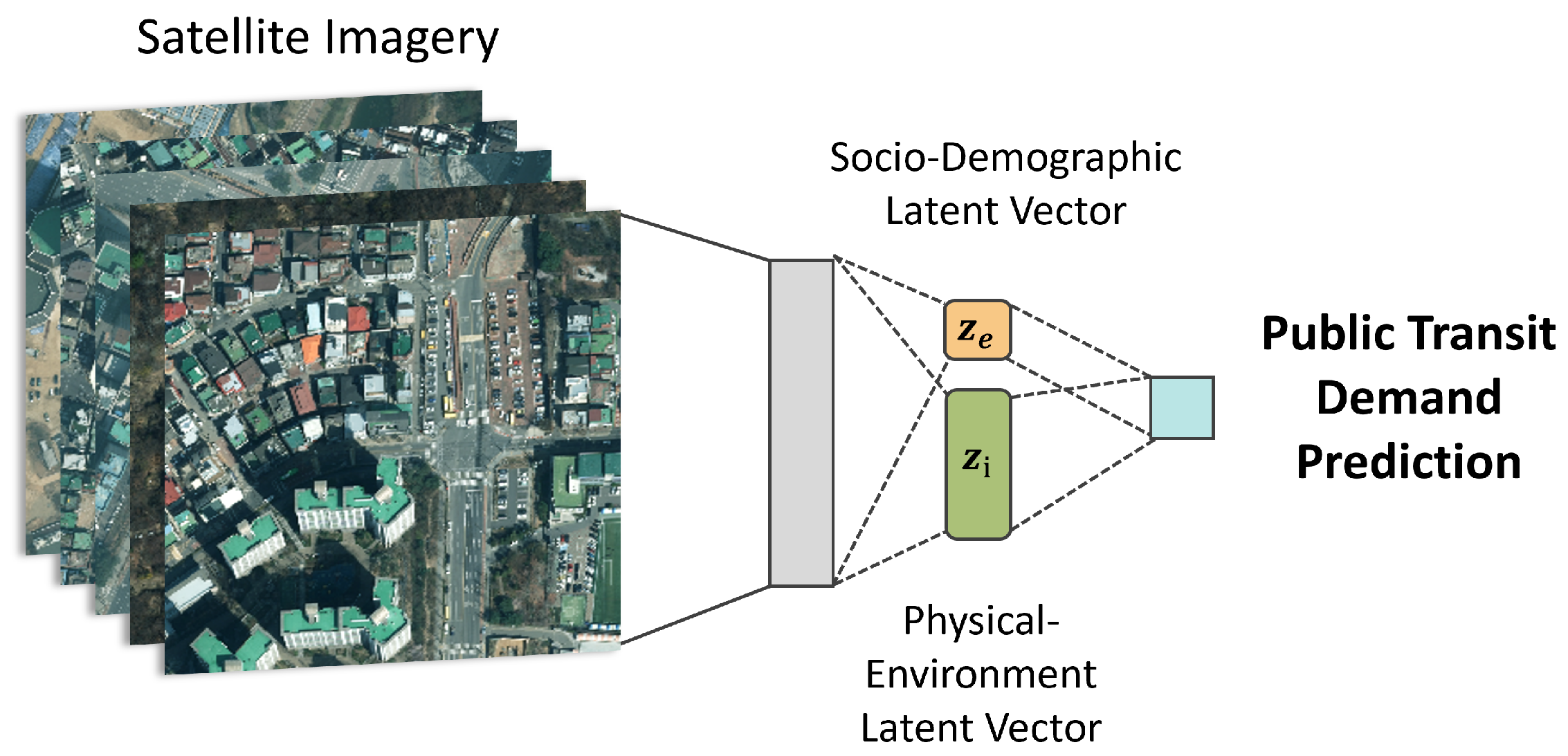
Predicting Public Transit Demand Using Urban Imagery with a Dual-Latent Deep Learning Framework

Abstract
1. Introduction
2. Literature Review
2.1. Public Transit Demand
2.2. Urban Imagery
3. Methodology
3.1. Problem Definition
3.2. Approach/Methodology
3.2.1. Training , the Sociodemographic Latent Vector
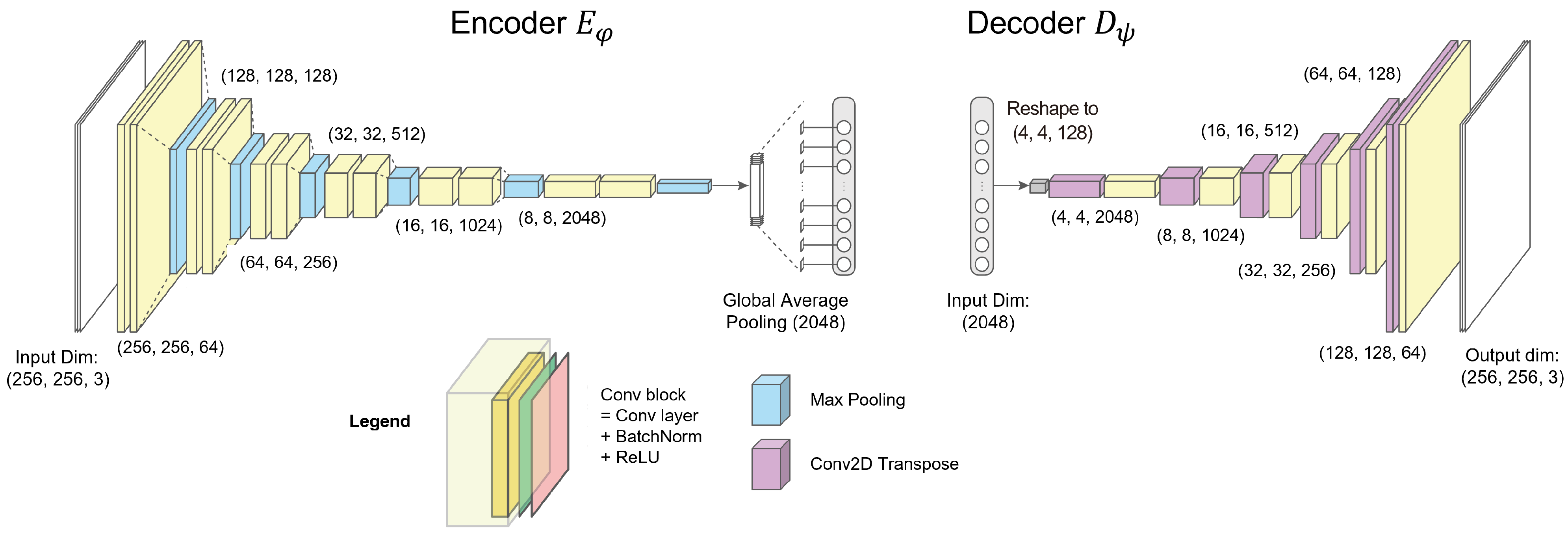
3.2.2. Training , the Physical Environment Latent Vector
3.2.3. Public Transit Ridership Prediction
4. Experiment Setting
4.1. Datasets
4.1.1. Aerial Photos
4.1.2. Sociodemographic Data
4.1.3. Public-Transit Ridership Data
4.2. Experiment Architecture Setting
4.3. Experimental Model Configurations
4.4. Evaluation Metrics
5. Results
5.1. Latent Vector
5.2. Latent Vector
5.3. Model Performance Analysis
5.4. Model Performance Across Modes
6. Discussion
6.1. Implications and Interpretation
6.2. Future Research Directions
6.2.1. External Validity
6.2.2. General Transportation Demand
6.2.3. Multiple Data Modalities
7. Conclusions
Author Contributions
Funding
Institutional Review Board Statement
Informed Consent Statement
Data Availability Statement
Conflicts of Interest
References
- Kaeoruean, K.; Phithakkitnukoon, S.; Demissie, M.G.; Kattan, L.; Ratti, C. Analysis of demand–supply gaps in public transit systems based on census and GTFS data: A case study of Calgary, Canada. Public Transp. 2020, 12, 483–516. [Google Scholar] [CrossRef] [Scilit]
- Hoque, J.M.; Zhang, I.; Schmitt, D.; Erhardt, G.D. Are public transit investments based on accurate forecasts? An analysis of the improving trend of transit ridership forecasts in the United States. Transp. Res. Part A Policy Pract. 2024, 186, 104142. [Google Scholar] [CrossRef] [Scilit]
- Diab, E.; Kasraian, D.; Miller, E.J.; Shalaby, A. The rise and fall of transit ridership across Canada: Understanding the determinants. Transp. Policy 2020, 96, 101–112. [Google Scholar] [CrossRef] [Scilit]
- Neog, D.; Brown, J. Transit ridership growth in small urbanized areas: Lessons from seven US transit systems. J. Urban Plan. Dev. 2022, 148, 05021051. [Google Scholar] [CrossRef] [Scilit]
- Urbanek, A.; Acedański, J.; Krawczyk, G. Depopulation or ageing? Decomposing the aggregate effects of projected demographic changes on urban transport systems. J. Transp. Geogr. 2023, 111, 103662. [Google Scholar] [CrossRef] [Scilit]
- Shao, Q.; Zhang, W.; Cao, X.; Yang, J.; Yin, J. Threshold and moderating effects of land use on metro ridership in Shenzhen: Implications for TOD planning. J. Transp. Geogr. 2020, 89, 102878. [Google Scholar] [CrossRef] [Scilit]
- Pasha, M.; Rifaat, S.M.; Tay, R.; De Barros, A. Effects of street pattern, traffic, road infrastructure, socioeconomic and demographic characteristics on public transit ridership. KSCE J. Civ. Eng. 2016, 20, 1017–1022. [Google Scholar] [CrossRef] [Scilit]
- Chi, M.; Plaza, A.; Benediktsson, J.A.; Sun, Z.; Shen, J.; Zhu, Y. Big data for remote sensing: Challenges and opportunities. Proc. IEEE 2016, 104, 2207–2219. [Google Scholar] [CrossRef] [Scilit]
- Zhao, J.; Deng, W.; Song, Y.; Zhu, Y. Analysis of Metro ridership at station level and station-to-station level in Nanjing: An approach based on direct demand models. Transportation 2014, 41, 133–155. [Google Scholar] [CrossRef] [Scilit]
- Cardozo, O.D.; García-Palomares, J.C.; Gutiérrez, J. Application of geographically weighted regression to the direct forecasting of transit ridership at station-level. Appl. Geogr. 2012, 34, 548–558. [Google Scholar] [CrossRef] [Scilit]
- He, Y.; Zhao, Y.; Tsui, K.L. Geographically modeling and understanding factors influencing transit ridership: An empirical study of Shenzhen metro. Appl. Sci. 2019, 9, 4217. [Google Scholar] [CrossRef] [Scilit]
- Yan, X.; Liu, X.; Zhao, X. Using machine learning for direct demand modeling of ridesourcing services in Chicago. J. Transp. Geogr. 2020, 83, 102661. [Google Scholar] [CrossRef] [Scilit]
- Shao, Z.; Tang, P.; Wang, Z.; Saleem, N.; Yam, S.; Sommai, C. BRRNet: A fully convolutional neural network for automatic building extraction from high-resolution remote sensing images. Remote Sens. 2020, 12, 1050. [Google Scholar] [CrossRef] [Scilit]
- Cervero, R.; Murakami, J.; Miller, M. Direct ridership model of bus rapid transit in Los Angeles County, California. Transp. Res. Rec. 2010, 2145, 1–7. [Google Scholar] [CrossRef] [Scilit]
- Mucci, R.A.; Erhardt, G.D. Evaluating the ability of transit direct ridership models to forecast medium-term ridership changes: Evidence from San Francisco. Transp. Res. Rec. 2018, 2672, 21–30. [Google Scholar] [CrossRef] [Scilit]
- Pinho, P.; Lopes, M.; Altieri, M.; e Sá, F.M.; Silva, C.; Amante, A. The application of direct ridership models in the evaluation of the expansion of the Porto Light Rail Transit. Case Stud. Transp. Policy 2024, 18, 101282. [Google Scholar] [CrossRef] [Scilit]
- Driscoll, R.A.; Lehmann, K.R.; Polzin, S.; Godfrey, J. The effect of demographic changes on transit ridership trends. Transp. Res. Rec. 2018, 2672, 870–878. [Google Scholar] [CrossRef] [Scilit]
- Rahman, M.; Yasmin, S.; Faghih-Imani, A.; Eluru, N. Examining the Bus Ridership Demand: Application of Spatio-Temporal Panel Models. J. Adv. Transp. 2021, 2021, 8844743. [Google Scholar] [CrossRef] [Scilit]
- Durning, M.; Townsend, C. Direct ridership model of rail rapid transit systems in Canada. Transp. Res. Rec. 2015, 2537, 96–102. [Google Scholar] [CrossRef] [Scilit]
- Guo, R.; Huang, Z. Mass rapid transit ridership forecast based on direct ridership models: A case study in Wuhan, China. J. Adv. Transp. 2020, 2020, 7538508. [Google Scholar] [CrossRef] [Scilit]
- Li, L.; Zhong, L.; Ran, B.; Du, B. Analysis of the relationship between metro ridership and built environment: A machine learning method considering combinational features. Tunn. Undergr. Space Technol. 2024, 144, 105564. [Google Scholar] [CrossRef] [Scilit]
- Jun, M.J.; Choi, K.; Jeong, J.E.; Kwon, K.H.; Kim, H.J. Land use characteristics of subway catchment areas and their influence on subway ridership in Seoul. J. Transp. Geogr. 2015, 48, 30–40. [Google Scholar] [CrossRef] [Scilit]
- Albert, A.; Kaur, J.; Gonzalez, M.C. Using Convolutional Networks and Satellite Imagery to Identify Patterns in Urban Environments at a Large Scale. In Proceedings of the 23rd ACM SIGKDD International Conference on Knowledge Discovery and Data Mining (KDD ’17), Halifax, NS, Canada, 13–17 August 2017; Association for Computing Machinery: New York, NY, USA, 2017; pp. 1357–1366. [Google Scholar] [CrossRef] [Scilit]
- Pastorino, M.; Gallo, F.; Di Febbraro, A.; Moser, G.; Sacco, N.; Serpico, S.B. Multimodal Fusion of Mobility Demand Data and Remote Sensing Imagery for Urban Land-Use and Land-Cover Mapping. Remote Sens. 2022, 14, 3370. [Google Scholar] [CrossRef] [Scilit]
- Khan, M.; Hanan, A.; Kenzhebay, M.; Gazzea, M.; Arghandeh, R. Transformer-based land use and land cover classification with explainability using satellite imagery. Sci. Rep. 2024, 14, 16744. [Google Scholar] [CrossRef] [Scilit] [PubMed]
- Singleton, A.; Arribas-Bel, D.; Murray, J.; Fleischmann, M. Estimating generalized measures of local neighbourhood context from multispectral satellite images using a convolutional neural network. Comput. Environ. Urban Syst. 2022, 95, 101802. [Google Scholar] [CrossRef] [Scilit]
- Baragwanath, K.; Goldblatt, R.; Hanson, G.; Khandelwal, A.K. Detecting urban markets with satellite imagery: An application to India. J. Urban Econ. 2021, 125, 103173. [Google Scholar] [CrossRef] [Scilit]
- Putri, S.R.; Wijayanto, A.W.; Pramana, S. Multi-source satellite imagery and point of interest data for poverty mapping in East Java, Indonesia: Machine learning and deep learning approaches. Remote Sens. Appl. Soc. Environ. 2023, 29, 100889. [Google Scholar] [CrossRef] [Scilit]
- Arshad, A.; Zulfiqar, J.; Zaib, M.H.; Khan, A.; Khan, M.J. Mapping socioeconomic conditions using satellite imagery: A computer vision approach for developing countries. J. Econ. Technol. 2023, 1, 144–163. [Google Scholar] [CrossRef] [Scilit]
- Ayush, K.; Uzkent, B.; Burke, M.; Lobell, D.; Ermon, S. Generating Interpretable Poverty Maps using Object Detection in Satellite Images. arXiv 2020, arXiv:2002.01612. [Google Scholar] [CrossRef] [Scilit]
- Dasgupta, N. Using satellite images of nighttime lights to predict the economic impact of COVID-19 in India. Adv. Space Res. 2022, 70, 863–879. [Google Scholar] [CrossRef] [Scilit]
- Son, J.Y.; Lane, K.J.; Lee, J.T.; Bell, M.L. Urban vegetation and heat-related mortality in Seoul, Korea. Environ. Res. 2016, 151, 728–733. [Google Scholar] [CrossRef] [Scilit]
- Zhang, C.; Wei, S.; Ji, S.; Lu, M. Detecting Large-Scale Urban Land Cover Changes from Very High Resolution Remote Sensing Images Using CNN-Based Classification. ISPRS Int. J. Geo-Inf. 2019, 8, 189. [Google Scholar] [CrossRef] [Scilit]
- Fu, Y.; Chai, H.; Zhen, Z.; Wang, F.; Xu, X.; Li, K.; Shafie-Khah, M.; Dehghanian, P.; Catalão, J.P. Sky image prediction model based on a convolutional auto-encoder for minutely solar PV power forecasting. IEEE Trans. Ind. Appl. 2021, 57, 3272–3281. [Google Scholar] [CrossRef] [Scilit]
- Li, S.; Yang, H.; Zhang, G.; Ling, Z.; Xiong, Y.; Li, Y. What is the best catchment area of a metro station? A study based on station level ridership modeling. In Proceedings of the 2019 5th International Conference on Transportation Information and Safety (ICTIS), Liverpool, UK, 14–17 July 2019; IEEE: Piscataway, NJ, USA, 2019; pp. 1239–1244. [Google Scholar]
- Noh, N.M.; Mohamad, D.; Hamid, A.H.A. Acceptable walking distance accessible to the nearest bus stop considering the service coverage. In Proceedings of the 2021 International Congress of Advanced Technology and Engineering (ICOTEN), Virtual, 4–5 July 2021; IEEE: Piscataway, NJ, USA, 2021; pp. 1–7. [Google Scholar]
- Mulley, C.; Ho, C.; Ho, L.; Hensher, D.; Rose, J. Will bus travellers walk further for a more frequent service? An international study using a stated preference approach. Transp. Policy 2018, 69, 88–97. [Google Scholar] [CrossRef] [Scilit]
- Kabra, A.; Belavina, E.; Girotra, K. Bike-share systems: Accessibility and availability. Manag. Sci. 2020, 66, 3803–3824. [Google Scholar] [CrossRef] [Scilit]
- Zhang, G.; Yang, H.; Li, S.; Wen, Y.; Li, Y.; Liu, F. What is the best catchment area of bike share station? A study based on Divvy system in Chicago, USA. In Proceedings of the 2019 5th International Conference on Transportation Information and Safety (ICTIS), Liverpool, UK, 14–17 July 2019; IEEE: Piscataway, NJ, USA, 2019; pp. 1226–1232. [Google Scholar]
- Zhang, Y.; Thomas, T.; Brussel, M.; Van Maarseveen, M. Exploring the impact of built environment factors on the use of public bikes at bike stations: Case study in Zhongshan, China. J. Transp. Geogr. 2017, 58, 59–70. [Google Scholar] [CrossRef] [Scilit]
- Wang, Q.; Wang, S.; Zheng, Y.; Lin, H.; Zhang, X.; Zhao, J.; Walker, J. Deep hybrid model with satellite imagery: How to combine demand modeling and computer vision for travel behavior analysis? Transp. Res. Part Methodol. 2024, 179, 102869. [Google Scholar] [CrossRef] [Scilit]
- Cao, R.; Zhu, J.; Tu, W.; Li, Q.; Cao, J.; Liu, B.; Zhang, Q.; Qiu, G. Integrating Aerial and Street View Images for Urban Land Use Classification. Remote Sens. 2018, 10, 1553. [Google Scholar] [CrossRef] [Scilit]
- Davenport, F.M.; Harrison, L.; Shukla, S.; Husak, G.; Funk, C.; McNally, A. Using out-of-sample yield forecast experiments to evaluate which earth observation products best indicate end of season maize yields. Environ. Res. Lett. 2019, 14, 124095. [Google Scholar] [CrossRef] [Scilit]
- Li, T.; Xin, S.; Xi, Y.; Tarkoma, S.; Hui, P.; Li, Y. Predicting multi-level socioeconomic indicators from structural urban imagery. In Proceedings of the 31st ACM International Conference on Information & Knowledge Management, Atlanta, GA, USA, 17–21 October 2022; pp. 3282–3291. [Google Scholar]
- Yeh, C.; Perez, A.; Driscoll, A.; Azzari, G.; Tang, Z.; Lobell, D.; Ermon, S.; Burke, M. Using publicly available satellite imagery and deep learning to understand economic well-being in Africa. Nat. Commun. 2020, 11, 2583. [Google Scholar] [CrossRef] [Scilit]






| Category | Type | Mean | Std. | Min | 25% | 50% | 75% | Max |
|---|---|---|---|---|---|---|---|---|
| Subway | Board | 49,108 | 89,068 | 0 | 0 | 8585 | 62,544 | 885,935 |
| Alight | 49,212 | 90,358 | 0 | 0 | 8358 | 62,172 | 886,440 | |
| Bus | Board | 43,035 | 51,105 | 0 | 4388 | 29,814 | 59,787 | 548,993 |
| Alight | 42,073 | 48,528 | 0 | 4652 | 30,252 | 60,311 | 572,287 | |
| Public Bike | Rentals | 908 | 1240 | 0 | 25 | 441 | 1292 | 11,037 |
| Model | Input | Configuration |
|---|---|---|
| Model 1 | ||
| Model 2 | ||
| Model 3 | ||
| Model 4 |
| Category | Metric | Model 1 | Model 2 | Model 3 | Model 4 |
|---|---|---|---|---|---|
| Subway | |||||
| Board | −1.27 | 0.25 | 0.44 | 0.22 | |
| RMSE | 61,244 | 54,670 | 48,444 | 59,545 | |
| sMAPE (%) | 125.54 | 71.93 | 50.29 | 85.55 | |
| Alight | −0.02 | 0.15 | 0.38 | 0.18 | |
| RMSE | 63,991 | 57,267 | 49,217 | 59,941 | |
| sMAPE (%) | 126.70 | 74.09 | 52.11 | 85.85 | |
| Bus | |||||
| Board | 0.38 | 0.43 | 0.31 | 0.27 | |
| RMSE | 30,832 | 29,792 | 32,284 | 33,230 | |
| sMAPE (%) | 72.20 | 41.76 | 65.11 | 68.06 | |
| Alight | 0.31 | 0.46 | 0.38 | 0.34 | |
| RMSE | 33,125 | 29,812 | 31,683 | 32,783 | |
| sMAPE (%) | 73.48 | 37.89 | 61.82 | 63.27 | |
| Public Bike | |||||
| Rentals | 0.42 | 0.56 | 0.61 | 0.31 | |
| RMSE | 1189 | 1048 | 979 | 1309 | |
| sMAPE (%) | 84.82 | 57.79 | 51.57 | 61.30 | |
Disclaimer/Publisher’s Note: The statements, opinions and data contained in all publications are solely those of the individual author(s) and contributor(s) and not of MDPI and/or the editor(s). MDPI and/or the editor(s) disclaim responsibility for any injury to people or property resulting from any ideas, methods, instructions or products referred to in the content. |
© 2025 by the authors. Licensee MDPI, Basel, Switzerland. This article is an open access article distributed under the terms and conditions of the Creative Commons Attribution (CC BY) license.
Share and Cite
Ko, E.; Park, G.; Choo, S. Predicting Public Transit Demand Using Urban Imagery with a Dual-Latent Deep Learning Framework. Sustainability 2026, 18, 67. https://doi.org/10.3390/su18010067
Ko E, Park G, Choo S. Predicting Public Transit Demand Using Urban Imagery with a Dual-Latent Deep Learning Framework. Sustainability. 2026; 18(1):67. https://doi.org/10.3390/su18010067
Chicago/Turabian StyleKo, Eunseo, Gitae Park, and Sangho Choo. 2026. "Predicting Public Transit Demand Using Urban Imagery with a Dual-Latent Deep Learning Framework" Sustainability 18, no. 1: 67. https://doi.org/10.3390/su18010067
APA StyleKo, E., Park, G., & Choo, S. (2026). Predicting Public Transit Demand Using Urban Imagery with a Dual-Latent Deep Learning Framework. Sustainability, 18(1), 67. https://doi.org/10.3390/su18010067