Quantitative Measurement of Digital Maturity in Manufacturing Enterprises: An Application Scenario-Based Study


Abstract
1. Introduction
2. Literature Review
2.1. Evaluation Level and Scope
2.2. Purpose of Model Evaluation
2.3. Data for Model Evaluation
2.4. Evaluation Methods
2.5. Summary of the Research State and Trends
- (1)
- Dominant focus on maturity and readiness evaluation
- (2)
- Emphasis on strategic-level evaluation
- (3)
- Prevalence of survey-based data and underuse of real-time or system data
- (4)
- Synthesized gaps
- Lack of Function- and Scenario-Level Diagnostics: Existing models predominantly focus on organization- or strategy-level assessments, providing limited insight into how specific business functions or application scenarios progress asynchronously during digital transformation.
- Dependence on Subjective, Survey-Based Data: The dominance of self-reported questionnaires and expert scoring limits scalability, continuity, and objectivity, while underutilizing the potential of publicly available or system-generated data.
- Limited Use of Data-Driven and Text-Based Semantic Modeling: Although some models integrate quantitative and hybrid approaches, the systematic use of text mining and advanced semantic models (e.g., LLMs) to extract and quantify digital practices from unstructured data is still rare.
- Modularity—Each function is evaluated independently, capturing asynchronous transformation progress across different areas.
- Objectivity—System-generated or publicly available data are used, rather than purely subjective judgments.
- Practicality—The model employs clear evaluation logic with a low data collection burden, supporting benchmarking, monitoring, and cross-functional comparison without imposing excessive reporting requirements on firms.
- Quantifiability—Targeted, quantitative diagnostics guide stepwise transformation aligned with varied maturity levels and functional priorities.
3. Scenario-Based Framework for Quantitative Evaluation of Digital Transformation in Manufacturing Enterprises
3.1. Digital Transformation Application Scenarios in Manufacturing Enterprises
3.2. Challenges in Using Annual Report Data to Evaluate Digital Transformation
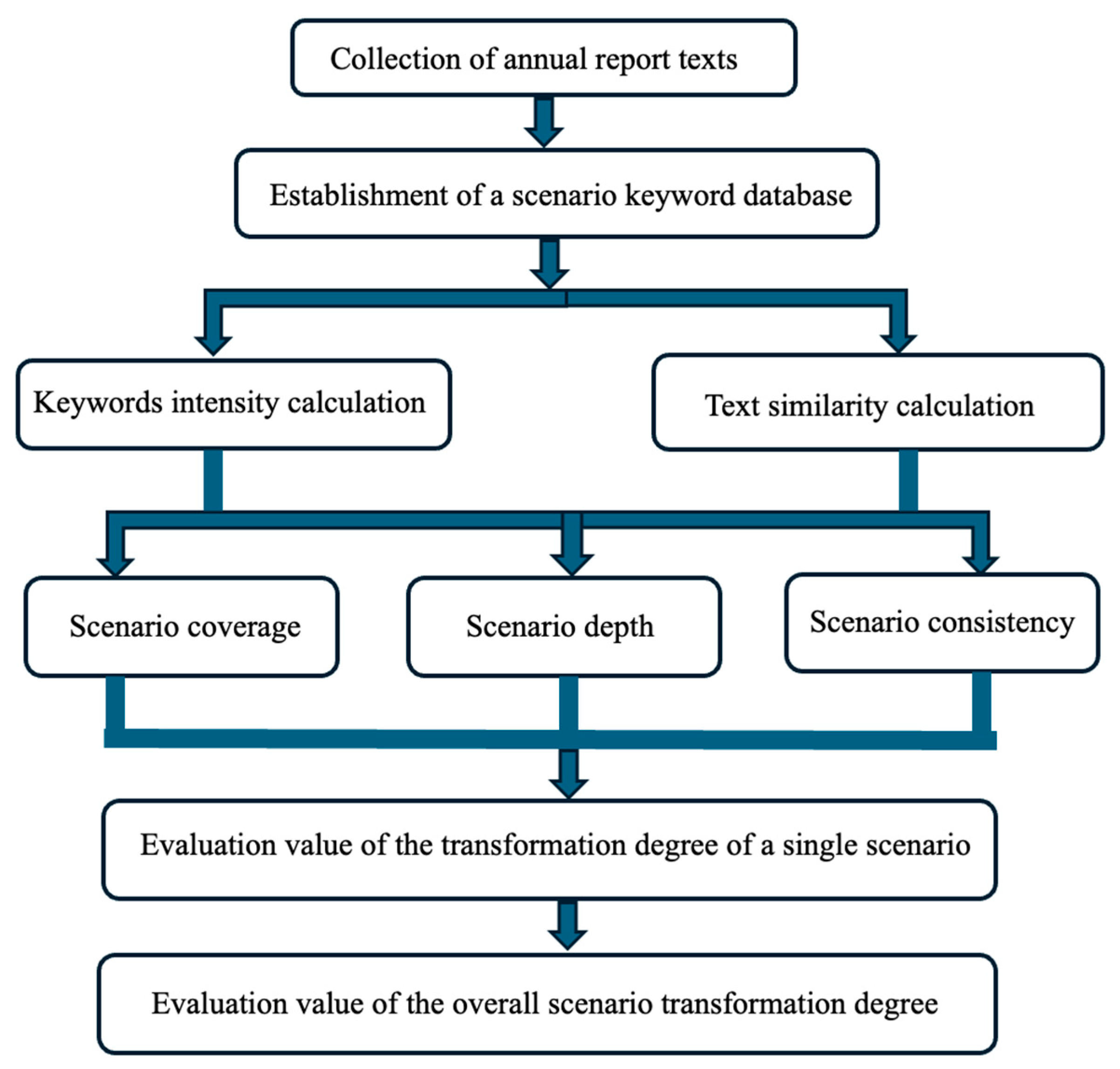
3.3. Evaluation Framework and Procedure
- (1)
- Annual reports data collection and preprocessing
- (2)
- Definition of scenario keywords
- (3)
- Calculation of scenario keyword intensity
- (4)
- Semantic similarity calculation
- (5)
- Three-dimensional evaluation
4. Data Example and Analysis
4.1. Annual Report Data Acquisition and Sampling Strategy
4.2. Three-Dimensional Keyword Mapping Table Construction
4.3. Evaluation Process
4.3.1. Calculation of Keyword Intensity
4.3.2. Calculation of Semantic Similarity
5. Evaluation Results and Trend Analysis
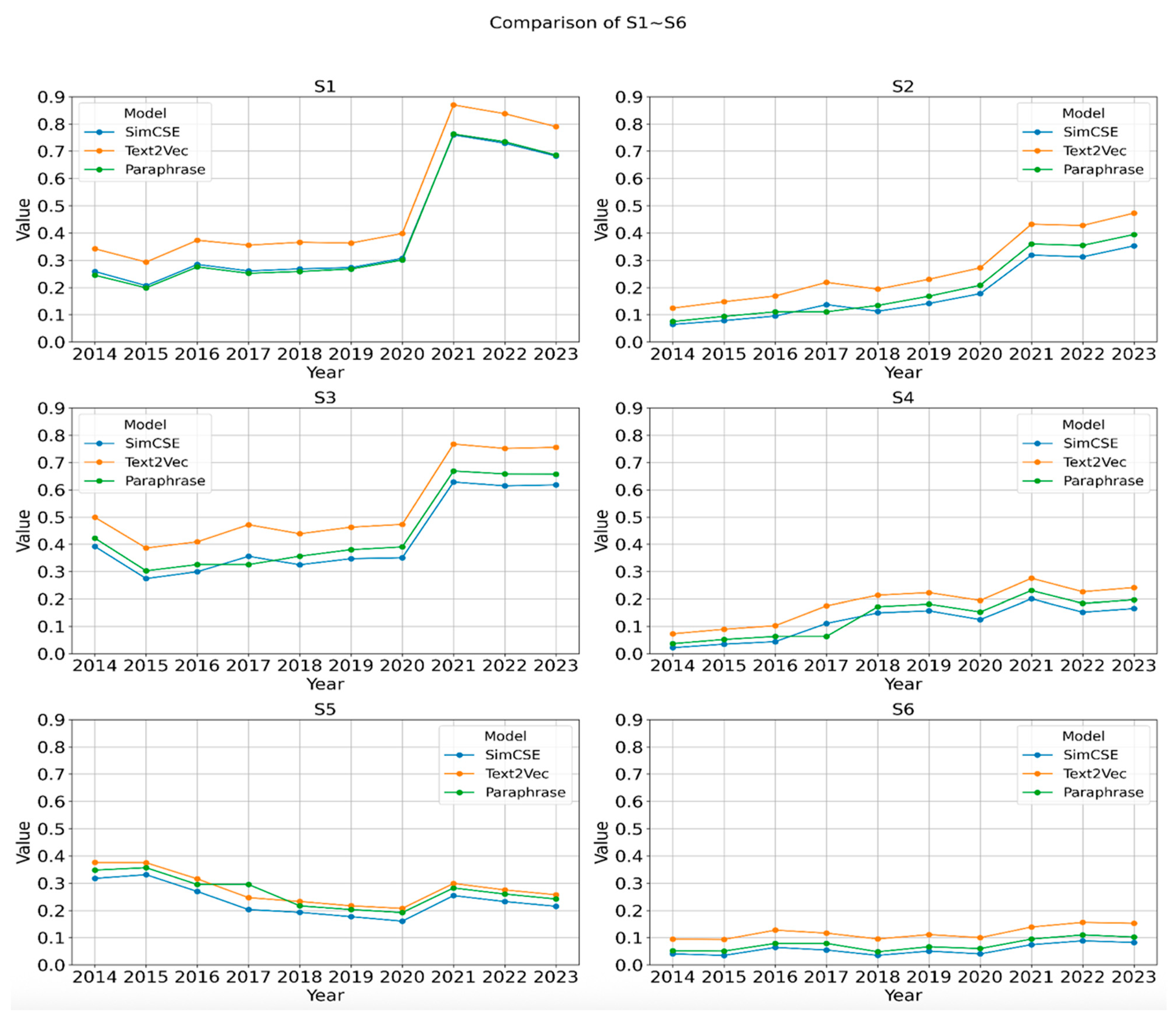
5.1. Comparative Analysis Across Models
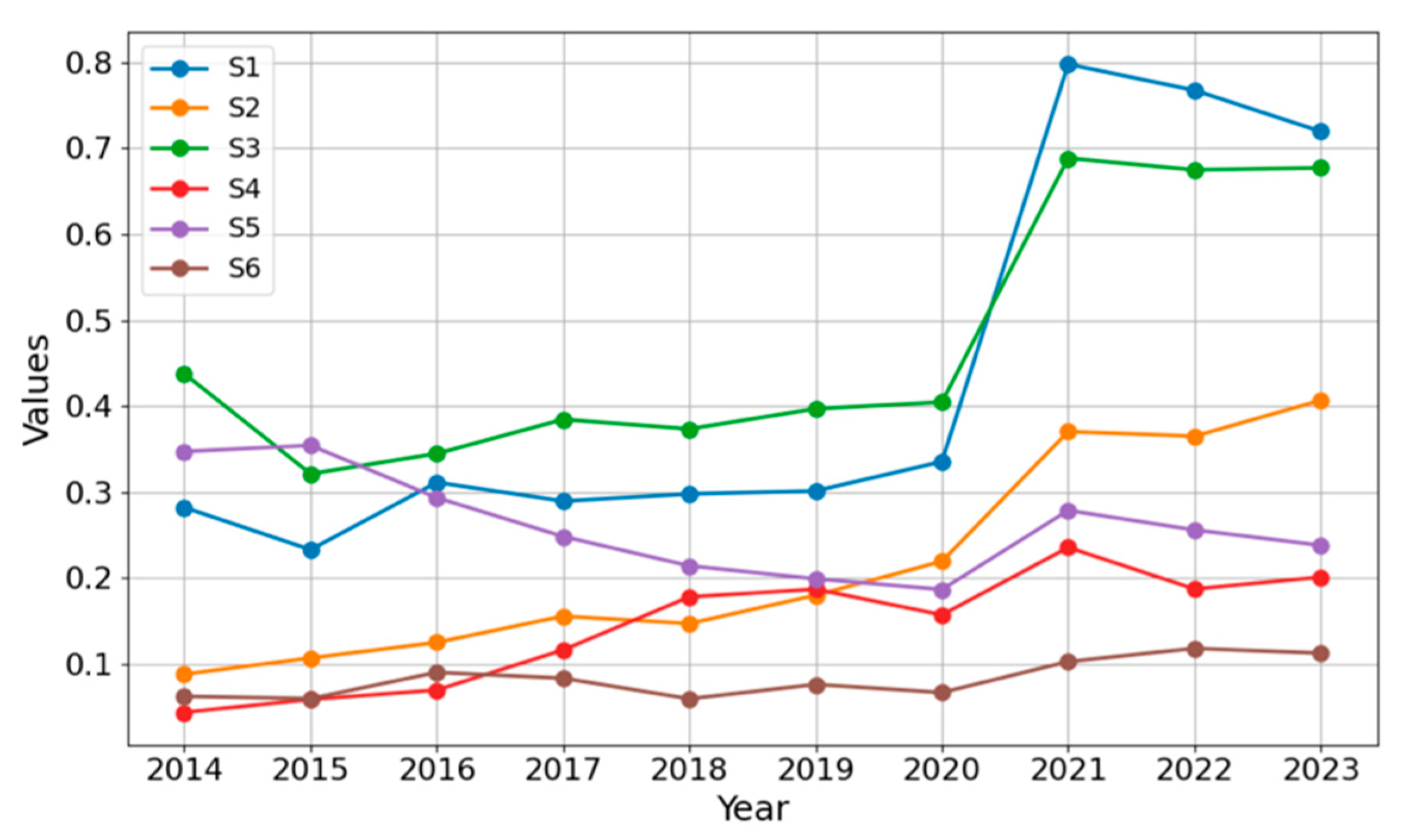
5.2. Overall Analysis of Digital Transformation Trends Across Enterprise Scenarios
5.3. Correspondence Between Enterprise Digital Maturity Trends and Stages of Intelligent Manufacturing Advancement in Zhejiang Province
5.4. Other Issues Identified in the Ten-Year Scenario-Based Digital Transformation Evaluation
- (1)
- Variations in the Clarity of Digital Transformation Expressions across Business Scenarios
- (2)
- Time Lag between Policy Priorities and the Transformation Effects Reflected in Textual Expressions
5.5. Sensitivity and Robustness Analysis
5.5.1. Cross Model Robustness
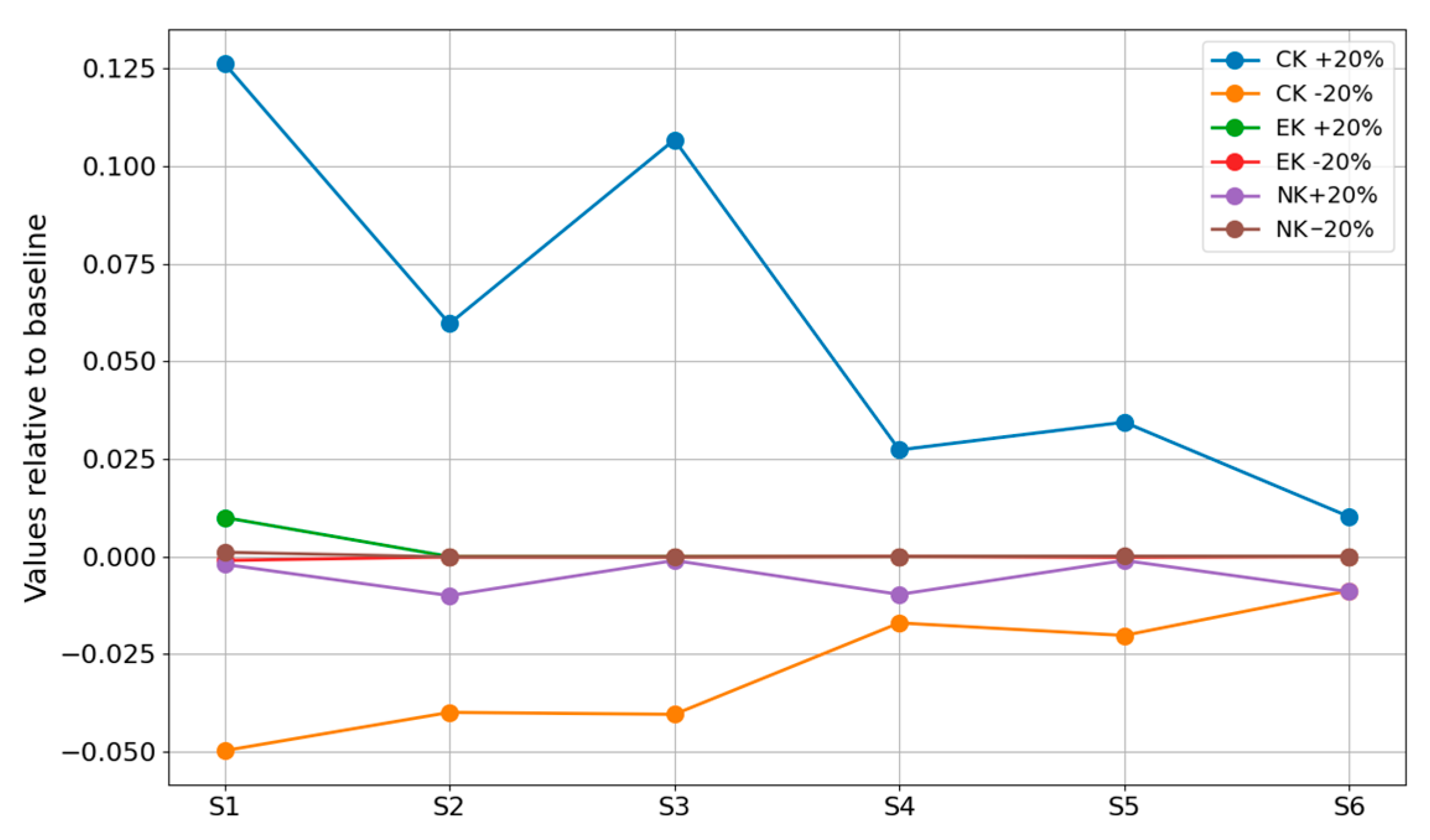
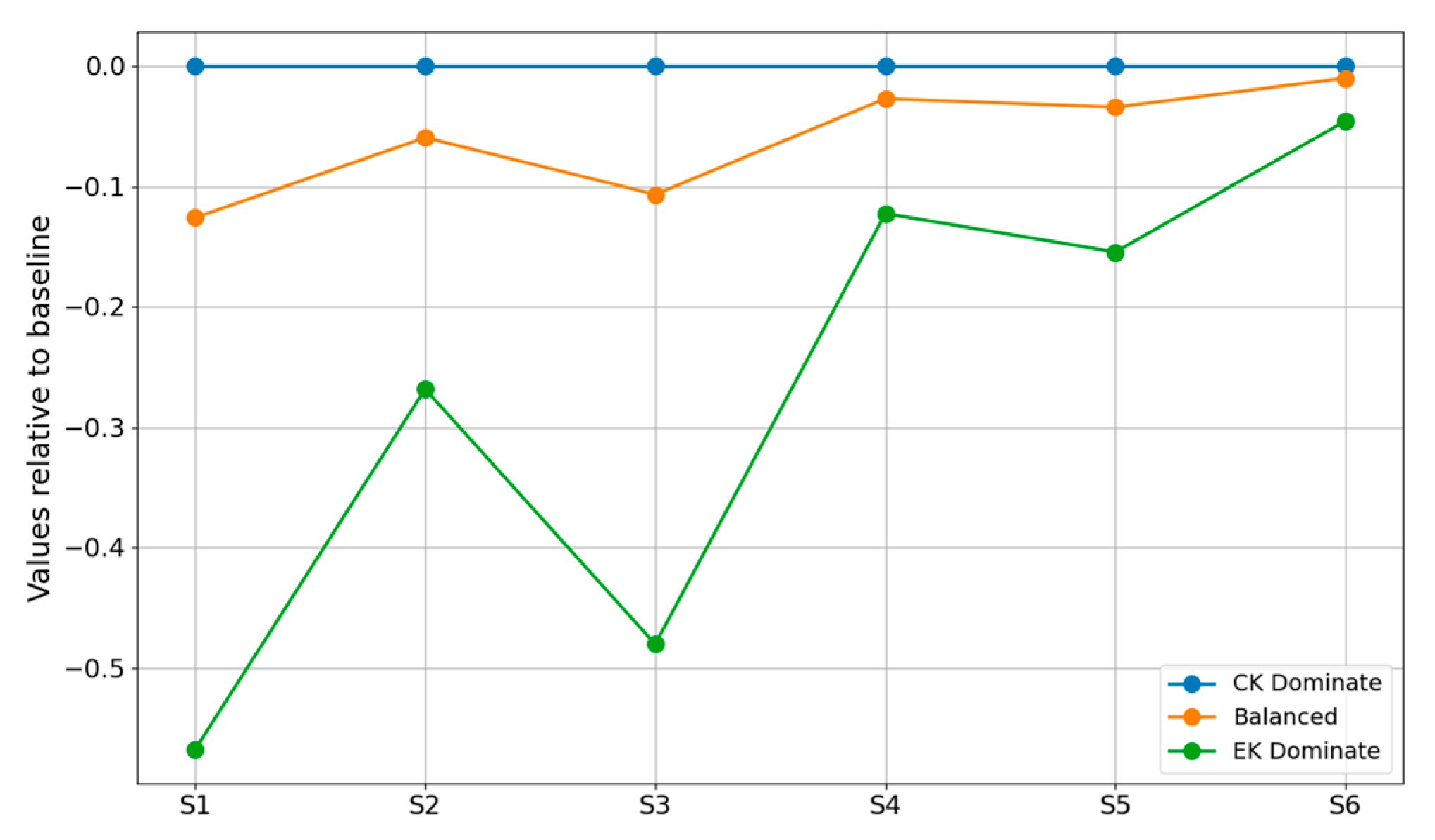
5.5.2. Sensitivity to Keyword Weights
- (1)
- Single-factor perturbation (±20% weight change):
- (2)
- Extreme Weight Configurations
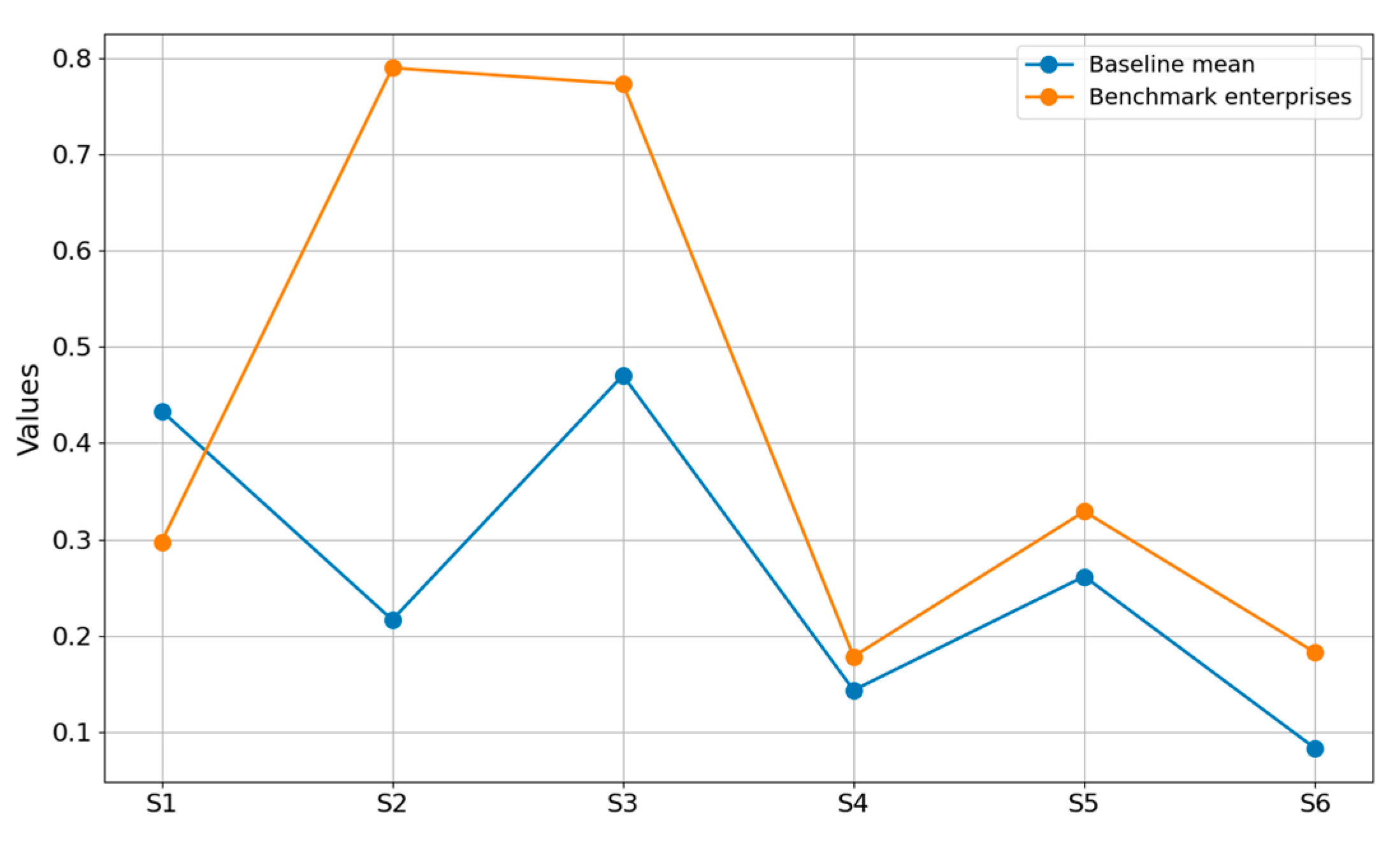
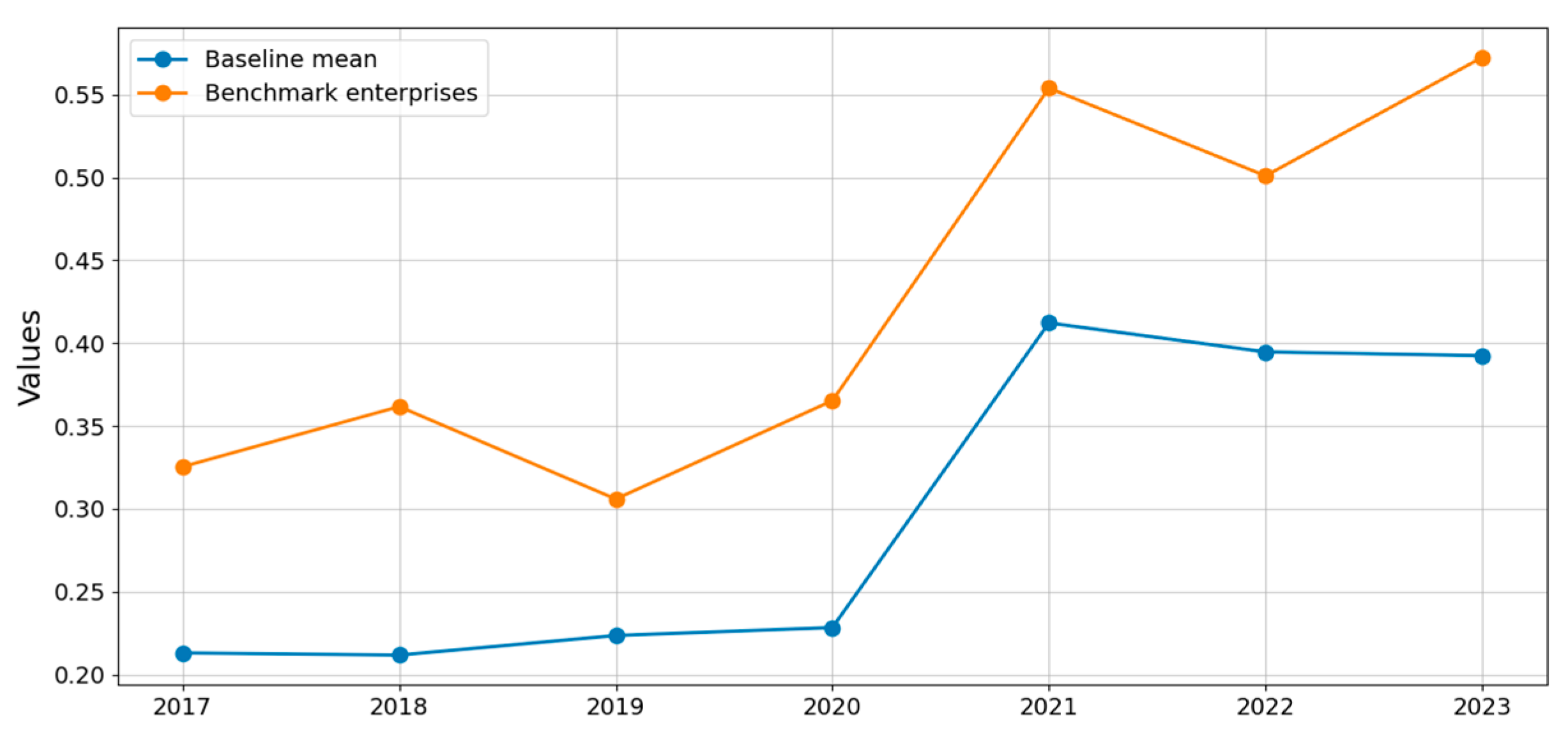
5.5.3. External Validity: Benchmark Enterprises vs. Other Firms
6. Discussion
6.1. Summary of Methods
6.2. Limitations and Future Improvements
Author Contributions
Funding
Institutional Review Board Statement
Informed Consent Statement
Data Availability Statement
Conflicts of Interest
Appendix A. Calculation of Semantic Similarity
- Step 1: Based on the predefined scenario keywords, they are input into the LLM to obtain word vector representations, which serve as semantic anchors.
- Step 2: The LLM performs context-aware encoding of the target text. Specifically, the annual report text under analysis is input into the LLM to generate high-dimensional semantic vectors that capture contextual relevance.
- Step 3: Cosine similarity is applied to calculate the similarity between the semantic anchors and the target text vectors. The results are normalized to a range between 0 and 1. The cosine similarity is computed as follows:
Appendix B. Calculation of the Scenario Coverage and Scenario Depth
- : the ith scenario, , is the amount of scenario.
- : word frequency of the jth core keywords (CK) in the ith scenario, , is the number of detected core keywords (CK) in the ith scenario.
- : word frequency of the jth extended keywords (EK) in the ith scenario, , is the number of detected extended keywords (EK) in the ith scenario.
- : word frequency of the jth negative keywords (NK) in the ith scenario, , is the number of detected negative keywords (NK) in the ith scenario.
- : weight of the core keywords (CK), ,
- : weight of the extended keywords (EK),, and > ;
- : weight of the negative keywords (NK),.
Appendix C. Scenario Keywords
| Scenario | Scenario Keywords | ||
| Core Keywords | Extended Keywords | Negative Keywords | |
| R&D design | Digital Twin; Virtual Reality (VR); Augmented Reality (AR); Mixed Reality (MR); 3D Optimization Design; Computer-Aided Design (CAD); Digital Mock-Up (DMU); Model-Driven Design (MDD); Product Platform Design; Virtual Process Simulation; Digital Factory; Numerical Control (NC); Product Lifecycle Management (PLM); Model-Based Systems Engineering (MBSE); Text Mining; Heterogeneous Data; Digital Communication; Digital Control; Digital Network; Image Understanding; Semantic Search; Visual Recognition; 3D Printing/Additive Manufacturing; 3D Technology; Digital Thread; Parametric Design; Topology Optimization; Simulation and Verification Platform; Multiphysics Coupling Analysis; Modular Architecture; Collaborative Design Platform; Virtual Verification Platform; Design Knowledge Base; Reverse Engineering Technology; Lightweight Design; Thermodynamic Simulation; Computational Fluid Dynamics (CFD) Analysis; Electronic Design Automation (EDA); Materials Database; Digital Prototype Iteration | Investment in R&D Digital transformation; Investment in Digital Mock-Up (DMU) Development; Investment in Reverse Engineering; Optimization of R&D Expense Ratio; Capitalization of R&D Expenses; R&D Digital transformation Strategy; R&D Innovation Incentive Mechanism; R&D Talent Reserve; Industry-Academia-Research Collaboration Achievements; Virtual Simulation Capability Building; Process Simulation Platform Development; Digital Twin Verification; Thermodynamic Simulation Capability; Simulation Verification Coverage; Improvement of Simulation Confidence; Cross-Platform Collaborative Development; Application of Intelligent Design Tools; Modular Design System; Application of Parametric Design; Forward Design Capability; Exploration of Generative Design; Application of Intelligent Correction Systems; Application of Smart Materials; R&D Cycle Reduction Indicator; Design Achievement Conversion Rate; Intellectual Property Commercialization; Patent Conversion of R&D Achievements; Improvement of Design Reuse Rate; Design Asset Reuse Rate; Improvement of R&D Efficiency; Design Iteration Speed; Enhancement of R&D Knowledge Base; Multidisciplinary Collaboration Mechanism; R&D Process Reengineering; Design Standardization Rate; 3D Model Coverage Rate; Electronic Design Automation (EDA); Digital transformation Rate of R&D Equipment; Breakthrough in Lightweight Design; Integration of the Digital Thread | Insufficient R&D Investment; Outdated Design Tools; Lack of Simulation and Verification; Dependence on 2D Drawings; High Cost of Physical Prototypes; Low Design Reuse Rate; Weak Intellectual Property Commercialization; Insufficient Cross-Department Collaboration; Excessive R&D Cycle Time; Lack of Forward Design Capability; Limited Application of Parametric Design; Absence of Modular Design; Fragmented Knowledge Management; Weak Reverse Engineering Capability; Insufficient Thermodynamic Verification; Lack of Materials Database; Absence of Industry-Academia-Research Collaboration; Non-Standardized R&D Processes; Frequent Design Changes; Imbalanced R&D Expense Ratio; Shortage of Digital Talent; Lagging Lightweight Technology; Insufficient Simulation Confidence; Dependence on Outsourced Electronic Design; Lack of Innovation Incentive Mechanism; Low Patent Output Efficiency; Low Process Simulation Coverage; Obsolete R&D Equipment; Disconnected Digital Thread; Absence of Intelligent Correction Systems; Insufficient Design Asset Reuse; Lack of Collaborative Development Platform; Low R&D Achievement Conversion Rate; Delayed Verification Platform Development; Insufficient Multidisciplinary Coupling; Low Design Standardization Rate; Lag in R&D Process Digital transformation; Slow Design Iteration Speed; Lack of Intelligent Material Selection; Unclear R&D Strategy |
| Production and manufacturing | Intelligent Manufacturing; Smart Factory; Industrial Robots; Machine Substitution for Labor; Human-Machine Collaboration; Automated Production Line; Manufacturing Execution System (MES); Distributed Control System (DCS); Production Process Optimization; Intelligent Quality Inspection; Automatic Monitoring; Automated Inspection; Automated Production; Flexible Manufacturing; Precision Manufacturing; Lean Production; Industry 4.0; Industrial Cloud; Digital Factory; Virtual Manufacturing; Lighthouse Factory | Future Factory; Intelligent Fault Diagnosis; Intelligent Production Line; Smart Workshop; Self-Optimizing Process Parameters; Adaptive Machining System; Production Line Digital Twin; Real-Time Energy Consumption Regulation | Automated Defect Classification; Equipment OEE Improvement; Intelligent Work Order Scheduling; Optimization of Material Readiness Rate; Process Knowledge Graph; Error-Proofing and Traceability System; Production Takt Balancing; Predictive Equipment Maintenance; Human-Machine Safety Interlock; Mold Life Prediction; Energy-Carbon Collaborative Management | Investment in Smart Factory Development; Improvement of Equipment Connectivity Rate; Effectiveness of Production Process Optimization; Progress of Automation Upgrades; Flexible Manufacturing Capability Development; Enhancement of Quality Traceability System; Digital Energy Consumption Management; Production Line OEE Improvement; Self-Optimizing Process Parameters; Predictive Maintenance Coverage Rate; Application of Digital Twin Factory; Lighthouse Factory Certification; Completion Rate of Machine Substitution for Labor; Coverage Rate of Smart Warehousing; Optimization of Production Takt; Accumulation of Process Knowledge; Standardization of Equipment Interconnection Protocols; Benchmarking Management of Energy Consumption; Reduction in Carbon Emission Intensity; Scrap Recycling Utilization Rate; Intelligent Manufacturing Demonstration Projects; Industrial Robot Density; Breakthrough of Process Bottlenecks; Application of Dynamic Scheduling System; Flexibility of Production Line Reconfiguration; Intelligent Mold Management; Rapid Changeover Rate of Tooling; Tool Life Prediction System; Effectiveness of Energy-Carbon Collaboration; Coverage Rate of Intelligent Inspection; Closed-Loop Rate of Quality Abnormalities; Digital transformation of Process Compliance; Equipment Health Management Platform; Automation of Production Reporting; Deepening of Manufacturing Execution System (MES); Preventive Maintenance Rate of Equipment; Material Readiness Early Warning System; Level of Production Visualization; Standardization Rate of Process Packages; Return on Investment in Intelligent Manufacturing | Low Equipment Automation Rate; Dependence on Experience for Process Parameters; Incomplete Quality Traceability; Extensive Energy Consumption Management; Insufficient Equipment Connectivity Rate; Lack of Production Line Flexibility; Absence of Process Knowledge Accumulation; Unstable Production Takt; Insufficient Digital transformation of Mold Management; Low Efficiency of Tooling Changeover; Uncontrollable Tool Wear; Unmonitored Carbon Emissions; Absence of Scrap Recycling System; Equipment OEE Below Industry Benchmark; Lack of Preventive Maintenance; Fluctuating Material Readiness Rate; Lagging Production Visualization; Manual Inspection for Process Compliance; Absence of Equipment Health Management; Insufficient Dynamic Scheduling Capability; Inadequate Investment in Intelligent Manufacturing; Low Industrial Robot Density; Delayed Lighthouse Factory Development; Absence of Digital Twin Applications; Slow Progress in Machine Substitution for Labor; Low Coverage of Smart Warehousing; Slow Response to Quality Abnormalities; Absence of Energy-Carbon Collaboration Mechanism; Persistent Process Bottlenecks; Manual Preparation of Production Reports; Shallow Application of Manufacturing Execution System (MES); Fragmented Equipment Interconnection Protocols; Absence of Energy Consumption Benchmarking System; Non-Compliance of Carbon Emission Intensity; Low Scrap Recycling Rate; Poor Flexibility of Production Reconfiguration; Non-Standardization of Process Packages; Absence of Intelligent Inspection Equipment; Insufficient Closed-Loop Rate of Quality Issues; ROI of Intelligent Manufacturing Below Expectations |
| Operations and maintenance services | Online Equipment Monitoring and Maintenance; Predictive Maintenance; Remote Energy Consumption Monitoring; Safety and Environmental Monitoring and Supervision; Intelligent Operation and Maintenance (O&M); Intelligent Customer Service; Smart Wearables; Smart Environmental Protection; Smart Transportation; Smart Healthcare; Internet of Things (IoT); Industrial Internet; Cyber-Physical Systems (CPS); Edge Computing; Remote Diagnosis; Aftermarket Services; Product Lifecycle Management (PLM); Fault Prediction; Smart Terminals; Digital Twin; Vibration Spectrum Analysis; Lubricant Condition Monitoring; Corrosion Rate Assessment; Equipment Health Index; Automated Service Work Orders; AR-Based Remote Guidance; Intelligent Spare Parts Recommendation; Customer Usage Behavior Analysis; Optimization of Service Response Time; Maintenance Knowledge Base; Service Revenue Management; Equipment Residual Value Assessment; Extended Warranty Service Design; Visualization of Service Network; Customer Satisfaction Modeling; Service Cost Attribution; 3D Printing of Service Spare Parts; Digital transformation of Service Contracts; Service Resource Scheduling; Service Risk Early Warning | Equipment Health Management System; Investment in Predictive Maintenance; Coverage Rate of Remote Diagnosis; Construction of Intelligent O&M Platform; Service Digital Transformation; Spare Parts Inventory Turnover Rate; Accuracy of Customer Profiling; Service Response Time Indicator; Application of AR-Based Remote Guidance; Enhancement of Maintenance Knowledge Base; Equipment Residual Value Assessment Model; Growth of Extended Warranty Service Revenue; Visualization of Service Network; Customer Satisfaction Modeling; Service Cost Attribution Analysis; Increase in Service Revenue Contribution; Equipment Migration Planning Capability; Digital transformation Rate of Service Contracts; Optimization of Service Resource Scheduling; Service Risk Early Warning System; Extension of Product Lifecycle; Service Revenue Growth Rate; Resolution Rate of Intelligent Customer Service; Contribution Rate of Aftermarket Services; Improvement of Service Gross Margin; Service Work Order Closed-Loop Rate; Equipment Performance Analysis Report; Standard Operating Procedures (SOP) for Services; Application of Service Scenario Simulation; Service Value Quantification System; Development of Service Digital Twin; Knowledge Management of Service Experience; Enhancement of Service Resource Profiling; Service Capability Evaluation Model; Timeliness of Service Anomaly Detection; Rate of Service Process Automation; Coverage Rate of Service Network; Compliance Rate of Service Response SLA; Investment in Service Digital Transformation; ROI Analysis of Intelligent O&M | Predominance of Passive Maintenance; Absence of Predictive Maintenance; Weak Remote Diagnosis Capability; Lag in Service Digital transformation; Low Spare Parts Inventory Turnover; Rough Customer Profiling; Service Response Delays; Lack of AR Guidance Application; Fragmented Maintenance Knowledge; Absence of Equipment Residual Value Assessment; Low Penetration of Extended Warranty Services; Lack of Service Network Visibility; Absence of Customer Satisfaction Modeling; Unclear Service Cost Attribution; Low Contribution of Service Revenue; Absence of Equipment Migration Planning; Paper-Based Management of Service Contracts; Inefficient Service Resource Scheduling; Absence of Service Risk Early Warning System; Insufficient Contribution from Aftermarket Services; Low Coverage of Intelligent Customer Service; Low Service Work Order Closed-Loop Rate; Absence of Equipment Performance Analysis; Lack of Established Service SOP; Absence of Service Scenario Simulation; Inability to Quantify Service Value; Absence of Service Digital Twin; Lack of Service Experience Accumulation; Absence of Service Resource Profiling; Absence of Service Capability Evaluation; Slow Response to Anomaly Detection; Low Service Process Automation Rate; Insufficient Coverage of Service Network; Low SLA Compliance Rate; Insufficient Investment in Digital Transformation; Unclear ROI of Intelligent O&M; Continuous Decline in Service Gross Margin; Stagnant Growth of Service Revenue; Lack of Unified Service Standards; Absence of Customer Self-Service Portal |
| Business management | Business Intelligence (BI); Enterprise Resource Planning (ERP); Management Cockpit; Lean Management; Financial System; Customer Relationship Management (CRM); Data Visualization; Market Positioning; Profit Model; Sales Model; Human Resources System; Contract Management System; Document Management System; Office Automation (OA); Data Middle Platform; Management Information System (MIS); Precision Marketing; Customer Insights; Supply Chain Marketing; Smart Business District; Business Profit and Loss Simulation; Cash Flow Forecasting Model; Organizational Effectiveness Analysis; Strategy Map Decomposition; Quantification of Risk Appetite; Automated Compliance Auditing; Opportunity Funnel Management; Customer Segmentation and Profiling; Employee Competency Mapping; Meeting Efficiency Analysis; Travel Cost Attribution; Dynamic Budget Adjustment; Expense Control Rule Engine; Contract Performance Monitoring; Seal Usage Traceability; Knowledge Base Search Optimization; Process Mining; Decision Tree Analysis; Executive Dashboard; Organizational Resilience Assessment | Strategy Execution Visualization; Organizational Effectiveness Digital transformation; Process Mining Coverage Rate; Intelligent Decision Support; Intelligent Risk Early Warning; Digital Compliance Auditing; Intelligent Opportunity Discovery; Customer Value Segmentation; Employee Capability Digital transformation; Meeting Efficiency Analysis; Optimization of Business Travel Models; Intelligent Budgeting; Expense Control Rule Engine; Intelligent Contract Review; Digital Seal Supervision; Intelligent Knowledge Retrieval; Process Bottleneck Diagnosis; Digital Management Dashboard; Organizational Resilience Assessment; Strategic Objective Decomposition; Risk Appetite Modeling; Compliance Knowledge Graph; Opportunity Value Assessment; Customer Churn Prediction; Employee Turnover Early Warning; Meeting Decision Traceability; Business Travel Cost Attribution; Budget Execution Monitoring; Expense Anomaly Detection; Contract Risk Profiling; Seal Usage Traceability; Knowledge Association Mining; Process Compliance Checking; Decision Factor Analysis; Management Cockpit; Organizational Health Index; Strategy Execution Deviation; Risk Heat Map; Compliance Audit Clues; Investment in Digital Governance | Lack of Strategy Execution Visibility; Unclear Organizational Effectiveness; Black-Box Process Operations; Experience-Driven Decision-Making; Delayed Risk Early Warning; Manual Compliance Inspection; Inefficient Opportunity Discovery; Absence of Customer Value Segmentation; Unquantified Employee Capabilities; Low Meeting Efficiency; Extensive Business Travel Model; Static Budgeting; Absence of Expense Control Rules; Manual Contract Review; Lack of Seal Supervision; Inefficient Knowledge Retrieval; Unidentified Process Bottlenecks; Absence of Management Dashboard; Lack of Organizational Resilience Assessment; Absence of Strategic Objective Decomposition; Unquantified Risk Appetite; Fragmented Compliance Knowledge; Misjudgment of Opportunity Value; Absence of Customer Churn Early Warning; Lack of Employee Turnover Prediction; No Traceability of Meeting Decisions; Lack of Business Travel Cost Attribution; Uncontrolled Budget Execution; Undetected Expense Anomalies; Absence of Contract Risk Profiling; No Record of Seal Usage; Existence of Knowledge Silos; Process Compliance Gaps; Ambiguous Decision Factors; Dispersed Management Data; Lack of Organizational Health Diagnosis; Significant Deviation in Strategy Execution; One-Sided Risk Identification; Inefficient Compliance Auditing; Insufficient Investment in Digital Governance |
| Supply Chain Management | Supply Chain Management (SCM); Intelligent Logistics; Unmanned Warehousing; Supply Chain Collaboration; Multi-Tier Supplier Management; Supply Chain Disruption Prediction; Blockchain Traceability; Product Quality Traceability; Route Optimization; Inventory Management; Industrial Internet; Internet of Things (IoT); E-Commerce; Cross-Border E-Commerce; Electronic Data Interchange (EDI); Intelligent Procurement; Centralized Procurement System; Supply Chain Visibility; Cold Chain Logistics; Supply Chain Finance; Supplier Risk Assessment; On-Time Delivery Rate Optimization; VMI Inventory Model; Transportation Cost Modeling; Packaging Standardization Rate; Automated Customs Documentation; Cross-Border Compliance Checking; Supplier Resilience Scoring; Alternative Sourcing Strategy; Logistics Carbon Footprint Tracking; Available-to-Promise (ATP); Dynamic Safety Stock; Demand Sensing Algorithm; Supply Network Reconfiguration; Material Readiness Early Warning; Supplier Collaboration Portal; Contract Performance Anomaly Detection; Logistics Lead Time Prediction; Supplier Capacity Profiling; Supply Chain Stress Testing | Supply Chain Visibility; Intelligent Demand Forecasting; Dynamic Safety Stock; Cross-Border Compliance Engine; Supplier Digital Profiling; Logistics Carbon Footprint Tracking; Alternative Sourcing System; Supply Disruption Simulation; Intelligent Customs System | Logistics Lead Time Prediction; Supplier Collaboration Platform; Contract Anomaly Detection; Material Readiness Early Warning; Transportation Cost Optimization; Intelligent Packaging Design; Supplier Risk Assessment; On-Time Delivery Model; VMI Inventory Optimization; Supply Network Reconfiguration; Demand Propagation Model; Intelligent Traceability System; Real-Time Cold Chain Monitoring; Electronic Data Interchange (EDI); Intelligent Route Planning; Inventory Health Index; Supply Chain Transparency; Supplier Credit Rating; Material Lifecycle Management; Supply-Demand Matching; Intelligent Proof-of-Delivery System; Logistics Resource Scheduling; Supply Volatility Absorption; Intelligent Replenishment Strategy; Reserved Supply Capacity; Cross-Border Tax Optimization; Supply Network Simulation; Blockchain-Based Quality Traceability; Multi-Tier Supplier Penetration; Supply Resilience Assessment; Supply Chain Digital Twin | Lack of Supply Chain Visibility; High Demand Forecast Error; Static Safety Stock; Cross-Border Compliance Risks; Subjective Supplier Evaluation; Untracked Logistics Carbon Emissions; Insufficient Alternative Sourcing Development; Absence of Supply Disruption Contingency Plans; Manual Customs Processes; Uncontrollable Logistics Lead Time; Inefficient Supplier Collaboration; Undetected Contract Anomalies; Delayed Material Readiness Early Warning; Unoptimized Transportation Costs; Traditional Packaging Design; Unquantified Supplier Risks; Low On-Time Delivery Rate; Ineffective VMI Execution; Rigid Supply Network; Distorted Demand Propagation; Absence of Traceability System; Gaps in Cold Chain Monitoring; Inefficient Data Exchange; Manual Route Planning; Undiagnosed Inventory Health; Low Supply Chain Transparency; Unrated Supplier Credit; Untracked Material Lifecycle; Imbalance in Supply-Demand Matching; Traditional Proof-of-Delivery System; Inefficient Logistics Scheduling; Poor Response to Supply Volatility; Primitive Replenishment Strategy | Insufficient Reserved Supply Capacity; Unoptimized Cross-Border Taxation; Absence of Network Simulation; Incomplete Quality Traceability; Uncontrollable Multi-Tier Supply; Unassessed Supply Resilience; Unapplied Supply Chain Digital Twin |
| Cross-process collaboration | Data Integration; Information Integration; Model Interconnection; Data-Driven; Ecosystem Collaboration; Industrial Internet; Product Lifecycle Management (PLM); C2M Mass Customization; Data Middle Platform; Cloud Platform; Industrial Cloud; Cloud Ecosystem; Digital Twin; Digital Thread; Industrial Information; Industrial Communication; Mixed Reality (MR); Augmented Reality (AR); Human-Computer Interaction; Digital Marketing; Componentization of Business Capabilities; End-to-End Process Integration; Organization-Level Architecture Governance; Master Data Consistency; Indicator Lineage Traceability; Heterogeneous System Adapter; Microservices Governance; API Economy Model; Digital Thread Connectivity; Change Impact Domain Analysis; Business Object Modeling; Shared Rule Engine; User Experience Journey Mapping; Value Stream Panorama View; Demand Propagation Mechanism; Capability Open Platform; Standardization of Business Semantics; Grey Release Control; Quantification of Technical Debt; Innovation Funnel Evaluation | Digital Thread Connectivity; Standardization of Business Objects; Intelligent Service Orchestration; Event-Driven Architecture; Master Data Governance | Intelligent Interface Adaptation; Deep Application of Process Mining; Change Impact Analysis; Capability Open Platform; Digital transformation of User Experience; Unified Business Semantics; Visualization of Technical Debt; Architecture Compliance Checking; Service Contract Governance; Data Lineage Traceability; Decoupling of Business Capabilities; Grey Release Control; Innovation Funnel Management; Value Stream Analysis; Centralized Rule Management; Experience Measurement System; Service Circuit Breaker Mechanism; Business Continuity Assurance; Architecture Resilience Assessment; Digital Product Factory; Business Middle Platform Maturity; Technology Stack Governance; Alignment of Business Semantics; Optimization of Capability Portfolio; Reengineering of Experience Journey; Architecture Evolution Roadmap; Change Impact Simulation; Service Dependency Mapping; Business Rules Engine; Data Ownership Mechanism; Technology Asset Inventory; Innovation Value Assessment; Reuse of Business Components; Digital transformation of Architecture Decisions; Digital Resilience Building | Broken Digital Thread; Disordered Business Objects; Inefficient Service Orchestration; Absence of Event-Driven Mechanism; Inconsistent Master Data; Difficulties in Interface Adaptation; Lack of Process Mining Application; Unknown Change Impact; Insufficient Capability Openness; Unquantifiable User Experience; Ambiguous Business Semantics; Accumulation of Technical Debt; Architecture Compliance Gaps; Absence of Service Contracts; Blurred Data Lineage; Strong Business Coupling; Uncontrolled Grey Release; Ineffective Innovation Funnel; Lack of Value Stream Analysis; Fragmented Rule Management; Absence of Experience Measurement; Blank Circuit Breaker Mechanism; Risks to Business Continuity; Lack of Architecture Resilience Assessment; Absence of Digital Product Factory; Weak Middle Platform Capability; Chaotic Technology Stack; Misaligned Business Semantics; Inefficient Capability Portfolio; Unoptimized Experience Journey; Disordered Architecture Evolution; Unmeasured Change Impact; Unclear Service Dependencies; Absence of Rules Engine; Unclear Data Ownership; Lack of Technology Asset Inventory; Unassessed Innovation Value; Low Component Reuse Rate; Arbitrary Architecture Decisions; Insufficient Digital Resilience |
References
- Elhusseiny, H.M.; Crispim, J. A review of Industry 4.0 maturity models: Theoretical comparison in the smart manufacturing sector. Procedia Comput. Sci. 2024, 232, 1869–1878. [Google Scholar] [CrossRef]
- Vance, D.; Jin, M.; Price, C.; Nimbalkar, S.U.; Wenning, T. Smart manufacturing maturity models and their applicability: A review. J. Manuf. Technol. Manag. 2023, 34, 735–770. [Google Scholar] [CrossRef]
- Senna, P.P.; Barros, A.C.; Bonnin Roca, J.; Azevedo, A. Development of a digital maturity model for Industry 4.0 based on the technology-organization-environment framework. Comput. Ind. Eng. 2023, 185, 109645. [Google Scholar] [CrossRef]
- Jamwal, A.; Agrawal, R.; Sharma, M. Developing a maturity model for Industry 4.0 practices in manufacturing SMEs. Oper. Manag. Res. 2025, 18, 111–143. [Google Scholar] [CrossRef]
- Chatterjee, S.; Rana, N.P.; Dwivedi, Y.K.; Baabdullah, A.M. Understanding AI adoption in manufacturing and production firms using an integrated TAM-TOE model. Technol. Forecast. Soc. Change 2021, 170, 120880. [Google Scholar] [CrossRef]
- Henriquez, R.; Muñoz-Villamizar, A.; Santos, J. Key factors in operational excellence for Industry 4.0: An empirical study and maturity model in emerging countries. J. Manuf. Technol. Manag. 2023, 34, 771–792. [Google Scholar] [CrossRef]
- De Carolis, A.; Sassanelli, C.; Acerbi, F.; Macchi, M.; Terzi, S.; Taisch, M. The Digital REadiness Assessment MaturitY (DREAMY) framework to guide manufacturing companies towards a digitalisation roadmap. Int. J. Prod. Res. 2025, 63, 5555–5581. [Google Scholar] [CrossRef]
- Latino, M.E. A maturity model for assessing the implementation of Industry 5.0 in manufacturing SMEs: Learning from theory and practice. Technol. Forecast. Soc. Change 2025, 214, 124045. [Google Scholar] [CrossRef]
- Santos, R.C.; Martinho, J.L. An industry 4.0 maturity model proposal. J. Manuf. Technol. Manag. 2020, 31, 1023–1043. [Google Scholar] [CrossRef]
- Mittal, S.; Romero, D.; Wuest, T. Towards a Smart Manufacturing Maturity Model for SMEs (SM3). In Proceedings of the IFIP International Conference on Advances in Production Management Systems, Seoul, Republic of Korea, 26–30 August 2018; Springer: Cham, Germany, 2018; pp. 155–163. [Google Scholar]
- Rahamaddulla, S.R.B.; Leman, Z.; Baharudin, B.T.; Ahmad, S.A. Conceptualizing smart manufacturing readiness-maturity model for small and medium enterprise (SME) in Malaysia. Sustainability 2021, 13, 9793. [Google Scholar] [CrossRef]
- Benešová, A.; Basl, J.; Tupa, J.; Steiner, F. Design of a business readiness model to realise a green industry 4.0 company. Int. J. Comput. Integr. Manuf. 2021, 34, 920–932. [Google Scholar] [CrossRef]
- Fareri, S.; Fantoni, G.; Chiarello, F.; Coli, E.; Binda, A. Estimating industry 4.0 impact on job profiles and skills using text mining. Comput. Ind. 2020, 118, 103222. [Google Scholar] [CrossRef]
- Battistoni, E.; Gitto, S.; Murgia, G.; Campisi, D. Adoption paths of digital transformation in manufacturing SMEs. Int. J. Prod. Econ. 2023, 255, 108675. [Google Scholar] [CrossRef]
- Andrei, M.; Johnsson, S. Advancing maturity in the adoption of digital technologies for energy efficiency in manufacturing industry. J. Manuf. Technol. Manag. 2025, 36, 114–133. [Google Scholar] [CrossRef]
- Volf, L.; Dohnal, G.; Beranek, L.; Kyncl, J. Navigating the Fourth Industrial Revolution: SBRI—A comprehensive digital maturity assessment tool and road to Industry 4.0 for small manufacturing enterprises. Manuf. Technol. 2024, 24, 668–680. [Google Scholar] [CrossRef]
- Nottbrock, C.; Van Looy, A.; De Haes, S. Impact of digital Industry 4.0 innovations on interorganizational value chains: A systematic literature review. Bus. Process Manag. J. 2023, 29, 43–76. [Google Scholar] [CrossRef]
- Gürdür, D.; El-Khoury, J.; Törngren, M. Digitalizing Swedish industry: What is next? Data analytics readiness assessment of Swedish industry, according to survey results. Comput. Ind. 2019, 105, 153–163. [Google Scholar] [CrossRef]
- Gökalp, M.O.; Gökalp, E.; Kayabay, K.; Koçyiğit, A.; Eren, P.E. Data-driven manufacturing: An assessment model for data science maturity. J. Manuf. Syst. 2021, 60, 527–546. [Google Scholar] [CrossRef]
- Kääriäinen, J.; Pussinen, P.; Saari, L.; Kuusisto, O.; Saarela, M.; Hänninen, K. Applying the positioning phase of the digital transformation model in practice for SMEs: Toward systematic development of digitalization. Int. J. Inf. Syst. Proj. Manag. 2020, 8, 24–43. [Google Scholar] [CrossRef]
- Gladysz, B.; Krystosiak, K.; Buczacki, A.; Quadrini, W.; Ejsmont, K.; Kluczek, A.; Park, J.; Fumagalli, L. Sustainability and Industry 4.0 in the packaging and printing industry: A diagnostic survey in Poland. Eng. Manag. Prod. Serv. 2024, 16, 51–67. [Google Scholar] [CrossRef]
- Hajoary, P.K.; Balachandra, P.; Garza-Reyes, J.A. Industry 4.0 maturity and readiness assessment: An empirical validation using confirmatory composite analysis. Prod. Plan. Control 2024, 35, 1779–1796. [Google Scholar] [CrossRef]
- Manavalan, E.; Jayakrishna, K. A review of Internet of Things (IoT) embedded sustainable supply chain for industry 4.0 requirements. Comput. Ind. Eng. 2019, 127, 925–953. [Google Scholar] [CrossRef]
- Naeem, H.M.; Garengo, P. The interplay between industry 4.0 maturity of manufacturing processes and performance measurement and management in SMEs. Int. J. Product. Perform. Manag. 2022, 71, 1034–1058. [Google Scholar] [CrossRef]
- Gomes, A.D.O.; Basilio, J.C. A fuzzy inference model to identify the current industry maturity stage in the transformation process to Industry 4.0. IEEE Trans. Autom. Sci. Eng. 2024, 21, 1607–1622. [Google Scholar] [CrossRef]
- Krykavskyy, Y.; Pokhylchenko, O.; Hayvanovych, N. Supply chain development drivers in industry 4.0 in Ukrainian enterprises. Oeconomia Copernic. 2019, 10, 273–290. [Google Scholar] [CrossRef]
- Saad, S.M.; Bahadori, R.; Jafarnejad, H. The smart SME technology readiness assessment methodology in the context of Industry 4.0. J. Manuf. Technol. Manag. 2021, 32, 1037–1065. [Google Scholar] [CrossRef]
- Ferreira, D.V.; De Gusmão, A.P.H.; De Almeida, J.A. A multicriteria model for assessing maturity in industry 4.0 context. J. Ind. Inf. Integr. 2024, 38, 100579. [Google Scholar] [CrossRef]
- Bayrak, İ.T.; Cebi, F. Procedure model for Industry 4.0 realization for operations improvement of manufacturing organizations. IEEE Trans. Eng. Manag. 2024, 71, 7901–7912. [Google Scholar] [CrossRef]
- Zhao, L.; Shao, J.; Qi, Y.; Chu, J.; Feng, Y. A novel model for assessing the degree of intelligent manufacturing readiness in the process industry: Process-industry intelligent manufacturing readiness index (PIMRI). Front. Inf. Technol. Electron. Eng. 2023, 24, 417–432. [Google Scholar] [CrossRef]
- Modrak, V.; Soltysova, Z.; Sobotova, L. Transition of SMEs towards smart factories: A multi-case survey. Pol. J. Manag. Stud. 2024, 29, 237–254. [Google Scholar] [CrossRef]
- Jankowska, B.; Götz, M.; Mińska-Struzik, E.; Bartosik-Purgat, M. A new wave and the ripples it makes: Post-transition firm’s digital maturity and its consequences in global value chains. Entrep. Bus. Econ. Rev. 2024, 12, 135–152. [Google Scholar] [CrossRef]
- Ciravegna Martins Da Fonseca, L.M.; Pereira, T.; Oliveira, M.; Ferreira, F.; Busu, M. Manufacturing companies industry 4.0 maturity level: A multivariate analysis. J. Ind. Eng. Manag. 2024, 17, 196. [Google Scholar] [CrossRef]
- Mora-Alvarez, Z.A.; Hernandez-Uribe, O.; Luque-Morales, R.A.; Cardenas-Robledo, L.A. Modular ontology to support manufacturing SMEs toward Industry 4.0. Eng. Technol. Appl. Sci. Res. 2023, 13, 12271–12277. [Google Scholar] [CrossRef]
- Ganzarain, J.; Errasti, N. Three stage maturity model in SMEs toward industry 4.0. J. Ind. Eng. Manag. 2016, 9, 1119–1128. [Google Scholar] [CrossRef]
- Ahn, D.-J.; Jun, C.; Song, S.; Baek, J.-G. Production system maturity model (PSMM) for assessing manufacturing execution system. IEEE Access 2024, 12, 123459–123475. [Google Scholar] [CrossRef]
- Garechana, G.; Río-Belver, R.; Bildosola, I.; Rodríguez Salvador, M. Effects of innovation management system standardization on firms: Evidence from text mining annual reports. Scientometrics 2017, 111, 1987–1999. [Google Scholar] [CrossRef]
- Maibaum, F.; Kriebel, J.; Foege, J.N. Selecting textual analysis tools to classify sustainability information in corporate reporting. Decis. Support Syst. 2024, 183, 114269. [Google Scholar] [CrossRef]
- Stinson, M.; Mohammadian, A. W2VPCA: A machine learning method for measuring attitudes with natural language. IEEE Trans. Intell. Transp. Syst. 2024, 25, 8063–8077. [Google Scholar] [CrossRef]
- Wu, F.; Hu, H.; Lin, H.; Ren, X. Corporate digital transformation and capital market performance: Empirical evidence from stock liquidity. Manag. World 2021, 37, 130–150. [Google Scholar]
- Meng, M.; Fan, S.; Li, X.; Lei, J. Digital transformation and strategic risk taking dataset for China’s public-listed companies. Data Brief 2024, 54, 110511. [Google Scholar] [CrossRef]
- Jin, X.Y.; Zuo, C.J.; Fang, M.Y.; Li, T.; Nie, H.H. The measurement dilemma of enterprise digital transformation: New methods and findings based on large language models. J. World Econ. 2024, 2024, 34–53. [Google Scholar]



| Model | Level/Scope | Main Purpose | Data Source | Method Type | Function-/Scenario-Level? |
|---|---|---|---|---|---|
| Mittal et al. (2018) [10] | Organization/plant | Industry 4.0 readiness/maturity | Survey | Expert/MCDA | No |
| De Carolis et al. (DREAMY) (2025) [7] | Organization (manufacturing) | Digital readiness/roadmap | Survey + interviews | Expert/MCDA | Limited |
| Battistoni et al. (2023) [14] | Manufacturing SMEs/firm | DT adoption paths | Survey | PLS-SEM + NCA | No |
| Gürdür et al. (2019) [18] | Cross-industry/organization | Data analytics readiness | Web-based survey | Survey-based scoring | No |
| Manavalan & Jayakrishna (2019) [23] | Supply chain/organization | I4.0/sustainable SC readiness | Literature review | Conceptual framework | No (supply-chain level) |
| Rahamaddulla et al. (2021) [11] | Manufacturing SMEs/organization | Smart manufacturing readiness | Literature + conceptual synthesis | Conceptual readiness–MM | Limited |
| Saad et al. (2020) [27] | SMEs/value chain/design | I4.0 technology readiness (SSTRA) | Case/practitioner data | AHP-based assessment | Partial (design-related) |
| Fareri et al. (2020) [13] | Organization/HR | I4.0 impact on skills/profiles | Job descriptions/text | Text mining/NLP | No |
| Jamwal et al. (2025) [4] | Manufacturing SMEs/organization | I4.0 practices maturity | Survey | Fuzzy/multi-criteria maturity | No |
| Latino, M.E. (2025) [8] | Manufacturing SMEs/organization | Industry 5.0 implementation maturity | Self-assessment/survey | Expert/MCDA-style model | Limited |
| This study | Function/scenario (firm) | Scenario-level digital maturity | Public annual reports (text) | LLM-based semantic model | Yes (scenario-level) |
| Indicator Name | Calculating Principles | Equation No |
|---|---|---|
| Scenario coverage | (The number of keywords appearing in the text/Total keywords) × 100% | Equation (A2) in Appendix B |
| Scenario Depth | Σ(Weights of different types of keywords × Frequencies of different types of keywords)/(Weight of the core keywords × keyword frequency) × 100% | Equation (A3) in Appendix B |
| Scenario consistency | Normalized semantic similarity value | Equation (A4) in Appendix B |
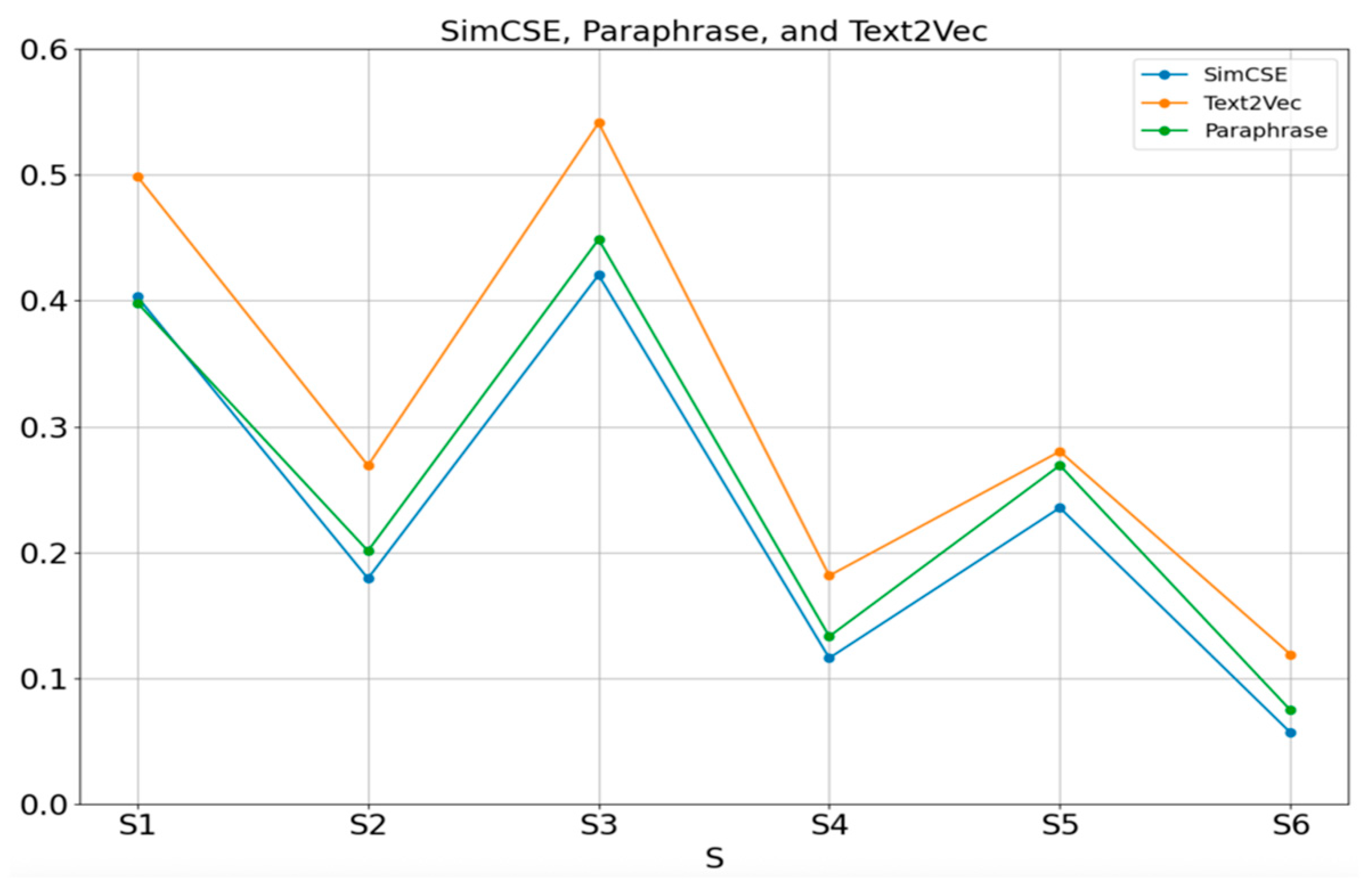
| SimCSE | Text2Vec | Paraphrase | |
|---|---|---|---|
| S1 | 0.4031 | 0.4989 | 0.3983 |
| S2 | 0.1792 | 0.269 | 0.2011 |
| S3 | 0.4205 | 0.5415 | 0.4488 |
| S4 | 0.1159 | 0.1814 | 0.1331 |
| S5 | 0.2354 | 0.2802 | 0.2691 |
| S6 | 0.0566 | 0.1188 | 0.0744 |
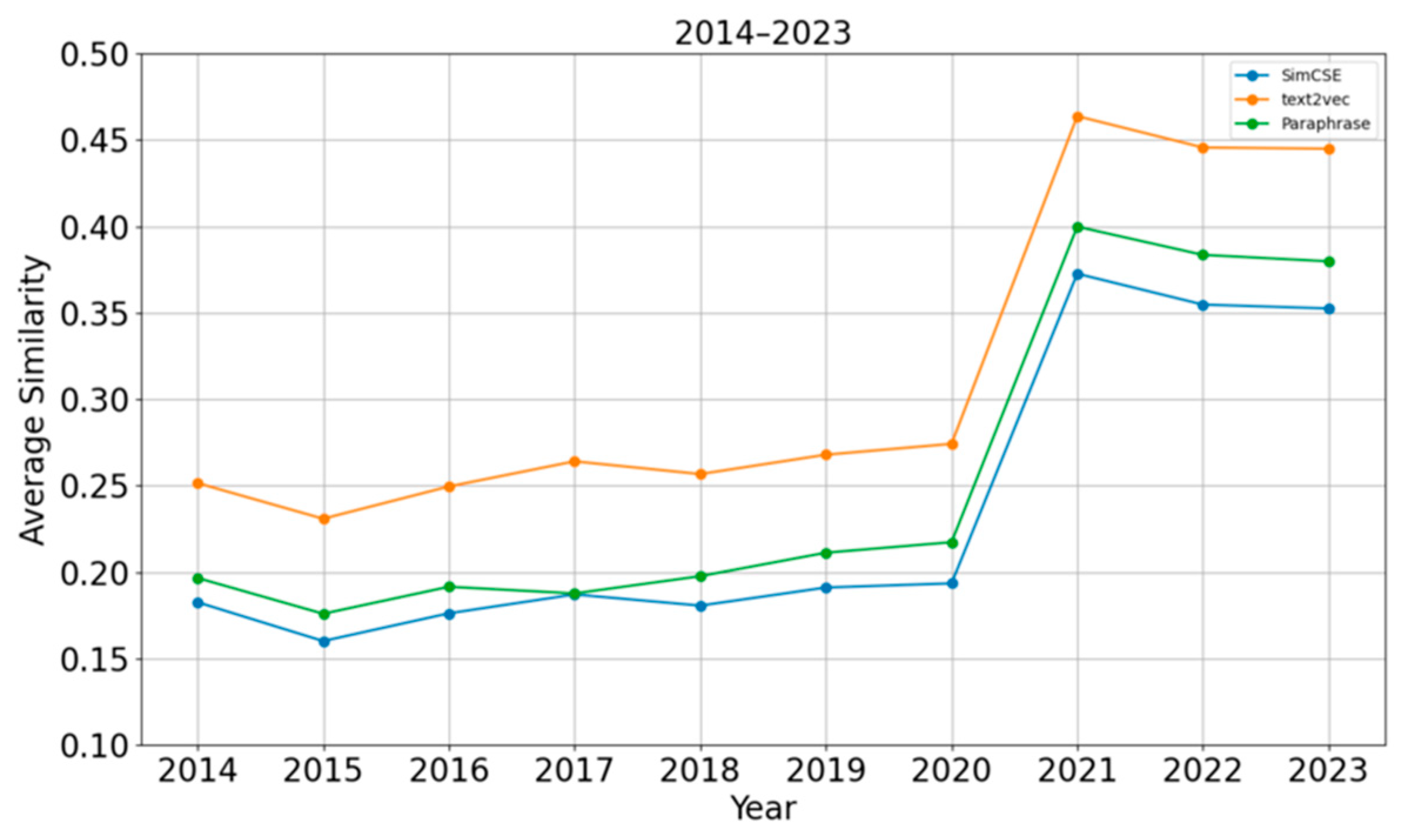
| 2014 | 2015 | 2016 | 2017 | 2018 | 2019 | 2020 | 2021 | 2022 | 2023 | |
|---|---|---|---|---|---|---|---|---|---|---|
| SimCSE | 0.1826 | 0.1601 | 0.1762 | 0.1871 | 0.1806 | 0.1911 | 0.1935 | 0.3727 | 0.3548 | 0.3526 |
| Paraphrase | 0.1966 | 0.1759 | 0.1915 | 0.1877 | 0.1977 | 0.2113 | 0.2173 | 0.3999 | 0.3836 | 0.3799 |
| Text2Vec | 0.2515 | 0.2309 | 0.2496 | 0.2641 | 0.2568 | 0.2680 | 0.2742 | 0.4639 | 0.4457 | 0.4450 |
Disclaimer/Publisher’s Note: The statements, opinions and data contained in all publications are solely those of the individual author(s) and contributor(s) and not of MDPI and/or the editor(s). MDPI and/or the editor(s) disclaim responsibility for any injury to people or property resulting from any ideas, methods, instructions or products referred to in the content. |
© 2025 by the authors. Licensee MDPI, Basel, Switzerland. This article is an open access article distributed under the terms and conditions of the Creative Commons Attribution (CC BY) license.
Share and Cite
Liu, Q.; Jiang, X. Quantitative Measurement of Digital Maturity in Manufacturing Enterprises: An Application Scenario-Based Study. Sustainability 2026, 18, 274. https://doi.org/10.3390/su18010274
Liu Q, Jiang X. Quantitative Measurement of Digital Maturity in Manufacturing Enterprises: An Application Scenario-Based Study. Sustainability. 2026; 18(1):274. https://doi.org/10.3390/su18010274
Chicago/Turabian StyleLiu, Qing, and Xiaoyan Jiang. 2026. "Quantitative Measurement of Digital Maturity in Manufacturing Enterprises: An Application Scenario-Based Study" Sustainability 18, no. 1: 274. https://doi.org/10.3390/su18010274
APA StyleLiu, Q., & Jiang, X. (2026). Quantitative Measurement of Digital Maturity in Manufacturing Enterprises: An Application Scenario-Based Study. Sustainability, 18(1), 274. https://doi.org/10.3390/su18010274