Article

Occurrence Patterns and Pollution Risk of Microplastics in Surface Sediments and Sediment Cores of the Three Gorges Reservoir, China

1
School of Resources, Environment and Materials, Guangxi University, Nanning 530004, China
2
State Key Laboratory of Simulation and Regulation of Water Cycle in River Basin, China Institute of Water Resources and Hydropower Research, Beijing 100038, China
*
Authors to whom correspondence should be addressed.
Sustainability 2026, 18(1), 273; https://doi.org/10.3390/su18010273
Submission received: 1 December 2025 / Revised: 20 December 2025 / Accepted: 22 December 2025 / Published: 26 December 2025
(This article belongs to the Section Sustainable Engineering and Science)

Abstract

As a sink for microplastics (MPs) in the aquatic environment, sediments have garnered considerable attention. However, the occurrence characteristics of MPs in sediments of different water seasons are not clear, especially for reservoir sediment cores. This study aimed to elucidate the occurrence, spatial and vertical distribution, fragmentation and pollution risk of MPs in the sediment cores of the Xiangxi River, Three Gorges Reservoir (TGR) during different seasons. In sediment cores, the average abundance of MPs was 8.57 × 10³ ± 5.65 × 10³ items/kg DW in the wet season (WS) and 7.98 × 10³ ± 4.00 × 10³ items/kg DW in the dry season (DS), respectively. The abundance of MPs in surface sediments and sediment cores exhibited spatial heterogeneity, reflecting seasonally contrasting hydrodynamic conditions between sites S1 and S3. However, the abundance of MPs in the river estuary was the highest, both in surface sediments and sediment cores. Interestingly, the occurrence characteristics of MPs in surface sediments indicated that in addition to anthropogenic activity, hydrological conditions of the river can also have an impact on the spatial distribution of MP abundance in surface sediments. Polypropylene (PP), polyethylene (PE), polystyrene (PS), and polyethylene-propylene copolymer (EPM) were identified as the dominant polymer types (57–99%), with small-sized microplastics (SMPs, 0–300 μm) being the most prevalent. Water seasons influenced the size distribution of MPs in surface sediments. Using a conditional fragmentation model, MP sources were inferred by comparing fragmentation parameters (λ and α) in sediments with those reported for atmospheric deposition, reservoir water, and water-level fluctuation zone soils. Furthermore, the pollution load index (PLI) exceeded 1, indicating MP accumulation in the sediments. The pollution risk index (PRI) values indicated a considerable (300 < PRI < 1000) pollution risk in two water seasons, primarily due to the presence of polyvinyl chloride (PVC). This study enhances the understanding of MP behavior and associated environmental risks in reservoir sediments, offering valuable insights for future research and pollution mitigation efforts.

1. Introduction

With the rapid rise in global plastic production, microplastics (MPs) (<5 mm) have become pervasive, persisting in nearly all aquatic and sediment environments [1]. Early research on MPs predominantly focused on the ocean; however, recent studies have shifted toward river systems, which serve as major conduits for transporting MPs to marine environments. Notably, the abundance of MPs in rivers has been found to exceed even the highest levels recorded in ocean waters [2,3]. Given these findings, a comprehensive understanding of MP occurrence and behavior in river systems is essential.
Rivers act as vital conduits, linking terrestrial environments to marine ecosystems. The presence of MPs in river sediments provides critical insights into pollution sources and transmission pathways [4,5]. In addition, atmospheric deposition has also emerged as an important pathway transporting MPs into river systems, such as the atmosphere in the long-range transport of microplastic fibers [6]. A growing body of research has recently investigated MPs in inland freshwater ecosystems, including rivers, lakes, and wetlands [7]. However, most previous research on MPs in sediments has been based on single-sample assessments conducted over short timeframes [8]. Consequently, there remains a significant gap in understanding the temporal and seasonal variations in the occurrence and environmental behavior of MPs in river systems worldwide. Several studies have demonstrated seasonal variations in MP abundance in surface water and sediments, largely influenced by surface runoff and discharge loads [9]. Water velocity has also been identified as a key factor affecting MP accumulation in sediments [10]. Thus, the spatial distribution of MPs not only reflects pollution patterns but also provides insights into their accumulation processes over time. Compared with the distribution of MPs in river water, the distribution of MPs particularly in sediments offers a more reliable indication of long-term pollution trends in each region [11]. Therefore, investigating the vertical stratification of MPs in sediment cores enables the reconstruction of historical contamination chronologies and the elucidation of post-depositional migration behaviors in aquatic systems [12,13,14].
The Xiangxi River is a major tributary of the Three Gorges Reservoir (TGR) and a key ecological area within the region. Investigating the occurrence of MPs in the Xiangxi River Basin is essential for understanding MP pollution characteristics within the TGR. However, most existing studies on MPs in sediments of the Yangtze River Basin have been limited to single-sample assessments, inconsistent particle size ranges, and a predominant focus on surface sediments [15,16,17]. Variability in sampling and pretreatment methods may further contribute to inaccuracies in MP characterization. Previous research on MPs in Xiangxi River sediments has primarily focused on surface layers, with a minimum analyzed particle size of 100 μm. This approach may overlook smaller MPs, resulting in incomplete characterization of their environment [18]. Therefore, this study established three objectives to: (i) examine the surface, spatial, and vertical distribution of MPs in Xiangxi River sediment cores across different water seasons; (ii) explore the fragmentation processes and potential sources of MPs; and (iii) quantitatively evaluate the pollution risk posed by MPs in sediments of Xiangxi River. By integrating sediment cores analysis, seasonal hydrological context, and a conditional fragmentation model, this study provides a novel framework for assessing the occurrence characteristics and environmental risks of MPs.

2. Materials and Methods

2.1. Study Area

The Xiangxi River, recognized as the primary tributary of the TGR near the dam area, merges with the Yangtze River approximately 32 km upstream of the Three Gorges Dam (TGD). As a typical seasonal river in mountainous terrain, its hydrology is strongly influenced by distinct wet and dry seasons. The TGR operates seasonally to regulate flood control, water supply, and power generation, significantly impacting the hydrodynamics of the Xiangxi River. During the dry season (DS, October to February), at the water level of 175 m, hydraulic gradient inversion induces Yangtze River backflow into the Xiangxi River with laminar-dominated flow (0.50 m/s). Conversely, in the wet season (WS, May to August), increased rainfall lowers the reservoir level to 145 m. The Xiangxi River then flows freely into the Yangtze River. The average velocity ranges from 1.00 to 3.00 m/s [19]. These seasonal fluctuations lead to backwater effects, which alter the river’s hydrodynamics and sedimentation processes.

2.2. Sampling Collection

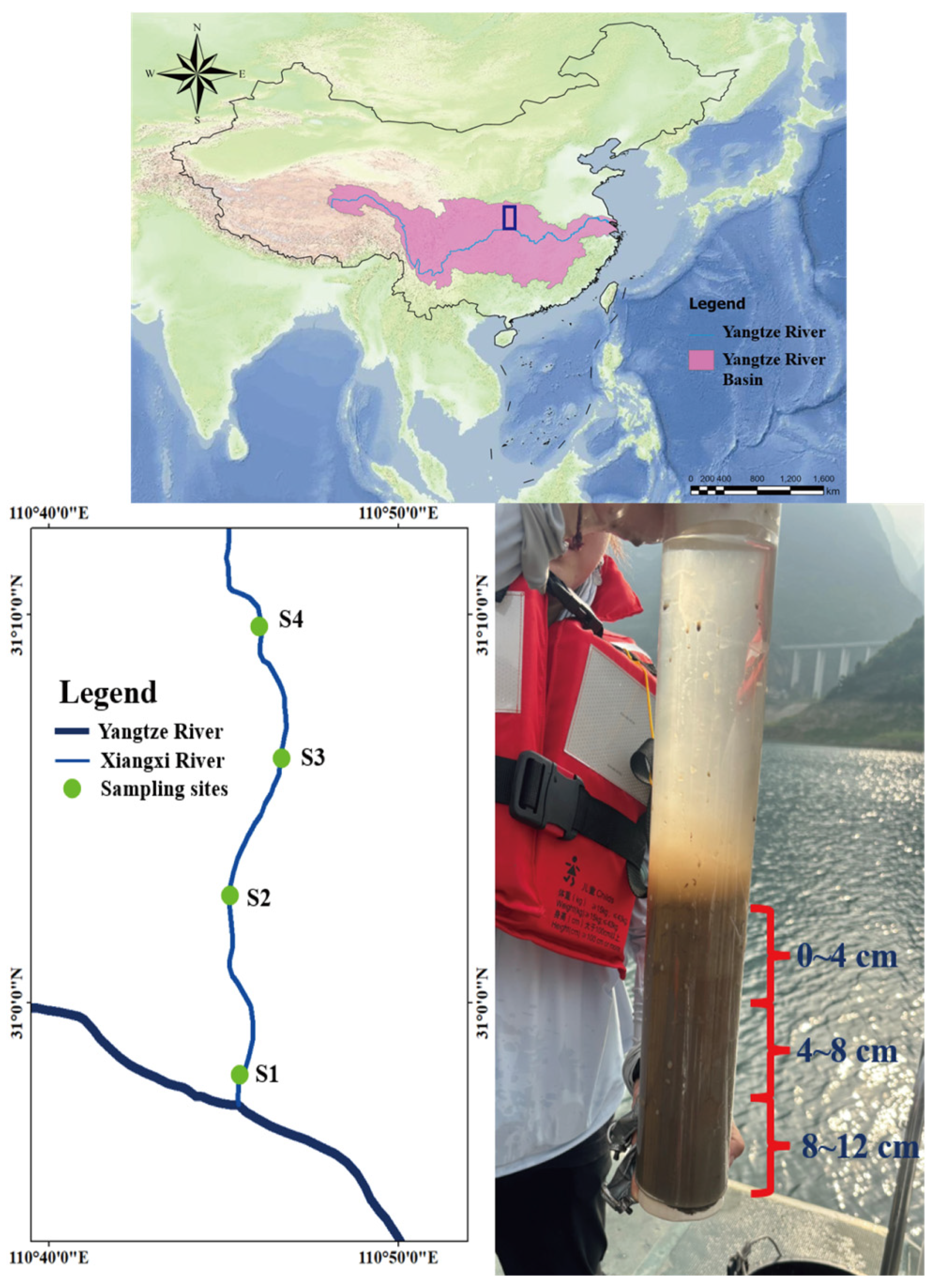
In June 2023 (WS) and November 2023 (DS), four sampling sites (S1, S2, S3, S4) were established along the Xiangxi River, from the estuary to the upper reaches (Figure 1). At each site, sediment cores were collected using Plexiglass tubes (Φ7 × 50 cm) [20]. Following in situ sectioning with stainless steel blades, sediment cores were vertically stratified into three equidistant 4 cm strata. These samples were sealed in aluminumized barrier films and cryopreserved during transport. All of the Plexiglass tubes were clean three times by ultra-pure water before each sample collection. A sampling protocol across two water seasons yielded 8 sediment cores, each core sectioned into triplicate, providing 24 sediment samples.

2.3. Microplastic Extraction and Identification

According to previous studies, a classical method was used to isolate MPs from the sediment samples [21,22]. The MP extraction process of the sediments in the Xiangxi River were conducted in an ultra-clean laboratory. Specifically, the sediment samples were freeze-dried and then transferred into glass beakers. Zinc chloride (ZnCl2) solution was added for extraction. Then, the supernatant was filtered through a membrane. The membrane was then transferred to a glass beaker. Fresh Fenton and 30% hydrogen peroxide (H2O2) solution were added for digestion. Following digestion, sodium chloride (NaCl) solution was used for further extraction. The harvested supernatant underwent vacuum-assisted filtration through cellulose acetate membranes (0.45 μm, Φ47 mm). The membranes were stored in Petri dishes, dried, and preserved for subsequent analysis. Complete methodological specifications are provided in the Supplementary Materials (Text S1).

2.4. Quality Assurance and Quality Control (QA/QC)

To implement stringent QA/QC measures against anthropogenic contamination, all sampling apparatus underwent triple-rinsing protocols with Milli-Q water. Samples were processed, extracted and identified in a super-clean laboratory. All laboratory supplies were made of non-plastic materials. Three blank samples were prepared, and the suspected particles in them were extracted and identified using the same method. No suspected particles in the blank samples were detected as MPs.

2.5. Stability Analysis of MPs

In this study, a conditional fragmentation model was used to describe the stability of MPs in the sediments of the Xiangxi River, and the formula is [23]:
F ( x )   =   1 e λ x α   ( x     0 )
where x is the size of the MPs, λ is the range parameter of MP size, and α determines the fragmentation pattern. The α value can show the stability of MPs in the sediments of the Xiangxi River (Text S2).

2.6. Microplastic Pollution Load Index and Pollution Risk

Based on previous studies, the pollution load index (PLI) of MPs in the sediments of Xiangxi River were calculated [24]:
PLI = C i C 0
PLI River = PLI 1 × PLI 2 × PLI 3 × × PLI n n
where Ci is the MP abundance of sediment sample i in the Xiangxi River and C0 is the minimum baseline MP abundance of sediment sample in the Xiangxi River. In this study, the minimum MP abundance in the WS and DS were used as baseline abundance for the two water seasons, respectively. The PLI of MPs at site i is denoted as PLIi, while PLIRiver represents the overall PLI of MPs for the Xiangxi River. The toxicity risk assessment of different polymers was carried out based on established methodologies [25]. Furthermore, the chemical toxicity coefficient of polymers was incorporated into the analysis [26]. The assessment was conducted using the following formula:
H i = j = 1 m { ( P ji C i ) × S j }
H River = H 1 × H 2 × H 3 × × H n n
where j donates the type of polymer represented in the sediments of the Xiangxi River, m denotes the total number of polymer types identified in the sediment samples, Pji represents the quantified abundance of polymer type j. Sj refers to the chemical toxicity coefficient of the detected polymers in sediments of the Xiangxi River. The total MP polymer risk index at site i is represented as Hi, whereas HRiver denotes the overall MP polymer risk for the sediments of the Xiangxi River. The comprehensive pollution risk index (PRI) was ultimately derived through the integration of the chemical toxicity coefficient of MPs and MP abundance data, as defined by the following computational framework:
P R I i = H i × P L I i
P R I R i v e r = P R I 1 × P R I 2 × P R I 3 × × P R I n n
where PRIi is the PRI of site i, and PRIRiver is the PRI of the Xiangxi River.

2.7. Data Analysis

Significant differences in MP characteristics were evaluated through independent samples t-tests in R Studio (4.5.0) (p < 0.05 threshold). The particle size frequency analysis of MPs was also performed using R Studio. Figures were generated using ArcGIS Pro (3.0.1) and Origin 2022.

3. Results and Discussion

3.1. The Influence of Hydrological Conditions on Microplastics in Surface Sediments

3.1.1. Abundance of Microplastics in Surface Sediments of Xiangxi River

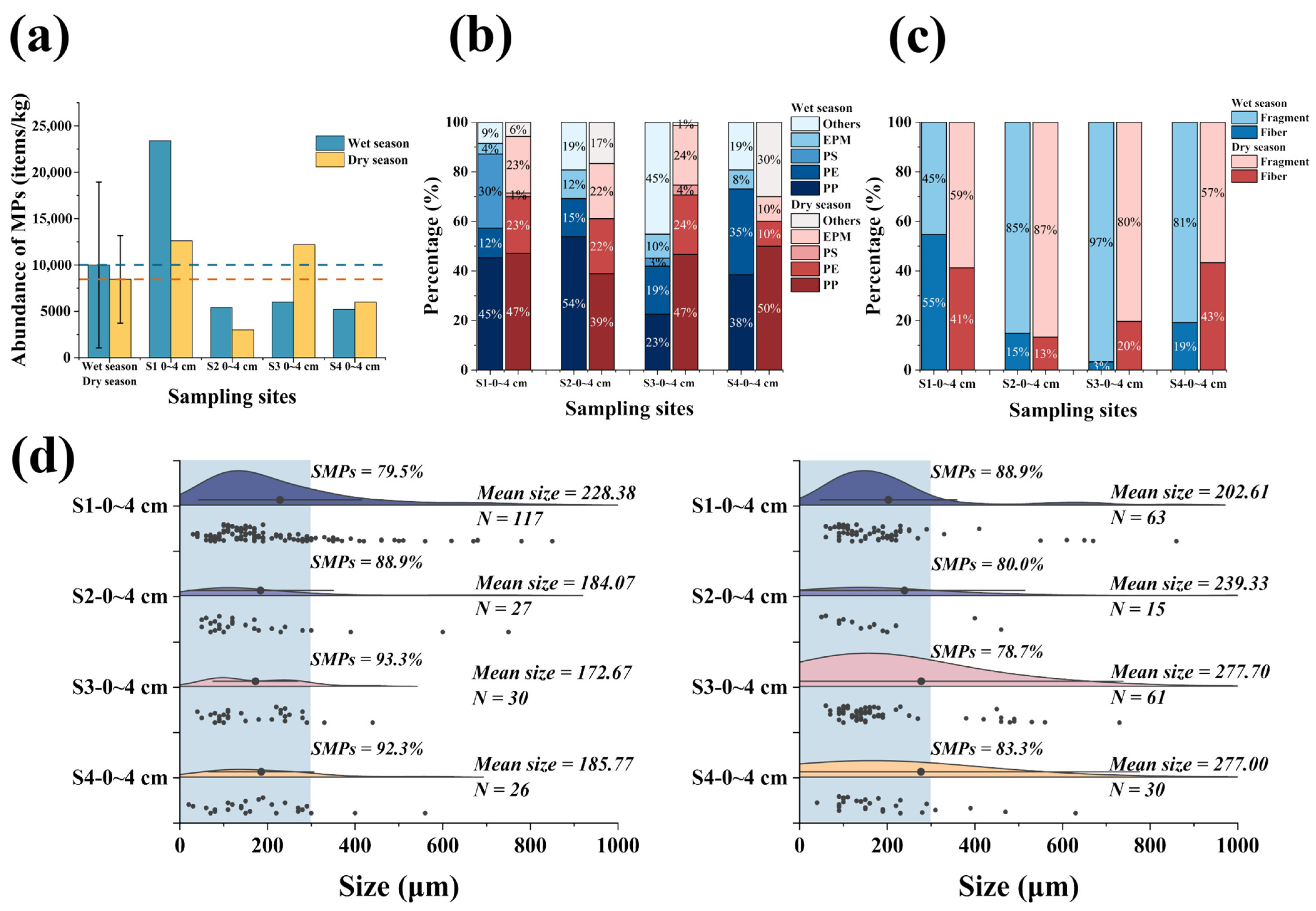
MP particles were identified in all surface sediment samples collected from the Xiangxi River. Quantitative analysis revealed seasonal variations in abundance of MPs, where the WS sediment samples exhibited higher abundance levels (1.00 × 10⁴ ± 8.94 × 10³ items/kg DW) compared with the DS (8.45 × 10³ ± 4.73 × 10³ items/kg DW) (Figure 2a). The highest abundance observed at S1 in both seasons (2.34 × 10⁴ items/kg DW in the WS and 1.26 × 10⁴ items/kg DW in the DS). The lowest abundances were recorded at S4 (5.20 × 10³ items/kg DW) in the WS and S3 (3.00 × 10³ items/kg DW) in the DS. The operational dynamics of the TGR exerted a substantial influence on MP distribution. During the WS, when the Xiangxi River flowed into the Yangtze River, MPs were transported downstream and accumulated in the estuary sediments (S1) [27]. In contrast, the backflow from the Yangtze River during the DS attenuated hydrodynamic energy within the Xiangxi River Bay’s confluence zone, leading to increased MP accumulation at S3 [27]. This indicates that in addition to anthropogenic activity, hydrological conditions of the river can also have an impact on the spatial distribution of MP abundance in surface sediments [18,28].

3.1.2. Polymer Composition of Microplastics in Surface Sediments of Xiangxi River

Surface sediments contained 18 polymer types in the WS and 11 in the DS, showing reduced diversity during the DS (Figure 2b and Figure S1). The dominant polymers were polypropylene (PP), polyethylene (PE), polystyrene (PS), and polyethylene-propylene copolymer (EPM), while other polymers with smaller shares are detailed in Tables S1 and S2. These MPs were analyzed under an optical microscope, and the μ-FTIR spectra of the main polymers are summarized in Figure S2. Among them, PP and PE accounted for the highest proportions, consistent with findings from sediment studies in the Yangtze River [21]. During the WS, rainfall in the Xiangxi River Basin led to increased surface runoff, introducing large quantities of MPs into the water. This influx contributed to a greater variety of polymer types, which eventually settled into the sediment. Notably, PP, PE, and EPM are low-density MPs. In the WS, the estuary area (S1) exhibited the highest polymer accumulation (91%), whereas in the DS, the highest proportion (99%) was observed at S3. Flow velocity likely influenced the seasonal distribution of polymer types in surface sediments [29]. During the WS, higher river flow transported MPs downstream, leading to their deposition at the estuary (S1). Increased flow rates also promoted the suspension and downstream transport of low-density MPs [30]. In contrast, during the DS, backflow from the Yangtze River reduced the flow velocity in the Xiangxi River, which was conducive to the deposition of low-density MPs in Xiangxi Bay. This resulted in an increased proportion of dominant MPs at S3 in the DS.

3.1.3. Morphological Characteristics of Microplastics in Surface Sediments of Xiangxi River

In both the WS and DS, fragments were the predominant morphotype in surface sediments, accounting for 63.0% and 68.6%, respectively. Figure 2c and Figure S1 show the morphological MP distributions in surface sediments. Fiber proportions were higher at S1 and S2 during WS than DS, while lower at S3 and S4. It has been demonstrated that the sedimentation behavior of MPs varies according to their morphology [31,32]. Fibers were more difficult to deposit and tended to migrate to estuarine areas (S1) with the flow of water, leading to the highest fiber proportion at S1 during the WS. In the DS, the backflow from the Yangtze River caused MPs to return to the bay, resulting in a higher fiber content at S3 and S4 compared to the WS. Additionally, the resuspension of MPs with different morphologies is influenced by water flow. The lower flow velocity in the DS made it more difficult for fibers to resuspend from the sediment. Consequently, fibers were more likely to settle into the sediment, leading to a shift in the morphological distribution of MPs between the two seasons [33,34].

3.1.4. Size Distribution of Microplastics in Surface Sediments of Xiangxi River

In this investigation, the size of identified MP particles spanned from 10 to 5000 μm. The classification categorized particulates measuring below 300 μm as SMPs, while those exceeding this threshold were designated as large-sized microplastics (LMPs).
In the surface sediments of the Xiangxi River, the proportions of SMPs and LMPs in the DS were 84.5% and 15.5%, respectively, while in the WS, these values were 83.4% and 16.6% (Figure S1). The particle size distribution of MPs in the surface sediments at each sampling point during the two water seasons in the Xiangxi River is shown in Figure 2d. The average particle size of MPs increased from 193 ± 25 μm in the WS to 249 ± 36 μm in the DS, indicating a seasonal shift toward larger particles under reduced flow velocity, which favors the deposition of fibrous and less-fragmented MPs [31,32]. During the WS, the largest average particle size of MPs was found at S1 (228 μm), and the smallest at S3 (173 μm). In the DS, the smallest particle size was at S1 (203 μm), and the largest at S3 (278 μm). Additionally, at S3, where human activities were frequent, MPs originating from these activities were directly discharged into the Xiangxi River. Less-aged MPs, which were accompanied by larger particles, may have sunk directly into the sediment.

3.2. Microplastics in Sediment Cores of Xiangxi River During Different Seasons

3.2.1. Abundance of Microplastics in Sediment Cores of Xiangxi River

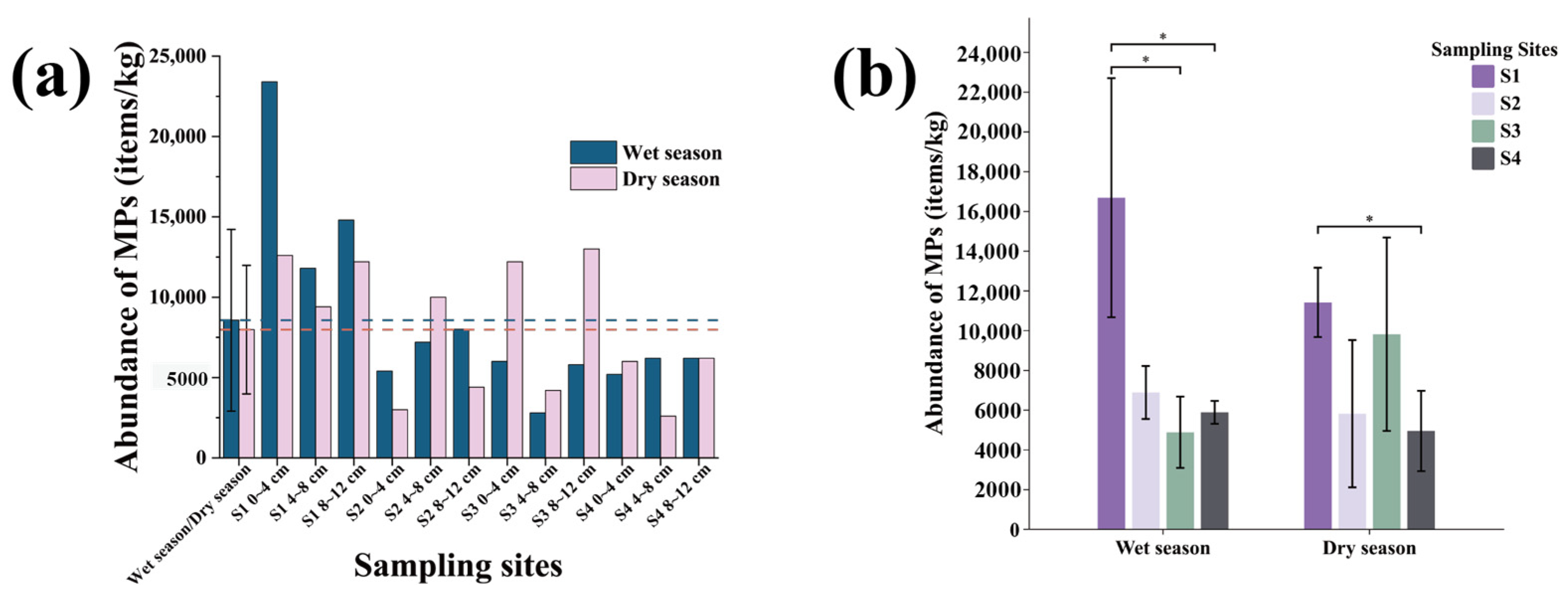
Microplastics were detected at all sampling sites (Figure 3a, Tables S5 and S6). In the sediment cores of the Xiangxi River, the mean abundance of MPs was 8.57 × 10³ ± 5.65 × 10³ items/kg DW (ranging from 2.8 × 10³ to 2.34 × 10⁴ items/kg DW) in the WS, and 7.98 × 10³ ± 4.00 × 10³ items/kg DW (ranging from 2.60 × 10³ to 1.30 × 10⁴ items/kg DW) in the DS. The highest MP abundance in both seasons was found at S1, with 1.67 × 10⁴ ± 6.02 × 10³ items/kg DW in the WS and 1.14 × 10⁴ ± 1.74 × 10³ items/kg DW in the DS. The lowest MP abundance was observed at S3 (4.87 × 10³ ± 1.79 × 10³ items/kg DW) in the WS and at S4 (4.93 × 10³ ± 2.02 × 10³ items/kg DW) in the DS. Additionally, there was spatial heterogeneity in the sediment cores of the Xiangxi River (Figure 3b). In the WS, MP abundance at S1 was significantly higher than at S3 (p = 0.03 < 0.05) and S4 (p = 0.03 < 0.05). In the DS, MP abundance at S1 was significantly higher than at S4 (p = 0.01 < 0.05).
This trend reflects the accumulation of MPs in Xiangxi River sediments from upstream to downstream. The upstream site S4 was less affected by human activity, resulting in generally lower MP abundance compared to the downstream sites, which were in more densely populated areas, such as S1 [18]. Sediment core analysis from site S3 revealed an increase in MP accumulation during the DS compared to WS. This seasonal variation could be attributed to the observed elevation of MP abundance in surface sediments, which led to an overall elevation of MPs in the sediment cores. Seasonal variation in MP abundance and characteristics in the Xiangxi River was regulated by hydrodynamics, sedimentation, and human activities. During the WS, increased precipitation and river discharge enhanced flow velocity and turbulence, promoting the downstream transport and redistribution of MPs and reducing their immediate deposition in upstream and midstream sediments. In contrast, during the WS, reduced river discharge and backwater effects from the TGR result in lower flow velocity and weakened hydrodynamic energy, favoring particle settling and long-term retention of MPs in sediments. Human activities further modulated these seasonal patterns by providing continuous local MP sources, which became more readily preserved in sediments under low-flow conditions. These processes explain the observed seasonal differences in MP abundance, size distribution, and pollution risk in the Xiangxi River sediments. In addition, bioturbation by benthic organisms and seasonally variable sedimentation rates can further modify the vertical distribution of MPs by enhancing particle mixing and controlling burial efficiency within sediment layers [35,36].
Furthermore, we compared our findings with previous reports on MPs in sediments (Table 1). The abundance of MPs quantified in the Xiangxi River surpassed that of most studies. The abundance of MPs quantified in this study exceeded prior measurements recorded in Xiangxi River sediments (130–830 items/kg DW) [18], but lower than that in sediments from the Wen-Rui Tang River [37]. Several studies reporting higher abundance have detected MPs with particle sizes < 300 μm, indicating that SMPs are more prevalent in the environment compared to LMPs [38]. The neglect of detecting SMPs may explain the lower measured abundance of MPs in those studies [39]. In addition, inconsistencies in sampling methods, pretreatment procedures, and detection techniques may contribute to the differences observed between this study and previous research [40].

3.2.2. Polymer Composition of Microplastics in Sediment Cores of Xiangxi River

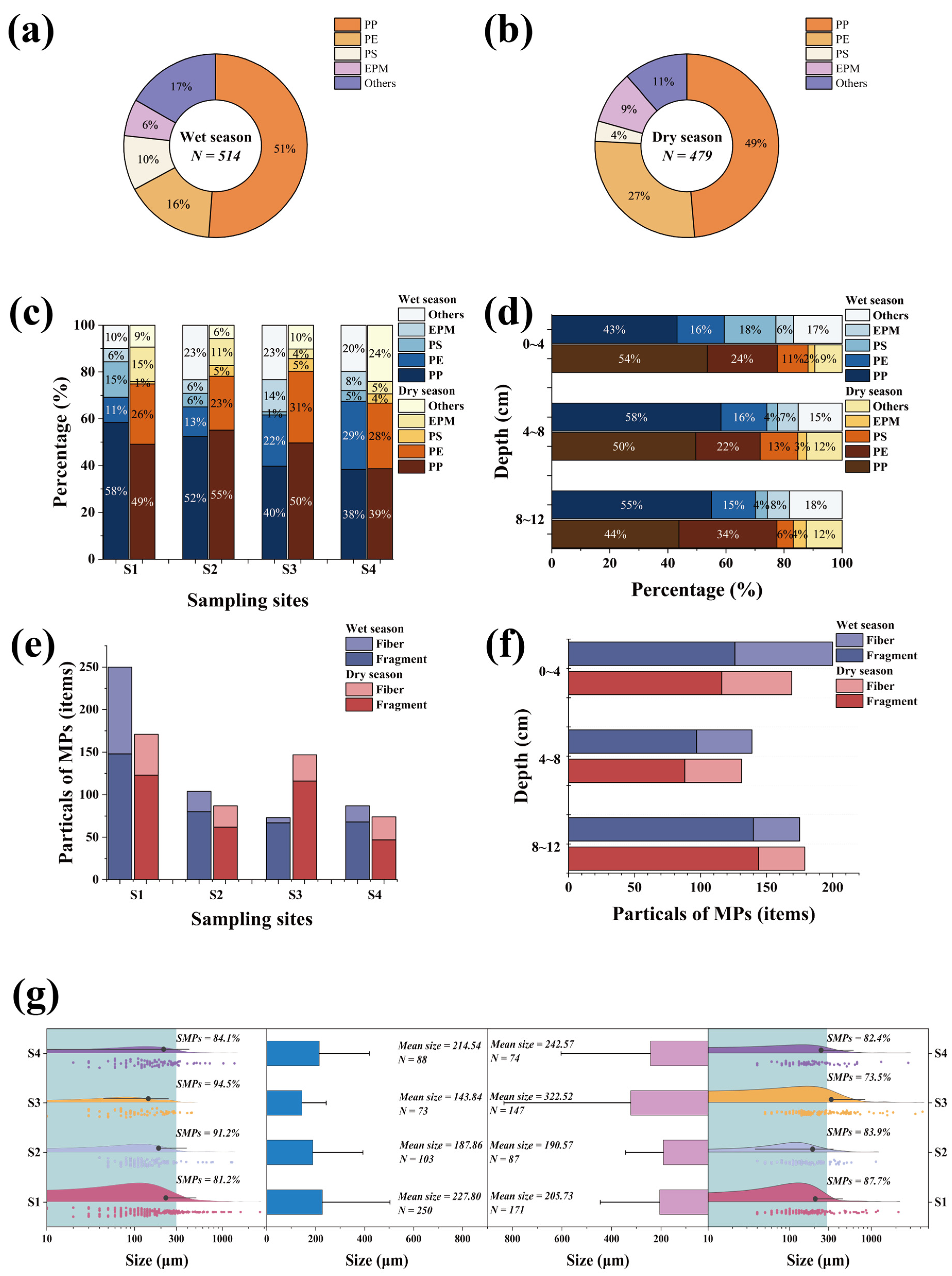
A total of 2028 particles suspected to be MPs were selected, of which 993 were confirmed as MPs. In total, 24 types of polymers were identified in the sediments during the WS, while 19 types were found in the DS (Figure 4a,b). As with the surface sediments, PP, PE, PS, and EPM were the main polymer types in the sediment cores. Spatially, compared with the WS, the overall proportion of main polymers in the sediment cores was higher in the DS (Figure 4c). The effect of water season on polymer type deposition was indicated. Among them, the sampling points S2 and S3 were affected by different water seasons. Proportion of PP and PE increased by 17% in DS compared to WS, likely due to reduced flow velocity allowing low-density MPs to settle. Vertically, the low-density MPs were resuspended under the influence of faster water flow in the WS [45,46], which made the proportion of PP and PE in the surface sediments lower than that in the middle and bottom layers, and lower than that in the surface sediments in the DS (Figure 4d). The lower proportion of low-density MPs in surface sediments during the WS can be attributed to enhanced flow velocity and hydrodynamic disturbance, which inhibit their retention at the sediment–water interface and promote resuspension or downstream transport [47].

3.2.3. Morphological Characteristics of Microplastics in Sediment Cores of Xiangxi River

In this study, the identified MPs were classified into two primary morphotypes: fragments and fibers, both of which were detected across all sampling sites (Figure 4e,f). The proportion of fragments increased slightly from 70.6% in the WS to 72.7% in the DS, likely reflecting the enhanced retention of denser and more stable particles in sediments under reduced hydrodynamic disturbance (Figure S3). Spatially, the estuarine site (S1) exhibited the highest abundance of both fragments and fibers in both seasons. During the WS, fragment abundance reached 9.87 × 10³ ± 1.81 × 10³ items/kg DW, while fiber abundance was 6.80 × 10³ ± 5.20 × 10³ items/kg DW. In the DS, fragments and fibers were recorded at 8.20 × 10³ ± 2.50 × 10³ items/kg DW and 3.20× 10³ ± 2.00 × 10³ items/kg DW, respectively. The accumulation trend of fragments and fibers followed an upstream-to-downstream pattern, with the estuarine site (S1) showing significantly higher fragment concentrations than other sampling sites (p < 0.05). Additionally, a substantial number of fibers were detected at S1, likely reflecting increased MP input from anthropogenic sources, particularly waste and wastewater discharge [48]. Vertically, fiber abundance peaked in the surface layer (0–4 cm) during both seasons, with values of 3.70 × 10³ ± 6.10 × 10³ items/kg DW in the WS and 2.65 × 10³ ± 1.97 × 10³ items/kg DW in the DS. Fragment abundance was highest in the surface layer (0–4 cm) during the WS but shifted to the bottom layer (8–12 cm) in the DS, with values of 6.30 × 10³ ± 2.95 × 10³ items/kg DW and 7.20 × 10³ ± 3.90 × 10³ items/kg DW, respectively. Fragments remained the predominant MP morphotype, aligning with findings from the Baiyangdian Wetland [14]. Additionally, fiber abundance decreased with sediment depth, which may be attributed to the natural aging of fibers into smaller fragments and their subsequent transport into deeper sediment layers due to vertical bioturbation [49,50].

3.2.4. Size Distribution of Microplastics in Sediment Cores of Xiangxi River

In this study, the average particle size of MPs during the WS was 206 ± 234 μm, which was smaller than in the DS (245 ± 357 μm). SMPs dominated both seasons, accounting for 84.90% of total MPs in the WS and 81.84% in the DS. Spatially, the estuarine site (S1) had the highest average particle size in the WS (228 ± 276 μm), whereas S3 had the lowest (144 ± 99 μm). In the DS, S3 exhibited the largest average size (323 ± 512 μm), while S2 had the smallest (191 ± 153 μm) (Figure 4g). Vertically, the MPs with the smallest average particle size were found in the bottom layer (8–12 cm) during the WS and in the middle layer (4–8 cm) during the DS, with particle sizes of 156 ± 45 μm and 227 ± 110 μm, respectively. The middle layer (4–8 cm) had the largest average particle size in the WS (240 ± 64 μm), while the bottom layer (0–4 cm) had the largest particle size during the DS (252 ± 414 μm) (Figure S4). At site S3, the abundance of fibrous MPs was 1.20 × 10³ items/kg DW in the WS and increased to 6.20 × 10³ items/kg DW in the DS. The mean particle size of fibers at S3 was 217 ± 170 μm in the WS and increased to 770 ± 964 μm in the DS, with a statistically significant difference (p < 0.05). The observed seasonal, spatial, and vertical variations in microplastic particle size are closely associated with hydrodynamic conditions and particle characteristics. These patterns align with findings in the Yangtze River Basin, where SMPs were also prevalent in sediments [21,51]. Spatially, the larger average particle size at site S3 during the DW was closely linked to the increased contribution of fibrous MPs at this site. Fibers generally exhibited larger characteristic lengths, and their enhanced retention under low-flow conditions contributed to an increase in the overall mean particle size. Vertically, differences in particle size distribution among sediment layers likely reflect the combined effects of hydrodynamic disturbance, resuspension, and burial processes, which regulate the vertical redistribution and retention of MPs within sediment cores. Overall, spatial and vertical distribution of MPs were governed by the interaction between hydrological conditions, sedimentation, polymer density, and human activities, which together regulate particle transport, deposition, and long-term retention in reservoir sediments.

3.3. Potential Sources Identification Using Fragmentation and Stability of Microplastics

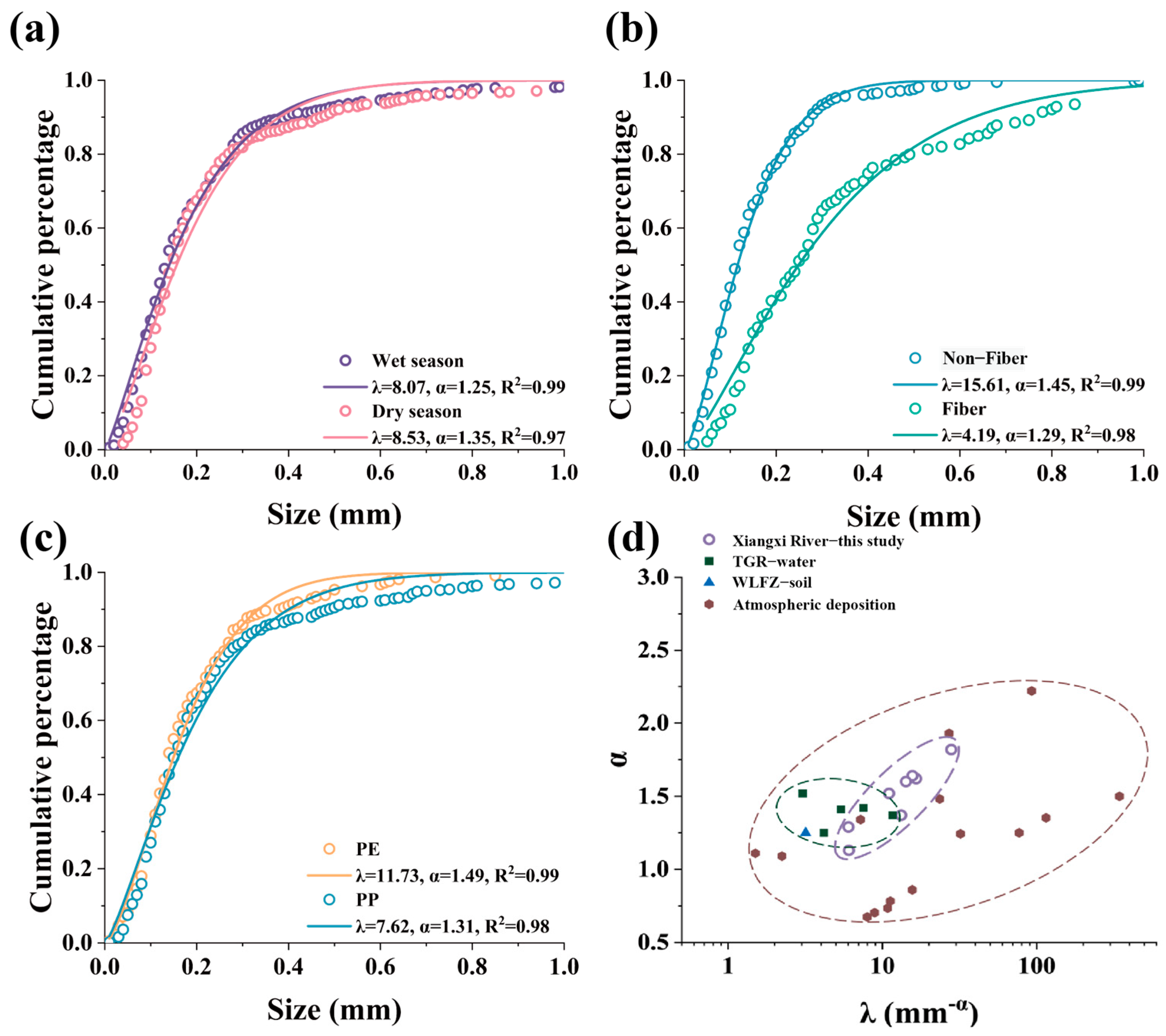
In the conditional fragmentation model, λ represents the effective fragmentation intensity, with higher values indicating more fragmentation and a greater contribution of small MPs. The parameter α describes the size-scaling behavior of fragmented products and influences the relative distribution of particle sizes after breakage. Variations in λ and α are therefore linked to particle size distributions and are modulated by particle morphology (e.g., fibers and fragments) and polymer type, as mechanically weaker polymers and fibrous particles are more prone to fragmentation.
The sediments of the Xiangxi River were analyzed using a conditional fragmentation model to assess the downsized dynamics and environmental persistence of MPs (Figure 5a). The λ value for sediments of the Xiangxi River was lower in the WS (λ = 8.07) than in the DS (λ = 8.53), suggesting seasonal differences in fragmentation potential. The α parameters exceeding 1 demonstrated that larger MPs tend to fragment more readily. The λ parameter, associated with MP particle size, exceeded values reported for surface water and water-level fluctuation zone soils in the TGR (Figure 5d) [52,53], highlighting the predominance of SMPs in sediments of the Xiangxi River.
Microplastic size distribution varies according to morphology and polymer type, influencing stability and fragmentation (Figure 5b,c). Non-fibrous MPs exhibited particles of 149 μm, contrasting with 548 μm for fibrous MPs. Non-fibrous MPs exhibited greater stability, with higher λ and α values (λ = 15.61, α = 1.45) compared to fibers (λ = 4.19, α = 1.29). This phenomenon can be attributed to the elevated surface-to-volume ratio of fibrous MPs, which amplifies their interaction with environmental weathering processes [23]. For polymer types, the fragmentation resistance of PP (λ = 7.62, α = 1.31) was lower than that of PE (λ = 11.73, α = 1.49), likely due to PE’s smaller average particle size (205 ± 270 μm) compared to PP (243 ± 299 μm). Consequently, the relatively high proportion of SMPs and fibrous PP and PE observed in the sediments is consistent with the λ and α parameter combinations derived from the model, supporting their physical interpretation in terms of fragmentation intensity and size-scaling behavior.
The conditional fragmentation model demonstrated significant potential as a methodological framework for source attribution of MPs in environmental investigations [23]. The MPs in the sediment cores of the Xiangxi River mainly came from the atmospheric deposition, wet deposition, TGR water and water-level fluctuation zone soils of the TGR (Table S7). The λ and α distributions in sediment samples showed significant overlap with those from atmospheric deposition (Figure 5d). This quantitative correspondence provided compelling evidence that atmospheric transport serves as a pathway for anthropogenic MP accumulation in the study region. We collected relevant studies on the Xiangxi River in the Yangtze River Basin [52,53]. The range of λ and α values of MPs in the sediments of Xiangxi River intersected with the range of λ and α values of MPs in the surface water of the TGR and the water-level fluctuation zone soils. The λ and α values in the sediments of the Xiangxi River showed a higher trend and reflected a higher degree of fragmentation. This indicates that the MPs in the water-level fluctuation zone soils and water body of Xiangxi River were further aged and broken when they entered the sediment.

3.4. Microplastic Pollution Risk Assessment and Analysis

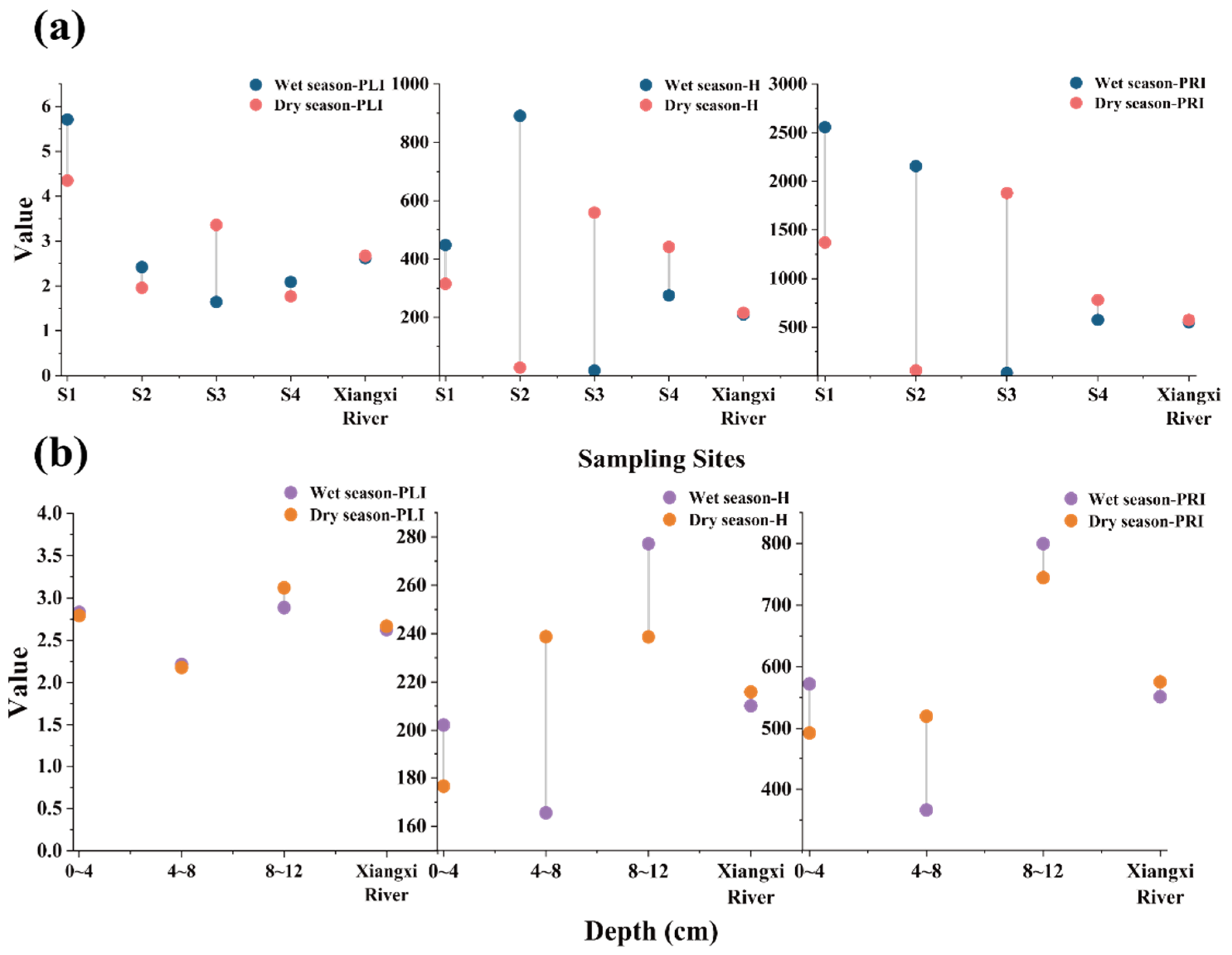
In this study, the PLI, H, and PRI were determined based on the abundance and polymer composition of MPs. The risk values for each sampling site are shown in Table S8. MPs have accumulated in the sediments of Xiangxi River, as indicated by PLI values greater than 1. In the WS and DS, the PLI values were 2.62 and 2.67, respectively. Spatially, the highest PLI was observed at site S1, with values of 5.71 in the WS and 4.35 in the DS. Vertically, the highest PLI values were recorded in the bottom layer (8–12 cm) with PLI values of 2.88 in the WS and 3.12 in the DS. This may be due to the high abundance of MPs in the bottom layer. Given the varying toxicity of different polymers, further evaluation of MP contamination risks should consider polymer-specific toxicity.
The polymer toxicity risk in sediments of the Xiangxi River was evaluated using chemical toxicity coefficients for various polymers (Tables S10 and S11). The toxicity risk levels (H) were calculated for the wet (H = 210) and dry (H = 216) seasons, both classified as level III (101 < H < 1000), meaning that there were polymer types with a relatively high toxicity coefficient in the Xiangxi River. Peak H indices were observed in the bottom layer (8–12 cm) at site S2 in the WS (2.30 × 10³) and middle layer (4–8 cm) at S3 in the DS (2.43 × 10³), both categorized as level IV, despite low abundance in the middle layers (4–8 cm) at S2 in the WS and S3 in the DS (Figure 6a). Spatially, the highest H values were found at S2 in the WS (H = 891) and at S3 in the DS (H = 559), while vertically, the highest H values were observed in the bottom sediments in the WS (H = 277) and in the middle layer in the DS (H = 239) (Figure 6b). These results reflect the influence of PVC’s toxicity on the spatial and vertical distribution of toxicity risk.
The combined PLI and H were utilized to evaluate the PRI for assessing the MP pollution risk in the sediment cores of the Xiangxi River. The PRI values indicated a considerable (300 < PRI < 1000) pollution risk in both the WS (PRI = 551) and DS (PRI = 575) (Table S9). This means that MPs in the sediment of the Xiangxi River could provide potential ecological pressure. Notably, the overall MP pollution risk was determined by the combined effect of polymer toxicity and MP abundance. Spatially, the highest PRI values were observed at S1 in the WS (PRI = 2.56 × 10³) and at S3 in the DS (PRI = 1.88 × 10³) (Figure 6a). These values were influenced by the high abundance of MPs at these sites. In terms of vertical distribution, the highest PRI values were found in the bottom sediments during both the wet (PRI = 800) and dry (PRI = 744) seasons (Figure 6b). At S1, there were high PRI values in the surface sediment during the WS (PRI = 5.84 × 10³) and in the bottom sediment during the DS (PRI = 3.58 × 10³). The result was mainly that a large number of MPs were detected compared to the minimum baseline MP abundance of sediment sample in the Xiangxi River. Conversely, there were high PRI values in the bottom sediment of S2 in the WS (PRI = 6.58 × 10³) and in the middle sediment of S3 in the DS (PRI = 3.92 × 10³). The results were due to the high toxicity of the polymers present, particularly PVC, which has a high chemical toxicity coefficient. In addition, PP and PE are generally considered less chemically toxic. However, their high environmental abundance and strong capacity to absorb organic pollutants and metals can enhance indirect toxicity to aquatic organisms. PS has been reported to induce oxidative stress, inflammatory responses, and developmental toxicity in aquatic species, particularly in its micro- and nano-sized forms [54,55].

4. Conclusions

This study systematically examined the occurrence characteristics, fragmentation, and pollution risks of MPs in the sediment cores of the Xiangxi River. In surface sediment, the occurrence characteristics of MPs in surface sediments of Xiangxi River was affected by the variation of water season. The average abundance of MPs was 1.00 × 10⁴ ± 8.94 × 10³ items/kg DW in the WS, which was higher than the average abundance in the DS (8.45 × 10³ ± 4.73 × 10³ items/kg DW). PP, PE, PS and EPM were the main polymers detected. Fragments were the predominant morphotypes. SMPs dominated both seasons, accounting for 84.90% of total MPs in the WS and 81.84% in the DS.
In the sediment cores, the abundance of MPs was 8.57 × 10³ ± 5.65 × 10³ items/kg DW in the WS, and 7.98 × 10³ ± 4.00 × 10³ items/kg DW in the DS, which was affected by water season. PP, PE, PS and EPM were the main types of polymers detected. Fragments were the main morphology of the MPs. The spatial and vertical particle size distributions of MPs in the two water seasons were different, which may be related to the particle size distributions of the major polymers. Based on conditional fragmentation model, the potential sources of MPs in sediments of the Xiangxi River include soil and surface water in the TGR and atmospheric deposition. The sediments of the Xiangxi River had been contaminated by MP. The PRI values indicated a considerable (300 < PRI < 1000) pollution risk. Hydrological seasonality was identified as a key regulator of MP abundance and pollution risk in the Xiangxi River sediments. Seasonal shift between WS and DS altered MP transportation, deposition, and retention in sediments. Therefore, MP risk assessments in regulated reservoir systems should explicitly account for hydrological seasonality, as ignoring seasonal dynamics may lead to an underestimation of sedimentary accumulation and mischaracterization of pollution risks. Importantly, the combined application of MP abundance and polymer toxicity coefficients demonstrated that MP pollution risk in reservoir sediments was jointly controlled by MP accumulation and polymer composition. This finding underscores the necessity of polymer toxicity in environmental risk assessments rather than relying solely on an abundance of metrics. The observation of considerable pollution risk in both the WS and DS further indicate that MP abundance in deep reservoir sediments constitutes a persistent and non-negligible environmental threat. From a management perspective, these findings suggest that risk assessments for large reservoirs should explicitly address sedimentary MPs.

Supplementary Materials

The following supporting information can be downloaded at: https://www.mdpi.com/article/10.3390/su18010273/s1, Text S1. Microplastic extraction from sediment; Text S2. Stability analysis of MPs in sediments of the Xiangxi River; Figure S1. Distribution of polymer type (a,b), morphological (c,d) and particle size (e,f) in surface sediments of the Xiangxi River in the wet and dry seasons; Figure S2. μ-FTIR spectra of the collected microplastic samples; Table S1. Abundance (items/kg) of polymers in the sediments of the Xiangxi River in the wet season; Table S2. Abundance (items/kg) of polymers in the sediments of the Xiangxi River in the dry season; Table S3. Abundance (items/kg) of microplastics with different particle sizes (μm) in the sediments of the Xiangxi River in the wet season; Table S4. Abundance (items/kg) of microplastics with different particle sizes (μm) in the sediments of the Xiangxi River in the dry season; Table S5. Abundance (items/kg) of microplastics with different morphotypes in the sediments of the Xiangxi River in the wet season; Table S6. Abundance (items/kg) of microplastics with different morphotypes in the sediments of the Xiangxi River in the dry season; Figure S3. The proportion of fiber and fragment in the wet season (a) and dry season (b); Figure S4. (a) Vertical distribution of average particle size of microplastics in the wet and dry seasons; Table S7. Modeling parameters for MPs separated from various environmental samples [52,53,56,57,58]; Table S8. Pollution Load Index (PLI), Hazard Index (H), and Polymer Risk Index (PRI) values in sediments of the Xiangxi River; Table S9. Microplastic pollution risk assessment standards; Table S10. Hazardous scores of polymers in sediments of the Xiangxi River in the wet season; Table S11. Hazardous scores of polymers in sediments of the Xiangxi River in the dry season. References [23,52,53,56,57,58] are cited in Supplementary Materials.

Author Contributions

Methodology, W.W., S.G., W.H. and B.G.; Formal analysis, W.W. and B.G.; Investigation, W.W.; Writing—original draft, W.W. and B.G.; Writing—review and editing, S.G., W.H. and B.G.; Supervision, S.G.; Project administration, B.G.; Funding acquisition, W.H. All authors have read and agreed to the published version of the manuscript.

Funding

This research was supported by the National Natural Science Foundation of China (42277262) and the Research & Development Support Program of China Institute of Water Resources and Hydropower Research (WE0199A042021).

Institutional Review Board Statement

Not applicable.

Informed Consent Statement

Not applicable.

Data Availability Statement

The original contributions presented in this study are included in the article. Further inquiries can be directed to the corresponding author.

Conflicts of Interest

The authors declare no conflicts of interest.

References

  1. Rochman, C.M. Microplastics research—From sink to source. Science 2018, 360, 28–29. [Google Scholar] [CrossRef]
  2. Lechner, A.; Keckeis, H.; Lumesberger-Loisl, F.; Zens, B.; Krusch, R.; Tritthart, M.; Glas, M.; Schludermann, E. The Danube so colourful: A potpourri of plastic litter outnumbers fish larvae in Europe’s second largest river. Environ. Pollut. 2014, 188, 177–181. [Google Scholar] [CrossRef]
  3. Schmidt, C.; Krauth, T.; Wagner, S. Export of Plastic Debris by Rivers into the Sea. Environ. Sci. Technol. 2017, 51, 12246–12253. [Google Scholar] [CrossRef]
  4. Kondolf, G.M.; Gao, Y.; Annandale, G.W.; Morris, G.L.; Jiang, E.; Zhang, J.; Cao, Y.; Carling, P.; Fu, K.; Guo, Q.; et al. Sustainable sediment management in reservoirs and regulated rivers: Experiences from five continents. Earth’s Future 2014, 2, 256–280. [Google Scholar] [CrossRef]
  5. Lebreton, L.C.M.; van der Zwet, J.; Damsteeg, J.-W.; Slat, B.; Andrady, A.; Reisser, J. River plastic emissions to the world’s oceans. Nat. Commun. 2017, 8, 15611. [Google Scholar] [CrossRef]
  6. Xiao, S.; Cui, Y.; Brahney, J.; Mahowald, N.M.; Li, Q. Long-distance atmospheric transport of microplastic fibres influenced by their shapes. Nat. Geosci. 2023, 16, 863–870. [Google Scholar] [CrossRef]
  7. Yang, L.; Zhang, Y.; Kang, S.; Wang, Z.; Wu, C. Microplastics in freshwater sediment: A review on methods, occurrence, and sources. Sci. Total Environ. 2021, 754, 141948. [Google Scholar] [CrossRef] [PubMed]
  8. Blettler, M.C.M.; Abrial, E.; Khan, F.R.; Sivri, N.; Espinola, L.A. Freshwater plastic pollution: Recognizing research biases and identifying knowledge gaps. Water Res. 2018, 143, 416–424. [Google Scholar] [CrossRef] [PubMed]
  9. Ouyang, W.; Zhang, Y.; Wang, L.; Barceló, D.; Wang, Y.; Lin, C. Seasonal relevance of agricultural diffuse pollutant with microplastic in the bay. J. Hazard. Mater. 2020, 396, 122602. [Google Scholar] [CrossRef]
  10. Liu, S.; Li, Y.; Wang, F.; Gu, X.; Li, Y.; Liu, Q.; Li, L.; Bai, F. Temporal and spatial variation of microplastics in the urban rivers of Harbin. Sci. Total Environ. 2024, 910, 168373. [Google Scholar] [CrossRef]
  11. Tanaskovski, B.; Petrović, M.; Kljajić, Z.; Degetto, S.; Stanković, S. Analysis of major, minor and trace elements in surface sediments by X-ray fluorescence spectrometry for assessment of possible contamination of Boka Kotorska Bay, Montenegro. Maced. J. Chem. Chem. 2014, 33, 139–150. [Google Scholar] [CrossRef]
  12. Huang, Y.; Fan, J.; Liu, H.; Lu, X. Vertical distribution of microplastics in the sediment profiles of the Lake Taihu, eastern China. Sustain. Environ. Res. 2022, 32, 44. [Google Scholar] [CrossRef]
  13. Mao, R.; Song, J.; Yan, P.; Ouyang, Z.; Wu, R.; Liu, S.; Guo, X. Horizontal and vertical distribution of microplastics in the Wuliangsuhai Lake sediment, northern China. Sci. Total Environ. 2022, 754, 142426. [Google Scholar] [CrossRef] [PubMed]
  14. Zhou, Z.; Zhang, P.; Zhang, G.; Wang, S.; Cai, Y.; Wang, H. Vertical microplastic distribution in sediments of Fuhe River estuary to Baiyangdian Wetland in Northern China. Chemosphere 2021, 280, 130800. [Google Scholar] [CrossRef]
  15. Li, W.; Jian, M.; Liu, S.; Jiang, Y.; Deng, Y.; Zhu, L. Occurrence Relationship Between Microplastics and Heavy Metals Pollutants in the Estuarine Sediments of Poyang Lake and the Yangtze River. Environ. Sci. 2020, 41, 242–252. [Google Scholar] [CrossRef]
  16. Liu, Y.; Jiang, Z. Contaminant differences of microplastics in the surface water and sediments of the Dafangying Reservior. J. Anhui Agric. Univ. 2022, 49, 787–793. [Google Scholar] [CrossRef]
  17. Xia, W.; Rao, Q.; Liu, J.; Chen, J.; Xie, P. Occurrence and characteristics of microplastics across the watershed of the world’s third-largest river. J. Hazard. Mater. 2024, 480, 135998. [Google Scholar] [CrossRef]
  18. Chen, S.; Li, W.; Zhang, K.; Xiong, W.; Zhang, X.; Liu, Z. Distribution Characteristics of Microplastics and Their Migration Patterns in Xiangxi River Basin. Environ. Sci. 2022, 43, 3077–3087. [Google Scholar] [CrossRef]
  19. Wang, X.; Fan, X.; Yang, X.; Lin, Y.; Huang, Y. Response of Water Quality to Changing Hydrological Conditions in Xiangxi Bay. Resour. Environ. Yangtze Basin 2023, 326, 2393–2402. [Google Scholar]
  20. Niu, L.; Li, Y.; Li, Y.; Hu, Q.; Wang, C.; Hu, J.; Zhang, W.; Wang, L.; Zhang, C.; Zhang, H. New insights into the vertical distribution and microbial degradation of microplastics in urban river sediments. Water Res. 2021, 188, 116449. [Google Scholar] [CrossRef]
  21. Gao, B.; Chen, Y.; Xu, D.; Sun, K.; Xing, B. Substantial burial of terrestrial microplastics in the Three Gorges Reservoir, China. Commun. Earth Environ. 2023, 4, 32. [Google Scholar] [CrossRef]
  22. Niu, J.; Gao, B.; Wu, W.; Peng, W.; Xu, D. Occurrence, stability and source identification of small size microplastics in the Jiayan reservoir, China. Sci. Total Environ. 2022, 807, 150832. [Google Scholar] [CrossRef] [PubMed]
  23. Wang, L.; Li, P.; Zhang, Q.; Wu, W.-M.; Luo, J.; Hou, D. Modeling the Conditional Fragmentation-Induced Microplastic Distribution. Environ. Sci. Technol. 2021, 55, 6012–6021. [Google Scholar] [CrossRef]
  24. Tomlinson, D.L.; Wilson, J.G.; Harris, C.R.; Jeffrey, D.W. Problems in the assessment of heavy-metal levels in estuaries and the formation of a pollution index. Helgoländer Meeresunters. 1980, 33, 566–575. [Google Scholar] [CrossRef]
  25. Kabir, A.H.M.E.; Sekine, M.; Imai, T.; Yamamoto, K.; Kanno, A.; Higuchi, T. Assessing small-scale freshwater microplastics pollution, land-use, source-to-sink conduits, and pollution risks: Perspectives from Japanese rivers polluted with microplastics. Sci. Total Environ. 2021, 768, 144655. [Google Scholar] [CrossRef]
  26. Lithner, D.; Larsson, Å.; Dave, G. Environmental and health hazard ranking and assessment of plastic polymers based on chemical composition. Sci. Total Environ. 2011, 409, 3309–3324. [Google Scholar] [CrossRef] [PubMed]
  27. Ji, D.; Liu, D.; Yang, Z.; Xiao, S. Hydrodynamic characteristics of Xiangxi Bay in Three Gorges Reservoir. Sci. China Phys. Mech. Astron. 2010, 40, 101–112. [Google Scholar]
  28. Rodriguez, C.; Silva, P.; Moreira, L.; Zacher, L.; Fernandes, A.; Bouyssou, R.; Jalón-Rojas, I.; Moller, O.; Garcia-Rodriguez, F.; Pinho, G.L.L.; et al. Trajectory, fate, and magnitude of continental microplastic loads to the inner shelf: A case study of the world’s largest coastal shallow lagoon. Sci. Total Environ. 2024, 948, 174791. [Google Scholar] [CrossRef]
  29. Xia, F.; Tan, Q.; Qin, H.; Wang, D.; Cai, Y.; Zhang, J. Sequestration and export of microplastics in urban river sediments. Environ. Int. 2023, 181, 108265. [Google Scholar] [CrossRef]
  30. Wang, C.; Liu, X.; Ma, Q.; Xing, S.; Yuan, L.; Zhou, X. Morphology and distribution characterization of microplastic in sediments of Jinshan Lake. Environ. Chem. 2023, 42, 3247–3255. [Google Scholar] [CrossRef]
  31. Ji, C.; Zhang, J.; Liu, G.; Zhang, Q.; Shen, X. A settling velocity formula for irregular shaped microplastic fragments based on new shape factor: Influence of secondary motions. Sci. Total Environ. 2024, 955, 176857. [Google Scholar] [CrossRef]
  32. Choi, C.E.; Zhang, J.; Liang, Z. Towards realistic predictions of microplastic fiber transport in aquatic environments: Secondary motions. Water Res. 2022, 218, 118476. [Google Scholar] [CrossRef]
  33. Akdogan, Z.; Guven, B. Modeling the settling and resuspension of microplastics in rivers: Effect of particle properties and flow conditions. Water Res. 2024, 264, 122181. [Google Scholar] [CrossRef] [PubMed]
  34. Shen, X.; Lin, M.; Chong, H.; Zhang, J.; Li, X.; Robins, P.; Bi, Q.; Zhu, Y.; Zhang, Y.; Chen, Q. Settling and rising velocities of microplastics: Laboratory experiments and lattice Boltzmann modeling. Environ. Pollut. 2024, 363, 125107. [Google Scholar] [CrossRef]
  35. Wu, F.; Wang, T. Investigating a probable relationship between the distribution of microplastics and crab burrows in the intertidal zone of Chongming Island, Yangtze Estuary. Sci. Total Environ. 2022, 851, 158187. [Google Scholar] [CrossRef]
  36. Saravia, C.J.; Ricking, M.; Grathwohl, P.; Bannick, C.G.; Obermaier, N. Surface Water Monitoring with Sedimentation Boxes: Assessing the Sampling Performance and Its Effect on Microplastic Concentration. Water 2025, 17, 1152. [Google Scholar] [CrossRef]
  37. Wang, Z.; Su, B.; Xu, X.; Di, D.; Huang, H.; Mei, K.; Dahlgren, R.A.; Zhang, M.; Shang, X. Preferential accumulation of small (<300 μm) microplastics in the sediments of a coastal plain river network in eastern China. Water Res. 2018, 144, 393–401. [Google Scholar] [CrossRef]
  38. Klein, S.; Worch, E.; Knepper, T.P. Occurrence and Spatial Distribution of Microplastics in River Shore Sediments of the Rhine-Main Area in Germany. Environ. Sci. Technol. 2015, 49, 6070–6076. [Google Scholar] [CrossRef] [PubMed]
  39. Yuan, W.; Christie-Oleza, J.A.; Xu, E.G.; Li, J.; Zhang, H.; Wang, W.; Lin, L.; Zhang, W.; Yang, Y. Environmental fate of microplastics in the world’s third-largest river: Basin-wide investigation and microplastic community analysis. Water Res. 2022, 210, 118002. [Google Scholar] [CrossRef]
  40. Bai, M.; Lin, Y.; Hurley, R.R.; Zhu, L.; Li, D. Controlling Factors of Microplastic Riverine Flux and Implications for Reliable Monitoring Strategy. Environ. Sci. Technol. 2022, 56, 48–61. [Google Scholar] [CrossRef]
  41. Chen, Y.; Zhang, L.; Zhou, R.; Wei, C.; Zhong, S.; Liu, J. Spatial and Temporal Distribution Characteristics and Influencing Factors of Microplastics in Huixian Karst Wetland. Rural. Eco-Environ. 2023, 37, 934–942. [Google Scholar] [CrossRef]
  42. Zhang, H.; Gao, L.; Ge, J.; Zhao, X.; Zhang, Z.; Mu, M.; Qiu, Y. Occurrence Characteritics and Risk Assessment of Microplatics in Water and Sediments of Anhui Section of Huaihe River Basin. Environ. Sci. 2023, 44, 5036–5045. [Google Scholar] [CrossRef]
  43. Dong, C.; Shi, Y.; Liu, H.; Yang, Z.; Chen, W.; Zhou, L.; Jin, Y.; Li, B. Distribution and Occurrence of Microplastics in Sediments of the Zhangdu Lake System in the Yangtze River Basin. J. Hydroecol. 2024, 45, 170–177. [Google Scholar] [CrossRef]
  44. Li, X.; Liang, R.; Li, Y.; Zhang, Y.; Wang, Y.; Li, K. Microplastics in inland freshwater environments with different regional functions: A case study on the Chengdu Plain. Sci. Total Environ. 2021, 789, 147938. [Google Scholar] [CrossRef] [PubMed]
  45. Wang, D.; Zhang, L.; Li, W.; Chang, M.; Liu, X.; Zhang, Z.; Tian, Z. The influence of water conservancy project on microplastics distribution in river ecosystem: A case study of Lhasa River Basin in Qinghai-Tibet Plateau. J. Hazard. Mater. 2024, 480, 136472. [Google Scholar] [CrossRef]
  46. Wang, Y.; Gu, Z.; Chen, X. Modeling of heteroaggregation driven buoyant microplastic settling: Interaction with multiple clay particles. Sci. Total Environ. 2025, 959, 178169. [Google Scholar] [CrossRef]
  47. Xia, F.; Yao, Q.; Zhang, J.; Wang, D. Effects of seasonal variation and resuspension on microplastics in river sediments. Environ. Pollut. 2021, 286, 117403. [Google Scholar] [CrossRef]
  48. Jiang, C.; Yin, L.; Li, Z.; Wen, X.; Luo, X.; Hu, S.; Yang, H.; Long, Y.; Deng, B.; Huang, L.; et al. Microplastic pollution in the rivers of the Tibet Plateau. Environ. Pollut. 2019, 249, 91–98. [Google Scholar] [CrossRef]
  49. Wang, J.; Wang, M.; Ru, S.; Liu, X. High levels of microplastic pollution in the sediments and benthic organisms of the South Yellow Sea, China. Sci. Total Environ. 2019, 651, 1661–1669. [Google Scholar] [CrossRef] [PubMed]
  50. Xue, B.; Zhang, L.; Li, R.; Wang, Y.; Guo, J.; Yu, K.; Wang, S. Underestimated Microplastic Pollution Derived from Fishery Activities and “Hidden” in Deep Sediment. Environ. Sci. Technol. 2020, 54, 2210–2217. [Google Scholar] [CrossRef]
  51. Li, W.; Zu, B.; Liu, Y.; Guo, J.; Li, J. Microplastics in sediment of the Three Gorges Reservoir: Abundance and characteristics under different environmental conditions. J. Oceanol. Limnol. 2024, 42, 101–112. [Google Scholar] [CrossRef]
  52. Chen, Y.; Gao, B.; Xu, D.; Sun, K.; Li, Y. Catchment-wide flooding significantly altered microplastics organization in the hydro-fluctuation belt of the reservoir. IScience 2022, 25, 104401. [Google Scholar] [CrossRef] [PubMed]
  53. Xu, D.; Gao, B.; Wan, X.; Peng, W.; Zhang, B. Influence of catastrophic flood on microplastics organization in surface water of the Three Gorges Reservoir, China. Water Res. 2022, 211, 118018. [Google Scholar] [CrossRef]
  54. Park, J.S.; Yoo, J.W.; Lee, Y.M. Effects of polypropylene and polyethylene on the antioxidant system of the marine rotifer Brachionus koreanus. Toxicol. Environ. Health Sci. 2024, 16, 515–521. [Google Scholar] [CrossRef]
  55. Zhou, T.; Wu, J.; Liu, Y.; Xu, A. Seawater Accelerated the Aging of Polystyrene and Enhanced Its Toxic Effects on Caenorhabditis elegans. Int. J. Mol. Sci. 2023, 24, 17219. [Google Scholar] [CrossRef]
  56. Allen, S.; Allen, D.; Phoenix, V.R.; Roux, G.L.; Jiménez, P.D.; Simonneau, A.; Binet, S.; Galop, D. Atmospheric transport and deposition of microplastics in a remote mountain catchment. Nat. Geosci. 2019, 12, 339–344. [Google Scholar] [CrossRef]
  57. Brahney, J.; Hallerud, M.; Heim, E.; Hahnenberger, M.; Sukumaran, S. Plastic rain in protected areas of the United States. Science 2020, 368, 1257–1260. [Google Scholar] [CrossRef]
  58. Chen, Y.; Niu, J.; Xu, D.; Zhang, M.; Sun, K.; Gao, B. Wet Deposition of Globally Transportable Microplastics (<25 μm) Hovering over the Megacity of Beijing. Environ. Sci. Technol. 2023, 57, 11152–11162. [Google Scholar] [CrossRef]
Figure 1. Study area and sampling sites for MPs in Xiangxi River.
Sustainability 18 00273 g001
Figure 2. (a) Abundance of MPs, (b) the proportion of polymers, morphology (c), and size distribution of MPs (d) in surface sediments of the Xiangxi River. (The blue dashed line and the yellow dashed line respectively represent the average abundance of surface sediments in the Xiangxi River during the WS and DS; The dots with line segments represent the average value of the sample and its error range).
Sustainability 18 00273 g002
Figure 3. Abundance of microplastics (a) and spatial distribution of microplastics (b) in sediment cores during wet and dry seasons in the Xiangxi River. (The blue dashed line and the pink dashed line respectively represent the average abundance of surface sediments in the Xiangxi River during the WS and DS; * indicates that the p < 0.05).
Sustainability 18 00273 g003
Figure 4. Proportion of polymer types in wet season (a), dry season (b), spatial (c) and vertical (d) distribution. Spatial (e) and vertical (f) distribution of polymer morphological distribution. Spatial distribution of average particle size of microplastics in wet and dry seasons (g). (The dots with line segments represent the average value of the sample and its error range).
Sustainability 18 00273 g004
Figure 5. Cumulative percentage and related modeling parameters of MPs in sediments of the Xiangxi River. The wet and dry season (a), polymer type (b) and morphotype (c) dependent size distribution of MPs following the conditional fragmentation law are displayed in the figure. The sediments of the Xiangxi River compared to previous studies in the stability analysis of microplastics in different environments (d).
Sustainability 18 00273 g005
Figure 6. Microplastic pollution assessment in the Xiangxi River. Characterization of the spatial distribution of the wet and dry seasons (a). Vertical distribution of the wet and dry seasons (b).
Sustainability 18 00273 g006
Table 1. Average abundance of MPs in sediments from different study areas.
Study AreaSediment TypeAbundance (Items/kg DW)Main Particle Size Range (μm)References
Wen-Rui Tang RiverSurface sediments32,947<300[37]
Yangtze RiverSurface sediments23,018<300[21]
Huixian Karst WetlandSurface sediments8252.7 (wet season)0.45–500[41]
20,680.0 (dry season)
Xiangxi RiverSurface sediments and sediment cores8566.67 (wet season)<300This study
7983.33 (dry season)
Lake TaihuSediment cores8000 (North of Lake Taihu)<1000[12]
5300 (Southeast of Lake Taihu)
Huaihe RiverSurface sediments507820–300[42]
Lake ZhangduSurface sediments2602.2520–50[43]
Jiayan ReservoirSurface sediments260030–100[22]
Jinshan LakeSurface sediments1368 (Winter)<1000[30]
1112 (Summer)
Minjiang RiverSurface sediments1391.330.45–500[44]
Xiangxi RiverSurface sediments560 (wet season)100–1000[20]
410 (dry season)
Yangtze RiverSurface sediments286.2<1000[39]
Disclaimer/Publisher’s Note: The statements, opinions and data contained in all publications are solely those of the individual author(s) and contributor(s) and not of MDPI and/or the editor(s). MDPI and/or the editor(s) disclaim responsibility for any injury to people or property resulting from any ideas, methods, instructions or products referred to in the content.