You are currently viewing a new version of our website. To view the old version click .
Sustainability
  • Article
  • Open Access

22 December 2025

Research on the Spatio-Temporal Evolution and Dynamic Prediction of Agricultural Carbon Emission Efficiency: A Case Study of 24 Counties in the Dabie Mountain Region of China

,
and
1
College of Urban and Environmental Science, Central China Normal University, Wuhan 430078, China
2
Wuhan Branch of China Tourism Academy, Wuhan 430078, China
3
School of Public Administration, Guizhou University of Finance and Economics, Guiyang 550025, China
4
School of Economics and Business Administration, Central China Normal University, Wuhan 430078, China
This article belongs to the Special Issue Agriculture and Climate Change: Strategies for Sustainable Development

Abstract

Agriculture has become a major source of greenhouse gases in China. Agricultural carbon emission efficiency (AECC), as a key indicator of agricultural greening and sustainability, holds significant importance for advancing synergistic pollution reduction and carbon emission reduction in China and implementing the “dual carbon” strategy in China, also providing ideas for agricultural emission reduction in developing countries around the world. Taking 24 counties (cities/districts) in the Dabie Mountains, a typical traditional agricultural mountainous region in central China that is currently facing agricultural green transformation, as the research objects, this study constructed an AECC measurement index system, collected 2010–2022 data, used a super-efficiency SBM model with undesirable outputs under the CRS mode to measure AECC, analyzed its spatiotemporal evolution, and applied a BP neural network for dynamic prediction. Our results show the following: (1) during the study period, Dabie Mountains’ overall AECC was low with fluctuations, showing significant but low-dispersion spatial differences; (2) temporally, the overall AECC showed an upward trend over the years, though the distribution pattern remained relatively dispersed; (3) spatially, a prominent “core-periphery” structure exists, with high-value areas showing a trend of spreading from block-like to patch-like, while overall spatial disparities converged; (4) in the coming years, the AECC in the Dabie Mountains will rise significantly with steady growth and shrinking spatial differences, and the spatial pattern will evolve into a “bipolar → tripolar → multipolar” structure.

1. Introduction

Global warming causes extreme weather, glacier melting, sea level rise, and sharp freshwater resource reduction. These problems seriously threaten human survival and development. Mitigating climate change has become a global consensus and a priority for action by all nations [1]. As a core signatory to the Paris Agreement, China committed to “peaking carbon emissions before 2030” as early as 2015. By incorporating carbon emissions into binding national economic and social development targets, China has charted a clear course for low-carbon transformation in agriculture [2]. The IPCC Sixth Assessment Report indicates that the global average surface temperature rose by 1.1 °C above pre-industrial levels between 2011 and 2020. As a significant carbon source, agriculture accounts for 17% of global greenhouse gas emissions and contributes 58% of non-anthropogenic CO2 emissions, primarily originating from agricultural land use, agricultural inputs, and livestock farming [3,4,5]. Although China has advanced agricultural emissions reduction through measures like regulating agricultural input use and banning straw burning, as a major agricultural producer, its total agricultural carbon emissions remain among the world’s highest. Under the “dual carbon” strategy, achieving synergistic “emissions reduction” and “efficiency enhancement” in agriculture has become a critical challenge requiring urgent solutions. Counties serve as the fundamental spatial units for agricultural production. The spatiotemporal evolution patterns and precise regulation of their carbon emission efficiency are central to implementing national agricultural low-carbon goals. However, despite substantial academic research on agricultural carbon emission efficiency, significant gaps persist, failing to meet the practical demands for low-carbon agricultural transformation at the regional scale.
Reviewing previous research trajectories, non-Chinese scholars initiated studies on agricultural carbon emission efficiency earlier, focusing on carbon source identification [6,7], optimization of efficiency measurement methods [8,9,10], and empirical analysis of influencing factors [11,12]. However, they lacked systematic elaboration on the core concept of “agricultural carbon emission efficiency” and failed to address the specific challenges of contiguous agricultural weak zones in developing countries. (e.g., Yadva and Gamnier took the agriculture in Saskatchewan, Canada, and France as the research areas, respectively [13,14]). Domestic Chinese research has pursued dual theoretical and empirical explorations: theoretically, Gao and Song defined it as agricultural productivity under carbon emission constraints [5], while Wang framed it from a performance perspective as the ratio of actual carbon emissions to the ideal minimum emissions [15]. Zheng and Shang interpreted the general principle of agricultural carbon emission efficiency, indicating that with the same agricultural input factors (materials and labor), regions with lower carbon emissions have higher agricultural carbon emission efficiency, making agricultural development in those areas more low-carbon [16,17], laying the theoretical foundation for research. Empirically, scholars have focused on efficiency measurement (e.g., Xie incorporated agricultural non-point source pollution into efficiency measurement under environmental regulation [18], Zhu explored agricultural emission reduction potential in Henan Province [19], and Hou assessed agricultural carbon emission efficiency in major grain-producing regions from both static and dynamic perspectives [20]), spatial differentiation (e.g., Xu discovered “block-like” distribution of high-efficiency zones in the three northeastern provinces [21], Zhang discovered that carbon emission intensity in China’s major grain-producing regions exhibits significant spatial heterogeneity [22], Zhang discovered that the carbon emission efficiency of agricultural households is influenced by environmental factors, primarily distance from urban centres and the level of government support, as well as variations in the number of years spent farming and educational attainment [23], and Yang pointed out the “low in southwest, high in northeast” pattern in Sichuan’s major grain-producing counties [24]), and influencing factors (e.g., Feng emphasized the driving role of technological progress [25], Tian believes that the level of rural economic development, the degree of urbanization, and rural electricity consumption all exert a positive influence on the carbon emission efficiency of agriculture in Hubei Province [26], and He focused on the impact of farmer consumption and R&D investment [27]). However, this research still faces some limitations: first, there is a structural gap in research scale and regional focus. Existing studies predominantly focus on large-to-medium scales like national or provincial levels [28,29], conducting analyses based on administrative boundaries while overlooking the critical unit of “contiguous agricultural zones spanning administrative regions.” Such zones (e.g., China’s Dabie Mountains region) typically share similar natural geographical conditions, backward agricultural production patterns, and low economic development levels. Their evolution logic and regulatory needs regarding agricultural carbon emission efficiency possess unique characteristics. As a predominantly traditional agricultural area with significant ecological functions but relatively underdeveloped economy, the Dabie Mountains county-level region faces both “emission reduction” pressures and the need to balance “stable production and efficiency enhancement” goals. However, no targeted research has examined the spatiotemporal characteristics or dynamic trends of its carbon emission efficiency, leaving the agricultural low-carbon transition in such regions without theoretical support. Second, practical limitations exist in research content and methodology. Existing studies predominantly focus on a static analytical framework of “efficiency measurement---spatial differentiation---influencing factors”, with severe underemphasis on dynamic forecasting. Moreover, the limited predictive research primarily employs traditional methods such as grey forecasting models [30] and STIRPAT models [31], which struggle to handle the nonlinear characteristics of agricultural carbon emission efficiency. Although BP neural networks excel at fitting nonlinear systems and dynamic forecasting, their application in predicting agricultural carbon emission efficiency remains unreported. This limitation prevents existing studies from accurately forecasting efficiency trends, thereby diminishing the practical guidance value of their conclusions.
To address these research gaps, this study examines contiguous counties across administrative boundaries in the Dabie Mountains region. We define agricultural carbon emission efficiency as the ratio of carbon dioxide equivalent directly or indirectly emitted by various agricultural activities to the agricultural output value in order to achieve a certain yield in a specific agricultural production activity. This efficiency index not only reflects the resource utilization efficiency of agricultural production, but also reflects the environmental friendliness of agricultural production mode. The higher the ratio, the greater the agricultural output per unit of carbon emissions, that is, the higher the efficiency of agricultural carbon emissions, indicating that agricultural production can more effectively control carbon emissions and achieve a low-carbon and sustainable development model while achieving economic growth. It poses the following questions: How has agricultural carbon emission efficiency evolved in recent years across counties in the Dabie Mountains region? And will future trends show positive development? Employing a systematic “measurement---evolution---prediction” analytical framework, the research introduces the following innovations and content: first, the super-efficiency SBM model with undesirable outputs under the CRS mode is employed to measure county-level agricultural carbon emission efficiency. Compared to traditional SBM models, this method precisely distinguishes decision units with efficiency values of 1, aligning with the subtle efficiency variations characteristic of the county scale. Second, by integrating kernel density estimation, ArcGIS spatial visualization, and standard deviation ellipses, it reveals the dynamic evolution patterns of carbon emission efficiency across contiguous counties, overcoming the limitations of existing spatial analyses constrained by administrative boundaries. Finally, the introduction of a BP neural network model leverages its advantage in fitting nonlinear systems to forecast future trends in agricultural carbon emission efficiency within the Dabie Mountains region. This approach addresses shortcomings in traditional forecasting methods. Visualization through spatial interpolation clearly depicts the agricultural development trajectory of this area until 2030, aligning with China’s national carbon peak target (the commitment to halt the sustained growth of carbon dioxide emissions by 2030). The purpose of this study is to provide precise guidance for the formulation of low-carbon agricultural transformation in Dabie Mountains, and to provide decision support for the realization of dual carbon goals in China’s counties. Furthermore, it is hoped that this research will offer valuable insights for achieving low-carbon agricultural development in mountainous regions of developing countries—such as China’s Qinba and Wuling Mountains, Peru’s Andes, and Ethiopia’s Highlands—where traditional farming practices are being modernized.

2. Materials and Methods

2.1. Overview of the Study Area

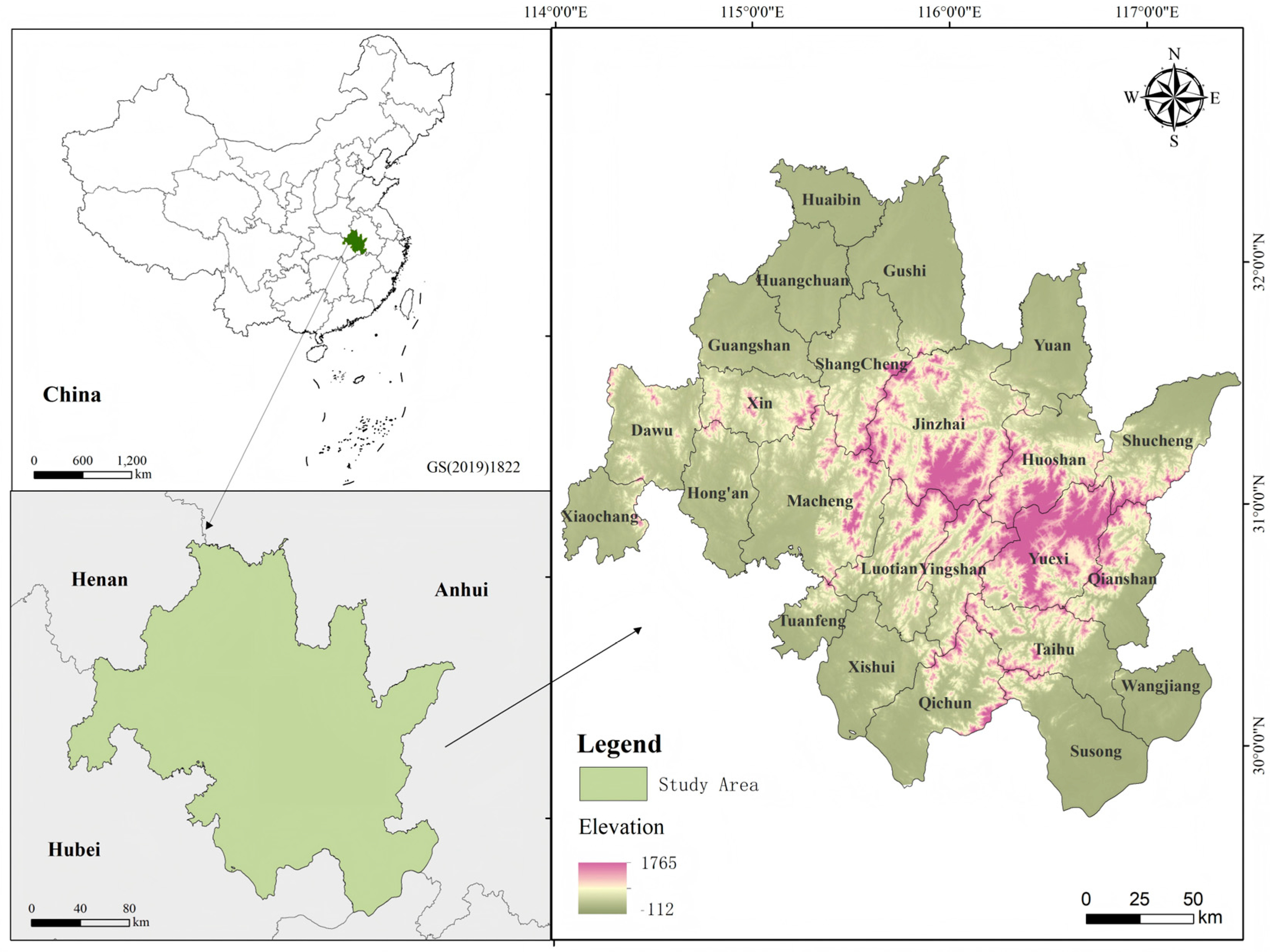
The Dabie Mountains are located between 29°78′ N~32°66′ N and 113°80′ E~117°25′ E, spanning the three provinces of Hubei, Henan, and Anhui in China, and covering more than 40 counties in total. It is the watershed between the Yangtze River and the Huai River, and was once among China’s most economically underdeveloped areas. The region has abundant climatic resources, situated in the warm and humid monsoon climate zone of the northern subtropics, with a mild climate, abundant rainfall, and synchronized rain and heat. The area also features typical mountain and forest climates. The terrain is complex and diverse, dominated by mountains, with steep slopes, valleys, and plains interwoven throughout. At the same time, this region is also an important water conservation area in the middle and lower reaches of the Yangtze River. The superior natural conditions result in rich and diverse agricultural resources, and agricultural production plays a key role in the county-level economic development of the region. However, due to geographical location and history, it was once one of the poorest areas in China. The agricultural technology in the region lags behind, and the overall level of agricultural development is relatively low, mainly relying on sacrificing the environment and increasing investment in machinery and biotechnology to achieve higher agricultural output value. This emission profile closely mirrors that of smallholder economies in Southeast Asia and Africa, as well as regions like China’s southwestern mountains and the North China Plain. This high-consumption, resource-intensive agricultural development model inevitably generates a large amount of carbon emissions, posing threats to the environment and resources. Amidst the global call for emissions reduction and China’s “dual carbon” strategy, the Dabie Mountains region is undergoing a critical transition from traditional to modern agriculture. Challenges include slow technology diffusion, low levels of scale, and weak awareness of emissions reduction. This development stage closely mirrors that of most developing countries and agricultural areas in central and western China. Therefore, selecting this region as the research area for agricultural carbon emission efficiency is of certain typicality. Based on the principles of spatial continuity of the research area, data availability, and reliability of research results, excluding some counties and cities (districts) located on the edge of the Dabie Mountains and those with difficult-to-obtain indicator data, 24 counties and cities (districts) were selected as research objects: Guangshan County, Xinxian County, Gushi County, Huaibin County, Shangcheng County, and Huangchuan County in Henan Province; Xiaochang County, Dawu County, Tuanfeng County, Hong’an County, Macheng City, Luotian County, Yingshan County, Xishui County, and Qichun County in Hubei Province; Qianshan County, Taihu County, Susong County, Wangjiang County, Yuexi County, Jinzhai County, Yu’an District, Huoshan County, and Shucheng County in Anhui Province. The selected area spans three provinces, covers the main agricultural production area of the Dabie Mountains, and is highly representative. An overview of the study area is shown in Figure 1.
Figure 1. Overview of the Dabie Mountains Counties Research Area.

2.2. Methods

2.2.1. Calculation of Agricultural Carbon Emissions

Agricultural carbon emissions originate from the inputs of various production factors in agricultural production processes. They constitute a key concept proposed within the framework of the low-carbon economy, serving to assess the development of low-carbon agricultural.
The Intergovernmental Panel on Climate Change (IPCC) reports that carbon emissions include six types of greenhouse gases. Agricultural carbon emissions, however, mainly comprise carbon dioxide (CO2), nitrous oxide (N2O), and methane (CH4). For the purpose of analysis, this paper converts these three gases into carbon dioxide equivalents (CO2-eq), which are used as the unit for calculating yield.
Agricultural production generates carbon emissions through multiple pathways. Each production stage may act as a direct or an indirect source of agricultural carbon emissions. Based on the research by Guo Sidai, Li Bo, and others [1,32], the formula for calculating carbon emissions is as follows:
E = E i = T i · δ i  
where E represents the total agricultural carbon emissions, E i denotes the carbon emissions from each type of carbon source, T i is the quantity of each type of carbon emission source, and δ i is the carbon emission coefficient (see Table 1).

2.2.2. Super-Efficiency SBM Model with Undesirable Outputs

The traditional DEA model generally considers producing more output with fewer resources as an efficient production method, overlooking the slack in inputs and outputs. To address this, Tone proposed the SBM model in 2001, which overcame the limitation of the original DEA model that could only be based on radial and angular perspectives, and created an efficiency measurement method based on slack variables. However, a drawback of this model is that the calculated efficiency values can only remain within the (0, 1] interval [33]. On this basis, Tone constructed the super-efficiency SBM model in 2002, but the super-efficiency SBM model can only calculate efficient DMUs, and the result for inefficient DMUs can only be 1 [34]. In 2003, Tone further developed the SBM model with undesirable outputs [35]. Referring to Tone’s SBM model with undesirable outputs, Cheng Gang proposed the super-efficiency SBM model with undesirable outputs in 2014 [36]. This model not only effectively avoids efficiency bias caused by differences in radial and angular selection, but also allows for decomposition and ranking of efficient decision-making units, and can more intuitively measure agricultural carbon emission efficiency. Since the results obtained under the Constant Returns to Scale (CRS) model better reflect the changes and differences in agricultural carbon emission efficiency across different regions compared to the Variable Returns to Scale (VRS) model, the super-efficiency SBM model with undesirable outputs under the CRS model is adopted, and its formula is as follows:
m i n ρ = 1 m i = 1 m ( x ¯ / x i k ) 1 r 1 + r 2 [ s = 1 r 1 y d ¯ / y s k d + q = 1 r 2 y f ¯ / y q k f ] x ¯ j = 1 , k n x i j λ j ; y d ¯ j = 1 , k n y s j d λ j y d ¯ j = 1 , k n y q j d λ j ; x ¯ x k y d ¯ y k d ; y f ¯ y k f ; λ j 0 , i = 1,2 , , m ; j = 1,2 , , n s = 1,2 , , r 1 ; q = 1,2 , , r 2                  
where ρ   represents agricultural carbon emission efficiency, If ρ 1 , it proves that the efficiency is relatively effective, and the larger the value, the more efficient the DMU is; If ρ < 1 , there is room for improvement in efficiency; n is the number of decision-making units, m is the input, r 1 is the desirable output, which refers to the total agricultural output value, r 2 is the undesirable output, which refers to carbon emissions, x is the element in the input matrix, y d is the element in the desirable output matrix, y f is the element in the undesirable output matrix, and λ denotes the intensity vector.

2.2.3. Standard Deviation Ellipse

Standard deviation ellipse (SDE) is a tool commonly used in spatial statistics and GIS to describe the spatial distribution characteristics of geographical elements. By calculating the standard deviation of spatial data, the method generates an ellipse to quantify the spatial concentration trend, directional characteristics, and degree of dispersion of geographical elements, while intuitively presenting the distribution law of elements in two-dimensional space. This paper adopts the standard deviational ellipse method to study the spatial evolution characteristics of agricultural carbon emission efficiency in Dabie Mountains region, aiming to effectively reveal the dynamic trends of agricultural carbon emission efficiency in this area. The calculation formula is as follows:
x w = i = 1 n w i x i i = 1 n w i     y w = i = 1 n w i y i i = 1 n w i    
where   x w and y w represent the relative coordinates of the spatial position ( x i , y i ) from the distribution centroid, w denotes the weight, and in this study, it refers to the agricultural carbon emission efficiency of counties in the Dabie Mountains.

2.2.4. Time Series Prediction of BP Neural Network

Backpropagation neural networks employ an error backpropagation algorithm suitable for multi-layer networks. BP neural networks demonstrate self-learning, self-organizing, and adaptive advantages in information processing, featuring a three-layer structure comprising input, hidden, and output layers. Backpropagation refers to the process of propagating errors layer by layer from the output layer to the input layer. When the output values obtained by the output layer deviate from the expected values, the weights are continuously adjusted layer by layer until the error reaches an optimal state. Consequently, in recent years, this technology has been widely applied in fields such as nonlinear system identification, optimization theory, and nonlinear system behavior prediction. It has also achieved multidimensional applications in agriculture, including agricultural irrigation water demand prediction [37], farmland water and soil research [38], and agricultural mechanization forecasting [39].
BP neural networks can simultaneously capture time dependency, fit nonlinear relationships, and adapt to small-to-medium sample sizes. They balance computational cost with interpretability. In contrast, as a static model, random forests cannot handle sequence dependencies in time series, smoothing out reasonable short-term emission fluctuations and reducing prediction accuracy. Although LSTMs are specifically designed for time series, they require massive datasets and high computational resources. Their long short-term memory units are irrelevant to agricultural carbon emissions and exhibit poor interpretability. ARIMA operates under design assumptions emphasizing linearity, stationarity, and endogenous drivers—assumptions entirely disconnected from the inherent nonlinearity, non-stationarity, and regional heterogeneity of agricultural carbon emission efficiency, thus failing to capture core characteristics. Given the model’s high adaptability, this paper employs it for time-series forecasting of agricultural carbon emission efficiency in the Dabie Mountains region, effectively meeting practical forecasting needs for this area. A three-layer BP network is set up, with the input vector as X = ( x 1 , , x i , , x n ) T , the hidden layer output vector as Y = ( y 1 , , y j , , y m ) T , the output layer output vector as O = ( o 1 , o 2 , , o k , , o l ) T , and the expected output vector as d = ( d 1 , d 2 , , d k , , d l ) T . The weights between the input layer and the hidden layer are V = ( V 1 , V 2 , , V j , , V m ) , and the weights between the hidden layer and the output layer are W = ( W 1 , W 2 , , W k , , W l ) .
Within a certain period, sample data on agricultural carbon emission efficiency are collected to obtain historical sample data { x a } . The known sample data [ x b   +   1 ,     x b   +   2 , ,   x b   +   c , ] are evaluated and analyzed. Through the forward propagation of data (information) among the three layers of the BP neural network and the adjustment of inter-layer weights and thresholds during the error feedback process, the output data are made to meet the pre-designed conditions, thus predicting the future agricultural carbon emission efficiency y m   , ( m   >   0 ) .

2.3. Construction of the Indicator System

Drawing on previous research experience [2,3,17] and considering the material, energy, and land factors involved in the agricultural production process, this study focuses on selecting input indicators for core resource inputs that directly affect carbon emissions within the agricultural production system. The use of agricultural materials in the agricultural production process can lead to agricultural carbon emissions, such as the use of fertilizers and pesticides, which produce greenhouse gases such as nitric oxide and fluorocarbons; agricultural mulching films made from plastic materials such as polyethylene are difficult to degrade, and farmers often resort to on-site decomposition or incineration, which generates large amounts of greenhouse gases such as methane and carbon dioxide. During the operation of agricultural machinery fueled by diesel, mixed compounds such as carbon monoxide, sulfur dioxide, and hydrocarbons are released as exhaust gases. Irrigation of farmland requires a certain amount of fossil fuels, which can also cause changes in carbon absorption and emissions of crops and soil in farmland. Therefore, in addition to necessary land resources, this article selects six aspects as input indicators, including plastic film, fertilizer, pesticide, machinery, irrigation, and diesel, and quantifies the use of agricultural plastic film, cultivated land area, total amount of agricultural fertilizer application, agricultural diesel use, effective irrigation area of farmland, and pesticide use, respectively.
Table 1. Input–output indicator system for agricultural carbon emission efficiency in the Dabie Mountains area.
Indicator CategoryIndicator NameContent DescriptionUnitCarbon Emission CoefficientReference
Input IndicatorsPlastic FilmAmount of agricultural plastic film used×104 t5.18 kg (CO2)/kgInstitute of Agricultural Resources and Ecological Environment, Nanjing Agricultural University [40]
LandArable land area×104 hm23.126 kg (CO2)/hm2College of Biology and Technology, China Agricultural University
FertilizerTotal amount of agricultural chemical fertilizer applied×104 t0.8956 kg (CO2)/kgOak Ridge National Laboratory, USA [41]
MachineryAgricultural diesel consumption×104 t0.5927 kg (CO2)/kgIPCC
IrrigationEffective irrigated area of farmland×104 hm220.476 kg (CO2)/hm2Li Bo et al. [28]
PesticidePesticide usage×104 t4.9341 kg (CO2)/kgOak Ridge National Laboratory, USA
Output Indicators
Desired outputEconomic outputTotal agricultural output value×104 CNY
Undesirable outputEnvironmental costAgricultural carbon emissions×104 kg(CO2-eq)
Considering the characteristics of Super-Efficiency SBM Model with Undesirable Outputs, this paper adopts gross agricultural output as the desired output, serving as a comprehensive quantitative indicator for measuring the economic efficiency of agricultural production. This directly reflects the value creation capacity across all stages of agricultural production, aligning with the economic objectives of agricultural output. Agricultural carbon emissions are treated as undesirable outputs, as they quantify greenhouse gas emissions resulting from the consumption of various input factors during agricultural production processes. The input–output indicator system for agricultural carbon emission efficiency established in the Dabie Mountains region is presented in Table 1.

2.4. Data Sources

The data are sourced from the Hubei Statistical Yearbook, Henan Statistical Yearbook, Anhui Statistical Yearbook from 2011 to 2023, the statistical yearbooks of the prefecture-level cities to which the relevant counties and districts belong [42,43,44]. Missing data were supplemented using interpolation methods.

3. Results

3.1. Results of Agricultural Carbon Emission Efficiency Measurement

According to Formula (1), the agricultural carbon emissions of each county and district from 2010 to 2022 were calculated, and Formula (2) was used to measure the agricultural carbon emission efficiency of each county and district. According to the characteristics of the model results, when the efficiency value is greater than or equal to 1, it means that the efficiency value of the area is relatively effective, and the greater the value, the higher the efficiency of the area; When the efficiency value is less than 1, it is proved that there is room to improve the efficiency of the area. The measurement results are shown in Table 2.
Table 2. Agricultural carbon emission efficiency in Dabie Mountain counties from 2010 to 2022.
Overall, during the study period, the agricultural carbon emission efficiency in the Dabie Mountain area did not performed well, with the annual average fluctuating between 0.779 and 0.975, and never exceeding 1. There were significant differences in agricultural carbon emission efficiency among regions. Among them, eight counties and districts—Guangshan, Xinxian, Shangcheng, Luotian, Yingshan, Yuexi, Yuan, and Huoshan—had relatively high levels of agricultural carbon emission efficiency, with average values all greater than 1. In contrast, Gushi in Henan Province; Tuanfeng, Hongan, Macheng, and Xishu in Hubei Province; and Wangjiang, Susong, Shucheng, Taihu, and Qianshan County in Anhui Province consistently maintained lower levels of agricultural carbon emission efficiency, with annual averages below 1. In 2015, Yingshan County’s agricultural carbon emission efficiency reached 4.444, the best level during the study period. This may be attributed not only to Yingshan County’s long-term cultivation of tea and Chinese medicinal herbs as characteristic economic crops, but also to the fact that in 2015, the Yingshan County government made green development its main focus, actively launched the rural “Three Sides, Three Beautifications, Three Reforms” initiative, and was committed to building a “National Demonstration County for Leisure Agriculture and Rural Tourism” and a “Strong Tourism County in Hubei,” placing special emphasis on the rural environment and green agricultural development. On the other hand, in 2010, Shucheng County recorded the lowest agricultural carbon emission efficiency during the study period at 0.204. This may be because 2010 was a key year marking the end of the “Eleventh Five-Year Plan” in which Shucheng County focused on agricultural modernization. That year, Shucheng County prioritized the promotion of agricultural machinery and regarded industrial concepts as important for agricultural development. The effective implementation of subsidies for the purchase of agricultural machinery greatly increased the utilization rate of agricultural machinery, resulting in a significant increase in carbon emissions.
To further study the overall change of agricultural carbon emission efficiency in this region, this paper conducts descriptive statistical analysis on its measurement results in the Dabie Mountains for 2010, 2014, 2018, and 2022 (see Table 3). The results are as follows:
Table 3. Descriptive Statistical Analysis of the Measurement Results of Agricultural Carbon Emission Efficiency in Dabie Mountain Counties.
(1) Mean: The average agricultural carbon emission efficiency reached 0.975 in 2010, the highest in the study period. It dropped to 0.805 (2014) and 0.778 (2018) year-on-year, then rebounded to 0.880 in 2022—still below the 2010 level. This shows the region’s overall agricultural carbon emission efficiency remained low, with a trend of first declining then rising.
(2) Standard deviation: The value hit 1.127 in 2010 (highest in the study period), indicating large efficiency differences among counties that year. It fell to 0.604 (2014) and 0.558 (2018) year-on-year, narrowing regional efficiency gaps. It slightly rose to 0.630 in 2022, showing a small expansion of regional differences. Overall, the annual standard deviation ranged from 0.558 to 1.127; the relatively small values mean counties/cities (districts) had efficiency differences, but low dispersion.
(3) Coefficient of variation: The 2010 value was 1.156, reflecting large regional differences and high dispersion. It dropped to 0.750 (2014), 0.717 (2018), and 0.716 (2022) year-on-year. This indicates the region’s spatial differences in agricultural carbon emission efficiency slowly converged and stabilized over time.
(4) Skewness coefficient: The 2010 value was 2.378, showing a significant right-skewed distribution—few counties had much higher efficiency than the average. It fell to 2.207 (2014) and 2.002 (2018) but remained right-skewed, then dropped sharply to 1.086 in 2022. This made the distribution more symmetrical and narrowed regional efficiency gaps. Overall, all skewness coefficients (2010–2022) were positive and continuously declining, balancing high and low efficiency values in the region.
(5) Kurtosis coefficient: The 2010 value was 5.876, showing a peaked distribution—efficiency values concentrated around the mean but with extremes. It fell to 5.505 (2014) and 5.015 (2018) but stayed peaked, then dropped significantly to 0.015 in 2022. This flattened the distribution and weakened extreme value impacts, also reflecting that the concentration of regions with similar efficiency first weakened then strengthened.

3.2. Spatio-Temporal Evolution of Agricultural Carbon Emission

3.2.1. Temporal Evolution Characteristics

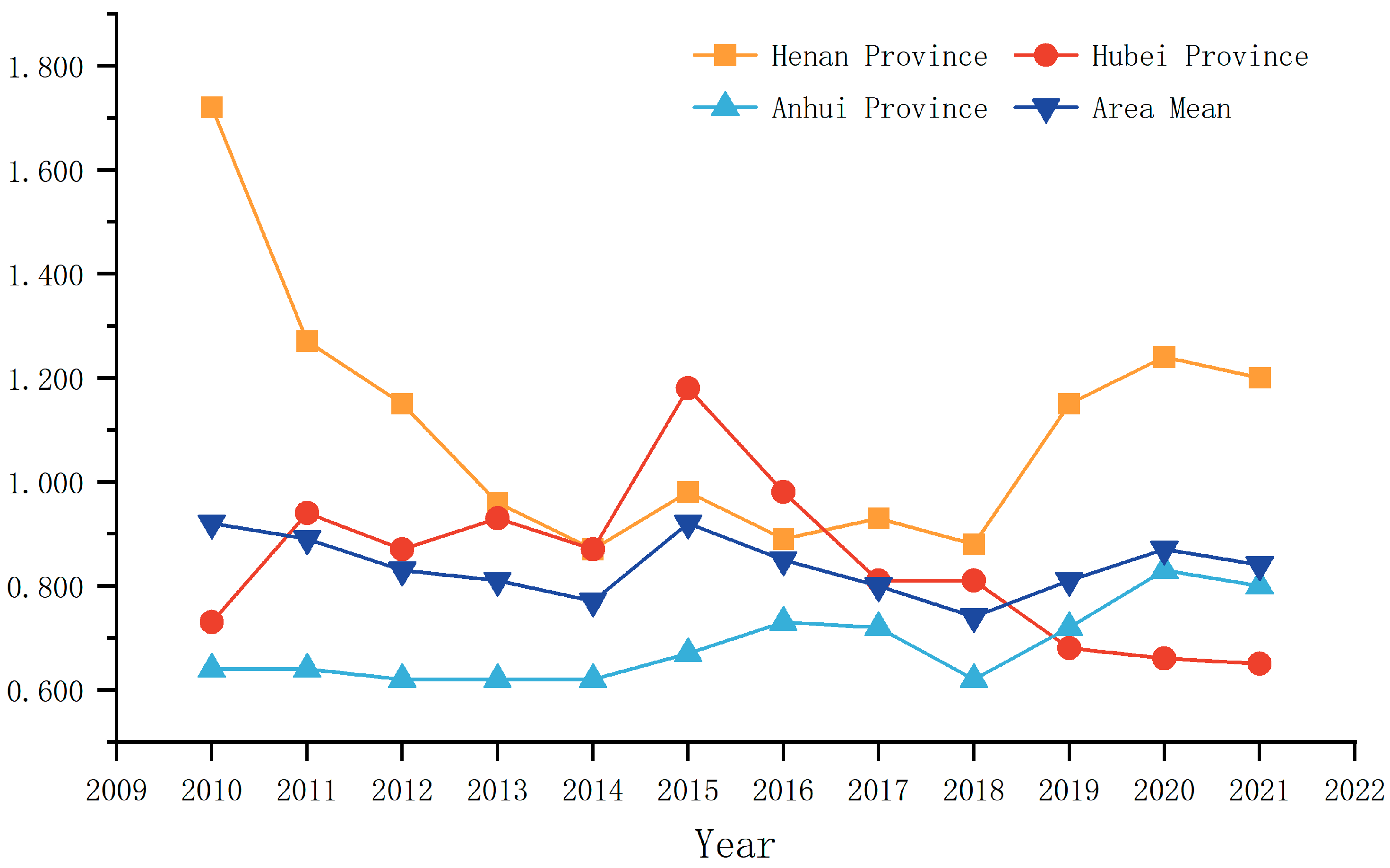
In order to explore the temporal evolution characteristics of agricultural carbon emission efficiency in the Dabie Mountain area during the study period, the annual average values of agricultural carbon emission efficiency for each county (district) in the Dabie Mountain area from 2010 to 2022 were calculated according to their respective provinces, and a line chart was created, as shown in Figure 2.
Figure 2. The average carbon emission efficiency of agriculture in Dabie Mountain counties from 2010 to 2022.
Figure 2 shows the average annual agricultural carbon emission efficiency of each county in the Dabie Mountains during the study period. Overall, the average agricultural carbon emission efficiency in the region exhibited a fluctuating trend, with no significant overall improvement. This trend reflects the instability of agricultural emission reduction policies in the Dabie Mountains region, revealing that balancing the development of low-carbon agriculture, short-term economic goals, and ecological protection in the research area is still a long way to go for the government and agricultural participants.
From a provincial perspective, counties in the Dabie Mountains across Henan, Hubei, and Anhui Provinces showed different agricultural carbon emission efficiency characteristics and trends.
Henan Province: Each county’s annual average agricultural carbon emission efficiency exceeded the overall Dabie Mountains level. Its temporal variation showed a “W”-shaped fluctuation. This reflects strong agricultural carbon emission management in Henan, likely driven by effective government agricultural policies and management measures. In recent years, Henan optimized agricultural production structure, promoted green agricultural technologies, and strengthened intensive agricultural resource use—these actions effectively improved its agricultural carbon emission efficiency.
Hubei Province: Each county/city’s annual average agricultural carbon emission efficiency exceeded the overall study area level in all years before 2019, except 2010. It fell below the overall level after 2019, possibly due to the late-2019 COVID-19 outbreak. Strict rural lockdowns sharply reduced agricultural production efficiency; the pandemic also disrupted agricultural supply chains and production activities, which affected agricultural carbon emission efficiency.
Anhui Province: Each county/district’s annual average agricultural carbon emission efficiency stayed below the overall Dabie Mountains level for most of the study period. It began during this period, actively launched high-quality, efficient green initiatives, and promoted livestock/poultry manure and straw “two utilizations”—these efforts achieved notable results.
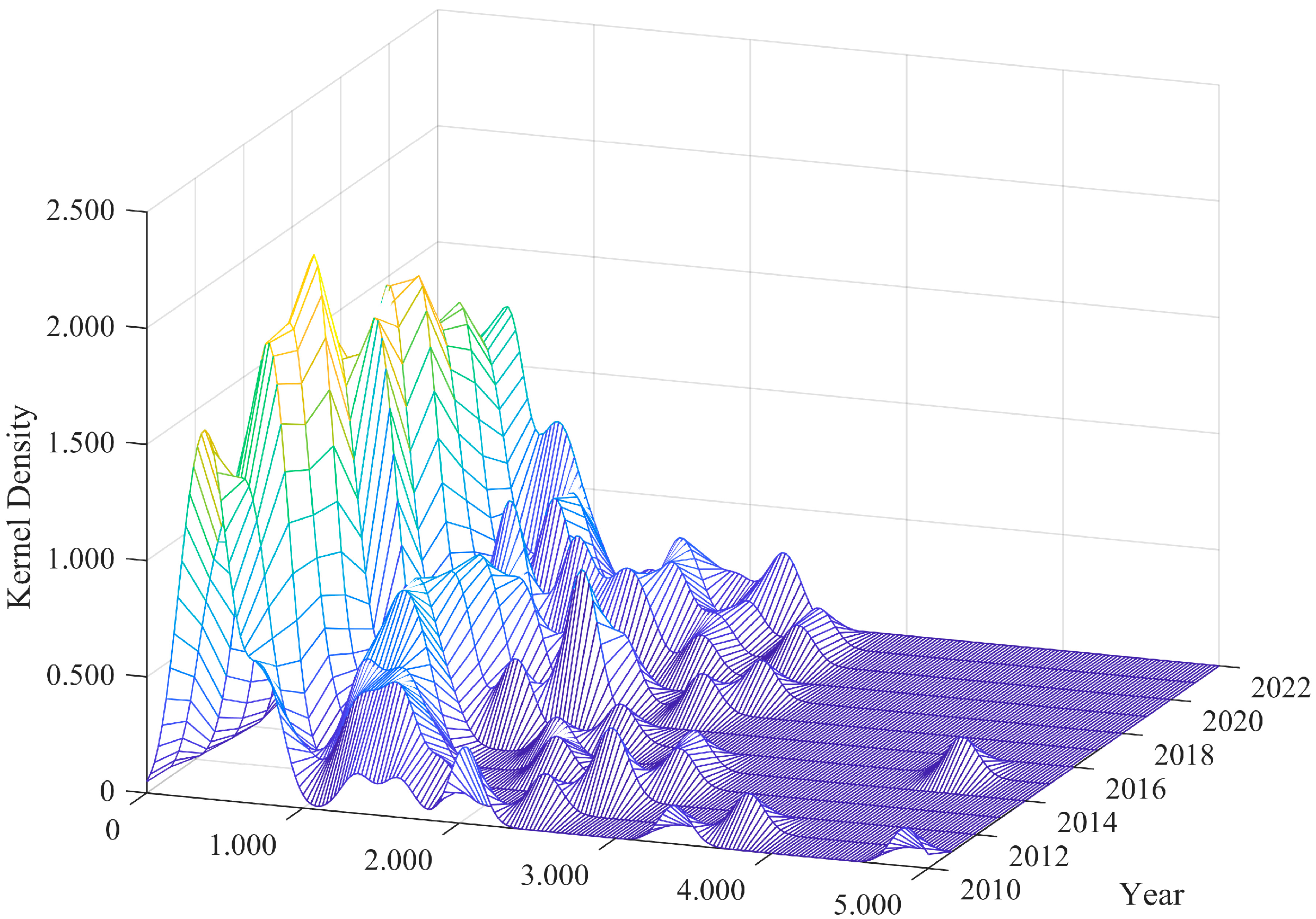
To further explore the temporal variation characteristics of agricultural carbon emission efficiency in the Dabie Mountain area, kernel density estimation was conducted on the agricultural carbon emission efficiency values from 2010 to 2022, as shown in Figure 3.
Figure 3. Kernel Density Estimation of Agricultural Carbon Emission Efficiency in Dabie Mountain Counties.
This paper further analyzes temporal variation patterns of agricultural carbon emission efficiency in Dabie Mountain counties using Figure 3. Key findings are as follows:
(1) Overall positional distribution: The kernel density curve shifted right over the study period. This indicates the region’s agricultural carbon emission efficiency trended upward overall. (2) Main peak evolution: The peak value followed a “first rising, then falling” pattern, with its width “first narrowing, then widening.” This means low-efficiency areas first became more concentrated, then less so—low-efficiency areas decreased, overall distribution grew more dispersed, and high-efficiency areas increased. (3) Distribution extensibility: The right tail shows high-efficiency areas drove overall efficiency from 2010 to 2022. Narrowing distribution reflects reduced absolute differences in efficiency, overall regional efficiency improvement, and mitigated regional imbalances. (4) Polarization trends: Kernel density curves showed multi-polarization from 2010 to 2022, generally presenting bimodal or multimodal distributions. These distributions included one main peak and one/more secondary peaks (secondary peaks were much lower than the main peak), with some right-side protrusions. This indicates agglomeration of efficiency levels moderated, high-efficiency areas increased, but overall distribution still remained somewhat dispersed.

3.2.2. Spatial Evolution Characteristics

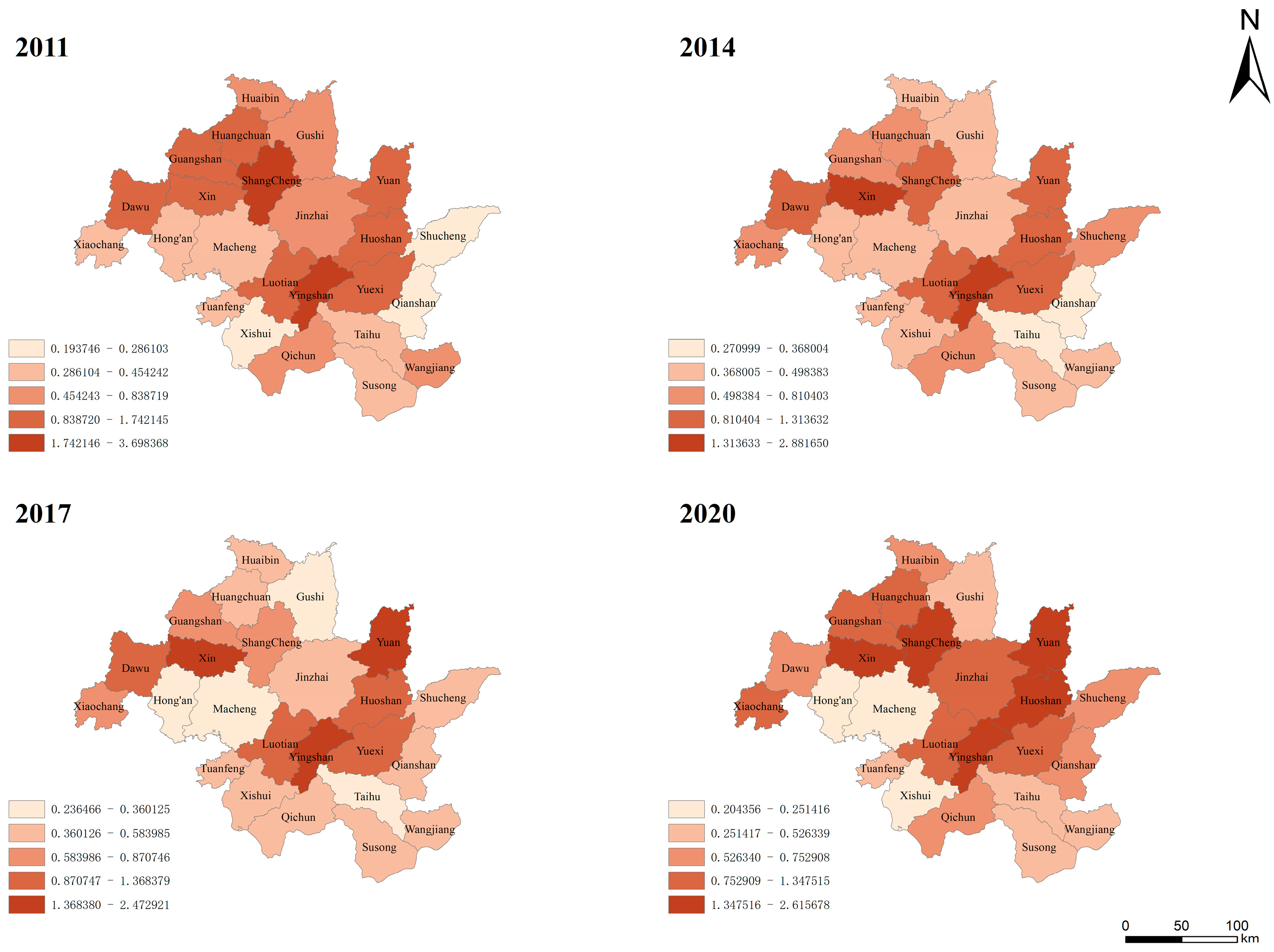
With the help of ArcGIS 10.8 software, agricultural carbon emission efficiency data for the years 2010, 2014, 2018, and 2022 were selected. Using the natural breaks method, the spatial evolution characteristics of agricultural carbon emission efficiency in the Dabie Mountains were visualized, as shown in Figure 4.
Figure 4. Spatial distribution of agricultural carbon emission efficiency in the Dabie Mountains in 2010, 2014, 2018, and 2022.
The analysis identifies three key characteristics of agricultural carbon emission efficiency’s spatial evolution in the Dabie Mountains from 2010 to 2022:
(1) Overall pattern: A clear “core–periphery” spatial distribution exists, with high-efficiency areas forming a “dual-center, block-like” layout. Central–eastern areas (centered on Yingshan County) and northwestern areas (centered on Shangcheng and Xinxian Counties) have higher efficiency. Southern, southwestern, and northern counties/districts have lower efficiency. Yingshan County maintains high efficiency consistently. It became a “National Pollution-Free Tea Base Demonstration County” in 2010; its tea, mulberry, chestnut, and medicinal herb industries require low agricultural input, reducing emissions. Xinxian and Shangcheng (northwestern Henan) also stay efficient. They benefit from Henan’s 2011 * Notice on the Twelfth Five-Year Plan for Environmental Protection*, which emphasizes rural environmental protection and emission reduction. (2) Interannual changes: 2010—high-efficiency areas cluster around Yingshan (including Yuexi, central-eastern Jinzhai) and Shangcheng (including Xinxian, Guangshan); 2014—high-efficiency areas increase, where Xinxian leads, Dawu improves, and Jinzhai declines (due to its focus on rural financial reform and infrastructure), while Luotian (Hubei) and Huoshan/Yu’an (Anhui) join high-efficiency areas; 2018—overall efficiency drops, but high-efficiency clusters remain similar to 2014. Yu’an District and Yingshan stand out; Xinxian, Shangcheng, Dawu, and Huangchuan stay high. Yu’an’s efficiency improved because it transformed agricultural methods and coordinated production with ecology during the “Twelfth Five-Year Plan.” 2022: High-efficiency clustering strengthens. It benefits from China’s “dual carbon” strategy (proposed by Xi Jinping at the 2020 UN General Assembly), which sets 2030 carbon peaking and 2060 carbon neutrality goals. The strategy guides regional agricultural emission reduction and boosts efficiency.
In summary, high-efficiency areas evolve from “block-like” to “sheet-like” distribution. Overall spatial differentiation shows a converging trend.
To gain a deeper understanding of the internal differences in carbon emission efficiency within the region and to clarify the dynamic evolution patterns of agricultural carbon emission efficiency in Dabie Mountain counties, this paper selected relevant data on agricultural carbon emission efficiency for 2010, 2014, 2018, and 2022. According to Formula (3), the long axis, short axis, azimuth, and ellipse area were calculated, as shown in Table 4.
Table 4. Calculation Results of Standard Deviation Ellipse for Agricultural Carbon Emission Efficiency in the Dabie Mountains from 2010 to 2022.
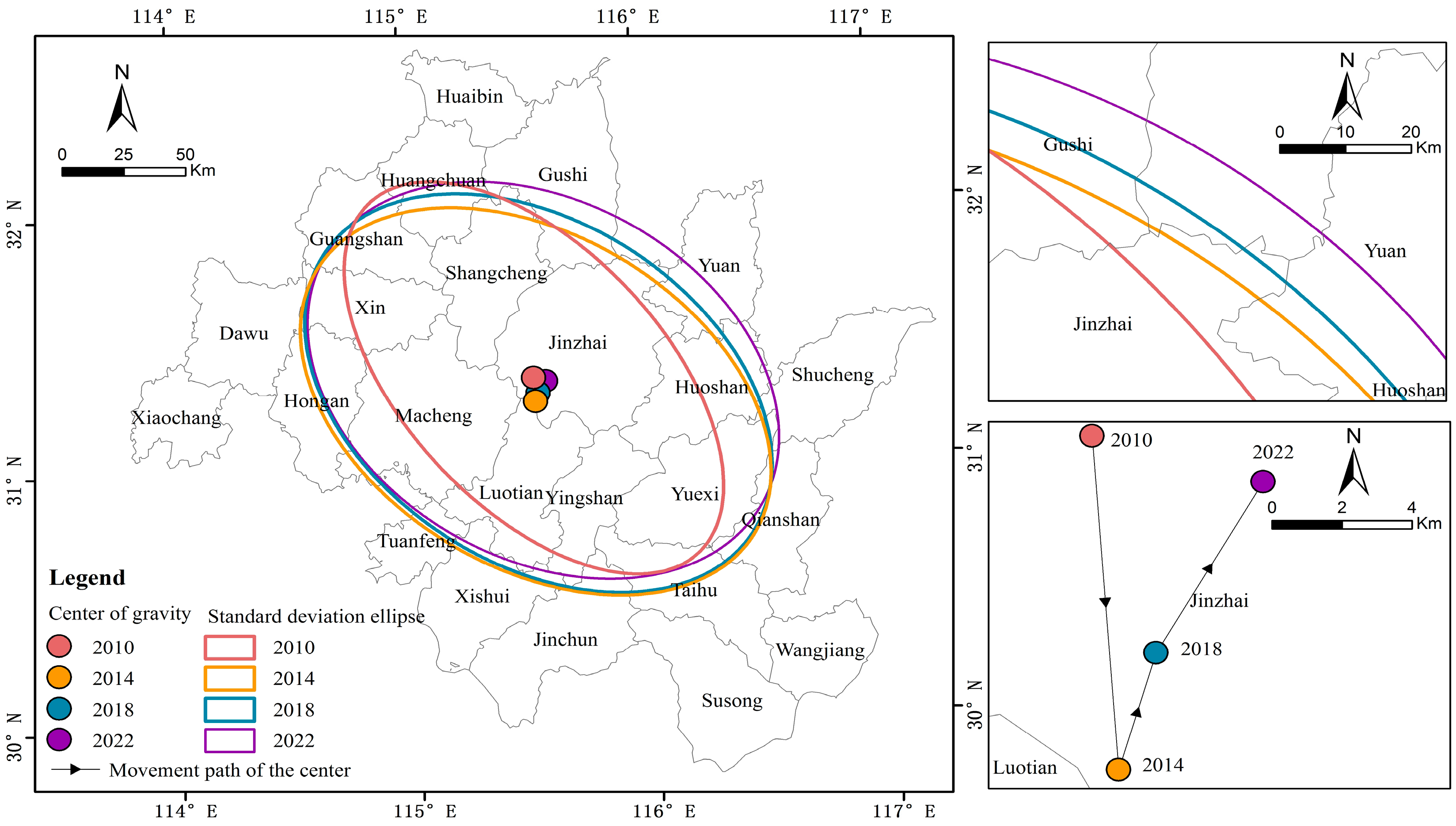
According to the calculation results in Table 4, with the help of ArcGIS 10.8 software, the centroid migration path of agricultural carbon emission efficiency in the Dabie Mountains was analyzed based on the standard deviation ellipse, as shown in Figure 5.
Figure 5. Standard deviation ellipse of agricultural carbon emission efficiency in the Dabie Mountains from 2010 to 2022.
Based on Table 4 and Figure 5, the standard deviation ellipse of agricultural carbon emission efficiency in the Dabie Mountains leads to the following conclusions: (1) in terms of the direction and position of centroid migration, the centroid of agricultural carbon emission efficiency in the Dabie Mountains shifted southeast from 2010 to 2014, and gradually shifted northeast after 2014. However, the centroid remained in Jinzhai County, indicating that during the study period, the centroid of agricultural carbon emission efficiency in the region as a whole migrated northeast, resulting in spatial changes. This suggests that the high-value area of carbon emission efficiency gradually concentrated in the northeast, but the overall degree of change was not significant. (2) Regarding the changes in the standard deviation ellipse, the major axis significantly shortened from 100.919 km in 2010 to 70.605 km in 2014, and then slowly increased from 70.605 km in 2014 to 75.492 km in 2022, indicating that the spatial distribution of agricultural carbon emission efficiency in the region first became more concentrated and then slightly diffused. The minor axis significantly increased from 54.004 km in 2010 to 105.524 km in 2014, and then remained stable until 2022, indicating that the distribution range of agricultural carbon emission efficiency in the Dabie Mountains expanded in the direction perpendicular to the major axis from 2010 to 2022. (3) In terms of changes in the ellipse area, the area of the standard deviation ellipse in the region continued to increase from 17,120 km2 in 2010 to 24,640 km2 in 2022, indicating that the spatial distribution range of agricultural carbon emission efficiency in the region gradually expanded. (4) Regarding the change in the shape index, the shape index increased significantly from 0.535 in 2010 to 1.495 in 2014, and then slightly decreased to 1.377 in 2022, indicating that the ellipse shape gradually changed from “elongated” to “nearly circular,” and the spatial distribution of carbon emission efficiency tended to become more balanced.
In summary, from 2010 to 2022, the spatial distribution of agricultural carbon emission efficiency in the Dabie Mountains showed a clear trend of migration and diffusion, with the centroid moving northeast and the spatial distribution range expanding year by year. The change in the shape of the ellipse indicates that the spatial distribution of carbon emission efficiency is becoming more balanced, and regional differences are gradually decreasing. These changes may be closely related to factors such as regional economic development, policy support, and agricultural structural adjustment.

3.3. Analysis of Prediction Results for Agricultural Carbon Emission Efficiency

Using MATLAB 2024 software, a BP neural network model was constructed to predict the time series of agricultural carbon emission efficiency in the Dabie Mountains region for 312 samples from 2010 to 2022. The dataset was divided into a training set covering 2010 to 2018 and a test set covering 2019 to 2022. The simulated output values were regressed against actual values. The prediction conditions were as follows: sigmoid activation function, error tolerance E < 0.001, iteration count > 1000, BP neural network weight threshold range [−1, 1], training iterations 1000, and learning rate 0.001. A higher R2 value closer to 1 and a lower MSE indicate better fitting quality.
Table 5 shows that the average MAE is 0.020, indicating a small average absolute deviation between predicted and actual values. The average MAPE is 2.45%, falling within the “fair accuracy” range. The average R2 is 0.923, close to 1, confirming the model’s stability and strong explanatory power for variations in agricultural carbon emission efficiency. The predicted results of agricultural carbon emission efficiency for each county and city (district) in Dabie Mountain area from 2024 to 2030 are shown in Table 6.
Table 5. Evaluation indicator results for predicting agricultural carbon emission efficiency in the Dabie Mountains region.
Table 6. Prediction of agricultural carbon emission efficiency in Dabie Mountain counties from 2024 to 2030.
According to the prediction results in Table 6, in the coming years, the agricultural carbon emission efficiency in most counties and cities (districts) within the study area will continue to show a steady upward trend, indicating that the overall agricultural carbon emission efficiency in the Dabie Mountain area will be improved. In terms of changes in the values of agricultural carbon emission efficiency, the trend can be characterized as “overall improvement, local highlights, and regional disparities that still need to be narrowed.” The counties are divided into three distinct tiers. The high-efficiency leading tier has efficiency values all above 1.5, including regions such as Xinxian, Luotian County, Yuan District, and Huoshan County. These areas have achieved high output with extremely low agricultural carbon emission intensity, suggesting that their agricultural systems have deeply integrated the concept of ecological agriculture, or have become benchmarks in the region by developing high value-added industries and introducing advanced low-carbon technologies. The middle stable tier, including Guangshan County, Shangcheng County, Huangchuan County, Dawu County, and Yingshan County, has agricultural carbon emission efficiency values fluctuating slightly between 1.0 and 1.5, basically maintaining a balance between input and output, with a relatively mature model that does not require large-scale adjustments in the short term. In contrast, the low-level tier in urgent need of improvement covers the widest range, including Gushi County, Huaibin County, Xiaochang County, Tuanfeng County, Hong’an County, Macheng City, Xishui County, Qichun County, as well as Qianshan County, Taihu County, Susong County, Wangjiang County, and Shucheng County in Anhui Province. The agricultural carbon emission efficiency values in these areas are significantly below 1.0, indicating excessively high carbon emissions per unit of output and an urgent need to optimize the efficiency of agricultural resource utilization. These counties and cities (districts) should be the focus of future agricultural industrial structure adjustment and efforts to reduce emissions and increase efficiency. In addition, Yingshan County, which has maintained a high level of agricultural carbon emission efficiency, may experience a decline in the coming years, which should raise concerns among the Yingshan County government, agricultural departments, and local farmers.
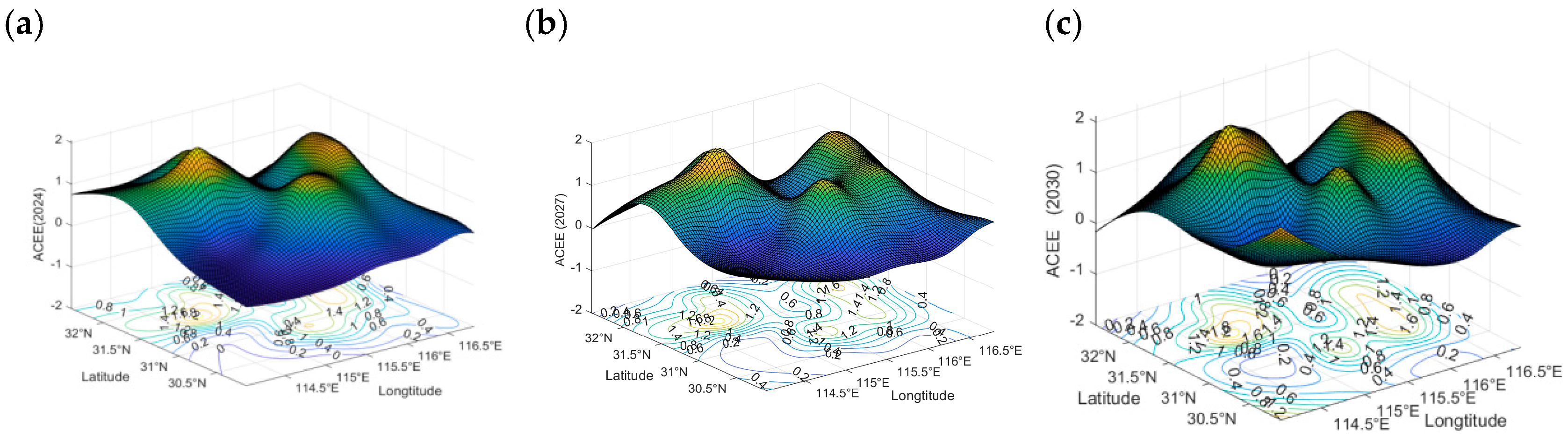
To further explore the variation patterns of the prediction results, MATLAB software was used to perform three-dimensional spatial interpolation of the predicted agricultural carbon emission efficiency for the years 2024, 2027, and 2030 (Figure 6).
Figure 6. Spatial interpolation of predicted agricultural carbon emission efficiency results in Dabie Mountain counties. (a) represents the predicted results of agricultural carbon emission efficiency in various counties of the Dabie Mountains in 2024; (b) represents the predicted results of agricultural carbon emission efficiency in this area in 2027; (c) represents the predicted results in 2030.
Figure 6a–c represent the spatial interpolation maps of predicted regional agricultural carbon emission efficiency for 2024, 2027, and 2030, respectively. Observing the changes in the spatial pattern of agricultural carbon emission efficiency in the Dabie Mountains from (a) to (c), the main features are as follows: (1) Locally, in 2024, the peak of agricultural carbon emission efficiency in the Dabie Mountains is located in the northwest, northeast, and central regions; compared with 2024 (a), in 2027 (b), a secondary peak appears south of the high-efficiency area in the northeast of the Dabie Mountains, and the agricultural carbon emission efficiency in the southern region also shows a significant improvement; as seen in (c), compared with 2024 and 2027, the overall agricultural carbon emission efficiency in the Dabie Mountains in 2030 increases significantly, with a new high-value area emerging in the southwest, the peak in the northeast further consolidating, overall efficiency improving and the gap narrowing, and the efficiency values in the northwest and northern regions increasing markedly. (2) Overall, during the forecast period, regional differentiation in agricultural carbon emission efficiency in the Dabie Mountains remains significant, but the differences between regions show a trend of further convergence. In addition, the spatial distribution pattern of agricultural carbon emission efficiency within the region is gradually manifesting a “core-periphery” structure, with an increasing number of high-efficiency areas, and the spatial pattern evolving from “bipolar” to “tripolar” to “multipolar.” In the coming years, the core status of the northwest, central, and eastern regions of the Dabie Mountains will be further consolidated, maintaining high levels of agricultural carbon emission efficiency. Notably, the agricultural carbon emission efficiency in the southwestern counties (districts) will also increase significantly. In summary, the overall agricultural carbon emission efficiency in Dabie Mountain counties shows a year-on-year upward trend, which may be related to China’s goal of “achieving carbon peaking before 2030” (“dual carbon” strategy). Each county and city (district) is strengthening the management and intervention of agricultural carbon emissions, paying more attention to the transformation and upgrading of agricultural structure, and vigorously developing low-carbon agriculture.

4. Discussion

Based on the concept of “looking to the past and envisioning the future,” this paper selects 24 counties and cities (districts) in the Dabie Mountain area as the research objects, collects relevant data from 2010 to 2022 to establish an indicator system, measures agricultural carbon emission efficiency, and depicts its spatio-temporal evolution characteristics. Based on the measurement results, this study dynamically forecasts the agricultural carbon emission efficiency in the region from 2024 to 2030. The research findings enrich and expand the theoretical foundation and empirical results in the field of agricultural carbon emission efficiency to a certain extent, and also provide a multidimensional practical reference for the low-carbon agricultural transition in developing regions globally where traditional smallholder farming dominates. Other regions can leverage their unique resource endowments and developmental stages to advance regional agricultural carbon reduction and efficiency gains through measures such as technological innovation pathways, policy coordination mechanisms, spatial governance strategies, and capacity building. Compared with previous studies, this research takes the county level in the Dabie Mountain area as the unit of analysis, breaking the limitation of administrative boundaries and achieving a shift from large-scale to medium- and small-scale research, which may be an innovation in research region and scale. Furthermore, this study breaks through the constraint of only conducting static analysis of agricultural carbon emission efficiency. On the basis of static analysis results, it uses the BP neural network to dynamically forecast sample data, which may be an innovation in research content and perspective.
In addition, this paper has the following shortcomings: First, although the agricultural carbon emission efficiency in the region has been measured and its spatial differentiation characteristics revealed, the influencing factors of agricultural carbon emission efficiency and the spatial correlation characteristics between regions have not been deeply analyzed, resulting in insufficient guidance on how to improve agricultural carbon emission efficiency in the area. Second, although the BP neural network analysis method was used to dynamically forecast the agricultural carbon emission efficiency in the region for the coming years, only the measurement results were used as sample data, without comprehensively considering other external factors affecting agricultural carbon emission efficiency, which may lead to possible errors in the forecast results. These shortcomings need to be further explored in future related research. Third, regarding the research subject, this paper examines agricultural carbon emission efficiency in a narrow sense, primarily focusing on crop cultivation. Consequently, limitations exist in indicator selection, data quality, and the application of results. Future research could extend to assessing broader agricultural carbon emission efficiency encompassing fisheries, forestry, crop cultivation, and animal husbandry. This would involve conducting evaluations based on more comprehensive data and integrated indicator systems. Subsequent research could focus on in-depth analysis of multidimensional influencing factors, investigation of cross-scale spatial linkages and spillover effects, addressing uncertainties in long-term evolutionary predictions, and studying the co-evolution of socio-ecological systems. This would provide more systematic theoretical underpinnings and practical guidance for global agricultural sustainability and the achievement of carbon neutrality and carbon peaking goals.
Based on the findings of this study, the following feasible recommendations for regional agricultural development are proposed to promote agricultural emissions reduction and sustainable agricultural development in the Dabie Mountains region: (1) Promote ecological and organic agriculture. The central and northwestern regions of the Dabie Mountains have relatively high agricultural carbon emission efficiency. Local governments in these areas should fully leverage their unique environmental and ecological advantages. They should vigorously promote ecological farming models. For instance, adopting practices such as rice-fish farming and forest-based economies can enhance resource utilization efficiency while reducing chemical fertilizer and pesticide usage, thereby effectively lowering carbon emissions. Simultaneously, local authorities should strengthen economic support and leverage modern technologies like GPS, remote sensing, and sensors to develop precision organic agriculture. Through targeted fertilization and irrigation, they can further reduce chemical fertilizer and water consumption, achieving a low-carbon transformation in agricultural production. (2) Improve farming practices. In the southern, southwestern, and northern regions of the Dabie Mountains, relevant departments should actively promote conservation tillage techniques like no-till and reduced-till farming. These methods effectively minimize soil disturbance, thereby increasing soil organic carbon content. Furthermore, adopting scientifically designed crop rotation and intercropping systems can improve soil structure and fertility, reducing chemical fertilizer requirements and further lowering carbon emissions from agricultural production. (3) Strengthen community engagement and regional cooperation. On one hand, governments at the township and village levels should encourage villages and towns to mobilize farmers’ active participation in agricultural emission reduction projects and green agriculture training, raising awareness and involvement in green, low-carbon farming practices. On the other hand, counties and districts across the Dabie Mountains should strengthen regional agricultural emissions reduction cooperation. They should jointly establish an agricultural carbon emissions monitoring system to track and evaluate emissions in real time. Building on this foundation, they should collaboratively develop and implement agricultural emissions reduction strategies, working together to advance the sustainable development of regional agriculture and contribute to achieving the green development goals of the Dabie Mountains region.

5. Conclusions

Based on the above analysis results, this study discusses the following:
Firstly, during the research period, the overall agricultural carbon emission efficiency in the Dabie Mountains region was relatively low, with an annual average of less than 1 and fluctuating between 0.779 and 0.975. There are significant spatial differences in agricultural carbon emission efficiency within the region, but the degree of dispersion is relatively small. Yingshan, Xinxian, Yu’an District, Luotian, Huoshan, Guangshan, Yuexi, Shangcheng and other counties have high agricultural carbon emission efficiency, with an average value of over 1.000, while Gushi, Tuanfeng, Hong’an and other counties (cities) have consistently low agricultural carbon emission efficiency.
Secondly, during the research period, the overall efficiency of agricultural carbon emissions in the Dabie Mountains showed a fluctuating trend, but the overall improvement was not significant. At the inter provincial level, the agricultural carbon emission efficiency of counties in Henan Province is higher than the overall level of the Dabie Mountains, while the agricultural carbon emission efficiency of counties (districts) in Anhui Province is lower than the overall level of the Dabie Mountains. The agricultural carbon emission efficiency of counties (cities) in Hubei Province increased before the overall level, then fell below the overall level, and has remained below the overall level since 2019. Overall, the spatial differences in agricultural carbon emission efficiency within the region are gradually narrowing and showing an upward trend. Inefficient regions are gradually decreasing, while efficient regions significantly boost overall efficiency, and regional imbalances are alleviated to a certain extent.
Thirdly, the “core-periphery” spatial distribution pattern of agricultural carbon emission efficiency in the Dabie Mountain area is evident, with high-value regions exhibiting a “dual-center, block-shaped” distribution. Specifically, the central-eastern area centered on Yingshan County and the northwestern area centered on Shangcheng County and Xinxian County demonstrate higher agricultural carbon emission efficiency. In contrast, the southern, southwestern, and northern counties and districts have relatively lower agricultural carbon emission efficiency. During the study period, the high-value areas of agricultural carbon emission efficiency in the Dabie Mountain area evolved from a block-shaped to a patch-shaped distribution, with overall spatial disparities showing a converging trend. Moreover, the spatial distribution of agricultural carbon emission efficiency exhibited significant migration and diffusion trends during the study period, with the center of gravity shifting toward the northeast. The spatial distribution of agricultural carbon emission efficiency became more balanced, and regional differences gradually diminished.
Finally, in the future, from 2024 to 2030, the agricultural carbon emission efficiency in the Dabie Mountain area will be significantly improved and will show a steady growth trend. Although spatial disparities within the region will still be prominent, there is a tendency toward further convergence. In addition, during the forecast period, the “core-periphery” spatial distribution pattern within the region will become more pronounced, with an increasing number of high-value areas for agricultural carbon emission efficiency, exhibiting an evolution from a “bipolar—tripolar—multipolar” spatial pattern.

Author Contributions

Conceptualization, Y.H. and K.Z.; methodology, Y.H.; software, Y.H.; validation, Y.H.; formal analysis, Y.H.; investigation, Y.H.; resources, K.Z.; data curation, Y.H.; writing—original draft preparation, Y.H.; writing—review and editing, G.Z.; visualization, Y.H.; supervision, G.Z.; project administration, G.Z.; funding acquisition, G.Z. All authors have read and agreed to the published version of the manuscript.

Funding

This research was funded by Innovation Exploration and Academic New Talent Project of Guizhou University of Finance and Economics. Funder: Guizhou University of Finance and Economics; Funding number: 2024XSXMB15.

Institutional Review Board Statement

Not applicable.

Data Availability Statement

The data presented in this study are openly available in [Hubei Provincial Bureau of Statistics\Henan Provincial Bureau of Statistics.\Anhui Provincial Bureau of Statistics.] at [https://tjj.hubei.gov.cn/tjsj/sjkscx/tjnj/qstjnj/index.shtml], [https://tjj.henan.gov.cn/tjfw/tjcbw/tjnj/], [https://tjj.ah.gov.cn/ssah/qwfbjd/tjnj/index.html] reference number [42,43,44].

Conflicts of Interest

The authors declare no conflicts of interest.

References

  1. Guo, S.D.; Qian, Y.B.; Zhao, R. Agricultural carbon emission efficiency and convergence analysis in western China: Based on SBM-Undesirable model. Rural Econ. 2018, 80–87. [Google Scholar]
  2. Hu, W.L.; Zhang, J.X.; Wang, H.L. Characteristics and influencing factors of agricultural carbon emissions in China. Stat. Decis. 2020, 36, 56–62. [Google Scholar]
  3. Cheng, L.L.; Zhang, J.B.; Tian, Y.; Zhou, X.S. Spatial differentiation characteristics and dependence effect of provincial agricultural carbon productivity in China. Resour. Sci. 2016, 38, 276–289. [Google Scholar]
  4. Shi, Y.F.; Wu, W.L.; Meng, F.Q.; Wang, D.P.; Zhang, Z.H. Research progress on the impact of farmland carbon sequestration measures on greenhouse gas emission reduction. China Popul. Resour. Environ. 2012, 22, 43–48. [Google Scholar]
  5. Gao, M.; Song, H.Y. Spatial convergence and differentiation of agricultural carbon emission performance in China: Empirical analysis based on Malmquist-Luenberger index and spatial econometrics. Econ. Geogr. 2015, 35, 142–148+185. [Google Scholar]
  6. Taghavi, S.; Mendoza, T.; Acero, B., Jr.; Li, T.; Siddiq, S.A.; Yorobe, J., Jr.; Li, Z.; Ali, J. Carbon Dioxide Equivalent Emissions of Newly Developed Rice Varieties. Jpn. Agric. Stand. Food 2017, 9, 107. [Google Scholar] [CrossRef]
  7. Johnson, J.M.; Franzluebbers, A.J.; Weyers, S.L.; Reicosky, D.C. Agricultural opportunities to mitigate greenhouse gas emissions. Environ. Pollut. 2007, 150, 207–224. [Google Scholar] [CrossRef]
  8. Kaya, Y. Impact of Carbon Dioxide Emission Control on GNP Growth: Interpretation of Proposed Scenarios IPCC Energy and Industry Subgroup, Response STRATEGIES Working Group. Intergovernmental Panel on Climate Change/Response Strategies Working Group. 1990. Available online: https://www.researchgate.net/publication/312468754_Impact_of_carbon_dioxide_emission_control_on_GNP_growth_interpretation_of_proposed_scenarios_IPCC_energy_and_industry_subgroup_response_strategies_working_group (accessed on 15 May 2025).
  9. Zhou, P.; Ang, B.W.; Han, J.Y. Total factor carbon emission performance: A Malmquist index analysis. Energy Econ. 2010, 32, 194–201. [Google Scholar] [CrossRef]
  10. Bibi, Z.; Khan, D.; Haq, I. Technical and environmental efficiency of agriculture sector in South Asia: A stochastic frontier analysis approach. Environ. Dev. Sustain. 2024, 23, 9260–9279. [Google Scholar] [CrossRef]
  11. Fernández González, P.; Landajo, M.; Presno, M. The driving forces behind changes in CO2 emission levels in EU-27: Differences between member states. Environ. Sci. Policy 2014, 38, 11–16. [Google Scholar] [CrossRef]
  12. Liu, Y.; Gao, Y. Measurement and impact factor analysis of agricultural carbon emission performance in Changjiang Economic Corridor. Alex. Eng. J. 2024, 61, 1123–1132. [Google Scholar]
  13. Yadav, D.; Wang, J. Modelling carbon dioxide emissions from agricultural soils in Canada. Environ. Pollut. 2017, 230, 1040–1049. [Google Scholar] [CrossRef] [PubMed]
  14. Garnier, J.; Le Noë, J.; Marescaux, A.; Sanz-Cobena, A.; Lassaletta, L.; Silvestre, M.; Thieu, V.; Billen, G. Long-term changes in greenhouse gas emissions from French agriculture and livestock (1852–2014): From traditional agriculture to conventional intensive systems. Sci. Total Environ. 2019, 660, 1486–1501. [Google Scholar] [CrossRef] [PubMed]
  15. Wang, Q.W.; Zhou, P.; Zhou, D.Q. Dynamic changes, regional differences and influencing factors of carbon dioxide emission performance in China. China Ind. Econ. 2010, 45–54. [Google Scholar]
  16. Zheng, Y.Y.; Luo, J.L. Carbon emission effect of agricultural production efficiency: Spatial spillover and threshold characteristics. J. Beijing Univ. Aeronaut. Astronaut. (Soc. Sci. Ed.) 2021, 34, 96–105. [Google Scholar]
  17. Shang, J.; Yang, B.J. Measurement of carbon sources and sinks in crop farming and dynamic analysis of influencing factors of net carbon sinks: An example from Shandong Province. Reform 2019, 123–134. [Google Scholar]
  18. Xie, C.Y.; Huang, C.F.; Xu, H. Regional differences and influencing factors of China’s agricultural technical efficiency under environmental regulation: From the perspective of dual constraints of agricultural carbon emissions and agricultural non-point source pollution. Sci. Technol. Manag. Res. 2021, 41, 184–190. [Google Scholar]
  19. Zhu, Y.B.; Ma, X.Z.; Shi, Y.J. Analysis of agricultural input-output efficiency and emission reduction potential in Henan Province at the county scale. Chin. J. Eco-Agric. 2022, 30, 1852–1861. [Google Scholar]
  20. Hou, Y.; Zhang, H.S.; Yang, S.Z.; Geng, F.Y. Spatio-temporal evolution and influencing factors of agricultural carbon emission efficiency in major grain-producing areas. Xinjiang Agric. Reclam. Econ. 2023, 53–65. [Google Scholar]
  21. Xu, X.Y.; Dong, H.Z.; Pang, M. Spatio-temporal evolution characteristics and driving factors of agricultural carbon emission efficiency in the three northeastern provinces of China. Chin. J. Environ. Manag. 2023, 15, 86–97. [Google Scholar]
  22. Zhang, J.W.; Zhang, J.H.; Wu, F.W. Carbon emissions from grain production in China and analysis of emission reduction paths. Stat. Decis. 2018, 34, 168–172. [Google Scholar]
  23. Zhang, J.; Chen, H.; Liu, D.; Geng, T.W.; Dong, J.W. Differences in farmers’ agricultural carbon emission efficiency and multi-level influencing factors: A case study of Mizhi County, Shaanxi Province. Chin. J. Agric. Resour. Reg. Plan. 2022, 43, 90–100. [Google Scholar]
  24. Yang, Q.L.; Zhao, R.Q.; Zhao, T.; Hu, Y.M.; Zhang, Y.P.; Zhu, R.M. Relationship between agricultural carbon emission efficiency and food security at the county scale. Chin. J. Agric. Resour. Reg. Plan. 2023, 44, 156–169. [Google Scholar]
  25. Feng, F.; Feng, J.N. Agricultural carbon emission efficiency and its influencing factors in cities of Shaanxi Province. Resour. Ind. 2023, 25, 10–18. [Google Scholar]
  26. Tian, Y.; Wang, M.C. Spatio-temporal differences and influencing factors of agricultural carbon emission efficiency in Hubei Province. Sci. Agric. Sin. 2020, 53, 5063–5072. [Google Scholar]
  27. He, J. Study on the Spatio-Temporal Heterogeneity and Driving Mechanism of Agricultural Carbon Emission Efficiency in the Yangtze River Economic Belt. Master’s Thesis, Central South University of Forestry and Technology, Changsha, China, 2022. [Google Scholar]
  28. Li, B.; Zhang, W.Z.; Yu, J.H. Decomposition of regional differences and influencing factors of China’s agricultural production efficiency under carbon emission constraints. Econ. Geogr. 2016, 36, 150–157. [Google Scholar]
  29. Guo, H.H.; Liu, X.M. Spatio-temporal evolution of agricultural green total factor productivity in China. Chin. J. Manag. Sci. 2020, 28, 66–75. [Google Scholar]
  30. Huang, X.Y.; Wu, J.Y.; Lin, W.H.; Wu, Q.X. Prediction of carbon emissions in Jiangsu Province based on GM(1,1) model. Heilongjiang Sci. 2022, 13, 26–28+32. [Google Scholar]
  31. He, Y.; Wang, L.G.; Zhu, H.; Song, W.; Zhan, X.Y. Prediction, decoupling effect and driving factors of carbon emissions from tourism industry in the Yangtze River Economic Belt under the “dual carbon” goal. J. Resour. Ecol. 2023, 14, 1329–1343. [Google Scholar]
  32. Li, B.; Zhang, J.B.; Li, H.P. Spatio-temporal characteristics and decomposition of influencing factors of agricultural carbon emissions in China. China Popul. Resour. Environ. 2011, 21, 80–86. [Google Scholar]
  33. Tone, K. A slacks-based measure of efficiency in data envelopment analysis. Eur. J. Oper. Res. 2001, 130, 498–509. [Google Scholar] [CrossRef]
  34. Tone, K. A slacks-based measure of super-efficiency in data envelopment analysis. Eur. J. Oper. Res. 2002, 143, 32–41. [Google Scholar] [CrossRef]
  35. Tone, K. Dealing with undesirable outputs in DEA: A slacks-based measure (SBM) approach. In Proceedings of the Presentation at North American Productivity Workshop 2004, Toronto, ON, Canada, 23–25 June 2004; pp. 44–45. [Google Scholar]
  36. Cheng, G. Data Envelopment Analysis Method and MaxDEA Software; Intellectual Property Publ. House: Beijing, China, 2014. [Google Scholar]
  37. Wang, J.H.; Ran, J.X.; Shen, Y.Y.; Han, Z.Z.; Cui, Y.L.; Luo, Y.F. BP neural network agricultural irrigation water prediction model optimized by GA-Adam algorithm. China Rural Water Hydropower 2022, 138–143. [Google Scholar]
  38. Wang, H.; Zhang, J.F.; Gao, Z.H.; Li, T. Application of BP neural network in agricultural water and soil research. Mod. Agric. Sci. Technol. 2021, 134–139. [Google Scholar]
  39. Wang, X.Y.; Wang, S.; Zhou, Q. Prediction of agricultural machinery quantity based on BP neural network. J. Agric. Mech. Res. 2015, 37, 11–14. [Google Scholar]
  40. Wu, F.L.; Li, L.; Zhang, H.L.; Chen, F. Effects of conservation tillage on net carbon release in farmland ecosystems. Chin. J. Ecol. 2007, 26, 2035–2039. [Google Scholar]
  41. Zhi, J.; Gao, J.X. Comparative analysis of carbon emissions from food consumption between urban and rural residents in China-. Prog. Geogr. 2009, 28, 429–434. [Google Scholar]
  42. Hubei Provincial Bureau of Statistics. Hubei Statistical Yearbook 2011–2023 [M/OL]; China Statistics Press: Beijing, China, 2011–2023. Available online: https://tjj.hubei.gov.cn/tjsj/sjkscx/tjnj/qstjnj/index.shtml (accessed on 15 May 2025).
  43. Hunan Provincial Bureau of Statistics. Hunan Statistical Yearbook 2011–2023 [M/OL]; China Statistics Press: Beijing, China, 2011–2023. Available online: https://tjj.henan.gov.cn/tjfw/tjcbw/tjnj/ (accessed on 24 March 2025).
  44. Anhui Provincial Bureau of Statistics. Anhui Statistical Yearbook 2011–2023 [M/OL]; China Statistics Press: Beijing, China, 2011–2023. Available online: https://tjj.ah.gov.cn/ssah/qwfbjd/tjnj/index.html (accessed on 5 April 2025).
Disclaimer/Publisher’s Note: The statements, opinions and data contained in all publications are solely those of the individual author(s) and contributor(s) and not of MDPI and/or the editor(s). MDPI and/or the editor(s) disclaim responsibility for any injury to people or property resulting from any ideas, methods, instructions or products referred to in the content.

Article Metrics

Citations

Article Access Statistics

Multiple requests from the same IP address are counted as one view.