Technological Innovations Shaping Sustainable Competitiveness—A Systematic Review

Abstract
1. Introduction
1.1. Literature Review and Theoretical Background
1.1.1. Theoretical Foundations of Technological Innovation and Sustainable Competitiveness
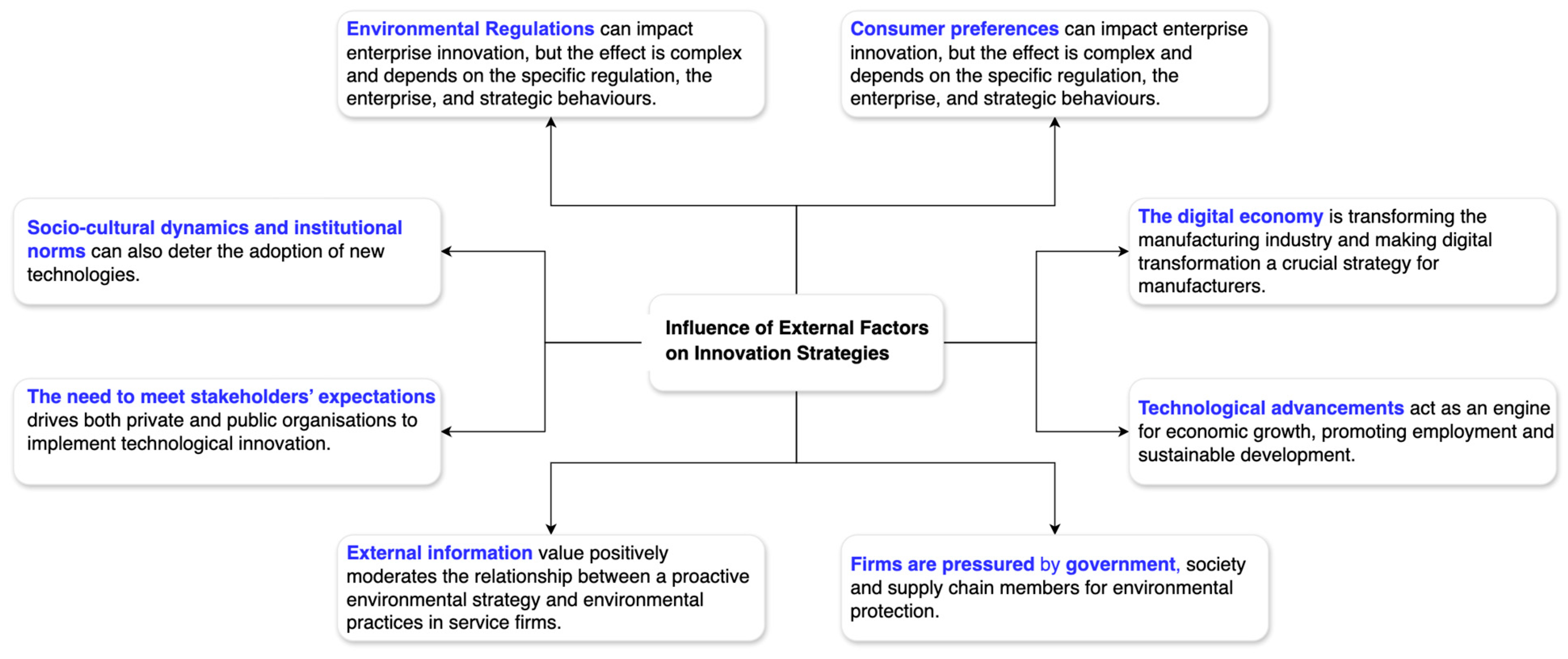
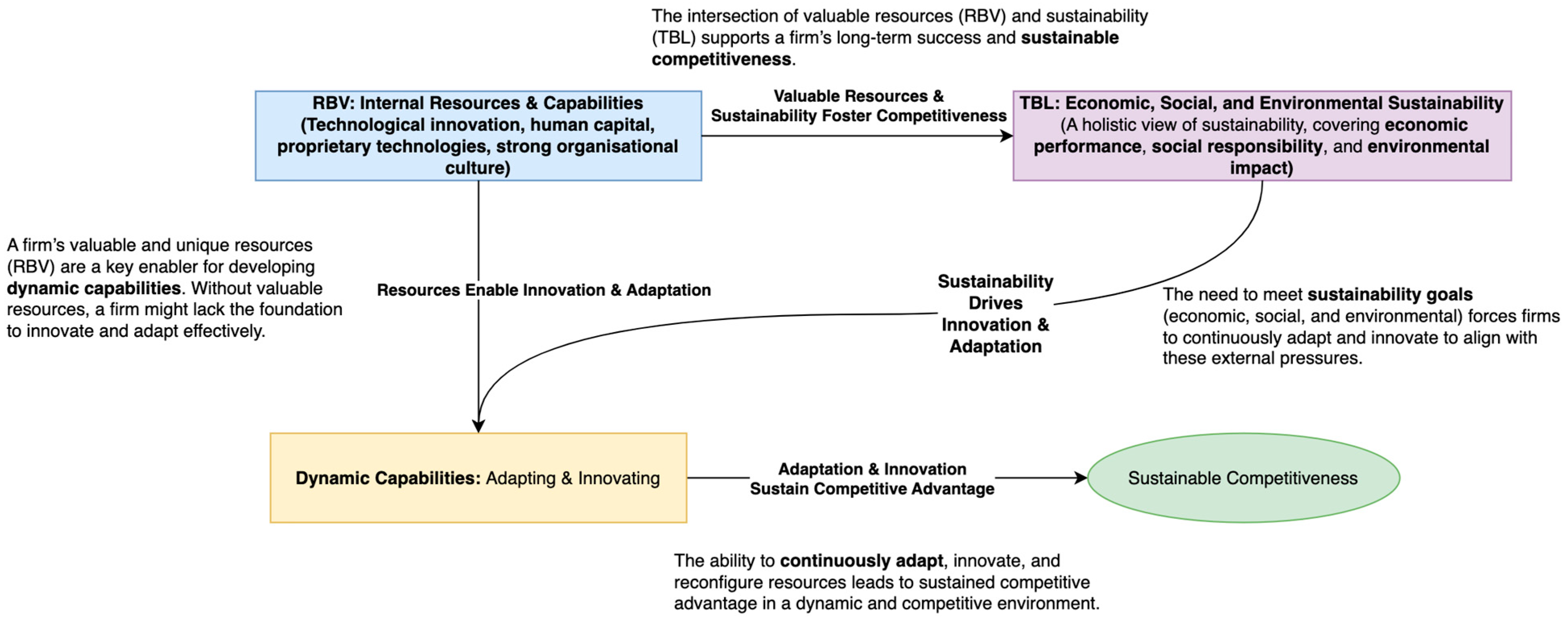
- Resource-Based View (RBV) Framework: Barney highlights the strategic role of resources in achieving competitive advantage [4]. Technological assets empower firms with solutions that help in enhancing efficiency while addressing the aspects of sustainability.
- Dynamic Capabilities Theory: Theory of Dynamic Capabilities: It builds on the previously mentioned framework (RBV), in which, while the RBV is about the ability of a firm to use resources and capabilities for sustained competition, the theory of Dynamic extends on this by stressing the high value of agility while adapting to technological and environmental changes [5]. It emphasizes the need for firms to adapt and reconfigure their resources and competencies in response to rapidly changing environments.
- Triple Bottom Line (TBL): In this framework, Elkington expanded the traditional way of focusing only on the financial performance of a firm to include a wider perspective that supports a balance between three main elements: economic, environmental, and social goals [6]. Technological innovation provides help in giving a balance among those elements. This is through providing support in improving resource efficiency and promoting equitable growth.
- Model of Triple Helix: In their model, Etzkowitz and Leydesdorff highlighted the vital collaboration between three key spheres: academia, industry, and government. This intersection aims to help innovation ecosystems that scale technological advancements for sustainable competitiveness [7]. Carayannis and Campbell developed this model and formed a Quadruple Helix Model [8] by the involvement of civil society in the innovation ecosystem. While Peris-Ortiz, Ferreira, Farinha, Fernandes, and Nuno additionally included the natural environment as a new subsystem and substantiated mechanisms for close interaction between government, academia, industry, and civil society to promote sustainable competitiveness at the country (regional) and company (business) levels [9]. Within the Quintuple Helix Model, sustainable development became a core idea, pushing innovators to launch new solutions with support given by universities, authorities, and society to reduce natural environment degradation.
1.1.2. Empirical Evidence of the Impact of Technological Innovation on Sustainable Competitiveness
- Environmental Sustainability: Innovations in renewable energy, smart grids, and green technologies mitigate environmental impacts and enhance resilience [12].
- Social Equity: World Economic Forum highlighted that advances in education, healthcare, and digital access promote inclusivity, although the digital divide persists [13].
1.1.3. Strategies and Challenges in Adopting Technological Innovation for Sustainable Competitiveness
- Policy Support: OECD highlighted the importance that governments bring when it comes to encouraging and helping public–private partnerships; besides, their help in setting clear regulatory frameworks [14].
- Collaboration: For scaling innovations, Etzkowitz and Leydesdorff stated in their research that it is essential to have partnerships across three spheres: academia, industry, and government [7].
- Capacity Building: Organizations need to ensure their competency by having a good knowledge base and advanced technologies. Also, organizations need to promote a culture of innovation [15].
2. Materials and Methods
- Are the technological innovations key determinants of sustainable competitiveness?
- How do advanced technologies contribute to sustainable competitiveness across sectors?
- What measures and strategies on micro and macroeconomic levels stimulate and accelerate sustainable competitiveness?
- Inclusion Criteria Include the following:
- Articles that examine, in particular, the role of technological innovation in shaping sustainable competitiveness or competitive advantage
- Articles that present real-life case studies, frameworks, or empirical evidence linking technology with sustainable competitiveness.
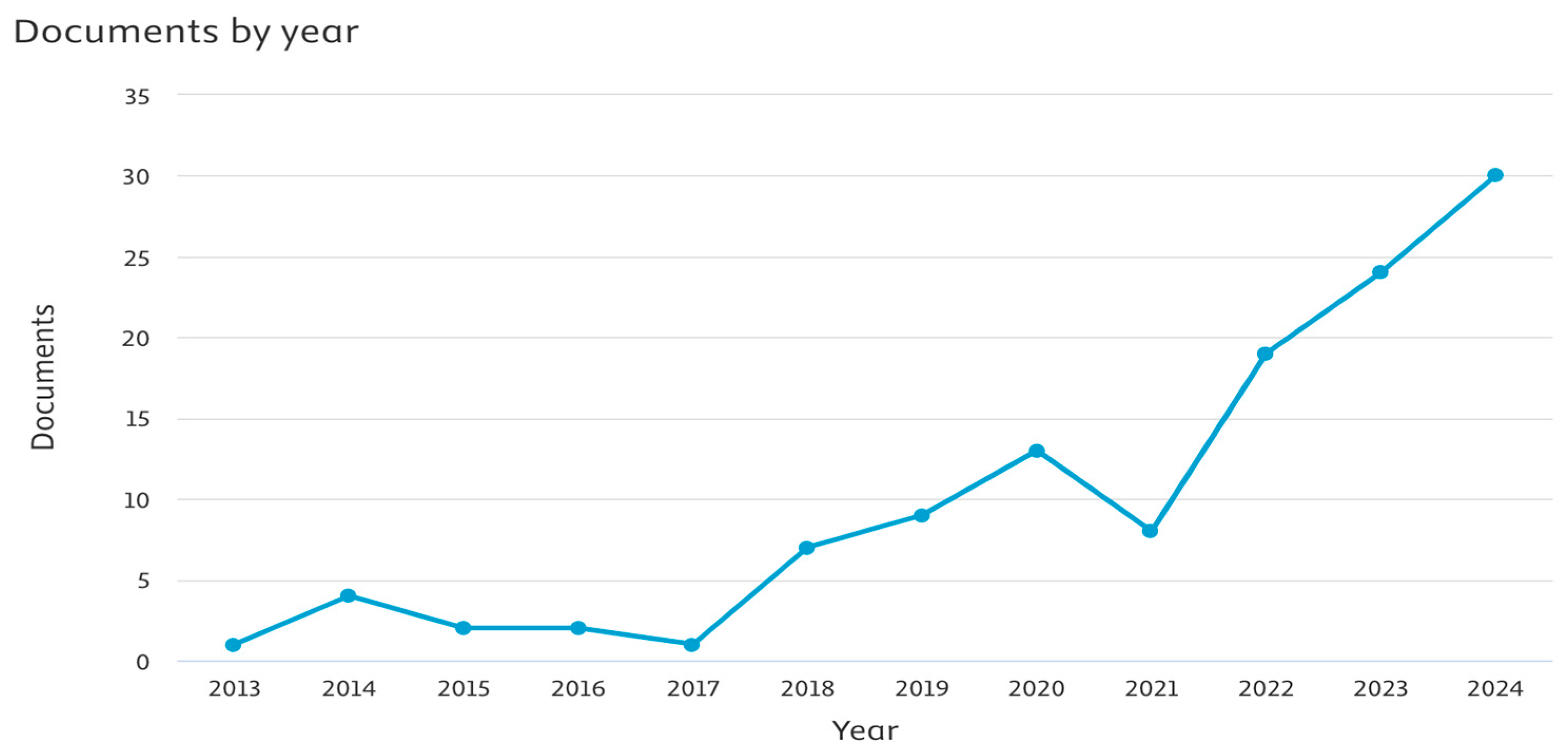
- Articles published between 2013 and the present (1 December 2024). The reason behind this is to look at recent advancements that consider critical to understanding current trends of sustainable competitiveness.
- Articles in the final publication stage to ensure only completed and peer-reviewed works were included.
- Exclusion Criteria-Studies were excluded if they met any of the following conditions:
- Non-article documents (e.g., reviews, book chapters, or conference proceedings).
- Articles that do not offer any clear ideas on technology, sustainability, or competitiveness.
- Non-English articles
- Articles with no current application and just focused on historical analysis
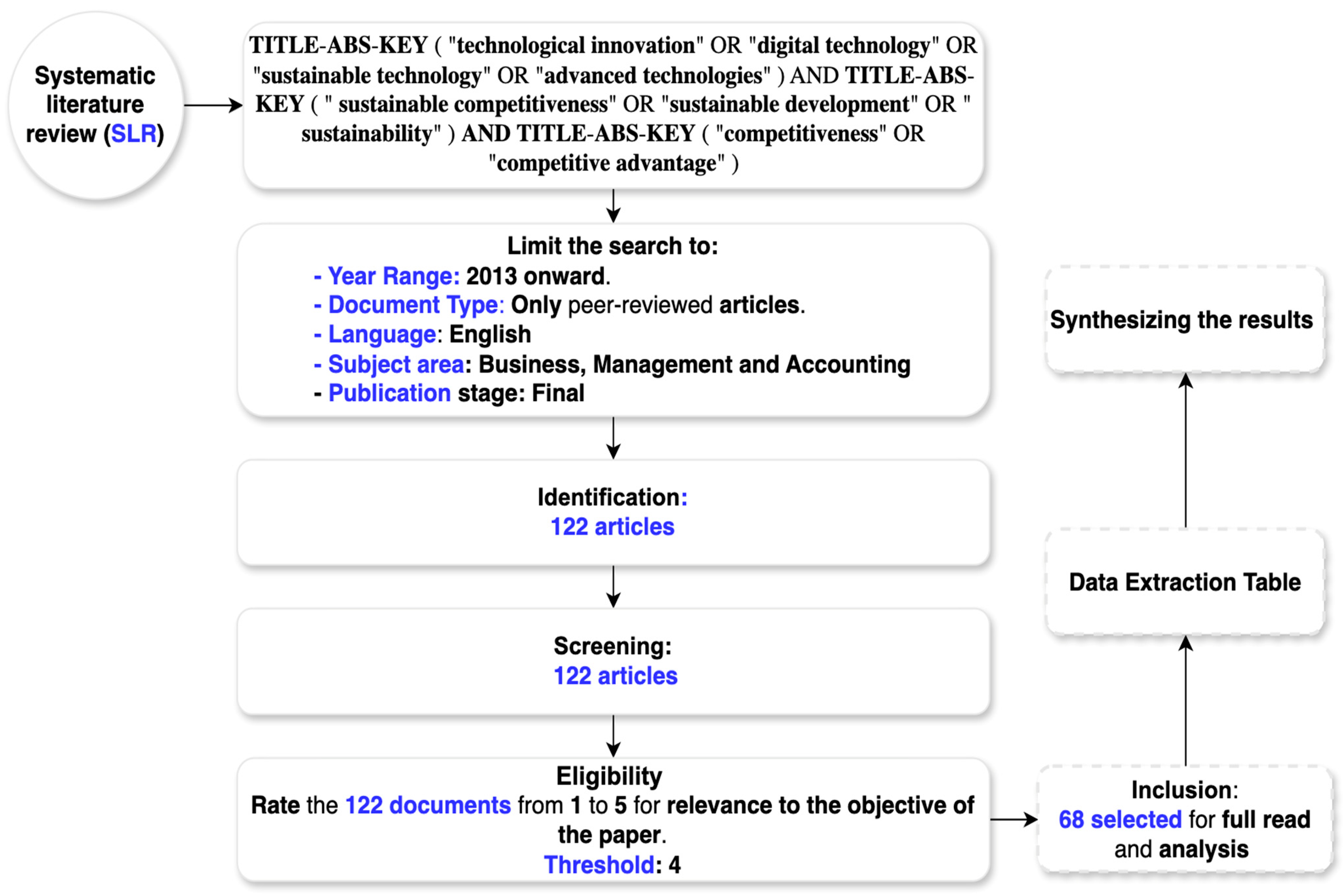
- Step 1: Identification. An initial search on Scopus gave us 122 articles. (Retrieved on 1 December 2024). This is for the field of Business, Management and Accounting.
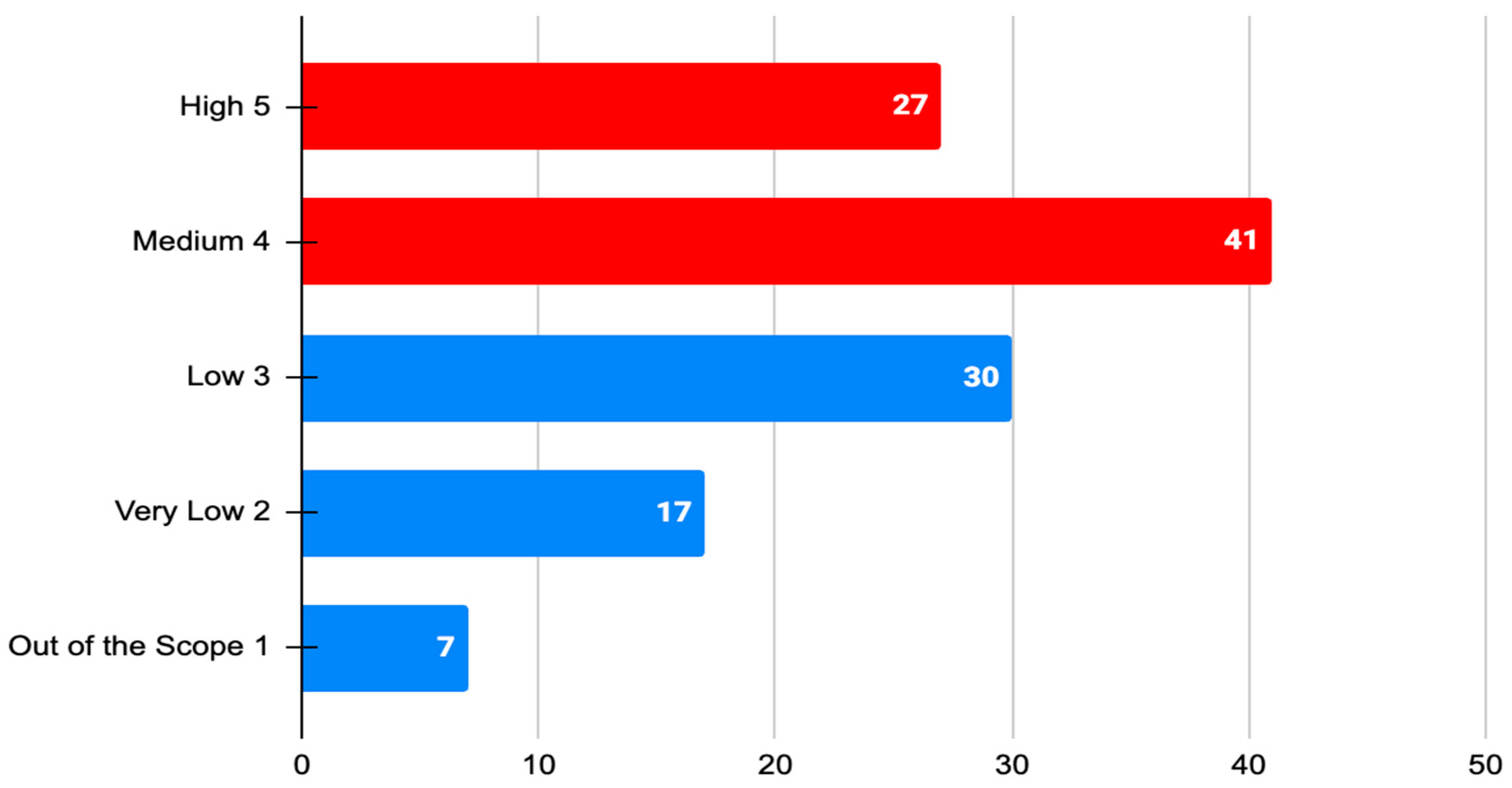
- Step 2: Screening. This stage required reviewing all the titles and abstracts for the 122 articles, and then they were ranked based on relevance, with ranks from 1 to 5. The criterion used for evaluating the relevancy of the retrieved articles began with a review of the title and abstract to determine the significance of their content to the topic of research based on the selection in this article. Furthermore, the relevancy check used a scale of 1 to 5, with 1 being out of scope and 5 being the highest rate of relevancy, and the publications for full reading were selected from scores of 4 to 5. Moreover, a score of 3 was considered low, and a score of 2 was considered very low. Table 2 presents the criteria behind this scale and how we selected the articles.
- Step 3: Eligibility. Only articles that received rank 4 and 5 were selected for full in-depth analysis. Those ranked as 3 and 2 will be used as supportive articles in the discussion section.
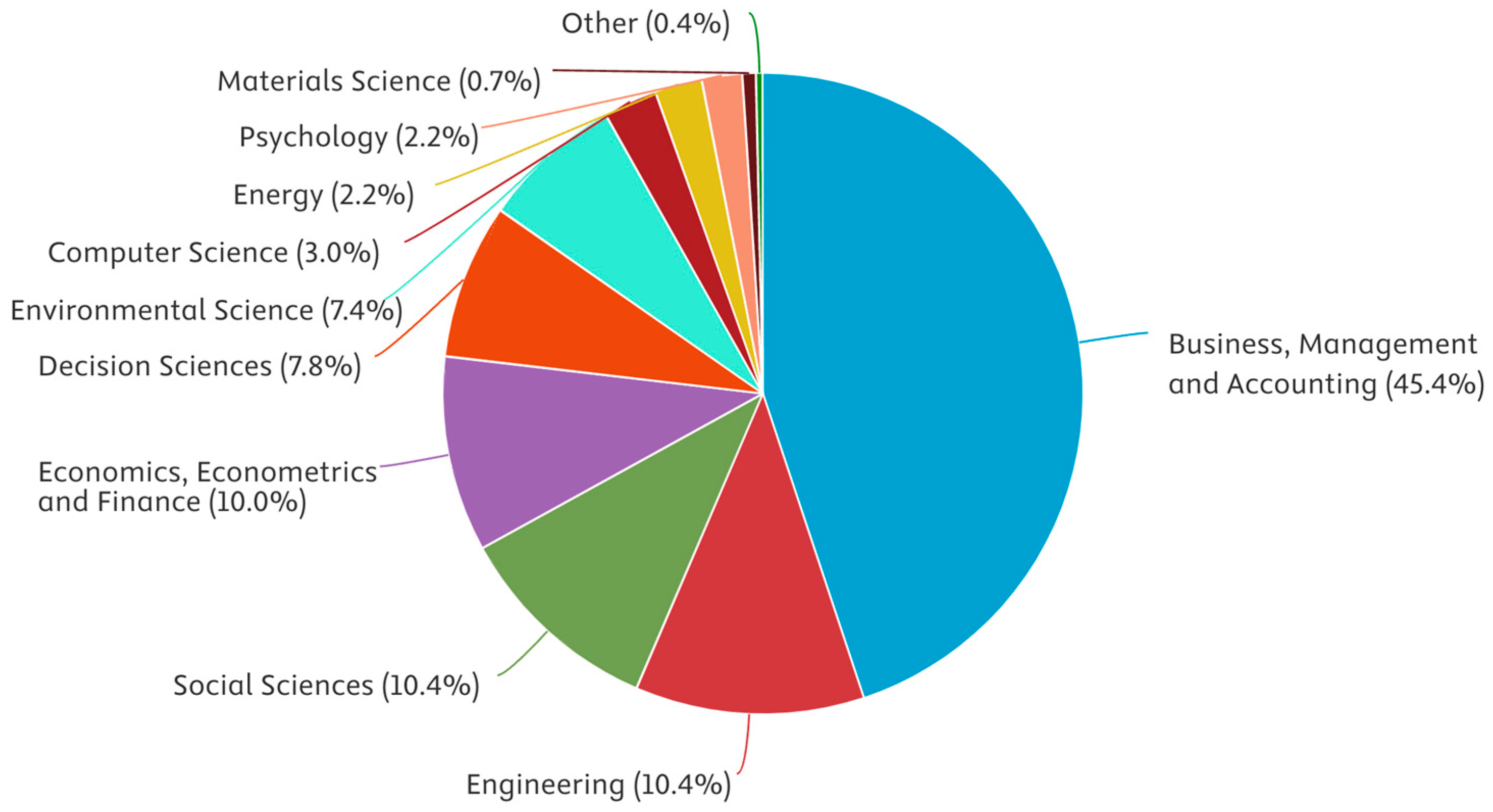
- Step 4: Inclusion. The final selection included 4 and 5-ranked articles (overall 68 articles). Figure 2 shows the distributions of the articles.
- Step 5: Data Extraction. Data from each selected article were extracted using a standardized form. The reason behind that is to ensure consistency across all the included articles. Key details included: article citation, technological innovations discussed, sector, key findings on how each technology supports sustainable competitive advantage, and limitations and gaps in the articles that were noted by authors.
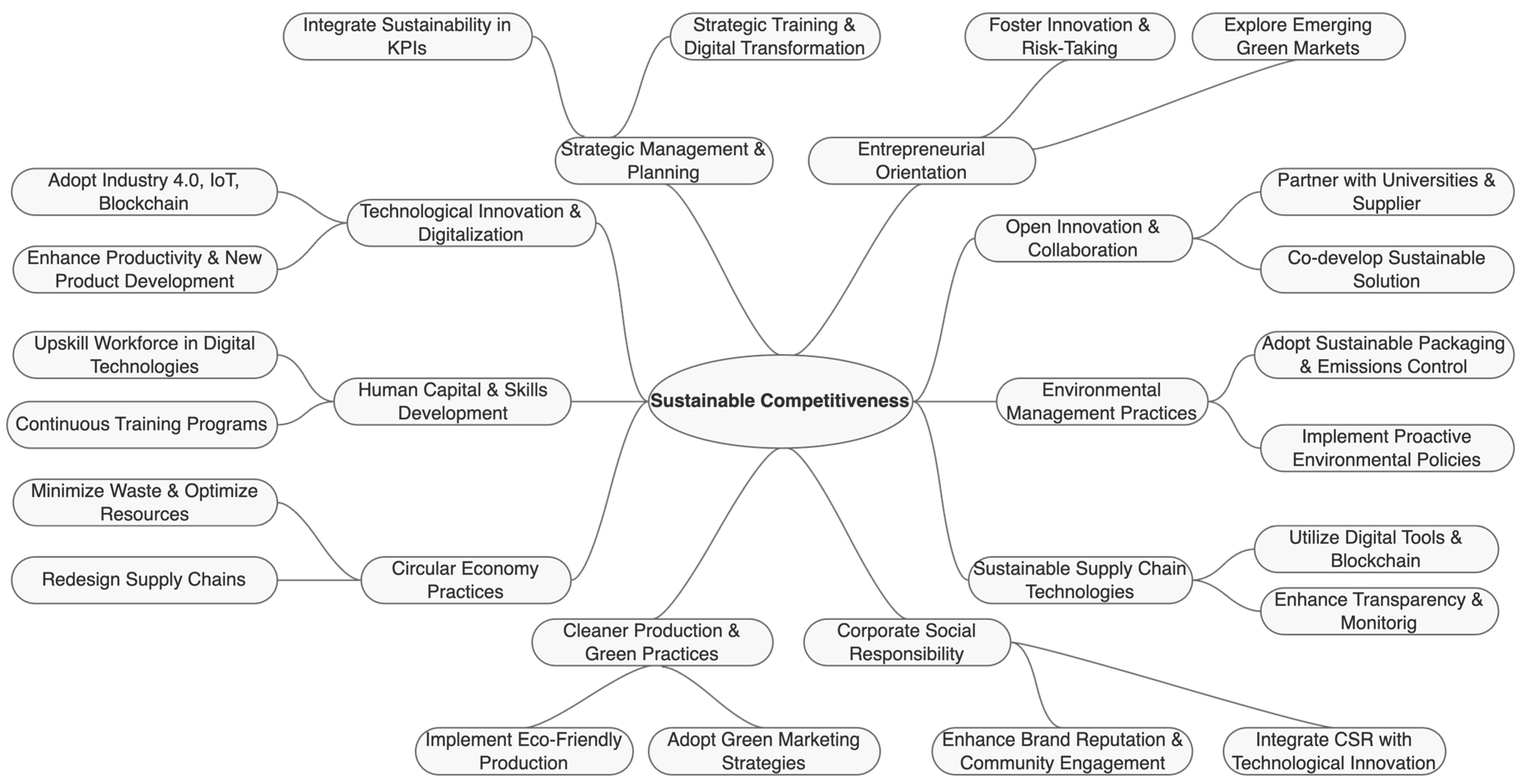
- Step 6: Thematic Synthesis. A thematic synthesis was conducted over the selected 68 articles. This analysis seeks to categorize key insights based on sectors and strategies to stimulate sustainable competitiveness. This process highlighted innovations frequently associated with sustainable competitive advantage. Also, it underlines sector-specific insights, in which it presents the differences in implementation across industries such as agriculture, manufacturing, and energy. In addition to presenting a summary of practical strategies for firms looking to enhance competitiveness through sustainable technological innovation.
3. Results
3.1. Analysis of the Scopus Results
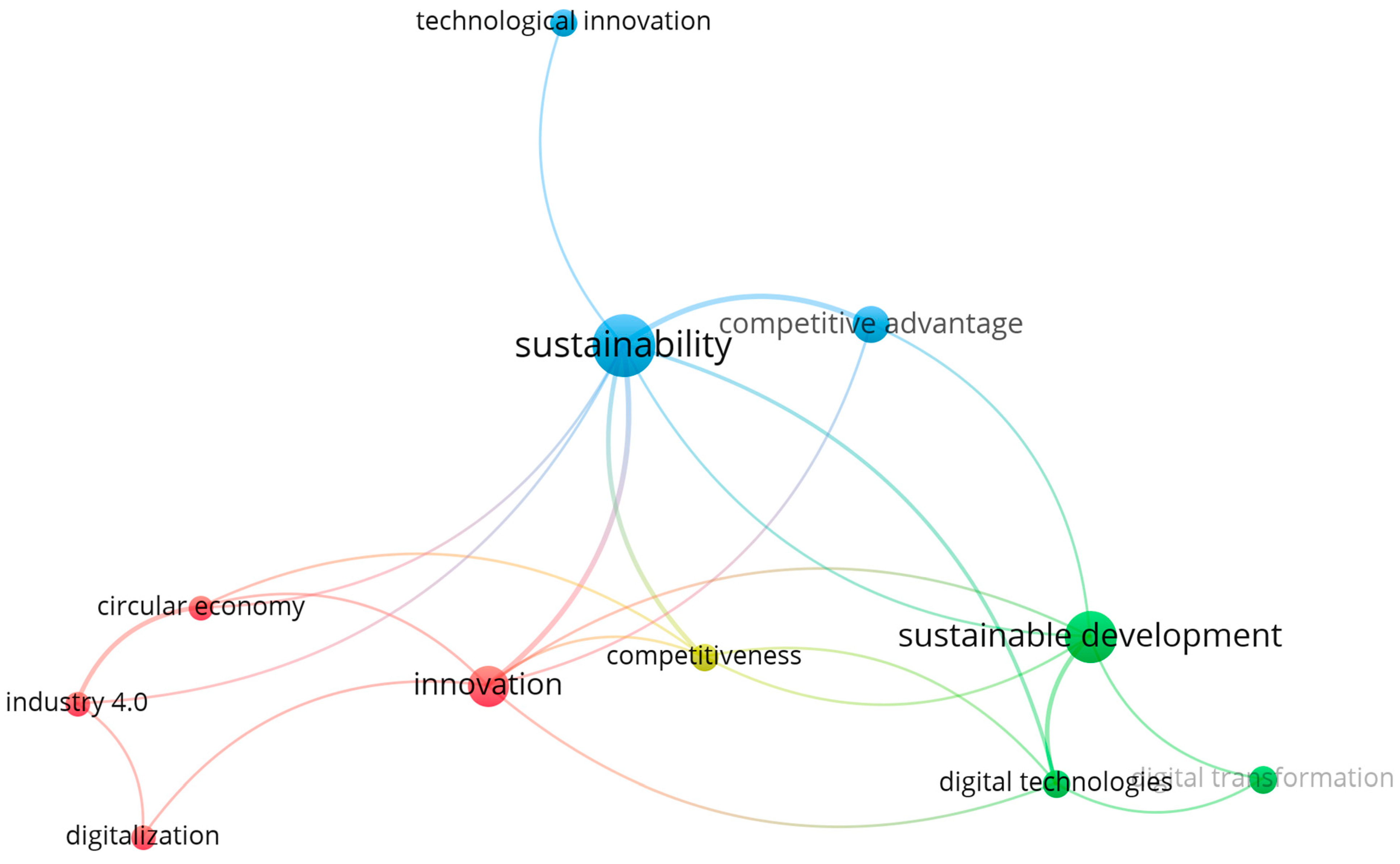
3.2. Biblometric Analysis Results (VOSviewer)
3.3. Data Extraction Table
- Business Sustainability: Focus on environmental, economic, or social sustainability. It is about how businesses integrate sustainable practices, technologies, and strategies into their operations for long-term impact.
- Competitiveness: Contributions to competitive advantage, firm performance, or innovation. This includes improving firm performance, innovation, market share, and financial growth. However, it does not necessarily require that sustainability be a part of competitiveness. It is only regarding the company’s practices or strategies that drive its competitive advantage.
- Sustainability-Competitiveness Synergy: Interactions between sustainability practices and competitiveness outcomes. This category examines the intersection between business sustainability practices and competitive advantage. It is about identifying how adopting sustainable strategies (e.g., environmentally-friendly practices, eco-innovation, etc.) directly contributes to or enhances a company’s competitiveness.
- High rate: High means that an article explored in deep detail the topic from that rated dimension. Therefore, this rate can be given for a certain article for a certain category like business sustainability or completeness or sustainability-competitiveness synergy. For example, the study by Ha et al. 2023 [3] received a high rate in terms of “sustainability-competitiveness synergy” since it contributes to sustainable competitiveness, such as integrating Industry 4.0 technologies with circular economy practices. Normally, studies with high ranks for all of the categories propose actionable strategies and explore sustainability-competitiveness synergy.
- Moderate—when an article partially explores the dimension, offering useful but limited or less integrated insights. For instance, the article from Antonioli et al. 2022 [17] emphasizes sustainable strategies in innovation and technology adoption but does not extensively explore the sustainability-competitiveness link, giving it a moderate rate from this dimension.
- Low—an article can be rated as low in a certain dimension when it offers broad or superficial discussions with minimal relevance or depth in addressing the dimension. This is not really the case in our table, as we already filtered the articles from 122 to 68. Only one article received this from the dimension of sustainability-competitiveness Synergy. Including this type of article in our data extraction table helps identify gaps in actionable insights and methodological approaches, which can provide a guide for future studies.
- Citation of the Article: The source of the article.
- Sector/Industry Focus: In order to shed light on the specific industries or sectors examined.
- Technological Innovations Discussed: Summary of the technological advancements that were covered in the studies, such as Industry 4.0, digital transformations, or circular economy practices.
- Key Findings on Sustainable Competitiveness: Summarizes the studies’ contributions to understanding how technological innovations impact sustainable competitiveness.
- Measures and Strategies: Outlines actionable recommendations for enhancing sustainable competitiveness, including policy suggestions, frameworks, and industry-specific interventions.
- Limitations/Gaps: Identifies unresolved challenges or research gaps.
- Cite of the article: Lists of the 68 publications included in the review.
- Research Method: The methodological approaches used in the studies (e.g., case studies, qualitative analyses, etc.)
- Keywords: Highlights significant terms that were used by the authors in their research.
- Citation Metrics: Provides data on the academic impact and recognition of the studies.
4. Discussion
- RQ1: Are the technological innovations key determinant of sustainable competitiveness?
- Enhancing Operational Efficiency:
- Driving Market Differentiation:
- Achieving Environmental Goals–Green innovations a source of competitiveness:
- Addressing Social and Economic Aspects:
- Catalyzing Strategic Transformation:
- 2.
- RQ2: How do advanced technologies contribute to sustainable competitiveness across sectors?
- 3.
- RQ3: What measures and strategies stimulate and accelerate sustainable competitiveness?
- Infrastructure and Economic Resources: Sustainable technological innovations (STI) are more likely to be adopted in areas with strong infrastructure and economic resources. For instance, by implementing precision agriculture and intelligent livestock management, areas with higher R&D expenditures typically see better Corporate Social Responsibility (CSR) results [20].
- Policy Support and Targeted Interventions: The presence of supportive policies and targeted interventions is essential for regions falling behind in sustainability. Government policies encouraging wealth creation, employment, research, and infrastructure investments can facilitate innovation and technological development [52]. In contrast, limited financial autonomy, reliance on political priorities, excessive bureaucracy, and inadequate technological knowledge can impede the implementation of modern technologies in civil service organizations [33].
- Market Conditions: The specific market environment of a region also influences the adoption of new technologies. One study emphasized the importance of market orientation in the development of new products and technologies [63].
- Digital Infrastructure: Entrepreneurship and long-term competitiveness are positively impacted in areas that make investments in digital infrastructure and encourage internet use. Digital integration, internet usage, and connectivity are important determinants of sustained competitiveness [76].
- Financial Reform: Financial reforms in a region can bolster urban resilience through technological innovation and industrial agglomeration.
5. Conclusions
- Digitalization and Advanced Technologies: tapping into Industry 4.0 innovations to drive operational efficiency and innovation.
- Circular Economy and Green Practices: implementing circular economy ideas and cleaner production practices to reduce waste and maximize resource use.
- Open Innovation and Collaboration: promoting external knowledge integration and stakeholder collaboration to enhance innovation capacity.
- Sustainable Supply Chain Management: It is about using advanced technologies to ensure the supply chain is environmentally friendly and dependable.
Supplementary Materials
Author Contributions
Funding
Conflicts of Interest
Appendix A

| Articles | Research Method | Keywords | Citation |
|---|---|---|---|
| [3] | Quantitative | circular economy; firm performance; Industry 4.0; Industry 4.0 technology; partial least squares structural equation modelling; PLS-SEM; Vietnam | 0 |
| [17] | Quantitative | circular economy; economic return; firm competitiveness; sustainable production | 39 |
| [18] | Qualitative | business creation; competitive advantage; digitization; less developed and emerging economies; small and medium scale enterprise; technology adoption | 18 |
| [19] | Quantitative | Competitiveness progress; Economic growth; Institution; New product development; Performance; Productivity; Sustainable development | 5 |
| [20] | Mixed-methods approach (Qualitative and Quantitative) | business competitiveness; CSR; digital transformation; environmental impact mitigation; sustainable development; sustainable technological innovation | 0 |
| [21] | Quantitative | innovation; innovation performance; Sustainability; sustainability performance; value creation | 2 |
| [22] | Quantitative | digital economic platforms; digital technologies; human capital; innovative technologies; Peace Index; sustainable development | 0 |
| [23] | Qualitative | Air transport; Circular Economy; Competitiveness; Innovation; Sustainability | 0 |
| [24] | Mixed-methods approach (Qualitative and Quantitative) | Business innovation; Sustainable automation integration; Sustainable business automation; Sustainable business strategies; Workforce sustainability | 0 |
| [25] | Quantitative | Behavior; Consumer; Industry 4.0; Lifestyle; Networks; Sustainability | 48 |
| [26] | Mixed-methods approach (Qualitative and Quantitative) | agribusiness; business sustainability; logistics 4.0; systematic literature review; VOSviewer | 6 |
| [27] | Quantitative | Agricultural digitalization; competitiveness; digital technologies; productivity; research and innovation; smart farming; sustainability | 1 |
| [28] | Mixed-methods approach (Qualitative and Quantitative) | Bibliometric; Governance; Innovation; Management; Strategy; Sustainable development | 6 |
| [29] | Mixed-methods approach (Qualitative and Quantitative) | absorptive capacity; competitive advantage; resources and capabilities; responsible innovation; SEM-ANN; sustainability | 1 |
| [30] | Mixed-methods approach (Qualitative and Quantitative) | competitividad sostenible; decisions estratégicas; factores claves para la productividad; key factors for productivity; strategic decisions; sustainable competitiveness | 12 |
| [31] | Qualitative | Big data analytics; Competitive advantage; Digital circular economy; Expert interviews; Resource-based view; Sustainability | 97 |
| [32] | Quantitative | Employee disability; Financial performance; Stakeholder theory; Technological innovation | 6 |
| [33] | Quantitative | absorptive capacity; export; export companies of the Republic of Croatia; new digital technologies; sustainable development | 0 |
| [34] | Qualitative | Civil service organizations; Communication sustainability; Digital communication; Technologies | 9 |
| [35] | Quantitative | innovation; multicriteria decision analysis (MCDA); PINTEC; PROMETHEE II; qualified human capital | 0 |
| [36] | Mixed-methods approach (Qualitative and Quantitative) | BWM; Cleaner production; GREY-DEMATEL; GRID; Industry 5.0; Strategies; Sustainable competitive advantage | 12 |
| [37] | Quantitative | ABC II; Attributes Based Costing Technology; Competitive Advantage; Manufacturing Firms; Sustainable Development | 8 |
| [38] | Quantitative | Absorptive Capacity; High-tech Firms; Innovation Performance; Innovative Culture | 19 |
| [39] | Mixed-methods approach (Qualitative and Quantitative) | Design; Digital; Digitalization; Industry 4.0; Integration; IoT; Manufacturing; Performance; SME; Transformation | 170 |
| [40] | Quantitative | Digital Age; digital capability; industrial enterprises; sustainable competitive advantage; systematic transformation | 32 |
| [41] | Quantitative | Adaptive neuro-fuzzy inference systems (ANFIS); FMCG; retail industry; Supplier selection; sustainability factors | 54 |
| [42] | Mixed-methods approach (Qualitative and Quantitative) | competitive advantage; open innovation; small-medium enterprises; sustainability | 6 |
| [43] | Quantitative | Artificial Intelligence (AI); critical success factor (CSF) theory; diffusion of innovation (DOI) theory; grey DEMATEL; success factors; sustainable frugal innovation; triple bottom line (TBL) theory | 39 |
| [44] | Quantitative | Carbon cap-and-trade mechanism; Different scenarios; Digital transformation; Low carbon; Manufacturer decision-making | 6 |
| [45] | Quantitative | Artificial intelligence (AI); effort expectancy; innovation openness; knowledge integration; perceived knowledge; performance expectancy; technology adoption | 4 |
| [46] | Quantitative | Administrative, regulatory or design; Green technologies; Latent dirichlet allocation (LDA); Patent analysis; Text mining; Topic evolution | 18 |
| [47] | Quantitative | Business Sustainability; Second Order Confirmatory Factor Analysis; Strategy toward Excellence | 2 |
| [48] | Mixed-methods approach (Qualitative and Quantitative) | Artificial intelligence (AI) applications; Employability; Fuzzy delphi method; Smartized upscale hotel; Z-numbers | 1 |
| [49] | Quantitative | developed economies; emerging; managerial practices; sustainability practices (SP); Technology-Organisation-Environment (TOE) framework; tourism industry | 0 |
| [50] | Qualitative | Digital Performance; Innovation; Sdgs; Sme; Society 5.0; Sustainable Growth; Tbl | 9 |
| [51] | Quantitative | Biotechnology; Government support; Innovation; Innovation policy | 42 |
| [52] | Quantitative | Digitalization; European Union; Innovation; Panel data; Synthetic indicator | 28 |
| [53] | Qualitative | Antecedents; Competitive advantages; Equifinality; Fuzzy set/qualitative comparative analysis (fsQCA) | 4 |
| [54] | Mixed-methods approach (Qualitative and Quantitative) | Determination of weights; green technology innovation (GTI) capability; interval linguistic Z -number vector (ILZNV); multiattribute group decision making (MAGDM); MULTIMOORA | 7 |
| [55] | Quantitative | Digital technology adoption; innovation performance; knowledge base; technological capability | 9 |
| [56] | Mixed-methods approach (Qualitative and Quantitative) | clustering analysis; data visualization; industry-university cooperation; partner selection; Patent analysis | 17 |
| [57] | Mixed-methods approach (Qualitative and Quantitative) | agribusiness competitiveness; agribusiness sustainability; bibliometric analysis; logistics 4.0; systematic literature review | 9 |
| [58] | Quantitative | Absorptive capacity; External sources of knowledge; Longitudinal analysis; Science and technology parks; Sustainability performance | 7 |
| [59] | Quantitative | Bayesian networks; Knowledge intensive organizations; Sustainability; Technology transfer; University–industry | 15 |
| [60] | Qualitative | Decision-making; EHS; Intangible risks; Life cycle perspective; Sustainability; Uncertainty | 71 |
| [61] | Quantitative | Environment; Supply chain; Sustainability; Thailand | 4 |
| [62] | Quantitative | CIS; Community innovation survey; Entrepreneurship; HJ-Biplot; Innovation accelerators; Innovation return; Internet of things; IoT; Open innovation; Portugal | 10 |
| [63] | Mixed-methods approach (Qualitative and Quantitative) | Concept relationship diagram; Environmental innovation; Malaysia; Review; Sustainable development | 10 |
| [64] | Qualitative | Complexity and Uncertainty; Creating Shared Value; Global Competitiveness; Globalization; International Business; Macro Strategy Analysis; Social Inclusion; Sustainability; Technological Innovation | 4 |
| [65] | Qualitative | Chemical industry; Innovation management; Internationalization; Sustainability | 5 |
| [66] | Quantitative | China; firm size; process innovation; product innovation; product quality; structural equation model; technological innovation practice | 23 |
| [67] | Quantitative | Analytic Hierarchy; Chain (SSC); Clean technology; Manufacturing; Oxy-fuel burner; Process (AHP); Secondary metal; Selection; Sustainability; Sustainable Supply; Technology; Triple Bottom Line | 15 |
| [68] | Mixed-methods approach (Qualitative and Quantitative) | Community; Marketing; Networking; Online; Organizations; Social network | 24 |
| [69] | Qualitative | Biodiesel; Competitiveness; Critical factors; Dimensions; Supply chain; Sustainability | 7 |
| [70] | Mixed-methods approach (Qualitative and Quantitative) | CQI on-track innovation; CQI technological discontinuities; Organizational quality specific immune; Technological perception | 1 |
| [71] | Quantitative | Business response; Creativity; Digital technology speed; Mimetic pressure; Performance; Status certainty; Traditionality | 0 |
| [72] | Mixed-methods approach (Qualitative and Quantitative) | barriers; fuzzy AHP; supply chain initiatives | 16 |
| [73] | Quantitative | environmental; information; resource-based view of the firm; services; strategy; sustainability; sustainability | 9 |
| [74] | Qualitative | Energy; Housing; Sustainability; Transportation; Urban design; Water management | 1 |
| [75] | Quantitative | digital competitiveness index; digital technologies; digital transformation; digitization; economic development; global competitiveness index; stability index | 1 |
| [76] | Quantitative | Digitalization; Entrepreneurship; Panel data analysis; Sustainable competitiveness | 59 |
| [77] | Qualitative | Industrial ecosystem; Sustainable development; Technologies to reduce CO2 emissions; Tehnological innovation; The knowledge triangle | 4 |
| [78] | Mixed-methods approach (Qualitative and Quantitative) | circular economy; hybrid method; Industry 4.0; Kendall’s W; smart circularity performances; smart circularity practices | 1 |
| [79] | Qualitative | environmental policy; natural-resource-based view theory; stakeholder engagement; sustainability; sustainable development; sustainable packaging | 3 |
| [80] | Mixed-methods approach (Qualitative and Quantitative) | Co-creation; Growth strategies; Istria; Technological innovation in tourism; Transformational tourist experiences | 8 |
| [81] | Qualitative | ecological innovation; environmental regulation; product innovation; system innovation; technological innovation | 331 |
| [82] | Quantitative | competitiveness; mediating effect; moderating effect; procurement; strategy | 10 |
| [83] | Quantitative | Digital currency vs. mobile payments; Impact of DCEP; Metcalfe’s Law in digital currencies; Mobile payment market dynamics; Stackelberg model in payments | 3 |
References
- Herciu, M.; Ogrean, C. Business Sustainable Competitiveness a Synergistic, Long-Run Approach of a Company’s Resources and Results. Stud. Bus. Econ. 2018, 13, 26–44. [Google Scholar] [CrossRef]
- Špiler, M.; Milošević, D.; Miškić, M.; Gostimirović, L.; Beslać, M.; Jevtić, B. Investments in Digital Technology Advances in Textiles. Ind. Textila 2023, 74, 90–97. [Google Scholar] [CrossRef]
- Ha, M.-T.; Mai, S.-T.; Tran, T.-K.; Nguyen, T.-S. The Adoption of Industry 4.0 Technology and the Circular Economy: A Solution for the Sustainable Development of Enterprises. J. Glob. Bus. Adv. 2023, 16, 225–249. [Google Scholar] [CrossRef]
- Barney, J. Firm Resources and Sustained Competitive Advantage. J. Manag. 1991, 17, 99–120. [Google Scholar] [CrossRef]
- Teece, D.J.; Pisano, G.; Shuen, A. Dynamic Capabilities and Strategic Management. Strateg. Manag. J. 1997, 18, 509–533. [Google Scholar] [CrossRef]
- Elkington, J. Cannibals with Forks: The Triple Bottom Line of 21st Century Business; Conscientious Commerce; New Society Publishers: Gabriola, BC, Canada, 1998. [Google Scholar]
- Etzkowitz, H.; Leydesdorff, L. The Dynamics of Innovation: From National Systems and “Mode 2” to a Triple Helix of University–Industry–Government Relations. Res. Policy 2000, 29, 109–123. [Google Scholar] [CrossRef]
- Carayannis, E.G.; Campbell, D.F.J. “Mode 3” and “Quadruple Helix”: Toward a 21st Century Fractal Innovation Ecosystem. Int. J. Technol. Manag. 2009, 46, 201–234. [Google Scholar] [CrossRef]
- Peris-Ortiz, M.; Ferreira, J.J.; Farinha, L.; Fernandes, N.O. (Eds.) Multiple Helix Ecosystems for Sustainable Competitiveness; Innovation, Technology, and Knowledge Management; Springer International Publishing: Cham, Switzerland, 2016. [Google Scholar] [CrossRef]
- Tortorella, G.L.; Fettermann, D. Implementation of Industry 4.0 and Lean Production in Brazilian Manufacturing Companies. Int. J. Prod. Res. 2018, 56, 2975–2987. [Google Scholar] [CrossRef]
- Stahel, W.R. The Circular Economy. Nature 2016, 531, 435–438. [Google Scholar] [CrossRef] [PubMed]
- Bocken, N.M.P.; Short, S.W.; Rana, P.; Evans, S. A Literature and Practice Review to Develop Sustainable Business Model Archetypes. J. Clean. Prod. 2014, 65, 42–56. [Google Scholar] [CrossRef]
- How Can We Close the Digital Divide? | World Economic Forum. Available online: https://www.weforum.org/stories/2021/10/how-to-build-a-bridge-across-the-digital-divide/ (accessed on 25 December 2024).
- OECD. Recommendation of the Council on Principles for Public Governance of Public-Private Partnerships; OECD: Paris, France, 2012. [Google Scholar]
- Ghobakhloo, M.; Iranmanesh, M.; Grybauskas, A.; Vilkas, M.; Petraitė, M. Industry 4.0, Innovation, and Sustainable Development: A Systematic Review and a Roadmap to Sustainable Innovation. Bus. Strategy Environ. 2021, 30, 4237–4257. [Google Scholar] [CrossRef]
- Page, M.J.; McKenzie, J.E.; Bossuyt, P.M.; Boutron, I.; Hoffmann, T.C.; Mulrow, C.D.; Shamseer, L.; Tetzlaff, J.M.; Akl, E.A.; Brennan, S.E.; et al. The PRISMA 2020 Statement: An Updated Guideline for Reporting Systematic Reviews. BMJ 2021, 372, n71. [Google Scholar] [CrossRef]
- Antonioli, D.; Ghisetti, C.; Mazzanti, M.; Nicolli, F. Sustainable Production: The Economic Returns of Circular Economy Practices. Bus. Strategy Environ. 2022, 31, 2603–2617. [Google Scholar] [CrossRef]
- Akpan, I.J.; Ibidunni, A.S. Digitization and Technological Transformation of Small Business for Sustainable Development in the Less Developed and Emerging Economies: A Research Note and Call for Papers. J. Small Bus. Entrep. 2023, 35, 671–676. [Google Scholar] [CrossRef]
- Prasetyo, P.E.; Setyadharma, A.; Kistanti, N.R. Integration and Collaboration of Determinants of Entrepreneurial Competitiveness. Uncertain. Supply Chain. Manag. 2021, 9, 585–594. [Google Scholar] [CrossRef]
- Abad-Segura, E.; Castillo-Díaz, F.J.; Batlles-delaFuente, A.; Belmonte-Ureña, L.J. Enhancing Competitiveness and Sustainability in Spanish Agriculture: The Role of Technological Innovation and Corporate Social Responsibility. Bus. Strategy Dev. 2024, 7, e70021. [Google Scholar] [CrossRef]
- Khaghaany, M.; Shaker, A.S.; Dawood, A.N.; Almagtome, A.H. Sustainability, Innovation, and Value Creation in Developing Countries: Evidence from Iraq. Innovar 2024, 34, e116817. [Google Scholar] [CrossRef]
- Danik, N.; Rud, I.; Symonenko, O.; Bilousko, T.; Tsikalo, Y. Directions of the development of the digital economy in the conditions of military conflicts. Financ. Credit. Act. Probl. Theory Pract. 2023, 1, 238–248. [Google Scholar] [CrossRef]
- Malagón, R.C.; Reyes, M.A.C.; Saldaña, R.S.R. Circular Economy: A Technological Innovation Strategy for Sustainability in Air Transport. Mercados y Negocios 2024, 2024, 31–52. [Google Scholar] [CrossRef]
- Gómez Gandía, J.A.; Gavrila Gavrila, S.; de Lucas Ancillo, A.; del Val Núñez, M.T. Towards Sustainable Business in the Automation Era: Exploring Its Transformative Impact from Top Management and Employee Perspective. Technol. Forecast. Soc. Change 2025, 210, 123908. [Google Scholar] [CrossRef]
- Satyro, W.C.; de Almeida, C.M.V.B.; Pinto, M.J.A., Jr.; Contador, J.C.; Giannetti, B.F.; de Lima, A.F.; Fragomeni, M.A. Industry 4.0 Implementation: The Relevance of Sustainability and the Potential Social Impact in a Developing Country. J. Clean. Prod. 2022, 337, 130456. [Google Scholar] [CrossRef]
- Soledispa-Cañarte, B.J.; Pibaque-Pionce, M.S.; Merchán-Ponce, N.P.; Mex Alvarez, D.C.; Tovar-Quintero, J.; Escobar-Molina, D.F.; Cedeño-Ramirez, J.D.; Rincon-Guio, C. The Role of Logistics 4.0 in Agribusiness Sustainability and Competitiveness, A Bibliometric and Systematic Literature Review. Oper. Supply Chain. Manag. 2023, 16, 109–120. [Google Scholar] [CrossRef]
- Tomorri, I.; Domi, S.; Çera, G.; Keco, R.; Kapaj, I. Examination of the Importance and Level of Application of Digitization in the Rural Sector, the Case of Albania. WSEAS Trans. Bus. Econ. 2024, 21, 528–543. [Google Scholar] [CrossRef]
- Alonso Dos Santos, M.; Huertas González-Serrano, M.; Staniewski, M.W. Analytical Editorial: Ensuring the Future of Our World: Innovation, Management and Governance for Sustainable Growth. Acad. Rev. Latinoam. Adm. 2022, 35, 117–130. [Google Scholar] [CrossRef]
- Memon, K.R.; Ooi, S.K.; Han, H. Responsible Innovation and Corporate Sustainability Performance: A Structural Equation Modeling-Neural Network Approach. Bus. Strategy Environ. 2024, 33, 2712–2730. [Google Scholar] [CrossRef]
- Luis Alberto, B.G.; Claudio, R.E.; Marcelo, R.T.; Alexis, M.P.; Martín, I.A.; Paola, J.M. Analysis of Competitiveness Factors for the Sustainable Productivity of SMEs in Trujillo (Peru). Rev. Metodos Cuantitativos Econ. Empresa 2020, 29, 208–236. [Google Scholar] [CrossRef]
- Kristoffersen, E.; Mikalef, P.; Blomsma, F.; Li, J. Towards a Business Analytics Capability for the Circular Economy. Technol. Forecast. Soc. Change 2021, 171, 120957. [Google Scholar] [CrossRef]
- Oware, K.M.; Mallikarjunappa, T. Disability Employment and Financial Performance: The Effect of Technological Innovation of Listed Firms in India. Soc. Responsib. J. 2020, 17, 384–398. [Google Scholar] [CrossRef]
- Martincevic, I. Enhancing Financial Performance through Absorptive Capacity: Evidence from Croatian Export Companies in Domestic and International Markets. Bus. Syst. Res. 2023, 14, 214–238. [Google Scholar] [CrossRef]
- Laužikas, M.; Miliūtė, A. Impacts of Modern Technologies on Sustainable Communication of Civil Service Organizations. Entrep. Sustain. Issues 2020, 7, 2494–2509. [Google Scholar] [CrossRef] [PubMed]
- Silva Neto, A.R.; Silva, M.G.G.D.; Taques, F.H.; Poleto, T.; Nepomuceno, T.C.C.; Carvalho, V.D.H.D.; Monte, M.B.D.S. Multicriteria Analysis of Innovation Ecosystems and the Impact of Human Capital and Investments on Brazilian Industries. Adm. Sci. 2024, 14, 241. [Google Scholar] [CrossRef]
- Sharma, R.; Gupta, H. Harmonizing Sustainability in Industry 5.0 Era: Transformative Strategies for Cleaner Production and Sustainable Competitive Advantage. J. Clean. Prod. 2024, 445, 141118. [Google Scholar] [CrossRef]
- Ahmad, S.A.; Sulaiman, G.A. The role of attributes based costing technology in achieving sustainable development goals. Int. J. Prof. Bus. Rev. 2023, 8, 8. [Google Scholar] [CrossRef]
- Liu, S.-M.; Hu, R.; Kang, T.-W. The Effects of Absorptive Capability and Innovative Culture on Innovation Performance: Evidence from Chinese High-Tech Firms. J. Asian Financ. Econ. Bus. 2021, 8, 1153–1162. [Google Scholar] [CrossRef]
- Dutta, G.; Kumar, R.; Sindhwani, R.; Singh, R.K. Digital Transformation Priorities of India’s Discrete Manufacturing SMEs—A Conceptual Study in Perspective of Industry 4.0. Compet. Rev. 2020, 30, 289–314. [Google Scholar] [CrossRef]
- Li, J.; Zhou, J.; Cheng, Y. Conceptual Method and Empirical Practice of Building Digital Capability of Industrial Enterprises in the Digital Age. IEEE Trans. Eng. Manag. 2022, 69, 1902–1916. [Google Scholar] [CrossRef]
- Okwu, M.O.; Tartibu, L.K. Sustainable Supplier Selection in the Retail Industry: A TOPSIS- and ANFIS-Based Evaluating Methodology. Int. J. Eng. Bus. Manag. 2020, 12, 1847979019899542. [Google Scholar] [CrossRef]
- Wibowo, V.; Gautama, I.; Kuncoro, E.A.; Bandur, A. Improving Sustainability in the Small-Medium Culinary Industry: Analyzing the Role of Open Innovation and Competitive Advantage. J. Syst. Manag. Sci. 2024, 14, 172–187. [Google Scholar] [CrossRef]
- Govindan, K. How Artificial Intelligence Drives Sustainable Frugal Innovation: A Multitheoretical Perspective. IEEE Trans. Eng. Manag. 2024, 71, 638–655. [Google Scholar] [CrossRef]
- Chen, A.; Zhang, H.; Zhang, Y.; Zhao, J. Digital Transformation or Not? Manufacturer’s Selection Strategy under Carbon Cap-and-Trade Mechanism. Ind. Manag. Data Syst. 2024, 124, 541–563. [Google Scholar] [CrossRef]
- Khan, A.N.; Mehmood, K.; Soomro, M.A. Knowledge Management-Based Artificial Intelligence (AI) Adoption in Construction SMEs: The Moderating Role of Knowledge Integration. IEEE Trans. Eng. Manag. 2024, 71, 10874–10884. [Google Scholar] [CrossRef]
- Liu, M.; Guo, J.; Bi, D. Comparison of Administrative and Regulatory Green Technologies Development between China and the U.S. Based Pat. Analysis. Data Sci. Manag. 2023, 6, 34–45. [Google Scholar] [CrossRef]
- Silpcharu, T.; Noongam, W. The Second Order Confirmatory Factor Analysis Strategies Toward Sustainable Excellence in the Industrial Sector. Acad. Strateg. Manag. J. 2020, 19, 1–10. [Google Scholar]
- Fang, C.C.; Liou, J. Developing an Assessment Framework of Smartized Upscale Hotel Workforce Employability from the Practitioners’ Perspective. J. Hosp. Tour. Insights 2024, 7, 1636–1659. [Google Scholar] [CrossRef]
- Lucas, M.M.; Moreno-Luna, L.; Roets, A.O.S.B.; Al-Jaberi, S. Technological, Organisational and Environmental Drivers of Sustainability in Hotels. S. Afr. J. Bus. Manag. 2024, 55. [Google Scholar] [CrossRef]
- Islam, A.; Wahab, S.A.; Latiff, A.S.A. Annexing a Smart Sustainable Business Growth Model for Small and Medium Enterprises (SMEs). World J. Entrep. Manag. Sustain. Dev. 2022, 18, 185–209. [Google Scholar] [CrossRef]
- Aghmiuni, S.K.; Siyal, S.; Wang, Q.; Duan, Y. Assessment of Factors Affecting Innovation Policy in Biotechnology. J. Innov. Knowl. 2020, 5, 180–190. [Google Scholar] [CrossRef]
- Marti, L.; Puertas, R. Analysis of European Competitiveness Based on Its Innovative Capacity and Digitalization Level. Technol. Soc. 2023, 72, 102206. [Google Scholar] [CrossRef]
- Yu, T.H.-K.; Huarng, K.-H. Causal Analysis of SDG Achievements. Technol. Forecast. Soc. Chang. 2024, 198, 122977. [Google Scholar] [CrossRef]
- Su, Y.; Chai, J.; Lu, S.; Lin, Z. Evaluating Green Technology Innovation Capability in Intelligent Manufacturing Enterprises: A Z-Number-Based Model. IEEE Trans. Eng. Manag. 2024, 71, 5391–5409. [Google Scholar] [CrossRef]
- Zhou, Y.; Yang, C.; Liu, Z.; Gong, L. Digital Technology Adoption and Innovation Performance: A Moderated Mediation Model. Technol. Anal. Strateg. Manag. 2024, 36, 3341–3356. [Google Scholar] [CrossRef]
- Ran, C.; Song, K.; Yang, L. An Improved Solution for Partner Selection of Industry-University Cooperation. Technol. Anal. Strateg. Manag. 2020, 32, 1478–1493. [Google Scholar] [CrossRef]
- Soledispa-Cañarte, B.J.; Pibaque-Pionce, M.S.; Merchán-Ponce, N.P.; Alvarez, D.C.M.; Tovar-Quintero, J.; Escobar-Molina, D.F.; Cedeño-Ramírez, J.D.; Rincon-Guio, C. Advancing agribusiness sustainability and competitiveness through Logistics 4.0: A bibliometric and systematic literature review. Logforum 2023, 19, 155–168. [Google Scholar] [CrossRef]
- Forés, B.; Fernández-Yáñez, J.M. Sustainability Performance in Firms Located in a Science and Technology Park: The Influence of Knowledge Sources and Absorptive Capacity. J. Knowl. Manag. 2023, 27, 112–135. [Google Scholar] [CrossRef]
- Terán-Bustamante, A.; Martínez-Velasco, A.; López-Fernández, A.M. University–Industry Collaboration: A Sustainable Technology Transfer Model. Adm. Sci. 2021, 11, 142. [Google Scholar] [CrossRef]
- Köhler, A.R.; Som, C. Risk Preventative Innovation Strategies for Emerging Technologies the Cases of Nano-Textiles and Smart Textiles. Technovation 2014, 34, 420–430. [Google Scholar] [CrossRef]
- Girdwichai, L.; Jamjumrus, T.; Pongsiri, T.; Jaepho, S. Exploring the Nexus among the Technological Innovation, Supply Chain Integration and Environmental Management Practices in Thai Manufacturing Industry: A Sustainability View. Int. J. Supply Chain. Manag. 2019, 8, 334–341. [Google Scholar]
- Fernandes, S.; Castela, G. Start-Ups’ Accelerators Support Open Innovation in Portugal. Int. J. Innov. Learn. 2019, 26, 82–93. [Google Scholar] [CrossRef]
- Yusuf, M.F.; Ashari, H.; Razalli, M.R. Environmental Technological Innovation and Its Contribution to Sustainable Development. Int. J. Technol. 2018, 9, 1569–1578. [Google Scholar] [CrossRef]
- Pezzuto, I. Turning globalization 4.0 into a real and sustainable success for all stakeholders. J. Gov. Regul. 2019, 8, 8–18. [Google Scholar] [CrossRef]
- de Menezes, U.; Dias, V.; Gomes, C.; Scherer, F.; Kruglianskas, I. Management of Sustainable Innovation in an Internationalized Company. J. Technol. Manag. Innov. 2013, 8, 264–273. [Google Scholar]
- Shi, L.; Wang, X.; Sun, H.; He, Z. The Impact of Technological Innovation on Product Quality: The Moderating Role of Firm Size. Total Qual. Manag. Bus. Excell. 2018, 29, 746–761. [Google Scholar] [CrossRef]
- Khatri, J.; Srivastava, M. Technology Selection for Sustainable Supply Chains. Int. J. Technol. Manag. Sustain. Dev. 2016, 15, 275–289. [Google Scholar] [CrossRef] [PubMed]
- Correia, P.A.P.; Medina, I.G.; Romo, Z.F.G.; Contreras-Espinosa, R.S. The Importance of Facebook as an Online Social Networking Tool for Companies. Int. J. Account. Inf. Manag. 2014, 22, 295–320. [Google Scholar] [CrossRef]
- dos Santos, S.F.; Borschiver, S.; de Souza, V. Mapping Sustainable Structural Dimensions for Managing the Brazilian Biodiesel Supply Chain. J. Technol. Manag. Innov. 2014, 9, 27–43. [Google Scholar] [CrossRef]
- Xu, Y.; Yu, G.; Qiang, L. Deconvoluting the Mechanism of the Continuous Quality Improvement Technological Discontinuities on the Continuous Quality Improvement On-Track Innovation: The Mediating Effect of the Organizational Quality Specific Immune and the Two-Stage Moderating Effe. J. Ind. Eng. Eng. Manag. 2022, 36, 37–52. [Google Scholar] [CrossRef]
- Bui, M.-T.; Tran, T.-T.-H. The Internal and External Effect of Environmental Complexity on Business Responses: A PLS-SEM and Artificial Neural Network Approach. J. Hosp. Tour. Insights 2024, 7, 2742–2762. [Google Scholar] [CrossRef]
- Nazam, M.; Hashim, M.; Ahmad Baig, S.; Abrar, M.; Ur Rehman, H.; Nazim, M.; Raza, A. Categorizing the Barriers in Adopting Sustainable Supply Chain Initiatives: A Way-Forward towards Business Excellence. Cogent Bus. Manag. 2020, 7, 1825042. [Google Scholar] [CrossRef]
- Galbreath, J.; Chang, C.-Y.; Tisch, D. The Impact of a Proactive Environmental Strategy on Environmentally Sustainable Practices in Service Firms: The Moderating Effect of Information Use Value. Bus. Strategy Environ. 2023, 32, 5420–5434. [Google Scholar] [CrossRef]
- Suresh, S.; Neetha, S.N.; Kollarath, R.M. Sustainable Urban Design in Singapore. Int. J. Recent Technol. Eng. 2019, 8, 944–952. [Google Scholar] [CrossRef]
- Spitsina, A.; Plukar, L.; Maslyhan, O.; Moroz, T.; Kasmin, D.; Nazarenko, I. Digitalization of the economy as a factor of sustainable state development against the background of large-scale military aggression (Ukrainian experience). Financ. Credit. Act. Probl. Theory Pract. 2022, 6, 304–315. [Google Scholar] [CrossRef]
- Dabbous, A.; Barakat, K.A.; Kraus, S. The Impact of Digitalization on Entrepreneurial Activity and Sustainable Competitiveness: A Panel Data Analysis. Technol. Soc. 2023, 73, 102224. [Google Scholar] [CrossRef]
- Frone, S.; Constantinescu, A. Impact of Technological Innovation on the Pillars of Sustainable Development. Qual.-Access Success. 2014, 15 (Suppl. S1), 69–75. [Google Scholar]
- Ali, S.S.; Torğul, B.; Paksoy, T.; Luthra, S.; Kayikci, Y. A Novel Hybrid Decision-Making Framework for Measuring Industry 4.0-Driven Circular Economy Performance for Textile Industry. Bus. Strategy Environ. 2024, 33, 7825–7854. [Google Scholar] [CrossRef]
- Lau, C.C.I.; Wong, C.W.Y. Achieving Sustainable Development with Sustainable Packaging: A Natural-Resource-Based View Perspective. Bus. Strategy Environ. 2024, 33, 4766–4787. [Google Scholar] [CrossRef]
- Golja, T.; Paulišić, M. Managing-Technology Enhanced Tourist Experience: The Case of Scattered Hotels in Istria | Upravljanje Tehnološki Usmjerenim Turističkim Iskustvom: Slučaj Raspršenih Hotela u Istri. Management 2021, 26, 63–95. [Google Scholar] [CrossRef]
- Shao, S.; Hu, Z.; Cao, J.; Yang, L.; Guan, D. Environmental Regulation and Enterprise Innovation: A Review. Bus. Strategy Environ. 2020, 29, 1465–1478. [Google Scholar] [CrossRef]
- Corboș, R.-A.; Bunea, O.-I.; Jiroveanu, D.-C. The Effects of Strategic Procurement 4.0 Performance on Organizational Competitiveness in the Circular Economy. Logistics 2023, 7, 13. [Google Scholar] [CrossRef]
- Wu, W.; Chen, X.; Zvarych, R.; Huang, W. The Stackelberg Duel between Central Bank Digital Currencies and Private Payment Titans in China. Technol. Forecast. Soc. Change 2024, 200, 123169. [Google Scholar] [CrossRef]
- Yang, Y.-J. The Rising and Fall of Mobile Phone Enterprises: Patent-Based Competitive Advantage Analysis. Contemp. Manag. Res. 2022, 18, 133–163. [Google Scholar] [CrossRef]
- Li, G.; Wang, X.; Su, S.; Su, Y. How Green Technological Innovation Ability Influences Enterprise Competitiveness: Green Technological Innovation Ability, Product Differentiation and Enterprise Competitiveness. Technol. Soc. 2019, 59, 101136. [Google Scholar] [CrossRef]
- Sun, D.; Zeng, S.; Lin, H.; Yu, M.; Wang, L. Is Green the Virtue of Humility? The Influence of Humble CEOs on Corporate Green Innovation in China. IEEE Trans. Eng. Manag. 2023, 70, 4222–4232. [Google Scholar] [CrossRef]
- Ogbari, M.E.; Ibidunni, A.S.; Ogunnaike, O.O.; Olokundun, M.A.; Amaihian, A.B. A Comparative Analysis of Small Business Strategic Orientation: Implications for Performance. Acad. Strateg. Manag. J. 2018, 17, 1–15. [Google Scholar]
- Li, G.; Xue, J.; Li, N.; Qi, Q. Does Digital Finance Favor Firms in Supply Chains? Roles of Green Innovation and Bargaining Power. Transp. Res. Part E Logist. Transp. Rev. 2024, 183, 103431. [Google Scholar] [CrossRef]
- Thompson, B.S.; Rust, S. Blocking Blockchain: Examining the Social, Cultural, and Institutional Factors Causing Innovation Resistance to Digital Technology in Seafood Supply Chains. Technol. Soc. 2023, 73, 102235. [Google Scholar] [CrossRef]
- Camel, A.; Belhadi, A.; Kamble, S.; Tiwari, S.; Touriki, F.E. Integrating Smart Green Product Platforming for Carbon Footprint Reduction: The Role of Blockchain Technology and Stakeholders Influence within the Agri-Food Supply Chain. Int. J. Prod. Econ. 2024, 272, 109251. [Google Scholar] [CrossRef]
- Kazancoglu, Y.; Sezer, M.D.; Ozkan-Ozen, Y.D.; Mangla, S.K.; Kumar, A. Industry 4.0 Impacts on Responsible Environmental and Societal Management in the Family Business. Technol. Forecast. Soc. Change 2021, 173, 121108. [Google Scholar] [CrossRef]
- Broccardo, L.; Zicari, A.; Jabeen, F.; Bhatti, Z.A. How Digitalization Supports a Sustainable Business Model: A Literature Review. Technol. Forecast. Soc. Change 2023, 187, 122146. [Google Scholar] [CrossRef]
- Rahman, M.; Hack-Polay, D.; Billah, M.; Nabi, N.U. Bio-Based Textile Processing through the Application of Enzymes for Environmental Sustainability. Int. J. Technol. Manag. Sustain. Dev. 2020, 19, 87–106. [Google Scholar] [CrossRef]
- Restrepo-Morales, J.A.; Valencia-Cárdenas, M.; García-Pérez-de-Lema, D. The Role of Technological Innovation in the Mitigation of the Crisis Generated by COVID-19: An Empirical Study of Small and Medium-Sized Businesses (SMEs) in Latin America. Int. Stud. Manag. Organ. 2024, 54, 120–136. [Google Scholar] [CrossRef]
- Parrilli, M.D.; Balavac-Orlić, M.; Radicic, D. Environmental Innovation across SMEs in Europe. Technovation 2023, 119, 102541. [Google Scholar] [CrossRef]
- Bucci, G.; Bentivoglio, D.; Finco, A. Precision Agriculture as a Driver for Sustainable Farming Systems: State of Art in Litterature and Research. Qual.-Access Success. 2018, 19, 114–121. [Google Scholar]
- Guan, H. Research on Performance Evaluation Model of Papermaking Enterprise Innovation Management Based on Organizational Shared Mental Model. Paper Asia 2018, 34, 35–40. [Google Scholar]
- Walwyn, D.; Bertoldi, A.; Gable, C. Building the Hydrogen Economy through Niche Experimentation and Digitalisation. J. Manuf. Technol. Manag. 2019, 30, 1179–1195. [Google Scholar] [CrossRef]
- Ilyina, L.A.; Ermolina, L.V.; Sunteev, A.N. Features of Advanced Technologies and Development Strategies of Fuel and Energy Complex. Qual.-Access Success. 2018, 19, 62–66. [Google Scholar]
- Galazova, S.S.; Magomaeva, L.R. The Transformation of Traditional Banking Activity in Digital. Int. J. Econ. Bus. Adm. 2019, 7, 41–51. [Google Scholar] [CrossRef]
- Luneto, B.; Mala, A.R.; Hasbi, M.; Supiah. The Challenge in School Education Management in Achieving Sustainability and Advantages in the Technological Digital Era. Educ. Adm. Theory Pract. 2022, 28, 94–107. [Google Scholar] [CrossRef]
- Rumanti, A.A.; Sunaryo, I.; Wiratmadja, I.I.; Irianto, D. Cleaner Production for Small and Medium Enterprises: An Open Innovation Perspective. IEEE Trans. Eng. Manag. 2023, 70, 2355–2368. [Google Scholar] [CrossRef]
- Chygryn, O.; Miskiewicz, R. New trends and patterns in green competitiveness: A bibliometric analysis of evolution. Virtual Econ. 2022, 5, 24–41. [Google Scholar] [CrossRef]
- Annunziata, E.; Pucci, T.; Frey, M.; Zanni, L. The Role of Organizational Capabilities in Attaining Corporate Sustainability Practices and Economic Performance: Evidence from Italian Wine Industry. J. Clean. Prod. 2018, 171, 1300–1311. [Google Scholar] [CrossRef]
- Onofrei, G.; Nguyen, H.; Yang, Y.; Filieri, R. Entrepreneurial Orientation and the Triple Bottom Line: Does Supply Chain Learning Matter? IEEE Trans. Eng. Manag. 2024, 71, 10054–10065. [Google Scholar] [CrossRef]
- Zaloznova, Y.; Trushkina, N. Management of logistics activities as a mechanism for providing sustainable development of enterprises in the digital economy. Virtual Econ. 2019, 2, 64–81. [Google Scholar] [CrossRef] [PubMed]
- Cui, Y.; Cao, Y.; Ji, Y.; Chang, I.-S.; Wu, J. Determinant Factors and Business Strategy in a Sustainable Business Model: An Explorative Analysis for the Promotion of Solid Waste Recycling Technologies. Bus. Strategy Environ. 2022, 31, 2533–2545. [Google Scholar] [CrossRef]



| Inclusion Criteria | Searches for all variations of technological innovation, ensuring inclusiveness: “technological innovation” OR “digital technology” OR “sustainable technology” OR “advanced technologies” |
| Focuses on sustainability-related aspects: “sustainable competitiveness” OR “sustainable development” OR “ sustainability” | |
| Targets competitiveness dimensions: “competitiveness” OR “competitive advantage” | |
| Exclusion Criteria | Limit Publication Year: PUBYEAR > 2012 AND PUBYEAR < 2026 |
| Limited to Business, Management and Accounting areas to ensure contextual relevance: LIMIT-TO (SUBJAREA, “BUSI”) | |
| Limit document type to journal articles, excluding reviews, conference papers, or other formats: LIMIT-TO (DOCTYPE, “ar”) | |
| Limit language to English to ensure ease of analysis: LIMIT-TO (LANGUAGE, “English”) | |
| Limit on publication stage, excluding preprints or drafts, focusing on finalized publications: LIMIT-TO (PUBSTAGE, “final”) |
| Ranking | Criteria |
|---|---|
| 5 (High) | Articles directly addressed technological innovations as a key driver of sustainable competitiveness across multiple sectors. It may provide empirical evidence, case studies, or theoretical frameworks that align with our research objectives. |
| 4 (Medium) | The articles discuss technological innovations and competitiveness in a way that partially aligns with our paper’s focus but may lack strong empirical validation or sector-wide comparisons. |
| 3 (Low) | Articles that examine either sustainability or competitiveness but fail to connect the two concepts were ranked as 3. These articles may provide contextual or theoretical background instead of direct insights. |
| 2 (Very low) | Articles are assigned 2 when they mention technological innovations but do not focus on sustainability or competitiveness as a central theme. It may primarily discuss unrelated economic, regulatory, or policy aspects. |
| 1 (Out of the Scope) | This rank is for articles not meaningfully related to technological innovations, sustainability, or competitiveness. We excluded these articles. |
| Keywords | Occurrence | Total Link Strength |
|---|---|---|
| sustainability | 23 | 17 |
| innovation | 12 | 10 |
| digital technologies | 6 | 8 |
| sustainable development | 17 | 8 |
| competitiveness | 6 | 7 |
| circular economy | 5 | 6 |
| competitive advantage | 10 | 6 |
| industry 4.0 | 5 | 5 |
| digital transformation | 6 | 2 |
| digitalization | 5 | 2 |
| technological innovation | 6 | 1 |
| Articles | Business Sustainability | Competitiveness | Sustainability-Competitiveness Synergy |
|---|---|---|---|
| [3] | High | High | High |
| [17] | High | Moderate | Moderate |
| [18] | Moderate | High | Moderate |
| [19] | High | High | Moderate |
| [20] | High | Moderate | High |
| [21] | High | High | High |
| [22] | Moderate | Moderate | Moderate |
| [23] | High | High | High |
| [24] | Moderate | High | Moderate |
| [25] | Moderate | High | Moderate |
| [26] | High | High | High |
| [27] | High | High | Moderate |
| [28] | Moderate | Moderate | Low |
| [29] | High | High | High |
| [30] | Moderate | High | Moderate |
| [31] | High | High | High |
| [32] | Moderate | High | Moderate |
| [33] | Moderate | High | Moderate |
| [34] | Moderate | Moderate | Moderate |
| [35] | Moderate | High | Moderate |
| [36] | High | High | High |
| [37] | High | High | High |
| [38] | Moderate | High | Moderate |
| [39] | Moderate | High | Moderate |
| [40] | Moderate | High | Moderate |
| [41] | High | Moderate | Moderate |
| [42] | High | High | High |
| [43] | High | High | High |
| [44] | Moderate | High | Moderate |
| [45] | Moderate | High | Moderate |
| [46] | High | High | High |
| [47] | High | High | Moderate |
| [48] | High | High | Moderate |
| [49] | High | Moderate | High |
| [50] | High | Moderate | Moderate |
| [51] | High | High | High |
| [52] | Moderate | High | Moderate |
| [53] | High | Moderate | Moderate |
| [54] | High | Moderate | Moderate |
| [55] | Moderate | High | Moderate |
| [56] | Moderate | High | Moderate |
| [57] | High | High | High |
| [58] | High | High | Moderate |
| [59] | High | High | High |
| [60] | Moderate | Moderate | Moderate |
| [61] | High | High | High |
| [62] | Moderate | Moderate | Moderate |
| [63] | High | Moderate | Moderate |
| [64] | Moderate | Moderate | Moderate |
| [65] | High | High | High |
| [66] | Moderate | High | Moderate |
| [67] | High | Moderate | Moderate |
| [68] | Moderate | High | Moderate |
| [69] | High | High | Moderate |
| [70] | Moderate | High | Moderate |
| [71] | Moderate | Moderate | Moderate |
| [72] | High | Moderate | Moderate |
| [73] | High | Moderate | Moderate |
| [74] | High | High | High |
| [75] | High | High | High |
| [76] | High | High | High |
| [77] | High | High | High |
| [78] | High | High | High |
| [79] | High | Moderate | Moderate |
| [80] | Moderate | Moderate | Moderate |
| [81] | Moderate | Moderate | Moderate |
| [82] | High | High | High |
| [83] | High | High | Moderate |
| Articles | Sector/ Industry Focus | Technological Innovations Discussed | Key Findings on Sustainable Competitiveness | Measures and Strategies | Limitations/Gaps |
|---|---|---|---|---|---|
| [3] | Enterprises in Vietnam (Cross-Industry Focus) | Industry 4.0 Technologies (Advanced Manufacturing, IoT), Circular Economy Practices | Industry 4.0 and Circular Economy (CE) practices positively impact firm performance across economic, environmental, operational, and social dimensions, promoting sustainability and competitiveness. | Encourage the adoption of CE practices, invest in advanced technologies, and support training programs for I4 technologies to mitigate operational and logistical challenges. | Limited to Vietnamese firms; does not address long-term scalability or specific barriers to I4 and CE adoption in other developing economies. |
| [17] | Italian manufacturing firms (especially SMEs) | Circular economy related innovations | Short-term economic gains from circular economy innovations are difficult to obtain, especially for SMEs; may result in negative returns in the short run. | Focus on long term sustainable approaches to innovation and technology adoption. | Examines short term economic impact, not longer-term benefits. |
| [18] | SMEs in Less Developed and Emerging Economies (LDEE) | Digitization of operations and processes; technology adoption | Digitization is slow in LDEE. Technology is essential for new business creation, competitive advantage, and survival in the post-COVID-19 economy. | Entrepreneurs need to awaken to the current digital era and adopt technology to create competitive businesses. | Focuses on the need for technology adoption but does not deeply address the barriers. |
| [19] | Entrepreneurship Industry and MSMEs in Indonesia | New Product Development (NPD), Technological Integration | Technological innovation (including NPD) is crucial for achieving sustainable competitiveness. Productivity and economic growth are not enough, but collaboration with NPD and institutional integration are key factors. | Institutional integration and collaboration, optimization of human and social capital, and enhancing NPD. | Limited research on the scalability of NPD and institutional integration across different economic sectors and regions. |
| [20] | Spanish Agricultural and Livestock Sectors | Precision Agriculture, Smart Livestock Management, Renewable Energy, Biotechnology | Integration of Sustainable Technological Innovation (STI) and Corporate Social Responsibility (CSR) enhances resource optimization, environmental stewardship, and regional sustainability. Significant disparities exist across regions due to economic and infrastructural differences. | Develop region-specific policies, enhance investment in R&D+i, foster public-private partnerships, and promote CSR-aligned innovation practices. | Regional disparities in CSR and STI adoption; limited official data availability; challenges in integrating CSR with innovation metrics. |
| [21] | Different Companies in developing countries (Iraq) | Sustainable Technologies, Innovative Technologies (Production, Operations, Marketing, Organizational Strategies) | Sustainability performance and innovation performance positively influence company value, both independently and synergistically, fostering competitive advantage. | Invest in sustainable and innovative technologies, integrate sustainability and innovation in production and strategy, and focus on long-term viability amid technological advancements. | Study is limited to companies listed on the Iraqi stock exchange. |
| [22] | Digital economy of Ukraine during military conflicts | Digital technologies, innovative technologies | The level of digital economy development in Ukraine did not decrease despite military conflicts. Retaining and developing human capital and introducing innovations is key during conflicts. | Retaining and developing human capital; introduction of innovations at all stages of employment and support for digital activity. | Limitations due to the lack of some 2022 statistics due to unfavourable conditions for obtaining reliable data. |
| [23] | Air Transport Industry | New Materials, Additive Manufacturing, Digital Twins, AI, Internet of Things (IoT) | The circular economy can enhance sustainability and competitiveness in air transport by reducing resource use, promoting recycling, and fostering innovation in manufacturing and airport operations. | Implement circular economy strategies in aircraft manufacturing and airport operations, such as recycling materials, adopting renewable energy, and using AI to optimize operations. | Lack of international regulations for circular economy in aviation; challenges in scaling up practices and stakeholder collaboration. |
| [24] | Business Automation Across Sectors | Artificial Intelligence (AI), Robotic Process Automation (RPA), Circular Economy Integration | Automation significantly impacts operational efficiency, sustainability, and innovation. However, differing perceptions between business leaders and employees indicate alignment challenges in technology adoption. | Develop inclusive strategies addressing employees’ concerns, integrate RPA and AI with sustainability goals, and promote skills development. | Divergent perceptions between business owners and employees on automation’s role in motivation and job security; lack of cross-industry studies. |
| [25] | Manufacturing Sector in Brazil | Digital Technologies, Automation, Information Technology (IT) | Industry 4.0 enhances global competitiveness and production quality but faces challenges like high costs, cultural resistance, and training difficulties. Sustainability is not a strategic priority, with social impacts largely overlooked. | Promote digital training programs, foster organizational culture change, and integrate sustainability as a core component of Industry 4.0 strategies. | Focuses on the Brazilian manufacturing sector so generalizability is limited. |
| [26] | Agro-industrial sector | Logistics 4.0, digital technologies, new business models | Logistics 4.0 contributes to business sustainability and competitive advantages through digital technologies and new business models in the agro-industrial sector. | Adoption of digital technologies and innovative business models. | Bibliometric and content analysis from 2015 to 2021 and may not reflect current trends. |
| [27] | Agriculture Sector in Albania | Digital Agriculture, ICT (Information and Communication Technologies), IoT, Smart Farming, Digital Platforms | Digitalization enhances productivity, reduces transaction costs, and strengthens competitiveness and sustainability in the agricultural value chain. Farmers face significant barriers, including lack of knowledge and limited access to advanced technology. | Promote ICT (Information and Communication Technologies) adoption through training, improve rural infrastructure, support value chain digitalization, and develop vocational programs focused on digital agriculture. | Limited adoption of advanced technologies among smallholders, knowledge gaps, and uneven access to digital tools across regions. |
| [28] | Broad (SMEs, textile, entrepreneurship) | Sustainable innovation, technological innovation | Research is needed on knowledge management and competitiveness in developing countries to compare with developed countries in the field of innovation and sustainability. | Knowledge management and competitive strategies. | Focuses on the need for more research rather than providing specific findings. |
| [29] | Innovative manufacturing firms in Malaysia | Responsible innovation (RI) | Responsible Innovation (RI) is a distinctive competency that improves sustainability performance and provides a sustainable competitive advantage. | Focus on RI as a strategic initiative. | Study is limited to manufacturing firms in Malaysia, limiting broader generalizability. |
| [30] | Small and Medium Enterprises (SMEs) in Trujillo, Peru (Footwear, Metalworking, Textiles) | ICTs (Information and Communication Technologies), Quality Improvements | Quality, human capital, finances, strategic planning, marketing, and alliances positively impact competitiveness. ICT integration has mixed results. |
| Limited longitudinal studies on the sustained impact of strategies; lack of comparative studies across other Latin American regions or industries. |
| [31] | Firms transitioning to circular economy | Digital technologies, business analytics | Business analytics is crucial for leveraging digital technologies to implement a more efficient and effective digital-enabled circular economy. | Development of business analytics capabilities and adoption of digital technologies. | Based on a thematic analysis of expert interviews, may not fully capture the nuances. |
| [32] | Firms listed in the Indian Stock Market | Technological innovation (TI) | TI has a positive association with disability employment (EDI) and combining EDI with TI improves the financial performance of firms. Service sector is a critical contributor. | Increase disability employment and utilize technological innovation. | Limited to Indian stock market; may not apply to all contexts. |
| [33] | Croatian export companies | New digital technologies | Absorptive capacity for new technologies significantly impacts financial performance, especially in foreign markets. | Investment in the ability to absorb and apply new technologies. | Focuses on Croatian export companies only, so may have limited generalizability. |
| [34] | Civil Service Organizations (Central and Eastern Europe) | Digital marketing, social media tools, mobile applications, digital hubs, and CRMs | Modern technologies improve communication efficiency, transparency, and social image. A combination of traditional and innovative tools enhances social trust and stakeholder engagement. | Integrating social media strategies, leveraging digital marketing tools, developing human capital in digital communication, and fostering innovative HR practices. | Focuses on Central and Eastern European countries. |
| [35] | Brazilian Industrial Sectors (e.g., Chemicals, Food, Software Development) | Innovation expenditures, workforce qualifications (e.g., postgraduate and undergraduate education), net revenue innovations | Innovation expenditures and human capital qualifications are critical drivers of competitiveness; sector-specific dynamics are significant. | Investing in advanced education, promoting innovation-friendly policies, and targeted sectoral strategies to enhance competitiveness. | Limited temporal scope (2011–2017); lack of deeper exploration of demographic, economic, and regional variations in the data. |
| [36] | Manufacturing Sector in India (Industry 5.0 Context) | AI, IoT, Blockchain, Advanced Robotics, Digital Twins, AR/VR | Integration of Industry 5.0 technologies with cleaner production practices is essential for achieving sustainable competitive advantage. AI and IoT emerge as the most influential strategies. | Adopt AI and IoT for optimization, incorporate Blockchain for transparency, and adopt the GRID (Green, Resilient, Inclusive Development) framework for sustainable production. | Study focused on Indian manufacturing; applicability to other developing economies and sectors requires further investigation. Limited exploration of long-term impacts. |
| [37] | Manufacturing firms in the Kurdistan region of Iraq. | Attributes-Based Costing (ABC II) | ABC II technology significantly contributes to achieving sustainable development goals. It promotes environmental protection, reduces pollution, and increases market competitiveness. | Adoption of advanced cost management techniques, emphasizing environmentally friendly production and adherence to product specifications. Awareness programs for management on sustainability goals are recommended. | The study is specific to cement and iron manufacturing firms in the Sulaimani city. |
| [38] | High-Tech Firms in China | Knowledge Absorptive Capacity (Acquisition, Assimilation, Transformation, Exploitation), Innovation Culture | Absorptive capacity significantly impacts innovation performance; innovative culture mediates this relationship by fostering knowledge use and creativity. | Invest in improving absorptive capacity dimensions, promote innovative cultural practices, and encourage employee participation in innovation. | Limited exploration of specific high-tech sectors; focus needed on regional dynamics and the evolution of innovation culture over time. |
| [39] | Discrete Manufacturing SMEs in India | Industry 4.0 Technologies (Real-time Machine Data, Digital Transformation, Design Interventions) | Adoption of Industry 4.0 technologies can enhance manufacturing competitiveness through operational improvements and real-time data analytics. SMEs need to prioritize digitalization for sustainability and relevance in the global market. | Develop policies to support Industry 4.0 adoption, prioritize skill development programs, and incorporate real-time machine data analysis into manufacturing strategies. | Limited to Indian SMEs and may not reflect a broader picture. Also, the maturity assessment is still evolving. |
| [40] | Chinese industrial enterprises | Digital capability | Building digital capability is crucial for sustainable competitive advantages. Major concerns are R&D, production, supply chain, financial, business, and customer service. | Identify suitable digital capabilities and efficiently implement the building process, with focus on key areas of concern. | Limited by the data sample based in Chinese industrial enterprises. |
| [41] | Retail end of FMCG (Fast- Moving Consumer Goods) industry | Advanced technology | Dominant sustainability factors in the Nigerian FMCG retail sector are advanced technology, cost, reliability, on-time delivery, and environmental competencies. | Focus on sustainability factors like technology, cost, and environmental aspects for supplier selection. | Study is limited to the retail sector of the Nigerian FMCG industry. |
| [42] | Small and Medium Culinary Enterprises in Indonesia | Open Innovation, Digital Technology Integration | Open innovation and competitive advantage significantly enhance the sustainability of culinary SMEs. Open innovation helps SMEs adapt to industry trends and consumer preferences, while competitive advantage fosters differentiation through unique products and services. | Encourage SMEs to adopt open innovation practices by leveraging digital technologies, analyzing consumer trends, and creating distinctive offerings to strengthen their competitive edge. | Specific to culinary SMEs in 10 large cities in Indonesia. |
| [43] | Broad (Companies that innovate) | Artificial Intelligence (AI) | Integrating AI with sustainable frugal innovation can increase business competitiveness during disruptions in a more sustainable way. | Focus on understanding the critical success factors for integrating AI with sustainable frugal innovation. | The study is theoretical and case study based, not an empirical study. |
| [44] | Manufacturing Industry | Digital Transformation (DT) | Manufacturers should initiate DT to enhance competitiveness, regardless of technology level. DT enhances the ability to respond to emergencies, impacts carbon emissions. | Initiate DT and respond to external emergencies by choosing the correct level of DT. | Study divides DT into low and high technology market scenarios and this may not encompass all scenarios. The impact of DT on carbon emissions is also uncertain. |
| [45] | Construction Sector SMEs in Emerging Markets | Artificial Intelligence (AI), Knowledge Integration | Openness to innovation influences perceived knowledge, which affects performance expectations and AI adoption. Knowledge integration moderates the relationship between adoption and actual usage of AI. | Promote openness to innovation among construction SMEs, enhance knowledge integration frameworks, and align AI-based technology with performance expectations. | Research limited to SMEs in construction; further investigation needed into cross-sectoral AI adoption and long-term impacts on sustainability. |
| [46] | Green Technologies (Global Focus on China and the U.S.) | Data Processing Systems, Traffic Control Systems, Building Designs, Artificial Intelligence (AI) Applications | Both nations focus strategically on ARD green technology. The U.S. leads in innovation and capabilities, while China excels in application scale and rapid growth, narrowing the gap. | Encourage collaborative R&D, integrate green technologies in policies, and promote industry-university partnerships to boost innovation and application. | Limited exploration of industry-specific applications; lack of detailed socio-economic impact analysis, especially for emerging markets. |
| [47] | Industrial Sector in Thailand | Digital Technology, Leadership Models, Quality Control Systems, Total Quality Management (TQM) | Management strategies like planning, customer focus, leadership, workforce, and digital technology drive sustainable excellence. Leadership and customer focus are the most significant factors. | Foster leadership with a vision for sustainable growth, implement TQM for quality control, and enhance workforce digital skills. | Limited generalizability to industries outside Thailand; reliance on specific metrics and lack of qualitative insights into implementation challenges. |
| [48] | Upscale Hotel Industry | Artificial Intelligence (AI), Advanced Technologies | Workforce employability is increasingly tied to competence in AI applications and advanced technologies, critical for addressing labor shortages and enhancing operational efficiency. | Develop AI-focused training programs, implement frameworks for workforce employability evaluation, and optimize management practices based on updated competency indicators. | Focuses on upscale hotels and may not apply to all types of hotels. |
| [49] | Hospitality and Tourism (Hotels in Emerging Economies) | Eco-Friendly Technologies, Sustainable Policies, Environmental Regulation Adherence | Technological advancements, organizational commitments, and adherence to environmental standards enhance sustainability practices and competitive advantage in hotels. | Emphasize the TOE (Technology-Organization-Environment) framework by integrating advanced technologies, sustainable policies, and strict adherence to environmental regulations. | Limited in geographic scope to Africa and Asia. |
| [50] | SMEs | Digital performance, advanced technology | Strategic convergence of social, economic, environmental, and digital performances enables SMEs to survive long-term; introducing a Smart Quadruple Bottom Line (SQBL) framework. | Adopt the SQBL framework, enhance business efficiency using data driven decision making. | Conceptual and lacks empirical testing; future research needs to inquire on this conceptualization. |
| [51] | Biotechnology (Pharmaceuticals, Agriculture, Food Production) | Biotechnological Innovation Systems, R&D Networks, Public–Private Collaboration | Biotechnology innovation enhances competitiveness through increased R&D efficiency and knowledge transfer. Policies and collaborations are key drivers of sustainable innovation. | Strengthen innovation policies, foster government-industry-academic collaborations, and promote investment in biotech-specific R&D networks. | Limited integration of biotech innovation across sectors; challenges in scaling R&D due to regulatory and funding constraints. |
| [52] | European Union countries | Digitalization, innovation | Competitiveness is measured through innovation capacity and digitalization level. Governments should promote wealth, employment, research, and infrastructure investments. | Governments should promote wealth, employment, research, and infrastructure investments. | Limited to European countries. |
| [53] | Cross-country (Global economies) | Digital technology (measured by Inclusive Internet Index), innovation (Global Innovation Index), financial technology (Fintech) | Digital technology, innovation, and financial technology are all linked to Sustainable Development Goals (SDG) achievement, and different countries can choose appropriate paths to facilitate their own SDG achievements. | Focus on digital technology, innovation, and financial technology depending on competitive advantages. | Limited to a few indices and countries from 2020 and 2021. |
| [54] | Intelligent manufacturing enterprises | Green Technology Innovation (GTI) | GTI capability is critical for the sustainable development of the intelligent manufacturing (IM) industry; model is established using Z-numbers to include qualitative and quantitative metrics. | Improve evaluation of GTI based on new methods and Z-numbers. | Model may be complex to implement and is based on specific methods. |
| [55] | Chinese listed companies | Digital Technology Adoption (DTA) | DTA improves innovation performance, mediated by knowledge base breadth and depth; the indirect effect of knowledge base breadth is moderated by technological capability. | Adoption of digital technologies and development of a strong knowledge base. | Study limited to Chinese listed companies; may not apply to all types of companies. |
| [56] | Small and Medium-Sized Enterprises (SMEs) leveraging Blockchain Technology | Latent Dirichlet Allocation (LDA), K-means Clustering, Topic Matching Index (TMI) | Industry-University Cooperation (IUC) enhances SMEs’ ability to identify opportunities for technological innovation and achieve sustainable competitiveness. | Use LDA for technology topic extraction, K-means for patent clustering, TMI for selecting universities, and cooperation networks for identifying research teams. | Limited validation across other technology domains beyond blockchain; does not address long-term impacts of IUC on SMEs’ innovation capacity. |
| [57] | Agribusiness | Logistics 4.0 | Logistics 4.0 enhances the sustainability of firms in the agro-industrial sector through digital technologies and innovative business models and creates competitive advantages for these firms. | Implement Logistics 4.0 strategies to promote sustainability and competitiveness. | Bibliometric and content analysis from 2015 to 2021. |
| [58] | Firms located in a science and technology park (STP) | External knowledge sources, absorptive capacity | Firms’ sustainability performance is affected by external knowledge sources and absorptive capacity; heterogeneity is explained by embedding in STP networks and absorbing knowledge. | Focus on embedding in networks and knowledge absorption. | Limited to firms in science and technology parks in Spain. |
| [59] | Biopharmaceutical Industry, University Collaboration | Technology Transfer, Bayesian Network Models | Collaboration between universities and industries enhances technology transfer, innovation, and sustainability. Key processes include knowledge management, innovation strategy, and needs detection. | Foster university-industry partnerships, implement structured knowledge transfer models, and utilize Bayesian networks for decision-making. | Limited generalizability to industries beyond biopharmaceuticals; reliance on case study data for model validation. |
| [60] | Nano-Textiles and Smart Textiles | Emerging technologies (e.g., engineered nanoparticles, electronic components) | Early-stage innovation in nano- and smart textiles can entail significant EHS/S risks due to epistemic uncertainty about exposure and harm mechanisms. Proactive risk assessment enhances competitiveness by enabling safe product design. | Adopt life cycle assessment approaches, integrate sustainable design heuristics, and enforce legislative standards for risk management during innovation processes. | Limited capacity and resources for businesses, particularly SMEs, to assess and manage EHS/S risks; inadequate legal frameworks to address emerging technology risks. |
| [61] | Manufacturing firms in Thailand | Technological innovation, Supply chain integration (SCI) | Companies with higher level of SCI have more benefit for implementation of environmental management activities; EMPs promote technological innovation. | Focus on SCI and the implementation of environmental management activities. | Specific to the Thailand manufacturing sector. |
| [62] | Companies in Portugal | Open Innovation | Portuguese firms need to cut back on activities not leading to the right outcomes; the right partnerships and innovation accelerators are critical. | Cut back on activities not leading to outcomes, focus on partnerships and innovation accelerators. | Based on Portuguese data from the Community Innovation Survey, it has some limitations. |
| [63] | Firms in Malaysia | Environmental technological innovation (ET innovation) | ET innovation is linked to sustainable development; firms need to be more market-oriented in developing their eco-products and green technologies. | Invest in R&D and become more market-oriented in eco-product development. | Specific to ET innovation in Malaysia, and generalization to other regions is limited. |
| [64] | Broad (Global Economy) | Technological development | Technological development is a major driver of disruptive change, which should be perceived as an opportunity rather than a threat. | Perceive innovative technology as a potential opportunity, rather than a threat. | Qualitative approach based on the author’s opinion and limited macroeconomic data. |
| [65] | Internationalized Brazilian chemical industry | Sustainable technological innovation | Management practices of sustainable innovation may represent motivations for international partnerships and innovations that can lead to domestic and international market opportunities. | Seek international partnerships and innovation opportunities. | Specifically limited to the Brazilian Chemical Industry. |
| [66] | Chinese manufacturing companies | Technological innovation practices (TIPs) (product and process) | TIP positively influences attractive and normal product quality. Firm size moderates the relationship between TIP and attractive quality. | Utilize innovation practices (product and process) to improve product quality. | Study limited to Chinese manufacturing companies and specific data from China. |
| [67] | Manufacturing firms with sustainable supply chains | Sustainable technology selection | Technology selection for sustainable supply chains is complex, involving economic, environmental, and societal factors. | Focus on sustainability criteria, implement multi-criteria decision making for technology selection. | Limited by the specific MCDM model and focus on the selection process of sustainable technologies. |
| [68] | Marketing and Communication Across Industries | Social Networks (Facebook), Mobile Technologies | Facebook enhances organizational competitiveness through dynamic communication, customer interaction, and viral marketing, transcending geographical boundaries. Social factors like learning and interaction contribute to a sustainable competitive advantage. | Organizations should prioritize meaningful content creation, integrate social and mobile technologies, and monitor user behavior to transform fans into customers. | Study limited to Portugal with small sample size; focuses on short-term behaviors rather than long-term trends. Limited application to broader geographic and cultural contexts. |
| [69] | Brazilian Biodiesel Supply Chain | Innovations in biodiesel production processes, supply chain logistics, and monitoring systems | Structural dimensions like supply chain environment, institutional frameworks, and market conditions directly influence sustainable competitiveness. Emphasis on balancing economic viability, environmental impact mitigation, and social inclusion. | Use of intermodal transportation, development of monitoring systems, and stakeholder collaboration for efficient operations. Policies promoting sustainability and regulatory frameworks. | Limited empirical validation of the proposed conceptual model. Lack of case studies to assess practical implementation of the identified structural dimensions in real-world scenarios. |
| [70] | Quality Management in Enterprises | Continuous Quality Improvement (CQI) on-track innovation, Technological Perception, Organizational Quality Specific Immune Syste | CQI technological discontinuities positively influence CQI on-track innovation; organizational quality immune system mediates these effects; technological perception moderates both direct and indirect relationships. | Develop robust CQI frameworks addressing technological discontinuities, align CQI efforts with technological perception, and strengthen organizational quality immune mechanisms. | Limited exploration of practical implementation; does not address industry-specific variations or long-term impacts of CQI innovations. |
| [71] | Tourism and Hospitality Industry (Vietnam) | Digital transformation, status certainty tools, mimetic pressure, creativity mechanisms | Internal factors (creativity, traditionality) and external factors (mimetic pressure, digital technology speed) positively influence business responses and firm performance during crises. | Integrate internal creativity and traditional practices with external factors like digital transformation and mimetic pressure for effective responses to crises. | Limited focus on long-term impacts of strategies; study specific to COVID-19 era and Vietnamese tourism, limiting broader applicability. |
| [72] | Agro-based Industries in Emerging Economies (e.g., Pakistan) | Sustainable supply chain technologies, Fuzzy Analytical Hierarchical Process (FAHP) | Seven key barriers identified: lack of sustainable outsourcing, production, innovation, marketing, knowledge sharing, and technology adoption. Sustainable outsourcing ranked as the most critical. | Implement multi-criteria decision-making frameworks, foster sustainable buyer-supplier relationships, and address barriers to SSCI adoption systematically. | Study focused on agro-based industries in Pakistan, limiting generalizability; reliance on subjective expert inputs which may introduce bias. |
| [73] | Service Firms in Taiwan | Proactive Environmental Strategy (PES), Information Use (Internal and External) | PES positively influences environmentally sustainable practices; external information significantly strengthens the PES-practices link. Internal information has a weaker and inconsistent effect. | Balance internal and external information use, foster partnerships with external actors, and integrate external data sources for enhanced decision-making. | Study limited to Taiwanese service firms; lacks generalizability to other regions and industries. Further exploration of other contingent factors needed. |
| [74] | Urban Development in Singapore | Intelligent Transport Systems (ITS), Green Building Technologies, Water Recycling (NEWater), Desalination | Singapore excels in sustainable urban design through innovations in transportation, energy efficiency, green buildings, and water management. Ranked as Asia’s greenest city and a global leader in sustainable urban mobility. | Policies for car limitation, use of ITS for-traffic management, mandatory green building practices, integration of water reclamation and desalination systems. | Limited scalability of certain policies like car ownership restrictions to other global cities; reliance on high investments in advanced technologies. |
| [75] | National Digital Economy (Focus on Public Services and Private Enterprises in Ukraine) | E-Governance, Digital Technologies (e.g., ICT, AI), Cybersecurity, E-Commerce | Digitalization boosts competitiveness through global value chain integration, resilience during crises (pandemic and war), and innovative digital service delivery. Military conditions have redirected digitalization focus towards defense capabilities. | Development of e-governance platforms, adoption of ICT and cybersecurity frameworks, expansion of broadband internet, and leveraging digitalization for economic recovery. | The study does not address the scalability of digitalization efforts under prolonged conflict conditions. Limited examination of cross-sectoral digital integration and regional disparities in adoption. |
| [76] | Cross-Industry Digitalization and Entrepreneurship in National Economies (34 Countries) | Digitalization (Connectivity, Internet Use, Digital Integration), Entrepreneurship, ICT | Digitalization positively impacts sustainable competitiveness through improved connectivity, Internet usage, and digital integration. Entrepreneurial activity is a mediator in enhancing sustainability | Promote digital infrastructure, Internet access, and digital integration in business processes. Encourage entrepreneurial activity through supportive policies and education. | Limited timeframe (2015–2018) and geographic scope (34 countries); does not explore long-term sustainability or diverse regional impacts of digitalization. |
| [77] | Cross-Industry (Knowledge-Based Societies) | Mechanisms of Technological Innovation in Economic, Social, and Environmental Spheres | Technological innovation creates synergistic benefits across economic, social, and environmental pillars, reinforcing sustainable development. Policies that integrate social and environmental progress requirements support low-cost sustainable economic growth. | Develop integrated policies combining technological innovation with environmental and social goals; ensure low-cost mechanisms for policy implementation to spur innovation. | Lacks empirical validation of proposed mechanisms; limited application framework for specific industries or regional contexts. |
| [78] | Indian Textile Industry | AI, Robotics, Blockchain, Greener Logistics | Industry 4.0 technologies within the circular economy framework improve resource optimization, emissions monitoring, and sustainability. Positive outcomes include government incentives and greener logistics. | Implement Industry 4.0-driven CE practices, utilize hybrid decision-making frameworks, and enhance government support for green initiatives. | Limited focus on market demand and profitability of green products; further research needed to optimize economic outcomes of CE strategies. |
| [79] | Sustainable Packaging Across Different Industries | Biopolymers, Bioplastics, Advanced Processing Techniques, Waste Valorization, Circular Economy Integration | Sustainable packaging enhances competitive advantage through pollution prevention, product stewardship, and sustainable development. Social aspects and stakeholder integration are underexplored in current sustainable packaging research. | Promote stakeholder integration in packaging strategies, invest in sustainable materials, and improve waste management frameworks. Develop policies to support technology commercialization. | Insufficient focus on social aspects in sustainable packaging research. Limited examination of packaging innovation commercialization and its practical challenges. |
| [80] | Hospitality and Tourism (Scattered Hotels) | Customized Technological Solutions, Ecosystem Integration, Personalized Experiences | Scattered hotels leverage technological innovation to revitalize old towns and villages, enhance local economies, and preserve cultural and ecological integrity while boosting destination competitiveness. | Implement tailored technological solutions for scattered hotels, foster cooperation among stakeholders, and promote personalized tourist experiences to enhance destination value. | Challenges include limited financing, lack of cooperation, uncertain demand, and barriers to innovation adoption among small entrepreneurs and stakeholders. |
| [81] | Enterprise Innovation Across Sectors | Technological Innovation, Product Innovation, System Innovation, Ecological Innovation | Environmental regulation impacts enterprise innovation through complex interactions involving creation, adoption, and application of new technologies, products, and systems. The outcomes depend on enterprise characteristics, regulatory methods, and strategic behaviors. | Align environmental regulations with enterprise characteristics, promote innovation through tailored policies, and foster enterprise ecosystems for strategic collaboration. | Lack of quantification of innovation caused by regulation; limited insights into the integration of eliminated enterprises and the role of social security in this context. |
| [82] | Logistics and Procurement Sector | Strategic Procurement 4.0 (e.g., IoT, Big Data, Cloud-based ERP) in the Circular Economy | Enhanced competitiveness through strategic alignment with circular economy practices and adoption of Industry 4.0 technologies | Adoption of procurement planning, strategy, and performance review tailored to circular economy; real-time data integration. | Limited empirical evidence across different contexts; focus on large companies, with smaller enterprises underexplored; lack of longitudinal studies for long-term performance impact. |
| [83] | Digital Finance and Payment Systems | Central Bank Digital Currencies (CBDCs), Digital Payment Platforms (e.g., DCEP, Alipay, WeChat Pay), Advanced Simulation Techniques | Cooperation between CBDCs and private payment platforms can lead to optimal market outcomes. Government support is critical for CBDC adoption, and user connectivity is a major determinant of profitability and competitiveness. | Strengthen government backing for CBDCs during initial stages, promote cross-platform compatibility, and leverage existing user networks for market penetration. | Limited exploration of cross-border implications and global CBDC integration. Lack of real-world empirical validation for the Stackelberg model’s predictions. |
| Sector/Industry | Technological Innovations | Key Contributions |
|---|---|---|
| Textile & Fashion [2,60,93] | Cloud computing, IT, automation, robotics, machine learning [2], enzymes for bio-based processing [93], nano-textiles, smart textiles [60] | Reduced product lead time and cost, increased supply chain efficiency [2], more sustainable and less resource intensive production, hence, increasing sustainable competitiveness [93]. Addresses health & safety and sustainability (EHS/S) risks [60], enhance competitiveness [2], improved performance of materials [93] |
| Small & Medium Enterprises (SMEs) [18,45,50,56,62,94,95] | Digitalization, AI [45], marketing automation, digital platforms [18], open innovation [62], supply chain integration [61] | Enhanced competitiveness [18,45], mitigated crises [94], improved sustainability [45,50], access to global markets [18], streamlined operations [18], better customer relations, innovation and knowledge transfer [56], addresses environmental concerns [50], more efficient practices [95], improved brand value [56] |
| Agriculture & Agribusiness [20,26,27,57,96] | Precision agriculture, smart livestock management [20], Logistics 4.0, digital technologies, new business models [24,55], digital farming technologies [27], ICT, precision agriculture technologies [96], AI [43] | Optimized resource utilization, minimized environmental impact [20], enhanced sustainability and competitiveness [26,57], increased productivity [27], efficient and sustainable farming [57], improved decision making [57], improved supply chain [96], sustainable development [27,57] |
| Manufacturing [29,32,36,37,40,44,55,61,66,67,97] | AI, IoT, blockchain, digital twins [36], digital transformation technologies [44], AI [43], advanced production techniques [37], product and process innovation [66], knowledge management systems [97], clean technologies [67] | Enhanced cleaner production practices [36], sustainable competitive advantage [36], improved product quality [66], better cost management [37], optimized resource use [36], enhanced responsiveness to market needs, greater innovation performance [38,55], supply chain efficiency [67], greater knowledge sharing [61] |
| Energy [98,99] | Digital technologies for managing energy grids [98], Advanced technologies for fuel and energy production [99] | Managing supply fluctuations, ensuring a reliable energy supply [98], Promoting sustainable growth and global competitiveness of the energy sector [99], Increased efficiency [99]. |
| Transportation (Air) [23] | New materials, fuels, building methods | Supports circular economy principles, promotes sustainability, and increases competitiveness [23]. |
| Public Sector/Civil Service [34] | Digital communication tools, digital marketing techniques, business intelligence [34] | Improved communication strategies, enhanced value to stakeholders, more sustainable communication [34]. |
| Tourism & Hospitality [49,71] | Eco-friendly technologies, digital transformation [49], digital technology speed, AI [71] | Enhanced sustainable competitive advantage [49], improved business responses during crisis [71]. |
| Banking & Finance [100] | FinTech, blockchain, big data, digital ecosystem [100] | Transformation of traditional services, improved competitiveness and efficiency, staying relevant in the digital era [100]. |
| Construction [45] | AI-based technology | Enhanced competitiveness, improved sustainability, increased efficiency [45]. |
| Education [101] | Digital technology | Improve competitiveness, address governance challenges [101] |
| Biotechnology [51] | Genetic and biotechnological innovations | Sustainable development, wealth generation [51] |
| Measures Stimulating Sustainable Competitiveness | Strategic Priorities in Accelerating Sustainable Competitiveness |
|---|---|
| Technological Innovation & Digitalization [19,20,23,24,25,32,35,36,52,63,66,76,77,85,101,102] | Digitalization strategies with an emphasis on advanced technologies (e.g., Industry 4.0, IoT, blockchain, etc.) enhance productivity and competitiveness [3,36]. Digitalization affects entrepreneurial activity and sustainable competitiveness in a positive way. Also, it is considered a key driver for both—a company’s economic and sustainable development [52]. Technological innovation leads to new product development and is crucial for achieving sustainable competitive advantage [19]. Strategic procurement 4.0 with digital technologies increases competitiveness. Other researchers focused on green innovations and highlighted that green technology innovation improves product quality and enterprise competitiveness [82]. Others confirmed that the integration of digital technologies in business processes optimizes efficiency and contributes to sustainability [24]. |
| Circular Economy Practices [3,17,23,78,82] | Strategies of implementing a circular economy that helps us live more sustainably by minimizing our impact on the planet [3]. By cutting down on waste and using our resources wisely, businesses can thrive and be more sustainable [23]. Strategic procurement 4.0 within a circular economy can give businesses a serious competitive edge, as highlighted in article [82]. However, Smaller businesses might experience some initial financial setbacks while they are figuring out how to make these new circular economy approaches work [82]. |
| Cleaner Production & Green Practices [36,85,97,102,103] | Green production strategy, especially environmentally friendly production, is one of the main factors of sustainability [102]. Integrating cleaner production with technological innovation can lead to a sustainable competitive advantage [36]. Greening economic activity and adopting green marketing strategies are also important for green competitiveness [103]. Another article stresses that enterprises can uses technological innovation and green production as a way to be more sustainable and competent [97]. Green innovation enhances firm performance [88]. |
| Open Innovation & Collaboration [42,56,58,102,104] | An open innovation strategy that allows SMEs to innovate by adopting external knowledge and improving sustainability [102]. Collaboration with partners and suppliers fosters implementation of socio-environmental practices and improves economic performance [104]. Industry-university cooperation is an effective model for SMEs to seek technological development and achieve sustainable competitiveness [56]. Science and technology parks can provide access to knowledge sources and networks enhancing sustainability performance of firms [58] |
| Sustainable Supply Chain Technologies [61,67,69,88,105] | Sustainable supply chain management is crucial for sustainable development [65]. Supply chain integration benefits environmental management and technological innovation [61]. Digital finance can improve firms’ performance in supply chains through green innovation and bargaining power [88]. Supply chain learning is a key conduit to translate entrepreneurial orientation into better environmental and business performance [105]. Mapping structural dimensions within supply chains like monitoring systems and technological innovation is crucial for sustainability and competitiveness [69]. |
| Strategic Management & Planning [21,24,28,30,37,47,82,87,106,107] | Strategic management of logistics activities using modern digital technologies improves competitiveness and sustainable development [106]. Strategic decisions relating to quality, human capital, finance, marketing, and alliances improves competitiveness [30]. Strategic training in procurement 4.0 is important for increasing competitiveness in a circular economy [82]. Strategic orientation of small businesses improves performance [87]. Integrating sustainability performance with innovation enhances value creation [21]. Business strategy innovation is key for promoting sustainable technologies [107]. Companies should have sustainable business strategies and must be creative to achieve sustainability goals [24]. Cost technology based on ABC II specifications positively contributes to sustainable development goals [37]. |
| Human Capital & Skills Development [35,38,66,82] | The human capital management strategy focused on a highly skilled workforce as a key factor in accelerating innovation and competitiveness [35]. Digital skills development is important for sustainable competitiveness [76]. Strategic training in procurement 4.0 enhances competitiveness in a circular economy [82]. Intellectual capital (human, structural and relational) significantly impacts absorptive capacity and innovation performance [38]. |
| Environmental Management Practices (EMP) [61,73,79] | A proactive environmental strategy has a positive effect on environmental practices [73]. Environmental management practices can promote technological innovation, leading to better performance and sustainability [61]. Sustainable packaging and environmental policy compliance are crucial for sustainable development [79] |
| Entrepreneurial Orientation [53,105] | Entrepreneurial orientation strategy improves the ability of the company to learn and gain insights within the context of the supply chain. At the same time, it has a positive impact on the environment and also on the business’s overall performance in the market [105]. Entrepreneurship is a key antecedent for achieving Sustainable Development Goals (SDGs) [53]. |
| Corporate Social Responsibility (CSR) [20,104] | The strategy of integrating Corporate Social Responsibility (CSR) with technological innovation enhances sustainability and competitiveness, as mentioned in this article [20]. Also, proactive socio-environmental practices within the organization have been considered a source of competitive advantage, highlighted by the authors of this article [104]. |
| Industry | Technologies Implemented | Empirical Findings | Practical Implications | Limitations of Existing Studies | Gaps | References |
|---|---|---|---|---|---|---|
| Manufacturing | AI, IoT, Digital Twins | Improved efficiency, reduced waste, better resource management. | Implement AI-driven process optimization to reduce waste and increase efficiency. | Studies often focus on large enterprises, leaving out SMEs and their challenges. | The effect of technology on SMEs in manufacturing is underexplored. | [36,43,52,55] |
| Fashion | Smart Textiles, Nano-textiles | Increased sustainability but inconsistent market adoption. | Scale production of eco-friendly smart textiles and ensure carbon-neutral production. | Lack of long-term sustainability data on innovative textiles. | Need more data on the cost-effectiveness of smart textiles in different market segments. | [2,60,93] |
| Agriculture | Precision Farming, IoT, Digital Tech | Enhanced resource management, yield optimization, and environmental impact reduction. | Small farms should adopt IoT to optimize water use and soil health. | Existing studies often ignore the socio-economic challenges faced by small-scale farmers. | Gaps in understanding IoT adoption barriers in small-scale farming. | [20,27,96] |
| Services | AI-driven Personalization, Cloud | Enhanced customer experiences, more responsive service delivery. | Invest in AI for personalized services, ensuring agility in service delivery. | Studies are more focused on technology adoption, less on the integration with human factors (e.g., employee training). | Need more research on the intersection of employee performance and AI in services. | [35,36,42] |
| Tourism | Digital Platforms, Big Data | Digital transformation enhanced customer engagement but with mixed sustainability impact. | Leverage big data to personalize services while integrating sustainable tourism practices. | Insufficient focus on sustainable tourism models in digitalization studies. | More analysis of the environmental and economic impact of digital transformation in tourism. | [49,71] |
| Healthcare | AI, Cloud Computing | Improved patient care efficiency, but challenges in long-term sustainability. | Healthcare systems should focus on AI for operational efficiency while reducing costs. | Lack of comprehensive studies on AI’s cost-effectiveness in healthcare in the long run. | Further research needed on how to balance AI adoption with patient privacy concerns. | [24,50,92] |
| Banking & Finance | Blockchain, Big Data, FinTech | Digital transformation revolutionized service delivery and efficiency. | Invest in FinTech innovations to stay competitive while ensuring security in digital transactions. | Limited research on the long-term impacts of blockchain on customer trust. | Need more insights into blockchain’s role in reducing fraud and increasing customer confidence. | [100] |
| Education | Digital technologies | Technology adoption is slow in less developed economies. School governance faces challenges in the digital age | In order to attain sustainability, school management must undergo digital transformation. | The distinctive challenges that schools encounter in the digital era and the varying rates of digitalization across different countries may not be completely addressed by studies. | Further research is needed on effective strategies for schools to utilize digital technology and address the digital divide. | [101] |
| Public Administration | Digital technologies, Artificial Intelligence (AI), Financial technologies (FinTech), Blockchain, Internet-based platforms | Financial reform can enhance urban resilience through technological innovation and industrial agglomeration. AI can improve organizational efficiency and sustainability. Fintech can contribute to economic growth | Governments should support startups, boost connectivity, and raise digital integration levels. To increase economic sustainability, public policy should encourage collaboration among the government, educational institutions, and enterprises. | Research may not adequately address the constraints of deploying digital technologies in the public sector, the limitations of existing FinTech, and a lack of comparison research. | Research is needed to understand effective digital technology implementation in public sector, develop sustainable growth and resilience policies in urban areas, and conduct comparative studies across countries and regions. | [46,53,76] |
Disclaimer/Publisher’s Note: The statements, opinions and data contained in all publications are solely those of the individual author(s) and contributor(s) and not of MDPI and/or the editor(s). MDPI and/or the editor(s) disclaim responsibility for any injury to people or property resulting from any ideas, methods, instructions or products referred to in the content. |
© 2025 by the authors. Licensee MDPI, Basel, Switzerland. This article is an open access article distributed under the terms and conditions of the Creative Commons Attribution (CC BY) license (https://creativecommons.org/licenses/by/4.0/).
Share and Cite
Hamdouna, M.; Khmelyarchuk, M. Technological Innovations Shaping Sustainable Competitiveness—A Systematic Review. Sustainability 2025, 17, 1953. https://doi.org/10.3390/su17051953
Hamdouna M, Khmelyarchuk M. Technological Innovations Shaping Sustainable Competitiveness—A Systematic Review. Sustainability. 2025; 17(5):1953. https://doi.org/10.3390/su17051953
Chicago/Turabian StyleHamdouna, Muntaser, and Mariya Khmelyarchuk. 2025. "Technological Innovations Shaping Sustainable Competitiveness—A Systematic Review" Sustainability 17, no. 5: 1953. https://doi.org/10.3390/su17051953
APA StyleHamdouna, M., & Khmelyarchuk, M. (2025). Technological Innovations Shaping Sustainable Competitiveness—A Systematic Review. Sustainability, 17(5), 1953. https://doi.org/10.3390/su17051953