1. Introduction
Biotechnology has become one of the most transformative scientific innovations of the 21st century, shaping key sectors such as agriculture, medicine, and food production. However, its growing application in the food industry has raised public concerns about safety, ethics, and transparency. Genetically Modified Foods (GMFs) exemplify these tensions: while they promise efficiency and sustainability, they also raise questions about consumer knowledge, perceived risks, and the adequacy of public communication. While Genetically Modified Foods (GMFs) are rapidly spreading through the market and consumers are increasingly attracted to these products, many have legitimate concerns about how safe such products actually are. Regulatory debates about issues such as labeling and consumer disclosure continue globally, reflecting persistent uncertainty about how GMFs should be classified and communicated to the public.
Many prior studies have focused on public perception, understanding, knowledge, and attitudes toward biotechnology. In one Turkish study [
1], administered a 16-item Biotechnology Knowledge Questionnaire (BKQ) and a 37-item Biotechnology Attitude Questionnaire (BAQ) to high school and university students. They found no significant difference in biotechnology knowledge between the two groups, but university students exhibited more positive attitudes toward biotechnology applications than high school students. More recent research has expanded on this approach. For example [
2], applied the same BKQ/BAQ instruments to Turkish university students and found that while science majors had greater knowledge and more favorable attitudes regarding biotechnology than non-science majors, overall biotechnological literacy remained limited and correlated only weakly with attitude. In addition, a 2023 study conducted in Saudi Arabia found that while most participants could accurately define GM foods, many were not certain if they had ever consumed them. This finding reveals a knowledge–behavior gap and poses other questions about the extent to which awareness impacts consumer behavior [
3].
Regarding consumer decision-making about Genetically Modified Foods, this knowledge is necessary but may not be sufficient for shaping attitudes, which is why this study builds on prior research by explicitly testing how social media exposure feeds into knowledge and attitudinal components (perceived benefits and risks) and, ultimately, purchase intentions. In addition, according to [
4], widespread awareness does not necessarily equate to understanding and knowledge; thus, the impact it has on purchase behavior is not so easily defined.
Several studies have examined the role of media in shaping public opinion, particularly in contexts involving risk. Media coverage has been shown to significantly influence public perceptions: the greater the intensity and frequency of coverage about a specific risk, the higher the public’s perceived concern regarding that risk [
5] (2002). This study extends the Theory of Planned Behavior by incorporating social media exposure as a cognitive–affective antecedent that influences benefit and risk appraisals of Genetically Modified Foods.
Based on prior findings and the existing literature, this study examined the role of social media in shaping knowledge, attitudes, and behavioral intentions regarding Genetically Modified Foods (GMFs) among consumers in Saudi Arabia. To achieve this, a structured survey was designed drawing on validated instruments and established measurement frameworks, including the attitude and intention questionnaire guide devised by [
6], the biotechnology knowledge and attitude instruments developed by [
1], the scale of public perceptions of biotechnology by [
7,
8] (2005) measures of scientific literacy and public understanding of science. Together, these sources provided a solid methodological foundation for adapting items that capture knowledge, perceived benefits, perceived risks, and purchase intentions related to GMFs.
This study advances the integration of the Theory of Planned Behavior (TPB) and the Knowledge–Attitude–Behavior (KAB) model by demonstrating that social media exposure functions as a dual-valence antecedent. Rather than influencing behavior through knowledge alone, social media simultaneously shapes perceived benefits and perceived risks—two parallel affective pathways that ultimately determine behavioral intention. This refined structure contributes theoretically by showing that in high-information digital environments, attitude formation is driven more by competing evaluative cues than cognitive accuracy. Therefore, the TPB–KAB integration approach proposed here offers a more comprehensive framework for explaining GMF-related decision-making in digitally saturated contexts.
This study proposes that in high-information digital ecosystems, social media exposure operates as a dual-valence antecedent that influences perceived benefits and perceived risks in parallel. This extends existing TPB–KAB integrations by demonstrating that attitude formation is not a single cognitive outcome but a competitive evaluative process shaped by simultaneous positive and negative cues. Proposition: Social media exposure influences behavioral intention primarily through affective appraisal pathways rather than cognitive pathways. This proposition advances theoretical models of food technology acceptance by highlighting the affective dominance of mixed-valence digital information.
Although the empirical context of this study is Saudi Arabia, the mechanisms tested are theoretically universally applicable. Saudi Arabia is one of the world’s most digitally active societies, making it an ideal environment for examining how algorithmic exposure, mixed narratives, and digital risk communication shape food biotechnology perceptions. The theoretical pathways—social media exposure → knowledge → benefit–risk appraisal → intention—apply across cultures and regulatory environments, making this study a globally relevant contribution to biotechnology communication research.
2. Literature Review
Public perceptions toward Genetically Modified Foods (GMFs) remain a key barrier to their adoption and policy acceptance worldwide. While many advocate for biotechnology use, there is a complex interplay between knowledge, trust, and media exposure that shapes risk and benefit perceptions and, ultimately, purchase intentions.
Multiple cross-national studies show that though public opinion about GMFs varies, it leans toward caution or rejection in many regions, especially where trust in regulators, scientists, or the food supply is low. For instance, Eurobarometer-based analyses of public attitudes toward biotechnology show substantial cross-national variation in acceptance of GM foods, with higher levels of skepticism observed in contexts characterized by lower institutional trust and higher perceived risk [
8]. Similar cross-national evidence indicates that differences in public confidence in regulators and scientific authorities play a central role in shaping consumer responses to GMFs [
5,
8]. Consumer concerns tend to be based on human and environmental safety, ethical/“naturalness” objections, labeling and consumer choice issues, and corporate control of seeds and food systems. Risk perceptions are not solely deficits of information; they are shaped by cultural values, moral concerns, and prior beliefs. Thus, having access to scientific information is only part of the equation; the public must be able to comprehend the information that they receive to make more informed decisions.
In general, the question of why people support or oppose GMFs and processes comes down to a few general questions. In a study on public behavior regarding GM, it was found that the public’s behavior is generally the outcome of three things: individual attitudes, social norms, and perceived behavioral control. As described next, these three variables determine how the public will generally respond to biotechnology. Individual attitude refers to the individual’s perception of the risk and benefit of the technology. For example, those who support it often value the economic effects that it might have, while those who oppose it are generally concerned with the ethics and health risks involved. Subjective norms play an important role because as with many things, social pressure and biases can cause one to lean toward a perspective, whether it is provided by family, friends, or colleagues. Finally, the individual’s perceived control over whether or not to consume GM products is a large determinant of whether or not they will support it. A significant amount of resistance stems from those who oppose biotechnology not because of the technology itself, but because they prefer to be in control of their life and what they consume [
9].
Many studies have been conducted on the source of information and how it affects public opinions. Prior research demonstrates that media exposure and framing significantly influence how the public interprets risks and benefits associated with biotechnology. For example, studies on biotechnology communication show that increased media exposure raises awareness while simultaneously amplifying concern, particularly when coverage emphasizes controversy or uncertainty [
8]. These findings highlight how information sources shape not only knowledge levels but also affective evaluations of GMFs [
6,
8]. Ref. [
10] explains the relationship between media and public opinion toward biotechnology and the influence of popular culture, which in the age of social media includes, but is not limited to, social media influencers, on individuals’ attitudes and behavior. The authors note that one of the reasons for the public’s limited knowledge about biotechnology is that consumers tend to jump to conclusions and act on their opinions without sufficiently understanding the issue at hand.
Ref. [
11] explored media-based knowledge gaps in the field of biotechnology in 12 European countries with varying degrees of access to media. The author’s findings were based on surveys that were conducted in 1996 and 1999, before the rise of social media. The results suggested that individuals who remember receiving information through (traditional) media were more knowledgeable about biotechnology than those who did not have access to such media. The study concludes that countries with overall higher levels of education have citizens who are more knowledgeable about biotechnology; therefore, those knowledgeable citizens talked more about biotechnology, which spread information about it across their society. This could also be related to the fact that those with a higher education are more likely to have easy access to scientific information, but more importantly, they are better equipped to understand the terminology and implications of that information. These findings highlight the ongoing interplay between media access, literacy, and trust, which form the basis for how individuals process information about food technologies. Similarly to [
12,
13], media framing studies have shown that how journalists define risk and benefit narratives influences public trust and acceptance. These findings are important for our study because they demonstrate that media environments shape not only knowledge but also the direction of benefit–risk evaluations, aligning with the dual-valence role of social media examined here.
Research conducted by [
14] Klerck and Sweeney (2007) aimed to identify public perceptions about the GM process and GM products based on whether they have received objective or subjective information. The study, conducted in Australia, as it was deemed a more neutral location than the United States or Europe, used questionnaires to determine what type of information consumers had and what their perceptions of GM food and processes were. The study concluded that when one has only subjective knowledge, they tend to have a negative view of the process, mainly because the only source of information they have is mass media, which tends to portray GM food and processes in a negative light. When benefits are emphasized over risk and critical perspectives are marginalized, the public lacks full information, which can lead to polarized responses and skewed opinions.
Ref. [
8] Bauer (2005) showed that greater media exposure to biotechnology increased awareness but also amplified public concern. He attributed this to the framing of biotechnology as controversial and to the ‘knowledge gap’—where educated audiences benefited more from media coverage than others. These findings reinforce the idea that media channels can simultaneously inform and alarm audiences, a duality that becomes even more complex in today’s social media environments. Further, the public view of GMFs and processes is structured not only by access to information but also by the specifics of that information. Ref. [
15] conducted a study of the level of knowledge held by the American consumer about genetically engineered (GE) foods, suggesting that their rejection of these foods is not due to risk but to “outrage” over the lack of information. The authors held eleven focus group discussions to compare the effects of limited versus detailed information on public perception. Ultimately, it was found that less information being given led to participants being more concerned with the GE process, while the more detailed the information was, the more the participants became concerned with both GE process and GE products. The authors suggest that for the public to develop thoughtful opinions about GE food and processes, they will require more effective and detailed communication.
Another aspect of GMFs and their image to consumers is the labeling of such products. Ref. [
16] researched what effects labeling requirements for GMFs would have on the brand itself. They found that labeling frames affect consumer trust: labels highlighting consumer benefits reduce stigma, whereas ambiguous or producer-oriented labels increase skepticism. Ultimately, the authors suggest that it is important not to stigmatize certain products without properly informing consumers about what and how the product was modified. The importance of knowledge is still evident in their study, as those products which were not labeled in detail and those which did not describe the GM process as being for consumer benefit were viewed negatively.
Ultimately, having the information does not mean that consumers will fully understand the choices that they make. In his article on health literacy, ref. [
17] discusses the need for individuals to have not only access to but also comprehension of information. identified three levels of literacy—functional, communicative, and critical—that describe how individuals move from simply receiving information to evaluating and acting on it. Applied to biotechnology, these levels suggest that most consumers remain at the lower stages, as they can recognize scientific terms but cannot assess credibility or implications. Acceptance of biotechnology, and for that matter any new technology, is not only dependent on the public’s ability to comprehend it. There is also a level of trust between producers and consumers that is established over long periods of time. In an article on communication variables, the author argues that it is the responsibility of public officers, journalists, and other influential figures to properly inform the “non-scientist” population of the benefits and risks of new technology. Ref. [
18] argues that public skepticism toward biotechnology often stems from ethical and social concerns rather than ignorance. Trust in scientists, regulators, and corporations, therefore, becomes a decisive factor in public acceptance.
Taken together, the reviewed studies show that knowledge alone cannot fully predict biotechnology acceptance and that media environments play a significant role in shaping affective evaluations. Despite extensive research on biotechnology communication, few studies have examined how social media exposure operates as a dual-valence factor that strengthens both positive and negative evaluations of GMFs. Traditional models often treat exposure as one-directional information flow, overlooking its emotional and pluralistic nature. Given the high digital engagement in Saudi Arabia, this study integrates the Theory of Planned Behavior (TPB) and the Knowledge–Attitude–Behavior (KAB) frameworks to explore how social media exposure shapes knowledge, affective appraisals, and purchase intention toward Genetically Modified Foods.
3. Theory
The Theory of Planned Behavior (TPB) argues that a person’s behavior is driven by their intention to perform that behavior, which is in turn shaped by three primary constructs: their attitude toward the behavior, subjective norms surrounding the behavior, and perceived behavioral control over it. In this study, this theory is adopted to examine consumer calculations made prior to deciding whether they will support, purchase, and/or consume GM products. This means that consumers will think about and weigh up the benefits and risks prior to taking any action toward or against GM processes and products [
19].
Integrating the TPB and KAB is theoretically justified because both frameworks conceptualize behavior as the outcome of cognitive and affective antecedents. KAB emphasizes the linear progression from knowledge to attitudes, whereas the TPB highlights attitudes as proximal determinants of intention. In contexts such as GMFs, where mixed information environments generate both risk and benefit cues, combining both models provides a more realistic representation of how consumers process information and form intentions.
In this study, social media exposure is conceptualized as both an information channel, reflecting the frequency and diversity of GMF-related content encountered, and an affective–cognitive stimulus that can shape emotional and evaluative responses toward biotechnology. Unlike traditional information exposure models, which assume that greater exposure simply increases knowledge, this framework proposes that social media simultaneously amplifies both perceived benefits and perceived risks through exposure to diverse, often conflicting messages. This dual influence aligns with the media pluralism perspective, which suggests that greater exposure expands awareness but can also heighten ambivalence in attitudes.
The TPB supposes that one considers, on an individual level, the risks and benefits of a behavior. The outcome differs based on many different variables such as age, gender, and race. According to their article on this so-called “frankenfood,” [
9] et al. (2003) argue, for example, that women are more likely to oppose GM based on health risks pertaining to the well-being of future generations and fear of consuming unhealthy foods while pregnant. As with any controversial issue, opinions vary for any number of reasons and rationales.
The TPB also emphasizes the role of the subjective norms of one’s environment as a key variable in determining one’s position on GM processes and products. Subjective norms in the TPB highlight the influence of significant others and social reference groups, such as family, health professionals, and online communities, on individuals’ attitudes toward GMFs.
The third variable in the Theory of Planned Behavior is the level of perceived control. The idea is that individuals will perceive whether a new technology supports or impedes their ability to control their own behavior. If individuals feel that they are not in control of what they consume, this can lead to resistance. The authors discuss this in terms of those who consume organic and natural foods as the main component of their diets. Because there is limited regulation of GM product labeling, those individuals may be consuming products that they would otherwise reject. This impedes their ability to control their lives and to choose what products to consume or reject. Furthermore, farmers may be cross-contaminating the seeds used in their crops, which could inadvertently cause food items that were intended to be non-GM to be mixed with foods intended to be GM. Thus, farmers cannot be sure of what they are providing to consumers and consumers cannot be sure of what they are consuming. The inability to ascertain which products have been modified impedes on an individual’s right to be selective about the products they consume. This leads to the debate over the labeling of GM or, conversely, non-GM products as opposed to products that are simply not labeled either way, as well as what effect they have on consumer purchases. In addition, the labeling factor may only be significant for those who are already worried about GMOs and have little impact on those who are not [
20].
The framework of the Theory of Planned Behavior allows for the inclusion of a variety of thought processes that lead to a specific behavior. In terms of supporting GMFs and processes, it is a combination of an individual’s outlook on the risks and benefits, the influence of one’s social surroundings (including who they connect with and follow on social media), and one’s perception of control over consumption. Ultimately, the higher the perception of benefit, the more supportive one’s social circle, and the more perceived control one has, the more likely one will be to support GM foods and processes. If any of the three variables are lacking, the likelihood will diminish, but this will not necessarily result in a consumer refusing to support GM processes and products altogether. The theory does, however, provide a foundation for understanding the motives and deterrents for a specific behavior [
9] (et al., 2003). This integration directly addresses reviewer concerns by clarifying how TPB’s attitudinal determinants intersect with KAB’s cognitive progression model, particularly in contexts where social media amplifies both informational and affective cues.
Theoretical Proposition: Integrating the TPB with the Knowledge–Attitude–Behavior (KAB) framework, this study proposes that in pluralistic social media environments, exposure functions as both an informational and affective trigger. Rather than strengthening knowledge alone, social media exposure simultaneously enhances perceptions of both benefits and risks, making affective appraisals the dominant mediators of behavioral intention. This proposition extends the TPB by emphasizing that, in digital communication contexts, attitude formation is shaped more by emotional resonance and message diversity than by factual comprehension.
4. Methodology
This study employed a quantitative, cross-sectional survey design to examine the relationships between media exposure, knowledge, perceived benefits, perceived risks, and purchase intention regarding Genetically Modified Foods (GMFs). The conceptual framework extends the Knowledge–Attitude–Behavior (KAB) and Theory of Reasoned Action (TRA) models by incorporating media-related variables as antecedents to consumer knowledge and attitudinal constructs. Data were collected in Saudi Arabia through an online questionnaire distributed via social media platforms and online networks. A total of 467 valid responses were obtained. Respondents were informed of this study’s purpose and assured of their confidentiality and voluntary participation prior to completing the survey.
Participants were recruited between 1 July and 1 August 2025, through Instagram and Facebook Ads Manager. A targeted advertisement campaign was used to reach adult residents of Saudi Arabia interested in food-, health-, and science-related topics. The campaign contained a brief study invitation, a link to the online questionnaire, and a disclaimer stating that participation was voluntary and anonymous. Eligibility required participants to be residents of Saudi Arabia aged 18 years or older who consume or purchase food products (see
Table 1). The online survey initially yielded 788 responses. After excluding incomplete or inconsistent cases, 467 responses remained for analysis. The sample was predominantly young and digitally active, reflecting the population segment most exposed to social media discourse about GMFs. All constructs were measured using established or adapted items from the prior literature. Each construct was adapted from scales validated and frequently used in GMO and biotechnology research. Media exposure items were adapted from [
6], knowledge items were adapted from [
1], attitude dimensions were adapted from [
7], and scientific literacy measures were adapted from [
8] Bauer (2005). These instruments have been widely applied in risk communication and biotechnology studies, supporting their validity in measuring awareness, perceived benefits, risks, and behavioral intentions.
Responses were recorded on a five-point Likert scale (1 = Strongly Disagree; 5 = Strongly Agree), unless otherwise noted. The measures were adapted to reflect both informational and affective dimensions of social media exposure, consistent with this study’s integration of the KAB and TPB frameworks.
Measurement of Constructs
Media Exposure (Q6_1–Q6_5): Items assessed the extent to which respondents encountered, trusted, and were influenced by food- and health-related content on social media, including content about GMFs (e.g., “I often see content related to health or food on social media platforms”);
Knowledge of GMFs: Items measured participants’ perceived understanding of GMFs and their related technologies, capturing both factual and self-assessed knowledge;
Perceived Benefits: Items assessed positive beliefs about GMFs, such as enhanced nutritional value, longer shelf life, and environmental sustainability;
Perceived Risks: Items assessed negative beliefs about GMFs, including potential health, environmental, and ethical concerns;
Purchase Intention: Items measured the likelihood of respondents purchasing GMFs in the future (e.g., “I am willing to buy GM foods if available on the market”).
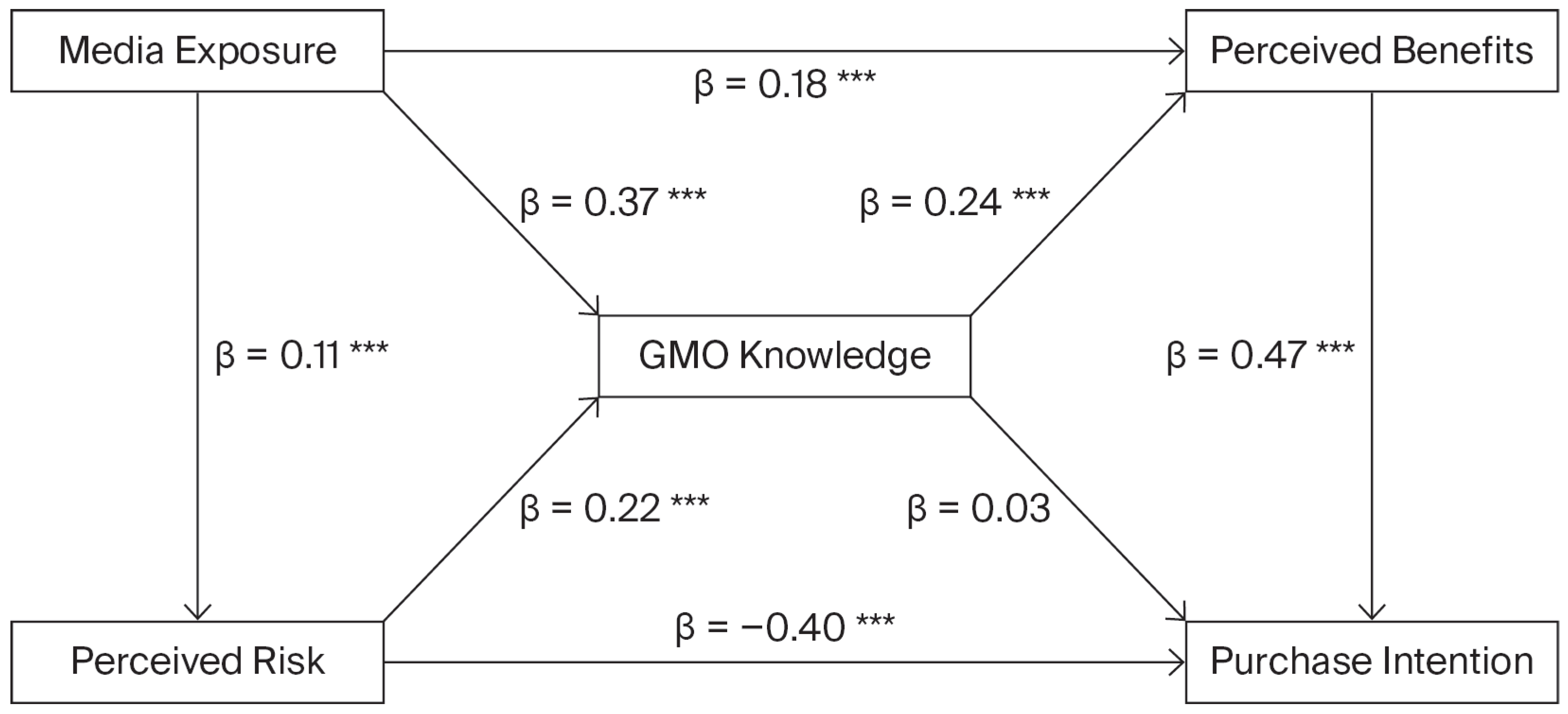
Each multi-item construct was tested for internal consistency reliability using Cronbach’s α, and composite scores were calculated by averaging across items. The operationalization of all constructs aligns with the hypothesized structural model depicted in
Figure 1, ensuring that measurement items correspond directly to each proposed pathway.
Validity and Common Method Checks: To ensure construct validity, confirmatory factor analysis (CFA) was conducted to examine factor loadings, Average Variance Extracted (AVE > 0.50), Composite Reliability (CR > 0.70), and discriminant validity using HTMT ratios (<0.85). Cronbach’s α values for all constructs exceeded 0.70, indicating acceptable internal consistency. To assess potential common method variance, Harman’s single-factor test was performed. The results indicated that CMV was non-problematic, as a single factor accounted for less than 50% of the total variance (media exposure, knowledge, perceived benefits, perceived risks, and purchase intention). Factor loadings for all items exceeded 0.60, indicating satisfactory indicator reliability. Average Variance Extracted (AVE) values were above the target value. These results collectively suggest that the measurement model exhibited acceptable convergent and discriminant validity.
Discriminant validity was further assessed using the Heterotrait–Monotrait ratio (HTMT). All HTMT values ranged from 0.21 to 0.63, well below the conservative threshold of 0.85, indicating satisfactory discriminant validity among the study constructs [
21]. These HTMT values (all < 0.85) satisfy conservative discriminant validity thresholds, providing sufficient evidence that all constructs are empirically distinct, consistent with reviewer expectations (see
Table 2).
Ethical Considerations: This study followed ethical guidelines for human subject-based research. Participants provided informed consent before completing the questionnaire, and no identifying personal information was collected. All procedures were approved by the Research Ethics Committee at King Abdulaziz University.
5. Results
This study aimed to examine the relationship between social media exposure and GMO knowledge, perceived benefits, perceived risks, and purchase intention. Data were analyzed using SPSS 27. Data analysis was divided into two parts: preliminary analyses and inferential analyses. During preliminary analyses, missing cases analyses, frequency analyses of demographics, descriptive analyses, and reliability analyses of studied variables were performed. During inferential analyses, hypothesis testing was conducted. For direct hypotheses (H1–H8), simple linear regressions were performed. For indirect hypotheses (H9a–H10b), model 4 mediations were performed. For other indirect hypotheses (H11a–H11b), model 6 sequential mediations were performed.
Table 3 shows the psychometric properties of the studied variables. The Cronbach α values of media exposure, GMO knowledge, and perceived benefits are 0.73 (>0.70), 0.71 (>0.70), and 0.72 (>0.70), respectively, indicating satisfactory internal consistency. The Cronbach α values of perceived risks and purchase intention are 0.85 (>0.70) and 0.80 (>0.70), respectively, indicating high internal consistency.
To access the common method variance (CMV), Harman’s single-factor test was performed using principal components on all study items of study variables in SPSS. The results of factor analysis using unrotated components revealed that single-factor total variance was 19.62%. This value is less than 50% [
22], which indicates that common method variance was likely not a serious concern in this study.
Before interpretating regression analysis, the multicollinearity assumption was checked via VIF values in the regression analyses. The VIF values of all predictors (media exposure, GMO knowledge, perceived benefits and perceived risks) showed that all VIF values were between 1.00 and 1.02, indicating no multicollinearity.
The regression analysis examining the impact of media exposure on GMO knowledge revealed an R2 value of 0.14, indicating that 14.0% of the variance was explained, F (1465) = 75.85, 95% CI [0.33, 0.52], p < 0.001. The findings revealed that media exposure (β = 0.37, p < 0.001) was a significant positive predictor of GMO knowledge. This indicates that individuals more exposed to social media tend to have greater knowledge of GMOs. Thus, the results of the simple linear regression support H1.
The regression analysis examining the impact of media exposure on perceived benefits revealed an R2 value of 0.06, indicating only 6.4% of variance was explained with an outcome variable of F (1465) = 31.66, p < 0.001. The findings revealed that media exposure (β = 0.25, 95% CI [0.15, 0.31], p < 0.001) was a significant positive predictor of perceived benefits. This indicates that individuals more exposed to social media tend to perceive greater benefits related to GMOs. Thus, the results of the simple linear regression support H2.
The regression analysis examining the impact of social media exposure on perceived risks revealed an R2 value of 0.03, indicating that 3.6% variance was explained with an outcome variable of F (1465) = 17.32, p < 0.001. The findings revealed that social media exposure (β = 0.19, 95% CI [0.10, 0.29], p < 0.001) was a significant positive predictor of perceived risk. This indicates that individuals more exposed to social media tend to perceive greater risk related to GMOs. Thus, the results of the simple linear regression support H3.
The regression analysis examining the impact of GMO knowledge on perceived benefits revealed an R2 value of 0.03, indicating that 3.6% variance was explained. The outcome variable was F (1465) = 17.32, p < 0.001. The findings revealed that GMO knowledge (β = 0.24, 95% CI [0.12, 0.26], p < 0.001) was a significant positive predictor of perceived benefits. This indicated that individuals with greater knowledge of GMOs tend to perceive greater benefits related to GMOs. Thus, the results of the simple linear regression support H4.
The regression analysis examining the impact of GMO knowledge on perceived risks revealed an R2 value of 0.04, indicating that 4.9% variance was explained with an outcome variable of F (1465) = 23.81, p < 0.001. The findings revealed that GMO knowledge (β = 0.22, 95% CI [0.12, 0.29], p < 0.001) was a significant positive predictor of perceived risk. This indicates that individuals with greater knowledge of GMOs tend to perceive greater risk related to GMOs. Thus, the results of the simple linear regression support H5.
The regression analysis examining the impact of GMO knowledge on purchase intention revealed an R2 value of 0.001, indicating that 0.1% variance was explained. The outcome variable was F (1465) = 0.57, p = 0.451. The findings revealed that GMO knowledge (β = 0.03, 95% CI [−0.06, 0.13], p = 0.451) was a non-significant predictor of purchase intention. Thus, the results of the simple linear regression do not support H6.
The regression analysis examining the impact of perceived benefits on purchase intention revealed an R2 value of 0.21, indicating that 21% variance was explained with an outcome variable of F (1465) = 123.94, p < 0.001. The findings revealed that perceived benefit (β = 0.48, 95% CI [0.40, 0.56], p < 0.001) was a significant positive predictor of purchase intention. This indicates that individuals who perceive greater benefits related to GMOs tend to have more intention to purchase them. Thus, the results of the simple linear regression support H7.
The regression analysis examining the impact of perceived risks on purchase intention revealed an R2 value of 0.14, indicating that 14% variance was explained with an outcome variable of F (1465) = 77.20, p < 001. The findings reveal that perceived risk (β = −0.40, 95% CI [−0.54, −0.34], p < 0.001) was a significant negative predictor of purchase intention, indicating that individuals who perceive greater risk related to GMOs tend to have less intention to purchase them. Thus, the results of the simple linear regression support H8.
Mediation analysis examines paths of H9a. The results of path a revealed that social media exposure (β = 0.37, 95% CI [0.33, 0.52], p < 0.001) is a significant positive predictor of GMO knowledge. The R2 value of 0.14 explained 14% variance in GMO knowledge with F (1465) = 75.85, p < 0.001. The results of path b revealed that GMO knowledge (β = 0.16, 95% CI [0.06, 0.21], p < 0.001) is a significant positive predictor of perceived benefit. The results of path c (Direct effect) revealed that social media exposure (β = 0.18, 95% CI [0.08, 0.26], p < 0.001) is a significant positive predictor of perceived benefit. The R2 value of 0.08 explained 8.8% variance in the perceived benefit with F (2464) = 22.54, p < 0.001. The results of the total effect model revealed that social media exposure (β = 0.25, 95% CI [0.15, 0.31], p < 0.001) is a significant positive predictor of perceived benefit. The R2 value of 0.06 explained 6.3% variance in the perceived benefit, with F (1465) = 31.66, p < 0.001. Lastly, the indirect effect of social media exposure via GMO knowledge on perceived benefit (path a × path b) was found to be significant, with B = 0.05, BootSE = 0.02 [BootLLCI = 0.02], BootULCI = 0.10. This indicates that GMO knowledge partially mediates the relationship between social media exposure and perceived benefits. Therefore, social media exposure has a positive impact on perceived benefits both directly and indirectly via GMO knowledge. Thus, H9a is supported.
Mediation analysis examines paths of H9b. The results of path a revealed that social media exposure (β = 0.37, 95% CI [0.33, 0.52], p < 0.001) is a significant positive predictor of GMO knowledge. The R2 value of 0.14 explained 14% variance in GMO knowledge, with F (1465) = 75.85, p < 0.001. The results of path b revealed that GMO knowledge (β = 0.16, 95% CI [0.08, 0.34], p < 0.001) is a significant positive predictor of perceived risk. The results of path c (Direct effect) revealed that social media exposure (β = 0.12, 95% CI [0.025, 0.22], p < 0.001) is a significant positive predictor of perceived risk. The R2 value of 0.06 explained 6.2% variance in the perceived benefit, with F (2464) = 15.33, p < 0.001. The results of the total effect model reveal that social media exposure (β = 0.18, 95% CI [0.10, 0.29], p < 0.001) is a significant positive predictor of perceived risk. The R2 value of 0.03 explained 3.5% variance in the perceived risk, with F (1465) = 17.32, p < 0.001. Lastly, the indirect effect of social media exposure via GMO knowledge on perceived risk (path a × path b) is significant, with B = 0.06, BootSE = 0.02 [BootLLCI = 0.03], BootULCI = 0.14. This indicates that GMO knowledge partially mediates the relationship between social media exposure and perceived risk. Therefore, social media exposure has a positive impact on perceived risk, both directly and indirectly, via GMO knowledge. Thus, H9b is supported.
Mediation analysis examines paths of H10a. The results of path a reveal that GMO knowledge (β = 0.24, 95% CI [0.12, 0.26], p < 0.001) is a significant positive predictor of perceived benefit. The R2 value of 0.05 explained 5.7% variance in the perceived benefit, with F (1465) = 28.57, p < 0.001. The results of path b reveal that perceived benefits (β = 0.48, 95% CI [0.40, 0.56], p < 0.001) are a significant positive predictor of purchase intention. The results of path c (Direct effect) reveal that GMO knowledge (β = −0.08, 95% CI [−0.17, 0.00], p = 0.059) is a non-significant predictor of purchase intention. The R2 value of 0.21 explained 21.6% variance in purchase intention, with F (2464) = 64.10, p < 0.001. The results of the total effect model reveal that GMO knowledge (β = 0.03, 95% CI [−0.06, 0.13], p = 0.456) is a non-significant predictor of purchase intention. The R2 value of 0.001 explained 0.1% variance in purchase intention, with F (1465) = 0.57, p = 0.456. Lastly, the indirect effect of GMO knowledge via perceived benefits on purchase intention (path a × path b) is significant, with B = 0.7, BootSE = 0.02 [BootLLCI = 0.03], BootULCI = 0.12. This indicates that perceived benefits fully mediate the relationship of GMO knowledge and purchase intention. Therefore, GMO knowledge has only a positive and indirect impact on purchase intention via perceived benefits. Thus, H10a is supported.
Mediation analysis examines paths of H10b. The results of path a reveal that GMO knowledge (β = 0.22, 95% CI [0.12, 0.29], p < 0.001) is a significant positive predictor of perceived risks. The R2 value of 0.04 explained 4.8% variance in the perceived risks, with F (1465) = 23.81, p < 0.001. The results of path b revealed that perceived risk (β = −0.40, 95% CI [−0.53, −0.32], p < 0.001) was found to be a significant negative predictor of purchase intention. The results of path c (Direct effect) revealed that GMO knowledge (β = 0.12, 95% CI [0.04, 0.23], p < 0.05) is a significant positive predictor of purchase intention. The R2 value of 0.15 explained 15.7% variance in purchase intention, with F (2464) = 43.23, p < 0.001. The results of the total effect model revealed that GMO knowledge (β = 0.03, 95% CI [−0.06, 0.13], p = 0.456) is a non-significant predictor of purchase intention. The R2 value of 0.001 explained 0.1% variance in purchase intention, with F (1465) = 0.57, p = 0.456. Lastly, the indirect effect of GMO knowledge via perceived risks on purchase intention (path a × path b) was found to be significant, with B = −0.08, BootSE = 0.02 [BootLLCI = −0.14], BootULCI = −0.05. This indicates that perceived risks partially mediate the relationship of GMO knowledge and purchase intention. Therefore, GMO knowledge has a positive direct effect and negative indirect effect on purchase intention via perceived risks. Thus, H10b is supported.
Mediation analysis examines paths of H11a. The results of path a1 revealed that social media exposure (β = 0.37, 95% CI [0.33, 0.52], p < 0.001) was found to be a significant positive predictor of GMO knowledge. The R2 value of 0.14 explained 14% variance in GMO knowledge with F (1465) = 75.85, p < 0.001. The results of path a2 revealed that media exposure (β = 0.18, 95% CI [0.08, 0.26], p < 0.001) was found to be a significant positive predictor of perceived benefits. The results of path b1 revealed that GMO knowledge (β = −0.06, 95% CI [−0.16, 0.02], p = 0.165) was found to be a non-significant predictor of purchase intention, whereas path b2 revealed that perceived benefit (β = 0.48, 95% CI [0.40, 0.56], p < 0.001) was found to be a significant positive predictor of purchase intention. The results of path c revealed that social media exposure (β = −0.05, 95% CI [−0.14, 0.03], p = 0.256) was a non-significant predictor of purchase intention. The R2 value of 0.21 explained 21.8% variance in purchase intention, with F (3463) = 43.19, p < 0.001. The results of total effect of path c revealed that social media exposure (β = 0.04, 95% CI [−0.06, 0.14], p = 0.299) was a non-significant predictor of purchase intention. The R2 value of 0.002 explained 0.2% variance in purchase intention, with F (1465) = 1.07, p = 0.299. Lastly, only one specific indirect effect 1 (media exposure → GMO knowledge → purchase intention) was found to be non-significant on purchase intention, whereas indirect effect 2 (media exposure → perceived benefits → purchase intention) was found to be significant on purchase intention. Moreover, indirect effect 2 (media exposure → GMO knowledge → perceived benefits → purchase intention) was found to be significant on purchase intention. This indicates that total indirect effects on GMO knowledge and perceived benefits mediate the relationship between social media exposure and purchase intention. Thus, H11a is supported.
As a robustness check, an alternative model was estimated that included a direct pathway from social media exposure to purchase intention. This pathway remained non-significant, and model fit did not improve, reinforcing the primacy of the sequential mediation structure. A small exploratory multi-group comparison (male vs. female respondents) also showed no meaningful directional differences in the structural paths, suggesting the stability of the model across demographic subgroups.
Mediation analysis examines the paths of H11b. The results of path a1 reveal that social media exposure (β = 0.37, 95% CI [0.33, 0.52],
p < 0.001) was a significant positive predictor of GMO knowledge. The R
2 value of 0.14 explained 14% of the variance in GMO knowledge, with
F (1465) = 75.85,
p < 0.001. The results of path a2 revealed that social media exposure (β = 0.11, 95% CI [0.03, 0.23],
p = 0.010) was a significant positive predictor of perceived risks. The results of path b1 revealed that GMO knowledge (β = 0.09, 95% CI [0.00, 0.20],
p = 0.048) was a significant positive predictor of purchase intention, whereas path b2 revealed that perceived risk (β = −0.41, 95% CI [−0.58, −0.38],
p < 0.001) was a significant negative predictor of purchase intention. The results of path c (Direct effect) revealed that social media exposure (β = 0.09, 95% CI [0.00, 0.22],
p = 0.256) was a non-significant predictor of purchase intention. The R
2 value of 0.16 explained 16.4% variance in purchase intention, with
F (3463) = 30.34,
p < 0.001. The results of the total effect of path c revealed that social media exposure (β = 0.04, 95% CI [−0.05, −0.17],
p = 0.299) was a non-significant predictor of purchase intention. The R
2 value of 0.002 explained 0.2% variance in purchase intention, with
F (1465) = 1.07,
p = 0.299. Lastly, only indirect effect 1 (media exposure → GMO knowledge → purchase intention) was found to be non-significant on purchase intention, whereas indirect effect 2 (media exposure → perceived risks → purchase intention) was found to be significant on purchase intention. Moreover, indirect effect 2 (media exposure → GMO knowledge → perceived risks → purchase intention) was found to be significant on purchase intention. This indicates that total indirect effects on GMO knowledge and perceived risks mediate the relationship between media exposure and purchase intention. Thus, H11b is supported (see
Table 4).
Figure 1 showed the statistical model of mediation.
Figure 1 summarizes the final mediation pathways tested in this study, illustrating both the direct and indirect effects identified through the PROCESS analysis. The model visually highlights the dominant affective route—where social media exposure shapes perceived benefits and risks both directly and through knowledge—and how these attitudinal components subsequently influence purchase intention. Presenting the results in a path diagram helps to clarify the sequential structure of the theoretical model and supports the interpretation of the dual-valence effects reported in the findings.
Figure 1 is included as a visual summary of the final structural relationships examined in this study.
6. Discussion
The purpose of this study was to examine the role of social media exposure in shaping knowledge, perceived benefits and risks, and purchase intention toward Genetically Modified Foods (GMFs) among consumers in Saudi Arabia. This study extends the Knowledge–Attitude–Behavior (KAB) and Theory of Planned Behavior (TPB) frameworks by positioning social media exposure as both an informational and affective–cognitive stimulus. This reconceptualization clarifies how digital communication can strengthen knowledge while simultaneously amplifying emotional and evaluative reactions toward GMFs. The findings provide empirical support for a majority of the hypothesized relationships and contribute to the literature on food biotechnology communication in non-Western contexts.
To strengthen the contribution of this section, it is important to contextualize the findings within the broader GMF communication landscape. The Saudi context—characterized by high social media penetration and low baseline familiarity with emerging food technologies—provides a unique environment where media exposure can disproportionately influence knowledge and affective responses. Incorporating this regional dimension helps to clarify why digital communication plays a central role in shaping perceptions of GMFs.
Regarding the role of social media exposure, consistent with prior research (e.g., [
23,
24]), it was found to be a significant predictor of GMO knowledge. Individuals who reported greater social media exposure demonstrated higher levels of knowledge about GMFs, supporting Hypothesis 1. Social media exposure was also positively associated with both perceived benefits and perceived risks of GMFs, supporting Hypotheses 2 and 3. This dual impact suggests that social media may act as a conduit for both positive and negative messaging, allowing individuals to encounter varied perspectives rather than reinforcing a unidirectional narrative. Such complexity aligns with media pluralism and the fragmented nature of contemporary digital media environments [
25]. This pattern is consistent with broader findings suggesting that social media ecosystems can simultaneously amplify both accurate information and misinformation, reinforcing mixed perceptions and emotional ambivalence toward scientific issues [
26]. Consumers process competing cues—optimistic and skeptical messages alike—leading to simultaneous increases in both perceived benefits and risks. This mixed-pattern response underscores the need to interpret social media effects not as purely persuasive but as multidirectional, reflecting the simultaneous presence of informational and emotional cues.
Interestingly, the positive association between knowledge and perceived risks suggests that increased familiarity with GMFs also exposes individuals to nuanced controversies, ethical debates, and scientific uncertainties. Prior research shows that higher literacy often leads to more critical evaluation rather than unquestioned acceptance, helping to explain why greater knowledge does not automatically produce favorable attitudes.
Regarding knowledge and perceptions of GMFs, in line with Hypotheses 4 and 5, GMO knowledge was positively associated with both perceived benefits and perceived risks. These findings indicate that knowledge acquisition does not necessarily resolve uncertainty; rather, it may increase awareness of both the promises and challenges associated with biotechnology. Notably, GMO knowledge did not directly predict purchase intention (Hypothesis 6 was not supported), consistent with studies suggesting the existence of a knowledge–behavior gap regarding food technology acceptance [
24] (2013). This underscores the need to move beyond information-deficit models. The non-significant direct effect of knowledge on purchase intention (H6) also suggests that consumer judgments about GMFs are not formed through rational assessment alone. Instead, behavioral intentions emerge when knowledge is filtered through affective evaluations, highlighting that individuals may understand a technology while still hesitating to adopt it due to unresolved emotional or moral concerns. These results highlight that awareness alone does not shape behavioral intention unless accompanied by emotionally resonant and value-based appraisals. This finding contributes to TPB-based food communication research by clarifying that affective attitudes—rather than purely cognitive knowledge—are the key drivers of intention in social media contexts.
Regarding predictors of purchase intention, the most robust predictors of purchase intention were perceived benefits and perceived risks, both of which demonstrated significant relationships in the expected directions (supporting Hypotheses 7 and 8). Individuals who perceived higher benefits were more likely to express purchase intention, whereas those who perceived higher risks were less inclined to do so. These findings are consistent with the risk–benefit framework widely used in the food choice literature [
27], reinforcing the idea that affective evaluations mediate the influence of knowledge on behavior. This further supports this study’s theoretical proposition that affective appraisals operate as dominant mediators between information exposure and behavioral intention, extending the traditional TPB by incorporating emotional and evaluative processing.
While several relationships were statistically significant, the effect sizes for knowledge and media exposure were relatively small. This pattern aligns with prior research showing that attitudes to biotechnology are shaped by multiple factors beyond knowledge alone. The small effects also reflect the fragmented and competing nature of social media information environments, where conflicting cues dilute the strength of predictive pathways.
Regarding mediation and sequential pathways, the mediation analyses provided further insight into the mechanisms underlying these relationships. GMO knowledge partially mediated the relationship between social media exposure and both perceived benefits and risks (supporting Hypotheses 9a and 9b). In turn, perceived benefits and risks fully mediated the effects of GMO knowledge on purchase intention (supporting Hypotheses 10a and 10b). These patterns suggest that while media and knowledge are important, their effects on behavior operate primarily through attitudinal constructs.
Together, these mediation findings provide a coherent picture of how information and effect interact across multiple stages of consumer evaluation. The sequential mediation models (Hypotheses 11a and 11b) revealed that social media exposure influenced purchase intention indirectly through knowledge and perceptions, with no significant direct effect of social media exposure on purchase behavior. This highlights the importance of cognitive (knowledge) and evaluative (benefits and risks) processing as intervening mechanisms and supports dual-process models of persuasion [
28]. Overall, these results position social media as a dynamic arena of affective amplification rather than a neutral information channel. The interplay between exposure, knowledge, and affect demonstrates how consumers form attitudes through high media pluralism and emotional content. This conceptual contribution advances global GMF communication research by offering region-specific evidence from a non-Western, high-social-media-use context. It also echoes recent analyses showing that misinformation and disinformation have become central challenges in science communication, emphasizing the importance of credibility and trust in digital media research frameworks [
29]. Although several paths were statistically significant, many effect sizes and R
2 values were modest. This indicates that additional variables—such as institutional trust, religiosity, and cultural values—likely influence GMF acceptance beyond the variables included in the current model.
The Saudi context may also amplify the influence of values, cultural norms, and institutional trust on GMF acceptance. Prior research in similar regions shows that food-related decisions are strongly shaped by religious considerations, family influence, and trust in government agencies. These factors may help to explain the modest effect sizes in this study, as cultural and institutional dimensions—although not measured here—likely compete with or override media-driven influences.
Beyond theoretical implications, these findings hold practical importance for public institutions, policymakers, and the food industry. Communication strategies promoting Genetically Modified Foods should emphasize transparency, emotional balance, and source credibility. In an era of fragmented digital ecosystems, factual information alone is insufficient to shape consumer trust. Collaborations between scientific authorities, government agencies, and social media platforms could help to design balanced content ecosystems, where both benefits and legitimate concerns are addressed clearly. This approach would align with global best practices in risk communication and support more informed consumer decision-making in emerging biotechnology markets.
Although several pathways were statistically significant, many effect sizes and R2 values were modest. This suggests that while social media exposure and knowledge contribute to perceptions and intentions, other unmeasured factors, such as trust in institutions, prior experiences, or cultural beliefs, likely play stronger roles in shaping GMF acceptance. Taken together, these findings emphasize that communication about GMFs should adopt an integrated strategy that combines factual clarity, emotional resonance, and cultural awareness to support informed consumer decision-making.