


Abstract
In recent years, China’s land-based marine aquaculture industry has developed rapidly. Frequent water changes during the aquaculture process have resulted in a large amount of aquaculture tail water. The untreated tail water, containing organic waste, nutrients, and chemicals, is often discharged into the seawater, potentially causing serious environmental and ecological problems. Therefore, the tail water from land-based marine aquaculture should be treated before being reused for resource utilization or safely discharged into the environment. This can promote the sustainable development and circular economy of the marine aquaculture industry. Against this background, this article provides an in-depth understanding of the generation, composition, and hazards of aquaculture wastewater. It reviews the various technologies for marine aquaculture tail water treatment currently adopted by scholars, classifying them into three major categories: physical, chemical, and biological. The paper analyzes the advantages and disadvantages of each technology, as well as the challenges they face. Additionally, future research directions are proposed, and suggestions are provided for achieving the sustainable development of the marine aquaculture industry and transitioning to environmentally friendly aquaculture.
1. Introduction
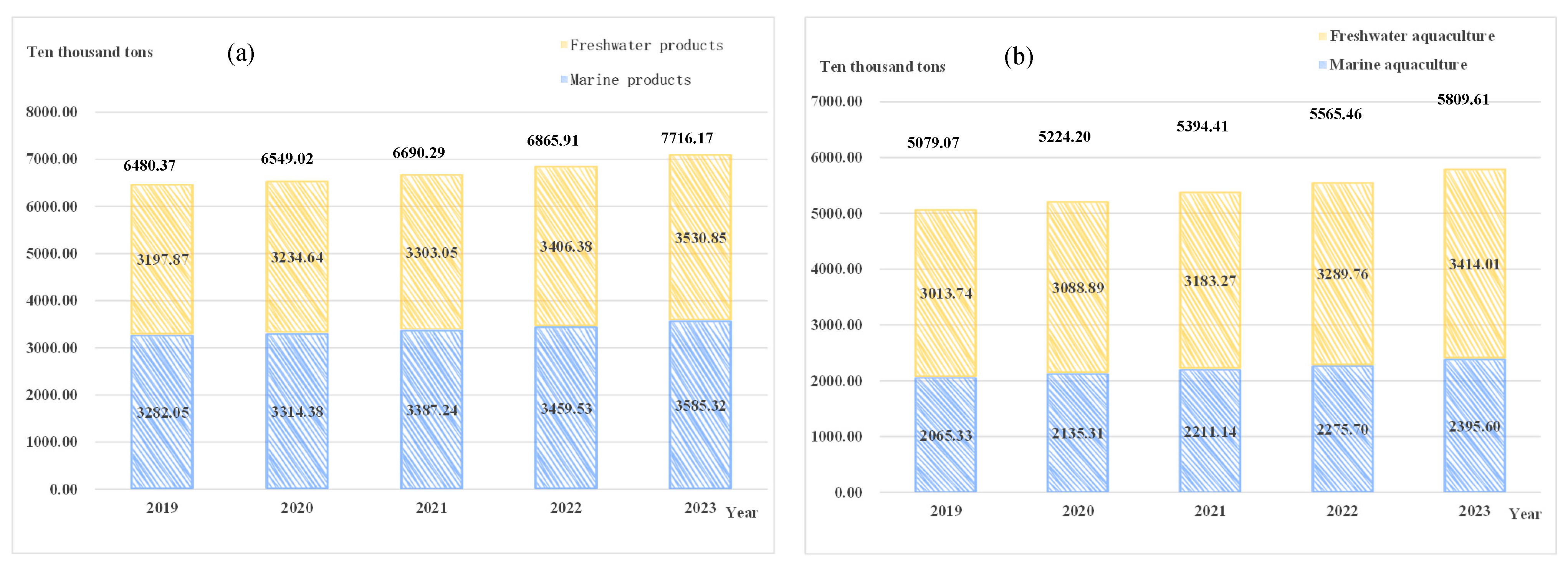
According to the 2024 Statistical Yearbook of Food and Agriculture of the World, the total output of global fisheries and aquaculture increased by 47% from 2000 to 2022. Over the past three decades, aquaculture has been the main driver of growth in the output of fisheries and aquaculture, with an average annual increase of 5% from 2000 to 2022. In 2022, aquaculture reached a record high of 94.4 million tons, accounting for more than half (51%) of the global total production for the first time [1,2]. Among them, China is one of the most developed countries in aquaculture in the world. Both its aquaculture area and total output rank among the top in the world [3]. The “2024 China Fisheries Statistical Yearbook” shows that in 2023, the output value ratio of farmed products to caught products in China was 81.9:18.1, and the output ratio of marine products to freshwater products was 50.4:49.6 (please refer to Figure 1). In recent years, due to overfishing, environmental pollution and other reasons, China’s marine aquatic resources have decreased. The focus of the aquatic industry has shifted towards aquaculture, which has led to the rapid development of the marine aquaculture industry [4]. During this process, China’s marine economy has continued to grow, and the pace of transformation and upgrading of marine industries has accelerated, providing solid policy support and infrastructure guarantee for marine aquaculture. Seafood is rich in high-quality protein, abundant minerals and trace elements, etc., and has high nutritional benefits [5]. Under the guidance of the marine economy strategy, the marine aquaculture industry still has huge growth potential in the future and is expected to further become an important force in ensuring national food security and promoting the development of the blue economy.
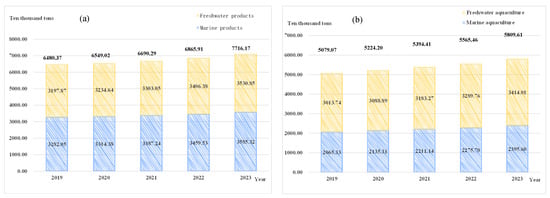
Figure 1.
China’s aquatic product output and composition from 2019 to 2023 (a); China’s aquaculture product output and composition from 2019 to 2023 (b).
Marine aquaculture in China is mainly distributed in Shandong, Liaoning, Hebei, Guangdong and other places [6]. The planning of marine aquaculture waters and tidal flats in various regions divides the marine aquaculture areas into marine aquaculture zones, tidal flats and terrestrial aquaculture zones [7]. Marine aquaculture encompasses nearshore and offshore cage culture, primarily for finfish (e.g., large yellow croaker and grouper); suspended culture (including raft and longline systems), mainly for shellfish (e.g., oysters) and seaweeds (e.g., kelp); as well as bottom-sowing for stock enhancement of shellfish (e.g., clams) and sea cucumbers. Coastal and land-based aquaculture, on the other hand, includes pond culture of fish, shrimp, and crabs; intensive factory-based facility aquaculture of species such as finfish and shrimp; and intertidal zone aquaculture of shellfish (e.g., razor clams) [8]. The Bulletin on the Status of China’s Marine Ecological Environment points out that the main over-standard indicators in the water bodies of key marine aquaculture areas (Liaodong Bay, Yangtze River Estuary, Hangzhou Bay and Pearl River Estuary and other coastal waters) are inorganic nitrogen and active phosphate [9]. During the breeding process, feed, fertilizer and chemicals are repeatedly input by humans to ensure the growth and health of the breeding products [10]. Marine aquaculture systems generate a large amount of wastewater. A considerable amount of organic waste, nutrients and chemical substances in the wastewater are discharged into the seawater, which is then transported in the water body and deposited on the seabed, affecting adjacent areas (nearshore) and more distant areas (the open sea) [11]. These processes may lead to serious environmental and ecological problems, such as low dissolved oxygen levels (i.e., hypoxia), water eutrophication, heavy metal pollution and antibiotic pollution, etc. [12,13,14]. However, marine aquaculture wastewater with high salinity usually has a relatively low organic matter concentration and C/N ratio [15]. Compared with freshwater aquaculture wastewater, marine aquaculture wastewater is more difficult to treat due to the influence of salinity [16]. Therefore, the process of treating marine aquaculture tail water through a series of physical, chemical and biological processes to effectively remove the above-mentioned pollutants in the wastewater and make it meet the standards for environmental discharge or reuse within the system is very crucial.
The rapid development of the marine aquaculture industry and the large-scale generation of aquaculture tail water have attracted widespread attention. Against the current background of sustainable development, there is an urgent need to analyze the sources, hazards and treatment technologies of marine aquaculture wastewater. This article will systematically explain these processes and discuss the main challenges and future prospects of common technologies for treating tail water from marine aquaculture in practical applications at the present stage, so as to achieve a more sustainable development of the marine aquaculture industry.
2. Marine Aquaculture Tail Water
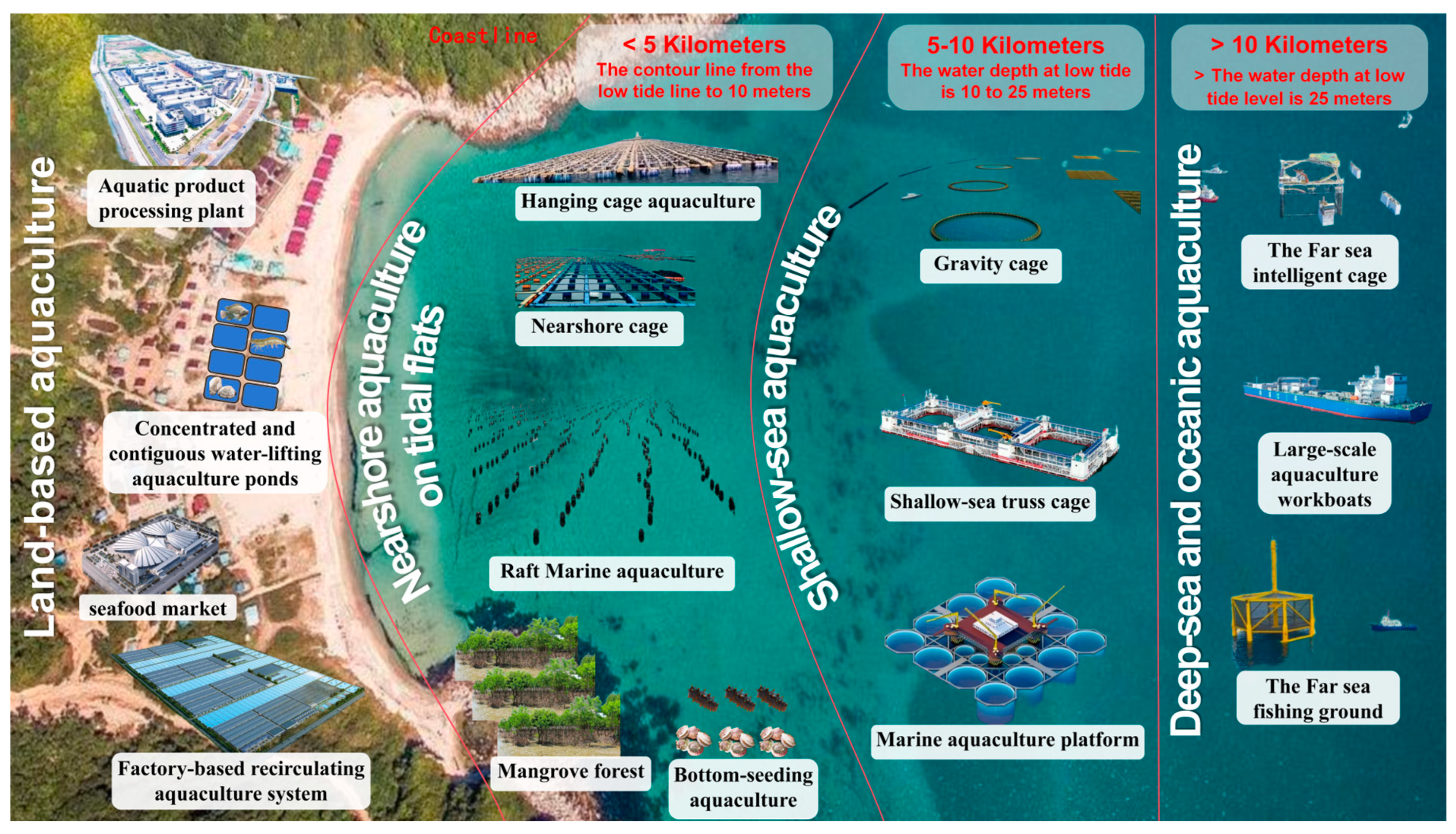
Aquaculture can be classified by aquaculture methods into pond aquaculture, factory aquaculture and open sea aquaculture [17,18]. At present, most of the tail water from Marine pond aquaculture in China is discharged directly into the sea without treatment or after simple treatment [19]. Factory aquaculture is also an important part of marine aquaculture in China [20,21]. They often have a high stocking density, long water usage cycle and high nutrient content in the tail water [22]. According to the classification of aquaculture waters, it can be divided into land-based aquaculture, nearshore aquaculture on tidal flats, shallow sea aquaculture and deep-sea distant-water aquaculture [23], as shown in Figure 2. Among them, the pollution of aquaculture tail water from land-based pond aquaculture and factory aquaculture is the most common [24], and it is also the focus of current research on the treatment technology of marine aquaculture tail water. Therefore, this paper will focus on evaluating the application of tail water treatment technologies in pond aquaculture and factory aquaculture, as well as their advantages and disadvantages.
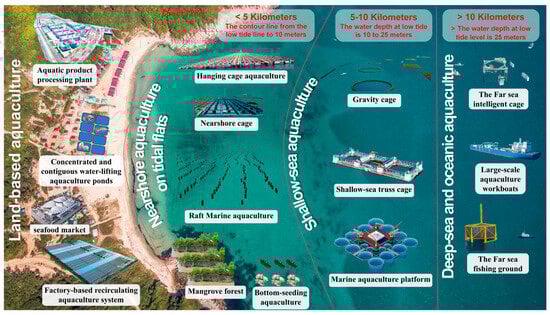
Figure 2.
Types of marine aquaculture.
2.1. Aquaculture Tail Water Pollution
From the perspective of marine aquaculture waters, the water quality in marine aquaculture areas located in open regions with relatively fast flow rates is less likely to deteriorate. However, in marine aquaculture areas near the tidal flats and land-based marine aquaculture, due to their relatively poor water exchange capacity and relatively slow flow rates, the water quality is more prone to deterioration [25]. From the perspective of the types of marine aquaculture, fish and shrimp pond farming is a type of aquaculture that causes relatively serious pollution [26]. Algal farming does not require breeding. Most shellfish do not need to be bred or are based on algal farming, and seaweed has a great potential for carbon sequestration [27]. The impact of these two types of marine aquaculture on seawater quality is less than that of fish and shrimp farming. For example, oysters feed on algae, and their raft farming has not had adverse effects on water quality [28]. Therefore, land-based aquaculture and cage aquaculture near the shore of tidal flats are currently the focus of attention in the treatment technology of marine aquaculture tail water, among which the research on the treatment technology of aquaculture wastewater from fish and crustaceans is the most extensive.
At present, most of the land-based marine aquaculture ponds belong to extensive aquaculture, with the phenomenon of untreated tail water being directly discharged into the ocean. On average, land-based aquaculture ponds are cleaned 1 to 2 times a year. During this period, a large amount of aquaculture wastewater is discharged into the surrounding water environment at one time. Meanwhile, during the process of Marine shrimp pond farming, there is frequent water change. Depending on the season and the water quality in the pond, water needs to be changed approximately every 10 days. During the dry season, the temperature and salinity of the water will increase, and 10% to 15% of the water needs to be changed. When the shrimp pond is contaminated or diseased, 10% to 15% of the water should also be changed [29]. In the process of factory farming, the water consumption of the pond will increase over time. After the harvest, a large amount of wastewater is discharged into the surrounding environment, and clear water is pumped into the aquaculture ponds to wash away the sediment in the ponds. Then, this water is usually pumped back into the ocean, which seriously affects the habitat of the mangroves on the tidal flats [30]. The main pollutants in these marine aquaculture tail water can be roughly classified into four categories [31]: organic carbon (accumulation of sediment organic carbon burial fluxes ranging from 2.9 to 79.71 g·m−2·a−1 [20]); nutrients (the phosphorus flux of marine aquaculture in Fujian is 2.2 times that of the Minjiang River, and the nitrogen flux caused by seaweed farming accounts for 69% of that of the Minjiang River [32]); suspended solids (concentrations can be highly variable, from 30 to over 500 mg/L.); and new pollutants (for example, the highest antibiotic concentration in the Liaodong Peninsula was 692.0 ng/L [33], etc.). During the period of replacement and discharge, aquaculture wastewater containing a large amount of pollutants is discharged into the surrounding water bodies without treatment, seriously polluting the surrounding fishery water environment. It is an important part of seawater non-point source pollution. The discharge of untreated aquaculture wastewater is very likely to cause serious environmental and social and economic problems.
2.2. The Environmental Impact of Marine Aquaculture Tail Water
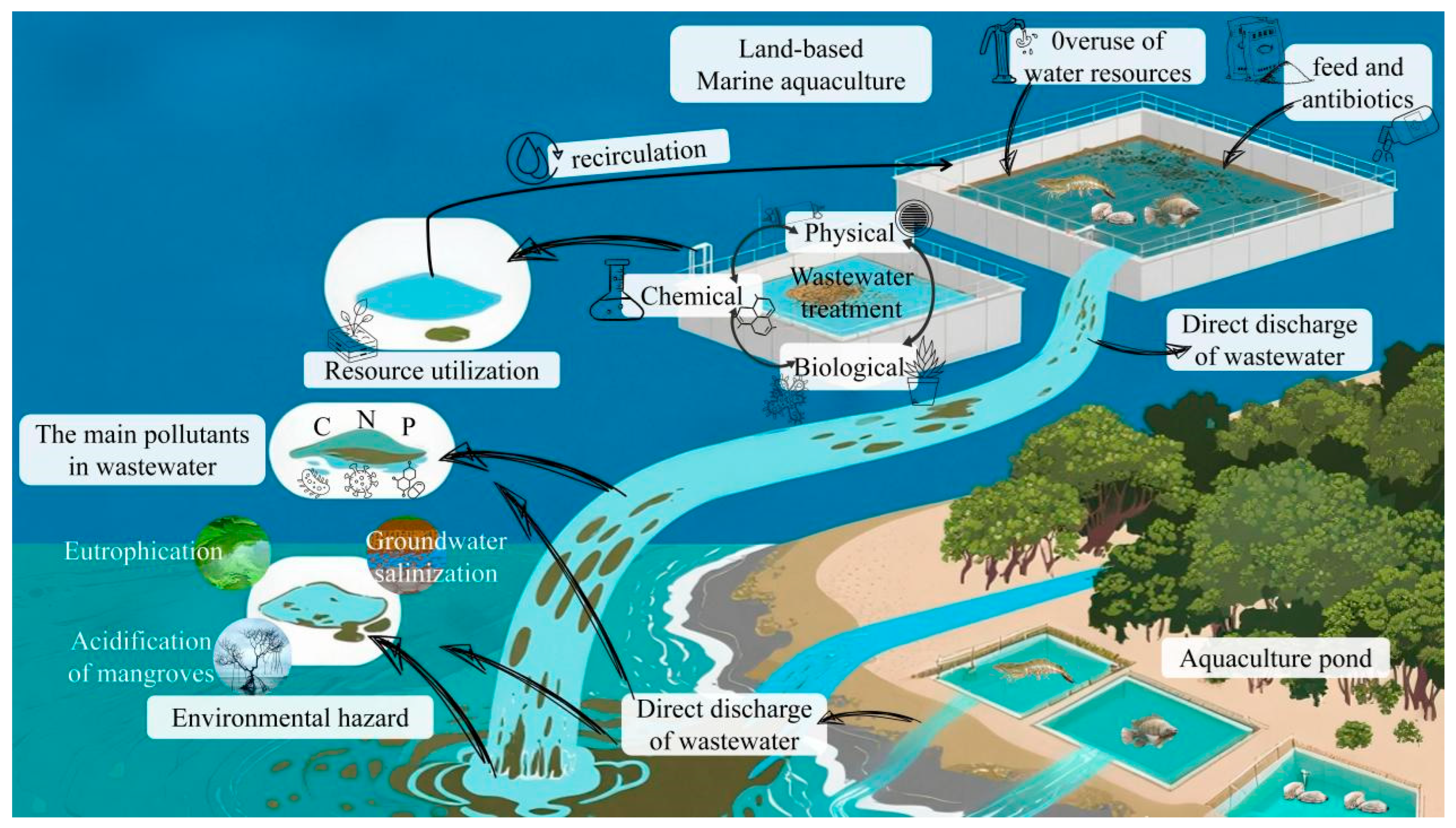
The potential interaction and conflict between marine aquaculture activities and the Marine environment and ecosystem is a long-term concern [34]. Many scholars have also analyzed the pollution caused by the discharge of tail water from marine aquaculture. Price et al.’s research indicates that Marine cage culture operations are recognized as one of the sources of nitrogen and phosphorus pollutants. Their emission forms include particulate matter (uneaten food and feces containing undigested food, passing through the fish’s digestive tract) and dissolved metabolic wastes, including ammonia, urea, and dissolved phosphorus [35]. Bouwman et al. estimated through a model that only 36% of the nitrogen in the feed was retained in farmed salmon and trout, while 54% was lost as dissolved waste, 10% as particle loss, and the phosphorus absorption rate was only 33% [36]. Herbeck et al. discovered through isotope tracking that in large-scale coastal aquaculture areas such as China and Southeast Asia, the impact of active nitrogen from aquaculture sources on the performance of coastal ecosystems may be greater than previously thought [37]. The research by JianWei Yu et al. found that the large-scale feeding of feed during the breeding period of large yellow croakers in Zhoushan City was the main factor leading to a significant increase in the biological oxygen demand and total nitrogen concentration in the breeding water [38]. As shown in Figure 3, dissolved pollutants are released into the water through excreta and granular solids. The continuous accumulation of pollutants will lead to the formation of algal blooms, reducing the dissolved oxygen in the water body. Harmful algal blooms can kill or poison marine aquaculture products, significantly reducing the quality of aquatic products and causing incalculable economic losses. In severe cases, they can even harm human health [39]. Apart from dissolved waste, particulate and suspended solid waste can cause fish death by blocking gills. The significant increase in particulate phosphorus in sediments and harmful substances in water bodies and sediments also poses a threat to marine ecosystems [40]. With the accumulation of pollutants in marine aquaculture ponds, biological diseases occur frequently, eventually causing huge economic losses to the aquaculture department [41]. Qin et al.’s research indicates that the direct discharge of wastewater from shrimp Marine ponds has a significant acidification effect on mangrove sediments in the discharge area. The accumulation of NO3--N, NO2--N, and DIN in intertidal water increases with the discharge of shrimp farming wastewater [42]. The high-level ponds for marine aquaculture are usually filled with seawater by pumping water with pumps, providing a suitable aquaculture environment for fish, shrimp, oysters, etc. The research on groundwater salinization in Qinzhou Bay, Guangxi, by Hu Kaiyan et al. found that the groundwater salinity in Qinzhou Bay has been on the rise since 2013 [43]. The intensive pumping and the extensive expansion of marine aquaculture in this area are both important reasons for the increased salinization of water bodies.
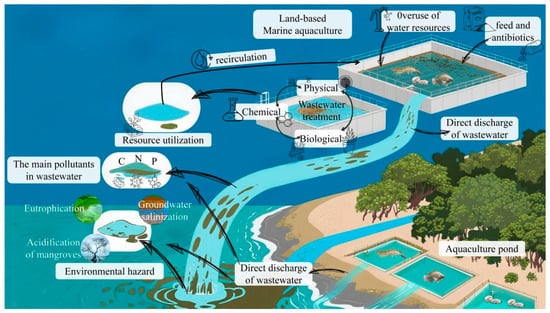
Figure 3.
The sources and hazards of land-based marine aquaculture tail water.
3. The Dilemma of the Existing Tail Water Treatment Technology
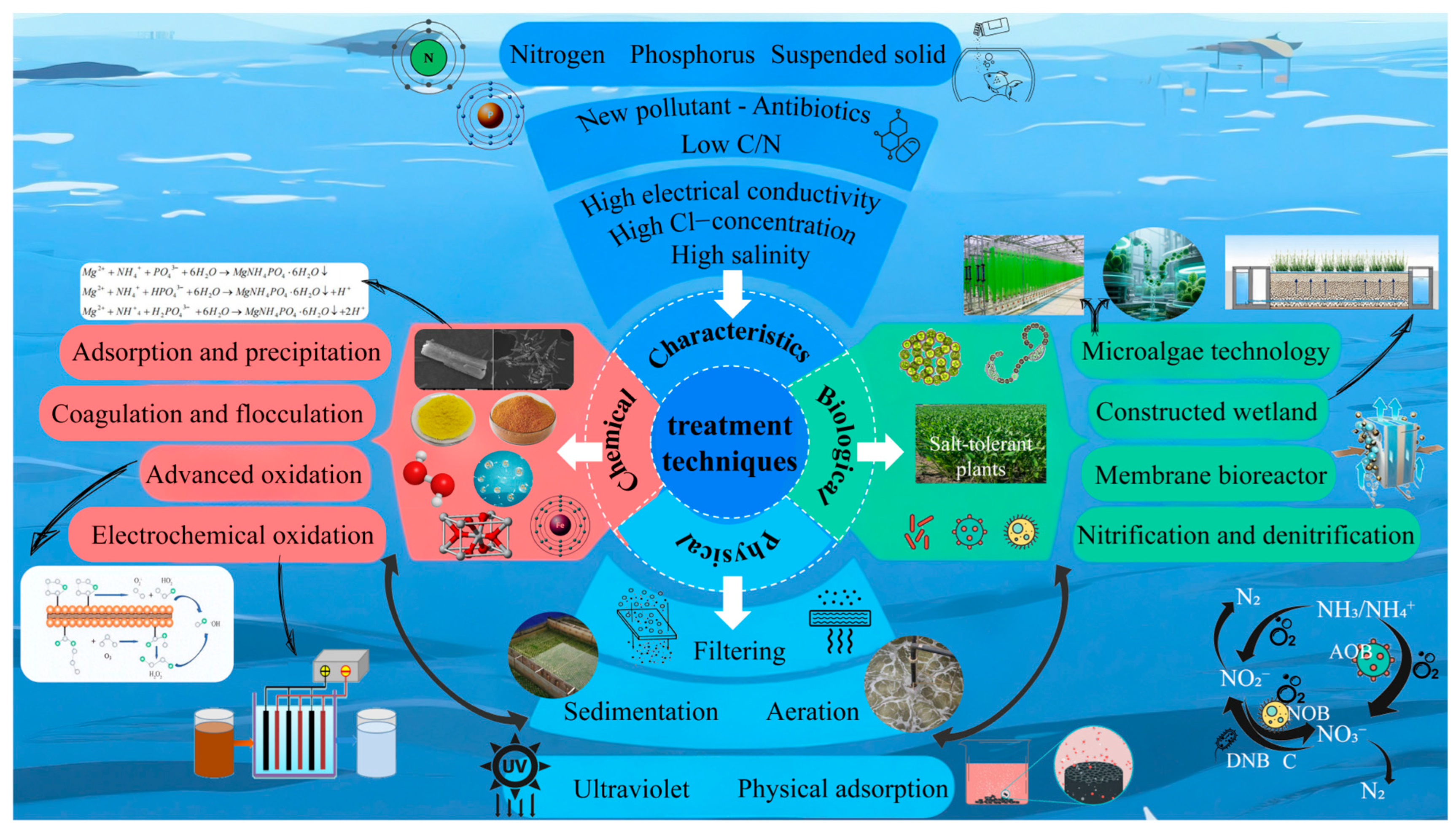
As shown in Figure 4, to date, a variety of physical, chemical and biological technologies have been employed to treat the tail water from marine aquaculture. The selection and optimization of these methods not only focus on the efficiency of pollutant removal, but also increasingly emphasize coordination with the goals of a circular economy [44]. Physical methods remove suspended large particle substances through sedimentation, foam separation and filtration, etc. [45]. Advanced oxidation methods, electrochemical oxidation, and coagulation/flocculation are examples of chemical methods. The high-salt environment of seawater (up to 30‰) provides certain favorable conditions for chemical treatment processes [46]. Biological treatment technologies, represented by microalgae technology, fluidized bed reactors and biological contactors, are the main wastewater treatment technologies for low-cost and high-efficiency removal of ammonia and organic pollutants [47]. Classification is a method based on the separation of pollutants. Physical methods purely separate pollutants from their original forms, while chemical and biological methods remove pollutants through assimilation, degradation or transformation into other substances. The comprehensive assessment and systematic integration of these technologies are precisely the key to promoting the transformation of the aquaculture wastewater treatment model from end-of-pipe treatment to resource reuse and system sustainability.
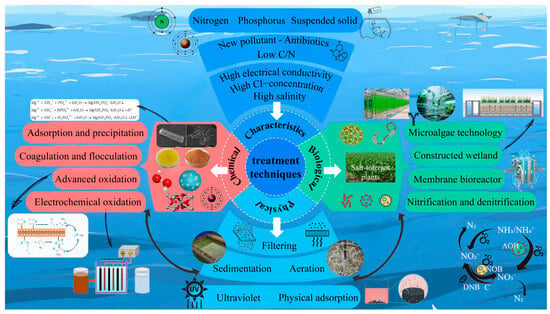
Figure 4.
Characteristics and Treatment technologies of land-based marine aquaculture tail water.
3.1. Physical Technology
Physical methods refer to a category of approaches that utilize physical actions to separate or remove insoluble suspended pollutants from wastewater. They play a significant pretreatment role in treating marine aquaculture wastewater, including aeration, physical adsorption, sedimentation [48], filtration and ultraviolet technology [49], etc. [50,51]. For example, Ali et al. prepared polyethersulfone (PES) membranes and studied the feasibility of treating aquaculture wastewater. They found that the PES membranes could remove approximately 85.70% of total ammonia nitrogen and 96.49% of total phosphorus, respectively [52]. Zhang et al. used ultraviolet/persulfate compound disinfectant (UV/PDS) to inactivate Escherichia coli and Streptococcus agalactiae in marine aquaculture water. The results showed that UV/PDS had a better disinfection effect on marine aquaculture water [53]. Some examples of physical methods and their advantages and disadvantages are shown in Table 1.

Table 1.
Summary of Physical Techniques for Treating Tail water from marine aquaculture.
3.2. Chemical Technology
Compared with fresh water or brackish water, seawater has a higher ionic strength [61], and marine aquaculture wastewater is characterized by high salinity and a low C/N ratio [62]. Chemical methods refer to the techniques that transform, separate and remove pollutants by adding chemical agents or initiating chemical reactions. Therefore, this technology may be beneficial for treating wastewater from marine aquaculture [63,64]. However, it must be noted that the high concentration of chloride ions (Cl−) in seawater may also have significant adverse effects on the chemical treatment process, such as competing for the consumption of oxidants, generating harmful by-products (such as chlorinated organic compounds), intensifying equipment corrosion, and interfering with the coagulation and flocculation process [65]. The main methods include chemical adsorption and sedimentation [66,67], flocculation and coagulation [68,69], electrochemical oxidation [70] and advanced oxidation [71], etc. For instance, Zhang et al. studied the crystallization of struvite in seawater/brackish water to explore the dissolution and precipitation of phosphate in the tail water. The results showed that the naturally occurring magnesium in seawater and the ammonia and phosphate in the tail water promoted the precipitation of struvite, which led to a decrease in the phosphate concentration and ammonia nitrogen concentration in the effluent [72]. It is worth noting that flocculants can not only remove suspended particles but also effectively eliminate certain organic substances. [73]. Zhang et al. studied the removal efficiency of inorganic coagulants FeCl3 and polymeric aluminum sulfate (PAS) on TSS, turbidity, TOC, etc., in the tail water of saltwater aquaculture. The results show that both inorganic coagulants have good removal effects on solids and phosphorus under salt-containing conditions, and FeCl3 is a powerful coagulant for further concentrating the wastewater from marine fish farms [74]. Seawater is a natural electrolyte. Yakamercan et al. treated recirculating aquaculture wastewater by electrooxidation (EO) with boron-doped diamond (BDD) electrodes [75]. The results show that the EO treatment method successfully removed more than 93% of the pollutants, including NH3–N, NO3+–N, NO2+–N and TDN. The removal rate of COD in aquaculture wastewater was 86.85%, and that of TDP was 79.41%. Romano et al. conducted kinetic analysis and modeling of amination by establishing electrochemical cells with a Ti/RuO2 anode and a Ti cathode [76]. The results show that electrochemical-assisted chlorination is an effective method for removing ammonia nitrogen from marine aquaculture wastewater, and the mechanism therein is revealed. Advanced oxidation methods include the Fenton process, photocatalysis, ozonation and persulfate process [77,78,79], etc. Ozone, chlorine and sodium hypochlorite are commonly used oxidants [80,81]. Zhang et al. studied the degradation effect of the ultraviolet/persulfate (UV/PS) process on tetracycline (TC) in marine aquaculture wastewater [60]. The results revealed that 95.73% removal of TC with a 5 mg/L dosage was achieved after 30 min UV/PS treatment. Zhao et al. used an ultraviolet/hydrogen peroxide (UV/H2O2) advanced oxidation process to treat mariculture wastewater containing sulfonamide-resistant genes [71]. The results show that the UV/H2O2 advanced oxidation process can effectively remove antibiotic resistance genes. However, due to the fact that high concentrations of Cl− can decompose SO4− and form relatively inactive active chlorine species, it further affects the removal efficiency of pollutants. Some examples of chemical methods and their advantages and disadvantages are shown in Table 2.
Table 2.
Summary of Chemical Technologies for Treating Tail Water from Marine Aquaculture.
3.3. Biotechnology
Biological treatment refers to the technology that utilizes microorganisms, plants or their metabolic activities to degrade, transform and remove organic matter and nutrients from water bodies. Compared with physical and chemical techniques, this method is generally regarded as more economical, effective and environmentally sustainable [90]. However, the high salinity environment of marine aquaculture wastewater can exert osmotic pressure stress on microorganisms, leading to cell water loss, inhibition of enzyme activity and energy metabolism disorders, which is seriously detrimental to their survival and growth [91]. Therefore, researchers have specifically explored various biological treatment methods based on the characteristics of marine aquaculture wastewater, including membrane bioreactor (MBR) [92], microalgae technology [93], constructed wetland (constructed wetland system, CWs) technology [94], heterotrophic nitrifying—aerobic denitrification (HNAD) technology [95] and aquaponics [96], etc.
MBR technology, as a type of biological treatment method, possesses dual characteristics of biological treatment and membrane separation, with biological degradation as the main approach and membrane separation as a secondary one. For example, membrane contamination is a bottleneck that affects the application of MBR technology in mariculture wastewater treatment [97,98]. Therefore, Liu et al. conducted a study on the mitigation mechanism of membrane fouling by microalgae biofilms [99]. The results show that microalgae biofilm formation can effectively reduce the protein-to-polysaccharide ratio of extracellular polymers, thereby reducing the possibility of biofilm contamination by protein substances (especially tryptophane-like proteins), and is more economical and effective than the suspended microalgae method when treating low C/N marine aquaculture wastewater. Böpple et al.’s research also indicates that microalgae cultivation can fully absorb nitrates and phosphates in the effluent of recirculating aquaculture systems [100]. Biofilm reactors can adapt to changes in nutrient concentration and salinity, generating economic value while treating tail water. Microalgae technology also plays a key role in improving the removal of pollutants in marine aquaculture wastewater [101]. Liu et al. used a natural hybrid microalgae to study the mechanism of microalgae biofilm formation and the treatment effect on marine aquaculture wastewater under different ammonia nitrogen loads [102]. The results showed that when the ammonia nitrogen concentration was 25 mg/L, the removal rates of nitrogen and phosphorus were the highest (NH3-N: 98%, TN: 84%, PO43−-P: 68%). Compared with single microalgae technology, the advantage of combined microalgae technology lies in the strong adsorption capacity of microalgae, which enables them to effectively absorb nutrients from wastewater and convert them into biomass [103]. Therefore, Zhang et al. studied the removal mechanism of antibiotics and nutrients in marine aquaculture wastewater by microalgae [104]. The results showed that the average removal rates of DIN and DIP in the membrane photobioreactor were 81.2% and 100%, respectively, and the degradation rate and adsorption rate of chlorella for the antibiotic (florfenicol) are 89.74% and 3.72% respectively.
In recent years, CWs has been gradually applied to the treatment of mariculture tail water because of its low economic cost and good benefits [105]. For instance, Li et al. investigated the effects of ammonia nitrogen loading rate and salinity on the removal rate of nutrients and the activity of substrate enzymes in the micro-ecosystem of constructed wetlands [106]. The results show that compared with low salinity, high salinity levels increase the removal rate of nutrients. The possible reason for this result is that halophilic and salt-tolerant microorganisms have dominated in CWs. Fu et al. demonstrated this possibility by screening out a salt-tolerant aerobic denitrifying bacterium, Zobellella denitrificans strain A63, and investigated its effects on the denitrification efficiency of saline wastewater and substrate denitrification microbial community structure in a vertical-flow constructed wetland. [107]. The results showed that the removal rates of NH3-N, NO3−-N and total nitrogen by this strain reached 79.2%, 95.7% and 89.9%, respectively. The heterotrophic nitrification—aerobic denitrification technology is also constantly maturing. Ning et al. studied the performance of continuous operation of heterotrophic nitrifying—aerobic denitrification biofilm reactors in treating wastewater from seawater recirculating aquaculture systems and tail water from traditional seawater aquaculture ponds [108]. The results show that the system achieved simultaneous nitrification and denitrification on the 7th day. The removal rates of inorganic nitrogen were 87.37 ± 4.23% and 65.00 ± 8.35% respectively. In addition, autotrophic denitrification is also an alternative to heterotrophic denitrification that has emerged in recent years. It reduces NO3−-N to gaseous nitrogen by using inorganic electron donors and inorganic carbon sources [109]. Liu et al. established a heterotrophic–sulfur autotrophic denitrification system and studied the effect of Fe3O4 on the nitrogen removal effect of seawater recirculating aquaculture wastewater [110]. The results show that Fe3O4 enriches sulfur autotrophic denitrifying bacteria, thereby improving the denitrification efficiency. When the optimal concentration of Fe3O4 was 50 mg/L, the nitrogen removal efficiency reached 100%.
Halophytes can produce economically valuable crops while removing the main nutrients contained in aquaculture wastewater [111]. Doncato et al. cultivated sea asparagus (Sarcocornia ambigua) using wastewater from saline shrimp farms. By analyzing their growth rate and biomass, they demonstrated that they could serve as an alternative to irrigating salt-containing wastewater from aquaculture on salt-affected soil for food production [112]. Some examples of biological methods and their advantages and disadvantages are shown in Table 3.
Table 3.
Summary of Biotechnologies for Treating Tail Water from Marine Aquaculture.
4. The Main Challenges Faced in Tail Water Treatment
To sum up, with the growth of population, the increase in per capita consumption of seafood and the decrease in consumption of other protein sources [126], the continuously developing land-based marine aquaculture industry has also drawn people’s attention to the importance of treating marine aquaculture wastewater and protecting the environment from the impact of polluted wastewater [39,127]. In recent years, research on various ways and methods for treating marine aquaculture wastewater has been conducted, as described in Section 3. Although physical technology can quickly remove large pollutants without generating by-products, it often only achieves partial performance and also has disadvantages such as sludge generation, high energy consumption, and frequent equipment maintenance [35]. Chemical technology is simple to operate, occupies a small area and can efficiently remove pollutants based on the high ionic strength of seawater. However, the chemicals added cannot be recycled and may produce harmful by-products. Electrochemical and other technologies may be difficult to implement on a large scale [46]. Biotechnology is a sustainable, environmentally friendly treatment technology that conforms to ecological laws. In view of the characteristics of high salinity and low carbon-nitrogen ratio of marine aquaculture wastewater, more efficient biological treatment technologies need to be studied specifically [128]. The research and application of comprehensive treatment technology is the direction of future marine aquaculture wastewater treatment [129]. However, the current research and application mainly focus on a single technology and remain at the experimental stage. Its application in real aquaculture wastewater is limited. The existing comprehensive technologies often originate from freshwater aquaculture [130], and targeted research is still scarce. The economic costs, advantages and disadvantages of several marine aquaculture tail water treatment technologies are summarized in Table 4.
Table 4.
Economic cost, advantages and disadvantages of tail water treatment technology for mariculture.
China’s various provinces have successively introduced stricter standards for the discharge of aquaculture tail water. For instance, in Fujian Province, the discharge limits for TP, TN and COD in aquaculture tail water of Marine receiving waters are 0.5–1, 3–7 and 10–20 mg/L, respectively. The gradually strengthened regulatory requirements have also brought huge challenges to the marine aquaculture industry [133]. A too low C/N ratio in marine aquaculture wastewater will affect the effectiveness of nitrogen and phosphorus removal. In the actual treatment process, external organic carbon sources need to be added. With the improvement of tail water discharge standards, the excessively high TN concentration in tail water and the lack of carbon sources have become the main bottlenecks in the treatment of marine aquaculture wastewater, similar to the advanced denitrification of secondary effluent in urban sewage treatment [134]. It should be noted that excessive carbon sources can easily lead to anaerobic reduction of sulfates, releasing toxic H2S [135]. The recirculating water aquaculture system is the development direction of the future land-based marine aquaculture industry, but at present, there are relatively few research cases of large-scale application in China.
The main challenge of current tail water treatment technology for land-based mariculture is the development and integration of core technologies. There is an urgent need to develop low-cost, high-efficiency and salt-alkali-resistant core technologies for land-based tail water treatment, such as halophilic/salt-tolerant microbial agents, Anammox technology suitable for seawater and low-energy consumption nitrogen and phosphorus removal processes. At the same time, the Internet of Things, sensors and big data algorithms should be fully utilized to conduct real-time monitoring of water quality parameters and precise and intelligent regulation of treatment processes, so as to reduce the consumption of chemicals, electricity and labor costs. It is important to note that the resource utilization of tail water and sludge is also one of the main challenges. Nutrients such as nitrogen and phosphorus in the tail water should be regarded as “resources” rather than “wastes”, such as by cultivating economically valuable microalgae and recovering nutrients, to create additional economic value and form a more sustainable development of land-based marine aquaculture.
5. Countermeasures and Suggestions
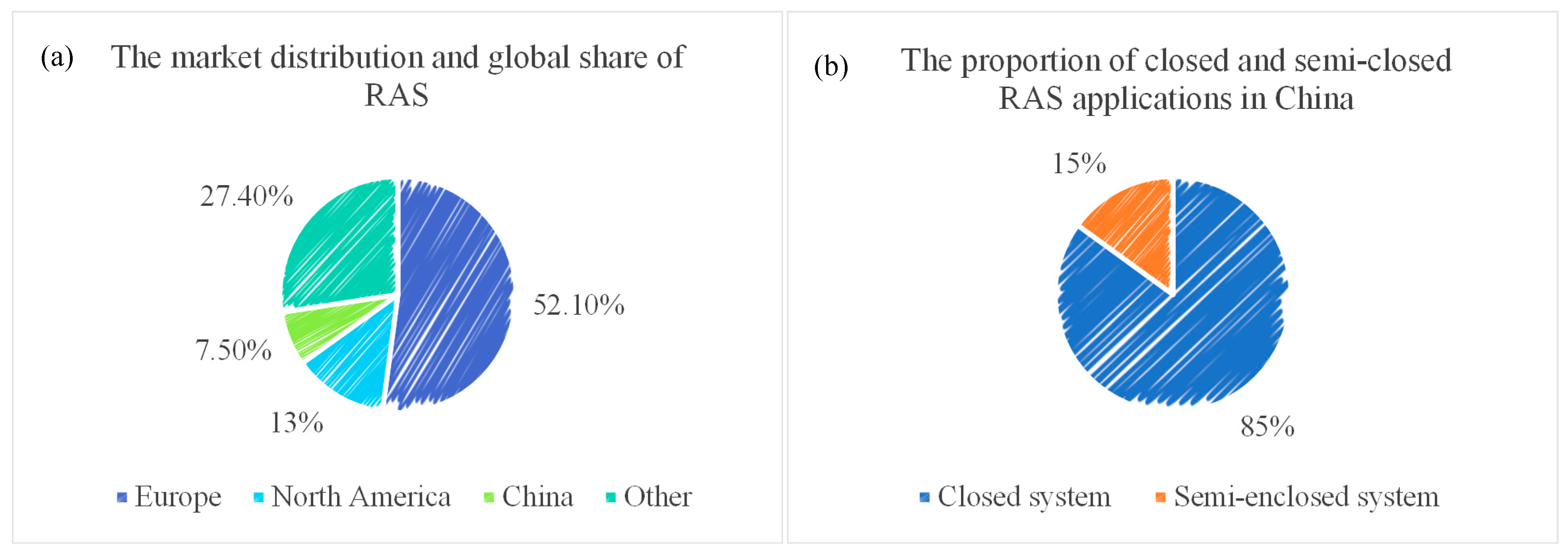
The adoption of highly engineered recirculating aquaculture systems (RAS) has become the development trend of global marine aquaculture and an inevitable trend for the sustainable development of aquaculture. RAS can reduce the discharge of aquaculture wastewater into the near-sea area and enable marine aquaculture technology to gradually achieve resource recycling [136]. Meanwhile, RAS reduces water consumption by optimizing the use and recycling of water. Therefore, controlling the concentrations of ammonia nitrogen and nitrite nitrogen in aquaculture water bodies is the key to achieving water circulation [137,138]. Zhang et al. compared the nitrogen removal characteristics and microbial communities in freshwater and seawater recirculating aquaculture systems. The research results provide a theoretical and practical basis for improving the activation speed of nitrifying biofilms in high salinity [136]. In the RAS water treatment process, physical filtration is the most ideal method for pretreatment of marine aquaculture wastewater. Then, ecological methods can be used for the deep removal of nutrients. Microalgae technology, constructed wetlands and aquaponics can generate certain economic value while treating the tail water [96,139,140]. Combining a bioreactor with RAS can achieve high treatment efficiency for most pollutants and offers high potential for resource recovery. At present, RAS projects account for the highest proportion in Europe. Among them, Norway dominates the market with its technological advantages and large-scale salmon production, ranking first in the world in terms of the number of projects. The application of RAS in China and other countries is shown in Table 5 and Figure 5.
Table 5.
Comparison of the application of RAS between China and foreign countries.
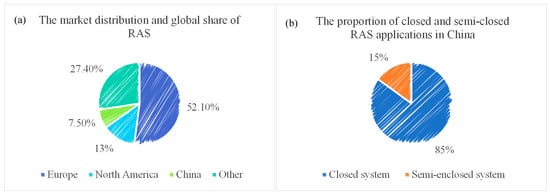
Figure 5.
The market distribution and global share of RAS (a). The proportion of closed and semi-closed RAS applications in China (b).
Integrated multi-trophic aquaculture system (IMTA) is also a promising approach that enhances the performance of aquaculture while minimizing environmental pollution. It offers an alternative pathway toward the long-term sustainability and profitability of the aquaculture industry. Li et al. utilized a novel RAS-IMTA system to test the efficiency of nutrient salt bioreaction and the production capacity of diatom communities in oyster farming. More than 96% of nitrogen and phosphorus in the system were removed [141].
Despite being recognized as an imperative direction for transitioning mariculture towards resource efficiency and environmental friendliness, the large-scale adoption of RAS and IMTA in China continues to face significant challenges. Most current research remains confined to laboratory or pilot-scale stages, often overemphasizing the removal efficiency of individual pollutants while lacking a comprehensive evaluation of system integration stability, long-term operational reliability, and the economic costs of practical large-scale application. Consequently, many research outcomes struggle to translate into commercially viable solutions. Technically, the biofilm stability and energy efficiency of RAS under high-salinity conditions still require enhancement [142], while the species combination and ecological regulation techniques for IMTA remain underdeveloped. Economically, the absence of life-cycle cost–benefit analysis means that high initial investment and operational costs present major barriers. From a policy perspective, bottlenecks such as the lack of targeted incentives for resource recycling persist.
To address these issues, future research must shift from purely technological optimization to integrated techno-economic assessment. Key economic indicators—such as energy consumption, equipment durability, and operational maintenance costs—should be incorporated into the technology R&D framework. Furthermore, industry–academia collaboration should be promoted to conduct demonstration projects under typical production scenarios and develop cost-effective, low-maintenance technological models suited to China’s context. At the institutional and market guidance levels, it is essential to improve the supporting policy framework [143]. This includes accelerating the establishment of technical standards for RAS and IMTA, streamlining project approval procedures, and establishing green channel mechanisms. Innovative mechanisms for environmental rights trading should also be introduced—quantifying the water-saving and emission-reduction benefits of RAS and integrating them into carbon trading or eco-compensation schemes—to explore pathways for converting “reduction into carbon quotas, and quotas into economic benefits” [144].
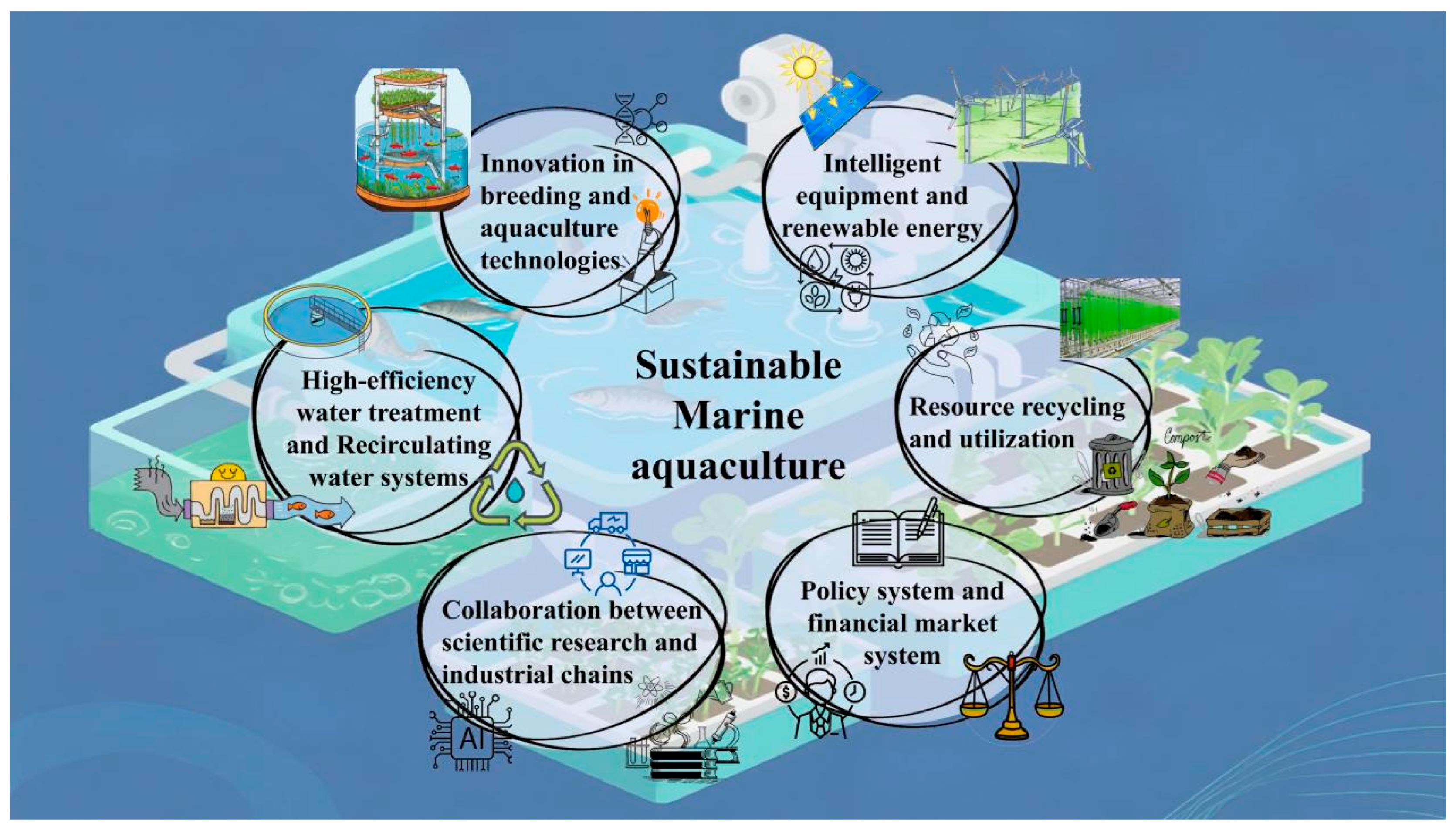
Ultimately, by establishing a synergistic promotion framework centered on “technological iteration, economic viability, and policy empowerment,” mariculture tail water treatment technologies are expected to overcome current bottlenecks and transition from experimental research to full-scale industrial application. This progression will ultimately drive the mariculture industry toward the unification of environmental and economic benefits, with the key pillars of sustainable mariculture illustrated in Figure 6.
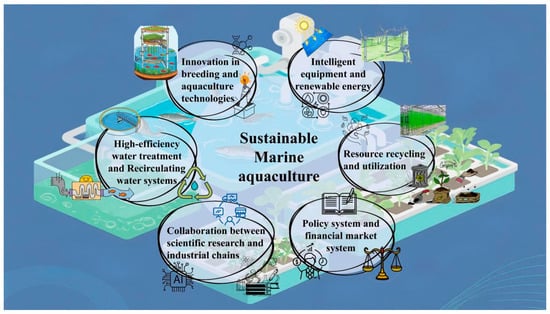
Figure 6.
A pillar for achieving sustainable marine aquaculture.
6. Conclusions
In recent years, land-based marine aquaculture has developed rapidly due to its abundant resources, and its output has exceeded that of traditional fisheries to meet the increasing demand for high-quality fish protein. However, land-based marine aquaculture poses a threat to the marine environment due to the generation of wastewater and the excessive use of resources. This article introduces various technologies for treating marine aquaculture wastewater at home and abroad, and summarizes the latest research achievements, advantages and disadvantages of each technology. It is found that the current research on marine aquaculture tail water treatment technology in China focuses on improving the decontamination efficiency of a single method, and most of it remains at the laboratory stage or the small-scale trial stage. Limiting factors such as energy demand, cost and scale have a significant impact on the expected treatment effect of actual tail water. For the more sustainable and circular development of land-based marine aquaculture, China needs to conduct targeted research on comprehensive treatment technologies that are suitable for the characteristics of marine aquaculture tail water, with a focus on resource recovery (such as water reuse and nutrient recycling). The ultimate goals are to optimize and develop safer, more energy-efficient and more efficient technical methods, and to ensure a sustainable marine aquaculture industry that operates within a circular economy framework.
Author Contributions
All authors contributed to the conception and writing of the review. Both S.D. and W.P. participated in the collection, analysis of relevant literature and the writing of the first draft of the manuscript. All authors have read and agreed to the published version of the manuscript.
Funding
This research received no external funding.
Institutional Review Board Statement
Not applicable.
Informed Consent Statement
Not applicable.
Data Availability Statement
No new data were created or analyzed in this study.
Acknowledgments
We are grateful to the postgraduate students and professors from Fuzhou University.
Conflicts of Interest
The authors declare no conflicts of interest.
References
- FAO. World Food and Agriculture—Statistical Yearbook 2024; FAO: Rome, Italy, 2024; pp. 1–76. [Google Scholar]
- FAO. The State of World Fisheries and Aquaculture 2024—Blue Transformation in Action; FAO: Rome, Italy, 2024; pp. 1–82. [Google Scholar]
- Ji, J.; Sun, Y.; Xu, L.; Xu, Y. Research on the influencing factors and configuration path of environmental technological progress bias in China’s mariculture industry. Aquac. Int. 2025, 33, 357. [Google Scholar] [CrossRef]
- Qiao, S.; Yin, W.; Liu, Y.; Li, D. The evolution of food and nutrition supply patterns of marine capture and mariculture in China and its transformation coping strategies. Front. Mar. Sci. 2024, 11, 1478631. [Google Scholar] [CrossRef]
- Mohiuddin, A.K. Nutritional Value and Associated Potentials Risks of Seafood Consumption. Biomed. J. Sci. Tech. Res. 2019, 19, 14456–14459. [Google Scholar] [CrossRef]
- Liu, Y.; Wang, Z.; Yang, X.; Wang, S.; Liu, X.; Liu, B.; Zhang, J.; Meng, D.; Ding, K.; Gao, K.; et al. Changes in the spatial distribution of mariculture in China over the past 20 years. J. Geogr. Sci. 2023, 33, 2377–2399. [Google Scholar] [CrossRef]
- Liu, Y.; Yang, X.; Wang, Z.; Liu, B.; Zhang, J.; Liu, X.; Meng, D.; Gao, K.; Zeng, X.; Yu, G.; et al. Mapping the fine spatial distribution of global offshore surface seawater mariculture using remote sensing big data. Int. J. Digit. Earth 2024, 17, 1. [Google Scholar] [CrossRef]
- Clawson, G.; Kuempel, C.D.; Frazier, M.; Blasco, G.; Cottrell, R.S.; Froehlich, H.E.; Metian, M.; Nash, K.L.; Többen, J.; Verstaen, J.; et al. Mapping the spatial distribution of global mariculture production. Aquaculture 2022, 553, 738066. [Google Scholar] [CrossRef]
- Ministry of Ecology and Environment. Bulletin on the State of Marine Ecological Environment in China in 2022. Environ. Prot. 2023, 51, 70–82. [Google Scholar] [CrossRef]
- Bambaranda, B.V.A.S.M.; Tsusaka, T.W.; Chirapart, A.; Salin, K.R.; Sasaki, N. Capacity of Caulerpa lentillifera in the Removal of Fish Culture Effluent in a Recirculating Aquaculture System. Processes 2019, 7, 440. [Google Scholar] [CrossRef]
- Bannister, R.J.; Johnsen, I.A.; Hansen, P.K.; Kutti, T.; Asplin, L. Near- and far-field dispersal modelling of organic waste from Atlantic salmon aquaculture in fjord systems. ICES J. Mar. Sci. 2016, 73, 2408–2419. [Google Scholar] [CrossRef]
- Wu, L.; Ren, L.; Li, J.; Li, X.; Yang, S.; Song, Y.; Li, X. Novel maricultural-solid-waste derived biochar for removing eutrophic nutrients and enrofloxacin: Property, mechanism, and application assessment. J. Hazard. Mater. 2022, 427, 128147. [Google Scholar] [CrossRef]
- Liu, F.; Lu, T.; Zhang, Y. Performance assessment of constructed wetland-microbial fuel cell for treatment of mariculture wastewater containing heavy metals. Process Saf. Environ. Prot. 2022, 168, 633–641. [Google Scholar] [CrossRef]
- Liu, X.; Steele, J.C.; Meng, X.-Z. Usage, residue, and human health risk of antibiotics in Chinese aquaculture: A review. Environ. Pollut. 2017, 223, 161–169. [Google Scholar] [CrossRef] [PubMed]
- Zhang, C.; Hasunuma, T.; Shiung Lam, S.; Kondo, A.; Ho, S.-H. Salinity-induced microalgal-based mariculture wastewater treatment combined with biodiesel production. Bioresour. Technol. 2021, 340, 125638. [Google Scholar] [CrossRef]
- Lang, Z.; Zhou, M.; Zhang, Q.; Yin, X.; Li, Y. Comprehensive treatment of marine aquaculture wastewater by a cost-effective flow-through electro-oxidation process. Sci. Total Environ. 2020, 722, 137812. [Google Scholar] [CrossRef] [PubMed]
- Xu, J.; Han, L.; Yin, W. Research on the ecologicalization efficiency of mariculture industry in China and its influencing factors. Mar. Policy 2022, 137, 104935. [Google Scholar] [CrossRef]
- Li, N.; Hu, C.; Wang, K.; Du, J.; He, J.; Wu, J. Research Progress on Prevention and Control Technology of Mariculture Wastewater: A Review. Fish. Sci. 2023, 42, 911–920. [Google Scholar] [CrossRef]
- Wang, L.; Zhang, Z.; Wang, W.; Wang, D.; Sun, L. The treatment effects of “Three ponds and two dams” on the wastewater from Litopenaeus vannamei industrialized mariculture. Mar. Environ. Sci. 2023, 42, 720–728. [Google Scholar] [CrossRef]
- Tan, L.; Liu, Y.; Ren, J.S.; Zhang, J. The sources and burial fluxes of sedimentary organic carbon from the intensive mariculture zone in Haizhou Bay, China. Mar. Pollut. Bull. 2025, 218, 118168. [Google Scholar] [CrossRef]
- Wang, Y.; Guo, X.; Wang, G.; Wang, L.; Huang, T.; Li, Y.; Wang, Z.; Dai, M. Assessment of nutrient cycling in an intensive mariculture system. Mar. Pollut. Bull. 2024, 209, 117085. [Google Scholar] [CrossRef]
- He, Q.; Zhang, D.; Main, K.; Feng, C.; Ergas, S.J. Biological denitrification in marine aquaculture systems: A multiple electron donor microcosm study. Bioresour. Technol. 2018, 263, 340–349. [Google Scholar] [CrossRef]
- Wang, Q.; Liu, H.; Sui, J. Mariculture: Developments, Present Status and Prospects. In Aquaculture in China; Wiley Blackwell: Hoboken, NJ, USA, 2018; pp. 38–54. [Google Scholar]
- Castilla-Gavilán, M.; Guerra-García, J.M.; Hachero-Cruzado, I.; Herrera, M. Understanding Carbon Footprint in Sustainable Land-Based Marine Aquaculture: Exploring Production Techniques. J. Mar. Sci. Eng. 2024, 12, 1192. [Google Scholar] [CrossRef]
- Liu, Y.; Wang, Z.; Yang, X.; Wang, S.; Liu, X.; Liu, B.; Zhang, J.; Meng, D.; Ding, K.; Gao, K.; et al. Changes in mariculture and offshore seawater quality in China during the past 20 years. Ecol. Indic. 2023, 157, 111220. [Google Scholar] [CrossRef]
- Liu, X.; Shao, Z.; Cheng, G.; Lu, S.; Gu, Z.; Zhu, H.; Shen, H.; Wang, J.; Chen, X. Ecological engineering in pond aquaculture: A review from the whole-process perspective in China. Rev. Aquac. 2021, 13, 1060–1076. [Google Scholar] [CrossRef]
- Xu, L.; Yang, Y.; Cui, Z.; Wang, Q. Carbon dynamics in seawater and sediment: A case study of shellfish and seaweed mariculture systems. Mar. Environ. Res. 2025, 204, 106897. [Google Scholar] [CrossRef]
- Huang, J.; Wang, D.; Gong, F.; Bai, Y.; He, X. Changes in Nutrient Concentrations in Shenzhen Bay Detected Using Landsat Imagery between 1988 and 2020. Remote Sens. 2021, 13, 3469. [Google Scholar] [CrossRef]
- Anh, P.T.; Kroeze, C.; Bush, S.R.; Mol, A.P.J. Water pollution by intensive brackish shrimp farming in south-east Vietnam: Causes and options for control. Agric. Water Manag. 2010, 97, 872–882. [Google Scholar] [CrossRef]
- Zhao, Z.; Wei, Y.; Wang, Y.; Peng, G.; Zeng, E.Y.; Yu, K.; Xu, X.-R.; Li, R. Fate and drivers of mariculture-derived microplastics from ponds to mangrove forests. Environ. Pollut. 2024, 361, 124790. [Google Scholar] [CrossRef]
- Liu, M.; Lian, Q.; Zhao, Y.; Ni, M.; Lou, J.; Yuan, J. Treatment effects of pond aquaculture wastewater using a Field-scale Combined Ecological Treatment System and the associated microbial characteristics. Aquaculture 2023, 563, 739018. [Google Scholar] [CrossRef]
- Xiong, Y.; Gao, L.; Qu, L.; Xu, J.; Ma, Z.; Gao, G. The contribution of fish and seaweed mariculture to the coastal fluxes of biogenic elements in two important aquaculture areas, China. Sci. Total Environ. 2023, 856, 159056. [Google Scholar] [CrossRef]
- Du, J.; Yan, Z.; Hu, C.; Wang, K.; Liu, G.; Jiang, B.; Song, L.; Xie, H. Occurrence, distribution and risk assessment of antibiotics and pesticides in mariculture area around Liaodong Peninsula. Mar. Pollut. Bull. 2024, 205, 116588. [Google Scholar] [CrossRef]
- Dong, S.; Liu, D.; Zhu, B.; Zhang, D.; Wang, F. Practice assessment of integrated marine pond aquaculture for increasing benefits and reducing environmental pollution using an ecosystem modeling approach. Sci. Total Environ. 2024, 908, 168408. [Google Scholar] [CrossRef]
- Price, C.; Black, K.D.; Hargrave, B.T.; Morris, J.A. Marine cage culture and the environment: Effects on water quality and primary production. Aquac. Environ. Interact. 2015, 6, 151–174. [Google Scholar] [CrossRef]
- Bouwman, L.; Beusen, A.; Glibert, P.M.; Overbeek, C.; Pawlowski, M.; Herrera, J.; Mulsow, S.; Yu, R.; Zhou, M. Mariculture: Significant and expanding cause of coastal nutrient enrichment. Environ. Res. Lett. 2013, 8, 044026. [Google Scholar] [CrossRef]
- Herbeck, L.S.; Krumme, U.; Nordhaus, I.; Jennerjahn, T.C. Pond aquaculture effluents feed an anthropogenic nitrogen loop in a SE Asian estuary. Sci. Total Environ. 2021, 756, 144083. [Google Scholar] [CrossRef]
- Yu, J.; Wu, S.; Zhang, Y.; Xiao, Y. Fuzzy comprehensive evaluation of seawater quality of Larimichthys Crocea mariculture areas in Zhoushan, China. Mar. Freshw. Res. 2024, 75, MF23151. [Google Scholar] [CrossRef]
- Duan, N.; Yu, X.; Jiang, Z.; Chen, H.; Feng, H.; Kang, Y.; Ma, H.; Zhu, H. Impacts of an intensive traditional mariculture model on offshore environments as evidenced by dissolved organic matter and bacterial communities. Water Res. 2024, 267, 122530. [Google Scholar] [CrossRef]
- Yin, P.; Wang, D.; Zhang, X.; Zhang, G.; Zhao, H.; Zhang, Y.; Yang, H. Effects of KMPS on eutrophic sediment-water interface in pond aquaculture: Based on physicochemical properties, DOM characteristics and microbial community structure. Aquaculture 2026, 612, 743089. [Google Scholar] [CrossRef]
- Bennett, N.J.; Blythe, J.; White, C.S.; Campero, C. Blue growth and blue justice: Ten risks and solutions for the ocean economy. Mar. Policy 2021, 125, 104387. [Google Scholar] [CrossRef]
- Qin, Y.-Y.; Liang, M.-Z.; Liang, S.-C.; Zheng, H.-L. Effect of Shrimp Aquaculture Effluent on Mangrove Sediment in Beibu Bay. Pol. J. Environ. Stud. 2021, 31, 795–802. [Google Scholar] [CrossRef]
- Hu, K.; Huang, Q.; Han, P.; Han, Z.; Yang, Z.; Luo, Q.; Li, P.; Miao, M.; Zeng, Z.; Chen, H.; et al. A Hydrochemical Study of Groundwater Salinization in Qinzhou Bay, Guangxi, Southern China. Earth Space Sci. 2023, 10, e2022EA002565. [Google Scholar] [CrossRef]
- Lu, S.; Wang, Q.; Gao, M.; Zhao, C.; She, Z.; Zhao, Y.; Jin, C.; Guo, L. Effect of aerobic/anoxic duration on the performance, microbial activity and microbial community of sequencing batch biofilm reactor treating synthetic mariculture wastewater. Bioresour. Technol. 2021, 333, 125198. [Google Scholar] [CrossRef]
- Zheng, L.; Liu, Q.; Liu, J.; Xiao, J.; Xu, G. Pollution Control of Industrial Mariculture Wastewater: A Mini-Review. Water 2022, 14, 1390. [Google Scholar] [CrossRef]
- Mook, W.T.; Chakrabarti, M.H.; Aroua, M.K.; Khan, G.M.A.; Ali, B.S.; Islam, M.S.; Abu Hassan, M.A. Removal of total ammonia nitrogen (TAN), nitrate and total organic carbon (TOC) from aquaculture wastewater using electrochemical technology: A review. Desalination 2012, 285, 1–13. [Google Scholar] [CrossRef]
- Zhao, W.; Wang, Y.; Su, S.; Qiu, H.; Wang, K.; Zhang, Y. Research Advances in Mechanism and Process of NH4+-N Removal from Mariculture Tail Water. Technol. Water Treat. 2024, 50, 1–5. [Google Scholar] [CrossRef]
- Lasaki, B.A.; Maurer, P.; Schönberger, H. Uncovering the reasons behind high-performing primary sedimentation tanks for municipal wastewater treatment: An in-depth analysis of key factors. J. Environ. Chem. Eng. 2024, 12, 112460. [Google Scholar] [CrossRef]
- Kang, P.; Liu, P.; Wang, F. Use of multiple isotopes to evaluate the impact of mariculture on nutrient dynamics in coastal groundwater. Environ. Sci. Pollut. Res. 2019, 26, 12399–12411. [Google Scholar] [CrossRef]
- Wang, C.; Yuan, Z.; Yuan, Y.; Li, X.; Yu, B.; Ying, L. Research progress of biological treatment technology of mariculture wastewater and thoughts on carbon reduction: A review. J. Dalian Ocean Univ. 2022, 37, 1055–1065. [Google Scholar] [CrossRef]
- Ye, M.; Tong, J. Development trend and prospect of tail water treatment technology of shrimp mariculture. J. Huazhong Agric. Univ. 2021, 40, 241–252. [Google Scholar] [CrossRef]
- Nora’aini, A.; Wahab Mohammad, A.; Jusoh, A.; Hasan, M.R.; Ghazali, N.; Kamaruzaman, K. Treatment of aquaculture wastewater using ultra-low pressure asymmetric polyethersulfone (PES) membrane. Desalination 2005, 185, 317–326. [Google Scholar] [CrossRef]
- Zhang, Y.; Wei, M.; Huang, K.; Yu, K.; Liang, J.; Wei, F.; Huang, J.; Yin, X. Inactivation of E. coli and Streptococcus agalactiae by UV/persulfate during marine aquaculture disinfection. Environ. Sci. Pollut. Res. 2022, 29, 45421–45434. [Google Scholar] [CrossRef]
- Kuang, B.; Zhou, L.; Cai, C. Mariculture wastewater treatment using electroactive bacteria-algae biofilm coupled with siphon aeration. Trans. Chin. Soc. Agric. Eng. 2023, 39, 205–212. [Google Scholar] [CrossRef]
- Zhang, J.; Liu, H.; Yao, J.; Cao, S.; Liu, X.; Cheng, G.; Hu, Q.; Wang, F.; Zhang, Z. Hydrodynamic characteristics analysis of series hydraulic cyclone separators for pond aquaculture wastewater purification. Aquac. Eng. 2024, 106, 102436. [Google Scholar] [CrossRef]
- Xu, J.; Du, Y.; Qiu, T.; Zhou, L.; Li, Y.; Chen, F.; Sun, J. Application of hybrid electrocoagulation–filtration methods in the pretreatment of marine aquaculture wastewater. Water Sci. Technol. 2021, 83, 1315–1326. [Google Scholar] [CrossRef] [PubMed]
- Zeng, D.; Lin, F.; Wu, G.; Hu, L.; Shen, K.; Zhou, C.; Xu, Z. Mariculture Wastewater Treatment by Integrated Process of Hybridmesh, Continuous Flow Sand Filter, and Activated Carbon Adsorption. China Water Wastewater 2019, 35, 97–102. [Google Scholar] [CrossRef]
- Huang, B.; Zhou, N.; Yi, P.; Fan, X. Application of Continuous Uf Technique in Water Treatment for Marine Culture. Technol. Water Treat. 2006, 03, 43–45. [Google Scholar] [CrossRef]
- De Jesus Gregersen, K.J.; Pedersen, P.B.; Pedersen, L.-F.; Liu, D.; Dalsgaard, J. UV irradiation and micro filtration effects on micro particle development and microbial water quality in recirculation aquaculture systems. Aquaculture 2020, 518, 734785. [Google Scholar] [CrossRef]
- Zhang, Y.; Zhao, Y.-G.; Hu, Y.; Gao, M.; Guo, L.; Ji, J. Insight in degradation of tetracycline in mariculture wastewater by ultraviolet/persulfate advanced oxidation process. Environ. Res. 2022, 212, 113324. [Google Scholar] [CrossRef]
- Tang, Y.; Wang, T.; Hu, Y.; Wang, X.; Wang, Y.; Zhang, H.; Gao, X.; Li, P. Study of an electrochemical system with dual cathodes for the treatment of mariculture wastewater. Chem. Eng. J. 2024, 498, 155064. [Google Scholar] [CrossRef]
- Sun, J.; Liu, L.; Yang, F. Successful bio-electrochemical treatment of nitrogenous mariculture wastewater by enhancing nitrogen removal via synergy of algae and cathodic photo-electro-catalysis. Sci. Total Environ. 2020, 743, 140738. [Google Scholar] [CrossRef]
- Quan, F.; Zhan, G.; Zhou, B.; Ling, C.; Wang, X.; Shen, W.; Li, J.; Jia, F.; Zhang, L. Electrochemical removal of ammonium nitrogen in high efficiency and N2 selectivity using non-noble single-atomic iron catalyst. J. Environ. Sci. 2023, 125, 544–552. [Google Scholar] [CrossRef]
- Zhou, Y.; Wang, H.; Liu, X.; Zeng, D.; Wang, K.; Zhang, L.; Wang, W. An efficient strategy for selective oxidation of ammonia nitrogen into N2 over BiOCl photocatalyst. Appl. Catal. B Environ. 2021, 294, 120265. [Google Scholar] [CrossRef]
- Chi, Y.; Xu, S.; Li, M.; He, M.; Yu, H.; Li, L.; Yue, Q.; Gao, B. Effective blockage of chloride ion quenching and chlorinated by-product generation in photocatalytic wastewater treatment. J. Hazard. Mater. 2020, 396, 122670. [Google Scholar] [CrossRef] [PubMed]
- Velusamy, K.; Periyasamy, S.; Kumar, P.S.; Vo, D.-V.N.; Sindhu, J.; Sneka, D.; Subhashini, B. Advanced techniques to remove phosphates and nitrates from waters: A review. Environ. Chem. Lett. 2021, 19, 3165–3180. [Google Scholar] [CrossRef]
- Mavhungu, A.; Masindi, V.; Foteinis, S.; Mbaya, R.; Tekere, M.; Kortidis, I.; Chatzisymeon, E. Advocating circular economy in wastewater treatment: Struvite formation and drinking water reclamation from real municipal effluents. J. Environ. Chem. Eng. 2020, 8, 103957. [Google Scholar] [CrossRef]
- Bonisławska, M.; Nędzarek, A.; Rybczyk, A. Assessment of the use of precipitating agents and ceramic membranes for treatment of effluents with high concentrations of nitrogen and phosphorus from recirculating aquaculture systems. Aquac. Res. 2019, 50, 1248–1256. [Google Scholar] [CrossRef]
- Ahmad, A.; Abdullah, S.R.S.; Hasan, H.A.; Othman, A.R.; Kurniawan, S.B. Aquaculture wastewater treatment using plant-based coagulants: Evaluating removal efficiency through the coagulation-flocculation process. Results Chem. 2024, 7, 101390. [Google Scholar] [CrossRef]
- Liao, H.; Wang, W.; Cheng, X.; Chen, S.; Liu, F.; Liu, G. Efficient degradation of inorganic nitrogen in mariculture wastewater by electrochemical methods. J. Hazard. Mater. Adv. 2022, 6, 100093. [Google Scholar] [CrossRef]
- Zhao, L.; Hu, Y.; Zhao, Y.-G.; Mupindu, P. Removal of typical sulfonamide resistance genes by ultraviolet/hydrogen peroxide advanced oxidation process in mariculture wastewater. J. Water Process Eng. 2023, 55, 104262. [Google Scholar] [CrossRef]
- Zhang, X.; Hu, J.; Spanjers, H.; van Lier, J.B. Struvite crystallization under a marine/brackish aquaculture condition. Bioresour. Technol. 2016, 218, 1151–1156. [Google Scholar] [CrossRef]
- Alnawajha, M.M.; Kurniawan, S.B.; Imron, M.F.; Abdullah, S.R.S.; Hasan, H.A.; Othman, A.R. Plant-based coagulants/flocculants: Characteristics, mechanisms, and possible utilization in treating aquaculture effluent and benefiting from the recovered nutrients. Environ. Sci. Pollut. Res. 2022, 29, 58430–58453. [Google Scholar] [CrossRef]
- Zhang, X.; Hu, J.; Spanjers, H.; van Lier, J.B. Performance of inorganic coagulants in treatment of backwash waters from a brackish aquaculture recirculation system and digestibility of salty sludge. Aquac. Eng. 2014, 61, 9–16. [Google Scholar] [CrossRef]
- Yakamercan, E.; Turco, R.F.; Nas, B.; Hussain, A.S.; Aygun, A.; Meador, L.; Simsek, H. Optimizing electrochemical methods for fish wastewater treatment in recirculating aquaculture systems. J. Water Process Eng. 2024, 66, 105891. [Google Scholar] [CrossRef]
- Romano, A.; Ortiz, I.; Urtiaga, A.M. Comprehensive kinetics of electrochemically assisted ammonia removal in marine aquaculture recirculating systems. J. Electroanal. Chem. 2021, 897, 115619. [Google Scholar] [CrossRef]
- Fujihira, M.; Satoh, Y.; Osa, T. Heterogeneous photocatalytic oxidation of aromatic compounds on TiO2. Nature 1981, 293, 206–208. [Google Scholar] [CrossRef]
- Wang, J.; Bai, Z. Fe-based catalysts for heterogeneous catalytic ozonation of emerging contaminants in water and wastewater. Chem. Eng. J. 2017, 312, 79–98. [Google Scholar] [CrossRef]
- Xiao, R.; Liu, K.; Bai, L.; Minakata, D.; Seo, Y.; Kaya Göktaş, R.; Dionysiou, D.D.; Tang, C.-J.; Wei, Z.; Spinney, R. Inactivation of pathogenic microorganisms by sulfate radical: Present and future. Chem. Eng. J. 2019, 371, 222–232. [Google Scholar] [CrossRef]
- Chen, Y.; Duan, X.; Zhou, X.; Wang, R.; Wang, S.; Ren, N.; Ho, S.-H. Advanced oxidation processes for water disinfection: Features, mechanisms and prospects. Chem. Eng. J. 2021, 409, 128207. [Google Scholar] [CrossRef]
- Kanakaraju, D.; Glass, B.D.; Oelgemöller, M. Advanced oxidation process-mediated removal of pharmaceuticals from water: A review. J. Environ. Manag. 2018, 219, 189–207. [Google Scholar] [CrossRef]
- Ong, J.H.; Huang, S.; Hu, X.; Xu, R. Struvite precipitation for low-level ammonium removal in mariculture wastewater: Feasibility study. Bioresour. Technol. 2025, 424, 132270. [Google Scholar] [CrossRef]
- Schleyken, J.; Gumpert, F.; Tränckner, S.; Palm, H.W.; Tränckner, J. Enhanced chemical recovery of phosphorus from residues of recirculating aquaculture systems (RAS). Int. J. Environ. Sci. Technol. 2023, 21, 3775–3788. [Google Scholar] [CrossRef]
- Letelier-Gordo, C.O.; Fernandes, P.M. Coagulation of phosphorous and organic matter from marine, land-based recirculating aquaculture system effluents. Aquac. Eng. 2021, 92, 102144. [Google Scholar] [CrossRef]
- Li, S.; Meng, D.; Zhang, G.; Yang, F. Periodic polarity reversal triggered sequential electrochemical redox of blue TiO2 nanotube arrays for efficient removal of antibiotics and inorganic nitrogen from actual mariculture wastewater. Chem. Eng. J. 2024, 499, 156651. [Google Scholar] [CrossRef]
- Wei, Y.; Sun, Z.; Song, X.; Sun, G.; Li, M. Mariculture wastewater treatment using electrochemically assisted submerged fixed bed bioreactor (E-SFBBR): Potential performance and pathways of nitrogen removal. J. Water Process Eng. 2021, 40, 101904. [Google Scholar] [CrossRef]
- Xue, W.; Zhang, C.; Zhou, D. Positive and negative effects of recirculating aquaculture water advanced oxidation: O3 and O3/UV treatments improved water quality but increased antibiotic resistance genes. Water Res. 2023, 235, 119835. [Google Scholar] [CrossRef]
- Huang, Y.; Zhang, S.; Chen, L.; Kou, X.; Hou, Y.; Wu, Z.; Wu, J.; Li, S.; Zou, J. Removal of ammonia nitrogen in maricultural wastewater with Cl−/peroxymonosulfate process: Performances and mechanism. J. Environ. Chem. Eng. 2025, 13, 115549. [Google Scholar] [CrossRef]
- Zhang, Y.; Zhao, M.; Huang, Y.; Hu, Y.-L.; Wang, L. Efficient chlorination reaction of Pt/RuO2/g-C3N4 under visible light irradiation for simultaneous removal of ammonia and bacteria from mariculture wastewater. J. Environ. Sci. 2025, 150, 490–502. [Google Scholar] [CrossRef]
- You, X.; Zhang, Z.; Guo, L.; Liao, Q.; Wang, Y.; Zhao, Y.; Jin, C.; Gao, M.; She, Z.; Wang, G. Integrating acidogenic fermentation and microalgae cultivation of bacterial-algal coupling system for mariculture wastewater treatment. Bioresour. Technol. 2021, 320, 124335. [Google Scholar] [CrossRef]
- Dildar, T.; Cui, W.; Ikhwanuddin, M.; Ma, H. Aquatic Organisms in Response to Salinity Stress: Ecological Impacts, Adaptive Mechanisms, and Resilience Strategies. Biology 2025, 14, 667. [Google Scholar] [CrossRef]
- Neoh, C.H.; Noor, Z.Z.; Mutamim, N.S.A.; Lim, C.K. Green technology in wastewater treatment technologies: Integration of membrane bioreactor with various wastewater treatment systems. Chem. Eng. J. 2016, 283, 582–594. [Google Scholar] [CrossRef]
- Shahid, A.; Malik, S.; Zhu, H.; Xu, J.; Nawaz, M.Z.; Nawaz, S.; Asraful Alam, M.; Mehmood, M.A. Cultivating microalgae in wastewater for biomass production, pollutant removal, and atmospheric carbon mitigation; a review. Sci. Total Environ. 2020, 704, 135303. [Google Scholar] [CrossRef]
- Wu, H.; Zhang, J.; Ngo, H.H.; Guo, W.; Hu, Z.; Liang, S.; Fan, J.; Liu, H. A review on the sustainability of constructed wetlands for wastewater treatment: Design and operation. Bioresour. Technol. 2015, 175, 594–601. [Google Scholar] [CrossRef]
- Duan, J.; Fang, H.; Su, B.; Chen, J.; Lin, J. Characterization of a halophilic heterotrophic nitrification–aerobic denitrification bacterium and its application on treatment of saline wastewater. Bioresour. Technol. 2015, 179, 421–428. [Google Scholar] [CrossRef]
- Pinheiro, I.; Carneiro, R.F.S.; Vieira, F.d.N.; Gonzaga, L.V.; Fett, R.; Costa, A.C.d.O.; Magallón-Barajas, F.J.; Seiffert, W.Q. Aquaponic production of Sarcocornia ambigua and Pacific white shrimp in biofloc system at different salinities. Aquaculture 2020, 519, 734918. [Google Scholar] [CrossRef]
- Jang, D.; Hwang, Y.; Shin, H.; Lee, W. Effects of salinity on the characteristics of biomass and membrane fouling in membrane bioreactors. Bioresour. Technol. 2013, 141, 50–56. [Google Scholar] [CrossRef] [PubMed]
- Ma, Y.; Zhang, C.; Wang, D.; Cheng, K.; Lu, Y.; Dai, C.; Guo, J. Co-activation of peroxymonosulfate activation with sunlight and tailored catalytic MnFe2O4/MWCNTs membrane to mitigate membrane fouling caused by NOM and synergistic oxidation mechanism analysis. J. Membr. Sci. 2024, 707, 123030. [Google Scholar] [CrossRef]
- Liu, Y.; Zhu, J.; Li, W.; Xie, B.; Zhang, G.; Ding, Y.; Liu, F.; Tan, H.; Jia, Y.; You, H.; et al. Mechanism of membrane fouling mitigation by microalgae biofilm formation for low C/N mariculture wastewater treatment: EPS characteristics, composition and interfacial interaction energy. J. Environ. Chem. Eng. 2024, 12, 114146. [Google Scholar] [CrossRef]
- Böpple, H.; Kymmell, N.L.E.; Slegers, P.M.; Breuhaus, P.; Kleinegris, D.M.M. Water treatment of recirculating aquaculture system (RAS) effluent water through microalgal biofilms. Algal Res. 2024, 84, 103798. [Google Scholar] [CrossRef]
- Zhao, J.; Peng, L.; Ma, X. Innovative microalgae technologies for mariculture wastewater treatment: Single and combined microalgae treatment mechanisms, challenges and future prospects. Environ. Res. 2025, 266, 120560. [Google Scholar] [CrossRef]
- Liu, Y.; Zhang, G.; Li, W.; Ding, Y.; You, H.; Zhu, J.; Leng, H.; Xu, C.; Xing, X.; Xu, J.; et al. The characteristic evolution and formation mechanism of hybrid microalgae biofilm and its application in mariculture wastewater treatment. J. Environ. Chem. Eng. 2023, 11, 109645. [Google Scholar] [CrossRef]
- Han, P.; Lu, Q.; Fan, L.; Zhou, W. A Review on the Use of Microalgae for Sustainable Aquaculture. Appl. Sci. 2019, 9, 2377. [Google Scholar] [CrossRef]
- Zhang, Q.; Li, N.; Wang, B.-L.; Zhang, T.; Ma, P.-F.; Zhang, W.-X.; Nusrat Zahan, S.; Ma, Z.; Zhang, Y.-Q.; Ying, L. Capabilities and mechanisms of microalgae on nutrients and florfenicol removing from marine aquaculture wastewater. J. Environ. Manag. 2022, 320, 115673. [Google Scholar] [CrossRef]
- Vymazal, J.; Zhao, Y.; Mander, Ü. Recent research challenges in constructed wetlands for wastewater treatment: A review. Ecol. Eng. 2021, 169, 106318. [Google Scholar] [CrossRef]
- Li, M.; Liang, Z.; Callier, M.D.; Roque d’orbcastel, E.; Sun, G.; Ma, X.; Li, X.; Wang, S.; Liu, Y.; Song, X. Nutrients removal and substrate enzyme activities in vertical subsurface flow constructed wetlands for mariculture wastewater treatment: Effects of ammonia nitrogen loading rates and salinity levels. Mar. Pollut. Bull. 2018, 131, 142–150. [Google Scholar] [CrossRef]
- Fu, G.; Zhao, L.; Huangshen, L.; Wu, J. Isolation and identification of a salt-tolerant aerobic denitrifying bacterial strain and its application to saline wastewater treatment in constructed wetlands. Bioresour. Technol. 2019, 290, 121725. [Google Scholar] [CrossRef]
- Ning, M.; Li, X.; Lu, Z.; Yang, Y.; Liu, W. Heterotrophic nitrification-aerobic denitrification (HNAD) in marine aquaculture wastewater treatment: Nitrogen removal performance, mechanism and microbial community characteristics. J. Water Process Eng. 2025, 70, 107006. [Google Scholar] [CrossRef]
- Di Capua, F.; Pirozzi, F.; Lens, P.N.L.; Esposito, G. Electron donors for autotrophic denitrification. Chem. Eng. J. 2019, 362, 922–937. [Google Scholar] [CrossRef]
- Liu, X.; Yu, J.; Wang, H.; Jin, C.; Zhao, Y.; Guo, L. Effect of magnetic powder (Fe3O4) on heterotrophic-sulfur autotrophic denitrification efficiency and electron transport system activity for marine recirculating aquacultural wastewater treatment. J. Environ. Manag. 2024, 370, 122749. [Google Scholar] [CrossRef]
- Beyer, C.P.; Gómez, S.; Lara, G.; Monsalve, J.P.; Orellana, J.; Hurtado, C.F. Sarcocornia neei: A novel halophyte species for bioremediation of marine aquaculture wastewater and production diversification in integrated systems. Aquaculture 2021, 543, 736971. [Google Scholar] [CrossRef]
- Doncato, K.B.; Costa, C.S.B. Growth and Mineral Composition of Two Lineages of The Sea Asparagus Sarcocornia Ambigua Irrigated With Shrimp Farm Saline Effluent. Exp. Agric. 2018, 54, 399–416. [Google Scholar] [CrossRef]
- Fan, X.-Y.; Zhou, S.-L.; Yang, Y.; Cao, S.-B.; Niu, Y.; Zheng, M.-Y.; Zhao, J.-R. Impact of carbon/nitrogen ratio on sequencing batch biofilm reactors initiated with different seed sludges for treating actual mariculture effluents. Bioresour. Technol. 2025, 417, 131838. [Google Scholar] [CrossRef] [PubMed]
- Ma, X.; Yin, R.; Yang, C.; Cai, C.; Zhao, J.; Lv, C.; Wang, X.; Chen, S.; Ren, J.; Zhang, B. Application of a biofilm-enhanced A2O system in the treatment of wastewater from mariculture. Front. Mar. Sci. 2024, 11, 1408774. [Google Scholar] [CrossRef]
- Zhang, H.; Zhou, C.; Shangguan, M.; Peng, Z.; An, Z. Simultaneous removal of organic pollutants and nutrients from mariculture wastewater using a rotating algal biofilm system. J. Water Process Eng. 2024, 57, 104598. [Google Scholar] [CrossRef]
- Ding, W.; Zhou, X.; He, M.; Jin, W.; Chen, Y.; Sun, J. Pollutant removal and resource recovery of co-cultivated microalgae Chlorella sp. and Phaeodactylum tricornutum for marine aquaculture wastewater. J. Water Process Eng. 2024, 67, 106182. [Google Scholar] [CrossRef]
- Zhao, L.; Tang, J.; Xu, Y.; Zhang, Y.; Song, Z.; Fu, G.; Hu, Z. A vertical-flow constructed wetland–microalgal membrane photobioreactor integrated system for treating high-pollution-load marine aquaculture wastewater: A lab-scale study. Sci. Total Environ. 2024, 919, 170465. [Google Scholar] [CrossRef]
- Zhao, Z.; Liu, Y.; Dong, X.; Jiang, Q.; Wang, J.; Yang, X.; Chen, J.; Lei, Z. Unveiling the role of ferrous ion in driving microalgae granulation from salt–tolerant strains for mariculture wastewater treatment. Sci. Total Environ. 2024, 923, 171315. [Google Scholar] [CrossRef] [PubMed]
- Chen, J.; Gao, M.; Zhao, Y.; Guo, L.; Jin, C.; Ji, J.; She, Z. Nitrogen and sulfamethoxazole removal in a partially saturated vertical flow constructed wetland treating synthetic mariculture wastewater. Bioresour. Technol. 2022, 358, 127401. [Google Scholar] [CrossRef] [PubMed]
- Zhao, L.; Fu, G.; Pang, W.; Li, X.; Pan, C.; Hu, Z. A novel autotrophic denitrification and nitrification integrated constructed wetland process for marine aquaculture wastewater treatment. Chemosphere 2023, 321, 138157. [Google Scholar] [CrossRef]
- Ma, X.; Li, X.; Li, J.; Ren, J.; Chi, L.; Cheng, X. Iron-carbon could enhance nitrogen removal in Sesuvium portulacastrum constructed wetlands for treating mariculture effluents. Bioresour. Technol. 2021, 325, 124602. [Google Scholar] [CrossRef]
- Wang, L.; Liu, J.; Lin, X.; Liu, Z.; Cui, H.; Zhang, Y. Simultaneous removal of nitrogen and phosphorus from mariculture wastewater by mixotrophic-denitrification biofilm process based on pyrite and poly-3-hydroxybutyrate-co-hyroxyvelate. J. Water Process Eng. 2024, 68, 106414. [Google Scholar] [CrossRef]
- Liu, H.; Du, Y.; Chen, Y.; Huang, Z.; Ji, J.; Gao, M.; Zhao, Y.; Jin, C. Nitrogen removal via solid carbon source-driven heterotrophic nitrification and aerobic denitrification in marine aquaculture wastewater. J. Water Process Eng. 2025, 73, 107697. [Google Scholar] [CrossRef]
- Feng, Y.; Wang, L.; Yin, Z.; Cui, Z.; Qu, K.; Wang, D.; Wang, Z.; Zhu, S.; Cui, H. Comparative investigation on heterotrophic denitrification driven by different biodegradable polymers for nitrate removal in mariculture wastewater: Organic carbon release, denitrification performance, and microbial community. Front. Microbiol. 2023, 14, 1141362. [Google Scholar] [CrossRef] [PubMed]
- Jiang, S.; Huang, H.; Chen, Y.; Xiong, J.; Lin, Z.; Wang, S. Optimizing Nitrogen Removal Through Coupled Simultaneous Nitrification-Denitrification and Sulfur Autotrophic Denitrification: Microbial Community Dynamics and Functional Pathways in Mariculture Tailwater Treatment. Water 2025, 17, 683. [Google Scholar] [CrossRef]
- Xu, Y.; Zhang, Y.; Ji, J.; Xu, L.; Liang, Y. What drives the growth of China’s mariculture production? An empirical analysis of its coastal regions from 1983 to 2019. Environ. Sci. Pollut. Res. 2023, 30, 111397–111409. [Google Scholar] [CrossRef]
- Liang, Y.; Cheng, X.; Zhu, H.; Shutes, B.; Yan, B.; Zhou, Q.; Yu, X. Historical Evolution of Mariculture in China During Past 40 Years and Its Impacts on Eco-environment. Chin. Geogr. Sci. 2018, 28, 363–373. [Google Scholar] [CrossRef]
- Xu, C.; Feng, Y.; Li, H.; Li, Y.; Yao, Y.; Wang, J. Constructed wetlands for mariculture wastewater treatment: From systematic review to improvement measures and insights. Desalination 2024, 579, 117505. [Google Scholar] [CrossRef]
- Cooney, R.; de Sousa, D.B.; Fernández-Ríos, A.; Mellett, S.; Rowan, N.; Morse, A.P.; Hayes, M.; Laso, J.; Regueiro, L.; Wan, A.H.L.; et al. A circular economy framework for seafood waste valorisation to meet challenges and opportunities for intensive production and sustainability. J. Clean. Prod. 2023, 392, 136283. [Google Scholar] [CrossRef]
- Castine, S.A.; McKinnon, A.D.; Paul, N.A.; Trott, L.A.; de Nys, R. Wastewater treatment for land-based aquaculture: Improvements and value-adding alternatives in model systems from Australia. Aquac. Environ. Interact. 2013, 4, 285–300. [Google Scholar] [CrossRef]
- Lahav, O.; Ben Asher, R.; Gendel, Y. Potential applications of indirect electrochemical ammonia oxidation within the operation of freshwater and saline-water recirculating aquaculture systems. Aquac. Eng. 2015, 65, 55–64. [Google Scholar] [CrossRef]
- Bhatt, P.; Huang, J.-Y.; Brown, P.; Shivaram, K.B.; Yakamercan, E.; Simsek, H. Electrochemical treatment of aquaculture wastewater effluent and optimization of the parameters using response surface methodology. Environ. Pollut. 2023, 331, 121864. [Google Scholar] [CrossRef]
- Wang, X.; Cuthbertson, A.; Gualtieri, C.; Shao, D. A Review on Mariculture Effluent: Characterization and Management Tools. Water 2020, 12, 2991. [Google Scholar] [CrossRef]
- Li, W.; Zhang, X.; Zhao, B.; Cui, Y.; Antwi, P.; Li, R.; Zhou, A.; Li, J.; Yue, X. Advancing the treatment of low carbon-to-nitrogen ratio municipal wastewater using a novel microaerobic sludge bed approach: Insights into enhanced performance and functional microbial community. Environ. Res. 2024, 258, 119461. [Google Scholar] [CrossRef] [PubMed]
- Yu, M.; Lu, H.; Wu, D.; Zhao, Q.; Meng, F.; Wang, Y.; Hao, X.; Chen, G.-H. Effects of carbon-to-sulfur (C/S) ratio and nitrate (N) dosage on Denitrifying Sulfur cycle-associated Enhanced Biological Phosphorus Removal (DS-EBPR). Sci. Rep. 2016, 6, 23221. [Google Scholar] [CrossRef]
- Zhang, W.; Liu, B.; Sun, Z.; Wang, T.; Tan, S.; Fan, X.; Zou, D.; Zhuang, Y.; Liu, X.; Wang, Y.; et al. Comparision of nitrogen removal characteristic and microbial community in freshwater and marine recirculating aquaculture systems. Sci. Total Environ. 2023, 878, 162870. [Google Scholar] [CrossRef]
- Kumar, N.; Thorat, S.T.; Chavhan, S.R.; Reddy, K.S. Understanding the molecular mechanism of arsenic and ammonia toxicity and high-temperature stress in Pangasianodon hypophthalmus. Environ. Sci. Pollut. Res. 2024, 31, 15821–15836. [Google Scholar] [CrossRef]
- Ding, R.; Yang, R.; Fu, Z.; Zhao, W.; Li, M.; Yu, G.; Ma, Z.; Zong, H. Changes in pH and Nitrite Nitrogen Induces an Imbalance in the Oxidative Defenses of the Spotted Babylon (Babylonia areolata). Antioxidants 2023, 12, 1659. [Google Scholar] [CrossRef]
- Enwereuzoh, U.O.; Harding, K.G.; Low, M. Fish farm effluent as a nutrient source for algae biomass cultivation. South Afr. J. Sci. 2021, 117, 22–30. [Google Scholar] [CrossRef]
- Nguyen, T.T.; Zhang, Z.; Wang, R.; Sawada, K.; Soda, S. Greywater treatment using lab-scale systems combining trickling filters and constructed wetlands with recycled foam glass and water spinach. Bioresour. Technol. Rep. 2024, 27, 101915. [Google Scholar] [CrossRef]
- Li, M.; Callier, M.D.; Blancheton, J.-P.; Galès, A.; Nahon, S.; Triplet, S.; Geoffroy, T.; Menniti, C.; Fouilland, E.; Roque d’orbcastel, E. Bioremediation of fishpond effluent and production of microalgae for an oyster farm in an innovative recirculating integrated multi-trophic aquaculture system. Aquaculture 2019, 504, 314–325. [Google Scholar] [CrossRef]
- Zhang, R.; Chen, T.; Wang, Y.; Short, M. An optimisation approach for the design and operation of recirculating aquaculture systems integrated with sustainable hybrid energy systems. J. Clean. Prod. 2024, 477, 143860. [Google Scholar] [CrossRef]
- Dong, J.; Shen, M.; Yu, X. Study on the eco-economic efficiency of China’s mariculture based on undesirable output. Front. Mar. Sci. 2023, 10, 1254537. [Google Scholar] [CrossRef]
- Yin, Z.; Liu, Z.; Sun, X.; Li, F. The blue economy: Assessing the comprehensive benefits and future development trends of China’s marine aquaculture industry. Aquac. Int. 2025, 33, 185. [Google Scholar] [CrossRef]
Disclaimer/Publisher’s Note: The statements, opinions and data contained in all publications are solely those of the individual author(s) and contributor(s) and not of MDPI and/or the editor(s). MDPI and/or the editor(s) disclaim responsibility for any injury to people or property resulting from any ideas, methods, instructions or products referred to in the content. |
© 2025 by the authors. Licensee MDPI, Basel, Switzerland. This article is an open access article distributed under the terms and conditions of the Creative Commons Attribution (CC BY) license (https://creativecommons.org/licenses/by/4.0/).