

Abstract
Measuring the bioeconomy enables policymakers to monitor advancements in sustainable development goals, identify growth opportunities, comprehend the economic implications of bio-based products, assess environmental impacts, and shape policies that foster a sustainable economy reliant on renewable biological resources. For this purpose, this study measures the value of the bioeconomy in New Zealand using the latest published input–output table for the year 2020. This study estimates the size and economic significance of New Zealand’s bioeconomy by applying two complementary methodologies. Results indicate that, in 2020, the total value added by the bioeconomy ranged from NZD 48.8 billion to NZD 50.8 billion, representing 16.5% to 17.1% of the nation’s total value added. Agriculture emerged as the dominant contributor, accounting for approximately 89% of the sector’s total value added, followed by forestry and logging at around 11%. To identify potential growth areas, the analysis further disaggregated bioeconomy value added by economic subsectors. Among bio-based industries, food manufacturing was the largest contributor, generating 43.1% (NZD 21 billion) of total bioeconomy value added, followed by bio-based services at 12.9% (NZD 6.3 billion). The biotechnology sector contributed NZD 0.34 billion, equivalent to 0.7% of the total bioeconomy. Additional significant contributors included wood processing and manufacturing (3.3%; NZD 1.6 billion), construction (0.71%; NZD 0.35 billion), and textiles and clothing (0.58%; NZD 0.29 billion). These findings underscore the pivotal role of food manufacturing, services, wood processing, textiles and clothing, and construction in shaping the bioeconomy. They further highlight the importance of assessing the economic and environmental impacts of bio-based industries and formulating policy frameworks that support a sustainable, renewable resource-based economy.
1. Introduction
In recent years, the concept of bioeconomy has emerged as a significant framework for integrating biological resources into sustainable economic systems. This interdisciplinary field encompasses a wide array of methodologies and definitions aimed at enhancing resource use efficiency while minimizing environmental impacts. The urgency of transitioning to a bioeconomy is underscored by global challenges such as climate change, resource depletion, and the need for sustainable development models. The bioeconomy refers to economic activities that use renewable biological resources (e.g., plants, animals, and microorganisms) to produce food, materials, energy, and other bio-based products [1,2,3]. It encompasses sectors such as agriculture, forestry, fisheries, bioenergy, biotechnology and biomanufacturing.
It is important to recognize that measuring the bioeconomy extends beyond the mere assessment of economic output. A comprehensive evaluation must encompass environmental sustainability, social impacts, and technological progress associated with bioeconomic activities [4]. This multidimensional approach reflects the inherent interconnectedness of these factors and emphasizes the need for policies and practices that promote sustainable and equitable bioeconomic systems. By integrating these diverse dimensions, stakeholders can attain a more accurate understanding of the true value and potential of the bioeconomy within contemporary society. Ultimately, such an inclusive measurement framework is essential for informing policy decisions and guiding future developments in the field.
Bioeconomy evaluation is important because of its contribution to economic growth and job creation. For instance, in the European Union, biomass sectors, particularly agriculture and fishing, are the most labor-intensive, and the food and beverage sector alone accounts for half of the 2 trillion EUR turnover, with agriculture and forestry contributing a quarter, while the remaining portion stems from what is classified as bio-based industries [5]. Bioeconomy-related employment in Germany ranges between 3.7 and 4 million jobs, with bio-based gross value added reaching between 116 billion and 135 billion EUR, and bio-based turnover estimated to be between 451 billion and 520 billion EUR [6]. Furthermore, research shows that the food and wood industries continue to dominate activities within the German bioeconomy [7,8]. When assessing the importance of bioeconomy in the country GDP (gross domestic product), it was revealed that the role of purely bio-based sectors, such as forestry or agriculture, in the GDP is less than its relevant bio-business values. For example, the size of the bioeconomy in Estonia, Latvia, Lithuania, and Finland reveals that while forestry’s contribution to GDP is between 0.40% and 1.9%, the forest-based bioeconomy is significantly larger, ranging from 3.59% to 7.22% [9].
One of the attributes of economic growth that bio-based products can contribute to is technological innovation. In a comprehensive cross-country analysis of 22 European Union (EU) nations, Dolge, Balode [10] revealed that Denmark emerged as a leader in bioeconomy innovation and technology, significantly contributing to its impressive position in the Bioeconomy Sustainability Index. In the context of UAS, the economy shows a broad variety, with the bioeconomy making a significant contribution to the overall economic landscape. In 2023, the U.S. bioeconomy generated an impressive 643,992 domestic jobs and added a remarkable 210.4 billion USD to the U.S. GDP, reinforcing its role as a vital economic force [11]. Studies indicate that in China, the bioeconomy accounted for approximately 16% of the economy in 2018 [12]. Moreover, Fischer and Losacker [13] conducted a comprehensive study on the technological specialization of 15 countries in Europe, Asia, and America in the field of bio-based technologies related to chemicals and pharmaceuticals, analyzing data from 1997 to 2019. Their research revealed that countries with a pre-existing advantage in bio-based technologies are more likely to develop new specializations that align with the bioeconomy.
Bio-based products benefit not only specific industries but can also be used in various services. For example, Ronzon and Iost [14] discovered that bioeconomy services in the EU contribute significantly to the region’s economic landscape, accounting for 5.0% to 8.6% of the region’s GDP and 10.2% to 16.9% of its labor force. They also found a remarkable improvement in labor productivity in these services during the last decade.
The bioeconomy, an evolving economic framework, emphasizes sustainable practices by utilizing renewable biological resources to create value-added products such as food, energy, and bio-based materials. Recognizing the importance of this sector, more than 50 countries and international organizations have formulated strategies to facilitate a transition towards a bioeconomy, highlighting its potential to foster sustainable development [15]. With Spain’s proactive stance on incorporating bioeconomy principles into its policy strategies, the country exemplifies a commitment to creating a sustainable economy through its strategic analysis of bio-based products [16]. Therefore, all countries must identify their potential and opportunities for using bioeconomic sectors to achieve sustainable development goals.
New Zealand is one of those countries that needs to explore the role of the bioeconomy in its economic growth and identify which economic sectors can contribute more to the economy’s value. International policies and regulations regarding bio-based products, particularly in European nations, present considerable challenges for exporters in New Zealand. By adopting and implementing effective policies and regulations that encourage the use of bio-based products across sectors such as building, agriculture, food, and manufacturing, New Zealand can achieve substantial emissions reductions over time. This strategic shift could enhance productivity, foster job creation, and strengthen supply chain resilience [17]. This is because the country has an agriculture-based economy, where the agriculture and forestry sectors, along with their relevant industrial sectors, contributed approximately 10% of its GDP and 71% of the country’s total exports in 2023 [18]. The agriculture sector, along with dairy products and food and beverage products, contributes 62.5% of total exports (48 billion NZD), while the forestry and logging sector, along with wood and paper products, contributes 4.2% of total exports [18]. In 2019, approximately 49% (13 million hectares) and 37.8% (10 million hectares) of the total area of the country was covered by agriculture and forestry, respectively [19]. Therefore, bio-based products and the bioeconomy play an important role in the country’s economy and make a significant contribution to its economic growth.
Following MBIE’s initial exploration of the circular economy and bioeconomy in New Zealand in 2024 [17], this study marks a pioneering effort to quantify the value of the bioeconomy in the nation. The primary aim of this study is to estimate the value of the bioeconomy in New Zealand through input–output (IO) table analysis, a widely recognized method in the academic literature.
The remainder of this paper is structured as follows: Section 2 reviews the literature. Section 3 offers an overview, specifically focusing on the agriculture and forestry sectors in New Zealand. Section 4 outlines the study methodology. Section 5 interprates the study’s results. Section 6 provides a scientific discussion of the results, and the final section concludes the findings.
2. Literature Review
There is a strong literature on employing input–output tables and social accounting matrix (SAM) to assess the economic significance of bioeconomy sectors at national and EU levels. For example, Philippidis and Sanjuán [1] used SAM multipliers to profile the bioeconomy across EU member states, investigating structural patterns in economic contributions. Mainar-Causapé and George [2] developed an open-access economy-wide database, enabling detailed impact assessments of bioeconomic activities. To estimate the contribution of the bioeconomy to value added, employment, and greenhouse gas emissions, Alviar, García-Suaza [3] used an input–output analysis. Cingiz and Gonzalez-Hermoso [4] offered a cross-country input–output measurement approach for the EU bioeconomy, providing comparative insights. Ronzon and Iost [5] link output-based bioeconomy measurements with policy insights, addressing sectoral and service-oriented contributions. These studies highlight how input–output analysis enables comprehensive evaluations of bioeconomic sectors, illustrating their direct and indirect effects on national economies.
Some studies employ GDP contributions as a primary metric to quantify bioeconomy’s role in economic growth. Bracco and Calicioglu [6], for instance, reviewed national frameworks for assessing the bioeconomy’s contribution to total economic activity, evaluating different methodological approaches. Fadillah [7] applies a GDP approach to measure Malaysia’s bioeconomy contribution, providing a case study for non-EU assessments. Ronzon and Piotrowski [8] systematically quantify the EU’s bioeconomy, refining economic measurement techniques. These approaches emphasize the importance of standardizing methodologies to capture the bioeconomy’s true economic footprint across different regions.
Other studies examine bioeconomy measurement within specific industries and geographical contexts. For example, Tetere and Peerlings [9] analyze the forest-based bioeconomy in Estonia, Latvia, Lithuania, and Finland, applying sector-specific metrics. Iost and Labonte [10] investigate Germany’s bioeconomy, developing frameworks for economic importance assessments. Camia and Robert [11] conduct an integrated assessment of biomass production, supply, and flows, demonstrating how bioeconomic activities interact with traditional economic structures. These works underscore the regional disparities and sectoral variations in bioeconomic impact measurement, revealing the challenges of harmonizing different assessment techniques.
Given the evolving nature of bioeconomy research, monitoring approaches are essential for improving measurement accuracy. Jander, Wydra [12] propose economic–environmental and innovation indicators to track bioeconomy transitions, addressing short-term data gaps. Iost and Labonte [10] used three indicators (i.e., gross value added at factor cost, turnover, and number of jobs) to quantify the economic relevance of the bioeconomy in Germany. Sinkko and Sanyé-Mengual [13] introduce life cycle assessment approaches to integrate environmental impact into economic measurements. Kardung and Cingiz [14], also based on the EU Bioeconomy Strategy objectives, proposed a list of indicators for quantifying the EU bioeconomy. These contributions highlight ongoing efforts to refine bioeconomy metrics, ensuring their relevance in policymaking and sustainability assessments.
The above literature showed that economic measurement approaches in bioeconomy research are diverse, spanning input–output models, SAM, GDP-based assessments, and sectoral evaluations.
The literature showed that numerous countries have employed various methodologies to estimate the value of the bioeconomy, including input–output tables, social accounting matrices (SAM), GDP-based assessments, and sectoral evaluations. European nations and many OECD members are at the forefront of these calculations, offering valuable insights and guidance for policymakers and researchers alike. However, New Zealand, despite being part of the OECD, has yet to conduct such analyses. It is crucial for New Zealand to assess the value of its bioeconomy. A sectoral estimation of this value will provide essential information for domestic and international researchers, stakeholders, and investors, highlighting growth and investment opportunities within the country.
3. An Overview of New Zealand Economy
This section provides an overview of the New Zealand economy with a focus on the key characteristics of its two primary bioeconomy sectors: agriculture and forestry and logging industry.
For example, Table 1 shows that in 2020, the forestry and logging sector produced a total output of 5.4 billion NZD, of which 3.7 billion NZD was intermediate inputs, and the remaining (1.7 billion NZD) was the value that this sector added or contributed to the economy. We do not use the gross output of the relevant sectors to calculate the value of the bioeconomy because it includes the costs of the inputs used to produce their products.
Table 1.
Gross value added, CO2 emissions, and employment in New Zealand during 2019–2023.
Agriculture and forestry provide direct and indirect income, employment, ecosystem services, and recreation opportunities in New Zealand. Agricultural activities are the largest territorial ecosystem in New Zealand, covering 49% of the land area in 2019, while the forestry sector is the second largest, covering 38% of the land area [15].
Table 1 provides information on the economy of New Zealand. It shows that the economy has grown with an average rate of 6.5% in the recent 5 years (2019–2023), and the average gross value added of the country increased by 4.6%. The total CO2 emissions had a diminishing rate of 1%, and its share of the total number of employees is also decreasing. The number of filled jobs, or employment, increased by the rate of 1.8% during the last 5 years.
Table 2 presents data on the economic importance of agriculture, forestry, and logging sectors in New Zealand. It shows that the share of forestry GDP in the total GDP of the country is about 1.5% during the last 5 years, and for agriculture, it is about 9%. The forestry sector contributes about 1% of total CO2 emissions in the country, while agriculture contributes 6.5% of total CO2 emissions. This table also reports the value added, output, and intermediate consumption values for the agriculture, forestry, and logging sectors, along with their related manufacturing sectors (such as food processing and wood processing). This table indicates that in 2020, the total value of goods and services produced by the agriculture sector (or output) was 38.3 billion NZD, while that of the forestry and logging sector was 5.4 billion NZD. In contrast, the values of goods and services consumed in the production processes (intermediate consumption) for these sectors were 20.1 billion NZD and 3.7 billion NZD, respectively. Thus, the net value added to the economy from producing final goods and services for the agriculture sector is 16.7 billion NZD, and for the forestry and logging sector, it is 1.7 billion NZD.
Table 2.
Value added, output, and intermediate consumption of agriculture and forestry sectors (Million NZD).
For the food-processing sector, the value added stands at 11.6 billion NZD, derived by subtracting the value of output in this sector from its intermediate inputs, which is 52.9 billion NZD subtracted from 41.3 billion NZD. Similarly, for the wood-processing sector, the value added is 2.9 billion NZD, calculated as 10.3 billion NZD subtracted from 7.4 billion NZD.
Table 3 highlights the importance of the agriculture and forestry sectors in terms of total value added, exports, and employment in New Zealand. Column 3 indicates that the contribution of forestry and logging to the country’s total value added is relatively small (approximately 0.5% over time), while the agriculture sector contributes about 4%. The fourth column details the share of the entire forestry industry (including forestry and logging, wood and paper products manufacturing, and printing) and agriculture industry (comprising agriculture, fishing, aquaculture, agriculture, forestry and fishing support services, and food, beverage, and tobacco product manufacturing) within the total value added of the country. We observe that the contribution of the forestry industry to the country’s total value added has increased to 1.5%; however, agriculture has risen to about 9% over time.
Table 3.
Share (in %) of forestry and logging and agriculture in the economy of New Zealand during 2019–2023.
The agriculture and forestry sectors contribute significantly to the total exports of the country. In 2023, the agriculture sector contributes about 10.5%, while the forestry sector contributes about 4.2%. The last column shows that exports for agriculture include meat and dairy products and other food and beverage products manufacturing, and for forestry, it includes the manufacture of wood and paper products, except furniture. When we consider both the exports of primary sector and its manufacturing products, the share of agriculture exports will be about 60%, and forestry exports will be about 8%.
The total value of consumed biomass in New Zealand in 2020 was 87.3 million tons [16]. In New Zealand, forestry covers approximately 10.1 million hectares, which accounts for 38% of the country’s land area. This includes 8 million hectares of native forest, and 3.8 million hectares designated as plantation, reserve, and productive forests [17]. The agriculture sector also occupies nearly 10.2 million hectares, making up 38% of New Zealand’s total land area. The regions of Canterbury, Otago, and Waikato boast the largest agricultural lands, each ranging from 1.5 to 2.5 million hectares [18]. As the backbone of New Zealand’s tradable economy, agriculture generates a remarkable 48.9 billion NZD in annual export revenue, which constitutes 70% of merchandise exports for the year ending June 2023 [18].
4. Methodology and Data
In this section, we first discuss the upstream method, which is introduced in the Heijman [19] study. We also expand this model to estimate sectoral bioeconomy value added in New Zealand. Then we represent the downstream and upstream methodology based on the Cingiz and Gonzalez-Hermoso [4] study for estimating the value added of bioeconomy. Following the Cingiz, Gonzalez-Hermoso [4], and Heijman [19] studies, this study uses input–output table to estimate the size of bioeconomy in New Zealand in 2020. It is important to note that the first methodology is a part of the second, and its value should be close to the downstream values of the second methodology. This year has been chosen because the latest published input–output tables by the Department of Statistics (Stats NZ) was published in this year.
In this study, bioeconomy refers to the value added by all economic sectors that use renewable biological resources sourced from natural capital (land and sea) to produce food, materials, textiles, and energy. The value-added measurement is used to demonstrate how much value the bio-based sectors add to the overall economy (GDP or value added). In this study, agriculture, forestry and logging, fishery and aquaculture, and their related service sectors are primary bio-based or purely bioeconomy sectors. All other sectors that utilize inputs from these primary bio-based sectors are considered bio-business sectors. The purely bioeconomy industries produce renewable biological products from natural resources such as land and sea, using inputs from other sectors. Additionally, we may estimate the value of the bioeconomy in bio-business sectors separately for agriculture and forestry. Therefore, agriculture includes all agricultural sectors along with fishing and aquaculture and their related services, while the forestry sector covers forestry, logging, and their related services. The list of all sectors used in this study is in Table A1 of the Appendix A, based on the Australian and New Zealand Standard Industrial Classification (ANZSIC).
The downstream effect assesses the value added produced by the output flow transitioning from purely bioeconomic sectors to those that are partially bioeconomic. Conversely, the upstream effect evaluates the value added stemming from the output flow that moves from partially bioeconomic sectors to those that are purely bioeconomic [4].
4.1. Downstream Methodology
As discussed in the literature review, input–output analysis provides intersectoral relationship between economic sectors and are suitable methods for measuring the size of bioeconomy.
Wassily Leontief’s input–output model illustrates the economic equilibrium and highlights the intricate interconnections between different sectors of the economy [20,21,22]. The foundational framework of Leontief’s input–output table is presented in Equation (1), which integrates the principles of proportionality and output balance that characterize an economy in equilibrium [23]:
where aij represents the proportion of sector j’s output that is used as intermediate consumption by sector i. Additionally, fi signifies the final demand for (or final consumption of) the output from sector i, while xi and xj denote the total output of sectors i and j, respectively.
For calculating the value of bioeconomy, based on the basic structure of input–output table, we consider an economy comprising n different sectors, some of which are entirely bio-based (b), while others incorporate a bio-based component to varying degrees, referred to as partly bioeconomy (p). In this study, purely bio-based sectors (b) are defined to encompass all areas of agriculture, fishing, aquaculture, and their respective support services, alongside the forestry and logging sector and its support services. In contrast, other industries are classified as partly bio-based sectors (p) or bio-business.
In this study, the rows of the input–output table represent the inputs, denoted by i, while the columns signify the producers, represented by j, who utilize those inputs to generate outputs. It is also assumed that there are k purely bio-based sectors in the economy.
While the value added of the purely bio-based sector j () does not need any calculation and contributes to the size of the bioeconomy, its value equals the following formula.
Therefore, the most important part of bioeconomy calculation is calculating the bioeconomy share of partly bioeconomy industries (bio-business). The value added of partly bioeconomy sectors equals the subtraction of total intermediate inputs of all k sectors that provide inputs for the partly bio-based sectors () from the total output of the partly bio-based sector (), which is presented in Equation (2).
The value of the output from the partly bioeconomy sector represents the proportion of total intermediate inputs from purely bioeconomy sectors to the output of partly bioeconomy sectors. This share can be calculated by dividing the total output of the partly bioeconomy sector by the total (summation) of all intermediate inputs from this sector.
The inputs are assumed to be perfectly substitutable in the producing commodities (or production function) [4], and the output of each of the partly bioeconomy sectors is a share of total inputs from all sectors that supply inputs to the partly bioeconomy industry j.
The total values of bioeconomy intermediate inputs for the partly bioeconomy sectors are equal to the summation of the value of intermediate inputs of k purely bioeconomy sectors to the partly bioeconomy sectors plus the value of the imports of these k bioeconomy sectors for the partly bioeconomy sectors j.
As we do not know how much of the total output for the partly bioeconomy sectors is bioeconomy, following Heijman [19], we use the share of the value of the total output of the partly bioeconomy sectors in their total intermediate inputs.
Since coefficient α is derived from the values across all sectors of the partly bioeconomy (bio-business sectors), we consider it a constant factor for calculating the output of these sectors. Consequently, this coefficient can be employed to determine the output value for each individual sector within the partly bioeconomy.
Since we know output and input values from the IO tables for time t and sector j, the share parameter can be calculated by dividing the total output of the partly bioeconomy sector by the summation of all intermediate inputs of this sector. This coefficient is the fixed relation between inputs and outputs of each industry since we have perfect substitutability.
Since the input–output table provides sectoral consumption of bio-based sectors as inputs to other economic sectors, and the imports table provides the quantity of bio-based products that are imported, the value of bioeconomy sectors as an input can be calculated. This means that the value of bioeconomy inputs equals the value of bio-based sectors used by other sectors, plus the value of imported bio-based products.
The total value added of the bioeconomy is estimated by the sum of the value of the purely bioeconomy sectors plus the value added of all partly bioeconomy sectors.
4.2. Downstream and Upstream Methodology
To calculate the downstream and upstream values of partly bioeconomy sectors, we follow the Cingiz and Gonzalez-Hermoso [4] study. Same as the Cingiz and Gonzalez-Hermoso [4] study, we assume that we have two economic sectors: one purely bio-based sector and another that is a partly bio-based sector. Therefore, all purely bio-based sectors are aggregated into one sector, and all partly bioeconomic sectors are aggregated into another sector (bio-business). We calculate the downstream effect by using the input share approach from fully bioeconomy industries to partly bioeconomy sectors (p), which is denoted as Dp. Note that sector p takes inputs from both fully bioeconomy industries domestically and externally via imports. The data we use incorporate imports into the input values, so we do not differentiate the import calculation. As a result, we use the fixed ratio (derived from the downstream effect) of bioeconomy shares for imports, which is written as follows:
Since we know input values from the IO table and any sector, the coefficient can be calculated by a simple division of total intermediate inputs from the bioeconomy to partly bioeconomy sectors () and the total intermediate inputs of partly bioeconomy sectors (). This coefficient, , shows the percentage shares of the total inputs of sector j (partly bioeconomy) that are coming from all other fully bioeconomy sectors. Now we demonstrate that using either the alpha or beta coefficients results in the same amount of downstream bioeconomy value added part of sector j.
where Ip can be calculated as Equation (9) below:
The following equation can be used to calculate the bioeconomy share of the country’s total value added.
5. Results
In this section, we discuss the results of the primary model of Heijman [19], which estimates the downstream value of bioeconomy, and then explain the results of the upstream and downstream value of the bioeconomy. The first methodology is a part of the second. Consequently, the results derived from the first method, which assesses the downstream values of bioeconomy across various industries, should closely align with the downstream values generated by the second methodology. It is important to note that the estimated values in this study are based on the New Zealand dollar.
5.1. The Downstream Results
The results from estimating Equations (3)–(7) are presented in Table 4, Table 5, Table 6, Table 7, Table 8, Table 9 and Table 10. Table 5 shows the results of the bioeconomy value added for both agriculture and forestry sectors. According to 2020 national IO table, the agriculture sector includes several sectors (horticulture and fruit growing; sheep, beef cattle, and grain farming; dairy cattle farming; poultry, deer, and other livestock farming; fishing and aquaculture; agriculture and fishing support services), while forestry includes forestry, logging, and forestry and logging support services.
Table 4 shows that, based on the downstream model, the total value added of the bioeconomy for New Zealand is about 42.9 billion NZD, which is about 231.4% of the total value added of both purely bioeconomy sectors (i.e., agriculture, forestry, and logging sectors, 18.6 billion NZD). The results also show that both the agriculture and forestry and logging sectors and their relevant bio-business sectors contribute about 14.49% of the total value added of the country (296,389 million NZD), which is quite significant.
Table 4.
The value added of downstream bioeconomy in New Zealand.
Table 4.
The value added of downstream bioeconomy in New Zealand.
| Bioeconomy Value Added (Million NZD) | Share in Total Bioeconomy Value Added (%) | Share in Total Value Added (All Industries) (%) | |
|---|---|---|---|
| Agriculture sector | 39,023 | 90.9 | 13.17 |
| Forestry sector | 3912 | 9.1 | 1.32 |
| Total | 42,935 | 100 | 14.49 |
Source: author calculation.
The results also highlight that the total value added of the bioeconomy for the agriculture sector (including relevant bio-business sectors) was around 39.02 billion NZD in 2020, which is 239.8% of the purely agriculture bioeconomy, 16.3 billion NZD, and 90.9% of the total bioeconomy value added. The results also show that the agriculture and relevant bio-business sectors contribute about 13.17% of the total value added of the country.
Finally, the total value added of the bioeconomy for the forestry and logging sector (including relevant bio-business sectors) is around 3.91 billion NZD in 2020, which is 171.5% of the purely forestry and logging bioeconomy sector, 2.28 billion NZD, and 9.1% of the total bioeconomy value added. The results also show that the forestry and logging sector, along with its relevant bio-business sectors, contributes about 1.32% of the total value added of the country.
Table 5 shows that the value added of the bioeconomy for the agriculture sector (pure bioeconomy) was around 16.27 billion NZD in 2020, which is 100% of the pure bioeconomy and 5.5% of the total value added to New Zealand’s economy. It also contributes about 41.7% of the total value added of the bioeconomy in the agriculture sector. The results also show that the agriculture bio-business sectors contribute about 58.3% of the total bioeconomy value added for agriculture and 7.7% of the total value added of the country, which is significant. As discussed in Table 5, we observe that the agriculture bioeconomy contributes about 13.2% of the total value added of the country.
Table 5.
The value added of downstream bioeconomy in the agriculture and forestry and logging sectors.
Table 5.
The value added of downstream bioeconomy in the agriculture and forestry and logging sectors.
| Value Added (Million NZD) | Share in Total Value Added of Bioeconomy in the Industry (%) | Share in Total Value Added (All Industries) (%) | ||
|---|---|---|---|---|
| Agriculture | Primary production | 16,270 | 41.7 | 5.5 |
| Bio-business | 22,753 | 58.3 | 7.7 | |
| Total | 39,023 | 100 | 13.1 | |
| Forestry and logging | Primary production | 2281 | 58.3 | 0.77 |
| Bio-business | 1631 | 41.7 | 0.55 | |
| Total | 3912 | 100 | 1.32 | |
Source: author calculation.
The second row in Table 5 also reports that the value added of the bioeconomy for the forestry and logging sector (pure bioeconomy) was around 2.28 billion NZD in 2020, which is 100% of the pure bioeconomy and 0.77% of the total value added of New Zealand. It also contributes to about 58.3% of the total value added of the bioeconomy in this sector. The results also show that the forestry and logging bio-business sectors contribute about 41.7% of the total value added of the bioeconomy in the forestry and logging sector and 0.55% of the total value added of the country. As discussed in Table 5, we observe that the value added of the forestry and logging bioeconomy contributes to about 1.32% of the total value added of the country. While these results show that this sector is not one of the major leading sectors in the country, it provides significant environmental benefits for the country.
Table 6 shows the results of the bioeconomy value added for the agriculture’s bio-business sectors. We observe that the main contributor to the total value added of the country is food manufacturing (7.1%), with a 48.8% contribution to total bioeconomy value added. The second major contributor to the total bioeconomy value added and the total country’s value added is services, with 3.1% and 0.45%, respectively. This is because of the high inputs from the agriculture sector that are received by services such as wholesale and retail trade services, accommodation, transportation and telecommunication, administration services, and many others. Furthermore, the bioeconomy value added of textiles and clothing ranks third in terms of total bioeconomy value added (0.65%) and total economic value added (0.09%), while wood manufacturing ranks fourth, accounting for 0.18% and 0.03%, respectively. Another important contributor to the bioeconomy value added and total value added of the country is construction, which contributes about 0.17% and 0.03%, respectively.
These results show the importance of the food manufacturing, services, and construction sectors in the bioeconomy value added, as they are major manufacturing sectors receiving inputs from purely bio-based sectors in providing food, services, and houses for people in the country, and they can increase the total value added of the country over time. This is because of the increase in demand for agricultural products due to the increase in population and industrial demand. Other important contributors to the total value added of the bioeconomy are wood manufacturing, electricity and gas, and other industries, which contributed 0.18%, 0.01%, and 0.01%, respectively. The contribution of the bioeconomy value added of other bio-business sectors in the agriculture sector to the total value added of the country is zero or minor.
Table 6.
The downstream bioeconomy value added for the agriculture bio-business sectors.
Table 6.
The downstream bioeconomy value added for the agriculture bio-business sectors.
| Value Added (Million NZD) | Share in Total Bioeconomy Value Added (%) | Share in Total Value Added (All Industries) (%) | |
|---|---|---|---|
| Mining | 4 | 0.009 | 0.001 |
| Food manufacturing | 20,951 | 48.797 | 7.069 |
| Textile and clothing | 279 | 0.650 | 0.094 |
| Wood manufacturing | 79 | 0.184 | 0.027 |
| Mining and extraction of energy producing products | 0.00 | 0.000 | 0.000 |
| Chemical products (biotechnology) | 9 | 0.021 | 0.003 |
| Other industries | 5 | 0.012 | 0.002 |
| Electricity and gas | 5 | 0.012 | 0.002 |
| Sewerage and waste collection | 0.94 | 0.002 | 0.000 |
| Construction | 74.50 | 0.174 | 0.025 |
| Services | 1346 | 3.135 | 0.454 |
| Total bioeconomy value added | 22,753 | 52.994 | 7.677 |
Source: author calculation.
Table 7 shows the results of the downstream bioeconomy value added for the forestry and logging bio-business sectors. We observe that among the sectors, the main contributor to the total bioeconomy value added and the total value added of the country is wood manufacturing (3.92% and 0.49%, respectively). The services sector is the second major contributor to both total bioeconomy value added and the total value added of the country, at 0.26% and 0.04%, respectively. This is because the outputs from the forestry and logging sectors—such as wood products, firewood, recreational forestry areas, mountain biking trails, ecological research opportunities, and various other forest products—are invaluable resources for a range of services.
Additionally, the construction sector contributes significantly, 0.10% and 0.02%, to the total bioeconomy value added and the total value added of the country, respectively. These results show the importance of the construction sector as the major economic sector in providing inputs for other industries and houses for people in the country, and they can increase the total value added of the country because of the increase in the number of industries, houses, and population. Other important contributors to the total bioeconomy value added are chemical products and food manufacturing, which contribute 0.04% and 0.005%, respectively. The contribution of bioeconomy value added for other bio-business sectors in the forestry and logging sector to the total value added of the country is zero or minor.
Table 7.
The downstream bioeconomy value added for the forestry and logging bio-business sectors.
Table 7.
The downstream bioeconomy value added for the forestry and logging bio-business sectors.
| Bioeconomy Value Added (Million NZD) | Share in Total Value Added of Bioeconomy (%) | Share in Total Value Added (All Industries) (%) | |
|---|---|---|---|
| Mining | 0.000 | 0.000 | 0.000 |
| Food manufacturing | 10 | 0.023 | 0.003 |
| Textile and clothing | 0.00 | 0.000 | 0.000 |
| Wood manufacturing | 1444 | 3.363 | 0.487 |
| Mining and extraction of energy producing products | 0.00 | 0.000 | 0.000 |
| Chemical products (biotechnology) | 15 | 0.035 | 0.005 |
| Other industries | 6 | 0.014 | 0.002 |
| Electricity and gas | 0.94 | 0.002 | 0.000 |
| Sewerage and waste collection | 0.000 | 0.000 | 0.000 |
| Construction | 43 | 0.100 | 0.015 |
| Services | 112 | 0.261 | 0.038 |
| Total value added | 1631 | 3.799 | 0.550 |
Source: author calculation.
Table 8, similar to Table 6 and Table 7, shows the contribution of both bio-business sectors to the total bioeconomy value added and the total value added of the country. It shows that food manufacturing accounts for 48.8% of total bioeconomy value added, followed by wood manufacturing and services, which contribute 3.5% and 3.4%, respectively. The contributions of textiles and clothing and construction are about 0.65% and 0.09%, respectively, which are higher than those of other bio-business sectors.
Table 8.
The bioeconomy value added of both bio-business sectors.
Table 8.
The bioeconomy value added of both bio-business sectors.
| Bioeconomy Value Added (Million NZD) | Share in Total Bioeconomy Value Added (%) | Share in Total Value Added (All Industries) (%) | |
|---|---|---|---|
| Mining | 4 | 0.009 | 0.001 |
| Food manufacturing | 20,961 | 48.820 | 7.072 |
| Textile and clothing | 279 | 0.650 | 0.094 |
| Wood manufacturing | 1523 | 3.547 | 0.514 |
| Mining and extraction of energy producing products | 0.00 | 0.000 | 0.000 |
| Chemical products (biotechnology) | 24 | 0.056 | 0.008 |
| Other industries | 11 | 0.026 | 0.004 |
| Electricity and gas | 5.94 | 0.014 | 0.002 |
| Sewerage and waste collection | 0.94 | 0.002 | 0.000 |
| Construction | 117.5 | 0.274 | 0.040 |
| Services | 1458 | 3.396 | 0.492 |
| Total value added | 24,384 | 56.793 | 8.227 |
Source: author calculation.
5.2. The Downstream and Upstream Results
The results reported in Table 5, which estimates only the downstream value of the bioeconomy, show that the country’s total value added of the bioeconomy is 42.9 billion NZD. Furthermore, it can be seen that the value added of 100% bioeconomy sectors is about 18.5 billion NZD, representing a relative share of the value added of the primary sector of around 6.3%.
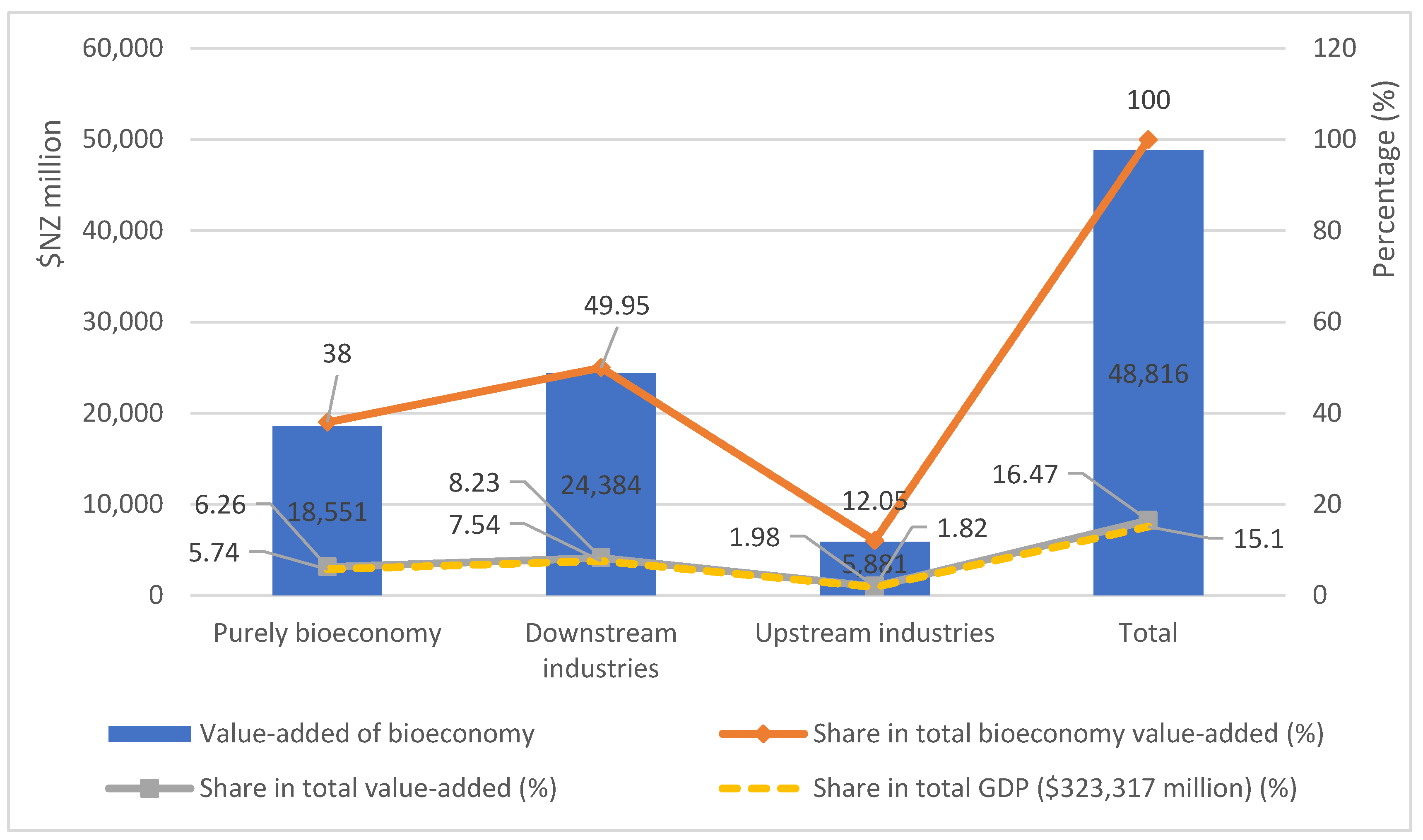
Figure 1 represents the findings of the upstream and downstream methodology when both purely bioeconomy sectors (agriculture and forestry and logging sectors) are considered one sector. The relationship between non-pure bioeconomy sectors’ output (bio-business) and this sector’s value of the total accumulated inputs is 1.94. Figure 1 shows that based on estimating the downstream, upstream, and purely bioeconomy value added, the total value added of bioeconomy in 2020 is about 48.8 billion NZD, of which the contributions of the purely bioeconomy sectors, downstream industries, and upstream industries are 38%, 49.9%, and 12.1%, respectively. The total value of the purely bioeconomy is 18.5 billion NZD, which accounts for 6.3% and 5.7% of the total value added and GDP of the country, respectively. The total value of the downstream bioeconomy is 24.4 billion NZD, which accounts for 8.2% and 7.5% of the total value added and GDP of the country, respectively. Furthermore, the total value of the upstream bioeconomy is 5.9 billion NZD, which accounts for 2% and 1.8% of the total value added and GDP of the country, respectively. In addition, the shares of bio-business and purely bioeconomy in total value added of the country are 0.082 and 0.145, respectively, indicating that bio-business and bioeconomy account for 8.2% and 14.5% of the country’s total value added.
Figure 1.
The upstream and downstream of bioeconomy value added aggregated sectors (million NZD). Source: author calculation.
Let us compare the results shown in Figure 1 with those of the downstream method in Table 5. It is evident that the total value of the purely bio-based sectors, which is 18.551 billion NZD, and the total value of downstream industries, which is 24.384 billion NZD, are the same in both approaches. Therefore, the first approach is a part of the second.
Table 9 shows the results of the upstream and total bioeconomy value added (upstream plus downstream) for bio-business sectors. The total bioeconomy value added in bio-business sectors shows that, among the sectors, the main contributor to the total bioeconomy value added and the total value added of the country is food processing and manufacturing (43.1% and 7.1%, respectively), followed by the services sector, with the contribution of 12.9% and 2.1%, respectively. The wood manufacturing sector is the third major contributor to both total bioeconomy value added and the total value added of the country at 3.3% and 0.54%, respectively. The construction sector is the fourth major contributor to both total bioeconomy value added and the total value added of the country, at 0.71% and 0.12%, respectively. The chemical products sector is another major contributor to both total bioeconomy value added and the total value added of the country, at 0.70% and 0.12%, respectively
Additionally, the textile and clothing sector contributes significantly, 0.58% and 0.10%, to the total bioeconomy value added and the total value added of the country, respectively. These results show the importance of the food manufacturing and services sectors as the major contributors to total value of the bioeconomy in New Zealand. Other important contributors to the total bioeconomy value added are electricity and gas, other industries, and petroleum and coal products manufacturing, which contribute 0.37%. 0.24% and 0.11%, respectively.
Table 9.
The bioeconomy value added of bio-business sectors.
Table 9.
The bioeconomy value added of bio-business sectors.
| Upstream Bioeconomy | Total (Upstream + Downstream) | |||||
|---|---|---|---|---|---|---|
| Value Added (Million NZD) | Share in Total Bioeconomy (%) | Share in Total Value Added (%) | Value Added (Million NZD) | Share in Total Bioeconomy (%) | Share in Total Value Added (%) | |
| Mining | 18.0 | 0.04 | 0.01 | 22 | 0.05 | 0.01 |
| Food manufacturing | 66.7 | 0.14 | 0.02 | 21,027.7 | 43.07 | 7.09 |
| Textile and clothing | 6.3 | 0.01 | 0.00 | 285.3 | 0.58 | 0.10 |
| Wood manufacturing | 68.4 | 0.14 | 0.02 | 1591.4 | 3.26 | 0.54 |
| Mining and extraction of energy producing products | 52.5 | 0.11 | 0.02 | 52.5 | 0.11 | 0.02 |
| Chemical products (biotechnology) | 319.6 | 0.65 | 0.11 | 343.6 | 0.70 | 0.12 |
| Other industries | 105.7 | 0.22 | 0.04 | 116.7 | 0.24 | 0.04 |
| Electricity and gas | 175.7 | 0.36 | 0.06 | 181.64 | 0.37 | 0.06 |
| Sewerage and waste collection | 4.4 | 0.01 | 0.00 | 5.34 | 0.01 | 0.00 |
| Construction | 229.2 | 0.47 | 0.08 | 346.7 | 0.71 | 0.12 |
| Services | 4834.5 | 9.90 | 1.63 | 6292.5 | 12.89 | 2.12 |
| Total value added | 5881 | 12.05 | 1.98 | 30,265 | 61.99 | 10.21 |
Source: author calculation.
If each individual purely bio-based sector is considered the only purely bio-based sector in the economy, then its bioeconomy value added can be estimated separately. In this case, it is assumed, for example, that only the agriculture sector exists as a purely bio-based sector, while another sector—such as forestry and logging—is treated as part of the bio-business sector. This assumption results in an increased share of bio-business sectors and leads to a higher estimated bioeconomy value for the individual bio-based sector being considered.
It is also worth noting that if one of the purely bio-based sectors is excluded from the bioeconomy calculation, then the estimated bioeconomy value of each remaining individual sector will decrease. In such cases, the total bioeconomy value across individual sectors will closely approximate the value derived from the aggregated bioeconomy sectors.
The results of this calculation are presented in Table 10. They indicate that the country’s total bioeconomy is approximately 50.8 billion NZD, which is close to the value of the bioeconomy when both purely bio-based sectors are considered one sector (48.9 billion NZD). Of this amount, the purely bioeconomy contribution is about 36.5% (18.5 billion NZD), the downstream industries’ contribution is around 50.4% (25.6 billion NZD), and the remaining 13.1% (6.6 billion NZD) is attributed to the upstream industries. The agriculture sector accounts for approximately 87.8% of the total bioeconomy value, with forestry contributing 12.2%. The downstream value added surpasses the upstream value added, confirming expectations for sectors that are not fully integrated into the bioeconomy. Notably, New Zealand has significantly larger industries compared to its 100% bioeconomy sectors.
Table 10.
The upstream and downstream bioeconomy value added of disaggregated sectors.
Table 10.
The upstream and downstream bioeconomy value added of disaggregated sectors.
| Agriculture | Forestry and Logging | Total | |
|---|---|---|---|
| Value added of primary bio-based sectors (Million NZD) | 16,270 | 2281 | 18,551 |
| Downstream industries (Million NZD) | 23,045 | 2549 | 25,594 |
| Share in total bioeconomy value added (%) | 45.0 | 5.0 | 50 |
| Share in total value added (%) | 7.8 | 0.9 | 8.6 |
| Upstream industries (Million NZD) | 5279 | 1363 | 6642 |
| Share in total bioeconomy value added (%) | 10.4 | 2.7 | 13.1 |
| Share in total value added (%) | 17.8 | 0.5 | 2.2 |
| Total bioeconomy value added (Million NZD) | 44,594 | 6193 | 50,787 |
| Share in total bioeconomy value added (%) | 88.9 | 11.1 | 100 |
| Share in total value added (%) | 15.2 | 1.9 | 17.1 |
| Share in total GDP (323,317 million NZD) (%) | 14.0 | 1.7 | 15.7 |
Source: author calculation.
Furthermore, it is evident that New Zealand’s total downstream and upstream value added (32.2 billion NZD) surpasses that of its purely bioeconomic industries (18.5 billion NZD). This suggests that the primary sectors are not the largest contributors to the bioeconomy value added in this country, and other industries contribute larger amounts. It is important to note, however, that the agriculture, forestry, and fishery sector has a relatively low share in the overall value added of New Zealand compared to the industry and services sectors. This also shows that the input flow from purely primary sectors (100% bioeconomy sectors) to partly bioeconomy sectors cannot generate additional value added that contributes to the bioeconomy value added more than the value added generated by the output flow from partly bioeconomy sectors to 100% bioeconomy sectors.
6. Discussion
New Zealand currently relies on woody biomass as a primary energy source for heating in specific industries, such as wood processing and pulp and paper manufacturing, consuming approximately 23.1 petajoules in 2023. Additionally, the residential sector accounts for around 2.4 petajoules of energy use. There is significant potential for the country to broaden the application of wood across more industries and households. Currently, the country produces only a small quantity of liquid biofuel, approximately 0.24 petajoules in 2023, primarily from agricultural byproducts like whey in food processing. Each year, a substantial volume of residues generated from forestry timber production presents a valuable opportunity for conversion into biofuels, providing a sustainable alternative for transportation and various other sectors [24]. Beyond energy production, biomass from agriculture and forestry can also be leveraged to create biochemical products, further expanding its utility.
Although the bioeconomy value added from chemical products in New Zealand currently stands at a modest 344 million NZD, the nation possesses significant opportunities and capabilities to enhance its involvement in related industries. By focusing on biochemicals and biomedical products derived from the agriculture and forestry sectors, New Zealand can tap into a market where the end products hold substantially greater value than their raw materials. Therefore, to achieve economically and environmentally sustainable value creation, it is crucial to conduct scientific monitoring of the evolving raw material portfolio in the chemical industry, which includes CO2, waste materials, biomass, and biogenic residues [25].
The findings provide a quantitative benchmark for New Zealand’s bioeconomy. This metric offers a valuable reference point for international researchers seeking to compare bioeconomic performance, assess sectoral strengths, and identify growth trajectories across countries. The predominance of agriculture (89%), alongside substantial inputs from food manufacturing (43.1%), services, and wood manufacturing, highlights strategic sectors for foreign direct investment (FDI), technology transfer, joint ventures, and supply chain development.
The emphasis on bio-based products and renewable biological resources aligns with global sustainability imperatives. International organizations such as the FAO, OECD, and UNEP may utilize these insights to inform policy dialogues, advance green growth agendas, and support low-carbon transitions.
Moreover, the analysis underscores the importance of food processing, wood processing, and construction within New Zealand’s bioeconomy, suggesting avenues for the adoption of innovative international technologies and fostering opportunities for collaborative research, technology commercialization, and capacity building.
The scale and diversity of the bioeconomy position it as a cornerstone of economic resilience. International stakeholders may regard New Zealand as a strategic hub for bioeconomy-related initiatives within the Asia–Pacific region. Development agencies can leverage these data to design targeted interventions, promote rural development, and encourage inclusive growth through bio-based enterprises. The detailed sectoral breakdown—distinguishing upstream versus downstream activities and pure versus hybrid bio-businesses—enables granular analysis, robust impact assessments, and the formulation of evidence-based policy recommendations.
There is substantial evidence indicating that the development of the bioeconomy is contingent upon a complex interplay of economic, technological, environmental, and social factors [26,27,28].
7. Conclusions
The primary objective of this study is to quantify the contribution of the bioeconomy to New Zealand’s total value added and gross domestic product (GDP), using the most recently published input–output tables. Specifically, the analysis employs the 2020 input–output tables to estimate the value added generated by bioeconomy-related sectors.
This study provides one of the first, economy-wide assessments of the bioeconomy in New Zealand, employing two methodological approaches to derive robust and comparable estimates. The sectorally disaggregated results not only establish a baseline for future monitoring but also highlight priority growth areas—such as food manufacturing, services, wood processing, textiles, and construction—providing an evidence-based foundation for targeted bioeconomy development strategies. By quantifying the bioeconomy’s total value added in 2020 at 48.8–50.8 billion NZD (16.5–17.1% of national value added) and decomposing contributions across purely bio-based, bio-business sectors, it offers a detailed structural profile rarely available in national bioeconomy accounts.
The analysis reveals the dominant role of agriculture (89% of purely bio-based value added) and food manufacturing (43.1% of bio-business value added), while identifying biotechnology’s notably small contribution (0.7% of total bioeconomy value added). This small share of biotechnology’s value added in the bioeconomy may contrast sharply with other countries where biotech is larger and could be a novel insight into NZ’s bioeconomy maturity stage and innovation profile. The results do not just measure the value of bioeconomy; they identify growth potential sectors (food manufacturing, services, wood processing, textiles, construction). They create a quantitative foundation for targeted bioeconomy policy rather than generic support.
The findings of the study emphasize the essential roles played by food manufacturing, wood manufacturing, services, textiles and clothing, and the construction sector, all of which are significant contributors to the bioeconomy of New Zealand. These sectors are pivotal in fostering new growth opportunities. They not only highlight the importance of comprehending the economic repercussions of bio-based products but also call for a thorough evaluation of their environmental impacts and the development of robust policies aimed at cultivating a sustainable economy rooted in renewable biological resources. Moreover, the introduction of innovative technologies across these industries, particularly within the food-processing sector, is vital to ensure the economic advancement of the country. By focusing on these sectors, New Zealand can strategically position itself for sustainable growth and resilience in the bioeconomy.
For future research, we recommend estimating the value of the bioeconomy over an extended period—ideally spanning the past two decades—to generate insights into its long-term trajectory, its contribution to national economic growth, and the influence of government policies and broader economic shifts on its development. This longitudinal analysis could be complemented by parallel estimates of biomass production over time, with a decomposition of contributing factors. Comparing these datasets would provide a clearer understanding of how biomass resources have been utilized and the directions in which the economy has channeled them. We further suggest assessing the social, environmental, and technological contributions of New Zealand’s bio-based sectors using robust, sector-appropriate methodologies. Of particular interest would be an investigation into the impacts of production changes in bio-based sectors arising from natural disasters and economic shocks, as well as an analysis of the timeframes required for these sectors to recover following such disruptions.
Author Contributions
Conceptualization, S.S. and T.B.; methodology, S.S.; software, S.S.; validation, S.S., M.G. and T.B.; formal analysis, S.S.; investigation, S.S., A.D., T.B. and M.G.; resources, S.S.; data curation, S.S. and M.G.; writing—original draft preparation, S.S.; writing—review and editing, S.S. and M.G.; visualization, T.B. and A.D.; supervision, S.S.; project administration, S.S., T.B. and M.G. All authors have read and agreed to the published version of the manuscript.
Funding
This work was supported by the Ministry of Business, Innovation and Employment under the fund No. C04X1703, entitled "Strategic Science Investment Fund (SSIF).
Data Availability Statement
The primary database used in this study is available on the New Zealand Statistical Department’s website at https://www.stats.govt.nz/.
Conflicts of Interest
The authors declare no conflicts of interest.
Appendix A
Table A1.
The list of all economic sectors used for the calculation of the value added of bioeconomy.
Table A1.
The list of all economic sectors used for the calculation of the value added of bioeconomy.
| Sectors | Sectors |
|---|---|
| Horticulture and fruit growing | Pharmaceutical and other store-based retailing |
| Sheep, beef cattle, and grain farming | Non-store and commission-based retailing |
| Dairy cattle farming | Accommodation |
| Poultry, deer, and other livestock farming | Food and beverage services |
| Forestry and logging | Road transport |
| Fishing and aquaculture | Rail transport |
| Agriculture, forestry, and fishing support services | Water transport |
| Coal mining | Air and space transport |
| Oil and gas extraction | Other transport |
| Metal ore and non-metallic mineral mining and quarrying | Postal and courier services |
| Exploration and other mining support services | Transport support services |
| Meat and meat product manufacturing | Warehousing and storage services |
| Seafood processing | Publishing (except internet and music publishing) |
| Dairy product manufacturing | Motion picture and sound recording activities |
| Fruit, oil, cereal, and other food product manufacturing | Broadcasting and internet publishing |
| Beverage and tobacco product manufacturing | Telecommunications services |
| Textile and leather manufacturing | Internet service providers, web search portals and data-processing services |
| Clothing, knitted products, and footwear manufacturing | Library and other information services |
| Wood product manufacturing | Banking and financing; financial asset investing |
| Pulp, paper, and converted paper product manufacturing | Life insurance |
| Printing | Health and general insurance |
| Coke and refined petroleum products | Superannuation and individual pension services |
| Basic chemical and basic polymer manufacturing | Auxiliary finance and insurance services |
| Fertilizer and pesticide manufacturing | Rental and hiring services (except real estate) |
| Pharmaceutical, cleaning, and other chemical manufacturing | Non-financial asset leasing |
| Polymer products and rubber product manufacturing | Residential property operation |
| Non-metallic mineral product manufacturing | Non-residential property operation |
| Primary metal and metal product manufacturing | Real estate services |
| Fabricated metal product manufacturing | Owner-occupied property operation |
| Transport equipment manufacturing | Scientific, architectural, and engineering services |
| Electronic and electrical equipment manufacturing | Legal and accounting services |
| Machinery manufacturing | Advertising, market research, and management services |
| Furniture manufacturing | Veterinary and other professional services |
| Other manufacturing | Computer system design and related services |
| Electricity generation and on-selling | Travel agency and tour arrangement services |
| Electricity transmission and distribution | Employment and other administrative services |
| Gas and water supply | Building cleaning, pest control, and other support services |
| Sewerage and drainage services | Local government administration services |
| Waste collection, treatment, and disposal services | Central government administration services |
| Residential building construction | Defense |
| Non-residential building construction | Public order, safety, and regulatory services |
| Heavy and civil engineering construction | Preschool education |
| Construction services | School education |
| Basic material wholesaling | Tertiary education |
| Machinery and equipment wholesaling | Adults, community, and other education |
| Motor vehicle wholesaling, including parts | Hospitals |
| Grocery, liquor, and tobacco product wholesaling | Medical and other health care services |
| Other goods and commission-based wholesaling | Residential care services and social assistance |
| Motor vehicle retailing, including parts | Heritage and artistic activities |
| Fuel retailing | Sports and recreation services |
| Supermarket and grocery stores | Gambling activities |
| Specialized food retailing | Repair and maintenance |
| Furniture, electrical, and hardware retailing | Personal services; domestic household staff |
| Recreational, clothing, footwear, and personal accessory retailing | Religious services; civil, professional, and other interest groups |
References
- Philippidis, G.; Sanjuán, A.I.; Ferrari, E.; M’Barek, R. Employing social accounting matrix multipliers to profile the bioeconomy in the EU member states: Is there a structural pattern? Span. J. Agric. Res. 2014, 12, 913–926. [Google Scholar] [CrossRef]
- Mainar-Causapé, A.J.; George, P.; Sanjuán-López, A.I. Constructing an open access economy-wide database for bioeconomy impact assessment in the European Union member states. Econ. Syst. Res. 2021, 33, 133–156. [Google Scholar] [CrossRef]
- Alviar, M.; García-Suaza, A.; Ramírez-Gómez, L.; Villegas-Velásquez, S. Measuring the Contribution of the Bioeconomy: The Case of Colombia and Antioquia. Sustainability 2021, 13, 2353. [Google Scholar] [CrossRef]
- Cingiz, K.; Gonzalez-Hermoso, H.; Heijman, W.; Wesseler, J.H.H. A Cross-Country Measurement of the EU Bioeconomy: An Input–Output Approach. Sustainability 2021, 13, 3033. [Google Scholar] [CrossRef]
- Ronzon, T.; Iost, S.; Philippidis, G. An output-based measurement of EU bioeconomy services: Marrying statistics with policy insight. Struct. Change Econ. Dyn. 2022, 60, 290–301. [Google Scholar] [CrossRef] [PubMed]
- Bracco, S.; Calicioglu, O.; Gomez San Juan, M.; Flammini, A. Assessing the Contribution of Bioeconomy to the Total Economy: A Review of National Frameworks. Sustainability 2018, 10, 1698. [Google Scholar] [CrossRef]
- Fadillah, K.N. Analysing the Contribution of Malaysian Bioeconomy Using the GDP Approach; Bioeconomy Malaysia Report: Putrajaya, Malaysia, 2015. [Google Scholar]
- Ronzon, T.; Piotrowski, S.; M’Barek, R.; Carus, M. A systematic approach to understanding and quantifying the EU’s bioeconomy. Bio-Based Appl. Econ. 2017, 6, 1–17. [Google Scholar] [CrossRef]
- Tetere, V.; Peerlings, J. Measuring the forest-based bioeconomy in Estonia, Latvia, Lithuania, and Finland. Scand. J. For. Res. 2024, 39, 226–231. [Google Scholar] [CrossRef]
- Iost, S.; Labonte, N.; Banse, M.; Geng, N.; Jochem, D.; Schweinle, J.; Weber, S.; Weimar, H. German Bioeconomy: Economic Importance and Concept of Measurement. Ger. J. Agric. Econ. 2019, 68, 275–288. [Google Scholar] [CrossRef]
- Camia, A.; Robert, N.; Jonsson, R.; Pilli, R.; García-Condado, S.; López-Lozano, R.; Velde, M.V.D.; Ronzon, T.; Gurría, P.; M’Barek, R.; et al. Biomass Production, Supply, Uses and Flows in the European Union—First Results from an Integrated Assessment; Publications Office: Luxembourg, 2018. [Google Scholar]
- Jander, W.; Wydra, S.; Wackerbauer, J.; Grundmann, P.; Piotrowski, S. Monitoring Bioeconomy Transitions with Economic–Environmental and Innovation Indicators: Addressing Data Gaps in the Short Term. Sustainability 2020, 12, 4683. [Google Scholar] [CrossRef]
- Sinkko, T.; Sanyé-Mengual, E.; Corrado, S.; Giuntoli, J.; Sala, S. The EU Bioeconomy Footprint: Using life cycle assessment to monitor environmental impacts of the EU Bioeconomy. Sustain. Prod. Consum. 2023, 37, 169–179. [Google Scholar] [CrossRef]
- Kardung, M.; Cingiz, K.; Costenoble, O.; Delahaye, R.; Heijman, W.; Lovrić, M.; van Leeuwen, M.; M’Barek, R.; van Meijl, H.; Piotrowski, S.; et al. Development of the Circular Bioeconomy: Drivers and Indicators. Sustainability 2021, 13, 413. [Google Scholar] [CrossRef]
- StatsNZ (Stats NZ). Agricultural and Horticultural Land Use.; Stats NZ: Wellington, New Zealand, 2021; p. 1. [Google Scholar]
- OECD. OECD Data Explorer; Organisation for Economic Cooperation and Development (OECD): Paris, France, 2024. [Google Scholar]
- MPI. About New Zealand’s Forests; Ministry of Primary Industry (MPI): Wellington, New Zealand, 2020. [Google Scholar]
- MPI. Agriculture Portfolio Briefing 2023; Ministry of Primary Industry: Wellington, New Zealand, 2023. [Google Scholar]
- Heijman, W. How big is the bio-business? Notes on measuring the size of the Dutch bio-economy. NJAS-Wagening. J. Life Sci. 2016, 77, 5–8. [Google Scholar] [CrossRef]
- Leontief, W.W. Input-Output Economics. Sci. Am. 1951, 185, 15–21. [Google Scholar] [CrossRef]
- Leontief, W.W. The Structure of American Economy 1919–1939: An Emperical Application of Equilibrium Analysis, 2nd ed.; Oxford University Press: Oxford, UK, 1951. [Google Scholar]
- Leontief, W.W. Input-Output Economics, 2nd ed.; Oxford University Press: New York, NY, USA, 1966. [Google Scholar]
- Miller, R.E.; Blair, P.D. Input-Output Analysis: Foundations and Extensions, 2nd ed.; Cambridge University Press: Cambridge, UK, 2009. [Google Scholar]
- Energy Efficiency & Conservation Authorit (EECA). Regional Energy Transition Accelerator (RETA); Energy Efficiency & Conservation Authority: Wellington, New Zealand, 2025; p. 208. [Google Scholar]
- Kircher, M. Chemical Production Based on Biomass—Potential and Limits. Biomass 2025, 5, 8. [Google Scholar] [CrossRef]
- Thomchick, E.; Jacobson, M.; Ruamsook, K. Bioeconomy bright spots, challenges, and key factors going forward: Perceptions of bioeconomy stakeholders. EFB Bioecon. J. 2024, 4, 100068. [Google Scholar] [CrossRef]
- Oguntuase, O.J.; Adu, O.B.; Obayori, O.S. How do individual-level factors influence the adoption of low-carbon technology? Proposing and validating the bioeconomy technology acceptance model in the context of Africa. Front. Sustain. 2023, 4, 1148001. [Google Scholar] [CrossRef]
- Muizniece, I.; Zihare, L.; Blumberga, D. Obtaining the Factors Affecting Bioeconomy. Environ. Clim. Technol. 2019, 23, 277–291. [Google Scholar] [CrossRef]
Disclaimer/Publisher’s Note: The statements, opinions and data contained in all publications are solely those of the individual author(s) and contributor(s) and not of MDPI and/or the editor(s). MDPI and/or the editor(s) disclaim responsibility for any injury to people or property resulting from any ideas, methods, instructions or products referred to in the content. |
© 2025 by the authors. Licensee MDPI, Basel, Switzerland. This article is an open access article distributed under the terms and conditions of the Creative Commons Attribution (CC BY) license (https://creativecommons.org/licenses/by/4.0/).



