1. Introduction
Rapid population growth, technological advancements, and the industrial revolution have disrupted the balance between humans and the environment, leading to numerous problems such as climate change, the depletion of natural resources, loss of biodiversity, and public health issues [
1]. In response to these challenges, many national and international organizations, non-governmental organizations (NGOs), policymakers, and scientists have taken action to propose solutions. As a result, sustainable development (SD) has become one of the key concepts of the 21st century. Although initially confined primarily to the field of economics, it has since emerged as a topic of study in disciplines such as environmental science, sociology, urban planning, and management sciences [
2].
Research on SD has emphasized that education plays a central role in promoting sustainability throughout society [
2,
3,
4,
5]. Education for sustainable development (ESD) is essential for teaching individuals how to contribute to a more sustainable economy, environment, and social order, as well as how to use resources responsibly [
6]. ESD aims not only to provide knowledge but also to foster the skills, values, and perspectives needed to support sustainability. Therefore, teachers are expected to possess sufficient knowledge [
7], positive attitudes [
8], and strong beliefs [
9] about SD. Positive beliefs about SD facilitate the implementation of ESD practices, while negative beliefs may hinder them [
9].
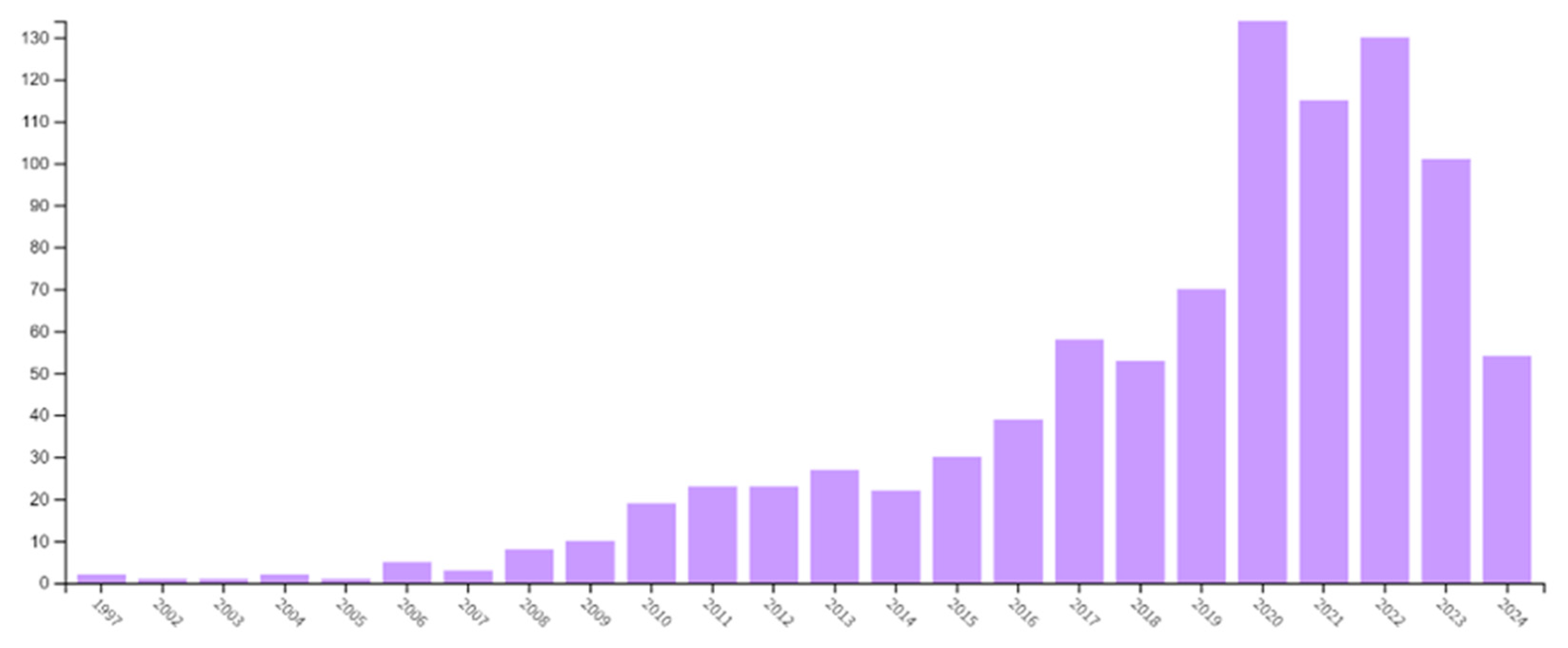
Research on teachers and ESD has significantly increased in recent years (
Figure 1). In particular, studies have examined how teachers integrate global sustainability issues into their lessons [
10], their perceptions of ESD [
11,
12,
13], their attitudes toward ESD [
14,
15], the barriers they encounter in implementing ESD [
16,
17,
18], and their general perspectives on ESD [
12,
13,
17,
18,
19,
20,
21,
22,
23,
24,
25,
26,
27,
28]. Additionally, some studies have explored teachers’ beliefs about ESD [
29,
30,
31]. In the context of Türkiye, however, research on teachers’ beliefs about ESD remains limited [
9,
32,
33,
34,
35]. Bedir [
32] examined English teachers’ beliefs about SD, while Emre et al. [
33] investigated teachers’ beliefs about ESD from a quantitative perspective. Sağdıç and Şahin [
9] identified primary school teachers’ beliefs, perceived barriers, and teaching strategies. Similarly, Tekin [
34] analyzed teachers’ values and beliefs regarding ESD. Nevertheless, many researchers have noted a potential gap between teachers’ beliefs and their classroom practices [
36,
37], as teachers often face challenges in articulating or enacting their beliefs about ESD [
29,
38,
39].
According to the 2024 Sustainable Development Report, Türkiye ranks 72nd out of 167 countries in terms of its overall success in achieving the Sustainable Development Goals (SDGs). While Türkiye has made notable progress in reducing poverty, enhancing educational quality, and fostering development, it has not yet reached the expected level of achievement [
40]. In its 12th Development Plan, Türkiye emphasized that the SDGs play a pivotal role, serving as a comprehensive and holistic framework for human-centered development initiatives [
41].
In this context, a significant gap remains in the literature due to the limited number of studies investigating teachers’ perspectives on ESD. Understanding teachers’ beliefs and attitudes toward ESD can inform the development of more effective strategies for future research and educational practices. In conclusion, this study is important for several reasons. First, it focuses on teachers, who play a critical role in shaping future generations. Second, SD and education are priority issues that deserve emphasis by both national and international organizations. Finally, the study is expected to contribute to the educational objectives outlined in Türkiye’s 12th Development Plan.
1.1. ESD and Teachers as Key Stakeholders
While there are many definitions of SD, the most widely accepted one in the literature is found in the Brundtland Report. It defines SD as “meeting the needs of the present without compromising the ability of future generations to meet their own needs” [
42]. The United Nations (UN) has played a leading role in promoting SD as a globally accepted approach, initiating numerous efforts such as the World Commission on Environment and Development Report (Our Common Future—Brundtland Report) (1987), the UN Conference on Environment and Development—Earth Summit (1992), the UN Millennium Summit (2000), the World Summit on SD (2002), the UN Conference on Sustainable Development—Rio+20 (2012), and the UN Sustainable Development Summit (2015). Furthermore, to protect the planet and ensure a more sustainable future for coming generations, the “2030 Agenda for Sustainable Development Goals” was signed by 193 UN member states, including 17 goals and 169 indicators [
43].
The SDGs are universal, transformative, interconnected, and inclusive. They address economic, social, and environmental challenges and aim to turn the concept of SD into concrete actions [
44]. In this regard, the SDGs represent a call for transformation. The European Union emphasizes that, to achieve SD, policymakers must work in an integrated and supportive manner. Therefore, collaboration among stakeholders is essential to meet these goals by 2030. The most fundamental tool for achieving the SDGs is education [
4].
Many terms have been proposed by scholars regarding SD and education [
31]. Among these are “environmental education for sustainability” [
45,
46], “education for sustainability” [
47,
48], “sustainable education,” and “ESD” [
49]. However, “ESD” has become the most commonly used term. It is defined as the process that equips individuals with the knowledge, skills, and attitudes needed to achieve the SDGs [
50] and is directly linked to Goal 4: Quality Education. ESD has evolved alongside sustainability challenges. It aims to provide learners with the knowledge, skills, values, and action-oriented mindset needed to address interconnected global challenges [
51]. ESD represents a new educational vision aimed at fostering responsibility for creating a sustainable future [
52]. It is a holistic concept encompassing learning content, pedagogy, learning environments, learning outcomes, and social transformation [
53].
The first challenge in implementing ESD is training teachers who can translate SD into classroom practice [
54]. Teachers play a key role in embedding SD values and principles into curricula and instructional methods to support the achievement of the SDGs [
55,
56]. UNESCO has described teacher professional development in ESD as “the priority of priorities” [
57,
58], as teachers are central agents of social change for SD within society [
59]. Even the best-designed curricula and teaching materials will not have the desired impact if teachers do not fully understand the aims of ESD or are not competent in delivering environmental education [
60]. The success of ESD implementation depends on qualified and committed teachers [
61]. Moreover, numerous studies have shown that teachers’ competencies and their commitment to sustainability are critical factors for the effective implementation of ESD in schools [
62,
63,
64,
65].
Teachers should act as catalysts in promoting sustainable principles and should acquire ESD competencies [
66]. The extent to which education and schools can be transformed into sustainable institutions largely depends on teachers’ knowledge, competencies, attitudes, and values, as well as their interaction with institutional frameworks and curriculum structures [
67]. To effectively fulfill the mission of ESD and achieve the SDGs, teachers must first develop their knowledge, skills, values, and attitudes. Therefore, by enhancing their capacities, teachers from any discipline can become proficient in delivering sustainability-focused instruction [
68].
Improving the quality of education requires shifts in teachers’ beliefs [
69]. Thus, teachers’ beliefs about ESD play a central role in the implementation of ESD and in how they prepare students for the future [
32]. Students often mirror the values, attitudes, and behaviors of their teachers [
70]. Given the established relationship between beliefs and behaviors [
71], it can be assumed that teachers’ beliefs about SD will be reflected in their actions and, consequently, students may adopt similar behaviors. Moreover, teachers’ beliefs about ESD—along with the challenges and opportunities they encounter—play a crucial role in supporting their communities in achieving the SDGs.
1.2. Theoretical Framework
In this study, the Theory of Planned Behavior (TPB), proposed by Icek Ajzen, was adopted as the theoretical framework [
72]. This theory offers a valuable lens for identifying the factors that influence teachers’ beliefs about education for sustainable development (ESD) and their intentions toward ESD practices. As an extension of Ajzen’s Theory of Reasoned Action [
72,
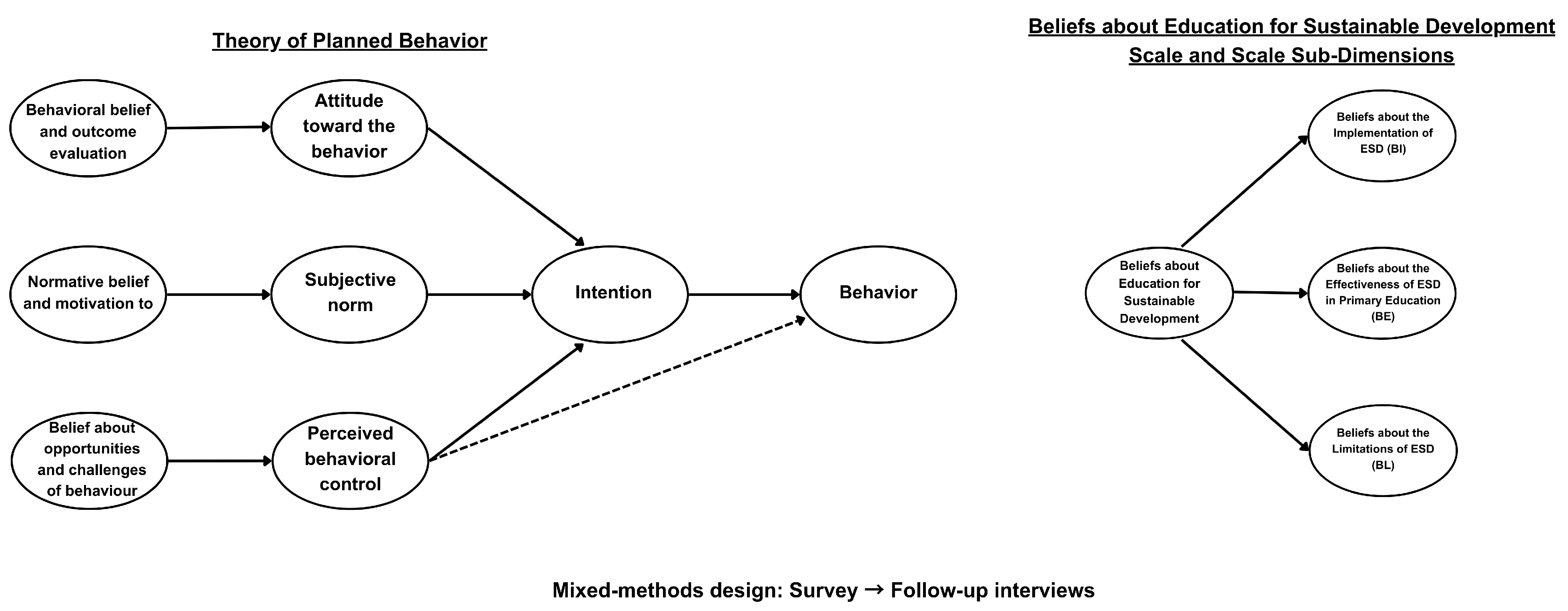
73], TPB posits that an individual’s behavior is guided by behavioral intentions, which are shaped by three key components: attitudes toward the behavior, subjective norms, and perceived behavioral control. According to the theory, attitudes toward the behavior stem from behavioral beliefs, which refer to expectations about the likely outcomes of the behavior. Subjective norms arise from normative beliefs, which reflect perceived social pressure or expectations from significant others. Perceived behavioral control is shaped by control beliefs, which relate to an individual’s perception of their ability to perform the behavior. Behavioral beliefs give rise to favorable or unfavorable attitudes toward the behavior. Normative beliefs influence perceived social pressure, contributing to the formation of subjective norms. Control beliefs reflect the perceived presence of factors that may facilitate or hinder the behavior and give rise to perceived behavioral control [
73].
These three belief components are shaped by individual background factors such as age, gender, education level, income, and personal values, as well as social background factors including religion, race, culture, media, and the economy. These beliefs, in turn, influence attitudes toward the behavior, subjective norms, perceived behavioral control, behavioral intentions, and ultimately, an individual’s actions. Behavioral intentions may vary depending on the specific behavior and the individual performing it. For instance, some behaviors may be primarily influenced by an individual’s attitudes, while others may be more strongly shaped by social norms or perceptions of control [
73].
The main reason for adopting Ajzen’s TPB as the theoretical foundation of this study lies in its capacity to systematically explain individuals’ intentions to perform specific behaviors and the underlying belief structures behind those behaviors. Furthermore, TPB has been widely used in various studies due to its suitability as a theoretical framework for examining education for sustainable development [
74,
75,
76,
77,
78].
The main aim of this study is to identify teachers’ belief levels regarding ESD, to explain the factors influencing these beliefs, and to reveal teachers’ suggestions for improving the quality of ESD. In alignment with these objectives, the TPB was adopted for its capacity to analyze the belief structures that shape teachers’ behavioral intentions and to evaluate the relationships among these structures. Additionally, the theory serves as a robust theoretical tool for understanding the effects of various socio-demographic variables (such as gender, age, teaching field, and education level) on the belief dimensions. TPB not only allows for the description of teachers’ current belief levels but also offers insights into the likelihood of these beliefs translating into actual behaviors and the factors influencing this process.
Figure 2 presents the conceptual framework summarizing the model of the Beliefs about Education for Sustainable Development scale based on the Theory of Planned Behavior, along with the mixed-methods research design employed in this study.
1.3. The Purpose of the Study
This study aimed to examine the belief levels of teachers regarding ESD, identify the factors influencing these beliefs, and present their suggestions for improving the quality of ESD. Accordingly, the following research questions were developed:
1. What are the levels of teachers’ beliefs about ESD?
2. Do teachers’ beliefs about ESD differ based on gender, education level, discipline, and age? How do these variables influence teachers’ beliefs about sustainable development, and how are the relationships among them shaped?
3. What are teachers’ suggestions for improving the quality of ESD?
3. Findings
In this section, the findings are presented based on the research questions.
3.1. Teachers’ Belief Regarding ESD
The descriptive analysis of the participants’ belief levels regarding SD are presented in
Table 5.
Table 5 shows that the participants’ average scores were 3.62 for BI, 2.65 for BE, and 2.50 for BL. These results indicate that participants held high scores in BI, moderate scores in BE, and low scores in BL. This suggests that teachers possess strong beliefs regarding the implementation of ESD, moderate beliefs about its effectiveness, and low beliefs about its limitations and barriers. The qualitative findings also support these results (see
Table 6 and
Table 7).
Participants generally evaluated ESD as an accessible and applicable educational model, emphasizing its significant role in fostering students’ sustainability-related knowledge, skills, values, awareness, and behaviors. For example, Osman stated that topics such as the carbon footprint introduced students to new information. He expressed his views as follows: “We have addressed topics like carbon footprint and future preventive measures, introducing students to important information they had never heard before in their lives.” According to the participants, ESD helped students develop certain values, including frugality (Ali, Ahmet), social justice (Merve), responsibility (Ahmet), and respect for humans and nature (Mehmet). Regarding sustainable behaviors, Mehmet stated: “It can instill specific behavioral changes, such as leaving a more livable world for future generations.” Concerning sustainability awareness, Merve remarked: “When we integrate the SDGs into our lessons, we raise conscious individuals, and that is actually the biggest advantage.” Ahmet highlighted the importance of cultivating global citizens through ESD, stating: “Global developments like hunger and poverty have started to affect everyone. Migration to Europe is the biggest proof of that. Now everything affects everyone. That’s why I believe we need this education to better read, understand, and interpret the world and to look at events from a broader perspective.” These findings are important for interpreting the high mean scores on the BI dimension and the low mean scores on the BL dimension reported by the participating teachers.
Participants expressed several limitations regarding ESD. These limitations help explain the low and moderate scores observed in the BE and the BL dimensions. For instance, teachers emphasized difficulties in understanding ESD due to the broad scope of the goals, their inappropriateness for students’ cognitive levels, and their abstract nature. Ali expressed his concerns about the suitability of the Sustainable Development Goals (SDGs) for students, stating: “I think the goals go beyond the level of middle school students.” Zeynep referred to the abstract nature of the concept, remarking: “Due to the abstractness of concepts like SD, students may initially have difficulty grasping the topic.” This reflects teachers’ uncertainties regarding the limitations of ESD and their concerns about potential challenges in its implementation.
The qualitative data also revealed various structural and pedagogical barriers that teachers encounter in the implementation of ESD. Participants identified several key obstacles, including the insufficient integration of ESD into the curriculum, economic constraints limiting implementation, the exam-oriented education system leaving little room for SDGs, and the lack of access to necessary resources for hands-on activities. Ahmet and Ali emphasized shortcomings in the curriculum and the lack of financial resources needed for practical activities. Regarding financial limitations, Ali noted: “For instance, we want to take students outside to raise environmental awareness or demonstrate how waste is recycled. … We need to take them to a waste recycling plant. But these facilities are an hour and a half away from our district, and transporting the students creates a costly situation.”
Teachers’ beliefs about their own competencies also emerged as a significant limitation. Osman pointed out the challenges arising from a lack of pedagogical content knowledge and emphasized the importance of teacher education: “I definitely find it feasible; honestly, I don’t think it’s very difficult. But we are not sufficiently competent in this area.” He also noted the absence of ESD content in pre-service teacher education: “There were no elective or compulsory courses or training on this topic in our undergraduate education.” Similarly, Mehmet stressed the lack of practical training related to ESD and suggested that university faculty members should reflect on their own educational practices. He stated: “Now, we really need to focus more on hands-on, applicable training. … No teacher says, ‘I learned this at university.’ Everyone learns in the field. That’s why we need to take responsibility and think about where we went wrong. Professors also need to reflect on the mistakes we are making.” These findings provide concrete examples that help explain the moderate belief scores observed in the BL dimension.
Not only teachers but also students and parents emerged as influential actors in the implementation of ESD. Regarding students’ lack of awareness, Merve stated: “I received responses from students like, ‘Why do we need such activities? Are these problems really that serious?’ And I said, ‘Yes, they are.’” Osman also highlighted the difficulty of raising awareness among students, noting: “When you talk about marine pollution to someone who has never seen the sea, they say, ‘Teacher, there is no sea here, we’ve never seen the sea—how can we pollute it?’ When we talk about protecting trees and say, ‘Let’s not cut them down, let’s keep them alive,’ they respond, ‘But if we don’t cut trees, what will we burn in winter?’” Students’ lack of interest and awareness regarding ESD increases the challenges teachers face in managing the educational process. The statements by Merve and Osman suggest that students struggle to make sense of content that does not align with their lived experiences. Similarly, inconsistencies in the family environment can also undermine the effectiveness of school-based education. Mehmet expressed his views on this issue as follows: “The activities a teacher conducts need to be embraced by the community. Now, we carry out an activity, but once the child leaves school, the family, the father, the TV, friends outside—everything is different. When they see things like wastefulness or a lack of environmental sensitivity, everything you’ve done becomes useless.”
When evaluated within the framework of the TPB, it is observed that although teachers hold high-level beliefs regarding the implementation of ESD and low-level beliefs concerning its limitations, their moderate-level beliefs about its effectiveness create certain gaps in practice. In other words, while teachers perceive ESD as necessary and important, the barriers they encounter at the individual, institutional, and societal levels negatively affect the holistic functioning of their belief structures.
3.2. Teachers’ Beliefs About Education for Sustainable Development in Relation to Demographic Variables
To examine whether teachers’ belief levels regarding sustainable development differ based on demographic characteristics—specifically gender, educational background, teaching discipline, and age—several statistical analyses were conducted. These included independent samples
t-tests, one-way Analysis of Variance (ANOVA), and Pearson product-moment correlation coefficient analysis (see
Table 8).
According to
Table 8, teachers’ scores on the BI [
t(407) = 0.129,
p > 0.05], the BE [
t(407) = −1.469,
p > 0.05], and the BL [
t(407) = −1.909,
p > 0.05] dimensions did not differ significantly based on gender. However, comparisons based on educational background revealed a statistically significant difference in the BI sub-dimension [
t(407) = 0.542,
p < 0.05], indicating that teachers with graduate-level education reported higher beliefs regarding the implementation of ESD. No significant differences were observed in the BE [
t(407) = −1.199,
p > 0.05] or BL [
t(407) = 0.809,
p > 0.05] dimensions with respect to educational background.
Similarly, no statistically significant differences were found across teaching disciplines in the BI [F(6, 407) = 0.883, p > 0.05], BE [F(6, 407) = 0.881, p > 0.05], or BL [F(6, 407) = 0.779, p > 0.05] dimensions, suggesting that subject area does not substantially influence teachers’ beliefs about the implementation, effectiveness, or limitations of ESD.
Regarding age, a weak but statistically significant positive correlation was found between age and the BL (r = 0.137, p < 0.01) dimension, suggesting that older teachers tend to perceive more limitations in implementing ESD. However, no significant correlation was observed between age and the BI or BE dimensions (p > 0.05).
To further explore these relationships and assess the predictive impact of demographic variables on each belief dimension, multiple linear regression analyses were conducted. The results are presented in
Table 9.
Although the regression model for the BI dimension approached the threshold of statistical significance, it was not statistically significant overall (F(4, 404) = 2.048, p = 0.087), and the amount of variance explained by the model was limited (R2 = 0.020). However, educational background emerged as a significant predictor (β = 0.127, p = 0.011), supporting the findings from the preliminary analyses. This suggests that teachers with graduate-level education possess stronger beliefs regarding the implementation of ESD. Qualitative findings further corroborate this result. Teachers holding graduate degrees (Ahmet, Ali, and Mehmet) described ESD as more feasible and applicable compared to their counterparts without graduate education (Osman, Zehra, and Merve). For example, Ahmet noted that he had conducted prior research on ESD and had engaged with the literature emphasizing its practical applicability. Ali advocated for an interdisciplinary approach to integrating sustainability skills and called for making ESD a compulsory component of the curriculum. Mehmet emphasized the need for experiential, hands-on learning opportunities, underscoring the role of practice-based education in successful ESD implementation. Collectively, these perspectives illustrate that graduate-educated teachers tend to engage with ESD both theoretically and practically, which in turn strengthens their implementation-related beliefs.
The regression model developed for the BE dimension was not statistically significant (F(4, 404) = 0.820, p = 0.513), and none of the variables significantly predicted this dimension (R2 = 0.008). Consistent with these findings, preliminary analyses showed no significant differences in BE scores by gender, educational background, teaching discipline, or age—suggesting that other underlying factors may shape teachers’ beliefs about ESD’s effectiveness. The qualitative data also aligned with this result: most teachers, regardless of demographic background, expressed belief in ESD’s potential effectiveness. While some participants acknowledged the indirect integration of ESD into their subject areas, only Zeynep, a Turkish language teacher, reported having never implemented ESD-related activities and encountering the concept for the first time through this study. She explained, “I don’t think this topic is very relevant to my subject. For example, topics like climate are more suited to social studies or science classes. Honestly, I couldn’t find a connection with Turkish.” In contrast, other teachers viewed their disciplines as highly relevant to ESD. For instance, Mehmet observed: “Science is a subject with many connections to SD, and it allows for the development of numerous behaviors. Why? Because many of the topics in science can be concretized.” Similarly, Ali emphasized the interdisciplinary nature of social studies, noting: “Social studies is a multidisciplinary subject, so if you try to make connections, you can actually find a link to every topic.” He described integrating the SDGs by linking historical content in the sixth-grade curriculum to themes like industry, innovation, and infrastructure. Ahmet also highlighted that national education goals are consistent with ESD, enabling indirect integration into his teaching practices.
The regression model established for the BL dimension was found to be statistically significant (F
(4, 404) = 2.651,
p = 0.033). Although the explanatory power of the model was relatively low (R
2 = 0.026), age emerged as a significant predictor (β = 0.124,
p = 0.014). This finding supports the correlation result obtained in the preliminary analysis, indicating that teachers’ beliefs about the limitations of ESD increase with age. The qualitative findings also support this result. When comparing teachers’ demographic characteristics (see
Table 2) with their negative beliefs about ESD, it appears that older teachers are more likely to express concerns regarding its limitations. Indeed, Mehmet, the oldest participant in the study, stated that the Sustainable Development Goals (SDGs) are overly broad and abstract, making it difficult to adapt them to classroom-level instruction. He also emphasized that insufficient curricular inclusion, the exam-oriented education system, bureaucratic barriers, and a lack of practical training prevent teachers from implementing ESD effectively.
3.3. What Do Teachers Recommend for Improving the Quality of ESD in Türkiye?
Participants identified numerous challenges that hinder the effective implementation of ESD. In addition to these barriers, they emphasized the need for improvements, even in contexts where no overt obstacles were present. The teachers offered a range of recommendations aimed at enhancing the overall quality and effectiveness of ESD in Türkiye (
Table 10).
As shown in
Table 10, participants offered recommendations targeting various stakeholders to enhance the implementation and quality of ESD in Türkiye. Several suggestions were directed at policymakers. Mehmet, for instance, emphasized that efforts to raise awareness should not be left solely to non-governmental organizations (NGOs): “
There are a few NGOs trying to carry out activities. Are they sufficient? No, they are not… This is not something that can be left to a few associations or foundations.” He also proposed implementing societal oversight mechanisms to sustain education in schools: “
Supervision! I’m not talking about school supervision, but there could be oversight regarding environmental sensitivity... Similar penalties could be introduced—not as punishments but as actions to raise awareness.” Ali suggested leveraging public campaigns through the establishment of nationally recognized days: “
If we could declare March 4 as World Sustainable Development Day and use that day to draw attention through media, schools, and public campaigns, we could achieve much more concrete results.” Ahmet called for broad-based education on global citizenship: “
Our society, our country, and our students need to be educated and informed about global citizenship.”
In relation to higher education, participants urged greater collaboration between the YÖK and the MEB. Mehmet highlighted the need for inter-institutional coordination: “University professors definitely need to collaborate with MEB… They should share their research with MEB and teachers, include teachers in their research—they should work as a whole.” He also stressed the importance of adopting a more practice-oriented approach in teacher education: “We see some foreign universities where instructors conduct experiments directly in front of the students.” Ali echoed this sentiment, stating that sustainability education should be compulsory across all faculties: “At the undergraduate level, compulsory courses need to be included… it should actually be a mandatory course in all faculties.”
The participants also reflected on their own professional development. Osman and Zeynep found their pre-service education on ESD inadequate, while Merve attributed her development in this area to involvement in extracurricular projects. Ahmet, Ali, and Mehmet expressed strong personal interest in ESD and a sense of responsibility to teach it, noting that postgraduate education significantly enhanced their competence and commitment in this domain. Another recommendation was directed toward the MEB. Regarding the visibility of ESD, Ahmet said, “21st-century skills or the Turkish Qualifications Framework are directly included in the curriculum. For example, these 17 goals should now officially be included in the program, becoming more visible and concrete”. Merve emphasized the need for material support in schools: “A smartboard is essential to show things to students, and there needs to be a project room where students can work in groups. They also need access to the internet for research.”
All three participants with graduate education (Mehmet, Ahmet, and Ali) emphasized that ESD should be approached from an interdisciplinary perspective. At the same time, several participants (Mehmet, Osman, Zeynep, Merve, and Ali) highlighted the lack of adequate pre-service and in-service training in this area. They advocated for discipline-specific professional development programs to be organized by the MEB. In addition to training, participants proposed engaging in ESD-related projects (Ali, Mehmet, Merve), staying informed about innovations in education (Ali, Mehmet), prioritizing hands-on, practice-oriented instruction (Ali, Mehmet, Zeynep), and incorporating out-of-school learning environments into the teaching process (Ali, Mehmet).
Mehmet elaborated on the role of project-based learning in promoting ESD: “We present students with problem-based inquiries or provide data and ask them to create a problem. We want them to identify the problem and then propose solutions… We can engage in various projects related to the environment through organizations like TÜBİTAK and TEKNOFEST.” He also stressed the importance of experiential learning linked to contemporary environmental issues: “We should take our students to visit various places across the country. For example, our children should see Konya Karapınar… Why is there desertification in Karapınar? Children should observe this.”
Ali echoed the need for keeping up with educational innovations: “Teachers must keep up with current information. Based on this up-to-date knowledge, we expect them to develop different teaching strategies that enable students to explore topics from new perspectives and ultimately see changes in their behavior.” He also emphasized the importance of utilizing out-of-school learning environments in ESD: “Just as we have museum education in social studies, we should take students to areas related to SD. For example, students should be taken to waste recycling plants.”
In conclusion, teachers’ recommendations suggest that the successful implementation of ESD requires a comprehensive and multidimensional transformation encompassing curriculum design, teacher education, interdisciplinary collaboration, community engagement, and the integration of experiential learning environments.
4. Discussion
In this study, teachers’ belief levels regarding ESD were identified, the factors influencing these beliefs were examined, and teachers’ suggestions for improving the quality of ESD were presented. The findings indicate that teachers hold high-level beliefs about the implementation of ESD, moderate-level beliefs about its effectiveness, and low-level beliefs concerning its limitations. These results are consistent with those of previous studies involving in-service teachers [
3,
9,
12,
34,
90] and pre-service teachers [
91,
92]. Although teachers generally express a positive orientation toward ESD, various barriers appear to hinder the translation of these beliefs into concrete instructional practices. In particular, the broad and abstract nature of the Sustainable Development Goals (SDGs), the inadequacy of supporting public policies, and the limited engagement of key stakeholders—teachers, students, and parents—emerged as prominent factors complicating this transformation. For example, Malik et al. [
12] noted that although teachers possess sustainability awareness, this often fails to translate into classroom practice. Similarly, Herranen and Aksela [
93] reported that teachers exhibited low self-efficacy in guiding students toward sustainability-related actions. In this context, it is encouraging that participants in the current study expressed strong beliefs in the importance and applicability of ESD, while perceiving its limitations as relatively manageable. Nonetheless, their evaluations of the adequacy of ESD within the Turkish education system reflected a more cautious stance. In particular, participants’ references to the limited and superficial coverage of ESD-related content in curricula and textbooks highlight ongoing structural shortcomings in ESD implementation.
Teachers generally perceived ESD as a feasible and applicable educational model and believed that it supports the development of students’ sustainability-related knowledge, skills, values, and behaviors—ultimately raising sustainability awareness. They also emphasized the role of ESD in fostering global citizenship. Kumar and Mohapatra [
94] similarly underscore the importance of promoting quality education as a vehicle for instilling sustainability-oriented values and competencies.
However, the finding that teachers’ beliefs about the effectiveness of ESD were moderate, and their beliefs about its limitations were low, points to a range of individual and systemic barriers affecting implementation. The qualitative findings offer a multidimensional explanation of these limitations. Teachers cited the inadequacy of the curriculum, the dominance of exam-oriented instructional practices, economic constraints, lack of practical and in-service training opportunities, and insufficient awareness among students and parents as primary impediments. These findings are consistent with those reported in earlier studies [
17,
19,
29].
Furthermore, when evaluated through the lens of the perceived behavioral control component of the TPB, teachers’ perceptions of barriers—such as lack of time, inadequate instructional materials, and limited systemic support—emerge as significant constraints to implementing ESD in classroom settings. These structural limitations appear to undermine teachers’ perceived ability to act on their intentions, despite strong attitudinal commitment. In line with this, Baena-Morales et al. [
11] similarly emphasized that time constraints and resource scarcity constitute major barriers negatively impacting the realization of ESD in practice. Individual-level limitations also play a role in shaping perceived behavioral control. These include insufficient pedagogical content knowledge, the lack of structured ESD components in pre-service teacher education programs, and limited opportunities for experiential learning. This finding is supported by a range of studies (e.g., [
13,
15,
32,
90]). For instance, Spiropoulou et al. [
15] reported that while teachers express interest in ESD, they often struggle with implementation due to unfamiliarity with innovative and participatory teaching methods central to environmental education. Similarly, Sağdıç [
90] found that although Turkish primary school teachers held positive attitudes toward sustainable development, they lacked adequate instructional knowledge and pedagogical strategies to deliver ESD effectively. Other studies also point to widespread knowledge gaps among teachers regarding sustainability education (e.g., [
16,
17,
91,
95]).
Beyond individual constraints, teachers’ perceptions of ESD limitations are also influenced by subjective norms and broader sociocultural factors. Abstract sustainability concepts that do not easily align with students’ lived realities, combined with value dissonance in the family or local community, reinforce the belief that the effectiveness of ESD is limited. In particular, participants noted that school-based efforts are often undermined by the absence of support at home or in the wider community. This perception underscores the role of social expectations and community engagement in shaping teachers’ belief structures. The finding that insufficient parental and societal support hinders ESD implementation echoes the results of Al-Hail et al. [
96], who identified similar dynamics in a different national context. This alignment suggests a degree of cross-contextual validity and reinforces the critical importance of inter-sectoral collaboration in sustainability education.
In conclusion, a holistic interpretation of the study’s integrated quantitative and qualitative findings reveals that while teachers exhibit a strong behavioral intention to implement ESD, the translation of this intention into practice is substantially mediated by individual competency gaps and systemic constraints. The TPB framework offers a comprehensive lens for interpreting this discrepancy, illustrating how attitudes, subjective norms, and perceived behavioral control interact to shape implementation outcomes. Importantly, the realization of ESD’s transformative potential depends not only on teachers’ individual motivation but also on structural reforms, including curriculum redesign, enhanced teacher preparation, and the development of out-of-school learning ecosystems. In this regard, the study’s findings resonate strongly with the strategic objective of “Qualified Individuals, Strong Society” articulated in Türkiye’s 12th Development Plan, underscoring the urgent need for a coordinated and multidimensional policy approach to advancing sustainability education.
When situated within the broader international literature, the findings of this study reveal both striking parallels and important divergences. Countries such as Australia and New Zealand were early adopters of ESD, swiftly revising national curricula to embed sustainability principles into formal education systems [
97]. Similarly, in South Asia, teachers have demonstrated a high degree of willingness to implement ESD, with pedagogical attitudes resembling those observed in European and Canadian contexts [
98]. In contrast, despite the development of national strategies in Russia, structural challenges persist—particularly in mainstreaming environmental education and fostering innovation at the school level [
99]. In Latin America, Mexico has emphasized quality-of-life objectives through education policies that prioritize sustainable resource management [
100]. European comparative research also highlights recurring barriers; Dahl [
95], for instance, found that pre-service teachers across seven European nations frequently felt ill-prepared to integrate ESD into their instruction.
Against this backdrop, the positive beliefs expressed by Turkish teachers in this study represent a noteworthy asset. However, as the findings demonstrate, these beliefs are often constrained by pedagogical, structural, and institutional barriers that inhibit full-scale implementation. Thus, despite global progress, ESD has yet to achieve systematic and transformative integration into educational systems—both in Türkiye and internationally. This underscores the urgent need to position ESD not as a peripheral topic, but as a clearly articulated, cross-curricular priority embedded in national and global education frameworks.
In addition, this study found that teachers’ beliefs about ESD were only weakly associated with demographic variables. Quantitative results indicated that gender and teaching discipline did not significantly affect beliefs across the three sub-dimensions. These findings were corroborated by the qualitative data, wherein participants—regardless of gender or disciplinary background—consistently described ESD as meaningful and attempted to incorporate it through interdisciplinary approaches. However, previous research presents a more nuanced and at times contradictory picture. Some studies align with the current findings [
34,
91], reporting no gender differences in ESD-related beliefs. Others, such as Emre et al. [
33], identified a significant difference favoring male teachers in the Implementation Beliefs dimension. Research on pre-service teachers has likewise yielded mixed results: while some studies report higher Behavioral Intention and Limitation Beliefs among female candidates, others show higher Implementation Beliefs among males [
101]. Tuncer et al. [
102] found stronger sustainable development beliefs among female teacher candidates. These inconsistencies highlight that demographic variables alone may not sufficiently explain the formation of ESD-related beliefs. Viewed through the lens of the TPB, this suggests that behavioral intention toward ESD is likely shaped by a complex interplay of personal experiences, perceived social norms, and environmental affordances, rather than by demographic factors alone. This interpretation underscores the importance of considering contextual and experiential influences when designing policies and interventions aimed at strengthening teachers’ engagement with sustainability education.
However, educational background emerged as a significant predictor of teachers’ beliefs regarding the implementation of ESD. The finding that teachers with graduate-level education hold stronger beliefs in the feasibility of ESD may be attributed not only to their broader content knowledge but also to their enhanced capacity to bridge theory and practice. This underscores the pivotal role of advanced educational experiences in shaping behavioral intentions. Nevertheless, Emre et al. [
33] reported no significant relationship between educational background and ESD-related beliefs, highlighting a discrepancy that may stem from contextual factors such as the specific field of graduate study, the nature of coursework, the influence of academic mentors, and research engagement.
In contrast, the findings related to the BE dimension suggest that demographic variables alone may not sufficiently explain variations in belief strength. Neither preliminary analyses nor regression models identified educational background, age, gender, or teaching discipline as statistically significant predictors. Instead, qualitative insights reveal that these beliefs are more closely shaped by individual experiences, subjective perceptions, and school-level contextual constraints. This highlights the need for a more nuanced understanding of how ESD beliefs are constructed beyond demographic determinants. Furthermore, the study found no statistically significant differences in teachers’ ESD beliefs based on their teaching discipline. The literature presents mixed evidence on this point. For example, Bulut and Çakmak [
3] reported no significant variation across Turkish Language, Social Studies, Preschool, and Science teachers. However, Emre et al. [
33] observed higher Behavioral Intention (BI) scores among middle school teachers, and Tekin [
34] reported significant differences across all three belief dimensions by discipline. Since sustainable development concepts are typically emphasized in Social Studies and Science curricula [
103], one might expect teachers in these areas to exhibit stronger ESD beliefs. The lack of significant differences in the present study may be attributable to several factors, such as the integration of elective courses like “Sustainable Development and Education” across various teacher education programs and the growing accessibility of interdisciplinary ESD content through diverse information channels. Qualitative data further corroborate these findings. Only one participant expressed doubt about the relevance of ESD to their subject area, and this teacher had only recently encountered the concept. The remaining participants largely affirmed ESD’s interdisciplinary applicability. As Gustafsson et al. [
104] argued, teachers’ interpretations of sustainability strongly influence their classroom practices, shaping how students engage with the content. Similarly, Saqib et al. [
13] and Baena-Morales et al. [
11] emphasized that a lack of subject-specific integration knowledge remains a key barrier to effective ESD implementation. Other studies echo this concern, pointing to widespread gaps in teachers’ pedagogical understanding of sustainability across different educational contexts [
17,
26,
27,
105].
The study identified a weak positive correlation between age and teachers’ beliefs about the limitations of ESD. This finding suggests that as teachers get older, they are more likely to believe that ESD is unsuitable for the primary school level, impractical or illogical in concept, difficult for students to implement, and challenging to integrate into their subject areas. The increasing emphasis on ESD in Türkiye in recent years, alongside its relatively recent integration into teacher education programs, may help explain why older teachers find it more difficult to adapt to ESD and tend to express stronger beliefs about its limitations. This finding aligns with the results of Risco Torres and Cebrián [
106], who found that younger and less experienced secondary school teachers in Madrid, despite not being fully proficient in ESD, held more positive attitudes toward it. Although the regression analyses identified variables such as educational background and age as statistically significant predictors, the variance explained by the models across the three subdimensions was relatively low. This suggests that individual demographic factors alone have limited influence on shaping teachers’ beliefs about ESD, highlighting the potential importance of contextual elements such as school culture, administrative support, professional development opportunities, and curriculum design. Therefore, it is recommended that future research adopt multilevel analyses to more comprehensively examine these multilayered and interactive factors within the sustainability context.
As an outcome of this study, teachers also proposed several recommendations to improve the effective and high-quality implementation of ESD. These recommendations were categorized across three levels: micro, meso, and macro.
Micro Level: Individual and Classroom-Based Interventions
Enhancing Teacher Competencies: To implement ESD effectively, teachers must enhance their knowledge of sustainable development concepts, strengthen their pedagogical content knowledge, and improve their capacity to integrate this knowledge into their teaching. Both pre-service and in-service teacher education should prioritize interdisciplinary and experiential learning approaches. Additionally, to increase teachers’ motivation, incentive-based practices should be developed, and bureaucratic burdens should be reduced. These needs are widely supported in the literature, which frequently highlights teachers’ limited knowledge of ESD and unfamiliarity with innovative pedagogical methods [
13,
32,
90,
91].
Structuring Teaching Processes with a Sustainability Focus: In classroom practice, approaches such as project-based learning, interdisciplinary activities, the use of out-of-school learning environments, and real-world problem-solving tasks should be encouraged. Assessment and evaluation systems should be redesigned to capture not only academic achievement but also student development in sustainability-related knowledge, skills, and attitudes.
Meso Level: School and Local Government-Based Interventions
Developing School-Based Holistic Approaches: ESD should not rely solely on individual teacher efforts but should instead be institutionalized through a school-wide holistic approach. The implementation of organizational models such as Scherp’s school organization model can enable a transformation centered on ESD across dimensions such as institutional vision, pedagogical practices, and professional knowledge production [
107].
Strengthening Community and Family Involvement: For any sustainability-related practice to be effective and enduring, it must be embraced on a broader societal scale. In order for the Sustainable Development Goals (SDGs) to be meaningfully adopted, families and local communities must be actively engaged alongside students. Raising public awareness and fostering collaboration between schools and communities are essential for cultivating environmental consciousness and promoting sustainable lifestyles. As the teachers emphasized, engaging families is a prerequisite for successful ESD.
Providing Content and Material Support: Teachers highlighted the need for subject-specific content and greater material support for ESD. It is therefore recommended that the Ministry of National Education (MoNE) and universities collaborate to develop interdisciplinary, locally relevant, and sustainability-focused teaching resources. Virtual learning platforms and open-access repositories can further improve teachers’ access to quality instructional materials.
Macro Level: Policy and System-Level Interventions
Transforming the Teacher Education System: Teachers recommended the inclusion of ESD as a compulsory course in undergraduate teacher education, the expansion of practical training opportunities, the provision of postgraduate-level ESD instruction, and increased engagement from academic experts through school-based seminars. They also called for formal collaboration between the YÖK and the MoNE. These recommendations are consistent with international research that underscores the necessity of integrating ESD into teacher education systems [
20,
26,
27,
32]. Specifically, the YÖK is advised to mandate ESD-focused courses and develop graduate specialization programs in this domain.
Strengthening Administrative Collaboration and Reducing Bureaucratic Barriers: Effective implementation of ESD requires robust coordination between the MoNE and the YÖK. Bureaucratic challenges should be minimized through streamlined approval and implementation processes. Flexible systems should be developed to support teacher-led ESD initiatives and innovations.
Developing Community-Based National Policies: To raise public awareness of sustainability and encourage widespread engagement, national policies should include media campaigns, social responsibility projects, and legal frameworks promoting environmental responsibility. These initiatives would align with Türkiye’s 12th Development Plan and the Ministry of National Education’s 2023 Education Vision, supporting a nationwide mobilization toward achieving the SDGs. In this context, the teachers’ recommendations highlight that beyond individual efforts, structural reforms and system-level strategies are essential. A multi-layered, integrated approach is needed to effectively restructure and institutionalize ESD.