
You are currently viewing a new version of our website. To view the old version click .
Sustainability
  • Article
  • Open Access

12 November 2024

Analysis of the Causes and Configuration Paths of Explosion Accidents in Chemical Companies Based on the REASON Model


,
and
1
School of Public Policy & Management, China University of Mining and Technology, Xuzhou 221116, China
2
School of Safety Engineering, China University of Mining and Technology, Xuzhou 221116, China
*
Author to whom correspondence should be addressed.
This article belongs to the Special Issue Safety and Risk Analysis of Industrial Processes from the Perspective of Sustainability

Abstract

Explosion accidents, representing one of the most severe accident types within the chemical industry, pose substantial threats to personnel safety, economic losses, and environmental pollution, among other consequences. This paper constructs a research framework based on the REASON theory, utilizing accident investigation reports of 30 typical chemical enterprise explosion accidents in China from 2013–2022 as research samples. The fsQCA method is employed to deeply explore the influencing factors and causal configuration pathways of chemical explosion accidents from a configurational perspective. The study findings indicate that the occurrence of explosions in chemical enterprises is the result of the coupled effects of multiple factors, with five complex accident causation configurations, which can be summarized into the following three categories: organizational management deficiencies, supervision deficiencies, and behavior–risk linkages. Organizational management and safety supervision have a direct and significant impact on the occurrence of explosions in chemical enterprises and are key factors in the accidents. The research conclusions contribute to a rational understanding of the complex causes of explosions in chemical enterprises and provide practical guidance for the prevention and control of such accidents.

1. Introduction

In recent years, the safety situation within China’s chemical industry has shown stability and improvement, which is attributable to the comprehensive management of hazardous chemicals and the implementation of special rectification actions. However, due to its intrinsic high-risk characteristics, the chemical industry persists as one of the most hazardous sectors. Given the entrenched weaknesses in production safety, a short-term transformation is challenging, rendering production safety accidents as still prone to occur [1]. The “14th Five-Year Plan for Safe Production of Hazardous Chemicals”, as issued by the Ministry of Emergency Management of China, highlights that the nation’s hazardous chemical production safety remains in a pivotal phase of overcoming challenges, contending with the severe intertwining of established and emerging risks and hazards. Chemical accidents are categorized into the following six types: explosion, fire, leakage, poisoning choke, scorching, and others. Explosions represent the most frequent and perilous type of accident within chemical companies, comprising the majority of accidents and inflicting substantial destruction [2]. The domino effect of explosions triggers a series of subsequent accidents, thereby becoming the principal cause of casualties in chemical accidents [3,4]. According to statistics on hazardous chemical accidents in China provided by Zhou et al. [5], a total of 295 chemical accidents were recorded between 2015 and 2021. Among these accidents, a total of 129 were explosion accidents, constituting 42.7% of the overall accidents. These accidents resulted in 708 fatalities, comprising approximately 52.3% of the total casualties. Consequently, a comprehensive analysis of the causes of explosion accidents in chemical companies is imperative for their minimization and prevention, as well as for the effective management and mitigation of significant production safety risks.
Currently, the academic community has undertaken extensive research and discourse on the causes of chemical accidents, yielding substantial findings. Existing research has largely converged on a consensus regarding the causes of chemical accidents, identifying primarily human, management, technical equipment, and environmental factors. (1) Human factors are as follows: Human error is one of the most critical factors contributing to accidents across various industries [6]. In the context of chemical production processes, issues such as human decision-making, skill levels, and psychological and physiological states directly impact production safety. Operators’ violations of procedures, negligence, and a lack of safety awareness can all directly lead to accidents [7]. Furthermore, physical fatigue, inattention, and emotional fluctuations in high-intensity work environments also elevate the risk of accidents [8]. (2) Management factors are as follows: Management factors play a decisive role in explosion accidents in chemical enterprises, with the root cause of human errors attributed to deficiencies in organizational management [9]. The completeness of safety management systems, the effectiveness of emergency response plans, the robustness of regulatory frameworks, and the cultivation of a corporate safety culture all directly influence the level of safety in production [10]. Inadequate safety investments, the absence of safety management systems, weaknesses in employee training, and equipment maintenance all increase the risk of accidents. (3) Technical factors are as follows: Qualified production equipment and scientific process flows form the foundation of safe production in enterprises, which is crucial for the stability and safety of production processes [11]. Equipment aging, improper maintenance, and process defects can all potentially trigger accidents [12]. Kidam et al. [13] examined data from 549 accidents and identified faults and deficiencies in process equipment (including reactors, pressure vessels, boilers, and pipelines) as significant contributors to chemical accidents. (4) Environmental factors are as follows: Chemical production processes are highly sensitive to environmental factors such as temperature, humidity, and pressure. Abnormal changes in these environmental factors can trigger chain reactions, leading to accidents. Wang et al. [14] conducted a statistical analysis of major chemical safety accidents that occurred during hot seasons in China from 1989–2019. The study concluded that adverse working environment conditions and high-temperature seasons significantly impact the safe production of chemical enterprises.
Existing studies predominantly fall into the following two categories, based on research methodology: statistical analysis and accident causal modeling analysis. Zhang et al. [15] utilized mathematical statistics to analyze chemical accidents along the Jiangsu Province coastline, identifying the following three main categories of causes: unsafe employee behaviors, company irresponsibility, and ineffective law enforcement by supervisory authorities. Dakkoune et al. [16] conducted a statistical analysis of 169 accidents within the French chemical industry, examining type, trend, frequency, causes, and consequences, and highlighted operator errors as the main cause of accidents. In addition, the introduction of modeling approaches such as the 24 Model [17], FTA [18], HFACS [19], Bayesian Networks [20], and AcciMap [21], etc., further reveals the complex logical relationship between influencing factors and accidents. Some scholars have engaged in research to analyze the causation of chemical explosion accidents. Tian and Song [22] devised the HCNAM-BN model, emphasizing multifactor risk coupling. They identified the causal factors of chemical explosion accidents by statistically analyzing the probability of coupling among different risk factors. Xu et al. [23] employed the HFCAS Model to examine 63 cases of explosion accidents in chemical companies, investigating contributory factors across the following four levels: organizational management, unsafe supervision, unsafe behavioral prerequisites, and unsafe acts.
In summary, previous studies have identified the factors influencing chemical accidents from various perspectives, thereby enhancing the understanding and investigation of such accidents. However, these studies exhibit certain limitations. Firstly, existing research predominantly relies on cases from typical regions to summarize the influencing factors of chemical accidents. Although case analyses offer typical insights, their representativeness and universality are relatively limited, failing to comprehensively reflect the complexity and reality of accident causation. Secondly, some studies utilize theoretical analysis frameworks to explore influencing factors and potential pathways, providing diverse perspectives and insights into chemical explosion accidents. However, these studies have primarily focused on identifying influencing factors and their mechanisms of action, neglecting the interplay between multiple concurrent conditions and outcomes that chemical explosion accidents embody, as well as the dynamic causal logic exhibited under different combinations of factors. Thirdly, regarding methodological limitations, existing research mainly employs linear statistical analysis to examine relationships between variables, neglecting the complex combinatorial effects among multiple conditions. Therefore, this paper focuses on explosion accidents in chemical enterprises, selects investigation reports of 30 such accidents in China from 2013–2022 as case samples, constructs a theoretical framework based on the REASON theoretical model, and further employs the fsQCA method to deeply explore the influencing factors, examining the underlying mechanisms and causal pathways leading to explosion accidents. This study offers a theoretical foundation for comprehending the complex interplay among multiple factors contributing to the formation of chemical explosion accidents. Additionally, it yields insights into the effective prevention and response to chemical accidents.

2. Research Framework

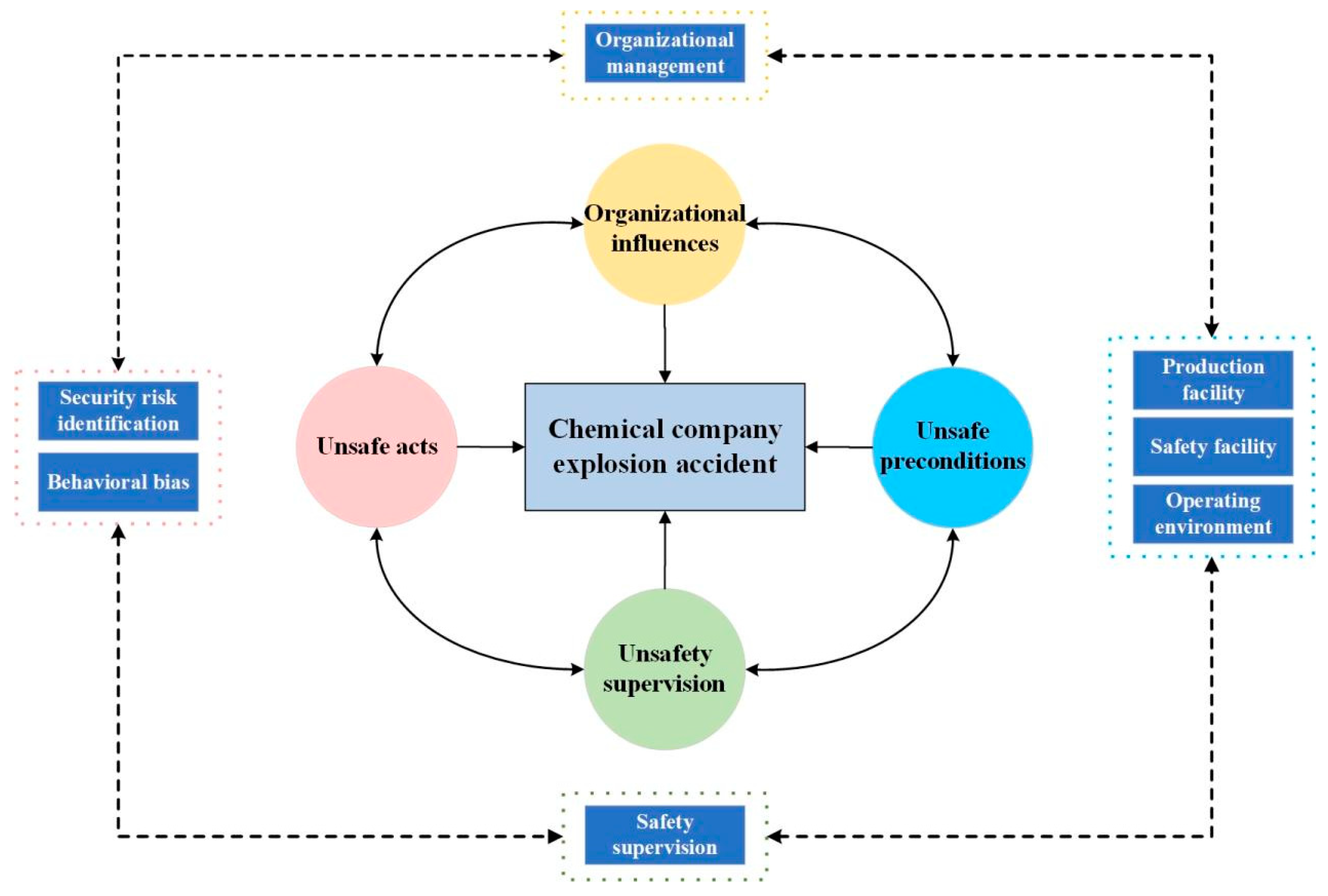
The REASON model, commonly referred to as the ‘Swiss cheese model’, was developed in 1990 by James Reason, a professor at the University of Manchester, to elucidate the mechanisms of risk events in complex systems [24]. This model comprises the following four levels: organizational influences, unsafe preconditions, unsafe supervision, and unsafe acts. Its internal logic highlights the cumulative effect of multiple levels of deficiencies. A deficiency at a single level may not necessarily lead to accidents; however, the simultaneous or sequential occurrence of deficiencies across multiple levels increases the likelihood of accidents. Accidents typically result from a combination of multiple failures and defects, often involving unsafe acts, hazardous physical conditions, and management shortcomings. The REASON model distinguishes between explicit and latent failures. Explicit failures refer to unsafe actions that directly cause accidents, while latent failures represent hidden hazards within an organization’s system that often go unnoticed until after an accident occurs. Owing to its robust explanatory power concerning accident causation, the REASON model has gained widespread application in fields such as coal mining, aviation, and healthcare. Yuan et al. [25] employed the REASON model to systematically explore the intrinsic mechanisms and influencing factors of human-caused accidents in coal mines. Zhao et al. [26] applied the REASON model as a foundation to analyze the causal factors of air accidents and the interlinkages among factors from the following four dimensions: human, machine, environment, and management. The REASON model is particularly well-suited for the analysis of chemical explosion accidents. Its multilevel analytical framework reveals the diversity and complexity of accident causation, aiding in a comprehensive understanding of the processes and causal chains involved in such incidents. First, the causal chain present in the REASON model emphasizes the reduction of the event itself. This paper focuses on the influencing factors and configurational pathways related to chemical enterprise explosion accidents, aligning with this perspective by examining the underlying causes of these events. Second, the REASON model highlights the collective impact of multilevel organizational deficiencies, indicating that a single factor may not trigger an accident; rather, latent hazards accumulate over time through long-term evolution. Chemical explosion accidents result from the interplay of various factors, including organizational, managerial, human, and technical elements. Finally, the REASON model demonstrates the complete process, from the initial latent failure to the eventual overt failure, and its evolutionary trajectory. Although chemical explosion accidents are often perceived as sudden occurrences, they are, in fact, the result of a gradual progression of latent failures that have not yet manifested into explicit failures.
Furthermore, the fundamental logic of the REASON model, along with the conceptual framework of qualitative comparative analysis (QCA), underscores that an outcome’s occurrence results not from a single factor, but from a combination of various antecedent conditions. Thus, this study employs the REASON model in conjunction with accident cases and fsQCA analysis to formulate a framework for analyzing the causes of explosion accidents in chemical companies. The framework selects conditional variables from the following four dimensions—organizational influences, unsafe preconditions, unsafe supervision, and unsafe acts—as illustrated in Figure 1.
Figure 1. Analysis framework of chemical company explosion accident causes based on the REASON model.

3. Analysis of the Causes of Explosions in Chemical Company

3.1. Methods

QCA is a research methodology developed by American sociologist Charles Ragin [27]. Grounded in set theory and Boolean algebra, it seeks to explore the causal relationships underlying complex phenomena. In contrast to traditional linear regression analysis, which centers on a single cause–effect relationship, QCA highlights concurrent and asymmetric causal relationships amongst multiple factors. In cross-case comparisons, this method ascertains the impact of multiple combinations of conditional variables on the outcome variables, and methodically interprets the complex causal relationships underpinning the phenomenon. QCA can be categorized into the following three types—clear set qualitative comparative analysis (csQCA), multivalued set qualitative comparative analysis (mvQCA), and fuzzy set qualitative comparative analysis (fsQCA)—based on the variable type [28]. This study employs fsQCA to examine the factors and pathways leading to chemical company explosion accidents. The rationale is as follows: (1) fsQCA is more apt for handling continuous variables, with an emphasis on the impact of changes in antecedent conditions on the results. This approach can effectively mitigate the endogeneity inherent in traditional correlation analysis, sampling bias in traditional hypothesis testing, and information loss during the data transformation process. (2) Chemical company explosion accidents result from a variety of factors, featuring intricate and complex relationships, both linear and nonlinear. The fsQCA method can effectively elucidate the impact of interactions among these factors on the outcomes. (3) The fsQCA method, requiring fewer cases, offers a considerable advantage in analyzing small and medium samples.
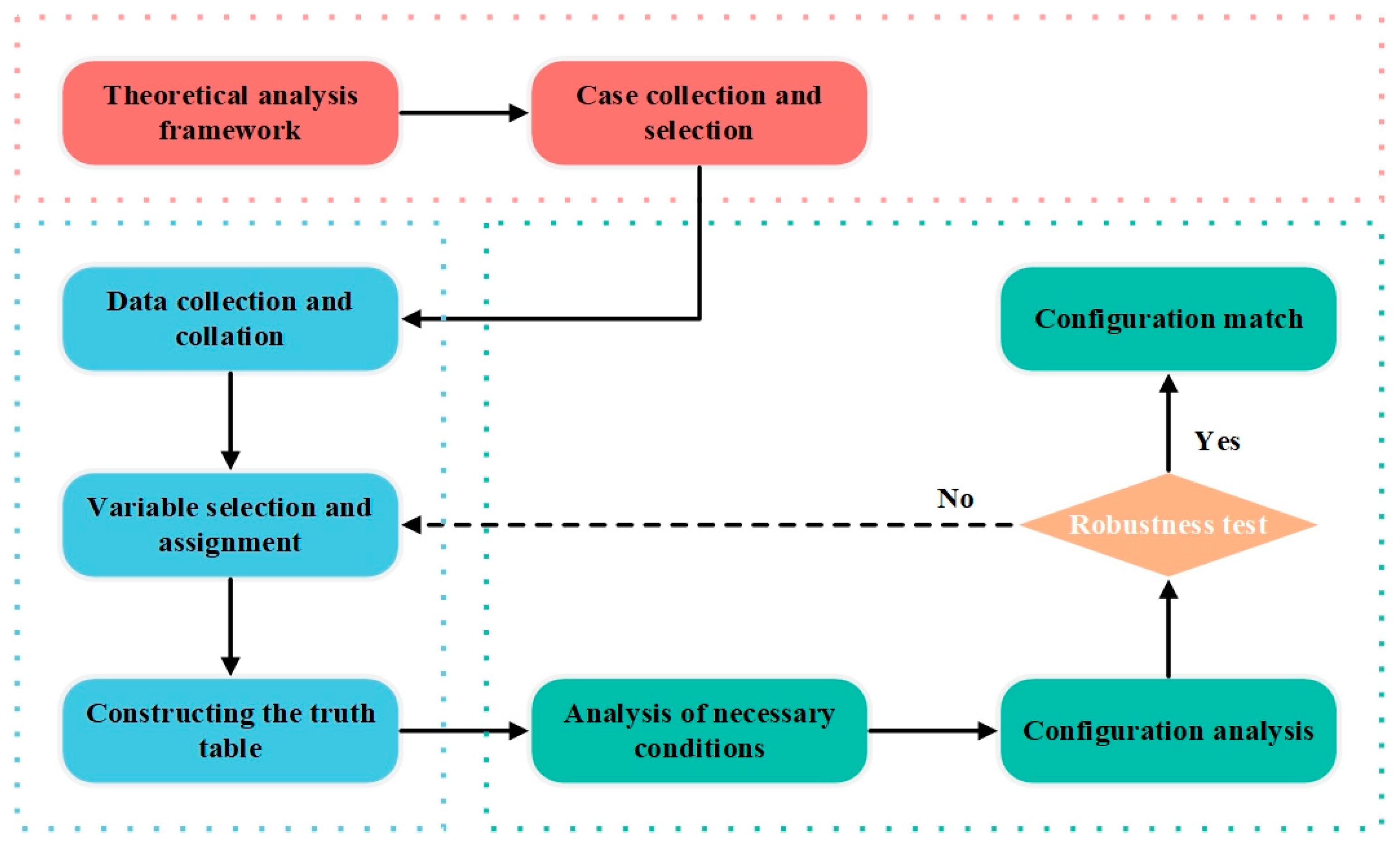
The fsQCA method encompasses three main steps. Firstly, identify the outcome and antecedent variables that are in line with the research purpose and select appropriate case samples. Secondly, gather and calibrate data for each case sample and construct a truth table. Finally, perform fuzzy set analysis on the truth table to evaluate the necessity of each conditional variable, proceeding to conditional variable configuration analysis. Consistency assesses whether each configuration is a sufficient and necessary condition for the outcome variable, and coverage evaluates the explanatory power of each configuration regarding the outcome variable. The procedure of the fsQCA method is illustrated in Figure 2.
Figure 2. Process of the fsQCA method.

3.2. Case Selection

The sample case data for this study were sourced from the official website of China’s Ministry of Emergency Management (MEM), the Safety Management Network (SMN), and the official websites of local governments. These sources provided investigation reports of explosions in chemical companies, which primarily involved traditional chemical companies within the chemical, petrochemical, and metallurgical industries. In the selection process of sample cases for explosion accidents in chemical companies, this study adhered to three principal criteria—diversity, comparability, and data accessibility—to ensure the representativeness and scientific validity of the selected cases. Firstly, the principle of diversity was employed to compile a case library that includes a broad spectrum of causes and varying degrees of severity in accidents, thereby ensuring the comprehensiveness and depth of the research. The diversified cases unveiled the complexities of explosion accidents within the chemical industry, providing a wealth of perspectives for understanding the varied factors leading to such accidents. Secondly, by maintaining consistency and diversity among the cases, their comparability was enhanced, which in turn facilitated more thorough analyses and comparisons. Finally, considering the rigorous demands of QCA for data completeness and reliability, this study emphasized the accessibility of case information, thereby ensuring the validity and transparency of the research findings.
A case base of 30 chemical explosion accidents was established through logical review and screening of information sourced from various channels. The sample cases are presented in Table 1.
Table 1. Sample cases of chemical company explosion accidents.

3.3. Variable Selection and Assignment

Drawing on the framework of causative analysis of explosion accidents in chemical companies, and with reference to the extant literature for summarizing the influencing factors, seven condition variables and one outcome variable were delineated from the following four dimensions: organizational influences, unsafe preconditions, unsafe supervision, and unsafe acts. Correspondingly, factor variables were established. In accordance with the fsQCA method, the sample data must be transformed into fuzzy sets within the range from 0 (non-subordinate) to 1 (fully subordinate), prior to undertaking qualitative comparative analysis of fuzzy sets [26]. The variables under consideration in this study are continuous variables that represent the degree, and thus the four-part assignment method in QCA, namely the four-value fuzzy set (1 = fully subordinate; 2/3 = partially subordinate; 1/3 = partially non-subordinate; 0 = completely non-subordinate), was employed. Subsequently, interval or scale variables must be converted into a fuzzy set in order to align with external standards. This method allows for the capture of subtle differences between variables in greater detail, thereby facilitating a more nuanced understanding. The research variables and assignment rules are presented in Table 2.
Table 2. Variables and assignment rules.
The outcome variable was as follows: The consequences of accidents were selected as the outcome variable in this study. In accordance with the Regulations on the Reporting and Investigation of Production Safety Accidents issued by the State Council of China in 2007, chemical accidents are classified into four grades—ordinary, serious, major, and particularly major—based on the number of casualties and the extent of property damage. The criteria for accident classification are detailed in Table 3.
Table 3. Accident classification criteria.
Conditional variable 1 comprises organizational factors. Organizational management is selected as a conditional variable. Safety accidents frequently stem from poor organizational management [29]. Problems with organizational management, including inadequate management systems, command violations, insufficient safety training, as well as unclear job responsibilities and processes, elevate the risk of chemical accidents.
Conditional variable 2 comprises unsafe preconditions. Unsafe preconditions are defined as loopholes or defects in chemical production that can lead to accidents or hazards. The production equipment, safety facilities, and operating environment have been selected as conditional variables. In chemical companies, safe production necessitates compliance with production equipment and process standards, along with the assurance of reliability and safety [30]. Accidents are prone to occur due to design defects, improper maintenance, aging damage, and other issues related to production equipment and processes. Safety protection facilities constitute an effective means of preventing accidents, decreasing the probability of accidents, and minimizing accidental injuries. The chemical industry is characterized by extreme temperatures (high or low), high pressure, flammability, and explosiveness, and requires stringent standards for the working environment [31]. Accidents can be induced by factors such as a dirty working environment, cramped spaces, inadequate lighting, extreme temperatures, and high humidity, among others.
Conditional variable 3 comprises unsafe supervision. Unsafe supervision is defined as the insufficient management and oversight of environments fraught with potential risks, hazards, or unsafe factors in work, production, or management contexts. Safety supervision has been selected as a conditional variable. The absence of adequate safety supervision is identified as the primary reason behind the frequent occurrence of safety accidents in chemical companies [32]. A number of accident cases have demonstrated that the absence or inadequacy of government supervision is hidden behind the occurrence of chemical accidents.
Conditional variable 4 comprises unsafe acts. Unsafe acts refer to actions potentially leading to danger, accidental injury, or undesirable consequences, stemming from employees’ misperception of production risks or operational errors within specific environments or scenarios. The study identified safety risk identification and behavioral deviation as conditioning variables [33]. Accurate risk identification is crucial for ensuring chemical safety during production. Timely detection of potential risks enables effective early warning and preventive measures, thereby reducing the likelihood of accidents. Furthermore, human behavioral errors constitute a significant cause of explosion accidents in chemical companies [34]. For instance, operational errors can arise from employees’ lack of training, prolonged hours of work under pressure, and fatigue. Additionally, a lack of safety awareness among employees, habitual violations, non-compliance with safety requirements and operating procedures, and engaging in illegal operations, among others, may result in accidents.

3.4. Results and Discussion

3.4.1. Analysis of the Necessary Conditions for Chemical Explosion Accidents

Before conducting the configuration analysis in this paper, it is necessary to perform a necessity test on the conditional variables that affect explosion accidents in chemical plants and determine whether each condition is a necessary condition for the results. Consistency and coverage serve as critical indicators in this assessment. The formulae for calculating consistency and coverage are as follows:
C o n s i s t e n c y ( X i Y i ) = [ m i n ( X i , Y i   ) ] / X i  
C o n v e r a g e ( X i Y i ) = [ m i n ( X i , Y i   ) ] / Y i
When the consistency exceeds 0.9, a conditional variable may be considered necessary for the outcome variable. Coverage denotes the explanatory power of the conditional variable X over the outcome variable Y, wherein a higher value signifies stronger explanatory power [35]. Utilizing fsQCA 3.0 for the analysis of each conditional variable, the test results are presented in Table 4. The results reveal that the consistency levels for the conditions of organizational management, safety supervision, and safety risk identification surpass the critical threshold of 0.9. Hence, these three factors may be essential for explaining the occurrence of explosion accidents in chemical companies. Referencing Schneider and Wagemann’s [36] discourse on validating necessary conditions, the X-Y scatterplot test demonstrates that most case points for the security risk identification condition variables cluster on the right-hand side near the Y-axis, and its coverage is less than 0.5, indicating that the condition fails the triviality test. Thus, identifying security risks as a conditional variable does not qualify as a necessary condition for the outcome variable. The consistency levels for both condition variables, safety supervision and organizational management, exceeded 0.9. However, their coverage was insufficiently high to regard them as separate influencing conditions. Further analysis is required to understand the grouping effects of the different condition variables.
Table 4. Results of single-conditional variable analysis.

3.4.2. Analysis of Conditional Configurations for Chemical Explosion Accidents

To ensure the reliability of the research findings, establishing the frequency threshold value and the consistency threshold value prior to performing the conditional combination analysis is essential. This study utilizes a sample size of 30, falling within the range of small- to medium-sized samples. Drawing on related studies [37,38], this study established a frequency threshold of 1 and a consistency threshold of 0.8. The fsQCA 3.0 software is employed to conduct standardized analysis, yielding the following three types of solutions: complex, intermediate, and parsimonious. These three solutions exhibit distinct strengths and weaknesses. The complex solution, intricate in nature, excludes counterfactual combinations. The parsimonious solution is straightforward, yet may overlook significant variables. The intermediate solution melds the advantages of the first two and incorporates logical residuals aligned with theoretical or practical knowledge. Thus, this study concentrates on the intermediate solution, integrating it with the parsimonious solution for analysis. Core conditions are identified by examining the nesting relationship between the parsimonious and intermediate solutions, where core conditions are present in both, whereas auxiliary conditions only appear in the intermediate solution. The findings of the conditional configuration analysis are presented in Table 5. The conditional configuration analysis results in Table 5 reveal five configuration paths for chemical company explosion accidents. The total consistency, at 0.890, exceeds the critical threshold of 0.8, confirming the reliability and validity of the empirical analysis. This indicates that each of the five configuration paths constitutes a sufficient condition for the occurrence of chemical explosion accidents. With a total coverage of 0.757, these configuration paths account for approximately 76% of chemical company explosion accident cases. Based on core conditions, the configuration paths classify into the following three types: organizational management deficiency, supervision deficiency, and behavior–risk linkage.
Table 5. Results of conditional variable combination analysis.
(1)
Organizational management deficiencies type.
The core conditions of both configuration path 1 and configuration path 5 are organizational management deficiencies, indicating that organizational management deficiencies play a crucial role in the occurrence of explosion accidents in both paths, leading to their classification as the same type. The formula for configuration path 1 is expressed as OM*~PF*~OE*SS*SRI*~BD. This configuration path represents scenarios where, despite the absence of issues related to production equipment, operating environment, and behavioral deviations, chemical plant explosion accidents can still occur due to severe deficiencies in organizational management, inadequate safety supervision, and failures in safety risk identification. This configuration path accounts for approximately 36.2% of accident cases. Case S18 (Hubei Province, Tianmen Chutian Biotechnology Co., Ltd. “9–28” explosion) is a representative case of this pathway. Chutian Biological Company experiences disorganization and management issues in their daily production activities. The safety organization structure is incomplete, and safety production regulations and operating procedures are inadequate. Furthermore, there is insufficient risk awareness regarding the replacement of the experimental plate and frame filter press, resulting in unauthorized experiments. The Tianmen Emergency Management Bureau and the local government had blind spots and loopholes in production safety supervision and management. They failed to detect and address the company’s violations promptly, which ultimately led to the explosion. The formula for configuration path 5 is expressed as OM*PF*SF*~OE*SS*~SRI*~BD. This configuration path indicates that chemical plant explosion accidents can occur even in the absence of issues related to the operating environment and behavioral deviations, when there are severe deficiencies in organizational management, problems with production equipment, a lack of safety facilities, and inadequate safety supervision. Configuration path 5 covers approximately 12% of the cases. The typical case of this path is S2 (Tangshan Kailuan Chemical Co., Ltd. “3–7” major explosion accident). The safety management at the Kailuan Chemical Company was inadequate, and production safety regulations were not properly enforced. Furthermore, the equipment used for producing emulsion explosives had significant design defects, and the protective facilities used to ensure production safety were inadequate. Coupled with the inadequate safety inspection of the Kailuan Chemical Company by the Tangshan City Bureau of Industry and Information Technology, the local government’s supervision and management were ineffective. These issues, combined, ultimately led to a major explosion.
(2)
Supervision deficiency type.
The safety facilities and safety regulations are the core conditions shared by configuration path 2 and configuration path 3. The formula for configuration path 1 is expressed as OM*~PF*SF*SS*SRI*~BD. This configuration path accounts for approximately 30.2% of accident cases. The formula for configuration path 2 is expressed as OM*~PF*SF*~OE*SS*SRI. Configuration path 3 covers approximately 30.2% of the cases. Configuration path 2 and configuration path 3 are analyzed together because they share similar paths and cover some of the same cases. According to configuration paths 2 and 3, it is shown that if there are defects in organizational management, a serious lack of safety facilities, and ineffective safety supervision, as well as incorrect identification of safety risks and other factors, it will lead to chemical explosion accidents despite there being no defects in production equipment and processes, and despite compliance in production operations. Typical representative cases of these two pathways include S9 (Hebei Zhangjiakou China National Chemical Corporation Shenghua Chemical Company “11–28” major deflagration accident), S10 (Jiangsu Tianjia Yihua Co., Ltd. “3–21” particularly significant explosion accident), S23 (Hubei Xianlong Chemical Co., Ltd. “2–26” large explosion accident), and so on. These cases show significant similarities in the causal pathways of chemical explosion accidents, especially in the high level of a lack of safety facilities and deficiencies in safety supervision, both of which play a key role in the occurrence of explosion accidents. Insufficient safety investment, as well as a lack of safety guards, monitoring instruments, and interlocking devices are common in these typical cases. This results in the inability to implement emergency stops or troubleshoot in the event of production abnormalities, leading to accidents. In addition, government regulation is closely related to the safe production behavior of companies. The negligence of the regulatory authorities in this case, lax safety inspections, inaccurate risk management and control, failure to implement regulatory responsibilities, and an ineffective crackdown on illegal acts also became important factors contributing to the escalation of safety hazards into accidents.
(3)
Behavioral–risk linkage type.
The corresponding path for this type is configuration path 4 in Table 5. The formula for configuration path 2 is expressed as OM*PF*OE*SS*SRI*BD. It has high production equipment defects, a poor working environment, and serious behavioral deviations as its core conditions, which can cover about 15.2% of cases. Configuration path 4 exhibits the characteristic of behavior–risk linkage, where the factors of the unsafe premise dimension and the unsafe behavior dimension together serve as the core conditions for the occurrence of chemical explosion accidents. This path indicates that chemical plant explosion accidents can occur under the circumstances of inadequate organizational management, severe defects in production equipment, a poor work environment, insufficient safety supervision, failure in risk identification, and significant behavioral deviations by employees. The S7 (Jiangsu Lianyungang Juxin Biotechnology Co., Ltd. “12–9” major explosion) and S8 (Yibin Hengda Technology Co., Ltd. in Sichuan Province, “7–12” major explosion) are typical representative cases of configuration path 4. The common problem presented by these cases is that there are serious problems with the production equipment, production environment, and employee production behavior of the companies. The dichlorobenzene production unit and process in the production workshop of Juxin Biotechnology Co., Ltd. did not have a formal technical source or scientific design. Additionally, the company did not commission a professional organization to carry out process calculations and safety assessments, leading to serious safety hazards. The design and construction of the plant were put into use without the completion acceptance of the construction project, and the risk control facilities were seriously lacking, failing to meet the requirements of a safe production environment. Workshop operators were unlicensed and generally lacked basic knowledge of chemical production safety and basic operating skills. They canceled the rupture discs of the holding kettle and changed the pressurized material medium without authorization, and failed to strictly implement the process standards and take correct emergency response measures. These factors led to the explosion accident, resulting in ten deaths, one person injured, and direct economic losses of 48.75 million yuan. Yibin Hengda Science and Technology Co., Ltd. did not have a formal design for their production processes and devices. Production tests for imazethapyr and 1,2,3-triazole were conducted directly on industrial devices without automatic control and process safety interlocks, which created a significant safety hazard. In addition, the company’s production environment did not meet safe production conditions. Unauthorized changes were made to the arrangement and quantity of equipment, and the height of the workshop floor was adjusted. The selection and installation of equipment, piping, and process piping were all determined based on the company staff’s experience, and proceeded without recalibration or design changes. The production workshop lacked anti-corrosion treatment, did not meet the second-class standard for fire resistance, and had inadequate safety equipment, which failed to meet the necessary safety requirements for the production of imazethapyr and 1,2,3-triazole. Production workers were unlicensed, unqualified, and unaware of the safety hazards associated with the production process. Workers did not carefully inspect incoming raw materials and mistakenly treated sodium chlorate as butyramide. As a result, production personnel mistakenly placed sodium chlorate, which was not labeled as butyramide, into the 2R301 vessel to conduct dewatering operations, which ultimately resulted in a chemical explosion. The high-temperature toluene vapor generated by the explosion quickly formed an explosive mixture with the outside air, and caused a secondary explosion. This resulted in the explosion and combustion of sodium chlorate, toluene, and methanol stored at the workshop site. The fire and combustion spread to the second and third workshops, causing significant casualties and property damage.

3.4.3. Robustness Test

Existing studies typically employ the following three methods for robustness testing: altering the calibration point, adjusting the consistency threshold, and adding or removing cases. This study conducted a robustness test by randomly removing cases and elevating the consistency threshold, which is in line with related studies [36]. The consistency threshold was raised from 0.8–0.85 and inputted again into the fsQCA3.0 software for recalibration. The results of the configuration robustness test are shown in Table 6. A comparison of the grouping results and corresponding parameters before and after the operation revealed that the analysis outcomes for each grouping were substantially similar to the existing results. Furthermore, the outputs of the five grouping paths aligned with the existing conclusions, satisfying the criteria for the QCA robustness test. Based on the aforementioned test, the findings of this study are both robust and reliable.
Table 6. Results of configuration robustness tests.

4. Measures to Prevent Chemical Explosion Accidents

Based on the findings of this study, this paper outlines recommendations in three key areas—company management, government supervision, and employee training—aimed at reducing the incidence of explosion accidents in chemical plants.
Chemical companies must rigorously manage their operations and assign primary responsibility for production safety. First, companies must enhance their production safety management and responsibility systems, their production safety organizational structures, and establish and refine their production safety rules and procedures. Second, it is imperative to bolster institutional management, delineate the safety responsibilities of managers and employees at all levels, and augment the supervision and evaluation of safety responsibilities. Yuan et al. also assert that enterprises bear primary responsibility for chemical accidents, and should strive to mitigate unsafe actions and conditions by refining their safety management systems, establishing comprehensive management protocols, and implementing rigorous inspection routines [39]. Additionally, enhancing the self-monitoring and management of concealed safety hazards and risks is crucial. This objective can be realized by conducting a comprehensive risk assessment of the overall process and production stages, pinpointing concealed hazards and risk points, and concentrating on stages that may precipitate major accidents. Effective measures must be implemented to control, promptly detect, and issue early warnings for potential safety risks, thereby ensuring that accidents are preempted. To guarantee the uninterrupted operation of equipment, it is essential to fortify the management of production equipment and safety facilities. Regular equipment overhauls and maintenance must be conducted to ensure the safety and reliability of the equipment.
Strengthening the safety supervision capacity and consolidating supervisory responsibilities are another priority. Safety regulation is one of the most crucial external factors in chemical accidents, necessitating stricter supervision and more frequent inspections of enterprises [40]. In ensuring the safety of the chemical production sector, both the government and relevant industry sectors play a critical role. First, the government and its regulatory agencies must cultivate a mindset of bottom-line thinking and red-line awareness, proactively preventing and addressing potential safety hazards in the chemical industry within their jurisdiction. By clearly defining supervisory responsibilities and establishing a comprehensive accountability system, it is possible to effectively encourage all levels of government departments and industry managers to strictly fulfill their safety regulatory duties, ensuring that measures for the safe production of chemicals are effectively implemented. Second, by combining governmental territorial supervision with industrial supervision, efforts in safety supervision and law enforcement have been intensified, focusing on the investigation and remediation of concealed safety hazards. Furthermore, chemical companies within the administrative area are managed hierarchically. Comprehensive investigations are conducted to identify potential safety hazards across areas including rules and regulations, safety training, process equipment, and special operations. Companies are urged to rectify and enhance safety measures, improve processes and safety facilities, and suspend production for rectification upon violation of laws and regulations. Zhang et al. also propose a tiered classification system (categorized as red, orange, and blue) for hazardous chemical production enterprises, emphasizing enhanced supervision and management of key enterprises and regions [15]. Lastly, bolstering the development of specialized regulatory forces and recruiting talent through various channels are crucial for enriching the safety supervision and law enforcement teams. Enhancing training for supervision and law enforcement within the business sector is imperative to improve the capacity of personnel in identifying issues and concealed dangers, and in preventing and mitigating significant safety risks.
Enhancing employee safety awareness through improved safety education and training is crucial. Initially, companies should develop a comprehensive safety education program, tailored to their specific safety risks and characteristics. This program should include systematic safety knowledge training for workers in different positions, encompassing safety operation procedures, identification and control of hazardous sources, emergency response to accidents, and the proper use of personal protective equipment. Such training aims to enhance workers’ safety operation skills and professionalism in safety production. Through practical operations and simulated emergency drills, employees can gain a comprehensive understanding of the safety risks associated with their workplaces and roles. This approach not only enhances workers’ safety awareness, but also equips them with relevant precautionary and emergency response measures, thereby improving their ability to cope with emergencies and react promptly. Chen et al. also point out the necessity for enterprises to intensify their investments in safety education and training, with the aim of enhancing the safety awareness of both corporate management and employees, and modifying their safety attitudes and behaviors [41]. Secondly, governments and relevant departments can further enhance workers’ safety awareness and participation by intensifying safety education and publicity campaigns. These initiatives may encompass safety knowledge competitions, safety experience exchange meetings, and safety month activities, among other efforts. By establishing comprehensive incentive mechanisms, including safety award schemes and commendation systems, it is possible to stimulate the enthusiasm and initiative for safe production among employees and companies. Individuals and businesses actively participating in safety training and implementing safety measures ought to be recognized and rewarded, whereas those violating safety regulations ought to face penalties. Lastly, from the employees’ perspective, cultivating a correct mindset, enhancing safety consciousness, strictly adhering to safety production protocols, proactively learning to improve safety operation skills and professional competence, and eliminating illegal and non-compliant behaviors are crucial.

5. Conclusions

This paper has examined 30 investigation reports on chemical company explosion accidents occurring between 2013 and 2022. The REASON model is combined with the fsQCA method to explore the multivariate causal pathways of these accidents. The research findings are presented below.
(1) The occurrence of explosion accidents in chemical enterprises is the result of the synergistic action of multiple dimensional influencing factors. Individual conditions do not constitute standalone causes for such accidents in chemical enterprises; instead, each configuration pathway involves more than two conditional variables. Explosion accidents in chemical enterprises are influenced by the coupling effects of factors such as organizational management, production equipment, safety facilities, working environment, safety supervision, risk identification, and production operation behaviors across different times and spaces. This aligns with the research conducted by Sadeghi et al., which posits that chemical accidents are the comprehensive outcomes of multiple factors and related variables (e.g., human error, equipment failure, and management decisions) [40]. This further elucidates the complex causal system of explosion accidents, necessitating a comprehensive consideration of multiple factors and a multifaceted approach to governance in order to effectively reduce the risk of accident occurrence.
(2) The causal pathways leading to explosions in chemical enterprises are characterized by “multiple concurrent causes” and “divergent paths converging on a common outcome”. The results of the combination of conditions show that there are five causal group paths for the occurrence of chemical company explosion accidents, each of which consists of a different combination of conditions, with significant heterogeneity among the paths. These group paths can be divided into the following three types, according to the core conditions: organizational management defects (path 1 and path 5), supervision deficiencies (path 2 and path 3), and behavioral–risk linkage (path 4). This suggests that explosion accidents are the result of multiple factors interacting at different levels, with multiple concurrent causal relationships and multiple causal pathways.
(3) All five configurational pathways include the following two condition variables: organizational management and safety supervision. In the analysis of 30 explosion accidents, 14 cases (approximately 47%) had direct associations with organizational management deficiencies, such as incomplete safety management systems and a lack of emergency plans; concurrently, 19 cases (approximately 63%) involved lapses in safety supervision, including inadequate regulatory oversight and insufficient inspections. This indicates that deficiencies in organizational management and the absence of safety supervision have a direct and significant impact on the occurrence of explosion accidents in chemical companies. To prevent such accidents, targeted measures must be adopted to enhance both organizational management and safety supervision capabilities.

6. Limitations and Future Research

This study is primarily based on published reports of explosion accidents and the existing literature. While these sources provide a substantial amount of information, they lack first-hand data obtained through field research, which may potentially compromise the accuracy and reliability of the findings to some extent. Consequently, further field research will be conducted in future studies to obtain primary data on safety management, employee behavior, and accident sites in chemical companies. This will be achieved through interviews, questionnaires, and on-site observations. The data will assist in the validation and supplementation of the causal analysis framework and research conclusions proposed in this study, thereby enhancing the accuracy and practicality of the study.

Author Contributions

C.W.: conceptualization, methodology, validation, resources, writing—original draft preparation, writing—review and editing, supervision, and funding acquisition. B.L.: conceptualization, methodology, software, validation, investigation, data curation, writing—original draft preparation, writing—original draft preparation, and project administration. R.S.: validation, formal analysis, writing—original draft preparation, and writing—review and editing. All authors have read and agreed to the published version of the manuscript.

Funding

This work was supported by the Social Science Youth Foundation of Ministry of Education of China (Grant No. 23YJC630173); the Humanity and Social Science Youth Foundation of Ministry of Education of China (Grant No. 21YJC630115); the Humanity and the Social Science Foundation of Jiangsu Province (Grant No. 23GLC006); and the Basic Research Funds Project of China University of Mining and Technology (Grant No. 2022SK09).

Institutional Review Board Statement

Not applicable.

Data Availability Statement

The data and models used during the study are available from the corresponding author upon request.

Conflicts of Interest

The authors declare no conflicts of interest.

References

  1. Bai, M.; Qi, M.; Shu, C.M.; Reniers, G.; Khan, F.; Chen, C.; Liu, Y. Why do major chemical accidents still happen in China: Analysis from a process safety management perspective. Process Saf. Environ. Prot. 2023, 176, 411–420. [Google Scholar] [CrossRef]
  2. Yang, R. Analysis of production safety accidents in chemical companies from 2000 to 2020. Plast. Ind. 2023, 51, 17–22+78. [Google Scholar]
  3. Darbra, R.M.; Palacios, A.; Casal, J. Domino effect in chemical accidents: Main features and accident sequences. J. Hazard. Mater. 2010, 183, 565–573. [Google Scholar] [CrossRef] [PubMed]
  4. Wang, B.; Wu, C.; Reniers, G.; Huang, L.; Kang, L.; Zhang, L. The future of hazardous chemical safety in China: Opportunities, problems, challenges and tasks. Sci. Total Environ. 2018, 643, 1–11. [Google Scholar] [CrossRef]
  5. Zhou, K.; Xiao, L.; Lin, Y.; Yuan, D.; Wang, J. A statistical analysis of hazardous chemical fatalities (HCFs) in China between 2015 and 2021. Sustainability 2022, 14, 2435. [Google Scholar] [CrossRef]
  6. Yalcin, E.; Ciftcioglu, G.A.; Guzel, B.H. Human factors analysis by classifying chemical accidents into operations. Sustainability 2023, 15, 8129. [Google Scholar] [CrossRef]
  7. Jung, S.; Woo, J.; Kang, C. Analysis of severe industrial accidents caused by hazardous chemicals in South Korea from January 2008 to June 2018. Saf. Sci. 2020, 124, 104580. [Google Scholar] [CrossRef]
  8. Wang, H.; Wei, L.; Wang, K.; Duo, Y.; Chen, C.; Zhang, S.; Su, M.; Zeng, T. Exploring human factors of major chemical accidents in China: Evidence from 160 accidents during 2011–2022. J. Loss Prev. Process Ind. 2024, 89, 105279. [Google Scholar] [CrossRef]
  9. Wang, J.; Fu, G.; Yan, M. Investigation and analysis of a hazardous chemical accident in the process industry: Triggers, roots, and lessons learned. Processes 2020, 8, 477. [Google Scholar] [CrossRef]
  10. Gonyora, M.; Ventura-Medina, E. Investigating the relationship between human and organisational factors, maintenance, and accidents. The case of chemical process industry in South Africa. Saf. Sci. 2024, 176, 106530. [Google Scholar] [CrossRef]
  11. Niciejewska, M.; Idzikowski, A.; Škurková, K.L. Impact of technical, organizational and human factors on accident rate of small-sized enterprises. Manag. Syst. Prod. Eng. 2021, 29, 139–144. [Google Scholar] [CrossRef]
  12. Cheng, C.W.; Yao, H.Q.; Wu, T.C. Applying data mining techniques to analyze the causes of major occupational accidents in the petrochemical industry. J. Loss Prev. Process Ind. 2013, 26, 1269–1278. [Google Scholar] [CrossRef]
  13. Kidam, K.; Hurme, M. Analysis of equipment failures as contributors to chemical process accidents. Process Saf. Environ. Prot. 2013, 91, 61–78. [Google Scholar] [CrossRef]
  14. Wang, B.; Li, D.; Wu, C. Characteristics of hazardous chemical accidents during hot season in China from 1989 to 2019: A statistical investigation. Saf. Sci. 2020, 129, 104788. [Google Scholar] [CrossRef]
  15. Zhang, Z.C.; Sun, X.; Li, Y.F.; Zhu, X.D. Analysis on the spatial and temporal change of chemical accidents and its suggestions: A case study in coastal areas of Jiangsu Province. China Saf. Sci. J. 2010, 20, 129–135. [Google Scholar]
  16. Dakkoune, A.; Vernières-Hassimi, L.; Leveneur, S.; Lefebvre, D.; Estel, L. Risk analysis of French chemical industry. Saf. Sci. 2018, 105, 77–85. [Google Scholar] [CrossRef]
  17. Jiang, W.; Li, Y.; Zhou, J.; Huang, Z.; Wu, Z. Comparative study of the hazardous chemical transportation accident analyses using the CREAM model and the 24 Model. Sustainability 2021, 13, 12923. [Google Scholar] [CrossRef]
  18. Ikwan, F.; Sanders, D.; Hassan, M. Safety evaluation of leak in a storage tank using fault tree analysis and risk matrix analysis. J. Loss Prev. Process Ind. 2021, 73, 104597. [Google Scholar] [CrossRef]
  19. Wang, J.; Fan, Y.; Niu, Y. Routes to failure: Analysis of chemical accidents using the HFACS. J. Loss Prev. Process Ind. 2022, 75, 104695. [Google Scholar] [CrossRef]
  20. Li, X.; Chen, C.; Yang, F.Q. Exploring hazardous chemical explosion accidents with association rules and Bayesian networks. Reliab. Eng. Sys. Saf. 2023, 233, 109099. [Google Scholar] [CrossRef]
  21. Gholamizadeh, K.; Alauddin, M.; Aliabadi, M.M.; Soltanzade, A.; Mohammadfam, I. Comprehensive failure analysis in Tehran Refinery Fire accident: Application of AcciMap methodology and quantitative domino effect analysis. Fire Technol. 2023, 59, 453–472. [Google Scholar] [CrossRef]
  22. Tian, Z.; Song, B.D. Causation chain analysis on explosion accident of chemical process based on HCNAM-BN. J. Saf. Sci. Technol. 2017, 13, 145–150. [Google Scholar]
  23. Xu, D.Y.; Wang, T.Y.; Liang, Y.Q.; Qu, L.N.; Li, P. Analysis on human factors of fire and explosion accidents in chemical companies based on HFACS. J. Saf. Sci. Technol. 2020, 16, 66–70. [Google Scholar]
  24. Reason, J. Human Error; Cambridge University Press: Cambridge, UK, 1990; pp. 1–19. [Google Scholar]
  25. Yuan, X.F.; Zhu, M.J. Analysis on influencing factors and configuration paths of human-caused accidents in coal mines. Saf. Coal Mines 2023, 54, 245–250. [Google Scholar]
  26. Zhao, L.Q.; Pan, J.; Zhang, Z.C. Effects of the interaction among civil aviation unsafe factors to air crash: A crisp-set qualitative comparative analysis of 45 cases. Sci. Technol. Eng. 2020, 20, 11809–11817. [Google Scholar]
  27. Fiss, P.C. Building better causal theories: A fuzzy set approach to typologies in organization research. Acad. Manag. J. 2011, 54, 393–420. [Google Scholar] [CrossRef]
  28. Bennett, A.; Elman, C. Qualitative research: Recent developments in case study methods. Annu. Rev. Polit. Sci. 2006, 9, 455–476. [Google Scholar] [CrossRef]
  29. Wang, J.; Fu, G.; Yan, M. Comparative analysis of two catastrophic hazardous chemical accidents in China. Process Saf. Prog. 2020, 39, e12137. [Google Scholar] [CrossRef]
  30. Gabbar, H.A.; Shinohara, S.; Shimada, Y.; Suzuki, K. Experiment on distributed dynamic simulation for safety design of chemical plants. Simul. Model. Pract. Theory 2003, 11, 109–123. [Google Scholar] [CrossRef]
  31. Vinodkumar, M.N.; Bhasi, M.J.S.S. Safety climate factors and its relationship with accidents and personal attributes in the chemical industry. Saf. Sci. 2009, 47, 659–667. [Google Scholar] [CrossRef]
  32. Xin, X. Research on Safety Regulation of chemical company under third-party mechanism: An evolutionary approach. Symmetry 2019, 11, 1057. [Google Scholar] [CrossRef]
  33. Theophilus, S.C.; Esenowo, V.N.; Arewa, A.O.; Ifelebuegu, A.O.; Nnadi, E.O.; Mbanaso, F.U. Human factors analysis and classification system for the oil and gas industry (HFACS-OGI). Reliab. Eng. Syst. Saf. 2017, 167, 168–176. [Google Scholar] [CrossRef]
  34. Kuselman, I.; Pennecchi, F.; Fajgelj, A.; Karpov, Y. Human errors and reliability of test results in analytical chemistry. Accredit. Qual. Assur. 2013, 18, 3–9. [Google Scholar] [CrossRef]
  35. Shi, R.; Lu, B.; Zhong, Y. Driving factors of urban community epidemic prevention and control capability: QCA analysis based on typical cases of 20 anti-epidemic communities in China. Front. Public Health 2024, 11, 1296269. [Google Scholar] [CrossRef]
  36. Schneider, C.Q.; Wagemann, C. Set-Theoretic Methods for the Social Sciences: A Guide to Qualitative Comparative Analysis; Cambridge University Press: Cambridge, UK, 2012; pp. 231–245. [Google Scholar]
  37. Zhou, F.; Fu, C. Generation paths of major production safety accidents—A fuzzy-set qualitative comparative analysis based on Chinese data. Front. Public Health 2023, 11, 1136640. [Google Scholar] [CrossRef]
  38. Zhang, X.; Lu, Y.; Huang, X.; Zhou, A. Research on the Effective Reduction of Accidents on Operating Vehicles with fsQCA Method—Case Studies. Appl. Sci. 2022, 12, 12737. [Google Scholar] [CrossRef]
  39. Yuan, C.H.; Shi, Y.Q.; Ma, Y.; Zhao, W.H.; Fu, G. Comparative study of systematic analysis on accident causes based on 24Model and accident investigation reports:taking Xiangshui explosion accident as an example. China Saf. Sci. J. 2022, 32, 48–55. [Google Scholar]
  40. Sadeghi, F.; Khoshmanesh zadeh, B.; Fatemi, F.; Gilani, N.; Alizadeh, S.S. Effective parameters on chemical accidents occurrence: Findings from a systematic review. J. Fail. Anal. Prev. 2020, 20, 1184–1191. [Google Scholar] [CrossRef]
  41. Chen, C.; Reniers, G. Chemical industry in China: The current status, safety problems, and pathways for future sustainable development. Saf. Sci. 2020, 128, 104741. [Google Scholar] [CrossRef]
Disclaimer/Publisher’s Note: The statements, opinions and data contained in all publications are solely those of the individual author(s) and contributor(s) and not of MDPI and/or the editor(s). MDPI and/or the editor(s) disclaim responsibility for any injury to people or property resulting from any ideas, methods, instructions or products referred to in the content.

Article Metrics

Citations

Article Access Statistics

Multiple requests from the same IP address are counted as one view.