

You are currently viewing a new version of our website. To view the old version click .
Sustainability
  • Article
  • Open Access

28 October 2024

Sustaining Teacher Education During COVID-19: Challenges with Remote Teaching and Learning Faced by Preservice Mathematics Teachers


,
,
and
1
Department of Mathematics Natural Science and Technology Education, Faculty of Education, University of the Free State, Bloemfontein 9301, South Africa
2
Mathematics Education Department, School of Education, University of KwaZulu-Natal, Edgewood Campus, Durban 4000, South Africa
3
Faculty of Culture and Society, School of Education, Auckland University of Technology, Auckland Campus, Auckland 1010, New Zealand
*
Author to whom correspondence should be addressed.
This article belongs to the Collection Education, Innovation and Training for Sustainable Development in the Context of COVID-19

Abstract

Education institutions worldwide implemented remote teaching and learning to ensure the sustainability of their academic programmes and continuity of study. However, evidence from the literature revealed that remote teaching and learning posed challenges to teaching and learning. This study seeks to explore whether there is a relationship between remote teaching and learning and the challenges faced by preservice mathematics teachers when learning mathematics education during COVID-19. It focuses on remote teaching at four universities: two in South Africa, one in Ghana, and one in New Zealand. The study design followed a quantitative research approach, with 95 preservice mathematics teachers from the four universities randomly assigned to complete an online survey after signing informed consent forms. This study revealed two challenging factors facing preservice mathematics teachers during remote teaching and learning: data, and technological devices for learning. The findings revealed no significant difference (p < 0.000) between remote teaching and learning and the challenges faced by preservice mathematics teachers when learning during the COVID era. Therefore, the null hypothesis is rejected, since p < 0.05. This study concludes that a significant relationship exists between accessibility to technological devices for learning as a challenge to preservice teachers and remote teaching and learning during COVID-19. It is recommended that appropriate technological devices are provided to assist preservice teachers to study mathematics education, thus ensuring continuing access to quality education.

1. Introduction

At the beginning of 2020, COVID-19 cases spread into many countries, prompting the World Health Organization to declare a coronavirus pandemic [1]. Each country tried to curb the spread within its borders through mandated lockdowns and social restrictions. These mandates affected educational institutions and their responsibility to students enrolled in tertiary programmes of study. To sustain the programmes and the integrity of teaching and learning, institutions responded by shifting their delivery mode from face-to-face to online; however, this led to many preservice teachers (PSTs) and teacher educators at universities in South Africa and worldwide experiencing challenges during remote teaching and learning. Most institutions lacked the necessary staff and resources to handle the unprecedented delivery of instruction online, and many students were both intellectually and practically unprepared for the shift to online learning [2]. Challenges included issues with resources such as computers and internet connectivity. Some PSTs reported frequent problems with internet quality, while others explained how rising demand was causing internet services to slow or even stop [3].
Teacher educators were forced to adapt and present their instruction online to ensure the continuity of teaching and learning during this time of crisis. König, Jäger-Biela, and Glutsch [3] state that teachers had to change to online teaching, which required them to use various digital tools and resources to solve problems and implement new approaches to teaching and learning. The emergence and threat of COVID-19 thus brought with it a set of challenges for teacher educators, students, and other stakeholders of higher education institutions.
According to Shim and Lee [4], teachers and students had difficulty adapting to the online teaching during COVID-19, identified in the literature as emergency remote teaching (ERT), since unlike the existing online learning, it did not have a planned class design. Zhang and Lin’s [5] study found five challenges that impede teachers in delivering instruction online. Firstly, teachers faced the challenge of effective instructional design for teaching and classroom management, and it was also hard to monitor students online. Teachers lacked adequate competence for teaching online, with some having challenges with online interaction, while others had issues with online interactive strategies as well as with monitoring students and engaging them in learning. Teachers recounted their challenges in assessing students online, as they could not find an effective way to carry out whole-class assessment or formative assessment because of limited instructional time. Online teaching increased teachers’ workload, since they spent a lot of time preparing multimedia lectures and may have had to offer additional offline individual or group tutoring. Finally, teachers highlighted that it was hard to meet all the learning needs of students in online spaces [5].
Contributing to the debate, Ning and Corcoran [6] averred that ERT made teachers powerless, as they found that not all students could or were willing to show up for online classes. The foregoing review made it clear that teachers’ shift from face-to-face delivery to online ERT because of the pandemic was met with some challenges, which affected PSTs being prepared to become practitioners after training. Researchers are exploring educators’ and PSTs’ experiences to determine how to improve current teaching and learning [7].
Studies on ERT during COVID-19 mostly focused on PSTs’ experiences [8,9], their readiness for ERT [10], and PSTs’ training during the pandemic [11]. Most of the literature reviews found some challenges associated with PSTs’ learning and training during the pandemic. For example, Ergulec and Eren found that PSTs were faced with pedagogical, technological, and socio-emotional challenges in the COVID-19 crisis era [8]. Sepúlveda et al. [11] posited that the lack of live communication between PSTs and their learners was one of the major challenges of online teaching practicum. However, to date, there is limited research on whether these identified challenges encountered by PSTs correlate with or depend on each other. This current study seeks to address this gap by exploring challenging factors faced by PSTs during ERT.

3. Theoretical Framework

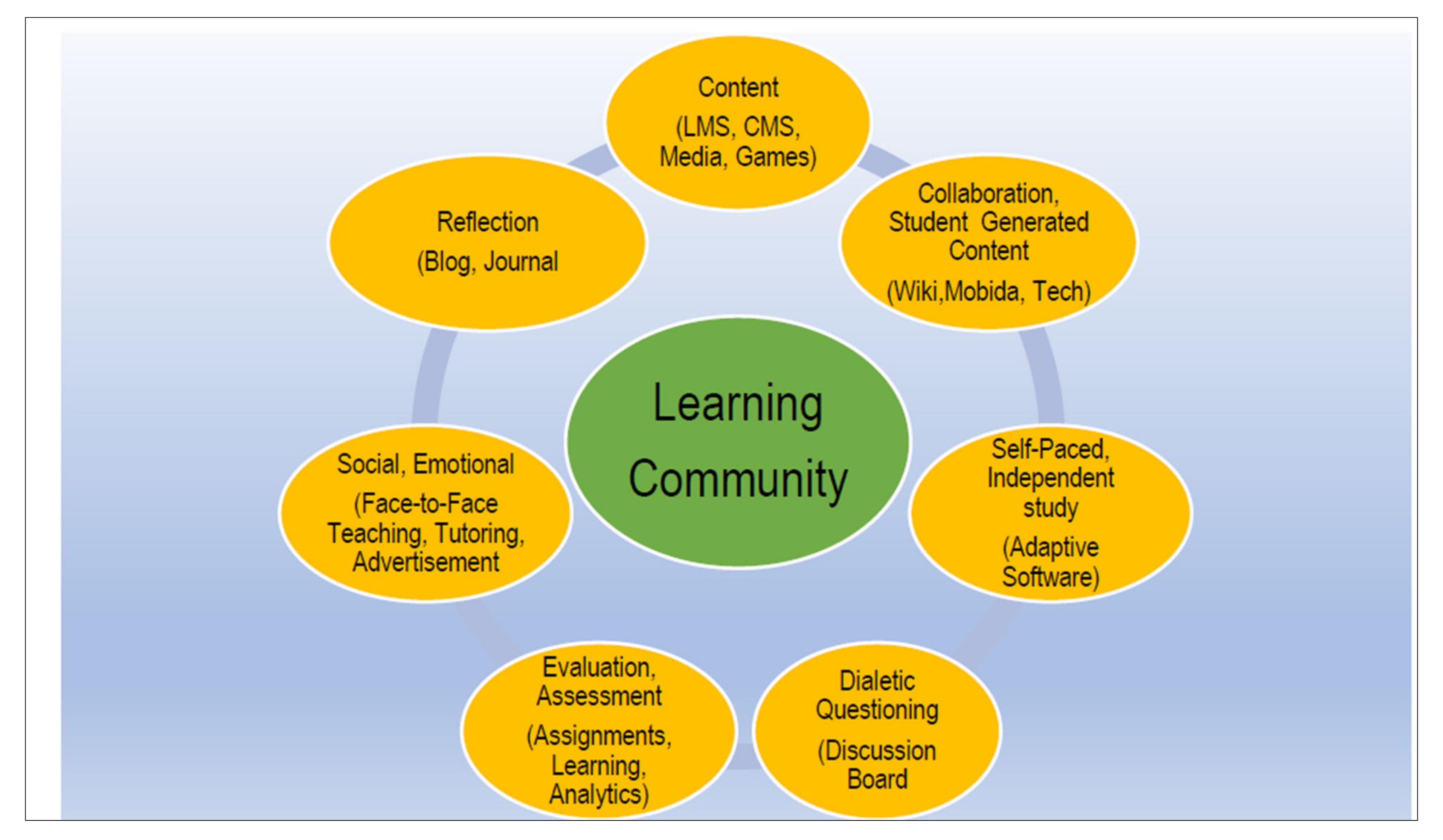
This study is framed within an integrated model of online/distance education of Picciano [23]. The model has seven components: content; collaboration and student-generated content; self-paced, independent study; dialectic questioning; evaluation assessment; social and emotional; and reflection. Drawing from the seven components, we focused on the challenges experienced by pre-service mathematics teachers during remote teaching. In his description of the model, Picciano [23] firstly explains that not every course will incorporate all seven components; however, pedagogical approaches’ objectives drive the components to be utilized at a particular time. When explaining the key constructs of the model, content is considered to be the major element in navigating teaching and learning, and this can be carried out in several ways [23]. Therefore, preservice mathematics teachers need to be able to know how to navigate the content taught during ERT and learning. Secondly, the model emphasis the need for students to collaborate, and this is achieved through using web-based tools that allow students to work together through messaging, file sharing, and assessments [30]. In the four institutions participating in this study, Blackboard was the commonly used teaching and learning platform for sharing, assessments, and messaging. Another component highlighted in this model is self-paced independent study, which refers to students working on their own, without direct interaction with the other students or the teacher [27]. Through using Blackboard, students can listen to the presentation at any time or place, and at their own pace, allowing students to interact with the content and reflect on what has been taught. As purported by Siat [31], dialectics or questioning are an essential activity in online teaching, as this allows faculty members to probe what students know to help refine their knowledge of the content taught. Figure 1 below illustrates the integrated online/distance education.
Figure 1. Integrated model of online/distance education (adapted from Picciano [23], p. 182).

4. Research Question

The research question in this study is as follows: Is there a significant relationship between challenges faced by preservice mathematics teachers and learning through remote teaching and learning during COVID-19?

5. Research Methodology

This study used a quantitative research approach with a descriptive online cross-sectional survey to investigate the challenges preservice mathematics teachers faced in the COVID-19 era. Drawing from the seven components of the model, we designed the questionnaire to explore, for example, challenges with learning the content, usage of the tools to navigate the content, to collaborate, to engage in self paced independent study, etc. We collected data from different fourth-year preservice mathematics teachers in the four universities. The PSTs completed an online questionnaire through a Google Forms link (https://forms.gle/3d9zU9kP7Rnuhb6W7, accessed on 3 September 2024) uploaded on the LMS and WhatsApp messages by the teacher educators involved in the study. The Google Forms link allowed for easy creation of a questionnaire (survey), emailing the link inviting the participants, including a distribution list, and directly sending reminders from the software. Potential participants were asked to complete the informed consent form to indicate their willingness to take part in the study and agreement for the data to be used for research purposes before being permitted to access the survey. Ninety-five students completed the survey: 71 males (74.7%) and 24 females (25.3%). Cronbach’s alpha was used to test the reliability (0.43) of the instrument, which was found to be moderate. This suggested that the instrument’s reliability could be challenged.
Participants responded on a 5-point Likert scale: 1 = Strongly disagree, 2 = Disagree, 3 = Neutral, 4 = Agree, and 5 = Strongly agree. The questionnaire was divided into three sections. The first section asked biographical or demographic questions about the respondent’s age, gender, and year of study; the second section included 5 items to measure challenging factors; and the third section comprised 5 items on enabling factors. Data from the questionnaire are analysed below.

Data Analysis

Data from the online survey were analysed descriptively and inferentially using the Statistical Package for Social Sciences (SPSS) version 24.0.0. Criterion means of 2.61 and above were identified as acceptable for each survey item. Mean intervals of 1.00–1.80 (poor) and 1.81–2.60 (unsatisfactory) were regarded as low, whereas 2.61–3.40 was satisfactory, 3.41–4.20 was very satisfactory, and 4.21–5.00 was outstanding. The level of significance at which the hypothesis was tested was 0.05 using a t-test. The data which emerged from responses to the questionnaire is presented in the next section.

6. Results

Descriptive and inferential statistics were adopted, where participants rated their agreement or disagreement, specifically rating the challenges they faced in the virtual settings of learning during COVID-19. The findings of the study are presented below.
The data in Table 1 show that the PSTs were not satisfied with the training that they received on using technological tools such as Learning Management Systems (LMS) for learning purposes. The inference is that the PSTs need training on the LMS to learn to navigate the mathematics content for meaningful learning, as purported by [23]navigating content is critical in ensuring quality learning. In their study, Larbi-Apau Sampong and Kwofie, cited in Naah [32], mooted that many lecturers were forced to post courses and notes that were originally designed for in-person, face-to-face interactions in the online classroom due to a lack of proper training, compensation, and support systems on using digital tools to aid in content creation and development. In line with these findings, the current study showed that PSTs felt that they were ill-prepared for online learning due to a lack of training to use the technological tools and thus hindering their ability to navigate content meaningfully.
Table 1. Preservice teachers’ description of remote learning.
Table 2 shows the challenging factors experienced by the PSTs during remote teaching and learning of mathematics. It is shown that the mean and standard deviation for data and internet connectivity during teaching and learning (M = 4.474; SD = 0.9768) is higher than technological devices for learning (M = 4.116; SD = 0.9878), social interaction with other PSTs (M = 3.479; SD = 1.1334), teacher-centred learning (M = 3.191; SD = 1.2553), knowledge navigating the online learning platform (M = 3.096; SD = 3.096), and training on the use of LMSs (M = 1.263; SD = 0.4427).
Table 2. Challenging factors during remote teaching and learning of mathematics.
While the finding suggests that the PSTs’ challenges were associated with (a) lack of data and instability internet connectivity, (b) not having suitable technological devices for learning, (c) lack of social interaction with other PSTs, (d) use of teacher-centred approaches in the teaching and learning process, (e) lack of knowledge on navigating the online learning platforms, and lack of training on use of the LMSs, the technological devices for learning and data and internet connectivity were regarded as challenges during COVID-19. The integrated model for online/distance education articulates what needs to be in place for online teaching to be successful, and the findings of this current study showed that not having the appropriate technology tools or lack of training to use the technology tools coupled with issues of connectivity exist. The findings about the challenge of internet connectivity agrees with the finding from [30], stating that the main challenge encountered by the PSTs was due to unstable internet connection, availability of loads, and Wi-Fi connection. Furthermore, PSTs in this study highlighted the lack of social interaction as one of the challenges. The inferences are that PSTs find it difficult to collaborate in an online setup.
Table 3 shows that the confidence level on challenges with technological devices for learning had a high mean difference of 4.1158. The two-tailed test gave a p-value of 0.000, which is less than 0.05, and hence a significant association was found between the challenges to remote teaching and learning and technological devices. This agrees with the findings of Katz et al. [33], who showed a meaningful relationship between communication challenges during remote teaching and learning and connectivity. This suggests that challenges with technological devices and meaningful communication were major issues during remote teaching and learning. There is therefore a need to improve communications and the provision of technological devices to enable PSTs to study mathematics education effectively.
Table 3. Analysis of challenges with technological devices for learning (t-test).

7. Discussion of the Findings

We explored whether there were significant relationships between the challenges faced by preservice mathematics teachers and remote teaching and learning during the COVID-19 era. We focused on preservice mathematics teachers since they had to learn from home during remote teaching and learning, although they had used to face-to-face learning.
A few studies identified a significant difference between challenging factors and remote teaching and learning during COVID-19 [2,32]. These studies identified challenges related to teaching practise, instruction, and support. However, this study identified whether the challenges identified had a significant relationship with remote teaching and learning during COVID-19. A significant relationship between remote teaching and learning and challenges with technological devices for learning was found; however, this relationship was not identified in the data for internet connectivity, teacher-centred learning of mathematics, lack of social interaction with other PSTs and teacher educators, and lack of skill or knowledge navigating through the online learning platform (such as LMS/Moodle/Blackboard).
Drawing from the findings, while PSTs experienced challenges with remote teaching, many of these challenges were not significant to an extent to compromise the quality of education offered by these institutions. Therefore, the transitioning to remote teaching and learning in the four institutions continued to allow them access to quality education; however, there is a need for these institutions to ensure that PSTs are equipped with the knowledge and skills to use technology and gain access to quality technological devices.

8. Conclusions and Implications

This study explored the challenges faced by PSTs during remote teaching and learning during the COVID-19 era in four selected universities in three countries (South Africa, Ghana, and New Zealand). Based on the narrative that remote teaching and learning posed some challenges during COVID-19, it intended to identify whether there was a significant difference between the challenges faced by PSTs during COVID-19 and remote teaching and learning.
Five challenges were faced by PSTs during remote teaching and learning in the COVID-19 era; however, the findings only revealed a significant relationship between remote teaching and learning and challenges with technological devices for learning among PSTs who participated in this study. Haleem, Javaid, Qadri, and Suman [34] posit that digital technologies are important in the teaching and learning process because they enhance collaborative practises between a student and teacher, and among students. Therefore, the findings of this study suggest the need to provide students with adequate or appropriate technology devices and capacitate them with the skills and knowledge to use them for the process of learning. The importance of training students to effectively use technology tools for meaningful learning is also emphasised by [35]. In addition, in the online setup, technological tools should allow for the effective engagement and participation of all stakeholders.

Author Contributions

Project administration & funding acquisition, A.Z.N.; conceptualising and writing original draft, J.E. and M.R.; writing and organising Literature review, J.J. and A.Z.N. All authors have read and agreed to the published version of the manuscript.

Funding

This research was funded by National Research Foundation: HSD210216586812.

Institutional Review Board Statement

Protocol reference number: HSSREC/00002050/2020, University of KwaZulu-Natal, Date: 22 February 2022.

Data Availability Statement

The original contributions presented in the study are included in the article, further inquiries can be directed to the corresponding author. However as per the protocol of the board data cannot be shared without consent of the participants unless its for research purposes.

Conflicts of Interest

The authors declare that there are no financial or personal relationships that might have inappropriately influenced the writing of this article.

References

  1. Ogbonnaya, U.I.; Awoniyi, F.C.; Matabane, M.E. Move to online learning during COVID-19 lockdown: Pre-service teachers’ experiences in Ghana. Int. J. Learn. Teach. Educ. Res. 2020, 19, 286–303. [Google Scholar] [CrossRef]
  2. Dow-Fleisner, S.J.; Seaton, C.L.; Li, E.; Plamondon, K.; Oelke, N.; Kurtz, D.; Jones, C.; Currie, L.M.; Pesut, B.; Hasan, K.; et al. Internet access is a necessity: A latent class analysis of COVID-19 related challenges and the role of technology use among rural community residents. BMC Public Health 2022, 22, 845. [Google Scholar] [CrossRef] [PubMed]
  3. König, J.; Jäger-Biela, D.J.; Glutsch, N. Adapting to online teaching during COVID-19 school closure: Teacher education and teacher competence effects among early career teachers in Germany. Eur. J. Teach. Educ. 2020, 43, 608–622. [Google Scholar] [CrossRef]
  4. Shim, T.E.; Lee, S.Y. College students’ experience of emergency remote teaching due to COVID-19. Child. Youth Serv. Rev. 2020, 119, 105578. [Google Scholar] [CrossRef]
  5. Zhang, Y.; Lin, C.H. Student interaction and the role of the teacher in a state virtual high school: What predicts online learning satisfaction. Technol. Pedagog. Educ. 2020, 29, 57–71. [Google Scholar] [CrossRef]
  6. Ning, A.; Corcoran, B. How China’s Schools Are Getting Through COVID-19; Global Education, EdSurge: Portland, OR, USA, 2020. [Google Scholar]
  7. Ozudogru, F. Turkish preservice teachers’ experiences with emergency remote teaching: A phenomenological study. Issues Educ. Res. 2021, 31, 166–187. [Google Scholar]
  8. Ergulec, F.; Eren, E. Emergency Remote Teaching from the Perspective of Pre-Service Teachers: An Evaluation through Digital Stories. Educ. Policy Anal. Strateg. Res. 2021, 16, 61–77. [Google Scholar] [CrossRef]
  9. Dorsah, P. Pre-Service Teachers’ Readiness for Emergency Remote Learning in the Wake of COVID-19. Eur. J. STEM Educ. 2021, 6, 1. [Google Scholar] [CrossRef]
  10. Nketsia, W.; Opoku, M.P.; Mohamed, A.H.; Kumi, E.O.; Twum, R.; Kyere, E.A. Preservice training amid a pandemic in Ghana: Predictors of online learning success among teachers. Front. Educ. 2021, 6, 745623. [Google Scholar] [CrossRef]
  11. Sepúlveda, T.; Almeida, A.K.; Muñoz Arce, G.; Pollak, T.R. Crisis over crisis: COVID-19 and two innovation proposals from Chile. Soc. Work. Educ. 2020, 39, 1066–1073. [Google Scholar] [CrossRef]
  12. Lasfeto, D. The relationship between self-directed learning and students’ social interaction in online learning environment. J. e-Learn. Knowl. Soc. 2020, 16, 34–41. [Google Scholar]
  13. Baber, H. Determinants of students’ perceived learning outcome and satisfaction in online learning during the pandemic of COVID-19. J. Educ. e-Learn. Res. 2020, 7, 285–292. [Google Scholar] [CrossRef]
  14. Moore, M.G. Three types of Interaction. Am. J. Distance Educ. 1989, 3, 1–7. [Google Scholar]
  15. Alqurashi, E. Predicting student satisfaction and perceived learning within online learning environments. Distance Educ. 2019, 40, 133–148. [Google Scholar] [CrossRef]
  16. Shukor, N.A.; Tasir, Z.; Van der Meijden, H. An examination of online learning effectiveness using data mining. Procedia-Soc. Behav. Sci. 2015, 172, 555–562. [Google Scholar] [CrossRef]
  17. Fredrickson, J. Online learning and student engagement: Assessing the impact of a collaborative writing requirement. Acad. Educ. Leadersh. J. 2015, 19, 127. [Google Scholar]
  18. Dahlstrom, E.; Brooks, D.C.; Bichsel, J. The Current Ecosystem of Learning Management Systems in Higher Education: Student, Faculty, and IT Perspectives; Technical Report; EDUCAUSE: Louisville, CO, USA, 2014. [Google Scholar]
  19. Kim, J.J.; Yoon, Y.; Kim, E.J. A comparison of faculty and student acceptance behavior toward learning management systems. Int. J. Environ. Res. Public Health 2021, 18, 8570. [Google Scholar] [CrossRef]
  20. Herald, I.C. Microcredential for Facilitators. Ph.D. Thesis, Morehead State University, Morehead, KY, USA, 2021. [Google Scholar]
  21. Ruef, J.L.; Willingham, C.J.; Ahearn, M.R. Math and equity in the time of COVID: Teaching challenges and successes. Int. Electron. J. Math. Educ. 2022, 17, em0681. [Google Scholar] [CrossRef]
  22. Viner, R.M.; Bonell, C.; Drake, L.; Jourdan, D.; Davies, N.; Baltag, V.; Jerrim, J.; Proimos, J.; Darzi, A. Reopening schools during the COVID-19 pandemic: Governments must balance the uncertainty and risks of reopening schools against the clear harms associated with prolonged closure. Arch. Dis. Child. 2021, 106, 111–113. [Google Scholar] [CrossRef]
  23. Picciano, A.G. Theories and Frameworks for Online Education: Seeking an Integrated Model. In A Guide to Administering Distance Learning; Brill: Leiden, The Netherlands, 2021; pp. 79–103. [Google Scholar]
  24. Tarun, I.M. The effectiveness of a customized online collaboration tool for teaching and learning. J. Inf. Technol. Educ. Res. 2019, 18, 275. [Google Scholar] [CrossRef]
  25. Nash, S.S. Moodle Course Design Best Practices: Design and Develop Outstanding Moodle Learning Experiences; Packt Publishing Ltd.: Birmingham, UK, 2018. [Google Scholar]
  26. Engelbrecht, J.; Harding, A. Teaching undergraduate mathematics on the internet. Educ. Stud. Math. 2005, 58, 253–276. [Google Scholar] [CrossRef]
  27. Cader, N.; Jafri, M.; Guo, L. Mathematics Education Students’ Experiences during Lockdown: Managing Collaboration in eLearning. Educ. Sci. 2021, 11, 191. [Google Scholar] [CrossRef]
  28. Mbhiza, H.; Muthelo, D. COVID-19 and the quality of mathematics education teaching and learning in a first-year course. South Afr. J. High. Educ. 2022, 36, 189–203. [Google Scholar] [CrossRef]
  29. Ngcobo, A.Z.; Enu, J.; Nkum, D.K. Implementing remote teaching in response to the COVID-19 Crisis: Enabling factors and challenges experienced by three Ghanaian teacher educators. South Afr. J. High. Educ. 2022, 36, 240–255. [Google Scholar] [CrossRef]
  30. Havenga, M. COVID-19: Transition to Online Problem-Based Learning in Robotics-Challenges, Opportunities and Insights. In Proceedings of the International Conference on Active Learning in Engineering Education (Striving Engineering Education Towards Student Competence Development), Bangkok, Thailand, 26–28 August 2020. [Google Scholar]
  31. Siat, G.O. Pre-service teachers perspective challenges and opportunities in online teaching. Cogniz. J. Multidiscip. Stud. 2023, 3, 280–291. [Google Scholar] [CrossRef]
  32. Naah, A.M. Pre-service teachers’ perception of online teaching and learning during the COVID–19 era. Int. J. Sci. Res. Manag. 2020, 8, 1649–1662. [Google Scholar]
  33. Katz, V.S.; Jordan, A.B.; Ognyanova, K. Digital inequality, faculty communication, and remote learning experiences during the COVID-19 pandemic: A survey of US undergraduates. PLoS ONE 2021, 16, e0246641. [Google Scholar] [CrossRef] [PubMed]
  34. Haleem, A.; Javaid, M.; Qadri, A.; Suman, R. Understanding the role of digital technologies in education: A review. Sustain. Oper. Comput. 2022, 3, 275–285. [Google Scholar] [CrossRef]
  35. Carstens, K.J.; Mallon, J.M.; Bataineh, M.; Al-Bataineh, A. Effects of Technology on Student Learning. Turk. Online J. Educ. Technol. 2021, 20, 105–113. [Google Scholar]
Disclaimer/Publisher’s Note: The statements, opinions and data contained in all publications are solely those of the individual author(s) and contributor(s) and not of MDPI and/or the editor(s). MDPI and/or the editor(s) disclaim responsibility for any injury to people or property resulting from any ideas, methods, instructions or products referred to in the content.

Article Metrics

Citations

Article Access Statistics

Multiple requests from the same IP address are counted as one view.

