


Abstract
Energy sources, one of the key elements of economic growth and development, have recently come to the forefront in terms of sustainability, security of supply, low cost, and environmental impact. Therefore, the diversification of energy sources is becoming more important; in this regard many countries are investing especially in renewable energy sources. This trend plays an important role in the decarbonization of the energy sector. The aim of this study is to analyze the convergence of electricity capacity in G20 countries, which account for two-thirds of the world population and have a dominant position in the world economy. Accordingly, the analysis was carried out for total electricity capacity and its sources (nuclear, fossil fuels, and renewables). Unlike other studies in the literature, this study utilizes nonlinear unit root tests with Fourier function, which models nonlinearity and structural break, the two main problems in unit root tests, within the framework of recent developments in time series analysis. According to the findings of the analysis, it was concluded that the converging countries are in line with the G20 policies in terms of electricity capacity and its sources and that there is no need for policy changes in these countries.
1. Introduction
Energy is one of the most essential factors for economic growth and development. As the population and economic activity increase, so does the demand for energy in all aspects of life. Environmental problems are also becoming more severe. Among these problems, global warming, which has effects on natural and human systems around the world, leads to climate change. In this context, climate change is increasingly affecting economic and political decisions today. Ultimately, energy transformation is critical to tackling today’s environmental problems, especially climate change.
The agricultural, industrial, and transportation sectors are the primary sources of carbon emissions, contributing significantly to climate change [1,2,3]. The main challenge for many countries is how to reduce carbon dioxide emissions into the atmosphere and generate lower-cost electricity while meeting growing energy demand. Energy strategy studies indicate that there will be a major shift to low-carbon technologies in electricity generation between 2030 and 2050. This is why we need energy policies that enable investment in renewables, nuclear fission, and energy efficiency [4].
Scenarios and projections for the coming years highlight three important trends in the process of the transition to a secure, economical, and sustainable energy system. These are, as follows: (a) a rapid decline in the share of fossil fuels in the energy system; (b) an increase in the share of renewable energy sources; and (c) an increase in the share of electricity [5]. The Intergovernmental Panel on Climate Change (IPCC) report argues that coal, oil, and natural gas consumption should be phased out by 2050 to meet the Paris Agreement’s goal of limiting a global average temperature increase to 1.5 °C [6]. As a result of these developments, the energy policies implemented in recent years have emphasized the security of energy supply, sustainable energy supply, minimization of greenhouse gas emissions, and transition to renewable energy. However, not only the electricity capacity of countries, but also the composition of that capacity has become important. In this context, the shift from fossil fuels to renewable energy sources, and the point reached by nuclear energy as an alternative source, have attracted attention and become the focus of many studies.
However, the G20 countries are the drivers of technological innovation and development. In this perspective, they are considered to be the locomotive of global energy policies. Therefore, the aim of this study is to examine whether G20 countries, which constitute the center of gravity of the world economy and have a very large share of the world’s electricity capacity, act in line with G20 policies according to their convergence status in terms of total electricity capacity and its components (nuclear, fossil fuels and renewables). In this direction, this study uses nonlinear unit root tests with Fourier function, modelling nonlinearity and structural break, which are the two main problems in unit root tests, within the framework of recent developments in time series analysis. This study is distinguished from other studies in the literature in this regard.
2. Electricity Capacity, Energy Transition, and G20 Countries
Electricity capacity is “the maximum electrical power that a power plant can provide at a given time under certain conditions” [7]. The sources of electricity capacity, which refers to the maximum amount of power [8], include nuclear, fossil fuels (coal, oil, natural gas), and renewables (hydro, solar, wind, geothermal, biomass, etc.).
Installed electric capacity refers to “the maximum amount of electricity that can be generated by power plants designed and built for a specific capacity” and is higher in value (usually given in megawatts) than the electricity that is generated. This is because power plants do not always operate at full capacity. In particular, wind turbines and solar plants, which produce renewable energy, depend on the amount of wind and sun, and their production varies at different times of the day and according to the seasons [9].
The G20 countries represent nearly two-thirds of the world’s population and 85% of the world’s economy. In terms of the sources of global electricity capacity for 2020, they stand out, with 77.6% in hydro, 96.8% in wind, 91.3% in solar, 93.8% in nuclear and 81.1% in fossil fuels [10].
Considering the 80% share of fossil fuels in the energy system, the proposed change scenarios imply a radical transformation of the energy system. In scenario and projection studies, the extent of the transition from fossil to renewable sources and electricity is also included in the scenarios presented in the World Energy Outlook Report. According to the scenario based on current policies, the share of fossil fuels will fall below 75% in 2030 and be less than 60% in 2050. The share of renewables in the energy supply will rise to 29% in 2050, and the share of electricity in the final energy consumption rate will rise to 28%. In the net-zero carbon target scenario, the share of renewables in the total energy supply is projected to be 70% and the share of electricity in the final consumption rate is projected to be 52% in 2050 [11].
Despite the continued dominance of fossil fuels, the installed capacity of renewable energy sources worldwide has more than doubled in the last decade, while the cost of installation has been on a downward trend. With this development, as well as the increasing pressure to shift to low-emission sources, it has been possible for renewable technologies to gradually replace traditional fossil fuels [12].
Figure 1 shows the total installed electricity capacity worldwide between 2010 and 2020. Despite the continued dominant role of conventional power plants in the energy system, the concentration of a large share of new capacity additions in renewables can be interpreted as a clean energy transition. Accordingly, excluding hydroelectricity, the total installed capacity of renewables, including solar, wind, geothermal, and biomass increased sevenfold from around 299 GW in 2010 to 1600 GW by the end of 2020. It can be argued that the proportional change in capacity growth is misleading due to the low initial installed capacity values of renewable energy resources. However, the increase in the installed capacity of renewables between 2010 and 2020 is higher than that of fossil fuels and nuclear power.
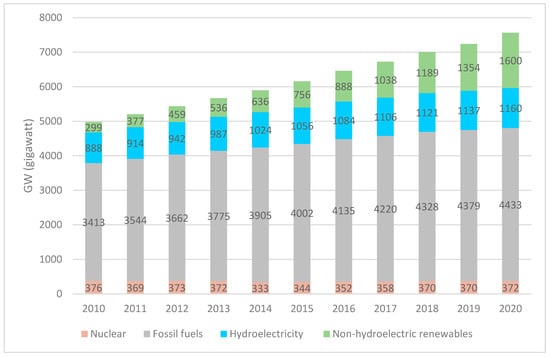
Figure 1.
Installed electricity capacity worldwide (2010–2020) [13].
Today, as in previous decades, the electricity sector is dominated by fossil fuel technologies. The environmental impacts of these technologies include increased gas emissions, pollution, and global warming. As a result, it has become imperative to follow the principles of sustainable development (SD) to reduce dependence on fossil fuels, reduce greenhouse gas emissions, and to mitigate the effects of climate change. SD is recognized as one of the key drivers of national energy policies; efforts are underway to support sustainable power generation technologies worldwide. Nuclear and renewable energy technologies have positive social, economic, and environmental impacts while meeting the world’s growing energy needs [14]. In this respect, the transition to green energy is now more and more necessary on a global scale.
“Energy transition is the process by which a country replaces its primary energy source with a range of energy sources and technologies”. As part of this process, governments tend to enact legislation to promote the production and use of renewable energy, and companies tend to adopt decarbonization-based business models. Although there are significant barriers to effectively implementing this process, companies are increasingly engaged in this transformation due to financial sustainability, the globalization process, technological development, regulatory obligations, a dynamic environment, or the need to find effective methods to improve business performance [15].
With increasing concern about climate change, a global environmental issue, the increasing shift to renewable energy to mitigate this problem is essentially playing a fundamental role in the energy transition. However, with the global economy still being driven by fossil fuels for the time being, it is essential to understand the performance of the system at different levels to ensure the accessibility, security, and efficiency of energy [16]. However, the energy industry is changing globally, and the increasing integration of renewable energy sources, particularly solar and wind, into the electricity grid is a defining feature of this change. Efforts to reduce dependence on fossil fuels and greenhouse gas emissions are at the forefront of this transformation [17].
In line with the United Nations’ 2030 Agenda for Sustainable Development, the actions that governments are taking and planning are not yet enough to fully achieve the three goals of improved energy access, better air quality, and reduced emissions. Significant additional investment is needed to put the world on a sustainable path [18].
Access to energy is a key priority for the G20 countries, who recognize the importance of collective action to support the transition to a cleaner and more resilient energy system. However, it is undeniable that the international community is not on track to ensure access to affordable and sustainable energy by 2030, and that G20 countries aim to secure this goal, considering the principle of “leaving no one behind”. G20 leadership is needed to make progress on the 7th Sustainable Development Goal—“affordable and clean energy—(ensuring access to affordable, reliable, sustainable, and modern energy for al)” [19] under the Paris Agreement and its targets. Accordingly, at the 26th United Nations Conference of the Parties 26 (COP26) in 2021, closer ties and strategic approaches were built for G20 and global climate cooperation. It would also be useful to share information on how G20 countries are implementing their commitments to promote universal access to energy to increase the share of renewable energy. The G20 energy and climate ministers held their first meeting in Naples and issued a statement on the G20’s shared ambition to protect the global climate and ensure a clean and inclusive energy transition. In addition, the need to align short-term recovery measures with long-term climate and environmental goals was emphasized. The importance of enhanced international cooperation to make financial flows consistent with the goals of the Paris Agreement was emphasized. Thus, the G20 principles of energy cooperation, also known as the Naples Principle, were adopted [20].
As a result of these developments, the number of companies declaring clean power commitments has increased significantly in recent years. Targets set by companies to meet demand with clean supply can promote capacity in cleaner production, increasing the overall share in energy systems [21]. Therefore, they have a critical role to play in combatting climate change. They need to quickly adopt and strive for a net-zero emissions target to achieve the goals set out in the Paris Agreement.
A growing number of companies want to demonstrate their efforts to reduce climate change and support the transition to clean energy. Meanwhile, more consumers are looking for products and services that support sustainability. This trend is encouraging many companies to identify sources of emissions and take steps to reduce them. At this point, electricity will form the basis for net-zero transitions [21].
Electricity is becoming the main driver in the transition to clean energy and the security of energy supply is becoming increasingly important. It is therefore clear that governments need to encourage investment in energy diversification to address security risks. Fossil fuels still dominate the energy supply of many G20 countries. However, making electricity and energy systems more resilient to the increasing negative impacts of climate change will have a mitigating effect [22].
Leading the transition to clean energy by enhancing energy security, affordability, and sustainability remains a critical role for G20 governments. In 2014, the G20 Principles for Energy Cooperation were developed and endorsed at the Brisbane Summit. Accordingly, G20 governments need to expand their energy security and preparedness to seven core principles for securing the transition to clean energy, an update of the security requirements in the 2014 Brisbane principles. These principles are, as follows: “(a) Prioritize energy efficiency; (b) Ensure the integration of wind and solar energy into the power system; (c) Develop and utilize a portfolio of low-carbon generation sources to increase electricity supply diversity and hedge against technology risks; (d) Ensure cost-effective use of existing energy infrastructure for an affordable, secure and clean energy pathway; (e) Modernize oil security systems and strengthen transparent, open and competitive energy markets to address traditional and emerging energy security concerns; (f) Be prepared for new and emerging risks to energy security; and (g) Promote a people-centered and inclusive approach to energy access and poverty reduction and support economic diversification in producer countries” [22].
Since the Pittsburgh Summit in 2009, OECD has also been a trusted strategic advisor to the G20 [23], providing advice on strategies and policies to facilitate the G20 countries’ transition to green energy, which is essential for achieving sustainable development and combating climate change. In fact, all technology options will be needed to achieve the green energy revolution and significant reductions in CO2 emissions. Energy efficiency, renewable energy, nuclear energy, and new transportation technologies can all help to reduce greenhouse gas emissions while enhancing energy security and providing other environmental and social benefits [24].
All countries should show the necessary sensitivity for international cooperation in taking the required actions against global warming and climate change. Accordingly, global efforts to reduce greenhouse gas emissions are steadily increasing. Establishing a direct link between the quality of life and the environmental impacts of the energy sector is at the center of the new energy approach [25]. Efforts to combat climate change are leading to a rapid switch to electricity by a wide range of end users, from transportation to industry, resulting in a huge increase in the demand for electricity and the need to generate as much of it as possible from renewable sources. As the global energy systems radically transform, new approaches and policies are needed for the ways in which energy systems are designed and operated [26].
However, “the environmental requirement to reduce carbon dioxide (CO2) emissions and ensure sustainable growth in the energy sector has led to a new phase of investment in most OECD countries”. There is an opportunity to create the policy framework to enable the transformation of the energy sector to reduce carbon intensity and increase energy efficiency. More investment is needed to enable this transformation. In fact, existing and emerging technologies could reduce global emissions by half by 2050. It is important for governments to promote innovation and green technology policies. The OECD Environmental Outlook to 2050 shows that tackling today’s key environmental challenges is achievable. A green growth policy for the energy sector has the potential to deliver significant results, including “better resource management, innovation and productivity gains, the creation of new markets and industries, and reduced environmental damage”. By 2050, it is possible to halve global emissions with additional investment using existing and emerging technologies [24].
According to the OECD, achieving carbon neutrality by 2050 will require a change in the way emissions are reduced. While renewable energy technologies have a critical role to play, the current scale and pace of innovation is insufficient to meet the net-zero challenge. A stable and effective innovation policy must become an integral part of climate policy to close this gap [27].
Although the G20 countries are at the forefront of the energy transition, their energy consumption is still predominantly based on fossil fuels, especially coal. Despite recent significant increases in renewable electricity capacity and declines in energy intensity, the combined share of coal, oil, natural gas, and nuclear power in the G20’s rapidly growing energy supply has not changed significantly. However, coal use is expected to decline rapidly in G20 countries where the energy sector is shifting to cleaner sources [13]. It is estimated that global renewable energy capacity will grow by more than 350 GW per year in the coming decades, while coal use will decline. As a result, global renewable electricity generation is projected to surpass fossil fuels by 2040 [12]. The deployment of clean energy technologies, which are critical to the transition to renewables, has created strong momentum, particularly for solar, wind, and nuclear power [15]. Ongoing investment in clean energy technology falls far short of the levels needed to steer the world toward a sustainable development process while essentially maintaining the security of energy demand [13].
Achieving the critical and challenging goal of net-zero emissions by 2050 is obviously requiring major efforts across society, with significant benefits for human health and economic development. To make progress toward the 1.5 °C target, annual global investment in clean energy projects and infrastructure must reach nearly $4 trillion by 2030. About 70% of the additional spending will need to occur in developing countries. This suggests that the biggest obstacle to accelerating clean energy deployment in emerging markets is financing. An international catalyst is also needed to accelerate capital flows to support the energy transition and enable emerging economies to create a new low-emission development blueprint. Otherwise, it is clear that the costs of inaction on climate change will be very high and that the energy sector will be at risk [28].
An important indicator of progress in the energy sector’s transition to clean energy is the share of low-emission technologies. In 2022, around 39% of power generation came from low-emission technologies. By 2030, a major shift is needed to ensure that more than 75% of power generation comes from low-carbon technologies [29]. As a solution to the economic and environmental problems caused by fossil fuels, countries will need to turn to renewable energy. Accordingly, many countries are restructuring their electricity profiles by investing in renewable energy [25].
The governments of G20 countries will lead in the energy transition if they support sustainable development and a clean energy future. Energy transitions have multiple goals: modernizing the economy, reducing import dependence, increasing energy security, and mitigating climate change. To maximize energy access and mitigate climate change, “G20 countries aim to triple the share of renewable electricity and double the share of renewable electricity in total energy consumption by 2030” [18].
Hydropower, one of the renewable resources used to meet energy needs as fossil fuels decline, is preferred because it is environmentally friendly and today provides more than 15% of the world’s electricity [30]. Hydropower has the highest energy payback rate; over its lifetime, a hydropower station can generate 200 times the energy required to build it. Therefore, it produces low levels of greenhouse gases and has the potential to mitigate global warming [31]. The potential benefits of hydropower make it a crucial element in implementing sustainability in the power generation process [32].
Nuclear power has historically been one of the largest contributors to decarbonized electricity and has the potential to contribute significantly to the decarbonization of the energy sector in some countries, although it faces significant challenges. Nuclear energy accounts for about 10% of electricity generation worldwide, and nearly 20% of that in developed economies [33]. Although it is a carbon-neutral energy source, it is noteworthy that the installed capacity of nuclear power remained unchanged, at 376 GW, between 2010 and 2020. A total of 422 nuclear reactors, with a total generating capacity of 378 GW, are in operation worldwide; 57 nuclear power plants, with a total installed capacity of approximately 59 GW, are under construction. The United States has the largest number of nuclear reactors in the world, with 92 reactors and an installed capacity of 94,718 MW. France follows with 56 reactors, with a capacity of 61,370 MW [34]. Given their safety standards and scale, long construction times (88 months on average) are not surprising for nuclear power plants [35]. However, nuclear energy, which is becoming increasingly efficient, stands out as an alternative energy source that can replace fossil fuels.
In the context of all these developments, it is clear that, despite progress in the global energy transition to sustainable and clean energy, challenges to this transition have emerged as countries focus on energy security due to the global energy crisis and geopolitical issues [36]. However, the G20 countries are leading the way in technological innovation and development and that they are considered the locomotive of global energy policy.
3. Data and Methodology
This study, which examines electricity capacity convergence in the G20 countries, uses annual data on total, nuclear, fossil fuels, and renewable electricity installed capacity for the period 1980–2020 from the U.S. Energy Information Administration [13]. Countries with missing data in the relevant range are excluded from the analysis.
The following data [37] were used as follows:
where is the electricity capacity of country i, is the mean electricity capacity of G20 countries. Stochastic convergence is examined by unit root tests. Rejection of the unit root hypothesis provides evidence of stochastic convergence.
The unit root test process was first introduced by Dickey and Fuller (1979) [38]. In the following period, different linear unit root tests were developed. In Perron’s (1989) study [39], the effect of structural breaks on the unit root test process was emphasized and it was proved that unit root tests tend to yield non-stationary results when structural breaks are not considered.
A similar situation would apply to nonlinearity. In other words, if there is a nonlinearity in the data and this is not considered in the unit root test procedure, the traditional unit root test tends to yield non-stationary results.
In recent years, unit root tests that take structural break and nonlinearity into account together have been developed. In these tests, the Fourier function is used to model the structural break, while the exponential smooth transition autoregressive (ESTAR) model is generally preferred for nonlinearity.
The nonlinear deterministic component is specified in the first stage, as follows:
The first stage involves finding the optimal frequency k*. It is obtained by assigning values of k between 1 and 5, then estimating the equation by using OLS and minimizing the sum of squares of error terms. The error terms of the estimated equation are obtained as follows:
The test statistic is calculated by estimating the following equation using the error terms obtained in the first stage, as follows:
In Equation (3), the hypothesis can be tested by using the t test. The critical values of this test are tabulated in Christopoulos and Leo’n-Ledesma (2010). The hypothesis can be tested by using the F test in Equation (4). Ranjbar et al. (2018) [40] tabulated the critical values. In Equation (5), hypothesis can be tested by using a modified Wald test. The critical values of this test are tabulated by Güriş (2019) [41].
4. Empirical Results
The variables in the analysis consist of the total electricity installed capacity and its sources (nuclear, fossil fuels, and renewables). In the first stage of the empirical analysis, linear unit root tests [“Augmented Dickey and Fuller (ADF) [42], Phillips-Perron (PP) [43], Kwiatkowski-Phillips-Schmidt-Shin (KPSS)” [44]] are used; the results are presented in Table 1a–d.

Table 1.
(a) unit root test results (capacity variable); (b) unit root test results (nuclear variable); (c) unit root test results (fossil fuels variable); and (d) unit root test results (renewables variable).
According to the results presented in Table 1a–d:
- ▪
- Capacity data of “Argentina, Indonesia, Italy, Mexico, Saudi Arabia, and Turkey”;
- ▪
- Nuclear energy data of “Argentina, Canada, France, South Korea, and United States”;
- ▪
- Fossil fuels data of “Argentina, Australia, Italy, Mexico, Saudi Arabia and Turkey”;
- ▪
- Renewables data of “Argentina, Brazil, Germany, Indonesia, Italy, Japan, Mexico, South Korea, Turkey, and United Kingdom” are stationary.
In the second stage of the analysis, nonlinear unit root tests (KSS [45], Sollis [46], Kruse [47], Hu and Chen [48]) are used, and the results are presented in Table 2a–d.
Table 2.
(a) nonlinear unit root test results (capacity variable); (b) nonlinear unit root test results (nuclear variable); (c) nonlinear unit root test results (fossil fuels variable); and (d) nonlinear unit root test results (renewables variable).
According to the results presented in Table 2a–d:
- ▪
- Capacity data of “Brazil, Japan, Mexico, Saudi Arabia, South Korea, Turkey, and United Kingdom”;
- ▪
- Nuclear energy data of “Argentina, France, South Korea, United Kingdom, and United States”;
- ▪
- Fossil fuels data of “Argentina, Canada, France, Mexico, Saudi Arabia, Turkey, and United Kingdom”;
- ▪
- Renewables data of “Italy, Japan, South Africa, South Korea, and Turkey” are stationary.
In the last stage of the analysis, unit root tests with Fourier function modelling nonlinearity and structural break are used, and the results are presented in Table 3a–d.
Table 3.
(a) nonlinear unit root test with Fourier function results (capacity variable); (b) nonlinear unit root test with Fourier function results (nuclear variable); (c) nonlinear unit root test with Fourier function results (fossil fuels variable); and (d) nonlinear unit root test with Fourier function results (renewables variable).
According to the results presented in Table 3a–d:
- ▪
- Capacity data of “Brazil, Mexico, and South Korea”;
- ▪
- Nuclear energy data of “Argentina, France, Germany, United Kingdom, and United States”;
- ▪
- Fossil fuels data of “Brazil, Mexico, and South Korea”;
- ▪
- Renewables data of “Australia, Germany, Italy, Japan, Turkey, and United Kingdom” follow a stationary process.
When the findings obtained from the analysis are evaluated together, the results are as follows:
- ▪
- In the capacity field, “Argentina, Brazil, Indonesia, Italy, Japan Mexico, Saudi Arabia, South Korea, Turkey and United Kingdom”;
- ▪
- In the nuclear energy field, “Argentina, Canada, France, Germany South Korea, United Kingdom and United States”;
- ▪
- In the fossil fuels field, “Argentina, Australia, Brazil, Canada, France, Italy, Mexico, Saudi Arabia, South Korea, Turkey and United Kingdom”;
- ▪
- In the renewables field, “Argentina, Australia, Brazil, Germany, Indonesia, Italy, Japan, Mexico, South Africa, South Korea, Turkey and United Kingdom” converged to the average of G20 countries.
5. Conclusions
Today, studies on the development of renewable energy technologies show that attempts are being made to manage the transition process to renewable energy sources. However, it seems that there is still a dependence on fossil fuels and that efforts to transition to clean energy are still not enough to limit global warming to 1.5 °C. More efforts are needed, and in this regard, collective action by G20 countries can provide significant support for building a sustainable, low-carbon energy system. Accordingly, the G20 countries have the greatest global responsibility to limit the global temperature rise and align policies with the Paris Climate Agreement.
In this regard, increasing environmental problems may require changes in countries’ policies and strategies with the contribution of technological developments. Therefore, it is clear that, to achieve the 2030 and 2050 goals in the fight against global environmental problems, especially climate change, it is necessary for the converging countries to take more actions within the framework of green transformation-oriented policies and strategies in the coming period.
Although progress has been made on energy transition reforms in many G20 member and non-member countries, the potential can only be realized with the efforts of more countries. In this process, the G20 countries have taken on an important role in addressing energy security concerns related to the transition to clean energy by promoting cooperation, both internally and globally.
In the process of reaching the 2050 targets, it is critical to solve the financing problem, which stands as an important obstacle to the widespread use of clean energy, especially in developing countries. Otherwise, the costs of inaction in the fight against environmental problems will become increasingly high. In addition, the risks in the energy sector will increase. In this respect, the importance and necessity of the G20 countries taking a leading role in the global energy transition is clear.
According to the findings of the analysis, this study concludes that countries converging in total electricity capacity and its components—nuclear power, fossil fuels and renewables—are in line with G20 policies and that there is no need for policy changes in these countries. However, it is critical that more G20 members adopt a committed renewable energy strategy that will increase domestic energy security and reduce emissions. An assessment of G20 spending on economic recovery reveals that there is still significant support for fossil fuels, as energy transition is a long-term process. In other respects, G20 members, except for Saudi Arabia and Russia, support green industries, and G20 members, except for Saudi Arabia, have climate change adaptation plans.
In conclusion, it is an undeniable fact that the increase in the share of renewable energy sources in electricity generation in the G20 countries and the decrease in CO2 emissions from the electricity sector are important achievements on the road to ensuring the diversity of energy sources and an energy transformation with a predominance of renewable energy sources.
Funding
This research received no external funding.
Institutional Review Board Statement
Not applicable.
Data Availability Statement
The original contributions presented in the study are included in the article.
Conflicts of Interest
The author declares no conflicts of interest.
References
- Ahmad, R.; Ilyas, H.N.; Yin, W.; Liu, X.; Li, B.; Sultan, M.; Imran, M.A.; Abbas, A.; Javed, Z.; Raman, P. Agricultural Residue Management Using Forced Draft Gasifier Cookstove. In Handbook of Energy Management in Agriculture; Rakshit, A., Biswas, A., Sarkar, D., Meena, V.S., Datta, R., Eds.; Springer Nature: Singapore, 2023; pp. 163–179. [Google Scholar] [CrossRef]
- Elahi, E.; Zhu, M.; Khalid, Z.; Wei, K. An empirical analysis of carbon emission efficiency in food production across the Yangtze River basin: Towards sustainable agricultural development and carbon neutrality. Agric. Syst. 2024, 218, 103994. [Google Scholar] [CrossRef]
- Ahmad, R.; Ilyas, H.N.; Li, B.; Sultan, M.; Amjad, M.; Aleem, M.; Abbas, A.; Imran, M.A.; Riaz, F. Current challenges and future prospect of biomass cooking and heating stoves in Asian Countries. Front. Energy Res. 2022, 10, 880064. [Google Scholar] [CrossRef]
- Budzianowski, W.M.; Gomes, J.F.P. Perspectives for low-carbon electricity production until 2030: Lessons learned from the comparison of local contexts in Poland and Portugal. Energy Sources Part B Econ. Plan. Policy 2016, 11, 534–541. [Google Scholar] [CrossRef]
- BP (British Petroleum). BP Energy Outlook. 2022. Available online: https://www.bp.com/content/dam/bp/business-sites/en/global/corporate/pdfs/energy-economics/energy-outlook/bp-energy-outlook-2022.pdf (accessed on 11 January 2024).
- IPCC (Intergovernmental Panel on Climate Change). Climate Change 2022: Mitigation of Climate Change: Summary of Policymakers. 2022. Available online: https://www.ipcc.ch/report/ar6/wg3/downloads/report/IPCC_AR6_WGIII_SPM.pdf (accessed on 25 December 2023).
- EIA (U.S. Energy Information Administration). Electricity Generation, Capacity, and Sales in the United States. Available online: https://www.eia.gov/energyexplained/electricity/electricity-in-the-us-generation-capacity-and-sales.php (accessed on 21 March 2024).
- U.S. Department of Energy. Available online: https://www.energy.gov/ne/articles/what-generation-capacity#:~:text (accessed on 11 September 2024).
- SMARD, Installed Generation Capacity. Available online: https://www.smard.de/page/en/wiki-article/6080/6038#:~:text (accessed on 11 September 2024).
- EMBER. 2023. Available online: https://ember-climate.org/countries-and-regions/regions/g20/ (accessed on 21 March 2024).
- IEA (International Energy Agency). World Energy Outlook. 2022. Available online: https://iea.blob.core.windows.net/assets/830fe099-5530-48f2-a7c1-11f35d510983/WorldEnergyOutlook2022.pdf (accessed on 21 March 2024).
- Statista, Installed Electricity Capacity Worldwide in 2022. Available online: https://www.statista.com/statistics/267358/world-installed-power-capacity/ (accessed on 11 September 2024).
- EIA. International Electricity Data. Available online: https://www.eia.gov/international/data/world/electricity/electricity-capacity?pd=2&p (accessed on 21 March 2024).
- Karakosta, C.; Pappas, C.; Marinakis, V.; Psarras, J. Renewable energy and nuclear power towards sustainable development: Characteristics and prospects. Renew. Sustain. Energy Rev. 2013, 22, 187–197. [Google Scholar] [CrossRef]
- Pinedo-López, J.; Baena-Navarro, R.; Durán-Rojas, N.; Díaz-Cogollo, L.; Farak-Flórez, L. Energy Transition in Colombia: An Implementation Proposal for SMEs. Sustainability 2024, 16, 7263. [Google Scholar] [CrossRef]
- Wehbi, H. Powering the Future: An Integrated Framework for Clean Renewable Energy Transition. Sustainability 2024, 16, 5594. [Google Scholar] [CrossRef]
- Shahzad, S.; Jasińska, E. Renewable Revolution: A Review of Strategic Flexibility in Future Power Systems. Sustainability 2024, 16, 5454. [Google Scholar] [CrossRef]
- IEA. Energy Transitions in G20 Countries. OECD/IEA. 2018. Available online: https://www.iea.org/reports/energy-transitions-in-g20-countries (accessed on 21 October 2023).
- UN (United Nations). The 17 Goals. Available online: https://sdgs.un.org/goals (accessed on 11 September 2024).
- UNDP-OECD. The G20 Contribution to the 2030 Agenda in Times of Crises 2019–2023. 2023. Available online: https://www.undp.org/sites/g/files/zskgke326/files/2023-11/undp-oecd-the-g20-contribution-to-the-2030-agenda-in-times-of-crises-2019-2023-v2.pdf (accessed on 15 August 2024).
- IEA. Advancing Decarbonisation through Clean Electricity Procurement. 2022. Available online: https://www.iea.org (accessed on 11 January 2024).
- IEA. Security of Clean Energy Transitions. Available online: https://www.iea.org/reports/security-of-clean-energy-transitions-2 (accessed on 10 September 2024).
- OECD (Organisation for Economic Co-operation and Development). OECD and G20. Available online: https://www.oecd.org/en/about/oecd-and-g20.html (accessed on 15 September 2024).
- OECD/IEA. Energy, OECD Green Growth Studies; OECD Publishing: Paris, France, 2012. [Google Scholar] [CrossRef]
- Višković, A.; Franki, V. Evaluating and forecasting direct carbon emissions of electricity production: A case study for South East Europe. Energy Sources Part B Econ. Plan. Policy 2022, 17, 2037028. [Google Scholar] [CrossRef]
- IEA. Electricity. 2023. Available online: https://www.iea.org/fuels-and-technologies/electricity (accessed on 21 March 2024).
- OECD. Innovation and Green Transitions. Available online: https://www.oecd.org/en/topics/sub-issues/innovation-and-green-transitions.html (accessed on 15 September 2024).
- IEA. World Energy Outlook 202. Available online: https://www.iea.org/reports/world-energy-outlook-2021 (accessed on 12 September 2024).
- IEA. Electricity. Available online: https://www.iea.org/energy-system/electricity (accessed on 15 September 2024).
- IHA (International Hydropower Association). World Hydropower Outlook. 2023. Available online: https://www.hydropower.org/publications/2023-world-hydropower-outlook (accessed on 17 May 2024).
- Kaygusuz, K. The Role of Hydropower for Sustainable Energy Development. Energy Sources Part B Econ. Plan. Policy 2009, 4, 365–376. [Google Scholar] [CrossRef]
- Dester, M.; Andrade, M.T.O.; Bajay, S.V. New Renewable Energy Sources for Electric Power Generation in Brazil. Energy Sources Part B Econ. Plan. Policy 2012, 7, 390–397. [Google Scholar] [CrossRef]
- IEA. Nuclear Power. 2023. Available online: https://www.iea.org/fuels-and-technologies/nuclear (accessed on 17 May 2024).
- IAEA (International Atomic Energy Agency). Power Reactor Information System. 2022. Available online: https://pris.iaea.org/PRIS/home.aspx (accessed on 11 January 2024).
- WNA (World Nuclear Association). World Nuclear Performance Report. 2022. Available online: https://world-nuclear.org/images/articles/World-Nuclear-Performance-Report-2022.pdf (accessed on 11 January 2024).
- WEF (World Economic Forum). Fostering Effective Energy Transition. 2023. Available online: https://www.weforum.org/publications/fostering-effective-energy-transition-2023/ (accessed on 14 September 2024).
- Carlino, G.A.; Mills, L.O. Are U.S. regional incomes converging? A time series analysis. J. Monet. Econ. 1993, 32, 335–346. [Google Scholar] [CrossRef]
- Dickey, D.A.; Fuller, W.A. Distribution of the Estimators for Autoregressive Time Series with a Unit Root. J. Am. Stat. Assoc. 1979, 74, 427–431. [Google Scholar] [CrossRef]
- Perron, P. The Great Crash, the Oil Price Shock, and the Unit Root Hypothesis. Econometrica 1989, 57, 1361–1401. [Google Scholar] [CrossRef]
- Ranjbar, O.; Chang, T.; Mila Elmi, Z.; Lee, C.C. A new unit root test against asymmetric ESTAR nonlinearity with smooth breaks. Iran. Econ. Rev. 2018, 22, 51–62. [Google Scholar] [CrossRef]
- Güriş, B. A new nonlinear unit root test with Fourier function. Communications in Statistics—Simulation and Computation 2019, 48, 3056–3062. [Google Scholar] [CrossRef]
- Dickey, D.A.; Fuller, W.A. Likelihood Ratio Statistics for Autoregressive Time Series with a Unit Root. Econometrica 1981, 49, 1057–1072. [Google Scholar] [CrossRef]
- Phillips, P.C.B.; Perron, P. Testing for a unit root in time series regression. Biometrika 1988, 75, 335–346. [Google Scholar] [CrossRef]
- Kwiatkowski, D.; Phillips, P.C.B.; Schmidt, P.; Shin, Y. Testing the null hypothesis of stationarity against the alternative of a unit root: How sure are we that economic time series have a unit root? J. Econom. 1992, 54, 159–178. [Google Scholar] [CrossRef]
- Kapetanios, G.; Shin, Y.; Snell, A. Testing for a unit root in the nonlinear STAR framework. J. Econom. 2003, 112, 359–379. [Google Scholar] [CrossRef]
- Sollis, R. A simple unit root test against asymmetric STAR nonlinearity with an application to real exchange rates in Nordic countries. Econ. Model. 2009, 26, 118–125. [Google Scholar] [CrossRef]
- Kruse, R. A new unit root test against ESTAR based on a class of modified statistics. Stat. Pap. 2011, 52, 71–85. [Google Scholar] [CrossRef]
- Hu, J.; Chen, Z. A unit root test against globally stationary ESTAR models when local condition is non-stationary. Econ. Lett. 2016, 146, 89–94. [Google Scholar] [CrossRef]
Disclaimer/Publisher’s Note: The statements, opinions and data contained in all publications are solely those of the individual author(s) and contributor(s) and not of MDPI and/or the editor(s). MDPI and/or the editor(s) disclaim responsibility for any injury to people or property resulting from any ideas, methods, instructions or products referred to in the content. |
© 2024 by the author. Licensee MDPI, Basel, Switzerland. This article is an open access article distributed under the terms and conditions of the Creative Commons Attribution (CC BY) license (https://creativecommons.org/licenses/by/4.0/).