



Green Chemistry and Its Impact on the Transition towards Sustainable Chemistry: A Systematic Review



Abstract
1. Introduction
- -
- Determine the definitions, principles, and approaches of Green Chemistry present in the scientific literature.
- -
- Identify and classify the most effective teaching strategies used to teach Green Chemistry.
- -
- Analyze the barriers and facilitators perceived by teachers in teaching Green Chemistry.
2. Methodology
2.1. Eligibility Criteria
2.2. Information Sources and Search Strategies
2.3. Study Selection and Data Extraction Process
3. Results
3.1. Study Selection
3.2. Study Characteristics
4. Discussion
- Objective 1: Determine the definitions, principles, and approaches of Green Chemistry present in the scientific literature.
- -
- Sustainability: The concept of Green Chemistry implicitly carries the idea of sustainability (SDG), which implies a delicate balance between environmental, social, and economic aspects. Pupils must understand how chemistry can actively contribute to a world where resources are conserved and environmental impacts are reduced [18,19,21,29].
- -
- Life-Cycle Assessment (LCA): The introduction of life-cycle assessment methods in the curriculum empowers pupils to comprehensively evaluate the environmental impact of chemicals and processes throughout their entire life cycle. This holistic approach considers every stage, i.e., from the extraction of raw materials to synthesis, use, and subsequent disposal [27]. By analyzing the entire life cycle, the pupils can identify opportunities for improvement and optimization, leading to more environmentally friendly and efficient processes [20,27].
- -
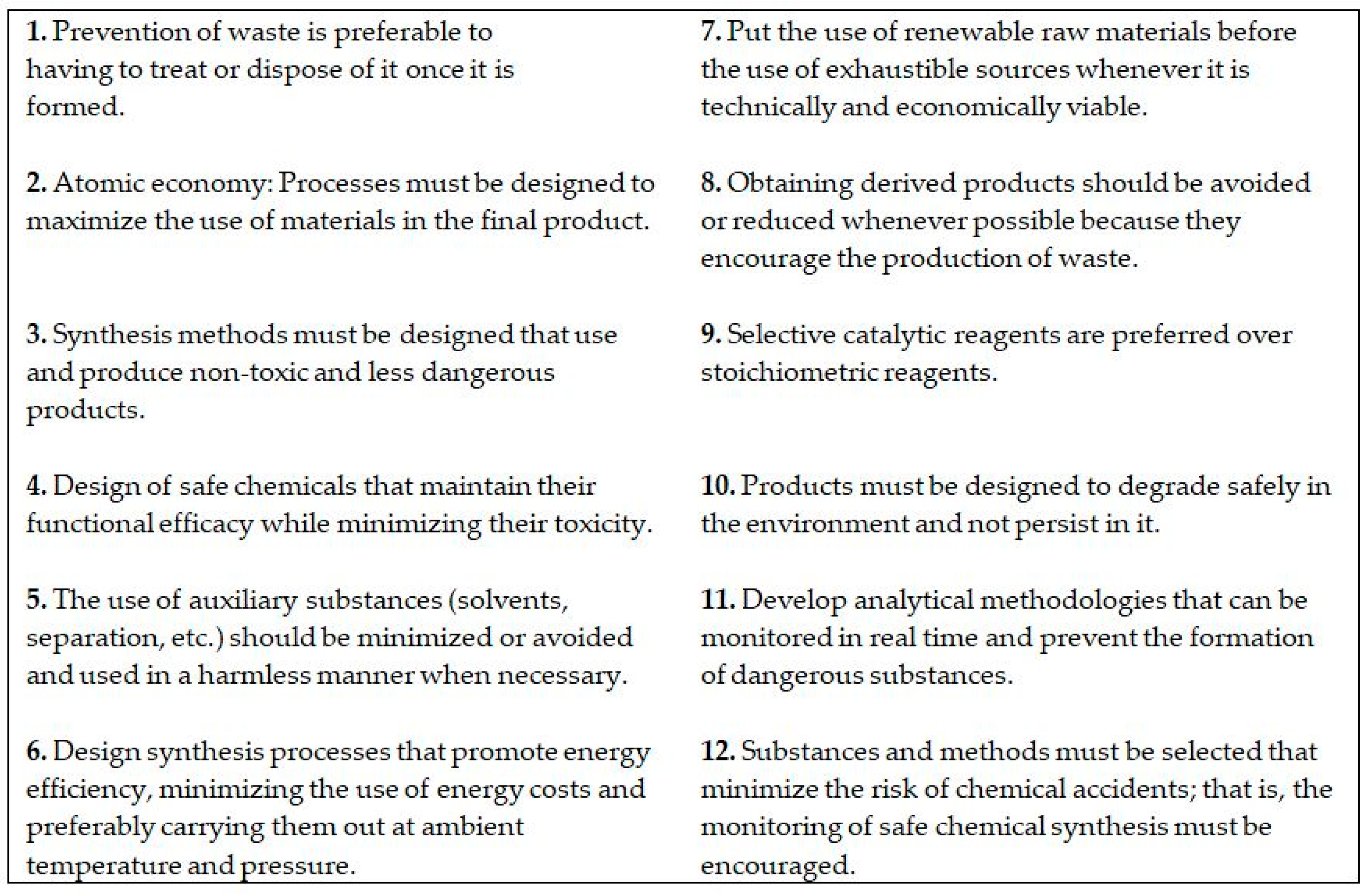
- Green metrics: These are indicators that evaluate the aspects of a chemical process in line with the principles of Green Chemistry. In other words, Green Chemistry metrics quantify the environmental performance of chemical processes, facilitating the widespread adoption of more sustainable technologies in the industry [27]. Therefore, providing pupils with the ability to analyze and interpret environmental metrics is essential to promoting more sustainable practices in the chemical industry. This knowledge allows pupils to design and promote more ecological reactions, thus reducing the consumption of resources and waste (principle 1) [27,29].
- -
- Climate change: As pupils immerse themselves in the study of Green Chemistry, they gain a deep understanding of how to mitigate climate change and reduce their carbon footprint [33]. They learn how sustainable practices and innovative technologies can reduce greenhouse gas emissions and combat global warming [17,21,22,26,33].
- -
- -
- Green innovations: Pupils should be provided with real cases that illustrate the positive impact of Green Chemistry in today’s world. These case studies reinforce the importance of innovating with sustainable practices, encouraging pupils to contribute to the initiatives that are being carried out worldwide for a more ecological and sustainable future. An example of this would be the future green hydrogen plant in Huelva [25,34].
- Objective 2: Identify and classify the most effective teaching strategies used to teach Green Chemistry.
- -
- Active and participatory learning: Methods that actively involve pupils, such as project-based learning, cooperative learning, problem-based learning, and service learning, have been found to be highly effective in fostering a deep understanding of the principles of Green Chemistry. These approaches promote pupil engagement and the practical application of content [17,18,21,22,24].
- -
- Use of case studies and contextualization: The integration of real case studies related to Green Chemistry provides pupils with a deeper understanding of how the principles apply in specific situations. This facilitates the connection between theory and practice, as well as the development of problem-solving skills [17,20,22,25].
- -
- Interdisciplinary approach: This strategy proposes the inclusion of Green Chemistry content in other areas of the curriculum, thus transcending traditional disciplines. It has been observed that interdisciplinary approaches that integrate knowledge from various areas help pupils appreciate the complexity of environmental problems and develop comprehensive solutions [17,18]. For example, environmental sustainability issues can be addressed in chemistry, biology, technology and engineering, and the environmental sciences; in this way, pupils can understand how the principles of Green Chemistry are applied in different contexts [18,19].
- -
- Focus on atomic design and sustainable experimentation: The principles of Green Chemistry promote the design of more efficient chemical reactions; therefore, promoting laboratory practices that follow these principles is essential. This involves reducing the use of toxic substances, minimizing waste production, and seeking more “green” alternatives for the environment [26]. For example, to undertake this, teachers can focus on explaining how chemicals can be synthesized in a way that uses non-volatile solvents, efficient catalysts, and reactions in fewer steps to generate fewer byproducts [16].
- -
- Application of digital technologies and virtual experiments: The incorporation of digital tools and virtual experiments offers opportunities to teach Green Chemistry interactively, allowing pupils to explore chemical phenomena in a safe and accessible way. These tools provide practical experiences that complement traditional teaching and facilitate the understanding of the abstract concepts of Green Chemistry. For example, the use of simulations, molecular models, and molecular design software encourages pupils to explore how chemical structures can be modified to achieve more sustainable products [18,23].
- -
- Research projects: Involving pupils in original research projects related to Green Chemistry, for example, researching new materials, cleaner synthesis processes, or applications of Green Chemistry in industry, encourages critical thinking and creativity [17]. These projects allow pupils to apply scientific methods and develop innovative solutions to environmental challenges [17,18,21,22,24].
- -
- Development of transversal skills: In addition to scientific knowledge, it is essential to develop transversal skills such as effective communication, teamwork, and critical thinking [17,18,22,24]. These skills enable pupils to develop projects in an ethical, responsible, and collaborative manner in the field of Green Chemistry [22].
- -
- Objective 3: Analyze the barriers and facilitators perceived by teachers in teaching Green Chemistry.
5. Conclusions
Author Contributions
Funding
Institutional Review Board Statement
Informed Consent Statement
Data Availability Statement
Acknowledgments
Conflicts of Interest
References
- Unites Nations. World Commission on Environment and Development. 1987. Available online: https://sustainabledevelopment.un.org/content/documents/5987our-common-future.pdf (accessed on 1 July 2024).
- Doria-Serrano, M.C. Química Verde: Un nuevo enfoque para el cuidado del medio ambiente. Educ. Quím. 2009, 20, 412–420. [Google Scholar] [CrossRef]
- Anastas, P.; Warner, J. Green Chemistry: Theory and Practice; Oxford University Press: Oxford, UK, 1998. [Google Scholar]
- Anastas, P.; Eghbali, N. Green Chemistry: Principles and practice. Chem. Soc. Rev. 2010, 39, 301–312. [Google Scholar] [CrossRef]
- Reyes, L. Aporte de la química verde a la construcción de una ciencia socialmente responsable. Educ. Quím. 2012, 23, 222–229. [Google Scholar]
- Clark, J.H.; Budarin, V.; Deswarte, F.E.I.; Hardy, J.J.E.; Kerton, F.M.; Hunt, A.J.; Luque, R.; Macquarrie, D.J.; Milkowski, K.; Rodriguez, A.; et al. Green chemistry and the biorefinery: A partnership for a sustainable future. Green Chem. 2006, 8, 853–860. [Google Scholar] [CrossRef]
- Vargas Afanador, E.O.; Ruiz Pimiento, L.P. Química Verde en el siglo XXI: Química Verde, una Química Limpia. Rev. Cuba. Quím. 2007, 19, 29–32. [Google Scholar]
- Cortés, A.; Reyes, J.; Bustos, E. Secuencia didáctica en química verde. In Enseñanza de Las Ciencias. Revista de Investigación y Experiencias Didácticas, Nº; Extraordinario, 2017; pp. 1189–1196. Available online: https://raco.cat/index.php/Ensenanza/article/view/335241/426078 (accessed on 1 July 2024).
- Vilches, A.; Gil, D. Papel de la Química y su enseñanza en la construcción de un futuro sostenible. Educ. Quím. 2011, 22, 103–116. [Google Scholar] [CrossRef]
- Lancaster, M. Green Chemistry: An Introductory Text, 2nd ed.; Royal Society of Chemistry: London, UK, 2010. [Google Scholar]
- González-García, P.J.; Pérez-Mendez, C.; Figueroa-Duarte, S. La enseñanza de laquímica desde la perspectiva de la Química Verde-The teaching of chemistry from theperspective of Green Chemistry. Rev. Científica 2016, 1, 24. [Google Scholar] [CrossRef][Green Version]
- Mascarell, L.; Vilches, A. Química verde y sostenibilidad en la educación en ciencias en secundaria. Enseñanza Cienc. 2016, 34, 25–42. [Google Scholar] [CrossRef]
- Moher, D.; Shamseer, L.; Clarke, M.; Ghersi, D.; Liberati, A.; Petticrew, M.; Stewart, L.A. Preferred reporting items for systematic review and meta-analysis protocols (PRISMA-P) 2015 statement. Syst. Rev. 2015, 4, 1. [Google Scholar] [CrossRef]
- Page, M.; McKenzie, J.; Bossuyt, P.; Boutron, I.; Hoffmann, T.; Mulrow, C.; Shamseer, L.; Tetzlaff, J.; Akl, E.; Brennan, S.; et al. The PRISMA 2020 statement: An updated guideline for reporting systematic reviews. BMJ 2021, 372, n71. [Google Scholar] [CrossRef]
- Marques, C.; Machado, A. Environmental Sustainability: Implications and limitations to Green Chemistry. Found. Chem. 2014, 16, 125–147. [Google Scholar] [CrossRef]
- Franco-Moreno, R.; Reina, J.; Riveros, C. Concepciones sobre química verde en profesores de química en formación inicial: Green chemistry concepts in chemistry teachers in initial training. Noria Investig. Educ. 2020, 1, 94–108. [Google Scholar]
- Meinguer, J.; Pérez, M. Desarrollo y evaluación de elementos de pensamiento crítico sobre la química verde en el bachillerato. Investig. Esc. 2021, 103, 106–124. [Google Scholar] [CrossRef]
- Chen, M.; Jeronen, E.; Wang, A. What lies behind teaching and learning green chemistry to promote sustainability education? A literature review. Int. J. Environ. Res. Public Health 2020, 17, 7876. [Google Scholar] [CrossRef]
- Zuin, V.; Eilks, I.; Elschami, M.; Kümmerer, K. Education in green chemistry and in sustainable chemistry: Perspectives towards sustainability. Green Chem. 2021, 23, 1594–1608. [Google Scholar] [CrossRef]
- Nahlik, P.; Kempf, L.; Giese, J.; Kojak, E.; Daubenmire, P. Developing green chemistry educational principles by exploring the pedagogical content knowledge of secondary and pre-secondary school teachers. Chem. Educ. Res. Pract. 2022, 23, 283–298. [Google Scholar] [CrossRef]
- Mitarlis, M.; Azizah, U.; Yonata, B. The integration of green chemistry principles in basic chemistry learning to support achievement of Sustainable Development Goals (SDGs) through education. J. Technol. Sci. Educ. 2023, 13, 233–254. [Google Scholar] [CrossRef]
- Aubrecht, K.; Bourgeois, M.; Brush, E.; MacKellar, J.; Wissinger, J. Integrating Green Chemistry in the Curriculum: Building Student Skills in Systems Thinking, Safety, and Sustainability. J. Chem. Educ. 2019, 96, 2872–2880. [Google Scholar] [CrossRef]
- Gawlik-Kobylińska, M.; Walkowiak, W.; Maciejewski, P. Improvement of a sustainable world through the application of innovative didactic tools in green chemistry teaching: A review. J. Chem. Educ. 2020, 97, 916–924. [Google Scholar] [CrossRef]
- Marcelino, L.; Dias, E.; Rüntzel, P.; Milli, J.; Santos, J.; Souza, L.; Marques, C. Didactic features specific to green chemistry teaching in the journal of chemical education. J. Chem. Educ. 2023, 100, 2529–2538. [Google Scholar] [CrossRef]
- Ronald, R. Exploring science literature: Integrating chemistry research with chemical education. J. Chem. Educ. 2023, 100, 2303–2311. [Google Scholar]
- Marques, C.; Machado, A. An integrated vision of the Green Chemistry evolution along 25 years. Found. Chem. 2021, 23, 299–328. [Google Scholar] [CrossRef]
- Marcelino, L.; Sjöström, J.; Marques, C. Socio-Problematization of Green Chemistry: Enriching Systems Thinking and Social Sustainability by Education. Sustainability 2019, 11, 7123. [Google Scholar] [CrossRef]
- Franco-Moreno, R.; Ordoñez, L. El enfoque de química verde en la investigación en didáctica de las ciencias experimentales. Su abordaje en revistas iberoamericanas: 2002–2018. Educ. Quím. 2020, 31, 84–104. [Google Scholar] [CrossRef]
- Marques, C.; Machado, A. Una visión sobre propuestas de enseñanza de la Química Verde. Rev. Electrón. Enseñ. Cienc. 2018, 17, 19–43. [Google Scholar]
- Manahan, S.E. Green Chemistry and the Ten Commandments of Sustainability; ChemChar Research, Inc.: Columbia, SC, USA, 2005. [Google Scholar]
- Anastas, P.; Zimmerman, J. The United Nations sustainability goals: How can sustainable chemistry contribute? Curr. Opin. Green Sustain. Chem. 2018, 13, 150–153. [Google Scholar] [CrossRef]
- Wardencki, W.; Curyło, J.; Namieśnik, J. Green chemistry—Current and future issues. Pol. J. Environ. Stud. 2005, 14, 389–395. [Google Scholar]
- Vence, C.; Pitti, M.; Martínez-Brenes, R.; Aparicio, C.; Soliís, O.; Pérez, L. Educación Para el Desarrollo Sostenible. 2021. Available online: https://fundacionsparkids.org/wp-content/uploads/2023/06/Guia-Unesco-Desarrollo-Sostenible-reedicion-nueva-version-corregida.pdf (accessed on 30 May 2024).
- Calero, M.; García-Berlanga, O.; Ull, A.; Vilches, A. La educación para la sostenibilidad en la formación del profesorado de ciencias experimentales en Secundaria. Enseñanza de las Ciencias. Rev. Investig. Exp. Didáct. 2019, 37, 157–175. [Google Scholar]
- American Chemical Society. Green Chemistry Institute. 2001. Available online: https://www.acs.org/greenchemistry.html (accessed on 1 June 2024).
- Jardim, E.; Serrano, E.; Barceló, I.; Linares, N.; Silvestre, A. Acercando la Química Verde a la vida cotidiana del alumnado. Desarrollo de nuevas herramientas didácticas. In Memorias del Programa de Redes-I3CE de Calidad, Innovación e Investigación en Docencia Universitaria: Convocatoria 2016–2017; Antolí, J.M., Lledó, A., Pellín, N., Roig, R., Eds.; Universidad de Alicante. Instituto de Ciencias de la Educación: Raspeig, Spain, 2017; pp. 2110–2114. Available online: https://dialnet.unirioja.es/servlet/articulo?codigo=6331643 (accessed on 1 June 2024).
- Ordaz, G.; Britt, M. Los caminos hacia una enseñanza no tradicional de la química. Actual. Investig. Educ. 2018, 18, 559–579. [Google Scholar]
- Ley Orgánica 3/2020, de 29 de diciembre, por la que se modifica la Ley Orgánica 2/2006, de 3 de mayo, de Educación. Boletín Oficial del Estado, núm. 340, de 30 de diciembre de 2020. 2020, pp. 100985–101041. Available online: https://www.boe.es/eli/es/lo/2020/12/29/3 (accessed on 30 May 2024).

| Title | Author/Year | Type of Study | Goals | Conclusions | |
|---|---|---|---|---|---|
| 1 | A view of Green Chemistry teaching proposals | Marques y Machado (2018) [15] | Bibliographic review | Examine the evolution and consolidation of the Green Chemistry community, identify areas of pending understanding, analyze educational proposals, and explore models for teaching Green Chemistry, considering its relationship with sustainable development and Environmental Education. | The importance of the twelve principles of Green Chemistry in teaching is highlighted, but the authors note a lack of systematization in their application. Three aspects are identified in the educational proposals: punctual insertion, specialized courses, and transversal integration. The need is highlighted from primary education onwards for a Green Chemistry education rooted in an ecological culture, together with Environmental Education. |
| 2 | Conceptions about Green Chemistry in prospective chemistry teachers | Franco-Moreno et al. (2020) [16] | Qualitative and interpretive study | Characterize the conceptions about Green Chemistry among prospective teachers. To this end, the study seeks to validate an inquiry resource focused on definitions, projects, and applications of this approach, in addition to promoting its importance in teacher training and laboratory practice. | The study revealed the need for greater transversality in Chemistry bachelor-degree programs to incorporate Green Chemistry on a mandatory basis. Prospective teachers show a superficial understanding of the approach, which suggests the importance of including it in required courses for a deeper understanding. It is essential that prospective teachers focus upon the development of projects and methods that promote reductions in toxic waste and pollution in alignment with the principles of Green Chemistry. |
| 3 | Development and evaluation of elements of critical thinking about Green Chemistry in Secondary Education | Meinguer y Pérez (2021) [17] | Qualitative and interpretative study | Design and application of a teaching strategy designed to cultivate critical thinking in the context of higher secondary education, specifically in relation to Green Chemistry, through the characterization of critical thinking and its relevance in scientific education. | The study highlights the success of strategies to promote critical thinking in the teaching of Green Chemistry in secondary education, highlighting the importance of integrating environmental awareness and sustainable development in scientific training. It recognizes the complexity of this task and emphasizes the importance of comprehensive teacher training to promote critical thinking and contextualized science teaching at the higher secondary education level. |
| 4 | What lies behind teaching and learning green chemistry to promote sustainability education? A literature review | Chen et al. (2020) [18] | Literature review | Identify effective methods of teaching Green Chemistry and their impact on learning, in addition to analyzing how integration with sustainable education promotes environmental awareness and change towards sustainability. | Integrating Green Chemistry education with other areas can improve Green Chemistry Thinking and Green Chemistry Literacy, deepening pupils’ environmental understanding. The importance of promoting systemic thinking, ICT skills, and integration with sustainable development is highlighted in relation to fostering environmental awareness and behavioral changes. |
| 5 | Education in green chemistry and in sustainable chemistry: perspectives towards sustainability | Zuin et al. (2021) [19] | Descriptive and exploratory study | Integrate Green and sustainable chemistry into educational plans, promote its teaching, and share good practices at a national and international level to transform methods towards more sustainable practices. | The importance of Green and sustainable chemistry for sustainable development is highlighted, and its integration into study plans, teacher training, and international cooperation is proposed. The study suggests involving diverse actors and promoting their integration into sustainable development initiatives worldwide. |
| 6 | Developing green chemistry educational principles by exploring the pedagogical content knowledge of secondary and pre-secondary school teachers | Nahlik et al. (2022) [20] | Interpretative and qualitative study | Explore teachers’ understanding of Green Chemistry, propose its definition for secondary classrooms, and justify its teaching through observations and case studies in a teacher training program. | The teachers point out the benefits of Green Chemistry for promoting health, safety, and a sustainable mindset in their pupils, and recognize the need for better-adapted resources. They conclude that it offers educational advantages regardless of future interests. |
| 7 | The integration of green chemistry principles in basic chemistry learning to support achievement of Sustainable Development Goals (SDGs) through education | Mitarlis et al. (2023) [21] | Qualitative exploratory study and bibliographic review | Integrate Green Chemistry into education to support Sustainable Development Goals (SDGs) and design a learning model focused on Green Chemistry to meet the SDGs. | Integrating Green Chemistry into teaching can support SDGs by reducing waste and promoting safety and efficiency. Specific learning models, such as discussions and practicals, are suggested to facilitate this integration and contribute towards the achievement of the SDGs through education. |
| 8 | Integrating Green Chemistry in the Curriculum: Building Student Skills in Systems Thinking, Safety, and Sustainability | Aubrecht et al. (2019) [22] | Literature review | Promote sustainability in chemistry education and society by integrating systemic thinking and Green Chemistry into educational programs by providing tools, teaching strategies, and examples of their implementation. | Systems thinking in chemistry education improves pupils’ understanding and addresses global issues. Three key areas are highlighted: educational resources, improving approaches, and application in broad contexts. Collaboration in the educational community is essential to take advantage of this approach and prepare pupils for global challenges. |
| 9 | Improvement of a sustainable world through the application of innovative didactic tools in green chemistry teaching: A review | Gawlik-Kobylińska et al. (2020) [23] | Bibliographic review | Analyze the use of new technologies to teach Green Chemistry and promote sustainability in education. The study focuses on e-learning platforms and virtual reality, highlighting the importance of proper instructions and overcoming any technological barriers to move towards sustainability in chemistry education. | Digital tools can improve the teaching of Green Chemistry and sustainability, promoting environmental awareness in pupils. Its implementation requires overcoming technical and human challenges, and integrating teaching with the principles of Green Chemistry. It is essential that teachers become familiar with these tools for a more effective and sustainable education. |
| 10 | Didactic features specific to green chemistry teaching in the journal of chemical education | Marcelino et al. (2023) [24] | Systematic review | Analyze, identify, and discuss methodological aspects and non-traditional teaching strategies and their relationship with the innovative nature of Green Chemistry. | The presence of innovative practices in the area of Green Chemistry is related to its transformative nature and sustainability, and therefore the integration of non-traditional strategies is key to better understanding it. Despite the challenges, there is progress towards more sustainable chemistry and the training of new professionals. |
| 11 | Exploring science literature: Integrating chemistry research with chemical education | Ronald (2023) [25] | Literature review | Integrate chemistry education with educational research to strengthen conceptual understandings, provide recent examples of research, and show real-world applications to enrich the teaching of chemistry. | It is crucial to integrate chemical research into education to enrich the understanding of scientific concepts and show their application to global challenges. Highlighting the central role of chemistry in solving global problems and designing curricula that reflect this connection are key actions to foster a deeper understanding of science through research. |
| 12 | An integrated vision of the Green Chemistry evolution along 25 years | Marques y Machado (2021) [26] | Systematic review | Evaluate the collected literature to identify and discuss the fundamental characteristics of Green Chemistry and highlight the main alterations in the evolution of Green Chemistry. | The analysis highlights the growth of the Green Chemistry community and its influence on the occupation of chemists. Challenges in chemistry assessment and the integration of GC into education and industrial practice are identified. A better definition of research areas and greater academic–industry integration are required. In summary, GC has made progress toward sustainability, but faces limitations and needs greater integration into chemical practice and education. |
| 13 | Socio-problematization of green chemistry: enriching systems thinking and social sustainability by education | Marcelino et al. (2019) [27] | Literature review | Analyze the relationship between Green Chemistry and sustainability, highlight the importance of systems thinking for more transformative practices, and advocate for chemistry education that promotes a broad understanding of sustainability. | The analysis highlights the limited attention given to the social dimension of Green Chemistry (GC), which focuses on technological optimism and the compatibility between the economy and environment. GC tends to be an elite movement, aimed at experts and politicians, without involving other social sectors such as NGOs and environmental movements. Only one article mentions humanitarian objectives, and highlights the need for qualitative metrics to evaluate GC in this respect. More research is required on the relationship between GC, sustainability, and social dimensions. |
| Facilitating Factors | Barrier Factors |
|---|---|
| Access to technology and educational tools. | Lack of interdisciplinary collaboration. |
| Training and professional development. | Resistance to changing methods. |
| Support from institutions. | Lack of teacher training. |
| Practical application of contents. | Time limitations in the education curriculum. |
| Innovative pedagogical approaches. | Lack of understanding about the benefits of Green Chemistry. |
Disclaimer/Publisher’s Note: The statements, opinions and data contained in all publications are solely those of the individual author(s) and contributor(s) and not of MDPI and/or the editor(s). MDPI and/or the editor(s) disclaim responsibility for any injury to people or property resulting from any ideas, methods, instructions or products referred to in the content. |
© 2024 by the authors. Licensee MDPI, Basel, Switzerland. This article is an open access article distributed under the terms and conditions of the Creative Commons Attribution (CC BY) license (https://creativecommons.org/licenses/by/4.0/).
Share and Cite
Sánchez Morales, R.; Sáenz-López, P.; de las Heras Perez, M.A. Green Chemistry and Its Impact on the Transition towards Sustainable Chemistry: A Systematic Review. Sustainability 2024, 16, 6526. https://doi.org/10.3390/su16156526
Sánchez Morales R, Sáenz-López P, de las Heras Perez MA. Green Chemistry and Its Impact on the Transition towards Sustainable Chemistry: A Systematic Review. Sustainability. 2024; 16(15):6526. https://doi.org/10.3390/su16156526
Chicago/Turabian StyleSánchez Morales, Renée, Pedro Sáenz-López, and Maria Angeles de las Heras Perez. 2024. "Green Chemistry and Its Impact on the Transition towards Sustainable Chemistry: A Systematic Review" Sustainability 16, no. 15: 6526. https://doi.org/10.3390/su16156526
APA StyleSánchez Morales, R., Sáenz-López, P., & de las Heras Perez, M. A. (2024). Green Chemistry and Its Impact on the Transition towards Sustainable Chemistry: A Systematic Review. Sustainability, 16(15), 6526. https://doi.org/10.3390/su16156526

