


Abstract
Negative effects on the port environment can originate from ports’ hinterland, ports’ activities and operations, and from ships. According to the available literature and long-lasting experience of numerous ports presented in different sources, pollution from ships belongs to the group of environmental priorities in ports. After a theoretical introduction where the importance of ports, their development, and the challenges/risks faced by ports (with special attention to environmental risks) are analyzed, an overview of the literature from the domain of prevention of pollution from ships is presented. Based on the standard structure of the PDCA (Plan, Do, Check, Act) management cycle, in this paper, a process model of the management (sub)system of prevention of pollution from ships in a port is proposed. Key demands related to the modeled (sub)system and bases which directly determine those demands are made concrete through an analysis of a case study: the Port of Bar (Montenegro). A categorization of domains of risks of pollution from ships in the analyzed port is conducted using the Analytic Hierarchy Process (AHP) method: considerations are based on a three-level hierarchy model: “0”—goal; level “1”—criterion; and level “2”—choice. The results of the analyses show that a domain with the highest rank of risk of pollution from ships is variant (alternative) M1: unloading oil/oil derivatives from ships to tanks (and vice versa), with a composite weight of 0.5365 (53.65%). The results of considerations presented in this paper can be used in a process of optimization of the (sub)system of prevention of pollution from ships in a multipurpose port as well as a reliable base for further research in this domain.
1. Introduction
The high intensity of changes that ports face nowadays generates more and more complex requirements that must be fulfilled by them in order to maintain/improve the port’s market position. All of this is accompanied by numerous challenges, especially when considering smaller ports, which often face a lack of resources and limited investment opportunities in order to reach the necessary level of adaptation to the mentioned changes. The aforementioned is specifically visible in the domain of environmental protection in ports, where requirements for the reduction in emissions of gases that damage the ozone layer, reception and treatment of liquid and solid waste from ships, handling of hazardous waste, noise reduction, optimization of relations with the local community (elimination of the impact of port activities on populated areas), etc., day by day are becoming more and more strict.
One of the definitive priorities in the field of environmental protection in cargo ports open to international maritime traffic is the optimization of the prevention system against pollution from ships. This is one of the main initial motives of the author to write this paper, using an approach which, by the method of deduction, starts from the general importance of the port and is finalized with the identification of risk categories of sea pollution from ships in the concrete port, which is analyzed within a case study.
Ports have critical importance for the global supply chain [1,2,3] and have a significant impact on economic activities in the country to which they belong and their wider hinterland [4,5,6,7,8]. The capability of ports to confirm their crucial importance directly depends on the adequacy and intensity of their development. Port development appears as a research problem in many of the available references, where different aspects of port development are taken into consideration, as shown in Table 1.

Table 1.
Port development—a literature overview.
Port sustainability includes internal (port side) and external (ships and land transport) actions and measures [35]. In general, the concept called “green port” aims to balance economic and ecological port operations [36]. The European Green Deal [37] calls for a 90% reduction in greenhouse gas (GHG) emissions from transport, in order for the EU to become a climate-neutral economy by 2050, while also working towards a zero-pollution ambition. The way of reaching the defined targets is very challenging, as can be illustrated by an example. Following the 80th session of the IMO’s Marine Environment Protection Committee (MEPC) in July 2023, the revised strategy to reduce GHG emissions from ships includes a commitment to reaching net zero “by or around” 2050. The previous target was a 50% reduction in GHG emissions by 2050, compared to 2008 levels [38]. The disruption in the Red Sea and Suez Canal combined with factors linked to the Panama Canal and the Black Sea and leading to the rerouting of vessels through longer routes are causing vessel sailing speeds to increase [39], implying increasing GHG emissions for a round trip.
In their daily functioning and especially through the development process, ports are facing different challenges/risks: the existing and forecasted effects of climate change [9]; the changing nature of shipping (the size and the complexity of the fleet are increasing; energy trades are changing) [40]; growing risks; etc.
According to ISO 31000 (2018) [41], risk is the effect of uncertainty in achieving the objectives, often quantified as the likelihood of the occurrence of an event multiplied by its impact (L × I) [42]. The ISO 31000 provides principles and generic guidelines on risk management that are applicable not only to seaports but to any organization or individual [43]. Risk analysis in seaports plays a crucially important role in ensuring port operation reliability, transportation safety, and supply chain resilience [44].
Risk analysis in a port, among others, takes into consideration such factors as [45] spill response equipment availability, tug assistance availability, fire-fighting service and equipment availability, depth of water in the port and its physical characteristics, ecological sensitivity of the coastal environment, safety and security considerations, etc. There are various groups of factors that could lead to port disruptions. One of these groups is environmental factors: pollution, seismic events, adverse weather, hydrological hazards, etc. [42].
Environmental risks can arise at all stages of the port and terminal life cycle [46] and involve [47,48,49,50,51,52] ship emissions, dust emissions, dredging, oil spills, chemical contaminants, ballast waters, noise pollution, alien species, etc. Forms of concretization of mentioned risks categories—negative effects of pollution could be very different. If the pollution from ships is focused, it is necessary to point out that contamination of sediments in the port water area is one of the principal negative consequences of that pollution.
From the general point of view, the port environment is negatively influenced by the ports’ hinterland, ports’ activities and operations, and ships [53,54,55,56,57,58,59].
The principal objective of this paper is to create/propose (respecting the relevant literature and verified methodology) a process model of the management (sub)system of prevention of pollution from ships in a port and to categorize the risks of pollution from ships determined with a group of influential factors.
After a general introduction, Section 2 analyzes the evolution of the environmental priorities in European Union ports. A literature overview on prevention of pollution from ships is given in Section 3, and a process model of the prevention of pollution from ships in a port, based on the PDCA management cycle, is structured in Section 4. Section 5 elaborates on the prevention of pollution from ships though a case study—the Port of Bar. Within Section 5, special attention is given to the basic characteristics of the Port of Bar and to factors that determine requirements related to the (sub)system of prevention of pollution from ships in that port as well as to the categorization of the domains of risk of pollution from ships, which is performed using the Analytic Hierarchy Process (AHP) method. In Section 6, key conclusions are given.
2. Evolution of the Environmental Priorities in European Union Ports
The evolution of the environmental priorities in European Union (EU) ports in the period from 2019 to 2023 is shown in the next table (Table 2).
Table 2.
Evolution of the environmental priorities in European Union ports.
In Table 3, environmental priorities in the ports of the European Union (EU) in 1996 and 2023 are compared (based on [60]). The key conclusion is that dramatic changes have happened in the 27-year period: only three among the top ten priorities from 1996 are still actual in the year 2023: port development—water-related (first in 1996, tenth in 2023); water quality (second in 1996, fifth in 2023); and port development—land-related (sixth in 1996, eighth in 2023).
Table 3.
Comparison of environmental priorities in ports 2023/1996.
Respecting the previously mentioned, it is an obvious fact that potential pollution from ships belongs to the group of environmental priorities in ports. It is closely connected with all the top 10 priorities analyzed in Table 2. This is a reason why pollution from ships in a port is taken as an object of further analyses in this paper.
3. Prevention of Pollution from Ships—A Literature Overview
The available literature from the domain of the prevention of pollution from ships is related to the very wide range of objects of research, as shown in Table 4.
Table 4.
Prevention of pollution from ships—a literature overview.
The research whose results are shown in the analyzed literature covers a very wide geographical area: developing countries [61,70], Indonesia [65], India [71], Nigeria [74,84], China [76], Malaysia [77], the world ocean [78,86], the Arctic region [80], Cambodia [89], Vietnam, the USA, Australia [94], the Southern North sea [99], Hong Kong [101], the Mediterranean sea [104,108], Kenya [105], and the Caspian sea [107]. Obviously, the references analyzed in Table 4, as per the related geographical areas, cover almost all continents and the world ocean and indicate what the priorities are in the domain of the prevention of pollution from ships in those areas. A further classification of the analyzed references was performed, recognizing the following groups: group 1—related to the prevention of pollution from ships in a concrete port [101]; group 2—related to the prevention of pollution from ships in a concrete country [65,71,74,76,77,84,89]; group 3—related to the prevention of pollution from ships in a group of countries/regions [61,70,80,94]; and group 4—related to the prevention of pollution from ships in the world ocean or its segments [78,86,99,104,107,108].
The methods used to conduct the research in the analyzed literature were the Gaussian Plume Dispersion Approach [53], dynamic method [54], ratio-matching method [56], qualitative research methodology [65], statistical tools [68], multiple criteria decision making method [82], fuzzy Bayesian network [83], instrument of questionnaires [84], system analysis [86], normative juridical legal research method [87,105], and integrated atmospheric models and health risk functions [102].
4. Process Model of Prevention of Pollution from Ships in a Port
Based on the standard structure of the PDCA management cycle [109], Figure 1 proposes a process model of the management (sub)system of the prevention of pollution from ships in a port (the term “(sub)system” is used due to fact that it is a segment of a port’s overall environmental management system).
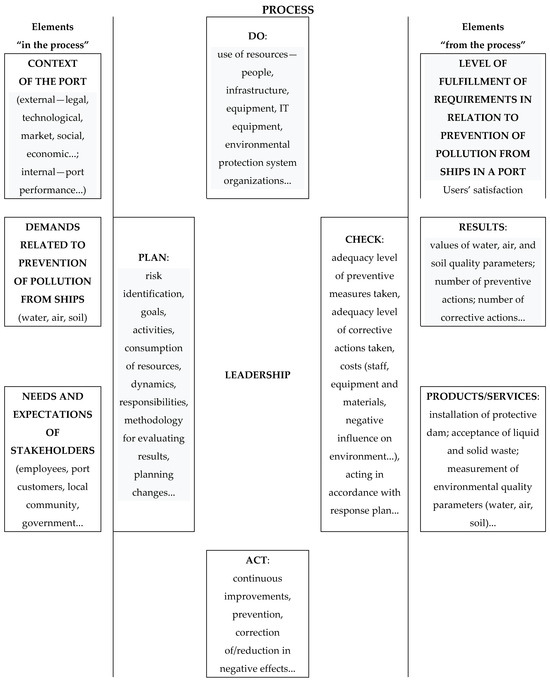
Figure 1.
Process model of a (sub)system of prevention of pollution from ships in a port. (Source: author, based on [109]).
The key general demands related to the (sub)system of prevention of pollution from ships in a port are adequate organization, the availability of qualified personnel, the availability of adequate equipment, etc. In order to establish bases for enabling the optimal functioning of the analyzed management sub(system), it is of crucial importance to recognize factors which directly determine the mentioned demands.
Speaking from a general point of view, sustainable development is a path which can be achieved through environmental management systems (EMSs).
The best-known standards setting out the criteria for an environmental management system (EMS) are ISO 14001 [110,111] and the EMAS (recommended by the European Parliament and the Council of the European Union, 2009) [112]. ISO 14001 provides a clear management framework to reduce environmental impacts, to meet legal requirements, to build stakeholder trust [113], and to integrate environmental management practices by supporting preventive and corrective measures [114]. It specifies requirements for an organization to identify the environmental aspects of its activities, products, and services and correlated environmental impacts. ISO 14001 is designed to be compatible and harmonized with other recognized management system standards, including ISO 9001 [113,115]. ISO 14001 requires organizations to define and execute their own operational controls in a manner appropriate for the sector they operate in [116]. Standards are not port-specific [112].
Ports, depending on their size, tend to have a wide range of environmental (sustainability) management needs. Small ports do not often have sufficient resources to implement environmental effectiveness enhancing tools, even if they need them [117].
5. Prevention of Pollution from Ships. Case Study: Port of Bar
5.1. Basic Characteristics of the Port of Bar
The Port of Bar [118] is a landlord port. In the port area, two port terminal operators are currently operating. There are the following specialized terminals within the Port of Bar: Liquid Cargo Terminal, Dry Bulk Cargo Terminal, Container Terminal, General Cargo Terminal, Ro-Ro Terminal, and Passenger Terminal.
In accordance with national strategic documents, laws, by-laws, and elements of international regulation, necessary activities are carried out in the Port of Bar with the aim of developing the function of environmental protection in accordance with the principles of sustainable development.
5.2. Factors That Determine Requirements Related to the (Sub)System of Prevention of Pollution from Ships in the Port of Bar
In this section, factors which determine requirements related to the (sub)system of prevention of pollution from ships in the Port of Bar are identified and analyzed.
- (A)
- Regulative: national and international
Basic elements of the national (Montenegrin) legislation related to the prevention of pollution from ships in the ports are the following: the Law on the Protection of the Sea from Pollution from Ships [119]—regulates the protection of the sea from pollution from ships that sail or are located in the internal sea waters and the territorial sea of Montenegro and the reception and handling of waste in ports, as well as responsibility and compensation for damages in case of pollution—and the Law on Ports [120]—regulates the legal status, division of ports, management, fees, concessions, order, inspection, and other matters of importance, including basic provisions on environmental management.
The important conventions which regulate at the international level the prevention of pollution from ships are the following: MARPOL—Convention on the Prevention of Pollution from Ships; AFS—Convention on the Control of Harmful Systems Against Ship Fouling; OPRC—Convention on Preparedness, Response and Cooperation in case of oil pollution; BWM—Convention on the Monitoring and Management of Ship’s Ballast Water; and the Nairobi Wreck Removal Convention.
In this context, it is important to point out the directives and regulations of the European Parliament and the Council related to the prevention of pollution from ships [121]: Directive 2002/84/EC (amending the directives on maritime safety and the prevention of pollution from ships); Regulation EC No2002/2099 (establishing a Committee on Safe Seas and the Prevention of Pollution from Ships); Directive 2000/59/EC (on port reception facilities for ship-generated waste and cargo residues); Directive 2001/96/EC (establishing harmonized requirements and procedures for the safe loading and unloading of bulk carriers); etc.
- (B)
- National response plans related to the prevention of pollution from ships and documented risk scenarios referring to sea pollution in ports from ships
In the document Risk Assessment of Disasters in Montenegro [122], general risks related to maritime traffic are analyzed. It is stated there that the set of potential risks with potential to cause disruptions to maritime transport and port activities in Montenegro also include those related to the Port of Bar and the ships that use this port: damage and accidents on ships that are berthed in the port, spillage of oil derivatives and harmful substances in the port water area, etc. In the mentioned document [122], some scenarios of unwanted events are elaborated.
- (C)
- Port capacity (including port terminal operators) to protect the sea from pollution from ships
The main activities of port terminal operators in the domain of the protection of the sea from pollution from ships are [118] the monitoring of activities in the domain of the protection of the sea from pollution from ships which, according to the corresponding contract, are entrusted to the operator for the management of liquid and solid waste from ships at the port area.
- (D)
- Competencies of the operator for the management of liquid and solid waste from ships in the port
The operator for the management of liquid and solid waste from ships in the port is authorized by the competent state authorities, and the port terminal operators have signed commercial agreements on mutual rights and obligations in relation to preventive measures (installation of a protective dam, acceptance of solid and liquid waste from ships, etc.) and corrective activities (procedure in case of environmental incidents, etc.).
- (E)
- Sources of income for financing activities in the field of protection from pollution from ships in the port
Port terminal operators finance activities in the field of protection from pollution from ships from their own revenues. In this context, it is important to mention that the Law on Ports [120], among others, defines additional sources of financing the protection of the sea from pollution from vessels in Montenegrin ports.
- (F)
- Waste management plan
The waste management plan is one of the basic documents that determine the goals and provide the conditions for sustainable waste management in the area of port terminal operators. According to the Law on Waste Management [123], the plan fulfills one of the important prerequisites for minimizing the amount of waste, thus reducing business costs through the optimized use of resources and reduction in waste disposal costs.
- (G)
- Material Safety Data Sheets for dangerous goods
The Material Safety Data Sheet (MSDS) represents one of the bases for the organization of the environmental protection system from pollution from ships during the (un)loading of hazardous materials that are transported to/from the port. The content of the MSDS is defined by the Montenegrin Law on Chemicals [124] and the Rulebook on the Content of the MSDS for Chemicals [125].
- (H)
- Cargo handling technologies in the relation from ship to shore (and vice versa)—in the function of preventing pollution from ships
Documented cargo handling technology [118] is also an important basis for the organization of sea protection against pollution from ships.
- (I)
- Number of ships
In Table 5, the number of ships which called at the Port of Bar JSC (one out of two terminal operators) in the period from 2019 to 2023 is shown.
Table 5.
Number of ships which called at the Port of Bar JSC in the period from 2019 to 2023.
- (J)
- Volume of oil/oil derivatives handled in the relation from ships to tanks (and vice versa)
In the following table (Table 6), systematized data related to the volume of oil/oil derivatives handled in the Port of Bar in the relation from ships to tanks (and vice versa) in the period from 2019 to 2023 are shown.
Table 6.
Volume of oil/oil derivatives handled in the period from 2019 to 2023.
- (K)
- Volume of harmful liquid substances in bulk (chemicals) handled in the relation from ships to tanks (and vice versa)
Table 7 shows systematized data on the volume of harmful liquid substances in bulk (chemicals) handled in the Port of Bar in the relation from ships to tanks (and vice versa) in the period from 2019 to 2023.
Table 7.
Volume of harmful liquid substances in bulk (chemicals) handled in the period from 2019 to 2023.
- (L)
- Volume of packaged dangerous goods handled in the relation from ships to warehouses (and vice versa)
Table 8 shows data on volume of packaged dangerous goods handled in the Port of Bar in the relation from ships to warehouses in the period from 2019 to 2023.
Table 8.
Volume of packaged dangerous goods handled in the period from 2019 to 2023.
- (M)
- Results of categorization of the domains of risks of pollution from ships
5.3. Categorization of the Domains of Risks of Pollution from Ships
The results of the literature overview confirm that none of the available references take into consideration the categorization of the domains of risks related to pollution from ships in a port. In order to contribute to the completion of the group of bases for the optimization of the (sub)system of prevention of pollution from ships in the analyzed port (Port of Bar), within this section, a categorization of the domains of risks related to pollution from ships is conducted using the Analytic Hierarchy Process (AHP) method.
The usual approach to risk identification and categorization includes investigating historical data on previous incidents, in addition to a structured brainstorming process with practitioners/professionals/experts for conceivable risks [48]. Due to its suitability, the AHP method is chosen for the realization of the mentioned brainstorming process for risk categorization in the domain of the prevention of pollution from ships.
5.3.1. Methodology
The AHP method is used to study production systems, software, supplier selection, construction method selection, warehouse selection, technology evaluation, etc. Numerous references are available where research results (based on the application of the AHP method) are presented: port selection [126], port competitiveness [127], cargo handling equipment selection as part of the investment process [128], etc.
The AHP is a method intended for solving complex problems at different hierarchical levels, where the goal is at the top, the middle levels are criteria and sub-criteria, and the lowest level is alternatives (choice) [129]. In principle, the AHP is a general measurement theory, which is used to define the scale of ratios for both discrete and continuous paired comparisons [130]. These comparisons may be taken from actual measurements or from a fundamental scale which reflects the relative strength of preferences. The AHP method has found its widest applications in multi-criteria decision making, planning, and resource allocation [131].
The basic steps in using the AHP method for the categorization of the domains of risks of pollution from ships in the Port of Bar are as follows (based on [131,132]):
- (A)
- Defining the goal
The goal is to identify the domains of the risks of pollution from ships in the Port of Bar, taking into account the elements analyzed in the previous sections of this paper.
- (B)
- Defining variants (alternatives) and selection criteria
The following variants (alternatives) are considered:
- Variant (alternative) 1—domain of risks M1: unloading oil/oil derivatives from ships to tanks (and vice versa);
- Variant (alternative) 2—domain of risks M2: unloading harmful liquid substances in bulk (chemicals) from ships to tanks (and vice versa);
- Variant (alternative) 3—domain of risks M3: unloading packaged dangerous goods from ships to warehouses (and vice versa);
- Variant (alternative) 4—domain of risks M4: liquid and solid waste from ships/emissions from ships.
The following selection/comparison criteria were chosen:
- Criterion 1—K1: workforce (number, profile, and level of education of personnel, etc.); the results of the research show that specific attention in this domain has to be given to the qualification, training, and attitude of the involved workforce [133].
- Criterion 2—K2: equipment.
- Criterion 3—K3: costs.
- Criterion 4—K4: period of exposure to the risks.
- (C)
- Defining the hierarchical analysis model
The general form of the hierarchical analysis model is shown in Figure 2.
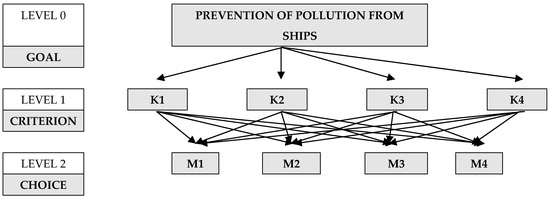
Figure 2.
General form of the hierarchy model of analysis (source: author).
- (D)
- Pair-wise comparison and consistency test
In order to perform pair-wise comparisons and associated consistency tests, the following activities should be performed [132]—Table 9.
Table 9.
Activities necessary to perform pair-wise comparisons and consistency tests.
- (E)
- Calculation of the global weights
The overall composite weight for the analyzed variants (alternatives)—domains of risks, Mi—is calculated based on the following relation:
Mi = Σ(relative weight of the criterion cj, from the compar. matrix with respect to the goal) × (relative weight of the variant (alternat.) − domain of risks Mi based on criterion cj, from compar. matrix with respect to criterion cj)
- (F)
- Final ranking of alternatives
5.3.2. Results—Final Ranking of Alternatives
- (A)
- Pair-wise comparison and consistency test
In line with the defined phases of the methodology (previous section of this paper), reciprocal matrices were created and all related parameters were calculated, all in order to define the categories of the domains of risks of pollution from ships in the Port of Bar, among defined variants (alternatives), Mi, based on the adopted selection criteria, Kj.
- (A.1)
- Pair-wise comparison and consistency test—level 1 of the hierarchy framework
Pair-wise comparison was performed by an ad hoc established group of 10 professionals engaged in different forms in the field of the prevention of pollution from ships (besides the author of this paper, members of the group were from the following institutions: Montenegrin Ministry of Traffic and Maritime Affairs, Montenegrin Directorate for Maritime Safety and Port Management, Harbor Master Office Bar, and Adriatic University). In comparison matrices, the rounded mean values of ratings from each member of the group were inserted.
A reciprocal (comparison) matrix—level 1 of the hierarchy framework (Figure 2)—with respect to the goal—is shown in Table 10, which was formed considering the number of items for comparison, n = 4, and Saaty’s fundamental scale of absolute numbers. The values from each column of Table 10 were summed (bottom row of the table), and, after that, each element of the table was divided with the sum of the belonging column in order to obtain the normalized relative weights. In the next step, the normalized principal eigen-vector (Priority Vector), w, is calculated by averaging across the rows of the matrix.
Table 10.
Paired comparison matrix—level 1—with respect to the goal.
In order to carry out the consistency test of the evaluation, it is necessary to calculate the consistency index, CI, and consistency ratio, CR. If the value of consistency ratio, CR, is under 0.10, the evaluation is consistent.
The calculated values related to the matrix shown in Table 10 are as follows:
Principal eigenvector: λmax = 4.2505; consistency index, CI = 0.0835; random value of consistency index, RI = 0.9; and consistency ratio, CR = 0.0928. The consistency ratio is under 0.10, which means that the performed evaluation is consistent.
- (A.2)
- Pair-wise comparisons and consistency tests—level 2 of the hierarchy framework
Reciprocal (comparison) matrices—level 2 of the hierarchy framework (Figure 2)—with respect to the selection criteria are presented in Table 11, Table 12, Table 13 and Table 14. All previously mentioned characteristic parameters are calculated as per the previously defined steps of the procedure (Table 9).
Table 11.
Paired comparison matrix—level 2—with respect to criterion C1.
Table 11.
Paired comparison matrix—level 2—with respect to criterion C1.
| Criterion | M1 | M2 | M3 | M4 | Priority Vector |
|---|---|---|---|---|---|
| M1 | 1.00 | 7.00 | 5.00 | 3.00 | 0.5668 |
| M2 | 0.14 | 1.00 | 0.20 | 0.33 | 0.0598 |
| M3 | 0.20 | 5.00 | 1.00 | 0.50 | 0.1644 |
| M4 | 0.33 | 3.00 | 2.00 | 1.00 | 0.2090 |
| sum | 1.67 | 16.00 | 8.20 | 4.83 | 1.000 |
(Source: author).
Principal eigenvector: λmax = 4.2606; consistency index, CI = 0.0869; random value of consistency index, RI = 0.9; and consistency ratio, CR = 0.0965. The consistency ratio is under 0.10, which means that the performed evaluation is consistent.
Table 12.
Paired comparison matrix—level 2—with respect to criterion C2.
Table 12.
Paired comparison matrix—level 2—with respect to criterion C2.
| Criterion | M1 | M2 | M3 | M4 | Priority Vector |
|---|---|---|---|---|---|
| M1 | 1.00 | 7.00 | 5.00 | 3.00 | 0.5668 |
| M2 | 0.14 | 1.00 | 0.20 | 0.33 | 0.0598 |
| M3 | 0.20 | 5.00 | 1.00 | 0.50 | 0.1644 |
| M4 | 0.33 | 3.00 | 2.00 | 1.00 | 0.2090 |
| sum | 1.67 | 16.00 | 8.20 | 4.83 | 1.000 |
(Source: author).
Principal eigenvector: λmax = 4.2606; consistency index, CI = 0.0869; random value of consistency index, RI = 0.9; and consistency ratio, CR = 0.0965. The consistency ratio is under 0.10, which means that the performed evaluation is consistent.
Table 13.
Paired comparison matrix—level 2—with respect to criterion C3.
Table 13.
Paired comparison matrix—level 2—with respect to criterion C3.
| Criterion | M1 | M2 | M3 | M4 | Priority Vector |
|---|---|---|---|---|---|
| M1 | 1.00 | 7.00 | 5.00 | 3.00 | 0.5668 |
| M2 | 0.14 | 1.00 | 0.20 | 0.33 | 0.0598 |
| M3 | 0.20 | 5.00 | 1.00 | 0.50 | 0.1644 |
| M4 | 0.33 | 3.00 | 2.00 | 1.00 | 0.2090 |
| sum | 1.67 | 16.00 | 8.20 | 4.83 | 1.000 |
(Source: author).
Principal eigenvector: λmax = 4.2606; consistency index, CI = 0.0869; random value of consistency index, RI = 0.9; and consistency ratio, CR = 0.0965. The consistency ratio is under 0.10, which means that the performed evaluation is consistent.
Table 14.
Paired comparison matrix—level 2—with respect to the criterion C4.
Table 14.
Paired comparison matrix—level 2—with respect to the criterion C4.
| Criterion | M1 | M2 | M3 | M4 | Priority Vector |
|---|---|---|---|---|---|
| M1 | 1.00 | 6.00 | 4.00 | 2.00 | 0.4918 |
| M2 | 0.16 | 1.00 | 0.25 | 0.25 | 0.0626 |
| M3 | 0.25 | 4.00 | 1.00 | 0.33 | 0.1527 |
| M4 | 0.50 | 4.00 | 3.00 | 1.00 | 0.2929 |
| sum | 1.91 | 15.00 | 8.25 | 3.58 | 1.000 |
(Source: author).
Principal eigenvector: λmax = 4.1874; consistency index, CI = 0.0625; random value of consistency index, RI = 0.9; and consistency ratio, CR = 0.0694. The consistency ratio is under 0.10, which means that the performed evaluation is consistent.
- (B)
- Calculating overall composite weights (synthesizing results) and final ranking
The overall composite weight of each variant (alternative)—potential domains of risks of pollution from ships—is based on the calculated weights of level 1 and level 2. It is just the normalization of the linear combination of multiplication between the weight and priority eigenvector (Priority Vector).
The overall composite weight for the analyzed variants (alternatives)—domains of risks, Mi—is calculated based on Equation (4):
M1 = (0.1753 × 0.5668) + (0.1230 × 0.5668) + (0.3274 × 0.5668) + (0.3760 × 0.4918) = 0.5365
M2 = (0.1753 × 0.0598) + (0.1230 × 0.0598) + (0.3274 × 0.0598) + (0.3760 × 0.0626) = 0.0623
M3 = (0.1753 × 0.1644) + (0.1230 × 0.1644) + (0.3274 × 0.1644) + (0.3760 × 0.1527) = 0.1602
M4 = (0.1753 × 0.2090) + (0.1230 × 0.2090) + (0.3274 × 0.2090) + (0.3760 × 0.2090) = 0.2408
The overall composite weight of the analyzed variants (alternatives) is presented with the matrix—Table 15. This table is formed of following elements: column “K1” is equal to the column “Priority Vector” in Table 11; column “K2” is equal to the column “Priority Vector” in Table 12; column “K3” is equal to the column “Priority Vector” in Table 13; and column “K4” is equal to the column “Priority Vector” in Table 14; in the column “Composite weight”, previously calculated values of this parameter are inserted.
Table 15.
Values of composite weights.
The overall consistency of the hierarchy, CR, calculated based on the related equation in Table 9, is 0.0995 (under 0.10), which means that the complete evaluation (at level 1 and level 2) is consistent.
5.3.3. Discussion of Results
Based on the results systematized in the previous sections, the analyzed variants (alternatives)—domains of risks of pollution from ships in the Port of Bar—can be ranked:
- -
- Rank 1: Variant (alternative) 1—domain of risks M1: unloading oil/oil derivatives from ships to tanks (and vice versa)—with a general composite weight share of 0.5365 (53.65%);
- -
- Rank 2: Variant (alternative) 4—domain of risks M4: liquid and solid waste from ships/emissions from ships—with a general composite weight share of 0.2408 (24.08%);
- -
- Rank 3: Variant (alternative) 3—domain of risks M3: unloading packaged dangerous goods from ships to warehouses (and vice versa)—with a general composite weight share of 0.1602 (16.02%);
- -
- Rank 4: Variant (alternative) 2—domain of risks M2: unloading harmful liquid substances in bulk (chemicals) from ships to tanks—with a general composite weight share of 0.0623 (6.23%).
The presented results (categories of domains of risks) indicate a strong dependence of the ranks on the following parameters:
- -
- Unloaded/loaded cargo volume, which directly determines the requirements regarding the necessary workforce and equipment for protection from pollution from ships, having at the same time an influence on costs;
- -
- Productivity during the unloading/loading operations, which directly determines the time of ships staying at berth—the time of exposure to risks of pollution from ships.
Connecting the previous statements with concrete data given in Section 5.2 of this paper, some correlations can be established:
- -
- Rank 1 of Variant (alternative) 1—domain of risks M1—corresponds to the volume of oil/oil derivates handled in the analyzed period, which was the biggest in comparison with the two other considered cargo types (packaged dangerous goods and harmful liquid substances in bulk (chemicals)), and the time of ships staying at berth for unloading/loading oil/oil derivates, which was the biggest in comparison with the two other cargo types (packaged dangerous goods and harmful liquid substances in bulk (chemicals)), which is followed with the biggest exposure to risks of pollution from ships.
In order to enable the highest possible adaptability of the (sub)system of prevention of pollution from ships, it is necessary to periodically reconsider the defined ranks depending on the variations in related parameters.
At the same time, the results shown, in a specific way, indicate the importance of all the requirements defined by the MARPOL Convention (including all its annexes) being fully met. In this context, it is necessary to point out the importance of all the elements of national (Montenegrin) regulation in the field of sea protection against pollution from ships being fully harmonized with international regulations, especially with the mentioned MARPOL Convention (and its annexes). Adequate implementation of MARPOL (as well as other related international widely adopted conventions and directives) in national legislation enables the unification of policy environments in the field of the prevention of pollution from ships, which is of crucial importance for the effectiveness and efficiency of the protection system. The management model of prevention of pollution from ships proposed by this paper considers that the related national legislation is fully in line with international legislation. It means that the implementation of the proposed management model in ports in countries where relevant conventions and directives are not successfully implemented would be limited.
The defined risks categories are, among others, established bases for the adequate planning of necessary preventive and corrective actions connected with pollution from ships. The previously mentioned directly bring to the fore the necessity to have defined (recognized) adequate recovery strategies. This can be very clearly illustrated if the contamination of sediments in the port water area—due to the pollution from ships—is taken into consideration. Concrete recovery strategies of dredged contaminated marine sediments in ports have been developed [134], and concrete remediation techniques have been proposed for the remediation of the contaminated dredged sediments [135].
Variant (alternative) 1—domain of risks M1: unloading oil/oil derivatives from ships to tanks (and vice versa)—has the highest rank according to all four selection criteria:
* According to criterion 1—K1: workforce—for the protection from pollution from ships (number, profile, and level of education of personnel, etc.), with a weight share of 0.5668 (56.68%);
* According to criterion 2—K2: equipment—for the protection from pollution from ships, with a weight share of 0.5668 (56.68%);
* According to criterion 3—K3: costs—related to the realization of activities for the purpose of protection from pollution from ships, with a weight share of 0.5668 (56.68%);
* According to criterion 4—K4: time of exposure to the risk of pollution from ships— with a weight share of 0.4918 (49.18%).
Variant (alternative) 4—domain of risks M4: liquid and solid waste from ships/emissions from ships—is ranked second according to all four selection criteria, with the following weight shares:
* According to criterion 1—K1: workforce—for the protection from pollution from ships (number, profile, and level of education of personnel, etc.), with a weight share of 0.2090 (20.90%);
* According to criterion 2—K2: equipment—for the protection from pollution from ships, with a weight share of 0.2090 (20.90%);
* According to criterion 3—K3: costs—related to the realization of activities for the purpose of protection from pollution from ships, with a weight share of 0.2090 (20.90%);
* According to criterion 4—K4: time of exposure to the risk of pollution from ships—with a weight share of 0.2929 (29.29%).
The ranks of Variant (alternative) 4—domain of risks M4—as per the selection criteria used, are mainly determined with the time of exposure to risks from pollution with liquid and solid waste from ships and emissions from ships, which, on the other hand, depends on productivity during the unloading/loading operations.
Variant (alternative) 3—domain of risks M3: unloading packaged dangerous goods from ships to warehouses—is the third in rank according to all four selection criteria, with the following weight shares:
* According to criterion 1—K1: workforce—for the protection from pollution from ships (number, profile, and level of education of personnel, etc.), with a weight share of 0.1644 (16.44%);
* According to criterion 2—K2: equipment—for the protection from pollution from ships, with a weight share of 0.1644 (16.44%);
* According to criterion 3—K3: costs—related to the realization of activities for the purpose of protection from pollution from ships, with a weight share of 0.1644 (16.44%);
* According to criterion 4—K4: time of exposure to the risk of pollution from ships—with a weight share of 0.1527 (15.27%).
Variant (alternative) 2—domain of risks M2: unloading harmful liquid substances in bulk (chemicals) from ships to tanks—is the fourth in rank according to all four selection criteria, with the following weight shares:
* According to criterion 1—K1: workforce—for the protection from pollution from ships (number, profile, and level of education of personnel, etc.), with a weight share of 0.0598 (5.98%);
* According to criterion 2—K2: equipment—for the protection from pollution from ships, with a weight share of 0.0598 (5.98%);
* According to criterion 3—K3: costs—related to the realization of activities for the purpose of protection from pollution from ships, with a weight share of 0.0598 (5.98%);
* According to criterion 4—K4: time of exposure to the risk of pollution from ships—with a weight share of 0.0626 (6.26%).
The ranks of variants (alternatives) 3 and 2—domains of risks M3 and M2—are in line with the values of related determining parameters: the volume of unloaded/loaded cargo and productivity during the unloading/loading operations—time of ships staying at berth—and time of exposure to risks.
6. Conclusions
The considerations made in this paper strongly confirm that the prevention of pollution from ships in a port definitely belongs to the priorities from all relevant managerial points of view, especially when an objective to fulfill demands determined by the “green port” concept is kept in mind. In this sense, it is of crucial importance to act systematically, in a modeled way, strictly in accordance with the development trends of environmental management systems in ports, taking into account all specific characteristics of a concrete port.
The range of factors with influence in the (sub)system of prevention of pollution from ships in a port is very wide. Among them, the ranks of domains of risks of pollution from ships deserve special attention, which motivated the author to propose an approach for their identification using the Analytic Hierarchy Process (AHP) method. Through the analyses conducted in this paper, some important correlations between the level of risks of pollution from ships and the quantity of unloaded/loaded cargo and productivity during the unloading/loading operations became obvious. The intention of the author is to investigate these correlations and present the results in a further paper.
Furthermore, respecting the fact that the categorization of risks of pollution from ships in a port, conducted in Section 5.3 of this paper, is, mainly, connected with the data from the concrete five-year period and fully respecting the changing nature of determining parameters, within the scope of his further engagement in this domain, the author plans to work on creating a software for calculating risk levels, based on the considerations made/the model proposed in this paper.
Respecting the fact that this paper proposes an approach to modeling a (sub)system of prevention of pollution from ships in a concrete port (analyzed through a case study) which is based on the general PDCA management model, recommends directions for the identification (and analysis) of factors which determine requirements related to the mentioned (sub)system of prevention of pollution, and defines a model for the categorization of the domains of risk of pollution from ships correlated with identified determining factors, the results of the considerations made could be implemented and/or replicated through research/analyses in other very similar ports (multipurpose ports), as well as in other ports, with necessary adjustments.
Funding
This research received no external funding.
Institutional Review Board Statement
Not applicable.
Informed Consent Statement
Not applicable.
Data Availability Statement
Data are contained within the article.
Acknowledgments
The author cordially thanks his colleagues who kindly participated in the group whose expert opinions were a base for creating the comparison matrices.
Conflicts of Interest
The author declares no conflicts of interest.
References
- Esmer, S. Performance Measurements of Container Terminal Operations. Dokuz Eylul University, Turkey. 2008. Available online: http://www.sbe.deu.edu.tr (accessed on 20 November 2023).
- Verschuur, J.; Koks, E.E.; Hall, J.W. Ports’ criticality in international trade and global supply-chains. J. Nat. Commun. 2022, 13, 4351. [Google Scholar] [CrossRef] [PubMed]
- Jouili, T. The Role of Seaports in the Process of Economic Growth. Dev. Ctry. Stud. 2016, 6, 64–69. Available online: https://core.ac.uk/download/pdf/234682718.pdf (accessed on 21 November 2023).
- Mudronja, G.; Jugović, A.; Škalamera-Alilović, D. Seaports and Economic Growth: Panel Data Analysis of EU Port Regions. J. Mar. Sci. Eng. 2020, 8, 1017. [Google Scholar] [CrossRef]
- Munim, Z.H.; Schramm, H.-J. The impacts of port infrastructure and logistics performance on economic growth: The mediating role of seaborne trade. J. Shipp. Trade 2018, 3, 1. [Google Scholar] [CrossRef]
- Dwarakisha, G.S.; Salima, A.M. Review on the Role of Ports in the Development of a Nation. Aquat. Procedia 2015, 4, 295–301. [Google Scholar] [CrossRef]
- Somu, R.; Jeevan, J.; Mohd Salleh, N.H.; Othman, M.R.; Mokhtar, K.; Ngah, A.H. The role of seaports in regional development in the East Coast of Peninsular Malaysia: An evaluation through an exploratory factor analysis. J. Transp. Supply Chain Manag. 2022, 16, 10. [Google Scholar] [CrossRef]
- Tareq, A.M.; Shaikh, M.A.; Sen, S.; Xuefeng, W. Deep Sea Port and the National Development: Perspective of Bangladesh. Int. J. Eng. Manag. Res. 2020, 10, 73–80. [Google Scholar] [CrossRef]
- Allen, C.H. Future Ports Scenarios for 21st Century Port Strategic Planning. J. Transp. Law Logist. Policy 2011, 79, 80–130. Available online: https://www.researchgate.net/publication/228120763_Future_Ports_Scenarios_for_21st_Century_Port_Strategic_Planning (accessed on 22 November 2023). [CrossRef]
- Hanson, S.E.; Nicholls, R.J. Demand for ports to 2050: Climate policy, growing trade and the impacts of sea-level rise. Earth’s Future 2020, 8, e2020EF001543. [Google Scholar] [CrossRef]
- Deloitte Inc. Port 2050 Scenarios Update Final Report. 2015. Available online: https://www.portvancouver.com/wp-content/uploads/2015/03/2015-04-07-Port-2050-Scenario-Refresh-Final-Report-with-appendices.pdf (accessed on 24 November 2023).
- Hartmann, S. Generating Scenarios for Simulation and Optimization of Container Terminal Logistics, Manuskripte aus den Instituten für Betriebswirtschaftslehre der Universität Kiel, No. 564, Universität Kiel, Institut für Betriebswirtschaftslehre, Kiel. 2002. Available online: https://www.econstor.eu/bitstream/10419/147631/1/manuskript_564.pdf (accessed on 25 November 2023).
- Lakshman Kadirgamar Institute of International Relations and Strategic Studies. Port City Sez—A Catalyst for Modern Services in Sri Lanka. 2020. Available online: https://www.portcitycolombo.lk/downloads/2020R-Port-City-SEZ-22-05-20.pdf (accessed on 25 November 2023).
- Perić Hadžić, A. Evaluation of development partnership scenarios of the Croatian seaports using MAMCA analysis. Pomorstvo 2022, 36, 135–145. [Google Scholar] [CrossRef]
- Andersen, T.; Aryee, J.; Acheampong, G.; Skovsted Hansen, A.S. The continuous search for new port governance models: Experiences from a developing country. J. Shipp. Trade 2023, 8, 10. Available online: https://jshippingandtrade.springeropen.com/articles/10.1186/s41072-023-00139-8 (accessed on 27 November 2023). [CrossRef]
- Olesen, P.B.; Dukovska-Popovska, I.; Henrik Hvolby, H.H.; Jensen, K.S. Strategic Port Development: Identifying a Development Approach for Small and Medium-Sized Ports. Proceedings from the Annual Transport Conference at Aalborg University. 2014. Available online: https://www.trafikdage.dk/td/papers/papers12/SpecialSessions/111_PeterBjergOlesen.pdf (accessed on 27 November 2023).
- Wahyni, S. Innovation in Port Development. The Quad Helix Model. In Infrastructure Investment in Indonesia: A Focus on Ports; Open Book Publishers: Cambridge, UK, 2019; Available online: http://books.openedition.org/obp/11468 (accessed on 28 November 2023).
- Indriastiwi, F.; Hadiwardoyo, S.P.; Nahry. Port Connectivity Model in The Perspective of Multimodal Transport: A Conceptual Framework. In Proceedings of the IOP Conference Series: Materials Science and Engineering, Volume 1052, The 5th International Conference on Marine Technology (SENTA 2020), Surabaya, Indonesia, 8 December 2020; Available online: https://iopscience.iop.org/article/10.1088/1757-899X/1052/1/012008 (accessed on 29 November 2023).
- Bulletin Fall 352. 2016. Available online: https://repositorio.cepal.org/server/api/core/bitstreams/1e9d475e-70e5-41a2-a1c9-7d8b7351db4d/content (accessed on 29 November 2023).
- Ducruet, C.; Reka, J.; Nagy, D.K.; Steinwender, C. All Aboard: The Effects of Port Development. 2020. Available online: https://shs.hal.science/halshs-03041845 (accessed on 30 November 2023).
- Liu, L.; Ping, H. Study of the Influencing Factors on Development of Ports in Guangdong, Hong Kong, and Macao from the Perspective of Spatial Economics. Math. Probl. Eng. 2020, 2020, 2343860. [Google Scholar] [CrossRef]
- Mrak, I. Locally Based Development—Tools for Identifying Opportunities and Evaluating Port Area Strategies of Rijeka. Sustainability 2013, 5, 4024–4056. [Google Scholar] [CrossRef]
- Del Saz-Salazar, S.; García-Menéndez, L.; Merk, O. The Port and Its Environment: Methodological Approach for Economic Appraisal; OECD Regional Development Working Papers; OECD Publishing: Paris, France, 2013. [Google Scholar] [CrossRef]
- Taneja, P.; Walker, W.E.; Ligteringen, H.; Van Schuylenburg, M.; Van der Plas, R. Future Scenario’s, Implications for Port Planning. Proceeding from the WCTRS Conference, Antwerp. 2009. Available online: https://www.researchgate.net/publication/284150234_Future_scenario’s_Implications_for_port_planning (accessed on 4 December 2023).
- Pardali, A.; Stathopoulou, C. The Post-War Port Industry Development Models: The Effects on the Economic Development of the Port Hinterland. 2006. Available online: https://www.researchgate.net/publication/23732100_The_Post-War_Port_Industry_Development_Models_the_Effects_on_the_Economic_Development_of_the_Portas_Hinterland (accessed on 4 December 2023).
- Notteboom, T.E.; Rodriguez, J.P. Port regionalization: Towards a new phase in port development. Marit. Policy Manag. 2005, 32, 297–314. Available online: https://skb.skku.edu (accessed on 6 December 2023). [CrossRef]
- Heikkilä, M.; Saarni, J.; Saurama, A. Innovation in Smart Ports: Future Directions of Digitalization in Container Ports. J. Mar. Sci. Eng. 2022, 10, 1925. [Google Scholar] [CrossRef]
- Inkinen, T.; Helminen, R.; Saarikoski, J. Technological trajectories and scenarios in seaport digitalization. Res. Transp. Bus. Manag. 2021, 41, 100633. Available online: https://www.sciencedirect.com/science/article/pii/S221053952100016X (accessed on 7 December 2023). [CrossRef]
- Vilke, S.; Ukić Boljat, H.; Grubišić, N.; Maglić, L. Application of multi-criteria analysis for the introduction of green port management practices: An evaluation of energy efficient mobility in nautical ports. Sci. J. Marit. Univ. Szczec. 2021, 65, 72–84. Available online: https://bibliotekanauki.pl/articles/1818877 (accessed on 9 December 2023).
- Haezendonck, E. Port Strategy for Sustainable Development. Sust. Spec. Issue 2022, 12, 9914. Available online: https://webaplicacion.apn.gob.pe/proyecto/wp-content/uploads/2022/01/Port-strategy-for-sustainable-development.pdf (accessed on 10 December 2023).
- Zhang, X. Port Development Model based on Low-carbon Economy. Int. Core J. Eng. 2020, 6, 160–170. Available online: https://www.airitilibrary.com/Article/Detail/P20190813001-202010-202009240001-202009240001-160-169 (accessed on 10 December 2023).
- Lloyd’s Register, Global Maritime Trends 2050. 2023. Available online: https://www.lr.org/en/knowledge/research-reports/global-maritime-trends-research-programme/ (accessed on 11 December 2023).
- Ghennaï, A.; Said Madani, S.; Hein, C. Evaluating the sustainability of scenarios for port city development with Boussole21 method. Environ. Syst. Decis. 2023, 43, 87–107. [Google Scholar] [CrossRef]
- Pham, T.Y. A smart port development: Systematic literature and bibliometric analysis. Asian J. Shipp. Logist. 2023, 39, 57–63. Available online: https://www.sciencedirect.com/science/article/pii/S2092521223000354 (accessed on 15 December 2023). [CrossRef]
- Alamoush, A.S.; Ballini, F.; Ölçer, A.I. Revisiting port sustainability as a foundation for the implementation of the United Nations Sustainable Development Goals (UN SDGs). J. Shipp. Trade 2021, 6, 19. Available online: https://jshippingandtrade.springeropen.com/articles/10.1186/s41072-021-00101-6 (accessed on 13 December 2023). [CrossRef]
- Amrullah, R.A.; Kusumawardhana, Y.B.; Arsantyo, H.I.; Gusharianto; Praugusta, M.A. Waste Pollution and Pollution Prevention in Tanjung Prior Port with Green Port Program. J. Marit. Malahayati 2023, 4, 71–74. Available online: https://journal.poltekpelaceh.ac.id/index.php/jumama/article/view/57 (accessed on 15 December 2023).
- European Commission, COM/2019/640 Final European Green Deal. 2019. Available online: https://ec.europa.eu/info/strategy/priorities-2019-2024/european-green-deal/transport-and-green-deal_en (accessed on 16 December 2023).
- Panaro, A.; Buonfanti, A.A. The Role of Ports as Energy Hubs and Their Impact on Mediterranean Maritime Relations. In Policy Study: Infrastructures, Energy and Digitalization: Pillars for the Sustainble Development of Transport in the Western Mediterranean, Centre for Transportation Studies for the Western Mediterranean (CETMO) and European Institute of the Mediterranean (IEMed). 2024, pp. 46–58. Available online: https://www.iemed.org/wp-content/uploads/2024/02/Policy-Study-8-CETMO-paper.pdf (accessed on 16 December 2023).
- UNCTAD. UNCTAD Rapid Assessment: Navigating Troubled Waters—Impact to Global Trade of Disruption of Shipping Routes in the Red Sea, Black Sea and Panama Canal. 2024. Available online: https://unctad.org (accessed on 16 December 2023).
- European Commission. Europe’s Seaports 2030: Challenges Ahead, Brussels. 2013. Available online: https://ec.europ.eu/commission/presscorner/detail/en/MEMO_13_448 (accessed on 17 December 2023).
- ISO 31000; Risk Management. ISO: Geneva, Switzerland, 2018.
- International Association of Ports and Harbors (IAPH), Risk and Resilience Guidelines for Ports. Available online: https://sustainableworldports.org/wp-content/uploads/IAPH-Risk-and-Resilience-Guidelines-for-Ports-BD.pdf (accessed on 18 December 2023).
- Nagy, A.; Indorf, M.; Kersten, W. Bibliometric analysis of risk management in seaports. In Digitalization in Supply Chain Management and Logistics: Smart and Digital Solutions for an Industry 4.0 Environment. Proceedings of the Hamburg International Conference of Logistics (HICL); Kersten, W., Blecker, T., Ringle, C., Eds.; epubli GmbH: Berlin, Germany, 2017; pp. 491–521. [Google Scholar] [CrossRef]
- Alyami, H.; Tae-Woo Lee, P.; Yang, Z.; Riahi, R.; Bonsall, S.; Wang, J. An advanced risk analysis approach for container port safety evaluation. Marit. Policy Manag. 2014, 41, 634–650. [Google Scholar] [CrossRef]
- Philip, J.; Christie, J.S.; Ircha, M.C. Port Risk Management. 2014. Available online: https://ctrf.ca/wp-content/uploads/2014/07/13JohnChristieIrchaPortRiskManagement.pdf (accessed on 18 December 2023).
- Janowicz, K.; Pauling, J. Risk Assessment, Management, and Mitigation for Port and Marine Terminals Projects. 2016. Available online: https://aapa.files.cms-plus.com/SeminarPresentations/2016Seminars/2016CargoOptimization/Kat%20J.pdf (accessed on 18 December 2023).
- Sihem, S.; Robert, N. Port Risk Assessment in Container terminals: The Case of Tunisia. Int. J. Transp. Dev. Integr. 2020, 4, 42–50. Available online: https://www.witpress.com/Secure/ejournals/papers/TDI040104f.pdf (accessed on 19 December 2023). [CrossRef]
- Pallis, P.L. Port Risk Management in Container Terminals. Transp. Res. Proc. 2017, 25, 4411–4421. Available online: www.sciencedirect.com (accessed on 19 December 2023). [CrossRef]
- Hudson Trident Maritime Security Management, Risk Assessment Factors in Port Security. 2019. Available online: https://portalcip.org/wp-content/uploads/2019/08/9-Assessing-Risk-and-Port-Security-05062019.pdf (accessed on 20 December 2023).
- Mokhtari, K. Advanced Risk Management in Offshore Terminals and Marine Ports. Doctoral Thesis, Liverpool Logistics, Offshore and Marine (LOOM) Research Institute School of Engineering, Technology and Maritime Operations, Liverpool, UK, 2011. Available online: https://researchonline.ljmu.ac.uk/id/eprint/6094/1/549427.pdf (accessed on 20 December 2023).
- UNCTAD—Resilient Maritime Logistics, Port Risk Management and Resilience-Building Toolbox. Available online: https://resilientmaritimelogistics.unctad.org/guidebook/5-port-risk-management-and-resilience-building-toolbox (accessed on 20 December 2023).
- Nagy, A.; Kersten, W. A Process Model for Cooperative Risk Management in Seaports. Sustainability 2022, 14, 1662. [Google Scholar] [CrossRef]
- Milošević, T.; Kranjčević, L.; Piličić, S.; Čavrak, M.; Kegalj, I.; Traven, L. Air Pollution Dispersion Modeling in Port Areas. J. Marit. Transp. Sci. 2020, 3, 157–170. Available online: https://hrcak.srce.hr/238819 (accessed on 21 December 2023). [CrossRef]
- Li, Z.; Feng, C.J.; Ya, D.J. Air Pollution and Control of Cargo Handling Equipments in Ports. In E3S Web Conference; International Conference on Green Energy and Environment Engineering; EDP Sciences: Les Ulis, France, 2018; Volume 93. [Google Scholar] [CrossRef]
- Jahan, S.; Strezov, V. Water quality assessment of Australian ports using water quality evaluation indices. PLoS ONE 2017, 12, e0189284. [Google Scholar] [CrossRef]
- Paladino, O.; Moranda, A.; Seyedsalehi, M. A Method for Identifying Pollution Sources of Heavy Metals and PAH for a Risk-Based Management of a Mediterranean Harbour. Scientifica 2017, 2017, 4690715. [Google Scholar] [CrossRef]
- OECD. The Environmental Effects of Freight. 1997. Available online: https://www.oecd.org/environment/envtrade/2386636.pdf (accessed on 23 December 2023).
- Zhou, Y.; Levy, J.I. Factors influencing the spatial extent of mobile source air pollution impacts: A meta-analysis. BMC Public Health 2007, 7, 89. Available online: https://bmcpublichealth.biomedcentral.com/articles/10.1186/1471-2458-7-89 (accessed on 28 December 2023). [CrossRef] [PubMed]
- Giacommeti, F. Intervention plans in case of sudden pollution of the sea from the ship and from the land (in Croatian). Pomorstvo 2006, 20, 13–22. Available online: https://hrcak.srce.hr/file/6563 (accessed on 28 December 2023).
- ESPO Environmental Report, EcoPortsinSights2023. 2023. Available online: https://www.espo.be/media/ESPO%20Environmental%20Report%202023.pdf (accessed on 29 December 2023).
- Rahman, M.R. Prevention of pollution of the marine environment from vessels: The potentials and limits of the International Maritime Organization (book review). J. Int. Marit. Saf. Environ. Aff. Shipp. 2017, 1, 22–23. [Google Scholar] [CrossRef]
- Gossling, S.; Meyer-Habighorst, C.; Humpe, A. A global review of marine air pollution policies, their scope and effectiveness. Ocean Coast. Manag. 2021, 212, 105824. Available online: https://www.sciencedirect.com/science/article/pii/S0964569121003070 (accessed on 30 December 2023). [CrossRef]
- Andrés Roiz, M.Á.; Sánchez Ruiz, L.; Perez Labajos, C.Á. The MARPOL Convention in scientific literature. Bibliographic review. J. Marit. Res. 2018, 15, 86–93. Available online: https://repositorio.unican.es/xmlui/bitstream/handle/10902/23663/TheMARPOLConvention.pdf?sequence=1 (accessed on 30 January 2024).
- Boyle, A.E. Marine Pollution under the Law of the Sea Convention. Am. J. Int. Law 1985, 79, 347–372. Available online: https://www.jstor.org/stable/2201706 (accessed on 30 December 2023). [CrossRef]
- Nuraini, I.N.; Triatmodjo, M. International Cooperation on Marine Environment Protection of Oil Pollution from Vessel (A Study of Straits Malacca and Singapore). Indones. J. Int. Law 2015, 12, 5. Available online: https://scholarhub.ui.ac.id/ijil/vol12/iss4/5 (accessed on 15 January 2024). [CrossRef]
- Nengye, L. International Legal Framework on the Prevention of Vessel-Sourced Pollution. China Ocean. Law Rev. 2011, 2, 1–32. Available online: https://www.vliz.be (accessed on 16 January 2024).
- Milošević-Pujo, B.; Radovan, H. Prevention of marine pollution according to the MARPOL Convention (in Croatian). J. Naše more 2011, 53, 231. Available online: https://hrcak.srce.hr/file/12538 (accessed on 31 January 2024).
- Mantoju, D. Analysis of MARPOL implementation based on port state control statistics. J. Int. Marit. Saf. Environ. Aff. Shipp. 2021, 5, 132–145. [Google Scholar] [CrossRef]
- Yuzon, F.J. Full Speed Ahead: International Law concerning Marine Pollution and the United States Navy—Steaming towards State Responsibility and Compliance. Pace Int. Law Rev. 1997, 9, 57. Available online: https://digitalcommons.pace.edu/cgi/viewcontent.cgi?article=1270&context=pilr (accessed on 18 January 2024). [CrossRef]
- Karim, S. Implementation of the MARPOL Convention in Developing Countries. Nord. J. Int. Law 2010, 79, 303–337. Available online: https://brill.com/view/journals/nord/79/2/article-p303_4.xml (accessed on 29 January 2024). [CrossRef]
- Solanki, C. MARPOL Convention: An Analysis. IJCRT 2018, 6, 973–979. Available online: https://ijcrt.org/papers/IJCRT1802121.pdf (accessed on 29 January 2024).
- Fitzmaurice, M. The International Convention for the Prevention of Pollution from Ships (MARPOL). 2023. Available online: https://www.elgaronline.com/edcollchap/book/9781839107696/book-part-9781839107696-19.xml (accessed on 27 January 2024).
- Marpol 73/78 Has a Proven Record of Achievement. Riviera Newsletters. 2008. Available online: https://www.rivieramm.com/news-content-hub/news-content-hub/marpol-7378-has-a-proven-record-of-achievement-52821 (accessed on 26 January 2024).
- Akpama, I.O. An Examination of the Effectiveness of Implementation of the MARPOL 73/78 Convention in Nigeria. 2017. Available online: https://www.semanticscholar.org/paper/An-examination-of-the-effectiveness-of-of-the-73-78-Akpama/83a38ba951e2bfdfd6e23a906b21f1cf0d4bbf55 (accessed on 27 January 2024).
- Murphy, S.D. Submission of MARPOL Protocol to the U.S. Senate. Am. J. Int. Law 2017, 97, 979–980. Available online: https://www.cambridge.org/core/journals/american-journal-of-international-law/article/abs/submission-of-marpol-protocol-to-the-us-senate/37CB9A0B525E8726E0555B802301EA74 (accessed on 22 January 2024). [CrossRef]
- Xing, H.; Cao, X.; Su, Z. The rule of law for marine environmental governance in maritime transport: China’s experience. Front. Mar. Sci. 2022, 9, 1083420. Available online: https://www.frontiersin.org/articles/10.3389/fmars.2022.1083420/full (accessed on 29 January 2024). [CrossRef]
- Abdulrazaq, A.O.; Zubaidah, S.; Kader, S.A. Vessel-sourced pollution: A security threat in Malaysian waters. J. Sustain. Dev. Law Policy 2014, 3, 22–36. Available online: https://www.ajol.info/index.php/jsdlp/article/view/122611 (accessed on 21 January 2024).
- Willis, K.A.; Serra-Gonçalves, C.; Richardson, K.; Schuyler, Q.A.; Pedersen, H.; Anderson, K.; Stark, J.S.; Vince, J.; Hardesty, B.D.; Wilcox, C.; et al. Cleaner seas: Reducing marine pollution. Rev. Fish Biol. Fish. 2022, 32, 145–160. [Google Scholar] [CrossRef] [PubMed]
- Hui, J. Research on Port Ship Pollution Prevention and Control System Based on the Background of Marine Environmental Protection. IOP Conf. Ser. Earth Environ. Sci. 2021, 781, 032059. Available online: https://iopscience.iop.org/article/10.1088/1755-1315/781/3/032059/meta (accessed on 29 January 2024). [CrossRef]
- Zhang, C.; Yang, J.-Q. Prevention and control of ship-source pollution in the Arctic shipping routes: Challenges and countermeasures. Environ. Sci. Pollut. Res. 2023, 1–9. [Google Scholar] [CrossRef]
- Dąbrowska, J.; Sobota, M.; Świąder, M.; Borowski, P.; Moryl, A.; Stodolak, R.; Kucharczak, E.; Zięba, Z.; Kazak, J.K. Marine Waste—Sources, Fate, Risks, Challenges and Research Needs. Int. J. Environ. Res. Public Health 2021, 18, 433. Available online: https://www.ncbi.nlm.nih.gov/pmc/articles/PMC7827083/ (accessed on 1 February 2024). [CrossRef]
- Özdemir, U.; Yılmaz, H.; Basar, E. Investigation of Marine Pollution Caused by Ship Operations with DEMATEL Method. TransNav Int. J. Mar. Navig. Saf. Sea Transp. 2016, 10, 315–320. [Google Scholar] [CrossRef]
- Bayazit, O.; Kaptan, M. Evaluation of the risk of pollution caused by ship operations through bow-tie-based fuzzy Bayesian network. J. Clean. Prod. 2023, 382, 135386. Available online: https://www.sciencedirect.com/science/article/abs/pii/S0959652622049605 (accessed on 2 February 2024). [CrossRef]
- Nitonye, S.; Uyi, O. Analysis of Marine Pollution of Ports and Jetties in Rivers State, Nigeria. Open J. Mar. Sci. 2017, 8, 114–135. Available online: https://www.scirp.org/journal/paperinformation?paperid=81974 (accessed on 21 February 2024). [CrossRef][Green Version]
- Mazzoccoli, M.; Altosole, M.; Vigna, V.; Bosio, B.; Arato, E. Marine Pollution Mitigation by Waste Oils Recycling Onboard Ships: Technical Feasibility and Need for New Policy and Regulations. Front. Mar. Sci. 2020, 7, 566363. [Google Scholar] [CrossRef]
- Rosenko, M.; Godovanik, E. Pollution from ships as a factor affecting maritime transportation: Universal and regional approaches to solving the problem. E3S Web Conf. 2023, 460, 06014. [Google Scholar] [CrossRef]
- Ramdhani, D.G. Review of Marine Pollution in Oil Spill Cases in terms of International Environmental Law. Int. J. Soc. Sci. Educ. Commun. Econ. 2023, 1, 927–934. Available online: https://sinomicsjournal.com/index.php/SJ/article/view/104 (accessed on 15 February 2024).
- Guo, D. Analysis of Global Marine Environmental Pollution and Prevention and Control of Marine Pollution. 2017. Available online: https://upcommons.upc.edu/bitstream/handle/2117/106236/126374_Dong%20Guo-Analysis%20of%20Global%20Marine%20Environmental%20Pollution%20and%20Prevention%20and%20Control%20of%20Marine%20Pollution.pdf (accessed on 2 February 2024).
- Yem, D. A Proposal for Protecting the Marine Environment from Effects of Oil Pollution in Cambodia. The Maritime Commons: Digital Repository of the World Maritime University Dissertations. 2020. Available online: https://commons.wmu.se/cgi/viewcontent.cgi?article=1332&context=all_dissertations (accessed on 21 February 2024).
- Griffin, A. MARPOL 73/78 and Vessel Pollution: A Glass Half Full or Half Empty? Indiana J. Glob. Leg. Stud. 1994, 1, 489–515. Available online: https://www.repository.law.indiana.edu/cgi/viewcontent.cgi?article=1021&context=ijgls&httpsredir=1&referer= (accessed on 17 February 2024).
- Curtis, J.B. Vessel-source oil pollution and MARPOL 73/78: An International Success Story? Environ. Law 1985, 15, 679–710. Available online: https://www.jstor.org/stable/43265739 (accessed on 18 February 2024).
- Mattson, G. MARPOL 73/78 and annex I: An assessment of its effectiveness. J. Int. Wild. Law Pol. 2006, 9, 175–194. Available online: https://www.researchgate.net/publication/233147393_MARPOL_7378_and_annex_I_An_assessment_of_its_effectiveness (accessed on 11 February 2024). [CrossRef]
- Zhang, R. Marine Pollution of Ship Domestic Waste and Countermeasures. IOP Conf. Ser. Earth Environ. Sci. 2020, 450, 012125. Available online: https://iopscience.iop.org/article/10.1088/1755-1315/450/1/012125/pdf (accessed on 12 February 2024). [CrossRef]
- Hussain, N.; Khan, A.; Memon, S. Addressing Marine Pollution: An Analysis of MARPOL 73/78 Regulations and Global Implementation Efforts. J. Soc. Sci. Rev. 2023, 3, 572–589. [Google Scholar] [CrossRef]
- Marinović, M. Equipment for Prevention of Pollution from Ships According to MARPOL Annex V, BSc Work (in Croatian). University of Dubrovnik. 2024. Available online: https://repozitorij.unidu.hr/islandora/object/unidu:2397 (accessed on 17 February 2024).
- Serra-Gonçalves, C.; Lavers, J.L.; Tait, H.L.; Fischer, A.M.; Bond, A.L. Assessing the effectiveness of MARPOL Annex V at reducing marine debris on Australian beaches. Mar. Pollut. Bull. 2023, 191, 114929. Available online: https://www.sciencedirect.com/science/article/pii/S0025326X23003600 (accessed on 21 February 2024). [CrossRef] [PubMed]
- Ninaber, E. MARPOL Annex V, Commercial Ships, and Port Reception Facilities: Making It Work. In Marine Debris. Springer Series on Environmental Management; Coe, J.M., Rogers, D.B., Eds.; Springer: New York, NY, USA, 1997. [Google Scholar] [CrossRef]
- Kirchner, S. Marine Pollution: B. Vessel Source Pollution. Yearb. Int. Environ. Law 2021, 32, 69–72. [Google Scholar] [CrossRef]
- Van Roy, W.; Merveille, J.-B.; Scheldeman, K.; Van Nieuwenhove, A.; Schallier, R.; Van Roozendael, B.; Maes, F. Assessment of the Effect of International Maritime Regulations on Air Quality in the Southern North Sea. Atmosphere 2023, 14, 969. [Google Scholar] [CrossRef]
- Mueller, D.; Uibel, S.; Takemura, M.; Klingelhoefer, D.; Groneberg, D.A. Ships, ports and particulate air pollution—An analysis of recent studies. J. Occup. Med. Toxicol. 2011, 6, 31. Available online: https://occup-med.biomedcentral.com/articles/10.1186/1745-6673-6-31 (accessed on 28 February 2024). [CrossRef] [PubMed]
- Wan, Z.; Zhu, M.; Chen, S.; Sperling, D. Pollution: Three steps to a green shipping industry. Nature 2016, 530, 451–466. Available online: https://www.nature.com/articles/530275a (accessed on 20 February 2024). [CrossRef] [PubMed]
- Sofiev, M.; Winebrake, J.J.; Johansson, L.; Carr, E.W.; Prank, M.; Soares, J.; Vira, J.; Kouznetsov, R.; Jalkanen, J.-P.; Corbett, J.J. Cleaner fuels for ships provide public health benefits with climate tradeoffs. Nat. Commun. 2018, 9, 406. Available online: https://www.nature.com/articles/s41467-017-02774-9 (accessed on 23 February 2024). [CrossRef] [PubMed]
- Han, C.-H. Strategies to Reduce Air Pollution in Shipping Industry. Asian J. Shipp. Logist. 2010, 26, 7–29. Available online: https://pdf.sciencedirectassets.com/282329/1-s2.0-S2092521210X80099/ (accessed on 29 February 2024). [CrossRef]
- Toscano, D. The Impact of Shipping on Air Quality in the Port Cities of the Mediterranean Area: A Review. Atmosphere 2023, 14, 1180. [Google Scholar] [CrossRef]
- Wangari-Muriithi, A. A Case Study of the Implementation and Enforcement of MARPOL Annex VI Sulphur Regulations in Kenya, The Maritime Commons: Digital Repository of the World Maritime University World Maritime University Dissertations. 2019. Available online: https://commons.wmu.se/cgi/viewcontent.cgi?article=2121&context=all_dissertations (accessed on 2 March 2024).
- Chettri, A. The Influence of MARPOL Annex VI on Global Ship Emission: A Study Based on the Impact in the ECAs. Master’s Thesis, University of South-Eastern Norway—Faculty of Technology, Natural Sciences, and Maritime Sciences, Notodden, Norway, 2019. Available online: https://openarchive.usn.no/usn-xmlui/bitstream/handle/11250/2637942/Ashwin%20Chettri%20Master%20Thesis.pdf?sequence=1 (accessed on 3 March 2024).
- Khalikov, S.; Smailkhan, A.; Nukuyeva, K. How Can Environmental Pollution by Ships be Minimized at the New Terminal of Cargo Offloading Facility of the Caspian Sea? J. Geosci. Environ. Prot. 2020, 8, 28–45. Available online: https://www.scirp.org/journal/paperinformation?paperid=97769 (accessed on 10 March 2024). [CrossRef]
- Villalba, G.; Gemechu, E.D. Estimating GHG emissions of marine ports—The case of Barcelona. J. Energy Policy 2011, 31, 1363–1368. [Google Scholar] [CrossRef]
- MEST EN ISO 9001:2016; Quality Management Systems—Requirements. Institut for Standardization of Montenegro: Podgorica, Montenegro, 2016.
- Available online: https://www.iso.org/standards/popular/iso-14000-family (accessed on 13 March 2024).
- ISO 14001:2015; Environmental Management Systems—Requirements with Guidance for Use. ISO: Geneva, Switzerland, 2015.
- Darbra1, R.M.; Journee, H.; Wooldridge, C.F. Environmental Management Tools for Ports. 2012. Available online: https://upcommons.upc.edu/bitstream/handle/2117/22622/Darbra%20et%20al.pdf (accessed on 9 March 2024).
- Available online: https://www.dnv.com/services/iso-14001-environmental-management-3360/ (accessed on 14 March 2024).
- Available online: https://www.tuvsud.com/en/services/auditing-and-system-certification/iso-14001 (accessed on 18 March 2024).
- ISO 9001:2015; Quality Management Systems—Requirements. ISO: Geneva, Switzerland, 2015.
- What Is ISO 14001? Available online: https://www.british-assessment.co.uk/insights/what-are-the-iso-14001-requirements/ (accessed on 11 March 2024).
- Brunila, O.-P.; Kunnaala-Hyrkki, V.; Inkinen, T. Sustainable small ports: Performance assessment tool for management, responsibility, impact, and self-monitoring. J. Shipp. Trade 2023, 8, 14. Available online: https://jshippingandtrade.springeropen.com/articles/10.1186/s41072-023-00142-z (accessed on 20 March 2024). [CrossRef]
- The Port of Bar. Documentation of The Development and Operational Departments; The Development and Operational Departments: Bar, Montenegro, 2023. [Google Scholar]
- Law on Protection of Sea from Pollution from Ships. Official Gazette of Montenegro. No. 020/11, 026/11, 027/14. Available online: https://www.fao.org/faolex/results/details/en/c/LEX-FAOC139383/ (accessed on 23 March 2024).
- Law on Ports. Official Gazette of Montenegro. No. 051/08, 040/11, 027/13, 018/19. Available online: https://www.fao.org/faolex/results/details/en/c/LEX-FAOC134759/ (accessed on 23 March 2024).
- Available online: https://eur-lex-europe.eu/EN/legal-content/summary/maritime-safety-prevention-of-pollution-from-ships.html (accessed on 23 March 2024).
- Disaster Risks Assessment for Montenegro; Montenegrin of Internal Affairs (Directorate for Emergency Situations): Podgorica, Montenegro, 2021.
- Law on Waste Management. Official Gazette of Montenegro. No. 64/11, 39/16. Available online: https://www.fao.org/faolex/results/details/en/c/LEX-FAOC138877/ (accessed on 23 March 2024).
- Law on Chemicals. Official Gazette of Montenegro. No.051/17. Available online: https://epa.org.me/wp-content/uploads/2018/03/51-17-zakon-o-hemikalijama-21.8.2017.pdf (accessed on 23 March 2024).
- Rulebook on MSDS for Chemicals Content. Official Gazette of Montenegro. No.081/17, 021/19. Available online: https://www.gov.me/dokumenta/b5a3aef3-8066-449b-8509-0e10ada3735c (accessed on 23 March 2024). (In Montenegrin)
- Georgoulas, D.; Koliousis, I.; Papadimitriou, S. An AHP enabled port selection multi-source decision support system and validation: Insights from the ENIRISST project. J. Shipp. Trade 2023, 8, 16. Available online: https://jshippingandtrade.springeropen.com/articles/10.1186/s41072-023-00144-x (accessed on 23 March 2024). [CrossRef]
- Lee, S.-W.; Song, J.-M.; Park, S.-J.; Sohn, B.-R. A Study on the Comparative Analysis of Port Competitiveness Using AHP. KMI Int. J. Marit. Aff. Fish. 2014, 6, 53–71. Available online: https://www.kmij.org (accessed on 23 March 2024). [CrossRef]
- Satoglu, S.I.; Türkekul, İ. Selection of Material Handling Equipment using the AHP and MOORA. J. Tek. Ind. 2021, 22, 113–124. [Google Scholar] [CrossRef]
- Maletič, D.; Pačaiová, H.; Nagyová, A.; Gomišček, B.; Maletič, M. Framework Development of an Asset Manager Selection Based on Risk Management and Performance Improvement Competences. Safety 2021, 7, 10. [Google Scholar] [CrossRef]
- Mattioli, R.; Levy-Bencheton, C. Methodologies for the Identification of Critical Information Infrastructure Assets and Services, Guidelines for Charting Electronic Data Communication Networks, European Union Agency for Network and Information Security. 2014. Available online: https://www.enisa.europe.eu (accessed on 21 March 2024).
- Saaty, R.W. The Analytic Hierarchy Process—What it is and how it is used. Math. Model. 1987, 9, 161–176. [Google Scholar] [CrossRef]
- Saaty, T.L. Decision making with the analytic hierarchy process. Int. J. Serv. Sci. 2008, 1, 83–98. Available online: https://www.rafikulislam.com/uploads/ (accessed on 21 March 2024). [CrossRef]
- Khan, R.U.; Yin, J.; Mustafa, F.S. Accident and pollution risk assessment for hazardous cargo in a port environment. PLoS ONE 2021, 16, e0252732. [Google Scholar] [CrossRef]
- Pasciucco, F.; Pecorini, I.; Di Gregorio, S.; Pilato, F.; Iannelli, R. Recovery Strategies of Contaminated Marine Sediments: A Life Cycle Assessment. Sustainability 2021, 13, 8520. [Google Scholar] [CrossRef]
- Pasciucco, E.; Pasciucco, F.; Castagnoli, A.; Iannelli, R.; Pecorini, I. Removal of heavy metals from dredging marine sediments via electrokinetic hexagonal system: A pilot study in Italy. Heliyon 2024, 10, e27616. [Google Scholar] [CrossRef] [PubMed]
Disclaimer/Publisher’s Note: The statements, opinions and data contained in all publications are solely those of the individual author(s) and contributor(s) and not of MDPI and/or the editor(s). MDPI and/or the editor(s) disclaim responsibility for any injury to people or property resulting from any ideas, methods, instructions or products referred to in the content. |
© 2024 by the author. Licensee MDPI, Basel, Switzerland. This article is an open access article distributed under the terms and conditions of the Creative Commons Attribution (CC BY) license (https://creativecommons.org/licenses/by/4.0/).