You are currently viewing a new version of our website. To view the old version click .
Sustainability
  • Article
  • Open Access

4 June 2024

Digitalization, Sustainability, and Internationalization Nexus: Insights from Portuguese Entrepreneurs


,
,
and
1
REMIT, IJP, Universidade Portucalense, 4200-072 Porto, Portugal
2
GOVCOPP, Universidade de Aveiro, 3810-193 Aveiro, Portugal
3
IEETA, Universidade de Aveiro, 3810-193 Aveiro, Portugal
*
Author to whom correspondence should be addressed.
This article belongs to the Special Issue Entrepreneurship, Open Innovation and Digital Transformation for Sustainability

Abstract

The convergence of digitalization, sustainability, and internationalization represents a fundamental paradigm shift in today’s world of global business. This paper delves into the intricate relationship among these three pillars and their transformative impact on businesses, economies, and societies worldwide. Digitalization, characterized by the adoption of digital technologies, serves as a catalyst for internationalization, breaking down traditional barriers and fostering seamless connectivity across borders. Concurrently, the imperative of sustainability compels organizations to operate with consideration for environmental, social, and economic factors. Bearing this reality in mind, the aim of this study is to investigate, from the perspective of entrepreneurs of internationalized Portuguese companies, the factors contributing most to the importance they attach to digitalization in inducing internationalization. Using statistical methods of regression analysis (linear and logistic multivariate regression), the study seeks to identify the complex interactions between digitalization strategies and international expansion efforts. The results shed light on the critical role that digitalization plays in supporting internationalization goals and furthering sustainability objectives, stating that there is a strong connection between the importance of digitalization partnerships, counselling, and access to the new technologies and resources. Additionally, budget constraints may pose challenges for companies prioritizing digitalization efforts.

1. Introduction

1.1. Internationalization

International business plays a vital role in driving economic growth and prosperity, as it fosters innovation, creates job opportunities, and promotes knowledge exchange, ultimately contributing to an increased competitiveness and resilience of national economies. OECD data show that exports of goods and services as a percentage of GDP have been steadily increasing globally, reaching an average of around 30% of GDP in 2020, and continued to rise in 2021, reaching an average of around 31% of GDP [1].
Internationalization can holistically be defined as a growth strategy that firms implement when they follow a process to expand their operations across country borders. Explanations for firm internationalization trace back to the era when global foreign direct investment (FDI) flows were predominantly led by corporations from the foremost industrialized nations. These explanations emphasize the benefits derived from firms’ cross-border transfer of competitive advantages, encompassing proprietary technology, know-how, brands, and managerial expertise. Such transfers serve to diminish the “liability of foreignness” encountered in host country markets [2,3]. The Uppsala Model expands upon and refines this perspective to accommodate the internationalization strategies of smaller enterprises and those possessing limited foreign market experience [4,5]. Through a resource-based approach, this model underscores the importance of managers’ incremental learning as a mechanism for mitigating firm risk, thereby engendering positive feedback effects.
Emerging internationalizing firms may opt to concentrate on their immediate global region to attenuate their exposure to the liability of foreignness, akin to the Triad market bias observed among Fortune 500 corporations [6] and US manufacturing firms [7]. However, empirical evidence at the global level fails to robustly support this perspective [8]. Furthermore, establishing a direct correlation between geographic distance and the liability of foreignness remains elusive. Therefore, the importance of the internationalization of firms for them and, of course, for the economy, is undeniable.

1.2. Internationalization, Digitalization, and Sustainability

In an era marked by rapid globalization and technological advancement, the intersection of internationalization, digitalization, and sustainability has become increasingly significant [9,10,11]. The integration of these three pillars has reshaped the landscape of businesses, economies, and societies worldwide. Internationalization, referring to the process of expanding operations beyond domestic borders, has been facilitated by digitalization, which encompasses the adoption of digital technologies to streamline processes, enhance connectivity, and foster innovation. Concurrently, the imperative of sustainability, encompassing environmental, social, and economic dimensions, has emerged as a fundamental consideration in decision-making processes, urging organizations to operate in a manner that ensures the well-being of current and future generations.
Digitalization has played a key role in facilitating internationalization efforts by breaking down traditional barriers to entry and enabling seamless communication and collaboration across borders. Through digital platforms, companies can reach new markets, engage with diverse stakeholders, and conduct business operations with unprecedented speed and efficiency. Moreover, digital technologies have empowered organizations to gather and analyze vast amounts of data, providing valuable insights into consumer behavior, market trends, and operational performance [12,13]. Also, in recent years, the landscape of international business has been significantly influenced by the rapid advancement of digitalization and the growing emphasis on sustainable practices. According to recent studies, companies that adopt digital technologies experience an average revenue increase of 14% and a significant expansion in their international market reach [14]. OECD statistics indicate that the digital economy has continued to expand, with ICT services, software, and digital media sectors contributing significantly to GDP growth in many countries [1]. This data-driven approach not only enhances strategic decision-making but also enables companies to tailor their offerings to meet the evolving needs and preferences of global consumers while optimizing resource utilization and minimizing environmental impact.
Therefore, the pursuit of internationalization and digitalization must be accompanied by a steadfast commitment to sustainability to ensure long-term viability and resilience. As organizations expand their global footprint and embrace digital technologies, they must mitigate the associated environmental and social risks while maximizing positive impacts. This entails adopting sustainable business practices, embracing renewable energy sources, reducing carbon emissions, promoting diversity and inclusion, and fostering ethical supply chains [15]. By aligning internationalization and digitalization efforts with sustainability goals, organizations can create shared value for stakeholders, enhance brand reputation, and contribute to the collective effort towards building a more equitable, prosperous, and resilient global community. A study by McKinsey & Company found that companies with strong sustainability practices are outperforming their peers financially, with a 3.9% higher return on investment (ROI) over a five-year period [16].
Considering the organization itself, the digitalization has become intrinsically linked to organizational sustainability, presenting opportunities for companies to enhance their environmental and social responsibility efforts. Through the adoption of digital technologies, firms can optimize resource utilization, reduce waste, and improve energy efficiency across their operations. Data-driven decision-making enabled by digitalization allows organizations to gain insights into their environmental footprint and identify areas for improvement, leading to more sustainable practices. Additionally, digital platforms facilitate greater transparency and engagement with stakeholders, enabling firms to communicate their sustainability initiatives and progress effectively. By embracing digitalization as a tool for enhancing sustainability, organizations can not only improve their environmental performance but also strengthen their reputation as responsible corporate citizens committed to long-term sustainability goals.
The integration of digitalization and sustainability within firms can significantly bolster internationalization strategies by providing competitive advantages and opening new market opportunities [17,18]. Digitalization enables firms to streamline processes, enhance operational efficiency, and improve communication channels, thereby facilitating their expansion into global markets. By leveraging digital technologies, firms can overcome traditional barriers to entry, such as geographical distance and cultural differences, and establish a stronger presence in international markets. Moreover, the alignment of digitalization with sustainability goals enhances the attractiveness of firms to international stakeholders, including customers, investors, and regulatory bodies [19]. Sustainable practices, enabled and supported by digital technologies, demonstrate a commitment to environmental stewardship, social responsibility, and ethical business conduct, thereby enhancing the firm’s reputation and credibility on the global stage. This positive reputation not only attracts environmentally conscious consumers but also fosters trust and collaboration with international partners and stakeholders. Furthermore, digitalization facilitates market research and consumer insights, enabling firms to adapt their products and services to meet the diverse needs and preferences of global consumers effectively [20]. Through data analytics and digital marketing strategies, firms can identify emerging trends, localize their offerings, and target specific market segments more precisely, thus enhancing their competitiveness in international markets. Additionally, digital platforms provide opportunities for firms to engage with international customers and build relationships through personalized interactions and targeted communication strategies. The integration of digitalization and sustainability not only enhances the operational efficiency and reputation of firms but also strengthens their internationalization strategies. By leveraging digital technologies to drive sustainability initiatives, firms can expand their global footprint, attract international stakeholders, and capitalize on new market opportunities more effectively. Embracing digitalization to enhance sustainability not only fosters organizational growth but also contributes to the collective effort towards building a more equitable, prosperous, and sustainable global economy.
Bearing this reality in mind, the aim of this study is to find out from the entrepreneurs of internationalized Portuguese companies, and their point of view, which factors contribute most to the importance they attach to the digitalization of their company as a factor that induces internationalization. With this aim in mind, we will use statistical multivariate methods of regression analysis.

3. Methodology

In relation to research methodology, the primary focus is on employing a scientific approach, conducting structured research, and maintaining rigorous control over the utilization of theoretical observations and knowledge. Quantitative approaches supported the research at the methodological level. Quantitative research is expressed in numbers and graphs, and it is used to test or confirm theories and assumptions [67]. The selection of the quantitative methodology was justified by the need to collect the entrepreneur’s opinions and attitudes, that is, the study was descriptive, and the data collection was carried out with the use of a questionnaire composed of several questions regarding companies located in Portugal and that are internationalized. This questionnaire intends to find from entrepreneurs who value business digitalization for internationalization, what other factors (for example, the importance of partnerships, the obstacles encountered …) they value the most. All 8183 companies registered in the AICEP database of Portuguese internationalized companies received the questionnaire by e-mail with the title “Factors inducing and inhibiting the internationalization of Portuguese companies”. We collected 310 valid answers between May 2019 and May 2020. The questionnaire had an evaluation period, where some businesses experts assessed it, and a pre-test was done. According to the two most widely adopted approaches (power analysis presented by [68] and rules of thumb described by [69] for estimating the sample size, it can be considered that the sample size used is sufficient for this study. For the multivariate techniques (that will be used in the study), we used rules of thumb, and the sample size used verified the condition of being between 5 k and 10 k, where k is the number of variables. For the study, we only considered 24 variables from the questionnaire (see Table 1), so the 310 responses are sufficient for the sample to be representative. It should be noted that both the dependent and independent variables in the study are all qualitative, measured on a nominal (dichotomous) or ordinal scale (5-point Likert scale).
Table 1. Variable descriptions with the respective scales.
Data collected were treated using IBM SPSS Statistics 29.0. The statistical analyses used were linear and logistic multivariate regression [70,71]. To verify whether the variability in the answers effectively resulted from differences in entrepreneurs’ opinions to analyze the degree of importance attributed to each construct of partnerships and obstacles, Cronbach’s alpha reliability analysis was used. The values obtained were 0.841 and 0.915, respectively, which show a good internal consistency.
Since the original dependent variable in the questionnaire is the variable “Importance of business digitalization (Y)” measured on a Likert (ordinal) scale, the multivariate regression analysis began by applying the ordinal regression model. However, in addition to some of the assumptions for applying this model not being validated, the results obtained (in terms of cumulative probabilities) did not meet the achievement of our objective.
It should also be noted that, for this study, it is more relevant to know whether the digitalization of the business was necessary for the implementation of internationalization than knowing the degree of importance (1—not important to 5—extremely important) attributed to the digitalization of the business by the respondents, which is why we opted for the binary logistical model. The new dependent variable, “Business Digitalization (BD)”, was constructed in this sense. With the application of this binary model, the aim was to model the occurrence, in probabilistic terms, of one of the two realizations of the BD variable and evaluate the significance of each of the independent variables present in the final adjusted model.
Subsequently, the multivariate linear regression model, a model widely used in practice and more straightforward to interpret, was used to identify which factors (independent variables) were most valued by entrepreneurs (survey respondents) for internationalization, depending on the importance they attribute to the digitalization of the business (Y).

4. Results and Discussion

4.1. Multiple Logistic Regression Model

The objective of binary logistic regression is to find a parsimonious model that provides a good fit to the data. What distinguishes the logistic regression model from the linear model is that the dependent variable, called the response variable, is dichotomous. In the case under study, the dependent variable business digitalization (BD) takes only two values: one if the answer to the question constitutes a “success”, that is if the digitalization of the business is considered important, very important, or extremely important, or zero if the answer constitutes a “failure”, in case the digitalization of the business is considered not important or not very important. The logistic model [71], for the case in which there are p independent variables, is as follows (1):
π ^   =   e X β 1 + e X β   =   e β 0 + β 1 x 1 + . + β p x p 1 + e β 0 + β 1 x 1 + . + β p x p
where π ^ is the vector of estimated probabilities ( π ^ 1   =   P(Y1 = 1)) and β is the vector of p logistic regression coefficients. To linearize this function, the logit function (π) (link function) (2) is used.
Logit   ( π ^ )   =   ln π ^ 1 π ^ = β 0 + β 1 x 1 + . + β p x p .
The values of the regression coefficients, β, can be challenging to interpret directly. Therefore, it is common practice to examine the exponential of these coefficients, known as odds ratios, for interpretation purposes (3):
E x p β i   =   P ( Y   =   1 | X i   =   x   +   1 ) 1 P ( Y   =   1 | X i   =   x   +   1 ) P ( Y   =   1 | X i   =   x ) 1 P ( Y   =   1 | X i   =   x )
The odds ratio estimates the ratio of the possibilities of “success” versus “failure” per unit of the independent variable i. Note that an Exp(β) value greater than one (β > 0) indicates an increase in chances. In contrast, an Exp(β) value less than one (β < 0) indicates a decrease in chances when the independent variable (in our study, the independent variables are all qualitative) passes from the reference class (in our case, the first class) to the class under test.
In this work, logistic regression was used, starting with the “Enter” method (in which all independent variables are selected), followed by the Forward-LR method (stepwise selection method based on the likelihood ratio). The significance level (p-value) for adding an independent variable to the model was α = 0.10 (the variable enters the model if its p-value in the addition test is less than or equal to 0.10). The p-value for removal was 0.15 (the variable is removed if its p-value in the removal test is more significant than 0.15).
To assess the significance of the complete model, we used the likelihood ratio test (omnibus tests of model coefficients, Table 2), noting that the greatest significance occurs for the 11th step model (G2 = 199.206, p-value < 0.001). This result allows us to conclude that at least one of the independent variables of the complete model has predictive power (significant influence) for the dependent variable (BD).
Table 2. Results of omnibus tests for complete model.
Next, to assess the significance of the independent variables (indicated in Table 1) on the probability of a company considering business digitalization (BD) to be at least important, the Wald test was used (test for the significance of the model coefficients). This test is constructed based on the null hypothesis (H0) that a coefficient (βi, i = 1, …, p) associated with a particular variable is null, that is, that this variable is not significant, against the alternative hypothesis (H1) that is non-zero.
In the first application of the test to the complete model, a non-significant p-value = 0.301 was obtained for the variable “Information on the macroeconomic and fiscal framework” for the usual levels of significance, so it was decided to remove this variable from the model and readjust the model with only the remaining significant independent variables. After re-estimating the model and the consequent evaluation of the significance of the variables, two more variables emerged, “Distribution channels” and “Leadership confused about what to do”, with high p-values (p-value = 0.115 and p-value = 0.376, respectively), so they were also removed from the model, and the model was readjusted again. This resulted in a simplified model consisting of only eight significant variables (overall p-values all below 5%, as will be shown later.
To apply the logistic regression model, it was necessary, since the independent variables are qualitative, to choose the reference classes that are left out of the model for each of them. For example, for the variable “Need to explore new resources (NER)”, the reference class is the “not important” class, with the “not very important” classes being class 1, “important” being class 2, “very important” class 3, and “extremely important” class 4. The reference class is always the first class for all qualitative variables in the final model. This information is essential for interpreting the odds ratio (Exp(βi)).
In summary, the independent variables included in the final model to assess the probability of a company considering business digitalization (BD) to be at least important were SER, CR, NER, ANT, ADM, C, R, and IB. These variables had a statistically significant effect on the probability of business digitalization (BD) being at least important.
To assess the significance of the adjusted model, we again used the likelihood ratio test, obtaining the value of the G2 test statistic, G2 = 181.401 with a p-value < 0.001, which allows us to conclude that at least one independent variable in the model has predictive power over the dependent variable (BD). To evaluate the quality of the model adjustment, we used the −2LL statistic (−2LogLikelihood) in which we obtained that the p-value corresponding to the −2LL estimated by χ2(277) = 248.35 (Table 3) is 0.89. Given this value, the Ho hypothesis cannot be rejected: the model fits the data. The table obtained also presents the pseudo-R2 values of Cox and Snell (R2 = 0.443) and Nagelkerke (R2 = 0.591). These values reveal a model with adequate quality.
Table 3. The goodness of fit measures.
Table 4 presents the Hosmer–Lemeshow fit test. Given that χ2 = 9.210 and p-value = 0.325, we can then conclude that the values estimated by the model are close to the observed values; that is, the model fits the data.
Table 4. Hosmer and Lemeshow test.
Next, to assess whether the model classifies companies well in terms of the importance they attribute to the digitalization of business in the internationalization process, we turn to Table 5, which provides the classification of the responses observed and predicted by the adjusted model.
Table 5. Classification table (the cut-off value is 0.500).
The model’s sensitivity is 198/216 = 0.917; that is, the model correctly classifies 91.7% of companies that consider business digitalization (BD) to be at least important (successes). The model’s specificity is 57/94 = 0.606; that is, the model correctly classifies 60.6% of companies that do not consider business digitalization important (failure). This model correctly classifies 82.3% of cases (of companies). Given these specificity and sensitivity measures, the model has acceptable predictive capabilities.
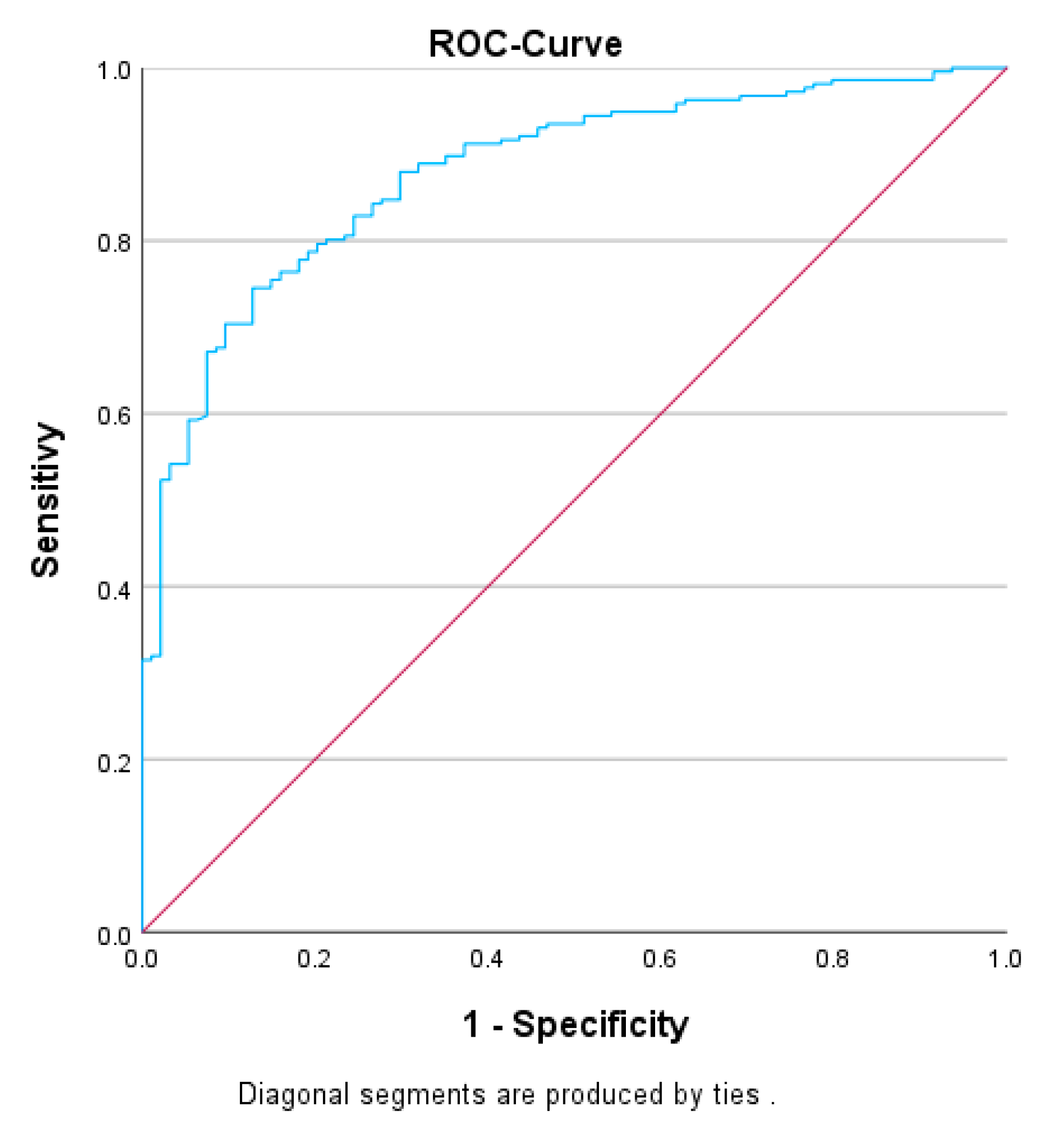
At the same time, the ROC curve was constructed (Figure 3) by calculating the respective area under the curve (AUC), given that this is another measure widely used to evaluate the model’s ability to discriminate between “companies that consider that the digitalization of business (BD) is at least important” against “companies that do not consider it important”.
Figure 3. ROC curve (red—diagonal reference line; blue—ROC curve).
Table 6 gives the area under the ROC curve (AUC = 0.878), which is significantly higher than 0.5 (p-value = 0.000), which validates that the adjusted model presents an excellent discriminating capacity.
Table 6. Area under the ROC curve.
Finally, we analyze the residuals and diagnose influential cases.
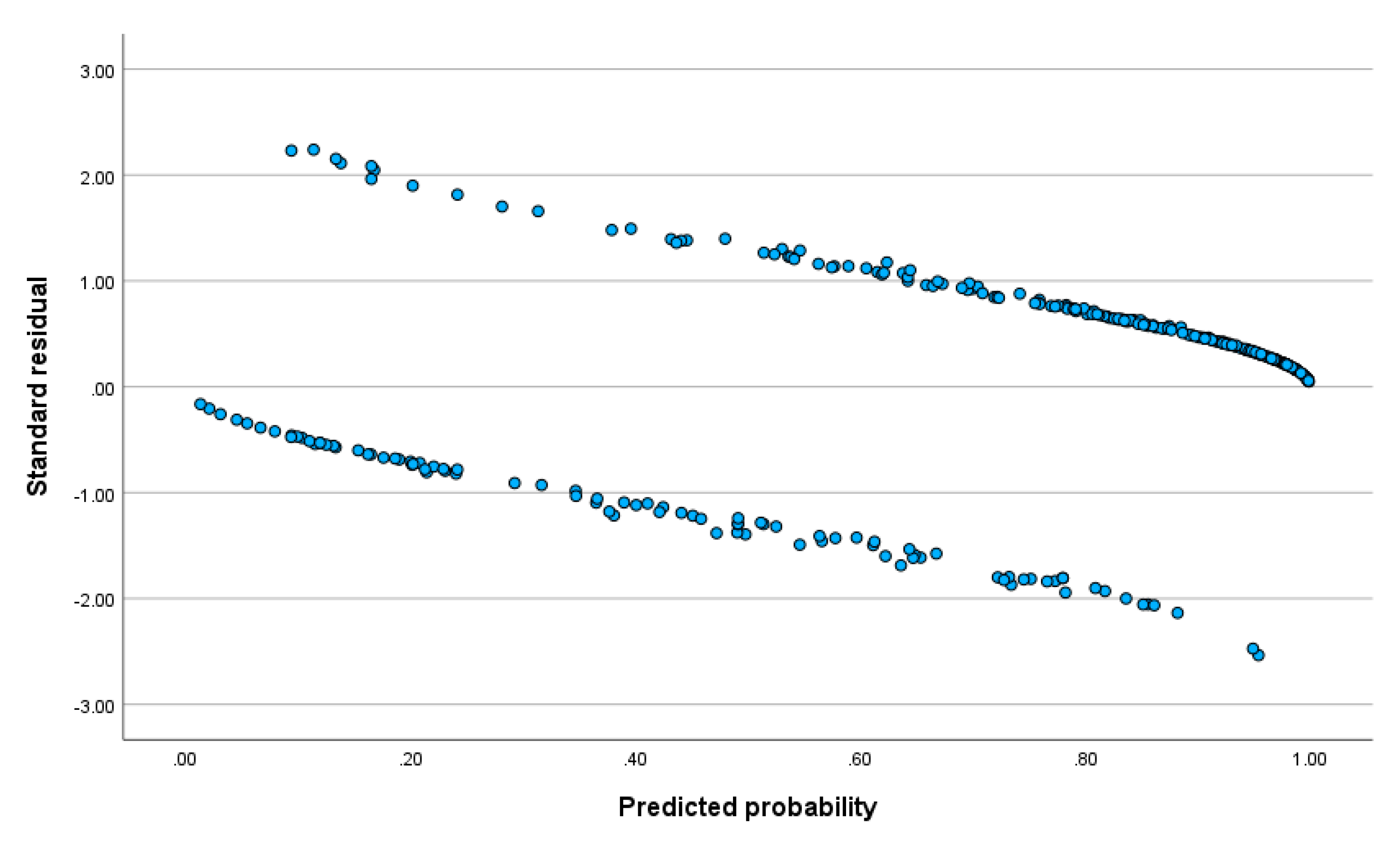
The standardized residuals graph (Figure 4) is a powerful tool for identifying outliers, which play a crucial role in our analysis. In our investigation, we identified some potential outlier observations, |r| > 2. However, their inclusion in the final model was justified as their removal did not enhance the significance or the quality of the adjustment of the logistic model.
Figure 4. Predicted probability versus standard residual.
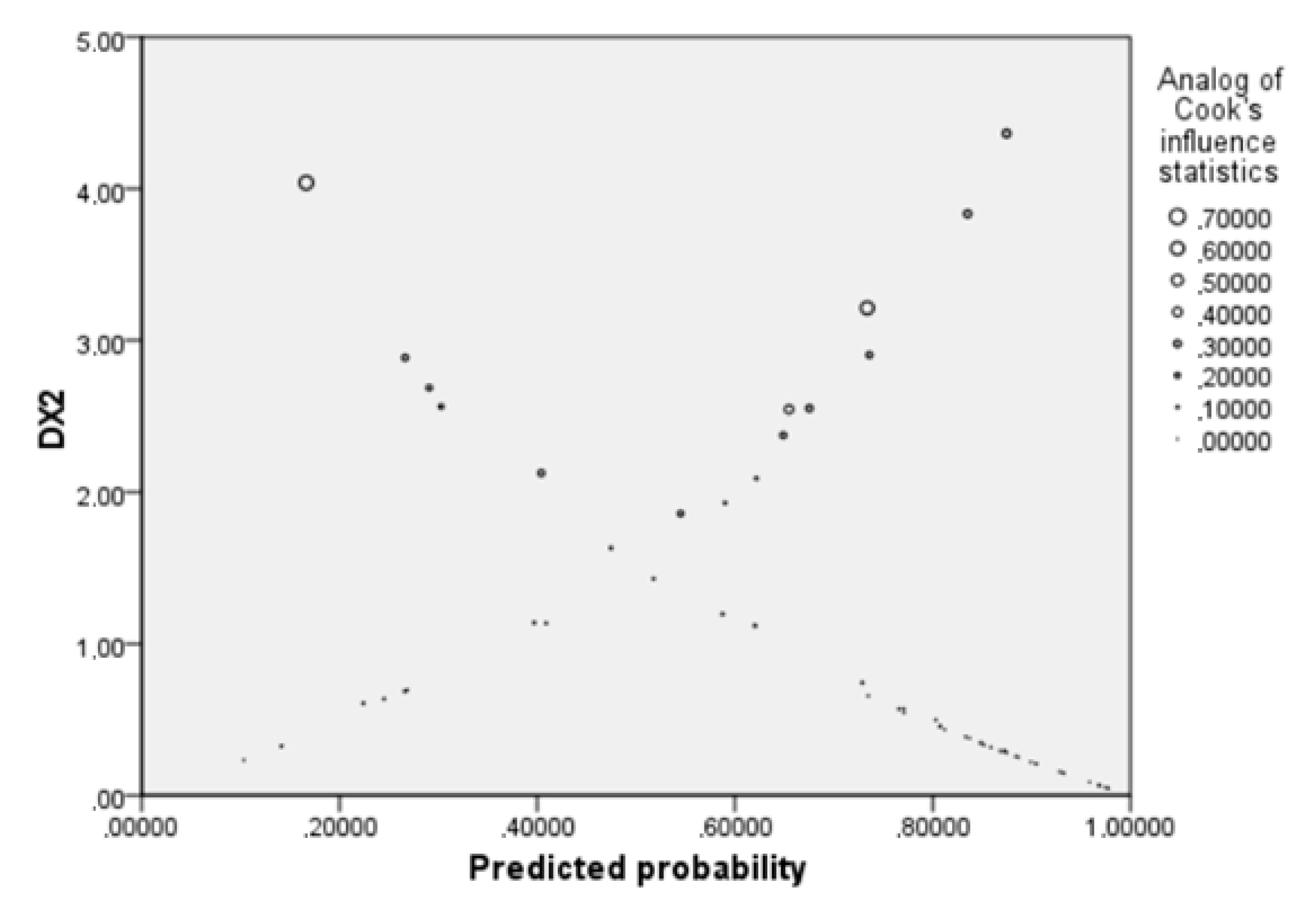
Regarding the diagnosis of influential cases (observations that influence the adjustment), a graphical representation (Figure 5) was used, which indicates both the influence of observations on the quality of the model and on the estimates of the model coefficients [69].
Figure 5. Predicted probability versus DX2.
Only two cases influence the quality of the model (DX2 ≥ 4). However, these cases present a Cook’s distance greater than 1, meaning that none of the observations significantly influence the model coefficients (they are not eliminated).
Table 7 summarizes information about the independent variables in the entire model. Since the variables are qualitative, the numbers in parentheses indicate the classes (codes) that participate in the model.
Table 7. Logit coefficients of the logistic regression model of the BD variable as a function of the variables NER, ANT, SER, ADM, C, CR, R, and IB.
Thus, the final model that allows estimating the probability ( π ^ ) of a company considering business digitalization (BD) to be at least important is then (according to Table 7) (4):
L o g i t ( π ^ )   =   1.723 N E R 1 0.532 N E R 2 0.141 N E R 3 2.032 N E R 4 + 1.696 A N T 1 + 1.564 A N T 2 + 2.278 A N T 3 + 3.332 A N T 4 + 2.594 I B 1 3.216 I B 2 2.538 I B 3 3.353 I B ( 4 )
That is (5),
π ^   =   e 1.723 N E R 1 0.532 N E R 2 0.141 N E R 3 2.032 N E R 4 + 1.696 A N T 1 + 1.564 A N T 2 + 2.278 A N T 3 + 3.332 A N T 4 + 2.594 I B 1 3.216 I B 2 2.538 I B 3 3.353 I B ( 4 ) 1 + e 1.723 N E R 1 0.532 N E R 2 0.141 N E R 3 2.032 N E R 4 + 1.696 A N T 1 + 1.564 A N T 2 + 2.278 A N T 3 + 3.332 A N T 4 + 2.594 I B 1 3.216 I B 2 2.538 I B 3 3.353 I B ( 4 )
which is equivalent to (6)
π ^   =   1 1 + e 1.723 N E R 1 0.532 N E R 2 0.141 N E R 3 2.032 N E R 4 + 1.696 A N T 1 + 1.564 A N T 2 + 2.278 A N T 3 + 3.332 A N T 4 + 2.594 I B 1 3.216 I B 2 2.538 I B 3 3.353 I B ( 4 )
According to this model, we can state the following:
The importance attributed to the digitalization of business is approximately 0.179 less critical in companies that classify the need to explore new resources (NER) as not very important and 0.131 less necessary in those that classify it as extremely important compared to those that classify it as not important. In the latter case, the chances decrease (0.131 − 1) × 100% = −86.9% when we go from the not important classification for the digitalization of business (reference class) to the extremely important classification.
The importance attributed to the digitalization of business is approximately 5.450 higher in companies that give the rating of less essential to allow access to new technologies or resources (ANT) compared to those that classify it as not important, 9.758 higher in companies that give the rating of essential to allow access to new technologies or resources compared to those that classify it as not important, and around 27.988 higher in companies that assign the classification of extremely important to allow access to new technologies or resources compared to those that classify it as not necessary. The chances of classifying business digitalization as at least important increase as the importance of allowing access to new technologies or resources increases.
The importance attached to the digitalization of business is approximately 1.475 higher in companies that assign the rating of not very important to strong entrepreneurial and risk-taking propensity by the main employees (SER), 1.371 higher in companies that assign the rating of important to strong entrepreneurial and risk-taking propensity, and is 1.360 higher in companies that classify strong entrepreneurial and risk-taking propensity as extremely important, compared to those that classify it as not important at all (even though these effects are not statistically significant). The chances of classifying business digitalization as at least necessary increase by approximately (1.360 − 1) × 100% = 36% when strong entrepreneurial and risk-taking propensity goes from not important to extremely important.
The importance attributed to business digitalization is approximately 1.602 higher in companies that assign important to autonomy in decision-making (ADM) and 2.209 higher in companies that assign very important to autonomy in decision-making, compared to those that classified it as not important. The chances of classifying business digitalization as the least significant increase by approximately (1.651 − 1) × 100% = 65.1% when autonomy in decision-making goes from not important to extremely important.
The importance attached to the digitalization of business is approximately 1.334 higher in companies that rate counselling partnership (C) as important, 5.359 higher in companies that rate counselling partnership as very important, and 7.911 higher in the companies that give the classification of the counselling partnership as extremely important, compared to those that classified it as not important. The chances of classifying business digitalization as the least significant increase as the degree of the importance of the counselling partnership increases.
The importance attributed to the digitalization of business is approximately 6.035/6.108 higher in companies that classify the credibility (CR) partnership as not very important/important than in those that classify it as not important at all. However, when the importance of this partnership is considered very important or extremely important, the importance given to business digitalization is about 1.731/1.154 higher.
The chances of the importance attached to the digitalization of business are not affected when the frequency of almost always or sometimes is attributed to managers’ resistance (R) because exp(β) ≅ 1, (0.983 and 0.920, respectively).The importance attributed to the digitalization of business is approximately 4.492 higher in companies that attribute never to the resistance of managers, compared to companies that classify resistance as always. When there is no resistance from managers, the importance attributed to business digitalization is more significant than when there is always resistance.
The importance of business digitalization is approximately 0.075 less in companies that consistently perceive their budget as inadequate (IB), 0.040 less in companies that occasionally perceive it as inadequate, 0.079 less in companies that rarely perceive the budget as inadequate, and 0.035 less in companies that never perceive it as inadequate, all of them compared to those that always perceive the budget as inadequate.
The importance that companies attach to business digitalization regarding internationalization decreases as the importance of inadequate budgets decreases. The digitalization is crucial for companies that consider budgets inadequate.

4.2. Multiple Linear Regression Model

Multiple linear regression with the stepwise variable selection method (with criteria where significance level α = 0.10 for the entry value and α = 0.15 for the removal value) was used to obtain a parsimonious model that allows for the prediction of the degree of the importance of the “digitization of business” (Y) in affecting the internationalization of the company depending on the independent variables (IPP, ANT, ADM, C, R, and IB).
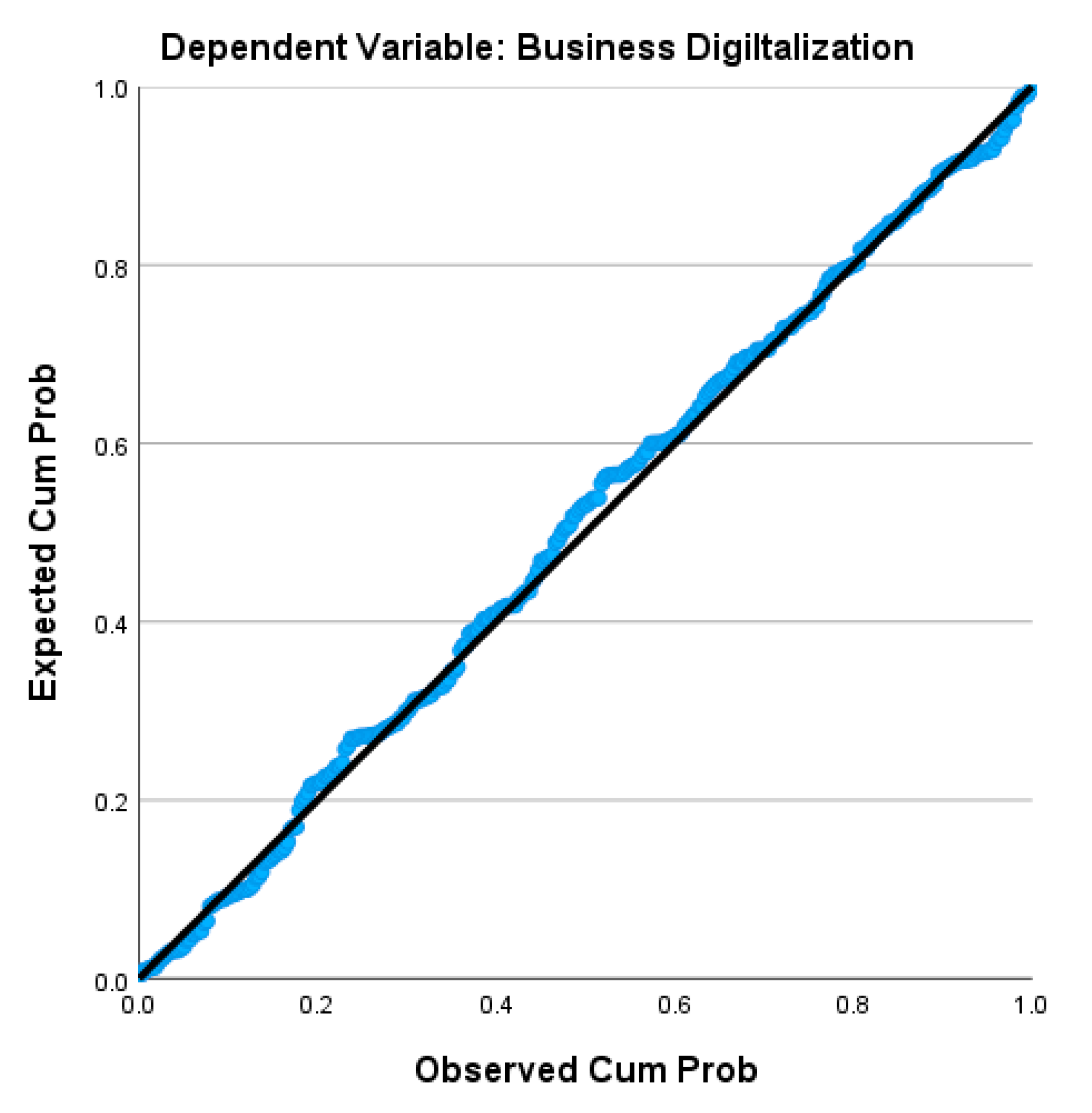
We began by analyzing whether the model’s applicability assumptions (the normal distribution of errors, homogeneity, and independence of errors) were verified. The first assumption was validated graphically (Figure 6) together with the Kolmogorov–Smirnov test (Table 8).
Figure 6. Normal P–P Plot for errors (residuals).
Table 8. Kolmogorov–Smirnov test for residuals.
We can conclude from this graph, where the abscissa axis shows the cumulative observed probability of the errors and the ordinate axis shows the cumulative probability that would be observed if the errors had a normal distribution, that since the values shown above are mostly distributed on the main diagonal, the errors are normally distributed. This assumption is also validated by the Kolmogorov–Smirnov test (p-value = 0.200).
The second assumption (the homogeneity of errors) was also validated graphically. Finally, the third assumption (the independence of errors) was validated using the Durbin–Watson test. Given that IBM SPSS does not produce the p-value associated with the Durbin–Watson test statistic, we then use the decision rule empirically—do not reject H0: there is no autocorrelation between the residuals if dobs ≈ 2 ± 0.2. It should be noted that, as dobs = 1.867 is far from 2 (Table 9), H0 is accepted; the residuals are independent.
Table 9. Model summary with Durbin–Watson test.
Next, to diagnose the possible existence of multicollinearity (association between independent variables), the ratio k = λ m a x / λ i designated as the condition index (Table 10) was used. As the values obtained for this ratio for each dimension (the number of model parameters) are all lower than 15 [69], we conclude there is no multicollinearity between the independent variables.
Table 10. Condition index.
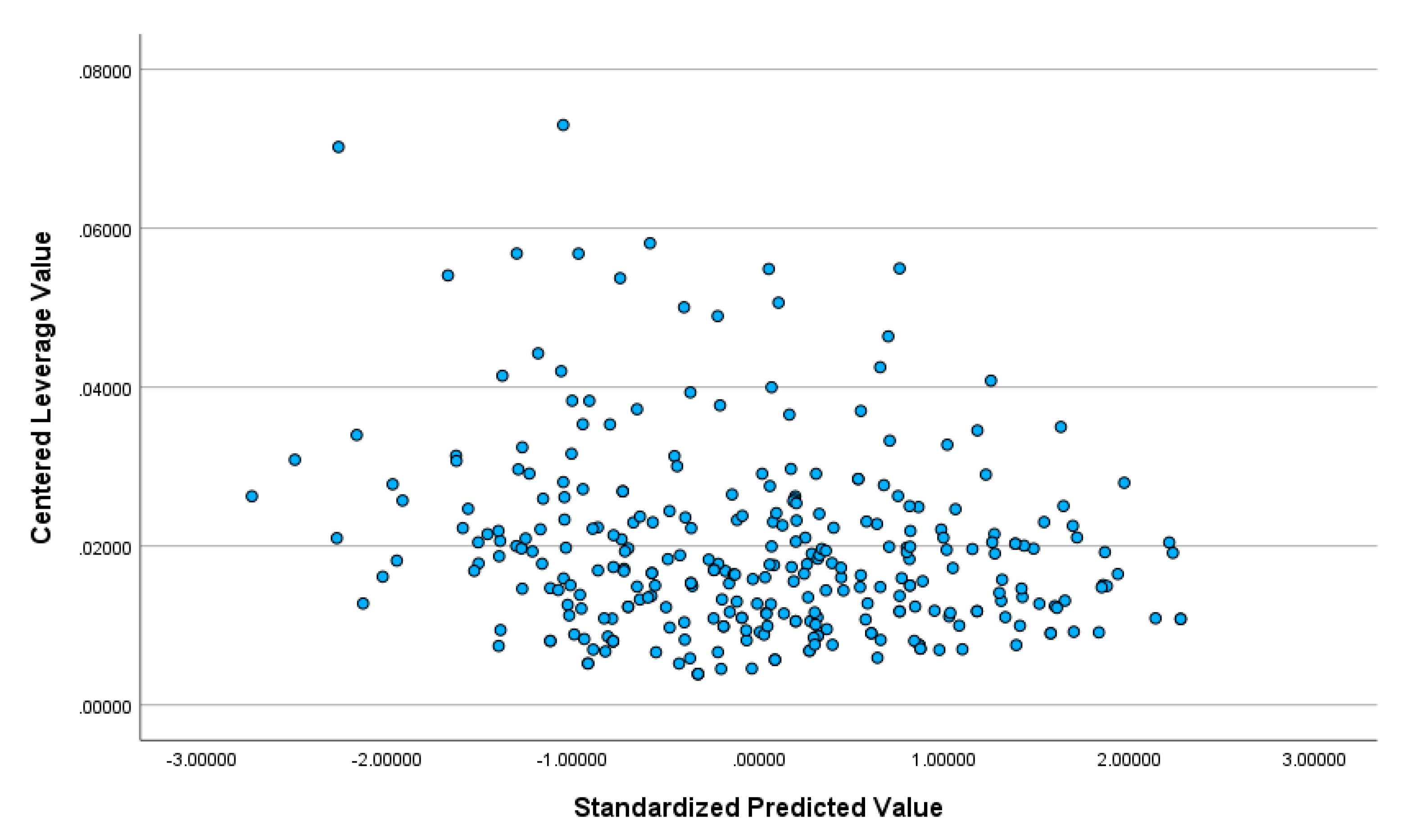
To assess the existence of influential observations in the sense that there are observations that affect the values of the estimated parameters, the effects of leverage and residuals are graphically represented. As we can see in Figure 7, there are no outliers because no centered leverage value is close to 0.5.
Figure 7. Graph of standardized predicted values vs. centered leverage values.
Having verified all of the applicability assumptions of the model and given that there was no association between the independent variables, the application of the multiple linear regression model made it possible to identify the variables IPP (β = 0.247, t = 3.367, p-value < 0.001), ANT (β = 0.203, t = 4.031, p-value < 0.001), ADM (β = 0.253, t = 4.020, p-value < 0.001), C (β = 0.193, t = 2.813, p-value = 0.005), R (β = 0.191, t = 3.225, p-value = 0.001), and IB (β = −0.108, t = −2.012, p-value = 0.045) as significant predictors of the dependent variable Y (business digitalization). A type I error probability of α = 0.05 was considered for all analyses.
The final adjusted model is highly significant (F = 426.160, p-value < 0.001) and explains a high proportion of the variability in variable Y ( R a 2   =   0.9 , we can state that 90% of the total variability in Y is explained by the independent variables present in the adjusted linear regression model—Table 11).
Table 11. Condition index.
As we can see in Table 12, the final adjusted model is highly significant (F = 426.160, p-value < 0.001) and explains a high proportion of the variability in the Y variable ( R a 2   =   0.9, we can say that 90 per cent of the total variability in Y is explained by the independent variables present in the adjusted linear regression model—see Table 9).
Table 12. Results of ANOVA.
The final fitted model (Table 11) that allows for the estimation of the “Importance of business digitalization (Y)” for the internationalization of a company is then as follows:
Y ^   =   0.255 × I P P + 0.238 × A N T + 0.236 × A D M + 0.210 × C + 0.179 × R 0.114 × I B
As all independent variables are expressed in the same units, regression coefficients can be used to assess the importance of each independent variable in the model (note that all regression coefficients are significant).
The higher the IPP, ANT, ADM, and C, the greater the importance of business digitalization. The lower the resistance from managers, the greater the degree of importance attributed to the digitalization of business (inverted Likert scale as explained above). Finally, with less effect on the prediction of Y, we can state that the more inadequate the available budgets are, the less importance is attributed to the digitalization of business.
The multivariate linear regression model, a model widely used in practice and renowned for its straightforward interpretation, was instrumental in identifying the factors (independent variables) most valued by entrepreneurs (survey respondents) for internationalization, based on the significance they attribute to the digitalization of the business (Y). The statistical variables used in both models (multivariate logistic and multivariate linear regression) are nearly identical, which further reinforces the validity of using the linear model, the most common in practice. This ultimately validates its use, instilling confidence in the results.

5. Conclusions

This study relates three crucial areas: digitalization, sustainability, and internationalization, which are essential issues that influence and condition business strategies. Digitalization is described as an enabler that allows companies to overcome some of the operational restrictions and reduce geographies through the adoption of digital technologies. Therefore, companies use digitalization to improve their operational efficiency, mainly to look for new market opportunities. Sustainability is fundamental to business operations, so companies balance economic objectives with social and environmental responsibilities.
Through the literature review, it becomes evident that digitalization plays a central role as a facilitator of internationalization through technological advancements. However, nowadays sustainability also emerges as a strategic imperative for companies aiming for long-term viability in international markets. The emphasis on sustainability is not just a trend, but a growing recognition of its economic, social, and environmental dimensions. Companies must urgently integrate both factors into their strategies to maintain competitiveness and ensure their long-term survival in the global marketplace.
The research methodology encompasses a robust quantitative analysis through surveys among Portuguese entrepreneurs, focusing on their perceptions and strategies regarding digitalization and its impact on international business activities. Through a comprehensive study of 310 internationalized Portuguese companies and statistical analysis using multivariate linear regression and multivariate logistic models, this study identifies the factors that influence entrepreneurs’ opinions on the importance of digitalization in internationalization efforts.
In this study, it is shown that the variables “Information about potential partnerships”, “Access to new technologies or resources”, “Autonomy in decision-making”, and “Counselling” are critical to entrepreneurs, specifically when they are assessing the importance assigned to digitalization in the context of internationalization. Additionally, the positive relationship between digitalization and sustainability is evident in the emphasis placed on factors such as access to new technologies and resources, which can enable companies to adopt more sustainable practices. Furthermore, the inverse relationship between resistance from managers and the importance attached to digitalization suggests that companies may face internal resistance when implementing digital initiatives. Overcoming this resistance is crucial for promoting sustainable practices and ensuring the success of internationalization efforts.
In addition, the observation that companies who perceive budgets as inadequate have less effect on predicting the importance of business digitalization, indicates that those who consider digitalization as an important factor most often consider that there are budget constraints. Adequate budget allocation is essential for investing in digital technologies and implementing sustainable strategies that support long-term growth and competitiveness in international markets.
In summary, the conclusions drawn from the analysis highlight the interconnection of digitalization and sustainability in the context of internationalization. Embracing digital technologies and overcoming barriers such as budget constraints and internal resistance are key steps towards achieving sustainable international business practices.
As our findings highlight the interconnection of digitalization and sustainability in the context of internationalization strategies, policymakers in Portugal could consider developing initiatives to support digitalization and sustainability efforts among entrepreneurs, in particular, and using the results of the study, could encourage entrepreneurs to strengthen strategic partnerships with other countries and international organizations and also encourage an increase in the autonomy of managers, to foster knowledge exchange and collaboration in digitalization and sustainability. In summary, our research provides valuable insights that can inform policy decisions and support programs and strategic initiatives aimed at advancing Portugal’s internationalization and digitalization agenda.
The resistance of managers towards digitalization, coupled with budget constraints, suggests a need for a strategic approach that addresses both technological and organizational challenges. Managers’ resistance to the loss of autonomy [72] and workers’ dissatisfaction with increased surveillance [73] highlight the importance of involving stakeholders in the digital transformation process. Implementing integrated management approaches through digital solutions [74] can enhance sustainability while overcoming challenges like technology robustness and data ownership. Additionally, understanding the power dynamics embedded in management control systems [75] can guide the development of digital tools that balance control and autonomy. By incorporating input from all levels of the organization, utilizing in situ measurements, satellite data, and decision support systems, a comprehensive digitalization strategy can effectively address resistance, budget constraints, and technological needs.
For future studies, we aim to explore additional driving forces of internationalization and their implications for digitalization and sustainable business practices. The majority of our data came from the manufacturing and services sectors, which may skew our results towards these industries. In future research, we will aim for a more diverse sample across various industries to mitigate potential biases. Also, it would be interesting to compare these results with post-pandemic data.

Author Contributions

Conceptualization, N.D., C.S.P., C.L., and F.M.; methodology, N.D., C.S.P., C.L., and F.M.; investigation, N.D., C.S.P., C.L., and F.M.; writing—original draft preparation, N.D., C.S.P., C.L., and F.M.; writing—review and editing, N.D., C.S.P., C.L., and F.M. All authors have read and agreed to the published version of the manuscript.

Funding

This research received no external funding.

Institutional Review Board Statement

Not applicable.

Data Availability Statement

Dataset available on request from the authors.

Conflicts of Interest

The authors declare no conflicts of interest.

References

  1. OECD. OECD.Stat. 2022. Available online: https://stats.oecd.org/ (accessed on 16 April 2024).
  2. Dunning, J.H. Trade, Location of Economic Activity and the Multinational Enterprise: A Search for an Eclectic Approach. In The International Allocation of Economic Activity; Ohlin, B., Hesselborn, P.O., Wijkman, P.M., Eds.; Macmillan: New York, NY, USA, 1977; pp. 395–418. [Google Scholar]
  3. Hymer, S.H. The International Operations of National Firms: A Study of Direct Foreign Investment; MIT Press: Cambridge, MA, USA, 1960. [Google Scholar]
  4. Johanson, J.; Vahlne, J.E. The Internationalization Process of the Firm: A Model of Knowledge Development and Increasing Foreign Market Commitments. J. Int. Bus. Stud. 1977, 8, 23–32. [Google Scholar] [CrossRef]
  5. Johanson, J.; Vahlne, J.E. The Uppsala Internationalization Process Model Revisited: From Liability of Foreignness to Liability of Outsidership. J. Int. Bus. Stud. 2009, 40, 1411–1431. [Google Scholar] [CrossRef]
  6. Rugman, A.M.; Verbeke, A. A Perspective on Regional and Global Strategies of Multinational Enterprises. J. Int. Bus. Stud. 2004, 35, 3–18. [Google Scholar] [CrossRef]
  7. Qian, G.; Li, L.; Rugman, A.M. Liability of Regional Foreignness and Use of Firm Resources in Multinational Enterprise Strategy. Strateg. Manag. J. 2010, 31, 1337–1358. [Google Scholar]
  8. Dunning, J.H.; Kim, C.; Park, D. Old Wine in New Bottles: A Comparison of Emerging-Market TNCs Today and Developed-Country TNCs Thirty Years Ago. Thunderbird Int. Bus. Rev. 2007, 49, 479–495. [Google Scholar]
  9. Dunning, J.H. Location and the multinational enterprise: A neglected factor? J. Int. Bus. Stud. 1998, 9, 45–66. [Google Scholar] [CrossRef]
  10. Elkington, J. Partnerships from cannibals with forks: The triple bottom line of 21st-century business. Environ. Qual. Manag. 1998, 8, 37–51. [Google Scholar] [CrossRef]
  11. OECD. Digitalisation and Internationalisation: The Impact of Digital Technologies on Trade, Foreign Investment and Global Value Chains; OECD Publishing: Paris, France, 2020. [Google Scholar]
  12. Schwab, K. The Fourth Industrial Revolution; Crown Business: Bangkok, Thailand, 2016. [Google Scholar]
  13. World Economic Forum. Digital Transformation Initiative: Sustainable Development; World Economic Forum: Cologny, Switzerland, 2019. [Google Scholar]
  14. Bughin, J.; Catlin, T.; Hirt, M.; Willmott, P. Why Digital Strategies Fail. McKinsey Quarterly. 2018. Available online: https://www.mckinsey.com/business-functions/mckinsey-digital/our-insights/why-digital-strategies-fail (accessed on 10 March 2024).
  15. UNEP. Digitalisation, Trade and Sustainability; United Nations Environment Programme: Nairobi, Kenya, 2021. [Google Scholar]
  16. McKinsey & Company. Sustainability’s Strategic Worth: McKinsey Global Survey Results. 2021. Available online: https://www.mckinsey.com/business-functions/sustainability/our-insights/sustainabilitys-strategic-worth-mckinsey-global-survey-results (accessed on 16 April 2024).
  17. Kolk, A.; Pinkse, J. A perspective on multinational enterprises and climate change: Learning from “an inconvenient truth”? J. Int. Bus. Stud. 2010, 41, 1359–1378. [Google Scholar]
  18. Lee, S.Y.; Kim, H.; Kim, D.; Kang, H.Y. The role of digitalization and sustainability in international business strategy. Sustainability 2020, 12, 6123. [Google Scholar]
  19. Eisenhardt, K.M.; Graebner, M.E. Theory building from cases: Opportunities and challenges. Acad. Manag. J. 2007, 50, 25–32. [Google Scholar] [CrossRef]
  20. Hill, C.W.; Rothaermel, F.T. The performance of incumbent firms in the face of radical technological innovation. Acad. Manag. Rev. 2003, 28, 257–274. [Google Scholar] [CrossRef]
  21. Feliciano-Cestero, M.M.; Ameen, N.; Kotabe, M.; Paul, J.; Signoret, M. Is digital transformation threatened? A systematic literature review of the factors influencing firms’ digital transformation and internationalization. J. Bus. Res. 2023, 157, 113546. [Google Scholar] [CrossRef]
  22. Gaweł, A.; Mroczek-Dąbrowska, K.; Pietrzykowski, M. Digitalization and Its Impact on the Internationalization Models of SMEs. In Artificiality and Sustainability in Entrepreneurship. FGF Studies in Small Business and Entrepreneurship; Adams, R., Grichnik, D., Pundziene, A., Volkmann, C., Eds.; Springer: Cham, Switzerland, 2023. [Google Scholar] [CrossRef]
  23. Fuxia, G.; Chuan, L.; Haomiao, Z. Digital Transformation, Corporate Innovation, and International Strategy: Empirical Evidence from Listed Companies in China. Sustainability. Sustainability 2022, 14, 8137. [Google Scholar] [CrossRef]
  24. Jafari-Sadeghi, V.; Garcia-Perez, A.; Candelo, E.; Couturier, L. Exploring the impact of digital transformation on technology entrepreneurship and technological market expansion: The role of technology readiness, exploration and exploitation. J. Bus. Res. 2021, 124, 100–111. [Google Scholar] [CrossRef]
  25. Carla, S.-P.; Natércia, D.; Moreira, F.; Veloso, B. The Importance of Digital Transformation in International Business. Sustainability 2022, 14, 843. [Google Scholar] [CrossRef]
  26. Hagen, B.; Zucchella, A.; Larimo, J.; Dimitratos, P. A Taxonomy of Strategic Postures of International SMEs. Eur. Manag. Rev. 2017, 14, 265–285. [Google Scholar] [CrossRef]
  27. Porter, M.E.; Kramer, M.R. Creating shared value. Harv. Bus. Rev. 2011, 89, 62–77. [Google Scholar]
  28. Bansal, P. Evolving sustainably: A longitudinal study of corporate sustainable development. Strateg. Manag. J. 2005, 26, 197–218. [Google Scholar] [CrossRef]
  29. Schaltegger, S.; Wagner, M. Sustainable entrepreneurship and sustainability innovation: Categories and interactions. Bus. Strategy Environ. 2011, 20, 222–237. [Google Scholar] [CrossRef]
  30. Schaltegger, S.; Burritt, R. Business Cases and Corporate Engagement with Sustainability: Differentiating Ethical Motivations. J. Bus. Ethics 2018, 147, 241–259. [Google Scholar] [CrossRef]
  31. Nakos, G.; Dimitratos, P.; Elbanna, S. The mediating role of alliances in the international market orientation-performance relationship of smes. Int. Bus. Rev. 2019, 28, 603–612. [Google Scholar] [CrossRef]
  32. Beneki, C.; Papastathopoulos, A.; Tsagris, M. The Influence of Web-based Enterprise Systems on SMEs’ Internationalization Process. Int. Bull. Bus. Adm. 2011, 12, 51–65. [Google Scholar]
  33. Gulati, R. Tent poles, tribalism, and boundary spanning: The rigor-relevance debate in management research. Acad. Manag. J. 2007, 50, 775–782. [Google Scholar] [CrossRef]
  34. Karavdic, M.; Gregory, G. Integrating e-commerce into existing export marketing theories: A contingency model. Mark. Theory 2005, 5, 75–104. [Google Scholar] [CrossRef]
  35. Joensuu-Salo, S.; Sorama, K.; Viljamaa, A.; Varamäki, E. Firm Performance among Internationalized SMEs: The Interplay of Market Orientation, Marketing Capability and Digitalization. Adm. Sci. 2018, 8, 31. [Google Scholar] [CrossRef]
  36. Etemad, H.; Wright, R.W. Internationalization of SMEs: Management Responses to a Changing Environment. J. Int. Mark. 1999, 7, 4–10. [Google Scholar] [CrossRef]
  37. Andersson, S. International entrepreneurship, born globals and the theory of effectuation. J. Small Bus. Enterp. Dev. 2011, 18, 627–643. [Google Scholar] [CrossRef]
  38. Thomas, A.M. Online activities and export performance of the smaller firm: A capability perspective. Eur. J. Int. Manag. 2009, 3, 266. [Google Scholar] [CrossRef]
  39. Coviello, N.; Munro, H. Network relationships and the internationalisation process of small software firms. Int. Bus. Rev. 1997, 6, 361–386. [Google Scholar] [CrossRef]
  40. Jones, M.V. The Internationalization of Small High-Technology Firms. J. Int. Mark. 1999, 7, 15–41. [Google Scholar] [CrossRef]
  41. Clercq, D.D.; Sapienza, H.J.; Crijns, H. The Internationalization of Small and Medium-Sized Firms. Small Bus. Econ. 2005, 24, 409–419. [Google Scholar] [CrossRef]
  42. Cao, L.; Navare, J.; Jin, Z. Business model innovation: How the international retailers rebuild their core business logic in a new host country. Int. Bus. Rev. 2018, 27, 543–562. [Google Scholar] [CrossRef]
  43. Merkert, J.; Mueller, M.; Hubl, M. A Survey of the Application of Machine Learning in Decision Support Systems. In Proceedings of the European Conference on Information Systems, Münster, Germany, 26–29 May 2015. Paper 133. [Google Scholar]
  44. Coviello, N.; Kano, L.; Liesch, P.W. Adapting the Uppsala model to a modern world: Macro-context and microfoundations. J. Int. Bus. Stud. 2017, 48, 1151–1164. [Google Scholar] [CrossRef]
  45. Vahlne, J.-E.; Johanson, J. From Internationalization to evolution: The Uppsala Model at 40 years. J. Int. Bus. Stud. 2017, 48, 1087–1102. [Google Scholar] [CrossRef]
  46. Neubert, M. Early internationalisation of high-tech firms: Past accomplishments and future directions. Int. J. Teach. Case Stud. 2015, 6, 353. [Google Scholar] [CrossRef]
  47. Alves, A.M.R. The Impact of Digitalization on SMEs International Strategies: A Bibliometric Analysis. 2020. Available online: https://sigarra.up.pt/fep/pt/pub_geral.show_file?pi_doc_id=266800 (accessed on 15 January 2024).
  48. Gilson, L.L.; Maynard, M.T.; Jones Young, N.C.; Vartiainen, M.; Hakonen, M. Virtual Teams Research: 10 Years, 10 Themes, and 10 Opportunities. J. Manag. 2014, 41, 1313–1337. [Google Scholar] [CrossRef]
  49. Kotha, S.; Rindova, V.P.; Rothaermel, F.T. Assets and Actions: Firm-Specific Factors in the Internationalization of U.S. Internet Firms. J. Int. Bus. Stud. 2001, 32, 769–791. [Google Scholar] [CrossRef]
  50. Leamer, E.E.; Storper, M. The Economic Geography of the Internet Age. J. Int. Bus. Stud. 2001, 32, 641–665. [Google Scholar] [CrossRef]
  51. Eduardsen, J.S.; Ivang, R. Internet-enabled internationalisation: A review of the empirical literature and a research agenda. Int. J. Bus. Environ. 2016, 8, 152. [Google Scholar] [CrossRef]
  52. Reuber, A.R.; Fischer, E. International entrepreneurship in internet-enabled markets. J. Bus. Ventur. 2011, 26, 660–679. [Google Scholar] [CrossRef]
  53. Vadana, I.-I.; Torkkeli, L.; Kuivalainen, O.; Saarenketo, S. Digitalization of companies in international entrepreneurship and marketing. Int. Mark. Rev. 2019. ahead-of-print. [Google Scholar] [CrossRef]
  54. Wittkop, A.; Zulauf, K.; Wagner, R. How Digitalization Changes the Internationalization of Entrepreneurial Firms: Theoretical Considerations and Empirical Evidence. Manag. Dyn. Knowl. Econ. J. 2013, 6, 193–207. [Google Scholar] [CrossRef]
  55. Mendes, M.V.I. The Limitations of International Relations Regarding MNCs and the Digital Economy: Evidence from Brazil. Rev. Political Econ. 2020, 33, 67–87. [Google Scholar] [CrossRef]
  56. Sestino, A.; Prete, M.I.; Piper, L.; Guido, G. Internet of Things and Big Data as enablers for business digitalization strategies. Technovation 2020, 98, 102173. [Google Scholar] [CrossRef]
  57. Manyika, J. Technology, Jobs, and the Future of Work. McKinsey & Company. 2017. Available online: https://www.mckinsey.com/featured-insights/employment-and-growth/technology-jobs-and-the-future-of-work (accessed on 10 March 2024).
  58. Valenduc, G.; Vendramin, P. Digitalisation, between disruption and evolution. Transf. Eur. Rev. Labour Res. 2017, 23, 121–134. [Google Scholar] [CrossRef]
  59. Huckstep, R. Insurance of Things–How IoT Shows Prevention is Better than Cure for Insurers. Insur. Wkly. 2016, 39. [Google Scholar]
  60. Zavery, A. Google Cloud BrandVoice: Digital Transformation Isn’t a Project, It’s a Way of Operating. Forbes. n.d. Available online: https://www.forbes.com/sites/googlecloud/2020/01/22/digital-transformation-isnt-a-project-its-a-way-of-operating/?sh=1fa0b18f7b6c (accessed on 21 February 2024).
  61. Knight, G.A.; Cavusgil, S.T. Innovation, Organizational capabilities, and the born-global Firm. J. Int. Bus. Stud. 2004, 35, 124–141. [Google Scholar] [CrossRef]
  62. Dethine, B.; Enjolras, M.; Monticolo, D. Digitalization and SMEs’ Export Management: Impacts on Resources and Capabilities. Technol. Innov. Manag. Rev. 2020, 10, 18–34. [Google Scholar] [CrossRef]
  63. Sebastian, I.M.; Ross, J.W.; Beath, C.; Mocker, M.; Moloney, K.G.; Fonstad, N.O. How Big Old Companies Navigate Digital Transformation. In Strategic Information Management; Routledge: Abingdon, UK, 2020; pp. 133–150. [Google Scholar] [CrossRef]
  64. White, M. Digital workplaces: Vision and reality. Bus. Inf. Rev. 2012, 29, 205–214. [Google Scholar] [CrossRef]
  65. Hervé, A.; Schmitt, C.; Baldegger, R. Digitalization, Entrepreneurial Orientation & Internationalization of Micro-, Small-, and Medium-Sized Enterprises. Technol. Innov. Manag. Rev. 2020, 10, 5–17. [Google Scholar] [CrossRef]
  66. Nambisan, S. Digital Entrepreneurship: Toward a Digital Technology Perspective of Entrepreneurship. Entrep. Theory Pract. 2017, 41, 1029–1055. [Google Scholar] [CrossRef]
  67. Malhotra, N.; Nunan, D.; Birks, D. Marketing Research: An Applied Approach; Pearson: London, UK, 2017. [Google Scholar]
  68. Cohen, J. Statistical Power Analysis for the Behavioral Sciences; Academic Press: Cambridge, MA, USA, 2013. [Google Scholar]
  69. Hair, J.F. Multivarate Data Analysis; Kennesaw State University: Kennesaw, GA, USA, 2009. [Google Scholar]
  70. Marôco, J. Análise Estatística com o SPSS Statistics, 7th ed.; ReportNumber; Análise e Gestão de Informação, Lda.: Pêro Pinheiro, Portugal, 2018. [Google Scholar]
  71. Hosmer, D.; Lemeshow, S.; Sturdivant, R. Applied Logistic Regression, 3rd ed.; John Wiley & Sons: Hoboken, NJ, USA, 2013; ISBN 9781118548387. [Google Scholar] [CrossRef]
  72. Mel, B. Management and resistance in the digital newsroom. Journalism 2019, 20, 890–905. [Google Scholar] [CrossRef]
  73. Konstantin, B.; Thomas, T.; Olga, A. Resistance to Digital Transformation: The Role of Middle Management Personal Networks. In Proceedings of the 23rd European Conference on Knowledge Management, Naples, Italy, 1–2 September 2022. [Google Scholar] [CrossRef]
  74. Moore, P.V.; Akhtar, P.; Upchurch, M. Digitalisation of Work and Resistance. In Humans and Machines at Work. Dynamics of Virtual Work; Palgrave Macmillan: Cham, Switzerland, 2018. [Google Scholar] [CrossRef]
  75. Anders, N. Budgeting and beyond: Mobilizing the management control system for change and resistance. In Proceedings of the Annual Congress of the European Accounting Association, Tallinn, Estonia, 21–23 May 2014. [Google Scholar]
Disclaimer/Publisher’s Note: The statements, opinions and data contained in all publications are solely those of the individual author(s) and contributor(s) and not of MDPI and/or the editor(s). MDPI and/or the editor(s) disclaim responsibility for any injury to people or property resulting from any ideas, methods, instructions or products referred to in the content.

Article Metrics

Citations

Article Access Statistics

Multiple requests from the same IP address are counted as one view.