

Abstract
Comprehensively promoting rural revitalisation is an important task for China so asto build a strong agricultural country in the new era; industrial revitalisation is the top priority of rural revitalisation, and the rural digital economy is an important driving force to achieve rural revitalisation. Based on data on the development level of the rural digital economy and the development level of rural revitalisation in 30 provinces in China from 2013 to 2020, the impact of rural digital economy development on rural revitalisation was empirically analysed using a two-way fixed effects model. The results show that the level of rural digital economy development in all Chinese provinces has a positive impact on the level of rural revitalisation development. At the same time, the level of economic development, urbanisation rate, degree of openness to the outside world, demographic structure, and rural assets are all inputs that have a significant positive impact on the level of development of rural revitalisation. In order to promote the development of rural revitalisation, it is proposed to build a rural digital infrastructure and promote the construction of digital villages, combining the actual situation of each place, guiding the layout of rural industries in accordance with local conditions, and further giving play to the positive effects om the level of rural economic development. This paper also considers policy recommendations for fostering a rural digital workforce to fulfil the important role of human capital.
1. Introduction
The implementation of the strategy of rural revitalisation is a major decision and deployment made by the 19th Congress of the Communist Party of China, a major historical task for China to build a moderately prosperous society in all aspects and a modern socialist country in all aspects, and a general guide for the work of the “three rural areas” in the new era. The Central Committee’s Document No. 1 of 2024 was released, which is the 21st consecutive No. 1 document guiding the work of the “Three Rural Areas” since the beginning of the new century, pointing out that in order to push forward Chinese-style modernisation, it is necessary to persistently consolidate the foundation of agriculture and push forward the comprehensive revitalisation of the countryside. Modernisation of agriculture and rural areas is the overall goal of the implementation of the rural revitalisation strategy; adhering to the priority development of agriculture and rural areas is the general policy; and industrial prosperity, ecological livability, civilised rural customs, effective governance, and a rich life are the general requirements [1]. China’s fast-growing digital economy is becoming an important engine to drive all-round high-quality economic and social development; therefore, digital economy-enabled rural development, rural construction, and rural governance is an important strategy for rural revitalisation [2]. The document also emphasises the continued implementation of digital rural development actions, the development of smart agriculture, narrowing the “digital divide” between urban and rural areas, and strengthening the collaborative sharing of agricultural production and management, rural social management, and other agricultural-related information. Specifically, the digital economy is a new type of economic form that takes digitised knowledge and information as the key production factors, takes digital technology as the core driving force, takes the modern information network as the important carrier, and through the deep integration of digital technology and the real economy, continuously improves the digitalisation, networking, and intelligence of the economy and society and accelerates the restructuring of economic development and governance modes [3]. By incorporating data elements into agricultural production, digital products and services into farmers’ lives, and digital thinking into rural government services, the digital economy helps diversify and intensify the agricultural industry, enhance farmers’ skills and satisfy their spiritual life, and digitise and smarten rural governance, thus providing digital impetus for the realisation of the revitalisation of rural industries, talents, culture, ecology, and organisation. Therefore, it is of great policy significance and practical significance to study the impact of the development of the digital economy on rural revitalisation and put forward targeted development proposals.
2. Literature Review
Academic research on the digital economy mainly elaborates on the following three aspects: First, research on the concept of digital economy, which is a series of economic activities using digitised information resources as key production factors and modern data networks and technology platforms as important carriers, aiming to use the effective use of information and communication technologies as an important driving force to enhance efficiency and optimise economic structures [4]. The second is research on the evaluation index system of the digital economy, from the digital economic environment, digital infrastructure, digital transformation of agriculture, and digitalisation of life [5], from the degree of Internet penetration, the level of development of rural e-commerce, and the degree of development of rural inclusive finance [6], and from the construction of digital infrastructure, the development and management of data resources, the digitalisation of industry, industrial digitisation, and governance digitisation [7]. Third, empirical studies related to the digital economy, the digital economy and agricultural and rural economic development [8], employment [9], common wealth [10], the consumer market [11], urban–rural structural transformation [12], and other perspectives. By combing through the literature, it is found that scholars have not formed a unified standard for constructing indicators to measure the digital economy, and at the same time, affected by the availability of data, the level of the digital economy is measured over a shorter span of years, and the degree of research on the longitudinal development of the digital economy is low. The theoretical study of the digital economy and rural revitalisation is involved, but its empirical analysis is less extensive.
The research on rural revitalisation is mainly elaborated from the following three aspects: First, research on the connotations of rural revitalisation [13,14]. Second, rural revitalisation path research, scholars from multiple perspectives explaining specific initiatives, the new era of rural human resources [15], rural education [16], company’s social entrepreneurship [17], digital financial inclusion [18], green food [19], rural migrant workers returning to their hometowns to start their own businesses [20], tourism and urbanisation [21], the agricultural land “three rights of ownership” system reform path [22], and so on. Third, the study of a rural revitalisation evaluation index system; scholars mostly construct an evaluation index system from the five aspects of industrial prosperity, ecological livability, a civilised countryside, effective governance, and an affluent life, and they use different methods to measure the level of rural revitalisation in each province [23,24,25], and there has been a consensus on the choice of first-level indicators.
The study of the digital economy and rural revitalisation is mainly elaborated from the following three aspects: First, changing the mode of agricultural production; the digital economy, by virtue of open and non-competitive data elements and technologies, affects the relationship between agricultural labourers and the means of production, accelerates the transformation of new agricultural technology overflows, and creates advantageous conditions for the innovation of the rural rights relationship, which then affects a change in the mode of agricultural production [26,27]. The second is to increase the income of rural residents by reducing the cost of obtaining market information, improving the efficiency of agricultural production, improving the marketing model, and changing the way of thinking of rural residents, expanding non-agricultural production income by expanding access to employment information and strengthening the accumulation of rural human resources [28]. Thirdly, to accelerate the realisation of the sustainable development of the rural economy, the digital economy can, to a certain extent, eliminate urban–rural dual-structure institutional limitations, accelerate the flow of resources between urban and rural elements and the formation of the “sharing economy” [29,30].
After combing the literature at home and abroad, it is found that the existing studies mostly analyse the respective connotations, path, and construction and development level of evaluation indexes of the rural digital economy and rural revitalisation, but the empirical analysis is less extensive. Moreover, the empirical analysis only analyses the impact of the rural digital economy on a certain aspect of rural revitalisation, lacks empirical research on the overall impact of rural revitalisation, and does not systematically elaborate on the mechanism of the impact of the rural digital economy on rural revitalisation, nor does it systematically analyse the development trend and regional differences in the level of rural digital economy and rural revitalisation development in various regions of China. This paper will use data collected from 30 provinces in China over the period 2013–2020, with the aim of using a fixed effects model to study the impact of rural digital economic development on rural revitalisation and provide valuable insights into the realisation of rural revitalisation. At the same time, a detailed analysis of the impact mechanism of the rural digital economy and rural revitalisation is extended from a certain aspect to systematisation, systematically analysing development trends and regional differences in the level of development of the rural digital economy and rural revitalisation in each region of China. In addition, this paper also deals with the endogeneity issue with the help of a panel Granger causality test, which better improves the robustness of the article’s conclusions.
3. Theoretical Analysis and Research Hypotheses
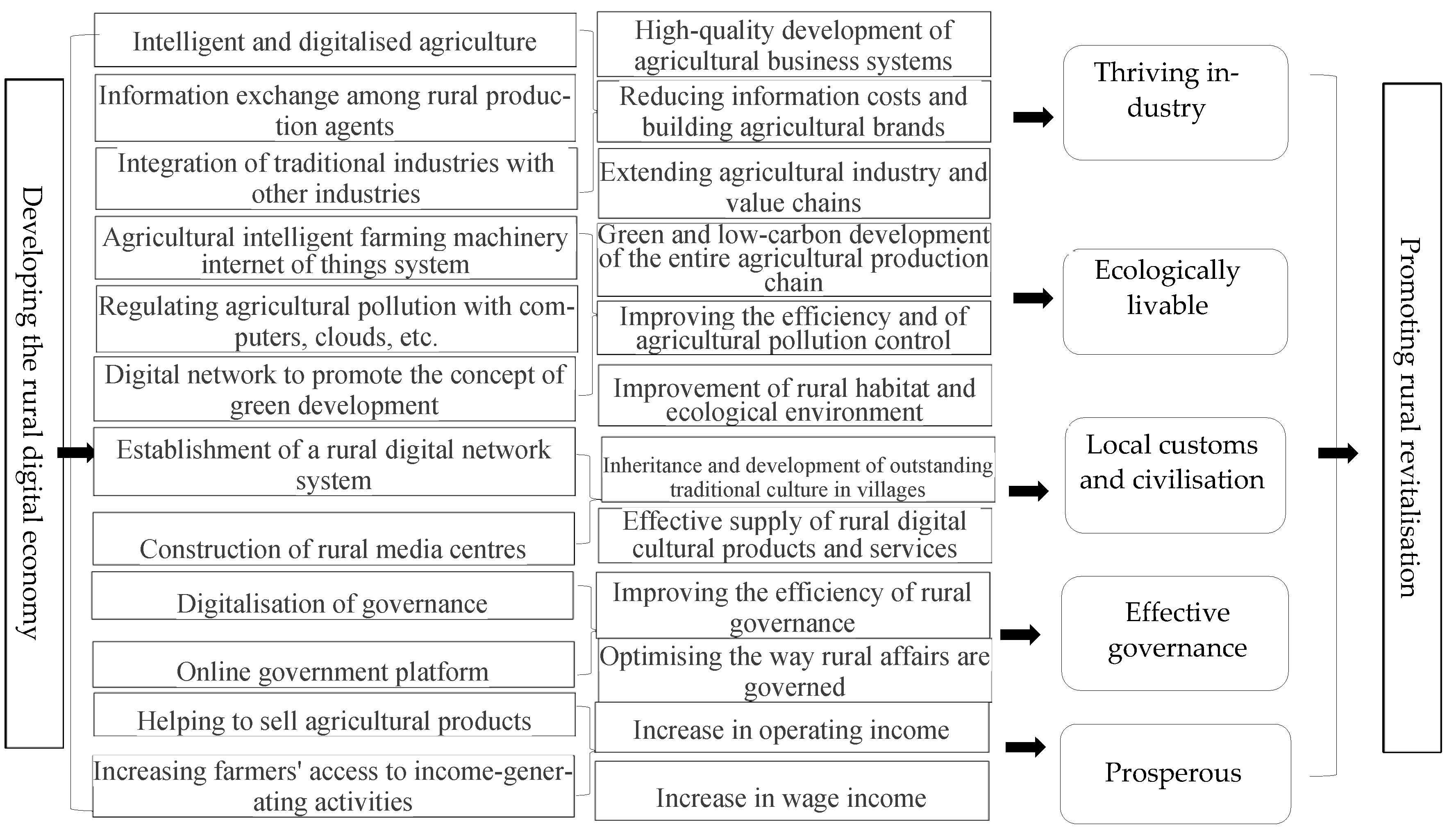
Firstly, the rural digital economy promotes the prosperity of rural industries, which is mainly reflected in the integrated development of industries, the innovation of industrial subjects, and an improvement in product quality. Firstly, the digital economy can promote industrial development, accelerate the realisation of the integration of primary, secondary and tertiary industries, and promote the multifunctional development of agriculture. In the process of the rapid development of the digital economy, big data technology and artificial intelligence boost the specialised segmentation of each link of the agricultural industry chain, extend the agricultural industry chain and value chain through the primary processing and deep processing of agricultural products, and improve the problem of traditional agriculture being in the middle and low end of the value chain for a long time [31,32]. At the same time, new agricultural industries and modes of business, such as agricultural tourism and health and wellness, are being utilised to achieve a deeper integration of the tertiary and primary industries and to promote the revitalisation of rural industries. Secondly, the digital economy can cultivate new agricultural management subjects [33,34]. The digital economy can facilitate strong links between farmers and agricultural organisations and provide timely and accurate financial assistance to agricultural operators. Finally, the digital economy can help improve the quality of agricultural products [35,36]. The digital economy promotes the use of smart agricultural technologies, such as smart-sensing robots in agriculture and numerically controlled pesticide spraying, to achieve the goal of intelligence and efficiency in the whole chain of agriculture, from sowing to harvesting, which is of great significance in improving the level of agricultural automation and production efficiency. The big data collection and analysis platform of the digital economy can help improve the quality and efficiency of agriculture by regulating the quality of agricultural products and forecasting risks, providing information on the varieties and quantities of agricultural products to be grown, and promoting the branding of agricultural products.
Secondly, the rural digital economy promotes rural eco-livability. Firstly, the digital economy promotes the greening of agriculture. The digital economy incorporates the whole process of agricultural production and processing into the agricultural intelligent agricultural IoT system, which puts forward higher requirements for the quality and safety traceability of agricultural products, especially the amount of fertilisers and pesticides used and the amount of residues, and boosts the green and low-carbon development of agricultural production [37,38]. Secondly, the digital economy can improve the efficiency and level of agricultural pollution control. In the process of digitising agriculture, the digital economy can leverage the Internet to rapidly disseminate advanced technologies for preventing and combating agricultural and rural pollution, collocate complete data on agricultural pollution, integrate resources for combating pollution, and improve the level of pollution control [39,40]. Thirdly, the digital economy is conducive to the improvement of the rural habitat and ecosystems. The digital economy can not only make use of digital networks to popularise the concept of green development in cities and towns to rural areas, but also make use of the rural environment monitoring system to effectively analyse in real time information on the living environment and ecological environment, such as the rural human environment, the ecology of farmland, rural rivers and lakes, and soil erosion, so as to continuously improve the efficiency of the improvement of the rural environment and the level of management specialisation [41,42].
Thirdly, the rural digital economy promotes rural civilisation from both the demand and supply sides. First, on the demand side, the inheritance and development of outstanding traditional culture in the countryside is being promoted through the development of the digital economy. The digital economy promotes the construction of rural digital networks, attracting a large number of farmers to invest in the construction of rural civilisation, such as the use of e-commerce live broadcasts to introduce the historical sites of the countryside, poems and ballads, traditional customs, folk legends, celebrity deeds, and township rules and regulations, which not only enriches the spiritual and cultural life of farmers but also inherits and develops the excellent traditional culture of the countryside through imperceptible influences [43,44]. Secondly, the effective supply of rural digital cultural products and services should be enhanced. Compared with urban residents, rural residents in China have fewer sources of access to information and the effective supply of cultural products is insufficient, leading to a more conservative mindset among rural residents and a lack of motivation for the revitalisation of talent, which constrains rural revitalisation. The provision of cross-regional information resources through the rural digital economy has met the spiritual and cultural needs of farmers and changed their original concepts of life, agricultural production, marriage, and consumption, promoting the development of digital value creativity and contributing to the long-term sustainable development of the construction of rural civilisation [45,46].
Fourthly, the rural digital economy promotes effective rural governance, mainly in the form of improved governance and governance efficiency. Firstly, convenient digital rural governance improves the efficiency of rural governance. In the process of gradually shifting the centre of gravity of grass-roots governance, villagers’ awareness of rural governance and public awareness has developed more rapidly; villagers have to deal with more things in villages, and villagers have put forward new demands on the efficiency of the handling of affairs [47,48]. Digital village governance uses digital technology to build a platform for the timely appeal of villagers’ opinions and needs, breaking down the long-standing barrier of “going into the government and applying face-to-face” and crossing the barriers of time and space. Secondly, digital rural governance optimises the way rural affairs are governed [49,50]. Digital village governance, in the close link between the villagers and village cadres’ vertical relationship, at the same time also deepens the connection between villages in different regions; the excellent governance cases around the appropriate combination with local rural governance can solve the problem of rural governance information blockage. The process of digital village governance will continue to improve the governance awareness and capacity of villagers, better exercise their rights to know, choose, participate and supervise, and further promote legitimate, transparent, efficient, and open procedures for village governance, so as to accelerate the implementation of good governance in the countryside.
Fifthly, the rural digital economy promotes a rich life. Farmers’ income growth is an important objective of rural revitalisation. Firstly, the rural digital economy helps to sell agricultural products and increase farmers’ household income. The “capital and skills” doctrine holds that the application of new technologies increases the income of skilled labour [51], but the adoption of new technologies does not necessarily reduce the income of unskilled labour [52]. The development of the rural digital economy has provided convenient conditions for the construction of rural commerce network trading platforms, and the use of rural commerce trading platforms to provide online and offline agricultural product-trading services for both the supply and demand sides has lowered the limitations of the farmers’ supply side to enter the market and reduced the cost of searching for market information and trading between the supply and demand sides. At the same time, the use of a rural commerce network trading platform can widely and accurately obtain changes in the price of agricultural products, quality requirements, trading areas, and the number of transactions, to help the supply side of agricultural products to formulate accurate and reasonable marketing methods, so that farmers and consumers can effectively avoid the middlemen’s layer-by-layer squeeze, and to strengthen the market position of the supply side of agricultural products in order to obtain more profits. Secondly, the rural digital economy increases the ways for farmers to increase their income and raise their wage income [53,54]. The development of the rural digital economy has also extended employment service businesses, closely linking the supply side of surplus rural labour with the demand side of market enterprises, promoting equal opportunities for employment and entrepreneurship, and helping surplus rural labour or short-term labourers in the agricultural idle period to flexibly take up employment or start their own businesses, so as to increase the income of farmers and promote a prosperous life.
As the systematic content of rural revitalisation, the rural digital economy promotes the development of these contents, while also promoting the development of rural revitalisation as a whole. Specifically, the theoretical mechanism of the rural digital economy empowering rural revitalisation is shown in Figure 1.
Figure 1.
Theoretical mechanisms of rural digital economy enabling rural revitalisation.
Based on this, the following hypothesis is put forward.
Hypothesis 1.
The digital economy can significantly drive rural revitalisation.
The development of rural digital can promote the high-quality development of the agricultural business system, reduce information costs, build agricultural product brands, and develop multifunctional agriculture to promote rural industrial prosperity. It can build a whole industrial chain of agricultural production and green low-carbon development, and improve the efficiency and level of agricultural pollution control to improve the rural habitat and ecological environment to promote the construction of ecological livability. It can inherit and develop excellent traditional culture in the countryside, effectively supply digital cultural products and services in the countryside, and promote the construction of rural civilisation. It can improve the efficiency of rural governance, optimise the governance of rural affairs, and promote effective governance. It can increase the operating income of farmers, improve their wage income, and achieve a rich life.
4. Indicator System and Model Construction
4.1. Entropy Approach Model
Compared with other multi-indicator weighting evaluation methods, the entropy value method has the advantages of reducing the bias caused by the assignment of subjective factors, avoiding the problem of repetition of the information of indicator variables, and using simple algorithms with a high accuracy. Therefore, the entropy value method is more suitable for determining the weights of the indicator system of rural entrepreneurial activity in multiple provinces in multiple time periods in this paper, so as to measure the comprehensive evaluation value of rural digital economic development. Because of the differences in the units and attributes of the indicators in the constructed indicator system, it is first necessary to standardise the data to avoid the influence of the scale, and the model expression is as follows:
Among them, Zij denotes the results of the data normalisation of the raw indicator data. indicates province, indicates the first indicator. indicates province, indicator raw data. Secondly, after standardisation of the data, the authors measured the information entropy of indicator raw data (Formula (3)) and weights (Formula (4)); included among these, denotes the sample size and indicates the number of indicators. Finally, the measurement of the composite value of digital economy development in rural villages in each province (Formula (5)).
4.2. Two-Way Fixed Effects Model
Through the F-value statistic test method and the Hausman test method, the fixed effect model is selected as the most appropriate; meanwhile, in order to solve the problem of the individual effect and time effect, the final choice is to use a two-way fixed effect model to measure the impact of the level of rural digital economy development on the level of rural revitalisation development, and the model expression is as follows:
In Equation (6), denotes the province, and the level of rural revitalisation development in the year; denotes the province, and the level of rural digital economy development in the year; denotes the province, and the vector of control variables for the year; denoted the province fixed effects term, to control for unobservable and time-invariant individual heterogeneity at the district level; denotes an observable time fixed effects term; denotes the random error term; , and all are parameters to be estimated.
4.3. Description of Data and Variables
4.3.1. Explanatory Variables
In this paper, referring to the measurement method of Luo Chunna et al. [55], we select the indicators of industrial prosperity, ecological livability, civilised rural culture, effective governance, and affluent life to construct the indicator system of the rural revitalisation development level, and we select the entropy method to measure the comprehensive evaluation value of the rural revitalisation development level, and the level of the comprehensive evaluation value indicates the high level of the rural revitalisation development level of the region, as shown in Table 1.
Table 1.
List of variable indicators.
4.3.2. Core Explanatory Variables
In this paper, referring to the measurement methods of Han Zhaoan et al. [56], digital infrastructure, agricultural digitalisation, and agricultural digital industrialisation indicators are selected to construct the indicator system of the rural digital economy development level. On the basis of this indicator system, the entropy value method is used to measure the comprehensive evaluation value of rural digital economic development, and the level of the comprehensive evaluation value indicates the level of rural digital economic development in the region.
4.3.3. Control Variable
This paper selects the level of economic development, urbanisation rate, degree of openness to the outside world, population structure, and rural asset investment as control variables. (1) The level of economic development is expressed by the real per capita gross regional product; (2) the urbanisation rate is expressed by the ratio of the urban population to the total population; (3) the degree of openness to the outside world is expressed by the amount of goods imported and exported to and from the gross domestic product; (4) the demographic structure is expressed by the value of the old age dependency ratio; and (5) the input of rural assets is expressed by the amount of the completed fixed-asset investment in rural households.
4.3.4. Data Sources
The basic data for measuring the level of rural digital economy development are mainly from the 2013–2020 China Tertiary Industry Statistical Yearbook, China Rural Statistical Yearbook, China Statistical Yearbook, the EPS data platform, data from the Ali Research Institute, the Centre for Spatial Planning of Nanjing University, and the digital financial inclusion indicators released by the Digital Finance Research Centre of Peking University. Data on rural revitalisation in each province comes from the 2013–2020 China Rural Statistics Yearbook, China Statistics Yearbook, China Population and Employment Statistics Yearbook, China Social Statistics Yearbook, China Civil Affairs Statistics Yearbook, and the statistical yearbooks of each province. Data on control variables were obtained from the China Statistical Yearbook, the China Population and Employment Statistics Yearbook, and the China Rural Statistics Yearbook.
4.3.5. Descriptive Statistics
According to Table 2, it can be seen that there is a large gap between the maximum and minimum values of the development level of rural revitalisation and the development level of the rural digital economy, indicating that there are regional differences in the development level of rural revitalisation and the digital economy in China.
Table 2.
Variable definitions and descriptive statistics.
5. Results
5.1. Level of Rural Digital Economy Development
According to Equations (1)–(5), the level of development of the digital economy in the rural areas of 30 provinces in China (data for Tibet are missing, so it is rounded off) was measured from 2013 to 2020 (Table 3).
Table 3.
Level of digital economy development in 30 provinces and villages in China, 2013–2020.
The development of China’s rural digital economy from 2013 to 2020 shows a trend of good development, growing from 0.2277 in 2013 to 0.4070 in 2020, an increase of 0.7874, with an average annual growth rate of 9.84 per cent, indicating that China’s rural digital is generally stable and steadily developing. The growth rate of all regions also showed positive growth, of which the western and central regions grew faster, with an increase of 0.9791 and 0.8827, respectively, and an average annual increase of 12.24% and 11.03, respectively; eight of the nine provinces with the fastest growth rate were located in the western and central regions, namely Chongqing (1.3654), Ningxia (1.2721), Qinghai (1.2636), Shaanxi (1.2178), Guizhou (1.2002), Gansu (1.0619), and Hunan (1.0097). The northeastern region increased by 0.6220, and the average annual growth rate of 7.78 per cent was also higher than the growth rate of the eastern region. It can be seen that in the central, western, and northeastern regions, although the level of development of the rural digital economy is weaker, the growth rate is faster and the development potential is greater.
However, there are gaps between the levels of development of the digital economy in rural villages across regions and provinces. In terms of the average value of rural digital economy development water, the average value of rural digital economy development water is greater in the Eastern region than in the Central region, in the Central region than in the Western region, and in the Western region than in the Northeastern region. The average value of rural digital economy development water is greater. The inter-regional development gap is large; the rural digital economy development level higher is than the national average level for a total of 12 provinces, mostly distributed in the northeastern region and the central region; the distribution is Shandong, Jiangsu, Sichuan, Guangdong, Zhejiang, Fujian, Henan, Hubei, Guangxi, Anhui, Xinjiang, and Shaanxi. Six of the seven provinces with the highest mean values are located in the eastern region, namely Shandong (0.5111), Jiangsu (0.4473), Guangdong (0.4094), Zhejiang (0.3997), and Fujian (0.3481), which is related to the higher level of economic development in the eastern region, and how to reduce the inter-regional rural digital economy development gap has also become a key issue for the coordinated development of the rural digital economy.
5.2. Level of Development of Rural Revitalisation in China
From 2013 to 2020, the development level of China’s rural revitalisation showed an overall stable and steady trend, increasing from 0.1633 in 2013 to 0.2836 in 2020, an increase of 0.8146, or an average annual increase of 10.18%, indicating that China’s rural revitalisation has gained a good level of development. From the point of view of the growth rate of the development level of rural revitalisation in each region, the development level of rural revitalisation and rural digital development level in each region show a similar development state, with the fastest growth rate in the western region and the central region, with an increase of 1.0231 and 0.7515, respectively, and an average annual increase of 12.79% and 9.39%, followed by an increase in the central region with an increase of 0.7183, and an average annual increase of 8.98 per cent; the lowest increase in the northeastern region was 0.4975, with an average annual increase of 6.22 per cent.
At the same time, there are gaps between the levels of development of rural revitalisation in various regions and provinces. In terms of the average value of rural revitalisation development water, the average value of rural revitalisation development water is greater in the central region than in the eastern region, greater in the eastern region than in the western region, and greater in the western region than in the northeastern region. And there is a large development gap between regions, with the level of rural revitalisation development in the eastern region and the central region being higher than the national average, and the level of rural revitalisation development in the western region and the northeastern region being lower than the national average. From the point of view of the level of development of each province, the level of development of rural revitalisation is higher than the national average level for a total of 15 provinces, distributed in the western region, the central region, the eastern region, and the northeastern region, respectively—Shandong, Henan, Sichuan, Hebei, Jiangsu, Anhui, Hubei, Hunan, Yunnan, Guangxi, Heilongjiang, Xinjiang, Inner Mongolia, and Zhejiang (Table 4).
Table 4.
Development level of rural revitalisation in 30 provinces in China, 2013-2020.
5.3. Analysis of the Results of the Baseline Model
In order to accurately estimate the overall effect of rural digital economic development on the level of rural revitalisation development, the core explanatory variables were first regressed. Meanwhile, the development level of rural revitalisation is affected by other factors, and appropriate control variables are selected for the F-test and Hausman test to choose the appropriate estimation model. Among them, the uncontrolled variables are the regression results of the level of rural digital economic development on the level of rural revitalisation development. Considering that the level of rural revitalisation development is affected by other factors, in order to more accurately reflect the effect of the level of rural digital economic development on the level of rural revitalisation development, the OLS estimation, FE estimation, and RE estimation in Table 5 are the results of the estimation of the mixed effect, individual fixed effect, and individual random effect models of the core explanatory variable rural digital economic development level on the level of rural revitalisation development after the introduction of the control variables (the level of economic development, the urbanisation rate, degree of openness to the outside world, population structure, and rural asset input), after the introduction of the core explanatory variables’ rural digital economy development level on the development level of rural revitalisation of the mixed effects, individual fixed effects, and individual random effects model estimation results. By analysing the F-value test and Hausmann test, it can be seen that the two-way fixed effects model is the most appropriate. According to Equation (6), the overall effect of the level of rural digital economy development on the level of rural revitalisation development in 30 Chinese provinces (Tibet data are missing, so it is rounded off) from 2013 to 2020 has been measured by the two-way fixed effects model (Table 5).
Table 5.
Estimated results of the impact of the rural digital economy on rural entrepreneurial activity.
Therefore, the FE estimates are more accurate and the conclusions drawn from each estimate are more consistent: the level of rural digital economy development in each province has a significant positive impact on the level of rural revitalisation development from 2013 to 2020. Estimates without control variables are shown to show that for every 1 percentage point increase in the level of rural digital economy development, the level of rural revitalisation development increases by 0.6394. The estimation results after adding the control variables show that for every 1 percentage point increase in the level of rural digital economy development, the level of rural revitalisation development increases by 0.1938. The role of the level of rural digital economy development in increasing the level of rural revitalisation development has decreased, but still has a significant positive impact.
The estimation results obtained by introducing control variables are more consistent in the direction of the impact of the level of rural digital economy development on the level of rural revitalisation development, i.e., in line with theoretical expectations. Among them, the level of economic development has a significant positive impact on the level of rural revitalisation development, and an increase in the level of economic development will increase the level of rural revitalisation development with an elasticity of 0.9805, i.e., for every 1 percentage point increase in the level of economic development, the level of rural revitalisation development will increase by 0.9805.
The urbanisation rate has a significant positive effect on the level of rural revitalisation development, and an increase in the urbanisation rate increases the level of rural revitalisation development with an elasticity of 0.5361, i.e., for every 1 percentage point increase in the urbanisation rate, the level of rural revitalisation development increases by 0.5361.
The degree of openness to the outside world has a significant positive effect on the development level of rural revitalisation; an increase in the degree of openness to the outside world will increase the development level of rural revitalisation, and the elasticity is 0.0978, i.e., for every 1 percentage point increase in the degree of openness to the outside world, the level of rural revitalisation and development will increase by 0.0978.
Population structure has a significant positive effect on the level of rural revitalisation development, and an increase in population structure increases the level of rural revitalisation development with an elasticity of 0.2640, i.e., for every 1 percentage point increase in population structure, the level of rural revitalisation development increases by 0.2640.
Rural asset inputs have a positive effect on the level of rural revitalisation development, and an increase in rural asset inputs increases the level of rural revitalisation development with an elasticity of 0.0026, i.e., for every 1 percentage point increase in rural asset inputs, the level of rural revitalisation development increases by 0.0026.
5.4. Endogeneity Test
When measuring the impact of the level of rural digital economy development on the level of rural revitalisation development, it may be affected by endogeneity, which includes two main factors: two-way causality and omitted variable bias. Bidirectional causation means that the level of rural digital economy development and the level of rural revitalisation development are causal to each other; the development of the rural digital economy promotes the level of rural revitalisation development, and at the same time, improvement in the level of rural revitalisation development drives the development of the rural digital economy, which in this context leads to the level of development of the rural digital economy related to the error term and the occurrence of the endogenous problem. Therefore, to address the potential two-way causation problem, this paper measures the level of rural digital economy development in the lagged period of the rural revitalisation development level by using a panel Granger causality test method [57], where the independent variable is treated as the dependent variable (Table 6). It can be found through the measurement results that there is no bidirectional causality between the level of rural digital economy development and the level of rural revitalisation development, and there is no endogeneity of the selected variables, thus verifying that the regression results in Table 5 are reliable.
Table 6.
Estimated results of the impact of the rural digital economy on rural entrepreneurial activity.
Omitted variable bias refers to the omission of certain explanatory variables from the model’s setup process that affect the measurements. In this study to analyse the impact of rural digital economic development on the development level of rural revitalisation, five control variables, such as the level of economic development, the urbanisation rate, the degree of openness to the outside world, the demographic structure, and the input of rural assets, were chosen to avoid the problem of omitted variables as much as possible, but there may still be the defect of omitted variable bias that leads to biased estimation results. Therefore, to address the potential omitted variable bias problem, this paper measured the impact of rural digital economy development on the development level of rural revitalisation through a dynamic panel model (the systematic GMM method) [58] by adding the lagged value of the dependent variable, i.e., the previous year’s value of the rural revitalisation development level, to the regression as the independent variable (Table 6). The results of the measurement show that the results of the regression model remain robust, and the impact of the level of rural digital economy development on the level of rural revitalisation development is significant at the 1% level (Table 7).
Table 7.
Estimation results of system GMM model.
5.5. Robustness Check
Robustness tests are carried out to prevent the influence of extreme values on the estimation results, which can be achieved by shrinking the continuous variables by 1 per cent, followed by the addition of other control variables that can affect the causality studied due to the possibility that important factors may have been overlooked in the analysis. On this basis, variables such as industrial structure, rural infrastructure, and financial support for agriculture were added to test the impact of the level of rural digital economy development on rural entrepreneurial activity (Table 8). As can be seen in Table 8, the level of rural digital economy development still has a significant positive impact on rural entrepreneurial activity, validating the robustness of the results.
Table 8.
Robustness test results.
6. Discussion
This study analyses the impact of rural digital economy development on rural revitalisation based on data from 30 provinces in China from 2013–2020. Firstly, the development level, development speed, and regional differences of the rural digital economy and rural revitalisation in China’s provinces from 2013 to 2020 are examined. Second, two-way fixed effects were used to validate the impact effects. Finally, the results are examined and similar conclusions are drawn using a panel Granger causality test, dealing with the endogeneity problem method by applying a 1 per cent deflator to the continuous variables and adding other control variables.
Although relevant studies have confirmed that digital applications have contributed to rural revitalisation in one dimension, such as the digital economy empowering rural industries (Zhao et al., (2024) [59]), enhancing agricultural productivity (Fang et al., (2024) [60]) and the common prosperity of farmers (Mossberger (2022) [61]), empowering rural governance (Miao et al., (2024) [62]), and other dimensions of rural revitalisation, the research on the logic and mechanism of the digital economy has been fragmented and needs to be deepened in a holistic and comprehensive way. The possible marginal contributions of this paper are mainly reflected in three aspects. First of all, compared with the existing literature that explores the application of the digital economy in rural revitalisation in the fields of agricultural production, industrial integration, rural governance, and other areas and its economic effects in a more fragmented manner, this paper assesses the economic effects of the overall architecture of rural revitalisation based on rural digital development, which is an improvement in the systematicity and comprehensiveness of the study. Secondly, it argues the mechanism of the rural digital economy’s impact on rural revitalisation, using digital elements, digital products and services, and digital thinking to achieve industrial digitalisation, intelligent intensification, and greening; farmers are educated, good at business, have new skills, and live a good life; rural governance is modernised, allowing people to live intelligently and technologically and to promote industrial revitalisation, ecological revitalisation, talent revitalisation, cultural revitalisation, and organisational revitalisation, and ultimately to achieve revitalisation of the countryside. Finally, it analyses the variability in the level of development of the rural digital economy and rural revitalisation in various regions of China, making a useful addition to the implementation of targeted development recommendations. This is in line with the studies of Meng et al., (2023) [63] and He et al., (2022) [64]. Our findings also focus on analysing regional differences in the level of digital economy development and the level of rural revitalisation development in various regions of China, which to a certain extent supports the viewpoints mentioned in the study by Liu et al., (2023) [65]. Studies have also shown that the level of economic development, urbanisation rate, openness to the outside world, demographics, and rural asset inputs can all contribute to the development of rural revitalisation, which is similar to the findings of Yang et al., (2023) [66], Fung et al., (2024) [67], Liu et al., (2022) [68], Millard (2022) [69], and others.
7. Conclusions and Suggestion
7.1. Conclusions
Using panel data from 30 provinces in China from 2013 to 2020, this paper empirically analyses the rural digital economy through the perspective of its impact on the development level of rural revitalisation and establishes a number of models, including a two-way fixed effects model and a dynamic panel model. These models were used to empirically test the effectiveness and mechanisms of the rural digital economy on the level of development of rural revitalisation, and the main findings can be summarised as follows. Firstly, the research hypothesis was verified that the level of rural digital economy development in Chinese provinces has a significant positive impact on the level of rural revitalisation development. Estimates without control variables are shown to show that for every 1 percentage point increase in the level of rural digital economy development, the level of rural revitalisation development increases by 0.6394. According to the panel Granger causality test method, there is no bidirectional causality between the level of rural digital economy development and the level of rural revitalisation development, and there is no endogeneity of the selected variables. Meanwhile, through the dynamic panel model, the results of the regression model remain robust, and the impact of the level of rural digital economy development on the level of rural revitalisation development is significant at the 1% level. The robustness of the results is verified by the stability test, which shows that the level of rural digital economy development still has a significant positive impact on rural entrepreneurial activity. The results of Zhang’s (2024) [70] study are consistent with our findings that the digital economy has become an important driving force for rural revitalisation. Secondly, China’s rural digital economy development shows a good development trend, with an increase of 0.7874 and an average annual increase of 9.84 per cent. However, there is a gap between the level of rural digital economy development in various regions and provinces; in terms of the average value of rural digital economy development water, the eastern region (0.3378) > central region (0.3152) > western region (0.2954) > northeastern region (0.2793); there is a large gap in the development of inter-regional development, which is in line with the study of Wang et al., (2024) [71]. Thirdly, the level of development of rural revitalisation in China has shown an overall stable, steady, and improving trend, with an increase of 0.8146 and an average annual increase of 10.18 per cent, while at the same time, there are gaps between the level of rural revitalisation development in various regions and provinces. In terms of the average value of rural revitalisation development water, the central region (0.2597) > the eastern region (0.2090) > the western region (0.1915) > the northeastern region (0.1799), and there is a large inter-regional development gap, which is in line with the study by Liu et al., (2023) [72]. Fourthly, an increase in the level of economic development will increase the level of rural revitalisation, and the elasticity is 0.9805. An increase in the urbanisation rate will increase the level of rural revitalisation, and the elasticity is 0.5361. An increase in the degree of openness to the outside world will increase the level of rural revitalisation, and the elasticity is 0.0978. An increase in the demographic structure will increase the level of rural revitalisation, and the elasticity is 0.2640. An increase in the investment in rural assets will increase the level of rural revitalisation, and the elasticity is 0.2640. An increase in asset investment will increase the level of rural revitalisation development, and the elasticity is 0.2640, which is consistent with the study of Wang (2024) [73].
7.2. Suggestions
The development of rural digital industrialisation plays an important role in promoting rural industrial prosperity, ecological livability, civilised rural culture, effective governance, and affluent living, thus having a positive impact on the development of rural revitalisation. To this end, this paper makes the following recommendations based on the findings of the study. Firstly, it is necessary to formulate a development strategy for targeted rural revitalisation in the light of the actual characteristics of each region in China, and to build a rational and orderly spatial pattern for rural revitalisation. Emphasis will be placed on upgrading the level of development of rural revitalisation in the western and northeastern regions, resolving key contradictions in inter-regional disparities, and promoting the coordinated advancement of rural revitalisation throughout the country as a whole. Secondly, in the process of developing the rural digital economy, it is necessary not only to do a good job of top-level design and plan the development of the rural digital economy by integrating it into the overall situation of the coordinated development of the country’s regions, but also to take into account the level of economic development of each region, the structure of the development of the rural industry, and the ability to guarantee technology and human resources. Thirdly, to build a rural digital infrastructure and promote the construction of digital villages. In particular, the construction of big data infrastructure in the countryside, the formation of a big data centre for the development of rural industries at the national level, and the collection, collation, and analysis of all kinds of rural industries and their products in the whole area of data and information. Fourth, taking into account the actual development of each region in China, we will guide the layout of rural industries in accordance with local conditions, so as to further give full play to the positive role played by rural figures in the level of rural economic development. The central and western regions, as well as the northeastern region, should accelerate the development of the digital economy to reduce the negative impact of the low level of digital economic development on rural revitalisation. Rural economic development has an important role to play in promoting rural revitalisation, and increasing rural inputs, while maintaining economic development, has given impetus to rural revitalisation. Fifthly, cultivate a rural digital talent team and give play to the important role of human capital. In the process of the integration of digital economy-related industries and traditional industries, villages should conduct a scientific evaluation of the development of digital industries, increase the introduction of high-end talents and advanced technologies, and cultivate a group of composite talents who understand both traditional business and digital technology, so as to promote the vigorous development of the rural digital economy. Sixthly, it is necessary to deepen the reform of the household registration system and raise the urbanisation rate of the household population. At the same time, it is necessary to improve the institutional mechanism for the integrated development of urban and rural areas and to narrow the development gap between urban and rural areas. It is necessary to accelerate the extension of basic public services to the countryside, accelerate the unified planning and construction of urban and rural infrastructure, and promote a greater flow of industrial capital and other types of factors to the countryside. Seventh, China’s agriculture and rural areas should take advantage of the domestic mega-market, attract global agricultural resource elements with a large domestic cycle, make full use of the two domestic and international markets and two kinds of resources, and further improve the level of opening up of agriculture and rural areas to the outside world.
7.3. Limitations and Further Research
In terms of research themes, studies have confirmed from a macro perspective that the digital economy can be a driving force for rural revitalisation, but issues such as how the dimensions of the digital economy play a role in the different stages of the evolution of the digital countryside are yet to be explored, and there is a lack of research on the spatial effects of the digital economy and rural revitalisation. Future research may go down various avenues of exploration. This trajectory is supported by the scholarly contribution of Su et al., (2024) [74] and has been recently elaborated in that study.
Author Contributions
All authors contributed meaningfully to this study. Research topic, Z.L.; Data acquisition and analysis, Z.L.; Methodology support, Z.L.; Original draft preparation, H.W.; Writing—review and editing, H.W.; Writing—review and editing, I.H.B. All authors have read and agreed to the published version of the manuscript.
Funding
This research was funded by the general project of the National Social Science Fund “Study on the Path and Countermeasures of Conservation Tillage to Promote the Effect of Food Security Enhancement” (No. 21BJY249). This research was funded by the Heilongjiang Provincial Social Science Fund Project “Study of Rural Cultural Changes in Heilongjiang Province in the Process of Chinese-Style Modernisation” (No. 23SHC144).
Institutional Review Board Statement
Not applicable.
Informed Consent Statement
Not applicable.
Data Availability Statement
The data presented in this study are available on request from the corresponding author.
Conflicts of Interest
The authors declare no conflicts of interest.
References
- Yang, Q.; Zhu, C.H. China’s road to rural revitalization: Characteristics, history and outlook. J. Probl. Agric. Econ. 2024, 2, 4–17. [Google Scholar]
- Chen, X.M.; Zhou, B. The internal mechanism and realization path of digital economy to promote rural revitalization. J. Theory Explor. 2023, 85–90. [Google Scholar]
- Tian, Y.; Liu, Q.; Huang, J. Role mechanism of digital economy empowering rural industry revitalization—Based on the case study of three typical townships in Zigui County, Hubei Province. J. Agric. Econ. Issues 2023, 36–46. [Google Scholar]
- G20 Digital Economy Development and Cooperation Initiative delivered at 2016 Hangzhou Summit Renews Impetus to Global Economy. Available online: https://www.chinadaily.com.cn/business/2016hangzhoug20/2016-09/28/content_26927065.htm (accessed on 23 May 2024).
- Wu, G.Y.; Pang, G.G.; Tang, J.H. Measurement, regional differences and spatial and temporal evolution of digital economy development in rural China. J. Hunan Agric. Univ. (Soc. Sci. Ed.) 2022, 23, 15–27. [Google Scholar]
- Qi, W.H.; Li, M.J.; Li, J.B. Digital rural empowerment and farmers’ income growth:role mechanism and empirical test—A study on the moderating effect based on farmers’ entrepreneurial activity. J. Southeast Univ. (Philos. Soc. Sci. Ed.) 2021, 23, 116–125+148. [Google Scholar]
- Zeng, Y.W.; Song, Y.X.; Lin, X.Z. Ruminations on some issues of digital village construction in China. J. China Rural Econ. 2021, 436, 21–35. [Google Scholar]
- Wen, T.; Chen, Y.M. Integration and development of digital economy and agricultural and rural economy:practice mode, realistic obstacles and breakthrough path. J. Agric. Econ. Issues 2020, 487, 118–129. [Google Scholar]
- He, Z.Y.; Song, X.G. Mechanisms and implications of the digital economy for employment—Reflections after the epidemic. J. Econ. 2020, 257, 58–68. [Google Scholar]
- Xia, J.C.; Liu, C. Digital economy enabling common wealth: Role path and policy design. J. Econ. Manag. Res. 2021, 42, 3–13. [Google Scholar]
- Ma, Y. Impact of digital economy on consumer market: Mechanism, performance, problems and countermeasures. J. Macroecon. Res. 2021, 270, 81–91. [Google Scholar]
- Gao, F. How has the digital economy affected the transformation of urban-rural structure? J. Tianjin Soc. Sci. 2021, 240, 131–140. [Google Scholar]
- Yu, H.J. The Strategic Choice of Rural Revitalisation. J. Peking Univ. 2022, 59, 38–45. [Google Scholar]
- Han, C.F. Vigorously implementing rural revitalisation strategy. N. People’s Dly. 2017, 12, 11. [Google Scholar]
- Yao, X.B.; Deng, X.X.; Luo, G.Q. Does rural human capital promote rural revitalisation?—Based on double heterogeneity perspective. J. Southwest Univ. Natl. 2022, 43, 136–149. [Google Scholar]
- Du, Y.H.; Yang, X.M. Rural revitalisation:rural education as a strategic support and its development path. J. South China Norm. Univ. 2018, 2, 76–81+192. [Google Scholar]
- Xu, H.; Zhang, Y.; Zhang, X.F.; Hu, Y.W.J. Research on the realisation path of corporate social entrepreneurship for rural revitalisation under the perspective of value co-creation. J. Agric. Econ. Issues 2023, 11, 63–75. [Google Scholar]
- Meng, W.F.; Li, S.; Liu, J.H. Research on the impact mechanism of digital inclusive finance for rural revitalisation. J. Econ. Issues 2023, 3, 102–111. [Google Scholar]
- Shen, X.X.; Zhu, S.Y.; Peng, C. Green food helps rural revitalisation: Theoretical logic, practical path and countermeasure suggestions. J. Rural Econ. 2023, 1, 45–52. [Google Scholar]
- Zhu, J.G. Analysis of the impact effect of the entrepreneurial behaviour of rural workers returning to their hometowns on rural revitalisation. J. Econ. Jingwei 2023, 40, 68–77. [Google Scholar]
- Tang, J.X.; Li, A.S.; Liu, Y.J. Research on the impact effect of tourism urbanisation driving rural revitalisation. J. Huazhong Agric. Univ. 2023, 163, 174–185. [Google Scholar]
- Gao, Y.J.; Wu, T.F.; Zou, Y.Y. Logic and conducting path of the reform of agricultural land “three rights of separation” system to promote rural revitalisation. J. Rural Econ. 2022, 482, 17–27. [Google Scholar]
- Cai, W.B.; He, W.Y. Research on the comprehensive evaluation of the development level of China’s rural revitalisation. J. Chongqing Univ. 2023, 29, 102–116. [Google Scholar]
- Wang, Q.; Zeng, F. Regional differences and convergence of rural revitalisation levels in China. J. Guizhou Univ. Financ. Econ. 2023, 1, 99–110. [Google Scholar]
- Zhang, L.; Zhang, X.R.; Jiang, N. Study on the difference in the level and spatial structure of rural revitalisation—Taking the western region of Heilongjiang as an example. J. Agric. Technol. Econ. 2022, 329, 134–144. [Google Scholar]
- Li, W.R.; Zhou, S.J. Changes in China’s agricultural production mode under the background of digital economy: Mechanism, contradiction and relief. J. Xi’an Jiaotong Univ. 2023, 43, 65–73. [Google Scholar]
- Jiang, C.Y. Development of Digital Economy Leads to Agricultural Transformation and Rural Industrial Integration. J. Econ. China 2022, 441, 41–49. [Google Scholar]
- Li, X.Z.; Li, J.Y. Research on the impact of digital economy development on urban-rural income gap. J. Agric. Technol. Econ. 2022, 77–93. [Google Scholar]
- Qi, W.H.; Zhang, Y.J. Boosting the high-quality development of rural economy with digital economy. J. Theory Explor. 2021, 93–99. [Google Scholar]
- Li, X.H.; Li, G.C. Digital village construction and urban-rural income gap: A U-shaped relationship. J. Huazhong Agric. Univ. 2024, 1–13. [Google Scholar]
- Li, Y.; Ruan, L.J. Expansion path and policy orientation of Chinese-style agricultural and rural modernisation in the context of digital economy. J. Xi’an Univ. Financ. Econ. 2023, 36, 21–29. [Google Scholar]
- Wang, H.F.; Qian, X. Research on the integration and development of three industries in rural areas of China empowered by digital economy. J. Gansu Soc. Sci. 2024, 196–205. [Google Scholar]
- Hong, R.F.; Wu, J.H. Digital Economy, Equalisation of Basic Public Services and Common Wealth of Farmers and Rural Areas. J. Southwest Univ. Natl. 2023, 44, 123–132. [Google Scholar]
- Hu, H.; Zhong, T.H. Tianhui. Construction of modern industrial system and common prosperity of farmers and rural areas: Influence mechanism and empirical test. J. Yunnan Univ. Natl. (Philos. Soc. Sci. Ed.) 2024, 41, 139–151. [Google Scholar]
- Liang, L. Research on the Development Path of Digital Economy for Agricultural Modernisation. J. Econ. 2022, 113–120. [Google Scholar]
- Guo, C.T.; Miao, Y.F. Mechanism and path of digital economy for rural industrial revitalisation. J. Beijing Inst. Technol. 2023, 23, 98–108. [Google Scholar]
- Xie, W.H.; Song, D.L.; Bi, Y.F. China’s Digital Village Construction:Inner Mechanism, Articulation Mechanism and Practical Path. J. Soochow Univ. 2022, 43, 93–103. [Google Scholar]
- Zhang, Y.P.; Luan, J. Digital Economy Enabling Rural Revitalisation: Theoretical Mechanisms, Constraints and Promotion Paths. J. Reform 2022, 79–89. [Google Scholar]
- Fei, W.; An, Z.X. Research on the Coupling and Coordination of Rural Digital Economy and Agricultural Green Development. J. Agric. For. Econ. Manag. 2024, 2, 1–11. [Google Scholar]
- Wang, F.; Sun, S.H.; Liu, T.J. Has the development of digital economy advanced the change of agricultural production methods—Evidence from prefecture-level cities in the Yellow River Basin. J. China Rural Econ. 2023, 122–143. [Google Scholar]
- Yao, Y.C.; Zhang, J.S.; Zhao, S.T. Mechanisms, dilemmas and policy optimisation of urban-rural integrated development empowered by digital economy. J. Econ. J. 2022, 50–58. [Google Scholar]
- Ma, J.; Liu, X. The basic dimensions, multiple dilemmas and promotion path of digital economy-enabled rural revitalisation. J. Lanzhou Univ. Financ. Econ. 2024, 1–12. [Google Scholar]
- Lu, J.X.; Ren, W.L. Mechanism and Path of Digital Economy to Promote the High-Quality Development of Cultural Industry—An Empirical Test Based on Provincial Panel Data. J. Nanjing Soc. Sci. 2022, 142–151. [Google Scholar]
- Li, T.; Yu, Y. Accelerating the high-quality development of digital countryside in the new period. J. Macroecon. Manag. 2024, 45–54. [Google Scholar]
- Zhou, J. Construction and innovation of digital ecosystem of cultural industry under the perspective of digital economy. J. Jiangsu Soc. Sci. 2023, 106–114. [Google Scholar]
- Han, S.; Wang, M.S. Digital economy, R&D innovation and high-quality development of cultural industry. J. Shandong Univ. 2022, 25–37. [Google Scholar]
- Zheng, Y.L.; Zhou, Q.X. Digital rural governance community: Theoretical picture, practical exploration and promotion strategy. J. Hunan Soc. Sci. 2022, 212, 71–79. [Google Scholar]
- Wen, F.A. Digital Economy Enabling Rural Revitalisation: Role Mechanisms, Dilemmas and Practical Approaches. J. Reform Strategy 2023, 39, 1–14. [Google Scholar]
- Shang, G.L.N.; Wei, C.K.; Du, Y.P. Does Digital Literacy Promote Farmers’ Participation in Rural Governance?—An analysis of the mediating role based on subjective socioeconomic status and political efficacy. J. Hunan Agric. Univ. 2024, 25, 54–63. [Google Scholar]
- Rong, A.P. Digital economy research: Progress and prospects. J. Shanxi Univ. Financ. Econ. 2023, 45, 74–82. [Google Scholar]
- Shen, G.J. The capital-skill complementarity hypothesis: Theory, verification and application. J. Econ. Q. 2016, 15, 1653–1682. [Google Scholar]
- Caselli, F.; Manning, A. Robot Arithmetic: New Technology and Wages. J. Am. Econ. Rev. Insights 2019, 1, 1–12. [Google Scholar] [CrossRef]
- Zhang, L.; Xu, Z.M. Digital Economy Participation, Farmers’ Income Inequality and Farmers’ Common Wealth. J. Jianghai 2024, 109–116+256. [Google Scholar]
- Zhong, W.; Yan, Z.Q. The impact of digital economy development on the reduction of urban-rural income gap: Mechanism and effect. J. Agric. Econ. Manag. 2024, 89–100. [Google Scholar]
- Luo, C.N.; Li, S.H. Research on the driving factors of China’s rural revitalisation—Based on the perspective of education. J. Macroecon. Res. 2020, 261, 105–117+145. [Google Scholar]
- Han, Z.A.; Zhao, J.F.; Wu, H.Z. A study on the size measurement, non-equilibrium and regional differences of China’s inter-provincial digital economy. J. Res. Quant. Tech. Econ. 2021, 38, 164–181. [Google Scholar]
- Sun, Q.X.; Zhu, Z.; Liu, Q.; Li, X. E-commerce platform attraction, quality governance and tourism product supply abundance. J. Tour. 2022, 37, 92–106. [Google Scholar]
- Xu, Y.M.; Zhou, H. The Impact of Rural Industry Revitalisation on Rural Residents’ Consumption Upgrading. J. Jiangxi Univ. Financ. Econ. 2022, 143, 103–115. [Google Scholar]
- Zhao, J.D.; Wang, H. Practical Analysis of Digital Collaborative Governance for Rural Industry Revitalization—Based on the Case Study of L District in S City. J. Learn. Explor. 2024, 133–140. [Google Scholar]
- Fang, Z.; Li, G.C.; Yin, Y.X. Measuring the development level of rural digital economy and its impact on agricultural productivity growth. J. China Agric. Univ. 2024, 29, 252–268. [Google Scholar]
- Mossberger, K.; LaCombe, S.; Tolbert, C.J. A new measure of digital economic activity and its impact on local opportunity. J. Telecomm. Telecomm. Policy 2022, 46, 102231. [Google Scholar] [CrossRef]
- Miao, S.L.; Lu, J.F. The internal mechanism and practical strategy of “four-governance integration” in rural governance empowered by digital economy. J. Agric. Econ. 2024, 61–63. [Google Scholar]
- Meng, W.F.; Zhang, G.M. Digital economy empowers rural revitalization: Influence mechanism and spatial effect. J. Res. Financ. Issues 2023, 32–44. [Google Scholar]
- He, H.L.; Wang, F.W. Changming. How Digital Economy Drives China’s Rural Revitalization? J. Explor. Econ. Issues 2022, 1–18. [Google Scholar]
- Liu, R.Q.; Cui, M.S. Analysis of regional differences and obstacle factors of rural digital economy development. J. Stat. Decis. Mak. 2023, 39, 11–16. [Google Scholar]
- Yang, J.R.; He, F.J.; Wang, H. Information construction, digital economy and rural revitalization. J. Stat. Decis. Mak. 2023, 39, 51–56. [Google Scholar]
- Feng, B.H.; Wang, X.H. Influence Mechanism and Policy Suggestions of Digital Agriculture in Promoting Rural Revitalization. J. Xi’an Univ. Financ. Econ. 2024, 37, 119–129. [Google Scholar]
- Liu, Y.N.; Wang, Q. Spatio-temporal pattern of China’s rural revitalization and its influencing factors. J. Explor. Econ. Issues 2022, 12–25. [Google Scholar]
- Millard, J. Rural areas in the digital economy. In Winning and Losing; Routledge: London, UK, 2022; pp. 90–123. [Google Scholar]
- Zhang, Y.; Sun, W. Research on the impact of digital economy development on the bias of rural technological progress. J. China Agric. Resour. Zoning 2024, 1–14. [Google Scholar]
- Wang, J.; Sun, H.; Liao, Z. Digital economy empowerment, dual-carbon development performance and regional coordination effect. J. Explor. Econ. Issues 2024, 125–148. [Google Scholar]
- Liu, Z.W. A study on the level of digital agriculture development, regional differences and spatial and temporal evolution characteristics. J. Stat. Decis. Mak. 2023, 39, 94–99. [Google Scholar]
- Wang, W.F. Ideas for enhancing the utility of rural financial management in the context of rural revitalisation strategy. J. Agric. Econ. 2024, 71–73. [Google Scholar]
- Su, H.; Ren, M.K.; Shi, X.Q. Spatio-temporal differences and their evolutionary trends in the synergistic development of digital economy and rural revitalisation in China. J. Chongqing Univ. 2024, 1–18. [Google Scholar]
Disclaimer/Publisher’s Note: The statements, opinions and data contained in all publications are solely those of the individual author(s) and contributor(s) and not of MDPI and/or the editor(s). MDPI and/or the editor(s) disclaim responsibility for any injury to people or property resulting from any ideas, methods, instructions or products referred to in the content. |
© 2024 by the authors. Licensee MDPI, Basel, Switzerland. This article is an open access article distributed under the terms and conditions of the Creative Commons Attribution (CC BY) license (https://creativecommons.org/licenses/by/4.0/).



