


Elements of Food Service Design for Low-Carbon Tourism-Based on Dine-In Tourist Behavior and Attitudes in China



Abstract
1. Introduction
2. Literature Review
2.1. Low-Carbon Tourism Food Service
2.2. Low-Carbon Tourism Attitude and Behavior of Tourists
3. Research Methods
3.1. Grounded Theory
- (1)
- On the other hand, this study was unable to predict the behavior and requirements of food-service providers and visitors in advance. Therefore, it is necessary to use the exploratory Grounded Theory and conduct in-depth interviews to uncover the underlying elements and relationships [55].
- (2)
- Procedural grounded theory often uses purposive sampling, which is consistent with the purpose of our study [56].
- (3)
- The coding method of procedural grounded theory can make our element extraction process clearer [57].
3.2. Interview Method
- (1)
- It is difficult to obtain more realistic responses in the form of questionnaires, both in terms of finding tourists’ high-carbon food actions and tourists’ attitudes toward low-carbon tourism.
- (2)
- Interviews can leave relatively sufficient room for participants to think and express themselves, and the researcher can also carefully observe the external expressions and internal psychology of the interviewees, so as to understand as deeply as possible the attitudes and emotions of the interviewees towards this dine-in low-carbon service.
- (3)
- The exploration of participants’ food actions and attitudes requires the researcher to guide the participants to recall a complete dine-in experience, and the researcher can help the participants recall more details through continuous and repeated questioning.
4. Research Process and Results
4.1. Analysis and Results of the First Interview Data Collection
4.1.1. First Interview of Data Collection
4.1.2. First Interview of Analysis Results
4.2. Analysis and Results of the Second-Interview Data Collection
4.2.1. Second Interview of Data Collection
4.2.2. Second Interview of Analysis Results
5. Discussion
5.1. Realistic Conditions: Service Scenarios and Service Personnel Guarantee the Realization of Low-Carbon Tourism Food Service Design
5.1.1. Low-Carbon Information Show Service
5.1.2. Low-Carbon Behavior of Service Provider
5.2. Realization Path: Service Products and Service Environment to Enhance the Effect of Low-Carbon Tourism Food Services
5.2.1. Low-Carbon Service Product Attractiveness Enhancement
5.2.2. Low-Carbon Food Environment Atmosphere Creation
6. Conclusions
Author Contributions
Funding
Institutional Review Board Statement
Informed Consent Statement
Data Availability Statement
Conflicts of Interest
Appendix A
| Guang Zhou | Age | Gender | Source | Education | Work |
| vg1 | 35 | male | local tourists | Three-year college education | Self-employed |
| vg2 | 43 | female | local tourists | Three-year college education | Government staff |
| vg3 | 29 | male | local tourists | Master | Corporate staff |
| vg4 | 27 | female | local tourists | Bachelor’s degree | Government staff |
| vg5 | 31 | male | local tourists | Bachelor’s degree | Corporate staff |
| vg6 | 30 | male | local tourists | Bachelor’s degree | Corporate staff |
| vg7 | 26 | female | local tourists | Bachelor’s degree | Corporate staff |
| vg8 | 42 | female | local tourists | Bachelor’s degree | Self-employed |
| vg9 | 25 | female | non-local tourists | Bachelor’s degree | Corporate staff |
| vg10 | 27 | male | non-local tourists | Bachelor’s degree | Corporate staff |
| vg11 | 22 | female | non-local tourists | Bachelor’s degree | Student |
| vg12 | 23 | female | non-local tourists | Bachelor’s degree | Student |
| vg13 | 25 | male | non-local tourists | Bachelor’s degree | Student |
| vg14 | 26 | female | non-local tourists | Master | Student |
| vg15 | 24 | male | non-local tourists | Bachelor’s degree | Student |
| vg16 | 30 | female | non-local tourists | Bachelor’s degree | Corporate staff |
| vg17 | 27 | female | non-local tourists | Three-year college education | Government staff |
| vg18 | 31 | male | non-local tourists | Bachelor’s degree | Corporate staff |
| vg19 | 22 | female | non-local tourists | Bachelor’s degree | Student |
| vg20 | 23 | female | non-local tourists | Bachelor’s degree | Student |
| vg21 | 27 | female | non-local tourists | Bachelor’s degree | Corporate staff |
| vg22 | 29 | female | non-local tourists | Master | Teacher |
| vg23 | 35 | male | non-local tourists | Bachelor’s degree | Self-employed |
| vg24 | 38 | female | non-local tourists | Bachelor’s degree | Corporate staff |
| vg25 | 45 | male | non-local tourists | Three-year college education | Self-employed |
| vg26 | 46 | female | non-local tourists | Three-year college education | Government staff |
| vg27 | 20 | female | non-local tourists | Bachelor’s degree | Student |
| vg28 | 21 | male | non-local tourists | Bachelor’s degree | Student |
| vg29 | 22 | male | non-local tourists | Bachelor’s degree | Student |
| vg30 | 21 | female | non-local tourists | Bachelor’s degree | Student |
| Beijing | Age | Gender | Source | Education | Work |
| vb1 | 32 | male | local tourists | Bachelor’s degree | Government staff |
| vb2 | 25 | female | local tourists | Master | Student |
| vb3 | 27 | female | local tourists | Master | Corporate staff |
| vb4 | 22 | female | local tourists | Bachelor’s degree | Student |
| vb5 | 36 | male | local tourists | Bachelor’s degree | Self-employed |
| vb6 | 37 | female | non-local tourists | Bachelor’s degree | Corporate staff |
| vb7 | 34 | female | non-local tourists | Bachelor’s degree | Corporate staff |
| vb8 | 32 | female | non-local tourists | Bachelor’s degree | Corporate staff |
| vb9 | 29 | female | non-local tourists | Bachelor’s degree | Corporate staff |
| vb10 | 41 | male | non-local tourists | Bachelor’s degree | Government staff |
| vb11 | 26 | male | non-local tourists | Bachelor’s degree | Corporate staff |
| vb12 | 26 | female | non-local tourists | Bachelor’s degree | Corporate staff |
| vb13 | 29 | female | non-local tourists | Doctor | Student |
| vb14 | 32 | male | non-local tourists | Bachelor’s degree | Self-employed |
| vb15 | 30 | female | non-local tourists | Bachelor’s degree | Self-employed |
| vb16 | 34 | female | non-local tourists | Bachelor’s degree | Corporate staff |
| vb17 | 29 | female | non-local tourists | Three-year college education | Self-employed |
| vb18 | 30 | male | non-local tourists | Doctor | Student |
| vb19 | 32 | male | non-local tourists | Bachelor’s degree | Corporate staff |
| vb20 | 31 | female | non-local tourists | Bachelor’s degree | Corporate staff |
| vb21 | 37 | male | non-local tourists | Bachelor’s degree | Self-employed |
| vb22 | 37 | female | non-local tourists | Bachelor’s degree | Government staff |
| vb23 | 34 | female | non-local tourists | Bachelor’s degree | Corporate staff |
| vb24 | 26 | male | non-local tourists | Master | Corporate staff |
| vb25 | 24 | female | non-local tourists | Bachelor’s degree | Corporate staff |
| vb26 | 27 | female | non-local tourists | Master | Corporate staff |
| vb27 | 23 | female | non-local tourists | Bachelor’s degree | Student |
| vb28 | 22 | male | non-local tourists | Bachelor’s degree | Student |
| vb29 | 20 | female | non-local tourists | Bachelor’s degree | Student |
| vb30 | 25 | male | non-local tourists | Master | Student |
| Cheng Du | Age | Gender | Source | Education | Work |
| vc1 | 23 | female | local tourists | Bachelor’s degree | Student |
| vc2 | 22 | female | local tourists | Bachelor’s degree | Student |
| vc3 | 24 | male | local tourists | Bachelor’s degree | Student |
| vc4 | 21 | male | local tourists | Three-year college education | Student |
| vc5 | 27 | female | local tourists | Master | Student |
| vc6 | 31 | male | local tourists | Bachelor’s degree | Corporate staff |
| vc7 | 25 | female | local tourists | Bachelor’s degree | Government staff |
| vc8 | 28 | female | local tourists | Bachelor’s degree | Self-employed |
| vc9 | 19 | female | local tourists | Bachelor’s degree | Student |
| vc10 | 18 | male | local tourists | Bachelor’s degree | Student |
| vc11 | 24 | female | local tourists | Bachelor’s degree | Student |
| vc12 | 27 | female | local tourists | Bachelor’s degree | Corporate staff |
| vc13 | 28 | female | non-local tourists | Bachelor’s degree | Government staff |
| vc14 | 32 | female | non-local tourists | Doctor | Teacher |
| vc15 | 33 | male | non-local tourists | Bachelor’s degree | Corporate staff |
| vc16 | 23 | female | non-local tourists | Bachelor’s degree | Student |
| vc17 | 22 | male | non-local tourists | Bachelor’s degree | Student |
| vc18 | 23 | female | non-local tourists | Bachelor’s degree | Student |
| vc19 | 23 | male | non-local tourists | Bachelor’s degree | Student |
| vc20 | 24 | female | non-local tourists | Bachelor’s degree | Student |
| vc21 | 22 | male | non-local tourists | Bachelor’s degree | Student |
| vc22 | 20 | female | non-local tourists | Bachelor’s degree | Student |
| vc23 | 21 | male | non-local tourists | Bachelor’s degree | Student |
| vc24 | 20 | female | non-local tourists | Bachelor’s degree | Student |
| vc25 | 20 | male | non-local tourists | Three-year college education | Student |
| vc26 | 21 | female | non-local tourists | Bachelor’s degree | Student |
| vc27 | 23 | male | non-local tourists | Bachelor’s degree | Student |
| vc28 | 24 | male | non-local tourists | Three-year college education | Corporate staff |
| vc29 | 24 | female | non-local tourists | Bachelor’s degree | Student |
| vc30 | 28 | female | non-local tourists | Master | Government staff |
| Xia Men | Age | Gender | Source | Education | Work |
| vx1 | 24 | female | local tourists | Bachelor’s degree | Corporate staff |
| vx2 | 46 | male | local tourists | Three-year college education | Government staff |
| vx3 | 26 | female | local tourists | Master | Student |
| vx4 | 27 | male | local tourists | Bachelor’s degree | Student |
| vx5 | 22 | female | non-local tourists | Bachelor’s degree | Student |
| vx6 | 23 | female | non-local tourists | Bachelor’s degree | Student |
| vx7 | 19 | male | non-local tourists | Bachelor’s degree | Student |
| vx8 | 19 | female | non-local tourists | Three-year college education | Student |
| vx9 | 18 | male | non-local tourists | high school | Student |
| vx10 | 24 | female | non-local tourists | Bachelor’s degree | Student |
| vx11 | 26 | male | non-local tourists | Bachelor’s degree | Corporate staff |
| vx12 | 23 | female | non-local tourists | Bachelor’s degree | Student |
| vx13 | 24 | female | non-local tourists | Bachelor’s degree | Student |
| vx14 | 26 | male | non-local tourists | Bachelor’s degree | Self-employed |
| vx15 | 23 | female | non-local tourists | Bachelor’s degree | Student |
| vx16 | 22 | female | non-local tourists | Bachelor’s degree | Student |
| vx17 | 20 | male | non-local tourists | Bachelor’s degree | Student |
| vx18 | 21 | male | non-local tourists | Bachelor’s degree | Student |
| vx19 | 20 | female | non-local tourists | Bachelor’s degree | Student |
| vx20 | 21 | male | non-local tourists | Bachelor’s degree | Student |
| vx21 | 23 | female | non-local tourists | Bachelor’s degree | Student |
| vx22 | 23 | female | non-local tourists | Bachelor’s degree | Student |
| vx23 | 19 | male | non-local tourists | Bachelor’s degree | Student |
| vx24 | 20 | male | non-local tourists | Bachelor’s degree | Student |
| vx25 | 21 | female | non-local tourists | Bachelor’s degree | Student |
| vx26 | 20 | male | non-local tourists | Bachelor’s degree | Student |
| vx27 | 19 | female | non-local tourists | Bachelor’s degree | Student |
| vx28 | 24 | male | non-local tourists | Bachelor’s degree | Student |
| vx29 | 24 | female | non-local tourists | Bachelor’s degree | Student |
| vx30 | 26 | male | non-local tourists | Master | Student |
References
- Lenzen, M.; Sun, Y.-Y.; Faturay, F.; Ting, Y.-P.; Geschke, A.; Malik, A. The carbon footprint of global tourism. Nat. Clim. Change 2018, 8, 522–528. [Google Scholar] [CrossRef]
- Liu, Z.; Guan, D.; Crawford-Brown, D.; Zhang, Q.; He, K.; Liu, J. A low-carbon road map for China. Nature 2013, 500, 143–145. [Google Scholar] [CrossRef] [PubMed]
- Tukker, A.; Jansen, B. Environmental impacts of products: A detailed review of studies. J. Ind. Ecol. 2006, 10, 159–182. [Google Scholar] [CrossRef]
- Brown, H. The Impact of the Tourist Industries on the Agricultural Sectors: The Competition for Resources and the Market for Food Provided by Tourism; Social & Sectoral Planning, National Planning Agency: Kingston, Jamaica, 1974. [Google Scholar]
- Lee, J. Tasting tourism: Travelling for food and drink: Priscilla Boniface. Tour. Manag. 2005, 26, 627–628. [Google Scholar]
- Bélisle, F.J. Tourism and food production in the Caribbean. Ann. Tour. Res. 1983, 10, 497–513. [Google Scholar] [CrossRef]
- Hsiao, T.Y. Developing a dual-perspective low-carbon tourism evaluation index system for travel agencies. J. Sustain. Tour. 2016, 24, 1604–1623. [Google Scholar] [CrossRef]
- Orea-Giner, A.; Fusté-Forné, F. The way we live, the way we travel: Generation Z and sustainable consumption in food tourism experiences. Br. Food J. 2023, 125, 330–351. [Google Scholar] [CrossRef]
- Ashworth, G.; Page, S. Urban tourism research: Recent progress and current paradoxes. Tour. Manag. 2011, 32, 1–15. [Google Scholar] [CrossRef]
- Li, X. Carbon Emission Accounting and Optimization of Urban Tourism System. Doctoral Dissertation, Henan University, Kaifeng, China, 2015. [Google Scholar]
- Zhang, L. Research on the Mechanism of Factors Influencing Low-Carbon Behavior of Urban Tourist Hotels. Doctoral Dissertation, Dalian University of Technology, Dalian, China, 2014. [Google Scholar]
- Luo, J.; Zhang, M. Route Choice of low-carbon industry for global climatechange: An issue of China tourism reform. Energy Procedia 2011, 5, 2283–2288. [Google Scholar] [CrossRef]
- Tan, X.; Guo, W.; Fan, J.; Guo, J.; Wang, M.; Zen, A. Policy framework and technology innovation policy of carbon peak and carbon neutrality. Bull. Chin. Acad. Sci. 2022, 37, 435–443. [Google Scholar]
- Hall, C.M.; Gössling, S. Sustainable Culinary Systems; Routledge: London, UK, 2013. [Google Scholar]
- Amicarelli, V.; Aluculesei, A.-C.; Lagioia, G.; Pamfilie, R.; Bux, C. How to manage and minimize food waste in the hotel industry: An exploratory research. Int. J. Cult. Tour. Hosp. Res. 2022, 16, 152–167. [Google Scholar] [CrossRef]
- Liu, C.; Yang, M. The development of an evaluation model for low carbon tourism consumption behaviour and its empirical application. Consum. Econ. 2018, 34, 36–43. [Google Scholar]
- Bergin-Seers, S.; Mair, J. Emerging green tourists in Australia: Their behaviours and attitudes. Tour. Hosp. Res. 2009, 9, 109–119. [Google Scholar] [CrossRef]
- Ramayah, T.; Lee, J.W.C.; Lim, S. Sustaining the environment through recycling: An empirical study. J. Environ. Manag. 2012, 102, 141–147. [Google Scholar] [CrossRef]
- Miller, D.; Merrilees, B.; Coghlan, A. Sustainable urban tourism: Understanding and developing visitor pro-environmental behaviours. J. Sustain. Tour. 2015, 23, 26–46. [Google Scholar] [CrossRef]
- Cheng, Q.; Su, B.; Tan, J. Developing an evaluation index system for low-carbon tourist attractions in China–A case study examining the Xixi wetland. Tour. Manag. 2013, 36, 314–320. [Google Scholar] [CrossRef]
- Walker, K.; Moscardo, G. Encouraging sustainability beyond the tourist experience: Ecotourism, interpretation and values. J. Sustain. Tour. 2014, 22, 1175–1196. [Google Scholar] [CrossRef]
- Ruhanen, L.; Weiler, B.; Moyle, C.-L.; McLennan, C.-L.J. Trends and patterns in sustainable tourism research: A 25-year bibliometric analysis. J. Sustain. Tour. 2015, 23, 517–535. [Google Scholar] [CrossRef]
- Au, N.; Law, R. Categorical classification of tourism dining. Ann. Tour. Res. 2002, 29, 819–833. [Google Scholar] [CrossRef]
- Tuomi, A.; Tussyadiah, I.P. Building the sociomateriality of food service. Int. J. Hosp. Manag. 2020, 89, 102553. [Google Scholar] [CrossRef]
- Sun, J.; Zhu, H. A Review of Tourism Food Waste Research and Prospects. Hum. Geogr. 2021, 1003–2398. [Google Scholar]
- Mobley, C.; Vagias, W.M.; De Ward, S.L. Exploring additional determinants of environmentally responsible behavior: The influence of environmental literature and environmental attitudes. Environ. Behav. 2010, 42, 420–447. [Google Scholar] [CrossRef]
- Cohen, E.; Avieli, N. Food in tourism: Attraction and impediment. Ann. Tour. Res. 2004, 31, 755–778. [Google Scholar] [CrossRef]
- Du Rand, G.E.; Heath, E. Towards a framework for food tourism as an element of destination marketing. Curr. Issues Tour. 2006, 9, 206–234. [Google Scholar]
- Sims, R. Food, place and authenticity: Local food and the sustainable tourism experience. J. Sustain. Tour. 2009, 17, 321–336. [Google Scholar] [CrossRef]
- Gössling, S.; Garrod, B.; Aall, C.; Hille, J.; Peeters, P. Food management in tourism: Reducing tourism’s carbon ‘foodprint’. Tour. Manag. 2011, 32, 534–543. [Google Scholar] [CrossRef]
- Poore, J.; Nemecek, T. Reducing food’s environmental impacts through producers and consumers. Science 2018, 360, 987–992. [Google Scholar] [CrossRef]
- Xu, X.; Sharma, P.; Shu, S.; Lin, T.-S.; Ciais, P.; Tubiello, F.N.; Smith, P.; Campbell, N.; Jain, A.K. Global greenhouse gas emissions from animal-based foods are twice those of plant-based foods. Nat. Food 2021, 2, 724–732. [Google Scholar] [CrossRef]
- Hwang, J.; Kim, H.M.; Kim, I. The antecedent and consequences of brand competence: Focusing on the moderating role of the type of server in the restaurant industry. J. Hosp. Tour. Manag. 2022, 50, 337–344. [Google Scholar] [CrossRef]
- Hwang, J.; Lee, K.W.; Kim, D.; Kim, I. Robotic restaurant marketing strategies in the era of the fourth industrial revolution: Focusing on perceived innovativeness. Sustainability 2020, 12, 9165. [Google Scholar] [CrossRef]
- Choi, H.; Joung, H.W.; Choi, E.K.; Kim, H.S. Understanding vegetarian customers: The effects of restaurant attributes on customer satisfaction and behavioral intentions. J. Foodserv. Bus. Res. 2022, 25, 353–376. [Google Scholar] [CrossRef]
- Cai, M. Theoretical and Practical Aspects of Low Carbon Tourism. Ph.D. Thesis, East China Normal University, Shanghai, China, 2012. [Google Scholar]
- Dolnicar, S.; Crouch, G.I.; Long, P. Environment-friendly tourists: What do we really know about them? J. Sustain. Tour. 2008, 16, 197–210. [Google Scholar] [CrossRef]
- Binti Aman, A.L. The Influence of Environmental Knowledge and Concern on Green Purchase Intention the Role of Attitude as a Mediating Variable. Ph.D. Dissertation, Universiti Malaysia Sabah, Kota Kinabalu, Malaysia, 2012. [Google Scholar]
- Sanchez-Sabate, R.; Sabaté, J. Consumer attitudes towards environmental concerns of meat consumption: A systematic review. Int. J. Environ. Res. Public Health 2019, 16, 1220. [Google Scholar] [CrossRef]
- Zhang, J. Evaluating regional low-carbon tourism strategies using the fuzzy Delphi-analytic network process approach. J. Clean. Prod. 2017, 141, 409–419. [Google Scholar] [CrossRef]
- Han, H.; Hsu, L.-T.J.; Lee, J.-S.; Sheu, C. Are lodging customers ready to go green? An examination of attitudes, demographics, and eco-friendly intentions. Int. J. Hosp. Manag. 2011, 30, 345–355. [Google Scholar] [CrossRef]
- Fairweather, J.R.; Maslin, C.; Simmons, D.G. Environmental values and response to ecolabels among international visitors to New Zealand. J. Sustain. Tour. 2005, 13, 82–98. [Google Scholar] [CrossRef]
- Dolnicar, S.; Matus, K. Are green tourists a managerially useful target segment? J. Hosp. Leis. Mark. 2008, 17, 314–334. [Google Scholar] [CrossRef]
- Maguire, C.; Belchior, C.; Hoogeveen, Y.; Westhoek, H.; Manshoven, S. Food in a Green Light—A Systems Approach to Sustainable Food; European Environment Agency: Copenhagen, Denmark, 2017. [Google Scholar]
- Campbell, A.M.; MacRae, R. Local Food Plus: The connective tissue in local/sustainable supply chain development. Local Environ. 2013, 18, 557–566. [Google Scholar] [CrossRef]
- Wan, S. Research on the construction of green consumption model in China in the new era. Ecol. Econ. 2021. [Google Scholar]
- Park, H.J.; Lin, L.M. Exploring attitude–behavior gap in sustainable consumption: Comparison of recycled and upcycled fashion products. J. Bus. Res. 2020, 117, 623–628. [Google Scholar] [CrossRef]
- Echegaray, F.; Hansstein, F.V. Assessing the intention-behavior gap in electronic waste recycling: The case of Brazil. J. Clean. Prod. 2017, 142, 180–190. [Google Scholar] [CrossRef]
- Taufique, K.M.R.; Islam, S. Green marketing in emerging Asia: Antecedents of green consumer behavior among younger millennials. J. Asia Bus. Stud. 2021, 15, 541–558. [Google Scholar] [CrossRef]
- Haase, L. Reducing the Attitude-Behavior Gap in the Context of Sustainable Tourism. Batchelor’s Thesis, Metropolia University of Applied Sciences, Helsinki, Finland, 2020. [Google Scholar]
- Kim, M.S.; Stepchenkova, S. Altruistic values and environmental knowledge as triggers of pro-environmental behavior among tourists. Curr. Issues Tour. 2020, 23, 1575–1580. [Google Scholar] [CrossRef]
- Vermeir, I.; Verbeke, W. Sustainable food consumption: Exploring the consumer “attitude–behavioral intention” gap. J. Agric. Environ. Ethics 2006, 19, 169–194. [Google Scholar] [CrossRef]
- ElHaffar, G.; Durif, F.; Dubé, L. Towards closing the attitude-intention-behavior gap in green consumption: A narrative review of the literature and an overview of future research directions. J. Clean. Prod. 2020, 275, 122556. [Google Scholar] [CrossRef]
- Glaser, B.G.; Strauss, A.L. The Discovery of Grounded Theory: Strategies for Qualitative Research; Aldine Publishing Company: New York, NY, USA, 1967. [Google Scholar]
- Li, F.; Pan, Y. Research on influencing factors of service interactive experience of digital gas station—The case from China. J. Theor. Appl. Electron. Commer. Res. 2021, 16, 2151–2169. [Google Scholar] [CrossRef]
- Coyne, I.T. Sampling in qualitative research. Purposeful and theoretical sampling; merging or clear boundaries? J. Adv. Nurs. 1997, 26, 623–630. [Google Scholar] [CrossRef]
- Zhang, J.; Liu, D.; Chen, X.; Meng, F.; Deng, Y. Application of programmatic version of grounded theory in psychological counseling training research. Chin. J. Ment. Health 2012, 26, 648–652. [Google Scholar]
- Fontana, A.; Frey, J. The art of science. Handb. Qual. Res. 1994, 361376. [Google Scholar]
- Zheng, Z. Synthesis of Sociological Methods—Taking Questionnaire and Interview as Examples. Soc. Sci. 2016, 93–100. [Google Scholar]
- Meng, H. Research interview and its application status and prospect. Psychol. Sci. 2004, 1202–1205. [Google Scholar]
- Aspers, P.; Corte, U. What is qualitative in qualitative research. Qual. Sociol. 2019, 42, 139–160. [Google Scholar] [CrossRef] [PubMed]
- Ma, X.; Ma, X.Z. Tourist Experience Based on Guangzhou Tourism Market Survey. J. Sun Yatsen Univ. Forum. 2006, 1007–1792. [Google Scholar]
- Shi, X.; Niu, Y. Exploring Chinese and American tourists’ perceptions of food tourism in Beijing based on user reviews. Mod. Urban Stud. 2022, 8, 122–129. [Google Scholar]
- Yang, C.; Fen, M. A study on the image of Chengdu’s cuisine based on tourists’ perceptions. Gastron. Res. 2022, 36, 15–22. [Google Scholar]
- Zhu, C.; Hou, Z.Q. Tourism Destination Image Perception Based on IWOM—Xiamen City as an Example. Trop. Geogr. 2013, 33, 489–495. [Google Scholar] [CrossRef]
- Kvalsvik, F.; Øgaard, T. Dyadic interviews versus in-depth individual interviews in exploring food choices of Norwegian older adults: A comparison of two qualitative methods. Foods 2021, 10, 1199. [Google Scholar] [CrossRef]
- Zhang, P.P. A study on food waste behaviour of restaurant consumers in tourist cities. Resour. Sci. 2018, 40, 1186–1195. [Google Scholar]
- Weed, M. Research quality considerations for grounded theory research in sport & exercise psychology. Psychol. Sport Exerc. 2009, 10, 502–510. [Google Scholar]
- Zhu, Z.; Lu, L.; Yao, X.; Zhang, W.; Liu, W. UNEP Food Waste Index Report; UNEP: Nairobi, Kenya, 2021. [Google Scholar]
- Capstick, S.; Khosla, R.; Wang, S.; van den Berg, N. Bridging the gap–the role of equitable, low carbon lifestyles. In The Emissions Gap Report; UNEP: Nairobi, Kenya, 2020. [Google Scholar]
- Zhou, R.; Li, P.; Zhou, S. Research on the Dynamic Mechanism and Path of Virtual Reality Publishing Development. Publ. Sci. 2023, 1–10. [Google Scholar]
- Draucker, C.B.; Martsolf, D.S.; Ross, R.; Rusk, T.B. Theoretical sampling and category development in grounded theory. Qual. Health Res. 2007, 17, 1137–1148. [Google Scholar] [CrossRef] [PubMed]
- Zhou, Q.; Wu, T.; Yang, W.; Liang, Y. Research on the Driving Factors and Functional Mechanism of the Enterprise Technology Standards Alliance Facing the “Belt and Road”—Based on the Fusion Method of Text Mining and Procedural Grounded Theory. Nankai Manag. Rev. 2021, 24, 150–161. [Google Scholar]
- Ernst, M.O.; Banks, M.S. Humans integrate visual and haptic information in a statistically optimal fashion. Nature 2002, 415, 429–433. [Google Scholar] [CrossRef] [PubMed]
- Zhang, X.; Cao, S.; Pan, Y. The Relationship between the Use of Non-Verbal Information in Communication and Student Connectedness and Engagement in Online Design Education. Sustainability 2022, 14, 15741. [Google Scholar] [CrossRef]
- Environmental Defense Fund. Methane: A Crucial Opportunity in the Climate Fight. Available online: https://www.edf.org/climate/methane-crucial-opportunity-climate-fight (accessed on 1 January 2023).
- Porter, S.D.; Reay, D.S.; Higgins, P.; Bomberg, E. A half-century of production-phase greenhouse gas emissions from food loss & waste in the global food supply chain. Sci. Total Environ. 2016, 571, 721–729. [Google Scholar] [PubMed]

| Title 1 | First Interview | Second Interview |
|---|---|---|
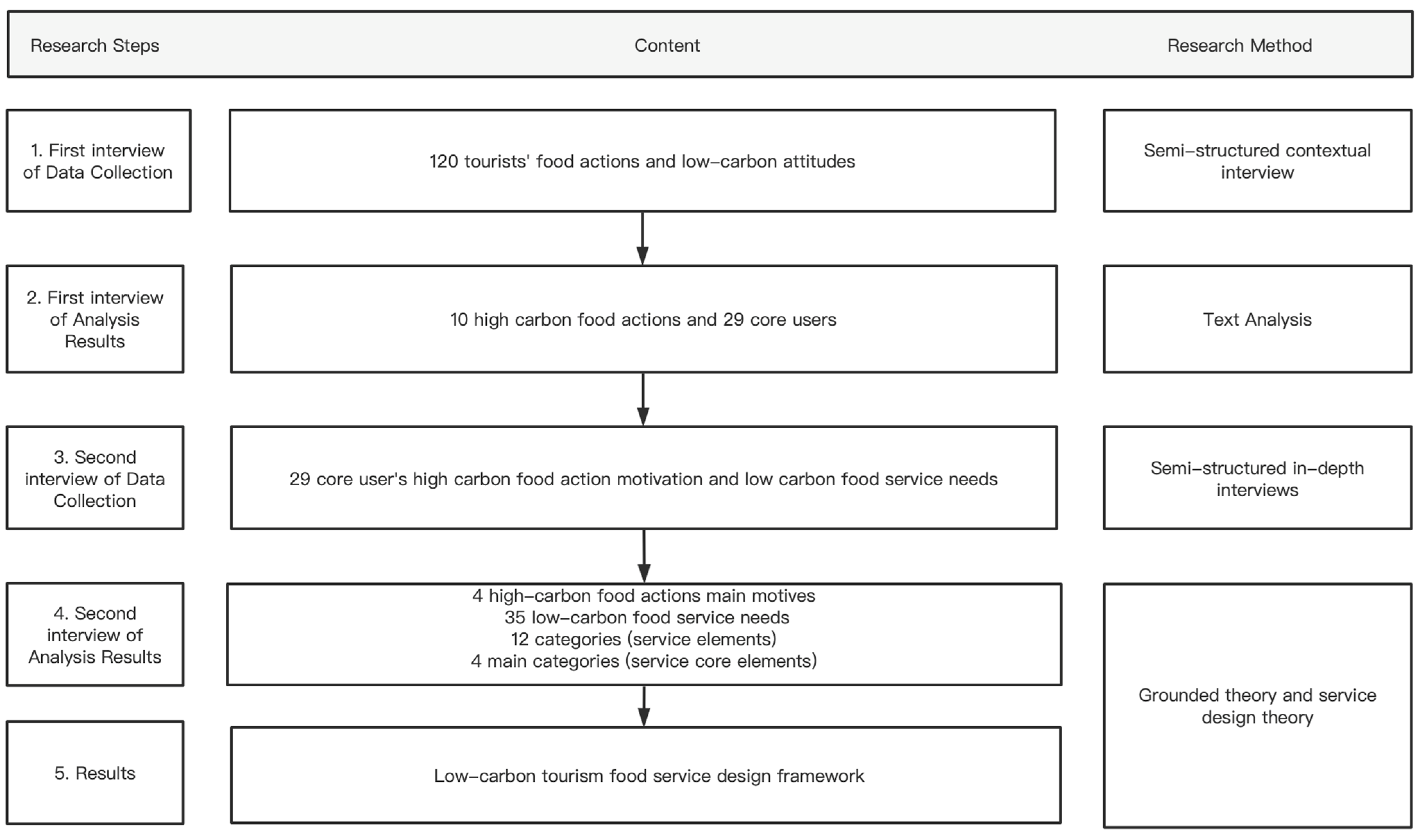
| Period | 10.1, 2022 | 10.10–19, 2022 |
| Participants | People who have experienced food street tours in four famous tourist cities | 29 core users |
| Methods | Semi-structured situational interviews | In-depth interview |
| Purpose | Core users | High-carbon food actions motivation and need for low-carbon-tourism food services |
| Interview framework | Participant Information Collection | Reasons for participants’ high-carbon actions |
| Participant food behavior [25,26,44] | ||
| Participant low-carbon attitude [37,41,42,43] |
| Item | Frequency (Person) | Percentage (%) | |
|---|---|---|---|
| AI | 120 | 100 | |
| Gender | Male | 49 | 41% |
| Female | 71 | 59% | |
| Age | ≤20 | 16 | 13% |
| 21–30 | 78 | 65% | |
| 31–40 | 20 | 17% | |
| >40 | 6 | 5% | |
| Education | High School | 1 | 0.83% |
| Three-year College Education | 11 | 9.17% | |
| Bachelor’s Degree | 93 | 77.5% | |
| Master | 12 | 10% | |
| Doctor | 3 | 2.5% | |
| Purpose | Framework |
|---|---|
| 1. Participants information | Basic Information. |
| 2. Participants action | Guiding participants to recall a recent complete dine-in meal, and find what do participants do in the following steps? Search, order, wait, eating, pay, and after meal |
| 3. Participants attitude | Tapping into participants attitudes towards this food experience: (1) Attitudes towards low-carbon products, services, or rules. (2) Attitudes towards the cost of low-carbon products or services. (3) Attention span to low-carbon-tips information. |
| Action | |
|---|---|
| 1. | Littering everywhere |
| 2. | Discarding takeout food |
| 3. | Continuous or repeated heating of food |
| 4. | Took menus from many different restaurants and discarded them |
| 5. | Asking for Additional Disposable Dining Room Sets |
| 6. | Using lots of paper towels to wipe down the table or tableware |
| 7. | Leftovers are not taken out to eat elsewhere |
| 8. | Accidentally ordering food that contains ingredients they can’t eat |
| 9. | Ordering too much food |
| 10. | Ordered a set meal but did not finish it |
| Participant No. | Original Sentence | Secondary Refining | Attitude |
|---|---|---|---|
| B5 | “I have used a carbon credit applet for scenic spots, yes, I think it’s fun, and you will get points for buying low-carbon drinks. “ | Think low-carbon services are interesting. | Friendly attitude towards low-carbon products, services or rules during the tour. |
| “I will take the initiative to pay attention to the sign of saving paper, directly, the four large characters are directly printed on the paper box and are very conspicuous. “ | Proactive attention to low-carbon information. | Have a concern for low-carbon-tips information during the tour. |
| Item | Frequency (Person) | Percentage (%) | |
|---|---|---|---|
| AI | 29 | 100 | |
| Gender | Male | 14 | 48% |
| Female | 15 | 52% | |
| Age | ≤20 | 3 | 10% |
| 21–30 | 17 | 59% | |
| 31–40 | 7 | 24% | |
| >40 | 2 | 7% | |
| Education | High School | 0 | 0% |
| Three-year College Education | 2 | 6.9% | |
| Bachelor’s Degree | 23 | 79.31% | |
| Master | 1 | 3.45% | |
| Doctor | 3 | 10.34% | |
| Purpose | Framework |
|---|---|
| 1. Reasons for high-carbon food behavior of core users | Multi-angle consulting Continuous consulting |
| 2. Requirements for low-carbon tourism food service of core users | What would enable you to reduce this type of action? What do you think the service provider can do to improve? What are your requirements for improvement methods? |
| Participant No. | Original Sentence | Touch Point | Psychological | Needs No. | Core User Needs |
|---|---|---|---|---|---|
| B5 | “It is not necessary to use paper towels, this cloth is hot to the touch, I will feel disinfected and clean” | Warm to the touch | Hot = sanitized = clean | N1 | The restaurant provides tools that can be identified as sterilized |
| G13 | “When he gives it to me, he can take it out of the disinfection in front of me and give it to me and I will feel cleaner.” | Saw the waiter take it out of the disinfection cabinet | Disinfection cabinet = sterilized = clean |
| Categories | Service Needs |
|---|---|
| Low-carbon Food information show service | Food low-carbon information should be fully displayed |
| Low-carbon foods should be distinguished from other foods when displayed | |
| User low-carbon action rules show service | The display of guidance information should be complete |
| Low-carbon slogans should have memorable elements | |
| The guidance information display for garbage sorting should be easy to see | |
| Low-carbon knowledge propaganda show service | Display the harmful content that is relevant to users’ daily lives. |
| Display position in line with visual habits | |
| The design expression should be able to stimulate users’ visual or auditory senses. | |
| Low-carbon label show service | The design style of labels should be consistent. |
| Label design that can be considered as low carbon | |
| Visually appealing labels | |
| Intelligence enhancement | Users can get feedback |
| Be easily comparable | |
| Timely updates | |
| Self-service matching | |
| Easy-to-see enhancement | Low-carbon evidence that can be seen |
| interesting introduction | |
| Transparent production process | |
| Humanized enhancement | Exclusive offers for low carbon products |
| Low-carbon theme activities | |
| Recommendations based on user preferences | |
| Disposal of leftover food | |
| Tools with low-carbon evidence | Use clean rags |
| Can determine the disinfected tools | |
| Tools with low carbon logos | |
| Service staff image | Wear a clean uniform |
| Uniforms with low-carbon guidance | |
| Restaurant image | Authoritative evidence that can be seen |
| Have a uniform style of decoration | |
| A clean environment | |
| Service quality of the service provider | Cleaning service carefully |
| Avoid direct contact with dining tools | |
| Fully understand low-carbon food | |
| Service provider reminder | Find and stop users’ high-carbon actions |
| Provide low-carbon remediation advice |
| Main Category | Main Category Connotation | Corresponding Category | Corresponding Category Connotation |
|---|---|---|---|
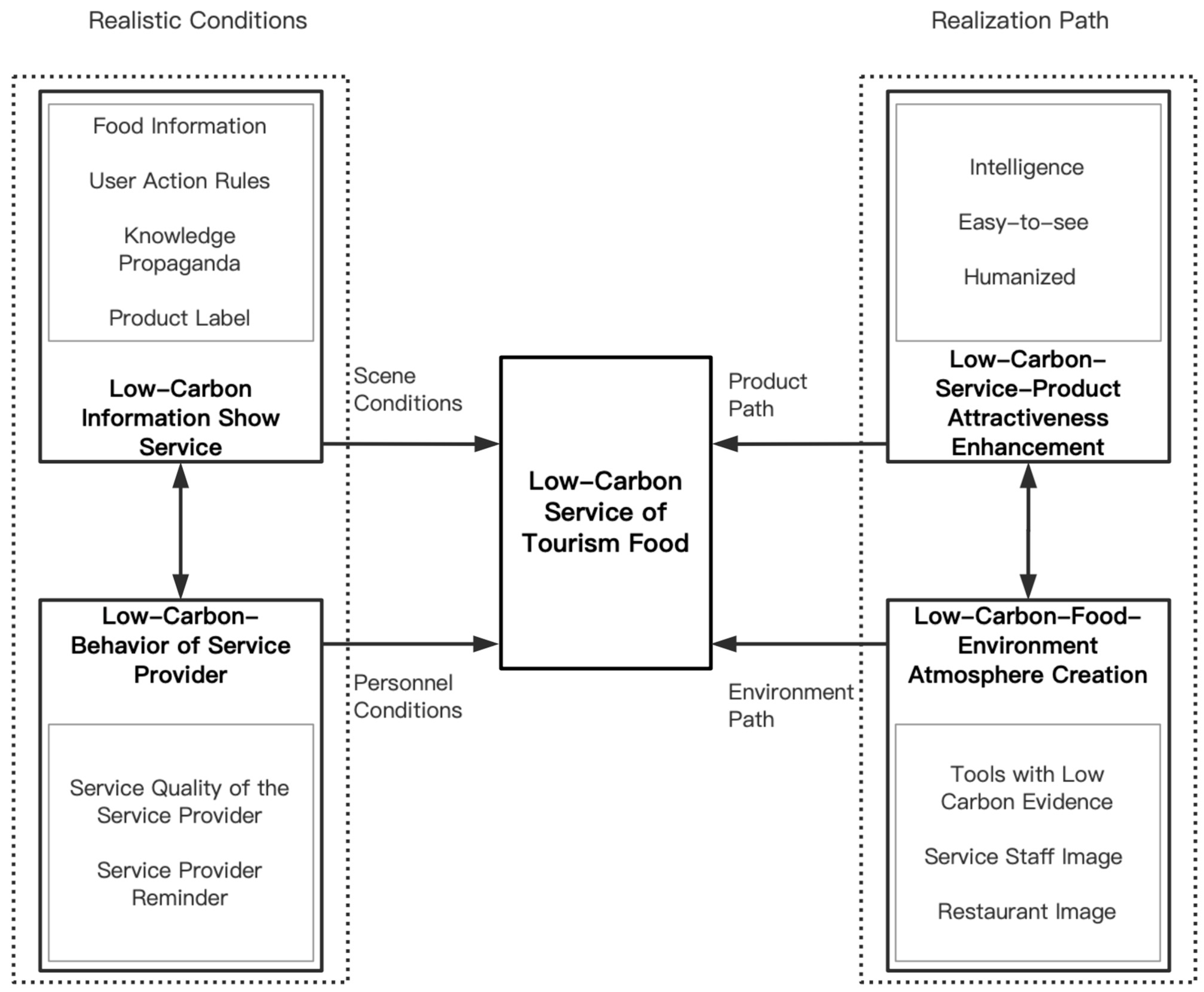
| Low-Carbon Information Show Service | The show service of low carbon information means that low carbon tourism food service needs to show low carbon related information | Low-carbon food information show service | The low carbon tourism food service needs to have a complete low carbon food information display service that is different from other foods. |
| User low-carbon action rules show service | The low carbon tourism food service needs to provide users with complete, easy to read, easy to remember instructions on low carbon rules for user food actions. | ||
| Low-carbon knowledge propaganda show service | The low carbon tourism food service needs to show users low carbon related knowledge. | ||
| Low-carbon label show service | The low carbon tourism food service needs to have a uniform style of product display with low carbon labels. | ||
| Low-Carbon Service Product Attractiveness Enhancement | Low carbon service product attractiveness enhancement means that the enhancement of low carbon tourism food service needs to focus on the core attractiveness of the service product | Intelligence enhancement | The enhancement of low carbon tourism food service needs to focus on the intelligence of low carbon service in restaurant service products. |
| Easy-to-see enhancement | The enhancement of low carbon tourism food service needs to focus on the ease of seeing low carbon services in restaurant service offerings. | ||
| Humanization enhancement | The improvement of low carbon tourism food service needs to focus on the humanization of low carbon service in restaurant service products. | ||
| Low-Carbon Food Environment Atmosphere Creation | Low carbon service environment atmosphere creation means that the enhancement of low carbon tourism food service needs to create a low carbon atmosphere of food experience environment. | Tools with low carbon evidence | The enhancement of low carbon tourism food service needs to show users evidence of the low carbon of the service tools. |
| Service staff image | The enhancement of low carbon tourism food service needs to create a low carbon image of the service staff. | ||
| Restaurant image | The enhancement of low carbon tourism food service needs to create a low carbon image of the restaurant. | ||
| Low-Carbon Behavior of Service Provider | Low carbon behavior of service providers means that low carbon tourism food services need service providers who can maintain their own low carbon behavior | Service quality of the service provider | Low carbon tourism food service needs to have service providers who can guarantee the quality of their services. |
| Service provider reminder | Low carbon tourism food service needs service providers who can provide low carbon reminders to users. |
| Design Direction | Suggestions |
|---|---|
| 1. Low-carbon information show design | A separate area for show low-carbon food. |
| The information on low-carbon food should be displayed in full, especially the price, ingredients, and proof of low-carbon credentials. | |
| The posters or media promotional materials for low-carbon knowledge should focus on content that is relevant to users’ daily lives. | |
| Design expressions should use impactful colors. | |
| The appearance of low-carbon labels should be uniform, using trees or other elements related to low-carbon design. | |
| Display logos on utensils and tools in restaurants. | |
| The information display for guiding processes in areas such as trash and self-service stations should emphasize the beginning and the end. | |
| The slogan for guiding processes should be fluent. | |
| Simple information feedback should be provided for steps that may confuse users. | |
| 2. Low-carbon ordering system design | Complete information classification with color differentiation of food. |
| UX writing needs to be short and interesting. | |
| Icon design to increase the user’s link to low carbon. | |
| The introduction of food can be presented in an anthropomorphic manner. | |
| The low-carbon steps of the production process can be shown in a moving image. | |
| Low-carbon food offers can be marked on the menu and on receipts. | |
| Products can be conspicuously labeled as low carbon. | |
| Low-carbon food on smart devices with a separate link module. | |
| New low-carbon food information up to date. | |
| Shopping cart that displays specific information about different foods. | |
| The low-carbon food in the set can be freely replaced. | |
| Daily push based on user’s browsing and frequently visited restaurants. | |
| 3. Low-carbon food environment design | Exhibit packaging and utensils’ environmental friendliness |
| Use energy-saving equipment | |
| Decorate with natural elements such as wood and bamboo as much as possible | |
| Minimize the use of plastic utensils | |
| Similar decorative items to other low carbon themed restaurants | |
| Display authoritative low-carbon certifications in a prominent position | |
| Uniform color and style for fresh-looking employee uniforms | |
| Employee uniforms with low-carbon logo printed on them | |
| Clean and spacious restaurant environment with simple table setting | |
| 4. Low-carbon service training for employees | Proactively introduce low carbon food features and offers to users when ordering |
| Encourage users after they choose low-carbon food. | |
| Describe the procedure and outcomes of waste disposal. | |
| Provide tableware with temperature. | |
| Secondary cleaning of the table in front of the user. | |
| Proactive introduction to low-carbon food purchased by users. | |
| Serve users using trays or wearing gloves. | |
| Proactively alert users to high-carbon actions and offer more low-carbon alternatives. | |
| Inform users that they can independently use the low-carbon services. |
Disclaimer/Publisher’s Note: The statements, opinions and data contained in all publications are solely those of the individual author(s) and contributor(s) and not of MDPI and/or the editor(s). MDPI and/or the editor(s) disclaim responsibility for any injury to people or property resulting from any ideas, methods, instructions or products referred to in the content. |
© 2023 by the authors. Licensee MDPI, Basel, Switzerland. This article is an open access article distributed under the terms and conditions of the Creative Commons Attribution (CC BY) license (https://creativecommons.org/licenses/by/4.0/).
Share and Cite
Lai, Y.; Yoo, C.; Zhou, X.; Pan, Y. Elements of Food Service Design for Low-Carbon Tourism-Based on Dine-In Tourist Behavior and Attitudes in China. Sustainability 2023, 15, 7662. https://doi.org/10.3390/su15097662
Lai Y, Yoo C, Zhou X, Pan Y. Elements of Food Service Design for Low-Carbon Tourism-Based on Dine-In Tourist Behavior and Attitudes in China. Sustainability. 2023; 15(9):7662. https://doi.org/10.3390/su15097662
Chicago/Turabian StyleLai, Yingjie, Chaemoon Yoo, Xiaomin Zhou, and Younghwan Pan. 2023. "Elements of Food Service Design for Low-Carbon Tourism-Based on Dine-In Tourist Behavior and Attitudes in China" Sustainability 15, no. 9: 7662. https://doi.org/10.3390/su15097662
APA StyleLai, Y., Yoo, C., Zhou, X., & Pan, Y. (2023). Elements of Food Service Design for Low-Carbon Tourism-Based on Dine-In Tourist Behavior and Attitudes in China. Sustainability, 15(9), 7662. https://doi.org/10.3390/su15097662

