Abstract
Urban green space has a cooling effect and its cooling effect can extend to the surrounding environment, conspicuously decreasing with distance. Land surface temperature (LST) and cooling distance are generally researched based on remote sensing and temperature inversion algorithms; this distance is affected by internal and external environment factors, but the high-intensity cooling distance (HCD) is overlooked by using large scale datasets. In addition, the comprehensive relationship between internal and external factors with cooling distance and HCD is still unclear. The aim of this study is to identify the HCD of green spaces by monitoring the changes of LST away from it and to quantify the influences of 12 internal and external factors on HCD. A multiple linear regression model is used to analyze the relationship between them. In the summer of 2022, we measured and calculated HCD for 59 urban green spaces in Xi’an, China. The analysis results show that the HCD is not only affected by the internal landscape factors of green spaces, but also closely related to factors associated with the natural environmental, urban attributes, and surrounding structures. These findings can rationally assist the planning of the allocation of urban green spaces and provide a scientific basis for mitigating the urban heat island effect.
1. Introduction
Urban heat islands (UHI) have become a universal urban issue worldwide [1,2,3,4]. The urban thermal environment is a consequence of the continuous progress of urbanization and industrialization, as well as the rapid growth of the urban population [5,6]. The urban population in 2020 accounted for approximately 56% of the global population [7], and the world urban population will show a growth trend over a long period of time [8]. Urban overpopulation will lead to the continuous expansion of urban built-up areas, reduction of vegetation coverage, and the increase of impervious surfaces that make the urban land surface temperature (LST) rise [9], resulting in a significant temperature difference between urban centers and surrounding areas.
UHI is manifested in various adverse microclimate phenomena in the city. It has caused various abnormal changes in urban meteorology and resource consumption [10,11,12]. The rising temperature has led to the change of urban relative humidity and the reduction of water diversity [13]. The continuous heat island intensifies the cooling load in summer, causing an increase in the overall energy consumption of the building [11,14]. Moreover, it is a serious threat to human health and life [12,15], causing many negative impacts and economic burdens on urban residents [16]. Many studies have found that the heat island effect increases the probability of inducing fever stress disease in urban residents [17], and it also increases pollution in urban areas and the mortality rate of urban residents living in extreme weather conditions [9].
The problem of the UHI phenomenon has been a concern at the global political level [10] and the international scientific community also increasingly has focused on this field [18]. To address the influence of UHI, policymakers in various regions have taken several measures, including social, spatial, and environmental interventions [19,20]. For example, the government of Hangzhou City planned to weaken the impact of UHI by controlling the population size and increasing the scale of green space, and the 2009 Wuhan Urban Master Plan explicitly proposed the construction of six green air ducts to alleviate UHI. This indicates that urban green space is the key to alleviate the urban thermal environment. Urban green spaces are biodiversity hotspots in cities [21], which provide areas for carbon storage and create an “oasis effect” [22,23,24,25]. Urban green spaces can help cities reduce LST, significantly alleviate the heat island effect, and reduce air pollution caused by heat waves [26,27]. In addition, they can reduce the adverse ecological consequences and improve the human living environment.
In studies of the relationship between green spaces and UHI, the cooling distance of green space is an important indicator to measure the mitigation of UHI by green spaces. The change of air temperature or LST is widely used to represent the cooling effect of green spaces [19,28]. The LST is increasingly being analyzed in present literature as it is stable and convenient for measurement, and it is a reasonable and reliable way to measure air temperature with extensive practical uses [29,30,31,32]. In addition, the results of cooling distance vary between different regions. For example, in Beijing, China, the cooling distance of some green spaces is only 25.6 m [33], but in the 21 parks in Ethiopia, the maximum cooling effect of green space can reach 240 m [34]. In order to explore the specific factors that affect the cooling distance of green spaces, many scholars have conducted specific explorations. For example, when the areas of green spaces increase, the land surface temperature within the corresponding range decreases [19,30]. The cooling distance increases logarithmically with the increase of the green space area [30,31]. The higher the proportion of trees and shrubs in the green space, the more significant the cooling effect is [35]. In addition, factors related to surrounding buildings affect the cooling effect [28,36]. Most of the studies in the current literature on factors influencing the cooling effect of green space have focused on its own internal factors, but the relevant factors outside or surrounding the green space have not been fully investigated. Among the internal factors, the basic attributes of green space and landscape ecology indices, such as green space areas and landscape fragmentation, are widely used [19,37,38]. For external factors, natural environment factors, urban attribute factors, and surrounding structure factors, such as humidity, land use types, and some factors related to buildings, are considered [19,28,35,39]. To study the cooling mechanism comprehensively, full consideration of the internal and external factors of green space areas are needed. Therefore, it is of great value to study the relationship between LST and these factors.
The LST-based measurement of cooling distance of urban green spaces has two main spatial scales: one is large-scale research based on satellite images and meteorological data [40] and the other is small-scale research through field observations or application models [41]. The cooling intensity of the green spaces decreases sharply with the increase of the distance away from the boundaries of the green space [30,42]. Addressing the high-intensity cooling distance (HCD) can better measure the largest cooling intensity, and determining how to expand HCD with the adjustment of impacting factors would be more significant to enhance the relief of UHI. However, the resolution of the widely used LandsatTM image is 30 m, which might result in the HCD turning point being ignored or missed within one cell. In addition, remote sensing measurement for LST has some shortcomings, such as the long transit period of satellites, low spatial resolutions, and vulnerability to atmospheric factors and other external factors [43]. Comparatively, the cooling effect of green spaces based on small-scale field observation can keenly capture the first turning point in the cooling process and provide the HCD with high accuracy. It is also significant for the further planning and spatial layouts of urban green spaces [41].
By field observation and investigating the LST for 59 green spaces in Xi’an, China, our research aims to achieve the following two objectives: (1) to obtain and calculate the HCD for each green space in specific directions; (2) to fit a linear regression model to reveal the internal and external factors affecting the HCD in green spaces and analyze the possible reasons. Our research will contribute to the cooling effect mechanism of urban green spaces, and develop a framework for formulating LST-reducing-oriented green space system planning. At the same time, it provides scientific guidance for allocating green spaces based on both internal and external factors, which addresses and promotes the HCD for a better cooling effect in urban area. This will help to improve the thermal comfort of urban residents and encourage the urban and rural planners to make planning decisions that benefit the people.
2. Materials and Methods
2.1. Study Area
Xi’an (108°56′32.5″ E, 34°15′39.4″ N) is the capital city of Shaanxi Province, China, with 920.18 km2 of built-up areas and an urban population of 9.575 million. The average altitude is 400 m and it is on the alluvial plain of the Weihe River. There are many green spaces in the built-up area of Xi’an, mostly consisting of scattered forest land or parks. Xi’an has a mild climate, with an annual average temperature of 14.5 °C and 28 days above 35 °C in 2021 (the range of temperature: 39–11 °C). The total annual precipitation was 1066.7 mm in 2021.
2.2. Measurement Location Selection
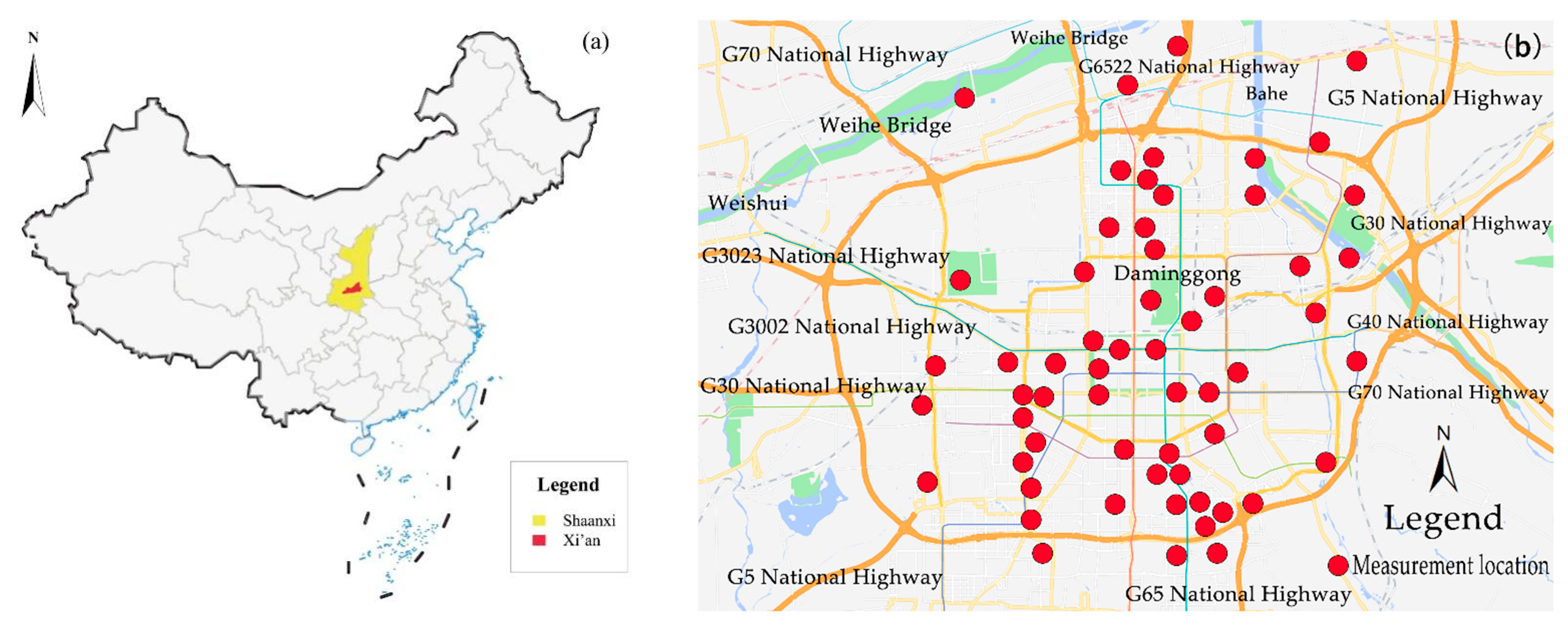
Green space in this study is defined as the designated urban open space, which is usually rich in vegetation resources and open to the public. We selected green spaces located in the built-up area of Xi’an (Figure 1a), and the sites appear as evenly geographically distributed as possible to ensure the coverage of most of the urban environment (Figure 1b).
Figure 1.
(a) Study area; (b) The selected measurement locations in Xi’an City, Shaanxi Province (Source: https://lbs.amap.com/, accessed on 11 April 2023).
The initial point is the starting point to measure the LST at the specific location of the green spaces’ boundary. Since the land use around urban green spaces is often complex, in order to avoid interference caused by other factors as much as possible, the following criteria are considered for the selection of initial points: (1) The measurement direction should avoid occlusion in space to reduce the interference caused by tree shadows or other factors. (2) The ground pavement materials of the measurement route should be consistent to avoid the interference of LST differences caused by different heat absorption capacity of different materials. (3) The selected initial point should be located at a smooth and straight boundary of the green space to eliminate the sinking of the boundary and reduce the impact of cooling in other directions inside the green space.
2.3. Data Collection and Processing
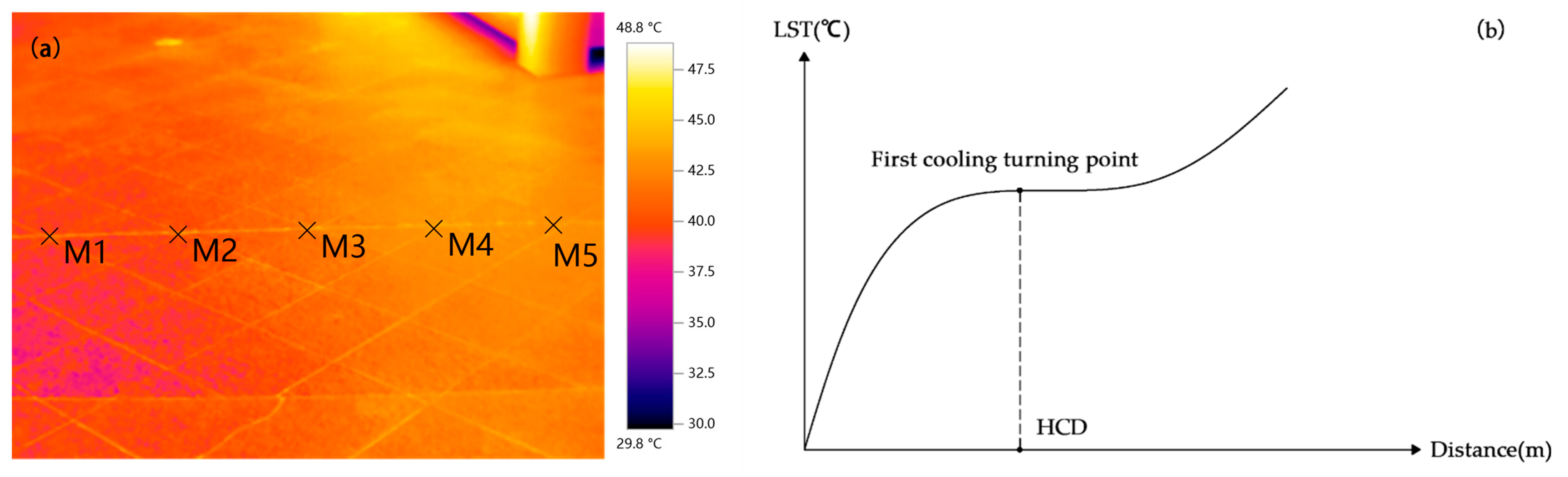
In order to conduct LST measurement and HCD acquisition, the measuring route is a vertical line of the green space boundary at the initial point. Relative research suggests that the range of the impact of green space on the surrounding microclimate generally reaches 60 m [44]. Therefore, the length of the measuring route in this study is designated as 60 m. Moreover, due to the influence of buildings and other factors, the length of some measuring routes is adjusted according to the actual environment. The interval of measuring LST is 0.5 m following the measuring route (Figure 2a). The LST is measured by a thermal infrared imager (Testo 885, Testo, Testo AG, Lenzkirch, Germany). When the camera shoots an image, the angle of view is horizontal with the ground, the height from the ground is controlled at 1.5 m, and the shooting is repeated three times for the same location. Then, the IRsoft software (Testo AG, Lenzkirch, Germany) is used to obtain the LSTs for each measuring location and the average temperature from three repeated measurements is used for analysis. We choose the first cooling turning point in the LST measurements as the HCD for the green space [45] by performing cubic function fitting for LST and the cooling distance [31,35]. The first cooling turning point is obtained from the first positive solution when the first derivative of the fitted cubic function is equal to zero (Figure 2b). This process is conducted through IBM SPSS Statistics 26 software (IBM, Armonk, NY, USA).
Figure 2.
(a) Schematic diagram of LST Reading; (b) Schematic diagram of HCD.
In measuring the internal factors of green space, we have extracted 4 internal factors of green spaces (Table 1). Besides the green space areas and percentage of forest land, other attributes are included from the landscape ecology indices to describe the patch status and landscape metrics. They are collected and processed in Baidu Maps (Source: https://map.baidu.com/, accessed on 13 April 2023) and the Bigemap GIS Office software (BIGEMAP, Chengdu, China). At the same time, since the area of green space and the cooling distance of green space are generally logarithmic relations [30,31], the logarithm is used for relevant data.
Table 1.
The measurement of internal factors of green spaces.
In measuring the external factors of green space, we have extracted 8 external factors of green spaces from natural environment factors, urban attribute factors, and surrounding structures factors. For natural environmental factors, we measured the solar radiation intensity (W/m2), and humidity (%RH) at the LST measuring location. The measuring instruments include a portable meteorological station (Kestrel-5500, Kestrel, Nielsen-Kellerman, Boothwyn, PA, America) and a solar radiometer (DT-1307, CEM, China Everbest Machinery Industry Co., Ltd., Shenzhen, China). Each measurement was recorded every 10 s during 5 min, and the analysis uses the average values. For urban attribute factors, we selected population density (number of population/ha), land use type, and the distance from the city center (km). The population density is derived from digital observation (Source: https://www.swguancha.com/, accessed on 13 April 2023) and the total residential population and employees within 500 m around the LST measuring location was collected. We assigned dominant land use types from residential, commercial, or industrial land use types to the LST measuring location. We also measured the distance from the city center using the Euclidean distance from the Xi’an Bell Tower. For the surrounding structure factors, we selected building density (%), the distance from the closest building to the measuring point (m), and the height of the closest building to the measuring point (m) in this study. Building density refers to the ratio of the total footprint of buildings to a circular area with a center of the LST measuring location and a radius of 500 m. All data were processed in ArcGIS 10.8 (ESRI, Redland, CA, USA), and the factor of the distance from the building closest to the measuring point fields correction through the rangefinder (D120, DELIXI, DELIXI Electric Ltd., Leqing, China).
2.4. Impacting Factor Analysis for the HCD of Green Spaces
We firstly conduct Pearson correlation analysis for all impacting factors and significant factors are kept as independent variables to fit the linear regression model. After the collinearity diagnostics, multivariate linear regression analysis is conducted, and the corresponding linear regression equation is finally deduced according to the analysis results. Multiple linear regression model is a statistical model that uses multiple independent variables to explain the changes of dependent variables. Its formula is shown in Formula (1). All operations are completed through IBM SPSS Statistics 26 software (IBM, Armonk, NY, USA).
where y is the dependent variable; x1, x2, and xk are nonrandom variables; b1, b2, and bk are regression coefficients; a is the constants; is the random error term.
3. Results
3.1. HCD Measurement and Its Impacting Factors
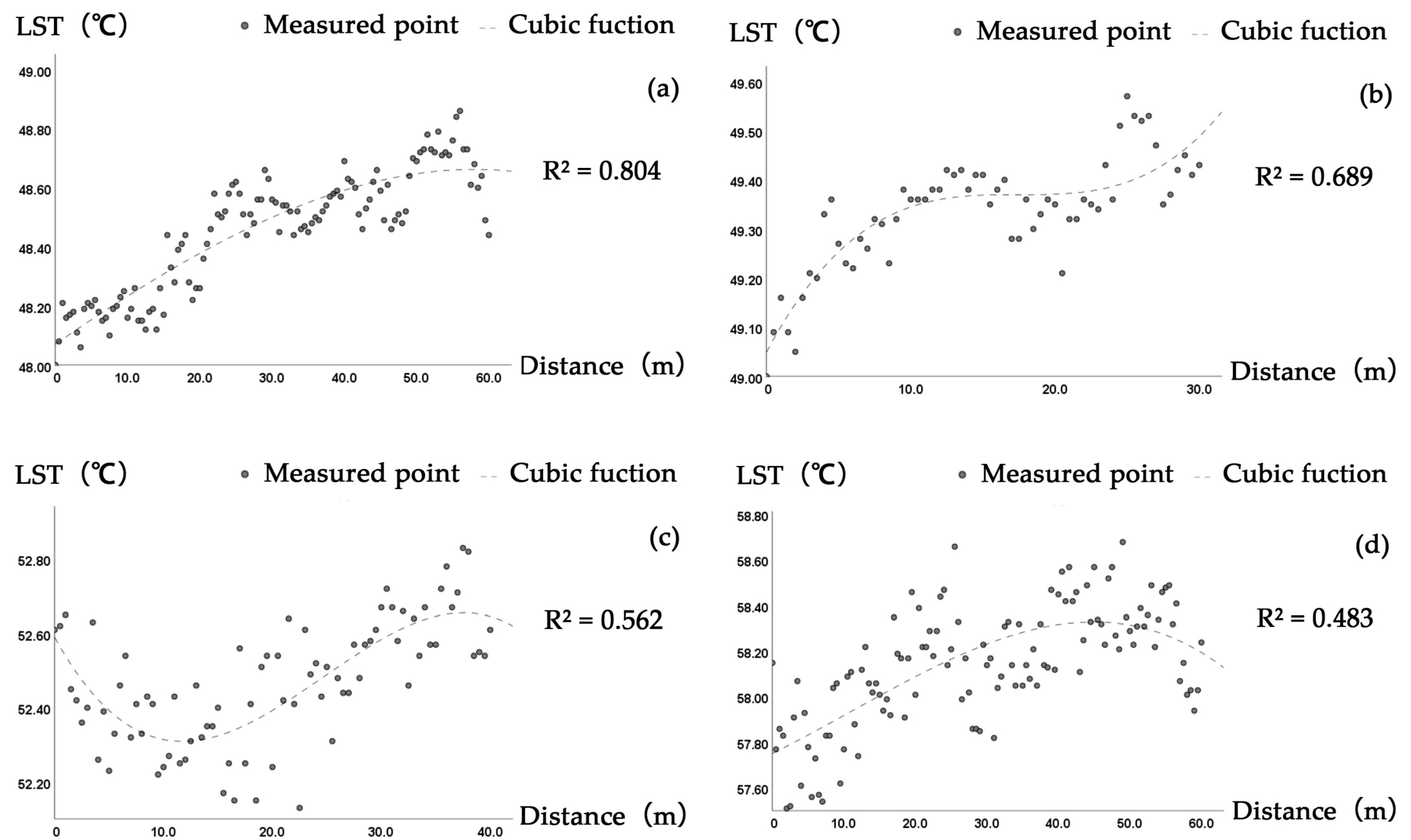
LST measuring and cooling distance on each measuring route were used to fit the cubic function, and the R2 of fitted cubic functions was in 0.5~1. The length of the measuring route for green spaces ranged from 40 m to 60 m according to the surrounding environment of the green space. After conducting the first derivative of the above cubic function, the HCDs were obtained for each green space that was concentrated at 15–40 m, of which the maximum HCD is 58.48 m and the minimum HCD distance is 1.74 m. The characteristics of LST changing with distance can be classified into the following four types: (1) LST increases with distance (the cooling change rate gradually decreases with the increase of distance; (Figure 3a); (2) LST continues to increase after a short pause in the middle of the function (Figure 3b); (3) LST shows an overall upward trend, but there is a significant decline in the middle of the image (Figure 3c); (4) LST shows an overall upward trend, but there is a significant decline in the tail of the image (Figure 3d). Table 2 shows the HCD measurement results at all measurement locations. Table 3 summarizes all factors’ measurement results for potential independent variables.
Figure 3.
Four main types of cubic function in HCD measurement: (a) LST increases with distance (the cooling change rate gradually decreases with the increase of distance; (b) LST continues to increase after a short pause in the middle of the function; (c) LST shows an overall upward trend, but there is a significant decline in the middle of the image; (d) LST shows an overall upward trend, but there is a significant decline in the tail of the image.
Table 2.
The HCD results for 59 measuring points in the study area.
Table 3.
Descriptive statistics for potential impacting factors.
3.2. Fitting the Linear Regression Model
3.2.1. Bivariate Correlation Analysis
All variables conform to the normal distribution test. We conducted the bivariate correlation analysis for all affecting factors for HCD. Green space areas (S), landscape shape index (LSI), percentage of forest land (P), solar radiation intensity (R), land use type (Residential Land) (RL), land use type (Industrial Land) (IL), the distance from the building closest to the measuring point (d1), and the distance from the city center (d2) are positively related to the HCD. However, the landscape fragmentation (C), humidity (H), population density (ρ1), building density (ρ2), land use type (Commercial Land) (CL), and the height of the building closest to the measuring point (h) are negatively related to the HCD. Furthermore, the correlation between the landscape shape index (LSI), percentage of forest land (P), population density (ρ1), land use type (Residential Land) (RL), and the height of the building closest to the measuring point (h) are not significant with HCD, so they are not included in the regression model. The results of the bivariate correlation analysis are shown in Table 4.
Table 4.
Bivariate correlation analysis results.
3.2.2. Establishment of Linear Regression Model
Before fitting the linear regression model, we firstly conducted a collinearity diagnosis of variables, which is usually judged by the variance inflation factor (VIF). When the VIF value is more than 10, it indicates that there is a collinearity problem among independent variables. The results show that the VIF values of all factors were less than 10, which indicates that there is no obvious collinearity relationship between the factors, so all factors were retained. All factors are included in Table 5.
Table 5.
Results of collinearity analysis.
For the linear regression model, the adjusted R2 is 0.678, indicating that the independent variable of the model has a strong degree of explanation of 67.8% of the dependent variable. F-test is also significant at a level of 0.01 and the overall D-W value of the model is 2.445, within the range of 1.5–2.5, indicating that the autocorrelation of the independent variables is not significant (Table 6). The multiple linear regression model indicates that the distance from the building closest to the measuring point (d1) and green space areas (S) present extremely significant levels of influence in the model (p-value < 0.01); the distance from the city center (d2), land use type (Commercial Land) (CL), and humidity (H) show a significant impact level in the model (0.01 < p-value < 0.05), while the other variables have no significant impact in the model. Meanwhile, the distance from the building closest to the measuring point (d1), green space areas (S), land use type (Industrial Land; IL), and solar radiation intensity (R) show a positive correlation with HCD in the model, while the distance from the city center (d2), land use type (Commercial Land; CL), humidity (H), building density (ρ2), and landscape fragmentation (C) shod a negative correlation with HCD. The coefficient estimations of this model are shown in Table 7.
Table 6.
Overall summary of the model.
Table 7.
Coefficients estimation for multiple linear regression model (Sorted by p-value increment).
4. Discussion
4.1. The Relationship between Internal Factors of Green Space and HCD
The green space areas are positively related to the HCD in the multiple linear regression model, and this is consistent with previous studies [30,31]. The increase of green space areas will tend to increase the total amount of plant transpiration in this area, which leads to the continuous expansion of the cooling effect in surrounding areas [46]. Landscape fragmentation and HCD show a significant negative correlation in the bivariate analysis, which may mean that the aggregated green space is more conducive to the spread of cooling than the fragmented green spaces. This is because the fragmented green space is often interfered with by internal uncertain factors for spreading the cooling effect (such as crowded human activities [33]), which causes the cooling effect to be internally neutralized before being transmitted to the outside. At the same time, many documents showed that a complex shape of green space has a negative impact on the cooling effect of green space [38,47,48], and circular green space has the best cooling effect [48]. However, it is not significant in the model, which may be because our sample size is relatively small, so it does not show an obvious corresponding function relationship with HCD.
4.2. The Relationship between External Factors of Green Space and HCD
Excessive humidity often leads to a weak transpiration intensity of green space in the unit area [49] that the plant uses for the cooling effect, so the humidity and HCD naturally show a significant negative correlation. Meanwhile, the increasing of humidity is probably caused by the nearby water bodies in the green space. A study in Suzhou, China, showed that water bodies have an obvious role in alleviating UHI [39], so the closed water bodies will inevitably block the spreading of the cooling effect of green spaces, and decrease the HCD. For land-use-related analysis, if the green spaces are surrounding by commercial land with a variety of social activities and crowned traffic, the HCD may rapidly decrease due to interference from external environmental factors. If changing to industrial land, the HCD can be fully extended without disturbances from human activity. However, it was not significant in the regression model because we lack green space samples with industrial land use type in this study. The positive correlation between the distance from the closest building to the measuring point and HCD can imply that the cooling air from the green space would be reversed with complex wind directions when it reaches the buildings [28]. When d1 is smaller, the effect for this phenomenon is faster, resulting in reducing the HCD, whereas when d1 is very large, the cooling cold air in green space is fully diffused before reaching the building. This study also indicates that the distance from the city center and HCD are significantly negatively correlated. The higher the ambient temperature at the measuring location, the more obvious the cooling effect of green space [50]. Because urban center UHI is more significant, urban ambient temperature is often higher than suburban. Green space distribution can affect its cooling effect [30]. However, in a study in Leipzig, Germany, this factor does not show obvious correlation [35]. Therefore, the impact of this factor needs to be further studied. The solar radiation intensity is not significant in the model. The probable reason is that solar radiation does not have enough variations in all measurement of LST that an effective relation cannot be constructed in the model. Building density is not significant in the model, which mean the number of measuring points needs to be further increased to show an obvious corresponding relation with HCD.
4.3. Limitations
There are some limitations in this study. First, the measuring route of LST in this study is only measured in one direction of the cooling effect of green spaces. The cooling effect or HCD in different directions or locations of the green space is not considered. Second, for the variables influencing the HCD, the cooling effects of water bodies or the relations of the HCD and distance to water bodies are not included. Furthermore, the maintenance of urban green spaces is also not considered in this study. These factors could be further researched.
5. Conclusions
This study focuses on the HCD extraction and the analysis of its impacting factors. We calculated HCD by field investigation of 59 urban green spaces in the City of Xi’an, China, and identified 12 total factors affecting HCD from the literature review. Based on these 12 factors and the HCD measurement results, a multiple linear regression analysis model was established. The results show green space areas, humidity, land use type, the distance from the building closest to the measuring point, and the distance from the city center are critical factors to cause the change of the HCD of urban green spaces.
In order to improve the HCD of urban green space, it would be very effective to increase the green space areas, but this is limited by expensive land prices. Therefore, we should take more comprehensive considerations including the surrounding environment of green spaces. In the urban building codes, dense buildings should not surround the green space and construction redlines should guarantee a certain distance from the green spaces. Spatial planning should help to conduct the air corridors to ensure air circulation and the diffusion of the cooling effect, or extension of the HCD. At the same time, we need to control the proportion of water bodies around plants. Meanwhile, appropriately increasing the proportion of green spaces in commercial land will be more conducive to the comfort of residents for reducing the intensity of the UHI. More green spaces should also be allocated in the central area of the city.
For planning and policy implications, planning and building codes should be conducted to guide real estate developers increase the setback from the green spaces and offset between buildings, which would help extend the cooling effect of green spaces. The allocation of urban green spaces in planning process needs to analyze the surrounding environment of the potential site, especially the land use and social activities, which would help balance economic development and the thermal comfort of residents, and improve the quality of life.
Author Contributions
Conceptualization, X.F. and M.S.; Methodology, X.F. and M.S.; Data acquisition, M.S. and Y.W.; Data Processing, M.S. and Z.R.; Writing original draft preparation, M.S. and X.Z.; Writing review and editing, M.S., X.Z. and X.F.; Fund acquisition, X.F., M.S. and Y.W. All authors have read and agreed to the published version of the manuscript.
Funding
This research was performed and supported while X.F. held funding (funding number: Z1090221023, 2022JM-204) from the Northwest A&F University, China and the Shaanxi Science and Technology Agency, China. This research was also partially funded by the Innovation and Entrepreneurship Training Plan for Chinese College Students (funding number: S202210712560) held by M.S.
Institutional Review Board Statement
Not applicable.
Informed Consent Statement
Not applicable.
Data Availability Statement
Not applicable.
Acknowledgments
In addition, we would like to thank Wenxiao Jia, Zhengkai, Zhang, and Shanshan Jia for their kind reviews and valuable suggestions for this project. At the same time, I would like to thank Zheng Chen, Xusheng Tang, Bei Peng, and Runze Sun, who are students of Northwest A&F University, for their contributions to the field research and data processing.
Conflicts of Interest
The authors declare no conflict of interest.
References
- Lee, K.; Kim, Y.; Sung, H.C.; Ryu, J.; Jeon, S.W. Trend Analysis of Urban Heat Island Intensity According to Urban Area Change in Asian Mega Cities. Sustainability 2020, 12, 112. [Google Scholar] [CrossRef]
- Iping, A.; Kidston-Lattari, J.; Simpson-Young, A.; Duncan, E.; McManus, P. (Re)presenting urban heat islands in Australian cities: A study of media reporting and implications for urban heat and climate change debates. Urban Clim. 2019, 27, 420–429. [Google Scholar] [CrossRef]
- Liu, X.; Zhou, Y.Y.; Yue, W.Z.; Li, X.C.; Liu, Y.; Lu, D.B. Spatiotemporal patterns of summer urban heat island in Beijing, China using an improved land surface temperature. J. Clean. Prod. 2020, 257, 120529. [Google Scholar] [CrossRef]
- Yang, F.; Lau, S.S.Y.; Qian, F. Summertime heat island intensities in three high-rise housing quarters in inner-city Shanghai China: Building layout, density and greenery. Build. Environ. 2010, 45, 115–134. [Google Scholar] [CrossRef]
- Du, H.Y.; Zhou, F.Q.; Li, C.L.; Cai, W.B.; Jiang, H.; Cai, Y.L. Analysis of the Impact of Land Use on Spatiotemporal Patterns of Surface Urban Heat Island in Rapid Urbanization, a Case Study of Shanghai, China. Sustainability 2020, 12, 1171. [Google Scholar] [CrossRef]
- Alqahtany, A. GIS-based assessment of land use for predicting increase in settlements in Al Ahsa Metropolitan Area, Saudi Arabia for the year 2032. Alex. Eng. J. 2023, 62, 269–277. [Google Scholar] [CrossRef]
- Gao, Z.; Zaitchik, B.F.; Hou, Y.; Chen, W.P. Toward park design optimization to mitigate the urban heat Island: Assessment of the cooling effect in five US cities. Sustain. Cities Soc. 2022, 81, 11. [Google Scholar] [CrossRef]
- Steffen, S.; Zeller, A.; Bohm, M.; Sawodny, O.; Blandini, L.; Sobek, W. Actuation concepts for adaptive high-rise structures subjected to static wind loading. Eng. Struct. 2022, 267, 114670. [Google Scholar] [CrossRef]
- Mirzaei, P.A. Recent challenges in modeling of urban heat island. Sustain. Cities Soc. 2015, 19, 200–206. [Google Scholar] [CrossRef]
- Kurek, J.; Martyniuk-Peczek, J. Exploring DAD and ADD Methods for Dealing with Urban Heat Island Effect. Sustainability 2021, 13, 9547. [Google Scholar] [CrossRef]
- Li, X.M.; Zhou, Y.Y.; Yu, S.; Jia, G.S.; Li, H.D.; Li, W.L. Urban heat island impacts on building energy consumption: A review of approaches and findings. Energy 2019, 174, 407–419. [Google Scholar] [CrossRef]
- Kurniati, A.C.; Nitivattananon, V. Factors influencing urban heat island in Surabaya, Indonesia. Sustain. Cities Soc. 2016, 27, 99–105. [Google Scholar] [CrossRef]
- Wong, L.P.; Alias, H.; Aghamohammadi, N.; Aghazadeh, S.; Sulaiman, N.M.N. Urban heat island experience, control measures and health impact: A survey among working community in the city of Kuala Lumpur. Sustain. Cities Soc. 2017, 35, 660–668. [Google Scholar] [CrossRef]
- Kikegawa, Y.; Genchi, Y.; Kondo, H.; Hanaki, K. Impacts of city-block-scale countermeasures against urban heat-island phenomena upon a building’s energy-consumption for air-conditioning. Appl. Energy 2006, 83, 649–668. [Google Scholar] [CrossRef]
- Heaviside, C.; Macintyre, H.; Vardoulakis, S. The Urban Heat Island: Implications for Health in a Changing Environment. Curr. Environ. Health Rep. 2017, 4, 296–305. [Google Scholar] [CrossRef]
- Yue, H.Y. Advance in the relationship between respiratory and cardio-cerebrovascular diseases and meteorological conditions. J. Meteorol. Environ. 2009, 25, 57–61. [Google Scholar]
- Harlan, S.L.; Brazel, A.J.; Prashad, L.; Stefanov, W.L.; Larsen, L. Neighborhood microclimates and vulnerability to heat stress. Soc. Sci. Med. 2006, 63, 2847–2863. [Google Scholar] [CrossRef]
- Salata, F.; Golasi, L.; Petitti, D.; Vollaro, E.D.L.; Coppi, M.; Vollaro, A.D.L. Relating microclimate, human thermal comfort and health during heat waves: An analysis of heat island mitigation strategies through a case study in an urban outdoor environment. Sustain. Cities Soc. 2017, 30, 79–96. [Google Scholar] [CrossRef]
- Park, J.H.; Cho, G.H. Examining the Association between Physical Characteristics of Green Space and Land Surface Temperature: A Case Study of Ulsan, Korea. Sustainability 2016, 8, 777. [Google Scholar] [CrossRef]
- Parsaee, M.; Joybari, M.M.; Mirzaei, P.A.; Haghighat, F. Urban heat island, urban climate maps and urban development policies and action plans. Environ. Technol. Innov. 2019, 14, 16. [Google Scholar] [CrossRef]
- Hermy, M.; Cornelis, J. Towards a monitoring method and a number of multifaceted and hierarchical biodiversity indicators for urban and suburban parks. Landsc. Urban Plan. 2000, 49, 149–162. [Google Scholar] [CrossRef]
- Huang, M.; Cui, P.; He, X. Study of the Cooling Effects of Urban Green Space in Harbin in Terms of Reducing the Heat Island Effect. Sustainability 2018, 10, 1101. [Google Scholar] [CrossRef]
- Ren, Y.; Wei, X.; Wei, X.H.; Pan, J.Z.; Xie, P.P.; Song, X.D.; Peng, D.; Zhao, J.Z. Relationship between vegetation carbon storage and urbanization: A case study of Xiamen, China. For. Ecol. Manag. 2011, 261, 1214–1223. [Google Scholar] [CrossRef]
- Strohbach, M.W.; Haase, D. Above-ground carbon storage by urban trees in Leipzig, Germany: Analysis of patterns in a Eu-ropean city. Landsc. Urban Plan. 2012, 104, 95–104. [Google Scholar] [CrossRef]
- Wang, X.Y.; Miao, S.G.; Liu, H.N.; Sun, J.N.; Zhang, N.; Zou, J. Assessing the Impact of Urban Hydrological Processes on the Summertime Urban Climate in Nanjing Using the WRF Model. J. Geophys. Res. -Atmos. 2019, 124, 12683–12707. [Google Scholar] [CrossRef]
- Yin, S.; Shen, Z.M.; Zhou, P.S.; Zou, X.D.; Che, S.Q.; Wang, W.H. Quantifying air pollution attenuation within urban parks: An experimental approach in Shanghai, China. Environ. Pollut. 2011, 159, 2155–2163. [Google Scholar] [CrossRef]
- Vailshery, L.S.; Jaganmohan, M.; Nagendra, H. Effect of street trees on microclimate and air pollution in a tropical city. Urban For. Urban Green. 2013, 12, 408–415. [Google Scholar] [CrossRef]
- Han, X.Y.; Zhang, J.J.; Rao, Y.H.; Jing, G.L. Hindering the impact of building characteristics on greenbelt cooling effects: A perspective of quantitative simulation with in situ measurements. Sci. Total Environ. 2019, 670, 308–319. [Google Scholar] [CrossRef]
- Song, Y.; Song, X.D.; Shao, G.F. Effects of Green Space Patterns on Urban Thermal Environment at Multiple Spatial-Temporal Scales. Sustainability 2020, 12, 6850. [Google Scholar] [CrossRef]
- Bao, T.L.G.; Li, X.M.; Zhang, J.; Zhang, Y.J.; Tian, S.Z. Assessing the Distribution of Urban Green Spaces and its Anisotropic Cooling Distance on Urban Heat Island Pattern in Baotou, China. ISPRS Int. Geo-Inf. 2016, 5, 12. [Google Scholar] [CrossRef]
- Xiao, Y.; Dai, S.; Zhao, B. Mitigation of Urban Heat Island Effect with Small-Scale Parks—An Empirical Study on Community Parks in Nanjing, Jiangsu Province. Landsc. Archit. Front. 2020, 8, 26–43. [Google Scholar] [CrossRef]
- Lin, W.Q.; Yu, T.; Chang, X.Q.; Wu, W.J.; Zhang, Y. Calculating cooling extents of green parks using remote sensing: Method and test. Landsc. Urban Plan. 2015, 134, 66–75. [Google Scholar] [CrossRef]
- Yan, L.; Jia, W.X.; Zhao, S.Q. The Cooling Effect of Urban Green Spaces in Metacities: A Case Study of Beijing, China’s Capital. Remote Sens. 2021, 13, 4601. [Google Scholar] [CrossRef]
- Feyisa, G.L.; Dons, K.; Meilby, H. Efficiency of parks in mitigating urban heat island effect: An example from Addis Ababa. Landsc. Urban Plan. 2014, 123, 87–95. [Google Scholar] [CrossRef]
- Jaganmohan, M.; Knapp, S.; Buchmann, C.M.; Schwarz, N. The Bigger, the Better? The Influence of Urban Green Space Design on Cooling Effects for Residential Areas. J. Environ. Qual. 2016, 45, 134–145. [Google Scholar] [CrossRef] [PubMed]
- Taha, H.; Akbari, H. Rosenfeld, A heat island and oasis effects of vegetative canopies: Micro-meteorological field-measurements. Theor. Appl. Climatol. 1991, 44, 123–138. [Google Scholar] [CrossRef]
- Bowler, D.E.; Buyung-Ali, L.; Knight, T.M.; Pullin, A.S. Urban greening to cool towns and cities: A systematic review of the empirical evidence. Landsc. Urban Plan. 2010, 97, 147–155. [Google Scholar] [CrossRef]
- Yu, Z.; Guo, X.; Jørgensen, G.; Vejre, H. How can urban green spaces be planned for climate adaptation in subtropical cities? Ecol. Indic. 2017, 82, 152–162. [Google Scholar] [CrossRef]
- Wu, Z.J.; Zhang, Y.X. Water Bodies’ Cooling Effects on Urban Land Daytime Surface Temperature: Ecosystem Service Reducing Heat Island Effect. Sustainability 2019, 11, 787. [Google Scholar] [CrossRef]
- Wong, N.H.; Yu, C. Study of green areas and urban heat island in a tropical city. Habitat Int. 2005, 29, 547–558. [Google Scholar] [CrossRef]
- Feng, L.F.; Jiao, Y.W.; Hua, K.F.; Wei, Y.H.; Long, B.Y.; Bin, X.W. A review on the urban green space cooling effect based on field measurement of air temperature. Ying Yong Sheng Tai Xue Bao J. Appl. Ecol. 2017, 28, 1387–1396. [Google Scholar]
- Skelhorn, C.; Lindley, S.; Levermore, G. The impact of vegetation types on air and surface temperatures in a temperate city: A fine scale assessment in Manchester, UK. Landsc. Urban Plan. 2014, 121, 129–140. [Google Scholar] [CrossRef]
- Xiao, R.B.; Ouyang, Z.Y.; Li, W.F.; Zhang, Z.M.; Gregory, T.J.; Wang, X.K.; Miao, H. A review of the eco-environmental consequences of urban heat islands. Acta Ecol. Sin. 2005, 25, 2055–2060. [Google Scholar]
- Grilo, F.; Pinho, P.; Aleixo, C.; Catita, C.; Silva, P.; Lopes, N.; Freitas, C.; Santos-Reis, M.; McPhearson, T.; Branquinho, C. Using green to cool the grey: Modelling the cooling effect of green spaces with a high spatial resolution. Sci. Total. Environ. 2020, 724, 138182. [Google Scholar] [CrossRef] [PubMed]
- Yu, Z.W.; Xu, S.B.; Zhang, Y.H.; Jorgensen, G.; Vejre, H. Strong contributions of local background climate to the cooling effect of urban green vegetation. Sci. Rep. 2018, 8, 6798. [Google Scholar] [CrossRef] [PubMed]
- Liang, H.L.; Li, W.Z.; Zhang, Q.P.; Zhu, W.; Chen, D.; Liu, J.; Shu, T. Using unmanned aerial vehicle data to assess the three-dimension green quantity of urban green space: A case study in Shanghai, China. Landsc. Urban Plan. 2017, 164, 81–90. [Google Scholar] [CrossRef]
- Kong, F.H.; Yin, H.W.; James, P.; Hutyra, L.R.; He, H.S. Effects of spatial pattern of greenspace on urban cooling in a large metropolitan area of eastern China. Landsc. Urban Plan. 2014, 128, 35–47. [Google Scholar] [CrossRef]
- Ren, Z.B.; He, X.Y.; Zheng, H.F.; Zhang, D.; Yu, X.Y.; Shen, G.Q.; Guo, R.C. Estimation of the Relationship between Urban Park Characteristics and Park Cool Island Intensity by Remote Sensing Data and Field Measurement. Forests 2013, 4, 868–886. [Google Scholar] [CrossRef]
- Hirai, H.; Kitaya, Y. Effects of Gravity on Transpiration of Plant Leaves. Ann. N. Y. Acad. Sci. 2009, 1161, 166–172. [Google Scholar] [CrossRef] [PubMed]
- Du, C.L.; Jia, W.X.; Chen, M.; Yan, L.; Wang, K. How can urban parks be planned to maximize cooling effect in hot extremes? Linking maximum and accumulative perspectives. J. Environ. Manag. 2022, 317, 115346. [Google Scholar] [CrossRef]
Disclaimer/Publisher’s Note: The statements, opinions and data contained in all publications are solely those of the individual author(s) and contributor(s) and not of MDPI and/or the editor(s). MDPI and/or the editor(s) disclaim responsibility for any injury to people or property resulting from any ideas, methods, instructions or products referred to in the content. |
© 2023 by the authors. Licensee MDPI, Basel, Switzerland. This article is an open access article distributed under the terms and conditions of the Creative Commons Attribution (CC BY) license (https://creativecommons.org/licenses/by/4.0/).