


Abstract
This study evaluated the concentration of toxic elements in soil samples from agricultural fields in the districts of Sachaca, Socabaya, Hunter, Quequeña, Yarabamba, Characato and Tiabaya in the city of Arequipa, Peru. The ecological risk, enrichment factor (EF), geo-accumulation index (Igeo) and integrated ecological risk index (RI) were estimated, while the health risk was determined with hazard coefficient (HQ) and hazard index (HI) values. Seven soil samples were collected in July 2019 and 17 toxic elements were analyzed in an accredited laboratory using the inductively coupled plasma-mass spectrometry (ICP-MS) methodology. The results were compared with environmental samples where no element exceeded what is established in the standard. The enrichment factor (EF), according to the background of Wedepohl, indicated that As (12.26 ± 3.66) presented a severe enrichment (high) in agricultural soils, while Cd (6.87 ± 3.25) presented moderate values. As, Cd, Pb, Cu and Zn (2.85 ± 0.85; 3.53 ± 1.67; 2.71 ± 1.25; 3.83 ± 0.81; 2.55 ± 0.79) presented low to moderate enrichment in agricultural soils, while Cr did not present enrichment in soils. The Igeo for As in Sachaca, Socabaya, Quequeña and Characato showed moderate contamination, Cu also showed moderate contamination in all the districts evaluated, and Cd showed the same contamination in the districts of Sachaca, Hunter, Quequeña and Tiabaya. The ecological risk in the districts evaluated showed a low degree of risk due to contamination by toxic elements. Finally, the health hazard index for toxic elements present in agricultural soils was evaluated, where the HQ values were negligible and the HI was less than 0.1 (H1 < 0.1) for children and adults.
1. Introduction
Soil is a natural body with physical, chemical and biological characteristics composed of organic particles, organic matter, water, living organisms and air [1]. It is the medium for plant growth and water storage and the sink for most toxic elements such as lead, cadmium, chromium, nickel, silver and zinc from pesticides [2] and industrial activities, which in excess can be phytotoxic and have health effects [1,3,4,5]. The soil can be considered as a source of contamination due to a resuspension process caused by meteorological events [6,7,8]. Furthermore, the contaminants could filter to deeper layers, reaching the groundwater where they can be absorbed by the roots of plants and be distributed to the entire crop that later would be consumed by animals and humans [6,7,8].
Toxic elements generated from various industrial activities such as solid waste and wastewater from cities can modify the physicochemical characteristics of soils [9], affecting the nutrients and anti-nutrients [10,11,12] that are absorbed by crops that are later consumed by the population [13]. The high content of toxic elements deposited in the soil can be potentially hazardous once consumed, inhaled or coming into contact with the skin [14,15,16], causing health concerns in farmers and final consumers [17]. Toxic elements present various reactions in the soil, which influence the mobility and availability for absorption of nutrients by plants [18,19], affecting trophic levels due to the presence of these toxic elements [8,20,21].
There are different indices used to identify metal concentrations, such as enrichment factor (EF) and geo-accumulation indices (Igeo) [22,23]. These geo-accumulation indices serve as statistical and numerical tools to estimate the source and magnitude of toxic element contamination and are widely used to assess the presence of these elements in agricultural soils [24,25].
Few studies have investigated the effects of toxic elements on agricultural soils in the Arequipa countryside and their effects on health and environmental contamination. The main objective was to evaluate the environmental contamination of the toxic elements and the risk to health present in agricultural soils of the Arequipa. This study will contribute to the knowledge about soil contamination and its health risks due to the consumption of plants grown in Arequipa, Peru.
2. Methodology
2.1. Description of the Study Area
The study area was based in seven districts of the city of Arequipa, Sachaca, Socabaya, Hunter, Quequeña, Yarabamba, Characato and Tiabaya, as shown in Figure 1, where the main crops consumed by the Arequipa population are produced. Table 1 shows the sampling coordinates.
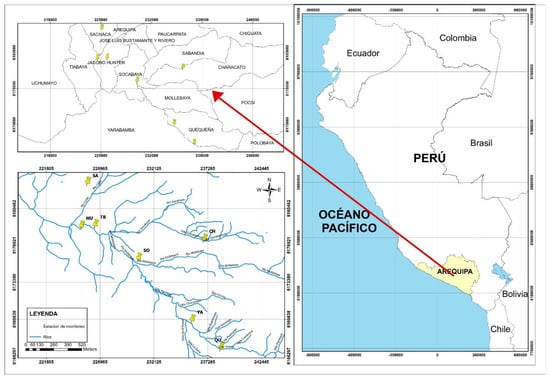
Figure 1.
Map of the study area in the city of Arequipa, Peru.

Table 1.
Sampling coordinates in the city of Arequipa, Peru.
The sampling was carried out as indicated in the soil sampling guide by the Ministry of Environment of Peru [26] using a random sampling approach. Before sampling, the area to be sampled was cleaned, which was 4 m2; later, with the help of a borehole, sampling was carried out to a depth of no more than 20 cm, removing 4 sub-samples that were placed in a container to carry out the quartet. This process was repeated for the 7 districts under study, then the samples were stored in Ziploc bags for later transfer to an accredited laboratory for the quantification of toxic elements.
2.2. Method of Analysis
Concentrations of the elements Al, Sb, As, Ba, B, Cd, Co, Cu, Cr, P, Fe, Mn, Hg, Mo, Ni, Pb and Zn were measured in soil samples using inductively coupled plasma-mass spectrometry (ICP-MS, ICP THERMO ICAP 6500DUO, Thermo Scientific, Cambridge, UK) following the ICP-MS: EPA METHOD 6020A—Revision 1, 2007. The samples were prepared using EPA Method 3051A: microwave-assisted acid digestion of sediments, sludges, soils and oils. Calibration and control solutions were prepared from stock solutions.
Control of the element chemical analyses was achieved by analyzing analytical blanks and certified reference materials (CRM). The soil analysis recovery for the determined elements ranged between 81 and 117%. For single extraction procedures, the recovery of the elements ranged from 74 to 121%.
2.3. Toxicity Evaluation
The toxicity assessment stage of the contaminants, also known as the characterization of the dose–response to which humans are exposed, was performed identifying the relevant toxicological profile and identifying the toxicity criteria for each toxic metal. Table 2 and Table 3 contain the toxicological profiles of each element with the toxicity reference values (TRVs) derived from USEPA (IRIS) and other internationally accepted sources.
Table 2.
Toxicity reference values.
Table 3.
Definitions and reference values of exposure parameters.
2.4. Human Health Risk Assessment
Human health risk was evaluated using the hazard quotient (HQ) and the risk index (HI). In this step, HQ was determined by dividing the average daily dose (ADD) by the oral reference dose (RfD) of each element, using Equation (1) [33].
where HQ is the hazard quotient of each element found in each sample. The HQ is an estimate of the level of non-carcinogenic risk due to exposure to an individual toxic element.
HQ = ADD/RfD
The hazard risk index (HI) represents the potential risk of adverse health effects caused by the sum of HQ of the chemical elements. This work calculated HI using Equation (2) [33].
2.5. Environmental Pollution Assessment
Equation (3) was used to determine the enrichment factor.
where EF is the enrichment factor, (M/Fe) sample is the ratio between the metal/Fe of the sample and (M/Fe) background is the ratio between the metal/Fe of the reference value.
The EF values were classified as follows: EF <1 indicates no enrichment, 1 < EF <3 is low, 3< EF < 5 is moderate, 5< EF < 10 is moderately severe, 10 < EF < 25 is severe, 25 < EF < 50 is very severe and EF > 50 is extremely severe enrichment [38,39].
The geo-accumulation index (Igeo) was used to evaluate contamination by ecotoxic elements in sediments and is defined from the following equation (Equation (4)) [40].
where C is the measured concentration of the sample, B is the reference value and k is the geo-accumulation constant (1.5). The Igeo value of each toxic element was classified into seven classes: <0 uncontaminated, 0–1 uncontaminated to moderately contaminated, 1–2 moderately contaminated, 2–3 moderate to heavily contaminated, 3–4 heavily contaminated, 4–5 heavily to extremely contaminated and 5–6 extremely contaminated [41].
The determination of the potential ecological risk index of soils from the districts evaluated in the city of Arequipa was performed using a previously described method [42] where the potential ecological risk index was determined based on the individual contamination factor of each toxic element and the toxic response factor for each element analyzed.
where Cif is the contamination factor, Cx is the concentration of toxic element in the sample and Cb is the recommended value of toxic element concentration in soils. The recommended values for Shandong Province were selected. Eri is the individual contamination factor. Tri is the toxic response factor (Cd: 30; Cu: 5; Pb: 5; Zn: 1; Cr: 2).
According to Saeedi and Jamshidi-Zanjani [42], based on the measured RI values, the soil can be classified as follows: low toxicity (RI < 150), moderate toxicity (150 ≤ RI < 300), considerable toxicity (300 ≤ RI < 600) and very high toxicity (RI ≥ 600).
2.6. Data Processing
The statistical analysis was carried out using the Statistic 8 software. Among the concentrations of the toxic elements of the soils, a Pearson correlation was applied to indicate the association of the toxic elements between the soil samples of the districts under evaluation. The significance level was set at a p-value < 0.05.
3. Results
Table 4 shows the concentrations of toxic elements evaluated in the soils of the Arequipa countryside.
Table 4.
Concentration of toxic elements in the Arequipa countryside.
The concentration of arsenic ranged from 3.44 to 8.84 mg/kg, cadmium 0.12 to 0.28 mg/kg, copper 23.44 to 37.54 mg/kg, chromium 3.86 to 13.74 mg/kg and lead 5.64 to 12.73 mg/kg. Table 5 shows the Pearson correlation analysis for metals, which shows a significant correlation between the metals Al-Co-Ni-Mn, while the other elements do not correlate with each other. To determine the ecological risk of the soils of the Arequipa countryside, the enrichment factor and the geo-accumulation index were evaluated.
Table 5.
Pearson correlation between soil elements in the Arequipa countryside.
3.1. Enrichment Factor (EF)
We observed that the EF values for As, Cd, Pb, Cu and Zn were between low to moderately enriched, and Cr and Ni did not show soil enrichment according to Turekian and Hans [43] (Table 6), while according to Wedepohl [44] (Table 7) only As shows a severe enrichment for the soils of the Arequipa countryside. Cd presented EF values between moderate to moderately severe. Pb, Ni, Cu and Zn presented EF values between low to moderate, and only Cr presented no enrichment.
Table 6.
Enrichment factor (EF) values for soils of the Arequipa countryside, according to Turekian and Wedepohl [43].
Table 7.
EF values for soils of the Arequipa countryside, according to Wedepohl [44].
3.2. Geo-Accumulation Index (Igeo)
The present work found values less than zero (Igeo < 0) according to the values established by Turekian and Hans [43], considering the soils of the Arequipa countryside as non-contaminated soils for most of the metals under study (Table 8). The determined Igeo values were in the following order: Cu (−1.19 ± 0.29) > Cd (−1.45 ± 0.59) > As (−1.66 ± 0.48) > Pb (−1.88 ± 0.52) > Zn (−2.31 ± 0.44) > Cr (−3.99 ± 0.86) > Ni (−4.38 ± 0.40).
Table 8.
Igeo values for soil samples from the Arequipa countryside, according to Turekian and Hans [43].
Table 9 shows that the geo-accumulation index according to Wedepohl [44] presents the following order: As (1.04 ± 0.48) > Cu (0.46 ± 0.29) > Cd (0.11 ± 0.59) > Sb (−0.57 ± 1.20) > Zn (−1.44 ± 0.44) > Pb (−1.58 ± 0.52) > Ni (−2.51 ± 0.40) > Cr (−2.63 ± 0.86).
Table 9.
Igeo values for soils of the Arequipa countryside, according to Wedepohl [44].
3.3. Ecological Risk Index (RI)
It was observed that cadmium represented one of the elements that contributed a high value to the sum of the RI compared to the other four elements analyzed (Cu, Pb, Zn and Cr). Figure 2 shows the ecological risk index (RI) for the sampling points in the Arequipa countryside, with low ecological risk (values below 150).
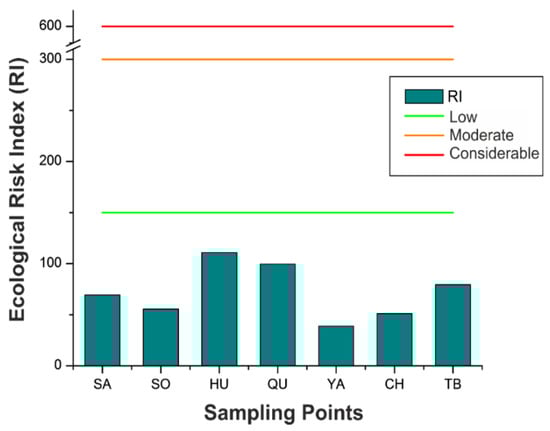
Figure 2.
Ecological risk index of the 7 monitoring points in the Arequipa countryside.
3.4. Health Risk Assessment
The results found on the coefficient and risk index on the health of people by dermal contact showed that the concentrations of elements present in the soils of the Arequipa countryside do not mean a health risk. Table 10 shows the values of HQ and HI, where the values in children and adults were insignificant. We found HI values for children between 0.011 and 0.030 and in adults between 0.0023 and 0.0059. According to the USEPA, values above 1 are considered a risk to people’s health.
Table 10.
Health risk assessment the toxic elements of the Arequipa countryside.
4. Discussion
In the study by Loska et al. [45] that quantified the geo-accumulation index and enrichment factor in soils of the Suszec commune, it was observed that most of the soils were acidic, directly affecting the mobility of toxic elements, which are easily absorbed by the plant entering the food chain and representing a risk to human and animal health. As pointed out by Wu et al. [32], who evaluated toxic element contamination in agricultural soils near a smelter, the results of ecological risk assessment of Cd, Hg and PB were very high. The results of non-carcinogenic health risk assessment in children decreased in the order of As > Pb > Cr > Hg > Ni > Cu > Zn, concluding that residents face cancer risk due to As contamination. Gujre et al. [46] assessed the ecological and human health risks in soils with municipal solid waste discharges, and it was found that Cr and Zn concentrations in soils were higher than the maximum permissible limit, since the Igeo value for Cr was between heavily to extremely contaminated. In contrast, Zn was found between strongly to moderately contaminated, high Cr and Zn enrichment was observed, and from the health risk assessment, Zn was negligible [46]. At the same time, Cr posed higher carcinogenic and non-carcinogenic risks in the case of adults and children, as shown by Loska et al. [45] who found high levels of Igeo for cadmium, lead, arsenic, mercury and antimony that represent up to 90% of soil contamination by the presence of these elements. Milicević et al. [47] evaluated 26 potentially toxic elements (PTE) in an organic vineyard to determine the soil–plant–air pollution. Cadmium (Cd) was identified at low concentrations and to originate mostly from soil, and that presented an influence on the increase in environmental risk, while grapevine showed not to be a hyperaccumulator of potentially toxic elements [47]. The same research group determined that the grapevine leaf was a reliable biomonitor for PTE [48] and that the non-carcinogenic and carcinogenic risk for grape consumers and farmers was low [49]. Tang et al. [50] evaluated 120 soil samples from residential areas surrounding the coal-fired power plant in Huainan City, China, determining the concentrations of 10 environmentally sensitive elements (ESE). They found that the ESE concentrations were higher in favor of the direction of the wind, which implies a potential entry of ESE by the coal plant. The ecological risk indicated a relatively low risk, but the health risk (HQ) was 1.5, indicating a potential risk to the health of children. However, the carcinogenic risk did not represent a danger [50]. In comparison with the present study, the values of enrichment and geo-accumulation of As present a serious enrichment and moderate contamination, respectively, in the districts of Sachaca, Socabaya, Quequeña and Characato, where the soils were affected by pesticides that contain metals in their composition and industries that discharge their effluents without prior treatment to the waters of the Chili River. Furthermore, said waters are used for the irrigation of agricultural products, and these concentrations might affect the values of the geo-accumulation, enrichment and ecological risk indices in the districts under evaluation.
5. Conclusions
According to the evaluation of the environmental contamination by toxic elements in the soils of the Arequipa countryside, As presented a severe enrichment while Cd presented a moderate to moderately severe enrichment. Regarding the geo-accumulation index, As in Sachaca, Socabaya, Quequeña and Characato, Cu at all monitoring points and Cd in Sachaca, Hunter, Quequeña and Tiabaya presented moderate contamination. The ecological risk index in the evaluated districts presented a low degree of risk due to the contamination of ecotoxic elements, and the values of HQ and HI for the risk to the health of adults and children did not represent a danger to health because they are below what is listed in the USEPA.
Author Contributions
Conceptualization, M.H.A., L.S.T., K.M., D.P., G.C. and B.P.; methodology, M.H.A., L.S.T., K.M., D.P., G.C. and B.P.; validation, M.H.A., L.S.T., K.M., D.P., G.C. and B.P.; formal analysis, M.H.A., L.S.T., K.M., D.P., G.C. and B.P.; investigation, M.H.A., L.S.T., K.M., D.P., G.C. and B.P.; data curation, M.H.A., L.S.T., K.M., D.P., G.C. and B.P.; writing—original draft preparation, M.H.A., A.A.-R., L.S.T., K.M., D.P., G.C., B.P., S.D.-A.-A. and J.A.Y.; writing—review and editing, M.H.A., A.A.-R., L.S.T., K.M., D.P., G.C., B.P., S.D.-A.-A. and J.A.Y.; visualization, M.H.A., A.A.-R., L.S.T., K.M., D.P., G.C., B.P., S.D.-A.-A. and J.A.Y. All authors have read and agreed to the published version of the manuscript.
Funding
This research received no external funding.
Institutional Review Board Statement
Not applicable.
Informed Consent Statement
Not applicable.
Data Availability Statement
The data presented in this study are available on request from the corresponding author.
Acknowledgments
The authors want to thank Universidad Nacional de San Agustín de Arequipa for their financial support of the project: IBA-0034-2016-UNSA.
Conflicts of Interest
The authors declare no conflict of interest.
References
- Williams, C.H.; David, D.J. The accumulation in soil of cadmium residues from phosphate fertilizers and their effect on the cadmium content of plants. Soil Sci. 1976, 121, 86–93. [Google Scholar] [CrossRef]
- Delgado-Zegarra, J.; Alvarez-Risco, A.; Yáñez, J.A. Indiscriminate use of pesticides and lack of sanitary control in the domestic market in PeruUso indiscriminado de pesticidas e falta de controle sanitário do mercado interno no Peru. Rev. Panam. Salud. Publica 2018, 42, e3. [Google Scholar] [CrossRef] [PubMed]
- Dijkshoorn, W.; van Broekhoven, W.; Lampe, J. Phytotoxicity of zinc, nickel, cadmium, lead, copper and chromium in three pasture plant species supplied with graduated amounts from the soil. Neth. J. Agric. Sci. 1979, 27, 241–253. [Google Scholar] [CrossRef]
- Olatunde, K.A.; Sosanya, P.A.; Bada, B.S.; Ojekunle, Z.O.; Abdussalaam, S.A. Distribution and ecological risk assessment of heavy metals in soils around a major cement factory, Ibese, Nigeria. Sci. Afr. 2020, 9, e00496. [Google Scholar] [CrossRef]
- Underwood, E.J. Trace Elements in Human and Animal Nutrition, 3rd ed.; Academic Press, Inc.: New York, NY, USA, 1971. [Google Scholar]
- Birke, M.; Rauch, U. Geochemical investigations in the Berlin metropolitan area. Z. Angew. Geol. 1997, 43, 58–65. [Google Scholar]
- Paterson, E.; Sanka, M.; Clark, L. Urban soils as pollutant sinks—A case study from Aberdeen, Scotland. Appl. Geochem. 1996, 11, 129–131. [Google Scholar] [CrossRef]
- Poggio, L.; Vrscaj, B.; Schulin, R.; Hepperle, E.; Ajmone Marsan, F. Metals pollution and human bioaccessibility of topsoils in Grugliasco (Italy). Environ. Pollut. 2009, 157, 680–689. [Google Scholar] [CrossRef]
- Serdar, B. Effect of cement dust pollution on microbial properties and enzyme activities in cultivated and no-till soils. Afr. J. Microbiol. Res. 2010, 4, 2418–2425. [Google Scholar]
- Yáñez, J.A.; Remsberg, C.M.; Takemoto, J.K.; Vega-Villa, K.R.; Andrews, P.K.; Sayre, C.L.; Martinez, S.E.; Davies, N.M. Polyphenols and Flavonoids: An Overview. In Flavonoid Pharmacokinetics: Methods of Analysis, Preclinical and Clinical Pharmacokinetics, Safety, and Toxicology; Davies, N.M., Yáñez, J.A., Eds.; John Wiley & Sons: Hoboken, NJ, USA, 2012; pp. 1–69. [Google Scholar]
- Yáñez, J.A.; Miranda, N.D.; Remsberg, C.M.; Ohgami, Y.; Davies, N.M. Stereospecific high-performance liquid chromatographic analysis of eriodictyol in urine. J. Pharm. Biomed. Anal. 2007, 43, 255–262. [Google Scholar] [CrossRef]
- Bermudez-Aguirre, D.; Yáñez, J.; Dunne, C.; Davies, N.; Barbosa-Cánovas, G. Study of strawberry flavored milk under pulsed electric field processing. Food Res. Int. 2010, 43, 2201–2207. [Google Scholar] [CrossRef]
- Barbieri, M. The importance of enrichment factor (EF) and geoaccumulation index (Igeo) to evaluate the soil contamination. J. Geol. Geophys. 2016, 5, 1–4. [Google Scholar] [CrossRef]
- Li, P.; Lin, C.; Cheng, H.; Duan, X.; Lei, K. Contamination and health risks of soil heavy metals around a lead/zinc smelter in southwestern China. Ecotoxicol. Environ. Saf. 2015, 113, 391–399. [Google Scholar] [CrossRef]
- Pavlowsky, R.T.; Lecce, S.A.; Owen, M.R.; Martin, D.J. Legacy sediment, lead, and zinc storage in channel and floodplain deposits of the Big River, Old Lead Belt Mining District, Missouri, USA. Geomorphology 2017, 299, 54–75. [Google Scholar] [CrossRef]
- Xiao, R.; Guo, D.; Ali, A.; Mi, S.; Liu, T.; Ren, C.; Li, R.; Zhang, Z. Accumulation, ecological-health risks assessment, and source apportionment of heavy metals in paddy soils: A case study in Hanzhong, Shaanxi, China. Environ. Pollut. 2019, 248, 349–357. [Google Scholar] [CrossRef]
- Morkunas, I.; Woźniak, A.; Mai, V.C.; Rucińska-Sobkowiak, R.; Jeandet, P. The Role of Heavy Metals in Plant Response to Biotic Stress. Molecules 2018, 23, 2320. [Google Scholar] [CrossRef]
- Ramos-Escudero, F.; Santos-Buelga, C.; Pérez-Alonso, J.J.; Yáñez, J.A.; Dueñas, M. HPLC-DAD-ESI/MS identification of anthocyanins in Dioscorea trifida L. yam tubers (purple sachapapa). Eur. Food Res. Technol. 2010, 230, 745–752. [Google Scholar] [CrossRef]
- Vega-Villa, K.R.; Remsberg, C.M.; Ohgami, Y.; Yanez, J.A.; Takemoto, J.K.; Andrews, P.K.; Davies, N.M. Stereospecific high-performance liquid chromatography of taxifolin, applications in pharmacokinetics, and determination in tu fu ling (Rhizoma smilacis glabrae) and apple (Malus x domestica). Biomed. Chromatogr. 2009, 23, 638–646. [Google Scholar] [CrossRef]
- Gupta, S.K.; Vollmer, M.K.; Krebs, R. The importance of mobile, mobilisable and pseudo total heavy metal fractions in soil for three-level risk assessment and risk management. Sci. Total Environ. 1996, 178, 11–20. [Google Scholar] [CrossRef]
- Romic, M.; Romic, D. Heavy metals distribution in agricultural topsoils in urban area. Environ. Geol. 2003, 43, 795–805. [Google Scholar] [CrossRef]
- Feng, H.; Jiang, H.; Gao, W.; Weinstein, M.P.; Zhang, Q.; Zhang, W.; Yu, L.; Yuan, D.; Tao, J. Metal contamination in sediments of the western Bohai Bay and adjacent estuaries, China. J. Environ. Manag. 2011, 92, 1185–1197. [Google Scholar] [CrossRef]
- GIPME. Guidance on Assessment of Sediment Quality; International Maritime Organization: London, UK, 1999. [Google Scholar]
- Frankowski, M.; Zioła-Frankowska, A.; Kowalski, A.; Siepak, J. Fractionation of heavy metals in bottom sediments using Tessier procedure. Environ. Earth Sci. 2010, 60, 1165–1178. [Google Scholar] [CrossRef]
- Tessier, A.; Campbell, P.G.C.; Bisson, M. Sequential extraction procedure for the speciation of particulate trace metals. Anal. Chem. 1979, 51, 844–851. [Google Scholar] [CrossRef]
- MINAM. Guía para el Muestreo de Suelos. Decreto Supremo 002-2013-MINAM—Estándares de Calidad Ambiental (ECA) para Suelo. Available online: https://www.minam.gob.pe/calidadambiental/wp-content/uploads/sites/22/2013/10/GUIA-PARA-EL-MUESTREO-DE-SUELOS-final.pdf (accessed on 9 September 2022).
- IRIS. Arsenic, inorganic CASRN 7440-38-2—IRIS—US EPA, ORD. Available online: https://cfpub.epa.gov/ncea/iris2/chemicalLanding.cfm?&substance_nmbr=278 (accessed on 9 September 2022).
- IRIS. Chromium (VI) CASRN 18540-29-9—IRIS—US EPA, ORD. Available online: https://cfpub.epa.gov/ncea/iris2/chemicalLanding.cfm?&substance_nmbr=144 (accessed on 9 September 2022).
- De Miguel, E.; Iribarren, I.; Chacón, E.; Ordoñez, A.; Charlesworth, S. Riskbased evaluation of the exposure of children to trace elements in playgrounds in Madrid (Spain). Chemosphere 2007, 66, 505–513. [Google Scholar] [CrossRef] [PubMed]
- IRIS. Cadmium CASRN 7440-43-9—IRIS—US EPA, ORD. Available online: https://cfpub.epa.gov/ncea/iris2/chemicalLanding.cfm?&substance_nmbr=141 (accessed on 9 September 2022).
- U.S. Department of Energy Office of Environmental Management. Remedial Investigation Report for Waste Area Grouping 6 at Paducah Gaseous Diffusion Plant Paducah, Kentucky; Department of Energy Office of Environmental Management: Washington, DC, USA, 1999.
- Wu, H.; Yang, F.; Li, H.; Li, Q.; Zhang, F.; Ba, Y.; Cui, L.; Sun, L.; Lv, T.; Wang, N.; et al. Heavy metal pollution and health risk assessment of agricultural soil near a smelter in an industrial city in China. Int. J. Environ. Health Res. 2020, 30, 174–186. [Google Scholar] [CrossRef]
- USEPA. Risk Assessment Guidance for Superfund (RAGS): Part A. Available online: https://www.epa.gov/risk/risk-assessment-guidance-superfund-rags-part (accessed on 9 September 2022).
- USEPA. Risk Assessment Guidance for Superfund. Volume I: Human Health Evaluation Manual (Part E, Supplemental Guidance for Dermal Risk Assessment). Available online: https://www.epa.gov/risk/risk-assessment-guidance-superfund-rags-part-e (accessed on 9 September 2022).
- MEPPRC. Technical Guidelines for Risk Assessment of Contaminated Sites. In Ministry of Environmental Protection of the People’s Republic of China, Beijing. Available online: https://english.mee.gov.cn/Resources/standards/Soil/Method_Standard4/201605/W020160506416578822108.pdf (accessed on 9 September 2022).
- USEPA. Risk Assessment: Guidance for Superfund Volume I: Human Heatlh Evaluation Manual (Part E, Supplemental Guidance for Dermal Risk Assessment) Final. Available online: http://www.epa.gov/oswer/riskassessment/ (accessed on 9 September 2022).
- EPA. Recommended Use of Body Weight 3/4 as the Default Method in Derivation of the Oral Reference Dose. Available online: https://www.epa.gov/risk/recommended-use-body-weight-34-default-method-derivation-oral-reference-dose (accessed on 9 September 2022).
- Acevedo-Figueroa, D.; Jiménez, B.D.; Rodríguez-Sierra, C.J. Trace metals in sediments of two estuarine lagoons from Puerto Rico. Environ. Pollut. 2006, 141, 336–342. [Google Scholar] [CrossRef]
- Pacle Decena, S.C.; Sanita Arguelles, M.; Liporada Robel, L. Assessing Heavy Metal Contamination in Surface Sediments in an Urban River in the Philippines. Pol. J. Environ. Stud. 2018, 27, 1983–1995. [Google Scholar] [CrossRef]
- Li, X.; Shen, H.; Zhao, Y.; Cao, W.; Hu, C.; Sun, C. Distribution and Potential Ecological Risk of Heavy Metals in Water, Sediments, and Aquatic Macrophytes: A Case Study of the Junction of Four Rivers in Linyi City, China. Int. J. Environ. Res. Public Health 2019, 16, 2861. [Google Scholar] [CrossRef]
- Shariati, S.; Pourbabaee, A.A.; Alikhani, H.A.; Rezaei, K.A. Assessment of phthalic acid esters pollution in Anzali wetland, north of Iran. Int. J. Environ. Sci. Technol. 2019, 16, 7025–7036. [Google Scholar] [CrossRef]
- Saeedi, M.; Jamshidi-Zanjani, A. Development of a new aggregative index to assess potential effect of metals pollution in aquatic sediments. Ecol. Indic. 2015, 58, 235–243. [Google Scholar] [CrossRef]
- Turekian, K.K.; Wedepohl, K.H. Distribution of the Elements in Some Major Units of the Earth’s Crust. GSA Bull. 1961, 72, 175–192. [Google Scholar] [CrossRef]
- Hans Wedepohl, K. The composition of the continental crust. Geochim. Cosmochim. Acta 1995, 59, 1217–1232. [Google Scholar] [CrossRef]
- Loska, K.; Wiechuła, D.; Korus, I. Metal contamination of farming soils affected by industry. Environ. Int. 2004, 30, 159–165. [Google Scholar] [CrossRef]
- Gujre, N.; Mitra, S.; Soni, A.; Agnihotri, R.; Rangan, L.; Rene, E.R.; Sharma, M.P. Speciation, contamination, ecological and human health risks assessment of heavy metals in soils dumped with municipal solid wastes. Chemosphere 2021, 262, 128013. [Google Scholar] [CrossRef]
- Milićević, T.; Aničić Urošević, M.; Relić, D.; Jovanović, G.; Nikolić, D.; Vergel, K.; Popović, A. Environmental pollution influence to soil–plant–air system in organic vineyard: Bioavailability, environmental, and health risk assessment. Environ. Sci. Pollut. Res. 2021, 28, 3361–3374. [Google Scholar] [CrossRef]
- Milićević, T.; Relić, D.; Urošević, M.A.; Vuković, G.; Škrivanj, S.; Samson, R.; Popović, A. Integrated approach to environmental pollution investigation—Spatial and temporal patterns of potentially toxic elements and magnetic particles in vineyard through the entire grapevine season. Ecotoxicol. Environ. Saf. 2018, 163, 245–254. [Google Scholar] [CrossRef]
- Milićević, T.; Urošević, M.A.; Relić, D.; Vuković, G.; Škrivanj, S.; Popović, A. Bioavailability of potentially toxic elements in soil–grapevine (leaf, skin, pulp and seed) system and environmental and health risk assessment. Sci. Total Environ. 2018, 626, 528–545. [Google Scholar] [CrossRef]
- Tang, Q.; Liu, G.; Zhou, C.; Zhang, H.; Sun, R. Distribution of environmentally sensitive elements in residential soils near a coal-fired power plant: Potential risks to ecology and children’s health. Chemosphere 2013, 93, 2473–2479. [Google Scholar] [CrossRef]
Disclaimer/Publisher’s Note: The statements, opinions and data contained in all publications are solely those of the individual author(s) and contributor(s) and not of MDPI and/or the editor(s). MDPI and/or the editor(s) disclaim responsibility for any injury to people or property resulting from any ideas, methods, instructions or products referred to in the content. |
© 2023 by the authors. Licensee MDPI, Basel, Switzerland. This article is an open access article distributed under the terms and conditions of the Creative Commons Attribution (CC BY) license (https://creativecommons.org/licenses/by/4.0/).