


Abstract
The paper focuses on the bibliometric review of the Scopus database in the field of innovation ecosystem development, aiming to reveal the key trends in this fast-growing area of interdisciplinary research in terms of different quantitative and qualitative parameters. The bibliometric analysis followed PRISMA protocol guidelines for finding and extracting relevant scholarly papers based on the selected national, institutional, demographic, and scientific variables. The PRISMA procedure resulted in 401 selected open-access articles published on the topic of innovation ecosystem development from 2013 to 2023. The key findings indicate that research on innovation ecosystem development has seen late growth, which is a sign of still underexplored fields for potential pioneers. Researchers and institutions from the Nordic countries and the UK are most active as far as publications on innovation ecosystem development are concerned. However, researchers from the USA, Australia, and the UK dominate the citation records. Research collaborations help increase productivity and citation levels. The most cited articles fall into 4 clusters based on citations: innovation, smart tourism, digitalization, and entrepreneurship. Future research synergies can also be envisaged with the domains of digitalization, sustainable development, and the smart environment.
1. Introduction
In the face of recent global challenges, no economic sector can stay without continuous innovation and improvement of business activities implemented in line with modern requirements for sustainable development and meeting economic, environmental, and social requirements [1]. Global changes such as energy access, food security, climate change, carbon emissions, and the digital divide [1,2,3], resulting in the search for energy efficiency, sustainability, and security of energy supply, foster exploring innovative solutions [3] and the use of artificial intelligence (AI) in the research and development of products [4]. Scientists [2] recognize innovation as a major determinant of a region’s or country’s economic growth and progress. Innovation and digital transformation support professionals and businesses in the development of new solutions and modifications of existing experiences, processes, and cultures to meet the ever-evolving market and human needs [5]; moreover, remarkable progress in technology makes people’s lives easier [6].
The past decade has seen a significant growth of interest by social scholars in ecosystem-related research. Originally derived from natural and environmental sciences, the concept of ecosystems traditionally focused on energy circulation across the species and their environment, as well as the interactions of its living and non-living components [7]. Social scientists have observed certain parallels between the actors of the social systems and the species of the natural ecosystems, especially regarding the complexity and constantly evolving nature of their systemic relationships [8]. Thus, the ecosystem first entered the research thesaurus of social anthropologists [9], then economists [10], and was later adopted by the researchers of business and organization sciences. The business ecosystem approach suggests that companies act as “organisms” by interacting and aligning their actions with other “species” in the business ecosystem, which in turn results in the co-evolving capabilities of all actors engaged in a continuous interaction [11,12]. The co-creation of the value of business firms takes place across disciplinary and industry boundaries during numerous decentralized spontaneous interactions, which justifies the “ecosystemic” approach later adopted by other researchers of inter-organizational systems, e.g., value networks [13], industrial clusters [14], and industry architecture [15].
Innovation ecosystems, together with knowledge ecosystems, are among the more recent additions to ecosystem-based academic discourse. An innovation ecosystem is traditionally defined as a collaborative arrangement through which firms combine their individual offerings into a coherent, customer-facing solution [16]. Such an ecosystem has the capacity to constantly realign its relationships and grow in response to changes in internal and external environments [17]. The co-evolution of capabilities of the loosely interconnected actors enables the development of new products and services [18]. Energy dynamics that take place in complex inter-actor relationships enable technology development and innovation [19]. This dynamic is usually of a cross-sectoral and cross-national nature [20], and innovation ecosystems are regarded as dynamically organized meta-networks and knowledge meta-clusters in various social and economic domains [21]. They are networks of human and inter-firm relationships enabling the flow of valuable resources through systems for the sustained co-creation of value [17,22] as well as the co-creation of new knowledge [23,24]. The innovation ecosystem may consist of different dynamically interacting subsystems, such as the research economy and commercial economy [25], the science ecosystem, the knowledge ecosystem, and the business ecosystem [26,27].
Moreover, the development of genuine innovation ecosystems is a complex undertaking due to the variety of stakeholders (from different subsystems) possessing divergent value systems, interests, and knowledge types involved. The success of development depends on the capacity of leading actors to enable the diverse actors to build a shared vision, manage the co-evolution of the network and its members, provide a shared sense of direction, and mediate processes of trust development and cooperation [28,29,30,31]. Therefore, it is important to take into consideration the complex adaptive nature of such social ecosystems—a view often neglected in mainstream research and policy, usually in favor of more controlling and interventionist approaches [32].
The review of innovation ecosystem research shows that extant papers contain little to no definition of the concept; researchers also focus on quite different aspects of the ecosystems that make the boundaries of the concept even more fuzzy and unclear [33,34]. Therefore, there is a commonly perceived need for better categorization of diverse research outputs and scholarly perspectives, which currently represents a research gap in the field.
Although bibliometric analyses on innovation ecosystems evoke researchers’ interest [35,36,37,38,39,40,41], scholars [5] emphasize the need for a more comprehensive understanding of the current state of innovation ecosystem research. No published documents have considered mapping innovation ecosystem development in the Scopus database. The current study concentrates on articles using (innovation AND ecosystem AND development) in their title, abstract, and/or keywords. Moreover, this study evaluates the research trends that have emerged during the last decade (January 2013 to October 2023). By providing a comprehensive bibliometric analysis of the most productive and collaborative countries and academic institutions, most prolific journals, productive authors, and most occurring keywords, this study aims to outline the current trends in the field of innovation ecosystem development and future research directions. Therefore, this study is among the first bibliometric studies on innovation ecosystems. The overall performance of the domain is analyzed by specifying the most productive countries and academic institutions, prolific journals, and authors developing the domain. The novelty and scientific contribution of this review results in research guidelines for researchers endeavoring to explore the domain of innovation ecosystem development. Firstly, based on the comprehensive analysis of scientific articles published in international journals on innovation ecosystem development during the last decade, recent research trends in the field are identified. Secondly, the identification and grouping of the most used keywords enable us to substantiate the current themes in the literature on innovation ecosystem development and outline the subtopics evoking the highest researcher interest. Finally, the citation analysis enables determining the emerging areas of interest in innovation ecosystem development research, indicating future research directions. The current analysis can serve as a research background for the further development of the domain.
The review is structured as follows: the materials and methods used for the analysis are presented in Section 2. The main results are provided and described in Section 3. Section 4 provides a discussion of the obtained results, outlining the directions of future research. The conclusions and limitations of the review are provided in Section 5.
2. Materials and Methods
In order to reveal the progress in the area, the most prolific contributions, and the prospective trends for further research, a systematic analysis of the scientific literature was provided. Systematic analyses are often used to enhance existing knowledge in the field by providing a literature overview resulting in bibliometrics, frameworks, and themes [42]. Bibliometrics was a term suggested in 1969 by Pritchard, and it provides a quantitative analysis of scientific publications in a chosen field [43]. Bibliometric analyses are often used to understand the inner structure of research in a chosen area of interest [44]. However, the application of bibliometric analyses in business research is relatively new and, in many instances, underdeveloped [45]. This study followed the guidelines outlined in the Preferred Reporting Items for Systematic Reviews and Meta-Analyses (PRISMA) protocol guidelines [46] in order to find and extract the relevant scholarly papers.
Several global databases of scientific information can be found suitable for bibliometric research. For many years, the Web of Science by Thomson Reuters (WoS) database was the only one allowing bibliometric studies; the Scopus database was introduced by Elsevier Science only in 2004 and enabled the researchers to conduct scientific analyses by area and time period in two databases [47]. These two typically represent the major databases and citation indexes for general-purpose scientific literature, including journal articles, conference proceedings, and books [48]. Also, other bibliographic data sources, e.g., Dimensions, emerged. In the WoS database, biases related to its coverage of regional sources in the fields of Social and Humanistic Sciences were identified; therefore, Scopus is used as an alternative for bibliometric analyses [49]. Scientists [48] emphasize that WoS mainly lists research in Natural Sciences and Engineering, while Scopus is relatively superior in coverage of the Social Sciences. Compared to other databases, e.g., WoS, Scopus dominates by the ease of navigation and access to cited documents, and 100% of the documents indexed in MEDLINE, EMBASE, and COMPEDEX are included in it [50]. Considering its advantages, the Scopus database was chosen for the study, as it is widely used by researchers to identify developments in the field of interest [51] and provides the most important bibliographic information for the review: countries, academic institutions, affiliations, references, publishers, citations, authors, etc. [52].
The research was designed to answer relevant research questions, most often raised in bibliometric analyses [53] adapted to the field of interest:
RQ1: What is the annual change in the number of scientific publications regarding Innovation Ecosystem Development?
RQ2: What are the most productive countries, academic institutions, journals, and authors?
RQ3: What are the most prominent keywords defined in the published articles indicating the current themes in the literature on innovation ecosystem development?
RQ4: What are the most-cited articles in the field of Innovation Ecosystem Development indicating future research directions?
The procedure of data collection from the Scopus database was provided on the 10th of October 2023. One recent decade (Y2013–Y2022) and the ten past months of the current year (Y2023) were chosen as the research period. To capture the most relevant data, the eligibility criteria for the published papers were established:
- Publication year: January 2013 to October 2023.
- Language: English.
- Document type: Article (reviews, book chapters, conference papers, and editorials were excluded).
- Accessibility: All open access.
- Subject area: Business, Management, and Accounting.
Following the pre-set limitations, the following query was applied to the title, abstract, and keywords: TITLE-ABS-KEY (innovation AND ecosystem AND development) AND (LIMIT-TO (PUBYEAR, 2013) OR LIMIT-TO (PUBYEAR, 2014) OR LIMIT-TO (PUBYEAR, 2015) OR LIMIT-TO (PUBYEAR, 2016) OR LIMIT-TO (PUBYEAR, 2017) OR LIMIT-TO (PUBYEAR, 2018) OR LIMIT-TO (PUBYEAR, 2019) OR LIMIT-TO PUBYEAR, 2020) OR LIMIT-TO (PUBYEAR, 2021) OR LIMIT-TO (PUBYEAR, 2022) OR LIMIT-TO (PUBYEAR, 2023)) AND (LIMIT-TO (SUBJAREA, “BUSI”)) AND (LIMIT-TO (DOCTYPE, “ar”)) AND (LIMIT-TO (LANGUAGE, “English”)) AND (LIMIT-TO (OA, “all”)).
The initial search with the identified keywords (innovation AND ecosystem AND development) indicated 6033 publications found in the Scopus database (Figure 1). Therefore, the pre-set inclusion criteria were applied to extract the most relevant articles. As indicated previously, the research focused on the original articles published on the Scopus database between January 2013 and October 2023. Moreover, articles published in languages other than English were excluded. The All Open Access criterion was set to find research that was easily accessible for other scholars, thus enabling further unconstrained development of the scope. Finally, to obtain the most relevant results, only articles published in the area of Business, Management, and Accounting were included in the further analysis.
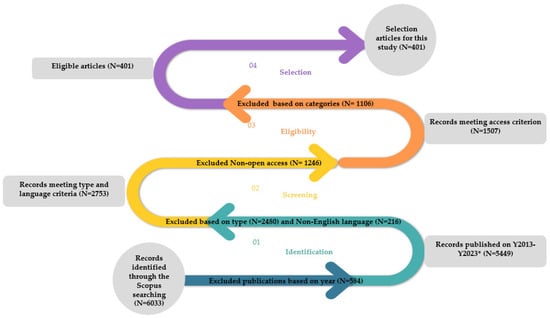
Figure 1.
Steps of the PRISMA procedure of publication inclusion in the study. Note: figure design used with permission [54]. * Data extracted from Scopus database on 10 October 2023.
To visualize the results of the co-occurrences of authors, keywords, and countries, VOSviewer software version 1.6.19 was applied. VOSviewer software is widely used in bibliometric analyses to visually support the obtained results [52]. The main bibliometric laws were also evaluated, including Lotka’s Law (scientific productivity of authors), and Zipf’s Law (basic vocabulary and word frequency) [55].
This research does not require ethics committee approval, as it does not involve subjects.
3. Results
The PRISMA procedure of publication inclusion in the study resulted in 401 selected open-access articles published on the topic of innovation ecosystem development from 2013 through 2023. Figure 2 depicts the number of articles published annually and the cumulative growth of the authors’ interest in this area. At the beginning of the analyzed period, only 1 publication was published, followed by 9 publications published the next year. A remarkable growth in publications is visible in 2018 and 2021. Considering the year 2023, as the extraction of articles from the database was provided on the 10th of October, the information represents only 9 months and 10 days. However, it can be forecasted that the reached level of publication quantity will be kept. Moreover, more than half of the articles in the field were published during the last four years.
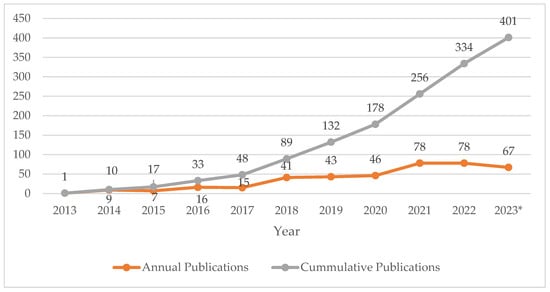
Figure 2.
The annual and cumulative articles published in the Scopus database on “Innovation ecosystem development” between 2013–2023. * Data extracted from Scopus database on 10 October 2023.
3.1. Most Productive Countries and Academic Institutions
The results extracted from the Scopus database indicated 68 countries that have published at least one article on innovation ecosystem development during the analyzed period. Eleven countries have published more than 20 articles; eight countries have published 11 to 20 articles (see Table 1); 23 countries have published 3–10 articles (Table 2); and 26 countries have published 1–2 articles (Table 3). The United Kingdom has published 93 articles that were cited 8277 times during the analyzed period; the United States of America is in second place based on the number of published articles and the number of citations. However, not all countries taking leading positions based on the number of published articles are the same successful if considering the number of citations. For example, Finland with 39 articles is the third in the world based on the number of publications; however, based on the number of citations (876 total citations), Finland is in the 14th place. A similar situation is observed regarding Brazil. Being in the top 10, Brazil has published 25 articles during the period of interest; however, these articles have only 283 citations (this results in the 22nd position if ranked based on the number of citations). One more prolific country to be mentioned is Denmark. Having published only 18 articles, based on the number of citations (1272 total citations), Denmark is ranked in 8th place.

Table 1.
The most productive countries in innovation ecosystem development research.
Table 2.
Countries in innovation ecosystem development research with 3 to 10 articles.
Table 3.
Countries in innovation ecosystem development research with 1–2 articles.
Table 2 shows 23 countries that have published from 3 to 10 articles each. In this group, only one country has accumulated more than 1000 citations. South Korea has published only 4 articles during the analyzed decade (30th rank), but with 1015 citations, it is in the 11th position based on the number of citations. Also, among the influential countries in this group, Norway (8 articles, 827 citations), Canada (8 articles, 697 citations), Belgium (3 articles, 530 citations), Singapore (8 articles, 425 citations), and Cyprus (3 articles, 404 citations) can be mentioned as being prolific. Having a relatively small number of articles, the latter countries attract scholars’ attention and recognition.
At the other extreme, among the countries that published from 3 to 10 articles, Thailand (4 articles, 10 citations), Saudi Arabia (3 articles, 9 citations), and Romania (4 articles, 2 citations) are found. Romania is the only country in this group, exceeding the number of citations with the number of articles.
Countries with 1–2 articles published in the field of innovation ecosystem development and their citation statistics are provided in Table 3. Among these countries, Slovenia (1 article, 34 citations), Hong Kong (1 article, 28 citations), Egypt (1 article, 22 citations), Iceland (1 article, 20 citations), and Mexico (2 articles, 21 citations) are to be mentioned as emerging.
Other countries in the group having 1 or 2 articles have accumulated less than 20 citations so far. On the very extreme, Iran, Luxembourg, Nigeria, Oman, Pakistan, and Palestine are found. Having one publication per country, the latter countries have not yet been cited.
To reveal the collaboration patterns between countries, bibliographic coupling was performed. It enables summarizing the bibliometric and intellectual structures of a field by analyzing the social and structural relationships between co-authoring countries [45]. The boundaries were set to a minimum of 5 documents by a country having at least one citation. Out of the 84 countries that contributed to the field of innovation ecosystem development, 29 countries passed the set threshold (Figure 3).
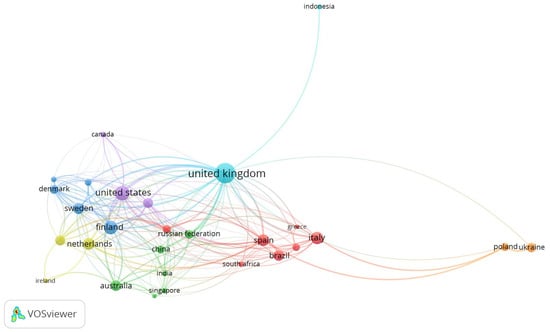
Figure 3.
The bibliographic coupling of contributed countries.
The countries with the greatest total link strengths (TLS) were selected, and different colors used in the network visualization show different clusters that were more frequently linked with each other. The study identified the United Kingdom as the most productive country with 93 published articles, 8277 citations, and a TLS of 5643.03, followed by the United States with 48 publications having 6634 citations and a TLS of 3262.32. As the third most collaborating country, Spain was identified with 32 publications cited by 1286 and the TLS of 2011.67. With a TLS of 1764.08, Sweden was found to be the fourth most collaborating country, having published 29 articles cited 1804 times, followed by Italy with a TLS of 1741.12 (33 publications and 1926 citations). Further, the Netherlands (TLS 1721.61), Finland (TLS 1712.49), France (TLS 1655.29), Denmark (TLS 1423.73), and Australia (TLS 1323.84) were ranked. Obviously, the most productive countries (except for Denmark) are also the most collaborating countries. The latter findings suggest that inter-country collaboration enables the publishing of high-quality research acknowledged by a broader audience of scholars worldwide.
Analyzing the most productive organizations, 17 institutions were found to have published 5 or more articles each (Table 4).
Table 4.
The most productive institutions in innovation ecosystem development research.
Luleå University of Technology (Sweden) has published 10 articles, followed by the University of Vaasa (Finland), Copenhagen Business School (Denmark), and the University of Cambridge (the United Kingdom), with 9 articles each. Aalto University (Finland) has 8 articles, and Utrecht University (the Netherlands), Vrije Universiteit Amsterdam (the Netherlands), and Aarhus University (Denmark) have 7 articles each. The results provided in Table 4 demonstrate that Nordic universities are leading research on innovation ecosystem development. However, considering the number of citations, the most cited universities were not from Europe. The University of California, Berkeley (the United States), having published only 5 articles, has been cited 7749 times; The University of Queensland (Australia) with 6 articles was cited 1097 times; while the European university the University of Cambridge (United Kingdom) was found to be in third place with 1041 citations.
3.2. Most Productive Authors
Lotka’s Law, which states that “in a given area of science, there are a lot of authors who publish only one study, while a small group of prolific authors contribute with a large number of publications” [56], was checked. By applying Lotka’s Law to the 1296 co-authors found, it was estimated that the prolific co-authors would be the 36 with the highest number of publications (square root of 1296). After analyzing the results, 68 co-authors were found to have more than 1 publication (5.25 percent); only 12 authors have co-authored more than 2 publications (less than 1 percent).
The most prolific authors (having co-authored more than 2 publications) in the field of innovation ecosystem development are listed in Table 5. The twelve most prolific authors in the field come from 10 institutions located in 8 countries. The total production of the selected 12 authors accounts for 44 articles (11 percent in the field).
Table 5.
The most productive authors in innovation ecosystem development research.
The most productive author Parida, V., representing Luleå University of Technology (Sweden), has co-authored 9 articles cited 388 times. On the other hand, Gawer, A. from Surrey Business School, Guildford, United Kingdom, has published 3 articles and was cited 1897 times. Buhalis, D. affiliated with The Business School at BU, Poole, United Kingdom, has 4 articles cited 987 times. On the other extreme to be mentioned, Miralles, F. and Pique, J.M. affiliated with Universitat Ramon Llull, Barcelona, Spain have co-authored 3 articles, which were cited only 22 times. Consequently, the research results prove that a high number of publications does not ensure a high number of citations.
3.3. Most Prolific Journals
In order to find out the most prolific journals in the research on innovation ecosystem development, further analysis was provided. The analyzed 401 articles were published in 184 journals.
The most prolific journals that have published articles based on the research query are listed in Table 6.
Table 6.
The most productive journals in innovation ecosystem development research.
Screening the Scopus database enabled the identification of 15 journals with 5 or more articles meeting the search requirements. 4 journals were published by Elsevier; Emerald Group Publishing Ltd., Springer Nature, and Wiley-Blackwell published 2 articles each; IEEE and SpringerOpen published 1 article each; and 3 articles were published by different universities’ publishing houses.
Six of the most prolific journals had a Cite Score indicator higher than 10, five journals—higher than 5, three journals—higher than 1, and one journal’s Cite Score lower than 1. The journal “Technological Forecasting and Social Change” has published 30 articles on innovation ecosystem development, having accumulated 1910 citations during the analyzed period. The most cited article published in this journal was written by Santoro, G., Vrontis, D., Thrassou, A., and Dezi, L. [57] in 2018, and was cited 396 times. The second prolific journal with 16 articles cited 550 times was found to be “Journal of Cleaner Production”. The article by Henry, M., Bauwens, T., Hekkert, M., and Kirchherr, J. [58], published in 2020, has accumulated 157 citations. Although “Research Policy” has published only 5 articles, they have accumulated 1225 citations; and the article by Teece, D.J. [68] in 2018 has been cited 586 times. On the other extreme, journals “Journal of Innovation Management” (9 articles, 23 citations), “R and D Management” (6 articles, 29 citations), “Innovation & Management Review” (6 articles, 25 citations), and “Journal of Evolutionary Studies in Business” (5 articles, 13 citations) are to be mentioned. Even having published 5 or more articles, the abovementioned journals have accumulated less than 30 citations each. Moreover, for example, the most cited article published in “R and D Management” on the researched topic was written by Prexl, K., Hubert, M., Beck, S., Heiden, C., and Prügl, R. [66] in 2019, and cited 20 times (out of 29). Finally, the results prove that the number of publications does not necessarily reflect the number of citations [52].
3.4. Analysis of Keywords
Keyword occurrences as a quantitative approach expressing the strength of links between paired keywords are assessed in bibliometric analyses to investigate specific subjects, presuming that keywords provide a coherent explanation of the content of the analyzed documents [71]. The link strength between a couple of keywords represents the frequency of these keywords’ co-occurrence [72].
Zipf’s Law aims to identify the most used words in the research topic, organizing the vocabulary of the study field [55]. A total of 1437 keywords were used by the authors in the analyzed 401 articles. After applying Zipff’s Law, it was estimated that prominent keywords should be 38 with the most occurrences (square root of 1437). The minimum number of occurrences of a keyword was limited to 5; 49 keywords passed this threshold and were considered eligible for further analysis (Table 7).
Table 7.
The most occurrent keywords.
The 49 most extensively used keywords, their occurrences, and their total link strength (TLS) are provided in Table 7. The 4 most occurrent keywords were “innovation” (66 occurrences), “innovation ecosystem” (40 occurrences), “entrepreneurship” (26 occurrences), and “ecosystem” (21 occurrences). However, while analyzing further, the repetition bias, based on the usage of the keyword in its singular or plural form, is detected: in the 5th place, the keyword “innovation ecosystems” (20 occurrences) is found, which is a plural form of the second most extensively used keyword. The same occurs with “ecosystems” (19 occurrences), “entrepreneurial ecosystem” (13 occurrences), and “entrepreneurial ecosystems” (12 occurrences).
The analysis of author keyword co-occurrence conducted in this paper involved 49 keywords identified as being suitable. Keyword co-occurrence analysis is effective for the evaluation and assessment of the trend themes in a particular subject, i.e., innovation ecosystem development, by checking the current global trends of publications in a particular subject [72]. Figure 4 depicts the main co-occurrence of keywords in the field of innovation ecosystem development.
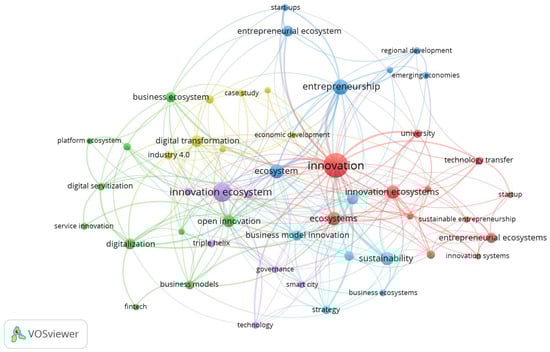
Figure 4.
Map of co-occurrence of keywords (minimum 5 occurrences).
Further analyzing the most used author keywords, the most emerging sub-topics can be envisioned. Based on their semantical meaning, all 49 keywords were divided into 6 categories (Table 8).
Table 8.
Keyword categories in innovation ecosystem development research.
As can be seen in Table 8, 6 keyword categories in innovation ecosystem development research, namely, related to innovation, ecosystem, entrepreneurship, sustainability, digitalization, and economic development. Some keywords were attached to more than one category, and some general keywords were not attached to any category (i.e., Universit*, Collaboration, Case study, Governance, China, and Research).
In order to map the interest of the authors depending on time, keyword co-occurrence in different years of analysis was provided. An overlay visualization is provided in Figure 5.
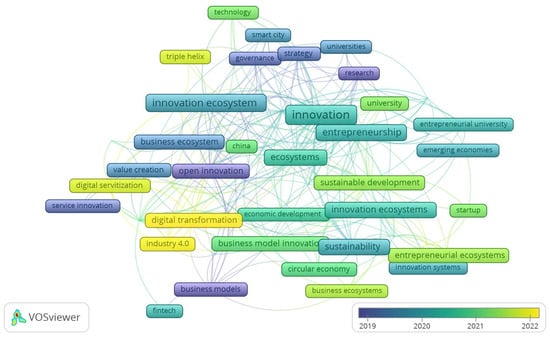
Figure 5.
Overlay visualization of co-occurrence of keywords (minimum 5 occurrences).
The overlay visualization provided in Figure 5 represents time-related keyword co-occurrences. The keywords attached to the general category of innovations (e.g., open innovation and service innovation) emerged earlier in the analyzed time span. Keywords related to ecosystems (e.g., ecosystems, business ecosystem, innovation ecosystem*) and entrepreneurship (e.g., entrepreneurship, entrepreneurial university, entrepreneurial ecosystems) emerged after 2020. As with the latest trend of author keyword co-occurrence, digitalization (e.g., digital servitization, digital transformation) and economic development (industry 4.0) can be observed. Also, the emergence of the keyword “triple helix” demonstrates the collaboration and technology transfer among university, industry, and government to reinforce entrepreneurial, societal, cultural, and policy competencies based on knowledge, innovation, and consensus [73].
3.5. Citation Analysis
Citation analysis was provided to identify the most cited articles in the field of innovation ecosystem development. The analysis enables determining the topics attracting higher researcher interest and identifying the articles that provide the most valuable information. Moreover, the results of citation analysis provide future research guidelines for scholars interested in the development of the domain.
While analyzing all 401 articles published from 2013 to 2023, 15,460 citations were detected. After extracting the square root of 15,460, it was decided that the number of 124 citations per document is the lower boundary for the article to be considered as prominent. 22 articles were found to have more than 124 citations. The bibliographic description of the selected articles is provided in Table 9.
Table 9.
The top-cited articles in innovation ecosystem development research.
The bibliographic description of all 22 articles having more than 124 citations each is provided in Table 9. Only one document was cited more than a thousand times: the article titled “Industry platforms and ecosystem innovation” [74] published in 2014 has accumulated 1171 citations so far. Five articles have been cited between 500 and 1000 times: “Smart tourism: foundations and developments” [75] was cited 958 times, “The digital platform: A research agenda” [76] was cited 808 times, “Service innovation in the digital age: Key contributions and future directions” [77]—659 times, “The open innovation research landscape: established perspectives and emerging themes across different levels of analysis” [68]—609 times, and “Profiting from innovation in the digital economy: Enabling technologies, standards, and licensing models in the wireless world” [68] had 581 citations. The most recent article titled “Digital Sustainability and Entrepreneurship: How Digital Innovations Are Helping Tackle Climate Change and Sustainable Development” [87] was published in 2021 and has already accumulated 188 citations.
Bibliographic coupling of the 22 most cited documents revealed the existence of 5 clusters based on citations (Table 10).
Table 10.
The research clusters in the field of innovation ecosystem development.
Being a form of document coupling for science mapping purposes, bibliographic coupling indicates the frequency with which two documents are cited together and the co-citation strength as the number of identical citing items [91]. The articles in the first identified cluster are mainly related to innovations in general. This cluster is the broadest (7 articles). The second large cluster gathers 5 articles, mainly related to smart tourism; therefore, the second important research direction can be envisioned in the adaptation and application of technologies in tourism and other service-related industries. The third cluster, with three publications, is devoted to digitalization and digital development, while the fourth cluster, with three articles, mainly focuses on entrepreneurship and entrepreneurial ecosystems. Finally, as can be noticed in Table 10, four publications were attached to a non-representative cluster, as were not connected to other publications (TLS = 0). If considering the articles that had no connection to other prominent publications, a research direction related to sustainability issues can be envisioned.
4. Discussion
Innovation is rapidly growing and affecting various industries [5]. The concept of an innovation ecosystem is focused on creating innovative and technology-led firms, districts, or nations, relying on synergistic relationships among innovative research institutions and universities, scientific and technological talent, institutional and socio-economic environments, and well-developed basic program research [92,93]. This study aimed to outline the current trends in the field of innovation ecosystem development and future research directions by providing bibliometric analysis. Bibliometric analyses are increasingly used to evaluate the quantitative and qualitative aspects of research trends and performance in a specific area of interest and to identify future research directions for scientists, policymakers, institutions, and funding agencies [40,53,54]. In this review, bibliometric analysis was performed to answer four research questions.
The first question was: what is the annual change in the number of scientific publications regarding Innovation Ecosystem Development? To answer this question, we identified 401 publications published during the recent decade in the Scopus database. In the social sciences and humanities, it is more common to publish in books, and international journals play a less prominent role [94]. A steady growth of scientific articles was detected, starting from 1 article published in 2013 and evolving to 78 articles published in 2021 and 2022. Latter growth implies a growing interest in the area, indicating that it is still underresearched. The growing researcher interest can be evaluated as a positive feature for researchers who want to become pioneers in the field.
Secondly, the study aimed to determine the most productive countries, academic institutions, journals, and authors. 84 countries contributing to the research of innovation ecosystem development were identified; however, only half of them have published 3 or more articles per country, and 19 countries (22.6 percent) have published more than 10 articles each. The most productive countries were identified as the United Kingdom (93 articles), the United States (48 articles), and Finland (39 articles). However, the number of published articles does not guarantee the number of citations [95]. Citing scientists are those who read the article and find it relevant and useful and wish to associate their work with it [96]; therefore, the quality of the paper is much more important than the quantity of published papers. The example of South Korea, which has published 4 papers during the analyzed period and accumulated 1015 citations, proves this. Further analysis of the collaboration patterns between countries revealed that the most collaborating countries were also the most productive. Moreover, inter-country collaboration enables the publishing of high-quality research acknowledged by a broader audience of scholars worldwide.
The analysis of the most prolific institutions revealed the interest of Nordic and UK universities (Luleå University of Technology, Sweden with 10 articles; University of Vaasa, Finland; Copenhagen Business School, Denmark; and University of Cambridge, the United Kingdom with 9 articles each; Aalto University, Finland, with 8 articles) in the field of innovation ecosystem development. Out of 17 institutions having published 5 or more articles, 14 were from Europe. However, as in the case of the most productive countries, the most cited institutions were not the same as the most productive and were from the United States (the University of California, Berkeley has published 5 articles accumulating 7749 citations), Australia (The University of Queensland has published 6 articles accumulating 1097 citations), and the United Kingdom (University of Cambridge with 9 articles and 1041 citations). The number of citations may be regarded as a measure of usefulness, impact, or influence [94]. As the probability of being cited depends on many factors [95], it might be envisioned that the name of the university can reinforce scholars’ interest in the publication. Therefore, inter-university cooperation can help peripheral universities gain attention and fortify their positions in the field.
The analysis of the most productive authors revealed that 68 authors have co-authored more than 1 publication, and only 12 have co-authored more than 2 publications published during the latter decade on innovation ecosystem development. Once again, the high number of publications did not attract the highest number of citations. For example, the most productive author Parida V. has co-authored 9 articles which were cited 388 times, while Gawer A. has published 3 articles cited 1897 times, and Buhalis D. has published 4 articles cited 987 times. This discrepancy could be explained by previous research indicating that citations of the persuasive type when the paper is authored by a recognized authority in the field account for about 5 percent to 40 percent [95].
The analyzed 401 articles were published in 184 journals; 15 journals published 5 or more articles meeting the search requirements. The journals published by Elsevier have published the highest number of articles and have accumulated the highest numbers of citations. Journal-dependent factors, such as the impact, quality, or prestige of the journal, may influence the number of citations [95]. This implies the importance of the careful choice of the journal for beginner authors, considering that many published papers remain unnoticed or unread, never get cited, or are only self-cited by the authors of the paper [96].
The third research question was related to the identification of the most prominent keywords used in articles published during the last decade in the field of innovation ecosystem development. The scientific literature indicates that keywords coherently explain the content of the document [71]. Therefore, to identify the current themes, existing research trends, and the mostly analyzed aspects of innovation ecosystem development, most occurrent keywords and their interrelations were identified. Out of 1437 keywords provided in the analyzed articles, 49 keywords were identified 5 or more times. The most occurrent keywords were “innovation” (66 occurrences), “innovation ecosystem” (40 occurrences), “innovation ecosystems” (20 occurrences), “ecosystem” (21 occurrences), “ecosystems” (19 occurrences), and “entrepreneurship” (26 occurrences). The keyword repetition bias was observed, resulting in the usage of the keyword in its singular or plural form. Therefore, for the researchers, it is recommended to ascertain the correctness of the keywords used before publishing. Keyword co-occurrence analysis identified the existence of 6 emerging sub-topics in the field of innovation ecosystem development, namely: (1) Innovation; (2) Ecosystem; (3) Entrepreneurship; (4) Sustainability; (5) Digitalization; (6) Economic development. The identified sub-topics outline the most prominent research trends to be considered by the researchers planning to excel in the field. The analysis of author keyword co-occurrences also revealed an attention shift from general innovation-related topics to digitalization. Moreover, the recent emergence of the keyword “triple helix” demonstrates the search for synergy among the actors. A previous systematic review of scientific literature on the triple helix and its evolution [97] identified four research clusters, namely: innovation and knowledge policies; entrepreneurial universities; business innovation strategy; and triple helix stakeholders in innovation, knowledge, and regional development. Therefore, the results of the current analysis support the previously established research trends.
Finally, the research aimed to determine the most-cited articles in the field of Innovation Ecosystem Development. Determining the most cited articles enables the identification of the topics attracting the most attention and recognition among researchers. Therefore, based on the articles attracting the most attention, future research directions can be identified. Usually, citations are assumed to reflect the impact of the research or its quality [94]. Citation counts are used to evaluate the importance of scientific work [95]. The citation analysis identified the most attractive topics and articles in the field of innovation ecosystem development. Based on the results of citation analysis, scholars can plan their future research in the domain. The analysis enabled us to identify 22 articles with more than 124 citations. The most cited article “Industry platforms and ecosystem innovation” written by Gawer, A. and Cusumano, M.A. in 2014 had accumulated 1171 citations. Obviously, the number of citations was affected by time-dependent factors: due to the exponential increase in scientific output, citations become more probable from year to year [95]. The provided analysis found 58 articles (14.5 percent) that have not been cited so far. However, it should be admitted that a lack of citations does not necessarily mean that a paper is of lower quality [96].
Bibliographic coupling of the 22 most cited articles resulted in 4 clusters based on citations: (1) Innovation; (2) Smart tourism; (3) Digitalization; and (4) Entrepreneurship. Latter clustering outlines the sub-topics in the field of innovation ecosystem development, attracting most researchers’ attention. Also, the four most cited articles did not fall into any of the identified clusters; however, based on their content, a research direction related to sustainability issues can be envisioned. The obtained results complement previous findings based on an analysis of 40 articles [5], suggesting the existence of five streams of current innovation ecosystem research: technology innovation, platform innovation ecosystems, regional development, innovation ecosystem conceptualization and theorization, and entrepreneurship and innovation.
In summary, future research contributing to the development of the domain should be focused on:
- Innovations in general. The research considering innovations in general can be devoted to various classifications of innovations, innovation management, innovation systems, and ecosystems. Considering the results obtained by keyword co-occurrence in different years, the recently emerged topics were related to business model innovation and triple, quadruple, and quintuple innovation helix. Therefore, to further develop the domain, it is recommended that researchers search for gaps in the latter fields.
- Entrepreneurship and economic development. Future research directed to this trend should be oriented toward analyzing various aspects of innovations and innovation ecosystems related to entrepreneurship and value creation. Various aspects of entrepreneurship and business innovation might be addressed. Based on the time-related keyword co-occurrence analysis, the currently emergent topics, i.e., Industry 4.0, business and entrepreneurial ecosystems, and sustainable entrepreneurship were also identified. Also, the researchers’ interest in SMEs emerged.
- Digital innovations and digitalization. The digitalization-related trend of innovation ecosystem development research should encompass the ultimate technological developments, technology digitalization, the Internet of Things, and other digital ecosystems. Time span analysis of keywords revealed the emerging keywords as “digital technologies” and “digital servitization”, resulting in the general focus on digital transformations. Moreover, the Industry 4.0 framework can be applied as a research background.
- Sustainable development. Research devoted to sustainable development should be directed toward analyzing the sustainability aspects of innovations and innovation ecosystems. This trend is also related to the usage of innovation for sustainable economic development and a circular economy. The analysis of keyword co-occurrence distribution over time revealed the focus shift from sustainability in general through sustainable development to sustainable entrepreneurship.
- Smart environment. This research trend encompasses research on various smart environments: smart cities, smart tourism destinations, smart hospitality, and other forms of smart environments. In this topic, initial research attention was focused on smart business ecosystems, smart technology, and smart tourism. At the end of the second decade, the research focus shifted to smart city/cities, and recently emerged keywords as “smartification”, “smart communities”, and “smart city transitions”.
Table 11 provides a general overview of some of the key findings related to the identified research areas related to the development of innovation ecosystems.
Table 11.
The prospective research fields for the discourse on the innovation ecosystem and its development.
Several implications for the researchers can be added. The study revealed that some articles remain uncited and therefore unrecognized. Two explanations might serve the issue: either the article is uninteresting or does not provide any useful insight to be cited, or it gets lost in the abundance of information. Therefore, to avoid such a situation, researchers are encouraged to think about the possible dissemination of their work in advance before publishing the article. Firstly, an attractive, intriguing, and inviting title must be created; secondly, the right keywords must be chosen. Researchers should consider the singularity or plurality of some keywords because, as the results show, there are different practices in academia in this regard. Finally, to attract the attention of other scholars, the content of the article must be interesting and provide at least several insights for other researchers to disseminate the idea further.
Summarizing our review, we must admit that extensive and comprehensive future research in the field of innovation ecosystem development is required to explore and identify the relationships within and between the determined topics and subtopics composing the domain.
5. Conclusions
A review of scientific articles published in the field of innovation ecosystem development in the Scopus database during the last decade revealed that the field is still emerging. The study found 401 articles published during the decade (67 articles were published in 2023).
The study revealed that inter-collaboration between countries and institutions was not high; the most collaborating countries were the United Kingdom and the United States. Therefore, it must be noted that collaboration between countries and institutions enhances the visibility and readability of publications. Considering the journals, articles published by well-known publishers attracted more citations compared to the universities’ publishing houses. Although the number of published articles might affect the number of citations, the results indicate that other factors (e.g., the university’s name or well-known co-authors) are also important. Researchers seeking to make their work visible and acknowledged by other scholars are encouraged to search for connections and collaborate to excel in the domain.
The keyword and citation analysis revealed the emergence of five future research directions, namely: (1) Innovations in general; (2) Entrepreneurship and economic development; (3) Digital innovations and digitalization; (4) Sustainable development; and (5) Smart environment. It must be admitted that, considering the infancy and constant development of the domain, more trends might emerge in the future.
Several limitations of the study should be mentioned. Firstly, the research was limited to open-access articles published in the English language in the field of Business, Management, and Accounting in the Scopus database. Expanding the search boundaries to other databases (e.g., Web of Science), including other types of publications (e.g., book chapters, reviews, etc.), and removing the restriction “All open access”, would open a wider picture of the domain. Moreover, studies published in different languages might provide some regional or country-specific insights.
Secondly, the research limitation might be envisioned in the research method. The study was conducted mainly quantitatively. Quantitative information enables the determination of current trends and future research directions; however, it is not open to details that could emerge in the case of qualitative analysis. Qualitative analysis of the identified articles could disclose a more precise picture of the domain and also indicate the existing sub-topics. Therefore, a systematic literature review based on qualitative indicators is necessary.
Author Contributions
Conceptualization, L.P. and G.J.; methodology, L.P. and G.J.; software, L.P. and G.J.; validation, L.P. and G.J.; formal analysis, L.P.; investigation, L.P. and G.J.; resources, L.P.; data curation, L.P. and G.J.; writing—original draft preparation, L.P. and G.J.; writing—review and editing, G.J.; visualization, L.P.; supervision, G.J.; project administration, G.J.; funding acquisition, G.J. All authors have read and agreed to the published version of the manuscript.
Funding
This research was funded by the Research Council of Lithuania under the research project SMARTORG, “Smart development of organizational knowledge ecosystem” (C. No. S-MIP-21-49).
Acknowledgments
The authors would like to thank Vytautas Magnus University for the organizational support and the Research Council of Lithuania for the financial support of this study. Also, we express our great gratitude to the Reviewers for the thorough assessment and substantive scientific discussion.
Conflicts of Interest
The authors declare no conflict of interest. The funders had no role in the design of the study; in the collection, analyses, or interpretation of data; in the writing of the manuscript; or in the decision to publish the results.
References
- Dimitrijević, M.S. Technological Progress in the Function of Productivity and Sustainability of Agriculture: The Case of Innovative Countries and the Republic of Serbia. J. Agric. Food Res. 2023, 14, 100856. [Google Scholar] [CrossRef]
- Sharma, G.; Dahlstrand, Å.L. Innovations, Informality, and the Global South: A Thematic Analysis of Past Research and Future Directions. Technol. Soc. 2023, 75, 102359. [Google Scholar] [CrossRef]
- Do Amaral, J.V.S.; Dos Santos, C.H.; Montevechi, J.A.B.; De Queiroz, A.R. Energy Digital Twin Applications: A Review. Renew. Sustain. Energy Rev. 2023, 188, 113891. [Google Scholar] [CrossRef]
- Marquez, R.; Barrios, N.; Vera, R.E.; Mendez, M.E.; Tolosa, L.; Zambrano, F.; Li, Y. A Perspective on the Synergistic Potential of Artificial Intelligence and Product-Based Learning Strategies in Biobased Materials Education. Educ. Chem. Eng. 2023, 44, 164–180. [Google Scholar] [CrossRef]
- Al-Sulaiti, A.; Madhoun, I.T.; Abdella, G.M.; Al-Yafei, H.; Hamouda, A.M. Innovation Ecosystems in Hydrocarbon-Based Economies: Opportunities and Challenges. Sustainability 2023, 15, 14194. [Google Scholar] [CrossRef]
- Jie, H.; Zaman, S.; Zaman, Q.U.; Shah, A.H.; Lou, J. A Pathway to a Sustainable Future: Investigating the Contribution of Technological Innovations, Clean Energy, and Women’s Empowerment in Mitigating Global Environmental Challenges. J. Clean. Prod. 2023, 421, 138499. [Google Scholar] [CrossRef]
- Golley, F.B. A History of the Ecosystem Concept in Ecology: More than the Sum of the Parts; Yale University Press: New Haven, CT, USA, 1996; ISBN 0-300-06642-2. [Google Scholar]
- Mars, M.M.; Bronstein, J.L. The Promise of the Organizational Ecosystem Metaphor: An Argument for Biological Rigor. J. Manag. Inq. 2018, 27, 382–391. [Google Scholar] [CrossRef]
- Winterhaider, B. Reconsidering the Ecosystem Concept. Rev. Anthropol. 1984, 11, 301–313. [Google Scholar] [CrossRef]
- Rothschild, M. Bionomics: Economy as Business Ecosystem; Beard Books Inc.: Fairless Hills, PA, USA, 1990. [Google Scholar]
- Moore, J.F. Predators and Prey: A New Ecology of Competition. Harv. Bus. Rev. 1993, 71, 75–86. [Google Scholar] [PubMed]
- Moore, J.F. The Death of Competition: Leadership and Strategy in the Age of Business Ecosystems; Harper Paperbacks: New York, NY, USA, 1997. [Google Scholar]
- Normann, R.; Ramírez, R. From Value Chain to Value Constellation: Designing Interactive Strategy. Harv. Bus. Rev. 1993, 71, 65–77. [Google Scholar]
- Porter, M.E. Clusters and the New Economics of Competition. Harv. Bus. Rev. 1998, 76, 77–90. [Google Scholar] [PubMed]
- Jacobides, M.G. Industry Change through Vertical Disintegration: How and Why Markets Emerged in Mortgage Banking. Acad. Manag. J. 2005, 48, 465–498. [Google Scholar] [CrossRef]
- Adner, R. Match Your Innovation Strategy to Your Innovation Ecosystem. Harv. Bus. Rev. 2006, 84, 98–107,148. [Google Scholar] [PubMed]
- Still, K.; Huhtamäki, J.; Russell, M.G.; Rubens, N. Insights for Orchestrating Innovation Ecosystems: The Case of EIT ICT Labs and Data-Driven Network Visualisations. Int. J. Technol. Manag. 2014, 66, 243. [Google Scholar] [CrossRef]
- Nambisan, S.; Baron, R.A. Entrepreneurship in Innovation Ecosystems: Entrepreneurs’ Self–Regulatory Processes and Their Implications for New Venture Success. Entrep. Theory Pract. 2013, 37, 1071–1097. [Google Scholar] [CrossRef]
- Jackson, D.J. What Is an Innovation Ecosystem; National Science Foundation: Arlington, VA, USA, 2011.
- Brusoni, S.; Prencipe, A. The Organization of Innovation in Ecosystems: Problem Framing, Problem Solving, and Patterns of Coupling. In Advances in Strategic Management; Emerald Group Publishing Limited: Bingley, UK, 2013; pp. 167–194. ISBN 978-1-78190-826-6. [Google Scholar]
- Carayannis, E.G.; Campbell, D.F. Developed Democracies versus Emerging Autocracies: Arts, Democracy, and Innovation in Quadruple Helix Innovation Systems. J. Innov. Entrep. 2014, 3, 12. [Google Scholar] [CrossRef]
- Autio, E.; Thomas, L.D.W. Innovation Ecosystems; Oxford University Press: Oxford, UK, 2014. [Google Scholar]
- Dattée, B.; Alexy, O.; Autio, E. Maneuvering in Poor Visibility: How Firms Play the Ecosystem Game When Uncertainty Is High. Acad. Manag. J. 2018, 61, 466–498. [Google Scholar] [CrossRef]
- Järvi, K.; Almpanopoulou, A.; Ritala, P. Organization of Knowledge Ecosystems: Prefigurative and Partial Forms. Res. Policy 2018, 47, 1523–1537. [Google Scholar] [CrossRef]
- Frenkel, A.; Maital, S. Mapping National Innovation Ecosystems: Foundations for Policy Consensus; Edward Elgar Publishing: Cheltenham, UK, 2014; ISBN 978-1-78254-681-8. [Google Scholar]
- Xu, G.; Wu, Y.; Minshall, T.; Zhou, Y. Exploring Innovation Ecosystems across Science, Technology, and Business: A Case of 3D Printing in China. Technol. Forecast. Soc. Change 2018, 136, 208–221. [Google Scholar] [CrossRef]
- Valkokari, K. Business, Innovation, and Knowledge Ecosystems: How They Differ and How to Survive and Thrive within Them. Technol. Innov. Manag. Rev. 2015, 5, 17–24. [Google Scholar] [CrossRef]
- O’Gorman, C.; Kautonen, M. Policies to Promote New Knowledge-Intensive Industrial Agglomerations. Entrep. Reg. Dev. 2004, 16, 459–479. [Google Scholar] [CrossRef]
- Carapiet, S.; Harris, H. Role of Self-Organisation in Facilitating Adaptive Organisation: A Proposed Index for the Ability to Self-Organise. Prod. Plan. Control 2007, 18, 466–474. [Google Scholar] [CrossRef]
- Lockett, N.; Jack, S.; Larty, J. Motivations and Challenges of Network Formation: Entrepreneur and Intermediary Perspectives. Int. Small Bus. J. 2013, 31, 866–889. [Google Scholar] [CrossRef]
- Ingstrup, M.B.; Damgaard, T. Cluster Facilitation from a Cluster Life Cycle Perspective. Eur. Plan. Stud. 2013, 21, 556–574. [Google Scholar] [CrossRef]
- Jucevičius, G.; Grumadaitė, K.; Staniulienė, S. Knowledge Ecosystems as Complex Adaptive Systems: Between Myth and Reality. In Proceedings of the ECKM 2021 22nd European Conference on Knowledge Management, Coventry, UK, 2–3 September 2021; pp. 397–403. [Google Scholar]
- Oh, D.-S.; Phillips, F.; Park, S.; Lee, E. Innovation Ecosystems: A Critical Examination. Technovation 2016, 54, 1–6. [Google Scholar] [CrossRef]
- Klimas, P.; Czakon, W. Species in the Wild: A Typology of Innovation Ecosystems. Rev. Manag. Sci. 2022, 16, 249–282. [Google Scholar] [CrossRef]
- Zeng, S.; Yang, H. A Bibliometric and Visualization Analysis of Knowledge Mapping in Digital Economy Research, 1992–2022. Sustainability 2023, 15, 6565. [Google Scholar] [CrossRef]
- Wu, S.; Junior, B.M. Emerging Technologies and Global Health: A Systematic Review Generating Bibliometric Evidence for Innovation Management. BMJ Innov. 2023, 9, 165–176. [Google Scholar] [CrossRef]
- Tang, J.; Fang, Y.; Tian, Z.; Gong, Y.; Yuan, L. Ecosystem Services Research in Green Sustainable Science and Technology Field: Trends, Issues, and Future Directions. Sustainability 2022, 15, 658. [Google Scholar] [CrossRef]
- Espina-Romero, L.; Guerrero-Alcedo, J.; Noroño Sánchez, J.G.; Ochoa-Díaz, A. What Are the Topics That Business Ecosystems Navigate? Updating of Scientific Activity and Future Research Agenda. Sustainability 2022, 14, 16224. [Google Scholar] [CrossRef]
- Pigola, A.; Da Costa, P.R.; Porto, G.; Mazieri, M.R. Towards a Comprehensive Conceptualization of Relational Capabilities: An Innovation Management Perspective. J. Innov. Manag. 2023, 10, 1–25. [Google Scholar] [CrossRef]
- Guindalini, C.; Verreynne, M.-L.; Kastelle, T. Taking Scientific Inventions to Market: Mapping the Academic Entrepreneurship Ecosystem. Technol. Forecast. Soc. Change 2021, 173, 121144. [Google Scholar] [CrossRef]
- Soehartono, A.M.; Khor, K.A. Critical Assessment of Technological Development: What Can Bibliometrics Reveal? Sch. Assess. Rep. 2020, 2, 4. [Google Scholar] [CrossRef]
- Alsharif, A.H.; Salleh, N.Z.M.; Abdullah, M.; Khraiwish, A.; Ashaari, A. Neuromarketing Tools Used in the Marketing Mix: A Systematic Literature and Future Research Agenda. SAGE Open 2023, 13, 215824402311565. [Google Scholar] [CrossRef]
- Alsharif, A.H.; Salleh, N.Z.M.; Baharun, R.; Hashem, E.A.R.; Mansor, A.A.; Ali, J.; Abbas, A.F. Neuroimaging Techniques in Advertising Research: Main Applications, Development, and Brain Regions and Processes. Sustainability 2021, 13, 6488. [Google Scholar] [CrossRef]
- Shukla, A.K.; Muhuri, P.K.; Abraham, A. A Bibliometric Analysis and Cutting-Edge Overview on Fuzzy Techniques in Big Data. Eng. Appl. Artif. Intell. 2020, 92, 103625. [Google Scholar] [CrossRef]
- Donthu, N.; Kumar, S.; Mukherjee, D.; Pandey, N.; Lim, W.M. How to Conduct a Bibliometric Analysis: An Overview and Guidelines. J. Bus. Res. 2021, 133, 285–296. [Google Scholar] [CrossRef]
- Page, M.J.; McKenzie, J.E.; Bossuyt, P.M.; Boutron, I.; Hoffmann, T.C.; Mulrow, C.D.; Shamseer, L.; Tetzlaff, J.M.; Akl, E.A.; Brennan, S.E.; et al. The PRISMA 2020 Statement: An Updated Guideline for Reporting Systematic Reviews. BMJ 2021, 372, 71. [Google Scholar] [CrossRef]
- Sánchez, A.D.; De La Cruz Del Río Rama, M.; García, J.Á. Bibliometric Analysis of Publications on Wine Tourism in the Databases Scopus and WoS. Eur. Res. Manag. Bus. Econ. 2017, 23, 8–15. [Google Scholar] [CrossRef]
- Kumpulainen, M.; Seppänen, M. Combining Web of Science and Scopus Datasets in Citation-Based Literature Study. Scientometrics 2022, 127, 5613–5631. [Google Scholar] [CrossRef]
- Suárez, D.; Peralta, M.J.; Piedra, Y.; Navarro, M.A. Thematic Coverage of CRIS in WoS, Scopus and Dimensions (2000–2020). Procedia Comput. Sci. 2022, 211, 170–186. [Google Scholar] [CrossRef]
- De Granda-Orive, J.I.; Alonso-Arroyo, A.; Roig-Vázquez, F. Which Data Base Should We Use for Our Literature Analysis? Web of Science versus SCOPUS. Arch. Bronconeumol. Engl. Ed. 2011, 47, 213. [Google Scholar] [CrossRef]
- Słupińska, K.; Duda, J.; Biercewicz, K. Planning an Experiment in a Virtual Environment Reality as a Place of Research on Human Behaviour Using Methods of Neuroscience Measurement—Bibliometric Analysis and Methodological Approach. Procedia Comput. Sci. 2021, 192, 3123–3133. [Google Scholar] [CrossRef]
- Alsharif, A.; Md Salleh, N.Z.; Pilelienė, L.; Abbas, A.F.; Ali, J. Current Trends in the Application of EEG in Neuromarketing: A Bibliometric Analysis. Sci. Ann. Econ. Bus. 2022, 69, 393–415. [Google Scholar] [CrossRef]
- Alsharif, A.; Salleh, N.Z.M.; Pilelienė, L. A Comprehensive Bibliometric Analysis of fNIRS and fMRI Technology in Neuromarketing. Sci. Ann. Econ. Bus. 2023, 70, 459–472. [Google Scholar] [CrossRef]
- Alsharif, A.H.; Salleh, N.Z.M.; Al-Zahrani, S.A.; Khraiwish, A. Consumer Behaviour to Be Considered in Advertising: A Systematic Analysis and Future Agenda. Behav. Sci. 2022, 12, 472. [Google Scholar] [CrossRef]
- Ito, J.Y.; Silveira, F.F.; Munhoz, I.P.; Akkari, A.C.S. International Publication Trends in Lean Agile Management Research: A Bibliometric Analysis. Procedia Comput. Sci. 2023, 219, 666–673. [Google Scholar] [CrossRef]
- Andrés, A. Author Production. In Measuring Academic Research; Elsevier: Amsterdam, The Netherlands, 2009; pp. 23–30. ISBN 978-1-84334-528-2. [Google Scholar]
- Santoro, G.; Vrontis, D.; Thrassou, A.; Dezi, L. The Internet of Things: Building a Knowledge Management System for Open Innovation and Knowledge Management Capacity. Technol. Forecast. Soc. Change 2018, 136, 347–354. [Google Scholar] [CrossRef]
- Henry, M.; Bauwens, T.; Hekkert, M.; Kirchherr, J. A Typology of Circular Start-Ups: An Analysis of 128 Circular Business Models. J. Clean. Prod. 2020, 245, 118528. [Google Scholar] [CrossRef]
- McAdam, M.; Miller, K.; McAdam, R. Situated Regional University Incubation: A Multi-Level Stakeholder Perspective. Technovation 2016, 50–51, 69–78. [Google Scholar] [CrossRef]
- Majava, J.; Leviäkangas, P.; Kinnunen, T.; Kess, P.; Foit, D. Spatial Health and Life Sciences Business Ecosystem: A Case Study of San Diego. Eur. J. Innov. Manag. 2016, 19, 26–46. [Google Scholar] [CrossRef]
- Melo Brito, C. Promoting the Creation of Innovation Ecosystems: The Case of the University of Porto. J. Innov. Manag. 2018, 6, 8–16. [Google Scholar] [CrossRef]
- Rucker Schaeffer, P.; Fischer, B.; Queiroz, S. Beyond Education: The Role of Research Universities in Innovation Ecosystems. Foresight STI Gov. 2018, 12, 50–61. [Google Scholar] [CrossRef]
- Audretsch, D.B.; Belitski, M. Entrepreneurial Ecosystems in Cities: Establishing the Framework Conditions. J. Technol. Transf. 2017, 42, 1030–1051. [Google Scholar] [CrossRef]
- Rocha, C.; Quandt, C.; Deschamps, F.; Philbin, S.; Cruzara, G. Collaborations for Digital Transformation: Case Studies of Industry 4.0 in Brazil. IEEE Trans. Eng. Manag. 2023, 70, 2404–2418. [Google Scholar] [CrossRef]
- Endres, H.; Huesig, S.; Pesch, R. Digital Innovation Management for Entrepreneurial Ecosystems: Services and Functionalities as Drivers of Innovation Management Software Adoption. Rev. Manag. Sci. 2022, 16, 135–156. [Google Scholar] [CrossRef]
- Prexl, K.; Hubert, M.; Beck, S.; Heiden, C.; Prügl, R. Identifying and Analysing the Drivers of Heterogeneity among Ecosystem Builder Accelerators. R&D Manag. 2019, 49, 624–638. [Google Scholar] [CrossRef]
- Rocha, A.K.L.D.; Moraes, G.H.S.M.D.; Fischer, B. The Role of University Environment in Promoting Entrepreneurial Behavior: Evidence from Heterogeneous Regions in Brazil. Innov. Manag. Rev. 2022, 19, 39–61. [Google Scholar] [CrossRef]
- Teece, D.J. Profiting from Innovation in the Digital Economy: Enabling Technologies, Standards, and Licensing Models in the Wireless World. Res. Policy 2018, 47, 1367–1387. [Google Scholar] [CrossRef]
- Condom-Vilà, P. How Technology Evolution and Disruption Are Defining the World’s Entrepreneurial Ecosystems: The Case of Barcelona’s Startup Ecosystem. J. Evol. Stud. Bus. 2020, 5, 14–51. [Google Scholar] [CrossRef]
- Zucchella, A.; Previtali, P. Circular Business Models for Sustainable Development: A “Waste Is Food” Restorative Ecosystem. Bus. Strat. Env. 2019, 28, 274–285. [Google Scholar] [CrossRef]
- Wang, M.; Chai, L. Three New Bibliometric Indicators/Approaches Derived from Keyword Analysis. Scientometrics 2018, 116, 721–750. [Google Scholar] [CrossRef]
- Alsharif, A.H.; Md Salleh, N.Z.; Baharun, R.; Rami Hashem, E.A. Neuromarketing Research in the Last Five Years: A Bibliometric Analysis. Cogent Bus. Manag. 2021, 8, 1978620. [Google Scholar] [CrossRef]
- Ranga, M.; Etzkowitz, H. Triple Helix Systems: An Analytical Framework for Innovation Policy and Practice in the Knowledge Society. Ind. High. Educ. 2013, 27, 237–262. [Google Scholar] [CrossRef]
- Gawer, A.; Cusumano, M.A. Industry Platforms and Ecosystem Innovation. J. Prod. Innov. Manag. 2014, 31, 417–433. [Google Scholar] [CrossRef]
- Gretzel, U.; Sigala, M.; Xiang, Z.; Koo, C. Smart Tourism: Foundations and Developments. Electron Mark. 2015, 25, 179–188. [Google Scholar] [CrossRef]
- De Reuver, M.; Sørensen, C.; Basole, R.C. The Digital Platform: A Research Agenda. J. Inf. Technol. 2018, 33, 124–135. [Google Scholar] [CrossRef]
- Barrett, M.; Davidson, E.; Prabhu, J.; Vargo, S.L. Service Innovation in the Digital Age: Key Contributions and Future Directions. MIS Q. 2015, 39, 135–154. [Google Scholar] [CrossRef]
- Bogers, M.; Zobel, A.-K.; Afuah, A.; Almirall, E.; Brunswicker, S.; Dahlander, L.; Frederiksen, L.; Gawer, A.; Gruber, M.; Haefliger, S.; et al. The Open Innovation Research Landscape: Established Perspectives and Emerging Themes across Different Levels of Analysis. Ind. Innov. 2017, 24, 8–40. [Google Scholar] [CrossRef]
- Clarysse, B.; Wright, M.; Bruneel, J.; Mahajan, A. Creating Value in Ecosystems: Crossing the Chasm between Knowledge and Business Ecosystems. Res. Policy 2014, 43, 1164–1176. [Google Scholar] [CrossRef]
- Spigel, B.; Harrison, R. Toward a Process Theory of Entrepreneurial Ecosystems. Strateg. Entrep. 2018, 12, 151–168. [Google Scholar] [CrossRef]
- Boes, K.; Buhalis, D.; Inversini, A. Smart Tourism Destinations: Ecosystems for Tourism Destination Competitiveness. Int. J. Tour. Cities 2016, 2, 108–124. [Google Scholar] [CrossRef]
- Buhalis, D.; Harwood, T.; Bogicevic, V.; Viglia, G.; Beldona, S.; Hofacker, C. Technological Disruptions in Services: Lessons from Tourism and Hospitality. J. Serv. Manag. 2019, 30, 484–506. [Google Scholar] [CrossRef]
- Buhalis, D. Technology in Tourism-from Information Communication Technologies to eTourism and Smart Tourism towards Ambient Intelligence Tourism: A Perspective Article. Tour. Rev. 2020, 75, 267–272. [Google Scholar] [CrossRef]
- Appio, F.P.; Lima, M.; Paroutis, S. Understanding Smart Cities: Innovation Ecosystems, Technological Advancements, and Societal Challenges. Technol. Forecast. Soc. Change 2019, 142, 1–14. [Google Scholar] [CrossRef]
- Guerrero, M.; Urbano, D.; Fayolle, A.; Klofsten, M.; Mian, S. Entrepreneurial Universities: Emerging Models in the New Social and Economic Landscape. Small Bus. Econ. 2016, 47, 551–563. [Google Scholar] [CrossRef]
- Anagnostopoulos, I. Fintech and Regtech: Impact on Regulators and Banks. J. Econ. Bus. 2018, 100, 7–25. [Google Scholar] [CrossRef]
- George, G.; Merrill, R.K.; Schillebeeckx, S.J.D. Digital Sustainability and Entrepreneurship: How Digital Innovations Are Helping Tackle Climate Change and Sustainable Development. Entrep. Theory Pract. 2021, 45, 999–1027. [Google Scholar] [CrossRef]
- Scaringella, L.; Radziwon, A. Innovation, Entrepreneurial, Knowledge, and Business Ecosystems: Old Wine in New Bottles? Technol. Forecast. Soc. Change 2018, 136, 59–87. [Google Scholar] [CrossRef]
- Walrave, B.; Talmar, M.; Podoynitsyna, K.S.; Romme, A.G.L.; Verbong, G.P.J. A Multi-Level Perspective on Innovation Ecosystems for Path-Breaking Innovation. Technol. Forecast. Soc. Change 2018, 136, 103–113. [Google Scholar] [CrossRef]
- Holgersson, M.; Granstrand, O.; Bogers, M. The Evolution of Intellectual Property Strategy in Innovation Ecosystems: Uncovering Complementary and Substitute Appropriability Regimes. Long Range Plan. 2018, 51, 303–319. [Google Scholar] [CrossRef]
- Jarneving, B. Bibliographic Coupling and Its Application to Research-Front and Other Core Documents. J. Informetr. 2007, 1, 287–307. [Google Scholar] [CrossRef]
- Huang, Y.; Li, K.; Li, P. Innovation Ecosystems and National Talent Competitiveness: A Country-Based Comparison Using fsQCA. Technol. Forecast. Soc. Change 2023, 194, 122733. [Google Scholar] [CrossRef]
- Reynolds, E.B.; Uygun, Y. Strengthening Advanced Manufacturing Innovation Ecosystems: The Case of Massachusetts. Technol. Forecast. Soc. Change 2018, 136, 178–191. [Google Scholar] [CrossRef]
- Aksnes, D.W.; Langfeldt, L.; Wouters, P. Citations, Citation Indicators, and Research Quality: An Overview of Basic Concepts and Theories. SAGE Open 2019, 9, 215824401982957. [Google Scholar] [CrossRef]
- Bornmann, L.; Daniel, H. What Do Citation Counts Measure? A Review of Studies on Citing Behavior. J. Doc. 2008, 64, 45–80. [Google Scholar] [CrossRef]
- Caon, M.; Trapp, J.; Baldock, C. Citations Are a Good Way to Determine the Quality of Research. Phys. Eng. Sci. Med. 2020, 43, 1145–1148. [Google Scholar] [CrossRef]
- Galvao, A.; Mascarenhas, C.; Marques, C.; Ferreira, J.; Ratten, V. Triple Helix and Its Evolution: A Systematic Literature Review. J. Sci. Technol. Policy Manag. 2019, 10, 812–833. [Google Scholar] [CrossRef]
Disclaimer/Publisher’s Note: The statements, opinions and data contained in all publications are solely those of the individual author(s) and contributor(s) and not of MDPI and/or the editor(s). MDPI and/or the editor(s) disclaim responsibility for any injury to people or property resulting from any ideas, methods, instructions or products referred to in the content. |
© 2023 by the authors. Licensee MDPI, Basel, Switzerland. This article is an open access article distributed under the terms and conditions of the Creative Commons Attribution (CC BY) license (https://creativecommons.org/licenses/by/4.0/).