Sustainability Assessment in Infrastructure Projects

 , and
, and 
Abstract
:1. Introduction
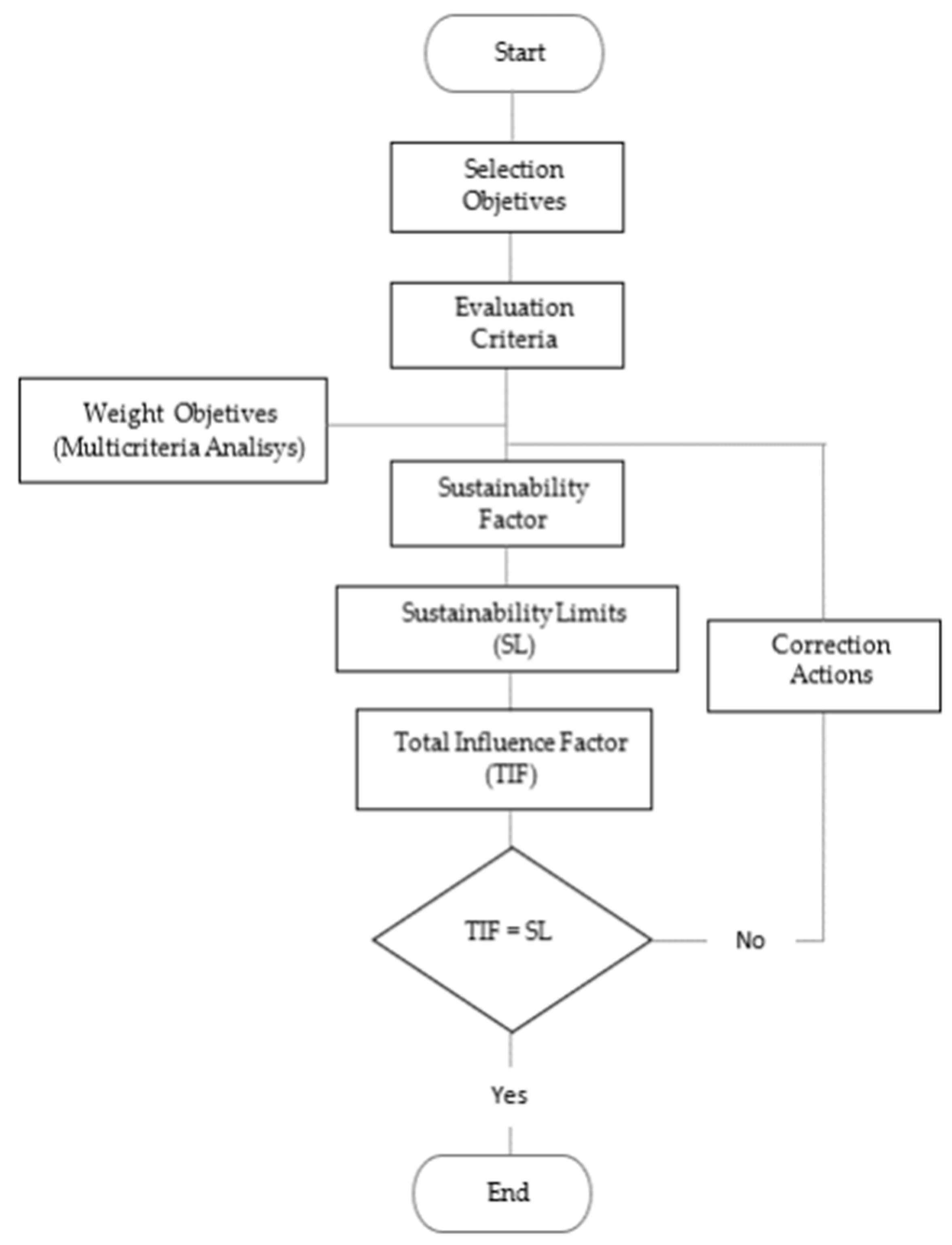
2. Materials and Methods
2.1. Selection of Objectives
- -
- Minimum residual impacts on the environment;
- -
- Profitability from the economic point of view;
- -
- Maximum functionality for users;
- -
- Maximum benefit for the affected territory.
2.2. Assessment Criteria
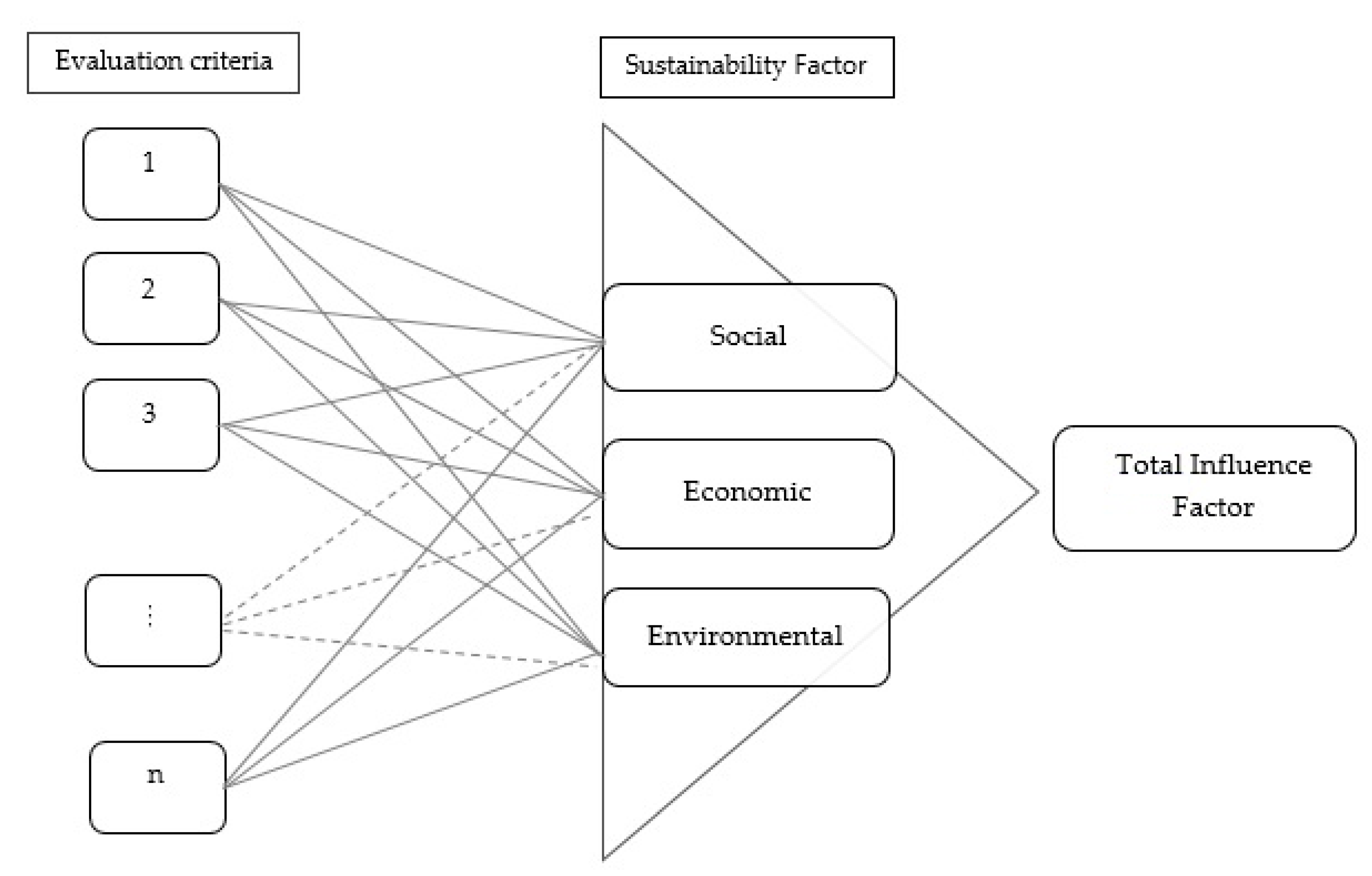
2.3. Sustainability Limits and Total Influence Factor (TIF)
3. Results and Discussion
3.1. Application of the Proposed Method for Sustainability Assessment of a Road Project
- -
- Road 1: El Villar de Arnedo bypass, Province of La Rioja;
- -
- Road 2: Connection alternatives between the Trujillo–Cáceres Highway (A-58) and the La Plata Highway (A-66) in the area of Cáceres, Province of Cáceres;
- -
- Highway 3: Bypass of the A-1 Highway, Section: Airport Axis Highway junction (M-12) and R-2 Highway, El Molar Bypass, Province of Madrid;
- -
- Road 4: Study of alternatives and development of the solution adopted for the new road connecting the municipalities of Onda and Betxi from “Carrer Tosalet hata Camí D’Onda, 33”, Province of Castellón;
- -
- Road 5: Inca Bypass, Modification of the section between the Ma-2130 (Lluc) and the MA-12 (Palma-Sa Pobla Highway), Province of Palma de Mallorca;
- -
- Road 6: Highway between Ávila (A-50) and the Northwest Highway (A-6).
3.2. Assessment of the Infrastructure
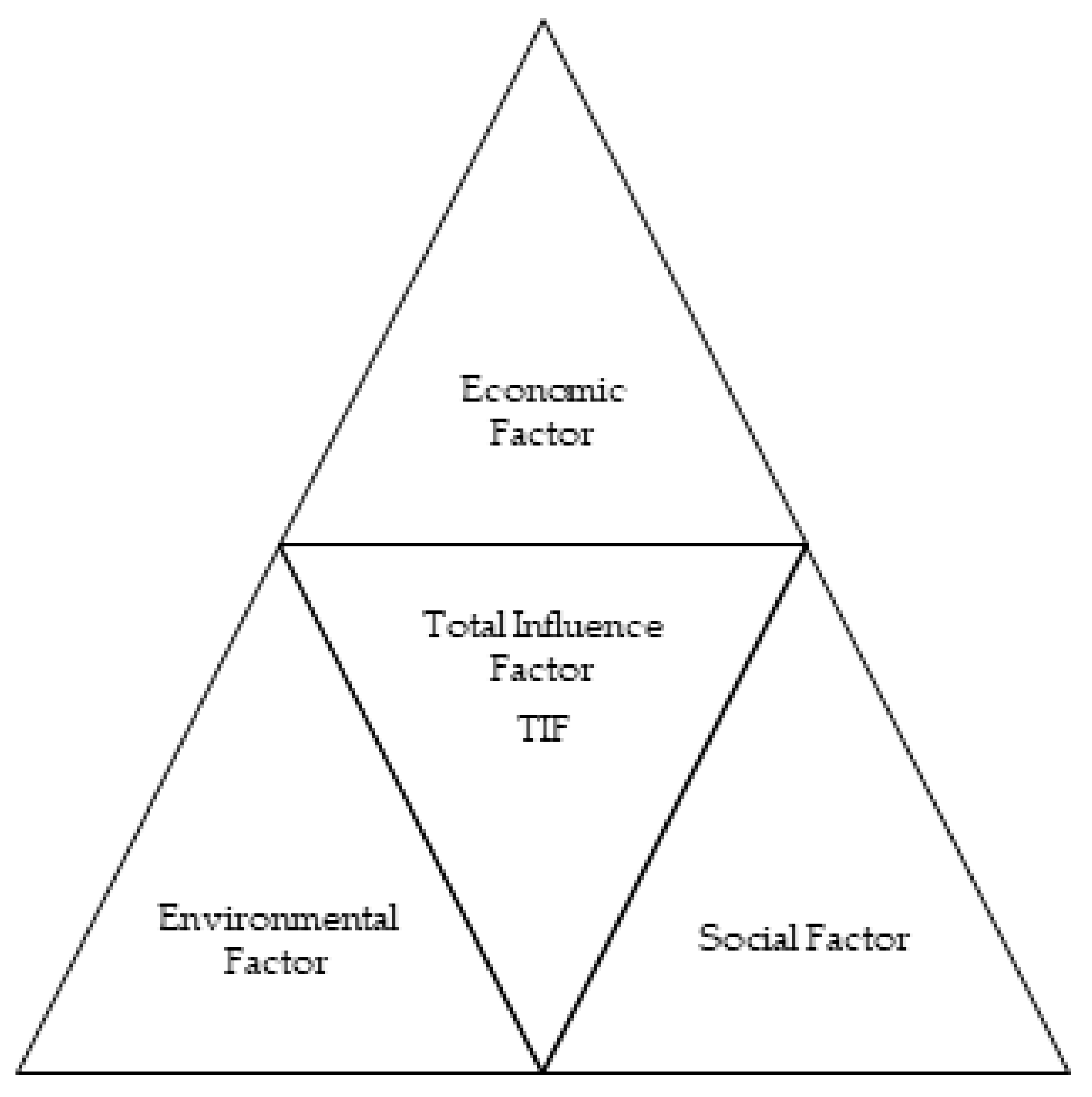
3.2.1. Assessment Triangle of the Project
3.2.2. Classification of the Infrastructure
3.2.3. Corrective Actions
4. Conclusions
Supplementary Materials
Author Contributions
Funding
Institutional Review Board Statement
Informed Consent Statement
Data Availability Statement
Acknowledgments
Conflicts of Interest
References
- Arce, R.; Gulloón, N. The Application of Strategic Environmental Assessment to Sustainability Assessment of Infrastructure Development. Environ. Impact Assess. Rev. 2000, 20, 393–402. [Google Scholar] [CrossRef]
- Jiang, X.; Zhang, L.; Xiong, C.; Wang, R. Transportation and Regional Economic Development: Analysis of Spatial Spillovers in China Provincial Regions. Netw. Spat. Econ. 2016, 16, 769–790. [Google Scholar] [CrossRef]
- Girardet, X.; Foltête, J.C.; Clauzel, C. Designing a Graph-Based Approach to Landscape Ecological Assessment of Linear Infrastructures. Environ. Impact Assess. Rev. 2013, 42, 10–17. [Google Scholar] [CrossRef]
- Min, J.H.; Jang, W.; Han, S.H.; Kim, D.; Kwak, Y.H. How Conflict Occurs and What Causes Conflict: Conflict Analysis Framework for Public Infrastructure Projects. J. Manag. Eng. 2018, 34, 04018019. [Google Scholar] [CrossRef]
- Swilling, M.; Hajer, M.; Baynes, T.; Bergesen, J.; Labbé, F.; Musango, J.K.; Anu Ramaswami, B.R.; Serge Salat, S.S. El Peso De Las Ciudades Los Recursos Que Exige La Urbanización Del Futuro; International Resource Panel: Paris, France, 2018. [Google Scholar]
- Marzouk, M.; Othman, A. Planning Utility Infrastructure Requirements for Smart Cities Using the Integration between BIM and GIS. Sustain. Cities Soc. 2020, 57, 102120. [Google Scholar] [CrossRef]
- Clevenger, C.M.; Ozbek, M.E.; Simpson, S. Review of Sustainability Rating Systems Used for Infrastructure Projects. In Proceedings of the 49th ASC Annual International Conference Proceedings, San Luis Obispo, CA, USA, 10–13 April 2013; pp. 10–13. [Google Scholar]
- Thacker, S.; Adshead, D.; Fay, M.; Hallegatte, S.; Harvey, M.; Meller, H.; O’Regan, N.; Rozenberg, J.; Watkins, G.; Hall, J.W. Infrastructure for Sustainable Development. Nat. Sustain. 2019, 2, 324–331. [Google Scholar] [CrossRef]
- Baird, J.; Callicott, K.M. Ecological Sustainability as a Conservation Concept. Conserv. Biol. 2002, 11, 32–40. [Google Scholar] [CrossRef]
- Maes, J.; Jacobs, S. Nature-Based Solutions for Europe’s Sustainable Development. Conserv. Lett. 2017, 10, 121–124. [Google Scholar] [CrossRef]
- Purvis, B.; Mao, Y.; Robinson, D. Three Pillars of Sustainability: In Search of Conceptual Origins. Sustain. Sci. 2019, 14, 681–695. [Google Scholar] [CrossRef]
- Boyer, R.H.W.; Peterson, N.D.; Arora, P.; Caldwell, K. Five Approaches to Social Sustainability and an Integratedway Forward. Sustainability 2016, 8, 878. [Google Scholar] [CrossRef]
- Vallance, S.; Perkins, H.C.; Dixon, J.E. What Is Social Sustainability? A Clarification of Concepts. Geoforum 2011, 42, 342–348. [Google Scholar] [CrossRef]
- Sierra, L.A.; Yepes, V.; Pellicer, E. A Review of Multi-Criteria Assessment of the Social Sustainability of Infrastructures. J. Clean. Prod. 2018, 187, 496–513. [Google Scholar] [CrossRef]
- Labuschagne, C.; Brent, A.C. An Industry Perspective of the Completeness and Relevance of a Social Assessment Framework for Project and Technology Management in the Manufacturing Sector. J. Clean. Prod. 2008, 16, 253–262. [Google Scholar] [CrossRef]
- Sierra, L.A.; Yepes, V.; García-Segura, T.; Pellicer, E. Bayesian Network Method for Decision-Making about the Social Sustainability of Infrastructure Projects. J. Clean. Prod. 2018, 176, 521–534. [Google Scholar] [CrossRef]
- Nielsen, S.B.; Elle, M. Assessing the Potential for Change in Urban Infrastructure Systems. Environ. Impact Assess. Rev. 2000, 20, 403–412. [Google Scholar] [CrossRef]
- Sheryn, D.; Pitman, C.B.D.; Martin, E.E. Green Infrastructure as Life Support: Urban Nature and Climate Change. Trans. R. Soc. South Aust. 2015, 139, 97–112. [Google Scholar] [CrossRef]
- Liu, T.Y.; Chen, P.H.; Chou, N.N.S. Comparison of Assessment Systems for Green Building and Green Civil Infrastructure. Sustainability 2019, 11, 2117. [Google Scholar] [CrossRef]
- AASHE The Sustainability Tracking, Assessment and Rating System (STARS). Available online: https://stars.aashe.org/wp-content/uploads/2019/07/STARS-2.2-Technical-Manual.pdf (accessed on 23 January 2023).
- TAC Transportation Association of Canada. Canadian Guide for Greener Roads Released. Available online: https://www.tac-atc.ca/en/canadian-guide-greener-roads-released (accessed on 15 January 2022).
- Federal Highway Administration. US Department of transportation INVEST. Available online: https://www.sustainablehighways.org/ (accessed on 5 December 2021).
- IDOT Illinois Department of Transportation. Livable and Sustainable Transportation Rating System and Guide (I-LAST) Version 2.02. Available online: https://idot.illinois.gov/transportation-system/environment/index (accessed on 30 January 2023).
- BRE Building Research Establishment CEQUAL. Available online: https://www.bregroup.com/services/testing/ (accessed on 29 September 2021).
- ISI Envision (a). Available online: https://sustainableinfrastructure.org/envision/use-envision/ (accessed on 1 March 2023).
- Laali, A.; Nourzad, S.H.H.; Faghihi, V. Optimizing Sustainability of Infrastructure Projects through the Integration of Building Information Modeling and Envision Rating System at the Design Stage. Sustain. Cities Soc. 2022, 84, 104013. [Google Scholar] [CrossRef]
- ISCA IS Rating Scheme. Available online: https://www.certifiedenergy.com.au/is-rating (accessed on 1 April 2022).
- DEFRA Green Infrastructure Valuation Toolkit (GI-Val). Available online: https://ecosystemsknowledge.net/green-infrastructure-valuation-toolkit-gi-val (accessed on 17 February 2022).
- University of Washington Greenroads—Rating System. Available online: https://csengineermag.com/university-of-washington-and-ch2m-hill-impart-greenroads-rating-system (accessed on 26 November 2021).
- NYSDOT New York State Department of Transportation. What Is GreenLITES. Available online: https://www.dot.ny.gov/programs/greenlites (accessed on 29 November 2021).
- Institute for Sustainable Infrastructure (ISI). Envision: Sustainable Infrastructure Framework Guidance Manual; Institute for Sustainable Infrastructure, ISI: Washington, DC, USA, 2018; Available online: https://sustainableinfrastructure.org/wp-content/uploads/EnvisionV3.9.7.2018.pdf (accessed on 22 April 2023).
- ISI Envision (b). Available online: https://sustainableinfrastructure.org/resource/website-tutorials/ (accessed on 7 March 2023).
- ISO/TC 59/SC 17; Sustainability in Buildings and Civil Engineering Works. International Organization for Standarization: Geneva, Switzerland, 2002.
- ISO/TS 21929-2:2015; Sustainability in Building Construction—Sustainability Indicators—Part 2: Framework for the Development of Indicators for Civil Engineering Works. International Organization for Standarization: Geneva, Switzerland, 2015.
- Al Hazaimeh, I.; Alnsour, M. Developing an Assessment Model for Measuring Roads Infrastructure Sustainability in Jordan. Innov. Infrastruct. Solut. 2022, 7, 287. [Google Scholar] [CrossRef]
- Bernard, J. Anejo No 10 Análisis Multicriterio. 2014. Available online: https://obraspublicas.navarra.es/documents/8789247/8851029/TBA_Anejo_10_Analisis_Multicriterio_A.pdf/3ba7a734-7562-6a92-97f4-37ac625afe50?t=1601895349844 (accessed on 22 April 2023).



| Evaluation Criteria | Description |
|---|---|
| Environmental factor | |
| Land Use/Site Selection | It measures the changes in the distribution of land uses over time. This criterion provides information on changes in the productive or protective uses of the land resource to facilitate sustainability, use planning, and policy development. |
| Water Quality | This criterion is associated with the control of the impacts generated by a project and the protection of the aquatic environment, legal requirements, and the improvement of the environment, if the project allows it. |
| Air Quality | This criterion aims to reduce the environmental impact generated by the project throughout its life cycle, considering the construction, operation, and decommissioning phases |
| Noise Quality | The evaluation of noise impact is required as part of the environmental assessment process; however, there are elements of noise management that can provide opportunities for sustainable practices. Noise levels can be reduced by altering the source of the noise (engine and exhaust noise and tire–pavement interaction) or by protecting the receptors. |
| Ecology and Biodiversity | Associated with the impacts on sites of high ecological value, protected species, species susceptible to conservation, and habitat recovery measures gained by human development. The effectiveness of protected area management is an important indicator of how well-protected areas are conserving biodiversity. |
| Land Improvements | This criterion includes the study of the terrain (visual, physical, chemical, and biological parameters) and the improvement measures required for the support of structures, which are part of the infrastructure project. |
| Solid and liquid waste management | It consists of optimizing the use of construction materials to the maximum, minimizing the waste generated during the construction process. A percentage of this waste is recycled or taken to landfills in controlled sites. |
| Energy and pollutant emission | Energy-efficient solutions in project design include passive systems that utilize natural light, air movement, and thermal mass, as well as solutions involving energy produced from renewable sources. Opting for clean energy is one way to mitigate the effects of heavy machinery powered by polluting energies. |
| Pollution control | Dust is a problem on most construction sites. Even low concentrations of dust can affect plant and fruit growth, especially if the dust is very alkaline, such as limestone or cement. Odors can become an unpleasant problem when they occur. The combustion of heavy machinery, essential in the infrastructure construction process, is another source of pollution. |
| Erosion and sediment control | Erosion and sedimentation can result from the removal of vegetation; installation of drainage structures; removal, storage, and reuse of topsoil; during earthworks; and while revegetation is taking place. Erosion and sediment control are the measures considered. |
| Flora and Fauna | This criterion seeks to consider methods in the construction phase to avoid damage to existing plant communities, promote the planting of native plant material, revegetate areas of abandoned alignment, and eliminate invasive species. |
| Reuse and recycling materials | Appropriate reuse of structures and parts of structures can significantly reduce the demand for new construction materials and other environmental burdens resulting from their development. The objectives of this criterion are to consider designs that allow for and provide flexibility for contractors to reduce waste generation and beneficially reuse and recycle materials. |
| Social factor | |
| Cultural Heritage | The extent, nature, and significance of the cultural heritage affected by the project are determined through predesign studies. The results of these studies should be included with the Planning Application or form part of the Environmental Impact Assessment (EIA) to inform any planning decisions. |
| Public access | These types of projects generate a great deal of public interest. Participation through public access via site tours, information panels, live video broadcasts, and other mechanisms helps to maintain relationships with the local community. |
| Health and safety | Every infrastructure project presents risks to the safety and health of workers during construction. Safety is fundamental in the development of the activities that take place during the execution of the project to protect people’s lives. Health is associated with effects on the future of workers or neighbours, mainly related to pulmonary problems due to the inhalation of contaminating particles. |
| Stakeholder relations | Direct and fluid communication with affected communities involves a two-way dialogue and relationship that goes far beyond the immediate impact of the construction project on its direct neighbours, which is vital for a smooth implementation of the project. This will reduce delays during planning implementation, reduce the risk of protests during construction, improve community relations, and provide greater acceptance of the whole scheme. |
| Intermodal Transportation | There is a difference between building a road and building a public-transport network. The interconnectivity of different public systems such as road, rail, cycle, and pedestrian paths becomes essential. Accessibility, connectivity, and user attractiveness are key elements and challenges for the design team. |
| Visual and Aesthetic Impact | Almost any built structure has a public perception of neighbours, visitors, passers-by, etc.; so, it is necessary to ensure that the visual impact experienced by anyone who sees the designed infrastructure is as pleasant as possible. To achieve this, citizen participation is required. This consists of optimizing the use of construction materials to the maximum, minimizing the waste generated during the construction process. A percentage of this waste is recycled or taken to landfills in controlled sites. |
| Economic factor | |
| Life-cycle cost and investment | The criterion seeks to value the costs involved in the infrastructure project in question, from the execution, construction, and maintenance phases to the decommissioning phase at the end of its useful life. |
| Project Risk | This criterion assesses the project risk, depending on the location of the project and the different risks that may affect the infrastructure. Project risk is highest during the construction phase. However, once the projects are in the operation phase, the project risk decreases and becomes more acceptable to investors. |
| Impact Value of the Assessment Criteria | Definition | Description | Corrective Actions |
|---|---|---|---|
| 0 | Does not affect | There is no direct or indirect relationship between the assessment criteria and the infrastructure evaluated. | No |
| 1 | Negligible or very light | The infrastructure generates a very low or nonperceived negative impact. | No |
| 2 | Light | The infrastructure visibly affects its surroundings, but no corrective actions are required. | Simple (Recommended) |
| 3 | Medium | The infrastructure affects its surroundings to a degree that it is advisable for the project to consider corrective actions. | Simple |
| 4 | High | There is a significant negative impact on the surroundings in which the infrastructure is located, which could be permanent or temporary, requiring corrective actions up to at least level 3. | Complex |
| 5 | Very high | There is permanent damage to the surroundings in which the infrastructure is located, requiring corrective actions to reduce the impact value to at least level 3. | Redesign and incorporate corrective actions |
| Weight Allocation—Pattern Method for the Best Alternative | ||||||
|---|---|---|---|---|---|---|
| Objective | Weight | |||||
| Road 1 | Road 2 | Road 3 | Road 4 | Road 5 | Road 6 | |
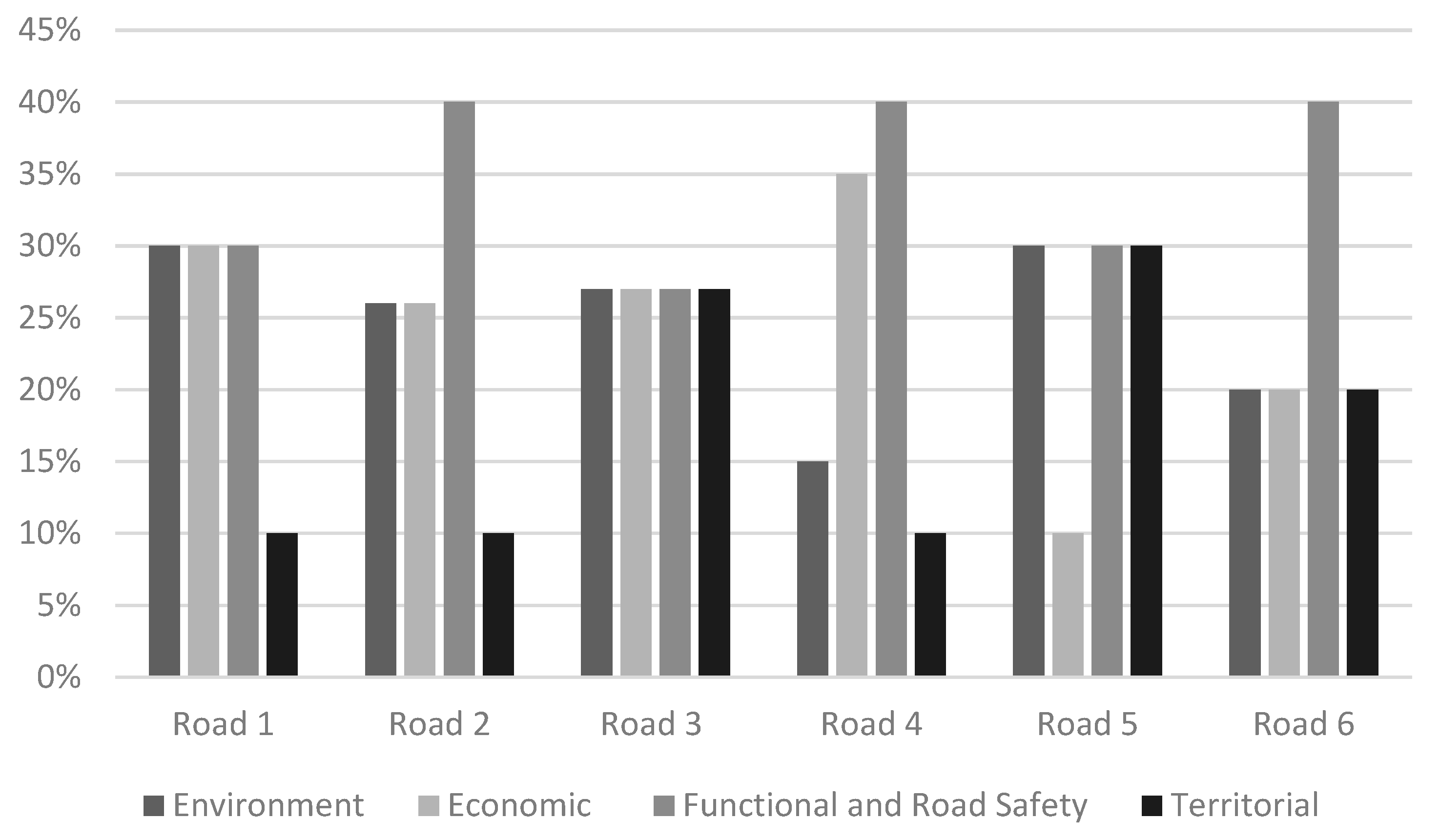
| Environmental | 0.30 | 0.25 | 0.25 | 0.15 | 0.30 | 0.20 |
| Economic | 0.30 | 0.25 | 0.25 | 0.35 | 0.10 | 0.20 |
| Functional and Safety Vial | 0.30 | 0.40 | 0.25 | 0.40 | 0.30 | 0.40 |
| Territorial | 0.10 | 0.10 | 0.25 | 0.10 | 0.30 | 0.20 |
| Redistribution of Evaluation Weighting Factors | ||||||
|---|---|---|---|---|---|---|
| Factor | Weight | |||||
| Road 1 | Road 2 | Road 3 | Road 4 | Road 5 | Road 6 | |
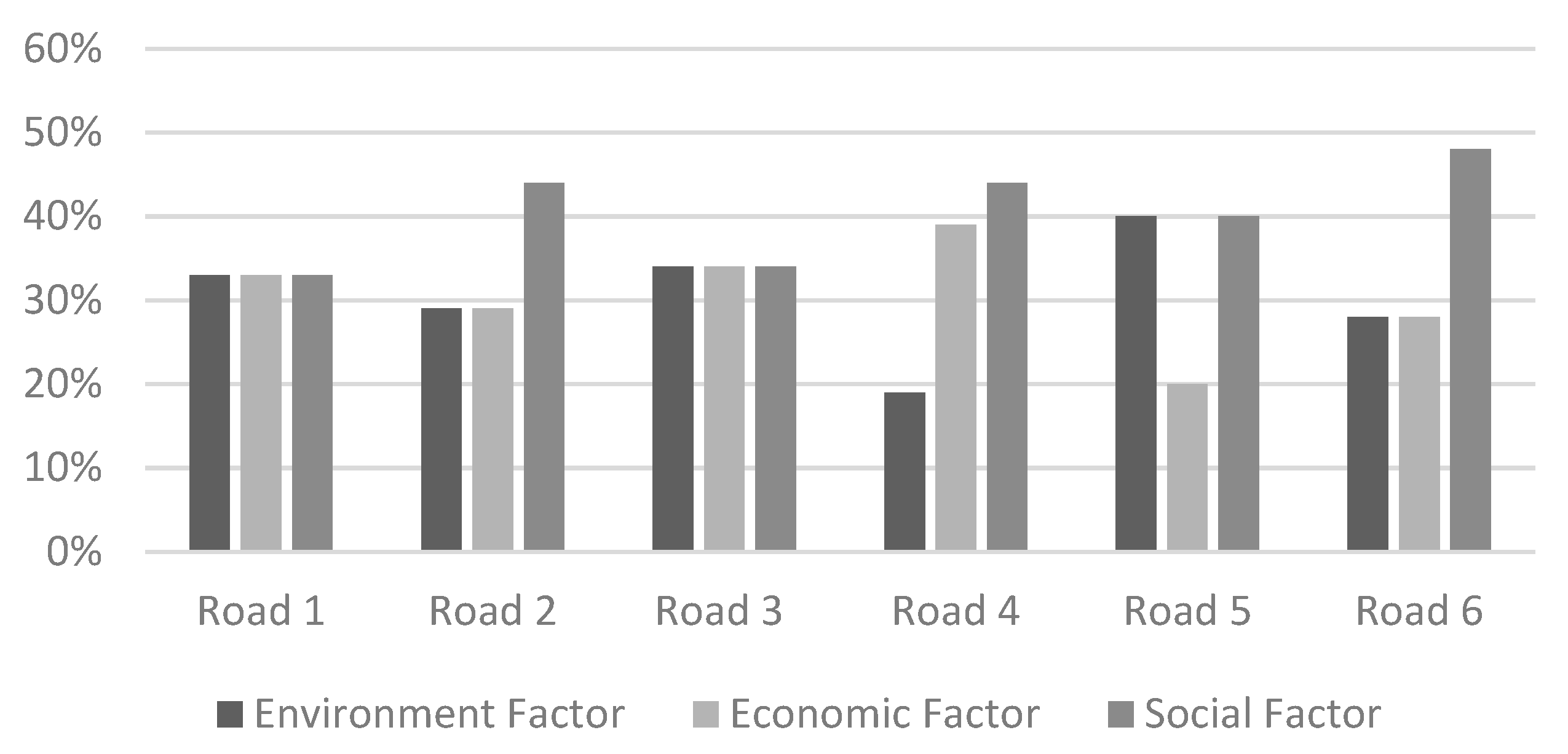
| Environmental | 0.33 | 0.28 | 0.33 | 0.18 | 0.40 | 0.27 |
| Economic | 0.33 | 0.28 | 0.33 | 0.38 | 0.20 | 0.27 |
| Social | 0.33 | 0.44 | 0.33 | 0.44 | 0.40 | 0.46 |
| Factor | |||
|---|---|---|---|
| Main Measurements | Environmental | Economic | Social |
| Minimum | 0.18 | 0.20 | 0.33 |
| Maximum | 0.40 | 0.38 | 0.47 |
| Mean | 0.30 | 0.30 | 0.40 |
| Standard Deviation | 0.07 | 0.06 | 0.06 |
| Factor | Limits | Description |
|---|---|---|
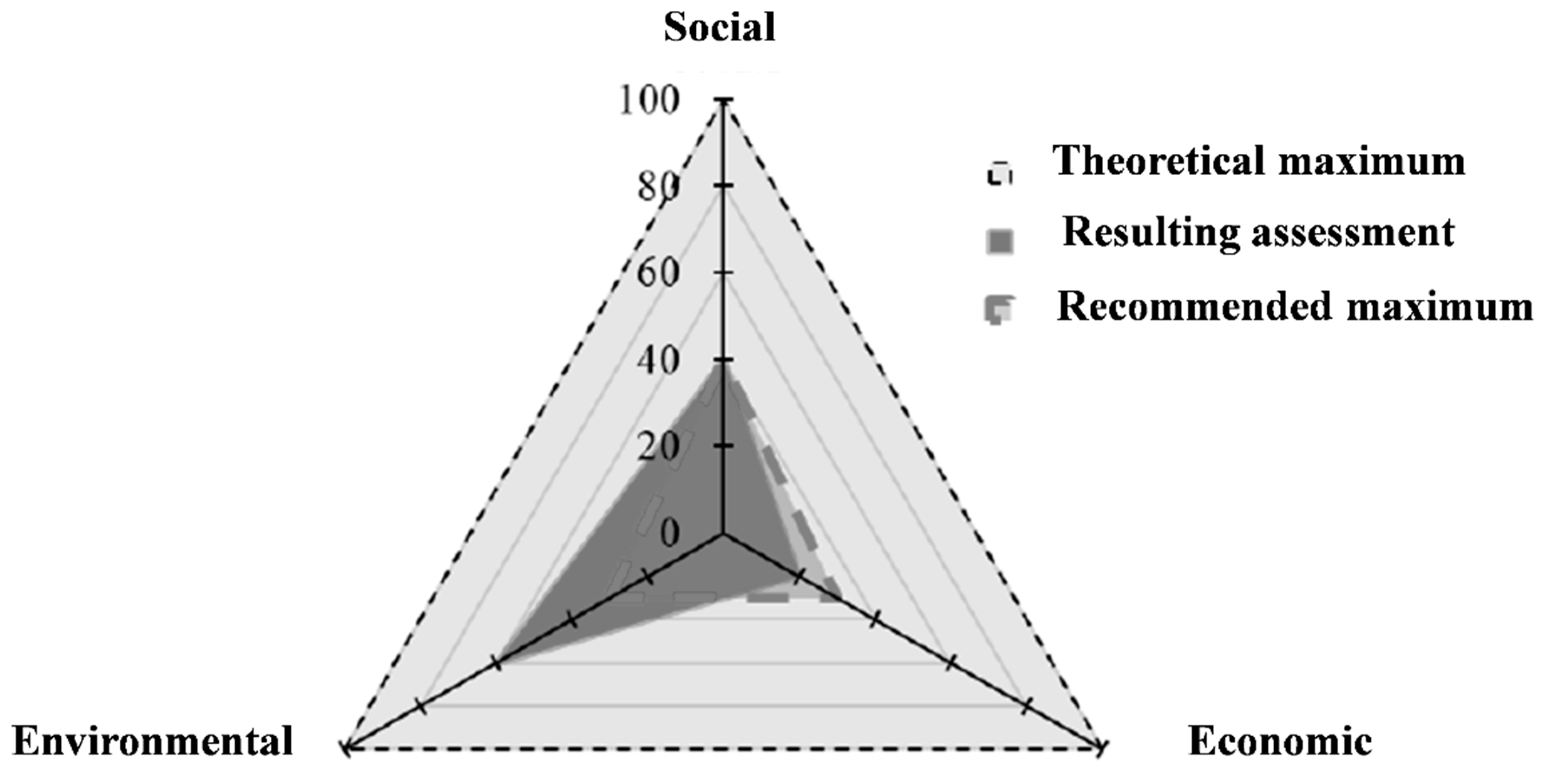
| Social | 40 | This type of infrastructure fulfils the function of connecting different territories along the route that directly influences the development of communities (job opportunities, trips with mentor time invested, increased tourism, etc.). |
| Economic | 30 | It is related to the social factor since connectivity generates ways to supply communities that are close to infrastructure and increases business opportunities, the dynamism of the region’s economy, and the internal rate of return (IRR), among other reasons. |
| Environmental | 30 | Valuation that has its greatest impact on territorial division, especially in areas with high biodiversity. |
| Range | Infrastructure Classification | Description |
|---|---|---|
| 0–20 | Minor Impact | The project has a low impact on all three sustainability factors. |
| 20–40 | Viable | The project complies with the minimum requirements for its execution. |
| 40–60 | Adjust | The project requires some adjustments to reduce the impact on some of the sustainability factors. |
| 60–80 | Redesign | The project requires a complete redesign. |
| 80–100 | Unfeasible | The project is not executable at all. |
| Aspects | Correction Action Simple → Value = 1 | Correction Action Complex → Value = 2 |
|---|---|---|
| Human Resources | Team of 2 to 4 unskilled workers for the development of simple tasks. | Team of more than 4 workers, with some type of qualification or specialization in the task performed. |
| Execution time | A short period is required for the execution of the corrective action, without a detailed planning of the procedure. | A considerable time for the execution of the corrective action is required, either for particular or repetitive activities. The development of a detailed plan of the sequence of tasks is required. |
| Implementation cost (maintenance, materials, machinery, and expenses) | Relatively low cost of materials, light machinery, and payment to workers and associated with a short execution time. The corrective action does not require major maintenance. | Medium-to-high cost, involving higher technology materials, heavy machinery, and payment of skilled workers and associated with a medium-to-long execution period. The corrective action may or may not require maintenance depending on its complexity. |
| Criteria | Corrective Action | Description of the Evaluation | Value |
|---|---|---|---|
| Environmental factor | |||
| Land Use /Site Selection | To take into account the greatest length of tunnels in linear works projects, such as highways, if this generates an optimization in the total length of the road. | Due to the increased cost involved in the construction of tunnels (excavation, support, interior installations, etc.). | 2.0 |
| Change in the layout of a linear work, in order to minimize some of the sustainability factors. | Due to the impact of interdisciplinary changes during the design phase. | 2.0 | |
| Reduce the surface area occupied by the infrastructure during its operation stage, considering in its design a verticalization of its main structures. | Due to the increased cost involved in the verticalization of major structures. | 2.0 | |
| Selection of sites with sufficient existing infrastructure for the use of the new site will minimize the need to build new roads, railroads, etc. | Due to the increase in the time required for site selection, but which can be assumed by the project without a relevant increase in the cost. | 1.0 | |
| Social factor | |||
| Land improvements and incorporation of technology | Geosynthetics implementation (geotextiles and geogrids). | Given for implementing an alternative technology with a slightly higher cost than other, more conventional, technologies. | 1.0 |
| Implement a compensatory policy for the municipality in which the infrastructure is located, by performing bioengineering soil treatment. | This value is calculated by the cost and time required to perform the soil studies and then apply the most appropriate solution to improve the properties of the selected land. | 1.7 | |
| Combination of plant material (such as hydroseeding) and structural elements for slope protection, reconstruction, stabilization, and erosion control. | Associated with the implementation of a solution that visually improves the environment, which also contributes to the increase of green areas. | 2.0 | |
| Economic factor | |||
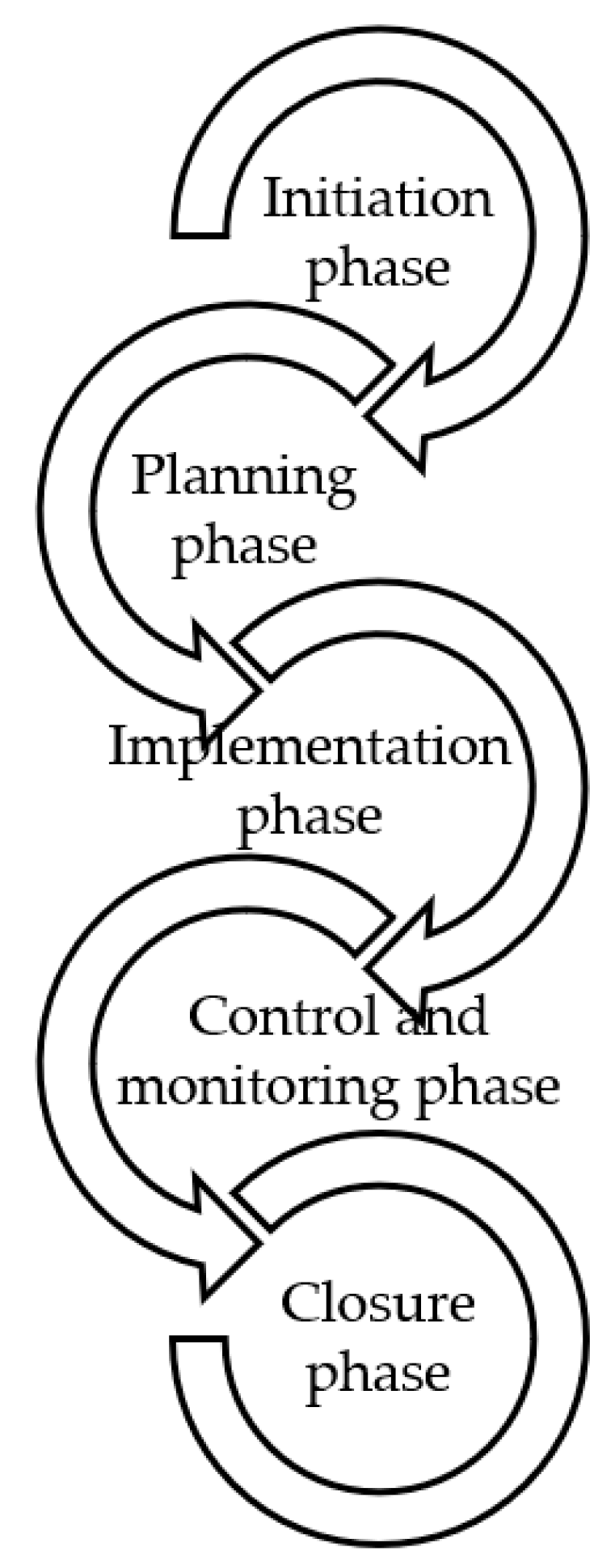
| Life-cycle cost and investment (initiation phase, planning phase, implementation phase, control and monitoring phase, and closure phase) | In the implementation phase, enhancement area at the infrastructure site, sites for commercial sale | Involves an insignificant increase in the cost of the project since the corrective action must meet the minimum safety requirements for users without requiring a unique design | 1.7 |
| In all types of infrastructure (roads, railroads, ports, airports, etc.), negotiate with the administration to extend the concession period, if the link with the administration is of this type | Physical work on site is not involved, but contractual work, which financially can significantly improve cash flows for the period of operation of the infrastructure | 2.0 | |
Disclaimer/Publisher’s Note: The statements, opinions and data contained in all publications are solely those of the individual author(s) and contributor(s) and not of MDPI and/or the editor(s). MDPI and/or the editor(s) disclaim responsibility for any injury to people or property resulting from any ideas, methods, instructions or products referred to in the content. |
© 2023 by the authors. Licensee MDPI, Basel, Switzerland. This article is an open access article distributed under the terms and conditions of the Creative Commons Attribution (CC BY) license (https://creativecommons.org/licenses/by/4.0/).
Share and Cite
Más-López, M.I.; García-del-Toro, E.M.; Alcala-Gonzalez, D.; García-Salgado, S. Sustainability Assessment in Infrastructure Projects. Sustainability 2023, 15, 14909. https://doi.org/10.3390/su152014909
Más-López MI, García-del-Toro EM, Alcala-Gonzalez D, García-Salgado S. Sustainability Assessment in Infrastructure Projects. Sustainability. 2023; 15(20):14909. https://doi.org/10.3390/su152014909
Chicago/Turabian StyleMás-López, María Isabel, Eva M. García-del-Toro, Daniel Alcala-Gonzalez, and Sara García-Salgado. 2023. "Sustainability Assessment in Infrastructure Projects" Sustainability 15, no. 20: 14909. https://doi.org/10.3390/su152014909
APA StyleMás-López, M. I., García-del-Toro, E. M., Alcala-Gonzalez, D., & García-Salgado, S. (2023). Sustainability Assessment in Infrastructure Projects. Sustainability, 15(20), 14909. https://doi.org/10.3390/su152014909