


Abstract
The European Entrepreneurship Competence (EntreComp) framework has been proposed by the European Commission in order to build consensus around a common understanding of entrepreneurship competence (knowledge, skills, and attitude). This study reports a bibliometric review of the research to date, addressing the EntreComp framework, based on documents published during the period from 2016 to June 2022. The research dataset was collected from Web of Science Core Collection (WoS) and included 37 articles. The bibliometric analysis includes citation, cooccurence and network analysis to represent the between countries and interorganizational collaboration, to identify relationships between documents topics. Along with the bibliometric analysis, a detailed description of characteristics for each article (study design and objectives, instruments, research findings, etc.) was also presented. Overall, this study provides insights regarding research addressing EntreComp framework, that could guide future research directions of practitioners/policy makers/researchers/etc. in the entrepreneurial competencies field and other interconnected domains.
Keywords:
EntreComp framework; entrepreneurship; competence; skill; education; innovation; bibliometric review 1. Introduction
The European Entrepreneurship Competence (EntreComp) Framework was developed by the Joint Research Center (JRC) and published in 2016 as part of the "New Skills Agenda For Europe: Working Together to Strengthen Human Capital Employability and Competitiveness", which has been proposed by the European Commission.
The framework aims to build consensus around a common understanding of entrepreneurship competence—knowledge, skills and attitude needed for people to develop an entrepreneurial mindset and culture for individuals and societal benefits [1,2].
The framework is very flexible, and it can be used or adopted in different contexts: curricula reform (adopt, design) in formal/non-formal education, practical entrepreneurial experience design, self-assessment tools of entrepreneurial proficiency measurement and monitoring, links identification with different skills, strength of team identification, and skills validation acquired from a learning experience [2,3].
The EntreComp offers an overview of interconnected and interrelated competencies that makes someone entrepreneurial (Ref. [4]) The EntreComp Framework include three competency areas: ideas and opportunities, resources, into action. Each of these areas has five competencies, detailed in Figure 1. The 15 entrepreneurial competencies are described by hints and further split in three up to six threads (60 threads in total) (see Figure 2). Each thread is explained and detailed on the eighth level of progression (from beginner to expert), resulting in 442 learning outcomes—Foundation: Level 1 (Discover), Level 2 (Explore); Intermediate: Level 3 (Experiment), Level 4 (Dare); Advanced: Level 5 (Improve), Level 6 (Reinforce); Expert: Level 7 (Expand), Level 8 (Transform) (see, for example, Figure 3).
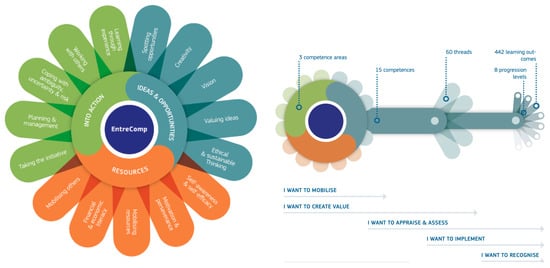
Figure 1.
EntreComp Framework of 15 entrepreneurial competencies and its extension with threads, progression levels, learning outcomes [4].
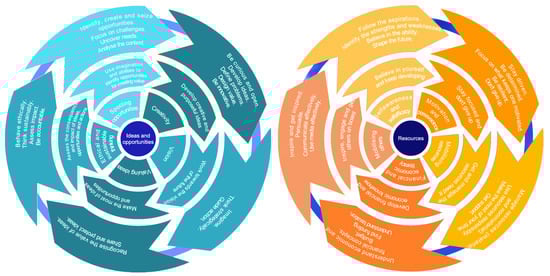
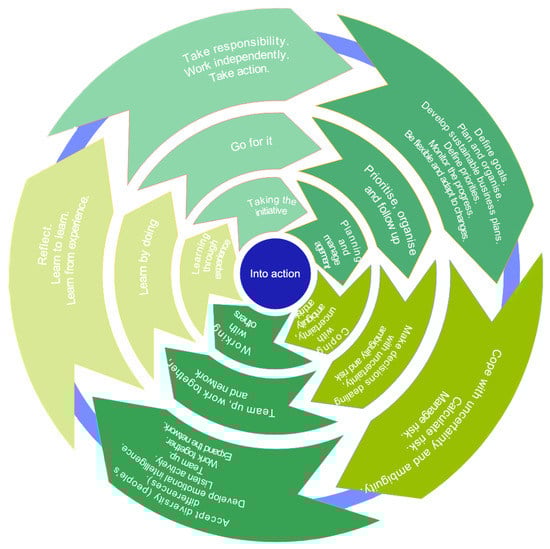
Figure 2.
Detailed presentation of competencies, hints, and threads for the competencies areas: ideas and opportunities (blue), resources (orange), into action (green). Each figure is composed of the following (from inside of the circle to the outside of it): competency area (in the middle), five competencies, five hints corresponding to each competency, and the corresponding threads (two to six). The figure was created by authors and include information from [4].
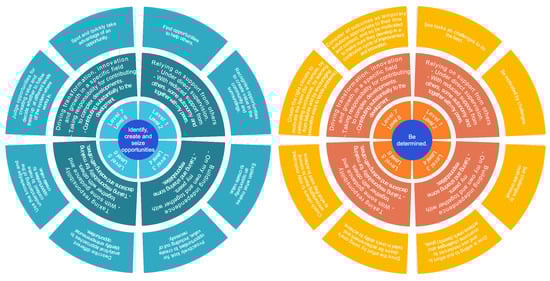
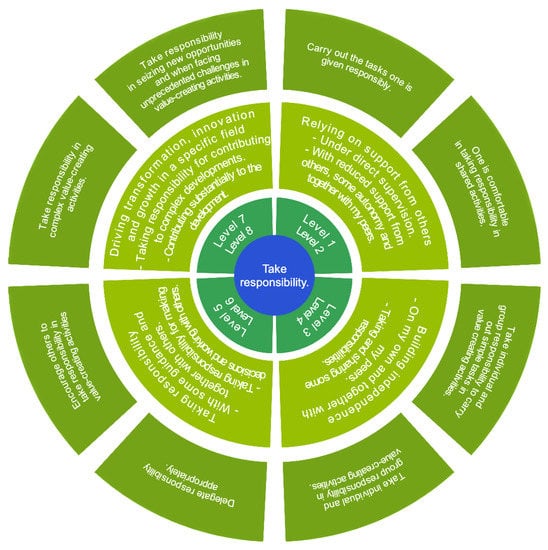
Figure 3.
Examples of the 8th levels of progression of threads: Thread Identify, create and seize opportunities from competency Spotting opportunities of competency area Ideas and Opportunities (blue); Thread Be determined from competency Motivation and perseverance of competency area Resources (orange); Thread Take responsibility from competency Taking the initiative of competency area Into Action (green). The Figure was created by authors and include information from [4].
A a series of resources have been presented for the development of entrepreneurial skills and are presented in Table 1.

Table 1.
EntreComp Framework guidelines.
The aim of this study is to assess scientific publications and research patterns and trends regarding the EntreComp framework. The most productive countries, organizations, sources, authorship and collaboration patterns, highly cited research papers, emerging research topics, and most frequently used keywords/terms related to the research field were identified. Characteristics of each article are also presented. A deeper exploration of research publications regarding EntreComp framework could offer a better understanding of the research field, be used as reference points for settings/strategies of future (international collaboration) research, and be useful in planing and polices of higher education institutions (HEIs), researchers, or research groups.
2. Materials and Methods
A literature search on the Web of Science Core Collection (WoS) online databases by using the search keyword EntreComp, was performed in June 2022 to identify scientific contributions on EntreComp. There were no restrictions regarding the study period, document type, or language. Retrieved articles were from period 2016–2022, and for each of them retrieved data contained the following information: title, abstract, years of publication, authors, authors’ affiliations, sources, and citations. The bibliometric analysis was performed by using VOSviewer software (VanEck and Waltman, Center for Science and Technology Studies of Leiden University [9,10]), a tool that has been used in studies from various areas of research [11,12,13,14,15,16,17,18,19,20,21]. The countries of origin and documents’ citation network are used to represent the between-countries and interorganizational collaboration, and keyword cooccurrence analysis was used to identify relationships between document topics. In the network visualization map, the link and the distance between two countries/publications/terms demonstrated the relationship strength (the smaller the distance, the most strongly related to each other). Countries/documents/terms are grouped in clusters of closely related items, the color of the bubble indicating the cluster in which the countries/documents/terms belonged to.
The study also presents a detailed description of the characteristics for each research article. We summarized the information related to the study design, proposed and achieved study objectives, sample size, country/region/organization, instruments/tools, and research findings.
3. Results
Over the seven-year period (2016, 1 (2.70%), 2017, 2 (5.41%), 2018, 2 (5.41%), 2019, 5 (13.51%), 2020, 14 (37.84%), 2021, 9 (24.32%), and 2022, 4 (10.81%)), the total number of publications in the research field was 37 (from 71 organizations and 31 countries). There were 20 articles and 17 proceedings papers from the following WoS categories: education educational research/education scientific disciplines (14, 37.83%, 4, 10.81%), business/management/economics (12, 32.43%, 7, 18.92%, 4, 10.81%), engineering multidisciplinary (4, 10.81%), green sustainable science technology (4, 10.81%), environmental sciences/environmental studies (3, 8.11%). The most productive countries were Spain (11 publications), Finland (6), Belgium (5), Italy (4), and Romania (3), and the hierarchy in terms of citations was as follows: Spain (30 citations), China (16), Italy (8), Estonia (8), Finland (7), Belgium (7), and Poland (7) (Figure 4 and Figure 5).
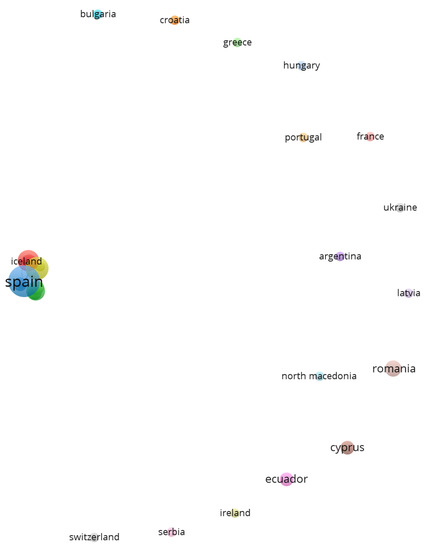
Figure 4.
VOSviewer network visualization map of countries (type of analysis: citations, weighted documents. Minimum number of documents of a country, 1 item; largest set of connected items, 15 items).
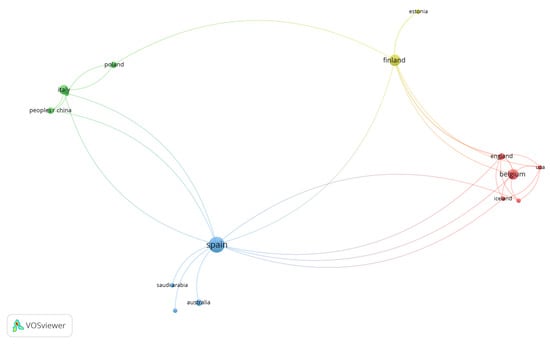
Figure 5.
VOSviewer network countries’ connection map related to their citations.
All the contributing countries are represented in the Figure 4, and those between which there were citations/connections are represented in more detail in Figure 5.
The articles with five or more citations were by Armuna et al. (2020, International Entrepreneurship and Management Journal, impact factor (IF) 6.15) [22] with 16 citations, Lillevali et al. (2017, Education Research International) [23] with 16 citations, Floris et al. (2019, International Journal of Educational Management) [24] with five citations, Bhatti et al. (2021, Journal of Small Business and Enterprise Development) [25] with five citations, Rayna et al. (2021, Technological Forecasting and Social Change, IF 10.88) [26] with five citations, and Palos Sanchez et al. (2019, Interciencia, IF 0.39) [27] with five citations (Figure 6).
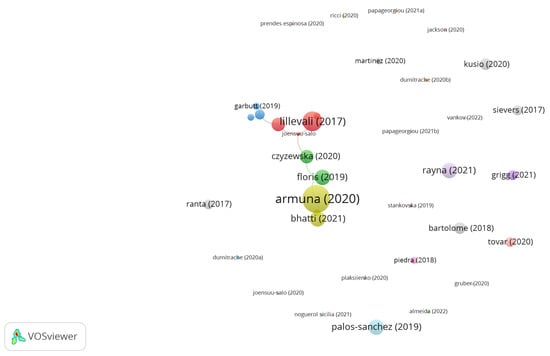
Figure 6.
VOSviewer network visualization map of documents (type of analysis: citation, weighted citations, and largest set of connected items, 13 documents). Each document is represented in the network by the name of the first author and the publication year. A citation link/connection between two documents is established if one document includes a cited reference that represents the other document. The dimension of the bubble represents the number of citations of the document—the higher the citations of a document, the larger the bubble of that document. Clusters (represented by bubbles of the same color) are formed by a set of documents citing each other and sharing similar ideas).
The network visualization of keywords on the publications was used to map topical directions in the field of EntreComp research. A total number of 193 keywords were identified from the research articles. The most frequently used keywords were entrepreneurship (13), entrepreneurship education (10), EntreComp/entrepreneurial/entrepreneurship competencie(s) (9/9), education/higher education/primary education (8/6/2), self-efficacy (5), innovation (4), enterprise/business/business dynamics (4/3/2), and gender/gender differences (3/2) (Figure 7). It can be seen that the researchers covered topics focusing on EntreComp competencies and entrepreneurship education (primary and higher) and/or enterprise/business dynamics/business takeover/business transfer. Moreover, within the figure there are clusters of keywords that are related to gender/gender differences, entrepreneurial intention, self-efficacy, attitudes, cognitive abilities, collaboration, and performance and innovation.
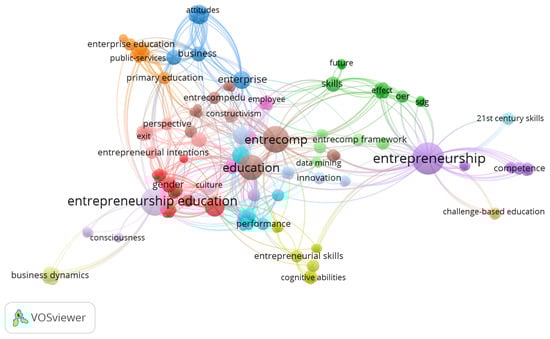
Figure 7.
VOSviewer network visualization map of keywords (type of analysis: cooccurrence, weighted occurrences, and a total of 193 keywords).
After the bibliometric review, a detailed description of the characteristics for each research article is presented. We summarized the information related to the study design, proposed and achieved study objectives, sample size, country/region/organisation, instruments/tools and research findings. The studies considered were grouped into two categories: studies that address EntreComp topics and use EntreComp framework with items and theoretical orientation (Table 2), and studies that address EntreComp topics and use the EntreComp framework items and practical orientation (Table 3).
Table 2.
Studies that address EntreComp topics and use EntreComp Framework with items and theoretical orientation.
Table 3.
Studies that address EntreComp topics and use EntreComp framework items, practical orientation.
In the case of theoretical orientation studies, the EntreComp framework was used for educational curricula evaluation/development and/or for evaluation/comparison of different models, whereas in the case of practical orientation studies, the EntreComp framework was used as an instrument/self-assessment tool in different groups of respondents.
4. Conclusions
The European Union (via the European Skills Agenda for Sustainable Competitiveness, Social Fairness, and Resilience) [71], the United Nations (via the 2030 Agenda for Sustainable Development) [72] and China (via China’s National Plan on Implementation of the 2030 Agenda for Sustainable Development) [73] have strategic policy documents that consider and promote entrepreneurial (behavioral and intellectual) and sustainability competencies as (i) important factors in developing social and economic sustainability and (ii) key priorities for education and lifelong training. EntreComp can be considered a reference point European tool to support the development of shared concepts of entrepreneurship competencies, goal setting, and evaluation [3]. Generally, creative and good entrepreneurial ideas can bring value and the effect of entrepreneurial action on the target community, the market, society, and the environment [2].
Entrepreneurship competency is one of the eight key competencies (literacy competence; multilingual competence; mathematical competence and competence in science, technology and engineering; digital competence; personal, social and learning-to-learn competence; citizenship competence; entrepreneurship competence; and cultural awareness and expression competence) for promoting lifelong learning, employability, and ensuring success in a knowledge-based society [49].
This study presents a bibliometric review and research patterns and trends of publications addressing the EntreComp framework. A total of 37 documents from 71 organizations and 31 countries (collected from the WoS database, published between 2016–2022) were analyzed. The articles, the research of which mainly focus on (i) exploring the relationship between entrepreneurship competencies and entrepreneurial intention (in case of STEM students and considering gender differences) [22] or (ii) comparative analysis (in terms of aims, definitions, constructing approaches) of five entrepreneurship competencies models [23] are the most cited. The network of keywords shows that two main thematic lines of research are focusing on EntreComp competencies and education areas and/or enterprise/business areas, with lines of research showing strong links between EntreComp competencies and various study topics (entrepreneurial intention, self-efficacy, performance, innovation, skills, attitudes, gender, etc.).
Studies [41,51] used EntreComp to investigate: (1) if/how students’ entrepreneurship competencies were fostered in different programs/curricula or (2) its usefulness in curricula development. Quantitative (content) analysis of curricula, face-to-face interviews and surveys with program leaders or experts were used. The results of these studies showed that in some cases a part of the entrepreneurship competencies are present in the program documentation [29,49], whereas in others it is uncommon to include them as a feature in program documentation [51]. In [41] experts agreed that all 15 EntreComp competencies were important for trainees and that the analyzed training program should address all 15 EntreComp competencies and should be flexible to accommodate the needs of trainees on different career trajectories. The study [51] emphasized a lack of reference to enterprise in program documentation and a confusion of the language associated with enterprise and entrepreneurship. In addition, these studies concluded that future research on the degree of incorporation of entrepreneurship competencies at different international universities would give an overview of their importance and information regarding the extent to which they are considered key aspects in the training process [49]. Moreover, it is important to evaluate the usefulness of the EntreComp framework and effectiveness of the learning content/the methods used in various teaching subjects [51].
The study [30] examined how EntreComp has been integrated into education and training development in different countries. The results showed that EntreComp has been widely recognized as an important driver of competence in entrepreneurial education, which can increase motivation and understanding of entrepreneurship education in different transnational contexts. Moreover, the article underlines a lack of shared vision and development of practice in the use of EntreComp and the need for support and guidance in promoting the learning process, to support successful adoption and adaptation of the policy-driven frameworks.
In [23], the competencies of the EntreComp framework are compared with five other competence models (Nordic, Danish, UK, USA, and EU) and 19 common competencies were identified, among them responsibility, creativity, recognition of opportunities, exploitation, work in a team, and management skills.
Researchers also analyzed the relationships between EntreComp framework and other measures: entrepreneurial intention (EI) [2,22,25,58,63,64], start-up behavior [50], entrepreneurial (intrapreneurial) self-capital (ESC) [2]. In study [22], it is emphasized that the competencies of opportunity identification and evaluation, abilities related to commitment, decision-making, and teams’ organization (soft skills), positively influence the development of EI more than the high level of specific knowledge (e.g., on economics, finance, legal). A direct significant correlation relationship was observed between EntreComp competencies and EI and ESC (a set of positive self-concepts to identify key life goals, plan actions, and make decisions to achieve them) [2]. The results of the study [50] showed that entrepreneurship competence is related to start-up behavior, is sensitive to role models (parents or close relatives with experience of an entrepreneurial career) and prior experience of entrepreneurship, and is not sensitive to gender or level of education. Moreover, the results of the study [58] proved the existence of a complex relationship between entrepreneurship competence, business takeover intentions (including both transfer options of succession and buying a company) and family role models (mother or father’s entrepreneurship). The study [64] revealed a positive influence/relationship between entrepreneurial competence and perceived behavioral control (considered one of the antecedents of entrepreneurial intentions) and also that gender has an effect on this relationship. The results from [74] demonstrated that entrepreneurial education elements (entrepreneurial skill, entrepreneurial learning, entrepreneurial intention) positively affect technology-based enterprises’ development, and motivation was considered as a mediator variable. By using the same variable, motivation, article [75] highlights the importance of social norms in the investigation of entrepreneurial intention in the academic environment.
Studies [28,29,69,70] showed a significant improvement for the subjects that have been using EntreComp in their activities, some of them related to the real-life practice (e.g., nure practitioners, agriculture technicians).
The studies [24,62] are presenting comparative results obtained before and after using EntreComp framework. An evaluation could assess if the attitudes and benefits relieved by EntreComp could change gradually the professional and private life of the subjects involved (see, for example [38,52,54,61,67,68,69,70]).
The EntreComp framework was used as a base for self-assessment (self-perception) tools for assessing entrepreneurial competencies/skills [2,22,50,58,64]. In [2], the psychometric analysis results showed a four-dimensional model with good reliability and validity of the data (in case of a sample of students from different universities and areas of knowledge). For future developments of the instrument, it was suggested (i) to include illustrative diagrams (spider diagrams), to visualize strengths and areas for improvement, (ii) expanding it with areas that would allow sustainability competencies to be evaluated more specifically. In [22], the used tool considered 22 self-reported competencies and factor analysis model results in five factors, offering a different categorization from the EntreComp theory (three constructs grouping). The study [50], by using the EntreComp framework with 15 items, in case of 1128 students (secondary and higher education level), show that although the framework proposes three distinct areas, entrepreneurship competence is unidimensional (in which the three areas are deeply interlinked). A unidimensional construct was also identified in study [58]. It would be recommended that entrepreneurial competency self-assessment tools include a psychometric validation, thus allowing comparative studies of groups (by demographic variables, educational levels, and countries) and evaluation of public policies and good practices [2].
Overall, this study provides insights regarding research addressing the EntreComp framework, which could guide future research directions of practitioners/policy makers/researchers/etc. in the entrepreneurial competencies field and other interconnected domains.
Author Contributions
The work presented here was carried out as a collaboration between the three authors A.R., I.M. and E.-L.P. The authors contributed equally and significantly to the writing of this article. The authors contributed to the manuscript. All authors have read and agreed to the published version of the manuscript.
Funding
Project financed by Lucian Blaga University of Sibiu through the research grant LBUS-IRG-2022-08.
Institutional Review Board Statement
Not applicable.
Informed Consent Statement
Not applicable.
Data Availability Statement
The data are available on request from the correspondent author.
Acknowledgments
The authors want to thank the anonymous reviewers and editor for their careful reading of the manuscript and for the many valuable remarks and suggestions.
Conflicts of Interest
The authors declare no conflict of interest. The funders had no role in the design of the study; in the collection, analyses, or interpretation of data; in the writing of the manuscript, or in the decision to publish the results.
References
- Bacigalupo, M.; Kampylis, P.; Punie, Y.; Van den Brande, G. EntreComp: The Entrepreneurship Competence Framework. Luxemb. Publ. Off. Eur. Union 2016, EUR 27939 EN. [Google Scholar] [CrossRef]
- López-Núñez, M.I.; Rubio-Valdehita, S.; Armuña, C.; Pérez-Urria, E. EntreComp Questionnaire: A Self-Assessment Tool for Entrepreneurship Competencies. Sustainability 2022, 14, 2983. [Google Scholar] [CrossRef]
- European Council. Recommendation of the European Parliament and the Council on Key Competencies for Lifelong Learning. Off. J. Eur. Union 2006, 10–18. Available online: https://eur-lex.europa.eu/LexUriServ/LexUriServ.do?uri=OJ:L:2006:394:0010:0018:en:PDF (accessed on 14 June 2022).
- Mccallum, E.; Weicht, R.; Mcmullan, L.; Price, A. EntreComp into Action: Get Inspired, Make it Happen (Bacigalupo, M. and O’keeffe Eds, W.): A User Guide to the European Entrepreneurship Competence Framework; EUR 29105 EN. Publ. Off. Eur. Union Luxemb. 2018. Available online: https://op.europa.eu/en/publication-detail/-/publication/4542fd58-20f3-11e8-ac73-01aa75ed71a1/language-en (accessed on 14 June 2022). [CrossRef]
- McCallum, E.; Weicht, R.; McMullan, L.; Price, A.; Bacigalupo, M.; O’Keeffe, W. EntreComp into Action: Get inspired, make it happen. In European Commission Scientific and Technical Research Reports; Publ. Off. Eur. Union: Luxemb. 2018. Available online: https://publications.jrc.ec.europa.eu/repository/handle/JRC109128 (accessed on 26 September 2022).
- McCallum, E.; McMullan, L.; Weicht, R.; Kluzer, S. EntreComp at Work. The European Entrepreneurship Competence Framework in Action in the Labour Market: A Selection of Case Studies; Bacigalupo, M., Ed.; Publications Office of the European Union: Luxembourg, 2020; Available online: https://publications.jrc.ec.europa.eu/repository/bitstream/JRC120486/jrc120486_entrecompatwork.pdf (accessed on 26 September 2022).
- Bacigalupo, M.; Weikert García, L.; Mansoori, Y.; O’Keeffe, W.; EntreComp Playbook. Entrepreneurial Learning beyond the Classroom. Publ. Off. Luxemb. 2020. Available online: https://publications.jrc.ec.europa.eu/repository/bitstream/JRC120487/jrc120487_entrecomp_playbook.pdf (accessed on 26 September 2022).
- EntreComp Europe, Inspiring Practices from across Europe. 2020. Available online: https://entrecompeurope.eu/wp-content/uploads/2020/11/EntreComp_Europe_Inspiring_Practices.pdf (accessed on 26 September 2022).
- VanEck, N.; Waltman, L. Software survey: VOSviewer, a computer program for bibliometric mapping. Scientometrics 2010, 84, 523–538. [Google Scholar] [CrossRef]
- VanEck, N.J.; Waltman, L. VOSviewer Manual; Univeristeit Leiden: Leiden, The Netherlands, 2013. [Google Scholar]
- Hosseini, M.R.; Martek, I.; Zavadskas, E.K.; Aibinu, A.A.; Arashpour, M.; Chileshe, N. Critical evaluation of off-site construction research: A Scientometric analysis. Autom. Constr. 2018, 87, 235–247. [Google Scholar] [CrossRef]
- Grosseck, G.; Ţîru, L.G.; Bran, R.A. Education for sustainable development: Evolution and perspectives: A bibliometric review of research, 1992–2018. Sustainability 2019, 11, 6136. [Google Scholar] [CrossRef]
- Maniu, I.; Costea, R.; Maniu, G.; Neamtu, B.M. Inflammatory Biomarkers in Febrile Seizure: A Comprehensive Bibliometric, Review and Visualization Analysis. Brain Sci. 2021, 11, 1077. [Google Scholar] [CrossRef]
- Fiore, U.; Florea, A.; Kifor, C.V.; Zanetti, P. Digitization, Epistemic Proximity, and the Education System: Insights from a Bibliometric Analysis. J. Risk Financ. Manag. 2021, 14, 267. [Google Scholar] [CrossRef]
- Gajdosikova, D.; Valaskova, K. A Systematic Review of Literature and Comprehensive Bibliometric Analysis of Capital Structure Issue. Manag. Dyn. Knowl. Econ. 2022, 10, 210–224. [Google Scholar]
- Cretu, D.M.; Morandau, F. Initial Teacher Education for Inclusive Education: A Bibliometric Analysis of Educational Research. Sustainability 2020, 12, 4923. [Google Scholar] [CrossRef]
- Tomaszewska, E.J.; Florea, A. Urban smart mobility in the scientific literature— Bibliometric analysis. Eng. Manag. Prod. Serv. 2018, 10, 41–56. [Google Scholar] [CrossRef]
- Maniu, I.; Maniu, G.; Totan, M. Clinical and Laboratory Characteristics of Pediatric COVID-19 Population—A Bibliometric Analysis. J. Clin. Med. 2022, 11, 5987. [Google Scholar] [CrossRef]
- Morante-Carballo, F.; Montalván-Burbano, N.; Arias-Hidalgo, M.; Domínguez-Granda, L.; Apolo-Masache, B.; Carrión-Mero, P. Flood Models: An Exploratory Analysis and Research Trends. Water 2022, 14, 2488. [Google Scholar] [CrossRef]
- Fiore, U.; Florea, A.; Pérez Lechuga, G. An Interdisciplinary Review of Smart Vehicular Traffic and Its Applications and Challenges. J. Sens. Actuator Netw. 2019, 8, 13. [Google Scholar] [CrossRef]
- Florea, A. Digital design skills for factories of the future. In Proceedings of the 9th International Conference on Manufacturing Science and Education—MSE 2019 “Trends in New Industrial Revolution”, Sibiu, Romania, 5–7 June 2019; Volume 290, p. 14002. [Google Scholar]
- Armuna, C.; Ramos, S.; Juan, J.; Feijoo, C.; Arenal, A. From stand-up to start-up: Exploring entrepreneurship competences and STEM women’s intention. Int. Entrep. Manag. J. 2020, 16, 69–92. [Google Scholar] [CrossRef]
- Lillevali, U.; Taks, M. Competence Models as a Tool for Conceptualizing the Systematic Process of Entrepreneurship Competence Development. Educ. Res. Int. 2017, 2017, 5160863. [Google Scholar] [CrossRef]
- Floris, M.; Pillitu, D. Improving entrepreneurship education in primary schools: A pioneer project. Int. J. Educ. Manag. 2019, 33, 1148–1169. [Google Scholar] [CrossRef]
- Bhatti, M.A.; Al Doghan, M.A.; Saat, S.A.M.; Juhari, A.S.; Alshagawi, M. Entrepreneurial intentions among women: Does entrepreneurial training and education matters? (Pre- and post-evaluation of psychological attributes and its effects on entrepreneurial intention). J. Small Bus. Enterp. Dev. 2021, 28, 167–184. [Google Scholar] [CrossRef]
- Rayna, T.; Striukova, L. Fostering skills for the 21st century: The role of Fab labs and makerspaces. Technol. Forecast. Soc. Chang. 2021, 164, 120391. [Google Scholar] [CrossRef]
- Palos-Sanchez, P.R.; Baena-Luna, P.; Pena, A.C. Analisis de las Comptencias Educativas para Evaluar a las Personas Emprendedoras. Interciencia 2019, 44, 291–297. [Google Scholar]
- Dumitrache, V.M.; Gole, I.; Balu, P.E.; Balu, F.O. Entrepreneurial Competences in the Training of Future Technicians in Economic Activities. In Proceedings of the 6th BASIQ International Conference on New Trends in Sustainable Business and Consumption, Messina, Italy, 4–6 June 2020; pp. 807–814. [Google Scholar]
- Dumitrache, V.M.; Gole, L.; Balu, P.E. Entrepreneurial competencies in Training Future Romanian Farmers. In Proceedings of the International Conference on Economics and Social Sciences, Xi’an, China, 6–8 March 2020; pp. 227–235. [Google Scholar]
- Seikkula-Leino, J.; Salomaa, M.; Jonsdottir, S.R.; McCallum, E.; Israel, H. EU Policies Driving Entrepreneurial competencies-Reflections from the Case of EntreComp. Sustainability 2021, 13, 8178. [Google Scholar] [CrossRef]
- Shulman, L.S.; Shulman, J.H. How and what teachers learn: A shifting perspective. J. Curric. Stud. 2004, 36, 257–271. [Google Scholar] [CrossRef]
- Seikkula-Leino, J. The implementation of entrepreneurship education through curriculum reform in Finnish comprehensive schools. J. Curric. Stud. 2011, 43, 69–85. [Google Scholar] [CrossRef]
- Seikkula-Leino, J.; Ruskovaara, E.; Hannula, H.; Saarivirta, T. Facing the Changing Demands of Europe: Integrating Entrepreneur- ship Education in Finnish Teacher Training Curricula. Eur. Educ. Res. J. 2012, 11, 382–399. [Google Scholar] [CrossRef]
- Seikkula-Leino, J.; Ruskovaara, E.; Ikavalko, M.; Mattila, J.; Rytkola, T. Promoting entrepreneurship education: The role of the teacher? Educ. Train. 2010, 52, 117–127. [Google Scholar] [CrossRef]
- Seikkula-Leino, J.; Ruskovaara, E.; Ikävalko, M.; Kolhinen, J.; Rytkölä, T. Teachers’ reflections on entrepreneurship education: Their understanding and practices. In Conceptual Richness and Methodological Diversity in Entrepreneurship Research; Fayolle, A., Kyrö, P., Mets, T., Venesaar, U., Eds.; Edward Elgar: Cheltenham, UK; Northampton, MA, USA, 2013; pp. 146–171. [Google Scholar]
- Bacigalupo, M.; Kampylis, P.; McCallum, E.; Punie, Y. Promoting the Entrepreneurship Competence of Young Adults in Europe: Towards a Self-Assessment Tool. In Proceedings of the 9th Annual International Conference of Education, Research and Innovation, Seville, Spain, 14–16 November 2016; pp. 611–621. [Google Scholar]
- Gruber, L. Mapping Literature Review on the Role of Consciousness in Entrepreneurship Development. Medunar Znan. Simp. Go. 2020, 622–636. [Google Scholar]
- Grigg, R. EntreCompEdu, a professional development framework for entrepreneurial education. Educ. Train. 2021, 63, 1058–1072. [Google Scholar] [CrossRef]
- Piedra, N.; Caro, E.T. EntreCompOnto: An Ontology for Semantic Representation of Entrepreneurship Competences. In Proceedings of the 2018 IEEE International Conference on Teaching, Assessment, and Learning for Engineering (TALE), Wollongong, NSW, Australia, 4–7 December 2018; pp. 1113–1118. [Google Scholar]
- Papageorgiou, G.; Yiannaki, S.M.; Varnava-Marouchou, D.; Anastasiades, T.; Hadjipapa-Gee, S.; Englezou, D. A System Dynamics Approach to Entrepreneurship Applied to the Case of the Creative Arts Industry. In Proceedings of the 16th European Conference on Innovation and Entrepreneurship ECIE 2021, Lisbon, Portugal, 16–17 September 2021; pp. 707–714. [Google Scholar]
- Garbutt, J.; Antes, A.; Mozersky, J.; Pearson, J.; Grailer, J.; Toker, E.; DuBois, J. Validating curricular competencies in innovation and entrepreneurship for biomedical research trainees: A modified Delphi approach. J. Clin. Transl. Sci. 2019, 3, 165–183. [Google Scholar] [CrossRef]
- DuBois, J.M.; Kraus, E.M.; Gursahani, K.; Mikulec, A.; Bakanas, E. Curricular priorities for business ethics in medical practice and research: Recommendations from Delphi consensus panels. BMC Med. Educ. 2014, 14, 235. [Google Scholar] [CrossRef]
- Diamond, I.R.; Grant, R.C.; Feldman, B.M.; Pencharz, P.B.; Ling, S.C.; Moore, A.M.; Wales, P.W. Defining consensus: A systematic review recommends methodologic criteria for reporting of Delphi studies. J. Clin. Epidemiol. 2014, 67, 401–409. [Google Scholar] [CrossRef] [PubMed]
- Dubois, J.M.; Dueker, J.M. Teaching and assessing the responsible conduct of research: A Delphi consensus panel report. J. Res. Adm. 2009, 40, 49–70. [Google Scholar] [PubMed]
- Papageorgiou, G.; Yiannaki, S.M.; Varnava-Marouchou, D. A Critical Evaluation of Contemporary Tools on Developing Innovative Thinking Competencies for Entrepreneurship. In Proceedings of the 16th European Conference on Innovation and Entrepreneurship ECIE 2021, Lisbon, Portuga, 16–17 September 2021; pp. 701–706. [Google Scholar]
- Morselli, D.; Gorenc, J. Using the EntreComp framework to evaluate two entrepreneurship education courses based on the Korda Method. Int. J. Manag. Educ. 2022, 20, 100591. [Google Scholar] [CrossRef]
- Korda, S. Reinventing teaching. Child. Educ. 2019, 95, 38–43. [Google Scholar] [CrossRef]
- Morselli, D. Teaching a sense of initiative and entrepreneurship through problem based learning. @ Re-Open J. Per La Form. Rete 2019, 19, 149–160. [Google Scholar]
- Arruti, A.; Morales, C.; Benitez, E. Entrepreneurship Competence in Pre-Service Teachers Training Degrees at Spanish Jesuit Universities: A Content Analysis Based on EntreComp and EntreCompEdu. Sustainability 2021, 13, 8740. [Google Scholar] [CrossRef]
- Joensuu-Salo, S.; Viljamaa, A.; Varamaki, E. Testing the EntreComp framework and its relation to start-up behaviour in seven European countries. J. Small Bus. Enterp. Dev. 2022, 29, 920–939. [Google Scholar] [CrossRef]
- Dinning, T. Articulating entrepreneurial competencies in the undergraduate curricular. Educ. Train. 2019, 61, 432–444. [Google Scholar] [CrossRef]
- Czyzewska, M.; Mroczek, T. Data Mining in Entrepreneurial Competencies Diagnosis. Educ. Sci. 2020, 10, 196. [Google Scholar] [CrossRef]
- Espinosa, M.P.P.; Fernandez, I.M.S.; Martinez, J.G.; Cartagena, F.C. Education for entrepreneurship in Secondary Education: Teachers’ opinions about the current state and future possibilities in European contexts. Bordon 2020, 72, 153–172. [Google Scholar]
- Stankovska, I.; Polenakovik, L.; Polenakovik, R.; Shterjova, N.; Velkovski, T. Analysis of Entrepreneurial Educators for Boosting the Entrepreneurial Potential in Europe. In Proceedings of the 12th Annual International Conference of Education, Research and Innovation, Seville, Spain, 11–13 November 2019; pp. 6696–6704. [Google Scholar]
- Tovar, E.; Tabuenca, B.; Piedra, N. EntreCom4ALL MODEL to sustain the entrepreneurship competence needs. In Proceedings of the 2020 IEEE Global Engineering Education Conference (EDUCON), Porto, Portugal, 27–30 April 2020; pp. 1937–1940. [Google Scholar]
- Sicilia, I.N.; Archilla, B.T.; Caro, E.T. Why students’ self-regulation is key towards the new normality? In Proceedings of the 2021 IEEE Global Engineering Education Conference (EDUCON), Vienna, Austria, 21–23 April 2021; pp. 1718–1722. [Google Scholar]
- Almeida, F.; Devedzic, V. The Relevance of Soft Skills for Entrepreneurs. J. East Eur. Manag. Stud. 2022, 27, 157–172. [Google Scholar] [CrossRef]
- Joensuu-Salo, S.; Viljamaa, A.; Varamaki, E. Understanding Business Takeover Intentions-The Role of Theory of Planned Behavior and Entrepreneurship Competence. Adm. Sci. 2021, 11, 61. [Google Scholar] [CrossRef]
- Bartolome, J.; de Soria, I.M.; Jakobsone, M.; Fernandez, A.; Ruseva, G.; Koutoudis, P.; Merrigan, D.; Vaquero, M. Devoloping a Digital Competence Assessment and Accreditaation Platform for Digital Profiles. In Proceedings of the 12th International Technology, Education and Development Conference (INTED), Valencia, Spain, 5–7 March 2018; pp. 4552–4559. [Google Scholar]
- Martinez, M.; Crusat, X. How Challenge Based learning enables entrepreneurship. In Proceedings of the 2020 IEEE Global Engineering Education Conference (EDUCON), Porto, Portugal, 27–30 April 2020; pp. 210–213. [Google Scholar]
- Jackson, K. Entrepreneurship in Hungarian High Schools and Its Positive Impact on Problem-Solving. In Proceedings of the 14th International Technology, Education and Development Conference, Valencia, Spain, 2–4 March 2020; pp. 5447–5453. [Google Scholar]
- Ricci, A. Entrepreneurial Transversal Skills and Growth Mindset; An Educational Research. In Proceedings of the 4th International Technology, Education and Development Conference, Valencia, Spain, 2–4 March 2020; pp. 8791–8796. [Google Scholar]
- Vankov, D.; Kozma, D.; Galanternik, M.; Chiers, J.; Vankov, B.; Wang, L. Understanding the Predictors of Entrepreneurial Intentions of Young People from Argentian, Belgium, Bulgaria, China and Romania. Entrep. Sustain. Issues 2022, 9, 384–398. [Google Scholar]
- Joensuu-Salo, S.; Viljamaa, A.; Varamaki, E. The Effect of Entrepreneurial Competence on Perceived Behavioral Control and Perspective of Gender. In Proceedings of the INTED 2020: 14th International Technology, Education and Development Conference, Valencia, Spain, 2–4 March 2020; pp. 1537–1545. [Google Scholar]
- Ajzen, I. The Theory of Planned Behavior. Organ. Behav. Hum. Decis. Process. 1991, 50, 179–211. [Google Scholar] [CrossRef]
- Kolvereid, L. Prediction of employment status choice intentions. Entrep. Theory Pract. 1996, 21, 47–57. [Google Scholar] [CrossRef]
- Kusio, T.; Fiore, M. The perception of entrepreneurship culture by internal university stakeholders. Eur. Bus. Rev. 2020, 32, 443–457. [Google Scholar] [CrossRef]
- Plaksiienko, V.Y.; Dorogan-Pisarenko, L.A.; Pryidak, T.B.; Leha, O.V.; Ialoveha, L.V.; Krasota, E.H. Designing a Framework for Future Economists’ Digital Competence. Inf. Technol. Learn. Tools 2020, 80, 140–160. [Google Scholar]
- Sievers, A.; Ranta, L.; Guilland, A. Creating Insight Among Students on Working Life Competences Through Problem Based Learning. In Proceedings of the ICERI2017 Conference, Seville, Spain, 16–18 November 2017; pp. 713–721. [Google Scholar]
- Ranta, L.; Sievers, A.; Guilland, A. Shared Responsibility of Higher Education Institutes (HEI) and Their Partners in Assuring Nursing Students’ Employability Skills. In Proceedings of the ICERI2017 Conference, Seville, Spain, 16–18 November 2017; pp. 1247–1255. [Google Scholar]
- European Commission. European Skills Agenda for Sustainable Competitiveness, Social Fairness and Resilience. 2020. Available online: https://ec.europa.eu/social/BlobServlet?docId=22832&langId=en (accessed on 2 December 2022).
- United Nations. Transforming Our World: The 2030 Agenda for Sustainable Development. 2015. Available online: https://sdgs.un.org/sites/default/files/publications/21252030/20Agenda/20for/20Sustainable/20Development/20web.pdf (accessed on 2 December 2022).
- Ministry of Foreign Affairs of the People’s Republic of China. China’s National Plan on Implementation of the 2030 Agenda for Sustainable Development. 2016. Available online: http://www.chinadaily.com.cn/specials/China’sNationalPlanonimplementationofagenda(EU).pdf (accessed on 2 December 2022).
- Dana, L.-P.; Tajpour, M.; Hosseini, E.; Zolfaghari, M. The Impact of Entrepreneurial Education on Technology-Based Enterprises Development: The Mediating Role of Motivation. Adm. Sci. 2021, 11, 105. [Google Scholar] [CrossRef]
- Davide, A.; Nicolli, F.; Ramaciotti, L.; Rizzo, U. The effect of intrinsic and extrinsic motivations on academics’ entrepreneurial intention. Adm. Sci. 2016, 6, 15–34. [Google Scholar]
Disclaimer/Publisher’s Note: The statements, opinions and data contained in all publications are solely those of the individual author(s) and contributor(s) and not of MDPI and/or the editor(s). MDPI and/or the editor(s) disclaim responsibility for any injury to people or property resulting from any ideas, methods, instructions or products referred to in the content. |
© 2023 by the authors. Licensee MDPI, Basel, Switzerland. This article is an open access article distributed under the terms and conditions of the Creative Commons Attribution (CC BY) license (https://creativecommons.org/licenses/by/4.0/).