


Abstract
The road pavement industry, worldwide, has often shown reluctance in quickly implementing innovative practices; however, in the case of raw material consumption, a cultural change is necessary and, in this sense, sustainability assessment could play a major role. Along these lines, this research study aims to provide evidence to all the involved stakeholders (material producers, pavement contractors, and road authorities) of how life cycle-based techniques can be crucial in evaluating whether the adoption of asphalt mixtures with high contents of reclaimed asphalt (RA) for wearing courses is actually a sustainable practice for major European roads. An evaluation framework composed of a life cycle assessment, to calculate the carbon footprint of both pavement materials and pavement activities, and a life cycle cost assessment, performed to determine the overall economic burden of the related road pavement surface courses and maintenance strategies over a sixty-year analysis period, is presented and applied to selected case studies. These were developed together with three major European national road authorities and include scenarios involving the construction of road surfaces with asphalt mixtures containing up to 90% RA. Results have shown that whenever high-content RA mixes do not under-perform against conventional mixtures, up to 50% CO2eq savings can be registered and up to 60% economic cost reductions can be reported. The durability of road pavement layers remains a key parameter for any road pavement sustainability assessment exercises; therefore, in order to adapt the obtained results to other contexts, researchers should always consider conducting a sensitivity analysis of the reference service life and/or road authorities should somehow request road pavement durability as a pre-requisite within procurement practices.
1. Introduction
Asphalt recycling is becoming more common and is normally labelled a sustainable practice. Several studies on the sustainability assessment of road pavement have been published, both to assess new projects and maintenance activities. The volume of existing research proves that the life cycle approach is more and more widely used in road pavement industries [1], but there is still a limit, represented by several gaps in the methodology [2]. Conventional materials [1,3], as well as alternative mixtures [1,4,5], have been investigated. Reclaimed asphalt (RA) has already been demonstrated as a valid partial substitute for virgin aggregates, maintaining beneficial properties [6,7]. It can be deduced that decreasing the extraction of raw materials can lead to reductions in emissions and costs. All the existing studies report an improvement when RA is used, and the combination of reduced temperature and the use of RA is particularly beneficial [8,9]. Several studies investigate sustainability performance at the pavement level, while the assessment of the production of one-ton volumes of asphalt mixtures is less developed [8]. Some studies compare the use of RA with the use of a conventional mix [10] or other alternative materials [11,12], while others aim to assess environmental performance with increases in RA content [8,13,14]. In all cases, whatever the mixtures are (asphalt concrete, stone mastic asphalt, porous asphalt), the emissions of CO2eq (the so-called carbon footprint (CF)) decrease with the decrease in virgin aggregate content, as reported in Table 1. With the exception of refs. [8,15], none of the existing research has investigated the sustainability performance of mixtures containing more than 50% RA. This is also true for studies performing life cycle cost (LCC) assessments, which are less developed than environmental analyses for RA mixtures. The studies report a linear reduction in costs as the RA content increases: reductions of 8%, 11%, and 14%, respectively, are due to 30%, 40%, and 50% RA contents [14] used in production and construction, while a reduction from 21% to 26% is, respectively, linked to an RA variation from 10% to 50%, also considering the maintenance and the end-of-life [13].

Table 1.
CF and LCC application in RA case studies.
It is clear that the use of RA has great potential to reduce environmental impacts, but a gap in the research currently prevents us from understanding whether, and to what degree, it is still worth maximising RA content. At the same time, there are still too few studies demonstrating the long-term economic benefits of using this technology.
In the above-mentioned studies, some inconsistencies and differences can be found in terms of functional units, system boundaries, databases, and software, making it difficult to compare the results. Most of the researchers conducted sustainability assessment exercises by considering a portion of pavement, often 1 km of constructed road, and assessing the impacts of the production and installation of the pavement component [10,17,18,19]. However, the burdens related to the use and the end-of-life phases are very often disregarded, and even excluded some exceptions [11,16,17]. Some research assesses sustainability considering several indicators [4,10,17], while other research only calculates carbon footprints and/or energy consumption [14,16,19]. This highlights the need for widely accepted frameworks to perform sustainability assessment exercises in the road pavement sector. These frameworks must comply with the generalised standard procedures provided by the International Standards Organisation in ISO14040 [20] and ISO14044 [21] for environmental life cycle assessment (LCA) and ISO 15686-5:2017 [22] for the life cycle cost (LCC) assessment related to economic aspects. What is stated above is valid for any applications and sectors [23,24]; however, each industry/sector should achieve harmonised SA procedures by tailoring these techniques to each investigated field. Within the road pavement sector, for instance, a plethora of scientific papers have been presented, with efforts usually aiming at providing a mere application of the methodology [1,11,12,14]. However, for SA to be an effective tool for decision-making, each industry needs a general framework suggesting harmonised approaches to carry out LCA exercises (i.e., the Product Category Rules) and/or to understand common procedures for data gathering and/or the use of results. Along these lines, first the PavementLCA framework in the USA [25], and very recently the PavementLCM framework of the Conference of European Directors of Roads [26] have provided guidelines towards a harmonised SA of road pavement materials and road pavement construction/maintenance activities. The latter suggests assessing sustainability, considering different exercises for each involved stakeholder: the manufacturer, contractor, and road authority. Each exercise differs in terms of unit, analysis period, system boundaries, and impact indicators. Concerning these last ones, the framework presents a set of sustainability performance indicators mainly based on the use of LCA and LCC techniques. This SA framework can be applied to assess and/or compare the sustainability of promising practices at any level of the road pavement industry, from technology development to asset management.
Aim and Structure of the Study
This study aims to understand whether maximizing the re-use of asphalt mixtures within major European road pavement surfaces is an environmentally and economic sustainable option. In order to do so, the authors at first developed three case studies gathering primary data from three major European road authorities and considering scenarios involving the construction of road surfaces with six asphalt mixtures containing up to 90% RA. Then, a tailored SA framework involving LCA and LCC (Figure 1) was used for evaluating the sustainability potential of material manufacturing (asphalt producers), layer installation (contractors), and maintenance strategies over a sixty-year analysis period (road agencies).
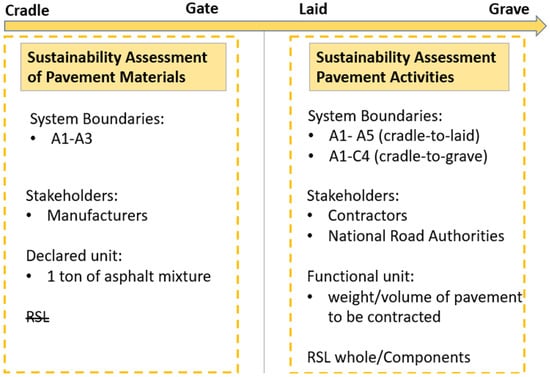
Figure 1.
PavementLCM SA framework (adapted from PavementLCM, CEDR 2021, [26]).
This introduction provides the context and theoretical background necessary to better understand what is shown in the next paragraphs: Section 2, “Methodology” will describe the structure of the investigation and provide details on the selected case studies; then, Section 3, “Results and Discussion” will present the SA findings, which are summarised in Section 3.3 “Summary of Results”; last, Section 4, “Conclusions and Future Studies” will provide practical recommendations for practitioners and ideas for further development for the scientific community.
2. Methodology
In order to obtain practical recommendations representative of the whole Europe, three case studies were built as representative of different geographical European areas (North, Central, South), pavement structures, maintenance strategies, and traffic levels. In each case, the comparison assumed that either asphalt concrete (AC16) or stone mastic asphalt (SMA8) were used as paving material throughout the analysis period (60 years). Furthermore, it was assessed that AC16 could contain up to 90% RA and SMA8 could contain up to 60% RA.
Once the case studies were structured, a long and detailed data collection exercise was conducted by building tailored surveys filled by NRAs [27] and/or through collection of secondary data from literature and/or software databases referenced in each of the following sections. Sometimes data were obtained by simpler email exchanges and filling tailored data collection templates.
Then, an SA assessment phase was carried out by tailoring the framework shown in Figure 1 to allow each involved stakeholder to obtain the sustainability performances of materials (several asphalt mixtures with high RA content) and paving activities (tailored maintenance strategies) related to case studies built to be representative of Southern, Central, and Northern Europe. Environmental and economic impact assessments were carried out by means of life cycle assessment (LCA) and life cycle cost (LCC) assessment, respectively, according to European standards on SA [22], while considering existing international standards [20,21,22] and frameworks [25].
Figure 2 presents a summary of the organisation of the whole study. Details of the materials, case studies, data collection, and SA are presented in the next paragraphs.
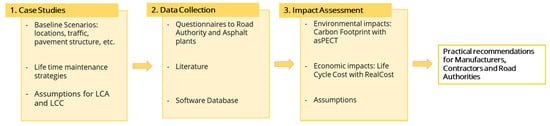
Figure 2.
Sustainability performance assessment methodology: case studies, data collection, impact assessment.
2.1. Case Studies and Data Collection
2.1.1. Pavement Materials
As mentioned above, two mixes used for wearing courses were selected as the baseline materials for the comparison. These are the typical mixes used for major roads in Germany (SMA with polymer-modified bitumen) and in Italy (AC with paving bitumen). The study then considered several versions of both technologies, incorporating at least three levels of RA and sometimes additives (add) as follows:
- AC16 30% RA + add
- AC16 60% RA + add
- AC16 90% RA + add
- SMA8S 30% RA
- SMA8S 60% RA
- SMA8S 60% RA + add
The asphalt mixture technologies, both with and without RA, were adopted and/or developed within the Allback2Pave project [27]. This effort, for the AC16s, modified the typical mix design specified by Italian NRAs (ANAS) by incorporating 30%, 60%, and 90% RA. In contrast, for the SMA8s, typical recipes without RA used in Germany (BASt) were designed and produced with 30%, 60%, and 60% + additives. Table 2 provides the details of each mix design as provided by the previously mentioned specifications and by the Allback2Pave project. Within the project, durability was also investigated, and it was concluded that, with a correct mix design and a fractioned and characterised RA, high recycling rates in asphalt wearing courses do not cause worse performance.
Table 2.
Details of asphalt mixture baselines and mixes with high RA contents.
Additionally, the study considered hypothetical scenarios where each of the mixtures was used in each case study, including the Northern European case in the UK. The mixtures were all compared to conventional mixtures to understand whether their use in replacing current asphalts reduces negative environmental impacts; in other words, this study assessed whether these new mixtures are more sustainable.
2.1.2. Case Studies
The above-mentioned asphalt mixtures were assumed to replace the current ones in three case studies representative of three geographical areas (South Europe (SE), Central Europe (CE), and North Europe (NE)), pavement structures, levels of course durability, and traffic levels (high, medium, and low). Each case study was crafted with the help of the interested NRAs and/or other available resources and was intended to be representative of “typical” inter-urban roads of the selected countries. The collection of primary data from asphalt production plants in Germany and Italy and tailored questionnaires completed by the interested NRAs were the sources of information on the key variables, such as the asphalt mix recipes, energy and fuel consumption, and transport distances. A summary of each case study is provided below together with screenshots of geography and locations (Figure 3), while details are presented in Table 3 and Figure 4 below and in Table A1, Table A2 and Table A3 in Appendix A.2.
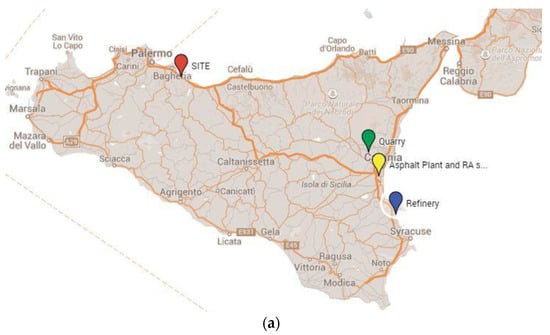
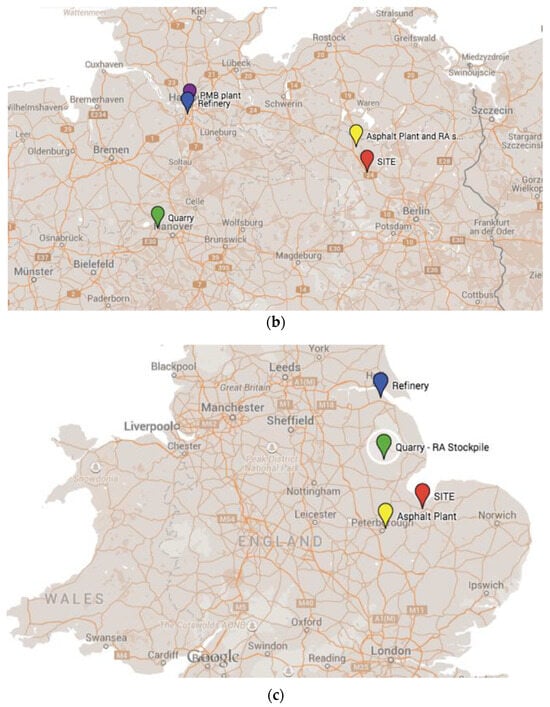
Figure 3.
(a–c) Case studies: geography and locations. (a) South Europe case study–localisation; (b) Central Europe case study–localisation; (c) North Europe case study–localisation.
Table 3.
Asphalt paving geometry and durability.
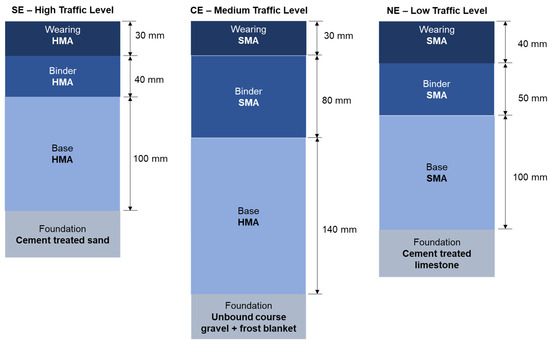
Figure 4.
Case studies: pavement structures.
- South Europe: Italy: A repaving operation on a motorway (40,000 ADT) called A19-Palermo–Catania. The road consists of two separate carriageways in each direction that are structurally composed of 170 mm of asphalt (30 mm wearing course, 40 mm binder course, and 100 mm of base) and 300 mm of foundation cement-stabilised sand. The road section, the object of the intervention, is 9.50 m wide and 2000 m long. Usual maintenance of this type of pavement consists of five-year periodic inlay of the wearing course, mainly for skid resistance issues [28], while the binder course is substituted every thirty years.
- Central Europe: Germany: A repaving operation on an inter-urban highway called A24 and situated near Berlin with medium traffic volume (20.000 ADT). The structure is composed of 30 mm of wearing course, 80 mm of binder course, 140 mm of base course, 200 mm of unbound gravel base course, and 350 mm of unbound frost blanket. The road section, the object of the intervention, is 11.80 m wide and 800 m long. Usual maintenance for this type of pavement, realised with SMA mixture, consists of sixteen-year periodic inlay of the wearing course [29], while the binder course is substituted every thirty years.
- North Europe: UK: An inlay operation on an inter-urban road with low/medium traffic volume (10.000 ADT) consisting of a single carriageway. The structure is currently composed as follows: 40 mm of wearing course, 100 mm of binder course, and 50 mm of base course. The road section, the object of the intervention, is 11 m wide and 720 m long. The wearing course is realised with SMA mixture, and its maintenance consists of ten-year periodic inlay [30], while the binder course is substituted every thirty years.
- Maintenance strategies: The maintenance strategies were considered similar for all of the case studies. These consisted of the milling and inlay of wearing courses (WCs) enhanced with binder course (BC) inlays and rehabilitation, considering an analysis period of 60 years. This assumption was made to account for the potential benefits, in terms of costs and emissions, linked to the use of RA, which implies reductions in the material stockpiled and the depletion of virgin materials. The maintenance plan was dependent on the reference service life of each pavement component, which was provided as primary data by European NRAs or estimated through laboratory tests [27]. The authors assumed that road pavement foundation and sub courses would not deteriorate and that the asphalt would not go under/over performance. The maintenance procedures consider the details shown below [27] and in Table 4:
Table 4. Country-dependent maintenance strategy over 60 years.
- ○
- Surface treatments involve the periodic inlay of wearing course and the occasional inlay of binder and base course.
- ○
- Maintenance is undertaken on one carriageway (two lane) or one lane (single-lane road) at a time, with the traffic diverted onto the other carriageway/lane.
- ○
- Work zones are extended for the whole length and the width of the full carriageway.
- ○
- In the case studies with dual carriageways, maintenance events are considered only in one direction.
2.2. Environmental Impact Assessment by Means of LCA
As mentioned before, the chosen methodology to assess the environmental performance was LCA; specifically, a carbon footprint assessment was carried out. The CF assessment was performed using asPECT (Asphalt Pavement Embodied Carbon Tool) [31], a flexible and customisable tool which enabled the implementation of all the inputs and estimated CO2eq emissions. The tool enables the calculation of greenhouse gas emissions throughout the life cycle of a road pavement, in compliance with ISO standards. It is flexible and customisable: it allows inserting and changing inputs and implementing new pavement designs. In order to estimate the CO2eq of each case study and scenario, the selected approach considered the currently used asphalt mixes and maintenance practices as the “baseline”; these were replaced with asphalt mixes containing different contents of RA%, thus building up a series of comparable scenarios. EARN Deliverable 5 [32], together with standards and reputable data sources, was utilised to provide missing data such as emissions factors for fuels, transport, and embodied carbon values for constituent materials.
In order to assess the environmental impact for each stakeholder, three different SA exercises were implemented. In fact, as stated in a recent framework developed by the Conference of European Directors of Roads [26], SA exercises for road pavements can be differentiated in relation to the aim of the study and the type of involved stakeholders. In particular, as already shown, the SA exercise, including system boundaries (Figure 5), changes as follows:
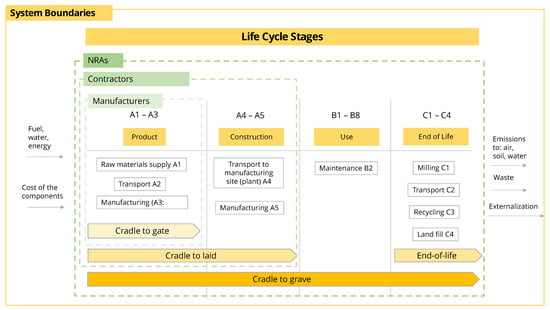
Figure 5.
System boundaries for each SA exercise.
- Asphalt mixture producers: The assessment is related to the production of the asphalt mixtures (cradle-to-gate), and the declared unit is assumed to be one ton of asphalt mixture.
- Pavement contractors: The evaluation concerns the installation of a pavement component(s) (cradle-to-laid), and the functional unit is the total weight of the pavement component(s) to be contracted, considering only a reference service (i.e., 10 years for a wearing course)
- Road pavement agencies: The assessment relates to the comparison of the maintenance strategies (over a certain analysis period (laid-to-grave)), and the functional unit is a square meter of road pavement and/or the total weight of pavement component(s) to be contracted.
Details of the exercises have been grouped and presented in typical steps constituting an LCA study, namely: (1) goal and scope definition, (2) life cycle inventory, (3) life cycle impact assessment, and (4) interpretation of results.
2.2.1. Goal and Scope Definition
The aim of this study is to calculate the environmental impacts related to the use of different mixtures throughout the pavement life cycle. The materials investigated include conventional hot asphalt mixtures (SMAs in Germany and ACs in Italy) and six mixtures with high contents of RA (AB2P mixtures).
The results of the study can be compared to understand how much less impactful using recycled asphalt is.
The intended applications of the study are:
- Understanding of the environmental benefits related to asphalt recycling.
- Understanding of the pros and the cons of using these new technologies when compared to current baselines.
- Support of more sustainable decision-making processes among asphalt mixture producers.
The study is directed to manufacturers, national road authorities, and academics to provide evidence of the environmental impact of maximizing RA for pavement roads.
The case studies have already been detailed in the previous section.
The system boundaries, as reported in Figure 5, are:
- A “cradle-to-gate” perspective for the pavement materials, considering only the production of the asphalt mixtures;
- A “cradle-to-laid” and a “cradle-to-grave” perspective were considered if the object of the assessment was pavement activities and therefore the wearing course. In the first case, the focus was on the production of the material and the installation of the layer; in the second case, all the necessary stages from the extraction to the end-of-life were considered.
A distinction between declared units and functional units is provided in the study: the former are used in assessments which do not cover the full life cycle, while the latter are used in other cases [33]. Hence, declared units are used for pavement material assessment and are defined as one ton of asphalt course, while functional units are considered for pavement activities and are assumed to be equivalent to the tons of asphalt to be replaced, calculated by multiplying the volume of each wearing course by an estimated density of 2.3 t/m3.
Concerning the analysis period, for pavement activities it was assumed to be one reference service life in the exercise for contractors, otherwise it was 60 years in the exercise for NRAs.
With reference to cut-off rules, processes/activities that altogether did not contribute to more than 1% of the total environmental impact for any impact category were omitted from the inventory. The only allocation considered regards the RA entering the systems. It was assumed that it contains 0 kg of CO2eq. Furthermore, RA recoverability is 95% (5% lost in transport, processing, etc.).
The only impact category is the global warming potential, while the considered characterisation factors are the latest Defra emission factors, as considered by the asPECT tool [31,32].
All the used data was primary, when possible, or taken from the literature when the former was not available.
2.2.2. Life Cycle Inventory (LCI)
In this second step, all the data required for the assessment were collected: they concern the inputs and outputs of the system in all the phases considered in the system boundaries. The inventory was modeled with asPECT. Data were directly provided by the partners/producers or taken from the database when missing (Table A4).
- Production phase (A1–A3)
The production phase consists of all inputs and outputs necessary for the extraction and transport of raw materials, plus the production of the asphalt mixtures:
- ○
- Raw materials supply (A1): The inventories (Table 2) include all the information linked to the components used, such as aggregates, neat bitumen, polymer-modified bitumen, fibres, and the STORBIT PLUS Rejuvenator (which is a composition of high-viscosity second refinement known for its higher viscosity STORFLUX PLUS and Fischer Tropsch Wax; it has a solid state of aggregation at room temperature).
- ○
- Transport (A2): This includes the distances between raw material suppliers and the asphalt plant. In this case study, all the constituents are locally sourced, excluding the additive imported from Germany (Table A5).
- ○
- Manufacturing (A3): This includes energy consumption required in the plant and the typology of the fuel. Some data were directly provided (i.e., quantity of energy used), while other data was assumed and taken from the literature, including:
- ○
- The consumption of electricity and fuel oil, taken from UK grid;
- ○
- The activity of soluble binder in RA, which was fixed to 80% (partial blending) to have an average of the two extremes considered during the mix design (100% and 60%);
- ○
- The content of soluble binder in the RA fraction;
- ○
- An increase of 10% due to RA aggregate heating, considered to account for fuel consumption [34].
- ●
- Installation (A4–A5)
The inventory linked to this step includes the inputs and outputs necessary for the components’ transport from the plant to the site (A4) and their successive installation (A5). The distances are all contained in Table A6. The installation includes laying and compaction of the asphalt courses plus a tack coat of bitumen emulsion. Data concerning A4 were directly provided, while those concerning A5 were taken from asPECT v4.0.
Furthermore, some assumptions were defined:
- ○
- According to asPECT protocol, laying and compacting impacts were considered as 4.7 kg CO2eq per ton of asphalt.
- ○
- Tack coat bitumen emulsion is applied at a rate of 0.4 L/m2 of laid asphalt [32].
- ○
- Unless otherwise stated, it is assumed that all the materials used at the site come from the asphalt plant.
- ●
- Use phase (B2)
This phase is included only if the system boundaries are extended to the maintenance activities.
In particular, within the use phase, only repair (B3) is part of the system boundaries. This is a step which corresponds to all the operations needed for course substitution (A1–A5 for the new course and C1–C3 of the one to be replaced).
Each maintenance activity consists of two steps:
- ○
- milling of the pavement course to be substituted, including 10 mm of regulating course.
- ○
- installation of new course, with the same inputs and outputs reported in A1–A5.
- ●
- End-of-Life (C1–C3)
Each maintenance activity has its own burden in terms of waste. Nevertheless, it has been decided that the milled pavement is transported and stockpiled in order to produce reclaimed asphalt for new mixtures.
The impacts related to this phase are due to milling, transport, and recycling. The data related to transport distances are presented in Table A7 in Appendix A.2.
2.2.3. Life Cycle Impact Assessment (LCIA)
This third step aims at calculating the potential impacts linked to the system. In this case, only an impact category was chosen and the methodology for calculation was strictly linked with the used tool (asPECT v4.0). No optional step (i.e., characterisation, grouping) was carried out. All the results are presented in Section 3.
2.2.4. Interpretation of Results
This fourth step consists in the interpretation of the obtained results and identification of the significant issues and the main relevant phases of the study. At the end, conclusions and recommendations are provided. This part is detailed and explained in Section 3.
2.3. Economic Impact Assessment by Means of LCC
The present economic impact was evaluated by using LCC using RealCost [35] software to calculate the net present value, which was limited to the cradle-to-gate approach (manufacturers) plus a basic estimate over the analysis period of 60 years. The assessment was carried out for production costs (cradle-to-gate), but also with a basic estimate of the costs over the analysis period of 60 years. The LCC was performed following the points described in the methodology.
- Establish alternative pavement design strategies:
The conventional baseline will be replaced with high-content RA mixtures, as described in the sections above.
- 2.
- Determine performance periods and activity timing:
This LCC is a cradle-to-gate analysis, so it is limited to the costs of the production of asphalt mixtures, calculated for the sixty-year analysis period. According to the maintenance plan and the durability assigned to each infrastructure component, the number of interventions and tons of asphalt mixtures were calculated. In particular, the expected number of maintenances is fourteen (nine inlay WC, two inlay WC + BC, one rehabilitation) for SE, four (two inlay WC, one inlay WC + BC, one rehabilitation) for CE, and five (two inlay WC, two inlay WC + BC, one rehabilitation) for NE.
- 3.
- Estimate agency costs:
Once the pavement design strategies and performance period were selected, the data collection was carried out according to the inputs needed for RealCost life cycle cost analysis software [36]. In this case study, the agency costs correspond to the cost of asphalt mixes. Hence, they are obtained by multiplying the cost of each ton for total tons of asphalt to be replaced in each intervention in each case study. The costs to be collected and accounted for are related to the production phase, from the extraction of raw materials (A1) to their transport to asphalt plant (A2) up to the manufacturing process (A3) (Table A8 and Table A9).
Concerning the costs related to A1–A2, they were mostly collected interviewing plants/contractors and material suppliers; for the SE case study, all data was provided by Ferrara, except for the cost of fibres from Iterchimica, while the NE and CE case study information was taken from the literature (i.e., [32]), excluding the costs of fibres [37] and the STORBIT PLUS additive [38]. They were assumed to be constant throughout the analysis period (60 years) for each intervention needed and previewed in the maintenance strategy. Concerning the costs linked to A3, they are given by the energy consumption used in the plant. Electricity and oil costs were taken from the literature [32] and some assumptions were made according to their consumption for the mixtures with a high content of RA. In fact, oil consumption was assumed to be 10% regardless of the amount of RA added, while the electricity amount was the same for all the alternatives.
- 4.
- Net Present Value
The net present value calculation was performed thanks to RealCost, a spreadsheet program made by FHWA. It performs a simulation on the basis of a discrete value (a fixed discount value because the deterministic approach was chosen) and computes an array of life-cycle costs (using a sampling of pre-defined costs or a probability distribution of costs). Each current baseline was compared with the six alternatives with RA; additionally, for each case study, the course’s durability, maintenance, and rehabilitation plans were implemented. As mentioned earlier, the life cycle cost exercise was carried out through a deterministic approach which is based on the definition of a fixed discount rate. Fixing the discount rate at 0% means to state no time preference: the costs of today are weighted as benefits in the future. Nevertheless, in common practice, the discount rate for public works is never null and it depends on the country. For this reason, according to the literature [37], a value for each case study was used for the calculation, namely, 5% for South Europe, 3% for Central Europe, and 3.5% for the first 30 years and 3% for the remaining 30 years for North Europe.
3. Results and Discussion
3.1. Calculation of Environmental Performance
On the basis of the data collected and the assumptions made, the results of the assessment highlight the environmental benefit linked to the use of high amounts of RA for most of the case studies. The results are reported in the tables below.
- Pavement Material–Manufacturers (A1–A3)
The results of the first assessment are provided in Table 5 and Figure 6. They show the total quantity of CO2eq emitted to produce one ton of asphalt mixture.
Table 5.
CO2eq emissions due to the production of one ton of asphalt mixture (A1–A3).
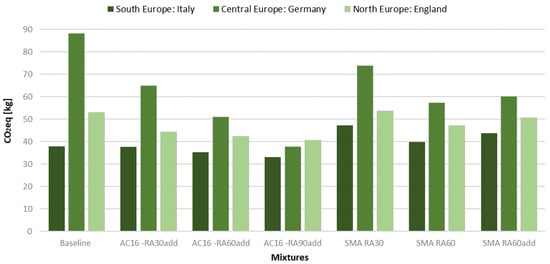
Figure 6.
CO2eq emissions due to the production of one ton of asphalt mixture (A1–A3).
Furthermore, to go deeper in the study, hotspot analyses were performed to assess the most impactful phases limited to the cradle-to-gate system (contribution > 50%).
The impacts related to production phase were divided into the three categories: 1. Raw material sourcing (A1); 2. Transport to plant (A2); 3. Heating and Mixing (A3). Looking at the results, generally, it can be stated that the contribution for manufacturing the mixtures increases proportionally with the increase in the amount of RA (due to the higher energy required by it). Instead, the impacts related to extraction of raw materials decrease.
In detail, concerning the SE case study, a hotspot always represented A3 while the impact of A2 was not significant (from 3% to 7%). The situation changed in the CE case study, where the impact of the A2 phase was much higher (from 16% to 46%), since transport distances were significantly longer. In NE case study, the only hotspot was obtained in A3 (53%) with the highest amount of RA (90%). Hence, for SE and NE, the heating and mixing (A3) phase were the most impactful, while in the CE, the transport to the plant (A2) provided the highest impact.
- Pavement Activities–Contractors (A1–A5)
The results of the assessment involving the contractors are provided below. Table 6 reports the total quantity of CO2eq emitted for the production and installation of a pavement component (one course, i.e., wearing course).
Table 6.
CO2eq emissions due to the production and installation of one pavement course (A1–A5).
Figure 7 shows CO2eq emissions due to the production and installation of one pavement course (A1–A5), showing a visible trend of reduction in CO2eq when the amount of RA was higher, ensuring that the reduction in virgin material is environmentally friendly in a cradle-to-laid approach.
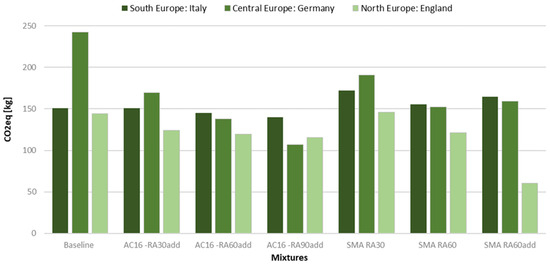
Figure 7.
CO2eq emissions due to the production and installation of one pavement course (A1–A5).
- Pavement Activities–NRAs (A1–C3)
Table 7 reports the total quantity of CO2eq emitted throughout the analysis period (60 years) for all the interventions required. It was assumed that whenever the maintenance intervention involved binder and base courses, these mixes were considered the wearing course.
Table 7.
CO2eq emissions for all the operations required in 60 years (A1–C3).
Figure 8 shows a visible trend of reduction in CO2eq when the amount of RA increases, demonstrating that a cradle-to-grave approach also shows good environmental performance by these mixtures.
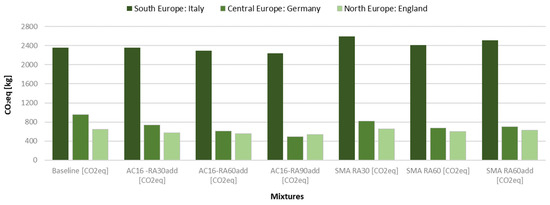
Figure 8.
CO2eq emissions for all the operations required in 60 years (A1–C3).
3.2. Calculation of Economic Performance
The costs have been calculated on the basis of the data collected and following the steps described above. Table 8, Table 9 and Table 10 represent the calculations carried out considering the agency costs for a cradle-to-gate analysis (results represented in Figure A4, Figure A5 and Figure A6 in Appendix A.1), while Figure 9 presents the total cradle-to-gate costs over a sixty-year analysis period.
Table 8.
SE case study: cradle-to-gate cost/ton of asphalt mixes (A1–A3).
Table 9.
CE case study: cradle-to-gate cost/ton of asphalt mixes (A1–A3).
Table 10.
NE case study: cradle-to-gate cost/ton of asphalt mixes (A1–A3).
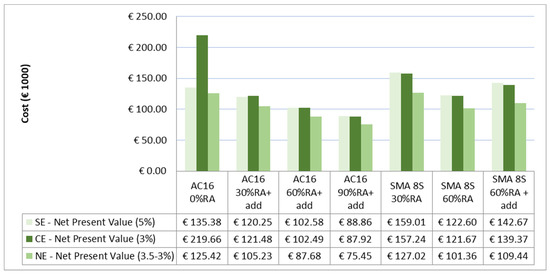
Figure 9.
Economic impacts due to the production of asphalt mixture (agency costs) (A1–A3).
3.3. Summary of Results Amongst Case Studies
Due to the variety and number of results produced within the study, this section provides a summary of both environmental and economical assessment for each case study. With regards to the environmental performance, overall, it can be stated that using a high quantity of RA is useful to reduce emissions of CO2eq. Nevertheless, there are some differences among the case studies.
For material producers and contractors, it can be stated that:
- Using asphalt with RA in the CE case study provided the best results compared to the baseline (from −13.5% to −48%) because the distance of the virgin aggregate quarry from the asphalt plant was 10 times higher than the distance to the RA stockpile.
- The worst performance was recorded in Italy, where AC16 mixtures provided a reduction in CO2eq (from −0.2% to −5.3%) while the use of SMA asphalts caused an increase in impacts (from 0.2% to 9.9%). These values can be explained because of the long distances from the plant to the site and from the site to the RA collection stockpile: on average, the distances were more than twice as high as the other cases.
- The additive used in this study allowed high recycling rates while keeping reasonable mixing and compaction temperatures. Since in all the case studies higher recycling rates enabled significantly lower transport of virgin material, overall, the additive helped indirectly lower the environmental impact.
- Considering that, for each case study, durability, maintenance strategy, and end-of-life were always assumed to be the same, the difference lies in the production phase (A1–A3). In particular, within the SE and NE case studies, using technologies and/or procedures enabling minimisation of emissions during A3 is recommended, while minimizing these distances should provide important environmental benefits within the CE case study.
- Using SMA in the CE case study was more environmentally friendly than in the other countries because of the average shorter transport distances.
For road owners, looking at the entire life cycle, it can be stated that:
- Enhancing the durability of an asphalt course and decreasing the number of maintenance interventions is far more important than increasing the amount of recycled material incorporated in the mixtures. In fact, the best results are recorded for CE and NE case studies, where the interventions were significantly lower than in Italy (4–5 against 12).
- Incorporating high quantities of RA implies important benefits almost in each case study. Nevertheless, in Italy, where it was chosen to add polymer-modified bitumen and fibres in SMA8S, these mixes had a consequently higher footprint. It can be deduced, then, that any improvement in the lifetime of this course can bring significant benefits to the environment. Both in CE and in NE, significant improvements were recorded. In particular, in Germany, maximizing the use of RA in asphalt mixes significantly reduced carbon emissions when compared to the baseline. Additionally, in the UK, the trend was similar: up to a 15% reduction in emissions was recorded when the RA increased.
Concerning the economic aspects, it can be stated that:
- Independently of the case study, increasing the amount of RA implies significant economic benefits; when a 60–90% volume of RA is incorporated, a cost reduction between 25% and 60% is recorded.
- The production of SMA is always more expensive than the production of an AC16; this is due to the higher costs for the acquisition of raw materials used in the mixture, such as PMB, fibres, or additives.
4. Discussion and Conclusions
From the present study, it is evident that maximizing the re-use of reclaimed materials from wearing courses in European road pavement make sense both from an economic and an environmental perspective. Therefore, it is important to move towards high-content RA wearing courses, being aware that new pavement must not under-perform compared to conventional materials and that, being a key factor, the durability/reference service life of road pavement must be somehow assessed/ensured after its construction.
This was obtained through the analysis of three case studies selected and developed to be representative of European practices. Results were obtained with the main assumption that asphalt technologists are now able to engineer reclaimed asphalt mixtures with comparable performance to conventional ones. In turn, this enabled authors to consider the expected durability of wearing courses laid with high-content RA asphalt mixtures, having the same durability as wearing courses built with conventional materials (no recycling). Having this main assumption in mind, the main take away messages to consider when adapting these results to other contexts are as follows:
- Overall, maximizing the use of RA while maintaining the durability of road pavement component(s) is suitable from both an environmental and an economical perspective. This holds true regardless of the selected case studies, geographical location within Europe, traffic level, and road pavement structures.
- Concerning the environmental impact
- ○
- In general, significant CO2eq savings (up to almost 50%) can be observed for high-content RA asphalt mixtures when compared to the baselines. These savings derived primarily from the incorporation of a high percentage of recycled materials, as well as from average shorter transportation distances of RA compared to virgin aggregates. In fact, in Europe, the former is usually stockpiled directly in the asphalt plant, while for the latter it is necessary to always add up emissions due to transport from quarries.
- ○
- In all the selected case studies, the main parameter that governs the volume of emissions remains the durability. This result might be different with different values of reference service life; therefore, in order to adapt these conclusions to other case studies, the authors strongly suggest carrying out a case-by-case sensitivity analysis.
- Concerning the economic impacts:
- ○
- LCC provided clear evidence of the economic savings due to the maximisation of the RA. In fact, the cost reduction ranged from 25 to 60% whenever the RA content ranged, respectively, from 60 to 90%.
- The adopted framework allows performing SA exercises for more informed decision-making by all stakeholders involved in the road pavement industry. It is evident that, in the current form, the framework provides estimates of economic costs and carbon footprints; therefore, the SA exercise can certainly be enriched with other environment-related impact categories. Currently, co-authors are also working towards improving the proposed approach by introducing indicators derived from social LCA.
- Durability of road pavement layers remains a main parameter for any road pavement sustainability assessment exercise; therefore, more research should focus on a detailed estimation of the reference service life of road pavements and/or each paved layer. In this sense, a collaboration between material manufacturers and pavement contractors aiming at obtaining/guaranteeing road pavement reference service lifespans is advisable as a pre-requisite within procurement practices.
Author Contributions
Conceptualisation, D.L.P.; methodology, D.L.P.; software, D.L.P.; validation, D.L.P. and G.B.; formal analysis, D.L.P. and G.B.; investigation, D.L.P. and G.B.; resources, D.L.P.; data curation, D.L.P. and T.P.; writing—original draft preparation, G.B., G.G. and D.L.P.; writing—review and editing, G.B., D.L.P. and G.G.; visualisation, D.L.P., G.B.; supervision, D.L.P., T.P.; project administration, D.L.P.; funding acquisition, D.L.P. All authors have read and agreed to the published version of the manuscript.
Funding
This research was partially funded by the Conference of European Directors of Roads (CEDR) as part of the CEDR Transnational Road Research Programme Call 2012 “Recycling” (Ref: CEDR Call2012RecyclingALLBACK2PAVE), funded by the national road administrations of Denmark, Finland, Germany, Ireland, The Netherlands, and Norway. However, the SA framework was defined and updated within the PavementLCM project, carried out within a research project as part of the CEDR Transnational Road Research Programme Call 2017 funded by the national road administrations of Denmark, Finland, Germany, Belgium, The Netherlands, and Norway (Project Nr. 128556).
Institutional Review Board Statement
Not applicable.
Informed Consent Statement
Not applicable.
Data Availability Statement
Data available under request contacting the corresponding author.
Acknowledgments
The authors would like to acknowledge the support of Silvia Noto and Giacomo D’Angelo for the support provided in data collection and analysis. Additionally, the authors would like to acknowledge Carlo Piraino of ANAS and Gaetano Di Mino for the data related to the Italian case study, Oliver Ripke of BASt for the data related to the German case study, and Alan Spray for the data related to the UK case study.
Conflicts of Interest
The authors declare no conflict of interest.
Abbreviation
| AADT | Average Annual Daily Traffic |
| AC | Asphalt Concrete |
| ANAS | Azienda Nazionale Autonoma delle Strade |
| BAST | Bundesanstalt für Straßenwesen (Federal Highway Research Institute in Germany) |
| BC | Binder Course |
| CE | Central Europe |
| CF | Carbon Footprint |
| EARN | Effects on Availability of Road Network |
| FHWA | Federal Highway Agency |
| GWP | Global Warming Potential |
| LCA | Life Cycle Assessment |
| LCC | Life Cycle Cost |
| LCCA | Life Cycle Cost Analysis |
| LCI | Life Cycle Inventory |
| LTA | RA Long-Term Aged Reclaimed Asphalt |
| NE | North Europe |
| NPV | Net Present Value |
| RA | Reclaimed Asphalt |
| RSL | Reference Service Life |
| PCR | Product Category Rules |
| PMB | Polymer Modified Bitumen |
| SE | South Europe |
| SMA | Stone Mastic Asphalt |
| STA RA | Short-Term Aged Reclaimed Asphalt |
| TUD | Technische Universität Dresden |
| WC | Wearing Course |
Appendix A
Appendix A.1. Figures
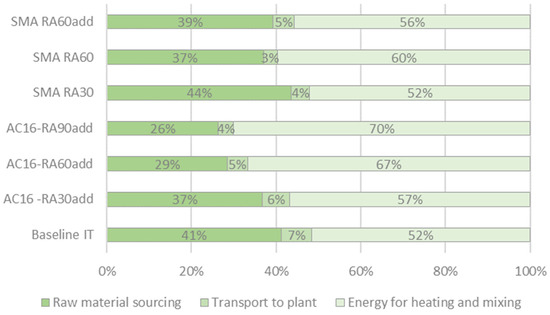
Figure A1.
South Europe case study–hotspot analysis (A1–A3).
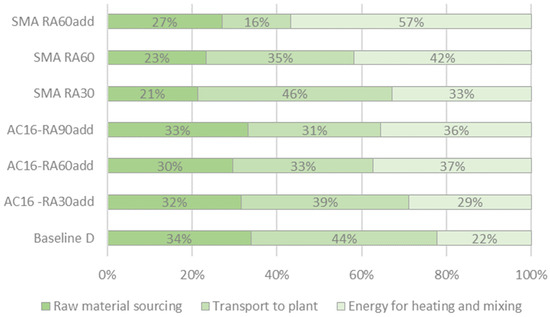
Figure A2.
Central Europe case study–hotspot analysis (A1–A3).
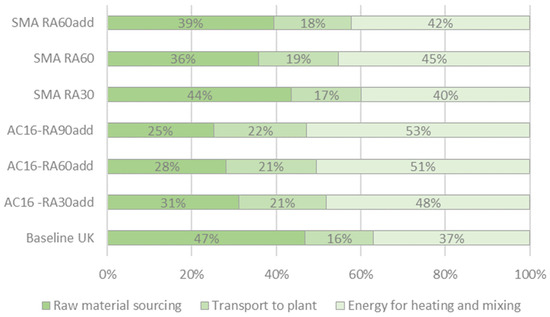
Figure A3.
North Europe case study–hotspot analysis (A1–A3).
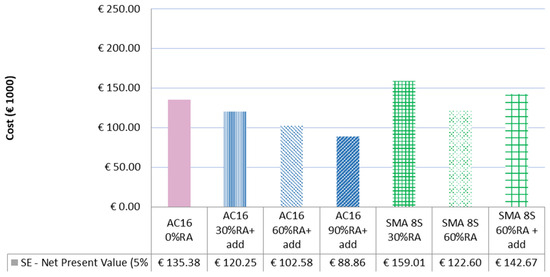
Figure A4.
South Europe case study–cradle-to-gate cost of the production of the asphalt mixture (one ton) (A1–A3).
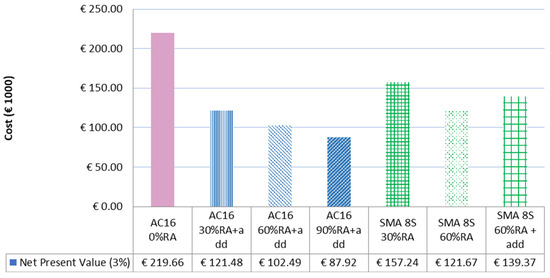
Figure A5.
Central Europe case study–cradle-to-gate cost of the production of the asphalt mixture (one ton) (A1–A3).
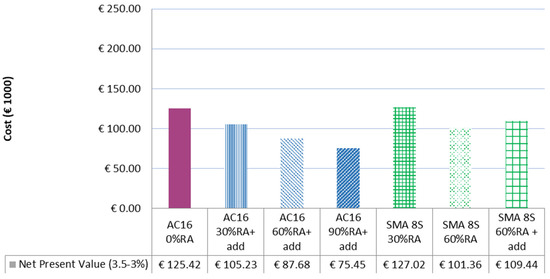
Figure A6.
North Europe case study–cradle-to-gate cost of the production of the asphalt mixture (one ton) (A1–A3).
Appendix A.2. Tables
Table A1.
South Europe case study: Information used to conduct the analyses.
Table A1.
South Europe case study: Information used to conduct the analyses.
| GENERAL | |
| Section length | 2000 m |
| Lane Width | Total carriageway width 9.50 m. Two lanes (3.5 m) plus shoulders (1.25 m) |
| Number of lanes | Dual carriageway road with two lanes |
| Traffic | HIGH VOLUME: 30,000 AADT vehicles/day |
| CURRENT PAVEMENT MATERIALS | |
| Mix specifications for all mixes used in the project. These should include (at the very least) aggregate type and content, asphalt content, and any modifiers used in the mix. |
|
| DESCRIPTION OF WORK Information about the milling, laying, and compaction processes used for each course, such as: | |
| Typical lift thickness used when laying each asphalt course | 170 mm asphalt, 30 mm wearing course, 45 mm binder course, 100 mm base course, and 300 mm of stabilised sand with cement |
| TRANSPORT DISTANCES (km) | |
| From: Bitumen refinery/binder production To: Mixing Plant | 35 |
| From: Bitumen refinery/binder production To Work Site | 233 |
| From: Aggregate Quarry To: Mixing Plant | 23 |
| From: RA stockpile To Mixing plant | 0 |
| From: Equipment storage To Work Site | 198 |
| From: Mixing plant To Work Site | 198 |
| From: Work site To: RA Stockpile | 198 |
Table A2.
Central Europe case study: Information used to conduct the analyses.
Table A2.
Central Europe case study: Information used to conduct the analyses.
| GENERAL | |
| Section length | 800 m |
| Lane Width (m) | Total carriageway width 11.80 m. |
| Number of lanes | Dual carriageway road with two lanes |
| Traffic | MEDIUM VOLUME: 20,000 AADT |
| CURRENT PAVEMENT MATERIALS | |
| Mix specifications for all mixes used in the project. These should include (at the very least) aggregate type and content, asphalt content and any modifiers used in the mix. |
|
| DESCRIPTION OF WORK Information about the milling, laying, and compaction processes used for each course, such as: | |
| Typical lift thickness used when laying each asphalt course | 30 mm wearing course, 80 mm binder course, 140 mm base course, unbound gravel base course 200 mm, unbound frost blanket 350 mm |
| TRANSPORT DISTANCES (km) | |
| From: Bitumen refinery To: Binder production (PMB) | 29 |
| From: binder production plant (PMB) To: Mixing Plant | 189 |
| From: Bitumen refinery/binder production To Work Site | - |
| From: Aggregate Quarry To: Mixing Plant | 348 |
| From: RA stockpile To Mixing plant | 0 |
| From: Equipment storage To Work Site | 35 |
| From: Mixing plant To Work Site | 35 |
| From: Work site To: RA Stockpile | 35 |
Table A3.
North Europe case study: Information used to conduct the analyses.
Table A3.
North Europe case study: Information used to conduct the analyses.
| GENERAL | |
| Section length | 720 m |
| Lane Width (m) | Total carriageway width 11 m |
| Number of lanes | Single carriageway with 2 lanes |
| Traffic | LOW VOLUME: 10,000 AADT |
| PAVEMENT MATERIALS | |
| Mix specifications for all mixes used in the project. These should include (at the very least) aggregate type and content, asphalt content and any modifiers used in the mix. |
|
| DESCRIPTION OF WORK Information about the milling, laying, and compaction processes used for each course, such as: | |
| Typical asphalt wearing course thickness | 190 mm asphalts: 40 mm wearing course, 100 mm binder course, 50 mm base course and 258 mm of stabilised sand with cement |
| TRANSPORT DISTANCES (km) | |
| From: Bitumen refinery/binder production To: Mixing Plant | 160 |
| From: Bitumen refinery/binder production To Work Site | 130 |
| From: Aggregate Quarry To: Mixing Plant | 70 |
| From: RA stockpile To Mixing plant | 70 |
| From: Equipment storage To Work Site | 43 |
| From: Mixing plant To Work Site | 43 |
| From: Work site To: RA Stockpile | 56 |
Table A4.
Data quality–parameters and emission factors for modelling.
Table A4.
Data quality–parameters and emission factors for modelling.
| Elements | Source | Notes |
| Costs | Wayman, 2014 [32], ITERCHIMICA [37], STORIMPEX [38] | Most of them were directly provided by the supplier, some of them coming from the literature |
| Durability | ANAS [28], BASt [29], Spray [30] | Durability should be subjected to sensitivity analysis |
| Discount rate | Vardakoulias, 2013 [39] | Discount rate should be subjected to sensitivity analysis ( + 1%) |
| Energy consumption–plant | Primary data. Temperature variations in hot and warm recycled mix collected from asphalt plant in Italy and Germany. Re-Road, 2012 [34] | Due to only slight variations in temperatures when using additives, the asphalt plant energy consumption was considered the same in all cases Heating increments should be subject to a sensitivity analysis to up 25% of increase |
| Laying and compacting energy consumption | asPECT v4.0 [31] | Review EARN and CEREAL outputs for relevance |
| Maintenance strategies | ANAS [28], BASt [29], Spray [30] | Strategies were adapted based on exchange of information with road authority engineers |
| Materials–additive | asPECT v4.0 [31], Mineral Products Association [38], STORIMPEX [38] | |
| Materials–mix recipes | ANAS [28], BASt [29], Spray [30], AllBack2Pave [27] | - |
| Planing energy consumption | asPECT v4.0 [31] | Review EARN and CEREAL outputs for relevance |
| Rolling resistance of materials in place | Reviewed published sources, no significant difference observed between asphalt with similar grading profiles | Assumed to be identical for all the considered asphalt mixes |
| Transport–distances | ANAS [28], BASt [29], Spray [30] | Distances should be subjected to sensitivity analysis |
| Transport–emission factors | [39] | - |
Table A5.
Case study-specific raw material transport distances to the plant (A2).
Table A5.
Case study-specific raw material transport distances to the plant (A2).
| Origins | Mode of Transport | One Way Distance (km) | |
| South Europe–Catania, Italy | |||
| Virgin aggregates 0.075–20 mm | Quarry | Rigid > 17 t, 20 t payload | 46 |
| Filler < 0.075 mm | Plant | - | 0 |
| RA Planings | RA stockpile | Rigid > 17 t, 20 t payload | 32 |
| Bitumen/PMB | Refinery | Rigid > 17 t, 20 t payload | 215 |
| Fibres | ITERCHIMICA Bergamo, IT | Articulated > 33 t, 24 t payload | 1370 |
| STORBIT PLUS additive | STORIMPEX Leipzig | Articulated > 33 t, 24 t payload | 2250 |
| Central Europe–Wittstock, Germany | |||
| Virgin aggregates 0.075–20 mm | Quarry | Rigid > 17 t, 20 t payload | 348 |
| Filler < 0.075 mm | Plant | - | 0 |
| RA Planings | RA stockpile | Rigid > 17 t, 20 t payload | 35 |
| Bitumen/PMB | Refinery | Rigid > 17 t, 20 t payload | 215 |
| Fibres | Central Germany | Articulated > 33 t, 24 t payload | 623 |
| STORBIT PLUS additive | STORIMPEX Hamburg | Rigid > 17 t, 20 t payload | 180 |
| North Europe–Lincoln, UK | |||
| Virgin aggregates 0.075–20 mm | Quarry | Rigid > 17 t, 20 t payload | 70 |
| Filler < 0.075 mm | Plant | 0 | |
| RA Planings | RA stockpile | Rigid > 17 t, 20 t payload | 70 |
| Bitumen/PMB | Refinery | Rigid > 17 t, 20 t payload | 160 |
| Fibres | Central Germany | Articulated > 33 t, 24 t payload | 375 |
| STORBIT PLUS additive | STORIMPEX Hamburg | Articulated > 33 t, 24 t payload (overestimated by not including the rail freight channel tunnel) | 1160 |
Table A6.
Transport distances from plant to site (A4).
Table A6.
Transport distances from plant to site (A4).
| Origin | Mode of Transport | One Way Distance (km) | |
| South Europe–Palermo, Italy | |||
| Asphalt mixes to site | Plant | Rigid > 17 t, 20 t payload | 198 |
| Bitumen emulsion for tack Coat | Plant | Rigid > 17 t, 20 t payload | 233 |
| Equipment | Plant | - | 198 |
| Central Europe–Wittstock, Germany | |||
| Asphalt mixes to site | Plant | Rigid > 17 t, 20 t payload | 35 |
| Bitumen emulsion for tack Coat | - | Rigid > 17 t, 20 t payload | 215 |
| Equipment | - | - | 35 |
| North Europe–Lincoln, UK | |||
| Asphalt mixes to site | Plant | Rigid > 17 t, 20 t payload | 43 |
| Bitumen emulsion for tack Coat | - | Rigid > 17 t, 20 t payload | 160 |
| Equipment | - | - | 43 |
Table A7.
Case study-specific excavated RA transport distances to the stockpile (C2).
Table A7.
Case study-specific excavated RA transport distances to the stockpile (C2).
| Origin | Mode of Transport | One Way Distance (km) |
| South Europe–Palermo, Italy | ||
| Excavated RA to stockpile | Rigid > 17 t, 20 t payload | 198 |
| Central Europe–Wittstock, Germany | ||
| Excavated RA to stockpile | Rigid > 17 t, 20 t payload | 35 |
| North Europe–Lincoln, UK | ||
| Excavated RA to stockpile | Rigid > 17 t, 20 t payload | 56 |
Table A8.
SE case study: cost of the asphalt mix constituents.
Table A8.
SE case study: cost of the asphalt mix constituents.
| Data Source | SE–IT [€/t] | |
| Virgin aggregates 0.075–20 mm | Ferrara | 10 |
| Filler < 0.075 mm | Ferrara | 10.50 |
| RA Planings | Ferrara | 4 * |
| Bitumen | Ferrara | 400 |
| Polymer modified bitumen | Ferrara | 520 |
| Fibres (glass) (0.90 €/Kg) | ITERCHIMICA | 900 |
| STORBIT PLUS additive | Ferrara | 1350 |
| Freight Transport (rigid > 17 t, 20 ton payload) | Ferrara | 0.33 |
* RA cost in Italy is the cost of stockpiling and fractioning (4 €/ton). If it is considered the cost to bring the RA to landfill is 8 €/ton.
Table A9.
CE and NE case study: cost of the asphalt mix constituents.
Table A9.
CE and NE case study: cost of the asphalt mix constituents.
| Data Source | CE/D and NE/UK [€/t] | |
| Virgin aggregates 0.075–20 mm | Wayman M [32] | 16.75 |
| Filler < 0.075 mm | as aggregate | 16.75 |
| RA Planings | Wayman M [32] | 11.00 |
| Bitumen | Rodriquez | 650 |
| Polymer modified bitumen | Wayman M [32] | 730.87 |
| Fibres (glass) (0.90 €/Kg) | ITERCHIMICA | 900 |
| STORBIT PLUS additive | STORIMPEX | 1350 |
| Transport–Rigid > 17 t, 20 ton payload | Wayman M [32] | 1.03 |
| Transport–Articulated > 33 t, 24 t payload | Wayman M [32] | 1.03 |
References
- Balaguera, A.; Carvajal, G.I.; Albertí, J.; Fullana-i-Palmer, P. Life Cycle Assessment of Road Construction Alternative Materials: A Literature Review. Resour. Conserv. Recycl. 2018, 132, 37–48. [Google Scholar] [CrossRef]
- Santero, N.J.; Masanet, E.; Horvath, A. Life-Cycle Assessment of Pavements. Part I: Critical Review. Resour. Conserv. Recycl. 2011, 55, 801–809. [Google Scholar] [CrossRef]
- Castro, C.; Sabogal, D.; Fernández, W. A Review of Emissions on Pavement Materials and Sustainability Rating Systems. Rev. Ing. Constr. 2022, 37, 280–291. [Google Scholar] [CrossRef]
- Vidal, R.; Moliner, E.; Martínez, G.; Rubio, M.C. Life Cycle Assessment of Hot Mix Asphalt and Zeolite-Based Warm Mix Asphalt with Reclaimed Asphalt Pavement. Resour. Conserv. Recycl. 2013, 74, 101–114. [Google Scholar] [CrossRef]
- Giani, M.I.; Dotelli, G.; Brandini, N.; Zampori, L. Comparative Life Cycle Assessment of Asphalt Pavements Using Reclaimed Asphalt, Warm Mix Technology and Cold in-Place Recycling. Resour. Conserv. Recycl. 2015, 104, 224–238. [Google Scholar] [CrossRef]
- Zaumanis, M.; Mallick, R.B. Review of Very High-Content Reclaimed Asphalt Use in Plant-Produced Pavements: State of the Art. Int. J. Pavement Eng. 2015, 16, 39–55. [Google Scholar] [CrossRef]
- Shi, B.; Dong, Q.; Chen, X.; Gu, X.; Wang, X.; Yan, S. A Comprehensive Review on the Fatigue Resistance of Recycled Asphalt Materials: Influential Factors, Correlations and Improvements. Constr. Build. Mater. 2023, 384, 131435. [Google Scholar] [CrossRef]
- Bizarro, D.E.G.; Steinmann, Z.; Nieuwenhuijse, I.; Keijzer, E.; Hauck, M. Potential Carbon Footprint Reduction for Reclaimed Asphalt Pavement Innovations: Lca Methodology, Best Available Technology, and Near-Future Reduction Potential. Sustainability 2021, 13, 1382. [Google Scholar] [CrossRef]
- Praticò, F.G.; Giunta, M.; Mistretta, M.; Gulotta, T.M. Energy and Environmental Life Cycle Assessment of Sustainable Pavement Materials and Technologies for Urban Roads. Sustainability 2020, 12, 704. [Google Scholar] [CrossRef]
- Bloom, E.F.; Horstmeier, G.J.; Ahlman, A.P.; Edil, T.B.; Whited, G. Assessing the Life Cycle Benefits of Recycled Material in Road Construction. In Proceedings of the Geo-Chicago 2016, Chicago, IL, USA, 14–18 August 2016. [Google Scholar]
- Chiu, C.T.; Hsu, T.H.; Yang, W.F. Life Cycle Assessment on Using Recycled Materials for Rehabilitating Asphalt Pavements. Resour. Conserv. Recycl. 2008, 52, 545–556. [Google Scholar] [CrossRef]
- Farina, A.; Zanetti, M.C.; Santagata, E.; Blengini, G.A. Life Cycle Assessment Applied to Bituminous Mixtures Containing Recycled Materials: Crumb Rubber and Reclaimed Asphalt Pavement. Resour. Conserv. Recycl. 2017, 117, 204–212. [Google Scholar] [CrossRef]
- Zhao, Y.; Goulias, D.; Peterson, D. Recycled Asphalt Pavement Materials in Transport Pavement Infrastructure: Sustainability Analysis & Metrics. Sustainability 2021, 13, 8071. [Google Scholar] [CrossRef]
- Aurangzeb, Q.; Al-Qadi, I.L.; Ozer, H.; Yang, R. Hybrid Life Cycle Assessment for Asphalt Mixtures with High RAP Content. Resour. Conserv. Recycl. 2014, 83, 77–86. [Google Scholar] [CrossRef]
- Vandewalle, D.; Antunes, V.; Neves, J.; Freire, A.C. Assessment of Eco-Friendly Pavement Construction and Maintenance Using Multi-Recycled Rap Mixtures. Recycling 2020, 5, 17. [Google Scholar] [CrossRef]
- Araújo, J.P.C.; Oliveira, J.R.M.; Silva, H.M.R.D. The Importance of the Use Phase on the LCA of Environmentally Friendly Solutions for Asphalt Road Pavements. Transp. Res. D Transp. Environ. 2014, 32, 97–110. [Google Scholar] [CrossRef]
- Butt, A.A. Life Cycle Assessment of Asphalt Roads: Decision support at project level. Doctoral Thesis, KTH Royal Institute of Technology, Stockholm, Sweden, 2014. Available online: https://www.diva-portal.org/smash/get/diva2:763875/FULLTEXT01.pdf (accessed on 12 July 2023).
- Thenoux, G.; González, Á.; Dowling, R. Energy Consumption Comparison for Different Asphalt Pavements Rehabilitation Techniques Used in Chile. Resour. Conserv. Recycl. 2007, 49, 325–339. [Google Scholar] [CrossRef]
- Huang, Y.; Bird, R.N.; Heidrich, O. A Review of the Use of Recycled Solid Waste Materials in Asphalt Pavements. Resour. Conserv. Recycl. 2007, 52, 58–73. [Google Scholar] [CrossRef]
- ISO 14040:2006; Environmental Management—Life Cycle Assessment—Principles and Framework. ISO: Geneva, Switzerland, 2006.
- ISO 14044:2006; Environmental Management—Life Cycle Assessment—Requirements and Guidelines. ISO: Geneva, Switzerland, 2006.
- EN 15804:2012; Sustainability of Construction Works—Assessment of Environmental Performance of Buildings—Calculation Method. Comite Europeen de Normalisation: Bruxelles, Belgium, 2012.
- Finkbeiner, M.; Schau, E.M.; Lehmann, A.; Traverso, M. Towards Life Cycle Sustainability Assessment. Sustainability 2010, 2, 3309–3322. [Google Scholar] [CrossRef]
- Kloepffer, W. Life Cycle Sustainability Assessment of Products (with Comments by Helias A. Udo de Haes, p. 95). Int. J. Life Cycle Assess. 2008, 13, 89–95. [Google Scholar] [CrossRef]
- Harvey, J.; Meijer, J.; Ozer, H.; Al-Qadi, I.L.; Saboori, A.; Kendall, A. Pavement Life Cycle Assessment Framework; Federal Highway Administration: Washington, DC, USA, 2016.
- Carrión, A.J.d.B.; Buttitta, G.; Neves, L.; Lo Presti, D. Sustainability Assessment for Road Pavements: PavementLCM Framework Deliverable D2.1b. 2021. Available online: https://www.pavementlcm.eu/download/sustainability-assessment-for-road-pavements-pavementlcm-framework-d2-1b/ (accessed on 1 March 2022).
- AllBack2Pave. AllBack2Pave—Toward a Sustainable 100% Recycling of Reclaimed Asphalt in Road Pavement; Conference of European Directors of Roads (CEDR): Brussels, Belgium, 2015. [Google Scholar]
- ANAS Capitolato Speciale d’appalto—Norme Tecniche per l’esecuzione del contratto–2010; Anas S.pA.: Rome, Italy, 2010.
- BASt. Section S3—Asphalt Pavements—Federal Highway Research Institute (BASt) Responsible, Oliver Ripke; BASt: Bergisch Gladbach, Germany, 2015. [Google Scholar]
- Spray, A. Global Warming Potential Assessment. Methodology and Road Pavements. Ph.D. Thesis, University of Nottigham, Nottingham, UK, 2014. [Google Scholar]
- AsPeCT. Available online: https://trlsoftware.com/services/software-development/aspect/ (accessed on 15 February 2022).
- Wayman, M.; Schiavi-Mellor, I.; Cordell, B. Protocol for the Calculation of Whole Life Cycle Greenhouse Gas Emissions Generated by Asphalt; Transport Research Laboratory: Wokingham, UK, 2014. [Google Scholar]
- EeBGuide Project G-06 Distinction between the Declared Unit and the Functional Unit. European Commission, Research and Innovation, Environment; Seventh Framework Programme for Research (FP7). Available online: https://www.eebguide.eu/eebblog/?p=1231 (accessed on 14 September 2023).
- Re-Road Re-Road: End of Life Strategies of Asphalt Pavements. Available online: http://re-road.fehrl.org/ (accessed on 15 September 2012).
- FHWA. Life-Cycle Cost Analysisin Pavement Design—In Search of Better Investment Decisions; Pavement Division Interim Technical Bulletin; U.S. Department of Transportation, Federal Highway Administration: Washington, DC, USA, 1998.
- FHWA. Life-Cycle Cost Analysis Software; Federal Highway Administration: Washington, DC, USA, 2015. [Google Scholar]
- Vardakoulias, O. Discounting and Time Preferences. the New Economics Foundation. Available online: www.neweconomics.org (accessed on 14 September 2015).
- Mineral Products Association Climate Change & Energy Data. Available online: http://www.mineralproducts.org/sustainability/climate-change-data.html (accessed on 14 September 2023).
- UK Gov UK Conversion Factor. Available online: http://www.ukconversionfactorscarbonsmart.co.uk/ (accessed on 15 September 2015).
Disclaimer/Publisher’s Note: The statements, opinions and data contained in all publications are solely those of the individual author(s) and contributor(s) and not of MDPI and/or the editor(s). MDPI and/or the editor(s) disclaim responsibility for any injury to people or property resulting from any ideas, methods, instructions or products referred to in the content. |
© 2023 by the authors. Licensee MDPI, Basel, Switzerland. This article is an open access article distributed under the terms and conditions of the Creative Commons Attribution (CC BY) license (https://creativecommons.org/licenses/by/4.0/).