


Abstract
To demonstrate the potential of the fifth edition of the Headway EFL textbook as a means to cultivate sustainability awareness and competence in Education for Sustainable Development (ESD), this study aims to identify themes related to the Sustainable Development Goals (SDGs) within the textbook. The secondary objective is to identify grammatical concept exercises that can function as a means of augmenting sustainability competencies. Drawing on constructivism research philosophy, this study utilized a content analysis approach to identify themes and patterns of SDGs in the textbook. This involved connecting language skill development (reading, listening, writing, and speaking) within every topic unit of the textbook with each of the 17 Sustainable Development Goals (SDGs). Furthermore, we focused on identifying and correlating different grammatical tasks that have the potential of enhancing students’ anticipatory, system-thinking, normative, strategic, and interpersonal sustainability competencies. The findings indicated that, with the exception of SDGs 6 and 1, all of the remaining 15 Sustainable Development Goals (SDGs) are depicted throughout the six levels of the textbook. In addition, it was revealed that exercises pertaining to grammatical concepts, including passive voice, pronouns, conjunctions, adjectives, and emphatic language, simple future tense, serve as significant predictors and enhancers of the five core competencies of sustainability. The present study sheds more light on the current understanding of sustainability awareness and competencies that are crucial for advancing Education for Sustainable Development (ESD) initiatives across various levels of the educational system.
1. Introduction
According to Basiago [1], sustainability refers to the ability of both individuals and society to preserve a given entity, outcome, or process over an extended period. The concept is crucial in the discourse of development as it emphasizes the need for sustainable development [2]. Sustainable development posits the need to improve the quality of life for both present and future generations by promoting a healthy lifestyle for the current generation while safeguarding the well-being of future generations [3]. Thus, governments are expected to establish and finance sustainable political, social, cultural, and environmental frameworks that facilitate local and national development. At the international level, the United Nations launched the Sustainable Development Goals (SDGs), also known as the 2030 Agenda for Sustainable Development. These commitments, established in 2012, serve as a means of fostering global development and are widely recognized as a set of overarching principles. They aim to address poverty, promote environmental conservation, and ensure universal access to peace and prosperity by 2030. Adopted by 193 countries, the SDGs outline a vision for a society characterized by economic prosperity, environmental sustainability, good governance, social inclusion, and cohesion. The SDGs provide a comprehensive framework for development applicable to nations at different stages of development. The objectives of the SDGs are centered around five overarching themes, known as the “five Ps”: people, planet, prosperity, peace, and partnerships. These themes are interwoven throughout the 17 SDGs, which address various concerns such as poverty (SDG 1), hunger (SDG 2), health (SDG 3), education (SDG 4), gender equality (SDG 5), water and sanitation (SDG 6), energy (SDG 7), economic growth (SDG 8), and industry, innovation, and infrastructure (SDG 9). Additional objectives include inequalities (SDG 10), cities and communities (SDG 11), consumption and production (SDG 12), climate change (SDG 13), water and land (SDG 14 and 15), peaceful and inclusive societies (SDG 16), and global partnership (SDG 17). Countries that have ratified the SDGs are expected to develop programs, policies, and measures to achieve these objectives. However, it is important to state that the successful implementation of national policies, programs, and measures related to the SDGs relies on the active involvement of citizens [4].
Awareness of sustainable development (SD) is considered a crucial factor in promoting citizen participation. The level of individuals’ awareness of the Sustainable Development Goals (SDGs) corresponds to their familiarity with both general and specific information related to the SDGs [5]. Heightened SDG awareness among the general populace can contribute to bolstering their engagement and dedication to policies and initiatives aimed at achieving the SDGs [4]. On the other hand, competence is identified as a crucial factor promoting citizen participation in the execution of the SDGs. The acquisition of sustainability competencies empower individuals to make informed decisions and take action toward achieving the SDGs [6]. In other words, citizens’ engagement in sustainable development depends on their possession of the requisite competencies for executing the 17 SDGs. These competencies comprise five distinct components: systems-thinking competence, anticipatory competence, normative competence, strategic competence, and interpersonal competence [7]. These interdependent components can be integrated into various configurations. For instance, individuals need the ability to examine sustainability issues comprehensively (systems-thinking competence), evaluate the issues and their contexts (normative competence), construct non-intervention scenarios that consider how the issue may evolve in the future (anticipatory competence), develop intervention approaches to achieve the SDGs (strategic competence), and establish partnerships with stakeholders from diverse fields (interpersonal competence).
Education for Sustainable Development (ESD) is implemented to foster awareness and competencies related to the SDGs. ESD is a dynamic concept encompassing an educational vision aimed at empowering students of all ages to assume personal responsibility for creating a sustainable future [8]. It is characterized by its interdisciplinary and transdisciplinary nature, suggesting that all academic fields can contribute individually and collectively to the advancement of ESDs [8]. Also, the inclusion of sustainability competencies in educational curricula requires a shift from knowledge-based to competency-based education, necessitating a transformation of pedagogical approaches [7,9]. Moreover, teachers play a crucial role as catalysts for the acquisition of ESD competencies, moving beyond the role of knowledge transmitters [10]. Therefore, it is imperative to examine the role of English educators as conveyors of SDG knowledge and facilitators of key competencies in sustainability among their students.
Chile has a robust policy framework for Education for Sustainable Development (ESD). However, its conceptualization is limited to the fundamental principles of environmental protection. The objective of this policy is to educate individuals on the acquisition of values and competencies that facilitate harmonious coexistence with the biophysical environment [11]. Studies conducted at the early childhood education level demonstrate that the pedagogical practices related to SDG subjects lack social and economic dimensions. This deficiency is evident in the majority of sustainability studies conducted in countries where the environmental dimension of the Sustainable Development Goals (SDGs) is prioritized [12].
According to Richards [13], textbooks play a crucial role in language instruction. However, it is imperative that they also incorporate a global perspective beyond language teaching. Risager [14] argues that language textbooks serve not only as a means of acquiring a particular language but also as a means of gaining insight into the world. Jodoin and Singer [15] propose that EFL textbooks can effectively facilitate the promotion of ESD by incorporating content aligned with the SDGs, thereby facilitating authentic and meaningful learning experiences. The review of numerous EFL textbooks reveals a deficiency in content related to Education for Sustainable Development (ESD) [16]. Several studies have explored the integration of sustainable development themes in English as a foreign language (EFL) textbooks to raise SDG awareness [17]. However, limited research has been conducted on promoting sustainability competency among students. The New Headway (fifth edition) collection, published by Oxford University Press (OUP), is a six-level English proficiency series designed for adult learners aiming to improve their general English. The textbook has gained widespread adoption in numerous English language institutes and teacher training colleges worldwide. Previous content analyses of this textbook have primarily focused on identifying cultural themes [18]. To date, no study has investigated and analyzed the SDG-related themes in the Headway EFL textbook to promote awareness of the SDGs.
Systemic Functional Grammar (SFG) is a linguistic framework that encompasses language features whose meanings derive from social interactions within society [19]. Numerous scholarly investigations have explored the correlation between SFG and various variables. For example, it has been used to assess the cognitive and affective characteristics of individuals within a given community [20] and stimulate critical thinking through language activities involving collaboration and interaction, such as pair work, small or large group work, and language-learning tasks [21]. Baraceros [22] also argues that implementing SFG concepts, such as the multi-functionality of clauses, grammar structures associated with communicative functions, interactive activities, and contextualized exercises, can stimulate critical-thinking processes. Thus, certain grammatical concepts can be adopted to cultivate competencies relevant to sustainability.
In light of the foregoing, this study aims to investigate and identify SDG-related themes presented as language skill topics that can promote SDG awareness and grammatical concept exercises that can foster the core competencies of sustainability in the fifth edition of the Headway textbook series. The study seeks to provide valuable insights for English teachers interested in utilizing this popular textbook series to promote awareness of the Sustainable Development Goals (SDGs) and equip their students with the necessary competencies to effectively implement these goals. In other words, the significance of this study lies in its potential to not only provide a framework for the effective integration of ESD in the EFL classroom but also extend the discourse of ESD beyond the dimension of the environment in Chile. The current work begins with the establishment of the theoretical and conceptual framework, followed by an examination of the relevant literature, methodology, results, and discussion, culminating in a conclusion that presents a synopsis and appraisal of the findings.
2. 3.0 Theoretical Framework
Olsson et al. [23] defined the concept of action competence theory, which aims to foster a triad of interconnected outcomes. This includes promoting knowledge of action possibilities, self-efficacy, and proactiveness [24], empowering a new generation with skills to take action in implementing the SDGs [25], and adopting an educational approach aimed at cultivating sustainability awareness and competencies among both individuals and groups [26,27].
The fostering of action competence within the context of Education for Sustainable Development (ESD) depends on the level of SDG-related content in textbooks. Textbooks are regarded as significant indicators of the prevailing social and political conditions and serve as symbols of the influence of groups and/or concepts on official knowledge [28]. They also depict human rights [29], individual agency [30], and environmental issues [31]. The present study conducts a content analysis of an EFL textbook with the objective of generating insights into potential actions for sustainable awareness (SDGs) and fostering competencies for sustainability (sustainability competencies) among present and future citizens. In other words, the themes within EFL textbooks have the potential to effectively foster sustainable awareness regarding the 17 Sustainable Development Goals (SDGs) among students and serve as a means to develop the Sustainability Competence (SC) proposed by Wiek et al. [7] as follows:
- Anticipatory competence refers to an individual’s capacity to predict and prepare for future outcomes as they relate to the SDGs by considering current actions and choices.
- System-thinking competence refers to the aptitude to comprehend and scrutinize complex systems with the aim of recognizing and resolving sustainability issues.
- Normative competence refers to the aptitude to comprehend and implement ethical standards and values in the context of sustainability issues.
- Strategic competency refers to the aptitude to devise and implement innovative actions aimed at tackling sustainability issues.
- Interpersonal competency refers to the aptitude to efficiently cooperate and collaborate with others in order to tackle sustainability issues.
The potential of Systemic Functional Grammar (SFG) to enhance SC is grounded on the notion that language functions as a social semiotic system, whereby it serves as a set of signs utilized to convey significance within social contexts [19]. Halliday and Matthiessen [32] posit that SFG can be subjected to analysis at three distinct levels, namely: the textual level, the interpersonal level, and the ideational level. That is, SFG is concerned with the organization of language into texts or discourse at the textual level. That is, a grammatical structure is employed to produce logically connected and unified texts, including the utilization of conjunctions and cohesive devices. At the interpersonal level, the study of SFG focuses on how language is utilized to navigate social relationships and convey emotions and attitudes. This involves the use of pronouns, modal verbs, and additional grammatical characteristics that signify the viewpoint of the speaker. At the ideational level, SFG examines how language is employed for the purpose of representing and conveying ideas and experiences by using tense, aspect, and additional grammatical characteristics that communicate details regarding time, process, and causation.
Our argument posits that the acquisition of various forms of SC is based on the acquisition of distinct functions at systemic functional grammar (SFG) levels, as outlined below:
- System-thinking competence: This competence can be acquired at the ideational level of SFG where learners recognize linkages, reflect holistic viewpoints, and grasp emergent features and feedback mechanisms in complex systems that exist in a language.
- Anticipatory competence: This competence can be acquired at the textual level of SFG, where learners predict and anticipate meaning based on text structure, cohesiveness, and genre conventions.
- Normative competence: This competence can be acquired at the interpersonal level of SFG where learners understand sociolinguistic norms, ethical issues, and efficient communication tactics for social interactions.
- Strategic competence: This competence can be acquired at the interpersonal level of SFG where learners adapt language, manage conversational turns, and use persuasive approaches to attain communication goals.
- Interpersonal competence: This competence can be acquired at the interpersonal level of SFG where learners express and interpret attitudes, negotiate meaning, resolve disagreements, and build and maintain relationships through effective communication.
Thus, we argue that if the grammatical structure generates meaning within a social context, it is plausible to suggest that specific grammatical concepts at these levels may contribute to the improvement of SC through appropriate grammar exercises. The utilization of grammar exercises as a traditional method for enhancing the comprehension and application of grammatical structures in second language (L2) acquisition is rooted in the behaviorist perspective of L2 learning [33]. This is based on the premise that language is a habit-forming process that highlights the significance of practice and reinforcement in the process of acquiring language. Thus, the practice of grammar exercises serves not only as a tool for aiding in the acquisition of a second language but also has the potential to encourage the development of SC.
Figure 1 illustrates that an English as a Foreign Language (EFL) textbook possesses the potential to facilitate both sustainable awareness (SA) about the 17 Sustainable Development Goals (SDGs) and sustainable competence (SC) necessary for executing them via language skills development and grammatical concept exercises, respectively.
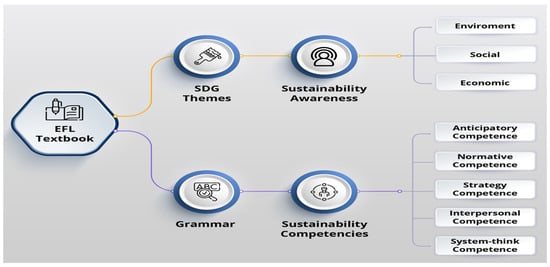
Figure 1.
An EFL textbook as a tool to foster both sustainability awareness and competencies.
3. Literature Review
The objective of Education for Sustainable Development (ESD) is to enhance awareness and competencies that enable individuals to engage in SDG programs by considering the present and future social, cultural, economic, and environmental impacts from both local and global perspectives [25]. According to Richards [13], textbooks are expected to focus on language instruction while also addressing global issues. Consequently, numerous studies have conducted content analyses of various EFL textbooks. For instance, a study examining the distribution of SDG themes in an EFL textbook series published by the Iran Language Institute (ILI) revealed that sustainability themes are not uniformly represented across ILI textbook series. Mohammadnia and Moghadam [17] report that in certain instances, sustainability-related topics are concentrated in one of several units within a textbook. Regarding the book level that contains the highest number of SDG themes, it was found that the 12th grade book, corresponding to a B1/B2 level of English, contains the most significant volume. In another study investigating the representation of SDG themes across different dimensions in an EFL textbook [34], it was demonstrated that the economic dimension was the least represented, followed by the environmental dimension, and finally the social dimension. In summary, there is a substantial body of literature related to the content analysis of Sustainable Development Goals (SDGs) in English as a Foreign Language (EFL) textbooks.
The successful implementation of Education for Sustainable Development (ESD) entails not only raising awareness about the Sustainable Development Goals (SDGs) but also equipping learners with the necessary competencies and attitudes for effective task performance and problem-solving in the face of real-world sustainability challenges and opportunities [35]. Thus, the concept of sustainability competencies within educational constructs is based on problem-solving strategies and abilities to take social action [36]. These competencies encompass five distinct components, namely systems-thinking competence, anticipatory competence, normative competence, strategic competence, and interpersonal competence [7]. Several research studies have been conducted on key competencies in sustainability. For example, Sá et al. [37] examined portrayals of sustainability competencies in doctoral dissertations within the Portuguese higher education system and found a greater emphasis on strategic and anticipatory competencies. Another approach to enhance these competencies involves the implementation of a sustainable chocolate project that is practically oriented, culturally diverse, and interdisciplinary among 35 undergraduate students from different countries [38]. According to scholars, the students acquired competencies related to systemic inquisitiveness, ethical dedication, moral perspective, innovative preparedness, collaborative competencies, and reflective learning. In terms of didactic strategies, Tejedor et al. [39] proposed service learning, problem-based learning, project-oriented learning, simulation games, and case studies as pedagogical approaches to promote key competencies in sustainability.
The possibilities to comprehend and interpret the world around us as well as develop a variety of competencies are all part of the meaning potential that Systemic Functional Grammar (SFG) theory offers to second language (L2) learners [32]. The theory has been utilized to promote critical thinking [22] and intercultural competence [40]. In terms of enhancing grammar competency, scholars have employed traditional methods involving grammar exercise practice [41,42], computational thinking [43], and critical thinking [44]. However, a gap in the literature includes the identification of grammatical exercises capable of fostering competencies in sustainability.
Considering the significance of the Headway English as a Foreign Language (EFL) textbook in English teacher training colleges worldwide, prior studies have focused on content analysis related to the portrayal of foreign cultures [45], humanistic elements [46], and the theme of globality [47]. Furthermore, comparative analyses of different dimensions and variables have been conducted to strengthen the EFL curriculum. For instance, a study comparing the degree of cultural themes among learners [48] demonstrated the need for integrating local content into the textbook. Another comparative study involved comparing the advanced Headway with the advanced ILI (Iran Language Institute) in terms of communicative language teaching [49]. The findings revealed that the New Headway Advanced series was considered more favorable and desirable compared to the ILI Advanced Series, attributed to its superior design and organization, authenticity, and attractiveness. Thus, in order to fill the lacuna in the literature, this present study aims to investigate the portrayal of Sustainable Development Goals (SDGs) in the Headway EFL textbook.
Taking this background into account, the purpose of this study is to identify SDG-related themes and grammatical exercises capable of fostering sustainability competencies. The following inquiries served as the basis for the research:
- What are the SDG themes depicted in the skills development unit (topic unit) of the textbook?
- What is the degree of SDG-related themes and grammatical concept exercises that foster sustainability competencies at each level of the textbook?
- What are the grammar exercises that can foster competencies in sustainability?
4. Materials and Methods
4.1. Research Design
The research design utilized is grounded in the constructivism research philosophy. It employs content analysis as a method to uncover themes related to Sustainable Development Goals (SDGs) and grammatical functions that have the potential to enhance the competency of SDGs in an English textbook. The constructionist perspective asserts that both reality and knowledge are products of social construction [50]. Consequently, this viewpoint offers a valuable framework for examining how educational materials depict the Sustainable Development Goals (SDGs). The present study will employ the approach of content analysis to comprehensively examine the textbooks and identify occurrences of Sustainable Development Goals (SDGs). The coding system will be established by an inductive approach, which involves deriving categories and themes directly from the text itself rather than relying on a predetermined framework. This methodology aligns with the principles of constructionist inquiry, as it acknowledges and reflects the emergent aspect of the research process.
4.2. Source of Data for the Identification of SDG Themes and Grammatical Concept Exercise for SC Enhancement
This study collected data systematically from a comprehensive and carefully selected set of resources. We utilized the fifth edition of the Headway English textbook series, which is widely acknowledged and esteemed in the field of English language education. The series consists of six proficiency levels including beginner, elementary, pre-intermediate, intermediate, upper-intermediate, and advanced level. Each level is represented by a separate book in the series. This book has been widely used and proven effective globally. This book serves as a valuable resource for teachers and learners, providing motivation and enrichment for language acquisition while boosting learners’ confidence. The fifth edition of the New Headway course book has been revised to incorporate fresh activities and updated content aimed at enhancing the English language learning experience for both adult and young learners. The courses integrate traditional and contemporary language teaching methods to enhance students’ fluency in English. The New Headway textbook comprises two parts, with the first part consisting of six units that each cover a specific topic. The second component comprises exercises that enhance learners’ proficiency in grammar, vocabulary, speaking, listening, writing, and reading. Each book unit comprises a topic and various sections for practicing grammar, functions, vocabulary, four skills, and pronunciation. The textbooks are accompanied by supplementary materials, including workbooks, CDs, and a manual for instructors.
4.3. Instrumentation for Theme Identification and Analysis
The SDG framework recommended by the UN was used since it is a comprehensive guide that was created after surveying millions of people worldwide [25]. The framework comprises recommended topics and corresponding goals for every dimension of the SDGs. After that, the SC framework proposed by Wiek et al. [7] was chosen as the most recent and comprehensive guide for the five key competencies of SC. The competencies were categorized into the levels of systemic functional grammar suggested by Halliday and Matthiessen [32].
4.4. Content Analysis
The initial step in content analysis involves selecting the text to be analyzed, specifying the unit of analysis, defining the categories to be assigned to each unit, and tallying the frequency of each category [51]. Content analysis is advantageous due to its systematic approach and verifiability through re-analysis and replication, as the material is permanent [52].
The procedures for constructing the content analysis tool were as follows:
Identifying units of analysis: The EFL book is designed to promote four skills of the English language, which are reading, listening, writing, and speaking. Thus, every unit that depicts an SDG is expected to express the above-mentioned four language skills. This is carried out with the aim of making every unit count and be measured easily. The existence, absence, repetition, or highlight of those units can give indications that help the researcher explain the qualitative results in terms of topics in reading, listening, speaking, and writing [53]. The researcher selected “the book level/page/unit lesson” as an analysis unit. With respect to identifying task-based grammar exercises that can promote sustainable competencies, every unit in the Headway EFL textbook has a section called language focus. Each section of every unit is designed to teach a particular grammatical concept. In other words, a grammatical concept that explains the functional topic of the unit is followed by a task-based grammar exercise. The researcher selected “book level/page/language focus activities” as an analysis unit.
Identifying categories of analysis: It refers to the main and secondary elements of units of analysis that are identified and categorized. It is the topic of a unit that is presented in the form of reading, listening, writing, and speaking skills, according to which the features of the content are then placed and categorized [54]. Hence, the categories of analysis were determined by identifying the indicators of sustainable development dimensions based on the goals of SD and its 53 indicators. This identification, which is a coding technique, is carried out by marking by hand, in different colors, each occurrence of goals corresponding to an environment, society, or economic dimension of the SDGs. SC was also coded by placing the first letter of the competence used against each grammatical concept exercise and SFG level. This is carried out by identifying and defining a grammatical concept as well as establishing its significance in fostering a particular form of sustainability competency and SFG level. In other words, every description of a grammatical exercise is an analysis unit to express tasks capable of fostering a particular form of key competency in sustainability.
4.5. Validity and Reliability
Inter-coder reliability is determined by comparing the coding of an answer by one coder at a different time or by another coder at the same time to ensure their identity [55].
The unit’s topical themes were identified as depicting SDGs, and critical grammar exercises were assigned to foster sustainability competencies. It is crucial to validate the indicators for each theme and the grammar exercises for each sustainability competency. The researcher defines each identified grammatical concept and the significance of the grammatical concept in fostering sustainability competence so that the jurors can carry out an effective assessment. The questionnaire included identified items and presented the six levels of EFL books to two jurors who were specialists in EFL curricula and instruction. The approach inspired by the work of Hassan [34] involves the jurors evaluating the suitability of the items using a 3-point Likert scale, ranging from highly appropriate to inappropriate.
Two jurors were instructed to assess the following:
Appropriateness of the identified topic unit with the corresponding SDG.
Appropriateness of the identified grammatical concept exercise with the corresponding SC.
The collected forms were statistically processed as follows:
Three marks were assigned for the first level “highly appropriate”, two for the second level “moderately appropriate”, and one for the third level “inappropriate”.
The sum of the additions was divided by the number of jurors, resulting in the mean weight of each indicator or item.
The item that received a mean weight of less than “2” or more was excluded.
Results of the application of the questionnaire: Most of the jurors agreed on the appropriateness of the items on the list to the content of EFL textbooks in the secondary stage, and the mean weight of items ranged between 75% and 90%.
4.6. Data Analysis
To analyze the representation of SDG themes and relevant grammatical competence across all levels of the textbook, both variables were calculated at every level of the textbook. Thus, this study employed a mixed-methods data analysis approach, first employing qualitative analysis to identify the topics covered in the textbooks, followed by quantitative analysis to calculate the number of SGD themes and the grammatical concepts that can foster the SDGs across different levels of the textbook series. Mixed-methods research provides a more comprehensive understanding of a research project than using only one approach [56]. With respect to qualitative analysis, we employed manual coding of the textbook material for the process of content analysis. Manual coding allows for nuanced interpretation of the text. That is, it helps us to understand and interpret context, metaphor, and semantics in ways that automated processes might overlook or misinterpret. The process involves a close reading of the textbook material and the identification of recurring themes, patterns, or ideas. These elements are then assigned specific codes for analysis. The primary tool used for the quantitative content analysis is SPSSv29 (Statistical Package for the Social Sciences). This software helped us to properly manage the data and calculate frequencies and distributions of coded SDG themes and grammatical concepts for SC enhancement at the beginner, elementary, pre-intermediate, intermediate, upper-intermediate, and advanced levels of the EFL book.
5. Results
To answer the first research question, the six levels of the EFL textbook were investigated by exploring the SDG themes depicted in the language skills development of the textbook, as illustrated in Table 1. Considering all six levels of the book, all the SDG themes are identified except water and poverty. Under the environmental dimension, life below water of SDG 14 is used to describe the poisoned by plastic topic at an upper-intermediate level. Tree planting in a reading passage titled “Forest Man” is a relevant topic for SDG 15. Recipe for Success is a topical issue about food that can be used to foster SDG 2. Historical topics about the system of education during the Victorian era are important for the SDG on education. Reading and discussing topics about jobs for boys or girls is important for gender equality. The promotion of peace and goodwill as well as Eugene Cernan and Christina Noble Obe volunteer work can be used to promote peace and partnership between private and public institutions, respectively. Economic goals consist of work; a speaking and listening topic is used to discuss professions that should earn more money. With respect to innovation, we select topics that focus on the importance of the Internet and how its functions should be used to broaden knowledge about sustainable cities. Last but not least, there is a focus on the success of the Scandinavians with respect to developing brands that produce products consumed across the world.

Table 1.
Summary of each SDG with their corresponding identified skills development in the EFL Textbook.
Figure 2 also reveals the degree of SDG representation and level of grammatical concepts that foster SC across the six levels of the EFL book. The result shows that intermediate and elementary have the highest levels of SDG-related themes and grammatical concept exercises, respectively.
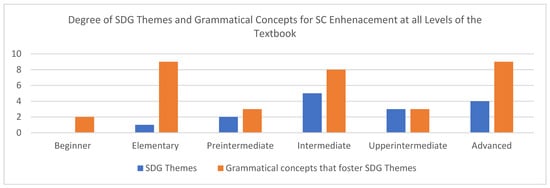
Figure 2.
The level of SDG representation and grammatical concepts that foster SC across the six levels of the EFL book.
We argue that certain concepts of grammatical exercises depicted in the language focus of the textbook can foster different forms of sustainability competence. Therefore, we established the function of the grammatical concept within the framework of sustainability and then identified them in the EFL textbook. As we stated in Table 2, the exercises are not meant to enhance only the grammatical competence of the target language but also competencies that are critical for sustainability. For example, system-thinking skills that involve the ability to understand and analyze complex issues can be gained through exercises that involve changing the active voice of different tenses to the passive voice. This is highlighted at the advanced level of the book. With respect to anticipatory competence, which is the ability to plan for the future, it can be argued that exercises that depict the simple future tense are good enough to foster this type of competence. This exercise is reported at several levels in the book. A normative competency is the ability to apply principles and ethical issues by using adjectives to express values and personalities’ importance in society, prepositions to describe relationships of power and authority, and adverbs to describe one’s obligation to society. regarding strategic competencies, which is the ability to implement innovative ideas. This involves being empathic, linking different ideas together, making a decision, and signalling the relationship between ideas. This can be learned by teaching empathic statements, conjunctions, collocations, and discourse markers, respectively. Last but not least, interpersonal competence, which is the ability to work collaboratively, requires a polite attitude. This can be done by learning grammatical exercises that focus on common, appropriate social expressions. In addition, learning suitable pronouns for communication as well as direct and indirect speech is critical to expressing assertiveness. Thus, we can argue that this book is effective in fostering sustainability competencies.
Table 2.
Summary of sustainability competencies with their corresponding identified grammatical concept exercise.
6. Discussion
The Sustainable Development Goals (SDGs) were established by the United Nations General Assembly in 2015 as a comprehensive framework to address global challenges, including poverty, inequality, climate change, and environmental degradation. These goals have been widely adopted across various sectors, such as governments, non-governmental organizations, and private sector organizations, as a means to promote sustainable development. Education, particularly through the use of textbooks, has gained increasing attention for fostering awareness and understanding of the SDGs among young students.
The portrayal of SDG-related themes in the EFL textbook exhibits notable variations across different levels, except for the beginner level. Out of the 17 SDGs, 15 are adequately covered either through speaking and listening activities or as reading passages. However, SDG 1 and SDG 6 are not addressed as dedicated topic units and at the syntactic level. The omission of these goals can have negative implications, resulting in learners who have limited knowledge about poverty and water-related issues. As a result, this can lead to a decrease in their ability to effectively address these issues. Furthermore, it is important to note that both SDG 1 and SDG 6 are interdisciplinary in nature, as they address various dimensions including economic, social, and environmental aspects. Excluding interdisciplinary learning opportunities can diminish the quality of the ESD experience. Nevertheless, the EFL textbook contains sufficient SDG content that can effectively raise awareness among higher education students. In other words, the use of the textbook is not limited to the promotion of foreign cultures [45], humanistic elements [46], and the theme of globality [47] but can also serve as a means to teach sustainability-related topics.
One of the research questions aims to identify a grammatical concept critical for the acquisition of sustainability competencies among learners. The findings demonstrate that exercises focusing on certain grammatical concepts can enhance sustainability competencies in the EFL textbook. For example, transforming active voice into passive voice exercises can promote systems thinking because the passive voice emphasizes action rather than the actors in a sentence. Thus, the activity can augment learners’ systemic thinking by emphasizing systemic actions needed to be taken with respect to sustainability. For example, actions such as deforestation, carbon emissions, and industrial practices can be emphasized in a sentence to promote the SC of learners with respect to climate change. Also, exercises involving the simple future tense can develop anticipatory competence which helps students envision actions needed to take in the future with respect to sustainability. Tasks related to adjectives, prepositions, and adverbs can help develop normative competence because they help students link positive attributes associated with sustainable actions, and exercises on emphasis and conjunctions can foster strategic competence. For example, emphatic words can be used to demonstrate to learners that actions are more important for sustainability. Consequently, they foster students’ SC because they will be able to identify and take appropriate actions critical for sustainability. Interpersonal competence can be nurtured through exercises on direct and indirect speech, pronouns, and social expression. SC can be fostered because grammatical concepts can help learners teach politeness strategies and inclusivity, which are critical for collaborative relationships and are essential for sustainable actions. In other words, the EFL textbook serves as a valuable resource for gaining knowledge about the SDGs and developing competencies in sustainability. This study goes beyond previous research that has focused solely on depicting SDG themes in EFL textbooks as a proxy for creating SDG awareness, as it demonstrates the potential of EFL textbooks as a tool to foster sustainability competencies. However, further research is needed to examine the impact of these competencies on students’ attitudes and behaviors toward sustainability.
Unlike a study conducted in an Iranian context that showed a concentration of SDG themes in a single unit [17], our chosen resource material presents a different pattern. Our findings indicate that all SDG themes are depicted across five out of the six levels of the textbook series, with a higher concentration of themes at the intermediate level. Thus, contrary to the textbook adopted by [34], Headway can be used to teach sustainable awareness at every level of English proficiency. Also, in line with previous research [34], we also noted that the social dimension is the most represented theme in the Headway EFL textbook. The fact that EFL publishers prioritize social issues in their content may help explain our results. Regarding the identified grammatical concepts, each level contributes to fostering sustainability competencies, with the elementary level covering the highest number of grammatical concepts. Thus, it can be argued that the textbook prioritizes grammar-focused learning before reaching the intermediate level, where SDG themes are concentrated at and above the intermediate level. This can be explained by the bottom-up approach to second language acquisition, in which language comprehension progresses from phonemes and morphemes to lexemes, phrases, clauses, and larger chunks of text [57]. Considering the effectiveness of this approach, the integration of Education for Sustainable Development (ESD) into English language programs can be successfully accomplished by utilizing the complete series of the EFL textbook. This allows for a focus on grammatical competence at the beginner and elementary levels as preparation for full content-based instruction on ESD, which can commence at the intermediate level.
Theoretically, the study has demonstrated the relevance of action competence to promote SDG awareness and competence [23]. This is because numerous studies focusing on the depiction of SDG themes in EFL textbooks are carried out within the framework of the ESD program to encourage interest in the SDG program and get involved in its implementation of it. Regarding the SFG theory that has been used to foster critical thinking [22] and intercultural competence [40], its function as a linguistic tool to communicate meaning in a social context has been successfully proven to have the capacity to foster key competencies in SC. With respect to the importance of behavior theory, which involves the use of grammar exercises to foster grammar competency and other key competencies in sustainability [33], we argue that by adopting different dynamic assessments of grammar and different forms of assessment, the acquisition of key competencies in sustainability will be more effective and rapid [42]. In other words, the more dynamic the grammar assessment, the stronger the acquired competence.
Having established that textbooks can help in developing sustainability awareness and competencies among students, it is important for teachers of English to know how to integrate grammar into content-based instruction (CBI). With respect to the ESD program, a grammatical concept can be integrated into the sustainability topic. This approach offers several advantages, including the development of grammatical competency, the acquisition of content knowledge (SDG knowledge), and the acquisition of SDG competencies that correspond to their grammatical concepts. However, one potential challenge of CBI is the effective integration of grammar instruction into content instruction. An educator can implement effective integration by providing explicit instruction on grammar rules and structures, with a focus on how these rules are used in the context of the subject matter. For example, in explicit grammar instruction, teachers can provide explanations of a grammatical concept and practice activities related to specific content topics, such as using the future tense to discuss anticipatory competence in sustainability. Since most of the grammatical concept exercises are not related to the sustainability topic, it is important to adapt EFL textbooks, especially grammar exercises. This can be achieved by using authentic texts related to the topic of sustainability to teach grammar structures and rules to foster its key competencies, allowing students to see how these structures are used in the context of sustainability [58]. This suggestion is given to avoid mismatches between what the material offers as an EFL textbook to enhance English proficiency and the conditions of the learning context of sustainability needed in an ESD program [59].
Lastly, due to the lack of SDG-related themes of water and poverty, the publisher and writers of Headway should endeavor to add these themes to future editions. This will create awareness about these goals among users of this textbook so that they can encourage water conservation and reduce poverty in their communities. In addition, the inclusion of the goals can help learners develop critical thinking that stems from the unit topic that depicts these goals. This attests to the importance of conducting a content analysis of EFL, which is critical to the objective of ESD.
7. Conclusions
The primary objective of the present study was to identify SDG-related themes and grammatical concept exercises that can act as predictors of sustainability competencies in the fifth edition of the Headway English textbook. One of the most notable findings indicates that the textbook encompasses 15 out of the 17 SDGs across all six levels of the textbook. Furthermore, it was discovered that certain grammatical concepts, such as passive voice, adjectives, pronouns, and conjunctions, among others, have the potential to foster all five key competencies of sustainability. This scholarly endeavor addresses the need for an ESD framework or tool that can facilitate the development of both student awareness (SA) and sustainable competencies (SCs). Consequently, the exploration and validation of the Headway EFL textbook as a potential tool to foster SA and SC among learners is well justified. An important suggestion arising from this study for the textbook publishers is the inclusion of SDG-related topics such as water and poverty in future editions of the textbook. Additionally, due to the concentration of SDG-related themes at the intermediate level, it is recommended that educators allow learners to attain a certain level of proficiency before introducing SDG-related content to learners in ESD programs. Also, while pedagogical approaches such as the discussion of themes, the real-world context, and project-based learning can be used to teach SDG themes in the EFL classroom, educators can use contextual sentences or grammar stories related to SDG themes to enhance the sustainability competency of their students. However, it is essential to acknowledge the limitations of this study. Specifically, it lacks empirical evidence regarding the impact of the identified SDG-related themes and grammatical concept exercises on the acquisition of SA and SC by learners, respectively. In addition, the study focuses on the fifth edition of the Headway EFL textbook, which may not be representative of all EFL textbooks available. Thus, the generalizability of the findings to other textbooks or educational contexts could be limited. Furthermore, with respect to the adopted methodology, content analysis as a method might be susceptible to subjectivity and bias in the process of connecting skill development and Sustainable Development Goals (SDGs). Therefore, the study could benefit from additional validation methods to enhance the reliability of the findings. Finally, the study lays a foundation for exploring sustainability awareness and competencies in EFL education but could be strengthened by addressing the limitations mentioned and providing more detailed explanations of its findings and implications. Further research and additional empirical evidence may be necessary to fully validate the efficacy of using the Headway EFL textbook or similar approaches to cultivate sustainability awareness and competence in ESD.
Author Contributions
Conceptualization, O.A.L.; Methodology, O.A.L. and E.S.C.; Validation, O.A.L. and B.S.M.; Resources, O.A.L.; Project administration, C.M.M.-A. All authors have read and agreed to the published version of the manuscript.
Funding
This research received no external funding.
Data Availability Statement
The datasets used and/or analyzed during the current study are available from the corresponding author on reasonable request.
Conflicts of Interest
The authors declare no conflict of interest.
References
- Basiago, A.D. Economic, social, and environmental sustainability in development theory and urban planning practice. Environmentalist 1998, 19, 145–161. [Google Scholar]
- Odoom, D.; Mensah, E.O.; Dick-Sagoe, C.; Lee, K.Y.; Opoku, E.; Obeng-Baah, J. Examining the level of public awareness on the Sustainable Development Goals in Africa: An empirical evidence from Ghana. Environ. Dev. Sustain. 2023, 23, 1–18. [Google Scholar]
- Wayne, C.G.; Chameau, J.L.; Carmichael, C. Sustainability, and the University. Presidency 2006, 9, 30–38. [Google Scholar]
- Kumi, E. Advancing the Sustainable Development Goals: An Analysis of the Potential Role of Philanthropy in Ghana. J. Asian Afr. Stud. 2019, 54, 1084–1104. [Google Scholar]
- Jati, H.F.; Darsono, S.N.A.C.; Hermawan, T.; Yudhi, W.A.S.; Rahman, F.F. Awareness and knowledge Assessment of Sustainable Development Goals Among University Students. J. Ekon. Studi Pembang. 2019, 20, 163–175. [Google Scholar]
- Fischer, D.; Barth, M. Key competencies for and beyond Sustainable Consumption: An Educational Contribution to the Debate. GAIA—Ecol. Perspect. Sci. Soc. 2014, 23, 193–200. [Google Scholar]
- Wiek, A.; Withycombe, L.; Redman, C.L. Key competencies in sustainability: A reference framework for academic program development. Sustain. Sci. 2011, 6, 203–218. [Google Scholar]
- Buckler, C.; Creech, H. Shaping the Future, We Want: UN Decade of Education for Sustainable Development; Final Report; UNESCO: Paris, France, 2014. [Google Scholar]
- Farioli, F.; Mayer, M.; Del Gobbo, G. Learning for an unpredictable future: What competences for educators. Enseñ. Cien. 2017, Extra, 4961–4966. [Google Scholar]
- Wiek, A.; Bernstein, M.J.; Foley, R.W.; Cohen, M.; Forrest, N.; Kuzdas, C.; Kay, B.; Keeler, L.W. Operationalising Competencies in Higher Education for Sustainable Development. In Routledge Handbook of Higher Education for Sustainable Development; Routledge: London, UK, 2015; pp. 241–260. [Google Scholar]
- Riquelme-Arredondo, A.; Antivilo-Bruna, A.; Torres-Contreras, H.; Landaeta, L.; Lamig, P. ¿Cómo se aborda la educación para el desarrollo sostenible en educación parvularia en Chile? Calid. Educ. 2022, 56, 135–173. [Google Scholar]
- Bronfman, N.C.; Cisternas, P.C.; López-Vázquez, E.; De la Maza, C.; Oyanedel, J.C. Understanding Attitudes and Pro-Environmental Behaviors in a Chilean Community. Sustainability 2015, 7, 14133–14152. [Google Scholar]
- Richards, J.C. Curriculum Development in Language Teaching; Cambridge University Press: Cambridge, UK, 2001. [Google Scholar]
- Risager, K. Language textbooks: Windows to the world. Lang. Cult. Curric. 2021, 34, 119–132. [Google Scholar]
- Jodoin, J.J.; Singer, J. A Framework for Integrating Education for Sustainable Development in the English as a Foreign Language Classroom in Japan: An Appeal to the Language Teaching Community. Osaka JALT J. 2019, 6, 51–66. [Google Scholar]
- Mochizuki, Y. Rethinking Schooling for the 21st Century: UNESCO-MGIEP’s Contribution to SDG 4.7. Sustain. J. Rec. 2019, 12, 88–92. [Google Scholar]
- Mohammadnia, Z.; Moghadam, F.D. Textbooks as Resources for Education for Sustainable Development: A Content Analysis. J. Teach. Educ. Sustain. 2019, 21, 103–114. [Google Scholar]
- Keles, U.; Yazan, B. Representation of cultures and communities in a global ELT textbook: A diachronic content analysis. Lang. Teach. Res. 2020, 27, 1325–1346. [Google Scholar]
- Kress, G. Linguistic Processes in Sociocultural Practice; Oxford University: Oxford, UK, 1989. [Google Scholar]
- Charlesworth, V. Critical Skills in the Early Years; Network Educational Press: Cheltenham, UK, 2005. [Google Scholar]
- Nation, P. Group work in language teaching. In Teacher Development: Making the Right Moves; Kral, T., Ed.; United States Information Agency: Washington, DC, USA, 1993; pp. 160–169. [Google Scholar]
- Baraceros, E.L. Systemic Functional Grammar Fostering Critical Thinking in Teaching and Learning Language. In Proceedings of the International Conference ICT for Language Learning, Florence, Italy, 14–15 November 2013. [Google Scholar]
- Olsson, D.; Gericke, N.; Sass, W.; Boeve-de Pauw, J. Self-perceived action competence for sustainability: The theoretical grounding and empirical validation of a novel research instrument. Environ. Educ. Res. 2020, 26, 742–760. [Google Scholar]
- Breiting, S.; Mogensen, F. Action Competence and Environmental Education. Camb. J. Educ. 1999, 29, 349–353. [Google Scholar]
- Rieckmann, M. Education for Sustainable Development Goals: Learning Objectives; UNESCO Publishing: Paris, France, 2017. [Google Scholar]
- Bonazzi, F.; Roberts, L. What elements in a sustainability course contribute to paradigm change and action competence? A study at Lincoln University, New Zealand. Environ. Educ. Res. 2018, 24, 694–715. [Google Scholar]
- Ellis, G.; Weekes, T. Making sustainability ‘real’: Using group-enquiry to promote education for sustainable development. Environ. Educ. Res. 2008, 14, 482–500. [Google Scholar]
- Schrader, C.E.; Wotipka, C.M. History Transformed? Gender in World War II Narratives in US History Textbooks, 1956–2007. Fem. Form. 2011, 23, 68–88. [Google Scholar]
- Skinner, N.; Bromley, P. Individual and Collective Social Justice Education: Comparing Emphases on Human Rights and Social Movements in Textbooks Worldwide. Comp. Educ. Rev. 2019, 63, 502–528. [Google Scholar]
- Lerch, J.; Bromley, P.; Ramirez, F.O.; Meyer, J.W. The rise of individual agency in conceptions of society: Textbooks worldwide, 1950–2011. Int. Sociol. 2017, 32, 38–60. [Google Scholar]
- Bromley, P.; Meyer, J.; Ramirez, F. Student-Centeredness in Social Science Textbooks, 1970–2008: A Cross-National Study. Soc. Forces 2011, 90, 547–570. [Google Scholar]
- Halliday, M.A.K.; Matthiessen, C.M.I.M. An Introduction to Functional Grammar; Routledge: London, UK, 2004. [Google Scholar]
- Lightbown, P.M.; Spada, N. How Languages Are Learned, 5th ed.; Oxford University Press: Oxford, UK, 2021. [Google Scholar]
- Hassan, S.R.R. Evaluating the Content of EFL Textbooks of the Secondary Stage in the Light of Sustainable Development Dimensions; Faculty of Education, Mansoura University: Mansoura, Egypt, 2019; Unpublished paper. [Google Scholar]
- van Kerkhoff, L.; Lebel, L. Linking knowledge and action for sustainable development. Annu. Rev. Environ. Resour. 2008, 31, 445–477. [Google Scholar]
- De Haan, G. The BLK ‘21’ programme in Germany: A ‘Gestaltungskompetenz’-based model for Education for Sustainable Development. Environ. Educ. Res. 2006, 12, 19–32. [Google Scholar]
- Sá, P.; Lourenço, M.; Carlos, V. Sustainability Competencies in Higher Education Research: An Analysis of Doctoral Theses in Portugal. Eur. J. Investig. Health Psychol. Educ. 2022, 12, 387–399. [Google Scholar]
- Vesala-Varttala, T.; Humala, I.; Isacsson, A.; Salonen, A.O.; Nyberg, C. Fostering Sustainability Competencies and Ethical Thinking in Higher Education: Case Sustainable Chocolate. eSignals Res. 2021, 12, 59474. [Google Scholar]
- Tejedor, G.; Segalàs, J.; Barrón, Á.; Fernández-Morilla, M.; Fuertes, M.T.; Ruiz-Morales, J.; Gutiérrez, I.; García-González, E.; Aramburuzabala, P.; Hernández, À. Didactic strategies to promote competencies in sustainability. Sustainability 2019, 11, 2086. [Google Scholar]
- Rodríguez, P. Fostering intercultural competence through contextualized texts in EFL settings. In Proceedings of the Congreso Internacional Topografías del Lenguaje Entre Culturas Análisis textual en la comunicación intercultural, Salamanca, Spain, 19–27 July 2014. [Google Scholar]
- Estaji, M.; Ameri, A.F. Dynamic assessment and its impact on pre-intermediate and high-intermediate EFL learners’ grammar achievement. Cogent Educ. 2020, 7, 1740040. [Google Scholar]
- Kamali, M.; Abbasi, M.; Sadighi, F. The Effect of Dynamic Assessment on L2 Grammar Acquisition by Iranian EFL learners. Int. J. Educ. Lit. Stud. 2018, 6, 72–78. [Google Scholar]
- Youjun, T.; Xiaomei, M. Computational thinking: A mediation tool and higher-order thinking for linking EFL grammar knowledge with competency. Think. Ski. Creat. 2022, 46, 101143. [Google Scholar]
- Ja’far, F. Teaching Grammar to Promote Critical Thinking in EFL Classrooms. IOSR J. Humanit. Soc. Sci. (IOSR–JHSS) 2018, 23, 15–26. [Google Scholar]
- Amerian, M.; Tajabadi, A. The role of culture in foreign language teaching textbooks: An evaluation of New Headway series from an intercultural perspective. Intercult. Educ. 2020, 31, 623–644. [Google Scholar]
- Hajar, A. Investigating Humanistic Elements in Global Textbooks: The Case of New Headway Intermediate Student’s Book; Materials Development Association: Norwich, UK, 2013. [Google Scholar]
- Melliti, M. Global content in Global Coursebooks: The Way Issues of Inappropriacy, Inclusivity, and Connectedness Are Treated in Headway Intermediate. SAGE Open 2013, 3. [Google Scholar] [CrossRef]
- Ahmad, H.; Shah, S.R. EFL textbooks: Exploring the Suitability of Textbook Contents from EFL Teachers’ Perspective. VFAST Trans. Educ. Soc. Sci. 2014, 2, 87–95. [Google Scholar]
- Zare-Behtash, E.; Banaruee, H. Critical Evaluation of the New Headway Advanced and the ILI Advanced Series: A comparison of curricular components and CLT Objectives Based on ACTFL. Int. J. Appl. Linguist. Engl. Lit. 2017, 6, 182–190. [Google Scholar]
- Pam, D.; Trevor, L.; Kim, B.-C. Constructivist Approaches and Research Methods: A Practical Guide to Exploring Personal Meanings; Sage: Newcastle upon Tyne, UK, 2016. [Google Scholar]
- Hammond, M.; Wellington, J. Research Methods: The Key Concepts; Routledge: Oxfordshire, UK, 2021. [Google Scholar]
- Cohen, L.; Manion, L.; Morrison, K. Coding and content analysis. In Research Methods in Education; Routledge: London, UK, 2017; pp. 668–685. [Google Scholar]
- Macnamara, J. Content Analysis. In Mediated Communication; Handbooks of Communication Science; De Gruyter: Berlin, Germany, 2018; pp. 1–16. [Google Scholar]
- Krippendorff, K. Content Analysis: An Introduction to Its Methodology; Sage Publications: Newcastle upon Tyne, UK, 2018. [Google Scholar]
- Hak, A.; Bernts, A.P.J. Coder training: Explicit instruction and implicit socialization? Content Anal. Read. 2009, 19, 220–233. [Google Scholar]
- Biesta, G. Combining methodologies: Mixed methods. In Research Methods and Methodologies in Education; Sage: London, UK, 2012; pp. 147–152. [Google Scholar]
- Celce-Murcia, M.; Olshtain, E. Discourse and Context in Language Teaching: A Guide for Language Teachers; Cambridge University Press: Cambridge, UK, 2000. [Google Scholar]
- Mestari, S.A.; Malabar, F. The Use of Authentic Materials in Teaching Grammar for EFL Students (Teachers’ Perspective). LLT J. J. Lang. Lang. Teach. 2016, 19, 125–131. [Google Scholar]
- McDonough, J.; Shaw, C.; Masuhara, H. Materials and Methods in ELT: A Teacher’s Guide; John Wiley & Sons: Sussex, UK, 2013. [Google Scholar]
Disclaimer/Publisher’s Note: The statements, opinions and data contained in all publications are solely those of the individual author(s) and contributor(s) and not of MDPI and/or the editor(s). MDPI and/or the editor(s) disclaim responsibility for any injury to people or property resulting from any ideas, methods, instructions or products referred to in the content. |
© 2023 by the authors. Licensee MDPI, Basel, Switzerland. This article is an open access article distributed under the terms and conditions of the Creative Commons Attribution (CC BY) license (https://creativecommons.org/licenses/by/4.0/).