Prey–Predator Mathematics Model for Fisheries Insurance Calculations in the Search of Optimal Strategies for Inland Fisheries Management: A Systematic Literature Review




Abstract
1. Introduction
2. Materials and Methods
2.1. Scientific Article Data
2.2. Selection of Literature Database
- A.
- (“Predator–Prey Model” OR “Predator-Prey Model” OR “Prey–Predator Model” OR “Prey–Predator Model”);
- B.
- (“Fishery”) AND (“Maximum Sustainable Yield” OR “MSY”);
- C.
- (“Insurance”).
2.3. Bibliometric Analysis
3. Results
3.1. Article Data Visualization
3.2. Mathematics Model
4. Discussion
5. Conclusions
Author Contributions
Funding
Institutional Review Board Statement
Informed Consent Statement
Data Availability Statement
Acknowledgments
Conflicts of Interest
References
- Triharyuni, S.; Aldila, D.; Husnah, A. Jawa Tengah Tilapia Stocking Model in Malahayu Reservoir, Brebes, Central Java. J. Penelit. Perikan. Indones. 2019, 25, 161–168. [Google Scholar] [CrossRef]
- Wilson, S.K.; Fisher, R.; Pratchett, M.S.; Graham, N.A.J.; Dulvy, N.K.; Turner, R.A.; Cakacaka, A.; Polunin, N.V.C. Habitat degradation and fishing effects on the size structure of coral reef fish communities. Ecol. Appl. 2010, 20, 442–451. [Google Scholar] [CrossRef] [PubMed]
- De Silva, S.S.; Funge-Smith, S.J. A review of stock enhancement practices in the inland water fisheries of Asia. Asiapacific Fish. Comm. 2005, 12, 1–93. [Google Scholar]
- Cowan, V.; Aeron-thomas, M.; Payne, I. An Evaluation of Floodplain Stock Enhancement; MRAG Ltd.: London, UK, 1997. [Google Scholar]
- Quiros, R. The relationship between fish yield and stocking density in reservoirs from tropical and temperate regions. In Theoretical Reservoir Ecology and Its Applications; International Institute of Ecology, Brazilian Academy of Sciences and Backhuys Publishers: Rio de Janeiro, Brazil, 1999; pp. 67–83. [Google Scholar]
- Kralles, E. Mathematical Modeling of Fish Populations in Lake Ontario using Differential Equations. Master’s Thesis, State University of New York, New York, NY, USA, 2018. [Google Scholar]
- Herwartz, H. Modelling interaction patterns in a predator-prey system of two freshwater organisms in discrete time: An identified structural VAR approach. Stat. Methods Appl. 2022, 31, 63–85. [Google Scholar] [CrossRef]
- Beveridge, M.C.M. Cage Aquaculture; Blackwell Publishing: Hoboken, NJ, USA, 2004; ISBN 1405108428. [Google Scholar]
- Kar, T.; Ghosh, B. Bifurcations and feedback control of a stage-structure exploited prey-predator system. Int. J. Eng. Sci. Technol. 2011, 2, 131–141. [Google Scholar] [CrossRef][Green Version]
- Ghosh, B.; Kar, T.K. Sustainable use of prey species in a prey-predator system: Jointly determined ecological thresholds and economic trade-offs. Ecol. Modell. 2014, 272, 49–58. [Google Scholar] [CrossRef]
- Vass, K.K.; Shrivastava, N.P.; Katiha, P.K.; Das, A.K. Enhancing fishery productivity in small reservoir in India. WorldFish Cent. Tech. Man. 2009, 1949, 22. [Google Scholar]
- Jiménez-Badillo, L. Application of holistic and analytical models for the management of tilapia fisheries in reservoirs Aplicación de modelos holísticos y analíticos para el manejo de pesquerías de tilapia en embalses. Hidrobiológica 2004, 14, 61–68. [Google Scholar]
- Laham, M.F.; Krishnarajah, I.S.; Shariff, J.M. Fish harvesting management strategies using logistic growth model. Sains Malays. 2012, 41, 171–177. [Google Scholar]
- Roopnarine, P. Ecology and the tragedy of the commons. Sustainability 2013, 5, 749–773. [Google Scholar] [CrossRef]
- Kar, T.K.; Ghosh, B. Author ’ s personal copy Impacts of maximum sustainable yield policy to prey—Predator systems. Ecol. Modell. 2013, 250, 134–142. [Google Scholar] [CrossRef]
- Dubey, B.; Patra, A. A mathematical model for optimal management and utilization of a renewable resource by population. J. Math. 2013, 2013, 613706. [Google Scholar] [CrossRef]
- Supriatna, A.K. Maximum Sustainable Yield for Marine Metapopulation Governed by Coupled Generalised Logistic Equations. J. Sustaninability Sci. Manag. 2012, 7, 201–206. [Google Scholar]
- Mumford, J.D.; Leach, A.W.; Levontin, P.; Kell, L.T. Insurance mechanisms to mediate economic risks in marine fisheries. ICES J. Mar. Sci. 2009, 66, 950–959. [Google Scholar] [CrossRef]
- Hohl, R. A Review of Aquaculture Insurance Summary; World Bank Group: Washington, DC, USA, 2022. [Google Scholar]
- Frost, H.; Ravensbeck, L.; Hoff, P.A.A. Environmental Management of Marine Ecosystems; Taylor & Francis: Oxford, UK, 2018; ISBN 9781498767729. [Google Scholar]
- Biswas, A.; Morita, T.; Yoshizaki, G.; Maita, M.; Takeuchi, T. Control of reproduction in Nile tilapia Oreochromis niloticus (L.) by photoperiod manipulation. Aquaculture 2005, 243, 229–239. [Google Scholar] [CrossRef]
- Murray, J.D. Mathematical Biology: I. An Introduction, 3rd ed.; Springer: Berlin/Heidelberg, Germany; New York, NY, USA, 2002; ISBN 0387952233. [Google Scholar]
- Daci, A. Fish Harvesting Models And Their Applications in a reservoir in Saranda, Albania. J. Multidiscip. Eng. Sci. Technol. 2016, 3, 2458–9403. [Google Scholar]
- Clark, C.W. The Worldwide Crisis in Fisheries Economic Models and Human Behavior; Cambridge University Press: New York, NY, USA, 2006; ISBN 9780521840057. [Google Scholar]
- Chen, X.; Li, G.; Ding, Q. Bioeconomic Model of Fishery Resources under Ecological and Technological Interdependencies; Fisheries; Chen, X., Ed.; Springer: Singapore, 2021; ISBN 978-981-33-4328-3. [Google Scholar]
- Schaefer, M.B. A study of the dynamics of the fishery for yellowfin tuna in the eastern tropical pacific ocean. Bull. Inter-Am. Trop. Tuna Comm. 1957, 11, 247–284. [Google Scholar]
- Schaefer, M.B. Some aspects of the dynamics of populations important to the management of the commercial Marine fisheries. Bull. Math. Biol. 1991, 53, 253–279. [Google Scholar] [CrossRef]
- Smith, M.D. The New Fisheries Economics: Incentives Across Many Margins. Annu. Rev. Resour. Econ. 2012, 4, 379–402. [Google Scholar] [CrossRef]
- Chakraborty, K.; Kar, T.K. Economic perspective of marine reserves in fisheries: A bioeconomic model. Math. Biosci. 2012, 240, 212–222. [Google Scholar] [CrossRef]
- Jakubik, P.; Kerimkhulle, S.; Teleuova, S.A. How to Anticipate Recession via Transport Indices. Ekon. Cas. 2017, 65, 972–990. [Google Scholar]
- Prosenjit Paul, T.K.K. Impacts of invasive species on the sustainable use of native exploited species, Ecological Modelling. Ecol. Modell. 2016, 340, 106–115. [Google Scholar] [CrossRef]
- Das, D.; Kar, T.K. Marine reserve and its consequences in a predator-prey system for ecotourism and fishing. Int. J. Math. Model. Numer. Optim. 2021, 11, 37–52. [Google Scholar] [CrossRef]
- Gauteplass, A. On the Optimal Control of an Animal-Vegetation Ecological System. 2012, pp. 1–32. Available online: https://citeseerx.ist.psu.edu/document?repid=rep1&type=pdf&doi=106108f11674038616f6dd0be8342900b63650bb (accessed on 3 June 2023).
- Barnett, L.A.K. Effects of Fishing, Species Interactions, and Climate on Populations and Communities: Insights for Ecosystem-Based Fisheries Management; University of California, Davis: Davis, CA, USA, 2015. [Google Scholar]
- Seijo, J.C.; Defeo, O.; Salas, S. Fisheries bioeconomics Theory, modelling and management. FAO. Fish. Tech. Pap. 1998, 368, 1–123. Available online: http://www.fao.org/documents/card/en/c/56f81566-3e34-561d-84dd-eb06810ce249/%5Cnhttp://www.fao.org/3/a-w6914e/index.html (accessed on 1 June 2023).
- Poudel, D. Stochastic Analysis in Fisheries. 2017. Available online: https://www.researchgate.net/profile/Diwakar-Poudel/publication/275020247_STOCHASTIC_ANALYSIS_IN_FISHERIES_MANAGEMENT/links/59282c1a458515e3d4668e5b/STOCHASTIC-ANALYSIS-IN-FISHERIES-MANAGEMENT.pdf (accessed on 3 June 2023).
- Gouhier, T.C.; Guichard, F.; Menge, B.A. Designing effective reserve networks for nonequilibrium metacommunities. Ecol. Appl. 2013, 23, 1488–1503. [Google Scholar] [CrossRef]
- FAO. World Review of Capture Fisheries and Aquaculture Insurance 2022; FAO: Roma, Italy, 2022; ISBN 9789251360583. [Google Scholar]
- De Llano Massino, A. Financial and Biological Model for Intensive Culture of Tilapia; UNU-Fisheries Training Programme: Reykjavík, Iceland, 2004; 62p. [Google Scholar]
- Sessions, S. The International Institute of Fisheries Economics & Trade. Changes 2014, 8, 9. [Google Scholar]
- Hotta, M. Fisheries Insurance Programes in Asia-Experiences, Practices and Principles. FAO Fish. Circ. 1999, 948, 54p. [Google Scholar]
- Keshet, L.E. Mathematical Model In Biology; SIAM; Random House: New York, NY, USA, 2005; ISBN 0-89871-554-7. [Google Scholar]
- Ghosh, B.; Kar, T.K.; Legović, T. Sustainability of exploited ecologically interdependent species. Popul. Ecol. 2014, 56, 527–537. [Google Scholar] [CrossRef]
- Clark, R.N. Control System Dynamics; Cambridge University Press: New York, NY, USA, 1996; ISBN 9780521472395. [Google Scholar]
- Badrudin. Analisis Data Catch & Effort Untuk Pendugaan MSY; Institute for Mathematics and Computer Science: Plantation, FL, USA, 2018. [Google Scholar]



| Keywords | Type | Google Scholar | Dimensions | Science Direct | Scopus |
|---|---|---|---|---|---|
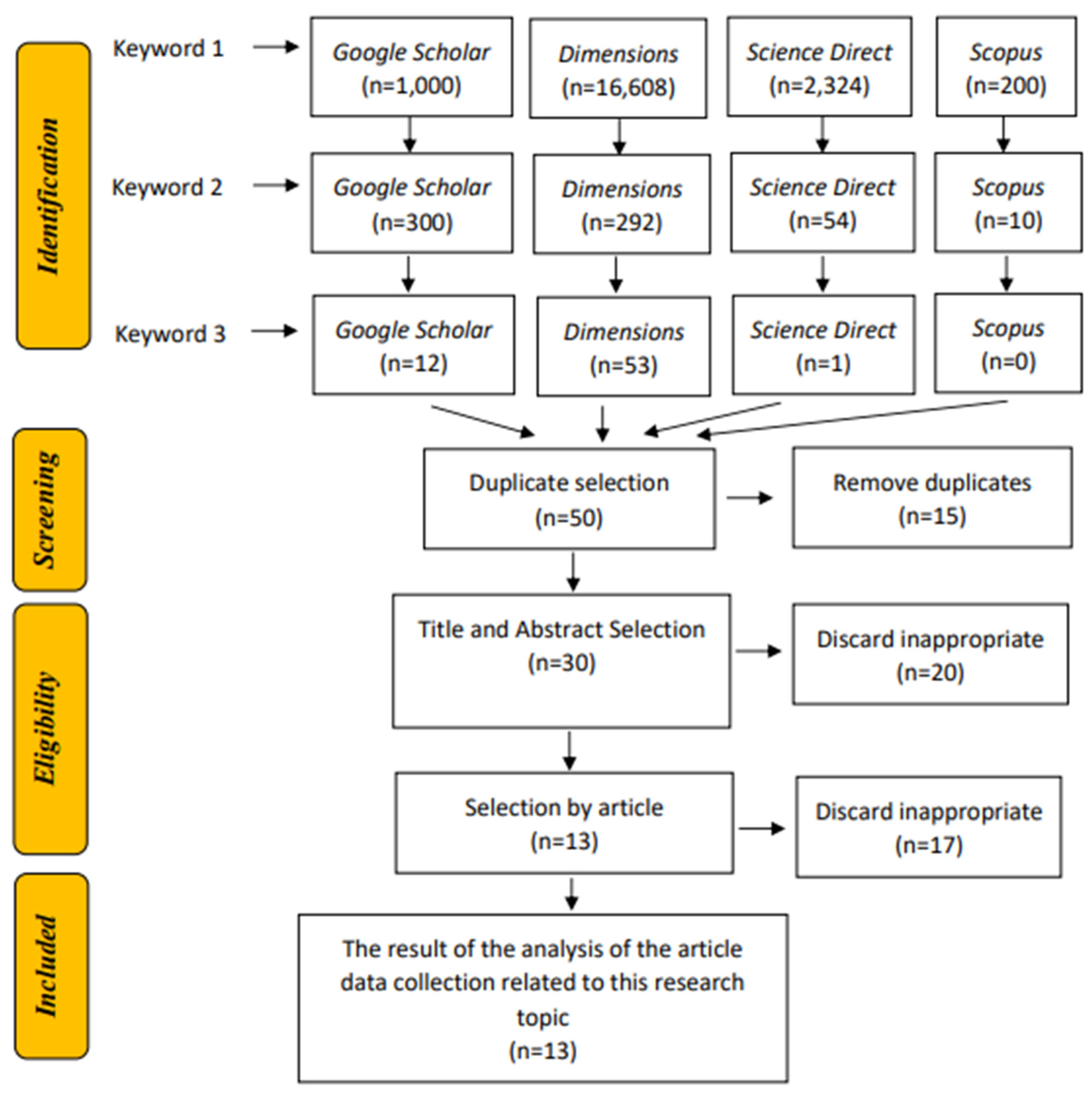
| Keywords 1 | A | 1000 | 16,608 | 2324 | 200 |
| Keywords 2 | A AND B | 300 | 292 | 54 | 10 |
| Keywords 3 | A AND B AND C | 12 | 53 | 1 | 0 |
| Database | Data Keywords 3 | Semi-Automatic | Manual Selection | ||||
|---|---|---|---|---|---|---|---|
| Duplicate | Abstract | Full Text | |||||
| Excluded | Included | Excluded | Included | Excluded | Included | ||
| Google Scholar | 12 | 2 | 10 | 4 | 6 | 0 | 6 |
| Dimensions | 53 | 14 | 39 | 15 | 24 | 17 | 7 |
| Science Direct | 1 | 0 | 1 | 1 | 0 | 0 | 0 |
| Scopus | 0 | 0 | 0 | 0 | 0 | 0 | 0 |
| Total | 66 | 16 | 50 | 20 | 30 | 17 | 13 |
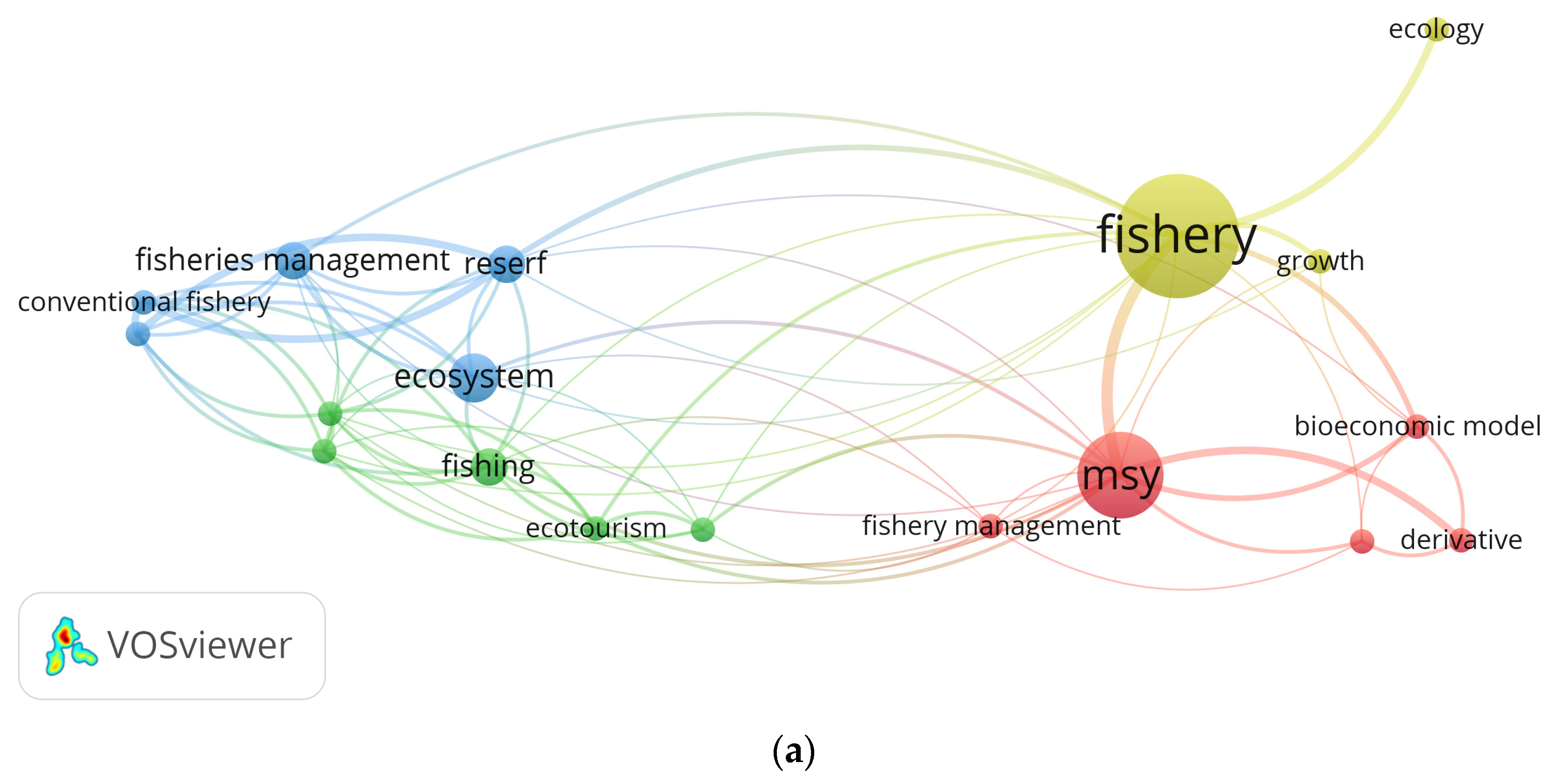
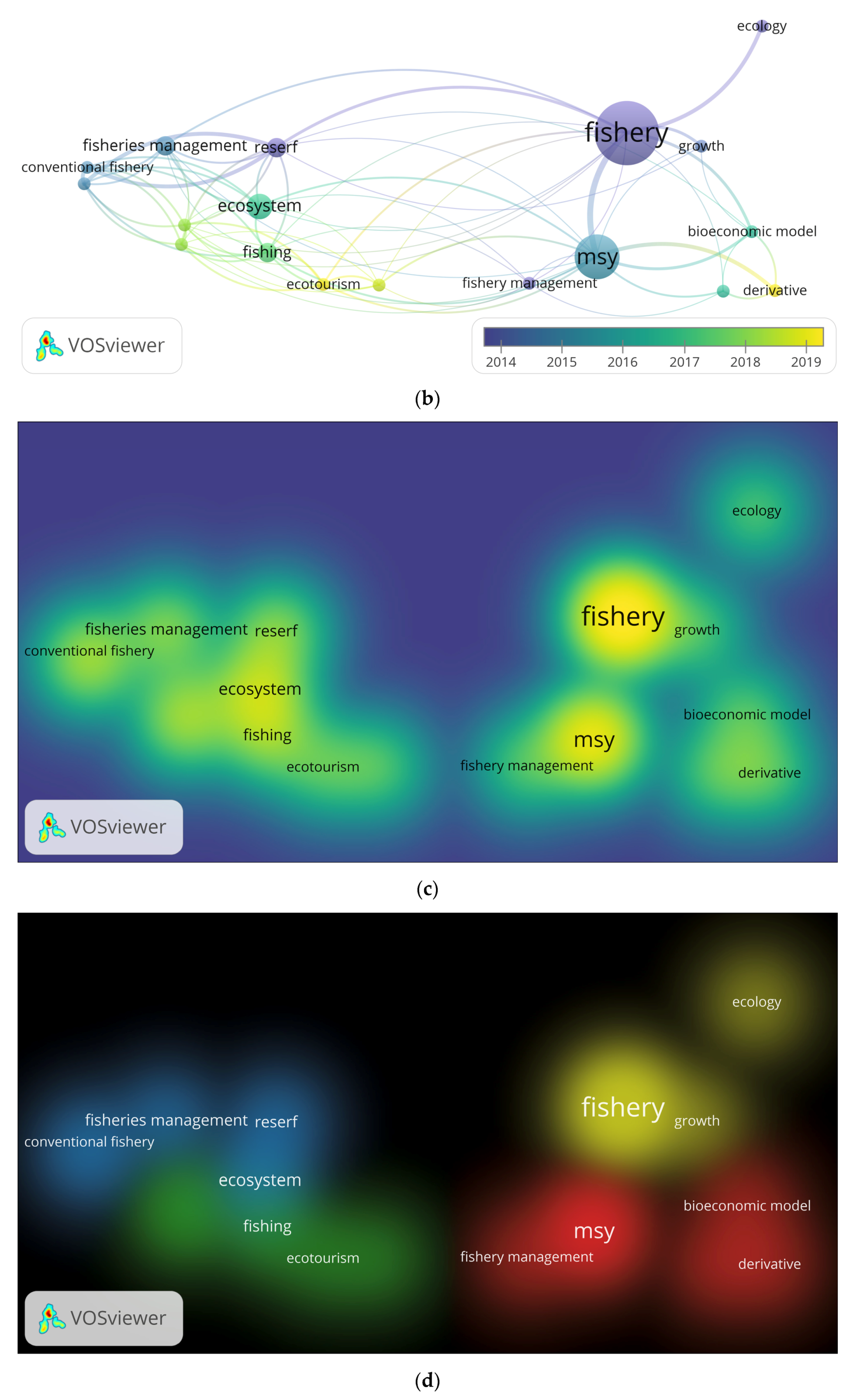
| Cluster | Items |
|---|---|
| 1 | ecotourism |
| fishing | |
| impact | |
| predator-prey model | |
| species interaction | |
| 2 | conventional fisheries management |
| ecosystem | |
| fisheries management | |
| insight | |
| reserves | |
| 3 | bioeconomic model |
| derivative | |
| fisheries management | |
| maximum sustainable yield | |
| MSY | |
| 4 | ecology |
| economic | |
| fisheries | |
| growth |
| No | Author | Title | Method | Object |
|---|---|---|---|---|
| 1. | M.D Smith [28] | The new fisheries economics: incentives across many margins | Logistics Models and Lotka–Volterra | Fisheries |
| 2. | Peter Roopnarine [14] | Ecology and the tragedy of the commons | Logistics Model and Lotka––Volterra, Ricker’s basic model | General interactions between species |
| 3. | K. Chakraborty, T.K Kar [29] | The economic perspective of marine reserves in fisheries: a bioeconomic model | Logistics Models, and Lotka–Volterra | Fisheries |
| 4. | P. Jakubik [30] | How to anticipate recession via transport indices | Stochastic Dynamics, Lotka–Volterra | Transportation index in fisheries |
| 5. | P. Paul, T.K Kar [31] | Impacts of invasive species on the sustainable use of native exploited species | Logistics Model and Lotka–Volterra | Fisheries |
| 6. | D. Das, T.K Kar [32] | Marine reserve and its consequences in a predator–prey system for ecotourism and fishing | Single species model, Predator-Prey Model, Harvesting, MSY, EMSY, MEY | Fisheries |
| 7. | X. Chen, G. Li, Q. Ding [25] | A bioeconomic model of fishery resources under ecological and technological interdependencies | Logistics Model and Lotka–Volterra. | Fisheries |
| 8. | A. Gauteplass [33] | On the optimal control of an animal-vegetation ecological system | Logistics Model and Lotka–Volterra, Harvesting, Type II Holling Function Response, MSY | Plants and animals |
| 9. | L.A.K Barnett [34] | Effects of fishing, species interactions, and climate on populations and communities: insights for ecosystem-based fisheries management | Dynamic Models, Fisheries Management, Predator-Prey Model, Harvesting | Fisheries |
| 10. | Seijo, J.C, Defeo, O and Salas, S, FAO [35] | Fisheries bioeconomics. Theory, modeling, and management | Prey–Predator Model | Fisheries |
| 11. | H. Frost, L. Ravensbeck, A. Hoff and P. Andersen. [20] | The economics of ecosystem-based fisheries management | Fisheries Management, MSY, MEY, Ecosystem Dynamic Model, Prey–Predator Model | Fisheries |
| 12. | D. Poudel [36] | Stochastic analysis in fisheries management | Dynamic Growth, Stochastic, Fisheries Management | Fisheries |
| 13. | Tarik C. Gouhier, F. Guichard and Bruce A. Menge. [37] | Designing effective reserve networks for nonequilibrium metacommunities | Logistik Model, Prey–Predator Model, Lotka–Volterra, | Fisheries |
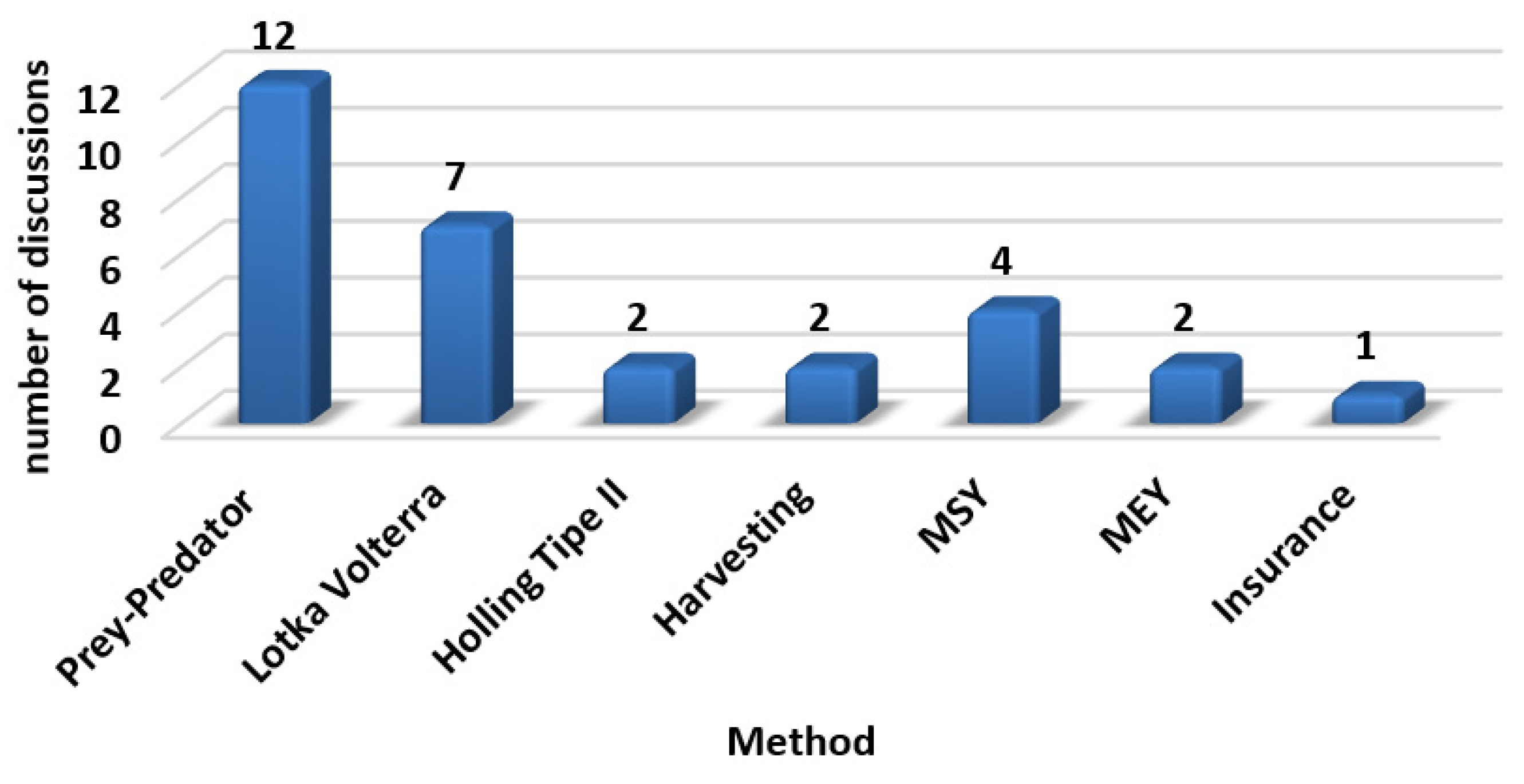
| No | Author | Title | Discussion Material | ||||||
|---|---|---|---|---|---|---|---|---|---|
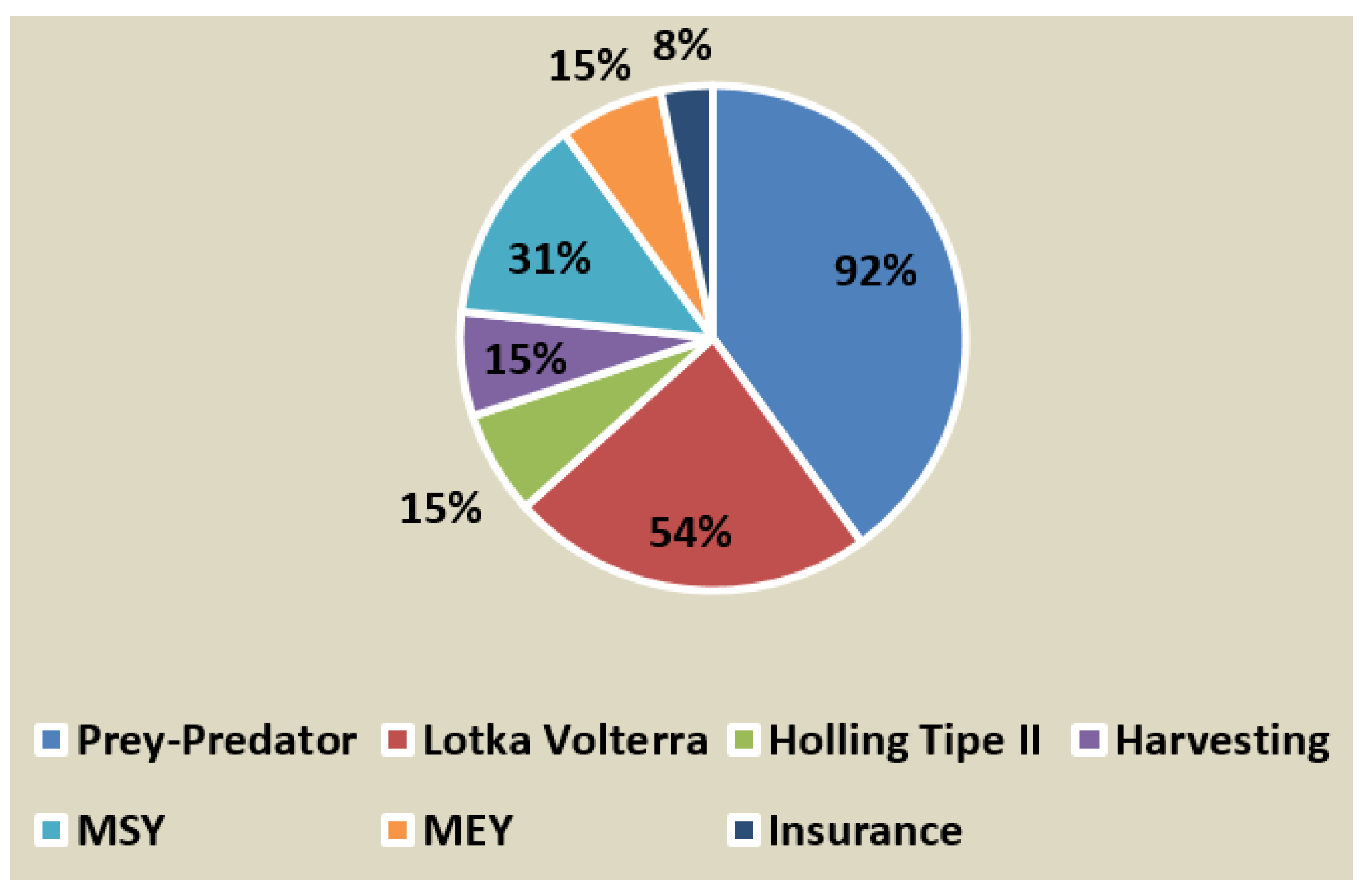
| Prey–Predator | Lotka–Volterra | Holling Type II | Harvesting | MSY | MEY | Insurance | |||
| 1. | M.D Smith [28] | The new fisheries economics: incentives across many margins | √ | √ | |||||
| 2. | Peter Roopnarine [14] | Ecology and the tragedy of the commons | √ | √ | |||||
| 3. | K. Chakraborty, T.K Kar [29] | The economic perspective of marine reserves in fisheries: a bioeconomic model | √ | √ | |||||
| 4. | P. Jakubik [30] | How to anticipate recession via transport indices | √ | √ | |||||
| 5. | P. Paul, T.K Kar [31] | Impacts of invasive species on the sustainable use of native exploited species | √ | √ | |||||
| 6. | D. Das, T.K Kar [32] | Marine reserve and its consequences in a predator-prey system for ecotourism and fishing | √ | √ | √ | √ | √ | ||
| 7. | X. Chen, G. Li, Q. Ding [25] | A bioeconomic model of fishery resources under ecological and technological interdependencies | √ | √ | |||||
| 8. | A. Gauteplass [33] | On the optimal control of an animal-vegetation ecological system | √ | √ | √ | ||||
| 9. | L.A.K Barnett [34] | Effects of fishing, species interactions, and climate on populations and communities: insights for ecosystem-based fisheries management | √ | √ | |||||
| 10. | Seijo, J.C, Defeo, O and Salas, S, FAO [35] | Fisheries bioeconomics: Theory, modeling, and management | √ | √ | |||||
| 11. | H. Frost, L. Ravensbeck, A. Hoff and P. Andersen. [20] | The economics of ecosystem-based fisheries management | √ | √ | √ | √ | |||
| 12. | D. Poudel [36] | Stochastic analysis in fisheries management | √ | ||||||
| 13. | Tarik C. Gouhier, F. Guichard and Bruce A. Menge. [37] | Designing effective reserve networks for nonequilibrium metacommunities | √ | √ | |||||
| Symbol | Description |
|---|---|
| Prey population | |
| Predator population | |
| Constant per capita growth rate | |
| Constant carrying capacity for the prey species | |
| The predation rate | |
| The conversion coefficient due to predation | |
| The natural mortality rate of the predator species | |
| The catchability coefficients of prey species, respectively | |
| The catchability coefficients of predator species, respectively | |
| The independent harvesting effort on prey species, respectively | |
| The independent harvesting effort on predator species, respectively |
Disclaimer/Publisher’s Note: The statements, opinions and data contained in all publications are solely those of the individual author(s) and contributor(s) and not of MDPI and/or the editor(s). MDPI and/or the editor(s) disclaim responsibility for any injury to people or property resulting from any ideas, methods, instructions or products referred to in the content. |
© 2023 by the authors. Licensee MDPI, Basel, Switzerland. This article is an open access article distributed under the terms and conditions of the Creative Commons Attribution (CC BY) license (https://creativecommons.org/licenses/by/4.0/).
Share and Cite
Basir, C.; Supriatna, A.K.; Sukono; Saputra, J. Prey–Predator Mathematics Model for Fisheries Insurance Calculations in the Search of Optimal Strategies for Inland Fisheries Management: A Systematic Literature Review. Sustainability 2023, 15, 12376. https://doi.org/10.3390/su151612376
Basir C, Supriatna AK, Sukono, Saputra J. Prey–Predator Mathematics Model for Fisheries Insurance Calculations in the Search of Optimal Strategies for Inland Fisheries Management: A Systematic Literature Review. Sustainability. 2023; 15(16):12376. https://doi.org/10.3390/su151612376
Chicago/Turabian StyleBasir, Choirul, Asep Kuswandi Supriatna, Sukono, and Jumadil Saputra. 2023. "Prey–Predator Mathematics Model for Fisheries Insurance Calculations in the Search of Optimal Strategies for Inland Fisheries Management: A Systematic Literature Review" Sustainability 15, no. 16: 12376. https://doi.org/10.3390/su151612376
APA StyleBasir, C., Supriatna, A. K., Sukono, & Saputra, J. (2023). Prey–Predator Mathematics Model for Fisheries Insurance Calculations in the Search of Optimal Strategies for Inland Fisheries Management: A Systematic Literature Review. Sustainability, 15(16), 12376. https://doi.org/10.3390/su151612376