


Abstract
Initiated by the Chinese government to mitigate pollution arising from informal recycling, the Internet + Recycling model has been evolving and yielding significant results in China over the past few years. However, due to the large amount of users’ personal information contained in electronic information and communication technology waste, residents are concerned about privacy leaks, leading to a lower willingness to recycle. This study aims to enhance people’s willingness to recycle electronic waste by testing the impacts of various factors through a nationwide survey and analysis. Prior research evaluated e-waste collection attributes separately, thus provoking potential validity concerns. Addressing this concern, our study, based on 184 valid entries, employs conjoint analysis to determine the effects of different attributes on residential recycling choices. Among the considered attributes, recycling trust emerged as paramount, followed by compensation methods, recycling price, and recycling methods. The high-utility attributes included government certification and monitoring, cashback, high prices, and door-to-door service. Transcending the core research aim, our study forecasts market shares for diverse recycling combinations. The results indicate that there is no single dominant strategy, as several combinations are substantially influential. Consequently, businesses are advised to adopt a multi-pronged approach using diverse combinations for optimal results.
1. Introduction
Information and communication technology (ICT) refers to a range of technologies that use devices such as computers, tablets, and mobile phones to process, store, analyze, and transmit data and information over the internet [1]. The rapid growth of ICT in China has resulted in a significant increase in electronic waste production, leading to major environmental and economic challenges. Currently, China is the world’s second-largest producer of e-waste products after the United States [2]. Despite developing and implementing laws and regulations on e-waste management, including with respect to electronic ICT waste, since 1995, China’s formal recycling rate for e-waste has been less than 20%, which is much lower than Europe’s recycling rate of 47.5% [3], according to a UN report. The collection of electronic ICT waste plays a crucial role in its refurbishment, remanufacture, or recycling [4,5]. However, in China, the environmentally sound management of e-waste faces significant challenges due to low resident participation and collection rates [6].
Increasing the recycling rate of electronic ICT waste is crucial for promoting resource recycling and contributing to China’s goal of carbon neutrality. This action not only helps to reduce environmental pollution caused by heavy metals but also supports the sustainable use of resources by enabling their reuse in the production of new devices. Metals make up around 60% of the total weight of electronic ICT waste, making them the primary material fraction. Electronic ICT waste contains a considerable amount of heavy metals, including copper, aluminum, cadmium, chromium, and others, which can be released into the environment and result in excessive heavy metal concentrations in air, dust, soil, sediments, and plants [7,8,9].
Before the launch of the “Internet + Recycling” model, the situation in China was so dire that the majority of waste collection was predominantly managed by informal recycling sectors due to the relatively low collection rate in the formal recycling sectors [10,11].The informal recycling sectors are often run by individuals or familial groups. These operations require minimal capital investment and are characterized by, for example, their small scale, use of rudimentary technology, and lack of regulation [10]. However, the high expenses associated with managing secondary pollutants during the waste disposal process—like the gathering and treatment of acidic wastewater and waste residue—typically result in a lower recycling price compared to that of the informal sectors. This situation eventually leads to a lack of sufficient recycling in formal sectors [12,13]. Consequently, the formal sectors tend to be less competitive than the informal ones, resulting in inefficiencies in the operations of the formal sectors. Under these circumstances, the unregulated recycling and processing activities of the informal sectors can potentially precipitate the significant wastage of resources and secondary environmental pollution [14].
In 2015, the Chinese government launched the “Internet Plus” initiative to promote entrepreneurial innovation, e-commerce, and green ecology. In 2016, the National Development and Reform Commission issued the “Internet + Green Resources Action Plan (2016–2020)” under the “Internet + Green Ecology” program, with the goal of establishing an innovative “Internet + Recycling” model. As a result, several online recycling platforms based on B2B, B2C, and other e-commerce models have emerged, including those such as Love Recycling, Taolv, Haoshou, and Baidu Recycle [15]. “Internet + Recycling” involves using an Internet recycling platform to recycle recoverable waste. This approach integrates principles of the Internet, technology, and recycling into the overall process of resource recovery.
Scholars in China and abroad have conducted extensive research on the factors that influence residents’ willingness to recycle. Previous studies have identified shortcomings in recycling system channels and proposed the development of a professionally operated centralized recycling system [16,17]. However, with the advent of “Internet + Recycling” in China, Bai et al. found that every respondent in their study was aware of at least one channel for recycling electronics, representing a significant improvement compared to previous studies, where 45.9% of residents did not recycle electronic ICT waste due to a lack of awareness regarding available recycling channels [18]. Recycling incentives are also an important influencing factor, with 28.3% of respondents indicating that a lack of attractive incentives was the main reason for their reluctance to recycle [19]. More recently, Bai, Wang, and Zeng showed that fear of personal information leakage and low trust in recyclers were the main reasons for refusing to recycle cited by 63.7% of the respondents in their study [18]. At the individual level, Yadav, Kumar Panda, and Kumar found that self-image, perceived negative impact, and residual value were the reasons for recycling e-waste, while inconvenience, lack of support, and emotional attachment were counter-reasons [20]. Moral and social norms also play a significant role in reasoning and attitudes toward e-waste recycling. The authors of [21] noted that individuals’ support for improved waste management systems is highly dependent on environmental values, experience, and socio-economic factors. The authors of [6] used statistical tests to investigate Foshan residents’ awareness of e-waste-recycling systems and preferences.
Extensive and comprehensive research has explored the reasons behind residents’ low willingness to recycle electronic ICT waste and found that residents consider a trade-off between a number of attributes when choosing a recycling service. This suggests that evaluating different attributes of e-waste collection services in isolation may lead to potential effectiveness problems. In order to better understand the willingness of Chinese residents to recycle electronic ICT waste, this study uses a conjoint analysis approach to understand the priorities of residents in assessing different attributes and levels when recycling based on the creation of specific recycling scenarios, with the aim of comparing the advantages and disadvantages of various recycling options and suggesting effective strategies with which to increase residents’ willingness to recycle. This paper is expected to provide more concrete and practical suggestions to promote the recycling of electronic ICT waste among Chinese citizens.
The methodology employed in this study is described in Section 2, covering the conjoint analysis, literature review, pre-research, questionnaire design, and data collection. The results of the conjoint analysis, namely, the attribute importance weights, utility values, and market shares of various recycling modes, are presented in Section 3. Section 4 discusses the findings and their implications. Finally, Section 5 summarizes the main conclusions and outlines directions for future research.
2. Methods
2.1. Conjoint Analysis
The conjoint analysis method was proposed by R. Luce and J. Tukey in 1964. It was originally used to decompose an overall assessment, classify objects, and perform basic measurements. In 1971, Paul E. Green argued that this method could be applied to the analysis of complex consumer behavior decisions to predict consumer behavior [22]. In previous research, the application of the conjoint analysis approach to environmental issues has included studies on consumer choice for refurbished products [23], preferences for sustainable outdoor clothing [24], the acceptance of and cognitive factors in relation to CO2-derived building materials [25], and decision making in the recycling of waste mobile phones [26]. The distinctive feature of conjoint analysis is that the utility derived from a product or service can be decomposed into parts based on the different attributes of a product or service [27]. In this study, conjoint analysis was used to identify the recycling attribute preferences of Chinese residents with respect to discarded ICT products and determine the relative importance of different attributes. Compared to other methods, conjoint analysis allows for a superior assessment of the relative importance of the impact attributes and levels of recycling in a given context [28,29].
Given the challenges recyclers face in the “Internet + Recycling” process with respect to electronic ICT waste, this paper focuses on identifying various factors that affect the operation of such programs. We first identify key attributes and their levels affecting residents’ willingness to participate in recycling through pre-research and then conduct an empirical study using conjoint analysis to clarify the main factors influencing residents’ willingness to participate in recycling. This research provides valuable insights that the government and enterprises can use to establish a high-participation recycling model.
2.2. Determination of Attributes and Levels
2.2.1. Attributes from Literature Review
- Recycling Price
Recycling price refers to the economic incentives offered to residents when delivering discarded electronic products to recyclers (including both formal and informal recyclers) [30]. Previous studies have shown that Chinese consumers are dissatisfied with the recycling incentives they are offered, which hinders their willingness to voluntarily participate in recycling activities [17,31,32]. However, recent research has found that, compared to the convenience and environmental considerations, residents are less concerned about the price of recycling [33].
- Recycling Trust
Recycling trust reflects users’ concerns about personal information leakage during electronic-ICT-waste-recycling. Research has found that 73.25% of respondents are concerned about personal information security during the recycling process [33]. In addition to incentives and convenience, it has been found that data security is a primary requirement for consumers when recycling mobile phones [18]. With increasing reports of fraud due to the sale of discarded mobile phones and the resulting private information leaks, residents have become more cautious about how they dispose of their old devices [6]. Therefore, we can conclude that recycling trust is a major factor affecting consumers’ willingness to actively participate in recycling.
- Compensation method
Compensation methods denote the payment conditions offered by electronic waste collectors. E-commerce platforms such as J.D. and several electronics retailers offer coupons or discounts to consumers when collecting e-waste, including discarded mobile phones. Professional recycling platforms such as Ai Huishou encourage platform users to participate in recycling through cash rebates and other means. Meanwhile, most informal recyclers in China also provide cash or distribute payments online. However, Mishima and Nishimura’s study suggests that cash payments alone are not a strong enough driver of willingness to recycling, and potential discounts on new products related to the recycling of old mobile phones can become an effective tool for encouraging specific recycling behaviors associated with electronic waste collection [34].
- Recycling method
With the development of “Internet Plus” in China, residents can now recycle and dispose of e-waste online. Relevant studies suggest that mobile-phone-recycling platforms should collaborate with logistics companies to provide doorstep pickup services. Furthermore, Pool and Schwegler argue that in uncertain environments, people tend to use others’ actions as a reference for their own behavior, leading to conformity with group norms [35]. Combined with the development of community group buying in China, we believe community recycling constitutes another potential recycling method.
- Convenience
In previous research, scholars have highlighted several inadequacies in electronic-waste-recycling systems. These include the existence of a singular recycling channel, long distances between recycling outlets, and a lack of knowledge among residents regarding available recycling channels. Such shortcomings are considered key factors contributing to residents’ reluctance to engage in electronic-ICT-waste-recycling efforts. To address these challenges, researchers have suggested the implementation of a professionally operated centralized recycling system that incorporates multiple recycling points and various channels to enhance the convenience of electronic-ICT-waste-recycling for consumers. This approach is critical to increasing effective residential recycling rates [16,17].
This paper summarizes the factors that affect residents’ participation in the “Internet + Recycling” of e-waste products through a literature review. Community recycling, as defined in this paper, refers to the unified community organization of electronic-ICT-waste-recycling. Due to residents’ lack of trust in recycling channels in the initial stage of the development of electronic-ICT-waste-recycling, the unification of a community with respect to e-waste recycling makes it easier for residents to trust Internet + Recycling as the subjective norm is stronger. Social interaction levels, particularly within the community atmosphere, strongly influence residents’ willingness to participate.
Five initial evaluation attributes, namely, recycling methods, convenience, recycled e-waste price, trust, and compensation methods, were selected. The study evaluated these attributes’ importance among 50 households through a particular test assessed with a five-point Likert scale. To ensure survey accuracy, semi-structured interviews were conducted with a few participants. Finally, the attributes of Internet + Recycling and their importance were determined.
2.2.2. Attributes from Pre-Research
Based on the literature review described above, this paper summarizes the factors that influence residents’ participation in the “Internet + Recycling” of e-waste products. Community recycling, as defined in this paper, refers to the unified community organization of ICT e-waste recycling. In the initial stage of the development of ICT e-waste recycling, due to residents’ lack of trust in recycling channels, when a community is unified behind carrying out product recycling, the stronger the subjective norm, the easier it is for residents to trust “Internet + Recycling”, thus making it more likely that they will trust Internet + Recycling. The level of social interaction referred to is increasingly important among the “community atmosphere” factors influencing willingness.
Five factors were selected as initial evaluation attributes, namely, recycling methods, convenience, recycling, recycling price, trust, and compensation methods. Following the methodology employed by Qu et al. [26], we conducted a pre-research survey incorporating 59 households, and the outcomes of a specific test were assessed using a five-point Likert scale. To ensure the accuracy of the survey, semi-structured interviews were conducted with several subjects, and the Internet + Recycling attributes and their importance were finalized.
Table 1 shows that one of the five attributes, namely, “convenience”, presents low importance scores, which indicates that it is not a critical factor. Moreover, the semi-structured interview reveals that the attribute of “convenience” plays insignificant roles. However, the level of convenience intersects with the recycling method in this study, where “door-to-door recycling” scored higher than “active delivery” in terms of convenience. Hence, this research focuses on four attributes, namely, recycling methods, recycling price, recycling trust, and compensation methods. Furthermore, the majority of the respondents in the semi-structured interviews articulated that they employ multiple recycling methods. Table 2 provides the residents’ descriptions of the three recycling methods: active drop-off, community organization, and door-to-door recycling.

Table 1.
Internet + Recycling model attributes importance degree.
Table 2.
Residents’ attitudes towards different recycling methods in “Internet + Recycling”.
Following the preceding discussion, the original five attributes of recycling model were revised based on the findings, and the final interpretations and levels of the joint recycling model attributes are presented below.
Recycling mode: “Active Delivery” signifies that residents take the initiative and send products to recycling centers; “Community Organization Recycling” denotes the participation in product-recycling activities organized by resident communities; and “Door-to-Door Recycling” implies that a courier arrives at the doorstep for recycling purposes.
Recycling price: According to the current market price of electronic ICT waste, this survey considers the iPhone 8 (used since 2018; 64 GB; slight traces of use), with a purchase price of CNY 5500, as an example. The iPhone 8′s recycling price is about 15–20% of its original price, and the survey sets the recycling price at three levels: CNY 825, 900, and 1100.
Compensation methods: Based on the relevant pre-research and semi-structured interview findings and literature studies, this paper classifies compensation methods into “Cash Rebate,” “Shopping Coupons,” and “Environmental Protection Donation.” The “Environmental Donation” is 105% of the recycling price, 5% of which the platform donates to the environmental aspects of waste product recycling. Residents can acquire certification from relevant institutions, and the value of shopping coupons and environmental donations is higher than cash.
Recycling trust: The attribute “Reputation of recycler” indicates that the recycler who carries out recycling has a reputable profile and good social credibility. “Recycler Commitment” implies that the recycler promises to erase the resident’s privacy data effectively, while “Recycler Feedback” means that the recycler provides feedback on the results of cleaning the data. Additionally, “Government Certification and Supervision” indicates that the recycler secures accreditation and supervision from the government.
The attribute levels are listed in Table 3.
Table 3.
“Internet + Recycling” behavior attributes and attribute levels.
2.3. Orthogonal Design
This paper employs a pre-research questionnaire to identify the characteristics of “Internet+” electronic-ICT-waste-recycling and categorizes them. The model attributes consist of recycling methods, recycling price, compensation methods, and recycling trust. If the entire model was considered, there would be 3 × 3 × 3 × 4 recycling modes, making it impossible to conduct a complete profile test. Therefore, this paper employs the orthogonal design module in SPSS 22.0 to orthogonalize the four primary attributes and attribute levels of “Internet+” electronic-ICT-waste-recycling. As a result, using SPSS orthogonal design, we generated sixteen contours, which can theoretically replace the 108 products noted earlier, resulting in a comprehensive product table of the “Internet + Recycling” model, as shown in Table 4.
Table 4.
Simulation of product outline.
2.4. Questionnaire Design
The outputs obtained from the conjoint analysis were utilized to organize the corresponding recycling cards and implemented in the design of the questionnaire. The questionnaire comprises two primary parts. The first part focuses on the respondents’ personal information, such as gender, age, education, occupation, monthly income, geographic location, and questions related to the recycling of electronic ICT waste, such as the purchase frequency of electronic ICT waste, the amount of electronic ICT waste held, and the experience with related recycling activities. The second part constitutes a nine-level Likert scale intended to allow the respondents to score their preferences for different analog products. An example of a question posed to the respondents in the second part is shown in Figure 1.
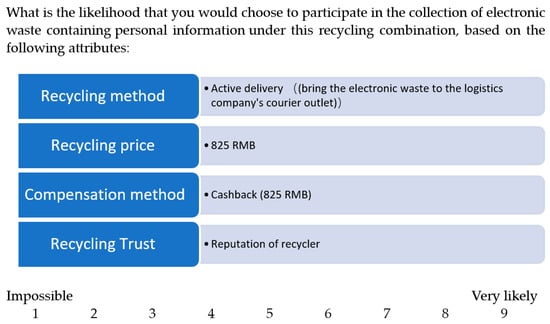
Figure 1.
An example card in the questionnaire.
2.5. Data Collection
In order to ensure that the residents understood the 16 product combinations generated by the conjoint analysis, the questionnaire was distributed to a small group of residents before its formal distribution. The results showed that elderly people had difficulty understanding the questionnaire. Therefore, the official distribution focuses on young people, who constitute the main consumers of electronic ICT products, pursue fashion trends, have prominent demands for updating and upgrading, and constitute the main source of electronic ICT waste [36]. This study successfully collected 225 questionnaires through SurveyStar, with an effective response rate of 82%. Among the distributed questionnaires, 41 were excluded due to invalid responses. The valid questionnaires collected covered multiple provinces and cities in China, including Jiangsu, Beijing, and Shandong. Most of the respondents lived in areas with high Internet penetration rates, a rapidly growing emerging product market, and high willingness to purchase ICT products, providing valuable references for this study. Ninety-one percent of the questionnaires came from residents in key cities with regard to the construction of China’s waste-recycling system [37], thus providing this study with valuable insights. Figure 2b–d show that the respondents had high levels of education, and over half of them were students. This group is more likely to generate electronic ICT waste and participate in online recycling [26]. Additionally, Figure 2c shows that the broad coverage and reasonable distribution of different occupations except for students provide reference value for this study. Furthermore, Figure 2e shows that the distribution of respondents with different recycling experiences is appropriate. Figure 2f specifically addresses individuals who have never recycled before (51.18%), investigating the primary attributes and levels influencing their recycling tendencies. This examination allows us to devise practical recycling plans with which to promote recycling within this cohort.
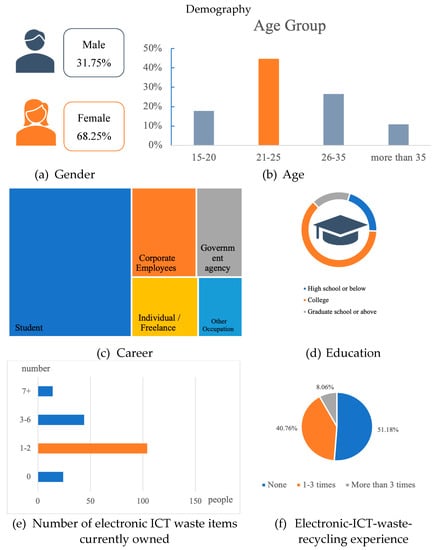
Figure 2.
Sample distribution.
The sample distribution is shown in Figure 2.
3. Results
3.1. Attribute Importance and Utility Scores
Table 5 displays the data output regarding the relative importance of four attributes, namely, recycling method, recycling price, compensation method, and recycling trust, to residents along with the corresponding utility values of every attribute level. The analysis was conducted utilizing the conjoint analysis tool of the SPSS 22.0 software.
Table 5.
Attributes and levels of “Internet + Recycling” behavior.
The Pearson’s value of 0.959, the Kendall’s tau value of 0.840, and the two-tailed test significance levels of 0.000 all confirm that the hypotheses and results meet the reliability criteria and can reasonably measure the respondents’ preferences for “Internet +” electronic-ICT-waste-recycling. This analysis highlights that residents’ primary concern when recycling electronic ICT waste through the “Internet + Recycling” mode is recycling trust, with a significance of 27.78%. This result also demonstrates that the respondents were focused on safeguarding their personal information when participating in recycling activities. Subsequently, the compensation method, with an importance of 25.56%, is another crucial attribute, indicating that residents are also concerned about how to obtain the remuneration for recycling. The price of recycling ranks third in terms of importance, presenting a score of 24.38%, demonstrating that financial compensation is also an essential factor of recycling. Finally, the method of recycling has an importance value of 22.28%, illustrating that respondents prioritize understanding how to participate in recycling activities.
The attribute level utility represents the residents’ preference for a given attribute level, with higher utility values indicating greater preference. Among the electronic-ICT-waste-recycling methods, the residents preferred courier-based door-to-door recycling. The utility values are negative for the low recycling price level and positive for the medium and high levels. The medium and high recycling price levels are 18% and 20% higher, respectively, than the low level. Additionally, the utility value is 2% higher when the recycling price is high, thereby stimulating residents’ participation in electronic-ICT-waste-recycling. Concerning compensation methods, cash rebates are the most preferred, followed by environmental donations, while shopping coupons were assigned the lowest utility value. Government certification and supervision have the highest utility value, namely, 0.186, while negative values were recorded for recyclers’ reputation, commitment, and feedback on information removal.
3.2. Market Share Simulation of Different Recycling Combinations
After identifying residents’ recycling preferences, selecting a recycling mode that can withstand market competition to ensure program sustainability is critical. Hence, estimating the market share of the recycling mode preferred by residents becomes crucial. Conjoint analysis facilitates resident preference analysis for attributes and levels, and it can also predict the market shares of different recycling modes. In this study, logistic regression was utilized to determine the market shares of various recycling modes.
According to the results presented in Table 6, the recycling combination with the highest market share was No. 11 at 10.6%, followed by No. 2 (9.0%), No. 16 (7.1%), and No. 7 (7.0%). Remarkably, cashback is a popular compensation method among consumers in high-market-share combinations, indicating that optimizing the cashback mechanism, such as shortening the repayment period, may attract more customers to an enterprise’s recycling services. Furthermore, governmental certification and monitoring significantly contribute to consumer trust in recycling services. Therefore, enterprises should strengthen their collaboration with the government to improve the level of certification and monitoring of recycling services further. The recycling methods and prices of the four combinations with the most substantial market shares differ, implying that customers prefer specific recycling methods and prices. Consequently, an enterprise can improve its recycling methods and prices according to varying market demands and consumer preferences, thereby offering more personalized and diversified recycling services to satisfy diverse customers’ demands.
Table 6.
Simulation of recycling modes.
Although recycling trust appeared to be vital in the preliminary recycling attributes studies, economic benefits seem to be the primary consideration in actual decision-making. Research has demonstrated that financial incentives affect recycling decisions, as they alter the monetary and convenience costs of recycling through policies and regulations [38].
4. Discussion
The optimization and evolution of electronic ICT waste are taking place in the midst of unprecedented technological innovation, stimulating the continual emergence of progressively advanced and stylish electronic devices [39]. The trend towards trendiness significantly shortens the average lifespan of these devices, resulting in a large volume of electronic ICT waste in China.
The aim of this study was to identify key factors affecting public participation in electronic-ICT-waste-recycling in China, thereby aiding in the development of effective recycling strategies.
Unraveling the complexities of recycling outdated electronic ICT waste is an essential precursor to tackling issues associated with e-waste. The primary hurdle in this process is the risk of personal data breaches [40]. Our research also discovered that recycling trust greatly influences residents’ decisions on whether to participate in the recycling of electronic ICT waste. Furthermore, our study indicates that among the various levels contained within the attribute of recycling trust, government certification and monitoring present the highest utility. Therefore, the Chinese government should focus on introducing pertinent technical standards or guidelines and stimulating the advancement of technology capable of securely erasing private information stored on such devices.
The logit analysis of the data revealed significant differences in market shares across recycling methods, recycling prices, compensation methods, and recycling trust factors. Card 11, involving community organization, cashback compensation, and government certification and monitoring as the recycling trust factor, demonstrates the highest market share, with a value of 10.6%. Similarly, Cards 2 and 7, involving door-to-door recycling with cashback compensation and the reputation of the recycler as the recycling trust factors, exhibit significantly higher market shares at 9.0% and 7.0%, respectively, compared to the average market share of 5.8%.
Our study found that recycling service providers certified and monitored by the Chinese government were the most trusted by consumers with respect to selecting a recycling method. This underscores the need for the Chinese government to implement more potent strategies for enhancing public awareness and participation in formal electronic-ICT-waste-recycling. Moreover, formally certified recycling enterprises should place greater emphasis on promoting their quality certifications to further instill trust among consumers.
The findings from our research suggest that door-to-door recycling with cashback compensation is highly favored by residents. This result is in line with the findings of previous studies [18,19,26] that found that cash incentives significantly increase public participation in recycling programs. Therefore, it is vital for recycling service providers to conduct further surveys or studies, focusing on incentive design and reward value, to optimize their strategies and boost residents’ engagement in electronic-ICT-waste-recycling.
Our data analysis shows that door-to-door collection with cash refunds and community organization collection with government certification and monitoring are popular recycling methods chosen by consumers. This indicates that consumers are more concerned about the convenience and credibility of recycling services.
These findings suggest that investing in community organizations, government certification and monitoring, and door-to-door recycling with cashback compensation can effectively increase market shares. Accordingly, companies could use these insights to develop tailored marketing strategies and enhance their competitive positioning in the industry. The results indicate that among the considered recycling methods, door-to-door collection with cash refunds and community organization collection with government certification and monitoring offer competitive advantages and occupy a significant market share. Factors such as cash refunds, government certification and monitoring, and the reputation of a recycling merchant appear to be important considerations for consumers when selecting a recycling method. Consumers may favor cash refunds more than compensation in the form of shopping vouchers or environmental donations. Consumers also pay attention to the promises and feedback of recycling merchants, which may influence their choices. When conducting an industry analysis of the recycling service market, it is necessary to fully understand consumer needs and behavior.
Cash refunds, as a common form of compensation, have direct and simple characteristics that adapt to the fast-paced lifestyle of modern society. In addition, government certification and monitoring make consumers feel more at ease, thereby increasing their trust in recycling merchants. Furthermore, the promises and feedback of recycling merchants enhance consumers’ trust in recycling services, showing that brand awareness and reputation are critical factors.
In the recycling market, service providers must consider consumer needs and develop marketing and service strategies that resonate with those needs. For instance, strengthening promotional efforts regarding trustworthy labels, such as community organizations and government certification, can be quite influential.
Our analysis reveals a multifaceted landscape of recycling strategies, each carrying its own weight in terms of market share. Interestingly, there is not a single dominant strategy. Instead, a diverse set of approaches, each capitalizing on different aspects of recycling trust and compensation methods, seem to carve out their own niches.
Take the strategy that incorporates community organization, cashback compensation, and government certification as the recycling trust factor, for example. This approach claims the largest market share, with a value of 10.6%. Meanwhile, strategies that combine door-to-door recycling, cashback compensation, and solid recycler reputation as the recycling trust factor secure market shares of 9.0% and 7.0%, which are significantly higher than the average market share of 5.8%.
Upon examining these findings, recycling service providers might want to consider how these individual strategies could be mixed and matched to meet a variety of consumer preferences. A community-organization-driven approach could work well in certain areas, while a door-to-door strategy could excel elsewhere. Government certification might inspire trust for some consumers, while others could be swayed by a recycler’s strong reputation.
Instead of striving for a one-size-fits-all approach, recycling service providers might find it more fruitful to develop a diverse toolkit of strategies. In doing so, they can cater to a broad spectrum of consumer preferences while also being flexible enough to adjust to changing market conditions or emerging trends. This, in essence, could be a more sustainable and resilient approach to achieving success in the recycling market.
For recycling service providers to succeed in the market, they need to consider consumer needs and develop corresponding marketing and service strategies by, for example, strengthening promotion efforts regarding labels such as community organizations and government.
However, it is important to note the limitations of this study. Firstly, the data only represent a single snapshot in time and do not reflect market trends over time. Thus, future research should examine market share trends. Secondly, external factors like economic conditions or competitor strategies were not considered in this study, which might have impacted the market share outcomes. Additionally, the sample size used in the study is relatively small and may not be representative of the entire population. Notwithstanding these limitations, our study provides valuable insights into the factors influencing market share in the recycling industry. Companies could consider investing in community organization, government certification and monitoring, and door-to-door recycling with cashback compensation to increase their market share. Further research could investigate trends over time and examine external factors that may impact market share outcomes.
5. Conclusions
This study highlights the role of ‘Internet + Recycling’ in China, a leader in global carbon emissions. This paper presents a clear picture of the current recycling landscape and the factors encouraging residents to participate. The insights gathered from this research are beneficial for government bodies and businesses planning to develop a high-participation recycling model.
Our research suggests that businesses can boost their visibility by partnering with local community organizations. Gaining government certification can also enhance their credibility and give them a competitive edge. The study also found that consumers prefer door-to-door recycling services that offer cashback. This strategy can attract more customers and motivate existing ones to recycle more frequently. Offering flexible payment options, like digital wallets or mobile payments, can also cater to the needs of modern consumers. The reputation of a recycling provider is a crucial factor for consumers when choosing a recycling method. Providers should focus on delivering high-quality services and interact with customers through various channels to build a strong reputation. Overall, this study provides key insights into the recycling industry and offers practical advice for providers looking to improve their competitive positioning.
Future research in the recycling industry should consider additional factors that impact market share, such as changes in environmental policies, technological innovations, and consumer behavior. Long-term tracking and analysis can provide insights into market share trends, while comparisons between regions and countries can uncover variations and their underlying causes. Additionally, integrating sustainability factors like resource efficiency and circular economy practices can contribute to market share growth, so such factors should also be considered.
Author Contributions
All the co-authors have contributed substantially and uniquely to the work reported. J.W. contributed to conceptualization, funding acquisition, project administration, and writing—original draft; C.W. contributed to formal analysis and methodology; Y.C. contributed to methodology and validation. All authors have read and agreed to the published version of the manuscript.
Funding
This research was funded by the Humanities and Social Sciences Planning Fund of the Ministry of Education (21 YJA630088).
Institutional Review Board Statement
Not applicable.
Informed Consent Statement
Not applicable.
Data Availability Statement
Not applicable.
Conflicts of Interest
The authors declare no conflict of interest.
References
- Weber, D.M.; Kauffman, R.J. What Drives Global ICT Adoption? Analysis and Research Directions. Electron. Commer. Res. Appl. 2011, 10, 683–701. [Google Scholar] [CrossRef]
- Wang, B.; Ren, C.; Dong, X.; Zhang, B.; Wang, Z. Determinants Shaping Willingness towards On-Line Recycling Behaviour: An Empirical Study of Household e-Waste Recycling in China. Resour. Conserv. Recycl. 2019, 143, 218–225. [Google Scholar] [CrossRef]
- Forti, V.; Balde, C.P.; Kuehr, R.; Bel, G. The Global E-Waste Monitor 2020: Quantities, Flows and the Circular Economy Potential; United Nations University/United Nations Institute for Training and Research, International Telecommunication Union, and International Solid Waste Association: Geneva, Switzerland, 2020; ISBN 978-92-808-9114-0. [Google Scholar]
- Golev, A.; Werner, T.T.; Zhu, X.; Matsubae, K. Product Flow Analysis Using Trade Statistics and Consumer Survey Data: A Case Study of Mobile Phones in Australia. J. Clean. Prod. 2016, 133, 262–271. [Google Scholar] [CrossRef]
- Islam, M.T.; Huda, N. Reverse Logistics and Closed-Loop Supply Chain of Waste Electrical and Electronic Equipment (WEEE)/E-Waste: A Comprehensive Literature Review. Resour. Conserv. Recycl. 2018, 137, 48–75. [Google Scholar] [CrossRef]
- Tan, Q.; Duan, H.; Liu, L.; Yang, J.; Li, J. Rethinking Residential Consumers’ Behavior in Discarding Obsolete Mobile Phones in China. J. Clean. Prod. 2018, 195, 1228–1236. [Google Scholar] [CrossRef]
- Ibanescu, D.; Cailean (Gavrilescu), D.; Teodosiu, C.; Fiore, S. Assessment of the Waste Electrical and Electronic Equipment Management Systems Profile and Sustainability in Developed and Developing European Union Countries. Waste Manag. 2018, 73, 39–53. [Google Scholar] [CrossRef]
- Liu, T.; Mahdi, M.; Yao, L. Life Cycle Assessment of Waste Mobile Phone Recycling–A Case Study in China. In Proceedings of the Eleventh International Conference on Management Science and Engineering Management; Xu, J., Gen, M., Hajiyev, A., Cooke, F.L., Eds.; Springer International Publishing: Cham, Switzerland, 2018; pp. 1351–1360. ISBN 978-3-319-59279-4. [Google Scholar]
- Song, Q.; Li, J. A Review on Human Health Consequences of Metals Exposure to E-Waste in China. Environ. Pollut. 2015, 196, 450–461. [Google Scholar] [CrossRef]
- Xue, Y.; Wen, Z.; Bressers, H.; Ai, N. Can Intelligent Collection Integrate Informal Sector for Urban Resource Recycling in China? J. Clean. Prod. 2019, 208, 307–315. [Google Scholar] [CrossRef]
- Li, Y.; Xu, F.; Zhao, X. Governance Mechanisms of Dual-Channel Reverse Supply Chains with Informal Collection Channel. J. Clean. Prod. 2017, 155, 125–140. [Google Scholar] [CrossRef]
- Ezeah, C.; Fazakerley, J.A.; Roberts, C.L. Emerging Trends in Informal Sector Recycling in Developing and Transition Countries. Waste Manag. 2013, 33, 2509–2519. [Google Scholar] [CrossRef]
- Scheinberg, A.; Spies, S.; Simpson, M.H.; Mol, A.P.J. Assessing Urban Recycling in Low- and Middle-Income Countries: Building on Modernised Mixtures. Habitat Int. 2011, 35, 188–198. [Google Scholar] [CrossRef]
- Troschinetz, A.M.; Mihelcic, J.R. Sustainable recycling of municipal solid waste in developing countries. Waste Manag. 2009, 29, 915–923. [Google Scholar] [CrossRef] [PubMed]
- Wang, H.; Han, H.; Liu, T.; Tian, X.; Xu, M.; Wu, Y.; Gu, Y.; Liu, Y.; Zuo, T. “Internet +” Recyclable Resources: A New Recycling Mode in China. Resour. Conserv. Recycl. 2018, 134, 44–47. [Google Scholar] [CrossRef]
- Li, B.; Yang, J.; Song, X.; Lu, B. Survey on Disposal Behaviour and Awareness of Mobile Phones in Chinese University Students. Procedia Environ. Sci. 2012, 16, 469–476. [Google Scholar] [CrossRef]
- Wang, Z.; Zhang, B.; Yin, J.; Zhang, X. Willingness and Behavior towards E-Waste Recycling for Residents in Beijing City, China. J. Clean. Prod. 2011, 19, 977–984. [Google Scholar] [CrossRef]
- Bai, H.; Wang, J.; Zeng, A.Z. Exploring Chinese Consumers’ Attitude and Behavior toward Smartphone Recycling. J. Clean. Prod. 2018, 188, 227–236. [Google Scholar] [CrossRef]
- Yin, J.; Gao, Y.; Xu, H. Survey and Analysis of Consumers’ Behaviour of Waste Mobile Phone Recycling in China. J. Clean. Prod. 2014, 65, 517–525. [Google Scholar] [CrossRef]
- Yadav, R.; Kumar Panda, D.; Kumar, S. Understanding the Individuals’ Motivators and Barriers of e-Waste Recycling: A Mixed-Method Approach. J. Environ. Manag. 2022, 324, 116303. [Google Scholar] [CrossRef]
- Cantillo, T.; Notaro, S.; Bonini, N.; Hadjichristidis, C. Assessing Italian Household Preferences for Waste Sorting Systems: The Role of Environmental Awareness, Socioeconomic Characteristics, and Local Contexts. Waste Manag. 2023, 163, 22–33. [Google Scholar] [CrossRef]
- Green, P.E.; Rao, V.R. Conjoint Measurement- for Quantifying Judgmental Data. J. Mark. Res. 1971, 8, 355–363. [Google Scholar] [CrossRef]
- Wallner, T.S.; Magnier, L.; Mugge, R. Do Consumers Mind Contamination by Previous Users? A Choice-Based Conjoint Analysis to Explore Strategies That Improve Consumers’ Choice for Refurbished Products. Resour. Conserv. Recycl. 2022, 177, 105998. [Google Scholar] [CrossRef]
- Wang, L.; Xu, Y.; Lee, H.; Li, A. Preferred Product Attributes for Sustainable Outdoor Apparel: A Conjoint Analysis Approach. Sustain. Prod. Consum. 2022, 29, 657–671. [Google Scholar] [CrossRef]
- Arning, K.; Offermann-van Heek, J.; Ziefle, M. What Drives Public Acceptance of Sustainable CO2-Derived Building Materials? A Conjoint-Analysis of Eco-Benefits vs. Health Concerns. Renew. Sustain. Energy Rev. 2021, 144, 110873. [Google Scholar] [CrossRef]
- Qu, Y.; Wang, W.; Liu, Y.; Zhu, Q. Understanding Residents’ Preferences for e-Waste Collection in China—A Case Study of Waste Mobile Phones. J. Clean. Prod. 2019, 228, 52–62. [Google Scholar] [CrossRef]
- Álvarez-Farizo, B.; Hanley, N. Using Conjoint Analysis to Quantify Public Preferences over the Environmental Impacts of Wind Farms. An Example from Spain. Energy Policy 2002, 30, 107–116. [Google Scholar] [CrossRef]
- Bech-Larsen, T.; Grunert, K.G. The Perceived Healthiness of Functional Foods: A Conjoint Study of Danish, Finnish and American Consumers’ Perception of Functional Foods. Appetite 2003, 40, 9–14. [Google Scholar] [CrossRef]
- Claret, A.; Guerrero, L.; Aguirre, E.; Rincón, L.; Hernández, M.D.; Martínez, I.; Benito Peleteiro, J.; Grau, A.; Rodríguez-Rodríguez, C. Consumer Preferences for Sea Fish Using Conjoint Analysis: Exploratory Study of the Importance of Country of Origin, Obtaining Method, Storage Conditions and Purchasing Price. Food Qual. Prefer. 2012, 26, 259–266. [Google Scholar] [CrossRef]
- Li, J.; Liu, L.; Ren, J.; Duan, H.; Zheng, L. Behavior of Urban Residents toward the Discarding of Waste Electrical and Electronic Equipment: A Case Study in Baoding, China. Waste Manag. Res. 2012, 30, 1187–1197. [Google Scholar] [CrossRef]
- Cao, J.; Chen, Y.; Shi, B.; Lu, B.; Zhang, X.; Ye, X.; Zhai, G.; Zhu, C.; Zhou, G. WEEE Recycling in Zhejiang Province, China: Generation, Treatment, and Public Awareness. J. Clean. Prod. 2016, 127, 311–324. [Google Scholar] [CrossRef]
- Gu, Y.; Wu, Y.; Xu, M.; Wang, H.; Zuo, T. The Stability and Profitability of the Informal WEEE Collector in Developing Countries: A Case Study of China. Resour. Conserv. Recycl. 2016, 107, 18–26. [Google Scholar] [CrossRef]
- Cai, K.; Wang, L.; Ke, J.; He, X.; Song, Q.; Hu, J.; Yang, G.; Li, J. Differences and Determinants for Polluted Area, Urban and Rural Residents’ Willingness to Hand over and Pay for Waste Mobile Phone Recycling: Evidence from China. Waste Manag. 2023, 157, 290–300. [Google Scholar] [CrossRef] [PubMed]
- Mishima, K.; Nishimura, H. Requirement Analysis to Promote Small-Sized E-Waste Collection from Consumers. Waste Manag. Res. 2016, 34, 122–128. [Google Scholar] [CrossRef] [PubMed]
- Pool, G.J.; Schwegler, A.F. Differentiating Among Motives for Norm Conformity. Basic Appl. Soc. Psychol. 2007, 29, 47–60. [Google Scholar] [CrossRef]
- Umair, S.; Björklund, A.; Petersen, E.E. Social Impact Assessment of Informal Recycling of Electronic ICT Waste in Pakistan Using UNEP SETAC Guidelines. Resour. Conserv. Recycl. 2015, 95, 46–57. [Google Scholar] [CrossRef]
- Notice on the Issuance of a List of Key Cities for the Construction of a Waste Recycling System China Government Web. Available online: http://www.gov.cn/zhengce/zhengceku/2022-08/02/content_5703971.htm (accessed on 23 May 2023).
- Viscusi, W.K.; Huber, J.; Bell, J. Promoting Recycling: Private Values, Social Norms, and Economic Incentives. Am. Econ. Rev. 2011, 101, 65–70. [Google Scholar] [CrossRef]
- Nduneseokwu, C.K.; Qu, Y.; Appolloni, A. Factors Influencing Consumers’ Intentions to Participate in a Formal E-Waste Collection System: A Case Study of Onitsha, Nigeria. Sustainability 2017, 9, 881. [Google Scholar] [CrossRef]
- Liu, J.; Bai, H.; Zhang, Q.; Jing, Q.; Xu, H. Why Are Obsolete Mobile Phones Difficult to Recycle in China? Resour. Conserv. Recycl. 2019, 141, 200–210. [Google Scholar] [CrossRef]
Disclaimer/Publisher’s Note: The statements, opinions and data contained in all publications are solely those of the individual author(s) and contributor(s) and not of MDPI and/or the editor(s). MDPI and/or the editor(s) disclaim responsibility for any injury to people or property resulting from any ideas, methods, instructions or products referred to in the content. |
© 2023 by the authors. Licensee MDPI, Basel, Switzerland. This article is an open access article distributed under the terms and conditions of the Creative Commons Attribution (CC BY) license (https://creativecommons.org/licenses/by/4.0/).